The differing ways to monitor and
instrument
Jonah Kowall
VP Market Development and Insights
Twitter : @jkowall
APPDYNAMICS CONFIDENTIAL AND PROPRIETARY 2
Notice
The information and materials included in this presentation (collectively, the
“Materials”) are the proprietary information of AppDynamics, Inc. (“AppDynamics” or
the “Company”). No part of the Materials may be reproduced, distributed,
communicated or displayed in any form or by any means, or used to make any
derivative work, without prior written permission from AppDynamics.
The Materials may contain product roadmap information of AppDynamics.
AppDynamics reserves the right to change any product roadmap information at any
time, for any reason and without notice. This information is intended to outline
AppDynamics' general product direction, it is not a guarantee of future product
features, and it should not be relied on in making a purchasing decision. The
development, release, and timing of any features or functionality described for
AppDynamics' products remains at AppDynamics' sole discretion. AppDynamics
reserves the right to change any planned features at any time before making them
generally available as well as never making them generally available.
All third-party trademarks, including names, logos and brands, referenced by
AppDynamics in this presentation are property of their respective owners. All
references to third-party trademarks are for identification purposes only and shall be
considered nominative fair use under trademark law. © 2016 AppDynamics, Inc. All
rights reserved.
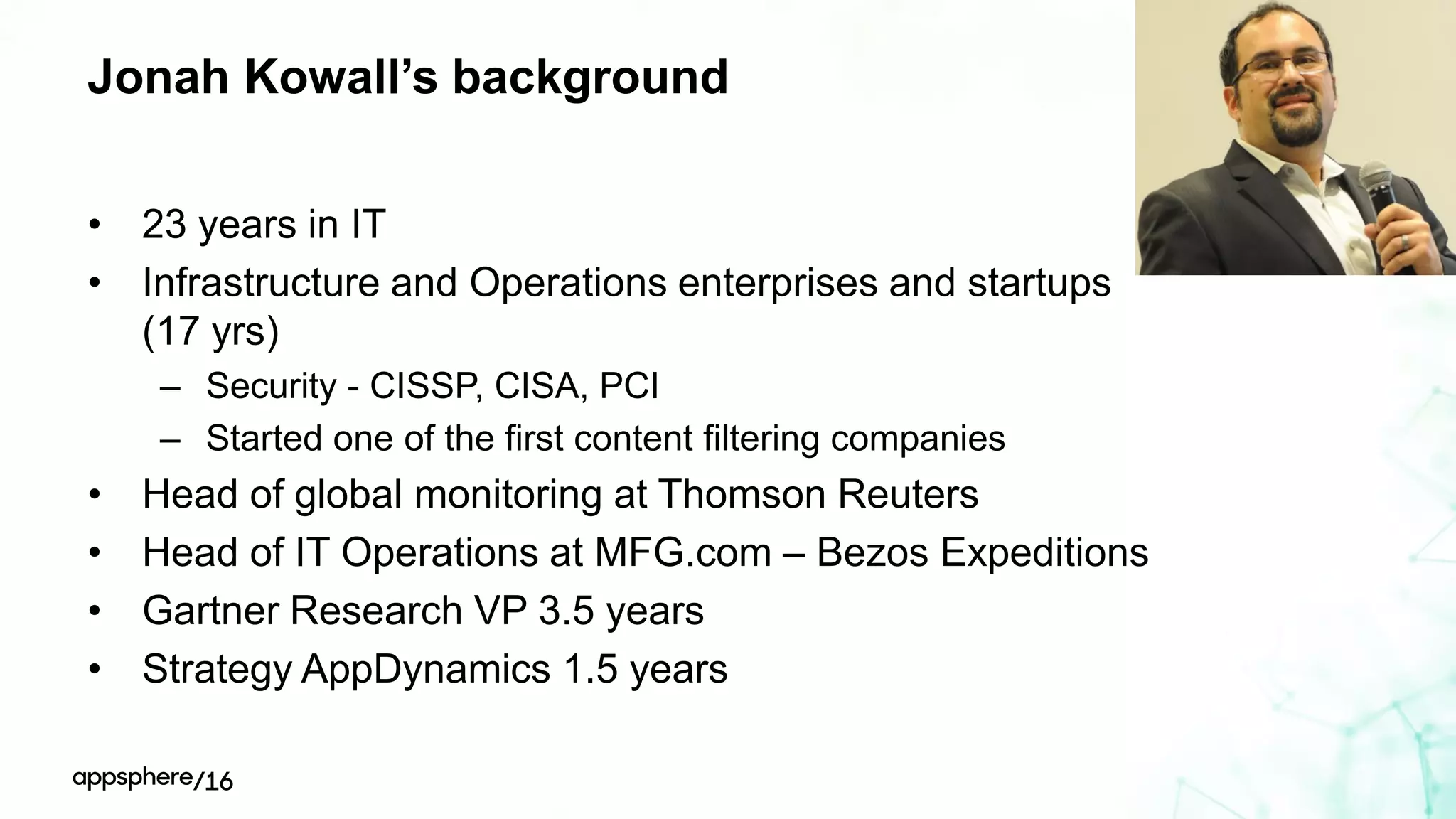
Jonah Kowall’s background
• 23 years in IT
• Infrastructure and Operations enterprises and startups
(17 yrs)
– Security - CISSP, CISA, PCI
– Started one of the first content filtering companies
• Head of global monitoring at Thomson Reuters
• Head of IT Operations at MFG.com – Bezos Expeditions
• Gartner Research VP 3.5 years
• Strategy AppDynamics 1.5 years
Agenda
• Introduction to instrumentation
• Instrumentation defined
• Priorities in instrumentation
• Technical instrumentation of frontends (Browser and Mobile)
• Technical instrumentation of backend (Java, .NET, Python, Node.js,
PHP)
• Logging best practices
• How transaction correlation options (AppDynamics and Open
Source)
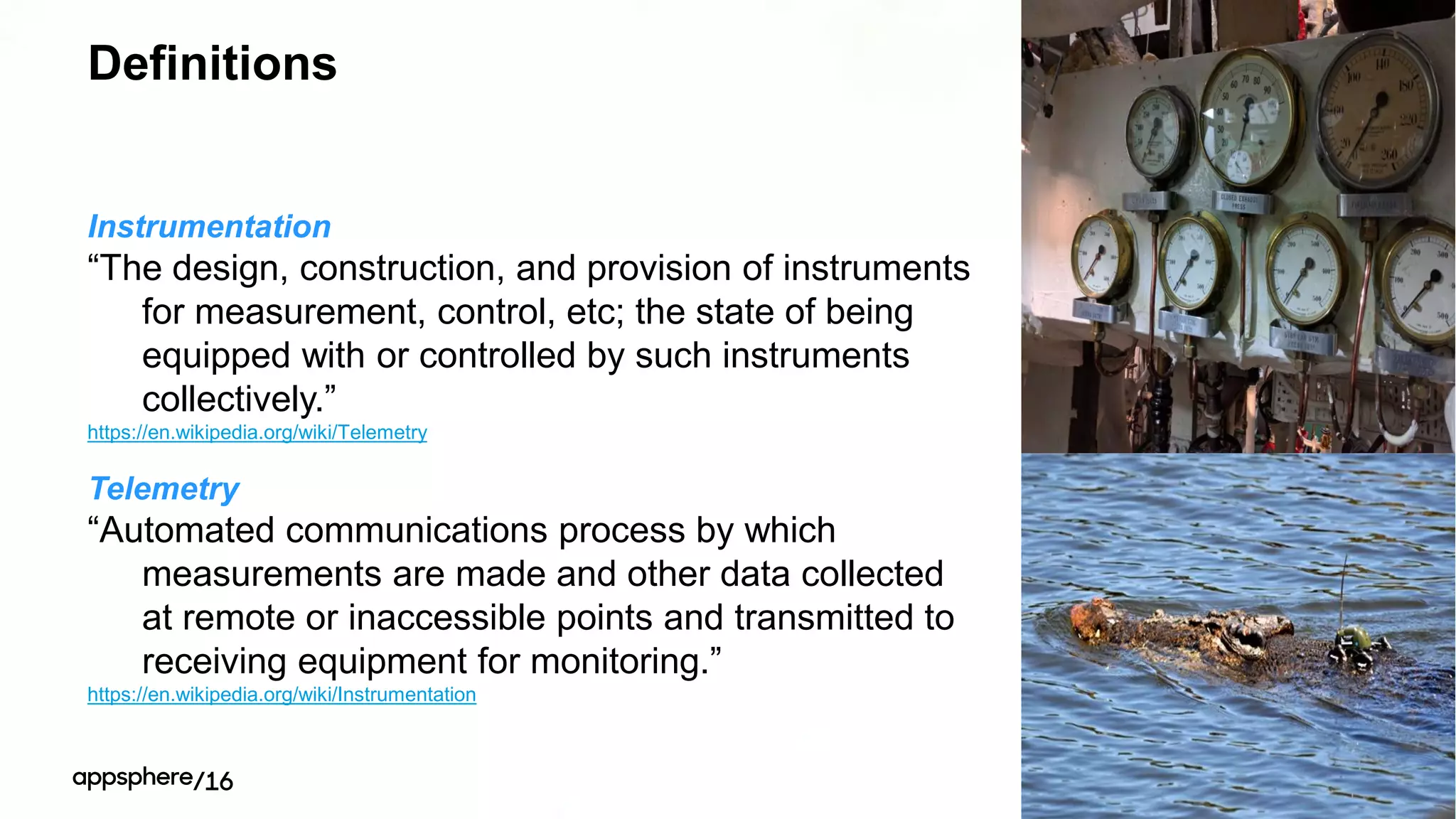
Definitions
Instrumentation
“The design, construction, and provision of instruments
for measurement, control, etc; the state of being
equipped with or controlled by such instruments
collectively.”
https://en.wikipedia.org/wiki/Telemetry
Telemetry
“Automated communications process by which
measurements are made and other data collected
at remote or inaccessible points and transmitted to
receiving equipment for monitoring.”
https://en.wikipedia.org/wiki/Instrumentation
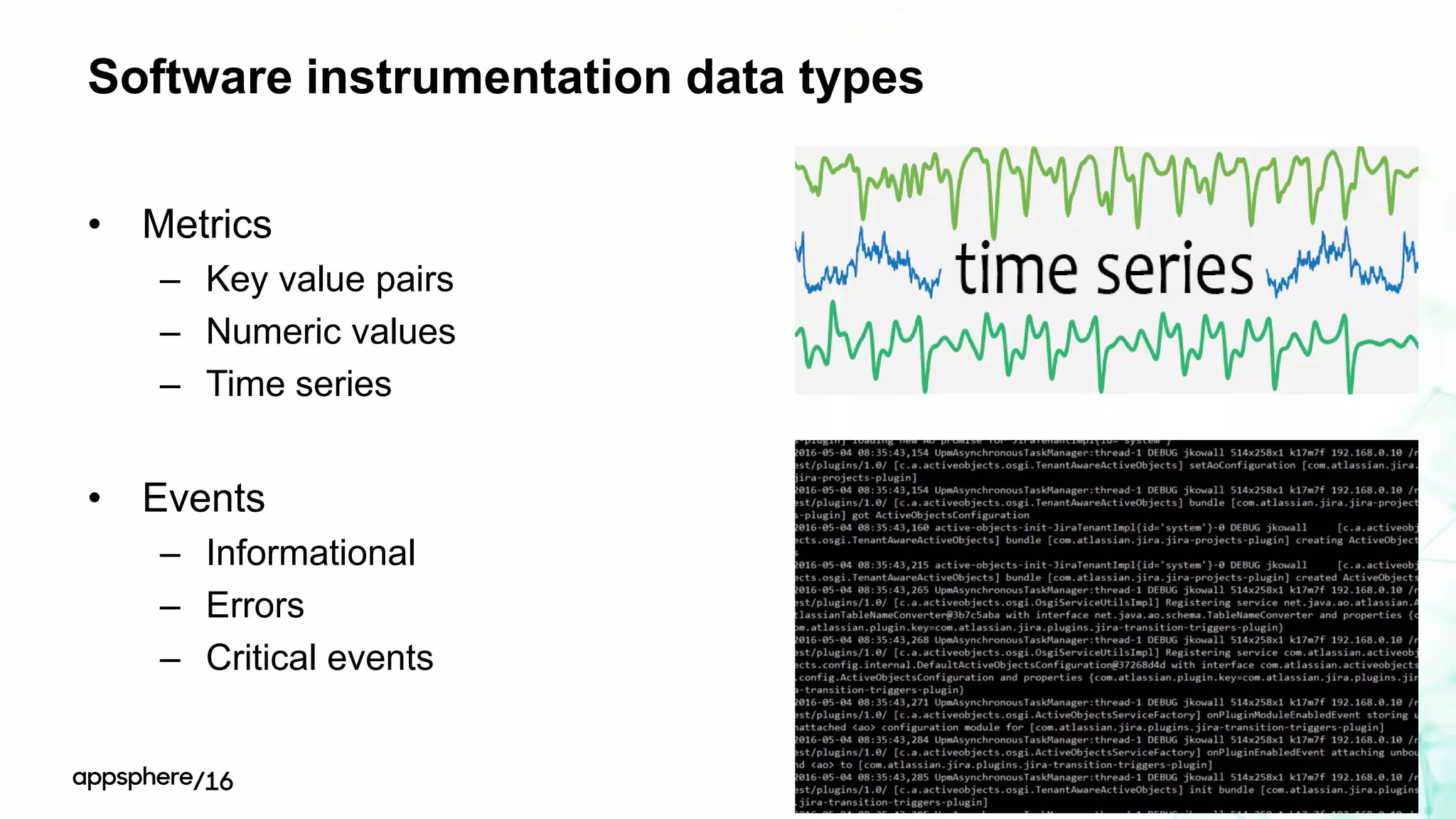
Software instrumentation data types
• Metrics
– Key value pairs
– Numeric values
– Time series
• Events
– Informational
– Errors
– Critical events
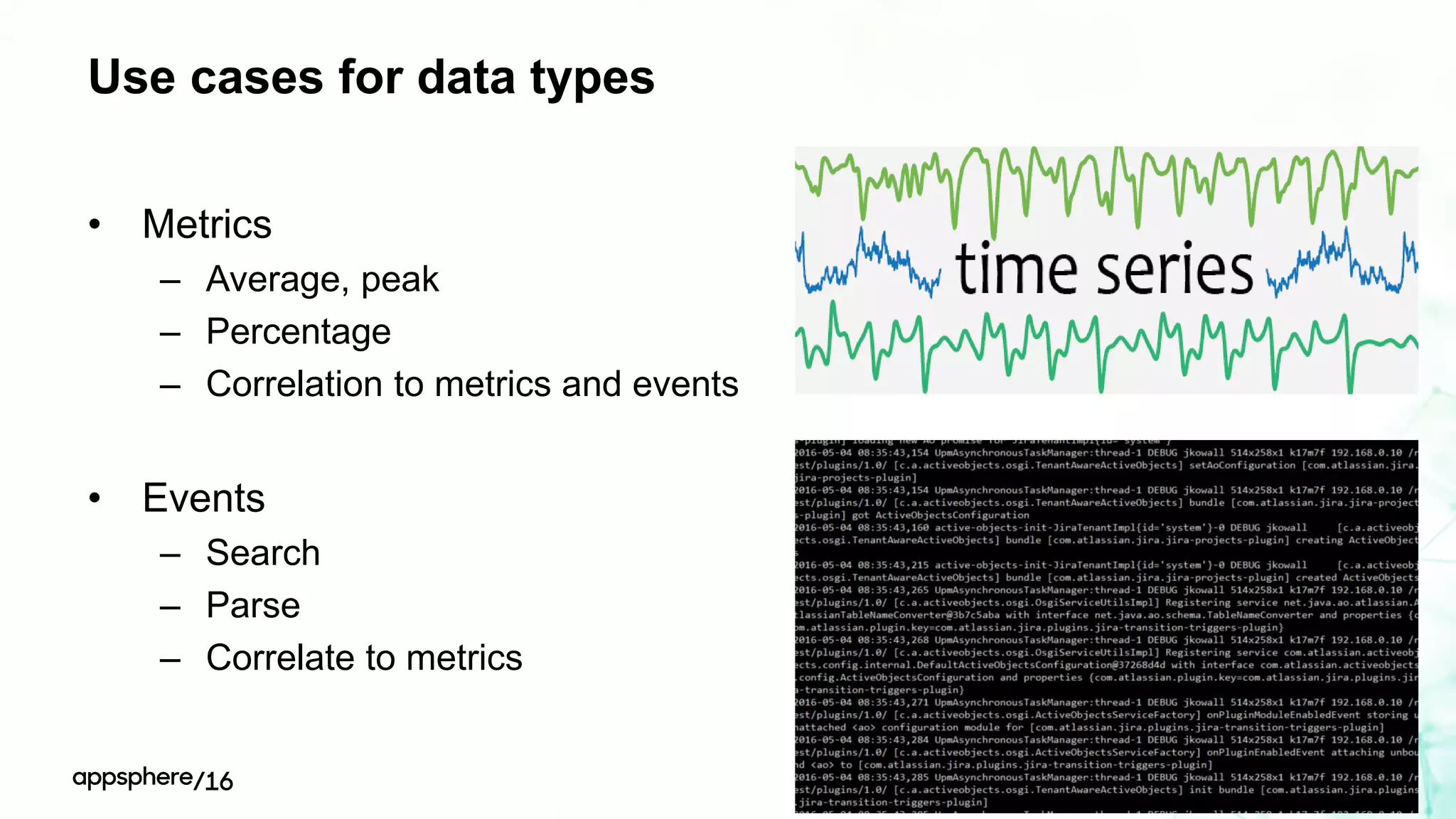
Use cases for data types
• Metrics
– Average, peak
– Percentage
– Correlation to metrics and events
• Events
– Search
– Parse
– Correlate to metrics
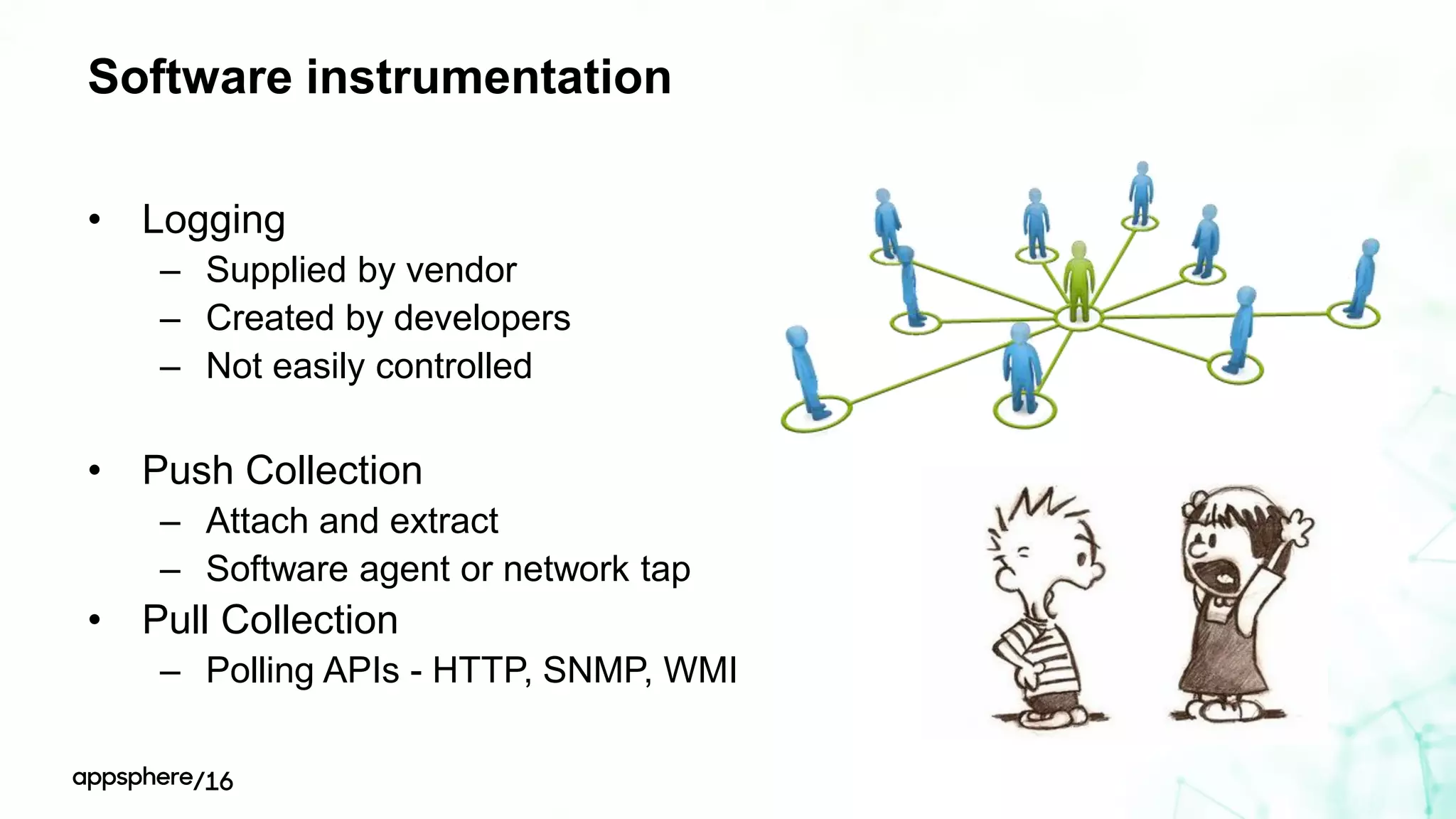
Software instrumentation
• Logging
– Supplied by vendor
– Created by developers
– Not easily controlled
• Push Collection
– Attach and extract
– Software agent or network tap
• Pull Collection
– Polling APIs - HTTP, SNMP, WMI
Instrumentation
misalignment
Priorities for instrumentation
• Business
• Application
• Services
• Infrastructure
Events and metrics
Uplevel the conversation
• Understand the customer
– Internally and externally
• Requirements should be gathered across business and IT teams
• Responsibility for definition of monitoring should be shared
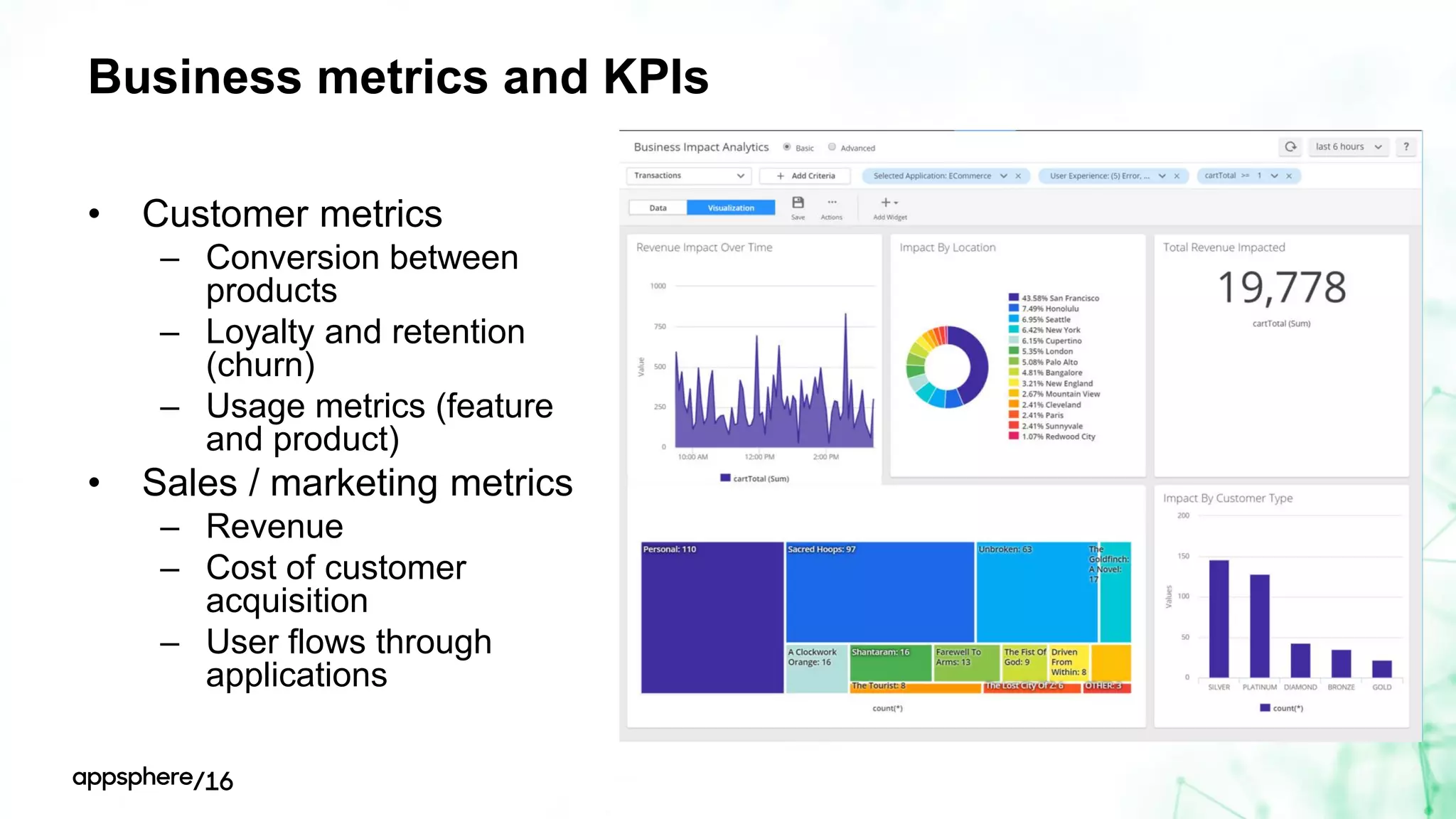
Business metrics and KPIs
• Customer metrics
– Conversion between
products
– Loyalty and retention
(churn)
– Usage metrics (feature
and product)
• Sales / marketing metrics
– Revenue
– Cost of customer
acquisition
– User flows through
applications
Technical metrics and KPIs
• End to end performance
– User through transaction hops
– Error isolation
• End user experience
– Client side errors
– Latency per element (page or app) + 3rd
party
– Client side DNS
• Application component performance
– Metrics from app server
– Metrics from code
– Queries
– Errors
• Intra application component performance
Use cases for business and technical data
• Usage
• Problem identification - MTTI
• Problem resolution - MTTR
• User satisfaction
• Usability
• Performance
• Change analysis
– A/B testing
– data center moves
– technology changes
Frontend instrumentation
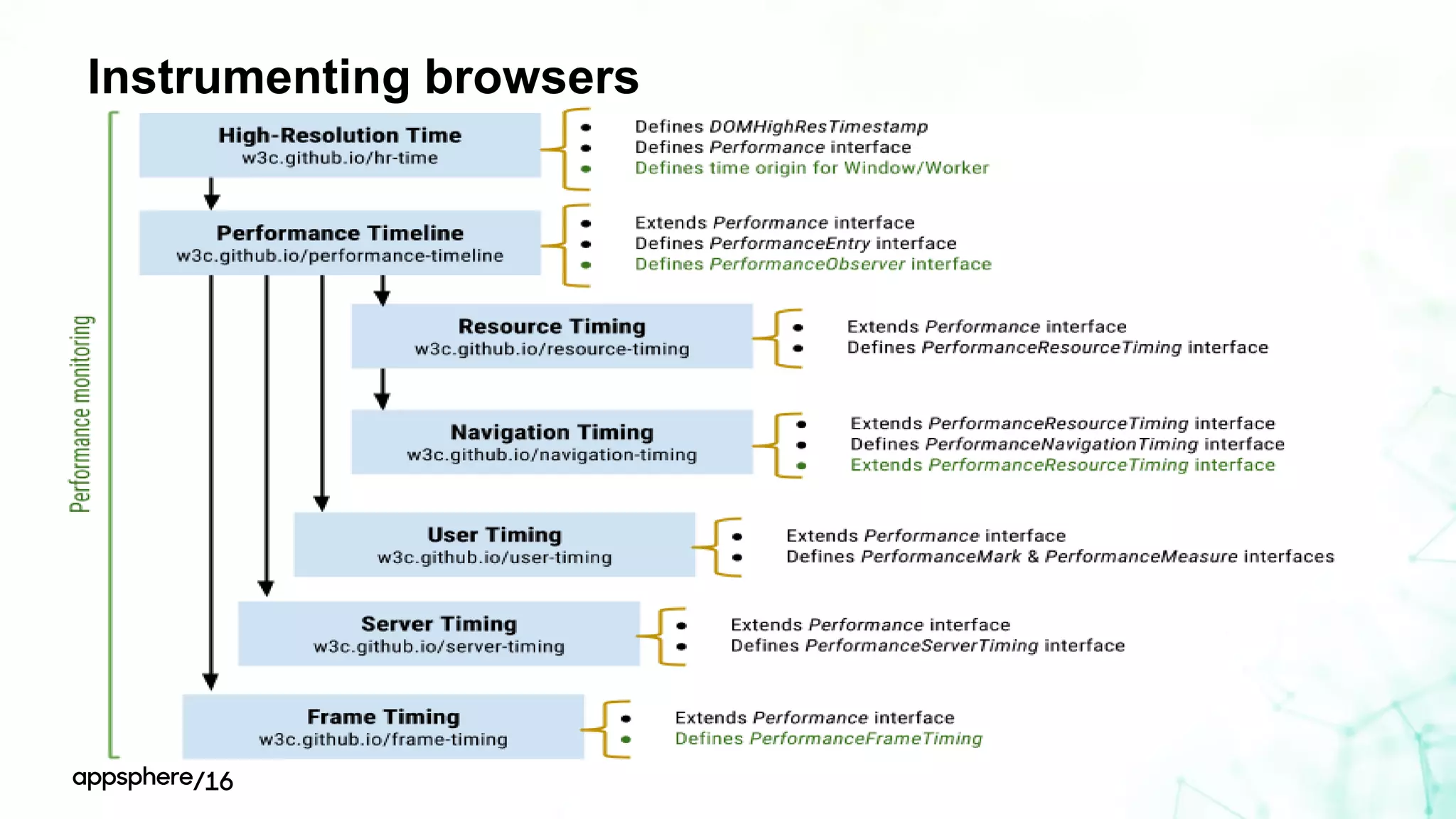
Instrumenting browsers
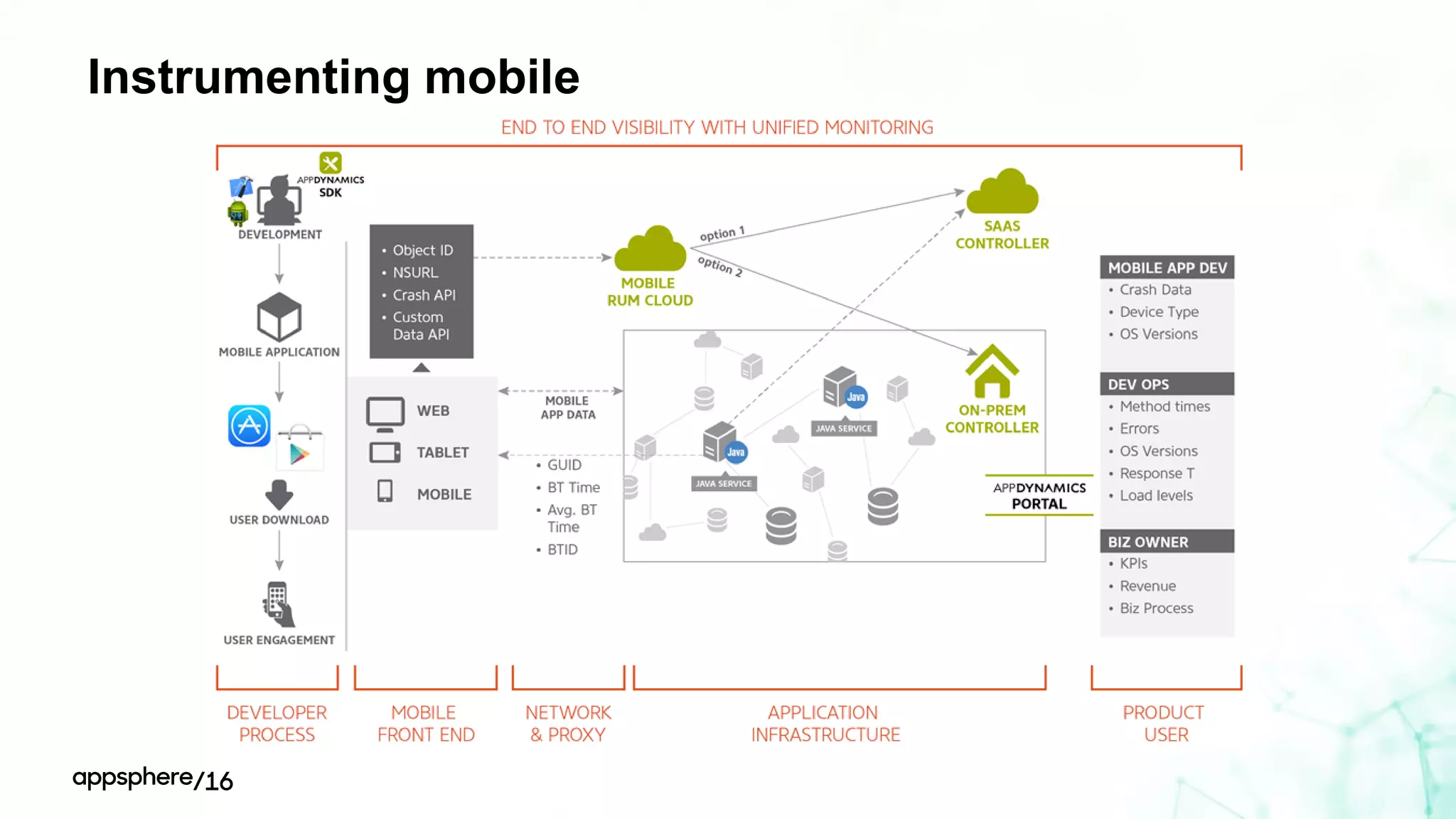
Instrumenting mobile
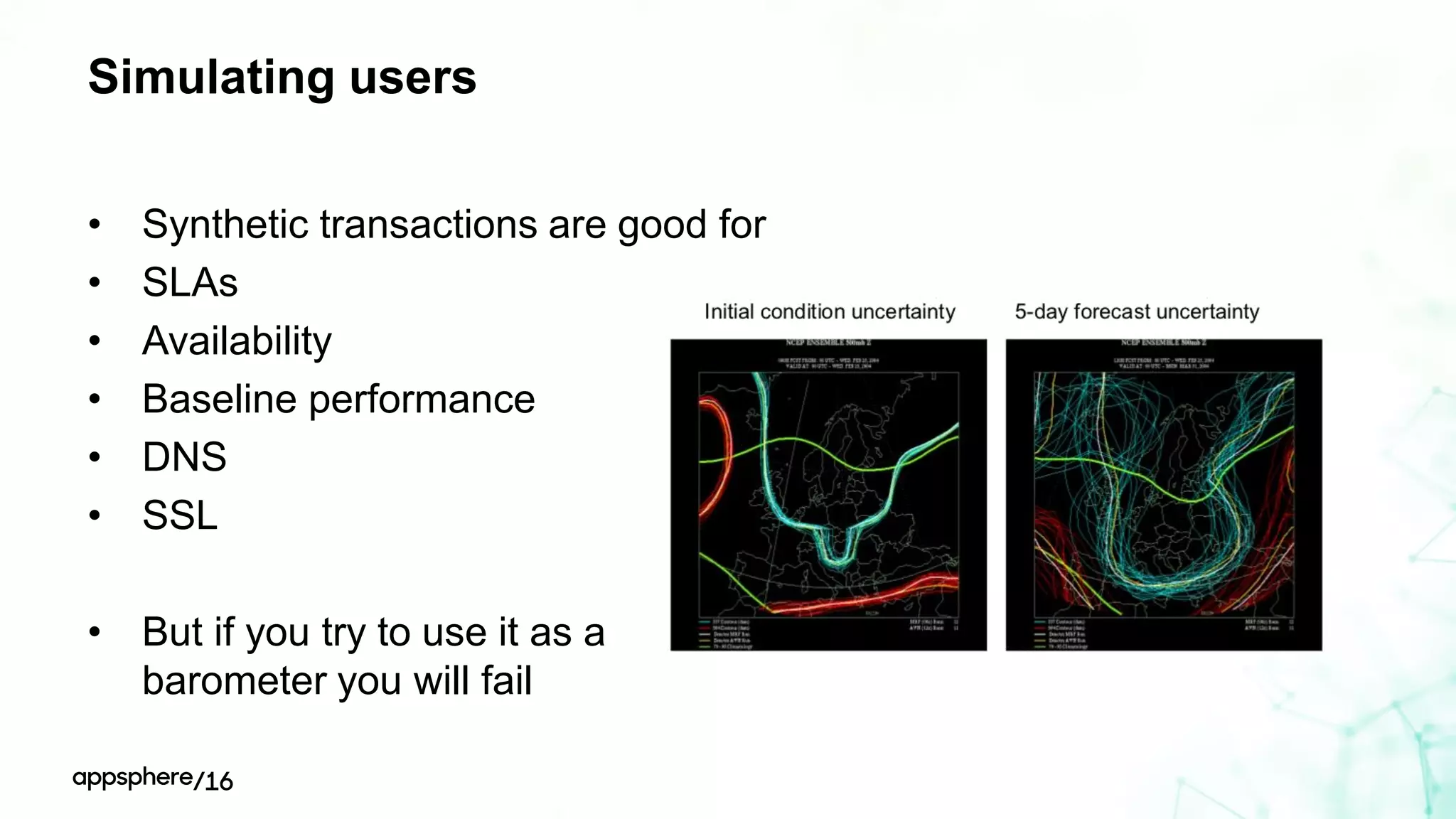
Simulating users
• Synthetic transactions are good for
• SLAs
• Availability
• Baseline performance
• DNS
• SSL
• But if you try to use it as a
barometer you will fail
Backend instrumentation
of Java and .NET
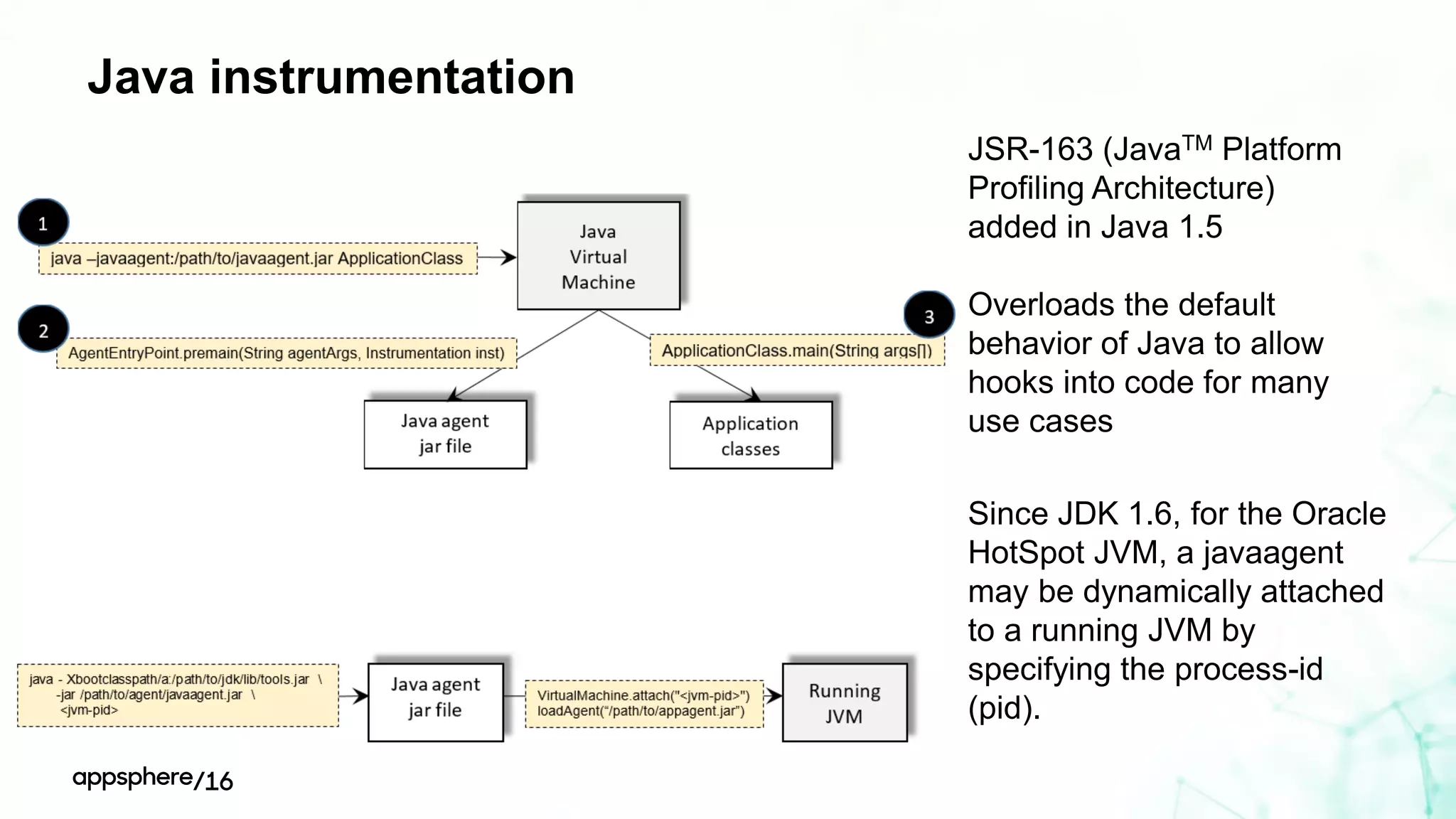
Java instrumentation
JSR-163 (JavaTM Platform
Profiling Architecture)
added in Java 1.5
Overloads the default
behavior of Java to allow
hooks into code for many
use cases
Since JDK 1.6, for the Oracle
HotSpot JVM, a javaagent
may be dynamically attached
to a running JVM by
specifying the process-id
(pid).
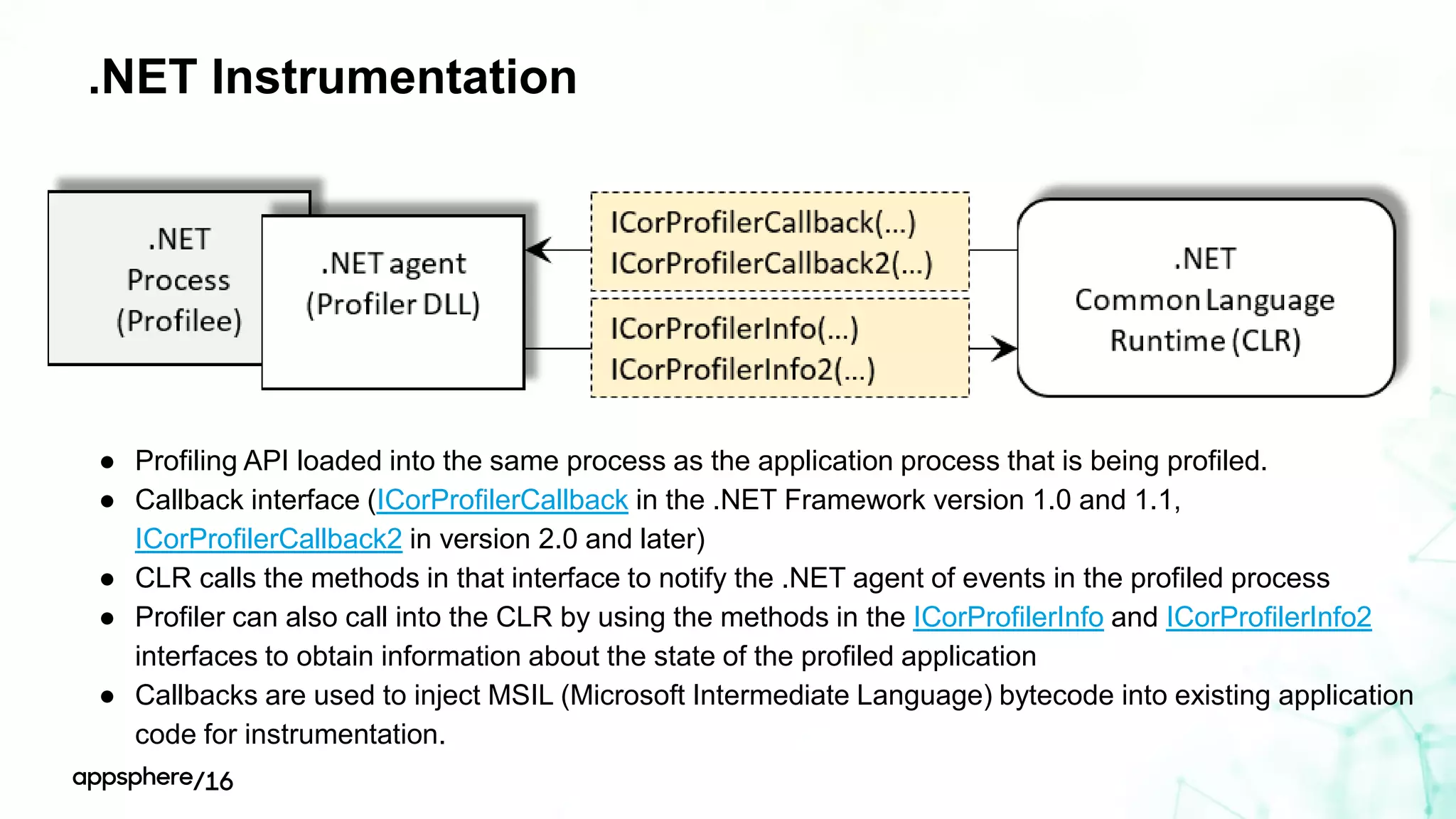
.NET Instrumentation
● Profiling API loaded into the same process as the application process that is being profiled.
● Callback interface (ICorProfilerCallback in the .NET Framework version 1.0 and 1.1,
ICorProfilerCallback2 in version 2.0 and later)
● CLR calls the methods in that interface to notify the .NET agent of events in the profiled process
● Profiler can also call into the CLR by using the methods in the ICorProfilerInfo and ICorProfilerInfo2
interfaces to obtain information about the state of the profiled application
● Callbacks are used to inject MSIL (Microsoft Intermediate Language) bytecode into existing application
code for instrumentation.
Backend instrumentation
of interpreted languages
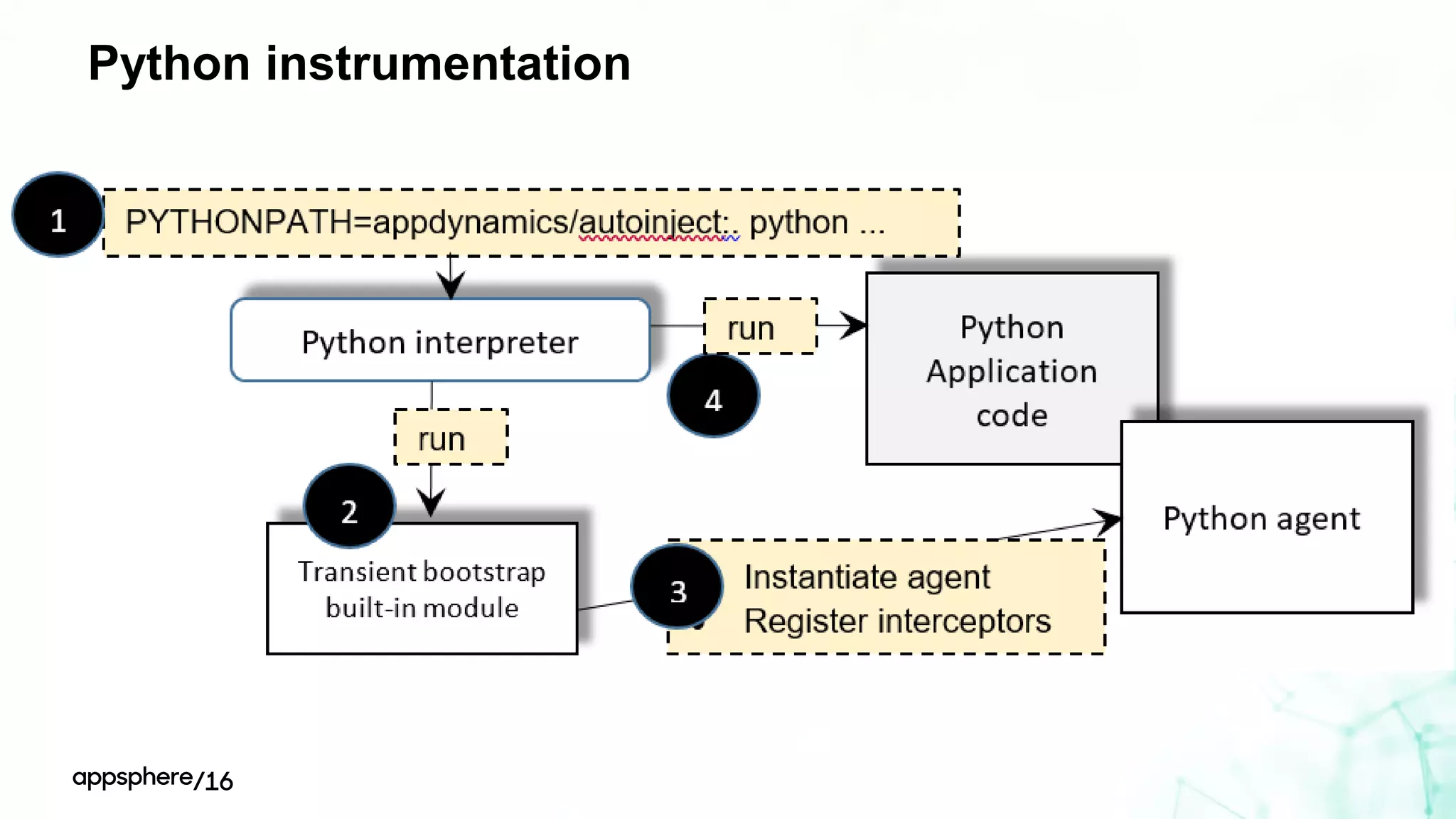
Monkey patching
Wikipedia relevant definition:
In Ruby,[3] Python,[4] and many other dynamic
programming languages... dynamic modifications of a
class or module at runtime, motivated by the intent to
patch existing third-party code as a workaround to a
bug or feature which does not act as desired
Disclaimer : Can be very dangerous, hard to maintain
• Replace methods / attributes / functions at runtime
• Apply a patch at runtime to the objects in memory,
instead of the source code on disk;
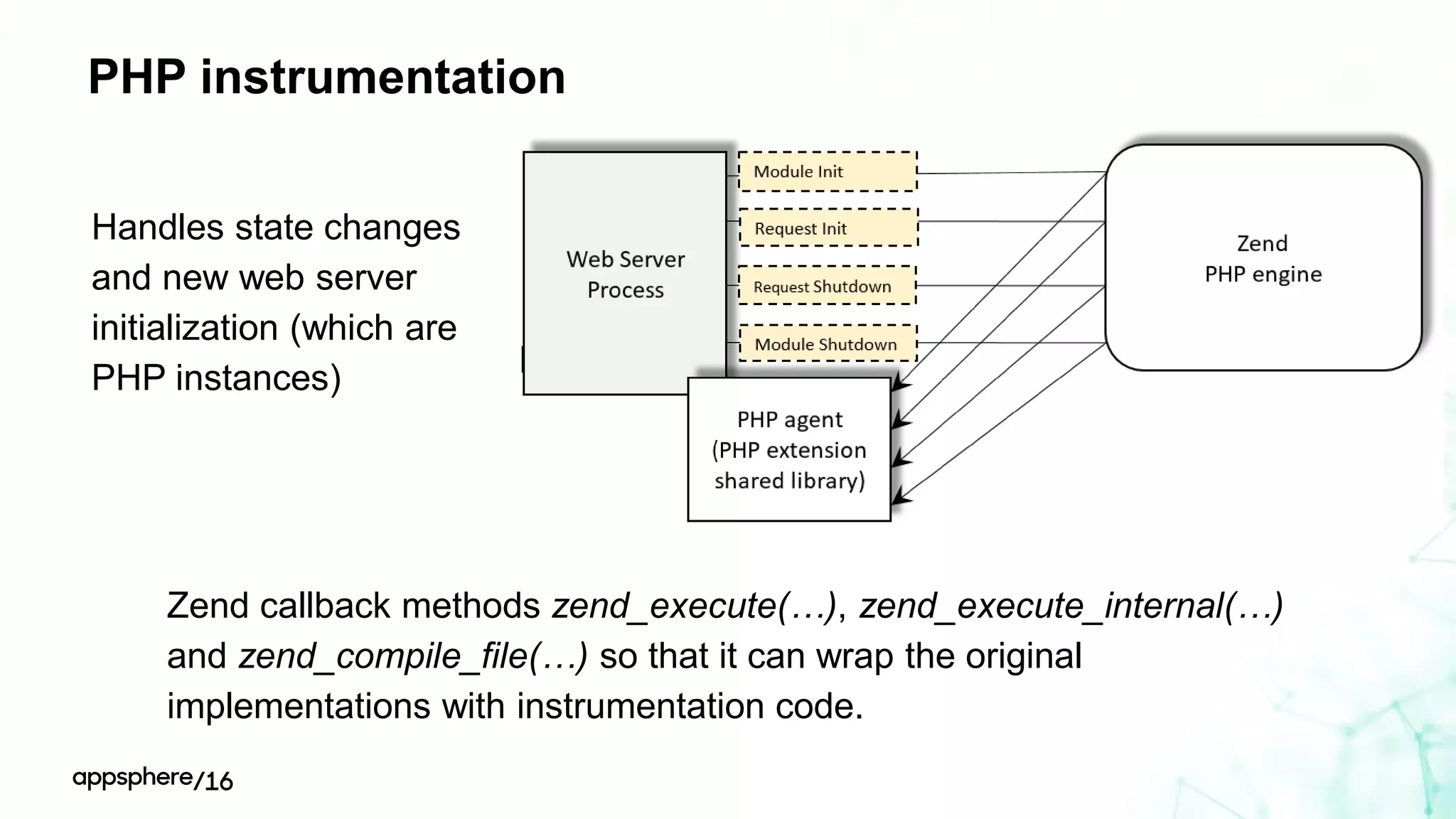
PHP instrumentation
Zend callback methods zend_execute(…), zend_execute_internal(…)
and zend_compile_file(…) so that it can wrap the original
implementations with instrumentation code.
Handles state changes
and new web server
initialization (which are
PHP instances)
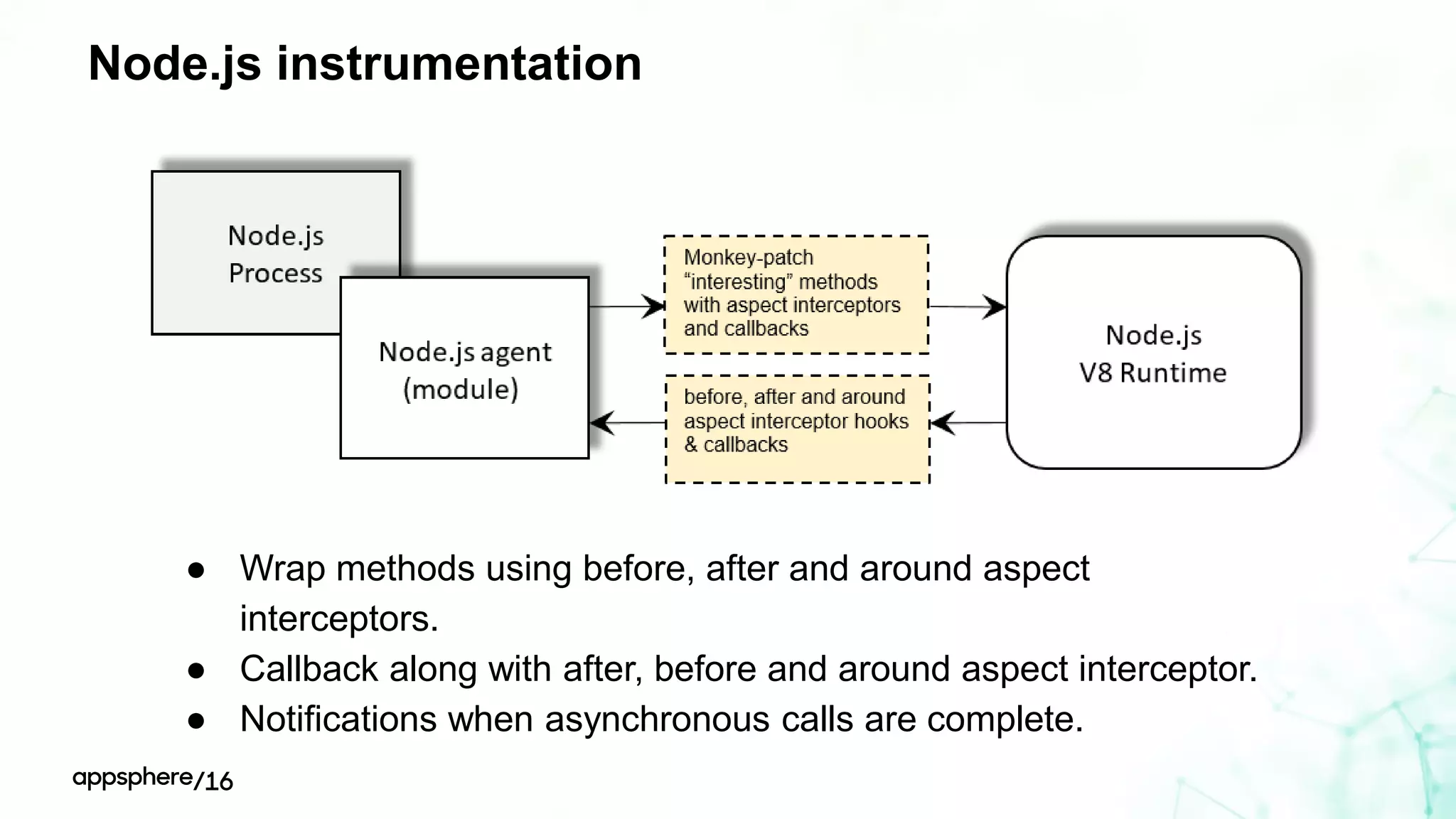
Node.js instrumentation
● Wrap methods using before, after and around aspect
interceptors.
● Callback along with after, before and around aspect interceptor.
● Notifications when asynchronous calls are complete.
Python instrumentation
Transaction correlation
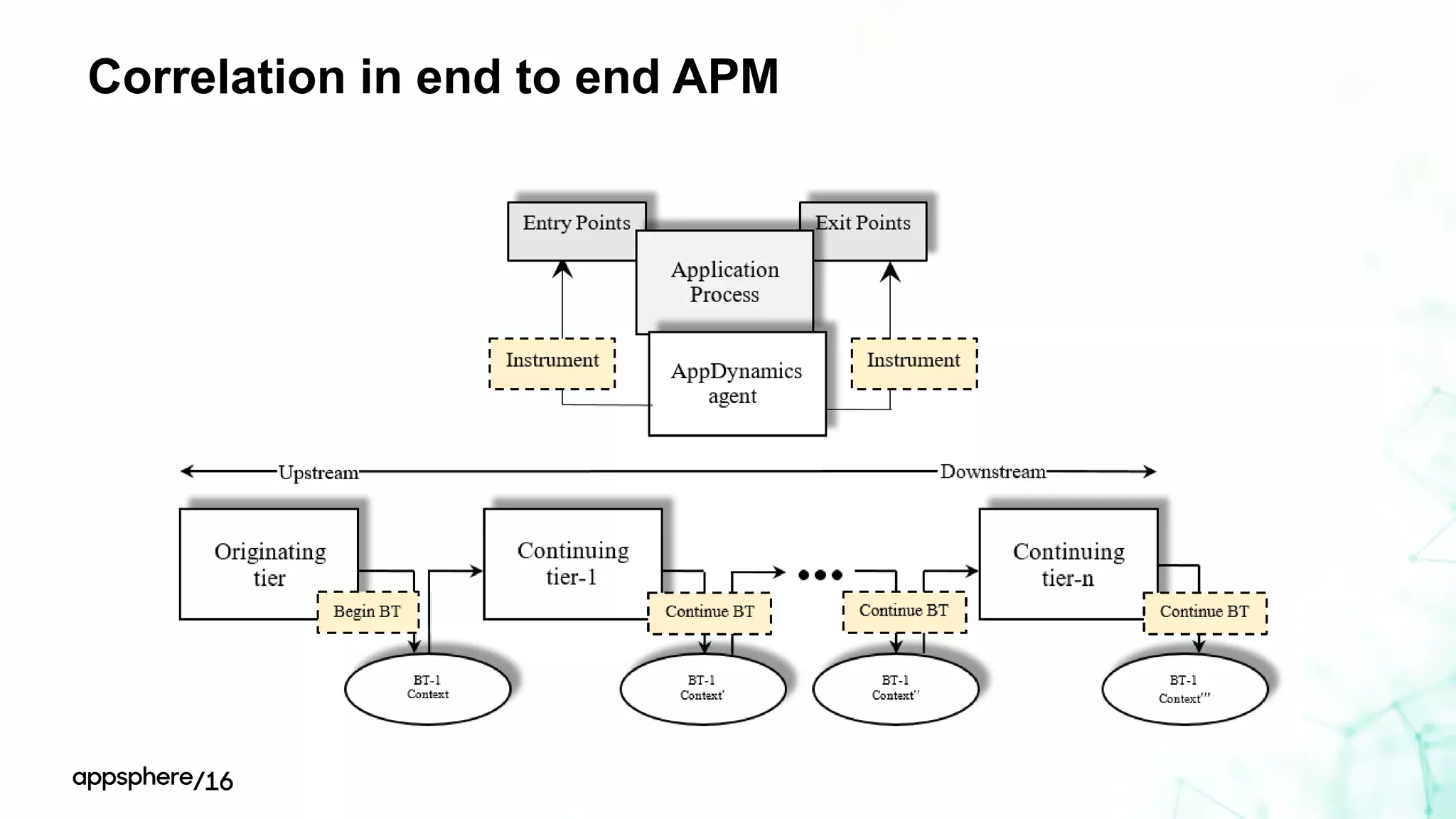
Correlation in end to end APM
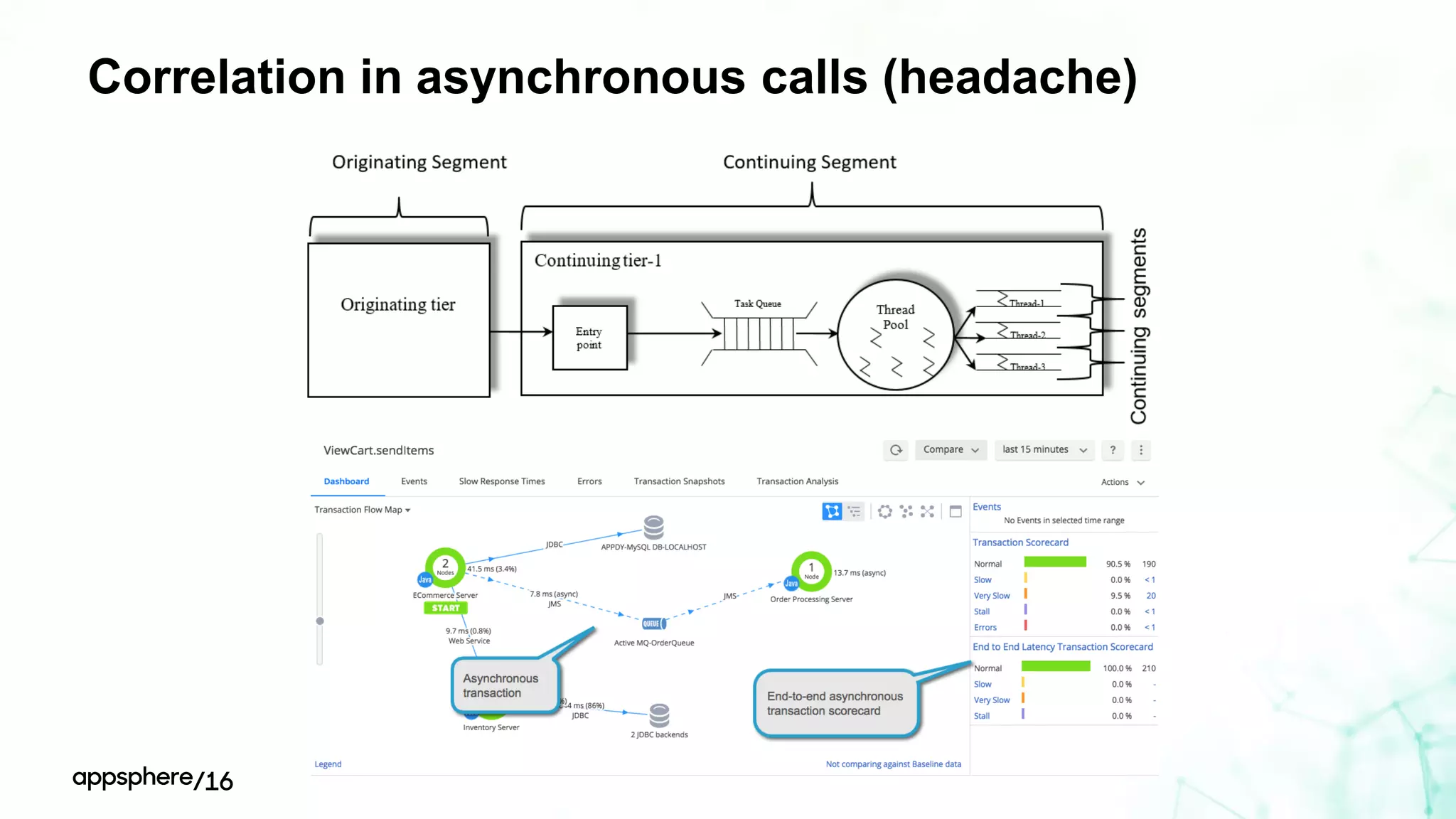
Correlation in asynchronous calls (headache)
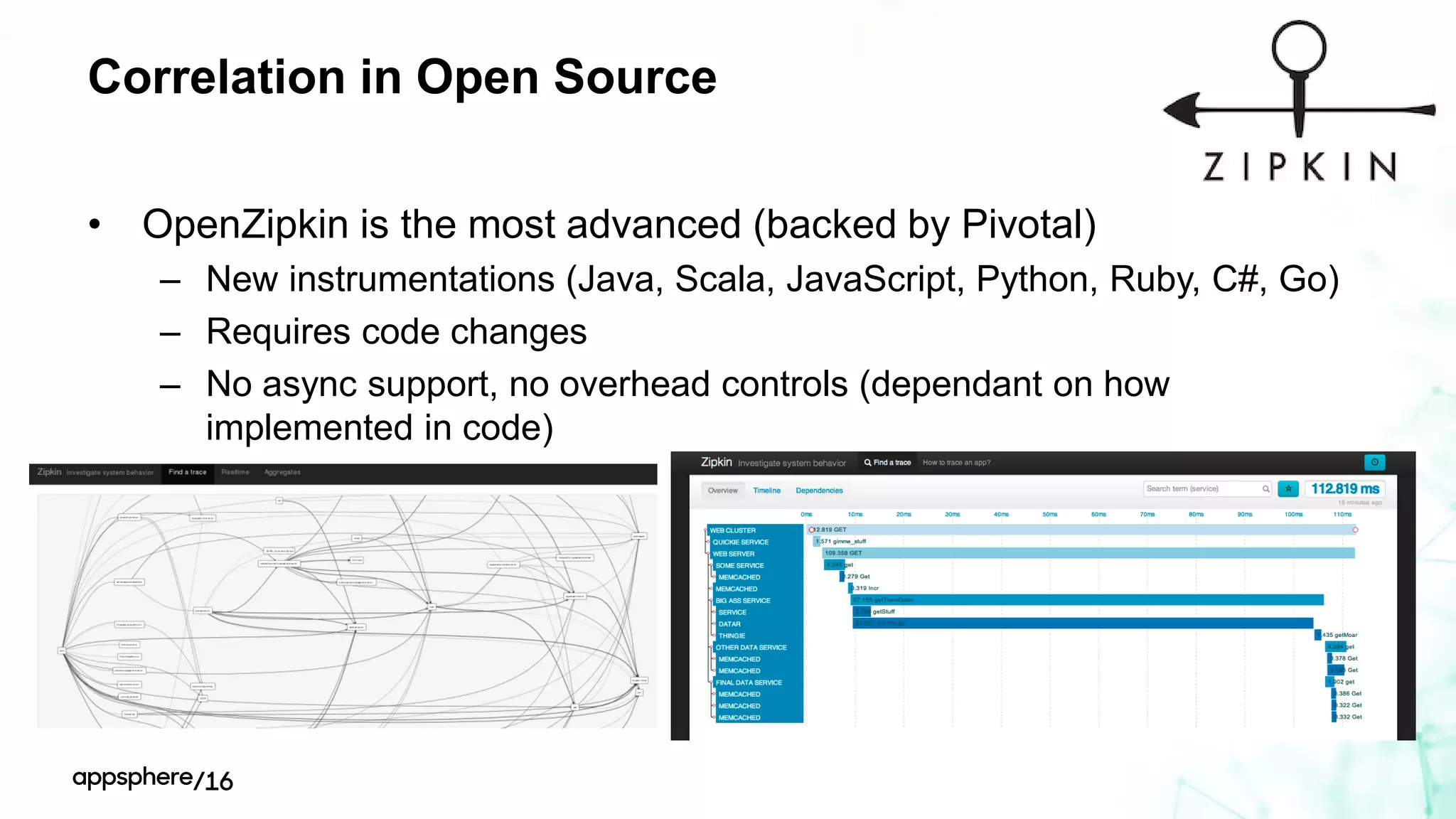
Correlation in Open Source
• OpenZipkin is the most advanced (backed by Pivotal)
– New instrumentations (Java, Scala, JavaScript, Python, Ruby, C#, Go)
– Requires code changes
– No async support, no overhead controls (dependant on how
implemented in code)
Future of correlation in Open Source
• OpenTracing an open standard API for instrumentation
– Vendors must implement specific code per instrumentation library which
doesn’t scale
– Must add code manually
– No overhead controls
• PivotTracing runs distributed traces on demand backed by Brown
University
– Currently has been written into forks of
• Apache Hadoop (YARN, MapReduce, HDFS)
• HBase
• ZooKeeper
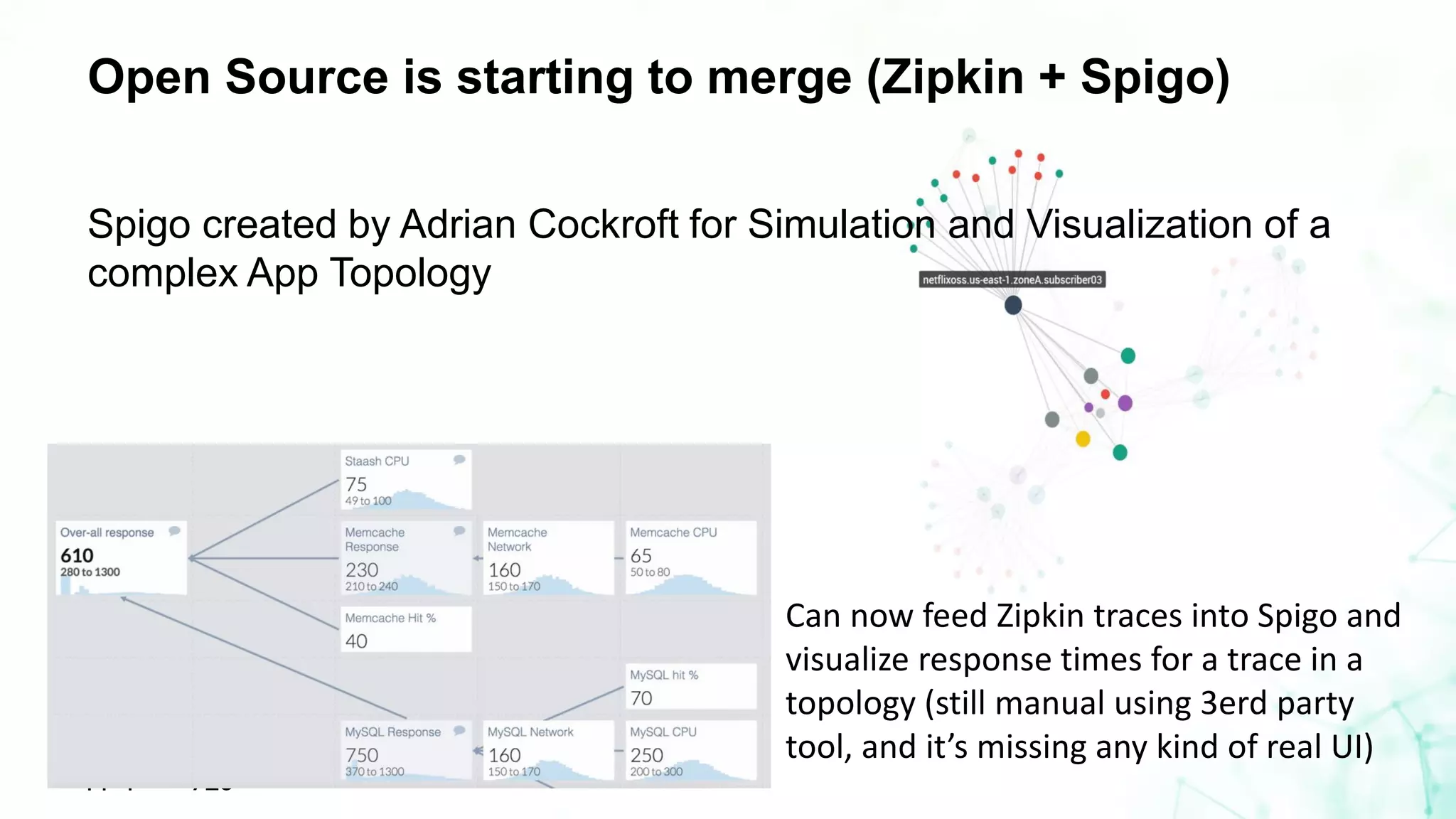
Open Source is starting to merge (Zipkin + Spigo)
Spigo created by Adrian Cockroft for Simulation and Visualization of a
complex App Topology
Can now feed Zipkin traces into Spigo and
visualize response times for a trace in a
topology (still manual using 3erd party
tool, and it’s missing any kind of real UI)
Logging and log
correlation
Logging best practices
• Logs are not transaction records
• Log errors and exceptions
• Easily parsed (JSON)
• Time (long), Source
• Write your own identifiers for each statement logged (or instrument
and inject)
• Think about security implications (plain text, on disk, syslog are all
insecure)
• Keep log statements small (thanks Java, .NET…)
• Every log statement introduces overhead, so don’t overdo it
• Exception logs create even more overhead, so fix them
• Do not try to use log tools as metric stores
Correlation in logs
• Log every transaction segment
• Persist a GUID or transaction ID
• This is very difficult in large teams
• Inefficient to analyze and pull metrics from logs
• Doesn’t work unless you own the code
[code]
PERF,2013-04-03 11:29:52.640,external,0x123456,NA,service1,MyAPP,jimmy,NA,336,NA,NA
INFO,2013-04-03 11:29:53.189,internal,789012,0x123456,service2,TheirApp,jimmy,NA,174,NA,NA
INFO,2013-04-03 11:29:52.892,internal,345678,789012,service3,TheirApp,jimmy,NA,163,NA,NA
[/code]
Transaction correlation and logs!
• Many integrations across APM
and Log vendors
• Can add correlation in code
and use any log tool
– ex: [%X{AD.requestGUID}]
• We auto inject and correlate
(one platform)
Please give us your feedback—Session T8455
• Complete the online survey you'll receive via
email later today or via text at:
Text this number: 878787
Text this word: APPSPHERE
• Every time you submit a session survey, your
name will be entered in a random drawing.
We're giving away Amazon Echos
to 5 lucky winners!
• Thank you for your input
APPDYNAMICS CONFIDENTIAL AND PROPRIETARY 37
Win!
Thank you

Monitoring and Instrumentation Strategies: Tips and Best Practices - AppSphere16

  • 1.
    The differing waysto monitor and instrument Jonah Kowall VP Market Development and Insights Twitter : @jkowall
  • 2.
    APPDYNAMICS CONFIDENTIAL ANDPROPRIETARY 2 Notice The information and materials included in this presentation (collectively, the “Materials”) are the proprietary information of AppDynamics, Inc. (“AppDynamics” or the “Company”). No part of the Materials may be reproduced, distributed, communicated or displayed in any form or by any means, or used to make any derivative work, without prior written permission from AppDynamics. The Materials may contain product roadmap information of AppDynamics. AppDynamics reserves the right to change any product roadmap information at any time, for any reason and without notice. This information is intended to outline AppDynamics' general product direction, it is not a guarantee of future product features, and it should not be relied on in making a purchasing decision. The development, release, and timing of any features or functionality described for AppDynamics' products remains at AppDynamics' sole discretion. AppDynamics reserves the right to change any planned features at any time before making them generally available as well as never making them generally available. All third-party trademarks, including names, logos and brands, referenced by AppDynamics in this presentation are property of their respective owners. All references to third-party trademarks are for identification purposes only and shall be considered nominative fair use under trademark law. © 2016 AppDynamics, Inc. All rights reserved.
  • 3.
    Jonah Kowall’s background •23 years in IT • Infrastructure and Operations enterprises and startups (17 yrs) – Security - CISSP, CISA, PCI – Started one of the first content filtering companies • Head of global monitoring at Thomson Reuters • Head of IT Operations at MFG.com – Bezos Expeditions • Gartner Research VP 3.5 years • Strategy AppDynamics 1.5 years
  • 4.
    Agenda • Introduction toinstrumentation • Instrumentation defined • Priorities in instrumentation • Technical instrumentation of frontends (Browser and Mobile) • Technical instrumentation of backend (Java, .NET, Python, Node.js, PHP) • Logging best practices • How transaction correlation options (AppDynamics and Open Source)
  • 5.
    Definitions Instrumentation “The design, construction,and provision of instruments for measurement, control, etc; the state of being equipped with or controlled by such instruments collectively.” https://en.wikipedia.org/wiki/Telemetry Telemetry “Automated communications process by which measurements are made and other data collected at remote or inaccessible points and transmitted to receiving equipment for monitoring.” https://en.wikipedia.org/wiki/Instrumentation
  • 6.
    Software instrumentation datatypes • Metrics – Key value pairs – Numeric values – Time series • Events – Informational – Errors – Critical events
  • 7.
    Use cases fordata types • Metrics – Average, peak – Percentage – Correlation to metrics and events • Events – Search – Parse – Correlate to metrics
  • 8.
    Software instrumentation • Logging –Supplied by vendor – Created by developers – Not easily controlled • Push Collection – Attach and extract – Software agent or network tap • Pull Collection – Polling APIs - HTTP, SNMP, WMI
  • 9.
  • 10.
    Priorities for instrumentation •Business • Application • Services • Infrastructure Events and metrics
  • 11.
    Uplevel the conversation •Understand the customer – Internally and externally • Requirements should be gathered across business and IT teams • Responsibility for definition of monitoring should be shared
  • 12.
    Business metrics andKPIs • Customer metrics – Conversion between products – Loyalty and retention (churn) – Usage metrics (feature and product) • Sales / marketing metrics – Revenue – Cost of customer acquisition – User flows through applications
  • 13.
    Technical metrics andKPIs • End to end performance – User through transaction hops – Error isolation • End user experience – Client side errors – Latency per element (page or app) + 3rd party – Client side DNS • Application component performance – Metrics from app server – Metrics from code – Queries – Errors • Intra application component performance
  • 14.
    Use cases forbusiness and technical data • Usage • Problem identification - MTTI • Problem resolution - MTTR • User satisfaction • Usability • Performance • Change analysis – A/B testing – data center moves – technology changes
  • 15.
  • 16.
  • 17.
  • 18.
    Simulating users • Synthetictransactions are good for • SLAs • Availability • Baseline performance • DNS • SSL • But if you try to use it as a barometer you will fail
  • 19.
  • 20.
    Java instrumentation JSR-163 (JavaTMPlatform Profiling Architecture) added in Java 1.5 Overloads the default behavior of Java to allow hooks into code for many use cases Since JDK 1.6, for the Oracle HotSpot JVM, a javaagent may be dynamically attached to a running JVM by specifying the process-id (pid).
  • 21.
    .NET Instrumentation ● ProfilingAPI loaded into the same process as the application process that is being profiled. ● Callback interface (ICorProfilerCallback in the .NET Framework version 1.0 and 1.1, ICorProfilerCallback2 in version 2.0 and later) ● CLR calls the methods in that interface to notify the .NET agent of events in the profiled process ● Profiler can also call into the CLR by using the methods in the ICorProfilerInfo and ICorProfilerInfo2 interfaces to obtain information about the state of the profiled application ● Callbacks are used to inject MSIL (Microsoft Intermediate Language) bytecode into existing application code for instrumentation.
  • 22.
  • 23.
    Monkey patching Wikipedia relevantdefinition: In Ruby,[3] Python,[4] and many other dynamic programming languages... dynamic modifications of a class or module at runtime, motivated by the intent to patch existing third-party code as a workaround to a bug or feature which does not act as desired Disclaimer : Can be very dangerous, hard to maintain • Replace methods / attributes / functions at runtime • Apply a patch at runtime to the objects in memory, instead of the source code on disk;
  • 24.
    PHP instrumentation Zend callbackmethods zend_execute(…), zend_execute_internal(…) and zend_compile_file(…) so that it can wrap the original implementations with instrumentation code. Handles state changes and new web server initialization (which are PHP instances)
  • 25.
    Node.js instrumentation ● Wrapmethods using before, after and around aspect interceptors. ● Callback along with after, before and around aspect interceptor. ● Notifications when asynchronous calls are complete.
  • 26.
  • 27.
  • 28.
  • 29.
  • 30.
    Correlation in OpenSource • OpenZipkin is the most advanced (backed by Pivotal) – New instrumentations (Java, Scala, JavaScript, Python, Ruby, C#, Go) – Requires code changes – No async support, no overhead controls (dependant on how implemented in code)
  • 31.
    Future of correlationin Open Source • OpenTracing an open standard API for instrumentation – Vendors must implement specific code per instrumentation library which doesn’t scale – Must add code manually – No overhead controls • PivotTracing runs distributed traces on demand backed by Brown University – Currently has been written into forks of • Apache Hadoop (YARN, MapReduce, HDFS) • HBase • ZooKeeper
  • 32.
    Open Source isstarting to merge (Zipkin + Spigo) Spigo created by Adrian Cockroft for Simulation and Visualization of a complex App Topology Can now feed Zipkin traces into Spigo and visualize response times for a trace in a topology (still manual using 3erd party tool, and it’s missing any kind of real UI)
  • 33.
  • 34.
    Logging best practices •Logs are not transaction records • Log errors and exceptions • Easily parsed (JSON) • Time (long), Source • Write your own identifiers for each statement logged (or instrument and inject) • Think about security implications (plain text, on disk, syslog are all insecure) • Keep log statements small (thanks Java, .NET…) • Every log statement introduces overhead, so don’t overdo it • Exception logs create even more overhead, so fix them • Do not try to use log tools as metric stores
  • 35.
    Correlation in logs •Log every transaction segment • Persist a GUID or transaction ID • This is very difficult in large teams • Inefficient to analyze and pull metrics from logs • Doesn’t work unless you own the code [code] PERF,2013-04-03 11:29:52.640,external,0x123456,NA,service1,MyAPP,jimmy,NA,336,NA,NA INFO,2013-04-03 11:29:53.189,internal,789012,0x123456,service2,TheirApp,jimmy,NA,174,NA,NA INFO,2013-04-03 11:29:52.892,internal,345678,789012,service3,TheirApp,jimmy,NA,163,NA,NA [/code]
  • 36.
    Transaction correlation andlogs! • Many integrations across APM and Log vendors • Can add correlation in code and use any log tool – ex: [%X{AD.requestGUID}] • We auto inject and correlate (one platform)
  • 37.
    Please give usyour feedback—Session T8455 • Complete the online survey you'll receive via email later today or via text at: Text this number: 878787 Text this word: APPSPHERE • Every time you submit a session survey, your name will be entered in a random drawing. We're giving away Amazon Echos to 5 lucky winners! • Thank you for your input APPDYNAMICS CONFIDENTIAL AND PROPRIETARY 37 Win!
  • 38.