Developing highly
instrumented applications
with minimal effort
Tim Hobson
Principal Engineer, Chief Caffeine Officer - Intuit
About Me

2
Agenda
Concepts
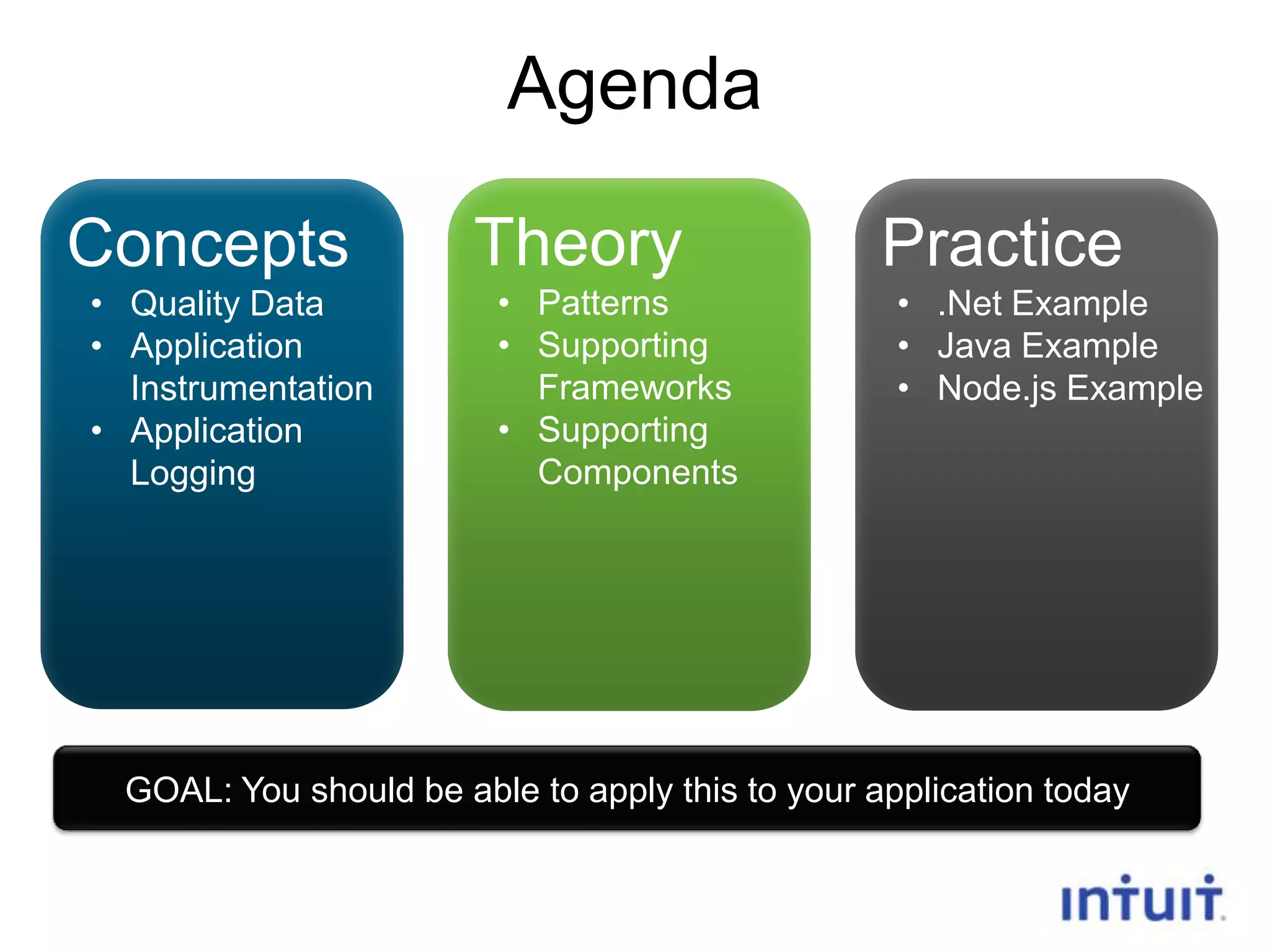
• Quality Data
• Application
Instrumentation
• Application
Logging

Theory
• Patterns
• Supporting
Frameworks
• Supporting
Components

Practice
• .Net Example
• Java Example
• Node.js Example

GOAL: You should be able to apply this to your application today
3
Concepts
If You Do Nothing…

OR

5
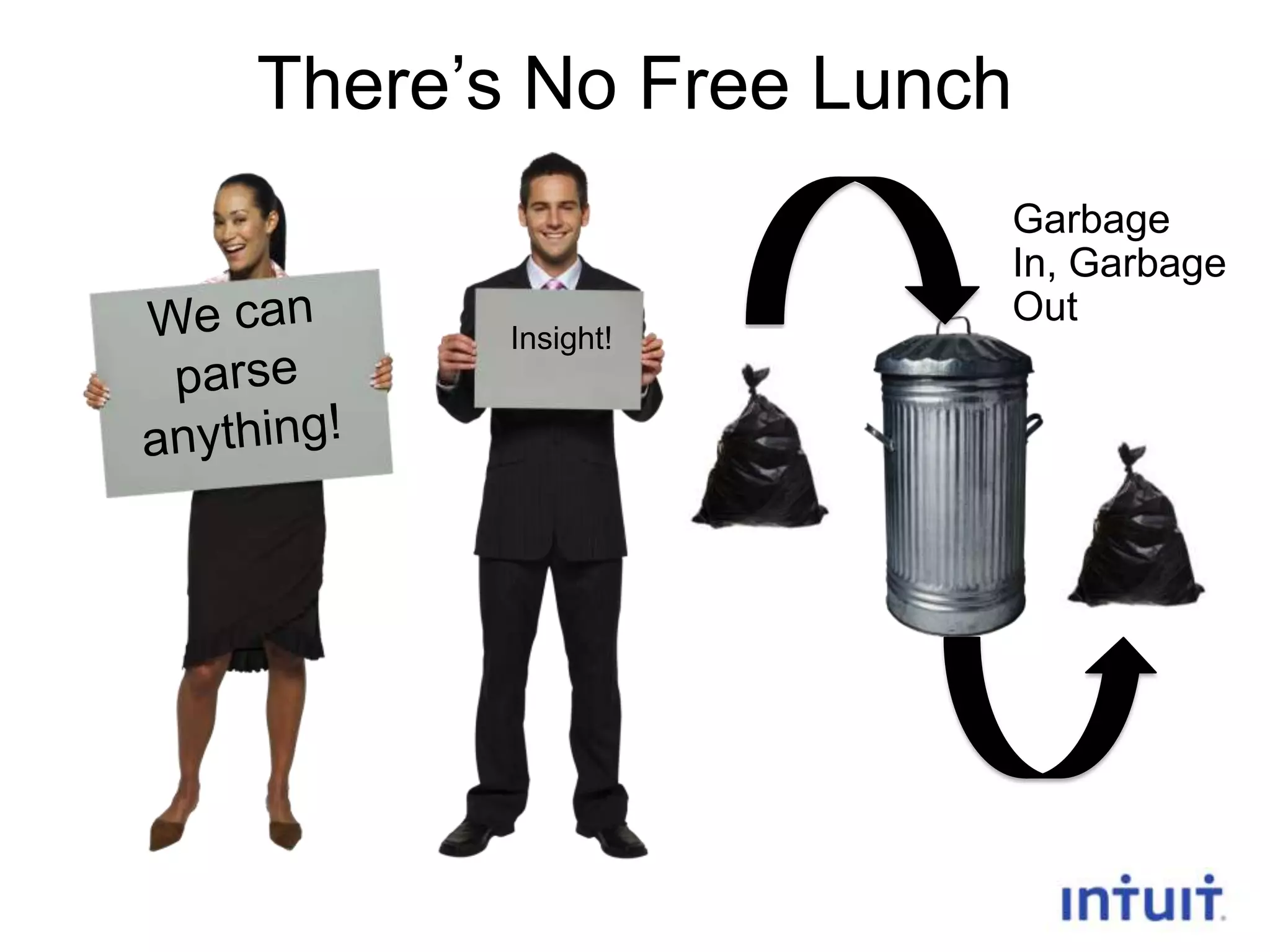
There’s No Free Lunch
Garbage
In, Garbage
Out

Insight!

6
Quality In, Insight Out
Most apps start with only the framework or
app server logging (or nothing!)
None of the above is interesting to the
business or the developer.
You can’t get if you don’t give – there are
many ways to give, and many classes of
data to provide.
7
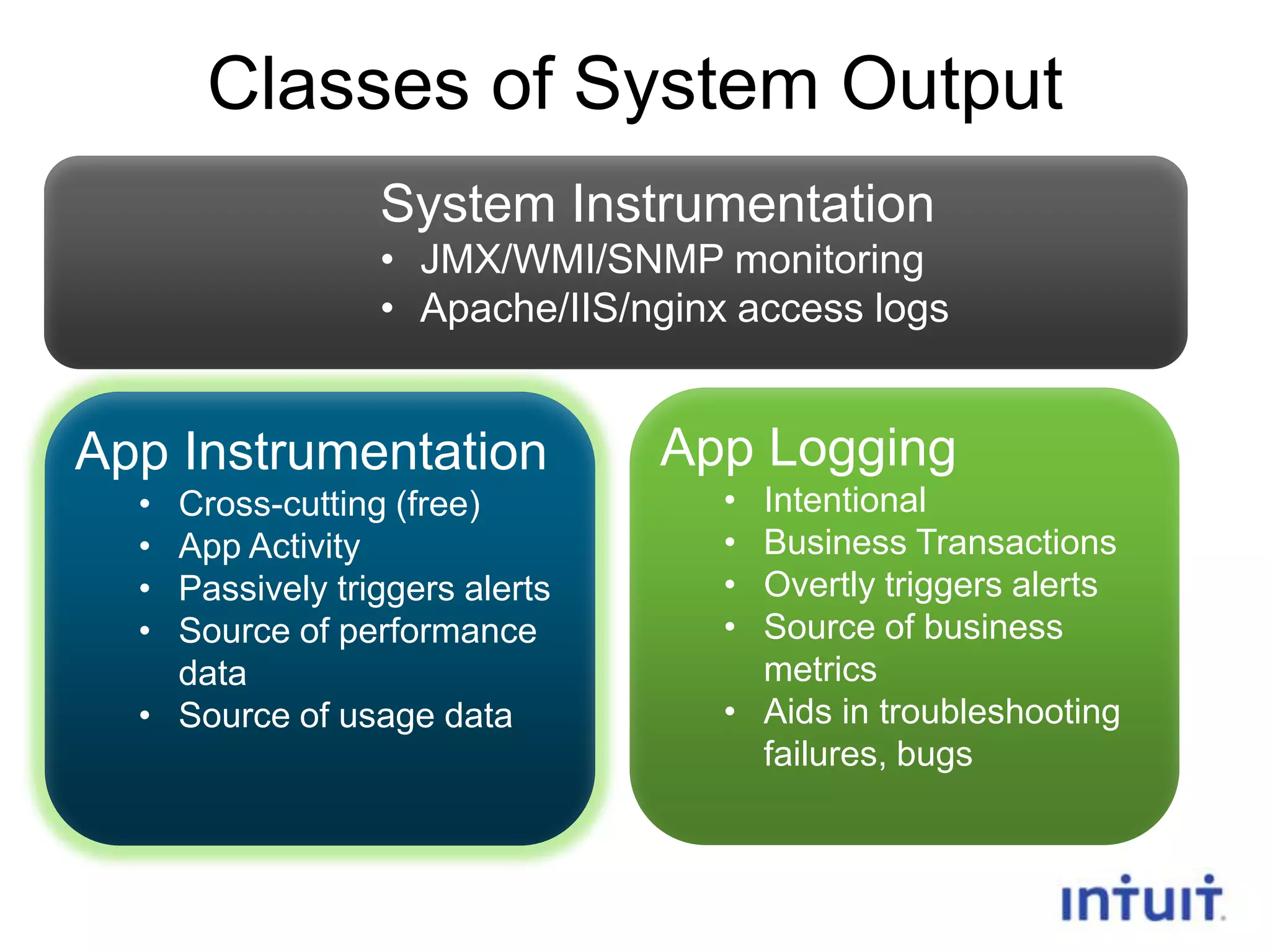
Classes of System Output
System Instrumentation
• JMX/WMI/SNMP monitoring
• Apache/IIS/nginx access logs

App Logging

App Instrumentation

•
•
•
•

•
•
•
•

Intentional
Business Transactions
Overtly triggers alerts
Source of business
metrics
• Aids in troubleshooting
failures, bugs

Cross-cutting (free)
App Activity
Passively triggers alerts
Source of performance
data
• Source of usage data

8
Theory and
Best
Practices
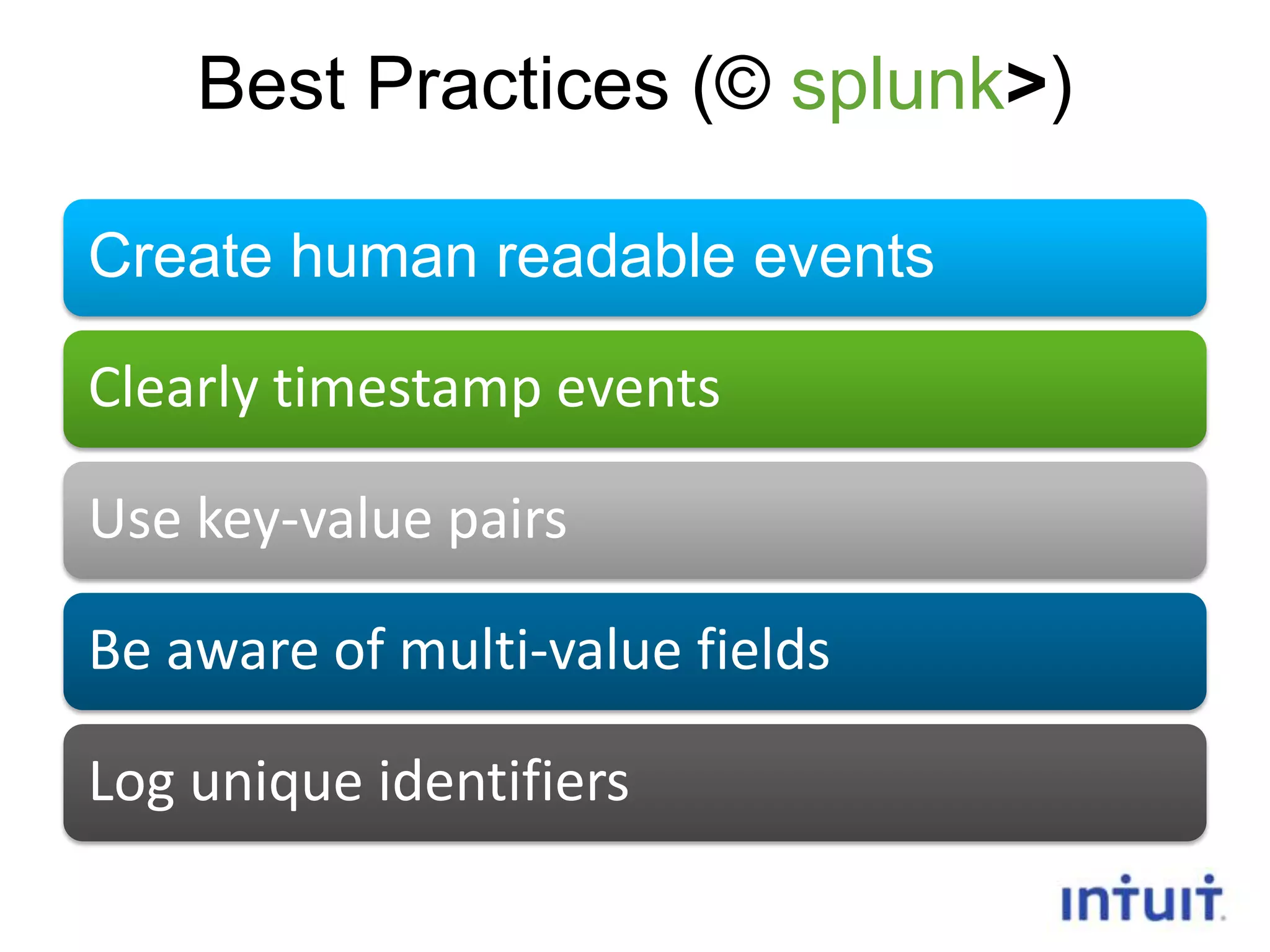
Best Practices (© splunk>)
Create human readable events

Clearly timestamp events
Use key-value pairs
Be aware of multi-value fields
Log unique identifiers
10
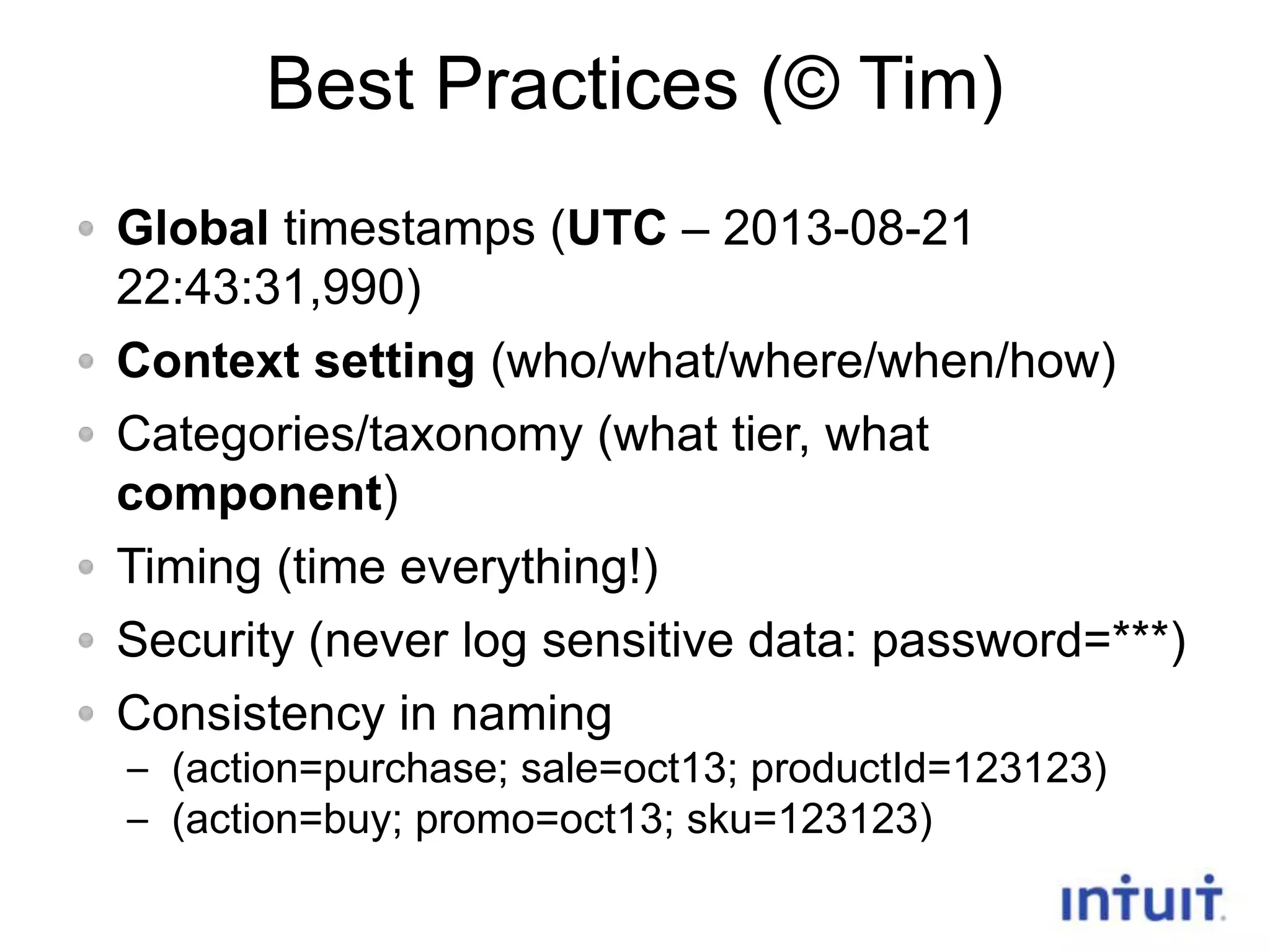
Best Practices (© Tim)
Global timestamps (UTC – 2013-08-21
22:43:31,990)
Context setting (who/what/where/when/how)
Categories/taxonomy (what tier, what
component)
Timing (time everything!)
Security (never log sensitive data: password=***)
Consistency in naming
– (action=purchase; sale=oct13; productId=123123)
– (action=buy; promo=oct13; sku=123123)
11
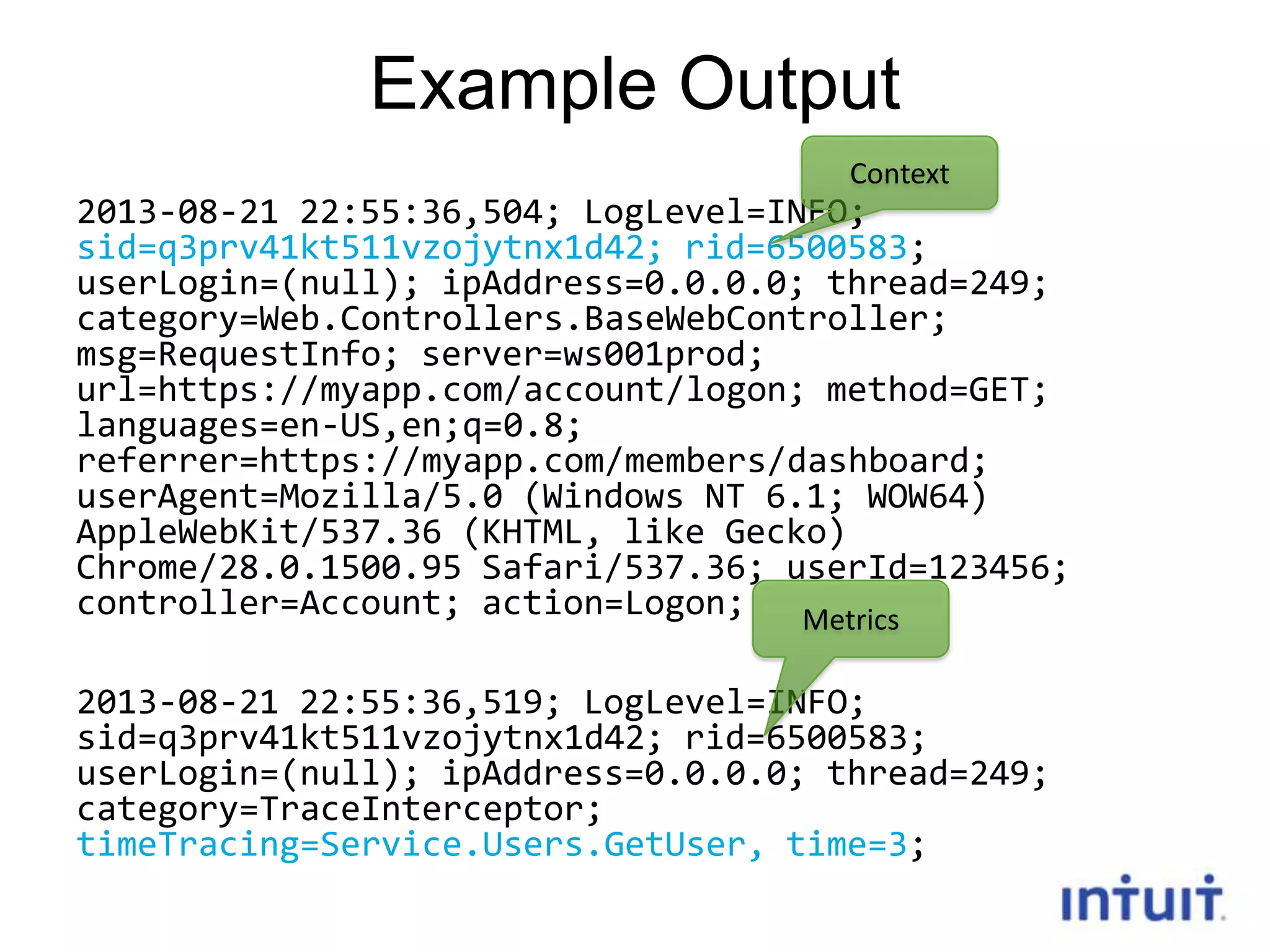
Example Output
Context

2013-08-21 22:55:36,504; LogLevel=INFO;
sid=q3prv41kt511vzojytnx1d42; rid=6500583;
userLogin=(null); ipAddress=0.0.0.0; thread=249;
category=Web.Controllers.BaseWebController;
msg=RequestInfo; server=ws001prod;
url=https://myapp.com/account/logon; method=GET;
languages=en-US,en;q=0.8;
referrer=https://myapp.com/members/dashboard;
userAgent=Mozilla/5.0 (Windows NT 6.1; WOW64)
AppleWebKit/537.36 (KHTML, like Gecko)
Chrome/28.0.1500.95 Safari/537.36; userId=123456;
controller=Account; action=Logon;
Metrics
2013-08-21 22:55:36,519; LogLevel=INFO;
sid=q3prv41kt511vzojytnx1d42; rid=6500583;
userLogin=(null); ipAddress=0.0.0.0; thread=249;
category=TraceInterceptor;
timeTracing=Service.Users.GetUser, time=3;
12
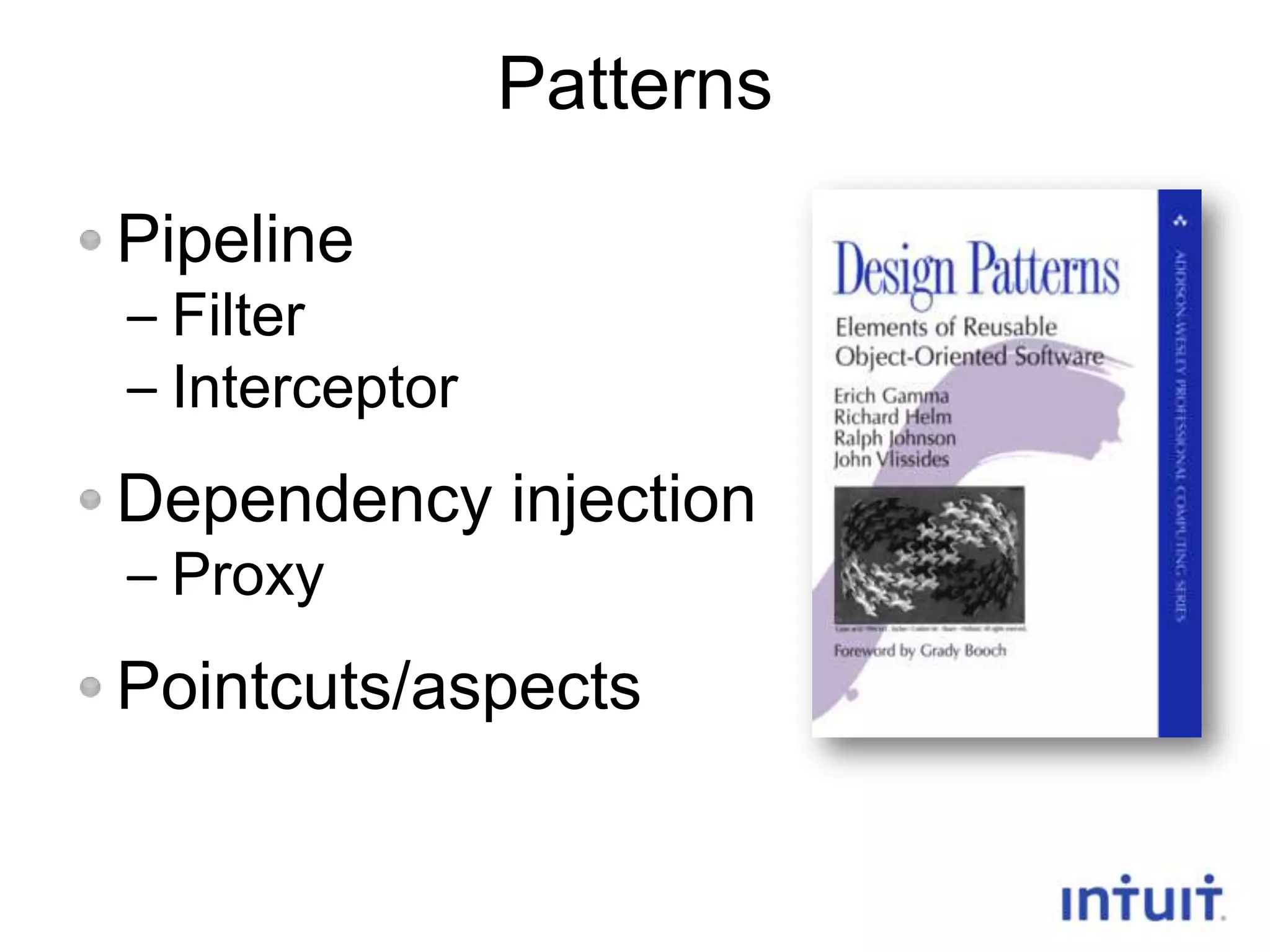
Patterns
Pipeline
– Filter
– Interceptor

Dependency injection
– Proxy

Pointcuts/aspects

13
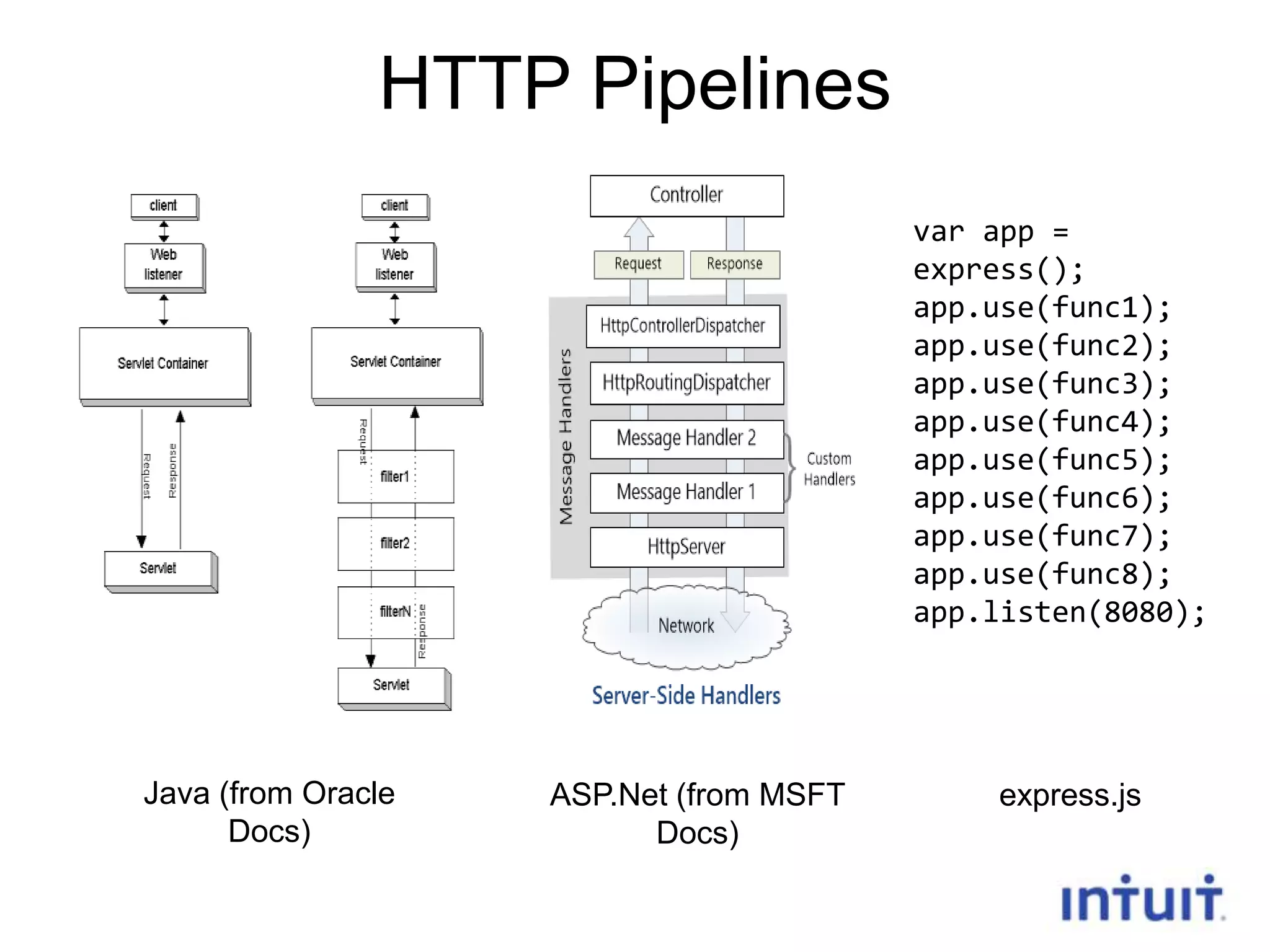
HTTP Pipelines
var app =
express();
app.use(func1);
app.use(func2);
app.use(func3);
app.use(func4);
app.use(func5);
app.use(func6);
app.use(func7);
app.use(func8);
app.listen(8080);

Java (from Oracle
Docs)

ASP.Net (from MSFT
Docs)
14

express.js
Dependency Injection
•

Enforces interface-based programming

•

Forbids circular references

•

Lends itself to testability

•

Flexibility in changing implementations

•

For our purposes: cross-cutting
capabilities

15
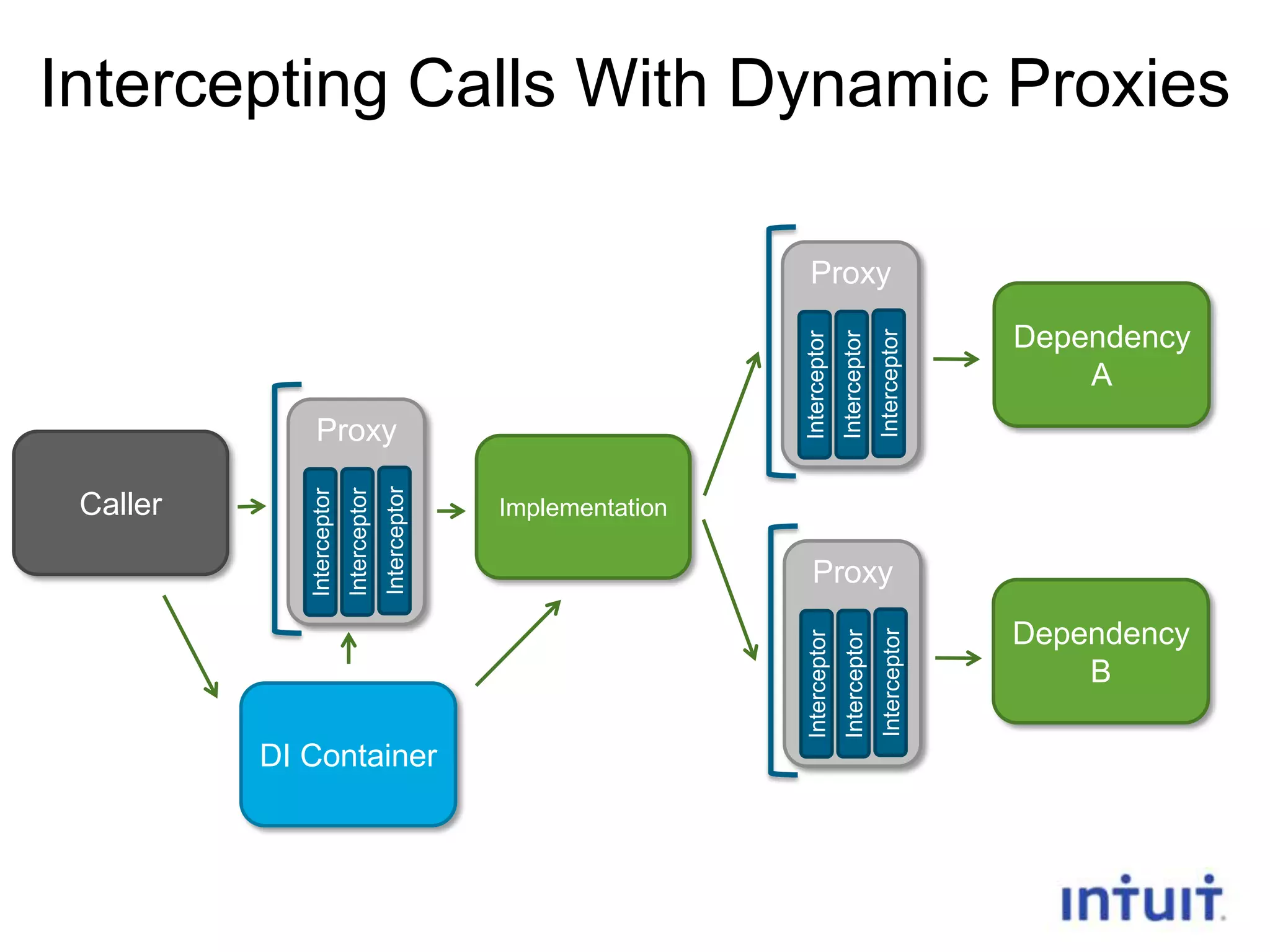
Intercepting Calls With Dynamic Proxies

Interceptor

Dependency
A

Implementation

DI Container

16

Interceptor

Interceptor

Proxy
Interceptor

Interceptor

Interceptor

Caller

Interceptor

Proxy

Interceptor

Interceptor

Proxy

Dependency
B
Supporting Frameworks
The Front
Door

The Inner
Sanctum

Annotations
& Attributes

• ASP.Net
Modules/ActionFi
lters
• Java Servlet
Filters/Spring
Interceptors
• Node.js
interceptors

• Unity Dynamic
Proxies
• Spring
@AspectJ
Pointcuts
• JavaScript
Mixins

• @Instrumentable
• [Instrumentable]

17
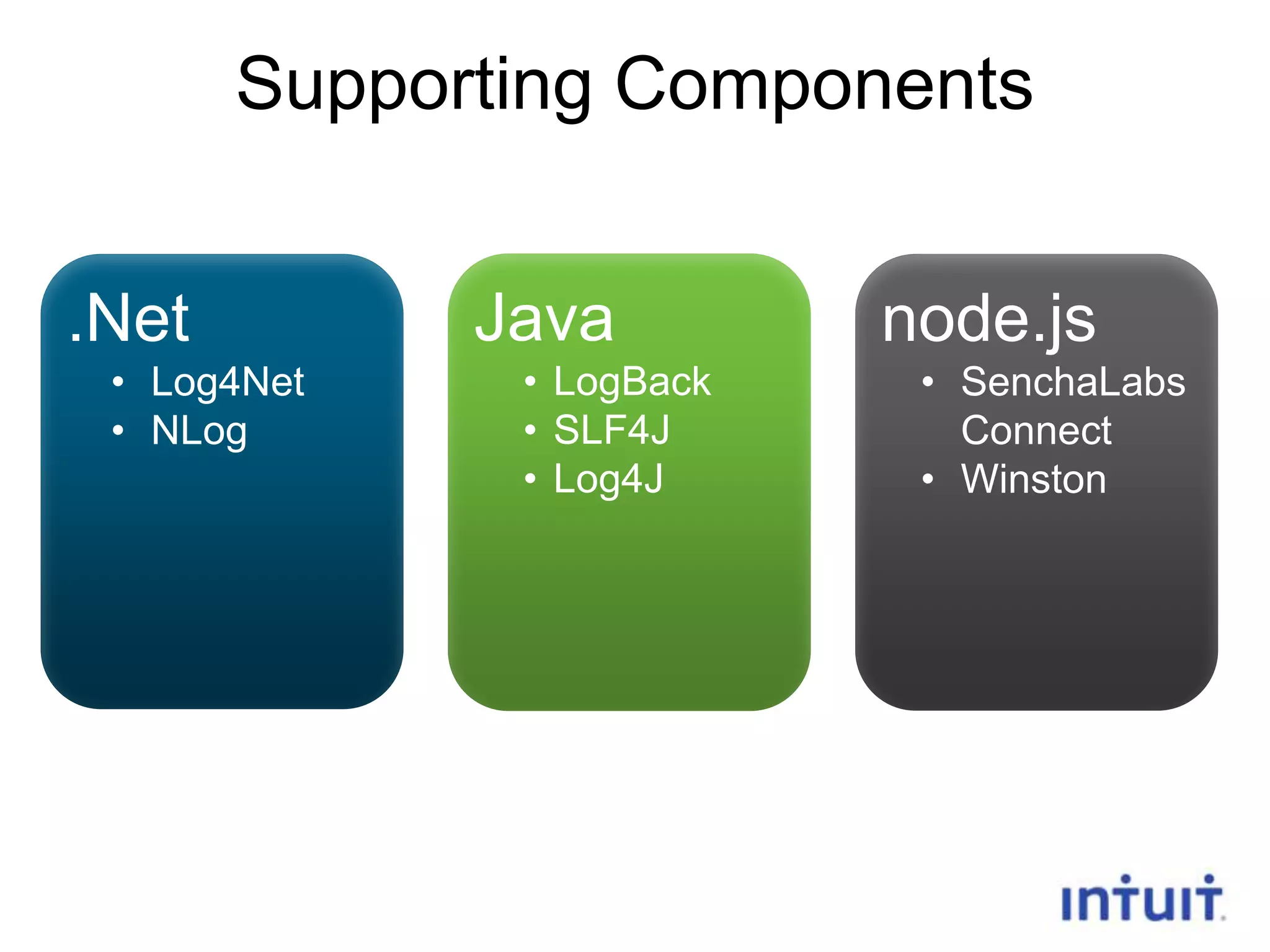
Supporting Components
.Net
• Log4Net
• NLog

Java

node.js

• LogBack
• SLF4J
• Log4J

18

• SenchaLabs
Connect
• Winston
Intervention!
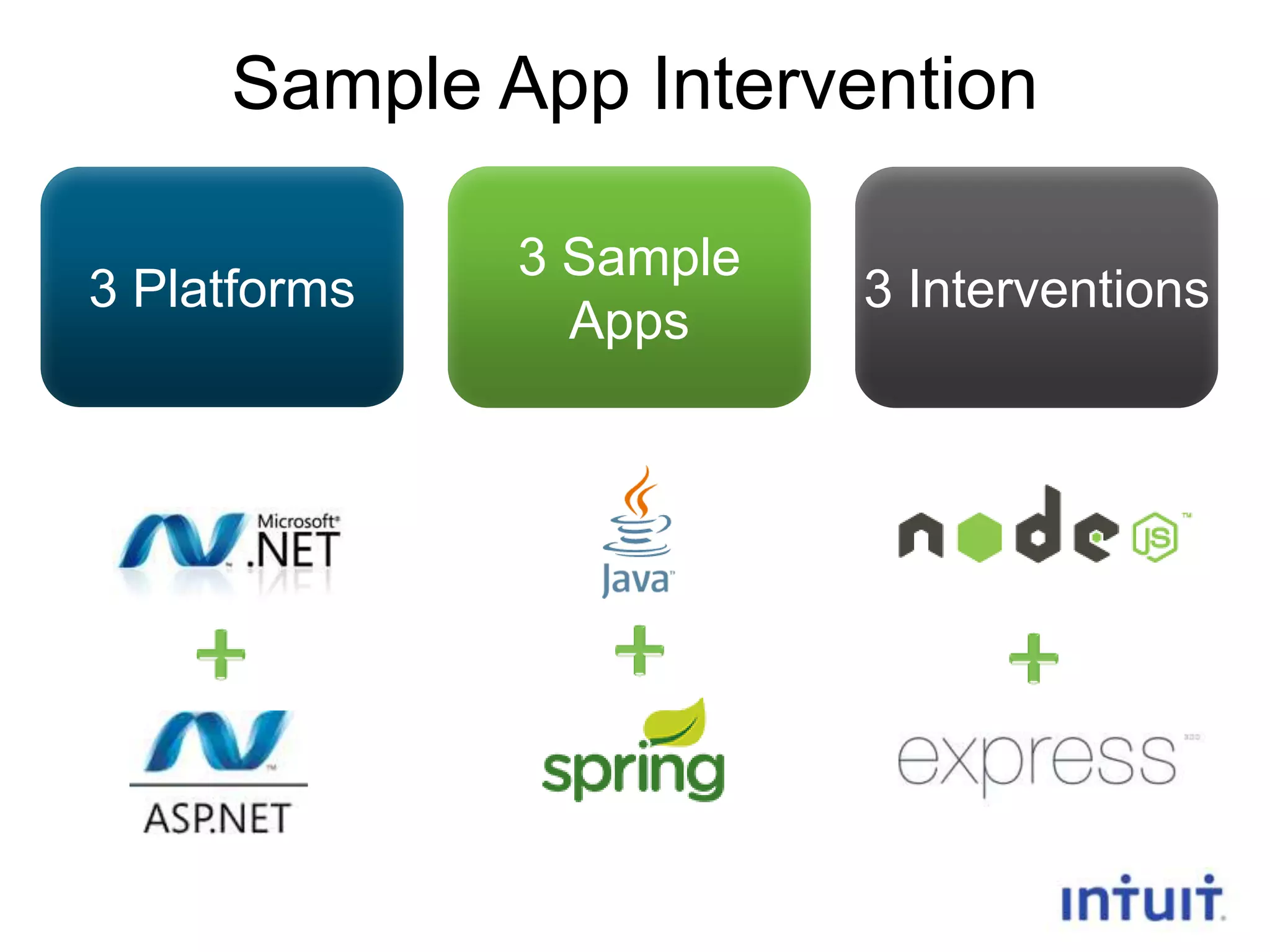
Sample App Intervention
3 Platforms

3 Sample
Apps

20

3 Interventions
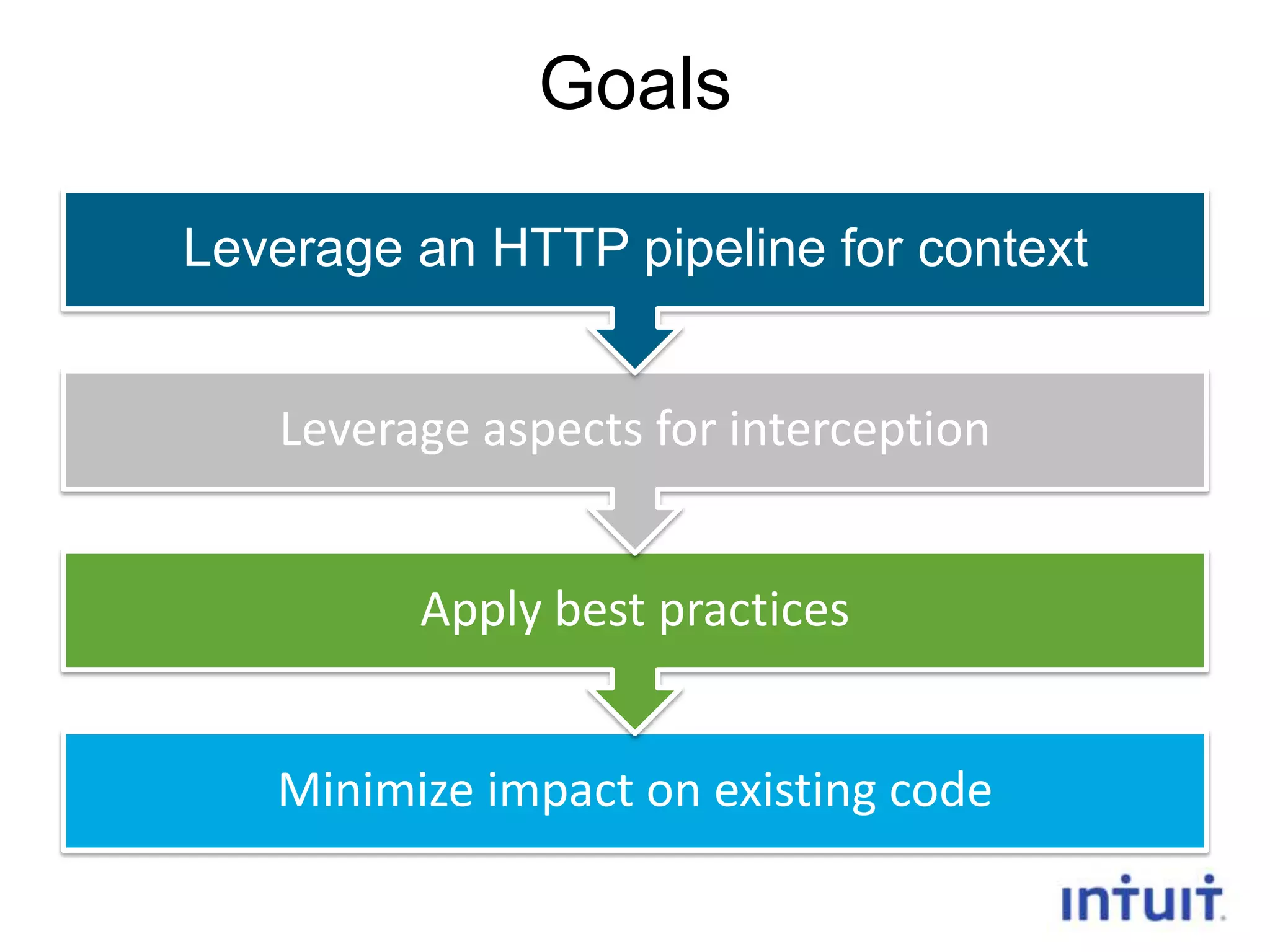
Goals
Leverage an HTTP pipeline for context

Leverage aspects for interception
Apply best practices

Minimize impact on existing code
21
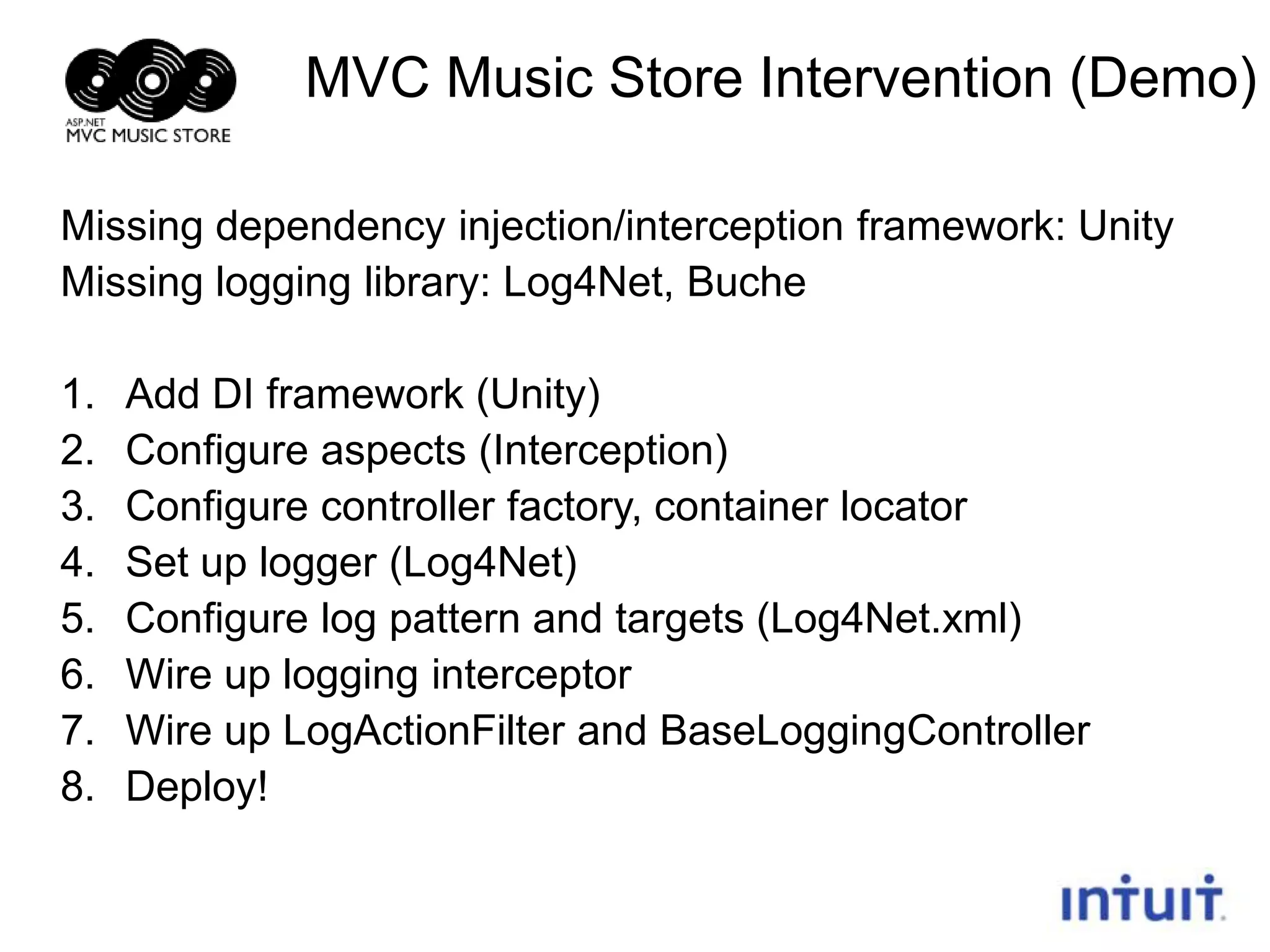
MVC Music Store Intervention (Demo)
Missing dependency injection/interception framework: Unity
Missing logging library: Log4Net, Buche
1.
2.
3.
4.
5.
6.
7.
8.

Add DI framework (Unity)
Configure aspects (Interception)
Configure controller factory, container locator
Set up logger (Log4Net)
Configure log pattern and targets (Log4Net.xml)
Wire up logging interceptor
Wire up LogActionFilter and BaseLoggingController
Deploy!
22
Spring Pet Clinic Intervention (Demo)
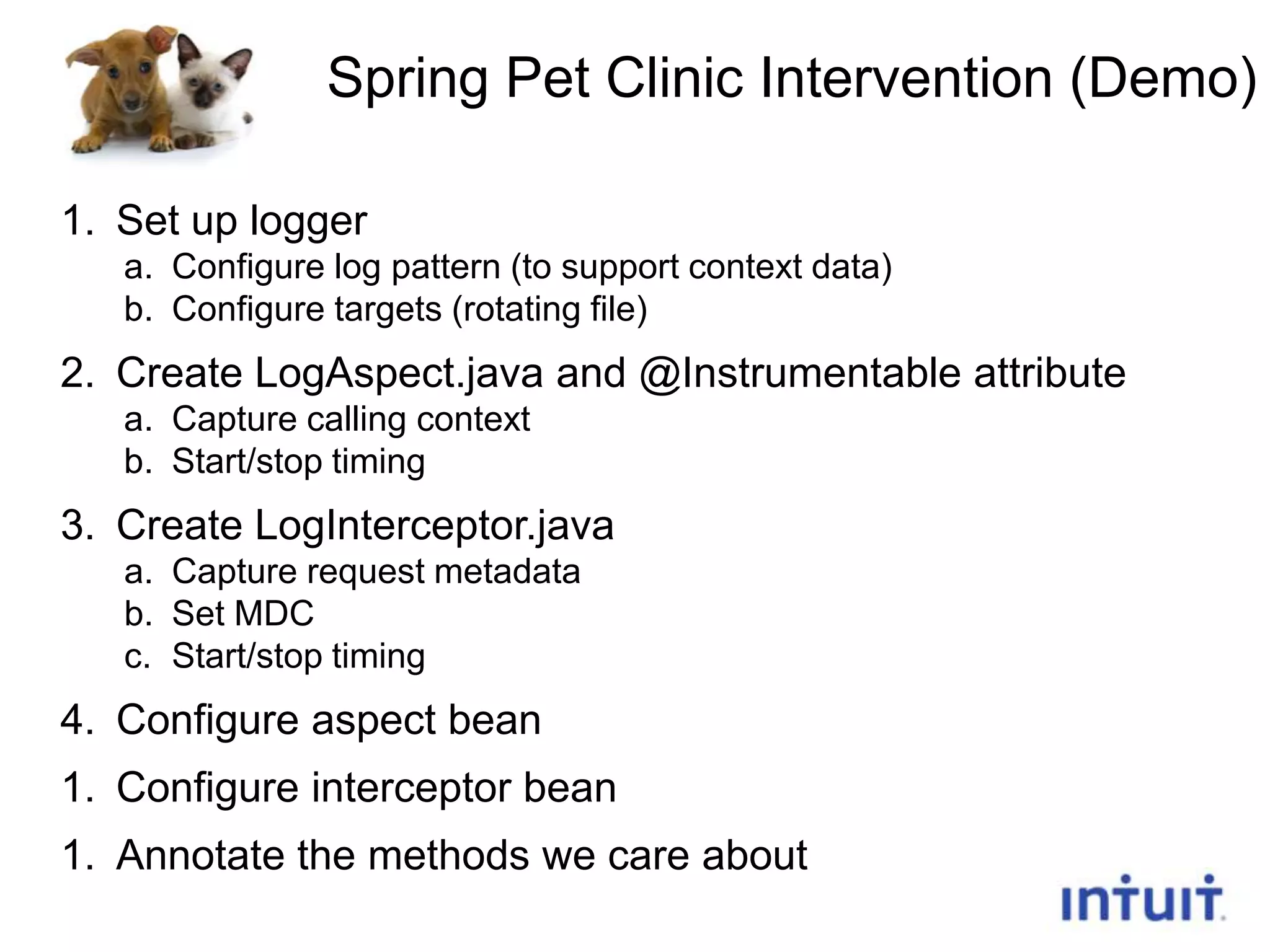
1. Set up logger
a. Configure log pattern (to support context data)
b. Configure targets (rotating file)

2. Create LogAspect.java and @Instrumentable attribute
a. Capture calling context
b. Start/stop timing

3. Create LogInterceptor.java
a. Capture request metadata
b. Set MDC
c. Start/stop timing

4. Configure aspect bean
1. Configure interceptor bean
1. Annotate the methods we care about
23
NodeCellar Intervention (Demo)
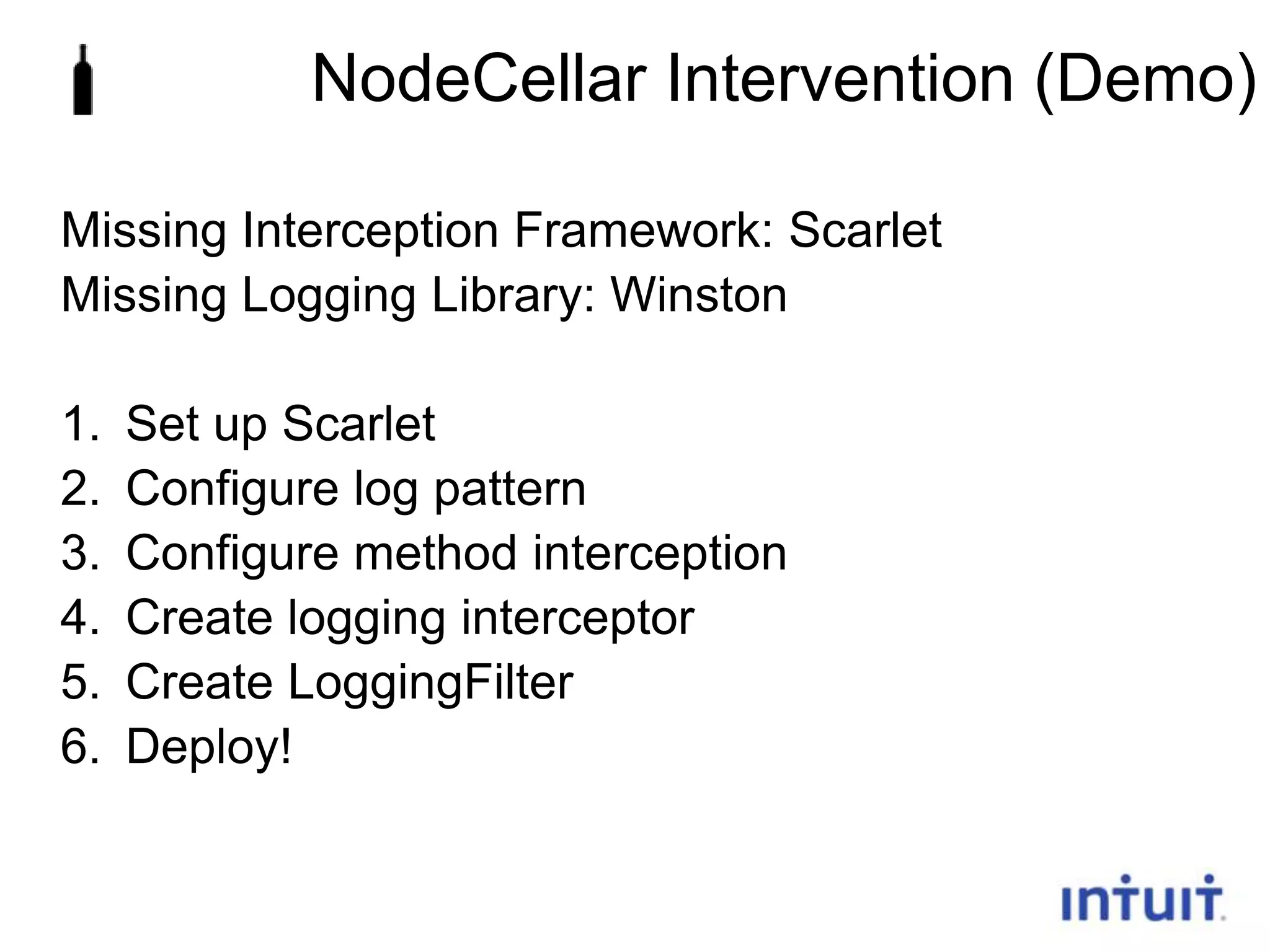
Missing Interception Framework: Scarlet
Missing Logging Library: Winston
1.
2.
3.
4.
5.
6.

Set up Scarlet
Configure log pattern
Configure method interception
Create logging interceptor
Create LoggingFilter
Deploy!

24
Closing
Thoughts
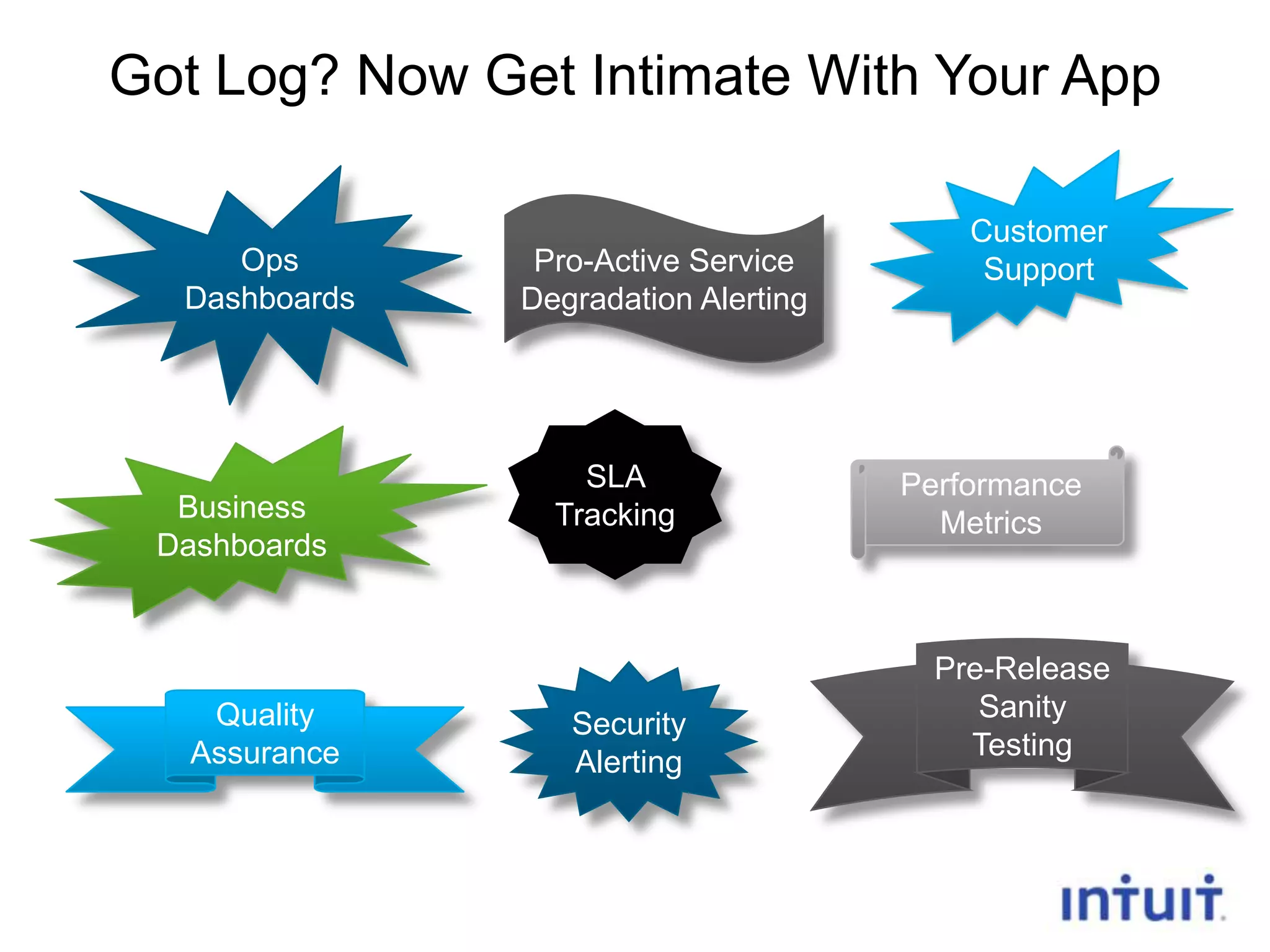
Got Log? Now Get Intimate With Your App

Ops
Dashboards

Business
Dashboards

Quality
Assurance

Pro-Active Service
Degradation Alerting

SLA
Tracking

Security
Alerting

2
6

Customer
Support

Performance
Metrics

Pre-Release
Sanity
Testing
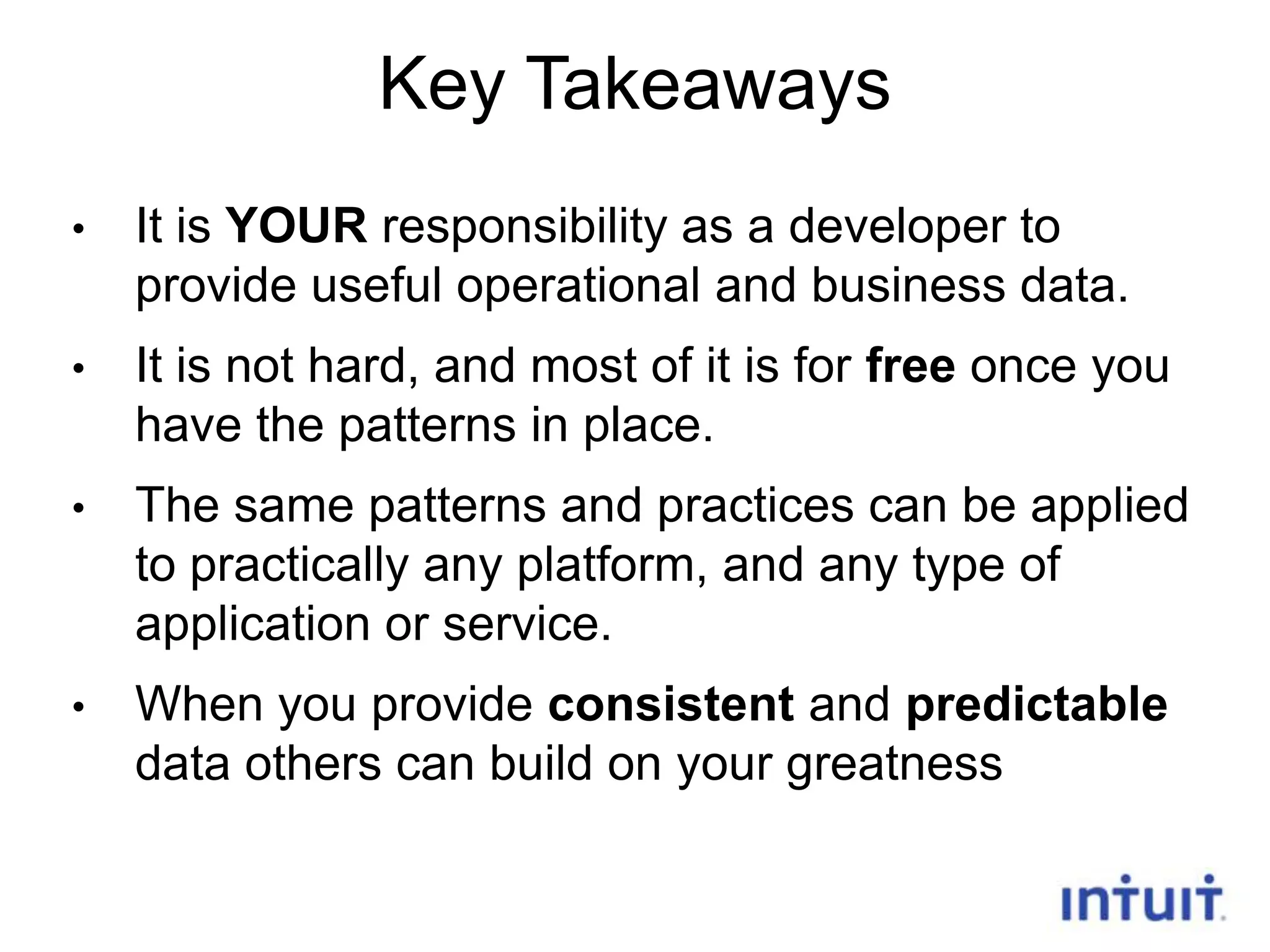
Key Takeaways
•

It is YOUR responsibility as a developer to
provide useful operational and business data.

•

It is not hard, and most of it is for free once you
have the patterns in place.

•

The same patterns and practices can be applied
to practically any platform, and any type of
application or service.

•

When you provide consistent and predictable
data others can build on your greatness
27
Get the Code
@hoserdude
Spring Pet Clinic Intervention:
https://github.com/hoserdude/spring-petclinic-instrumented
MVC Music Store Intervention:
https://github.com/hoserdude/mvcmusicstore-instrumented
NodeCellar Intervention:
https://github.com/hoserdude/nodecellar-instrumented

28
Intuit Speakers @ Silicon Code Camp 2013:
SATURDAY
9:45 a.m. - Ramakrishna Kollipara – “Complete Automation of Performance Testing”
1:45 p.m. - Joe Wells - “QBO: Journey From legacy Java app to a Client-side HTML5
app”
3:30 p.m. - Naga Addagadde & Sangeeta Narang – “Intuit APIs for Financial Transaction
Aggregation”
5:00 p.m. Ted Drake –“Hitting the Accessibility High Notes with ARIA”
SUNDAY
9:15 a.m. - Eugene Krivopaltsev –“Building Native Mobile Apps with Custom Views”
1:15 p.m. - Tim Hobson – “Developing Highly Instrumental Applications with Minimal
Effort”

For more information about joining our organization visit our booth or
connect with our onsite recruiter:
Chriscox_recruiter@intuit.com
You don't want to miss out on a chance to win this cool headset.
Stop by our booth to enter!
THANK YOU

Want to talk more?
I’ll be at the Intuit booth today 3-5 PM.

30

Developing Highly Instrumented Applications with Minimal Effort

  • 1.
    Developing highly instrumented applications withminimal effort Tim Hobson Principal Engineer, Chief Caffeine Officer - Intuit
  • 2.
  • 3.
    Agenda Concepts • Quality Data •Application Instrumentation • Application Logging Theory • Patterns • Supporting Frameworks • Supporting Components Practice • .Net Example • Java Example • Node.js Example GOAL: You should be able to apply this to your application today 3
  • 4.
  • 5.
    If You DoNothing… OR 5
  • 6.
    There’s No FreeLunch Garbage In, Garbage Out Insight! 6
  • 7.
    Quality In, InsightOut Most apps start with only the framework or app server logging (or nothing!) None of the above is interesting to the business or the developer. You can’t get if you don’t give – there are many ways to give, and many classes of data to provide. 7
  • 8.
    Classes of SystemOutput System Instrumentation • JMX/WMI/SNMP monitoring • Apache/IIS/nginx access logs App Logging App Instrumentation • • • • • • • • Intentional Business Transactions Overtly triggers alerts Source of business metrics • Aids in troubleshooting failures, bugs Cross-cutting (free) App Activity Passively triggers alerts Source of performance data • Source of usage data 8
  • 9.
  • 10.
    Best Practices (©splunk>) Create human readable events Clearly timestamp events Use key-value pairs Be aware of multi-value fields Log unique identifiers 10
  • 11.
    Best Practices (©Tim) Global timestamps (UTC – 2013-08-21 22:43:31,990) Context setting (who/what/where/when/how) Categories/taxonomy (what tier, what component) Timing (time everything!) Security (never log sensitive data: password=***) Consistency in naming – (action=purchase; sale=oct13; productId=123123) – (action=buy; promo=oct13; sku=123123) 11
  • 12.
    Example Output Context 2013-08-21 22:55:36,504;LogLevel=INFO; sid=q3prv41kt511vzojytnx1d42; rid=6500583; userLogin=(null); ipAddress=0.0.0.0; thread=249; category=Web.Controllers.BaseWebController; msg=RequestInfo; server=ws001prod; url=https://myapp.com/account/logon; method=GET; languages=en-US,en;q=0.8; referrer=https://myapp.com/members/dashboard; userAgent=Mozilla/5.0 (Windows NT 6.1; WOW64) AppleWebKit/537.36 (KHTML, like Gecko) Chrome/28.0.1500.95 Safari/537.36; userId=123456; controller=Account; action=Logon; Metrics 2013-08-21 22:55:36,519; LogLevel=INFO; sid=q3prv41kt511vzojytnx1d42; rid=6500583; userLogin=(null); ipAddress=0.0.0.0; thread=249; category=TraceInterceptor; timeTracing=Service.Users.GetUser, time=3; 12
  • 13.
    Patterns Pipeline – Filter – Interceptor Dependencyinjection – Proxy Pointcuts/aspects 13
  • 14.
    HTTP Pipelines var app= express(); app.use(func1); app.use(func2); app.use(func3); app.use(func4); app.use(func5); app.use(func6); app.use(func7); app.use(func8); app.listen(8080); Java (from Oracle Docs) ASP.Net (from MSFT Docs) 14 express.js
  • 15.
    Dependency Injection • Enforces interface-basedprogramming • Forbids circular references • Lends itself to testability • Flexibility in changing implementations • For our purposes: cross-cutting capabilities 15
  • 16.
    Intercepting Calls WithDynamic Proxies Interceptor Dependency A Implementation DI Container 16 Interceptor Interceptor Proxy Interceptor Interceptor Interceptor Caller Interceptor Proxy Interceptor Interceptor Proxy Dependency B
  • 17.
    Supporting Frameworks The Front Door TheInner Sanctum Annotations & Attributes • ASP.Net Modules/ActionFi lters • Java Servlet Filters/Spring Interceptors • Node.js interceptors • Unity Dynamic Proxies • Spring @AspectJ Pointcuts • JavaScript Mixins • @Instrumentable • [Instrumentable] 17
  • 18.
    Supporting Components .Net • Log4Net •NLog Java node.js • LogBack • SLF4J • Log4J 18 • SenchaLabs Connect • Winston
  • 19.
  • 20.
    Sample App Intervention 3Platforms 3 Sample Apps 20 3 Interventions
  • 21.
    Goals Leverage an HTTPpipeline for context Leverage aspects for interception Apply best practices Minimize impact on existing code 21
  • 22.
    MVC Music StoreIntervention (Demo) Missing dependency injection/interception framework: Unity Missing logging library: Log4Net, Buche 1. 2. 3. 4. 5. 6. 7. 8. Add DI framework (Unity) Configure aspects (Interception) Configure controller factory, container locator Set up logger (Log4Net) Configure log pattern and targets (Log4Net.xml) Wire up logging interceptor Wire up LogActionFilter and BaseLoggingController Deploy! 22
  • 23.
    Spring Pet ClinicIntervention (Demo) 1. Set up logger a. Configure log pattern (to support context data) b. Configure targets (rotating file) 2. Create LogAspect.java and @Instrumentable attribute a. Capture calling context b. Start/stop timing 3. Create LogInterceptor.java a. Capture request metadata b. Set MDC c. Start/stop timing 4. Configure aspect bean 1. Configure interceptor bean 1. Annotate the methods we care about 23
  • 24.
    NodeCellar Intervention (Demo) MissingInterception Framework: Scarlet Missing Logging Library: Winston 1. 2. 3. 4. 5. 6. Set up Scarlet Configure log pattern Configure method interception Create logging interceptor Create LoggingFilter Deploy! 24
  • 25.
  • 26.
    Got Log? NowGet Intimate With Your App Ops Dashboards Business Dashboards Quality Assurance Pro-Active Service Degradation Alerting SLA Tracking Security Alerting 2 6 Customer Support Performance Metrics Pre-Release Sanity Testing
  • 27.
    Key Takeaways • It isYOUR responsibility as a developer to provide useful operational and business data. • It is not hard, and most of it is for free once you have the patterns in place. • The same patterns and practices can be applied to practically any platform, and any type of application or service. • When you provide consistent and predictable data others can build on your greatness 27
  • 28.
    Get the Code @hoserdude SpringPet Clinic Intervention: https://github.com/hoserdude/spring-petclinic-instrumented MVC Music Store Intervention: https://github.com/hoserdude/mvcmusicstore-instrumented NodeCellar Intervention: https://github.com/hoserdude/nodecellar-instrumented 28
  • 29.
    Intuit Speakers @Silicon Code Camp 2013: SATURDAY 9:45 a.m. - Ramakrishna Kollipara – “Complete Automation of Performance Testing” 1:45 p.m. - Joe Wells - “QBO: Journey From legacy Java app to a Client-side HTML5 app” 3:30 p.m. - Naga Addagadde & Sangeeta Narang – “Intuit APIs for Financial Transaction Aggregation” 5:00 p.m. Ted Drake –“Hitting the Accessibility High Notes with ARIA” SUNDAY 9:15 a.m. - Eugene Krivopaltsev –“Building Native Mobile Apps with Custom Views” 1:15 p.m. - Tim Hobson – “Developing Highly Instrumental Applications with Minimal Effort” For more information about joining our organization visit our booth or connect with our onsite recruiter: Chriscox_recruiter@intuit.com You don't want to miss out on a chance to win this cool headset. Stop by our booth to enter!
  • 30.
    THANK YOU Want totalk more? I’ll be at the Intuit booth today 3-5 PM. 30

Editor's Notes

  • #7 Many products promise to provide insights and value from whatever data you throw at them. There’s no doubt they can provide something, but you can’t escape the law of GIGO.
  • #8 As a result, it’s on you as a developer, product manager and business to care about the data you are creating. This presentation will demonstrate some best practices on how to go about this, regardless of your platform.
  • #9 Now for some definitions. There is a lot of stuff generated by the system – let’s classify the stuff broadly and narrow on what I am going to be talking about.
  • #14 Quick review of patterns we’ll use. Interception is the secret sauce here. We want to be able to get in front of every call to every object or component in our system. That lets us see what data is being passed around, who is doing it, and how long it took.
  • #19 Indent the bullets