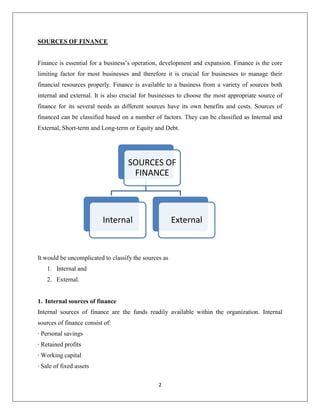
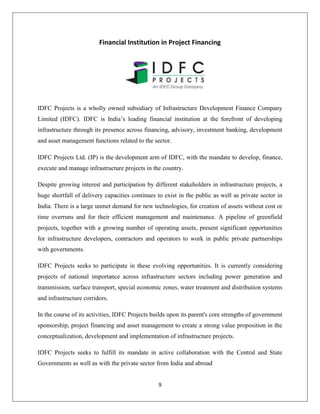
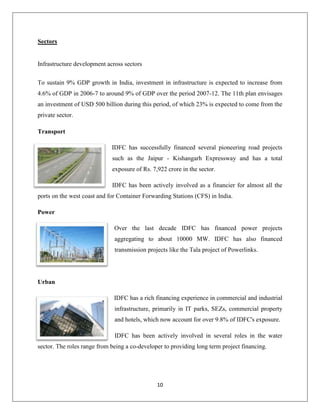
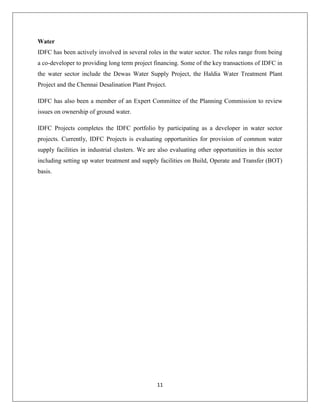
INTRODUCTION<br />Project Financing:<br />right0Finance is the life blood of any organisation, having too less of blood leads to anemia in human beings, similarly paucity of finance leads to decrease in activities or shelving of future expansion plans of any organisation and may even lead to failure of business. Financial institutions offer services for arranging finance for businesses to meet its various needs.<br />Project Financing discipline includes understanding the rationale for project financing, how to prepare the financial plan, assess the risks, design the financing mix, and raise the funds. In addition, one must understand the cogent analyses of why some project financing plans have succeeded while others have failed. A knowledge-base is required regarding the design of contractual arrangements to support project financing; issues for the host government legislative provisions, public/private infrastructure partnerships, public/private financing structures; credit requirements of lenders, and how to determine the project's borrowing capacity; how to prepare cash flow projections and use them to measure expected rates of return; tax and accounting considerations; and analytical techniques to validate the project's feasibility<br />Project finance is finance for a particular project, such as a mine, toll road, railway, pipeline, power station, ship, hospital or prison, which is repaid from the cash-flow of that project. <br />SOURCES OF FINANCE<br />Finance is essential for a business’s operation, development and expansion. Finance is the core limiting factor for most businesses and therefore it is crucial for businesses to manage their financial resources properly. Finance is available to a business from a variety of sources both internal and external. It is also crucial for businesses to choose the most appropriate source of finance for its several needs as different sources have its own benefits and costs. Sources of financed can be classified based on a number of factors. They can be classified as Internal and External, Short-term and Long-term or Equity and Debt.<br />523875215265<br />It would be uncomplicated to classify the sources as <br />Internal and
External.
Internal sources of financeInternal sources of finance are the funds readily available within the organization. Internal sources of finance consist of:<br />· Personal savings<br />· Retained profits<br />· Working capital<br />· Sale of fixed assets<br />Personal savingsThis is the amount of personal money an owner, partner or shareholder of a business has at his disposal to do whatever he wants. When a business seeks to borrow the personal money of a shareholder, partner or owner for a business’s financial needs the source of finance is known as personal savings.<br />Retained profitsRetained profits are the undistributed profits of a company. Not all the profits made by a company are distributed as dividends to its shareholders. The remainder of the profits after all payments is made for a trading year is known as retained profits. This remainder of finance is saved by the business as a back-up in times of financial needs and maybe used later for company’s development or expansion. Retained profits are a very valuable no-cost source of finance.<br />Working capitalWorking capital refers to the sum of money that a business uses for its daily activities. Working capital is the difference of current assets and current liabilities (i.e. Working capital = Current assets – Current liabilities). Proper working capital management is also vital as it is also a source of finance for a business.<br />Current assets<br />Current assets are also known as cash equivalents because they are easily convertible to cash. Current assets consist of Stock, Debtors, Prepayments, Bank and Cash. These assets are used up, sold or keep changing in the short run.<br />Stock – this refers to the stock of goods available to the business for sale at a given time. It is very important to maintain the right amount of stock of goods for a business. If stock levels are too high it means that too much of money is being held up in the form of stock and if stock levels are too low the business will lose possible opportunities of higher sales. Debtors – are a business’s customers owing money to the business having been bought the business’s goods or service on credit. If a business has cash flow problems it can maintain a low level of debtors by encouraging the debtors to pay as early as possible. Prepayments – these are the expenses paid in advance. The payment being made even before the expense occurs is a prepayment. Bank and Cash – Bank is the cash held in banks and cash is money held by the business in the form of cash. Having too much of money in the form of cash is also not good for a business since it can use that money to invest and earn a return but however a business should have healthy current ratio (current assets : current liabilities) of 2:1.<br />Current liabilities<br />Current liabilities are short-term debts that are in immediate need of settlement. Some examples of current liabilities are creditors, accruals, proposed dividends and tax owing. These obligations have to be paid within a year.<br />Creditors – also known as trade creditors are suppliers from whom the business purchased goods on credit. Paying the creditors as late as possible will ease cash flow requirements for a business. <br />Accruals – are the expenses owed by the business. <br />Dividends proposed – are the dividends payable for the year that is not yet paid.<br />Tax owing – is the sum of money owing as tax.<br />Sale of fixed assetsFixed assets are the assets a company that do not get consumed in the process of production. Some examples of fixed assets are land and building, machinery, vehicles, fixtures and fittings and equipment. Sometimes where the fixed asset is a surplus and is abandoned, it can be sold to raise finance in demanding times for the business. Otherwise businesses may choose to stop offering certain products and sell its fixed assets to raise finance. Selling fixed assets reduces the production capacity of a business affecting a business’s return.<br />2. External sources of finance<br />Sources of finance that are not internal sources of finance are external sources of finance. External sources of finance are from sources that are outside the business. External sources of finance can either be:<br />Ownership capital or
Non-ownership capital
Ownership capitalOwnership capital is the money invested in the business by the owners themselves. It can be the capital funding by owners and partners or it can also be share bought by the shareholders of a company. There are mainly two main types of shares. They are:<br />Ordinary shares
Preference shares
Ordinary sharesOrdinary shares also known as equity shares are a unit of investment in a company. Ordinary shareholders have the privilege of receiving a part of company profits via dividends which is based on the value of shares held by the shareholder and the profit made for the year by the company. They also have the right to vote at general meetings of the company. Companies can issue ordinary shares in order to raise finance for long-term financial needs.<br />Preference sharesPreference shares are another type of shares. Preference shareholders receive a fixed rate of dividends before the ordinary shareholders are paid. Preference shareholders do not have the right to vote at general meetings of the company. Preference shares are also an ownership capital source of finance. There are several types of preference shares. Some of them are Cumulative preference share, Redeemable preference share, Participating preference share and Convertible preference share. Cumulative preference shares – if a company is in a loss making situation and is unable to pay dividends for one year then the dividend for that year will be paid the next year along with next year’s dividends. Redeemable preference shares – these preference shares can be bought back by the company at a later date. <br />Non-ownership capitalUnlike ownership capital, non-ownership capital does not allow the lender to participate in profit-sharing or to influence how the business is run. The main obligations of non-ownership capital are to pay back the borrowed sum of money and interest. Different types of non-ownership capital:<br />○ Debentures<br />○ Bank overdraft<br />○ Loan<br />○ Hire-purchase<br />○ Lease<br />○ Grant<br />○ Venture capital<br />○ Factoring<br />○ Invoice discounting<br />DebenturesDebentures are issued in order to raise debt capital. Debenture holders are not owners but long-term creditors of the company. Debenture holders receive a fixed rate of interest annually whether the company makes a profit or loss. Debentures are issued only for a time period and thus the company must pay the amount back to the debenture holders at the end of the agreed period. Debentures can be secured, unsecured, fixed or floating. Secured debentures – are debentures that are secured against an asset. They are also called mortgage debentures. Unsecured debentures – these debentures do not have an asset as<br />Collateral. Fixed debentures – have a fixed rate of interest. Floating debentures – do not have fixed rate of interest and are not tied to any specific asset.<br />Bearer debentures – these debentures are easily transferable.
Registered debentures – are not easily transferable and legal
Procedures have to be followed in case of a transfer.
Convertible debentures – can be converted to stock at the end of the debenture repayment date.
Bank overdraftBank overdraft is a short term credit facility provided by banks for its current account holders. This facility allows businesses to with draw more money than their bank account balances hold. Interest has to be paid on the amount overdrawn. Bank overdraft is the ideal source of finance for short-term cash f low problems.<br />LoanLoans are amounts of money borrowed from banks or other financial institutions for large and long-term business projects such as the development or expansion of the business. However loans can be substituted by other alternative sources of finance which are more suitable.<br />Hire purchaseHire purchase allows a business to use an asset without paying the full amount to purchase the asset. The hire purchase firm buys the asset on behalf of the business and gives the business the sole usage of the asset. The business on its part must pay monthly payments to the hire purchase firm amounting to the total value of the asset and charges of the hire purchase firm. At the end of the payment period the business has the option of purchasing the asset for a nominal value.<br />LeaseIn a lease the leasing company buys the asset on behalf of the business and the asset is then provided for the business to its use. Unlike a hire purchase the ownership of the asset remains with the leasing company. The business pays a rent throughout the leasing period. The leasing firm is known as the less or and the customer as lessee.<br /> Leasing is of two types, namely <br />Finance lease and
Operating lease.
Finance Lease – this is where the lessee’s monthly payments add up to at least 90% of the total value of the asset. Operating Lease – this lease does not run for the full life of the asset and the lessee is not liable for the full value of the asset.
GrantGrants are funding given to businesses for programs or services that benefit the community or public at large. Grants can be given by the government or private firms. For example a grant may be given to open a new factory where unemployment is high.<br />Venture capitalVenture capital is the capital that is contributed at the initial stages of an uncertain business. The chance of failure of the business is great while there is also a possibility of providing higher than average return for the investor. The investor expects to have some influence over the business.<br />FactoringThis is where the factoring company pays a proportion of the sales invoice of the business within a short time-frame to the business. The remainder of the money is paid to the business when the factoring company receives the money from the business’s debtor. The remainder of the money will be paid only after deducting the factoring company’s service charges. Some factoring companies even offer to maintain the sales ledger of the business. <br />Factoring is of two types: <br />Recourse factoring and
Non-recourse factoring.
Recourse factoring – In this type of factoring the client company is liable for bad debts.
Non-recourse factoring – is where the factor takes responsibility for the payment of the debtors. The client company is not liable if debtors do not pay back. Non-recourse factoring is usually more expensive because of the high risks experienced by the factor.
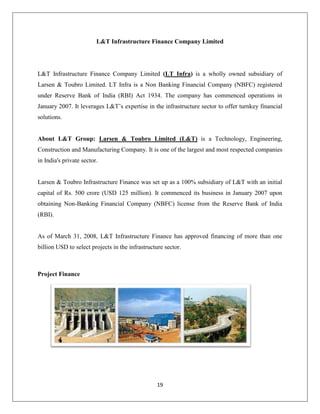
Invoice discountingIn invoice discounting the client company send out a copy of the invoice to the invoice discounting firm. The client then receives a portion of the invoice value. In contrast to factoring, the client company collects the money from its debtors. Once the payment is received it is deposited in a bank account controlled by the invoice discounter. The invoice discounter will then pay the remainder of the invoice less any charges to the client.<br />Financial Institution in Project Financing<br />2124075495300 <br />IDFC Projects is a wholly owned subsidiary of Infrastructure Development Finance Company Limited (IDFC). IDFC is India’s leading financial institution at the forefront of developing infrastructure through its presence across financing, advisory, investment banking, development and asset management functions related to the sector.<br />IDFC Projects Ltd. (IP) is the development arm of IDFC, with the mandate to develop, finance, execute and manage infrastructure projects in the country.<br />Despite growing interest and participation by different stakeholders in infrastructure projects, a huge shortfall of delivery capacities continues to exist in the public as well as private sector in India. There is a large unmet demand for new technologies, for creation of assets without cost or time overruns and for their efficient management and maintenance. A pipeline of greenfield projects, together with a growing number of operating assets, present significant opportunities for infrastructure developers, contractors and operators to work in public private partnerships with governments. <br />IDFC Projects seeks to participate in these evolving opportunities. It is currently considering projects of national importance across infrastructure sectors including power generation and transmission, surface transport, special economic zones, water treatment and distribution systems and infrastructure corridors.<br />In the course of its activities, IDFC Projects builds upon its parent's core strengths of government sponsorship, project financing and asset management to create a strong value proposition in the conceptualization, development and implementation of infrastructure projects.<br />IDFC Projects seeks to fulfill its mandate in active collaboration with the Central and State Governments as well as with the private sector from India and abroad<br />Sectors<br />Infrastructure development across sectors<br />To sustain 9% GDP growth in India, investment in infrastructure is expected to increase from 4.6% of GDP in 2006-7 to around 9% of GDP over the period 2007-12. The 11th plan envisages an investment of USD 500 billion during this period, of which 23% is expected to come from the private sector.<br />Transport<br />-3810055880IDFC has successfully financed several pioneering road projects such as the Jaipur - Kishangarh Expressway and has a total exposure of Rs. 7,922 crore in the sector.<br />IDFC has been actively involved as a financier for almost all the ports on the west coast and for Container Forwarding Stations (CFS) in India.<br />Power<br />1905012065Over the last decade IDFC has financed power projects aggregating to about 10000 MW. IDFC has also financed transmission projects like the Tala project of Powerlinks.<br />Urban<br />19050117475IDFC has a rich financing experience in commercial and industrial infrastructure, primarily in IT parks, SEZs, commercial property and hotels, which now account for over 9.8% of IDFC's exposure.<br />IDFC has been actively involved in several roles in the water sector. The roles range from being a co-developer to providing long term project financing.<br />Water<br />IDFC has been actively involved in several roles in the water sector. The roles range from being a co-developer to providing long term project financing. Some of the key transactions of IDFC in the water sector include the Dewas Water Supply Project, the Haldia Water Treatment Plant Project and the Chennai Desalination Plant Project.<br />IDFC has also been a member of an Expert Committee of the Planning Commission to review issues on ownership of ground water.<br />IDFC Projects completes the IDFC portfolio by participating as a developer in water sector projects. Currently, IDFC Projects is evaluating opportunities for provision of common water supply facilities in industrial clusters. We are also evaluating other opportunities in this sector including setting up water treatment and supply facilities on Build, Operate and Transfer (BOT) basis.<br />centertop<br />ICICI Bank is India's second-largest bank with total assets of Rs. 3,634.00 billion (US$ 81 billion) at March 31, 2010 and profit after tax Rs. 40.25 billion (US$ 896 million) for the year ended March 31, 2010. The Bank has a network of 2,528 branches and 5,808 ATMs in India, and has a presence in 19 countries, including India. ICICI Bank offers a wide range of banking products and financial services to corporate and retail customers through a variety of delivery channels and through its specialized subsidiaries in the areas of investment banking, life and non-life insurance, venture capital and asset management. The Bank currently has subsidiaries in the United Kingdom, Russia and Canada, branches in United States, Singapore, Bahrain, Hong Kong, Sri Lanka, Qatar and Dubai International Finance Centre and representative offices in United Arab Emirates, China, South Africa, Bangladesh, Thailand, Malaysia and Indonesia. Our UK subsidiary has established branches in Belgium and Germany. <br />ICICI Bank's equity shares are listed in India on Bombay Stock Exchange and the National Stock Exchange of India Limited and its American Depositary Receipts (ADRs) are listed on the New York Stock Exchange (NYSE).<br />Project Finance Group<br />ICICI Bank Project Finance Group (PFG) has developed comprehensive domain expertise and knowledge in the infrastructure & manufacturing sector, having ensured timely financial closure of several big ticket projects. PFG has unmatched capabilities of discovering, creating and structuring project finance transactions. <br />Group structure<br />PFG is the “One Stop Shop” fulfilling the funding requirements of Greenfield & Brownfield projects in infrastructure & manufacturing sector. It comprises of three sub-groups as follows: <br />Infrastructure Finance Group (IFG): IFG caters to the funding requirement in the infrastructure sector like Power, Telecom, Roads, Ports, Airports, Railways and Urban infrastructure. <br />Manufacturing Projects group (MPG): MPG caters to the funding requirement in the manufacturing sector like Oil & Gas, Steel, Aluminum, Cement, Auto, and Mining<br />Infrastructure Equity Group (IEG): IEG is engaged in providing equity support to projects in various established as well as upcoming sectors. <br /> The project finance team of ICICI Bank has developed substantial insight in the dynamics and trends in the infrastructure sector, having assisted the Government of India in formulating policies relating to various segments of the infrastructure sector. The unique insight and understanding thus derived from the exercise has not only enabled ICICI Bank to provide optimum solutions to its clients, but has also provided ICICI Bank with an appropriate decision support for strategic measures, going forward.<br />Service Offerings <br />PFG provide a wide range of services including the following: <br />Rupee term loans <br />Foreign currency term loans <br />External Commercial Borrowings <br />Subordinated debt and mezzanine financing <br />Export Credit Agency backed funding <br />Non fund based facilities like Letter of Credit, Bank Guarantee, Supplier’s Credit, Buyer’s Credit etc. <br />Equity funding<br />4057650-276225AHEB  Investment GroupWe are a financing and financial services group with continuous expansion into new markets. We arrange global access to capital and professional assistance in obtaining loans for medium and large organisations as well as industrial and commercial development projects.The key to our success, and our clients' success, is our ability to help secure hard-to-obtain loans from the world's major banks. We do so by reducing risks to those lenders by arranging collateral to cover the value of our clients' projects.To date, our record of successful global financing completions continues to expand, from power plants and petroleum production projects, hotel and resort developments, to airline acquisitions and corporate aircraft financing.One of AHEB Investment Group key assets is the strength of its relationships with many of the world's leading financial institutions and regional banks.During the year of 2007, AHEB Investment Group expanded its banking contact in Europe, and to Asia and the Middle East. Our global project financing activities increased dramatically as did the quality of our relationships with our existing prime banking partners. In 2007, we anticipate a further broadening our international banking relationships to provide our clients with even greater access to regionally-based industrial and commercial project financing sources.With the current strong demand for alternate sources of large project and start-up financing, AHEB Investment Group continues to widen its range of financing services and program options in lockstep with our banking contacts.AHEB Investment Group works with a number of partners that promote trade and investment, and offer development and funding program that can help your project.The financing programs typically include loans, equity investments, and guarantees. These agencies will enhance the credibility of your project with other lenders and equity investors, but also will increase the viability and protection of your project.AHEB Investment Group and Investors Member of AHEB Investment Group provide securitized funding and/or leveraged investment opportunities for third party project funding in a mutually agreed upon Structured finance platform for the benefited of all the parties. AHEB and Investors Member of AHEB establish the Credit and Asset backed funding Pool (“Asset Pool”). This Asset Pool is to be established for the purpose of effecting the aforesaid Structured Finance using special purpose vehicles (SPV’s). These SPV’s will issue debt or credit instruments in the capitalizing and/or securitizing of one or more dedicated accounts (the \"
Accounts\"
) with sufficient credit, funds or collateral to secure and facilitate the asset backed security issuance. This issuance of negotiable, investment grade (rated “AA” or better by Standard & Poor’s or an equivalent rating organization) asset backed securities is targeted for resale to institutional investors; AHEB Investment Group will fund these loans or credit facilities secured by above described guarantee instruments and to manage these accounts for addition yield and to reduce default risk. AHEB Investment Group will enter into downstream funding Agreements with credit worthy project sponsors and issue debt or credit instruments to financial institutions as determined by AHEB Investment Group and its institutional investors, to generate project funding from these assets, credit guarantees or collateral (ii.) for the immediate leveraging and management of the proceeds there from by AHEB Investment Group as Exclusive Asset Manager, and (iii.) for the sharing, to the extent provided hereunder, of such leveraged Funds. In consideration of this Asset Pool and mutual covenants included, INVESTOR and AHEB Investment Group they will provide the following services in connection with the INVESTOR and shall combine the asset management and investment management models developed by AHEB Investment Group. As exclusive Asset Manager for the Asset Pool, AHEB Investment Group will also manage and invest such account(s), together with other available assets and income streams, for profit and for the purposes hereof, through the date of repayment of all indebtedness arranged by the special purpose entity by AHEB Investment Group or the maturity of the underlying guarantee instruments. Any and all new debt or investment allocated for Asset Pool and/or any approved structured finance related entity that receives any financial benefit of such funds, is also to be managed, in trust nevertheless, by AHEB Investment Group for the mutual benefit and profit for the Parties<br />3762375-95250STATE BANK OF INDIA<br />Plans new arm for infrastructure finance<br />The State Bank of India (SBI) is planning to set up an infrastructure finance subsidiary to support construction or roads, power plants and airports. A subsidiary will help it overcome limitations that it encounters in funding infrastructure projects within the bank.<br />SBI will be able to raise long-term funds through the subsidiary, which will also not have to adhere to the norms of setting some portion of deposits as reserves that a bank is statutorily required to.<br />OP Bhatt last month said the bank does not have long-term funding resources and that the banking system under strain due to lack long-term funding opportunities and non-performing assets. Overall exposure to the infrastructure is also limited, as banks cannot raise long-term funds.The biggest hurdle for SBI providing a greater support to infrastructure projects is non-availability of long-term funding. The government has for long not granted the demand from banks to allow them to issue tax-free infrastructure bon-ds for mobilising long-term funds. As a bank, it has limited access to long-term sources of funds and the subsidiary will help the bank get over this handicap.<br />A detailed questionnaire on the bank’s plans for an infrastructure subsidiary was sent to the SBI managing director and group executive (associates and subsidiaries), R Sridharan, but there was no response, despite several reminders.<br />“As a bank there are a number of bottlenecks to fund infrastructure projects due asset-liability mismatches. Banks generally tap short-term funds, which cannot be used to finance long-term projects. We want to overcome these bottlenecks by having a subsidiary dedicated to infrastructure financing,” said an SBI official in the know of the happenings, but did not want to be identified.<br />Project finance for SBI had 70 proposals in pipe-line with SBI’s share of debt being Rs 30,883 crore and syndication mandates of Rs 28,665 crore. Compare this to the infrastructure finance requirement, which is close to $500 billion over the past five years. The major contributor is power sector. The total advance of the bank at the end of the third quarter was Rs 607,154 crore, 15 per cent growth from Rs 509,573 crore.<br />Whenever there are growth opportunities, SBI has been quick to set up subsidiaries. The merchant banking was once a division of the bank it got hived off into a subsidiary named SBI Capital markets when the business grew in size. SBI Cap focuses on infrastructure project advisory and syndication mandates particularly in sectors such as urban infrastructure and power and expected to boost the prospects for the infrastructure subsidiary.<br />This will be the second initiative from SBI to finance infrastructure outside the bank’s books. Last year in April, SBI and Australia-based Macquire Group along with International finance Corporation, an arm of the World Bank, launched an infrastructure fund for equity participation in projects.<br />“Raising funds on the balance sheet of the subsidiary may be advantageous rather than exposing the balance sheet of the bank. If funds have to be raised through the bank’s balance sheet, then SBI will have to issue bonds which would be limited, not enough to fund the huge requirement,” said the SBI official.<br />L&T Infrastructure Finance Company Limited<br />L&T Infrastructure Finance Company Limited (LT Infra) is a wholly owned subsidiary of Larsen & Toubro Limited. LT Infra is a Non Banking Financial Company (NBFC) registered under Reserve Bank of India (RBI) Act 1934. The company has commenced operations in January 2007. It leverages L&T’s expertise in the infrastructure sector to offer turnkey financial solutions.<br />About L&T Group: Larsen & Toubro Limited (L&T) is a Technology, Engineering, Construction and Manufacturing Company. It is one of the largest and most respected companies in India's private sector.<br />Larsen & Toubro Infrastructure Finance was set up as a 100% subsidiary of L&T with an initial capital of Rs. 500 crore (USD 125 million). It commenced its business in January 2007 upon obtaining Non-Banking Financial Company (NBFC) license from the Reserve Bank of India (RBI).<br />As of March 31, 2008, L&T Infrastructure Finance has approved financing of more than one billion USD to select projects in the infrastructure sector.<br />Project Finance<br />37147511430<br />The Project Finance Group (PFG) is responsible for business development, project appraisal and client relationship management in infrastructure lending. The project finance segment of our Company provides customized debt financing products to infrastructure projects and their sponsor companies. PFG provides efficient transaction processing and management capabilities and acts as a single point of contact for our customers’ entire project financing requirements. <br />In order to provide our customers with an optimal capital structure for the customized solutions that we offer, we typically make use of the following types of products:<br />Term loans <br />Debentures <br />Securitized debt <br />Subordinated debt <br />Convertible debentures <br />Preference shares<br />Our Company has provided financial products and services encompassing various infrastructure sectors, including power, roads, telecommunications, oil and gas, ports, urban infrastructure, water and sanitation, rail container and logistics operations, agricultural infrastructure, industrial parks, SEZs, etc.<br />Risk Management <br />As part of the appraisal process undertaken by the PFG, a risk analysis for the projects is carried out by the Risk Management department. Based on the risk analysis, PFG designs/recommends the appropriate risk mitigation structures to enhance the viability. After the project feasibility is established by PFG, the proposal is put forward for approval.<br />Project Development <br />The project development group has been set up as a distinct group to explore business opportunities in infrastructure projects, particularly energy and transportation sectors. The objective of the group is to identify and work on projects where LT Infra can participate in development of infrastructure projects as co-developer by taking equity/equity linked positions in the Developer Company.<br />GUIDELINES<br />Guidelines followed by IFC bank<br /> INTERNATIONAL FINANCE CORPORATION (IFC) BANK <br />To be eligible for IFC funding, a project must meet a number of criteria. The project must: <br />Be located in a developing country* that is a member of IFC; <br />Be in the private sector; <br />Be technically sound; <br />Have good prospects of being profitable; <br />Benefit the local economy; and <br />Be environmentally and socially sound, satisfying IFC environmental and social standards as well as those of the host country. <br />25 percent maximum: IFC's share of project cost <br />Investment size: $1 million to $100 million in standard projects <br />IFC does not lend directly to micro, small, and medium enterprises or individual entrepreneurs, but many of our investment clients are financial intermediaries that on-lend to smaller businesses. <br />Investment Proposals <br />A company or entrepreneur seeking to establish a new venture or expand an existing enterprise can approach IFC directly by submitting an investment proposal. An investment proposal should include the following preliminary information<br /> 1. Brief description of project.<br /> 2. Sponsorship, management & technical assistance: <br />History and business of sponsors, including financial information. <br />Proposed management arrangements and names and curricula vitae of managers. <br />Description of technical arrangements and other external assistance (management, production, marketing, finance, etc.). <br />3. Market & sales: <br />Basic market orientation: local, national, regional, or export. <br />Projected production volumes, unit prices, sales objectives, and market share of proposed venture. <br />Potential users of products and distribution channels to be used. <br />Present sources of supply for products. <br />Future competition and possibility that market may be satisfied by substitute products. <br />Tariff protection or import restrictions affecting products. <br />Critical factors that determine market potential. <br />4. Technical feasibility, manpower, raw material resources & environment: <br />Brief description of manufacturing process. <br />Comments on special technical complexities and need for know-how and special skills. <br />Possible suppliers of equipment. <br />Availability of manpower and of infrastructure facilities (transport and communications, power, water, etc.). <br />Breakdown of projected operating costs by major categories of expenditures. <br />Source, cost, and quality of raw material supply and relations with support industries. <br />Import restrictions on required raw materials. <br />Proposed plant location in relation to suppliers, markets, infrastructure, and manpower. <br />Proposed plant size in comparison with other known plants. <br />Potential environmental issues and how these issues are addressed. <br />5. Investment requirements, project financing & returns: <br />Estimate of total project cost, broken down into land, construction, installed equipment, and working capital, indicating foreign exchange component. <br />Proposed financial structure of venture, indicating expected sources and terms of equity and debt financing. <br />Type of IFC financing (loan, equity, quasi-equity, a combination of financial products, etc.) and amount. <br />Projected financial statement, information on profitability, and return on investment. <br />Critical factors determining profitability. <br />6. Government support & regulations: <br />Project in context of government economic development and investment program. <br />Specific government incentives and support available to project. <br />Expected contribution of project to economic development. <br />Outline of government regulations on exchange controls and conditions of capital entry and repatriation. <br />7. Timetable envisaged for project preparation & completion.<br /> <br />IFC Project Cycle <br />After this initial contact and a preliminary review, IFC may proceed by requesting a detailed feasibility study or business plan to determine whether or not to appraise the project. IFC's project/investment cycle illustrates the stages a business idea goes through as it becomes an IFC-financed project. <br />Stages of the Project Cycle <br />Application for IFC Financing <br />There is no standard application form for IFC financing. A company or entrepreneur, foreign or domestic, seeking to establish a new venture or expand an existing enterprise can approach IFC directly. This is best done by reading how to apply for financing and by submitting an investment proposal. After these initial contacts and a preliminary review, IFC may proceed by requesting a detailed feasibility study or business plan to determine whether or not to appraise the project. <br />Project Appraisal <br />Typically, an appraisal team consists of an investment officer with financial expertise and knowledge of the country in which the project is located, an engineer with the relevant technical expertise, and an environmental specialist. The team is responsible for evaluating the technical, financial, economic and environmental aspects of the project. This process entails visits to the proposed site of the project and extensive discussions with the project sponsors. <br />After returning to headquarters, the team submits its recommendations to senior management of the relevant IFC department. If financing of the project is approved at the department level, IFC's legal department, with assistance from outside counsel as appropriate, drafts appropriate documents. Outstanding issues are negotiated with the company and other involved parties such as governments or financial institutions<br /> Public Notification Before the proposed investment is submitted to the IFC Board for review, the public is notified of the main elements of the project. Environmental review documents are also made available to the public.<br /> Board Review and Approval The project is submitted to IFC's Board of Directors, which reviews the proposed investment.<br /> Resource Mobilization IFC seeks to mobilize additional finance by encouraging other institutions to make investments in the project. <br />Legal Commitment If the investment is approved by the Board, and if stipulations from earlier negotiations are fulfilled, IFC and the company will sign the deal, making a legal commitment. <br />Disbursement of Funds Funds are disbursed under the terms of the legal commitment signed by all parties.<br /> Project Supervision Once funds have been disbursed, IFC monitors its investments closely. It consults periodically with management, and it sends field missions to visit the enterprise. It also requires quarterly progress reports together with information on factors that might materially affect the enterprise in which it has invested, including annual financial statements audited by independent public accountants.<br /> Closing When an investment is repaid in full, or when IFC exits an investment by selling its equity stake, IFC closes its books on the project.<br />
project finance
project finance
project finance
project finance
project finance
project finance
project finance

project finance

  • 1.
    INTRODUCTION<br />Project Financing:<br/>right0Finance is the life blood of any organisation, having too less of blood leads to anemia in human beings, similarly paucity of finance leads to decrease in activities or shelving of future expansion plans of any organisation and may even lead to failure of business. Financial institutions offer services for arranging finance for businesses to meet its various needs.<br />Project Financing discipline includes understanding the rationale for project financing, how to prepare the financial plan, assess the risks, design the financing mix, and raise the funds. In addition, one must understand the cogent analyses of why some project financing plans have succeeded while others have failed. A knowledge-base is required regarding the design of contractual arrangements to support project financing; issues for the host government legislative provisions, public/private infrastructure partnerships, public/private financing structures; credit requirements of lenders, and how to determine the project's borrowing capacity; how to prepare cash flow projections and use them to measure expected rates of return; tax and accounting considerations; and analytical techniques to validate the project's feasibility<br />Project finance is finance for a particular project, such as a mine, toll road, railway, pipeline, power station, ship, hospital or prison, which is repaid from the cash-flow of that project. <br />SOURCES OF FINANCE<br />Finance is essential for a business’s operation, development and expansion. Finance is the core limiting factor for most businesses and therefore it is crucial for businesses to manage their financial resources properly. Finance is available to a business from a variety of sources both internal and external. It is also crucial for businesses to choose the most appropriate source of finance for its several needs as different sources have its own benefits and costs. Sources of financed can be classified based on a number of factors. They can be classified as Internal and External, Short-term and Long-term or Equity and Debt.<br />523875215265<br />It would be uncomplicated to classify the sources as <br />Internal and
  • 2.
  • 3.
    Internal sources offinanceInternal sources of finance are the funds readily available within the organization. Internal sources of finance consist of:<br />· Personal savings<br />· Retained profits<br />· Working capital<br />· Sale of fixed assets<br />Personal savingsThis is the amount of personal money an owner, partner or shareholder of a business has at his disposal to do whatever he wants. When a business seeks to borrow the personal money of a shareholder, partner or owner for a business’s financial needs the source of finance is known as personal savings.<br />Retained profitsRetained profits are the undistributed profits of a company. Not all the profits made by a company are distributed as dividends to its shareholders. The remainder of the profits after all payments is made for a trading year is known as retained profits. This remainder of finance is saved by the business as a back-up in times of financial needs and maybe used later for company’s development or expansion. Retained profits are a very valuable no-cost source of finance.<br />Working capitalWorking capital refers to the sum of money that a business uses for its daily activities. Working capital is the difference of current assets and current liabilities (i.e. Working capital = Current assets – Current liabilities). Proper working capital management is also vital as it is also a source of finance for a business.<br />Current assets<br />Current assets are also known as cash equivalents because they are easily convertible to cash. Current assets consist of Stock, Debtors, Prepayments, Bank and Cash. These assets are used up, sold or keep changing in the short run.<br />Stock – this refers to the stock of goods available to the business for sale at a given time. It is very important to maintain the right amount of stock of goods for a business. If stock levels are too high it means that too much of money is being held up in the form of stock and if stock levels are too low the business will lose possible opportunities of higher sales. Debtors – are a business’s customers owing money to the business having been bought the business’s goods or service on credit. If a business has cash flow problems it can maintain a low level of debtors by encouraging the debtors to pay as early as possible. Prepayments – these are the expenses paid in advance. The payment being made even before the expense occurs is a prepayment. Bank and Cash – Bank is the cash held in banks and cash is money held by the business in the form of cash. Having too much of money in the form of cash is also not good for a business since it can use that money to invest and earn a return but however a business should have healthy current ratio (current assets : current liabilities) of 2:1.<br />Current liabilities<br />Current liabilities are short-term debts that are in immediate need of settlement. Some examples of current liabilities are creditors, accruals, proposed dividends and tax owing. These obligations have to be paid within a year.<br />Creditors – also known as trade creditors are suppliers from whom the business purchased goods on credit. Paying the creditors as late as possible will ease cash flow requirements for a business. <br />Accruals – are the expenses owed by the business. <br />Dividends proposed – are the dividends payable for the year that is not yet paid.<br />Tax owing – is the sum of money owing as tax.<br />Sale of fixed assetsFixed assets are the assets a company that do not get consumed in the process of production. Some examples of fixed assets are land and building, machinery, vehicles, fixtures and fittings and equipment. Sometimes where the fixed asset is a surplus and is abandoned, it can be sold to raise finance in demanding times for the business. Otherwise businesses may choose to stop offering certain products and sell its fixed assets to raise finance. Selling fixed assets reduces the production capacity of a business affecting a business’s return.<br />2. External sources of finance<br />Sources of finance that are not internal sources of finance are external sources of finance. External sources of finance are from sources that are outside the business. External sources of finance can either be:<br />Ownership capital or
  • 4.
  • 5.
    Ownership capitalOwnership capitalis the money invested in the business by the owners themselves. It can be the capital funding by owners and partners or it can also be share bought by the shareholders of a company. There are mainly two main types of shares. They are:<br />Ordinary shares
  • 6.
  • 7.
    Ordinary sharesOrdinary sharesalso known as equity shares are a unit of investment in a company. Ordinary shareholders have the privilege of receiving a part of company profits via dividends which is based on the value of shares held by the shareholder and the profit made for the year by the company. They also have the right to vote at general meetings of the company. Companies can issue ordinary shares in order to raise finance for long-term financial needs.<br />Preference sharesPreference shares are another type of shares. Preference shareholders receive a fixed rate of dividends before the ordinary shareholders are paid. Preference shareholders do not have the right to vote at general meetings of the company. Preference shares are also an ownership capital source of finance. There are several types of preference shares. Some of them are Cumulative preference share, Redeemable preference share, Participating preference share and Convertible preference share. Cumulative preference shares – if a company is in a loss making situation and is unable to pay dividends for one year then the dividend for that year will be paid the next year along with next year’s dividends. Redeemable preference shares – these preference shares can be bought back by the company at a later date. <br />Non-ownership capitalUnlike ownership capital, non-ownership capital does not allow the lender to participate in profit-sharing or to influence how the business is run. The main obligations of non-ownership capital are to pay back the borrowed sum of money and interest. Different types of non-ownership capital:<br />○ Debentures<br />○ Bank overdraft<br />○ Loan<br />○ Hire-purchase<br />○ Lease<br />○ Grant<br />○ Venture capital<br />○ Factoring<br />○ Invoice discounting<br />DebenturesDebentures are issued in order to raise debt capital. Debenture holders are not owners but long-term creditors of the company. Debenture holders receive a fixed rate of interest annually whether the company makes a profit or loss. Debentures are issued only for a time period and thus the company must pay the amount back to the debenture holders at the end of the agreed period. Debentures can be secured, unsecured, fixed or floating. Secured debentures – are debentures that are secured against an asset. They are also called mortgage debentures. Unsecured debentures – these debentures do not have an asset as<br />Collateral. Fixed debentures – have a fixed rate of interest. Floating debentures – do not have fixed rate of interest and are not tied to any specific asset.<br />Bearer debentures – these debentures are easily transferable.
  • 8.
    Registered debentures –are not easily transferable and legal
  • 9.
    Procedures have tobe followed in case of a transfer.
  • 10.
    Convertible debentures –can be converted to stock at the end of the debenture repayment date.
  • 11.
    Bank overdraftBank overdraftis a short term credit facility provided by banks for its current account holders. This facility allows businesses to with draw more money than their bank account balances hold. Interest has to be paid on the amount overdrawn. Bank overdraft is the ideal source of finance for short-term cash f low problems.<br />LoanLoans are amounts of money borrowed from banks or other financial institutions for large and long-term business projects such as the development or expansion of the business. However loans can be substituted by other alternative sources of finance which are more suitable.<br />Hire purchaseHire purchase allows a business to use an asset without paying the full amount to purchase the asset. The hire purchase firm buys the asset on behalf of the business and gives the business the sole usage of the asset. The business on its part must pay monthly payments to the hire purchase firm amounting to the total value of the asset and charges of the hire purchase firm. At the end of the payment period the business has the option of purchasing the asset for a nominal value.<br />LeaseIn a lease the leasing company buys the asset on behalf of the business and the asset is then provided for the business to its use. Unlike a hire purchase the ownership of the asset remains with the leasing company. The business pays a rent throughout the leasing period. The leasing firm is known as the less or and the customer as lessee.<br /> Leasing is of two types, namely <br />Finance lease and
  • 12.
  • 13.
    Finance Lease –this is where the lessee’s monthly payments add up to at least 90% of the total value of the asset. Operating Lease – this lease does not run for the full life of the asset and the lessee is not liable for the full value of the asset.
  • 14.
    GrantGrants are fundinggiven to businesses for programs or services that benefit the community or public at large. Grants can be given by the government or private firms. For example a grant may be given to open a new factory where unemployment is high.<br />Venture capitalVenture capital is the capital that is contributed at the initial stages of an uncertain business. The chance of failure of the business is great while there is also a possibility of providing higher than average return for the investor. The investor expects to have some influence over the business.<br />FactoringThis is where the factoring company pays a proportion of the sales invoice of the business within a short time-frame to the business. The remainder of the money is paid to the business when the factoring company receives the money from the business’s debtor. The remainder of the money will be paid only after deducting the factoring company’s service charges. Some factoring companies even offer to maintain the sales ledger of the business. <br />Factoring is of two types: <br />Recourse factoring and
  • 15.
  • 16.
    Recourse factoring –In this type of factoring the client company is liable for bad debts.
  • 17.
    Non-recourse factoring –is where the factor takes responsibility for the payment of the debtors. The client company is not liable if debtors do not pay back. Non-recourse factoring is usually more expensive because of the high risks experienced by the factor.
  • 18.
    Invoice discountingIn invoicediscounting the client company send out a copy of the invoice to the invoice discounting firm. The client then receives a portion of the invoice value. In contrast to factoring, the client company collects the money from its debtors. Once the payment is received it is deposited in a bank account controlled by the invoice discounter. The invoice discounter will then pay the remainder of the invoice less any charges to the client.<br />Financial Institution in Project Financing<br />2124075495300 <br />IDFC Projects is a wholly owned subsidiary of Infrastructure Development Finance Company Limited (IDFC). IDFC is India’s leading financial institution at the forefront of developing infrastructure through its presence across financing, advisory, investment banking, development and asset management functions related to the sector.<br />IDFC Projects Ltd. (IP) is the development arm of IDFC, with the mandate to develop, finance, execute and manage infrastructure projects in the country.<br />Despite growing interest and participation by different stakeholders in infrastructure projects, a huge shortfall of delivery capacities continues to exist in the public as well as private sector in India. There is a large unmet demand for new technologies, for creation of assets without cost or time overruns and for their efficient management and maintenance. A pipeline of greenfield projects, together with a growing number of operating assets, present significant opportunities for infrastructure developers, contractors and operators to work in public private partnerships with governments. <br />IDFC Projects seeks to participate in these evolving opportunities. It is currently considering projects of national importance across infrastructure sectors including power generation and transmission, surface transport, special economic zones, water treatment and distribution systems and infrastructure corridors.<br />In the course of its activities, IDFC Projects builds upon its parent's core strengths of government sponsorship, project financing and asset management to create a strong value proposition in the conceptualization, development and implementation of infrastructure projects.<br />IDFC Projects seeks to fulfill its mandate in active collaboration with the Central and State Governments as well as with the private sector from India and abroad<br />Sectors<br />Infrastructure development across sectors<br />To sustain 9% GDP growth in India, investment in infrastructure is expected to increase from 4.6% of GDP in 2006-7 to around 9% of GDP over the period 2007-12. The 11th plan envisages an investment of USD 500 billion during this period, of which 23% is expected to come from the private sector.<br />Transport<br />-3810055880IDFC has successfully financed several pioneering road projects such as the Jaipur - Kishangarh Expressway and has a total exposure of Rs. 7,922 crore in the sector.<br />IDFC has been actively involved as a financier for almost all the ports on the west coast and for Container Forwarding Stations (CFS) in India.<br />Power<br />1905012065Over the last decade IDFC has financed power projects aggregating to about 10000 MW. IDFC has also financed transmission projects like the Tala project of Powerlinks.<br />Urban<br />19050117475IDFC has a rich financing experience in commercial and industrial infrastructure, primarily in IT parks, SEZs, commercial property and hotels, which now account for over 9.8% of IDFC's exposure.<br />IDFC has been actively involved in several roles in the water sector. The roles range from being a co-developer to providing long term project financing.<br />Water<br />IDFC has been actively involved in several roles in the water sector. The roles range from being a co-developer to providing long term project financing. Some of the key transactions of IDFC in the water sector include the Dewas Water Supply Project, the Haldia Water Treatment Plant Project and the Chennai Desalination Plant Project.<br />IDFC has also been a member of an Expert Committee of the Planning Commission to review issues on ownership of ground water.<br />IDFC Projects completes the IDFC portfolio by participating as a developer in water sector projects. Currently, IDFC Projects is evaluating opportunities for provision of common water supply facilities in industrial clusters. We are also evaluating other opportunities in this sector including setting up water treatment and supply facilities on Build, Operate and Transfer (BOT) basis.<br />centertop<br />ICICI Bank is India's second-largest bank with total assets of Rs. 3,634.00 billion (US$ 81 billion) at March 31, 2010 and profit after tax Rs. 40.25 billion (US$ 896 million) for the year ended March 31, 2010. The Bank has a network of 2,528 branches and 5,808 ATMs in India, and has a presence in 19 countries, including India. ICICI Bank offers a wide range of banking products and financial services to corporate and retail customers through a variety of delivery channels and through its specialized subsidiaries in the areas of investment banking, life and non-life insurance, venture capital and asset management. The Bank currently has subsidiaries in the United Kingdom, Russia and Canada, branches in United States, Singapore, Bahrain, Hong Kong, Sri Lanka, Qatar and Dubai International Finance Centre and representative offices in United Arab Emirates, China, South Africa, Bangladesh, Thailand, Malaysia and Indonesia. Our UK subsidiary has established branches in Belgium and Germany. <br />ICICI Bank's equity shares are listed in India on Bombay Stock Exchange and the National Stock Exchange of India Limited and its American Depositary Receipts (ADRs) are listed on the New York Stock Exchange (NYSE).<br />Project Finance Group<br />ICICI Bank Project Finance Group (PFG) has developed comprehensive domain expertise and knowledge in the infrastructure & manufacturing sector, having ensured timely financial closure of several big ticket projects. PFG has unmatched capabilities of discovering, creating and structuring project finance transactions. <br />Group structure<br />PFG is the “One Stop Shop” fulfilling the funding requirements of Greenfield & Brownfield projects in infrastructure & manufacturing sector. It comprises of three sub-groups as follows: <br />Infrastructure Finance Group (IFG): IFG caters to the funding requirement in the infrastructure sector like Power, Telecom, Roads, Ports, Airports, Railways and Urban infrastructure. <br />Manufacturing Projects group (MPG): MPG caters to the funding requirement in the manufacturing sector like Oil & Gas, Steel, Aluminum, Cement, Auto, and Mining<br />Infrastructure Equity Group (IEG): IEG is engaged in providing equity support to projects in various established as well as upcoming sectors. <br /> The project finance team of ICICI Bank has developed substantial insight in the dynamics and trends in the infrastructure sector, having assisted the Government of India in formulating policies relating to various segments of the infrastructure sector. The unique insight and understanding thus derived from the exercise has not only enabled ICICI Bank to provide optimum solutions to its clients, but has also provided ICICI Bank with an appropriate decision support for strategic measures, going forward.<br />Service Offerings <br />PFG provide a wide range of services including the following: <br />Rupee term loans <br />Foreign currency term loans <br />External Commercial Borrowings <br />Subordinated debt and mezzanine financing <br />Export Credit Agency backed funding <br />Non fund based facilities like Letter of Credit, Bank Guarantee, Supplier’s Credit, Buyer’s Credit etc. <br />Equity funding<br />4057650-276225AHEB Investment GroupWe are a financing and financial services group with continuous expansion into new markets. We arrange global access to capital and professional assistance in obtaining loans for medium and large organisations as well as industrial and commercial development projects.The key to our success, and our clients' success, is our ability to help secure hard-to-obtain loans from the world's major banks. We do so by reducing risks to those lenders by arranging collateral to cover the value of our clients' projects.To date, our record of successful global financing completions continues to expand, from power plants and petroleum production projects, hotel and resort developments, to airline acquisitions and corporate aircraft financing.One of AHEB Investment Group key assets is the strength of its relationships with many of the world's leading financial institutions and regional banks.During the year of 2007, AHEB Investment Group expanded its banking contact in Europe, and to Asia and the Middle East. Our global project financing activities increased dramatically as did the quality of our relationships with our existing prime banking partners. In 2007, we anticipate a further broadening our international banking relationships to provide our clients with even greater access to regionally-based industrial and commercial project financing sources.With the current strong demand for alternate sources of large project and start-up financing, AHEB Investment Group continues to widen its range of financing services and program options in lockstep with our banking contacts.AHEB Investment Group works with a number of partners that promote trade and investment, and offer development and funding program that can help your project.The financing programs typically include loans, equity investments, and guarantees. These agencies will enhance the credibility of your project with other lenders and equity investors, but also will increase the viability and protection of your project.AHEB Investment Group and Investors Member of AHEB Investment Group provide securitized funding and/or leveraged investment opportunities for third party project funding in a mutually agreed upon Structured finance platform for the benefited of all the parties. AHEB and Investors Member of AHEB establish the Credit and Asset backed funding Pool (“Asset Pool”). This Asset Pool is to be established for the purpose of effecting the aforesaid Structured Finance using special purpose vehicles (SPV’s). These SPV’s will issue debt or credit instruments in the capitalizing and/or securitizing of one or more dedicated accounts (the \" Accounts\" ) with sufficient credit, funds or collateral to secure and facilitate the asset backed security issuance. This issuance of negotiable, investment grade (rated “AA” or better by Standard & Poor’s or an equivalent rating organization) asset backed securities is targeted for resale to institutional investors; AHEB Investment Group will fund these loans or credit facilities secured by above described guarantee instruments and to manage these accounts for addition yield and to reduce default risk. AHEB Investment Group will enter into downstream funding Agreements with credit worthy project sponsors and issue debt or credit instruments to financial institutions as determined by AHEB Investment Group and its institutional investors, to generate project funding from these assets, credit guarantees or collateral (ii.) for the immediate leveraging and management of the proceeds there from by AHEB Investment Group as Exclusive Asset Manager, and (iii.) for the sharing, to the extent provided hereunder, of such leveraged Funds. In consideration of this Asset Pool and mutual covenants included, INVESTOR and AHEB Investment Group they will provide the following services in connection with the INVESTOR and shall combine the asset management and investment management models developed by AHEB Investment Group. As exclusive Asset Manager for the Asset Pool, AHEB Investment Group will also manage and invest such account(s), together with other available assets and income streams, for profit and for the purposes hereof, through the date of repayment of all indebtedness arranged by the special purpose entity by AHEB Investment Group or the maturity of the underlying guarantee instruments. Any and all new debt or investment allocated for Asset Pool and/or any approved structured finance related entity that receives any financial benefit of such funds, is also to be managed, in trust nevertheless, by AHEB Investment Group for the mutual benefit and profit for the Parties<br />3762375-95250STATE BANK OF INDIA<br />Plans new arm for infrastructure finance<br />The State Bank of India (SBI) is planning to set up an infrastructure finance subsidiary to support construction or roads, power plants and airports. A subsidiary will help it overcome limitations that it encounters in funding infrastructure projects within the bank.<br />SBI will be able to raise long-term funds through the subsidiary, which will also not have to adhere to the norms of setting some portion of deposits as reserves that a bank is statutorily required to.<br />OP Bhatt last month said the bank does not have long-term funding resources and that the banking system under strain due to lack long-term funding opportunities and non-performing assets. Overall exposure to the infrastructure is also limited, as banks cannot raise long-term funds.The biggest hurdle for SBI providing a greater support to infrastructure projects is non-availability of long-term funding. The government has for long not granted the demand from banks to allow them to issue tax-free infrastructure bon-ds for mobilising long-term funds. As a bank, it has limited access to long-term sources of funds and the subsidiary will help the bank get over this handicap.<br />A detailed questionnaire on the bank’s plans for an infrastructure subsidiary was sent to the SBI managing director and group executive (associates and subsidiaries), R Sridharan, but there was no response, despite several reminders.<br />“As a bank there are a number of bottlenecks to fund infrastructure projects due asset-liability mismatches. Banks generally tap short-term funds, which cannot be used to finance long-term projects. We want to overcome these bottlenecks by having a subsidiary dedicated to infrastructure financing,” said an SBI official in the know of the happenings, but did not want to be identified.<br />Project finance for SBI had 70 proposals in pipe-line with SBI’s share of debt being Rs 30,883 crore and syndication mandates of Rs 28,665 crore. Compare this to the infrastructure finance requirement, which is close to $500 billion over the past five years. The major contributor is power sector. The total advance of the bank at the end of the third quarter was Rs 607,154 crore, 15 per cent growth from Rs 509,573 crore.<br />Whenever there are growth opportunities, SBI has been quick to set up subsidiaries. The merchant banking was once a division of the bank it got hived off into a subsidiary named SBI Capital markets when the business grew in size. SBI Cap focuses on infrastructure project advisory and syndication mandates particularly in sectors such as urban infrastructure and power and expected to boost the prospects for the infrastructure subsidiary.<br />This will be the second initiative from SBI to finance infrastructure outside the bank’s books. Last year in April, SBI and Australia-based Macquire Group along with International finance Corporation, an arm of the World Bank, launched an infrastructure fund for equity participation in projects.<br />“Raising funds on the balance sheet of the subsidiary may be advantageous rather than exposing the balance sheet of the bank. If funds have to be raised through the bank’s balance sheet, then SBI will have to issue bonds which would be limited, not enough to fund the huge requirement,” said the SBI official.<br />L&T Infrastructure Finance Company Limited<br />L&T Infrastructure Finance Company Limited (LT Infra) is a wholly owned subsidiary of Larsen & Toubro Limited. LT Infra is a Non Banking Financial Company (NBFC) registered under Reserve Bank of India (RBI) Act 1934. The company has commenced operations in January 2007. It leverages L&T’s expertise in the infrastructure sector to offer turnkey financial solutions.<br />About L&T Group: Larsen & Toubro Limited (L&T) is a Technology, Engineering, Construction and Manufacturing Company. It is one of the largest and most respected companies in India's private sector.<br />Larsen & Toubro Infrastructure Finance was set up as a 100% subsidiary of L&T with an initial capital of Rs. 500 crore (USD 125 million). It commenced its business in January 2007 upon obtaining Non-Banking Financial Company (NBFC) license from the Reserve Bank of India (RBI).<br />As of March 31, 2008, L&T Infrastructure Finance has approved financing of more than one billion USD to select projects in the infrastructure sector.<br />Project Finance<br />37147511430<br />The Project Finance Group (PFG) is responsible for business development, project appraisal and client relationship management in infrastructure lending. The project finance segment of our Company provides customized debt financing products to infrastructure projects and their sponsor companies. PFG provides efficient transaction processing and management capabilities and acts as a single point of contact for our customers’ entire project financing requirements. <br />In order to provide our customers with an optimal capital structure for the customized solutions that we offer, we typically make use of the following types of products:<br />Term loans <br />Debentures <br />Securitized debt <br />Subordinated debt <br />Convertible debentures <br />Preference shares<br />Our Company has provided financial products and services encompassing various infrastructure sectors, including power, roads, telecommunications, oil and gas, ports, urban infrastructure, water and sanitation, rail container and logistics operations, agricultural infrastructure, industrial parks, SEZs, etc.<br />Risk Management <br />As part of the appraisal process undertaken by the PFG, a risk analysis for the projects is carried out by the Risk Management department. Based on the risk analysis, PFG designs/recommends the appropriate risk mitigation structures to enhance the viability. After the project feasibility is established by PFG, the proposal is put forward for approval.<br />Project Development <br />The project development group has been set up as a distinct group to explore business opportunities in infrastructure projects, particularly energy and transportation sectors. The objective of the group is to identify and work on projects where LT Infra can participate in development of infrastructure projects as co-developer by taking equity/equity linked positions in the Developer Company.<br />GUIDELINES<br />Guidelines followed by IFC bank<br /> INTERNATIONAL FINANCE CORPORATION (IFC) BANK <br />To be eligible for IFC funding, a project must meet a number of criteria. The project must: <br />Be located in a developing country* that is a member of IFC; <br />Be in the private sector; <br />Be technically sound; <br />Have good prospects of being profitable; <br />Benefit the local economy; and <br />Be environmentally and socially sound, satisfying IFC environmental and social standards as well as those of the host country. <br />25 percent maximum: IFC's share of project cost <br />Investment size: $1 million to $100 million in standard projects <br />IFC does not lend directly to micro, small, and medium enterprises or individual entrepreneurs, but many of our investment clients are financial intermediaries that on-lend to smaller businesses. <br />Investment Proposals <br />A company or entrepreneur seeking to establish a new venture or expand an existing enterprise can approach IFC directly by submitting an investment proposal. An investment proposal should include the following preliminary information<br /> 1. Brief description of project.<br /> 2. Sponsorship, management & technical assistance: <br />History and business of sponsors, including financial information. <br />Proposed management arrangements and names and curricula vitae of managers. <br />Description of technical arrangements and other external assistance (management, production, marketing, finance, etc.). <br />3. Market & sales: <br />Basic market orientation: local, national, regional, or export. <br />Projected production volumes, unit prices, sales objectives, and market share of proposed venture. <br />Potential users of products and distribution channels to be used. <br />Present sources of supply for products. <br />Future competition and possibility that market may be satisfied by substitute products. <br />Tariff protection or import restrictions affecting products. <br />Critical factors that determine market potential. <br />4. Technical feasibility, manpower, raw material resources & environment: <br />Brief description of manufacturing process. <br />Comments on special technical complexities and need for know-how and special skills. <br />Possible suppliers of equipment. <br />Availability of manpower and of infrastructure facilities (transport and communications, power, water, etc.). <br />Breakdown of projected operating costs by major categories of expenditures. <br />Source, cost, and quality of raw material supply and relations with support industries. <br />Import restrictions on required raw materials. <br />Proposed plant location in relation to suppliers, markets, infrastructure, and manpower. <br />Proposed plant size in comparison with other known plants. <br />Potential environmental issues and how these issues are addressed. <br />5. Investment requirements, project financing & returns: <br />Estimate of total project cost, broken down into land, construction, installed equipment, and working capital, indicating foreign exchange component. <br />Proposed financial structure of venture, indicating expected sources and terms of equity and debt financing. <br />Type of IFC financing (loan, equity, quasi-equity, a combination of financial products, etc.) and amount. <br />Projected financial statement, information on profitability, and return on investment. <br />Critical factors determining profitability. <br />6. Government support & regulations: <br />Project in context of government economic development and investment program. <br />Specific government incentives and support available to project. <br />Expected contribution of project to economic development. <br />Outline of government regulations on exchange controls and conditions of capital entry and repatriation. <br />7. Timetable envisaged for project preparation & completion.<br /> <br />IFC Project Cycle <br />After this initial contact and a preliminary review, IFC may proceed by requesting a detailed feasibility study or business plan to determine whether or not to appraise the project. IFC's project/investment cycle illustrates the stages a business idea goes through as it becomes an IFC-financed project. <br />Stages of the Project Cycle <br />Application for IFC Financing <br />There is no standard application form for IFC financing. A company or entrepreneur, foreign or domestic, seeking to establish a new venture or expand an existing enterprise can approach IFC directly. This is best done by reading how to apply for financing and by submitting an investment proposal. After these initial contacts and a preliminary review, IFC may proceed by requesting a detailed feasibility study or business plan to determine whether or not to appraise the project. <br />Project Appraisal <br />Typically, an appraisal team consists of an investment officer with financial expertise and knowledge of the country in which the project is located, an engineer with the relevant technical expertise, and an environmental specialist. The team is responsible for evaluating the technical, financial, economic and environmental aspects of the project. This process entails visits to the proposed site of the project and extensive discussions with the project sponsors. <br />After returning to headquarters, the team submits its recommendations to senior management of the relevant IFC department. If financing of the project is approved at the department level, IFC's legal department, with assistance from outside counsel as appropriate, drafts appropriate documents. Outstanding issues are negotiated with the company and other involved parties such as governments or financial institutions<br /> Public Notification Before the proposed investment is submitted to the IFC Board for review, the public is notified of the main elements of the project. Environmental review documents are also made available to the public.<br /> Board Review and Approval The project is submitted to IFC's Board of Directors, which reviews the proposed investment.<br /> Resource Mobilization IFC seeks to mobilize additional finance by encouraging other institutions to make investments in the project. <br />Legal Commitment If the investment is approved by the Board, and if stipulations from earlier negotiations are fulfilled, IFC and the company will sign the deal, making a legal commitment. <br />Disbursement of Funds Funds are disbursed under the terms of the legal commitment signed by all parties.<br /> Project Supervision Once funds have been disbursed, IFC monitors its investments closely. It consults periodically with management, and it sends field missions to visit the enterprise. It also requires quarterly progress reports together with information on factors that might materially affect the enterprise in which it has invested, including annual financial statements audited by independent public accountants.<br /> Closing When an investment is repaid in full, or when IFC exits an investment by selling its equity stake, IFC closes its books on the project.<br />