Welcome
Topic 5.Financial Management
Presented By
Mr. J.B.Shirote
Lecturer in Mechanical Engineering
Department
Latthe Education Society’s
Polytechnic
P-41,M.I.D.C.,Kupwad,Sangli.
Financial Management
 Finance is the effective procurement (to get
by means of some action)of funds and their
effective utilization
concept
 Financial management is the study of
relationship between the raising the finance
and deployment of finance.
a. Raising the finance
b. Effective utilization
c. management of assets
Objectives
 To finalize method of financing
 To decide investment policies
 To take correct decisions about dividends
 To maximize the value of the business
 To ensure regular and sufficient flow of
funds to the business
 To take care of safety on investment
Functions
 Conducting financial analysis to identify
strength and weakness of organization
 Identification of threats and strength
 Deciding and planning the financial
strategies
 Estimation of funds requirement in proper
manner
Functions
 Conducting profit loss and cost analysis
 Declaration of dividends
 Providing realistic data for top level
management for decision making
 Taking care of accounting and budgeting
 Disposal of surplus funds
Capital
 Capital is the measure of the amount of
resources of an enterprise.
 It is necessary of an enterprise all the time
 It includes cash in hand, land, building,
structures, machinery, materials
Types of capital
 Fixed capital
 Working capital
1.Permenant working capital
2.Seasonal working capital
Fixed capital
 Block capital
 Required at the starting phase of the org.
 Large amount is invested in land, plant set
up, equipment, building construction,
machinery purchase, internal roads,
furniture, patents
 Once it is invested it becomes permanent
assets
Working capital
 Day to day functioning of an enterprise is
possible through availability of working
capital
 It involves short term funds in business
 It is also called as circulating business
Working capital
 It includes
1. Material purchasing
2. Payment/salary
3. Maintenance cost
4. Selling cost
5. Advertisement cost
6. Transportation cost
Permanent Working capital
Its nature is permanent.ie after certain
period it is repeated
Seasonal Working capital
This is the expenditure due to seasonal
happening
Sources Of Raising Capital
 Internal sources:-
1. Inherited personal funds
2. Depreciation provisions
3. Retained equity earnings
4. Deferred taxation
Inherited personal funds
 Own investment is initially done
 All or part of a person's estate/assets that is
given to an heir once the person is
deceased(death)
Depreciation provisions
 Its provision against ageing of the
machinery
 Capital is kept aside from the starting phase
 Provision for depreciation is an advance
calculation for depreciation, while
depreciation is the actual amount which is
lost the Asset.
Retained equity earnings
Reinvestment of Profits
 Reinvestment of earnings of shareholders
Deferred taxation
 Because of accrual(revenues that have been
earned but are not yet recorded) accounting
rules, a company may be able to defer
taxes on some of its income.
External sources
 Short term (for working capital)
1. Trade credit
2. Bank credit
3. Customer advance
Trade credit:
Trade credit is the credit extended to you by
suppliers who let you buy now and pay later.
Bank credit:
Bank credit is an amount of funds that a person or
business can borrow from a bank
Customer advance:
The term advances from customers refers to money
collected by a company prior to providing a product or
service.
External sources
 Medium term(working capital)
1. Loans
2. Hire purchase
3. Equipment lease
4. Public deposits (long term)
1. Hire purchase:
 A hire purchase is a method of buying goods
through making installment payments over time.
 Under a hire purchase contract, the buyer is
leasing the goods and does not obtain ownership
until the full amount of the contract is paid.
 The cost of financing through hire purchase is very
high.
 Equipment lease:
The term “lease” refers to the contractual agreement
between the lessor (owner) and the lessee (hirer)
wherein the lessor grants right to the lessee to use
the equipment in exchange for the periodical rent
payments.
 Public deposits:
A company can accept deposits from the public to
finance its medium- and short-term requirements of
funds.
External sources
 Long term(for fixed capital)
1. Loans
2. Shares
3. Debentures
4. Savings
5. Corporate bonds
 Share:
one of the equal parts into which a company's capital is
divided, entitling the holder to a proportion of the
profits.
 Debentures
a long-term security yielding a fixed rate of interest,
issued by a company and secured against assets.
Corporate bonds:
 A corporate bond is a debt security issued by
a corporation and sold to investors. The backing
for the bond is usually the payment ability of
the company, which is typically money to be earned
from future operations.
 In some cases, the company's physical assets may
be used as collateral for bonds.
External sources
 Financial institutions
1. Industrial development banks
2. Industrial finance corporation(medium and long)
3. Insurance companies
4. State financial corporation(medium and short)
Share market
 Stock market or equity market
 Share is the investment in joint stock companies
e.g.
1.BSE-Bombay Stock Exchange, Mumbai
2.NSE-National Stock Exchange, Mumbai
Types of shares
 Preference share
 Ordinary share
 Bonus share
 Rights share
Preference share
 Preference shares, more commonly referred to as
preferred stock, are shares of a company's stock
with fixed dividends that are paid out to
shareholders before common stock dividends are
issued.
 If the company enters bankruptcy, the shareholders
with preferred stock are entitled to be paid from
company assets first.
Ordinary share
 Equity shares
 Ordinary shareholders have one vote for a share
they are holding
 The dividends are not fixed
 The dividend is fluctuating with profit and policy of
organization directors
Bonus share
 Bonus shares are additional shares given to the
current shareholders without any additional cost,
based upon the number of shares that a
shareholder owns.
 if Investor A holds 200 shares of a company and a
company declares 4:1 bonus, that is for every one
share, he gets 4 shares for free. That is total 800
shares for free and his total holding will increase to
1000 shares.
Rights share
 A rights issue is a dividend of subscription rights to
buy additional securities in a company made to the
company's existing security holders
 With the issued rights, existing security-holders have
the privilege to buy a specified number of new
securities from the issuer at a specified price within a
subscription period.
Budgets and accounts
 Budget is a financial plan for the next year.
 It is an financial statement of how money will come
and how it will go on business functioning.
 It is time bonded.
Budgets
Budgetary control
 When budget is used as tool for planning and
controlling the production system, it is called as
budgetary control.
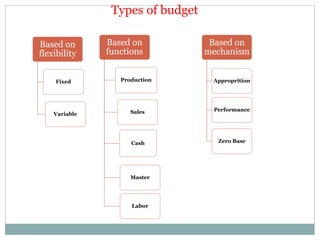
Types of budget
Based on
flexibility
Fixed
Variable
Based on
functions
Production
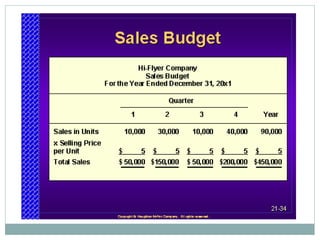
Sales
Cash
Master
Labor
Based on
mechanism
Approprition
Performance
Zero Base
Fixed and variable
 If the level of activity is fixed and if the budget is
prepared based on the fixed level of activity it is
called as fixed budget.
 The level of activity is variable for the variable
budget.
 It is more realistic and practical.
Appropriation,
 Congenital budget
 Applicable where measurement of the cost is
difficult.
 In R & D.
Performance
 Applicable where performance measure is easy
 Annual targets are defined in terms of physical
quantity or numbers
Zero Base
 It has no previous year records
 Here critical analysis of every activity is done and
based on the realistic situation budget is prepared
 The word zero means no history.
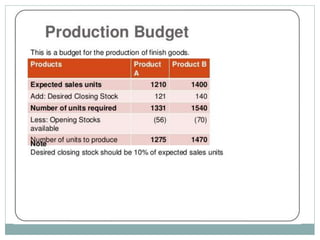
Production
 It start how many products and produced
 Then total cost expected in producing this output is
calculated
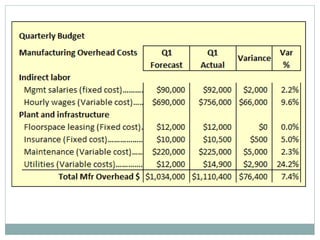
Variance report
 The deviation of the actual from the standard is
known as variance
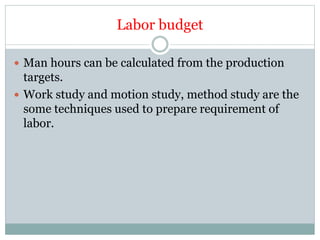
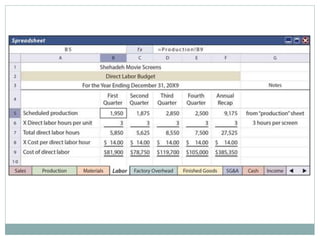
Labor budget
 Man hours can be calculated from the production
targets.
 Work study and motion study, method study are the
some techniques used to prepare requirement of
labor.
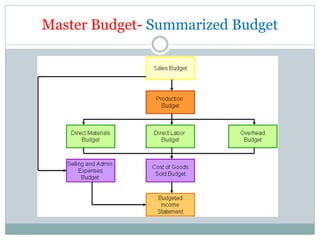
Master Budget- Summarized Budget
Types Of Accounts
 Profit and loss account
 Balance sheet
Difference
 The primary difference between the profit and loss
statement and the balance sheet involves their
respective treatments of time.
 The balance sheet summarizes the financial position
of a company for one specific point in time.
 The P&L statement shows revenues and expenses
during a set period of time.
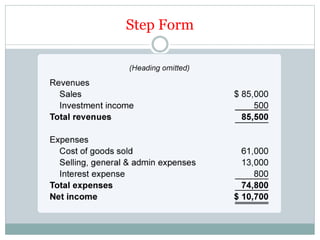
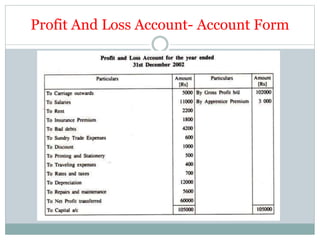
Profit And Loss Account
 It determines net profit and loss
 It matches revenue and expenses
It has two types
 Step form
 Account form
Step Form
Profit And Loss Account- Account Form
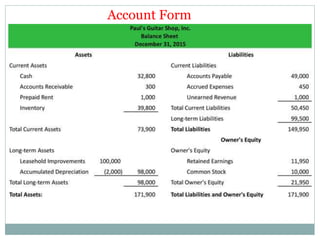
Balance Sheet
 A statement of the assets, liabilities, and capital of a
business or other organization at a particular point
in time, detailing the balance of income and
expenditure over the preceding period.
Account Form
Taxes
 a compulsory contribution to state revenue, levied by
the government on workers' income and business
profits, or added to the cost of some goods, services,
and transactions.
Taxes
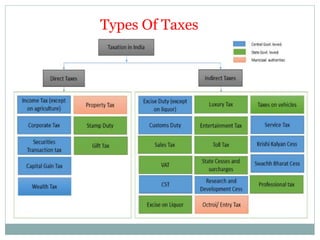
 Taxes are of two distinct types, direct and indirect
taxes.
 The difference comes in the way these taxes are
implemented.
 Some are paid directly by you, such as the dreaded
income tax, wealth tax, corporate tax etc.
 while others are indirect taxes, such as the value
added tax, service tax, sales tax, etc.
Types Of Taxes
Excise tax
 Commodity tax
 Indirect tax
 It is levied on production & no connection with sales
 Excise duty(expect alcohol)are levied by the central
government
 CBEC-Central Board Of Excise And Customs
Service tax
 Service tax is a tax levied by Central Government of
India on services provided
 It is indirect tax
 Service tax no is unique 15 digits no which is allotted
to the assesse
 12.36% I June 2015
 App.2% education cess
 Swach Bharat Cess(0.50%), the Krishi Kalyan Cess,
at 0.5%
=15%
Various Services Under Service Tax
 Advertisement agency
 Telecommunication
 Air travel agents
 Real estate agents
 CA
 Broadcasting services
 Photographic services
 Courier
 Security agency
Exemption
 Service tax is only liable to be paid in case the total
value of the service provided during the financial
year is more than 10 lakh
Income Tax
Income Tax
 Personal income tax is levied on incomes of individual
 Levied by central government of India
 Shared between state govt. and central govt.
 It is direct tax
 Income Tax law starts on the 1st of April and ends on
the 31st of March of the next calendar year.
 Salary, business, house property, capital gains
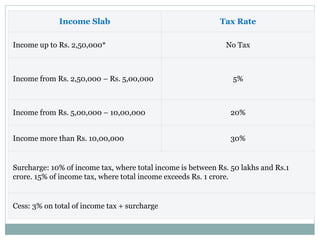
Income Slab Tax Rate
Income up to Rs. 2,50,000* No Tax
Income from Rs. 2,50,000 – Rs. 5,00,000 5%
Income from Rs. 5,00,000 – 10,00,000 20%
Income more than Rs. 10,00,000 30%
Surcharge: 10% of income tax, where total income is between Rs. 50 lakhs and Rs.1
crore. 15% of income tax, where total income exceeds Rs. 1 crore.
Cess: 3% on total of income tax + surcharge
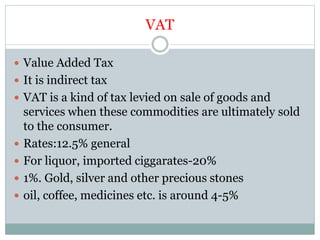
VAT
 Value Added Tax
 It is indirect tax
 VAT is a kind of tax levied on sale of goods and
services when these commodities are ultimately sold
to the consumer.
 Rates:12.5% general
 For liquor, imported ciggarates-20%
 1%. Gold, silver and other precious stones
 oil, coffee, medicines etc. is around 4-5%
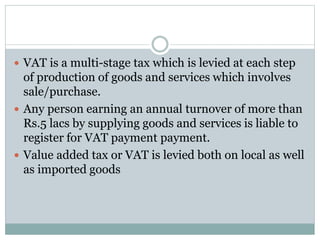
 VAT is a multi-stage tax which is levied at each step
of production of goods and services which involves
sale/purchase.
 Any person earning an annual turnover of more than
Rs.5 lacs by supplying goods and services is liable to
register for VAT payment payment.
 Value added tax or VAT is levied both on local as well
as imported goods
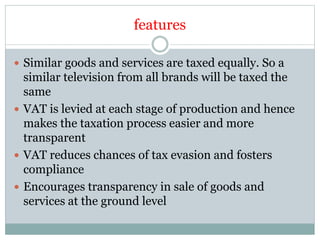
features
 Similar goods and services are taxed equally. So a
similar television from all brands will be taxed the
same
 VAT is levied at each stage of production and hence
makes the taxation process easier and more
transparent
 VAT reduces chances of tax evasion and fosters
compliance
 Encourages transparency in sale of goods and
services at the ground level
VAT Example:
 Suppose Ram owns a restaurant and spends Rs.50,000
towards obtaining raw materials. Input tax is 10%, so
input tax becomes 10% of Rs.50,000 = Rs.5,000
 Now after selling the food made by using the purchased
raw materials, Ram was able to make Rs.1,00,000.
Supposing 10% output tax, output tax becomes
Rs.10,000
 So, final VAT payable by Ram comes out to be Rs.10,000
– Rs.5,000 = Rs.5,000
Customs Duty
 Custom duty is a variant of Indirect Tax and is
applicable on all goods imported and a few goods
exported out of the country.
 Duty rates in India can be rupees per unit.
 Duty rates vary from 0% to 150%, with an average
duty rate of 11.9%.
 Some goods are not subject to duty (e.g. laptops and
other electronic products).
Import Duties
 Duties levied on import of goods are termed as
import duty
 Import duties are not levied on a few items including
lifesaving drugs/equipment, fertilizers, food grains
etc.
Export Duty
 Duties levied on exported goods are termed as export
duty.

5.financial man.

  • 1.
    Welcome Topic 5.Financial Management PresentedBy Mr. J.B.Shirote Lecturer in Mechanical Engineering Department Latthe Education Society’s Polytechnic P-41,M.I.D.C.,Kupwad,Sangli.
  • 2.
    Financial Management  Financeis the effective procurement (to get by means of some action)of funds and their effective utilization
  • 3.
    concept  Financial managementis the study of relationship between the raising the finance and deployment of finance. a. Raising the finance b. Effective utilization c. management of assets
  • 4.
    Objectives  To finalizemethod of financing  To decide investment policies  To take correct decisions about dividends  To maximize the value of the business  To ensure regular and sufficient flow of funds to the business  To take care of safety on investment
  • 5.
    Functions  Conducting financialanalysis to identify strength and weakness of organization  Identification of threats and strength  Deciding and planning the financial strategies  Estimation of funds requirement in proper manner
  • 6.
    Functions  Conducting profitloss and cost analysis  Declaration of dividends  Providing realistic data for top level management for decision making  Taking care of accounting and budgeting  Disposal of surplus funds
  • 7.
    Capital  Capital isthe measure of the amount of resources of an enterprise.  It is necessary of an enterprise all the time  It includes cash in hand, land, building, structures, machinery, materials
  • 8.
    Types of capital Fixed capital  Working capital 1.Permenant working capital 2.Seasonal working capital
  • 9.
    Fixed capital  Blockcapital  Required at the starting phase of the org.  Large amount is invested in land, plant set up, equipment, building construction, machinery purchase, internal roads, furniture, patents  Once it is invested it becomes permanent assets
  • 10.
    Working capital  Dayto day functioning of an enterprise is possible through availability of working capital  It involves short term funds in business  It is also called as circulating business
  • 11.
    Working capital  Itincludes 1. Material purchasing 2. Payment/salary 3. Maintenance cost 4. Selling cost 5. Advertisement cost 6. Transportation cost
  • 12.
    Permanent Working capital Itsnature is permanent.ie after certain period it is repeated
  • 13.
    Seasonal Working capital Thisis the expenditure due to seasonal happening
  • 14.
    Sources Of RaisingCapital  Internal sources:- 1. Inherited personal funds 2. Depreciation provisions 3. Retained equity earnings 4. Deferred taxation
  • 15.
    Inherited personal funds Own investment is initially done  All or part of a person's estate/assets that is given to an heir once the person is deceased(death)
  • 16.
    Depreciation provisions  Itsprovision against ageing of the machinery  Capital is kept aside from the starting phase  Provision for depreciation is an advance calculation for depreciation, while depreciation is the actual amount which is lost the Asset.
  • 17.
    Retained equity earnings Reinvestmentof Profits  Reinvestment of earnings of shareholders
  • 18.
    Deferred taxation  Becauseof accrual(revenues that have been earned but are not yet recorded) accounting rules, a company may be able to defer taxes on some of its income.
  • 19.
    External sources  Shortterm (for working capital) 1. Trade credit 2. Bank credit 3. Customer advance
  • 20.
    Trade credit: Trade creditis the credit extended to you by suppliers who let you buy now and pay later. Bank credit: Bank credit is an amount of funds that a person or business can borrow from a bank Customer advance: The term advances from customers refers to money collected by a company prior to providing a product or service.
  • 21.
    External sources  Mediumterm(working capital) 1. Loans 2. Hire purchase 3. Equipment lease 4. Public deposits (long term)
  • 22.
    1. Hire purchase: A hire purchase is a method of buying goods through making installment payments over time.  Under a hire purchase contract, the buyer is leasing the goods and does not obtain ownership until the full amount of the contract is paid.  The cost of financing through hire purchase is very high.
  • 23.
     Equipment lease: Theterm “lease” refers to the contractual agreement between the lessor (owner) and the lessee (hirer) wherein the lessor grants right to the lessee to use the equipment in exchange for the periodical rent payments.
  • 24.
     Public deposits: Acompany can accept deposits from the public to finance its medium- and short-term requirements of funds.
  • 25.
    External sources  Longterm(for fixed capital) 1. Loans 2. Shares 3. Debentures 4. Savings 5. Corporate bonds
  • 26.
     Share: one ofthe equal parts into which a company's capital is divided, entitling the holder to a proportion of the profits.  Debentures a long-term security yielding a fixed rate of interest, issued by a company and secured against assets.
  • 27.
    Corporate bonds:  Acorporate bond is a debt security issued by a corporation and sold to investors. The backing for the bond is usually the payment ability of the company, which is typically money to be earned from future operations.  In some cases, the company's physical assets may be used as collateral for bonds.
  • 28.
    External sources  Financialinstitutions 1. Industrial development banks 2. Industrial finance corporation(medium and long) 3. Insurance companies 4. State financial corporation(medium and short)
  • 29.
    Share market  Stockmarket or equity market  Share is the investment in joint stock companies e.g. 1.BSE-Bombay Stock Exchange, Mumbai 2.NSE-National Stock Exchange, Mumbai
  • 30.
    Types of shares Preference share  Ordinary share  Bonus share  Rights share
  • 31.
    Preference share  Preferenceshares, more commonly referred to as preferred stock, are shares of a company's stock with fixed dividends that are paid out to shareholders before common stock dividends are issued.  If the company enters bankruptcy, the shareholders with preferred stock are entitled to be paid from company assets first.
  • 32.
    Ordinary share  Equityshares  Ordinary shareholders have one vote for a share they are holding  The dividends are not fixed  The dividend is fluctuating with profit and policy of organization directors
  • 33.
    Bonus share  Bonusshares are additional shares given to the current shareholders without any additional cost, based upon the number of shares that a shareholder owns.  if Investor A holds 200 shares of a company and a company declares 4:1 bonus, that is for every one share, he gets 4 shares for free. That is total 800 shares for free and his total holding will increase to 1000 shares.
  • 34.
    Rights share  Arights issue is a dividend of subscription rights to buy additional securities in a company made to the company's existing security holders  With the issued rights, existing security-holders have the privilege to buy a specified number of new securities from the issuer at a specified price within a subscription period.
  • 36.
    Budgets and accounts Budget is a financial plan for the next year.  It is an financial statement of how money will come and how it will go on business functioning.  It is time bonded.
  • 37.
  • 38.
    Budgetary control  Whenbudget is used as tool for planning and controlling the production system, it is called as budgetary control.
  • 39.
    Types of budget Basedon flexibility Fixed Variable Based on functions Production Sales Cash Master Labor Based on mechanism Approprition Performance Zero Base
  • 40.
    Fixed and variable If the level of activity is fixed and if the budget is prepared based on the fixed level of activity it is called as fixed budget.  The level of activity is variable for the variable budget.  It is more realistic and practical.
  • 41.
    Appropriation,  Congenital budget Applicable where measurement of the cost is difficult.  In R & D.
  • 42.
    Performance  Applicable whereperformance measure is easy  Annual targets are defined in terms of physical quantity or numbers
  • 43.
    Zero Base  Ithas no previous year records  Here critical analysis of every activity is done and based on the realistic situation budget is prepared  The word zero means no history.
  • 44.
    Production  It starthow many products and produced  Then total cost expected in producing this output is calculated
  • 46.
    Variance report  Thedeviation of the actual from the standard is known as variance
  • 48.
    Labor budget  Manhours can be calculated from the production targets.  Work study and motion study, method study are the some techniques used to prepare requirement of labor.
  • 51.
  • 52.
    Types Of Accounts Profit and loss account  Balance sheet
  • 53.
    Difference  The primarydifference between the profit and loss statement and the balance sheet involves their respective treatments of time.  The balance sheet summarizes the financial position of a company for one specific point in time.  The P&L statement shows revenues and expenses during a set period of time.
  • 54.
    Profit And LossAccount  It determines net profit and loss  It matches revenue and expenses It has two types  Step form  Account form
  • 55.
  • 56.
    Profit And LossAccount- Account Form
  • 57.
    Balance Sheet  Astatement of the assets, liabilities, and capital of a business or other organization at a particular point in time, detailing the balance of income and expenditure over the preceding period.
  • 58.
  • 59.
    Taxes  a compulsorycontribution to state revenue, levied by the government on workers' income and business profits, or added to the cost of some goods, services, and transactions.
  • 60.
    Taxes  Taxes areof two distinct types, direct and indirect taxes.  The difference comes in the way these taxes are implemented.  Some are paid directly by you, such as the dreaded income tax, wealth tax, corporate tax etc.  while others are indirect taxes, such as the value added tax, service tax, sales tax, etc.
  • 61.
  • 62.
    Excise tax  Commoditytax  Indirect tax  It is levied on production & no connection with sales  Excise duty(expect alcohol)are levied by the central government  CBEC-Central Board Of Excise And Customs
  • 63.
    Service tax  Servicetax is a tax levied by Central Government of India on services provided  It is indirect tax  Service tax no is unique 15 digits no which is allotted to the assesse  12.36% I June 2015  App.2% education cess  Swach Bharat Cess(0.50%), the Krishi Kalyan Cess, at 0.5% =15%
  • 64.
    Various Services UnderService Tax  Advertisement agency  Telecommunication  Air travel agents  Real estate agents  CA  Broadcasting services  Photographic services  Courier  Security agency
  • 65.
    Exemption  Service taxis only liable to be paid in case the total value of the service provided during the financial year is more than 10 lakh
  • 66.
  • 67.
    Income Tax  Personalincome tax is levied on incomes of individual  Levied by central government of India  Shared between state govt. and central govt.  It is direct tax  Income Tax law starts on the 1st of April and ends on the 31st of March of the next calendar year.  Salary, business, house property, capital gains
  • 68.
    Income Slab TaxRate Income up to Rs. 2,50,000* No Tax Income from Rs. 2,50,000 – Rs. 5,00,000 5% Income from Rs. 5,00,000 – 10,00,000 20% Income more than Rs. 10,00,000 30% Surcharge: 10% of income tax, where total income is between Rs. 50 lakhs and Rs.1 crore. 15% of income tax, where total income exceeds Rs. 1 crore. Cess: 3% on total of income tax + surcharge
  • 69.
    VAT  Value AddedTax  It is indirect tax  VAT is a kind of tax levied on sale of goods and services when these commodities are ultimately sold to the consumer.  Rates:12.5% general  For liquor, imported ciggarates-20%  1%. Gold, silver and other precious stones  oil, coffee, medicines etc. is around 4-5%
  • 70.
     VAT isa multi-stage tax which is levied at each step of production of goods and services which involves sale/purchase.  Any person earning an annual turnover of more than Rs.5 lacs by supplying goods and services is liable to register for VAT payment payment.  Value added tax or VAT is levied both on local as well as imported goods
  • 71.
    features  Similar goodsand services are taxed equally. So a similar television from all brands will be taxed the same  VAT is levied at each stage of production and hence makes the taxation process easier and more transparent  VAT reduces chances of tax evasion and fosters compliance  Encourages transparency in sale of goods and services at the ground level
  • 72.
    VAT Example:  SupposeRam owns a restaurant and spends Rs.50,000 towards obtaining raw materials. Input tax is 10%, so input tax becomes 10% of Rs.50,000 = Rs.5,000  Now after selling the food made by using the purchased raw materials, Ram was able to make Rs.1,00,000. Supposing 10% output tax, output tax becomes Rs.10,000  So, final VAT payable by Ram comes out to be Rs.10,000 – Rs.5,000 = Rs.5,000
  • 73.
    Customs Duty  Customduty is a variant of Indirect Tax and is applicable on all goods imported and a few goods exported out of the country.  Duty rates in India can be rupees per unit.  Duty rates vary from 0% to 150%, with an average duty rate of 11.9%.  Some goods are not subject to duty (e.g. laptops and other electronic products).
  • 74.
    Import Duties  Dutieslevied on import of goods are termed as import duty  Import duties are not levied on a few items including lifesaving drugs/equipment, fertilizers, food grains etc.
  • 75.
    Export Duty  Dutieslevied on exported goods are termed as export duty.