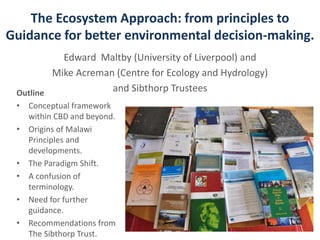
The Ecosystem Approach: from principles to
Guidance for better environmental decision-making.
Edward Maltby (University of Liverpool) and
Mike Acreman (Centre for Ecology and Hydrology)
and Sibthorp TrusteesOutline
• Conceptual framework
within CBD and beyond.
• Origins of Malawi
Principles and
developments.
• The Paradigm Shift.
• A confusion of
terminology.
• Need for further
guidance.
• Recommendations from
The Sibthorp Trust.
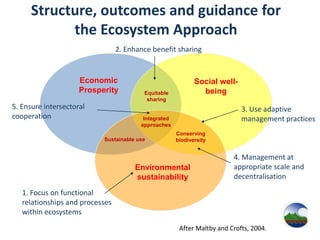
Economic
Prosperity
Social well-
being
Environmental
sustainability
Equitable
sharing
Integrated
approaches
Sustainable use
Conserving
biodiversity
2. Enhance benefit sharing
1. Focus on functional
relationships and processes
within ecosystems
3. Use adaptive
management practices
4. Management at
appropriate scale and
decentralisation
5. Ensure intersectoral
cooperation
Structure, outcomes and guidance for
the Ecosystem Approach
After Maltby and Crofts, 2004.
SWIMMER | University of Liverpool
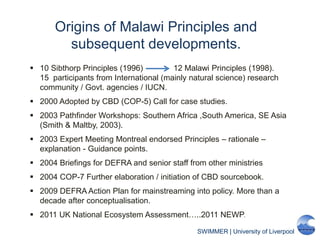
Origins of Malawi Principles and
subsequent developments.
 10 Sibthorp Principles (1996) 12 Malawi Principles (1998).
15 participants from International (mainly natural science) research
community / Govt. agencies / IUCN.
 2000 Adopted by CBD (COP-5) Call for case studies.
 2003 Pathfinder Workshops: Southern Africa ,South America, SE Asia
(Smith & Maltby, 2003).
 2003 Expert Meeting Montreal endorsed Principles – rationale –
explanation - Guidance points.
 2004 Briefings for DEFRA and senior staff from other ministries
 2004 COP-7 Further elaboration / initiation of CBD sourcebook.
 2009 DEFRA Action Plan for mainstreaming into policy. More than a
decade after conceptualisation.
 2011 UK National Ecosystem Assessment…..2011 NEWP.
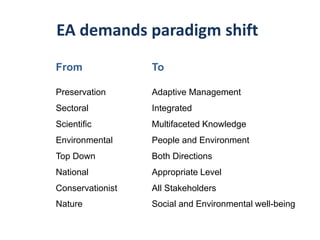
EA demands paradigm shift
From To
Preservation Adaptive Management
Sectoral Integrated
Scientific Multifaceted Knowledge
Environmental People and Environment
Top Down Both Directions
National Appropriate Level
Conservationist All Stakeholders
Nature Social and Environmental well-being
SWIMMER | University of Liverpool
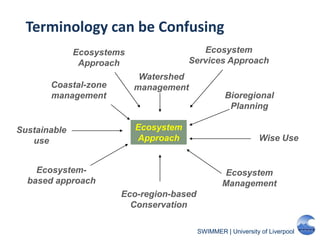
Terminology can be Confusing
Ecosystem
Approach
Watershed
management
Bioregional
Planning
Wise Use
Ecosystem
Management
Eco-region-based
Conservation
Ecosystem-
based approach
Sustainable
use
Coastal-zone
management
Ecosystems
Approach
Ecosystem
Services Approach
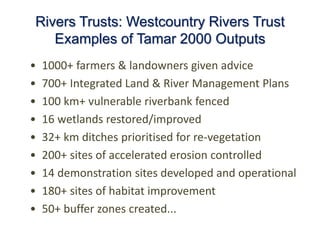
Rivers Trusts: Westcountry Rivers Trust
Examples of Tamar 2000 Outputs
• 1000+ farmers & landowners given advice
• 700+ Integrated Land & River Management Plans
• 100 km+ vulnerable riverbank fenced
• 16 wetlands restored/improved
• 32+ km ditches prioritised for re-vegetation
• 200+ sites of accelerated erosion controlled
• 14 demonstration sites developed and operational
• 180+ sites of habitat improvement
• 50+ buffer zones created...
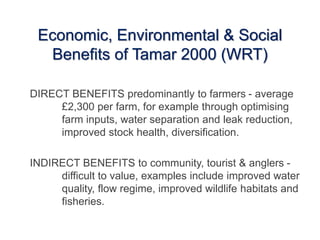
Economic, Environmental & Social
Benefits of Tamar 2000 (WRT)
DIRECT BENEFITS predominantly to farmers - average
£2,300 per farm, for example through optimising
farm inputs, water separation and leak reduction,
improved stock health, diversification.
INDIRECT BENEFITS to community, tourist & anglers -
difficult to value, examples include improved water
quality, flow regime, improved wildlife habitats and
fisheries.
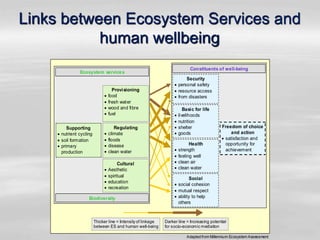
Links between Ecosystem Services and
human wellbeing
Supporting
nutrient cycling
soil formation
primary
production
Provisioning
food
fresh water
wood and fibre
fuel
Regulating
climate
floods
disease
clean water
Cultural
Aesthetic
spiritual
education
recreation
Security
personal safety
resource access
from disasters
Freedom of choice
and action
satisfaction and
opportunity for
achievement
Basic for life
livelihoods
nutrition
shelter
goods
Health
strength
feeling well
clean air
clean water
Social
social cohesion
mutual respect
ability to help
others
Ecosystem services
Constituents of well-being
Biodiversity
Thicker line = Intensity of linkage
between ES and human well-being
Darker line = Increasing potential
for socio-economic mediation
Adapted from Millennium Ecosystem Assessment
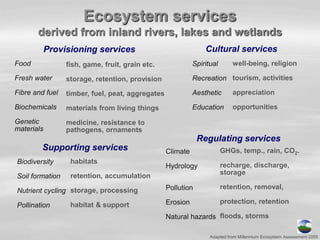
Ecosystem services
derived from inland rivers, lakes and wetlands
Provisioning services
Food
Fresh water
Fibre and fuel
Biochemicals
Genetic
materials
fish, game, fruit, grain etc.
storage, retention, provision
timber, fuel, peat, aggregates
materials from living things
medicine, resistance to
pathogens, ornaments
Regulating services
Climate
Hydrology
Pollution
Erosion
Natural hazards
GHGs, temp., rain, CO2.
recharge, discharge,
storage
retention, removal,
protection, retention
floods, storms
Cultural services
Spiritual
Recreation
Aesthetic
Education
well-being, religion
tourism, activities
appreciation
opportunities
Supporting services
Biodiversity
Soil formation
Nutrient cycling
Pollination
habitats
retention, accumulation
storage, processing
habitat & support
Adapted from Millennium Ecosystem Assessment 2005
.
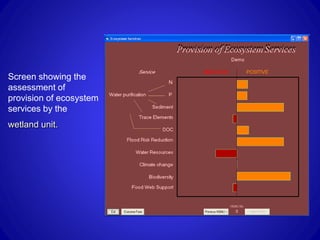
Screen showing the
assessment of
provision of ecosystem
services by the
wetland unit.
UK NEA
 Historic dehydration of the land
 Wetland ecosystems highly fragmented
 Runoff accelerated
 Resiliency reduced in face of climate change
 42% natural floodplains disconnected(England)
 50% all ecosystem services declining
 Emphasis change from flood defence to flood
risk management.
Freshwaters chapter Maltby & Ormerod et al 2011
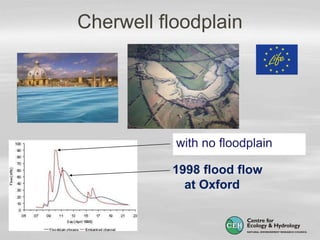
Cherwell floodplain
1998 flood flow
at Oxford
with no floodplain
•SWIMMER | University of Liverpool
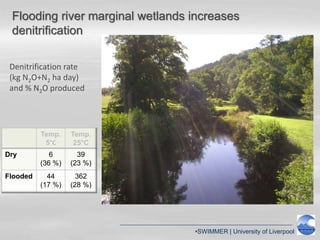
Flooding river marginal wetlands increases
denitrification
Temp.
5°C
Temp.
25°C
Dry 6
(36 %)
39
(23 %)
Flooded 44
(17 %)
362
(28 %)
Denitrification rate
(kg N2O+N2 ha day)
and % N2O produced
SWIMMER | University of Liverpool
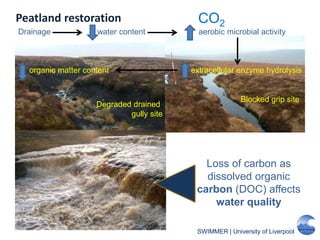
Loss of carbon as
dissolved organic
carbon (DOC) affects
water quality
Degraded drained
gully site
Peatland restoration
Blocked grip site
Drainage water content aerobic microbial activity
organic matter content extracellular enzyme hydrolysis
CO2
•SWIMMER | University of Liverpool
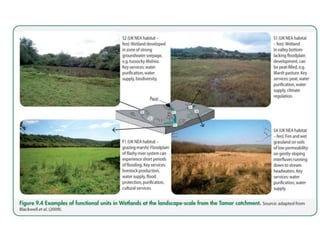
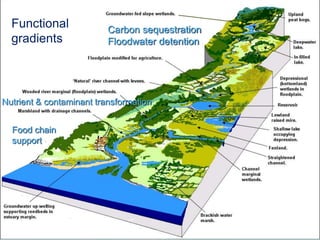
Functional
gradients
Carbon sequestration
Floodwater detention
Nutrient & contaminant transformation
Food chain
support
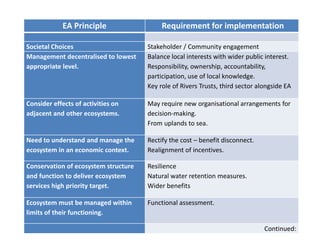
EA Principle Requirement for implementation
Societal Choices Stakeholder / Community engagement
Management decentralised to lowest
appropriate level.
Balance local interests with wider public interest.
Responsibility, ownership, accountability,
participation, use of local knowledge.
Key role of Rivers Trusts, third sector alongside EA
Consider effects of activities on
adjacent and other ecosystems.
May require new organisational arrangements for
decision-making.
From uplands to sea.
Need to understand and manage the
ecosystem in an economic context.
Rectify the cost – benefit disconnect.
Realignment of incentives.
Conservation of ecosystem structure
and function to deliver ecosystem
services high priority target.
Resilience
Natural water retention measures.
Wider benefits
Ecosystem must be managed within
limits of their functioning.
Functional assessment.
Continued:
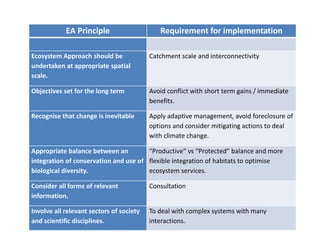
EA Principle Requirement for implementation
Ecosystem Approach should be
undertaken at appropriate spatial
scale.
Catchment scale and interconnectivity
Objectives set for the long term Avoid conflict with short term gains / immediate
benefits.
Recognise that change is inevitable Apply adaptive management, avoid foreclosure of
options and consider mitigating actions to deal
with climate change.
Appropriate balance between an
integration of conservation and use of
biological diversity.
“Productive” vs “Protected” balance and more
flexible integration of habitats to optimise
ecosystem services.
Consider all forms of relevant
information.
Consultation
Involve all relevant sectors of society
and scientific disciplines.
To deal with complex systems with many
interactions.
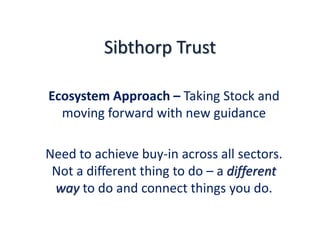
Sibthorp Trust
Ecosystem Approach – Taking Stock and
moving forward with new guidance
Need to achieve buy-in across all sectors.
Not a different thing to do – a different
way to do and connect things you do.
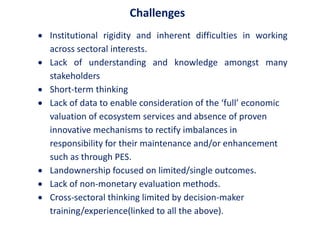
Challenges
 Institutional rigidity and inherent difficulties in working
across sectoral interests.
 Lack of understanding and knowledge amongst many
stakeholders
 Short-term thinking
 Lack of data to enable consideration of the ‘full’ economic
valuation of ecosystem services and absence of proven
innovative mechanisms to rectify imbalances in
responsibility for their maintenance and/or enhancement
such as through PES.
 Landownership focused on limited/single outcomes.
 Lack of non-monetary evaluation methods.
 Cross-sectoral thinking limited by decision-maker
training/experience(linked to all the above).
30 second message about the Ecosystem Approach
The Ecosystem Approach provides a flexible framework for
environmental management which is holistic and connects all
those considerations of societal concern with the best available
science and other knowledge which can help to achieve practical
sustainable development. It can be implemented in different
ways according to the problem addressed and its geographical
and/or cultural context.
The G20 Guidance-Framing objectives
• G1 The Ecosystem Approach will be most effective when it is
focused on actual and clearly defined issues.
• G2 A major aim should be closer collaboration across
government departments, agencies, and all elements of civil
society.
• G3 Changes in attitudes from purely material wealth to
recognition of wider well-being.
• G4 Management should recognize the value of multi-
functional aspects of landscape.
• G5 Objectives should be long-term.
Working together
• G6 At least initially it will be essential to work within existing
sectoral arrangements.
• G7 Identify clearly who can contribute to making the
necessary changes.
• G8 Need for inter-sectoral cooperation and willingness to
work together (cf G3).
Getting the ideas across
• G9 The concept of the EA can be transferred, without
substituting the detailed terminology, where it enhances or
improves existing integrated approaches.
• G10 A clear communications strategy is an essential pre-
requisite of delivery.
Collating information content
• G11 Appropriate-scale demonstration/exemplar projects.
• G12 Recognise traditional knowledge systems and how
related decisions are made.
• G13 Ensure all information is verified or quality level of
certainty defined.
• G14 Provide inventory of sources of information to guide
users and avoid overload – need to help sift information.
Delivery
• G15 Take note of unintended results of actions taken in
implementation.
• G16 Work at the appropriate spatial and temporal scale, reflecting
the nature of the problem or issue being addressed.
• G17 Ensure provision to collect sufficient information to undertake
a post project implementation appraisal.
• G18 Identify where possible cost savings for different sectors, esp.
industries/private sector/public of implementation of ecosystem
approach.
• G19 Review the full range of available tools to implement the
Ecosystem Approach most appropriately within the contextual
(spatial and temporal) framework of the problem addressed.
• G20 Ensure that provision is made to monitor the progress of
implementation against desired targets.
SWIMMER | University of Liverpool
Acknowledgements
Participants of the Sibthorp Cirencester Seminar:
Ecosystem Approach – “Has the Concept Worked?” April
2011. Funding support from DEFRA and The Sibthorp Trust.
Robert Bradburne, Natalie Barker, Stewart Clarke, Roger Crofts,
Andrew Church, Laurence Couldrick, Peter Costigan, Nick
Davidson, Richard Ellis, Maggie Gill, Steve Hall, Olivier
Hamerlynck, Pushpam Kumar, Paul Logan, Patrick Meire,
Dianne Mitchell, Joe Morris, Diane Mortimer, Jo Mulongoy, Paul
Nolan, Tom Nisbet, Mark Oddy, Dan Osborne, Martin Ross,
Shaun Russell, Michael Stewardson, Jonathan Wentworth.

4 ed maltby ecosystem approach

  • 1.
    The Ecosystem Approach:from principles to Guidance for better environmental decision-making. Edward Maltby (University of Liverpool) and Mike Acreman (Centre for Ecology and Hydrology) and Sibthorp TrusteesOutline • Conceptual framework within CBD and beyond. • Origins of Malawi Principles and developments. • The Paradigm Shift. • A confusion of terminology. • Need for further guidance. • Recommendations from The Sibthorp Trust.
  • 2.
    Economic Prosperity Social well- being Environmental sustainability Equitable sharing Integrated approaches Sustainable use Conserving biodiversity 2.Enhance benefit sharing 1. Focus on functional relationships and processes within ecosystems 3. Use adaptive management practices 4. Management at appropriate scale and decentralisation 5. Ensure intersectoral cooperation Structure, outcomes and guidance for the Ecosystem Approach After Maltby and Crofts, 2004.
  • 3.
    SWIMMER | Universityof Liverpool Origins of Malawi Principles and subsequent developments.  10 Sibthorp Principles (1996) 12 Malawi Principles (1998). 15 participants from International (mainly natural science) research community / Govt. agencies / IUCN.  2000 Adopted by CBD (COP-5) Call for case studies.  2003 Pathfinder Workshops: Southern Africa ,South America, SE Asia (Smith & Maltby, 2003).  2003 Expert Meeting Montreal endorsed Principles – rationale – explanation - Guidance points.  2004 Briefings for DEFRA and senior staff from other ministries  2004 COP-7 Further elaboration / initiation of CBD sourcebook.  2009 DEFRA Action Plan for mainstreaming into policy. More than a decade after conceptualisation.  2011 UK National Ecosystem Assessment…..2011 NEWP.
  • 4.
    EA demands paradigmshift From To Preservation Adaptive Management Sectoral Integrated Scientific Multifaceted Knowledge Environmental People and Environment Top Down Both Directions National Appropriate Level Conservationist All Stakeholders Nature Social and Environmental well-being
  • 5.
    SWIMMER | Universityof Liverpool Terminology can be Confusing Ecosystem Approach Watershed management Bioregional Planning Wise Use Ecosystem Management Eco-region-based Conservation Ecosystem- based approach Sustainable use Coastal-zone management Ecosystems Approach Ecosystem Services Approach
  • 6.
    Rivers Trusts: WestcountryRivers Trust Examples of Tamar 2000 Outputs • 1000+ farmers & landowners given advice • 700+ Integrated Land & River Management Plans • 100 km+ vulnerable riverbank fenced • 16 wetlands restored/improved • 32+ km ditches prioritised for re-vegetation • 200+ sites of accelerated erosion controlled • 14 demonstration sites developed and operational • 180+ sites of habitat improvement • 50+ buffer zones created...
  • 7.
    Economic, Environmental &Social Benefits of Tamar 2000 (WRT) DIRECT BENEFITS predominantly to farmers - average £2,300 per farm, for example through optimising farm inputs, water separation and leak reduction, improved stock health, diversification. INDIRECT BENEFITS to community, tourist & anglers - difficult to value, examples include improved water quality, flow regime, improved wildlife habitats and fisheries.
  • 8.
    Links between EcosystemServices and human wellbeing Supporting nutrient cycling soil formation primary production Provisioning food fresh water wood and fibre fuel Regulating climate floods disease clean water Cultural Aesthetic spiritual education recreation Security personal safety resource access from disasters Freedom of choice and action satisfaction and opportunity for achievement Basic for life livelihoods nutrition shelter goods Health strength feeling well clean air clean water Social social cohesion mutual respect ability to help others Ecosystem services Constituents of well-being Biodiversity Thicker line = Intensity of linkage between ES and human well-being Darker line = Increasing potential for socio-economic mediation Adapted from Millennium Ecosystem Assessment
  • 9.
    Ecosystem services derived frominland rivers, lakes and wetlands Provisioning services Food Fresh water Fibre and fuel Biochemicals Genetic materials fish, game, fruit, grain etc. storage, retention, provision timber, fuel, peat, aggregates materials from living things medicine, resistance to pathogens, ornaments Regulating services Climate Hydrology Pollution Erosion Natural hazards GHGs, temp., rain, CO2. recharge, discharge, storage retention, removal, protection, retention floods, storms Cultural services Spiritual Recreation Aesthetic Education well-being, religion tourism, activities appreciation opportunities Supporting services Biodiversity Soil formation Nutrient cycling Pollination habitats retention, accumulation storage, processing habitat & support Adapted from Millennium Ecosystem Assessment 2005
  • 11.
  • 12.
    Screen showing the assessmentof provision of ecosystem services by the wetland unit.
  • 13.
    UK NEA  Historicdehydration of the land  Wetland ecosystems highly fragmented  Runoff accelerated  Resiliency reduced in face of climate change  42% natural floodplains disconnected(England)  50% all ecosystem services declining  Emphasis change from flood defence to flood risk management. Freshwaters chapter Maltby & Ormerod et al 2011
  • 14.
    Cherwell floodplain 1998 floodflow at Oxford with no floodplain
  • 15.
    •SWIMMER | Universityof Liverpool Flooding river marginal wetlands increases denitrification Temp. 5°C Temp. 25°C Dry 6 (36 %) 39 (23 %) Flooded 44 (17 %) 362 (28 %) Denitrification rate (kg N2O+N2 ha day) and % N2O produced
  • 16.
    SWIMMER | Universityof Liverpool Loss of carbon as dissolved organic carbon (DOC) affects water quality Degraded drained gully site Peatland restoration Blocked grip site Drainage water content aerobic microbial activity organic matter content extracellular enzyme hydrolysis CO2
  • 17.
    •SWIMMER | Universityof Liverpool Functional gradients Carbon sequestration Floodwater detention Nutrient & contaminant transformation Food chain support
  • 18.
    EA Principle Requirementfor implementation Societal Choices Stakeholder / Community engagement Management decentralised to lowest appropriate level. Balance local interests with wider public interest. Responsibility, ownership, accountability, participation, use of local knowledge. Key role of Rivers Trusts, third sector alongside EA Consider effects of activities on adjacent and other ecosystems. May require new organisational arrangements for decision-making. From uplands to sea. Need to understand and manage the ecosystem in an economic context. Rectify the cost – benefit disconnect. Realignment of incentives. Conservation of ecosystem structure and function to deliver ecosystem services high priority target. Resilience Natural water retention measures. Wider benefits Ecosystem must be managed within limits of their functioning. Functional assessment. Continued:
  • 19.
    EA Principle Requirementfor implementation Ecosystem Approach should be undertaken at appropriate spatial scale. Catchment scale and interconnectivity Objectives set for the long term Avoid conflict with short term gains / immediate benefits. Recognise that change is inevitable Apply adaptive management, avoid foreclosure of options and consider mitigating actions to deal with climate change. Appropriate balance between an integration of conservation and use of biological diversity. “Productive” vs “Protected” balance and more flexible integration of habitats to optimise ecosystem services. Consider all forms of relevant information. Consultation Involve all relevant sectors of society and scientific disciplines. To deal with complex systems with many interactions.
  • 20.
    Sibthorp Trust Ecosystem Approach– Taking Stock and moving forward with new guidance Need to achieve buy-in across all sectors. Not a different thing to do – a different way to do and connect things you do.
  • 21.
    Challenges  Institutional rigidityand inherent difficulties in working across sectoral interests.  Lack of understanding and knowledge amongst many stakeholders  Short-term thinking  Lack of data to enable consideration of the ‘full’ economic valuation of ecosystem services and absence of proven innovative mechanisms to rectify imbalances in responsibility for their maintenance and/or enhancement such as through PES.  Landownership focused on limited/single outcomes.  Lack of non-monetary evaluation methods.  Cross-sectoral thinking limited by decision-maker training/experience(linked to all the above).
  • 22.
    30 second messageabout the Ecosystem Approach The Ecosystem Approach provides a flexible framework for environmental management which is holistic and connects all those considerations of societal concern with the best available science and other knowledge which can help to achieve practical sustainable development. It can be implemented in different ways according to the problem addressed and its geographical and/or cultural context.
  • 23.
    The G20 Guidance-Framingobjectives • G1 The Ecosystem Approach will be most effective when it is focused on actual and clearly defined issues. • G2 A major aim should be closer collaboration across government departments, agencies, and all elements of civil society. • G3 Changes in attitudes from purely material wealth to recognition of wider well-being. • G4 Management should recognize the value of multi- functional aspects of landscape. • G5 Objectives should be long-term.
  • 24.
    Working together • G6At least initially it will be essential to work within existing sectoral arrangements. • G7 Identify clearly who can contribute to making the necessary changes. • G8 Need for inter-sectoral cooperation and willingness to work together (cf G3).
  • 25.
    Getting the ideasacross • G9 The concept of the EA can be transferred, without substituting the detailed terminology, where it enhances or improves existing integrated approaches. • G10 A clear communications strategy is an essential pre- requisite of delivery.
  • 26.
    Collating information content •G11 Appropriate-scale demonstration/exemplar projects. • G12 Recognise traditional knowledge systems and how related decisions are made. • G13 Ensure all information is verified or quality level of certainty defined. • G14 Provide inventory of sources of information to guide users and avoid overload – need to help sift information.
  • 27.
    Delivery • G15 Takenote of unintended results of actions taken in implementation. • G16 Work at the appropriate spatial and temporal scale, reflecting the nature of the problem or issue being addressed. • G17 Ensure provision to collect sufficient information to undertake a post project implementation appraisal. • G18 Identify where possible cost savings for different sectors, esp. industries/private sector/public of implementation of ecosystem approach. • G19 Review the full range of available tools to implement the Ecosystem Approach most appropriately within the contextual (spatial and temporal) framework of the problem addressed. • G20 Ensure that provision is made to monitor the progress of implementation against desired targets.
  • 28.
    SWIMMER | Universityof Liverpool Acknowledgements Participants of the Sibthorp Cirencester Seminar: Ecosystem Approach – “Has the Concept Worked?” April 2011. Funding support from DEFRA and The Sibthorp Trust. Robert Bradburne, Natalie Barker, Stewart Clarke, Roger Crofts, Andrew Church, Laurence Couldrick, Peter Costigan, Nick Davidson, Richard Ellis, Maggie Gill, Steve Hall, Olivier Hamerlynck, Pushpam Kumar, Paul Logan, Patrick Meire, Dianne Mitchell, Joe Morris, Diane Mortimer, Jo Mulongoy, Paul Nolan, Tom Nisbet, Mark Oddy, Dan Osborne, Martin Ross, Shaun Russell, Michael Stewardson, Jonathan Wentworth.