SALIENT FEATURES OF
NATIONAL FOREST POLICIES
Dr. B. Sangeetha,
Asst. Professor, KITS.
Introduction
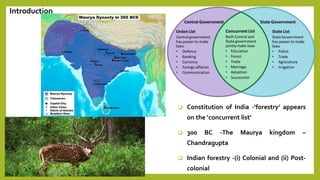
 Constitution of India -‘forestry’ appears
on the ‘concurrent list’
 300 BC -The Maurya kingdom –
Chandragupta
 Indian forestry -(i) Colonial and (ii) Post-
colonial
National Forest Policy
• -1855
• -1894
• -1952
• -1988
National Forest Policy 1855
 Lord Dalhousie issued –“Forest charter” in 1855 (his charter was intended
to restrict and regulate the unchecked exploitation of forests by private
individuals.)
 Potential long-term environmental, economic and climatic effects of
deforestation
 First - Indian Forest Act, 1865 - Imperial Forest Department
 Dietrich Brandis - Forest resource management
 The Indian Forest Act,1865 was declared the British Administration’s
monopoly over the forests of India.
National Forest Policy 1894
 Dr. Voelcker's recommendations given in a report on
'Improvement of Indian Agriculture', 1893.
 Main object of management of forests is public benefit
 Preservation of climatic and physical conditions of the country
 Supplying valuable timber for commercial purposes
National Forest Policy 1894
 Minor forests
 Pasture lands
 Permanent cultivation
 Fulfilment of the basic forest needs of the local people
 Maximum revenue
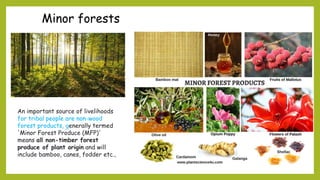
Minor forests
An important source of livelihoods
for tribal people are non-wood
forest products, generally termed
'Minor Forest Produce (MFP)'
means all non-timber forest
produce of plant origin and will
include bamboo, canes, fodder etc.,
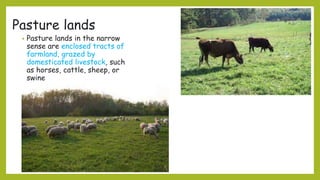
Pasture lands
• Pasture lands in the narrow
sense are enclosed tracts of
farmland, grazed by
domesticated livestock, such
as horses, cattle, sheep, or
swine
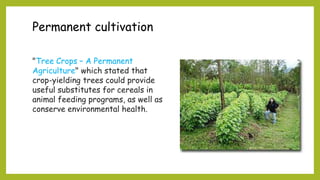
Permanent cultivation
"Tree Crops – A Permanent
Agriculture" which stated that
crop-yielding trees could provide
useful substitutes for cereals in
animal feeding programs, as well as
conserve environmental health.
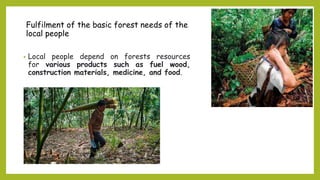
Fulfilment of the basic forest needs of the
local people
• Local people depend on forests resources
for various products such as fuel wood,
construction materials, medicine, and food.
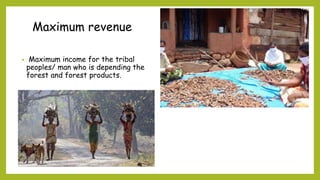
Maximum revenue
• Maximum income for the tribal
peoples/ man who is depending the
forest and forest products.
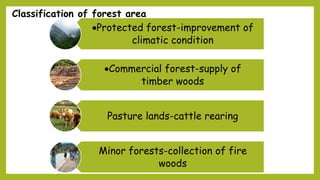
Classification of forest area
Protected forest-improvement of
climatic condition
Commercial forest-supply of
timber woods
Pasture lands-cattle rearing
Minor forests-collection of fire
woods
Defects in national forest policy 1894
 Formulated by Britishers for the need of Britishers
 Mandated for public benefits as a sole issue and not considered the conservation issues
 Indicated conversion of forest land for agricultural purposes which resulted in massive
conversion of forest for agricultural uses.
 Not considering the demands of public and industry.
 Not taken into account of profession man power and the need of forest education
 Silent on systematic research on forestry programme for production as well as conservation
 Not considering the wildlife – Decreased due to human interaction
 Not considering the ecological and other water resources – loss of resources
National Forest Policy 1952
• The First Forest Policy of 1894 was revised in 1952.
• On the basis of six dominant needs of the country
 Balanced and complementary land-use
 Denudation in the catchment areas
 Establishing tree land for wherever possible
 Allow the supplies of grazing, small wood and fuel wood
 Checking soil erosion by soil conservation and water conservation.
 Fulfilment of revenue needs – sustainable supply of timber and forest produces
Functional classification of forest
 Protection forest - Physical, climatic
considerations
 National forest - Defense, and
communications, industry
 Village forest - Local requirements
 Tree lands - Public use
Salient features
• Establishing tree lands- public use ensuring increasing supplies of grazing, small
wood for agricultural implements, sustained supply of timber - defense,
communications and industry.
 Considering the problem of shifting cultivation
 Focused on forest research and training
 Importance to wildlife management
 Sustained yield of forest management
Defects of National Forest Policy
1952
Defects of National Forest Policy 1952
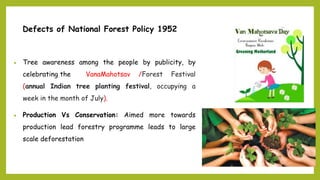
 Tree awareness among the people by publicity, by
celebrating the VanaMahotsav /Forest Festival
(annual Indian tree planting festival, occupying a
week in the month of July).
 Production Vs Conservation: Aimed more towards
production lead forestry programme leads to large
scale deforestation
• Mushrooming of industries:
Saw mills, pulp and paper
industry, plywood, Veneer,
particle board, match splits,
sport goods, agriculture
implements and construction
industry
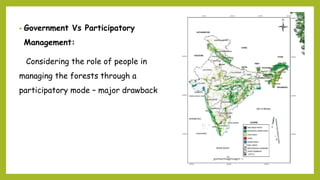
• Government Vs Participatory
Management:
Considering the role of people in
managing the forests through a
participatory mode – major drawback
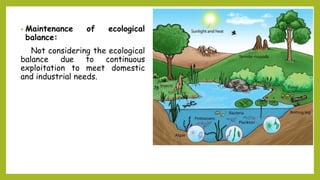
• Maintenance of ecological
balance:
Not considering the ecological
balance due to continuous
exploitation to meet domestic
and industrial needs.
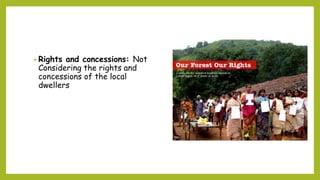
• Rights and concessions: Not
Considering the rights and
concessions of the local
dwellers
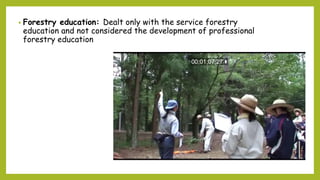
• Forestry education: Dealt only with the service forestry
education and not considered the development of professional
forestry education
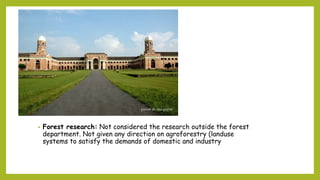
• Forest research: Not considered the research outside the forest
department. Not given any direction on agroforestry (landuse
systems to satisfy the demands of domestic and industry
National Forest Policy 1988
• To ensure environmental stability and maintenance of ecological balance, conserving the
natural heritage of the country by preserving the remaining natural forests.
• Salient features
 To meet the increasing energy demands of the population
 To obey the directive principles and duties given in the constitution
 Constitution amendments of 1976 and its stress on environment
 Naked growth of forest based industries in this era
 Need for the guideline on the wildlife conservation
Objectives of National Forest Policy (NPF) 1988
 Increasing substantially through afforestation and social forestry programmes
 Meeting the requirements of fuel-wood, and fodder, of the rural and tribal populations.
 Increasing the productivity of forests to meet essential national needs.
 Creating a people's movement with the involvement of women, for achieving these
objectives.
 Tribal development, symbiotic relationship between the tribal people and forests.
 Construction of dams and reservoirs, mining and industrial development compensatory by
afforestation.
Management strategy in NFP 1988
 Afforestation, Social forestry and farm forestry programmes were encouraged
 Rights and concessions of the local people are suitably addressed
 Diversion of forestry land for non-forestry purposes is discouraged
 Wildlife conservation is given more importance
 Shifting cultivation practices are discouraged
 Cultivation of perennial crops through horticulture and tree forming is encouraged
 Fire and grazing management is given special consideration
 Forest based industries are advised to get their raw materials from outside the forest
 Forest extension, research and personal management are emphasized
•
national forest policy.pptx

national forest policy.pptx

  • 1.
    SALIENT FEATURES OF NATIONALFOREST POLICIES Dr. B. Sangeetha, Asst. Professor, KITS.
  • 2.
    Introduction  Constitution ofIndia -‘forestry’ appears on the ‘concurrent list’  300 BC -The Maurya kingdom – Chandragupta  Indian forestry -(i) Colonial and (ii) Post- colonial
  • 3.
    National Forest Policy •-1855 • -1894 • -1952 • -1988
  • 4.
    National Forest Policy1855  Lord Dalhousie issued –“Forest charter” in 1855 (his charter was intended to restrict and regulate the unchecked exploitation of forests by private individuals.)  Potential long-term environmental, economic and climatic effects of deforestation  First - Indian Forest Act, 1865 - Imperial Forest Department  Dietrich Brandis - Forest resource management  The Indian Forest Act,1865 was declared the British Administration’s monopoly over the forests of India.
  • 5.
    National Forest Policy1894  Dr. Voelcker's recommendations given in a report on 'Improvement of Indian Agriculture', 1893.  Main object of management of forests is public benefit  Preservation of climatic and physical conditions of the country  Supplying valuable timber for commercial purposes
  • 6.
    National Forest Policy1894  Minor forests  Pasture lands  Permanent cultivation  Fulfilment of the basic forest needs of the local people  Maximum revenue
  • 7.
    Minor forests An importantsource of livelihoods for tribal people are non-wood forest products, generally termed 'Minor Forest Produce (MFP)' means all non-timber forest produce of plant origin and will include bamboo, canes, fodder etc.,
  • 8.
    Pasture lands • Pasturelands in the narrow sense are enclosed tracts of farmland, grazed by domesticated livestock, such as horses, cattle, sheep, or swine
  • 9.
    Permanent cultivation "Tree Crops– A Permanent Agriculture" which stated that crop-yielding trees could provide useful substitutes for cereals in animal feeding programs, as well as conserve environmental health.
  • 10.
    Fulfilment of thebasic forest needs of the local people • Local people depend on forests resources for various products such as fuel wood, construction materials, medicine, and food.
  • 11.
    Maximum revenue • Maximumincome for the tribal peoples/ man who is depending the forest and forest products.
  • 12.
    Classification of forestarea Protected forest-improvement of climatic condition Commercial forest-supply of timber woods Pasture lands-cattle rearing Minor forests-collection of fire woods
  • 13.
    Defects in nationalforest policy 1894  Formulated by Britishers for the need of Britishers  Mandated for public benefits as a sole issue and not considered the conservation issues  Indicated conversion of forest land for agricultural purposes which resulted in massive conversion of forest for agricultural uses.  Not considering the demands of public and industry.  Not taken into account of profession man power and the need of forest education  Silent on systematic research on forestry programme for production as well as conservation  Not considering the wildlife – Decreased due to human interaction  Not considering the ecological and other water resources – loss of resources
  • 14.
    National Forest Policy1952 • The First Forest Policy of 1894 was revised in 1952. • On the basis of six dominant needs of the country  Balanced and complementary land-use  Denudation in the catchment areas  Establishing tree land for wherever possible  Allow the supplies of grazing, small wood and fuel wood  Checking soil erosion by soil conservation and water conservation.  Fulfilment of revenue needs – sustainable supply of timber and forest produces
  • 15.
    Functional classification offorest  Protection forest - Physical, climatic considerations  National forest - Defense, and communications, industry  Village forest - Local requirements  Tree lands - Public use
  • 16.
    Salient features • Establishingtree lands- public use ensuring increasing supplies of grazing, small wood for agricultural implements, sustained supply of timber - defense, communications and industry.  Considering the problem of shifting cultivation  Focused on forest research and training  Importance to wildlife management  Sustained yield of forest management
  • 17.
    Defects of NationalForest Policy 1952
  • 18.
    Defects of NationalForest Policy 1952  Tree awareness among the people by publicity, by celebrating the VanaMahotsav /Forest Festival (annual Indian tree planting festival, occupying a week in the month of July).  Production Vs Conservation: Aimed more towards production lead forestry programme leads to large scale deforestation
  • 19.
    • Mushrooming ofindustries: Saw mills, pulp and paper industry, plywood, Veneer, particle board, match splits, sport goods, agriculture implements and construction industry
  • 20.
    • Government VsParticipatory Management: Considering the role of people in managing the forests through a participatory mode – major drawback
  • 21.
    • Maintenance ofecological balance: Not considering the ecological balance due to continuous exploitation to meet domestic and industrial needs.
  • 22.
    • Rights andconcessions: Not Considering the rights and concessions of the local dwellers
  • 23.
    • Forestry education:Dealt only with the service forestry education and not considered the development of professional forestry education
  • 24.
    • Forest research:Not considered the research outside the forest department. Not given any direction on agroforestry (landuse systems to satisfy the demands of domestic and industry
  • 25.
    National Forest Policy1988 • To ensure environmental stability and maintenance of ecological balance, conserving the natural heritage of the country by preserving the remaining natural forests. • Salient features  To meet the increasing energy demands of the population  To obey the directive principles and duties given in the constitution  Constitution amendments of 1976 and its stress on environment  Naked growth of forest based industries in this era  Need for the guideline on the wildlife conservation
  • 26.
    Objectives of NationalForest Policy (NPF) 1988  Increasing substantially through afforestation and social forestry programmes  Meeting the requirements of fuel-wood, and fodder, of the rural and tribal populations.  Increasing the productivity of forests to meet essential national needs.  Creating a people's movement with the involvement of women, for achieving these objectives.  Tribal development, symbiotic relationship between the tribal people and forests.  Construction of dams and reservoirs, mining and industrial development compensatory by afforestation.
  • 27.
    Management strategy inNFP 1988  Afforestation, Social forestry and farm forestry programmes were encouraged  Rights and concessions of the local people are suitably addressed  Diversion of forestry land for non-forestry purposes is discouraged  Wildlife conservation is given more importance  Shifting cultivation practices are discouraged  Cultivation of perennial crops through horticulture and tree forming is encouraged  Fire and grazing management is given special consideration  Forest based industries are advised to get their raw materials from outside the forest  Forest extension, research and personal management are emphasized •