OSCE FOR DNB
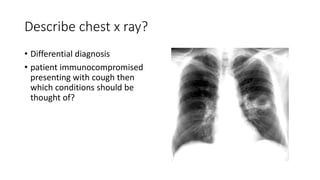
Describe chest x ray?
• Differential diagnosis
• patient immunocompromised
presenting with cough then
which conditions should be
thought of?
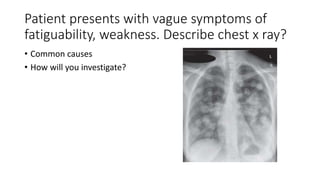
Patient presents with vague symptoms of
fatiguability, weakness. Describe chest x ray?
• Common causes
• How will you investigate?
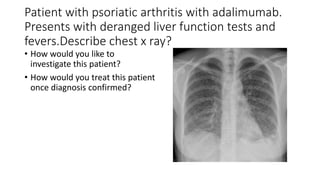
Patient with psoriatic arthritis with adalimumab.
Presents with deranged liver function tests and
fevers.Describe chest x ray?
• How would you like to
investigate this patient?
• How would you treat this patient
once diagnosis confirmed?
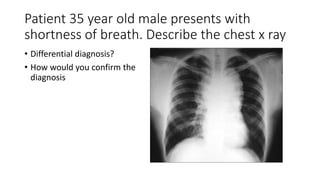
Patient 35 year old male presents with
shortness of breath. Describe the chest x ray
• Differential diagnosis?
• How would you confirm the
diagnosis
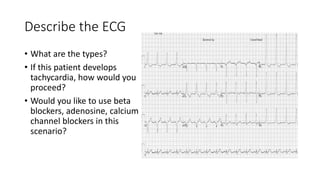
Describe the ECG
• What are the types?
• If this patient develops
tachycardia, how would you
proceed?
• Would you like to use beta
blockers, adenosine, calcium
channel blockers in this
scenario?
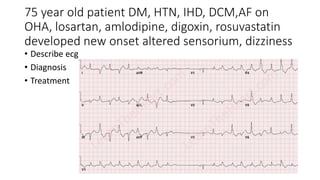
75 year old patient DM, HTN, IHD, DCM,AF on
OHA, losartan, amlodipine, digoxin, rosuvastatin
developed new onset altered sensorium, dizziness
• Describe ecg
• Diagnosis
• Treatment
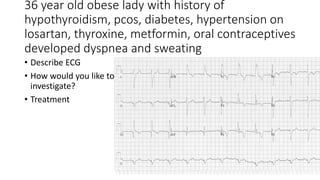
36 year old obese lady with history of
hypothyroidism, pcos, diabetes, hypertension on
losartan, thyroxine, metformin, oral contraceptives
developed dyspnea and sweating
• Describe ECG
• How would you like to
investigate?
• Treatment
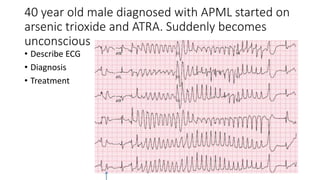
40 year old male diagnosed with APML started on
arsenic trioxide and ATRA. Suddenly becomes
unconscious
• Describe ECG
• Diagnosis
• Treatment
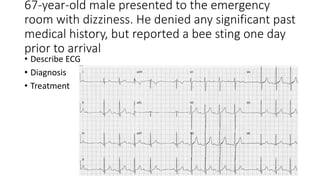
67-year-old male presented to the emergency
room with dizziness. He denied any significant past
medical history, but reported a bee sting one day
prior to arrival
• Describe ECG
• Diagnosis
• Treatment
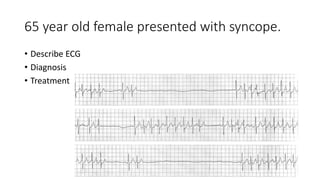
65 year old female presented with syncope.
• Describe ECG
• Diagnosis
• Treatment
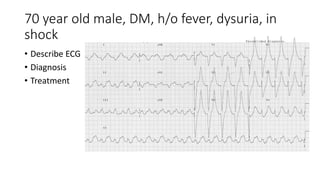
70 year old male, DM, h/o fever, dysuria, in
shock
• Describe ECG
• Diagnosis
• Treatment
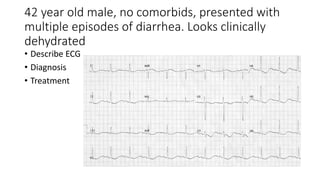
42 year old male, no comorbids, presented with
multiple episodes of diarrhea. Looks clinically
dehydrated
• Describe ECG
• Diagnosis
• Treatment
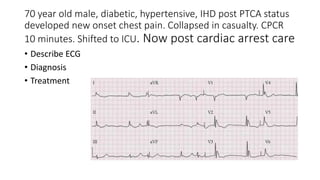
70 year old male, diabetic, hypertensive, IHD post PTCA status
developed new onset chest pain. Collapsed in casualty. CPCR
10 minutes. Shifted to ICU. Now post cardiac arrest care
• Describe ECG
• Diagnosis
• Treatment
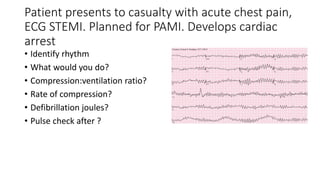
Patient presents to casualty with acute chest pain,
ECG STEMI. Planned for PAMI. Develops cardiac
arrest
• Identify rhythm
• What would you do?
• Compression:ventilation ratio?
• Rate of compression?
• Defibrillation joules?
• Pulse check after ?
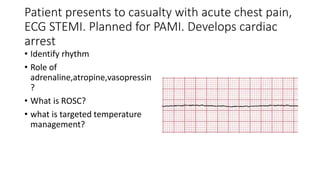
Patient presents to casualty with acute chest pain,
ECG STEMI. Planned for PAMI. Develops cardiac
arrest
• Identify rhythm
• Role of
adrenaline,atropine,vasopressin
?
• What is ROSC?
• what is targeted temperature
management?
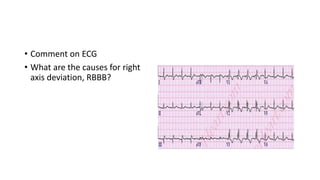
• Comment on ECG
• What are the causes for right
axis deviation, RBBB?
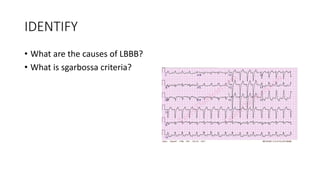
IDENTIFY
• What are the causes of LBBB?
• What is sgarbossa criteria?
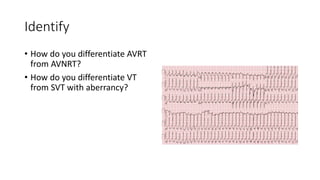
Identify
• How do you differentiate AVRT
from AVNRT?
• How do you differentiate VT
from SVT with aberrancy?
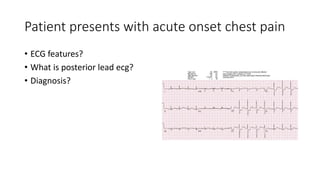
Patient presents with acute onset chest pain
• ECG features?
• What is posterior lead ecg?
• Diagnosis?
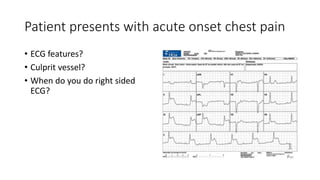
Patient presents with acute onset chest pain
• ECG features?
• Culprit vessel?
• When do you do right sided
ECG?
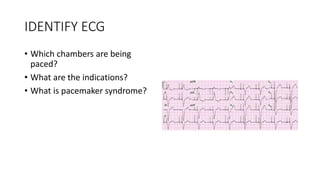
IDENTIFY ECG
• Which chambers are being
paced?
• What are the indications?
• What is pacemaker syndrome?
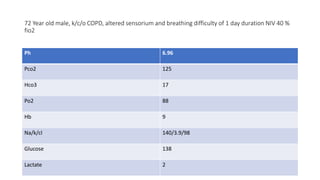
72 Year old male, k/c/o COPD, altered sensorium and breathing difficulty of 1 day duration NIV 40 %
fio2
Ph 6.96
Pco2 125
Hco3 17
Po2 88
Hb 9
Na/k/cl 140/3.9/98
Glucose 138
Lactate 2
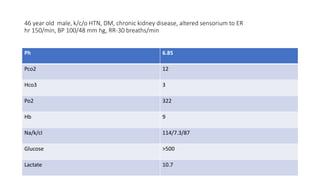
46 year old male, k/c/o HTN, DM, chronic kidney disease, altered sensorium to ER
hr 150/min, BP 100/48 mm hg, RR-30 breaths/min
Ph 6.85
Pco2 12
Hco3 3
Po2 322
Hb 9
Na/k/cl 114/7.3/87
Glucose >500
Lactate 10.7
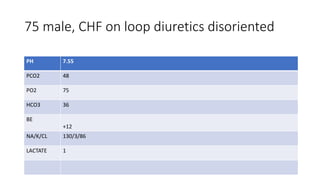
75 male, CHF on loop diuretics disoriented
PH 7.55
PCO2 48
PO2 75
HCO3 36
BE
+12
NA/K/CL 130/3/86
LACTATE 1
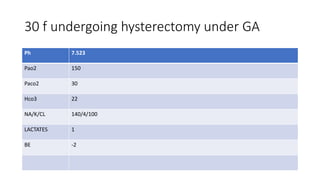
30 f undergoing hysterectomy under GA
Ph 7.523
Pao2 150
Paco2 30
Hco3 22
NA/K/CL 140/4/100
LACTATES 1
BE -2
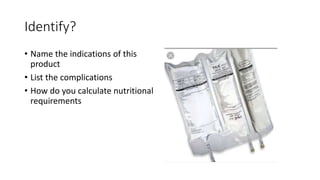
Identify?
• Name the indications of this
product
• List the complications
• How do you calculate nutritional
requirements
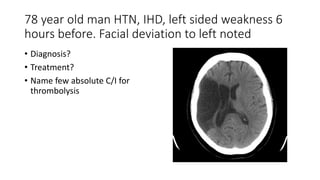
78 year old man HTN, IHD, left sided weakness 6
hours before. Facial deviation to left noted
• Diagnosis?
• Treatment?
• Name few absolute C/I for
thrombolysis
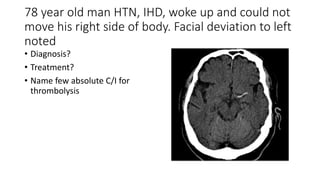
78 year old man HTN, IHD, woke up and could not
move his right side of body. Facial deviation to left
noted
• Diagnosis?
• Treatment?
• Name few absolute C/I for
thrombolysis
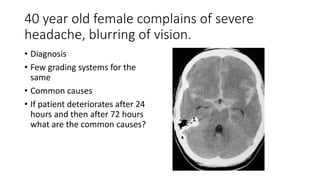
40 year old female complains of severe
headache, blurring of vision.
• Diagnosis
• Few grading systems for the
same
• Common causes
• If patient deteriorates after 24
hours and then after 72 hours
what are the common causes?
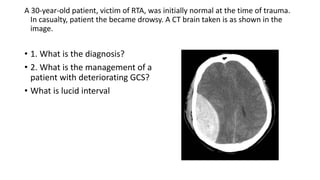
A 30-year-old patient, victim of RTA, was initially normal at the time of trauma.
In casualty, patient the became drowsy. A CT brain taken is as shown in the
image.
• 1. What is the diagnosis?
• 2. What is the management of a
patient with deteriorating GCS?
• What is lucid interval
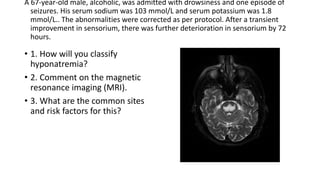
A 67-year-old male, alcoholic, was admitted with drowsiness and one episode of
seizures. His serum sodium was 103 mmol/L and serum potassium was 1.8
mmol/L.. The abnormalities were corrected as per protocol. After a transient
improvement in sensorium, there was further deterioration in sensorium by 72
hours.
• 1. How will you classify
hyponatremia?
• 2. Comment on the magnetic
resonance imaging (MRI).
• 3. What are the common sites
and risk factors for this?
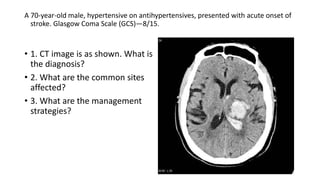
A 70-year-old male, hypertensive on antihypertensives, presented with acute onset of
stroke. Glasgow Coma Scale (GCS)—8/15.
• 1. CT image is as shown. What is
the diagnosis?
• 2. What are the common sites
affected?
• 3. What are the management
strategies?
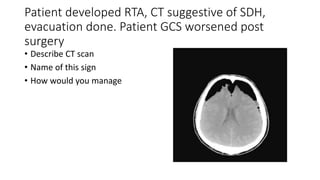
Patient developed RTA, CT suggestive of SDH,
evacuation done. Patient GCS worsened post
surgery
• Describe CT scan
• Name of this sign
• How would you manage
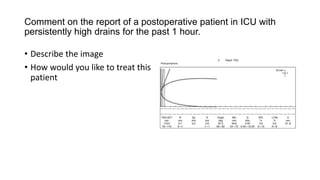
Comment on the report of a postoperative patient in ICU with
persistently high drains for the past 1 hour.
• Describe the image
• How would you like to treat this
patient
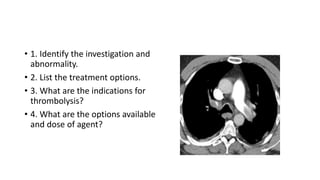
• 1. Identify the investigation and
abnormality.
• 2. List the treatment options.
• 3. What are the indications for
thrombolysis?
• 4. What are the options available
and dose of agent?
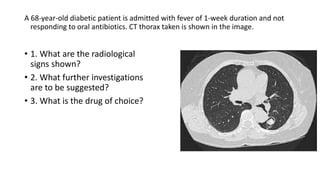
A 68-year-old diabetic patient is admitted with fever of 1-week duration and not
responding to oral antibiotics. CT thorax taken is shown in the image.
• 1. What are the radiological
signs shown?
• 2. What further investigations
are to be suggested?
• 3. What is the drug of choice?
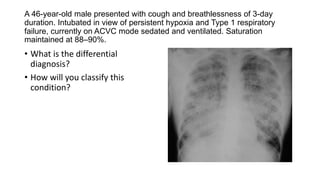
A 46-year-old male presented with cough and breathlessness of 3-day
duration. Intubated in view of persistent hypoxia and Type 1 respiratory
failure, currently on ACVC mode sedated and ventilated. Saturation
maintained at 88–90%.
• What is the differential
diagnosis?
• How will you classify this
condition?
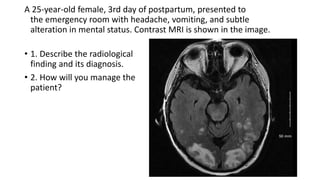
A 25-year-old female, 3rd day of postpartum, presented to
the emergency room with headache, vomiting, and subtle
alteration in mental status. Contrast MRI is shown in the image.
• 1. Describe the radiological
finding and its diagnosis.
• 2. How will you manage the
patient?
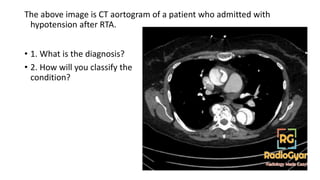
The above image is CT aortogram of a patient who admitted with
hypotension after RTA.
• 1. What is the diagnosis?
• 2. How will you classify the
condition?
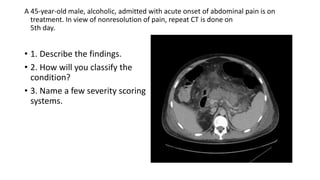
A 45-year-old male, alcoholic, admitted with acute onset of abdominal pain is on
treatment. In view of nonresolution of pain, repeat CT is done on
5th day.
• 1. Describe the findings.
• 2. How will you classify the
condition?
• 3. Name a few severity scoring
systems.
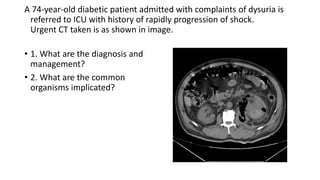
A 74-year-old diabetic patient admitted with complaints of dysuria is
referred to ICU with history of rapidly progression of shock.
Urgent CT taken is as shown in image.
• 1. What are the diagnosis and
management?
• 2. What are the common
organisms implicated?
Diagnosis and management
• A 40-year-old male recently
diagnosed case of Burkitt’s
lymphoma, started on steroids, and
shifted to ER with complaints of
respiratory distress. On
examination—
• conscious oriented. HR—120
beats/min, BP—136/100 mmHg,
RR—30 breaths/min GCS—15/15.
ABG and laboratory parameters
are as shown below. What is the
diagnosis and urgent
management?
• Hb—10.5 g/dL
• WBC—14,000/cc
• Platelets—1,25,000
• Na—138 mEq/dL
• K—6.6 mEq/dL
• Ca—6 mg/dL
• PO4—12 mg/dL
• Urea—110 mg/dL
• Uric acid—16 mg/dL
• Serum creatine—1.8 mg/dL
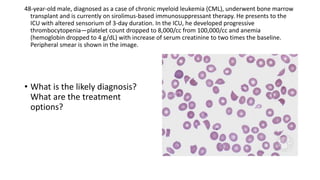
48-year-old male, diagnosed as a case of chronic myeloid leukemia (CML), underwent bone marrow
transplant and is currently on sirolimus-based immunosuppressant therapy. He presents to the
ICU with altered sensorium of 3-day duration. In the ICU, he developed progressive
thrombocytopenia—platelet count dropped to 8,000/cc from 100,000/cc and anemia
(hemoglobin dropped to 4 g/dL) with increase of serum creatinine to two times the baseline.
Peripheral smear is shown in the image.
• What is the likely diagnosis?
What are the treatment
options?
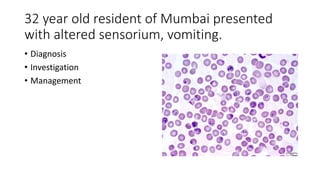
32 year old resident of Mumbai presented
with altered sensorium, vomiting.
• Diagnosis
• Investigation
• Management
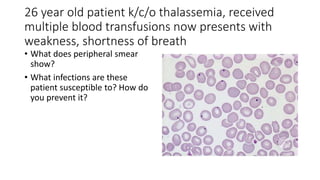
26 year old patient k/c/o thalassemia, received
multiple blood transfusions now presents with
weakness, shortness of breath
• What does peripheral smear
show?
• What infections are these
patient susceptible to? How do
you prevent it?
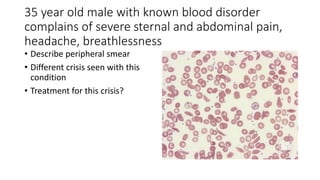
35 year old male with known blood disorder
complains of severe sternal and abdominal pain,
headache, breathlessness
• Describe peripheral smear
• Different crisis seen with this
condition
• Treatment for this crisis?
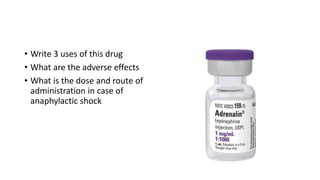
• Write 3 uses of this drug
• What are the adverse effects
• What is the dose and route of
administration in case of
anaphylactic shock
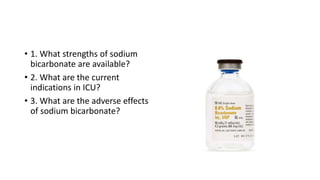
• 1. What strengths of sodium
bicarbonate are available?
• 2. What are the current
indications in ICU?
• 3. What are the adverse effects
of sodium bicarbonate?
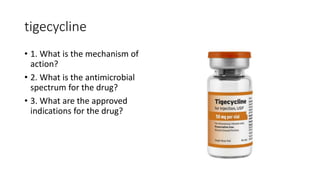
tigecycline
• 1. What is the mechanism of
action?
• 2. What is the antimicrobial
spectrum for the drug?
• 3. What are the approved
indications for the drug?
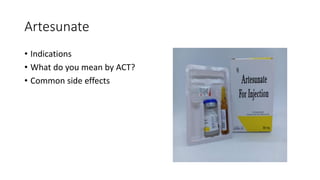
Artesunate
• Indications
• What do you mean by ACT?
• Common side effects
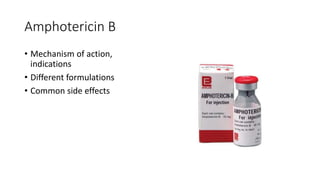
Amphotericin B
• Mechanism of action,
indications
• Different formulations
• Common side effects
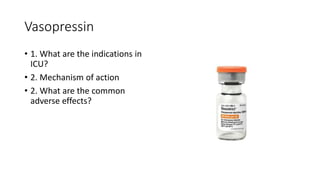
Vasopressin
• 1. What are the indications in
ICU?
• 2. Mechanism of action
• 2. What are the common
adverse effects?
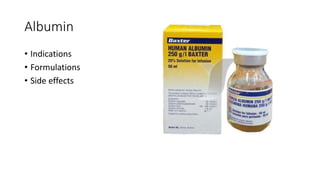
Albumin
• Indications
• Formulations
• Side effects
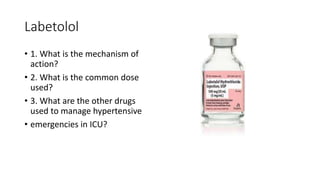
Labetolol
• 1. What is the mechanism of
action?
• 2. What is the common dose
used?
• 3. What are the other drugs
used to manage hypertensive
• emergencies in ICU?
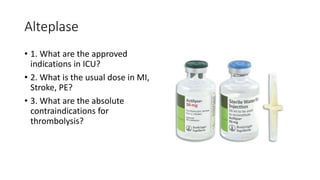
Alteplase
• 1. What are the approved
indications in ICU?
• 2. What is the usual dose in MI,
Stroke, PE?
• 3. What are the absolute
contraindications for
thrombolysis?
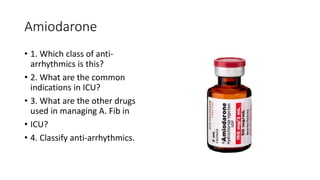
Amiodarone
• 1. Which class of anti-
arrhythmics is this?
• 2. What are the common
indications in ICU?
• 3. What are the other drugs
used in managing A. Fib in
• ICU?
• 4. Classify anti-arrhythmics.
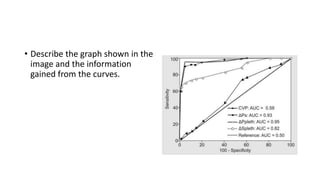
• Describe the graph shown in the
image and the information
gained from the curves.
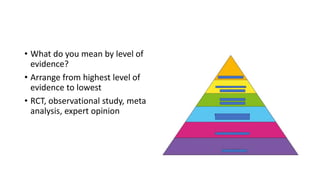
• What do you mean by level of
evidence?
• Arrange from highest level of
evidence to lowest
• RCT, observational study, meta
analysis, expert opinion
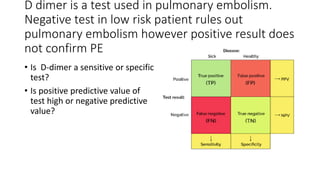
D dimer is a test used in pulmonary embolism.
Negative test in low risk patient rules out
pulmonary embolism however positive result does
not confirm PE
• Is D-dimer a sensitive or specific
test?
• Is positive predictive value of
test high or negative predictive
value?
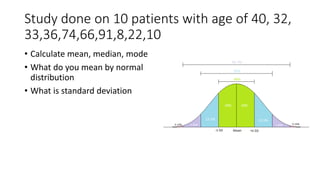
Study done on 10 patients with age of 40, 32,
33,36,74,66,91,8,22,10
• Calculate mean, median, mode
• What do you mean by normal
distribution
• What is standard deviation
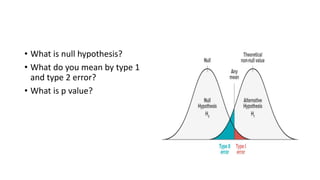
• What is null hypothesis?
• What do you mean by type 1
and type 2 error?
• What is p value?
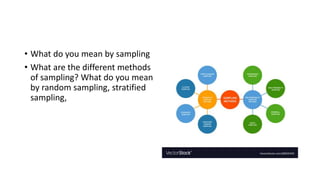
• What do you mean by sampling
• What are the different methods
of sampling? What do you mean
by random sampling, stratified
sampling,
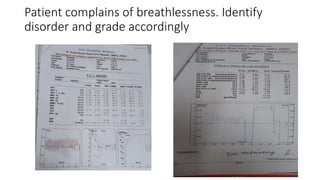
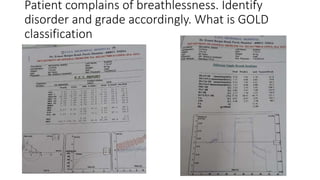
Patient complains of breathlessness. Identify
disorder and grade accordingly
Patient complains of breathlessness. Identify
disorder and grade accordingly. What is GOLD
classification
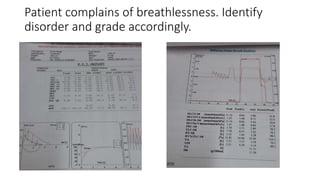
Patient complains of breathlessness. Identify
disorder and grade accordingly.
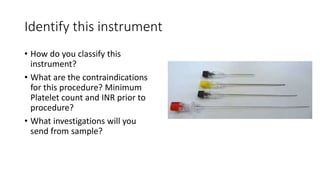
Identify this instrument
• How do you classify this
instrument?
• What are the contraindications
for this procedure? Minimum
Platelet count and INR prior to
procedure?
• What investigations will you
send from sample?
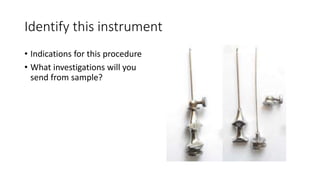
Identify this instrument
• Indications for this procedure
• What investigations will you
send from sample?
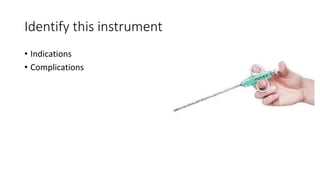
Identify this instrument
• Indications
• Complications
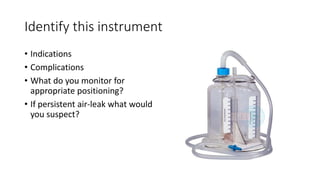
Identify this instrument
• Indications
• Complications
• What do you monitor for
appropriate positioning?
• If persistent air-leak what would
you suspect?
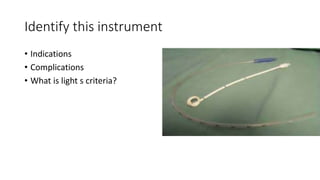
Identify this instrument
• Indications
• Complications
• What is light s criteria?
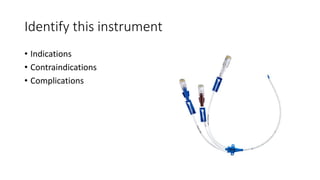
Identify this instrument
• Indications
• Contraindications
• Complications
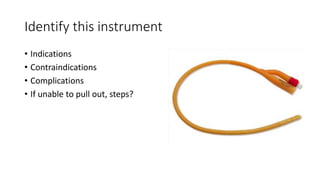
Identify this instrument
• Indications
• Contraindications
• Complications
• If unable to pull out, steps?
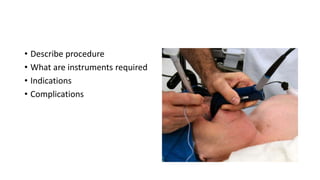
• Describe procedure
• What are instruments required
• Indications
• Complications
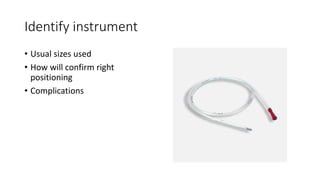
Identify instrument
• Usual sizes used
• How will confirm right
positioning
• Complications
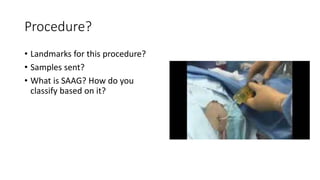
Procedure?
• Landmarks for this procedure?
• Samples sent?
• What is SAAG? How do you
classify based on it?
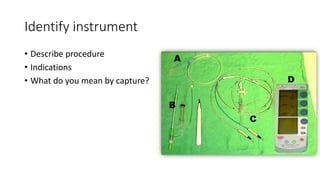
Identify instrument
• Describe procedure
• Indications
• What do you mean by capture?
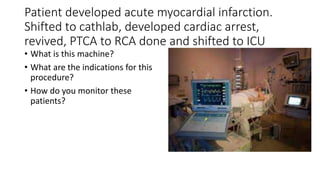
Patient developed acute myocardial infarction.
Shifted to cathlab, developed cardiac arrest,
revived, PTCA to RCA done and shifted to ICU
• What is this machine?
• What are the indications for this
procedure?
• How do you monitor these
patients?
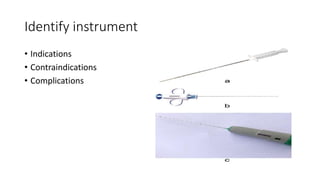
Identify instrument
• Indications
• Contraindications
• Complications
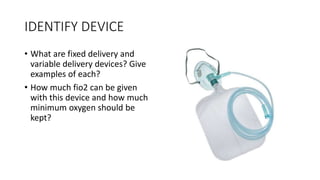
IDENTIFY DEVICE
• What are fixed delivery and
variable delivery devices? Give
examples of each?
• How much fio2 can be given
with this device and how much
minimum oxygen should be
kept?
IDENTIFY DEVICE
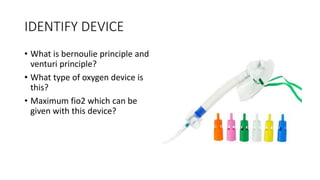
• What is bernoulie principle and
venturi principle?
• What type of oxygen device is
this?
• Maximum fio2 which can be
given with this device?
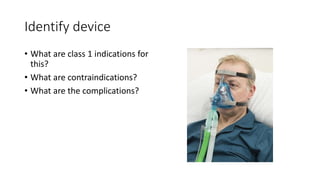
Identify device
• What are class 1 indications for
this?
• What are contraindications?
• What are the complications?
• Diagnosis
• Treatment options and their dose?
• Name few indications for plasmapheresis.
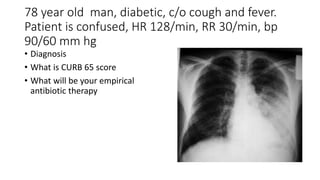
78 year old man, diabetic, c/o cough and fever.
Patient is confused, HR 128/min, RR 30/min, bp
90/60 mm hg
• Diagnosis
• What is CURB 65 score
• What will be your empirical
antibiotic therapy
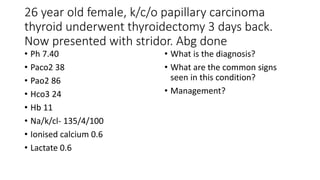
26 year old female, k/c/o papillary carcinoma
thyroid underwent thyroidectomy 3 days back.
Now presented with stridor. Abg done
• Ph 7.40
• Paco2 38
• Pao2 86
• Hco3 24
• Hb 11
• Na/k/cl- 135/4/100
• Ionised calcium 0.6
• Lactate 0.6
• What is the diagnosis?
• What are the common signs
seen in this condition?
• Management?
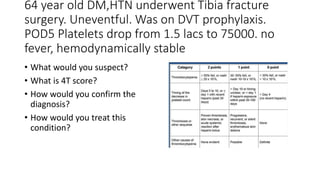
64 year old DM,HTN underwent Tibia fracture
surgery. Uneventful. Was on DVT prophylaxis.
POD5 Platelets drop from 1.5 lacs to 75000. no
fever, hemodynamically stable
• What would you suspect?
• What is 4T score?
• How would you confirm the
diagnosis?
• How would you treat this
condition?
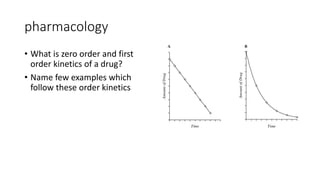
pharmacology
• What is zero order and first
order kinetics of a drug?
• Name few examples which
follow these order kinetics
24 year old primiparous female with normal
antenatal history was shifted to ICU with sudden
onset convulsions at 36 weeks gestation.
• Conscious, oriented
• Pulse 100/min, BP 160/90 mm
hg
• Hb 11, plt 150000, wbc 10000
• Urea 46 uric acis 6 creatinine 1.5
• Bilirubin 1.8, ALT 350 AST 240
• INR 1.1 apt t 45 sec
• What is most likely diagnosis?
• What are differential diagnosis
of seizures in pregnancy
• What are drugs given for BP
control in pregnancy
• What are differentials for
deranged LFT in pregnant
patients?
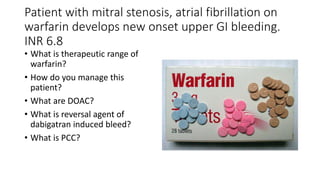
Patient with mitral stenosis, atrial fibrillation on
warfarin develops new onset upper GI bleeding.
INR 6.8
• What is therapeutic range of
warfarin?
• How do you manage this
patient?
• What are DOAC?
• What is reversal agent of
dabigatran induced bleed?
• What is PCC?
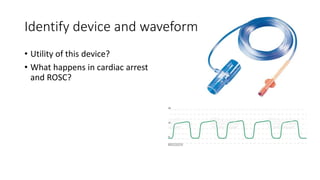
Identify device and waveform
• Utility of this device?
• What happens in cardiac arrest
and ROSC?
55 year old male, h/o fever, myalgia 3 days.spo2
80 % requiring 10 L oxygen however patient is not
breathless. RT PCR for Covid 19 positive
• What is happy hypoxia?
• What is role of steroids in covid
19?
• What is role of remdesivir,
antibody cocktail and
tocilizumab in covid?
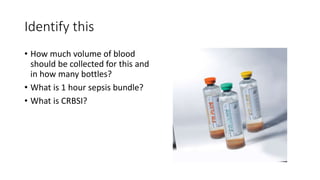
Identify this
• How much volume of blood
should be collected for this and
in how many bottles?
• What is 1 hour sepsis bundle?
• What is CRBSI?
Disinfectants
• What is disinfectant? How do
you classify disinfectants?
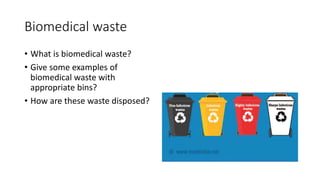
Biomedical waste
• What is biomedical waste?
• Give some examples of
biomedical waste with
appropriate bins?
• How are these waste disposed?
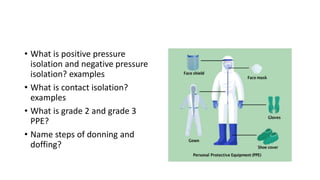
• What is positive pressure
isolation and negative pressure
isolation? examples
• What is contact isolation?
examples
• What is grade 2 and grade 3
PPE?
• Name steps of donning and
doffing?
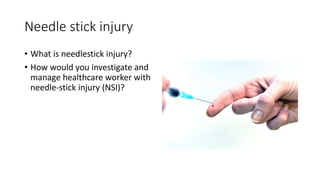
Needle stick injury
• What is needlestick injury?
• How would you investigate and
manage healthcare worker with
needle-stick injury (NSI)?
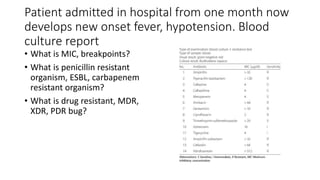
Patient admitted in hospital from one month now
develops new onset fever, hypotension. Blood
culture report
• What is MIC, breakpoints?
• What is penicillin resistant
organism, ESBL, carbapenem
resistant organism?
• What is drug resistant, MDR,
XDR, PDR bug?
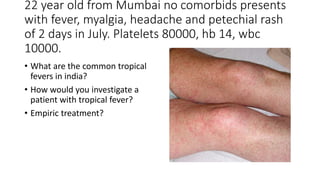
22 year old from Mumbai no comorbids presents
with fever, myalgia, headache and petechial rash
of 2 days in July. Platelets 80000, hb 14, wbc
10000.
• What are the common tropical
fevers in india?
• How would you investigate a
patient with tropical fever?
• Empiric treatment?
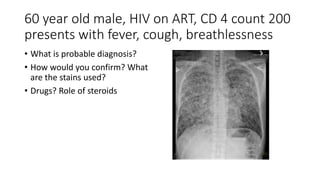
60 year old male, HIV on ART, CD 4 count 200
presents with fever, cough, breathlessness
• What is probable diagnosis?
• How would you confirm? What
are the stains used?
• Drugs? Role of steroids
45 male, admitted for gastroenteritis is found
to be hbsag positive on routine investigations
• Does he require treatment?
• How do you investigate and
manage?
Patient admitted for fever on and off since 3
weeks. He has been admitted thrice and all
investigations were found to be normal and hence
discharged
• What do you call this condition?
• Name few differentials? How
would you investigate?
68 year old female post surgery developed
pneumonia and was treated with ceftriaxone and
clindamycin. Patient was afebrile for 3 days,
planned for discharge develops acute watery
diarrhea
• What are the differentials?
• How would you investigate?
• Treatment?
BRAIN DEATH- APNEA TEST, REFLEXES
NMS VS SERATONIN SYNDROME
THYROID STORM
ADRENOCORTICAL INSUFFICIENCY
CUSHING S SYNDROME
METABOLIC SYNDROME
OP POISONING
PCM POISONING
BETA BLOCKER POISONING
SEIZURES EEG
DECOMPRESSION SICKNESS
HYPERBARIC OXYGEN THERAPY
HIGH ALTITUDE
HEAT STROKE
H PYLORI
CROHNS VS ULCERATIVE COLITIS
WEGERNER GRANULOMATOSIS
GIANT CELL ARTERITIS
COMMUNICATION SPIKES APPROACH
END OF LIFE CARE
ISBAR
MODES OF VENTILATOR
PARKINSON DISEASE
CAG
MYASTHENIA GRAVIS
AORTIC STENOSIS-TAVR
ASTHMA/COPD
UGI BLEED
OSCE FOR DNB.pptx

OSCE FOR DNB.pptx

  • 1.
  • 2.
    Describe chest xray? • Differential diagnosis • patient immunocompromised presenting with cough then which conditions should be thought of?
  • 3.
    Patient presents withvague symptoms of fatiguability, weakness. Describe chest x ray? • Common causes • How will you investigate?
  • 4.
    Patient with psoriaticarthritis with adalimumab. Presents with deranged liver function tests and fevers.Describe chest x ray? • How would you like to investigate this patient? • How would you treat this patient once diagnosis confirmed?
  • 5.
    Patient 35 yearold male presents with shortness of breath. Describe the chest x ray • Differential diagnosis? • How would you confirm the diagnosis
  • 6.
    Describe the ECG •What are the types? • If this patient develops tachycardia, how would you proceed? • Would you like to use beta blockers, adenosine, calcium channel blockers in this scenario?
  • 7.
    75 year oldpatient DM, HTN, IHD, DCM,AF on OHA, losartan, amlodipine, digoxin, rosuvastatin developed new onset altered sensorium, dizziness • Describe ecg • Diagnosis • Treatment
  • 8.
    36 year oldobese lady with history of hypothyroidism, pcos, diabetes, hypertension on losartan, thyroxine, metformin, oral contraceptives developed dyspnea and sweating • Describe ECG • How would you like to investigate? • Treatment
  • 9.
    40 year oldmale diagnosed with APML started on arsenic trioxide and ATRA. Suddenly becomes unconscious • Describe ECG • Diagnosis • Treatment
  • 10.
    67-year-old male presentedto the emergency room with dizziness. He denied any significant past medical history, but reported a bee sting one day prior to arrival • Describe ECG • Diagnosis • Treatment
  • 11.
    65 year oldfemale presented with syncope. • Describe ECG • Diagnosis • Treatment
  • 12.
    70 year oldmale, DM, h/o fever, dysuria, in shock • Describe ECG • Diagnosis • Treatment
  • 13.
    42 year oldmale, no comorbids, presented with multiple episodes of diarrhea. Looks clinically dehydrated • Describe ECG • Diagnosis • Treatment
  • 14.
    70 year oldmale, diabetic, hypertensive, IHD post PTCA status developed new onset chest pain. Collapsed in casualty. CPCR 10 minutes. Shifted to ICU. Now post cardiac arrest care • Describe ECG • Diagnosis • Treatment
  • 15.
    Patient presents tocasualty with acute chest pain, ECG STEMI. Planned for PAMI. Develops cardiac arrest • Identify rhythm • What would you do? • Compression:ventilation ratio? • Rate of compression? • Defibrillation joules? • Pulse check after ?
  • 16.
    Patient presents tocasualty with acute chest pain, ECG STEMI. Planned for PAMI. Develops cardiac arrest • Identify rhythm • Role of adrenaline,atropine,vasopressin ? • What is ROSC? • what is targeted temperature management?
  • 17.
    • Comment onECG • What are the causes for right axis deviation, RBBB?
  • 18.
    IDENTIFY • What arethe causes of LBBB? • What is sgarbossa criteria?
  • 19.
    Identify • How doyou differentiate AVRT from AVNRT? • How do you differentiate VT from SVT with aberrancy?
  • 20.
    Patient presents withacute onset chest pain • ECG features? • What is posterior lead ecg? • Diagnosis?
  • 21.
    Patient presents withacute onset chest pain • ECG features? • Culprit vessel? • When do you do right sided ECG?
  • 22.
    IDENTIFY ECG • Whichchambers are being paced? • What are the indications? • What is pacemaker syndrome?
  • 23.
    72 Year oldmale, k/c/o COPD, altered sensorium and breathing difficulty of 1 day duration NIV 40 % fio2 Ph 6.96 Pco2 125 Hco3 17 Po2 88 Hb 9 Na/k/cl 140/3.9/98 Glucose 138 Lactate 2
  • 24.
    46 year oldmale, k/c/o HTN, DM, chronic kidney disease, altered sensorium to ER hr 150/min, BP 100/48 mm hg, RR-30 breaths/min Ph 6.85 Pco2 12 Hco3 3 Po2 322 Hb 9 Na/k/cl 114/7.3/87 Glucose >500 Lactate 10.7
  • 25.
    75 male, CHFon loop diuretics disoriented PH 7.55 PCO2 48 PO2 75 HCO3 36 BE +12 NA/K/CL 130/3/86 LACTATE 1
  • 26.
    30 f undergoinghysterectomy under GA Ph 7.523 Pao2 150 Paco2 30 Hco3 22 NA/K/CL 140/4/100 LACTATES 1 BE -2
  • 27.
    Identify? • Name theindications of this product • List the complications • How do you calculate nutritional requirements
  • 28.
    78 year oldman HTN, IHD, left sided weakness 6 hours before. Facial deviation to left noted • Diagnosis? • Treatment? • Name few absolute C/I for thrombolysis
  • 29.
    78 year oldman HTN, IHD, woke up and could not move his right side of body. Facial deviation to left noted • Diagnosis? • Treatment? • Name few absolute C/I for thrombolysis
  • 30.
    40 year oldfemale complains of severe headache, blurring of vision. • Diagnosis • Few grading systems for the same • Common causes • If patient deteriorates after 24 hours and then after 72 hours what are the common causes?
  • 31.
    A 30-year-old patient,victim of RTA, was initially normal at the time of trauma. In casualty, patient the became drowsy. A CT brain taken is as shown in the image. • 1. What is the diagnosis? • 2. What is the management of a patient with deteriorating GCS? • What is lucid interval
  • 32.
    A 67-year-old male,alcoholic, was admitted with drowsiness and one episode of seizures. His serum sodium was 103 mmol/L and serum potassium was 1.8 mmol/L.. The abnormalities were corrected as per protocol. After a transient improvement in sensorium, there was further deterioration in sensorium by 72 hours. • 1. How will you classify hyponatremia? • 2. Comment on the magnetic resonance imaging (MRI). • 3. What are the common sites and risk factors for this?
  • 33.
    A 70-year-old male,hypertensive on antihypertensives, presented with acute onset of stroke. Glasgow Coma Scale (GCS)—8/15. • 1. CT image is as shown. What is the diagnosis? • 2. What are the common sites affected? • 3. What are the management strategies?
  • 34.
    Patient developed RTA,CT suggestive of SDH, evacuation done. Patient GCS worsened post surgery • Describe CT scan • Name of this sign • How would you manage
  • 35.
    Comment on thereport of a postoperative patient in ICU with persistently high drains for the past 1 hour. • Describe the image • How would you like to treat this patient
  • 36.
    • 1. Identifythe investigation and abnormality. • 2. List the treatment options. • 3. What are the indications for thrombolysis? • 4. What are the options available and dose of agent?
  • 37.
    A 68-year-old diabeticpatient is admitted with fever of 1-week duration and not responding to oral antibiotics. CT thorax taken is shown in the image. • 1. What are the radiological signs shown? • 2. What further investigations are to be suggested? • 3. What is the drug of choice?
  • 38.
    A 46-year-old malepresented with cough and breathlessness of 3-day duration. Intubated in view of persistent hypoxia and Type 1 respiratory failure, currently on ACVC mode sedated and ventilated. Saturation maintained at 88–90%. • What is the differential diagnosis? • How will you classify this condition?
  • 39.
    A 25-year-old female,3rd day of postpartum, presented to the emergency room with headache, vomiting, and subtle alteration in mental status. Contrast MRI is shown in the image. • 1. Describe the radiological finding and its diagnosis. • 2. How will you manage the patient?
  • 40.
    The above imageis CT aortogram of a patient who admitted with hypotension after RTA. • 1. What is the diagnosis? • 2. How will you classify the condition?
  • 41.
    A 45-year-old male,alcoholic, admitted with acute onset of abdominal pain is on treatment. In view of nonresolution of pain, repeat CT is done on 5th day. • 1. Describe the findings. • 2. How will you classify the condition? • 3. Name a few severity scoring systems.
  • 42.
    A 74-year-old diabeticpatient admitted with complaints of dysuria is referred to ICU with history of rapidly progression of shock. Urgent CT taken is as shown in image. • 1. What are the diagnosis and management? • 2. What are the common organisms implicated?
  • 43.
    Diagnosis and management •A 40-year-old male recently diagnosed case of Burkitt’s lymphoma, started on steroids, and shifted to ER with complaints of respiratory distress. On examination— • conscious oriented. HR—120 beats/min, BP—136/100 mmHg, RR—30 breaths/min GCS—15/15. ABG and laboratory parameters are as shown below. What is the diagnosis and urgent management? • Hb—10.5 g/dL • WBC—14,000/cc • Platelets—1,25,000 • Na—138 mEq/dL • K—6.6 mEq/dL • Ca—6 mg/dL • PO4—12 mg/dL • Urea—110 mg/dL • Uric acid—16 mg/dL • Serum creatine—1.8 mg/dL
  • 44.
    48-year-old male, diagnosedas a case of chronic myeloid leukemia (CML), underwent bone marrow transplant and is currently on sirolimus-based immunosuppressant therapy. He presents to the ICU with altered sensorium of 3-day duration. In the ICU, he developed progressive thrombocytopenia—platelet count dropped to 8,000/cc from 100,000/cc and anemia (hemoglobin dropped to 4 g/dL) with increase of serum creatinine to two times the baseline. Peripheral smear is shown in the image. • What is the likely diagnosis? What are the treatment options?
  • 45.
    32 year oldresident of Mumbai presented with altered sensorium, vomiting. • Diagnosis • Investigation • Management
  • 46.
    26 year oldpatient k/c/o thalassemia, received multiple blood transfusions now presents with weakness, shortness of breath • What does peripheral smear show? • What infections are these patient susceptible to? How do you prevent it?
  • 47.
    35 year oldmale with known blood disorder complains of severe sternal and abdominal pain, headache, breathlessness • Describe peripheral smear • Different crisis seen with this condition • Treatment for this crisis?
  • 48.
    • Write 3uses of this drug • What are the adverse effects • What is the dose and route of administration in case of anaphylactic shock
  • 49.
    • 1. Whatstrengths of sodium bicarbonate are available? • 2. What are the current indications in ICU? • 3. What are the adverse effects of sodium bicarbonate?
  • 50.
    tigecycline • 1. Whatis the mechanism of action? • 2. What is the antimicrobial spectrum for the drug? • 3. What are the approved indications for the drug?
  • 51.
    Artesunate • Indications • Whatdo you mean by ACT? • Common side effects
  • 52.
    Amphotericin B • Mechanismof action, indications • Different formulations • Common side effects
  • 53.
    Vasopressin • 1. Whatare the indications in ICU? • 2. Mechanism of action • 2. What are the common adverse effects?
  • 54.
  • 55.
    Labetolol • 1. Whatis the mechanism of action? • 2. What is the common dose used? • 3. What are the other drugs used to manage hypertensive • emergencies in ICU?
  • 56.
    Alteplase • 1. Whatare the approved indications in ICU? • 2. What is the usual dose in MI, Stroke, PE? • 3. What are the absolute contraindications for thrombolysis?
  • 57.
    Amiodarone • 1. Whichclass of anti- arrhythmics is this? • 2. What are the common indications in ICU? • 3. What are the other drugs used in managing A. Fib in • ICU? • 4. Classify anti-arrhythmics.
  • 58.
    • Describe thegraph shown in the image and the information gained from the curves.
  • 59.
    • What doyou mean by level of evidence? • Arrange from highest level of evidence to lowest • RCT, observational study, meta analysis, expert opinion
  • 60.
    D dimer isa test used in pulmonary embolism. Negative test in low risk patient rules out pulmonary embolism however positive result does not confirm PE • Is D-dimer a sensitive or specific test? • Is positive predictive value of test high or negative predictive value?
  • 61.
    Study done on10 patients with age of 40, 32, 33,36,74,66,91,8,22,10 • Calculate mean, median, mode • What do you mean by normal distribution • What is standard deviation
  • 62.
    • What isnull hypothesis? • What do you mean by type 1 and type 2 error? • What is p value?
  • 63.
    • What doyou mean by sampling • What are the different methods of sampling? What do you mean by random sampling, stratified sampling,
  • 64.
    Patient complains ofbreathlessness. Identify disorder and grade accordingly
  • 65.
    Patient complains ofbreathlessness. Identify disorder and grade accordingly. What is GOLD classification
  • 66.
    Patient complains ofbreathlessness. Identify disorder and grade accordingly.
  • 67.
    Identify this instrument •How do you classify this instrument? • What are the contraindications for this procedure? Minimum Platelet count and INR prior to procedure? • What investigations will you send from sample?
  • 68.
    Identify this instrument •Indications for this procedure • What investigations will you send from sample?
  • 69.
    Identify this instrument •Indications • Complications
  • 70.
    Identify this instrument •Indications • Complications • What do you monitor for appropriate positioning? • If persistent air-leak what would you suspect?
  • 71.
    Identify this instrument •Indications • Complications • What is light s criteria?
  • 72.
    Identify this instrument •Indications • Contraindications • Complications
  • 73.
    Identify this instrument •Indications • Contraindications • Complications • If unable to pull out, steps?
  • 74.
    • Describe procedure •What are instruments required • Indications • Complications
  • 75.
    Identify instrument • Usualsizes used • How will confirm right positioning • Complications
  • 76.
    Procedure? • Landmarks forthis procedure? • Samples sent? • What is SAAG? How do you classify based on it?
  • 77.
    Identify instrument • Describeprocedure • Indications • What do you mean by capture?
  • 78.
    Patient developed acutemyocardial infarction. Shifted to cathlab, developed cardiac arrest, revived, PTCA to RCA done and shifted to ICU • What is this machine? • What are the indications for this procedure? • How do you monitor these patients?
  • 79.
    Identify instrument • Indications •Contraindications • Complications
  • 80.
    IDENTIFY DEVICE • Whatare fixed delivery and variable delivery devices? Give examples of each? • How much fio2 can be given with this device and how much minimum oxygen should be kept?
  • 81.
    IDENTIFY DEVICE • Whatis bernoulie principle and venturi principle? • What type of oxygen device is this? • Maximum fio2 which can be given with this device?
  • 82.
    Identify device • Whatare class 1 indications for this? • What are contraindications? • What are the complications?
  • 91.
    • Diagnosis • Treatmentoptions and their dose? • Name few indications for plasmapheresis.
  • 92.
    78 year oldman, diabetic, c/o cough and fever. Patient is confused, HR 128/min, RR 30/min, bp 90/60 mm hg • Diagnosis • What is CURB 65 score • What will be your empirical antibiotic therapy
  • 93.
    26 year oldfemale, k/c/o papillary carcinoma thyroid underwent thyroidectomy 3 days back. Now presented with stridor. Abg done • Ph 7.40 • Paco2 38 • Pao2 86 • Hco3 24 • Hb 11 • Na/k/cl- 135/4/100 • Ionised calcium 0.6 • Lactate 0.6 • What is the diagnosis? • What are the common signs seen in this condition? • Management?
  • 94.
    64 year oldDM,HTN underwent Tibia fracture surgery. Uneventful. Was on DVT prophylaxis. POD5 Platelets drop from 1.5 lacs to 75000. no fever, hemodynamically stable • What would you suspect? • What is 4T score? • How would you confirm the diagnosis? • How would you treat this condition?
  • 95.
    pharmacology • What iszero order and first order kinetics of a drug? • Name few examples which follow these order kinetics
  • 97.
    24 year oldprimiparous female with normal antenatal history was shifted to ICU with sudden onset convulsions at 36 weeks gestation. • Conscious, oriented • Pulse 100/min, BP 160/90 mm hg • Hb 11, plt 150000, wbc 10000 • Urea 46 uric acis 6 creatinine 1.5 • Bilirubin 1.8, ALT 350 AST 240 • INR 1.1 apt t 45 sec • What is most likely diagnosis? • What are differential diagnosis of seizures in pregnancy • What are drugs given for BP control in pregnancy • What are differentials for deranged LFT in pregnant patients?
  • 98.
    Patient with mitralstenosis, atrial fibrillation on warfarin develops new onset upper GI bleeding. INR 6.8 • What is therapeutic range of warfarin? • How do you manage this patient? • What are DOAC? • What is reversal agent of dabigatran induced bleed? • What is PCC?
  • 99.
    Identify device andwaveform • Utility of this device? • What happens in cardiac arrest and ROSC?
  • 100.
    55 year oldmale, h/o fever, myalgia 3 days.spo2 80 % requiring 10 L oxygen however patient is not breathless. RT PCR for Covid 19 positive • What is happy hypoxia? • What is role of steroids in covid 19? • What is role of remdesivir, antibody cocktail and tocilizumab in covid?
  • 101.
    Identify this • Howmuch volume of blood should be collected for this and in how many bottles? • What is 1 hour sepsis bundle? • What is CRBSI?
  • 102.
    Disinfectants • What isdisinfectant? How do you classify disinfectants?
  • 103.
    Biomedical waste • Whatis biomedical waste? • Give some examples of biomedical waste with appropriate bins? • How are these waste disposed?
  • 104.
    • What ispositive pressure isolation and negative pressure isolation? examples • What is contact isolation? examples • What is grade 2 and grade 3 PPE? • Name steps of donning and doffing?
  • 105.
    Needle stick injury •What is needlestick injury? • How would you investigate and manage healthcare worker with needle-stick injury (NSI)?
  • 106.
    Patient admitted inhospital from one month now develops new onset fever, hypotension. Blood culture report • What is MIC, breakpoints? • What is penicillin resistant organism, ESBL, carbapenem resistant organism? • What is drug resistant, MDR, XDR, PDR bug?
  • 107.
    22 year oldfrom Mumbai no comorbids presents with fever, myalgia, headache and petechial rash of 2 days in July. Platelets 80000, hb 14, wbc 10000. • What are the common tropical fevers in india? • How would you investigate a patient with tropical fever? • Empiric treatment?
  • 108.
    60 year oldmale, HIV on ART, CD 4 count 200 presents with fever, cough, breathlessness • What is probable diagnosis? • How would you confirm? What are the stains used? • Drugs? Role of steroids
  • 109.
    45 male, admittedfor gastroenteritis is found to be hbsag positive on routine investigations • Does he require treatment? • How do you investigate and manage?
  • 110.
    Patient admitted forfever on and off since 3 weeks. He has been admitted thrice and all investigations were found to be normal and hence discharged • What do you call this condition? • Name few differentials? How would you investigate?
  • 111.
    68 year oldfemale post surgery developed pneumonia and was treated with ceftriaxone and clindamycin. Patient was afebrile for 3 days, planned for discharge develops acute watery diarrhea • What are the differentials? • How would you investigate? • Treatment?
  • 112.
    BRAIN DEATH- APNEATEST, REFLEXES
  • 113.
  • 114.
  • 115.
  • 116.
  • 117.
  • 118.
  • 119.
  • 120.
  • 121.
  • 122.
  • 123.
  • 124.
  • 125.
  • 126.
  • 127.
  • 128.
  • 129.
  • 130.
  • 131.
  • 132.
  • 133.
  • 134.
  • 135.
  • 136.
  • 137.
  • 138.
  • 139.