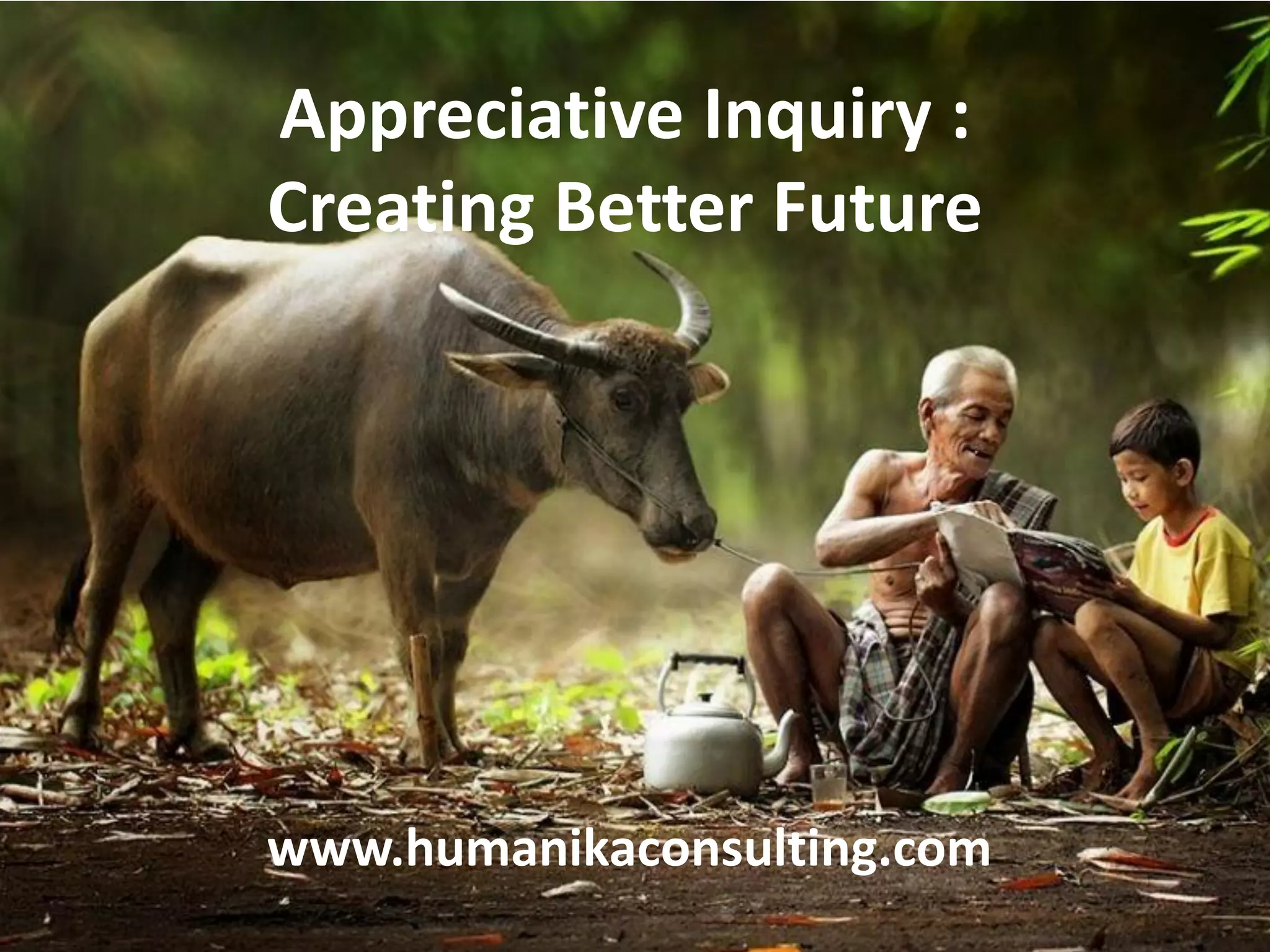
Appreciative Inquiry :
Creating Better Future
www.humanikaconsulting.com
“Thank God our precious time is now”
– M.L. King
A Time to Re-think Human Relationships
and Change ...
“No Limits to
Cooperation”
Power of
Wholeness
Realities and Relationships:
The “Language of Life”
A Positive Revolution in Change
An Open Moment…
We Are “In It.” Now.
Appreciative Inquiry is a Shift…
“No problem can be solved from the
same level of consciousness that
created it. We must learn to see the
world anew.”
“There are only two ways to live your
life. One is as though nothing is a
miracle. The other is as though
everything is a miracle.”
Ap-pre’ci-ate, v., 1. valuing; the act of recognizing the best in people
or the world around us; affirming past and
present strengths, successes, and potentials; to
perceive those things that give life (health,
vitality, excellence) to living systems
2. to increase in value, e.g. the economy has
appreciated in value. Synonyms: VALUING,
PRIZING, ESTEEMING, and HONORING.
In-quire’, v., 1. the act of exploration and discovery.
2. to ask questions; to be open to seeing new
potentials and possibilities. Synonyms:
DISCOVERY, SEARCH, and SYSTEMATIC
EXPLORATION, STUDY.
What is Appreciative Inquiry ?
What is Appreciative Inquiry?
• Appreciative Inquiry is the study and
exploration of what gives life to
human systems when they function
at their best.
• This approach to personal change
and organization change is based on
the assumption that questions and
dialogue about strengths, successes,
values, hopes, and dreams are
themselves transformational.
(from The Power of Appreciative Inquiry by
Diana Whitney and Amanda Trosten-Bloom)
So...Appreciative Inquiry
• Focuses on the “best of what is”
• To realise the ideal of “what might be”
• With the consent of “what should be”
• For the reality of “what can be”
(Cooperrider and Srivastva, 1987)
"The most serious
mistakes are not being
made as a result of wrong
answers. The truly
dangerous thing is asking
the wrong question."
- Peter Drucker
The Essence of Appreciative Inquiry
Positive Core
Appreciative Inquiry - Simply Put…
If we look for what is best and learn
we can magnify and multiply our suc
If we continue to search for problems,
we will continue to find problems
AI’s Origins
• Research from the Weatherhead School
of Management at Case Western
Reserve University
• David Cooperrider is Professor and
Chairman of the Case Center for
Business as an Agent of World Benefit
• Study at the Cleveland Clinic
A Positive View of Organizations
“Organizations are, first and foremost, centers of human
relatedness and relationships come alive where there is an
appreciative eye, when people see the best in one another
and the whole, when they share their dreams and ultimate
concerns in affirming ways, and when they are connected in
full voice to create not just new worlds, but better worlds.
By making it possible for every voice to be heard, a life
giving process is enacted.”
(from The Appreciative Organization by
Harlene Anderson, David Cooperrider, et. al.)
Imagine the difference…
What works well in this organization?
What problems do we need to fix to make
this organization better?
Starting with 2 very different questions:
Appreciative Inquiry Principles
• Constructionist Principle
We construct realities based on our previous
experience, so our knowledge and the destiny of
the system are interwoven.
• Principle of Simultaneity
Inquiry and change are simultaneous
• Poetic Principle
The system’s story is constantly co-authored, and is
open to infinite interpretations
• Anticipatory Principle
What we anticipate determines what we find
• Positive Principle
As an image of reality is enhanced, actions begin
to align with the positive image
Key Understandings of A.I.
• Appreciate/value the
best of what is
• Envision what might be
• Engage in dialogue about
what should be
• Innovate what will be
• A cooperative inquiry
• A collaborative process
• Generate new
narratives/perspectives
20
Appreciative Inquiry
PROBLEM SOLVING ORIENTATION
Fill the Gap
APPRECIATIVE ORIENTATION
Realize the Possibilities
CURRENT
STATE
THE QUESTIONS
What’s wrong?
How do we fix it?
PAST FUTURE
THE QUESTIONS
What’s working?
What’s possible?
What shall we do to achieve it?
Appreciative Inquiry Model
Traditional Old Process
• Define the problem
• Fix what’s broken
• Focus on decay
What problems are you
having?
Appreciative Inquiry
• Search for solutions
that already exist
• Amplify what is working
• Focus on life giving
forces
What is working well
around here?
(Hammond, 1998)
Deficit Based Change :
Unintended Consequences
 Much lamented fragmented responses
 Slow: Puts attention on yesterday’s
causes
 No new positive images of future
 Visionless voice... fatigue
 Weakened fabric of relationships &
defensiveness…negative culture
 out of sync with the embedded economy
of speed, partnerships, alliances, & e-
commerce
Six Aspects of Change and Development of
which to be Aware
Knowledge of the
community is critical to
determining its destiny.
The seeds of change are implicit in the first
questions we ask.
A critical resource we have for creating positive change
in our communities is our imagination and the capacity
to free the imagination and the mind of groups.
Our imagination
and mind are
constrained by bad
habits, limited
styles of thinking,
underlying
assumptions and
traditional rules of
organizing.
Our styles of thinking rarely match the
increasingly complex worlds in which we work…
We need to discover more creative and fruitful
ways of knowing.
All systems (organizations and communities), as
living constructions, are largely affirmative and
respond to positive thought and positive knowledge.
Harnessing Imagination
• Appreciative Inquiry gathers
positive stories and images
• Our minds are stretched by
hearing what is possible
• Positive images lead to positive
action
Positive Image Positive Action
• Medical research on the
placebo effect.
• Medical research on the
link between negative and
positive effect on healing
• Education: Pygmalion
Effect
• Sports Psychology on the
power of imagery of
differential self-monitoring.
• Emotional Intelligence
Positive Image-Positive Action
• Change happens at the level of discourse.
• The best clue to a system’s health is to listen
to how its members talk about the future.
Positive Image-Positive Action
• Our habitual styles of
thought, assumptions,
and rules of analysis
often have ironic
consequences of
exacerbating the very
problems we have so
carefully diagnosed.
• Energy flows where
attention goes.
Appreciative Inquiry Four D’s
DISCOVERY
“What gives life?”
Storytelling – the
best of what is.
DREAM
“What could be?”
Imagining the future.
DESIGN
“What should be?”
Provocative
propositions.
DESTINY
“What will we do?”
Delivering
performance.
Cooperrider, Whitney & Stavros,2003
Discovery
• What interests or excites you
about being here?
• What results are you hoping
for?
• Tell me about a time when
you thought --- was at its
best.
• Tell the story of what was
going on, who was involved,
and what happened
• What did you do? What did
you value most about your
involvement in that story?
• What do you value most
about the contribution of
others in that story?
Discovery → Dream
• Facilitates dialogue among participants
• Sharing of positive stories
• Creates energy and enthusiasm
• Brings out the positive core of the organisation
• Begin to see common themes
Dream → Design
• Underpinned by palliative
care philosophy
• Solid foundations
• Communication
• Shared goals
• Seamless service
• Responsive
• Appropriate levels of
funding
• Develop relationships
with client and family
• Multi-disciplinary team
(RDNS/EPC Action Research project 2004)
Design Phase
• Create the social-technical architecture
• Craft provocative proposition(s)
• Dream becomes a reality
Good provocative proposition
• Bridge the best of “what is” and
“what might be”
• Challenge the status quo
• It should be desirable
• State it in the affirmative and bold
terms
• Fit within the architecture
• Zone of proximal development (ZPD)
• Participative process
• Balance the management of
continuity, novelty and transition
Destiny – what will be?
Allow yourself to dream and you
will discover that destiny is
yours to design
(Dr J. Stavros)
Action plan: what next?
• What can we do -
together?
• What will we do – to
contribute?
• How will we do it – to
provide optimal client
care outcomes?
What would you call it?
(all these things taken together)
 Achievements
 Strategic opportunities
 Cooperative Moments
 Technical assets
 Innovations
 Elevated thoughts
 Community assets
 Positive emotions
 Financial assets
 Community wisdom
 Core competencies
 Visions of possibility
 Vital traditions, values
 Positive macrotrends
 Social capital
 Embedded knowledge
 Business ecosystem +s eg.
suppliers, partners,
competitors, customer
#1. Moments of Magnified
Meaning Making
# 2. Exploring Moments of
Leadership in Your Life:
A story of a “high point”
experience…leading positive change?
#3. Your Vision of a Better World &
Your Images and Vision of…
Business as an Agent of World Benefit? How Ideally Organized? Practices? Bring Out
Best in Human Beings?
12 Ways to Use Appreciative Questions in
Healthcare
• To improve patient care
• To establish a therapeutic
relationship
• To identify family capacities
for care
• To inspire healthy behaviors
in our patients
• To strengthen
interdisciplinary teams
• To build camaraderie and
trust
• To celebrate success
• To create a healthy work
environment
• To make the most of
meetings
• To foster appreciative
leadership
• To illuminate “best
practices” in quality and
safety
• To promote learning
May N, Becker D, Frankel R, et al. (2011)Appreciative Inquiry in Healthcare: Positive Questions to Bring Out the
Best. Crown Custom Publishing Inc
SMART Strategies
Multi-year Strategic Plan Format
Provocative Proposition:
Goal:
Strategy:
Steps: Assigned to Assessment
measures
Timeline / Status
1.
2.
3.
We Live in the Worlds
Our Questions Create
Be patient … and try to love the
questions themselves. Live the
questions now. Perhaps you will
then gradually, without noticing it,
live along some distant day into the
answer.
– Rainer Maria Rilke
Learning & Giving for
Better Indonesia

Appreciative inquiry

  • 1.
    Appreciative Inquiry : CreatingBetter Future www.humanikaconsulting.com
  • 2.
    “Thank God ourprecious time is now” – M.L. King
  • 3.
    A Time toRe-think Human Relationships and Change ...
  • 4.
  • 5.
    Realities and Relationships: The“Language of Life”
  • 6.
  • 7.
    An Open Moment… WeAre “In It.” Now.
  • 8.
    Appreciative Inquiry isa Shift… “No problem can be solved from the same level of consciousness that created it. We must learn to see the world anew.” “There are only two ways to live your life. One is as though nothing is a miracle. The other is as though everything is a miracle.”
  • 9.
    Ap-pre’ci-ate, v., 1.valuing; the act of recognizing the best in people or the world around us; affirming past and present strengths, successes, and potentials; to perceive those things that give life (health, vitality, excellence) to living systems 2. to increase in value, e.g. the economy has appreciated in value. Synonyms: VALUING, PRIZING, ESTEEMING, and HONORING. In-quire’, v., 1. the act of exploration and discovery. 2. to ask questions; to be open to seeing new potentials and possibilities. Synonyms: DISCOVERY, SEARCH, and SYSTEMATIC EXPLORATION, STUDY. What is Appreciative Inquiry ?
  • 10.
    What is AppreciativeInquiry? • Appreciative Inquiry is the study and exploration of what gives life to human systems when they function at their best. • This approach to personal change and organization change is based on the assumption that questions and dialogue about strengths, successes, values, hopes, and dreams are themselves transformational. (from The Power of Appreciative Inquiry by Diana Whitney and Amanda Trosten-Bloom)
  • 11.
    So...Appreciative Inquiry • Focuseson the “best of what is” • To realise the ideal of “what might be” • With the consent of “what should be” • For the reality of “what can be” (Cooperrider and Srivastva, 1987)
  • 12.
    "The most serious mistakesare not being made as a result of wrong answers. The truly dangerous thing is asking the wrong question." - Peter Drucker
  • 13.
    The Essence ofAppreciative Inquiry Positive Core
  • 15.
    Appreciative Inquiry -Simply Put… If we look for what is best and learn we can magnify and multiply our suc If we continue to search for problems, we will continue to find problems
  • 16.
    AI’s Origins • Researchfrom the Weatherhead School of Management at Case Western Reserve University • David Cooperrider is Professor and Chairman of the Case Center for Business as an Agent of World Benefit • Study at the Cleveland Clinic
  • 17.
    A Positive Viewof Organizations “Organizations are, first and foremost, centers of human relatedness and relationships come alive where there is an appreciative eye, when people see the best in one another and the whole, when they share their dreams and ultimate concerns in affirming ways, and when they are connected in full voice to create not just new worlds, but better worlds. By making it possible for every voice to be heard, a life giving process is enacted.” (from The Appreciative Organization by Harlene Anderson, David Cooperrider, et. al.)
  • 18.
    Imagine the difference… Whatworks well in this organization? What problems do we need to fix to make this organization better? Starting with 2 very different questions:
  • 19.
    Appreciative Inquiry Principles •Constructionist Principle We construct realities based on our previous experience, so our knowledge and the destiny of the system are interwoven. • Principle of Simultaneity Inquiry and change are simultaneous • Poetic Principle The system’s story is constantly co-authored, and is open to infinite interpretations • Anticipatory Principle What we anticipate determines what we find • Positive Principle As an image of reality is enhanced, actions begin to align with the positive image
  • 20.
    Key Understandings ofA.I. • Appreciate/value the best of what is • Envision what might be • Engage in dialogue about what should be • Innovate what will be • A cooperative inquiry • A collaborative process • Generate new narratives/perspectives 20
  • 21.
    Appreciative Inquiry PROBLEM SOLVINGORIENTATION Fill the Gap APPRECIATIVE ORIENTATION Realize the Possibilities CURRENT STATE THE QUESTIONS What’s wrong? How do we fix it? PAST FUTURE THE QUESTIONS What’s working? What’s possible? What shall we do to achieve it?
  • 22.
    Appreciative Inquiry Model TraditionalOld Process • Define the problem • Fix what’s broken • Focus on decay What problems are you having? Appreciative Inquiry • Search for solutions that already exist • Amplify what is working • Focus on life giving forces What is working well around here? (Hammond, 1998)
  • 23.
    Deficit Based Change: Unintended Consequences  Much lamented fragmented responses  Slow: Puts attention on yesterday’s causes  No new positive images of future  Visionless voice... fatigue  Weakened fabric of relationships & defensiveness…negative culture  out of sync with the embedded economy of speed, partnerships, alliances, & e- commerce
  • 24.
    Six Aspects ofChange and Development of which to be Aware
  • 25.
    Knowledge of the communityis critical to determining its destiny.
  • 26.
    The seeds ofchange are implicit in the first questions we ask.
  • 27.
    A critical resourcewe have for creating positive change in our communities is our imagination and the capacity to free the imagination and the mind of groups.
  • 28.
    Our imagination and mindare constrained by bad habits, limited styles of thinking, underlying assumptions and traditional rules of organizing.
  • 29.
    Our styles ofthinking rarely match the increasingly complex worlds in which we work… We need to discover more creative and fruitful ways of knowing.
  • 30.
    All systems (organizationsand communities), as living constructions, are largely affirmative and respond to positive thought and positive knowledge.
  • 31.
    Harnessing Imagination • AppreciativeInquiry gathers positive stories and images • Our minds are stretched by hearing what is possible • Positive images lead to positive action
  • 32.
    Positive Image PositiveAction • Medical research on the placebo effect. • Medical research on the link between negative and positive effect on healing • Education: Pygmalion Effect • Sports Psychology on the power of imagery of differential self-monitoring. • Emotional Intelligence
  • 33.
    Positive Image-Positive Action •Change happens at the level of discourse. • The best clue to a system’s health is to listen to how its members talk about the future.
  • 34.
    Positive Image-Positive Action •Our habitual styles of thought, assumptions, and rules of analysis often have ironic consequences of exacerbating the very problems we have so carefully diagnosed. • Energy flows where attention goes.
  • 35.
    Appreciative Inquiry FourD’s DISCOVERY “What gives life?” Storytelling – the best of what is. DREAM “What could be?” Imagining the future. DESIGN “What should be?” Provocative propositions. DESTINY “What will we do?” Delivering performance. Cooperrider, Whitney & Stavros,2003
  • 36.
    Discovery • What interestsor excites you about being here? • What results are you hoping for? • Tell me about a time when you thought --- was at its best. • Tell the story of what was going on, who was involved, and what happened • What did you do? What did you value most about your involvement in that story? • What do you value most about the contribution of others in that story?
  • 37.
    Discovery → Dream •Facilitates dialogue among participants • Sharing of positive stories • Creates energy and enthusiasm • Brings out the positive core of the organisation • Begin to see common themes
  • 38.
    Dream → Design •Underpinned by palliative care philosophy • Solid foundations • Communication • Shared goals • Seamless service • Responsive • Appropriate levels of funding • Develop relationships with client and family • Multi-disciplinary team (RDNS/EPC Action Research project 2004)
  • 39.
    Design Phase • Createthe social-technical architecture • Craft provocative proposition(s) • Dream becomes a reality
  • 40.
    Good provocative proposition •Bridge the best of “what is” and “what might be” • Challenge the status quo • It should be desirable • State it in the affirmative and bold terms • Fit within the architecture • Zone of proximal development (ZPD) • Participative process • Balance the management of continuity, novelty and transition
  • 41.
    Destiny – whatwill be? Allow yourself to dream and you will discover that destiny is yours to design (Dr J. Stavros)
  • 42.
    Action plan: whatnext? • What can we do - together? • What will we do – to contribute? • How will we do it – to provide optimal client care outcomes?
  • 43.
    What would youcall it? (all these things taken together)  Achievements  Strategic opportunities  Cooperative Moments  Technical assets  Innovations  Elevated thoughts  Community assets  Positive emotions  Financial assets  Community wisdom  Core competencies  Visions of possibility  Vital traditions, values  Positive macrotrends  Social capital  Embedded knowledge  Business ecosystem +s eg. suppliers, partners, competitors, customer
  • 44.
    #1. Moments ofMagnified Meaning Making
  • 45.
    # 2. ExploringMoments of Leadership in Your Life: A story of a “high point” experience…leading positive change?
  • 46.
    #3. Your Visionof a Better World & Your Images and Vision of… Business as an Agent of World Benefit? How Ideally Organized? Practices? Bring Out Best in Human Beings?
  • 47.
    12 Ways toUse Appreciative Questions in Healthcare • To improve patient care • To establish a therapeutic relationship • To identify family capacities for care • To inspire healthy behaviors in our patients • To strengthen interdisciplinary teams • To build camaraderie and trust • To celebrate success • To create a healthy work environment • To make the most of meetings • To foster appreciative leadership • To illuminate “best practices” in quality and safety • To promote learning May N, Becker D, Frankel R, et al. (2011)Appreciative Inquiry in Healthcare: Positive Questions to Bring Out the Best. Crown Custom Publishing Inc
  • 48.
  • 49.
    Multi-year Strategic PlanFormat Provocative Proposition: Goal: Strategy: Steps: Assigned to Assessment measures Timeline / Status 1. 2. 3.
  • 50.
    We Live inthe Worlds Our Questions Create Be patient … and try to love the questions themselves. Live the questions now. Perhaps you will then gradually, without noticing it, live along some distant day into the answer. – Rainer Maria Rilke
  • 51.
    Learning & Givingfor Better Indonesia