Evolutionary Leadership:
From Systemic Sustainability
to Integral Thrivability
Alexander Laszlo
TheLasz@me.com
ITBA Graduate Student Forum
!!
3 Key Frames
 Evolutionary Leadership
o Knowing how to choose among
existing alternatives as well as how to
create new ones
 SystemsThinking
o Seeing things in terms of connected
relationships, patterns and processes
and not just in terms of separate
objects, structures, positions
 Sustainability Strategy
o Understanding the objectives of
sustainable business practice and
knowing how to design for them
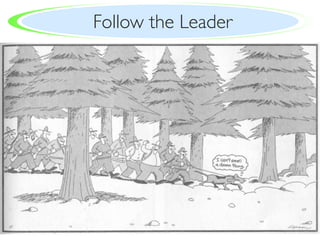
Follow the Leader
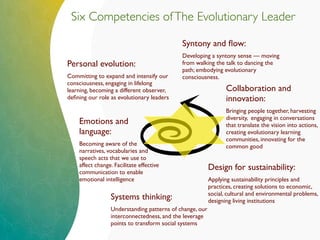
Six Competencies ofThe Evolutionary Leader
Personal evolution:
Committing to expand and intensify our
consciousness, engaging in lifelong
learning, becoming a different observer,
defining our role as evolutionary leaders
Systems thinking:
Understanding patterns of change, our
interconnectedness, and the leverage
points to transform social systems
Design for sustainability:
Applying sustainability principles and
practices, creating solutions to economic,
social, cultural and environmental problems,
designing living institutions
Collaboration and
innovation:
Bringing people together, harvesting
diversity, engaging in conversations
that translate the vision into actions,
creating evolutionary learning
communities, innovating for the
common good
Emotions and
language:
Becoming aware of the
narratives, vocabularies and
speech acts that we use to
affect change. Facilitate effective
communication to enable
emotional intelligence
Syntony and flow:
Developing a syntony sense — moving
from walking the talk to dancing the
path; embodying evolutionary
consciousness.
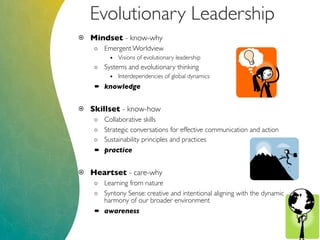
Evolutionary Leadership
 Mindset - know-why
o Emergent Worldview
• Visions of evolutionary leadership
o Systems and evolutionary thinking
• Interdependencies of global dynamics
 knowledge
 Skillset - know-how
o Collaborative skills
o Strategic conversations for effective communication and action
o Sustainability principles and practices
 practice
 Heartset - care-why
o Learning from nature
o Syntony Sense: creative and intentional aligning with the dynamic
harmony of our broader environment
 awareness
What Do Leaders Do ?
 Leaders are people who normally declare possible
what other people do not
 They declare a vision for a future, they generate
the future, they mobilize others to create new
realities
 Leaders work on adaptive challenges not on
technical problems
 They think big and use a systemic and strategic
vision
 They inspire and promote learning, change, and
evolution
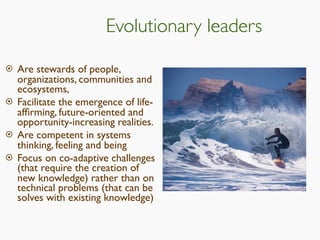
Evolutionary leaders
 Are stewards of people,
organizations, communities and
ecosystems,
 Facilitate the emergence of life-
affirming, future-oriented and
opportunity-increasing realities.
 Are competent in systems
thinking, feeling and being
 Focus on co-adaptive challenges
(that require the creation of
new knowledge) rather than on
technical problems (that can be
solves with existing knowledge)
Sustainability
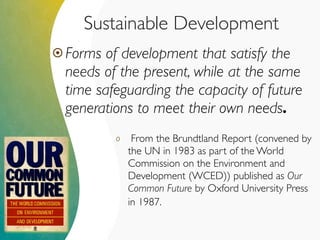
Sustainable Development
 Forms of development that satisfy the
needs of the present, while at the same
time safeguarding the capacity of future
generations to meet their own needs.
o From the Brundtland Report (convened by
the UN in 1983 as part of the World
Commission on the Environment and
Development (WCED)) published as Our
Common Future by Oxford University Press
in 1987.
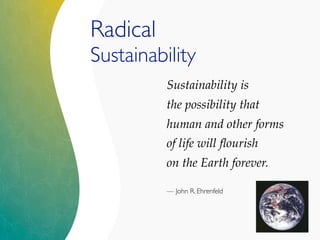
Sustainability is
the possibility that
human and other forms
of life will flourish
on the Earth forever.
— John R. Ehrenfeld
Radical
Sustainability
Systemic Sustainability
 A process of development (individual, corporate, or
societal) can be said to be socially and ecologically
sustainable if it involves an adaptive strategy that ensures
the evolutionary maintenance of an increasingly robust
and supportive environment.
“What is consistent with nature is sustainable”
– Janine Benyus, 1997
• Curating Systemic Sustainability involves the
responsible stewardship and creative cultivation of
resources — social, cultural, financial, and natural —
to generate stakeholder value while contributing to the
well-being of current and future generations of all
beings.
What does Sustainability mean to you?
Sustainability is the role I play in sustaining and
fostering the ability of [ ] (whom?)
to be able to [ ] 	 (have/do what?)
for the next [ ] (how long?)
as the result of my actions in the present.
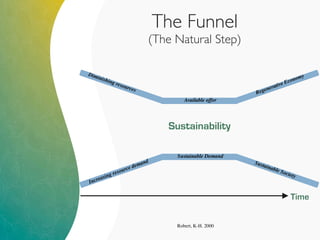
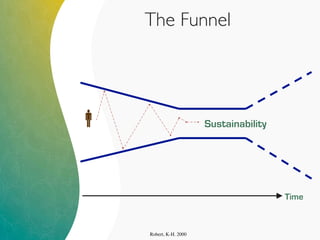
The Funnel
(The Natural Step)
Sustainability
Robert, K-H. 2000
Time
Increasing resource demand
Diminishing resources
Sustainable Demand
Available offer
Regenerative Economy
Sustainable Society
Sustainability
Robert, K-H. 2000
Time

The Funnel
Laszlo © 2010
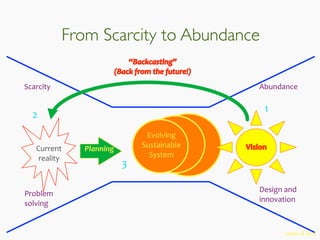
From Scarcity to Abundance
Current	
  
reality
Planning
Scarcity Abundance
Problem	
  
solving
Design	
  and	
  
innovation
Evolving	
  
Sustainable	
  
System
1
2
3
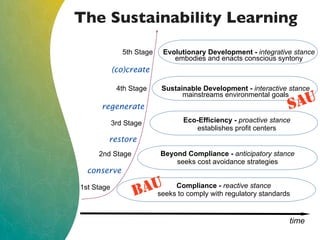
The Sustainability Learning
Compliance - reactive stance
seeks to comply with regulatory standards
Beyond Compliance - anticipatory stance
seeks cost avoidance strategies
2nd Stage
1st Stage
3rd Stage
4th Stage
Eco-Efficiency - proactive stance
establishes profit centers
Sustainable Development - interactive stance
mainstreams environmental goals
time
5th Stage Evolutionary Development - integrative stance
embodies and enacts conscious syntony
conserve
restore
regenerate
(co)create
SAU
BAU
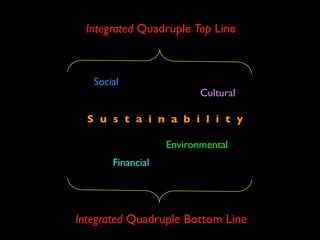
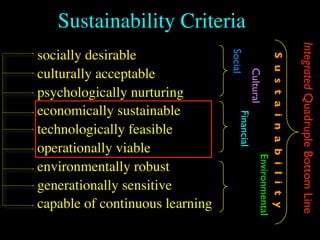
Integrated Quadruple Bottom Line
Social
Financial
Environmental
S u s t a i n a b i l i t y
Cultural
Integrated Quadruple Top Line
socially desirable
	

 culturally acceptable
	

 psychologically nurturing
	

 economically sustainable
	

 technologically feasible
	

 operationally viable
	

 environmentally robust
	

 generationally sensitive
	

 capable of continuous learning
Sustainability Criteria
IntegratedQuadrupleBottomLine
Social
Financial
Environmental
Sustainability
Cultural
Evolutionary vision
 It is no longer sufficient to be a smart
organization, one that can scan the commercial
environment, detect variations, and react
accordingly. If we restrict ourselves to reacting
to signals when it comes to human impact ... we
may well end up focusing our organizational
resources just on minimizing the pain of
irreversible damage. Our business organizations
need to become conscious of the evolutionary role
business plays in the future of the planet and to
take responsibility for that role.
o Nattrass & Altomare — The Natural Step for Business:
Wealth, Ecology and the Evolutionary Corporation
Evolving Development
 The new concept of development takes
account not only of economic growth but also
of all those parameters that reflect the quality
of life, full enjoyment of creative capacity and
observance of human rights, which the principal
decision-makers should take into account so
that development is not owned and dispensed
by a few but is a common undertaking on an
international, multilateral scale, with the human
being as its centre, its sole agent and its
beneficiary. All that is needed is a new look at
the world, and different premises.
o Federico Mayor — Summary Records from the 131st session of
the UNESCO Executive Board. Paris, 1990. Arts. 104-108, pp. 34-36.
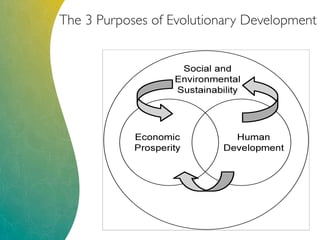
The 3 Purposes of Evolutionary Development
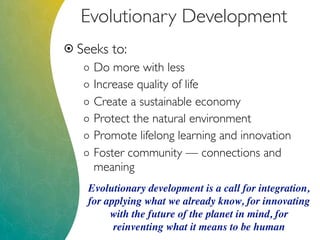
Evolutionary Development
 Seeks to:
o Do more with less
o Increase quality of life
o Create a sustainable economy
o Protect the natural environment
o Promote lifelong learning and innovation
o Foster community — connections and
meaning
Evolutionary development is a call for integration,
for applying what we already know, for innovating
with the future of the planet in mind, for
reinventing what it means to be human
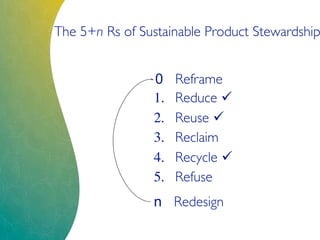
The 5+n Rs of Sustainable Product Stewardship
1. Reduce 
2. Reuse 
3. Reclaim
4. Recycle 
5. Refuse
n Redesign
0 Reframe
A Better Compass…
๏ As a society, we have to learn better how to
learn – I call it social learning; it is the
dynamism for change that could lead us to a
new kind of society that will not destroy itself
from its own excesses… for we must share
a vision for a new society before we can
realize it. Designing a better society and
maintaining a good life require deep thought
and sustained effort by all of us. Reasoning
together is the only way we can bring it
about.
• Lester W. Milbrath – Learning Our Way Out, 1989
Playing the Macro-Violin
 To describe hisTheory U, Otto Scharmer quotes the
violinist Miha Pogacnik recounting the insight he gained
during his first concert in Chartres:
• I felt that the cathedral almost kicked me out.‘Get out
with you!’ she said. For I was young and I tried to perform
as I always did: by just playing my violin. But then I realized
that in Chartres you actually cannot play your small
violin, but you have to play the ‘macro violin’.The small
violin is the instrument that is in your hands. The macro-
violin is the whole cathedral that surrounds you.The
cathedral of Chartres is built entirely according to musical
principles. Playing the macro violin requires you to listen
and to play from another place, from the periphery. You
have to move your listening and playing from within to
beyond yourself.
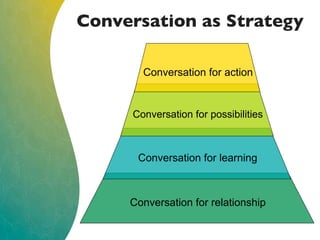
Conversation as Strategy
Conversation for relationship
Conversation for learning
Conversation for possibilities
Conversation for action
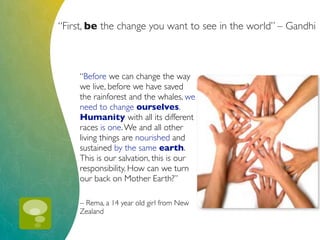
“First, be the change you want to see in the world” – Gandhi
“Before we can change the way
we live, before we have saved
the rainforest and the whales, we
need to change ourselves.
Humanity with all its different
races is one.We and all other
living things are nourished and
sustained by the same earth.
This is our salvation, this is our
responsibility. How can we turn
our back on Mother Earth?”
– Rema, a 14 year old girl from New
Zealand
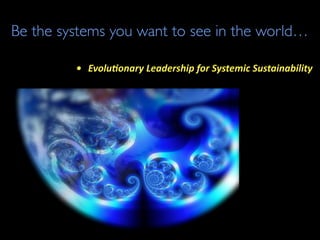
Be the systems you want to see in the world…
• Evolu'onary	
  Leadership	
  for	
  Systemic	
  Sustainability
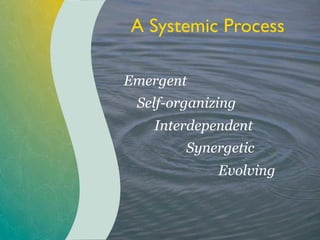
A Systemic Process
Emergent
Self-organizing
Interdependent
Synergetic
Evolving
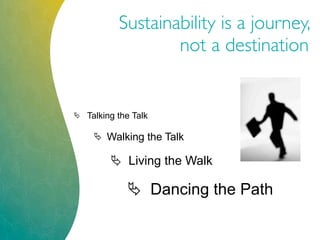
Sustainability is a journey,
not a destination
 Talking the Talk
 Walking the Talk
 Living the Walk
 Dancing the Path
Evolutionary Leadership
Quotes
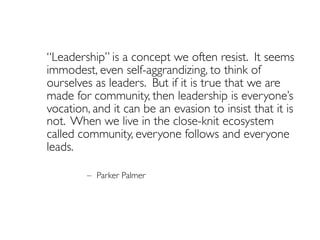
“Leadership” is a concept we often resist. It seems
immodest, even self-aggrandizing, to think of
ourselves as leaders. But if it is true that we are
made for community, then leadership is everyone’s
vocation, and it can be an evasion to insist that it is
not. When we live in the close-knit ecosystem
called community, everyone follows and everyone
leads.
– Parker Palmer
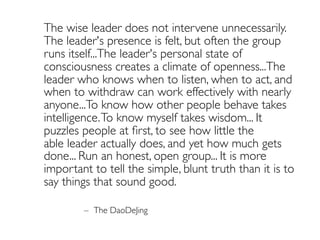
The wise leader does not intervene unnecessarily.
The leader's presence is felt, but often the group
runs itself...The leader's personal state of
consciousness creates a climate of openness...The
leader who knows when to listen, when to act, and
when to withdraw can work effectively with nearly
anyone...To know how other people behave takes
intelligence.To know myself takes wisdom... It
puzzles people at first, to see how little the
able leader actually does, and yet how much gets
done... Run an honest, open group... It is more
important to tell the simple, blunt truth than it is to
say things that sound good.
– The DaoDeJing
Because of our obsession with how leaders behave and
with the interactions of leaders and followers, we forget
that in its essence, leadership is about learning how to
shape the future... Leadership exists when people are
no longer victims of circumstances but participate in
creating new circumstances. Leadership is about
creating a domain in which human beings continually
deepen their understanding of reality and become more
capable of participating in the unfolding of the world.
Ultimately leadership is about creating new realities.
– Adam Kahane, quoting Peter Senge in his introduction to
Synchronicity:The Inner Path of Leadership by Joseph Jaworski
The very highest leader is barely known by men.
	 Then comes the leader they know and love.
	 Then the leader they fear.
	 Then the leader they despise.

 The leader who does not trust enough will not be
trusted.And so it is that a leader is best not when
people obey and acclaim him, but if — when the
work is done — the people say, 'we did it
ourselves'.
– Laozi
The Work of Evolutionary Leaders

 “The key challenge of this new century — for social
scientists, natural scientists, and everyone else — will
be to build ecologically sustainable communities,
designed in such a way that their technologies and
social institutions — their material and social
structures — do not interfere with nature’s inherent
ability to sustain life.
	

 The design principles of our future social institutions
must be consistent with the principles of
organization that nature has evolved to sustain the
web of life.”
– Fritjof Capra
The Hidden Connections
The most meaningful activity in which a human
being can be engaged is one that is directly related
to human evolution.This is true because human
beings now play an active and critical role not only
in the process of their own evolution but in the
survival and evolution of all living beings.
Awareness of this places upon human beings a
responsibility for their participation in and
contribution to the process of evolution.
Acceptance and acknowledgement of this
responsibility and creative engagement in the
process of metabiological evolution consciously
would bring forth a new reality.
– Jonas Salk
The Need for Evolutionary Leadership
We undergo the evolution that we envision
for ourselves.
» Theodore Roszak
Evolutionary leadership

Evolutionary leadership

  • 2.
    Evolutionary Leadership: From SystemicSustainability to Integral Thrivability Alexander Laszlo TheLasz@me.com ITBA Graduate Student Forum !!
  • 3.
    3 Key Frames Evolutionary Leadership o Knowing how to choose among existing alternatives as well as how to create new ones  SystemsThinking o Seeing things in terms of connected relationships, patterns and processes and not just in terms of separate objects, structures, positions  Sustainability Strategy o Understanding the objectives of sustainable business practice and knowing how to design for them
  • 4.
  • 5.
    Six Competencies ofTheEvolutionary Leader Personal evolution: Committing to expand and intensify our consciousness, engaging in lifelong learning, becoming a different observer, defining our role as evolutionary leaders Systems thinking: Understanding patterns of change, our interconnectedness, and the leverage points to transform social systems Design for sustainability: Applying sustainability principles and practices, creating solutions to economic, social, cultural and environmental problems, designing living institutions Collaboration and innovation: Bringing people together, harvesting diversity, engaging in conversations that translate the vision into actions, creating evolutionary learning communities, innovating for the common good Emotions and language: Becoming aware of the narratives, vocabularies and speech acts that we use to affect change. Facilitate effective communication to enable emotional intelligence Syntony and flow: Developing a syntony sense — moving from walking the talk to dancing the path; embodying evolutionary consciousness.
  • 6.
    Evolutionary Leadership  Mindset- know-why o Emergent Worldview • Visions of evolutionary leadership o Systems and evolutionary thinking • Interdependencies of global dynamics  knowledge  Skillset - know-how o Collaborative skills o Strategic conversations for effective communication and action o Sustainability principles and practices  practice  Heartset - care-why o Learning from nature o Syntony Sense: creative and intentional aligning with the dynamic harmony of our broader environment  awareness
  • 7.
    What Do LeadersDo ?  Leaders are people who normally declare possible what other people do not  They declare a vision for a future, they generate the future, they mobilize others to create new realities  Leaders work on adaptive challenges not on technical problems  They think big and use a systemic and strategic vision  They inspire and promote learning, change, and evolution
  • 8.
    Evolutionary leaders  Arestewards of people, organizations, communities and ecosystems,  Facilitate the emergence of life- affirming, future-oriented and opportunity-increasing realities.  Are competent in systems thinking, feeling and being  Focus on co-adaptive challenges (that require the creation of new knowledge) rather than on technical problems (that can be solves with existing knowledge)
  • 9.
  • 10.
    Sustainable Development  Formsof development that satisfy the needs of the present, while at the same time safeguarding the capacity of future generations to meet their own needs. o From the Brundtland Report (convened by the UN in 1983 as part of the World Commission on the Environment and Development (WCED)) published as Our Common Future by Oxford University Press in 1987.
  • 11.
    Sustainability is the possibilitythat human and other forms of life will flourish on the Earth forever. — John R. Ehrenfeld Radical Sustainability
  • 12.
    Systemic Sustainability  Aprocess of development (individual, corporate, or societal) can be said to be socially and ecologically sustainable if it involves an adaptive strategy that ensures the evolutionary maintenance of an increasingly robust and supportive environment. “What is consistent with nature is sustainable” – Janine Benyus, 1997 • Curating Systemic Sustainability involves the responsible stewardship and creative cultivation of resources — social, cultural, financial, and natural — to generate stakeholder value while contributing to the well-being of current and future generations of all beings.
  • 13.
    What does Sustainabilitymean to you? Sustainability is the role I play in sustaining and fostering the ability of [ ] (whom?) to be able to [ ] (have/do what?) for the next [ ] (how long?) as the result of my actions in the present.
  • 14.
    The Funnel (The NaturalStep) Sustainability Robert, K-H. 2000 Time Increasing resource demand Diminishing resources Sustainable Demand Available offer Regenerative Economy Sustainable Society
  • 15.
  • 16.
    Laszlo © 2010 FromScarcity to Abundance Current   reality Planning Scarcity Abundance Problem   solving Design  and   innovation Evolving   Sustainable   System 1 2 3
  • 17.
    The Sustainability Learning Compliance- reactive stance seeks to comply with regulatory standards Beyond Compliance - anticipatory stance seeks cost avoidance strategies 2nd Stage 1st Stage 3rd Stage 4th Stage Eco-Efficiency - proactive stance establishes profit centers Sustainable Development - interactive stance mainstreams environmental goals time 5th Stage Evolutionary Development - integrative stance embodies and enacts conscious syntony conserve restore regenerate (co)create SAU BAU
  • 18.
    Integrated Quadruple BottomLine Social Financial Environmental S u s t a i n a b i l i t y Cultural Integrated Quadruple Top Line
  • 19.
    socially desirable culturallyacceptable psychologically nurturing economically sustainable technologically feasible operationally viable environmentally robust generationally sensitive capable of continuous learning Sustainability Criteria IntegratedQuadrupleBottomLine Social Financial Environmental Sustainability Cultural
  • 20.
    Evolutionary vision  Itis no longer sufficient to be a smart organization, one that can scan the commercial environment, detect variations, and react accordingly. If we restrict ourselves to reacting to signals when it comes to human impact ... we may well end up focusing our organizational resources just on minimizing the pain of irreversible damage. Our business organizations need to become conscious of the evolutionary role business plays in the future of the planet and to take responsibility for that role. o Nattrass & Altomare — The Natural Step for Business: Wealth, Ecology and the Evolutionary Corporation
  • 21.
    Evolving Development  Thenew concept of development takes account not only of economic growth but also of all those parameters that reflect the quality of life, full enjoyment of creative capacity and observance of human rights, which the principal decision-makers should take into account so that development is not owned and dispensed by a few but is a common undertaking on an international, multilateral scale, with the human being as its centre, its sole agent and its beneficiary. All that is needed is a new look at the world, and different premises. o Federico Mayor — Summary Records from the 131st session of the UNESCO Executive Board. Paris, 1990. Arts. 104-108, pp. 34-36.
  • 22.
    The 3 Purposesof Evolutionary Development
  • 23.
    Evolutionary Development  Seeksto: o Do more with less o Increase quality of life o Create a sustainable economy o Protect the natural environment o Promote lifelong learning and innovation o Foster community — connections and meaning Evolutionary development is a call for integration, for applying what we already know, for innovating with the future of the planet in mind, for reinventing what it means to be human
  • 24.
    The 5+n Rsof Sustainable Product Stewardship 1. Reduce  2. Reuse  3. Reclaim 4. Recycle  5. Refuse n Redesign 0 Reframe
  • 25.
    A Better Compass… ๏As a society, we have to learn better how to learn – I call it social learning; it is the dynamism for change that could lead us to a new kind of society that will not destroy itself from its own excesses… for we must share a vision for a new society before we can realize it. Designing a better society and maintaining a good life require deep thought and sustained effort by all of us. Reasoning together is the only way we can bring it about. • Lester W. Milbrath – Learning Our Way Out, 1989
  • 26.
    Playing the Macro-Violin To describe hisTheory U, Otto Scharmer quotes the violinist Miha Pogacnik recounting the insight he gained during his first concert in Chartres: • I felt that the cathedral almost kicked me out.‘Get out with you!’ she said. For I was young and I tried to perform as I always did: by just playing my violin. But then I realized that in Chartres you actually cannot play your small violin, but you have to play the ‘macro violin’.The small violin is the instrument that is in your hands. The macro- violin is the whole cathedral that surrounds you.The cathedral of Chartres is built entirely according to musical principles. Playing the macro violin requires you to listen and to play from another place, from the periphery. You have to move your listening and playing from within to beyond yourself.
  • 27.
    Conversation as Strategy Conversationfor relationship Conversation for learning Conversation for possibilities Conversation for action
  • 28.
    “First, be thechange you want to see in the world” – Gandhi “Before we can change the way we live, before we have saved the rainforest and the whales, we need to change ourselves. Humanity with all its different races is one.We and all other living things are nourished and sustained by the same earth. This is our salvation, this is our responsibility. How can we turn our back on Mother Earth?” – Rema, a 14 year old girl from New Zealand
  • 29.
    Be the systemsyou want to see in the world… • Evolu'onary  Leadership  for  Systemic  Sustainability
  • 30.
  • 31.
    Sustainability is ajourney, not a destination  Talking the Talk  Walking the Talk  Living the Walk  Dancing the Path
  • 32.
  • 33.
    “Leadership” is aconcept we often resist. It seems immodest, even self-aggrandizing, to think of ourselves as leaders. But if it is true that we are made for community, then leadership is everyone’s vocation, and it can be an evasion to insist that it is not. When we live in the close-knit ecosystem called community, everyone follows and everyone leads. – Parker Palmer
  • 34.
    The wise leaderdoes not intervene unnecessarily. The leader's presence is felt, but often the group runs itself...The leader's personal state of consciousness creates a climate of openness...The leader who knows when to listen, when to act, and when to withdraw can work effectively with nearly anyone...To know how other people behave takes intelligence.To know myself takes wisdom... It puzzles people at first, to see how little the able leader actually does, and yet how much gets done... Run an honest, open group... It is more important to tell the simple, blunt truth than it is to say things that sound good. – The DaoDeJing
  • 35.
    Because of ourobsession with how leaders behave and with the interactions of leaders and followers, we forget that in its essence, leadership is about learning how to shape the future... Leadership exists when people are no longer victims of circumstances but participate in creating new circumstances. Leadership is about creating a domain in which human beings continually deepen their understanding of reality and become more capable of participating in the unfolding of the world. Ultimately leadership is about creating new realities. – Adam Kahane, quoting Peter Senge in his introduction to Synchronicity:The Inner Path of Leadership by Joseph Jaworski
  • 36.
    The very highestleader is barely known by men. Then comes the leader they know and love. Then the leader they fear. Then the leader they despise. The leader who does not trust enough will not be trusted.And so it is that a leader is best not when people obey and acclaim him, but if — when the work is done — the people say, 'we did it ourselves'. – Laozi
  • 37.
    The Work ofEvolutionary Leaders “The key challenge of this new century — for social scientists, natural scientists, and everyone else — will be to build ecologically sustainable communities, designed in such a way that their technologies and social institutions — their material and social structures — do not interfere with nature’s inherent ability to sustain life. The design principles of our future social institutions must be consistent with the principles of organization that nature has evolved to sustain the web of life.” – Fritjof Capra The Hidden Connections
  • 38.
    The most meaningfulactivity in which a human being can be engaged is one that is directly related to human evolution.This is true because human beings now play an active and critical role not only in the process of their own evolution but in the survival and evolution of all living beings. Awareness of this places upon human beings a responsibility for their participation in and contribution to the process of evolution. Acceptance and acknowledgement of this responsibility and creative engagement in the process of metabiological evolution consciously would bring forth a new reality. – Jonas Salk The Need for Evolutionary Leadership
  • 39.
    We undergo theevolution that we envision for ourselves. » Theodore Roszak