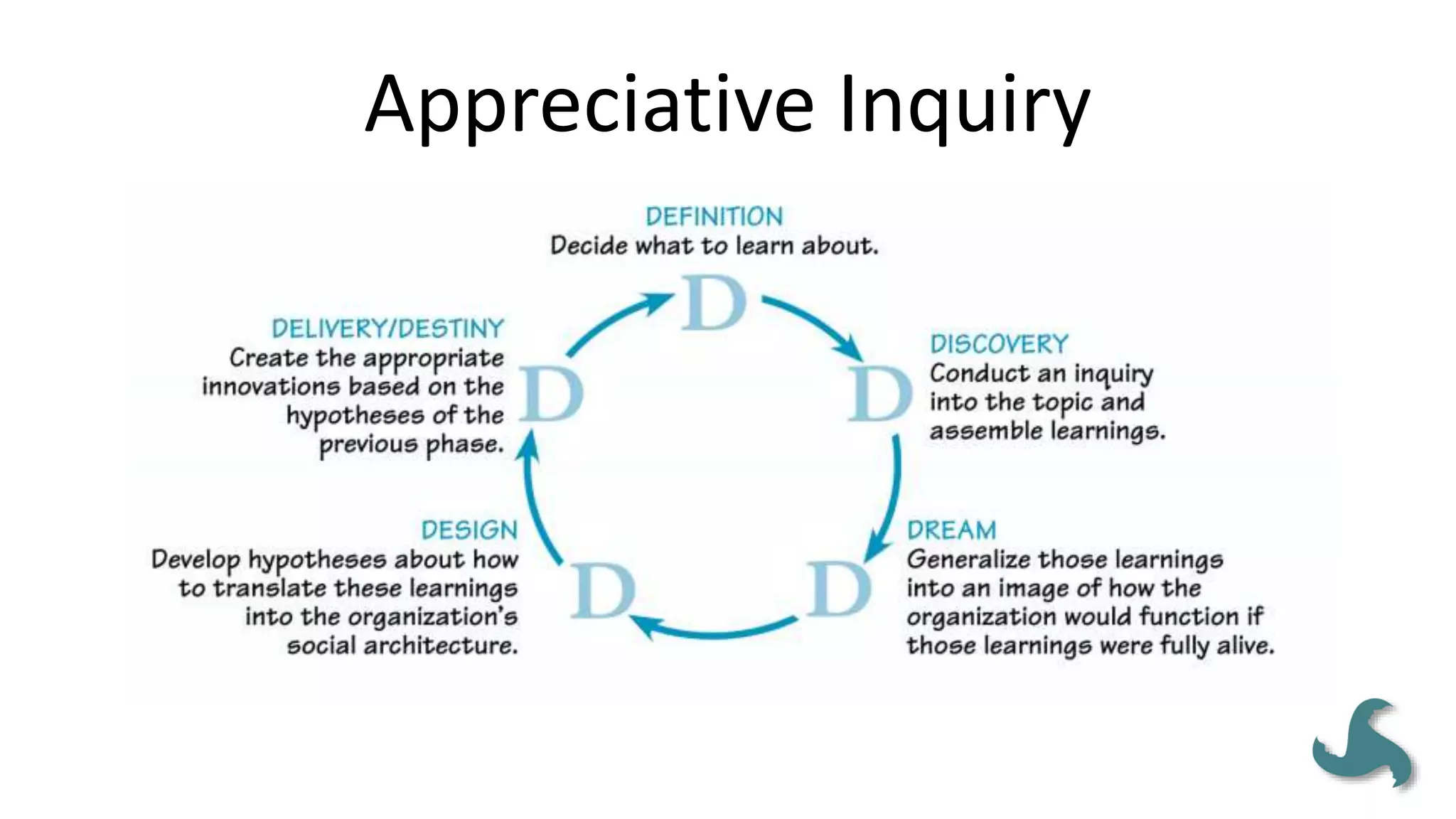
Appreciative Inquiry
openware
What is Apreciative Inquiry?
Appreciative Inquiry
• Appreciative Inquiry (AI) is based on a deceptively
simple premise: that organizations grow in the
direction of what they repeatedly ask questions
about and focus their attention on.
• The method was created by Dr. David L. Cooperrider
and Dr. Suresh Srivastva at the Case Western Reserve
University in Ohio in the 1980’s.
Appreciative Inquiry
• Research in sociology has shown that when people study
problems and conflicts, the number and severity of the
problems they identify actually increase.
• But when they study human ideals and achievements, peak
experiences, and best practices, these things — not the
conflicts — tend to flourish.
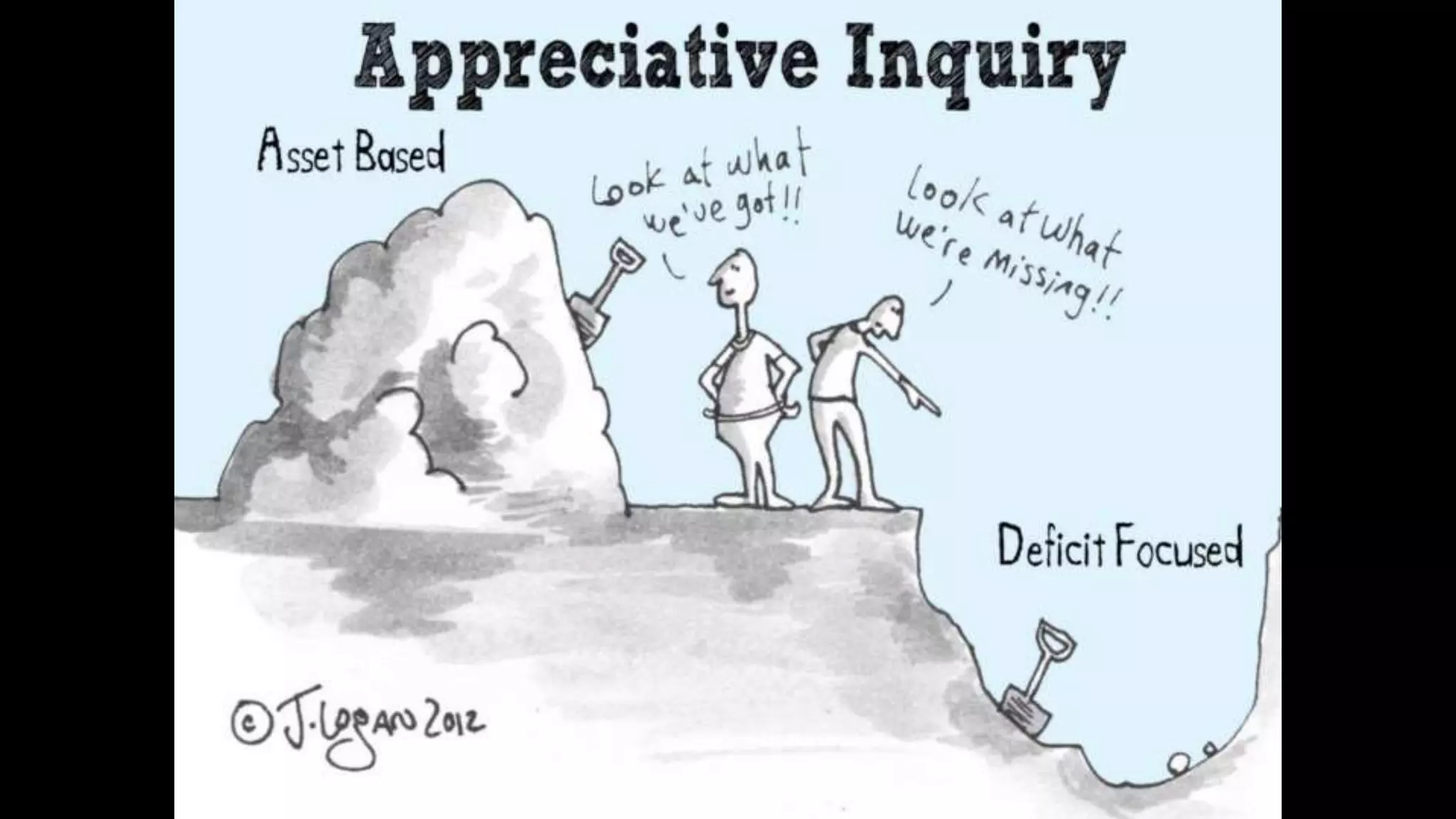
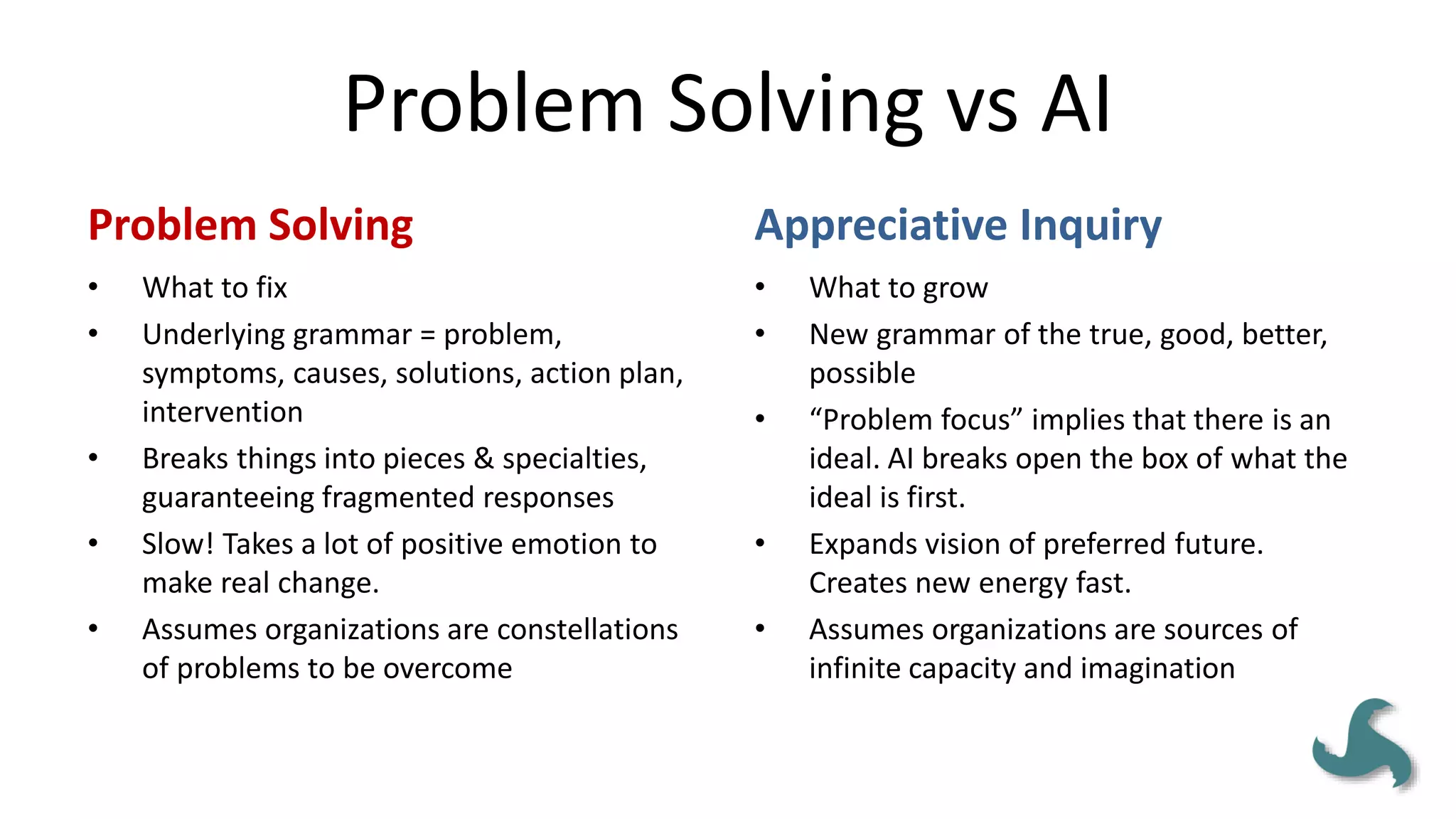
Problem Solving vs AI
Problem Solving
• What to fix
• Underlying grammar = problem,
symptoms, causes, solutions, action plan,
intervention
• Breaks things into pieces & specialties,
guaranteeing fragmented responses
• Slow! Takes a lot of positive emotion to
make real change.
• Assumes organizations are constellations
of problems to be overcome
Appreciative Inquiry
• What to grow
• New grammar of the true, good, better,
possible
• “Problem focus” implies that there is an
ideal. AI breaks open the box of what the
ideal is first.
• Expands vision of preferred future.
Creates new energy fast.
• Assumes organizations are sources of
infinite capacity and imagination
Appreciative Inquiry
• What’s going well
• Discover the best
• Why is the best the best?
• Amplify the best
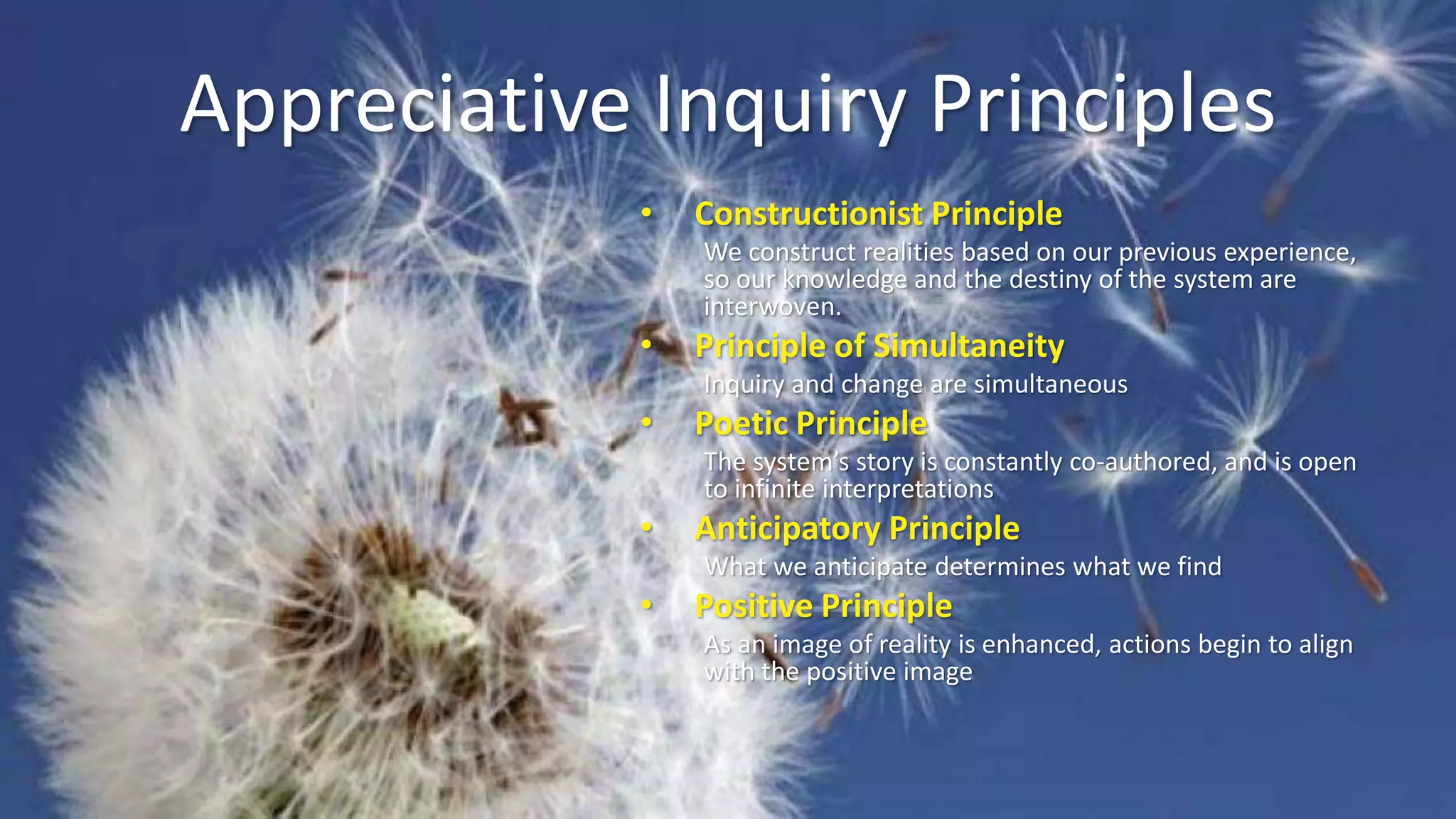
Appreciative Inquiry Principles
• Constructionist Principle
We construct realities based on our previous experience,
so our knowledge and the destiny of the system are
interwoven.
• Principle of Simultaneity
Inquiry and change are simultaneous
• Poetic Principle
The system’s story is constantly co-authored, and is open
to infinite interpretations
• Anticipatory Principle
What we anticipate determines what we find
• Positive Principle
As an image of reality is enhanced, actions begin to align
with the positive image
Appreciative Inquiry Principles
• Constructionist Principle
We construct realities based on our previous experience,
so our knowledge and the destiny of the system are
interwoven.
• Principle of Simultaneity
Inquiry and change are simultaneous
• Poetic Principle
The system’s story is constantly co-authored, and is open
to infinite interpretations
• Anticipatory Principle
What we anticipate determines what we find
• Positive Principle
As an image of reality is enhanced, actions begin to align
with the positive image
Appreciative Inquiry
DEFINITION
• This phase is arguably the most important one in the
AI cycle, because it establishes the initial focus and
scope of the inquiry.
01 . DISCOVERY
• This practice represents a dramatic departure from
normal statistical “sampling.”
• AI operates on the premise that the act of asking
positive questions is as important as the data it elicits.
• For that reason, the more people interviewed, the
stronger the organization’s movement in the direction
of the inquiry.
01 . DISCOVERY
• The Discovery phase is about appreciating the positive
core. During this phase, participants ask questions that
explore and identify strengths—of a team, organization,
group, or individual.
• The overarching question in this phase is:
“What gives life?”
02 . DREAM
• Here, the goal is to envision what we want to happen.
• We ask questions about stories; then, we can ask questions of
those stories to elicit more in the way of rich detail around
themes. These may include dream dialogues, which look at
building out aspirations and wishes about the shared future.
• The overarching question of the Dream stage, is therefore:
“What might be?”
03 . DESIGN
• The Design stage is about building the visions and ideas
with the greatest potential, together.
• In co-constructing ‘the ideal’, therefore, the questions
become slightly more specific and focused on clarifying.
• The overarching question of this phase is:
“What should be?”
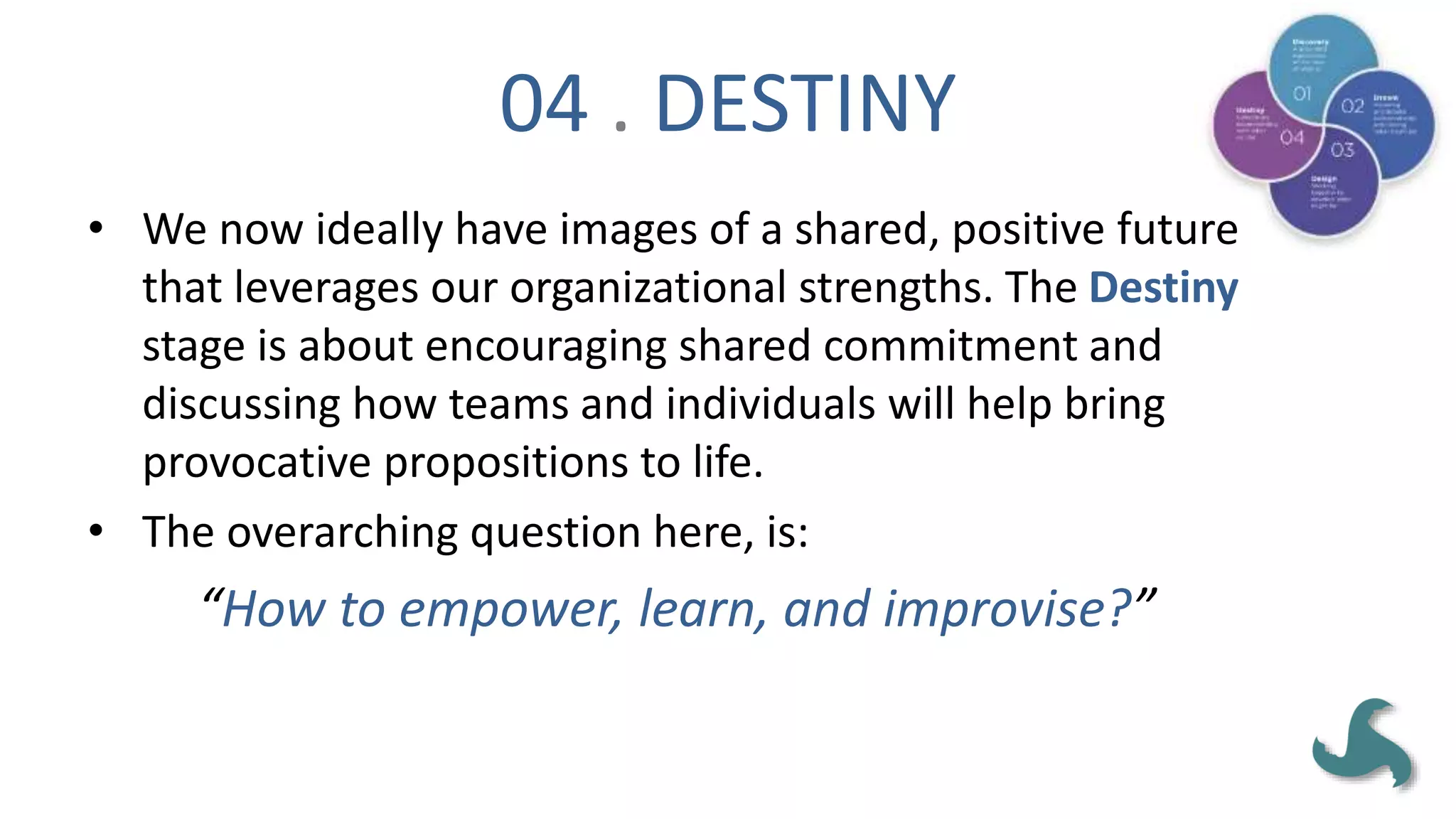
04 . DESTINY
• We now ideally have images of a shared, positive future
that leverages our organizational strengths. The Destiny
stage is about encouraging shared commitment and
discussing how teams and individuals will help bring
provocative propositions to life.
• The overarching question here, is:
“How to empower, learn, and improvise?”
Appreciative Inquiry Exercise
Identify a career or personal highpoint associated with
either leading change or introducing innovation:
1. Share the most memorable parts of the initiative including
challenges, innovations and changes with your support
network
2. Reflect on what were the ’root causes of success..’
3. What were your three best qualities or experienced strengths
Envisioning the future:
• You wake up and it is 2025. What do you see about you
that is new, different, changed, better…

Appreciative Inquiry - an introduction

  • 1.
  • 2.
  • 6.
    Appreciative Inquiry • AppreciativeInquiry (AI) is based on a deceptively simple premise: that organizations grow in the direction of what they repeatedly ask questions about and focus their attention on. • The method was created by Dr. David L. Cooperrider and Dr. Suresh Srivastva at the Case Western Reserve University in Ohio in the 1980’s.
  • 7.
    Appreciative Inquiry • Researchin sociology has shown that when people study problems and conflicts, the number and severity of the problems they identify actually increase. • But when they study human ideals and achievements, peak experiences, and best practices, these things — not the conflicts — tend to flourish.
  • 9.
    Problem Solving vsAI Problem Solving • What to fix • Underlying grammar = problem, symptoms, causes, solutions, action plan, intervention • Breaks things into pieces & specialties, guaranteeing fragmented responses • Slow! Takes a lot of positive emotion to make real change. • Assumes organizations are constellations of problems to be overcome Appreciative Inquiry • What to grow • New grammar of the true, good, better, possible • “Problem focus” implies that there is an ideal. AI breaks open the box of what the ideal is first. • Expands vision of preferred future. Creates new energy fast. • Assumes organizations are sources of infinite capacity and imagination
  • 10.
    Appreciative Inquiry • What’sgoing well • Discover the best • Why is the best the best? • Amplify the best
  • 11.
    Appreciative Inquiry Principles •Constructionist Principle We construct realities based on our previous experience, so our knowledge and the destiny of the system are interwoven. • Principle of Simultaneity Inquiry and change are simultaneous • Poetic Principle The system’s story is constantly co-authored, and is open to infinite interpretations • Anticipatory Principle What we anticipate determines what we find • Positive Principle As an image of reality is enhanced, actions begin to align with the positive image
  • 12.
    Appreciative Inquiry Principles •Constructionist Principle We construct realities based on our previous experience, so our knowledge and the destiny of the system are interwoven. • Principle of Simultaneity Inquiry and change are simultaneous • Poetic Principle The system’s story is constantly co-authored, and is open to infinite interpretations • Anticipatory Principle What we anticipate determines what we find • Positive Principle As an image of reality is enhanced, actions begin to align with the positive image
  • 13.
  • 14.
    DEFINITION • This phaseis arguably the most important one in the AI cycle, because it establishes the initial focus and scope of the inquiry.
  • 15.
    01 . DISCOVERY •This practice represents a dramatic departure from normal statistical “sampling.” • AI operates on the premise that the act of asking positive questions is as important as the data it elicits. • For that reason, the more people interviewed, the stronger the organization’s movement in the direction of the inquiry.
  • 16.
    01 . DISCOVERY •The Discovery phase is about appreciating the positive core. During this phase, participants ask questions that explore and identify strengths—of a team, organization, group, or individual. • The overarching question in this phase is: “What gives life?”
  • 17.
    02 . DREAM •Here, the goal is to envision what we want to happen. • We ask questions about stories; then, we can ask questions of those stories to elicit more in the way of rich detail around themes. These may include dream dialogues, which look at building out aspirations and wishes about the shared future. • The overarching question of the Dream stage, is therefore: “What might be?”
  • 18.
    03 . DESIGN •The Design stage is about building the visions and ideas with the greatest potential, together. • In co-constructing ‘the ideal’, therefore, the questions become slightly more specific and focused on clarifying. • The overarching question of this phase is: “What should be?”
  • 19.
    04 . DESTINY •We now ideally have images of a shared, positive future that leverages our organizational strengths. The Destiny stage is about encouraging shared commitment and discussing how teams and individuals will help bring provocative propositions to life. • The overarching question here, is: “How to empower, learn, and improvise?”
  • 22.
    Appreciative Inquiry Exercise Identifya career or personal highpoint associated with either leading change or introducing innovation: 1. Share the most memorable parts of the initiative including challenges, innovations and changes with your support network 2. Reflect on what were the ’root causes of success..’ 3. What were your three best qualities or experienced strengths Envisioning the future: • You wake up and it is 2025. What do you see about you that is new, different, changed, better…

Editor's Notes

  • #2 https://thesystemsthinker.com/appreciative-inquiry-igniting-transformative-action/
  • #6 Choosing to identify the positives immediately forces you to stop thinking about what doesn’t work and look for times and situations where things did work. This is important for that part of the process in which questions are framed and successes are shared.
  • #14 https://positivepsychology.com/appreciative-inquiry-questions/