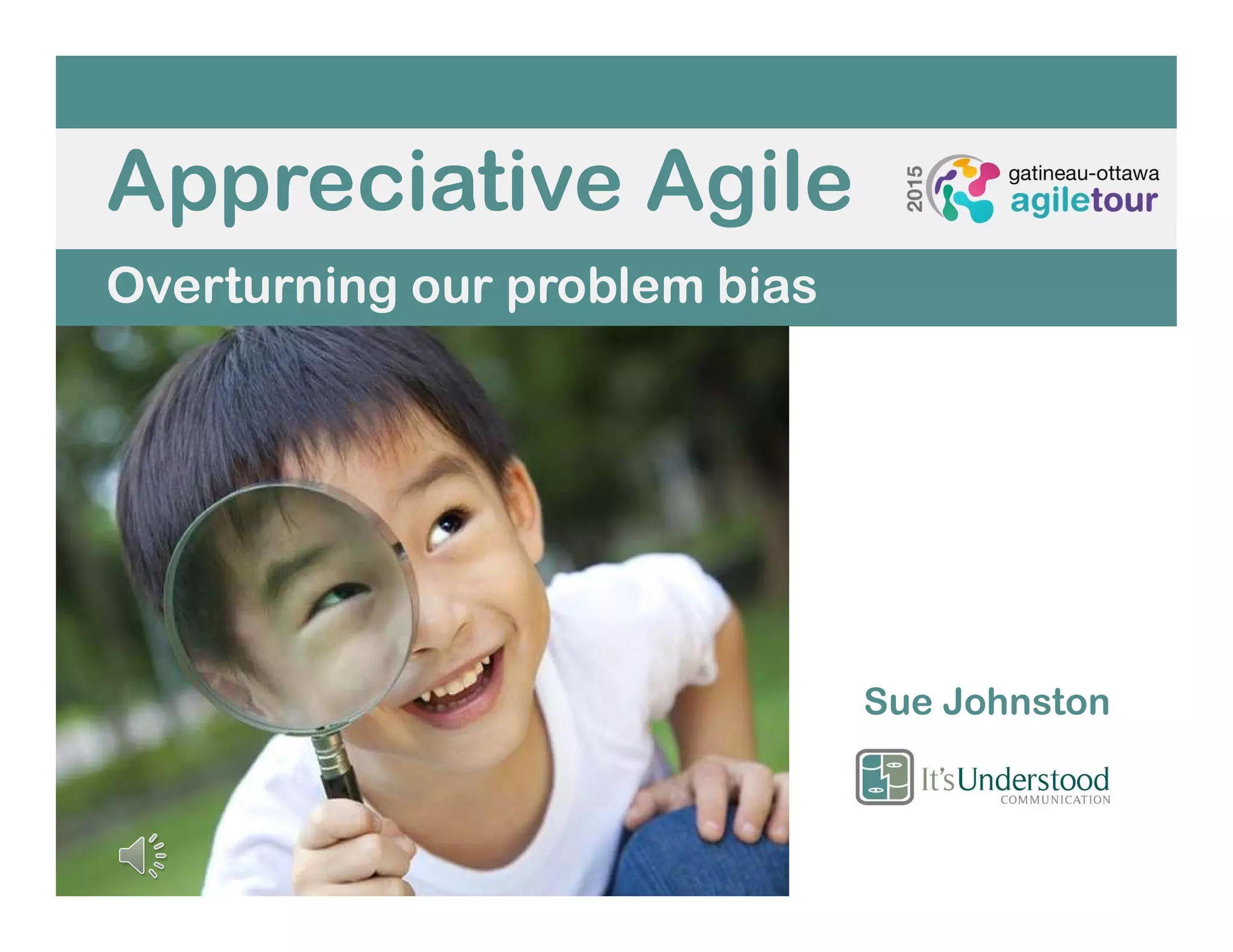
Appreciative Agile
Overturning our problem bias
Sue Johnston
PLEASE NOTE
SLIDES ≠ PRESENTATION
• These slides are designed to be viewed in
conjunction with human beings talking and
interacting with you.
• They may make little sense to you if you were not
at the live session.
The Idea
What
lens
are
you
using?
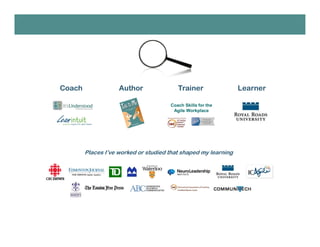
Coach Skills for the
Agile Workplace
Coach
Places I’ve worked or studied that shaped my learning
Author Trainer Learner
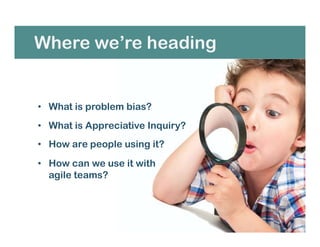
Where we’re heading
• What is problem bias?
• What is Appreciative Inquiry?
• How are people using it?
• How can we use it with
agile teams?
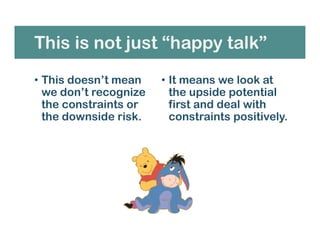
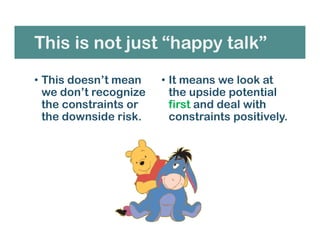
This is not just “happy talk”
• This doesn’t mean
we don’t recognize
the constraints or
the downside risk.
• It means we look at
the upside potential
first and deal with
constraints positively.
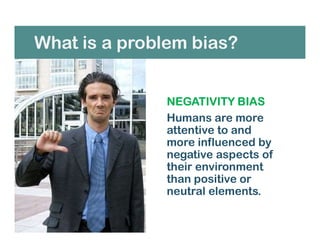
What is a problem bias?
NEGATIVITY BIAS
Humans are more
attentive to and
more influenced by
negative aspects of
their environment
than positive or
neutral elements.
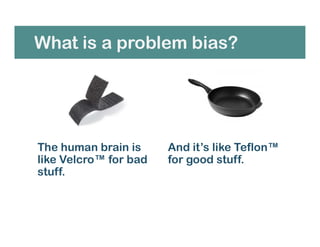
What is a problem bias?
And it’s like Teflon™
for good stuff.
The human brain is
like Velcro™ for bad
stuff.
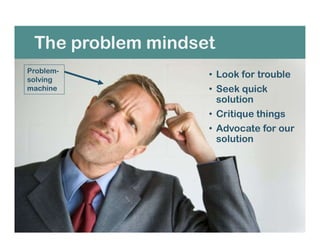
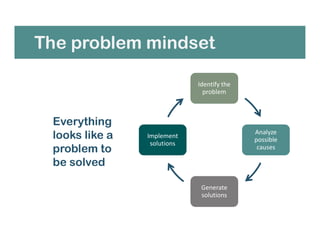
The problem mindset
• Look for trouble
• Seek quick
solution
• Critique things
• Advocate for our
solution
Problem-
solving
machine
The problem mindset
Identify the
problem
Analyze
possible
causes
Generate
solutions
Implement
solutions
Everything
looks like a
problem to
be solved
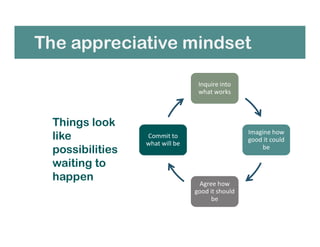
The appreciative mindset
Inquire into
what works
Imagine how
good it could
be
Agree how
good it should
be
Commit to
what will be
Things look
like
possibilities
waiting to
happen
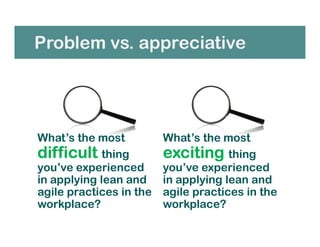
Problem vs. appreciative
What’s the most
difficult thing
you’ve experienced
in applying lean and
agile practices in the
workplace?
What’s the most
exciting thing
you’ve experienced
in applying lean and
agile practices in the
workplace?
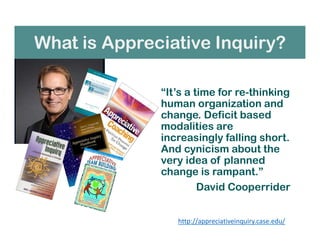
What is Appreciative Inquiry?
“It’s a time for re-thinking
human organization and
change. Deficit based
modalities are
increasingly falling short.
And cynicism about the
very idea of planned
change is rampant.”
David Cooperrider
http://appreciativeinquiry.case.edu/
What is Appreciative Inquiry?
APPRECIATE:
“ . . . to value or
admire highly; to judge
with heightened
understanding; to
recognize with
gratitude.”
INQUIRE:
“ . . . to search into,
investigate; to seek
information by
questioning.”
Inquiry requires questions
“The most serious
mistakes are not
being made as a
result of wrong
answers. The most
dangerous thing is
asking the wrong
questions.”
Peter Drucker
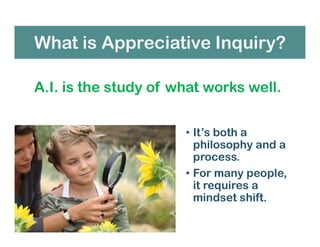
What is Appreciative Inquiry?
• It’s both a
philosophy and a
process.
• For many people,
it requires a
mindset shift.
A.I. is the study of what works well.
Some A.I. assumptions
• In every society, organization or group,
something works.
• People have more confidence and comfort to
journey to the future (the unknown) when they
carry forward parts of the past (the known).
• The act of asking questions of an organization
or group influences the group in some way.
• What we focus on becomes our reality
• The language we use affects our reality.
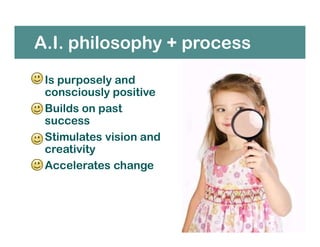
A.I. philosophy + process
• Is purposely and
consciously positive
• Builds on past
success
• Stimulates vision and
creativity
• Accelerates change
Appreciative questions
• Look at what’s present, not
what’s missing
• Are an invitation to tell stories
• Are inspired by past success
• Encourage exploration
Appreciative questions
• Influence without being
controlling
• Encourage “both/and” thinking,
rather than “either/or”
• Foster a “learner” rather than
“judger” mindset
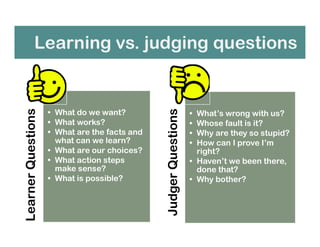
Learning vs. judging questions
LearnerQuestions
• What do we want?
• What works?
• What are the facts and
what can we learn?
• What are our choices?
• What action steps
make sense?
• What is possible?
JudgerQuestions
• What’s wrong with us?
• Whose fault is it?
• Why are they so stupid?
• How can I prove I’m
right?
• Haven’t we been there,
done that?
• Why bother?
Appreciative questions
• “What are some possibilities we
haven’t considered?”
• “What’s the smallest change that
could make the biggest impact?”
• “What solutions would have us both
win?”
• “What is it about our [work, meetings
etc.] that keeps us interested and
energized?”
• “How might we . . .?”
Exercise 1
• Pick a problem, project, issue or question
you’ve dealt with recently.
• Restate it in a way that uses positive
language and looks for possibilities, rather
than problems.
• Discuss how the situation might have
changed or produced different results had
you asked appreciative questions.
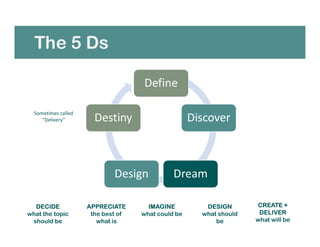
The 5 Ds
Define
Discover
DreamDesign
Destiny
DECIDE
what the topic
should be
APPRECIATE
the best of
what is
IMAGINE
what could be
DESIGN
what should
be
CREATE +
DELIVER
what will be
Sometimes called
“Delivery”
Exercise 2
• Using the handout as a guide, conduct an
appreciative interview.
• Invite the other person to share a success
story.
• Take a “listener/learner” stance.
• Be genuinely curious.
• Allow for silence.
• Enjoy the interview.
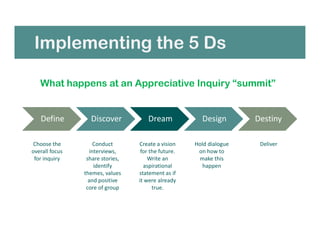
Implementing the 5 Ds
Define Discover Dream Design Destiny
Choose the
overall focus
for inquiry
Conduct
interviews,
share stories,
identify
themes, values
and positive
core of group
Create a vision
for the future.
Write an
aspirational
statement as if
it were already
true.
DeliverHold dialogue
on how to
make this
happen
What happens at an Appreciative Inquiry “summit”
• Best experience. A time when…
• What do you value about… yourself,
your work, and your organisation.
• What do you think is your
organisation’s core life-giving factor?
• If you had three wishes for this
organisation, what would they be?
Appreciative questions
Why Appreciative Inquiry works
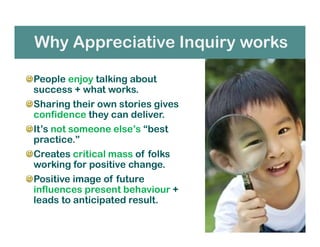
People enjoy talking about
success + what works.
Sharing their own stories gives
confidence they can deliver.
It’s not someone else’s “best
practice.”
Creates critical mass of folks
working for positive change.
Positive image of future
influences present behaviour +
leads to anticipated result.
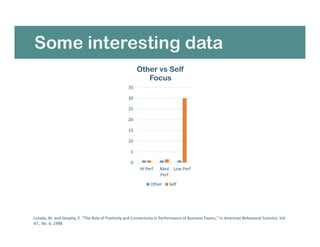
Some interesting data
Losada, M. and Heaphy, E. “The Role of Positivity and Connectivity in Performance of Business Teams,” in American Behavioral Scientist, Vol
47., No. 6, 1998.
0
5
10
15
20
25
Hi Perf Med
Perf
Low Perf
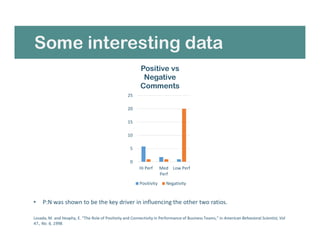
Positive vs
Negative
Comments
Positivity Negativity
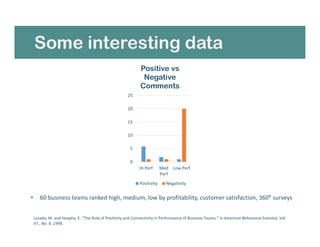
• 60 business teams ranked high, medium, low by profitability, customer satisfaction, 360⁰ surveys
Some interesting data
Losada, M. and Heaphy, E. “The Role of Positivity and Connectivity in Performance of Business Teams,” in American Behavioral Scientist, Vol
47., No. 6, 1998.
0
0.5
1
1.5
2
2.5
3
3.5
Hi Perf Med
Perf
Low Perf
Inquiry vs
Advocacy
Inquiry Advocacy
Some interesting data
Losada, M. and Heaphy, E. “The Role of Positivity and Connectivity in Performance of Business Teams,” in American Behavioral Scientist, Vol
47., No. 6, 1998.
0
5
10
15
20
25
30
35
Hi Perf Med
Perf
Low Perf
Other vs Self
Focus
Other Self
Some interesting data
Losada, M. and Heaphy, E. “The Role of Positivity and Connectivity in Performance of Business Teams,” in American Behavioral Scientist, Vol
47., No. 6, 1998.
0
5
10
15
20
25
Hi Perf Med
Perf
Low Perf
Positive vs
Negative
Comments
Positivity Negativity
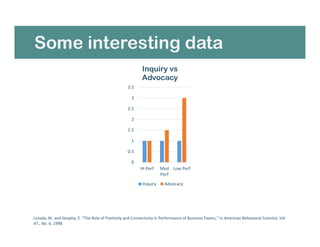
• P:N was shown to be the key driver in influencing the other two ratios.
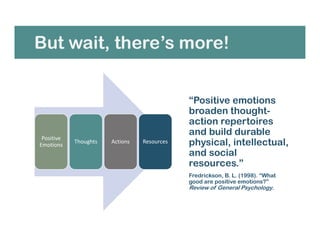
But wait, there’s more!
“Positive emotions
broaden thought-
action repertoires
and build durable
physical, intellectual,
and social
resources.”
Fredrickson, B. L. (1998). “What
good are positive emotions?”
Review of General Psychology.
Positive
Emotions
Thoughts Actions Resources
What is Appreciative Inquiry?
• “..distinguishes itself from critical modes of action
research by its deliberately affirmative
assumptions about people, organizations, and
questions”.
• “Human systems grow and construct their future
realities in the direction of what they most
persistently, actively, and collectively ask
questions about.”
Ludema, JD, Cooperrider DL, and Barrett, FJ Appreciative Inquiry: The Power of the Unconditional Positive
Question. http://www.2012waic.com/wp-content/uploads/2012/05/Ludema-Cooperrider-Barrett-goed.pdf
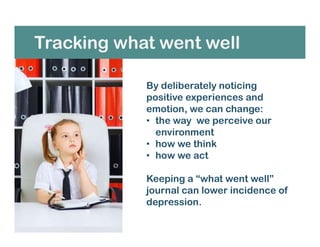
Tracking what went well
By deliberately noticing
positive experiences and
emotion, we can change:
• the way we perceive our
environment
• how we think
• how we act
Keeping a “what went well”
journal can lower incidence of
depression.
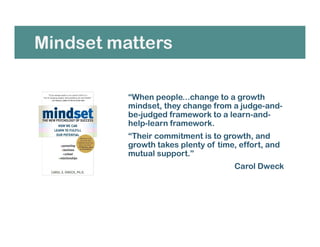
Mindset matters
“When people...change to a growth
mindset, they change from a judge-and-
be-judged framework to a learn-and-
help-learn framework.
“Their commitment is to growth, and
growth takes plenty of time, effort, and
mutual support.”
Carol Dweck
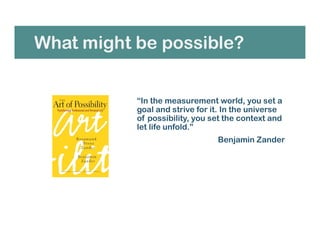
What might be possible?
“In the measurement world, you set a
goal and strive for it. In the universe
of possibility, you set the context and
let life unfold.”
Benjamin Zander
Adapting A.I. for our teams
• The heart of the process is the
Appreciative Interview.
• Ask positive, possibility-focussed
questions.
• Tell success stories.
• Hold appreciative team
building/retrospectives.
• Conduct appreciative workshops at
launch.
• Visualize the future (ideal sprint,
release, product, etc.).
• Become aware of words and
language.
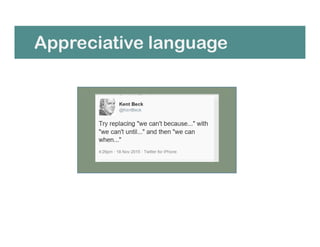
Appreciative language
Adapting A.I. for our teams
Switch from a Deficit
Lens
• Why did we deliver
[Item X] late?
• Why won’t Bob
participate?
• Our manager isn’t
supportive.
• We can’t do that!
To an Appreciative
Lens
• What can we do to
improve our delivery
times?
• What are Bob’s strengths
and how can we help him
contribute??
• How can we help our
manager better
understand our needs
• What if we could?
This is not just “happy talk”
• This doesn’t mean
we don’t recognize
the constraints or
the downside risk.
• It means we look at
the upside potential
first and deal with
constraints positively.
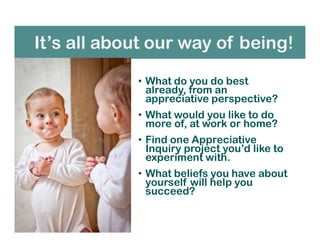
It’s all about our way of being!
• What do you do best
already, from an
appreciative perspective?
• What would you like to do
more of, at work or home?
• Find one Appreciative
Inquiry project you’d like to
experiment with.
• What beliefs you have about
yourself will help you
succeed?
Sue Johnston
sue@itsunderstood.com
sue@leanintuit.com
@itsunderstood
talktomebook.com
itsunderstood.com leanintuit.com

Appreciative Agile: Overturning the Problem Bias

  • 1.
    Appreciative Agile Overturning ourproblem bias Sue Johnston
  • 2.
    PLEASE NOTE SLIDES ≠PRESENTATION • These slides are designed to be viewed in conjunction with human beings talking and interacting with you. • They may make little sense to you if you were not at the live session.
  • 3.
  • 4.
    Coach Skills forthe Agile Workplace Coach Places I’ve worked or studied that shaped my learning Author Trainer Learner
  • 5.
    Where we’re heading •What is problem bias? • What is Appreciative Inquiry? • How are people using it? • How can we use it with agile teams?
  • 6.
    This is notjust “happy talk” • This doesn’t mean we don’t recognize the constraints or the downside risk. • It means we look at the upside potential first and deal with constraints positively.
  • 7.
    What is aproblem bias? NEGATIVITY BIAS Humans are more attentive to and more influenced by negative aspects of their environment than positive or neutral elements.
  • 8.
    What is aproblem bias? And it’s like Teflon™ for good stuff. The human brain is like Velcro™ for bad stuff.
  • 9.
    The problem mindset •Look for trouble • Seek quick solution • Critique things • Advocate for our solution Problem- solving machine
  • 10.
    The problem mindset Identifythe problem Analyze possible causes Generate solutions Implement solutions Everything looks like a problem to be solved
  • 11.
    The appreciative mindset Inquireinto what works Imagine how good it could be Agree how good it should be Commit to what will be Things look like possibilities waiting to happen
  • 12.
    Problem vs. appreciative What’sthe most difficult thing you’ve experienced in applying lean and agile practices in the workplace? What’s the most exciting thing you’ve experienced in applying lean and agile practices in the workplace?
  • 13.
    What is AppreciativeInquiry? “It’s a time for re-thinking human organization and change. Deficit based modalities are increasingly falling short. And cynicism about the very idea of planned change is rampant.” David Cooperrider http://appreciativeinquiry.case.edu/
  • 14.
    What is AppreciativeInquiry? APPRECIATE: “ . . . to value or admire highly; to judge with heightened understanding; to recognize with gratitude.” INQUIRE: “ . . . to search into, investigate; to seek information by questioning.”
  • 15.
    Inquiry requires questions “Themost serious mistakes are not being made as a result of wrong answers. The most dangerous thing is asking the wrong questions.” Peter Drucker
  • 16.
    What is AppreciativeInquiry? • It’s both a philosophy and a process. • For many people, it requires a mindset shift. A.I. is the study of what works well.
  • 17.
    Some A.I. assumptions •In every society, organization or group, something works. • People have more confidence and comfort to journey to the future (the unknown) when they carry forward parts of the past (the known). • The act of asking questions of an organization or group influences the group in some way. • What we focus on becomes our reality • The language we use affects our reality.
  • 18.
    A.I. philosophy +process • Is purposely and consciously positive • Builds on past success • Stimulates vision and creativity • Accelerates change
  • 19.
    Appreciative questions • Lookat what’s present, not what’s missing • Are an invitation to tell stories • Are inspired by past success • Encourage exploration
  • 20.
    Appreciative questions • Influencewithout being controlling • Encourage “both/and” thinking, rather than “either/or” • Foster a “learner” rather than “judger” mindset
  • 21.
    Learning vs. judgingquestions LearnerQuestions • What do we want? • What works? • What are the facts and what can we learn? • What are our choices? • What action steps make sense? • What is possible? JudgerQuestions • What’s wrong with us? • Whose fault is it? • Why are they so stupid? • How can I prove I’m right? • Haven’t we been there, done that? • Why bother?
  • 22.
    Appreciative questions • “Whatare some possibilities we haven’t considered?” • “What’s the smallest change that could make the biggest impact?” • “What solutions would have us both win?” • “What is it about our [work, meetings etc.] that keeps us interested and energized?” • “How might we . . .?”
  • 23.
    Exercise 1 • Picka problem, project, issue or question you’ve dealt with recently. • Restate it in a way that uses positive language and looks for possibilities, rather than problems. • Discuss how the situation might have changed or produced different results had you asked appreciative questions.
  • 24.
    The 5 Ds Define Discover DreamDesign Destiny DECIDE whatthe topic should be APPRECIATE the best of what is IMAGINE what could be DESIGN what should be CREATE + DELIVER what will be Sometimes called “Delivery”
  • 25.
    Exercise 2 • Usingthe handout as a guide, conduct an appreciative interview. • Invite the other person to share a success story. • Take a “listener/learner” stance. • Be genuinely curious. • Allow for silence. • Enjoy the interview.
  • 26.
    Implementing the 5Ds Define Discover Dream Design Destiny Choose the overall focus for inquiry Conduct interviews, share stories, identify themes, values and positive core of group Create a vision for the future. Write an aspirational statement as if it were already true. DeliverHold dialogue on how to make this happen What happens at an Appreciative Inquiry “summit”
  • 27.
    • Best experience.A time when… • What do you value about… yourself, your work, and your organisation. • What do you think is your organisation’s core life-giving factor? • If you had three wishes for this organisation, what would they be? Appreciative questions
  • 28.
    Why Appreciative Inquiryworks People enjoy talking about success + what works. Sharing their own stories gives confidence they can deliver. It’s not someone else’s “best practice.” Creates critical mass of folks working for positive change. Positive image of future influences present behaviour + leads to anticipated result.
  • 29.
    Some interesting data Losada,M. and Heaphy, E. “The Role of Positivity and Connectivity in Performance of Business Teams,” in American Behavioral Scientist, Vol 47., No. 6, 1998. 0 5 10 15 20 25 Hi Perf Med Perf Low Perf Positive vs Negative Comments Positivity Negativity • 60 business teams ranked high, medium, low by profitability, customer satisfaction, 360⁰ surveys
  • 30.
    Some interesting data Losada,M. and Heaphy, E. “The Role of Positivity and Connectivity in Performance of Business Teams,” in American Behavioral Scientist, Vol 47., No. 6, 1998. 0 0.5 1 1.5 2 2.5 3 3.5 Hi Perf Med Perf Low Perf Inquiry vs Advocacy Inquiry Advocacy
  • 31.
    Some interesting data Losada,M. and Heaphy, E. “The Role of Positivity and Connectivity in Performance of Business Teams,” in American Behavioral Scientist, Vol 47., No. 6, 1998. 0 5 10 15 20 25 30 35 Hi Perf Med Perf Low Perf Other vs Self Focus Other Self
  • 32.
    Some interesting data Losada,M. and Heaphy, E. “The Role of Positivity and Connectivity in Performance of Business Teams,” in American Behavioral Scientist, Vol 47., No. 6, 1998. 0 5 10 15 20 25 Hi Perf Med Perf Low Perf Positive vs Negative Comments Positivity Negativity • P:N was shown to be the key driver in influencing the other two ratios.
  • 33.
    But wait, there’smore! “Positive emotions broaden thought- action repertoires and build durable physical, intellectual, and social resources.” Fredrickson, B. L. (1998). “What good are positive emotions?” Review of General Psychology. Positive Emotions Thoughts Actions Resources
  • 34.
    What is AppreciativeInquiry? • “..distinguishes itself from critical modes of action research by its deliberately affirmative assumptions about people, organizations, and questions”. • “Human systems grow and construct their future realities in the direction of what they most persistently, actively, and collectively ask questions about.” Ludema, JD, Cooperrider DL, and Barrett, FJ Appreciative Inquiry: The Power of the Unconditional Positive Question. http://www.2012waic.com/wp-content/uploads/2012/05/Ludema-Cooperrider-Barrett-goed.pdf
  • 35.
    Tracking what wentwell By deliberately noticing positive experiences and emotion, we can change: • the way we perceive our environment • how we think • how we act Keeping a “what went well” journal can lower incidence of depression.
  • 36.
    Mindset matters “When people...changeto a growth mindset, they change from a judge-and- be-judged framework to a learn-and- help-learn framework. “Their commitment is to growth, and growth takes plenty of time, effort, and mutual support.” Carol Dweck
  • 37.
    What might bepossible? “In the measurement world, you set a goal and strive for it. In the universe of possibility, you set the context and let life unfold.” Benjamin Zander
  • 38.
    Adapting A.I. forour teams • The heart of the process is the Appreciative Interview. • Ask positive, possibility-focussed questions. • Tell success stories. • Hold appreciative team building/retrospectives. • Conduct appreciative workshops at launch. • Visualize the future (ideal sprint, release, product, etc.). • Become aware of words and language.
  • 39.
  • 40.
    Adapting A.I. forour teams Switch from a Deficit Lens • Why did we deliver [Item X] late? • Why won’t Bob participate? • Our manager isn’t supportive. • We can’t do that! To an Appreciative Lens • What can we do to improve our delivery times? • What are Bob’s strengths and how can we help him contribute?? • How can we help our manager better understand our needs • What if we could?
  • 41.
    This is notjust “happy talk” • This doesn’t mean we don’t recognize the constraints or the downside risk. • It means we look at the upside potential first and deal with constraints positively.
  • 42.
    It’s all aboutour way of being! • What do you do best already, from an appreciative perspective? • What would you like to do more of, at work or home? • Find one Appreciative Inquiry project you’d like to experiment with. • What beliefs you have about yourself will help you succeed?
  • 43.