The Power of
The Power of
Appreciative Inquiry
Bliss W. Browne
Bliss W. Browne
President
President
Imagine Chicago
Imagine Chicago
www.imaginechicago.org
Understanding
Understanding
Appreciative Inquiry
 A major assumption of AI is that in every
A major assumption of AI is that in every
community something works. Change
can be managed through the
identification of what works, and focus
on how to build on it.
 Focusing on what works as opposed to
Focusing on what works as opposed to
what problems the community is having
differentiates AI from traditional
problem solving approaches.
Introduction to
Introduction to
Appreciative Inquiry
 Inquiry into the “art of the possible”
Inquiry into the “art of the possible”
should begin with
should begin with appreciation
appreciation.
.
 The first task is to describe and explain
The first task is to describe and explain
those exceptional moments which give
energy and activate members’
competencies and energies.
Denise M.
Pizzulli:
Denise M.
Pizzulli:
Introduction to
Introduction to
Appreciative Inquiry
 Inquiry into what’s possible should be
Inquiry into what’s possible should be
applicable
applicable.
.
 Study should lead to the creation of
Study should lead to the creation of
knowledge that can be used, applied, and
validated in action
validated in action
Introduction to
Introduction to
Appreciative Inquiry
 Inquiry into what is possible should
Inquiry into what is possible should
be
be provocative
provocative.
.
An organization/community is capable of
becoming more than it is at any given
moment, and learning how to determine
its own future.
its own future.
Introduction to
Introduction to
Appreciative Inquiry
 Inquiry into what’s possible should be
Inquiry into what’s possible should be
collaborative
collaborative.
.
 There is an inseparable relationship
There is an inseparable relationship
between the process of inquiry and
its content.
its content.
Appreciative Inquiry
 Appreciative inquiry helps us to
Appreciative inquiry helps us to
understand
understand the “best of what is” in an
the “best of what is” in an
organization or social system; and
leads to
leads to imagining
imagining and
and creating
creating a
a
collectively envisioned,
collectively envisioned, grounded
grounded,
,
future.
future.
Inquiry
Inquiry
 Inquiry is our most important tool in
Inquiry is our most important tool in
creating positive change.
 The seeds of change are implicit in
The seeds of change are implicit in
the questions we ask.
 The more positive the question, the
The more positive the question, the
longer-lasting the change
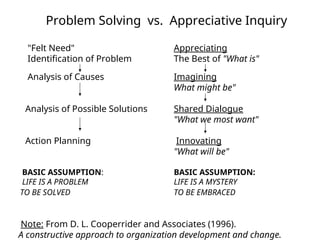
Problem Solving vs. Appreciative Inquiry
"Felt Need" Appreciating
Identification of Problem The Best of "What is"
Analysis of Causes Imagining
What might be"
Analysis of Possible Solutions Shared Dialogue
"What we most want"
Action Planning Innovating
"What will be"
BASIC ASSUMPTION: BASIC ASSUMPTION:
LIFE IS A PROBLEM LIFE IS A MYSTERY
TO BE SOLVED TO BE EMBRACED
Note: From D. L. Cooperrider and Associates (1996).
A constructive approach to organization development and change.
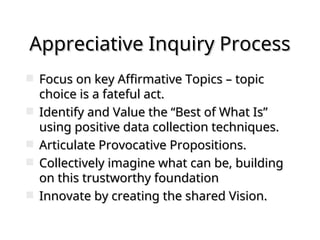
Appreciative Inquiry Process
 Focus on key Affirmative Topics – topic
Focus on key Affirmative Topics – topic
choice is a fateful act.
 Identify and Value the “Best of What Is”
Identify and Value the “Best of What Is”
using positive data collection techniques.
 Articulate Provocative Propositions.
Articulate Provocative Propositions.
 Collectively imagine what can be, building
Collectively imagine what can be, building
on this trustworthy foundation
 Innovate by creating the shared Vision.
Innovate by creating the shared Vision.
Six Aspects of Change and
Development of which to be Aware
 Knowledge of the community is
Knowledge of the community is
critical to determining its destiny.
 The seeds of change are implicit in
The seeds of change are implicit in
the first questions we ask.
Six Aspects of Change and
Development of which to be Aware
 A critical resource we have for
A critical resource we have for
creating positive change in our
communities is our imagination and
the capacity to free the imagination
and the mind of groups.
Six Aspects of Change and
Development of which to be Aware
 Our imagination and mind are
Our imagination and mind are
constrained by bad habits, limited
styles of thinking, underlying
assumptions and traditional rules of
organizing.
organizing.
Six Aspects of Change and
Development of which to be Aware
 Our styles of thinking rarely match the
Our styles of thinking rarely match the
increasingly complex worlds in which
we work… We need to discover more
creative and fruitful ways of knowing.
Six Aspects of Change and
Development of which to be Aware
 All systems (organizations and
All systems (organizations and
communities), as living constructions,
are largely affirmative and respond to
positive thought and positive
knowledge.
knowledge.
Harnessing Imagination
 Appreciative Inquiry gathers
Appreciative Inquiry gathers
positive stories and images
 Our minds are stretched by
Our minds are stretched by
hearing what is possible
 Positive images lead to positive
Positive images lead to positive
action
action
Positive Image
Positive Image
Positive Action
Positive Action
 Medical research on the placebo effect.
Medical research on the placebo effect.
 Medical research on the link between
Medical research on the link between
negative and positive effect on healing
 Education: Pygmalion Effect
Education: Pygmalion Effect
 Sports Psychology on the power of
Sports Psychology on the power of
imagery of differential self-monitoring.
 Emotional Intelligence
Emotional Intelligence
Positive Image-Positive
Action
Action
 Change happens at the level of
Change happens at the level of
discourse.
discourse.
 The best clue to a system’s health is
The best clue to a system’s health is
to listen to how its members talk
about the future.
about the future.
Positive Image-Positive
Action
Action
 Our habitual styles of thought,
Our habitual styles of thought,
assumptions, and rules of analysis
often have ironic consequences of
exacerbating the very problems we
have so carefully diagnosed.
 Energy flows where attention goes.
Energy flows where attention goes.
How can we engage new
constituencies and build
community participation?
 Recognize what community values
Recognize what community values
 Connect people and opportunities
Connect people and opportunities
 Leverage existing community networks,
Leverage existing community networks,
especially organizations which cross
boundaries (like faith communities,
businesses, schools, hospitals)
Imagine Chicago
Imagine Chicago
 Track record of building hope and civic
Track record of building hope and civic
investment on six continents
 Develops uncommon connections that
Develops uncommon connections that
expand what’s possible
– across generations
across generations
– across cultures
across cultures
– across sectors
across sectors
– across divisions of geography and economics
across divisions of geography and economics
IMAGINE CHICAGO
IMAGINE CHICAGO
 Designs projects that build capacity
Designs projects that build capacity
– of the individual participant
of the individual participant
– of their organization
of their organization
– of the community
of the community
Makes resources available on-line:
www.imaginechicago.org
Imagine Chicago’s (NGO )
role
role
 Strategic design partner
Strategic design partner
 Community development model
Community development model
resource
resource
 Trainer
Trainer
 Facilitator
Facilitator
Host organization role
 Determine focus and scope of
Determine focus and scope of
community building pilot
 Select design team
Select design team
 Design and implement project
Design and implement project
 Hold community summit
Hold community summit
 Document project and share findings
Document project and share findings
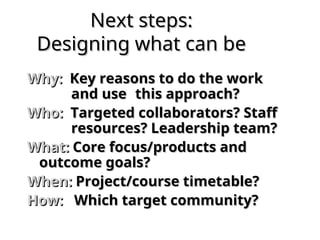
Next steps:
Next steps:
Designing what can be
Why:
Why: Key reasons to do the work
Key reasons to do the work
and use
and use this approach?
this approach?
Who:
Who: Targeted collaborators? Staff
Targeted collaborators? Staff
resources? Leadership team?
What:
What: Core focus/products and
Core focus/products and
outcome goals?
outcome goals?
When:
When: Project/course timetable?
Project/course timetable?
How:
How: Which target community?
Which target community?
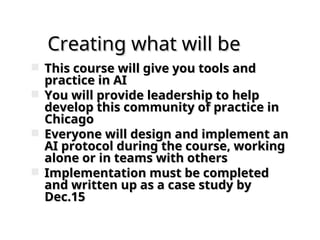
Creating what will be
 This course will give you tools and
This course will give you tools and
practice in AI
practice in AI
 You will provide leadership to help
You will provide leadership to help
develop this community of practice in
Chicago
Chicago
 Everyone will design and implement an
Everyone will design and implement an
AI protocol during the course, working
alone or in teams with others
 Implementation must be completed
Implementation must be completed
and written up as a case study by
Dec.15
Dec.15

The Introduction to Appreciative Inquiry

  • 1.
    The Power of ThePower of Appreciative Inquiry Appreciative Inquiry Bliss W. Browne Bliss W. Browne President President Imagine Chicago Imagine Chicago www.imaginechicago.org www.imaginechicago.org
  • 2.
    Understanding Understanding Appreciative Inquiry Appreciative Inquiry A major assumption of AI is that in every A major assumption of AI is that in every community something works. Change community something works. Change can be managed through the can be managed through the identification of what works, and focus identification of what works, and focus on how to build on it. on how to build on it.  Focusing on what works as opposed to Focusing on what works as opposed to what problems the community is having what problems the community is having differentiates AI from traditional differentiates AI from traditional problem solving approaches. problem solving approaches.
  • 3.
    Introduction to Introduction to AppreciativeInquiry Appreciative Inquiry  Inquiry into the “art of the possible” Inquiry into the “art of the possible” should begin with should begin with appreciation appreciation. .  The first task is to describe and explain The first task is to describe and explain those exceptional moments which give those exceptional moments which give energy and activate members’ energy and activate members’ competencies and energies. competencies and energies. Denise M. Pizzulli: Denise M. Pizzulli:
  • 4.
    Introduction to Introduction to AppreciativeInquiry Appreciative Inquiry  Inquiry into what’s possible should be Inquiry into what’s possible should be applicable applicable. .  Study should lead to the creation of Study should lead to the creation of knowledge that can be used, applied, and knowledge that can be used, applied, and validated in action validated in action
  • 5.
    Introduction to Introduction to AppreciativeInquiry Appreciative Inquiry  Inquiry into what is possible should Inquiry into what is possible should be be provocative provocative. . An organization/community is capable of An organization/community is capable of becoming more than it is at any given becoming more than it is at any given moment, and learning how to determine moment, and learning how to determine its own future. its own future.
  • 6.
    Introduction to Introduction to AppreciativeInquiry Appreciative Inquiry  Inquiry into what’s possible should be Inquiry into what’s possible should be collaborative collaborative. .  There is an inseparable relationship There is an inseparable relationship between the process of inquiry and between the process of inquiry and its content. its content.
  • 7.
    Appreciative Inquiry Appreciative Inquiry Appreciative inquiry helps us to Appreciative inquiry helps us to understand understand the “best of what is” in an the “best of what is” in an organization or social system; and organization or social system; and leads to leads to imagining imagining and and creating creating a a collectively envisioned, collectively envisioned, grounded grounded, , future. future.
  • 8.
    Inquiry Inquiry  Inquiry isour most important tool in Inquiry is our most important tool in creating positive change. creating positive change.  The seeds of change are implicit in The seeds of change are implicit in the questions we ask. the questions we ask.  The more positive the question, the The more positive the question, the longer-lasting the change longer-lasting the change
  • 9.
    Problem Solving vs.Appreciative Inquiry "Felt Need" Appreciating Identification of Problem The Best of "What is" Analysis of Causes Imagining What might be" Analysis of Possible Solutions Shared Dialogue "What we most want" Action Planning Innovating "What will be" BASIC ASSUMPTION: BASIC ASSUMPTION: LIFE IS A PROBLEM LIFE IS A MYSTERY TO BE SOLVED TO BE EMBRACED Note: From D. L. Cooperrider and Associates (1996). A constructive approach to organization development and change.
  • 10.
    Appreciative Inquiry Process AppreciativeInquiry Process  Focus on key Affirmative Topics – topic Focus on key Affirmative Topics – topic choice is a fateful act. choice is a fateful act.  Identify and Value the “Best of What Is” Identify and Value the “Best of What Is” using positive data collection techniques. using positive data collection techniques.  Articulate Provocative Propositions. Articulate Provocative Propositions.  Collectively imagine what can be, building Collectively imagine what can be, building on this trustworthy foundation on this trustworthy foundation  Innovate by creating the shared Vision. Innovate by creating the shared Vision.
  • 11.
    Six Aspects ofChange and Six Aspects of Change and Development of which to be Aware Development of which to be Aware  Knowledge of the community is Knowledge of the community is critical to determining its destiny. critical to determining its destiny.  The seeds of change are implicit in The seeds of change are implicit in the first questions we ask. the first questions we ask.
  • 12.
    Six Aspects ofChange and Six Aspects of Change and Development of which to be Aware Development of which to be Aware  A critical resource we have for A critical resource we have for creating positive change in our creating positive change in our communities is our imagination and communities is our imagination and the capacity to free the imagination the capacity to free the imagination and the mind of groups. and the mind of groups.
  • 13.
    Six Aspects ofChange and Six Aspects of Change and Development of which to be Aware Development of which to be Aware  Our imagination and mind are Our imagination and mind are constrained by bad habits, limited constrained by bad habits, limited styles of thinking, underlying styles of thinking, underlying assumptions and traditional rules of assumptions and traditional rules of organizing. organizing.
  • 14.
    Six Aspects ofChange and Six Aspects of Change and Development of which to be Aware Development of which to be Aware  Our styles of thinking rarely match the Our styles of thinking rarely match the increasingly complex worlds in which increasingly complex worlds in which we work… We need to discover more we work… We need to discover more creative and fruitful ways of knowing. creative and fruitful ways of knowing.
  • 15.
    Six Aspects ofChange and Six Aspects of Change and Development of which to be Aware Development of which to be Aware  All systems (organizations and All systems (organizations and communities), as living constructions, communities), as living constructions, are largely affirmative and respond to are largely affirmative and respond to positive thought and positive positive thought and positive knowledge. knowledge.
  • 16.
    Harnessing Imagination Harnessing Imagination Appreciative Inquiry gathers Appreciative Inquiry gathers positive stories and images positive stories and images  Our minds are stretched by Our minds are stretched by hearing what is possible hearing what is possible  Positive images lead to positive Positive images lead to positive action action
  • 17.
    Positive Image Positive Image PositiveAction Positive Action  Medical research on the placebo effect. Medical research on the placebo effect.  Medical research on the link between Medical research on the link between negative and positive effect on healing negative and positive effect on healing  Education: Pygmalion Effect Education: Pygmalion Effect  Sports Psychology on the power of Sports Psychology on the power of imagery of differential self-monitoring. imagery of differential self-monitoring.  Emotional Intelligence Emotional Intelligence
  • 18.
    Positive Image-Positive Positive Image-Positive Action Action Change happens at the level of Change happens at the level of discourse. discourse.  The best clue to a system’s health is The best clue to a system’s health is to listen to how its members talk to listen to how its members talk about the future. about the future.
  • 19.
    Positive Image-Positive Positive Image-Positive Action Action Our habitual styles of thought, Our habitual styles of thought, assumptions, and rules of analysis assumptions, and rules of analysis often have ironic consequences of often have ironic consequences of exacerbating the very problems we exacerbating the very problems we have so carefully diagnosed. have so carefully diagnosed.  Energy flows where attention goes. Energy flows where attention goes.
  • 20.
    How can weengage new How can we engage new constituencies and build constituencies and build community participation? community participation?  Recognize what community values Recognize what community values  Connect people and opportunities Connect people and opportunities  Leverage existing community networks, Leverage existing community networks, especially organizations which cross especially organizations which cross boundaries (like faith communities, boundaries (like faith communities, businesses, schools, hospitals) businesses, schools, hospitals)
  • 21.
    Imagine Chicago Imagine Chicago Track record of building hope and civic Track record of building hope and civic investment on six continents investment on six continents  Develops uncommon connections that Develops uncommon connections that expand what’s possible expand what’s possible – across generations across generations – across cultures across cultures – across sectors across sectors – across divisions of geography and economics across divisions of geography and economics
  • 22.
    IMAGINE CHICAGO IMAGINE CHICAGO Designs projects that build capacity Designs projects that build capacity – of the individual participant of the individual participant – of their organization of their organization – of the community of the community Makes resources available on-line: Makes resources available on-line: www.imaginechicago.org www.imaginechicago.org
  • 23.
    Imagine Chicago’s (NGO) Imagine Chicago’s (NGO ) role role  Strategic design partner Strategic design partner  Community development model Community development model resource resource  Trainer Trainer  Facilitator Facilitator
  • 24.
    Host organization role Hostorganization role  Determine focus and scope of Determine focus and scope of community building pilot community building pilot  Select design team Select design team  Design and implement project Design and implement project  Hold community summit Hold community summit  Document project and share findings Document project and share findings
  • 25.
    Next steps: Next steps: Designingwhat can be Designing what can be Why: Why: Key reasons to do the work Key reasons to do the work and use and use this approach? this approach? Who: Who: Targeted collaborators? Staff Targeted collaborators? Staff resources? Leadership team? resources? Leadership team? What: What: Core focus/products and Core focus/products and outcome goals? outcome goals? When: When: Project/course timetable? Project/course timetable? How: How: Which target community? Which target community?
  • 26.
    Creating what willbe Creating what will be  This course will give you tools and This course will give you tools and practice in AI practice in AI  You will provide leadership to help You will provide leadership to help develop this community of practice in develop this community of practice in Chicago Chicago  Everyone will design and implement an Everyone will design and implement an AI protocol during the course, working AI protocol during the course, working alone or in teams with others alone or in teams with others  Implementation must be completed Implementation must be completed and written up as a case study by and written up as a case study by Dec.15 Dec.15