












Leading Change
with Parents
TLAB15
Saturday 21st March 2015
Berkhamsted School
Mark S. Steed, MA (Cantab.), MA
Principal, Berkhamsted Schools Group
@independenthead
HOW WE USED TO DO IT
Berkhamsted Schools Group Appraisal Structure
Formal Appraisal
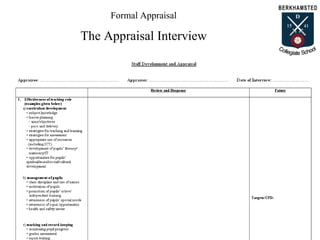
The Appraisal Interview
Formal Appraisal
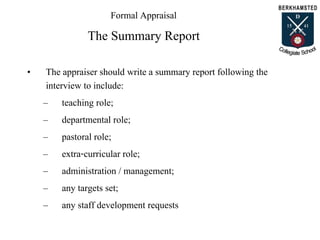
The Summary Report
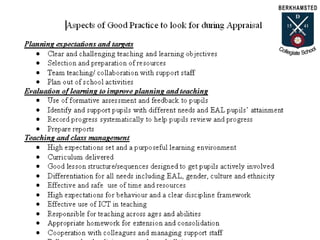
• The appraiser should write a summary report following the
interview to include:
– teaching role;
– departmental role;
– pastoral role;
– extra-curricular role;
– administration / management;
– any targets set;
– any staff development requests
WHY DO WE DO APPRAISAL?
Appraisal and Performance Management in Schools – A practical approach
Appraisal and Performance Management in Schools
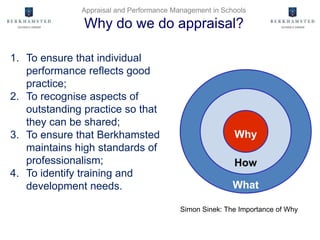
Why do we do appraisal?
What
How
Why
1. To ensure that individual
performance reflects good
practice;
2. To recognise aspects of
outstanding practice so that
they can be shared;
3. To ensure that Berkhamsted
maintains high standards of
professionalism;
4. To identify training and
development needs.
Simon Sinek: The Importance of Why
BACKGROUND
Appraisal and Performance Management in Schools – A practical approach
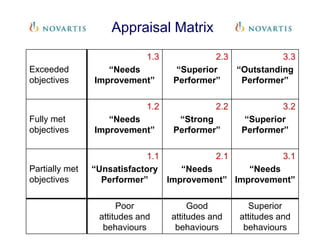
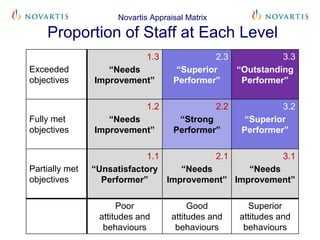
Appraisal Matrix
Exceeded
objectives
1.3
“Needs
Improvement”
2.3
“Superior
Performer”
3.3
“Outstanding
Performer”
Fully met
objectives
1.2
“Needs
Improvement”
2.2
“Strong
Performer”
3.2
“Superior
Performer”
Partially met
objectives
1.1
“Unsatisfactory
Performer”
2.1
“Needs
Improvement”
3.1
“Needs
Improvement”
Poor
attitudes and
behaviours
Good
attitudes and
behaviours
Superior
attitudes and
behaviours
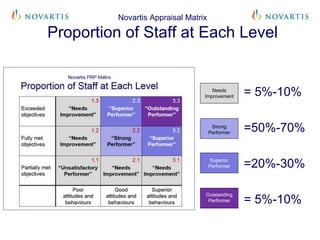
Novartis Appraisal Matrix
Proportion of Staff at Each Level
Exceeded
objectives
1.3
“Needs
Improvement”
2.3
“Superior
Performer”
3.3
“Outstanding
Performer”
Fully met
objectives
1.2
“Needs
Improvement”
2.2
“Strong
Performer”
3.2
“Superior
Performer”
Partially met
objectives
1.1
“Unsatisfactory
Performer”
2.1
“Needs
Improvement”
3.1
“Needs
Improvement”
Poor
attitudes and
behaviours
Good
attitudes and
behaviours
Superior
attitudes and
behaviours
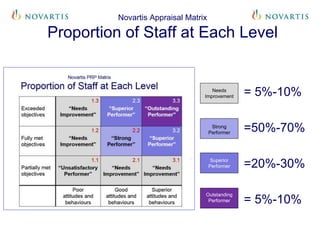
Novartis Appraisal Matrix
Proportion of Staff at Each Level
= 5%-10%
=50%-70%
=20%-30%
= 5%-10%
Needs
Improvement
Strong
Performer
Superior
Performer
Outstanding
Performer
Berkhamsted Schools Group
Appraisal: Rationale
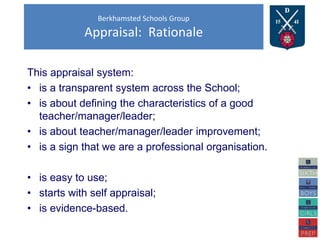
This appraisal system:
• is a transparent system across the School;
• is about defining the characteristics of a good
teacher/manager/leader;
• is about teacher/manager/leader improvement;
• is a sign that we are a professional organisation.
• is easy to use;
• starts with self appraisal;
• is evidence-based.
Berkhamsted Schools Group
Twilight CPD Programme
Berkhamsted Schools Group
Twilight CPD Programme
Berkhamsted Schools Group
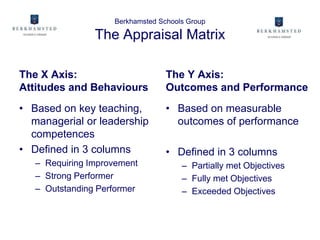
The Appraisal Matrix
The X Axis:
Attitudes and Behaviours
• Based on key teaching,
managerial or leadership
competences
• Defined in 3 columns
– Requiring Improvement
– Strong Performer
– Outstanding Performer
The Y Axis:
Outcomes and Performance
• Based on measurable
outcomes of performance
• Defined in 3 columns
– Partially met Objectives
– Fully met Objectives
– Exceeded Objectives
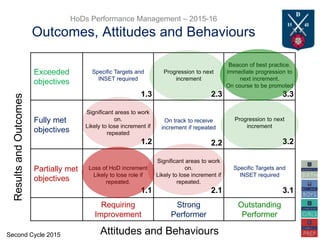
HoDs Performance Management – 2015-16
Outcomes, Attitudes and Behaviours
Exceeded
objectives
Specific Targets and
INSET required
1.3
Progression to next
increment
2.3
Beacon of best practice.
Immediate progression to
next increment.
On course to be promoted
3.3
Fully met
objectives
Significant areas to work
on.
Likely to lose increment if
repeated
1.2
On track to receive
increment if repeated
2.2
Progression to next
increment
3.2
Partially met
objectives
Loss of HoD increment
Likely to lose role if
repeated.
1.1
Significant areas to work
on.
Likely to lose increment if
repeated.
2.1
Specific Targets and
INSET required
3.1
Requiring
Improvement
Strong
Performer
Outstanding
Performer
Attitudes and Behaviours
ResultsandOutcomes
Second Cycle 2015
Berkhamsted Schools Group
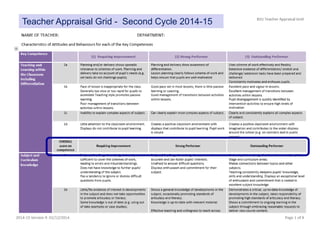
Teacher Appraisal Matrix
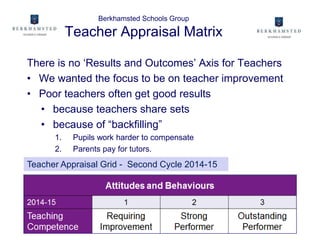
There is no ‘Results and Outcomes’ Axis for Teachers
• We wanted the focus to be on teacher improvement
• Poor teachers often get good results
• because teachers share sets
• because of “backfilling”
1. Pupils work harder to compensate
2. Parents pay for tutors.
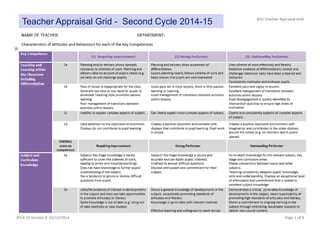
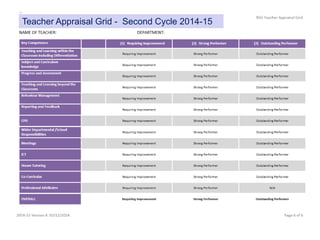
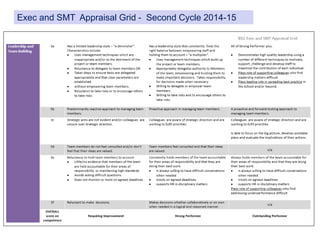
Teacher Appraisal Grid - Second Cycle 2014-15
Novartis Appraisal Matrix
Proportion of Staff at Each Level
= 5%-10%
=50%-70%
=20%-30%
= 5%-10%
Needs
Improvement
Strong
Performer
Superior
Performer
Outstanding
Performer
Berkhamsted Schools Group
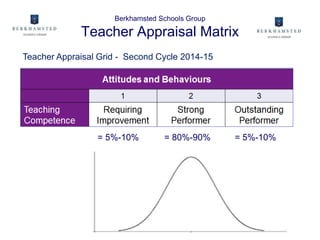
Teacher Appraisal Matrix
= 5%-10% = 80%-90% = 5%-10%
Teacher Appraisal Grid - Second Cycle 2014-15
Berkhamsted Schools Group
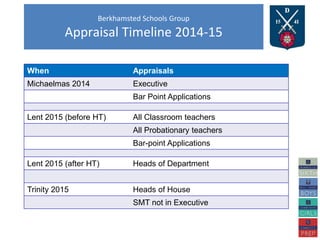
Appraisal Timeline 2014-15
When Appraisals
Michaelmas 2014 Executive
Bar Point Applications
Lent 2015 (before HT) All Classroom teachers
All Probationary teachers
Bar-point Applications
Lent 2015 (after HT) Heads of Department
Trinity 2015 Heads of House
SMT not in Executive
THE APPRAISAL PROCESS
Appraisal and Performance Management in Schools – A practical approach
STEP 1: SELF APPRAISAL
Berkhamsted Schools Group Appraisal Structure
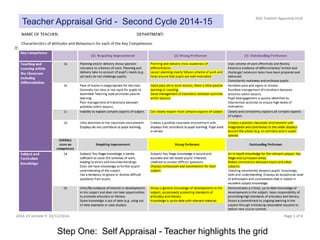
Step One: Self Appraisal - Teacher highlights the grid
Teacher Appraisal Grid - Second Cycle 2014-15
STEP 2: GATHERING EVIDENCE
Berkhamsted Schools Group Appraisal Structure
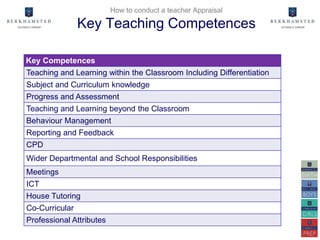
How to conduct a teacher Appraisal
Key Teaching Competences
Key Competences
Teaching and Learning within the Classroom Including Differentiation
Subject and Curriculum knowledge
Progress and Assessment
Teaching and Learning beyond the Classroom
Behaviour Management
Reporting and Feedback
CPD
Wider Departmental and School Responsibilities
Meetings
ICT
House Tutoring
Co-Curricular
Professional Attributes
How to conduct a teacher Appraisal
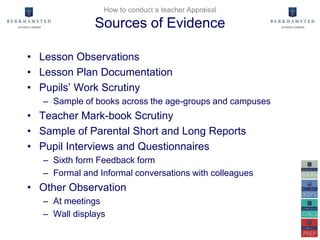
Sources of Evidence
• Lesson Observations
• Lesson Plan Documentation
• Pupils’ Work Scrutiny
– Sample of books across the age-groups and campuses
• Teacher Mark-book Scrutiny
• Sample of Parental Short and Long Reports
• Pupil Interviews and Questionnaires
– Sixth form Feedback form
– Formal and Informal conversations with colleagues
• Other Observation
– At meetings
– Wall displays
Gathering Evidence: Teaching and Learning
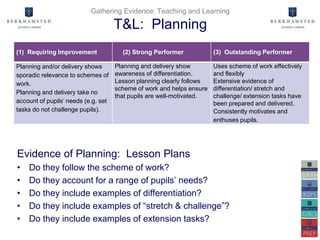
T&L: Planning
Evidence of Planning: Lesson Plans
• Do they follow the scheme of work?
• Do they account for a range of pupils’ needs?
• Do they include examples of differentiation?
• Do they include examples of “stretch & challenge”?
• Do they include examples of extension tasks?
(1) Requiring Improvement (2) Strong Performer (3) Outstanding Performer
Planning and/or delivery shows
sporadic relevance to schemes of
work.
Planning and delivery take no
account of pupils’ needs (e.g. set
tasks do not challenge pupils).
Planning and delivery show
awareness of differentiation.
Lesson planning clearly follows
scheme of work and helps ensure
that pupils are well-motivated.
Uses scheme of work effectively
and flexibly
Extensive evidence of
differentiation/ stretch and
challenge/ extension tasks have
been prepared and delivered.
Consistently motivates and
enthuses pupils.
STEP 3: MAKING PROVISIONAL
JUDGEMENTS
Berkhamsted Schools Group Appraisal Structure
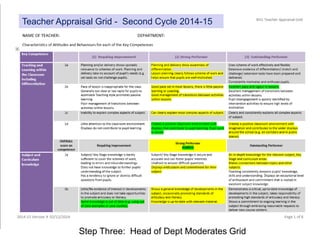
Step Three: Head of Dept Moderates Grid
Teacher Appraisal Grid - Second Cycle 2014-15
How to conduct a teacher Appraisal
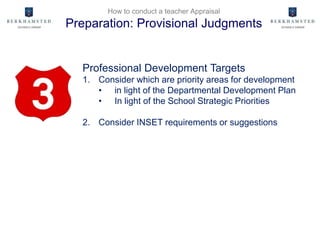
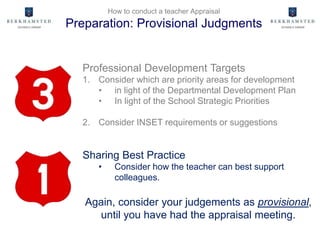
Preparation: Provisional Judgments
Professional Development Targets
1. Consider which are priority areas for development
• in light of the Departmental Development Plan
• In light of the School Strategic Priorities
2. Consider INSET requirements or suggestions
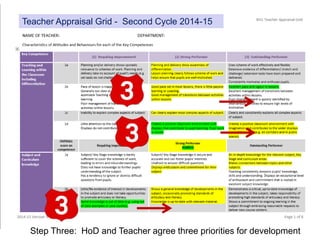
Step Three: HoD and Teacher agree three priorities for development
Teacher Appraisal Grid - Second Cycle 2014-15
How to conduct a teacher Appraisal
Preparation: Provisional Judgments
Professional Development Targets
1. Consider which are priority areas for development
• in light of the Departmental Development Plan
• In light of the School Strategic Priorities
2. Consider INSET requirements or suggestions
Sharing Best Practice
• Consider how the teacher can best support
colleagues.
Again, consider your judgements as provisional,
until you have had the appraisal meeting.
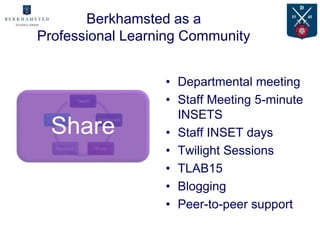
Berkhamsted as a
Professional Learning Community
• Departmental meeting
• Staff Meeting 5-minute
INSETS
• Staff INSET days
• Twilight Sessions
• TLAB15
• Blogging
• Peer-to-peer support
Teach
Collaborate
ShareResearch
Learn
Share
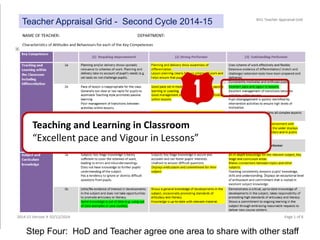
Teaching and Learning in Classroom
“Excellent pace and Vigour in Lessons”
Step Four: HoD and Teacher agree one area to share with other staff
Teacher Appraisal Grid - Second Cycle 2014-15
STEP 4: THE APPRAISAL
MEETING
Berkhamsted Schools Group Appraisal Structure
How to conduct a teacher Appraisal
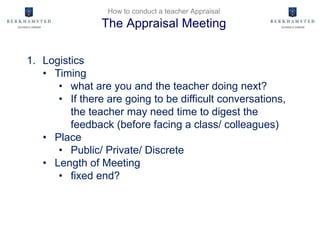
The Appraisal Meeting
1. Logistics
• Timing
• what are you and the teacher doing next?
• If there are going to be difficult conversations,
the teacher may need time to digest the
feedback (before facing a class/ colleagues)
• Place
• Public/ Private/ Discrete
• Length of Meeting
• fixed end?
How to conduct a teacher Appraisal
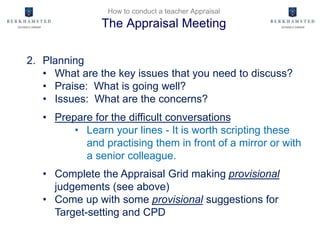
The Appraisal Meeting
2. Planning
• What are the key issues that you need to discuss?
• Praise: What is going well?
• Issues: What are the concerns?
• Prepare for the difficult conversations
• Learn your lines - It is worth scripting these
and practising them in front of a mirror or with
a senior colleague.
• Complete the Appraisal Grid making provisional
judgements (see above)
• Come up with some provisional suggestions for
Target-setting and CPD
How to conduct a teacher Appraisal
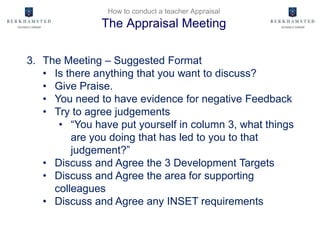
The Appraisal Meeting
3. The Meeting – Suggested Format
• Is there anything that you want to discuss?
• Give Praise.
• You need to have evidence for negative Feedback
• Try to agree judgements
• “You have put yourself in column 3, what things
are you doing that has led to you to that
judgement?”
• Discuss and Agree the 3 Development Targets
• Discuss and Agree the area for supporting
colleagues
• Discuss and Agree any INSET requirements
STEP 5: FINAL JUDGEMENTS
AND FEEDBACK
Berkhamsted Schools Group Appraisal Structure
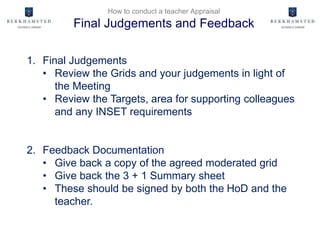
How to conduct a teacher Appraisal
Final Judgements and Feedback
1. Final Judgements
• Review the Grids and your judgements in light of
the Meeting
• Review the Targets, area for supporting colleagues
and any INSET requirements
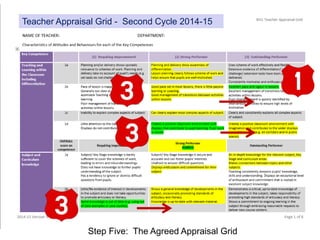
2. Feedback Documentation
• Give back a copy of the agreed moderated grid
• Give back the 3 + 1 Summary sheet
• These should be signed by both the HoD and the
teacher.
Step Five: The Agreed Appraisal Grid
Teacher Appraisal Grid - Second Cycle 2014-15
FINAL THOUGHTS ON TEACHER
APPRAISAL:
Appraisal and Performance Management in Schools – A practical approach
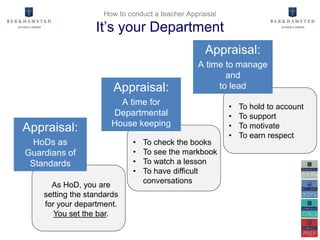
As HoD, you are
setting the standards
for your department.
You set the bar.
How to conduct a teacher Appraisal
It’s your Department
Appraisal:
HoDs as
Guardians of
Standards
• To check the books
• To see the markbook
• To watch a lesson
• To have difficult
conversations
Appraisal:
A time for
Departmental
House keeping
• To hold to account
• To support
• To motivate
• To earn respect
Appraisal:
A time to manage
and
to lead
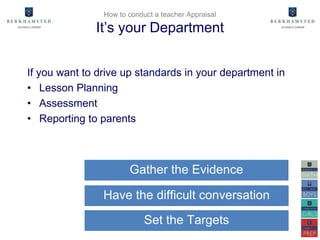
If you want to drive up standards in your department in
• Lesson Planning
• Assessment
• Reporting to parents
How to conduct a teacher Appraisal
It’s your Department
Gather the Evidence
Have the difficult conversation
Set the Targets
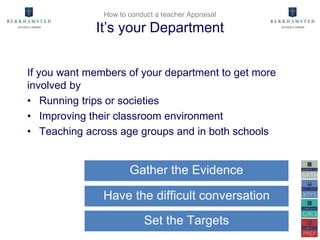
If you want members of your department to get more
involved by
• Running trips or societies
• Improving their classroom environment
• Teaching across age groups and in both schools
How to conduct a teacher Appraisal
It’s your Department
Gather the Evidence
Have the difficult conversation
Set the Targets
Conducting Teacher Appraisal is the best opportunity
that you have each year to raise standards within your
department.
Don’t waste it
How to conduct a teacher Appraisal
It’s your Department
SMT AND EXEC APPRAISAL
STRUCTURE
Appraisal and Performance Management in Schools – A practical approach
Exec and SMT Appraisal Grid - Second Cycle 2014-15
HODS PERFORMANCE
MANAGEMENT
Appraisal and Performance Management in Schools – A practical approach
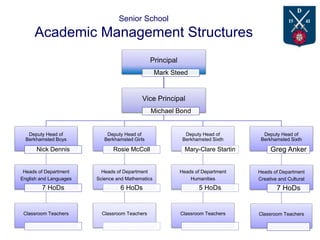
Senior School
Academic Management Structures
Principal
Mark Steed
Vice Principal
Michael Bond
Deputy Head of
Berkhamsted Boys
Nick Dennis
Heads of Department
English and Languages
7 HoDs
Classroom Teachers
Deputy Head of
Berkhamsted Girls
Rosie McColl
Heads of Department
Science and Mathematics
6 HoDs
Classroom Teachers
Deputy Head of
Berkhamsted Sixth
Mary-Clare Startin
Heads of Department
Humanities
5 HoDs
Classroom Teachers
Deputy Head of
Berkhamsted Sixth
Greg Anker
Heads of Department
Creative and Cultural
7 HoDs
Classroom Teachers
Senior School
Academic Cluster Groups
Maths and Science
• Mathematics, Science,
Biology, Chemistry,
Physics, ICT.
Languages
• English, French, Spanish,
German, Latin, English as
a Foreign Language
(EFL), Learning Support.
Humanities
• History, Politics,
Religion & Philosophy,
Sociology & Psychology,
Geography.
Creative and Practical
• Art & Photography,
Music, Media Studies,
Drama/Theatre Studies,
Design Technology, PE.
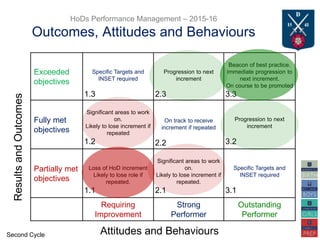
HoDs Performance Management – 2015-16
Outcomes, Attitudes and Behaviours
Exceeded
objectives
Specific Targets and
INSET required
1.3
Progression to next
increment
2.3
Beacon of best practice.
Immediate progression to
next increment.
On course to be promoted
3.3
Fully met
objectives
Significant areas to work
on.
Likely to lose increment if
repeated
1.2
On track to receive
increment if repeated
2.2
Progression to next
increment
3.2
Partially met
objectives
Loss of HoD increment
Likely to lose role if
repeated.
1.1
Significant areas to work
on.
Likely to lose increment if
repeated.
2.1
Specific Targets and
INSET required
3.1
Requiring
Improvement
Strong
Performer
Outstanding
Performer
Attitudes and Behaviours
ResultsandOutcomes
Second Cycle
HoDs Performance Management – 2015-16
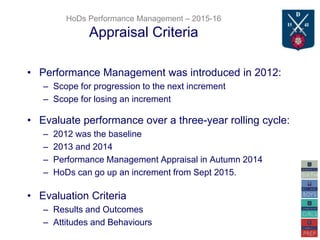
Appraisal Criteria
• Performance Management was introduced in 2012:
– Scope for progression to the next increment
– Scope for losing an increment
• Evaluate performance over a three-year rolling cycle:
– 2012 was the baseline
– 2013 and 2014
– Performance Management Appraisal in Autumn 2014
– HoDs can go up an increment from Sept 2015.
• Evaluation Criteria
– Results and Outcomes
– Attitudes and Behaviours
HoDs Performance Management – 2015-16
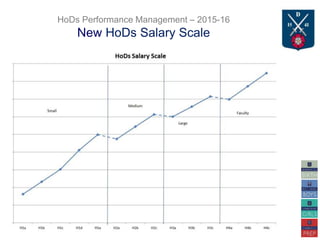
New HoDs Salary Scale
HoDs Performance Management – 2015-16
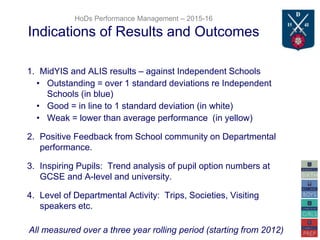
Indications of Results and Outcomes
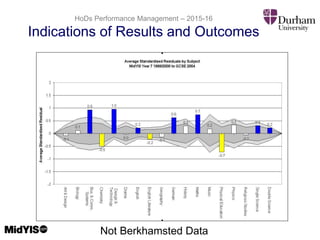
1. MidYIS and ALIS results – against Independent Schools
• Outstanding = over 1 standard deviations re Independent
Schools (in blue)
• Good = in line to 1 standard deviation (in white)
• Weak = lower than average performance (in yellow)
2. Positive Feedback from School community on Departmental
performance.
3. Inspiring Pupils: Trend analysis of pupil option numbers at
GCSE and A-level and university.
4. Level of Departmental Activity: Trips, Societies, Visiting
speakers etc.
All measured over a three year rolling period (starting from 2012)
HoDs Performance Management – 2015-16
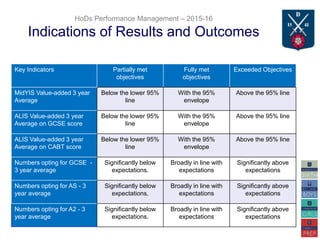
Indications of Results and Outcomes
Key Indicators Partially met
objectives
Fully met
objectives
Exceeded Objectives
MidYIS Value-added 3 year
Average
Below the lower 95%
line
With the 95%
envelope
Above the 95% line
ALIS Value-added 3 year
Average on GCSE score
Below the lower 95%
line
With the 95%
envelope
Above the 95% line
ALIS Value-added 3 year
Average on CABT score
Below the lower 95%
line
With the 95%
envelope
Above the 95% line
Numbers opting for GCSE -
3 year average
Significantly below
expectations.
Broadly in line with
expectations
Significantly above
expectations
Numbers opting for AS - 3
year average
Significantly below
expectations.
Broadly in line with
expectations
Significantly above
expectations
Numbers opting for A2 - 3
year average
Significantly below
expectations.
Broadly in line with
expectations
Significantly above
expectations
HoDs Performance Management – 2015-16
Indications of Results and Outcomes
Not Berkhamsted Data
HoDs Performance Management Consultation
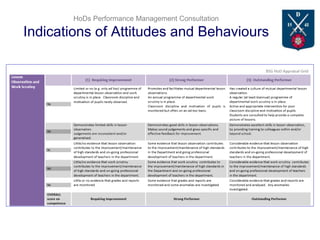
Indications of Attitudes and Behaviours
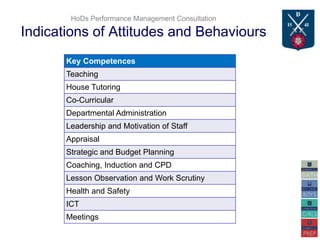
Key Competences
Teaching
House Tutoring
Co-Curricular
Departmental Administration
Leadership and Motivation of Staff
Appraisal
Strategic and Budget Planning
Coaching, Induction and CPD
Lesson Observation and Work Scrutiny
Health and Safety
ICT
Meetings
HoDs Performance Management Consultation
Indications of Attitudes and Behaviours
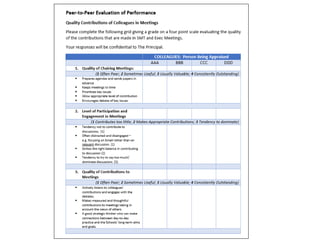
Appraising HoDs Attitudes and Behaviours – 2015-16
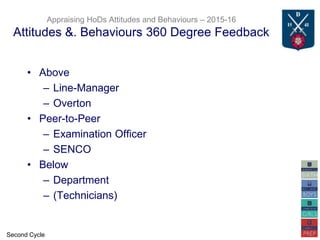
Attitudes &. Behaviours 360 Degree Feedback
• Above
– Line-Manager
– Overton
• Peer-to-Peer
– Examination Officer
– SENCO
• Below
– Department
– (Technicians)
Second Cycle
Appraising HoDs Attitudes and Behaviours – 2015-16
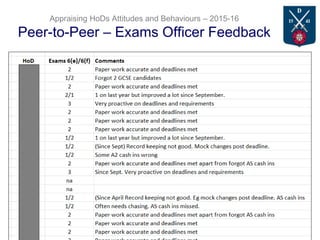
Peer-to-Peer – Exams Officer Feedback
HoDs Performance Management – 2015-16
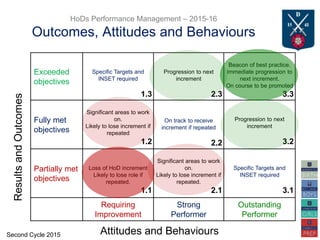
Outcomes, Attitudes and Behaviours
Exceeded
objectives
Specific Targets and
INSET required
1.3
Progression to next
increment
2.3
Beacon of best practice.
Immediate progression to
next increment.
On course to be promoted
3.3
Fully met
objectives
Significant areas to work
on.
Likely to lose increment if
repeated
1.2
On track to receive
increment if repeated
2.2
Progression to next
increment
3.2
Partially met
objectives
Loss of HoD increment
Likely to lose role if
repeated.
1.1
Significant areas to work
on.
Likely to lose increment if
repeated.
2.1
Specific Targets and
INSET required
3.1
Requiring
Improvement
Strong
Performer
Outstanding
Performer
Attitudes and Behaviours
ResultsandOutcomes
Second Cycle 2015
ResultsandOutcomes
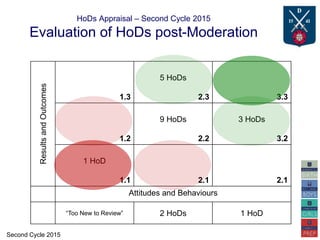
1.3
5 HoDs
2.3 3.3
1.2
9 HoDs
2.2
3 HoDs
3.2
1 HoD
1.1 2.1 2.1
Attitudes and Behaviours
“Too New to Review” 2 HoDs 1 HoD
HoDs Appraisal – Second Cycle 2015
Evaluation of HoDs post-Moderation
Second Cycle 2015
FUTURE DEVELOPMENT
Appraisal and Performance Management in Schools – A practical approach
Appraisal Structure – 2016 and Beyond
Future: Online Appraisal
Third Cycle 2015
Email: principal@berkhamstedschool.org
Twitter: @independenthead
LinkedIn: uk.linkedin.com/in/independenthead
Blog: http://independenthead.blogspot.com

Appraisal and Performance Management in Schools - A practical approach

  • 1.
    Leading Change with Parents TLAB15 Saturday21st March 2015 Berkhamsted School Mark S. Steed, MA (Cantab.), MA Principal, Berkhamsted Schools Group @independenthead
  • 2.
    HOW WE USEDTO DO IT Berkhamsted Schools Group Appraisal Structure
  • 3.
  • 4.
    Formal Appraisal The SummaryReport • The appraiser should write a summary report following the interview to include: – teaching role; – departmental role; – pastoral role; – extra-curricular role; – administration / management; – any targets set; – any staff development requests
  • 6.
    WHY DO WEDO APPRAISAL? Appraisal and Performance Management in Schools – A practical approach
  • 7.
    Appraisal and PerformanceManagement in Schools Why do we do appraisal? What How Why 1. To ensure that individual performance reflects good practice; 2. To recognise aspects of outstanding practice so that they can be shared; 3. To ensure that Berkhamsted maintains high standards of professionalism; 4. To identify training and development needs. Simon Sinek: The Importance of Why
  • 8.
    BACKGROUND Appraisal and PerformanceManagement in Schools – A practical approach
  • 10.
    Appraisal Matrix Exceeded objectives 1.3 “Needs Improvement” 2.3 “Superior Performer” 3.3 “Outstanding Performer” Fully met objectives 1.2 “Needs Improvement” 2.2 “Strong Performer” 3.2 “Superior Performer” Partiallymet objectives 1.1 “Unsatisfactory Performer” 2.1 “Needs Improvement” 3.1 “Needs Improvement” Poor attitudes and behaviours Good attitudes and behaviours Superior attitudes and behaviours
  • 11.
    Novartis Appraisal Matrix Proportionof Staff at Each Level Exceeded objectives 1.3 “Needs Improvement” 2.3 “Superior Performer” 3.3 “Outstanding Performer” Fully met objectives 1.2 “Needs Improvement” 2.2 “Strong Performer” 3.2 “Superior Performer” Partially met objectives 1.1 “Unsatisfactory Performer” 2.1 “Needs Improvement” 3.1 “Needs Improvement” Poor attitudes and behaviours Good attitudes and behaviours Superior attitudes and behaviours
  • 12.
    Novartis Appraisal Matrix Proportionof Staff at Each Level = 5%-10% =50%-70% =20%-30% = 5%-10% Needs Improvement Strong Performer Superior Performer Outstanding Performer
  • 13.
    Berkhamsted Schools Group Appraisal:Rationale This appraisal system: • is a transparent system across the School; • is about defining the characteristics of a good teacher/manager/leader; • is about teacher/manager/leader improvement; • is a sign that we are a professional organisation. • is easy to use; • starts with self appraisal; • is evidence-based.
  • 14.
  • 15.
  • 16.
    Berkhamsted Schools Group TheAppraisal Matrix The X Axis: Attitudes and Behaviours • Based on key teaching, managerial or leadership competences • Defined in 3 columns – Requiring Improvement – Strong Performer – Outstanding Performer The Y Axis: Outcomes and Performance • Based on measurable outcomes of performance • Defined in 3 columns – Partially met Objectives – Fully met Objectives – Exceeded Objectives
  • 17.
    HoDs Performance Management– 2015-16 Outcomes, Attitudes and Behaviours Exceeded objectives Specific Targets and INSET required 1.3 Progression to next increment 2.3 Beacon of best practice. Immediate progression to next increment. On course to be promoted 3.3 Fully met objectives Significant areas to work on. Likely to lose increment if repeated 1.2 On track to receive increment if repeated 2.2 Progression to next increment 3.2 Partially met objectives Loss of HoD increment Likely to lose role if repeated. 1.1 Significant areas to work on. Likely to lose increment if repeated. 2.1 Specific Targets and INSET required 3.1 Requiring Improvement Strong Performer Outstanding Performer Attitudes and Behaviours ResultsandOutcomes Second Cycle 2015
  • 18.
    Berkhamsted Schools Group TeacherAppraisal Matrix There is no ‘Results and Outcomes’ Axis for Teachers • We wanted the focus to be on teacher improvement • Poor teachers often get good results • because teachers share sets • because of “backfilling” 1. Pupils work harder to compensate 2. Parents pay for tutors. Teacher Appraisal Grid - Second Cycle 2014-15
  • 19.
    Teacher Appraisal Grid- Second Cycle 2014-15
  • 20.
    Teacher Appraisal Grid- Second Cycle 2014-15
  • 21.
    Teacher Appraisal Grid- Second Cycle 2014-15
  • 22.
    Novartis Appraisal Matrix Proportionof Staff at Each Level = 5%-10% =50%-70% =20%-30% = 5%-10% Needs Improvement Strong Performer Superior Performer Outstanding Performer
  • 23.
    Berkhamsted Schools Group TeacherAppraisal Matrix = 5%-10% = 80%-90% = 5%-10% Teacher Appraisal Grid - Second Cycle 2014-15
  • 24.
    Berkhamsted Schools Group AppraisalTimeline 2014-15 When Appraisals Michaelmas 2014 Executive Bar Point Applications Lent 2015 (before HT) All Classroom teachers All Probationary teachers Bar-point Applications Lent 2015 (after HT) Heads of Department Trinity 2015 Heads of House SMT not in Executive
  • 25.
    THE APPRAISAL PROCESS Appraisaland Performance Management in Schools – A practical approach
  • 26.
    STEP 1: SELFAPPRAISAL Berkhamsted Schools Group Appraisal Structure
  • 27.
    Step One: SelfAppraisal - Teacher highlights the grid Teacher Appraisal Grid - Second Cycle 2014-15
  • 28.
    STEP 2: GATHERINGEVIDENCE Berkhamsted Schools Group Appraisal Structure
  • 29.
    How to conducta teacher Appraisal Key Teaching Competences Key Competences Teaching and Learning within the Classroom Including Differentiation Subject and Curriculum knowledge Progress and Assessment Teaching and Learning beyond the Classroom Behaviour Management Reporting and Feedback CPD Wider Departmental and School Responsibilities Meetings ICT House Tutoring Co-Curricular Professional Attributes
  • 30.
    How to conducta teacher Appraisal Sources of Evidence • Lesson Observations • Lesson Plan Documentation • Pupils’ Work Scrutiny – Sample of books across the age-groups and campuses • Teacher Mark-book Scrutiny • Sample of Parental Short and Long Reports • Pupil Interviews and Questionnaires – Sixth form Feedback form – Formal and Informal conversations with colleagues • Other Observation – At meetings – Wall displays
  • 31.
    Gathering Evidence: Teachingand Learning T&L: Planning Evidence of Planning: Lesson Plans • Do they follow the scheme of work? • Do they account for a range of pupils’ needs? • Do they include examples of differentiation? • Do they include examples of “stretch & challenge”? • Do they include examples of extension tasks? (1) Requiring Improvement (2) Strong Performer (3) Outstanding Performer Planning and/or delivery shows sporadic relevance to schemes of work. Planning and delivery take no account of pupils’ needs (e.g. set tasks do not challenge pupils). Planning and delivery show awareness of differentiation. Lesson planning clearly follows scheme of work and helps ensure that pupils are well-motivated. Uses scheme of work effectively and flexibly Extensive evidence of differentiation/ stretch and challenge/ extension tasks have been prepared and delivered. Consistently motivates and enthuses pupils.
  • 32.
    STEP 3: MAKINGPROVISIONAL JUDGEMENTS Berkhamsted Schools Group Appraisal Structure
  • 33.
    Step Three: Headof Dept Moderates Grid Teacher Appraisal Grid - Second Cycle 2014-15
  • 34.
    How to conducta teacher Appraisal Preparation: Provisional Judgments Professional Development Targets 1. Consider which are priority areas for development • in light of the Departmental Development Plan • In light of the School Strategic Priorities 2. Consider INSET requirements or suggestions
  • 35.
    Step Three: HoDand Teacher agree three priorities for development Teacher Appraisal Grid - Second Cycle 2014-15
  • 36.
    How to conducta teacher Appraisal Preparation: Provisional Judgments Professional Development Targets 1. Consider which are priority areas for development • in light of the Departmental Development Plan • In light of the School Strategic Priorities 2. Consider INSET requirements or suggestions Sharing Best Practice • Consider how the teacher can best support colleagues. Again, consider your judgements as provisional, until you have had the appraisal meeting.
  • 37.
    Berkhamsted as a ProfessionalLearning Community • Departmental meeting • Staff Meeting 5-minute INSETS • Staff INSET days • Twilight Sessions • TLAB15 • Blogging • Peer-to-peer support Teach Collaborate ShareResearch Learn Share
  • 38.
    Teaching and Learningin Classroom “Excellent pace and Vigour in Lessons” Step Four: HoD and Teacher agree one area to share with other staff Teacher Appraisal Grid - Second Cycle 2014-15
  • 39.
    STEP 4: THEAPPRAISAL MEETING Berkhamsted Schools Group Appraisal Structure
  • 40.
    How to conducta teacher Appraisal The Appraisal Meeting 1. Logistics • Timing • what are you and the teacher doing next? • If there are going to be difficult conversations, the teacher may need time to digest the feedback (before facing a class/ colleagues) • Place • Public/ Private/ Discrete • Length of Meeting • fixed end?
  • 41.
    How to conducta teacher Appraisal The Appraisal Meeting 2. Planning • What are the key issues that you need to discuss? • Praise: What is going well? • Issues: What are the concerns? • Prepare for the difficult conversations • Learn your lines - It is worth scripting these and practising them in front of a mirror or with a senior colleague. • Complete the Appraisal Grid making provisional judgements (see above) • Come up with some provisional suggestions for Target-setting and CPD
  • 42.
    How to conducta teacher Appraisal The Appraisal Meeting 3. The Meeting – Suggested Format • Is there anything that you want to discuss? • Give Praise. • You need to have evidence for negative Feedback • Try to agree judgements • “You have put yourself in column 3, what things are you doing that has led to you to that judgement?” • Discuss and Agree the 3 Development Targets • Discuss and Agree the area for supporting colleagues • Discuss and Agree any INSET requirements
  • 43.
    STEP 5: FINALJUDGEMENTS AND FEEDBACK Berkhamsted Schools Group Appraisal Structure
  • 44.
    How to conducta teacher Appraisal Final Judgements and Feedback 1. Final Judgements • Review the Grids and your judgements in light of the Meeting • Review the Targets, area for supporting colleagues and any INSET requirements 2. Feedback Documentation • Give back a copy of the agreed moderated grid • Give back the 3 + 1 Summary sheet • These should be signed by both the HoD and the teacher.
  • 45.
    Step Five: TheAgreed Appraisal Grid Teacher Appraisal Grid - Second Cycle 2014-15
  • 46.
    FINAL THOUGHTS ONTEACHER APPRAISAL: Appraisal and Performance Management in Schools – A practical approach
  • 47.
    As HoD, youare setting the standards for your department. You set the bar. How to conduct a teacher Appraisal It’s your Department Appraisal: HoDs as Guardians of Standards • To check the books • To see the markbook • To watch a lesson • To have difficult conversations Appraisal: A time for Departmental House keeping • To hold to account • To support • To motivate • To earn respect Appraisal: A time to manage and to lead
  • 48.
    If you wantto drive up standards in your department in • Lesson Planning • Assessment • Reporting to parents How to conduct a teacher Appraisal It’s your Department Gather the Evidence Have the difficult conversation Set the Targets
  • 49.
    If you wantmembers of your department to get more involved by • Running trips or societies • Improving their classroom environment • Teaching across age groups and in both schools How to conduct a teacher Appraisal It’s your Department Gather the Evidence Have the difficult conversation Set the Targets
  • 50.
    Conducting Teacher Appraisalis the best opportunity that you have each year to raise standards within your department. Don’t waste it How to conduct a teacher Appraisal It’s your Department
  • 51.
    SMT AND EXECAPPRAISAL STRUCTURE Appraisal and Performance Management in Schools – A practical approach
  • 52.
    Exec and SMTAppraisal Grid - Second Cycle 2014-15
  • 54.
    HODS PERFORMANCE MANAGEMENT Appraisal andPerformance Management in Schools – A practical approach
  • 55.
    Senior School Academic ManagementStructures Principal Mark Steed Vice Principal Michael Bond Deputy Head of Berkhamsted Boys Nick Dennis Heads of Department English and Languages 7 HoDs Classroom Teachers Deputy Head of Berkhamsted Girls Rosie McColl Heads of Department Science and Mathematics 6 HoDs Classroom Teachers Deputy Head of Berkhamsted Sixth Mary-Clare Startin Heads of Department Humanities 5 HoDs Classroom Teachers Deputy Head of Berkhamsted Sixth Greg Anker Heads of Department Creative and Cultural 7 HoDs Classroom Teachers
  • 56.
    Senior School Academic ClusterGroups Maths and Science • Mathematics, Science, Biology, Chemistry, Physics, ICT. Languages • English, French, Spanish, German, Latin, English as a Foreign Language (EFL), Learning Support. Humanities • History, Politics, Religion & Philosophy, Sociology & Psychology, Geography. Creative and Practical • Art & Photography, Music, Media Studies, Drama/Theatre Studies, Design Technology, PE.
  • 57.
    HoDs Performance Management– 2015-16 Outcomes, Attitudes and Behaviours Exceeded objectives Specific Targets and INSET required 1.3 Progression to next increment 2.3 Beacon of best practice. Immediate progression to next increment. On course to be promoted 3.3 Fully met objectives Significant areas to work on. Likely to lose increment if repeated 1.2 On track to receive increment if repeated 2.2 Progression to next increment 3.2 Partially met objectives Loss of HoD increment Likely to lose role if repeated. 1.1 Significant areas to work on. Likely to lose increment if repeated. 2.1 Specific Targets and INSET required 3.1 Requiring Improvement Strong Performer Outstanding Performer Attitudes and Behaviours ResultsandOutcomes Second Cycle
  • 58.
    HoDs Performance Management– 2015-16 Appraisal Criteria • Performance Management was introduced in 2012: – Scope for progression to the next increment – Scope for losing an increment • Evaluate performance over a three-year rolling cycle: – 2012 was the baseline – 2013 and 2014 – Performance Management Appraisal in Autumn 2014 – HoDs can go up an increment from Sept 2015. • Evaluation Criteria – Results and Outcomes – Attitudes and Behaviours
  • 59.
    HoDs Performance Management– 2015-16 New HoDs Salary Scale
  • 60.
    HoDs Performance Management– 2015-16 Indications of Results and Outcomes 1. MidYIS and ALIS results – against Independent Schools • Outstanding = over 1 standard deviations re Independent Schools (in blue) • Good = in line to 1 standard deviation (in white) • Weak = lower than average performance (in yellow) 2. Positive Feedback from School community on Departmental performance. 3. Inspiring Pupils: Trend analysis of pupil option numbers at GCSE and A-level and university. 4. Level of Departmental Activity: Trips, Societies, Visiting speakers etc. All measured over a three year rolling period (starting from 2012)
  • 61.
    HoDs Performance Management– 2015-16 Indications of Results and Outcomes Key Indicators Partially met objectives Fully met objectives Exceeded Objectives MidYIS Value-added 3 year Average Below the lower 95% line With the 95% envelope Above the 95% line ALIS Value-added 3 year Average on GCSE score Below the lower 95% line With the 95% envelope Above the 95% line ALIS Value-added 3 year Average on CABT score Below the lower 95% line With the 95% envelope Above the 95% line Numbers opting for GCSE - 3 year average Significantly below expectations. Broadly in line with expectations Significantly above expectations Numbers opting for AS - 3 year average Significantly below expectations. Broadly in line with expectations Significantly above expectations Numbers opting for A2 - 3 year average Significantly below expectations. Broadly in line with expectations Significantly above expectations
  • 62.
    HoDs Performance Management– 2015-16 Indications of Results and Outcomes Not Berkhamsted Data
  • 63.
    HoDs Performance ManagementConsultation Indications of Attitudes and Behaviours Key Competences Teaching House Tutoring Co-Curricular Departmental Administration Leadership and Motivation of Staff Appraisal Strategic and Budget Planning Coaching, Induction and CPD Lesson Observation and Work Scrutiny Health and Safety ICT Meetings
  • 64.
    HoDs Performance ManagementConsultation Indications of Attitudes and Behaviours
  • 65.
    Appraising HoDs Attitudesand Behaviours – 2015-16 Attitudes &. Behaviours 360 Degree Feedback • Above – Line-Manager – Overton • Peer-to-Peer – Examination Officer – SENCO • Below – Department – (Technicians) Second Cycle
  • 66.
    Appraising HoDs Attitudesand Behaviours – 2015-16 Peer-to-Peer – Exams Officer Feedback
  • 67.
    HoDs Performance Management– 2015-16 Outcomes, Attitudes and Behaviours Exceeded objectives Specific Targets and INSET required 1.3 Progression to next increment 2.3 Beacon of best practice. Immediate progression to next increment. On course to be promoted 3.3 Fully met objectives Significant areas to work on. Likely to lose increment if repeated 1.2 On track to receive increment if repeated 2.2 Progression to next increment 3.2 Partially met objectives Loss of HoD increment Likely to lose role if repeated. 1.1 Significant areas to work on. Likely to lose increment if repeated. 2.1 Specific Targets and INSET required 3.1 Requiring Improvement Strong Performer Outstanding Performer Attitudes and Behaviours ResultsandOutcomes Second Cycle 2015
  • 68.
    ResultsandOutcomes 1.3 5 HoDs 2.3 3.3 1.2 9HoDs 2.2 3 HoDs 3.2 1 HoD 1.1 2.1 2.1 Attitudes and Behaviours “Too New to Review” 2 HoDs 1 HoD HoDs Appraisal – Second Cycle 2015 Evaluation of HoDs post-Moderation Second Cycle 2015
  • 69.
    FUTURE DEVELOPMENT Appraisal andPerformance Management in Schools – A practical approach
  • 70.
    Appraisal Structure –2016 and Beyond Future: Online Appraisal Third Cycle 2015
  • 72.
    Email: principal@berkhamstedschool.org Twitter: @independenthead LinkedIn:uk.linkedin.com/in/independenthead Blog: http://independenthead.blogspot.com