Performance appraisal
of
Teachers
- Anusha Veera
23-P-DX-03
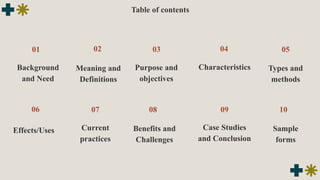
Table of contents
Background
and Need
Characteristics
Case Studies
and Conclusion
Types and
methods
01 05
04
02
Sample
forms
Meaning and
Definitions
06
03
Current
practices
Effects/Uses
Purpose and
objectives
Benefits and
Challenges
10
09
07 08
— Kenneth H. Blanchard
“Feedback is important to people. We all
want to know how well we’re doing.
That’s why it is essential for an effective
performance review system to provide
ongoing feedback.”
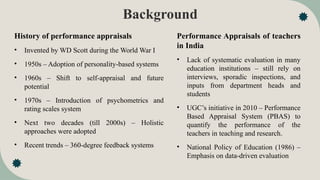
Background
History of performance appraisals
• Invented by WD Scott during the World War I
• 1950s – Adoption of personality-based systems
• 1960s – Shift to self-appraisal and future
potential
• 1970s – Introduction of psychometrics and
rating scales system
• Next two decades (till 2000s) – Holistic
approaches were adopted
• Recent trends – 360-degree feedback systems
Performance Appraisals of teachers
in India
• Lack of systematic evaluation in many
education institutions – still rely on
interviews, sporadic inspections, and
inputs from department heads and
students
• UGC’s initiative in 2010 – Performance
Based Appraisal System (PBAS) to
quantify the performance of the
teachers in teaching and research.
• National Policy of Education (1986) –
Emphasis on data-driven evaluation
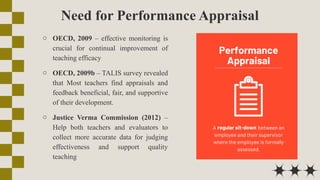
Need for Performance Appraisal
o OECD, 2009 – effective monitoring is
crucial for continual improvement of
teaching efficacy
o OECD, 2009b – TALIS survey revealed
that Most teachers find appraisals and
feedback beneficial, fair, and supportive
of their development.
o Justice Verma Commission (2012) –
Help both teachers and evaluators to
collect more accurate data for judging
effectiveness and support quality
teaching
Meaning
 Performance – Measured in terms of results.
“... the record of outcomes produced on specified job or
activity during specified time” – Thomas, (1987)
 Appraisal – Judgment of characteristics, traits, and
performance in a formal work setup.
 Performance Appraisal – Judgment made after
obtaining results on certain activities.
It is a systematic and objective evaluation –
 Systematic – Consistent evaluation of all employees
 Objective – Accurate measurement, reducing biases
and prejudices
Definitions
“Performance appraisal is a systematic, periodic and so far as humanly possible,
an impartial rating of an employee’s excellence in matters pertaining to his present
job and to his potentialities for a better job”
– Edwin B. Flippo
“Performance appraisal is a method of acquiring and processing the information
needed to improve an individual employee’s performance and accomplishments.”
– Douglass
National Educational Policy (NEP) 2020
 Development of National Professional Standards for Teachers (NPST)
 define expectations and competencies for teachers at various
career stages.
 Basis for appraisals, promotions, and career management
 Promotions and salary will be performance-based.
 NPST will be updated every ten years, starting in 2030.
 Emphasis on merit-based recognition and
rewards for teachers
 Basis for Performance assessments – Peer
reviews, attendance, commitment, CPD hours,
and contributions (to school or community)
Purpose of performance appraisal
o Quality Improvement: Continuously assess and
enhance teaching quality.
o Skill Assessment: Evaluate teacher skills and
capabilities.
o Manpower Forecasting: Predict future staffing
needs.
o Salary Planning: Inform salary and
compensation decisions.
o Training Needs: Identify specific training
requirements.
o Resource Allocation: Guide in providing
necessary resources.
o Equity & Fairness: Ensure fair treatment among
teachers.
o Communication: Minimize gaps between
administrators and teachers.
o Accountability: Link performance to rewards
and promotions.
o Institutional Alignment: Align teacher goals
with institutional objectives.
o Grievance Handling: Detect and address
teacher grievances.
o Teacher Development: Support holistic growth
of teachers.
o External Accountability: Ensure
accountability to external stakeholders.
o Feedback Mechanism: Provide continuous
feedback for improvement.
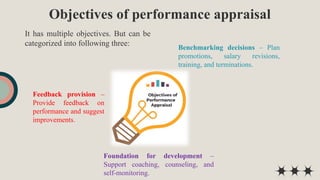
Objectives of performance appraisal
It has multiple objectives. But can be
categorized into following three:
Benchmarking decisions – Plan
promotions, salary revisions,
training, and terminations.
Feedback provision –
Provide feedback on
performance and suggest
improvements.
Foundation for development –
Support coaching, counseling, and
self-monitoring.
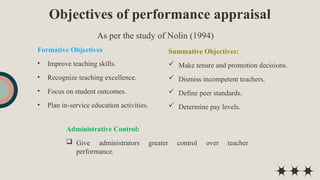
Objectives of performance appraisal
Formative Objectives
• Improve teaching skills.
• Recognize teaching excellence.
• Focus on student outcomes.
• Plan in-service education activities.
Summative Objectives:
 Make tenure and promotion decisions.
 Dismiss incompetent teachers.
 Define peer standards.
 Determine pay levels.
As per the study of Nolin (1994)
Administrative Control:
 Give administrators greater control over teacher
performance.
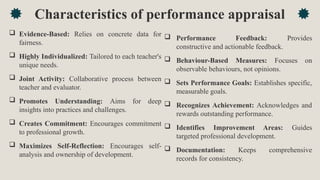
Characteristics of performance appraisal
 Evidence-Based: Relies on concrete data for
fairness.
 Highly Individualized: Tailored to each teacher's
unique needs.
 Joint Activity: Collaborative process between
teacher and evaluator.
 Promotes Understanding: Aims for deep
insights into practices and challenges.
 Creates Commitment: Encourages commitment
to professional growth.
 Maximizes Self-Reflection: Encourages self-
analysis and ownership of development.
 Performance Feedback: Provides
constructive and actionable feedback.
 Behaviour-Based Measures: Focuses on
observable behaviours, not opinions.
 Sets Performance Goals: Establishes specific,
measurable goals.
 Recognizes Achievement: Acknowledges and
rewards outstanding performance.
 Identifies Improvement Areas: Guides
targeted professional development.
 Documentation: Keeps comprehensive
records for consistency.
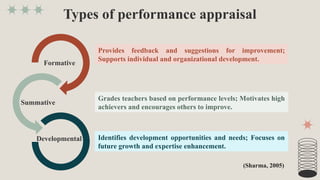
Types of performance appraisal
Formative
Summative
Developmental
Provides feedback and suggestions for improvement;
Supports individual and organizational development.
Grades teachers based on performance levels; Motivates high
achievers and encourages others to improve.
Identifies development opportunities and needs; Focuses on
future growth and expertise enhancement.
(Sharma, 2005)
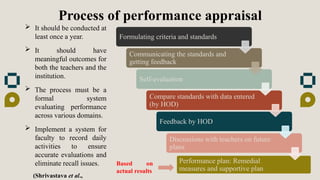
Process of performance appraisal
 It should be conducted at
least once a year.
 It should have
meaningful outcomes for
both the teachers and the
institution.
 The process must be a
formal system
evaluating performance
across various domains.
 Implement a system for
faculty to record daily
activities to ensure
accurate evaluations and
eliminate recall issues.
Formulating criteria and standards
Communicating the standards and
getting feedback
Self-evaluation
Compare standards with data entered
(by HOD)
Feedback by HOD
Discussions with teachers on future
plans
Performance plan: Remedial
measures and supportive plan
Based on
actual results
(Shrivastava et al.,
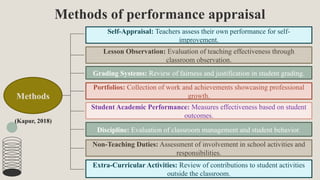
Methods of performance appraisal
Self-Appraisal: Teachers assess their own performance for self-
improvement.
Lesson Observation: Evaluation of teaching effectiveness through
classroom observation.
Grading Systems: Review of fairness and justification in student grading.
Portfolios: Collection of work and achievements showcasing professional
growth.
Student Academic Performance: Measures effectiveness based on student
outcomes.
Discipline: Evaluation of classroom management and student behavior.
Non-Teaching Duties: Assessment of involvement in school activities and
responsibilities.
Extra-Curricular Activities: Review of contributions to student activities
outside the classroom.
Methods
(Kapur, 2018)
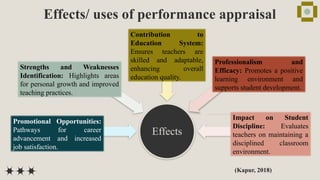
Effects/ uses of performance appraisal
Effects
Promotional Opportunities:
Pathways for career
advancement and increased
job satisfaction.
Strengths and Weaknesses
Identification: Highlights areas
for personal growth and improved
teaching practices.
Contribution to
Education System:
Ensures teachers are
skilled and adaptable,
enhancing overall
education quality.
Professionalism and
Efficacy: Promotes a positive
learning environment and
supports student development.
Impact on Student
Discipline: Evaluates
teachers on maintaining a
disciplined classroom
environment.
(Kapur, 2018)
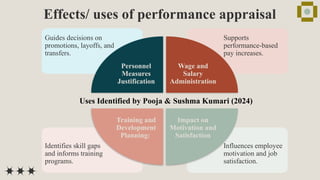
Effects/ uses of performance appraisal
Influences employee
motivation and job
satisfaction.
Identifies skill gaps
and informs training
programs.
Supports
performance-based
pay increases.
Guides decisions on
promotions, layoffs, and
transfers.
Personnel
Measures
Justification
Wage and
Salary
Administration
Impact on
Motivation and
Satisfaction
Training and
Development
Planning:
Uses Identified by Pooja & Sushma Kumari (2024)
Current practices of performance appraisal of
teachers
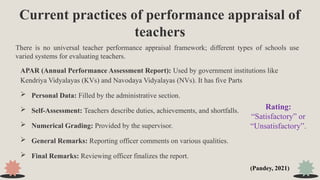
APAR (Annual Performance Assessment Report): Used by government institutions like
Kendriya Vidyalayas (KVs) and Navodaya Vidyalayas (NVs). It has five Parts
 Personal Data: Filled by the administrative section.
 Self-Assessment: Teachers describe duties, achievements, and shortfalls.
 Numerical Grading: Provided by the supervisor.
 General Remarks: Reporting officer comments on various qualities.
 Final Remarks: Reviewing officer finalizes the report.
There is no universal teacher performance appraisal framework; different types of schools use
varied systems for evaluating teachers.
Rating:
“Satisfactory” or
“Unsatisfactory”.
(Pandey, 2021)
Current practices of performance appraisal of
teachers
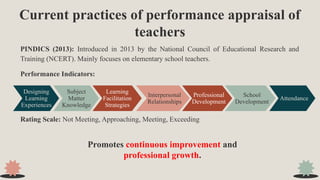
PINDICS (2013): Introduced in 2013 by the National Council of Educational Research and
Training (NCERT). Mainly focuses on elementary school teachers.
Performance Indicators:
Rating Scale: Not Meeting, Approaching, Meeting, Exceeding
Designing
Learning
Experiences
Subject
Matter
Knowledge
Learning
Facilitation
Strategies
Interpersonal
Relationships
Professional
Development
School
Development
Attendance
Promotes continuous improvement and
professional growth.
Current practices of performance appraisal of
teachers
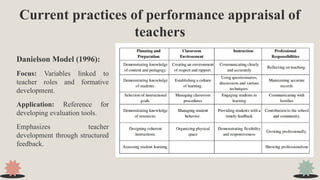
Danielson Model (1996):
Focus: Variables linked to
teacher roles and formative
development.
Application: Reference for
developing evaluation tools.
Emphasizes teacher
development through structured
feedback.
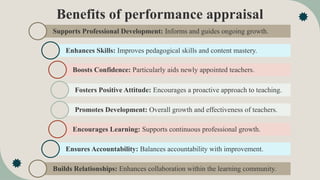
Supports Professional Development: Informs and guides ongoing growth.
Enhances Skills: Improves pedagogical skills and content mastery.
Boosts Confidence: Particularly aids newly appointed teachers.
Fosters Positive Attitude: Encourages a proactive approach to teaching.
Encourages Learning: Supports continuous professional growth.
Ensures Accountability: Balances accountability with improvement.
Builds Relationships: Enhances collaboration within the learning community.
Promotes Development: Overall growth and effectiveness of teachers.
Benefits of performance appraisal
Challenges of performance appraisal
 Complex Roles: Diverse duties complicate
accurate performance evaluations.
 Unclear Growth Paths: Limited career
advancement opportunities for talented
individuals.
 Legal and Ethical Issues: Need to comply
with standards to avoid legal and ethical
problems.
 Remote Work Challenges: Difficulties in
monitoring and assessing performance in
virtual environments.
 Impact on Morale: Challenges can affect
institutional efficiency and morale.
 Undefined Criteria: Difficulty in establishing
accurate evaluation standards.
 Rating Errors: Human biases like halo effects
and leniency can distort results.
 Lack of Competence: Evaluators may lack
skills or knowledge for fair assessments.
 Subjectivity and Bias: Personal preferences can
lead to unfair evaluations.
 Limited Resources: Insufficient funds for
training and development.
 Resistance to Change: Hesitation towards new
systems due to fear of negative outcomes.
Case study-1
Title of the study:"A study on attitude of teachers towards performance appraisal in private higher secondary
schools in Kanchipuram district"
Objective: To evaluate the overall attitude of teachers towards performance appraisal in private higher
secondary schools in Kanchipuram district
Locale of the study: the study is conducted in Kanchipuram district, Tamil Nadu, focusing on private higher
secondary schools. Teachers from these schools are selected using a random sampling method to ensure a
representative sample of the population being studied
Results:
• The study reveals that more than two-fifths of teachers in private higher secondary schools exhibit a
moderate level of attitude towards performance appraisal.
• A significant positive correlation (0.43) is found between teachers' attitudes towards performance
appraisal and their job performance, indicating that a better attitude is associated with improved job
performance.
• Overall, the findings suggest that teachers generally have a positive attitude towards performance appraisal,
which is crucial for enhancing their job performance and satisfaction.
(Syed, 2018)
Case study-2
Title of the study:The title of the study is "Evaluating the Effectiveness of Performance Appraisal Systems in
Higher Education: A Faculty-Centric Study" studied by Khurram and Ata.
Objective1: To assess the current practices and approaches of performance appraisal systems in
Higher Education Institutions (HEIs), aiming to understand their importance,
implementation, and effectiveness.
2.To analyze and identify the key factors that contribute to an effective performance appraisal system and its
impact on faculty members' motivation, job satisfaction, and overall performance within HEIs.
Locale of the study: The study took place at higher education institutions (HEIs), with interviews conducted at
convenient locations for faculty members, like their homes or the institutions.
Case study-2
Results:
The analysis of key factors contributing to an effective performance appraisal system and its impact on faculty
members' motivation, job satisfaction, and overall performance yielded several important results
•Motivation and Job Satisfaction: A well-structured performance appraisal system
enhances faculty motivation and job satisfaction, with clear expectations and regular
feedback being key.
•Impact on Performance: Effective appraisal systems improve faculty performance
metrics like research output and student evaluations.
•Feedback Mechanisms: Continuous, timely, and constructive feedback boosts teaching
effectiveness and professional development.
•Training and Development: Formal training on performance appraisal processes is
necessary to improve faculty understanding and effectiveness in meeting standards.
Case study-2
Results:
The assessment of current practices and approaches of performance appraisal systems in Higher Education
Institutions (HEIs) revealed several key findings regarding their importance, implementation, and
effectiveness:
•Importance of Performance Appraisal: These systems are crucial for assessing and improving
faculty performance, ensuring high academic standards and quality in education and research.
•Implementation Challenges: Challenges include perceptions of appraisals as mere formalities,
leading to low engagement from faculty members.
•Effectiveness of Current Systems: Effectiveness varies; some institutions enhance faculty
motivation, while others struggle with ineffective practices.
Recommendations
Implement Fair Appraisal Systems: HEIs should ensure that performance appraisal systems are perceived as
fair and transparent, incorporating faculty input in the development of evaluation criteria to foster trust and
engagement.
Provide Regular Training: Institutions should offer training programs for faculty on performance appraisal
processes to enhance their skills and understanding, thereby increasing job satisfaction and performance.
Encourage Continuous Feedback: Establishing a culture of continuous feedback is essential. Faculty should
receive regular updates on their performance to identify areas for improvement and foster professional growth.
Set Clear Goals: Institutions should collaborate with faculty to set clear, measurable goals that align with
institutional objectives. This ensures that faculty members understand expectations and can effectively track their
progress.
These results and recommendations underscore the importance of a well-structured performance appraisal system
in enhancing faculty motivation, job satisfaction, and overall performance within HEIs.
Sample performance appraisal forms
• Annual Performance Assessment Report (APAR) For Scientific Personnel of ICAR –
https://icar.org.in/sites/default/files/inline-files/APAR_Revised-21-04-2011.pdf
• Annual Self-Assessment for the Performance Based Appraisal System (PBAS) by UGC –
https://www.ugc.gov.in/oldpdf/regulations/webnotification_pbas.pdf
Conclusion
 Teacher performance appraisals, evolving from early
personality-based systems to comprehensive, evidence-
based evaluations, play a crucial role in enhancing
teaching quality.
 In India, while efforts like the UGC's PBAS and NEP
2020 emphasize systematic evaluations, challenges such
as subjectivity, bias, and resource limitations persist.
 Despite these hurdles, appraisals remain essential for
professional development, accountability, and
institutional alignment.
 Effective implementation can boost teacher confidence,
foster continuous improvement, and ultimately
contribute to a higher quality of education.
References
Divakara naik k s. (2018). Teacher performance appraisal (TPA): encourage professional
learning and growth. International Journal Of Advance Research And Innovative Ideas
In Education, 4(1), 330-333.
Kapur, R. (2018). Factors influencing performance and job satisfaction of teachers in
secondary schools in India. Research Gate, 1-25.
Nolin, M. J. (1994). Public Elementary Teachers' Views on Teacher Performance
Evaluations. Statistical Analysis Report. US Government Printing Office,
Superintendent of Documents, Mail Stop: SSOP, Washington, DC 20402-9328..
Pandey, A. (2021). Teacher performance appraisal at school: A critical analysis. Horizons of
Holistic Education, 8(1), 32-39.
Pooja, M., & Kumari, M. S. A Study on Performance Management and Appraisal in Higher
Education Sector (Delhi NCR).
Singh, S., Vaish, A., & Sengupta, S. (2018). Performance Appraisal in Higher Academic
Institutions of India. Indian Journal of Human Relations, 52(2), 75-82.
CREDITS: This presentation template was created by Slidesgo, and
includes icons by Flaticon, and infographics & images by Freepik
Thank
You!

Evaluating Teaching Effectiveness and Performance

  • 1.
  • 2.
    Table of contents Background andNeed Characteristics Case Studies and Conclusion Types and methods 01 05 04 02 Sample forms Meaning and Definitions 06 03 Current practices Effects/Uses Purpose and objectives Benefits and Challenges 10 09 07 08
  • 3.
    — Kenneth H.Blanchard “Feedback is important to people. We all want to know how well we’re doing. That’s why it is essential for an effective performance review system to provide ongoing feedback.”
  • 4.
    Background History of performanceappraisals • Invented by WD Scott during the World War I • 1950s – Adoption of personality-based systems • 1960s – Shift to self-appraisal and future potential • 1970s – Introduction of psychometrics and rating scales system • Next two decades (till 2000s) – Holistic approaches were adopted • Recent trends – 360-degree feedback systems Performance Appraisals of teachers in India • Lack of systematic evaluation in many education institutions – still rely on interviews, sporadic inspections, and inputs from department heads and students • UGC’s initiative in 2010 – Performance Based Appraisal System (PBAS) to quantify the performance of the teachers in teaching and research. • National Policy of Education (1986) – Emphasis on data-driven evaluation
  • 5.
    Need for PerformanceAppraisal o OECD, 2009 – effective monitoring is crucial for continual improvement of teaching efficacy o OECD, 2009b – TALIS survey revealed that Most teachers find appraisals and feedback beneficial, fair, and supportive of their development. o Justice Verma Commission (2012) – Help both teachers and evaluators to collect more accurate data for judging effectiveness and support quality teaching
  • 6.
    Meaning  Performance –Measured in terms of results. “... the record of outcomes produced on specified job or activity during specified time” – Thomas, (1987)  Appraisal – Judgment of characteristics, traits, and performance in a formal work setup.  Performance Appraisal – Judgment made after obtaining results on certain activities. It is a systematic and objective evaluation –  Systematic – Consistent evaluation of all employees  Objective – Accurate measurement, reducing biases and prejudices
  • 7.
    Definitions “Performance appraisal isa systematic, periodic and so far as humanly possible, an impartial rating of an employee’s excellence in matters pertaining to his present job and to his potentialities for a better job” – Edwin B. Flippo “Performance appraisal is a method of acquiring and processing the information needed to improve an individual employee’s performance and accomplishments.” – Douglass
  • 8.
    National Educational Policy(NEP) 2020  Development of National Professional Standards for Teachers (NPST)  define expectations and competencies for teachers at various career stages.  Basis for appraisals, promotions, and career management  Promotions and salary will be performance-based.  NPST will be updated every ten years, starting in 2030.  Emphasis on merit-based recognition and rewards for teachers  Basis for Performance assessments – Peer reviews, attendance, commitment, CPD hours, and contributions (to school or community)
  • 9.
    Purpose of performanceappraisal o Quality Improvement: Continuously assess and enhance teaching quality. o Skill Assessment: Evaluate teacher skills and capabilities. o Manpower Forecasting: Predict future staffing needs. o Salary Planning: Inform salary and compensation decisions. o Training Needs: Identify specific training requirements. o Resource Allocation: Guide in providing necessary resources. o Equity & Fairness: Ensure fair treatment among teachers. o Communication: Minimize gaps between administrators and teachers. o Accountability: Link performance to rewards and promotions. o Institutional Alignment: Align teacher goals with institutional objectives. o Grievance Handling: Detect and address teacher grievances. o Teacher Development: Support holistic growth of teachers. o External Accountability: Ensure accountability to external stakeholders. o Feedback Mechanism: Provide continuous feedback for improvement.
  • 10.
    Objectives of performanceappraisal It has multiple objectives. But can be categorized into following three: Benchmarking decisions – Plan promotions, salary revisions, training, and terminations. Feedback provision – Provide feedback on performance and suggest improvements. Foundation for development – Support coaching, counseling, and self-monitoring.
  • 11.
    Objectives of performanceappraisal Formative Objectives • Improve teaching skills. • Recognize teaching excellence. • Focus on student outcomes. • Plan in-service education activities. Summative Objectives:  Make tenure and promotion decisions.  Dismiss incompetent teachers.  Define peer standards.  Determine pay levels. As per the study of Nolin (1994) Administrative Control:  Give administrators greater control over teacher performance.
  • 12.
    Characteristics of performanceappraisal  Evidence-Based: Relies on concrete data for fairness.  Highly Individualized: Tailored to each teacher's unique needs.  Joint Activity: Collaborative process between teacher and evaluator.  Promotes Understanding: Aims for deep insights into practices and challenges.  Creates Commitment: Encourages commitment to professional growth.  Maximizes Self-Reflection: Encourages self- analysis and ownership of development.  Performance Feedback: Provides constructive and actionable feedback.  Behaviour-Based Measures: Focuses on observable behaviours, not opinions.  Sets Performance Goals: Establishes specific, measurable goals.  Recognizes Achievement: Acknowledges and rewards outstanding performance.  Identifies Improvement Areas: Guides targeted professional development.  Documentation: Keeps comprehensive records for consistency.
  • 13.
    Types of performanceappraisal Formative Summative Developmental Provides feedback and suggestions for improvement; Supports individual and organizational development. Grades teachers based on performance levels; Motivates high achievers and encourages others to improve. Identifies development opportunities and needs; Focuses on future growth and expertise enhancement. (Sharma, 2005)
  • 14.
    Process of performanceappraisal  It should be conducted at least once a year.  It should have meaningful outcomes for both the teachers and the institution.  The process must be a formal system evaluating performance across various domains.  Implement a system for faculty to record daily activities to ensure accurate evaluations and eliminate recall issues. Formulating criteria and standards Communicating the standards and getting feedback Self-evaluation Compare standards with data entered (by HOD) Feedback by HOD Discussions with teachers on future plans Performance plan: Remedial measures and supportive plan Based on actual results (Shrivastava et al.,
  • 15.
    Methods of performanceappraisal Self-Appraisal: Teachers assess their own performance for self- improvement. Lesson Observation: Evaluation of teaching effectiveness through classroom observation. Grading Systems: Review of fairness and justification in student grading. Portfolios: Collection of work and achievements showcasing professional growth. Student Academic Performance: Measures effectiveness based on student outcomes. Discipline: Evaluation of classroom management and student behavior. Non-Teaching Duties: Assessment of involvement in school activities and responsibilities. Extra-Curricular Activities: Review of contributions to student activities outside the classroom. Methods (Kapur, 2018)
  • 16.
    Effects/ uses ofperformance appraisal Effects Promotional Opportunities: Pathways for career advancement and increased job satisfaction. Strengths and Weaknesses Identification: Highlights areas for personal growth and improved teaching practices. Contribution to Education System: Ensures teachers are skilled and adaptable, enhancing overall education quality. Professionalism and Efficacy: Promotes a positive learning environment and supports student development. Impact on Student Discipline: Evaluates teachers on maintaining a disciplined classroom environment. (Kapur, 2018)
  • 17.
    Effects/ uses ofperformance appraisal Influences employee motivation and job satisfaction. Identifies skill gaps and informs training programs. Supports performance-based pay increases. Guides decisions on promotions, layoffs, and transfers. Personnel Measures Justification Wage and Salary Administration Impact on Motivation and Satisfaction Training and Development Planning: Uses Identified by Pooja & Sushma Kumari (2024)
  • 18.
    Current practices ofperformance appraisal of teachers APAR (Annual Performance Assessment Report): Used by government institutions like Kendriya Vidyalayas (KVs) and Navodaya Vidyalayas (NVs). It has five Parts  Personal Data: Filled by the administrative section.  Self-Assessment: Teachers describe duties, achievements, and shortfalls.  Numerical Grading: Provided by the supervisor.  General Remarks: Reporting officer comments on various qualities.  Final Remarks: Reviewing officer finalizes the report. There is no universal teacher performance appraisal framework; different types of schools use varied systems for evaluating teachers. Rating: “Satisfactory” or “Unsatisfactory”. (Pandey, 2021)
  • 19.
    Current practices ofperformance appraisal of teachers PINDICS (2013): Introduced in 2013 by the National Council of Educational Research and Training (NCERT). Mainly focuses on elementary school teachers. Performance Indicators: Rating Scale: Not Meeting, Approaching, Meeting, Exceeding Designing Learning Experiences Subject Matter Knowledge Learning Facilitation Strategies Interpersonal Relationships Professional Development School Development Attendance Promotes continuous improvement and professional growth.
  • 20.
    Current practices ofperformance appraisal of teachers Danielson Model (1996): Focus: Variables linked to teacher roles and formative development. Application: Reference for developing evaluation tools. Emphasizes teacher development through structured feedback.
  • 21.
    Supports Professional Development:Informs and guides ongoing growth. Enhances Skills: Improves pedagogical skills and content mastery. Boosts Confidence: Particularly aids newly appointed teachers. Fosters Positive Attitude: Encourages a proactive approach to teaching. Encourages Learning: Supports continuous professional growth. Ensures Accountability: Balances accountability with improvement. Builds Relationships: Enhances collaboration within the learning community. Promotes Development: Overall growth and effectiveness of teachers. Benefits of performance appraisal
  • 22.
    Challenges of performanceappraisal  Complex Roles: Diverse duties complicate accurate performance evaluations.  Unclear Growth Paths: Limited career advancement opportunities for talented individuals.  Legal and Ethical Issues: Need to comply with standards to avoid legal and ethical problems.  Remote Work Challenges: Difficulties in monitoring and assessing performance in virtual environments.  Impact on Morale: Challenges can affect institutional efficiency and morale.  Undefined Criteria: Difficulty in establishing accurate evaluation standards.  Rating Errors: Human biases like halo effects and leniency can distort results.  Lack of Competence: Evaluators may lack skills or knowledge for fair assessments.  Subjectivity and Bias: Personal preferences can lead to unfair evaluations.  Limited Resources: Insufficient funds for training and development.  Resistance to Change: Hesitation towards new systems due to fear of negative outcomes.
  • 23.
    Case study-1 Title ofthe study:"A study on attitude of teachers towards performance appraisal in private higher secondary schools in Kanchipuram district" Objective: To evaluate the overall attitude of teachers towards performance appraisal in private higher secondary schools in Kanchipuram district Locale of the study: the study is conducted in Kanchipuram district, Tamil Nadu, focusing on private higher secondary schools. Teachers from these schools are selected using a random sampling method to ensure a representative sample of the population being studied Results: • The study reveals that more than two-fifths of teachers in private higher secondary schools exhibit a moderate level of attitude towards performance appraisal. • A significant positive correlation (0.43) is found between teachers' attitudes towards performance appraisal and their job performance, indicating that a better attitude is associated with improved job performance. • Overall, the findings suggest that teachers generally have a positive attitude towards performance appraisal, which is crucial for enhancing their job performance and satisfaction. (Syed, 2018)
  • 24.
    Case study-2 Title ofthe study:The title of the study is "Evaluating the Effectiveness of Performance Appraisal Systems in Higher Education: A Faculty-Centric Study" studied by Khurram and Ata. Objective1: To assess the current practices and approaches of performance appraisal systems in Higher Education Institutions (HEIs), aiming to understand their importance, implementation, and effectiveness. 2.To analyze and identify the key factors that contribute to an effective performance appraisal system and its impact on faculty members' motivation, job satisfaction, and overall performance within HEIs. Locale of the study: The study took place at higher education institutions (HEIs), with interviews conducted at convenient locations for faculty members, like their homes or the institutions.
  • 25.
    Case study-2 Results: The analysisof key factors contributing to an effective performance appraisal system and its impact on faculty members' motivation, job satisfaction, and overall performance yielded several important results •Motivation and Job Satisfaction: A well-structured performance appraisal system enhances faculty motivation and job satisfaction, with clear expectations and regular feedback being key. •Impact on Performance: Effective appraisal systems improve faculty performance metrics like research output and student evaluations. •Feedback Mechanisms: Continuous, timely, and constructive feedback boosts teaching effectiveness and professional development. •Training and Development: Formal training on performance appraisal processes is necessary to improve faculty understanding and effectiveness in meeting standards.
  • 26.
    Case study-2 Results: The assessmentof current practices and approaches of performance appraisal systems in Higher Education Institutions (HEIs) revealed several key findings regarding their importance, implementation, and effectiveness: •Importance of Performance Appraisal: These systems are crucial for assessing and improving faculty performance, ensuring high academic standards and quality in education and research. •Implementation Challenges: Challenges include perceptions of appraisals as mere formalities, leading to low engagement from faculty members. •Effectiveness of Current Systems: Effectiveness varies; some institutions enhance faculty motivation, while others struggle with ineffective practices.
  • 27.
    Recommendations Implement Fair AppraisalSystems: HEIs should ensure that performance appraisal systems are perceived as fair and transparent, incorporating faculty input in the development of evaluation criteria to foster trust and engagement. Provide Regular Training: Institutions should offer training programs for faculty on performance appraisal processes to enhance their skills and understanding, thereby increasing job satisfaction and performance. Encourage Continuous Feedback: Establishing a culture of continuous feedback is essential. Faculty should receive regular updates on their performance to identify areas for improvement and foster professional growth. Set Clear Goals: Institutions should collaborate with faculty to set clear, measurable goals that align with institutional objectives. This ensures that faculty members understand expectations and can effectively track their progress. These results and recommendations underscore the importance of a well-structured performance appraisal system in enhancing faculty motivation, job satisfaction, and overall performance within HEIs.
  • 28.
    Sample performance appraisalforms • Annual Performance Assessment Report (APAR) For Scientific Personnel of ICAR – https://icar.org.in/sites/default/files/inline-files/APAR_Revised-21-04-2011.pdf • Annual Self-Assessment for the Performance Based Appraisal System (PBAS) by UGC – https://www.ugc.gov.in/oldpdf/regulations/webnotification_pbas.pdf
  • 29.
    Conclusion  Teacher performanceappraisals, evolving from early personality-based systems to comprehensive, evidence- based evaluations, play a crucial role in enhancing teaching quality.  In India, while efforts like the UGC's PBAS and NEP 2020 emphasize systematic evaluations, challenges such as subjectivity, bias, and resource limitations persist.  Despite these hurdles, appraisals remain essential for professional development, accountability, and institutional alignment.  Effective implementation can boost teacher confidence, foster continuous improvement, and ultimately contribute to a higher quality of education.
  • 30.
    References Divakara naik ks. (2018). Teacher performance appraisal (TPA): encourage professional learning and growth. International Journal Of Advance Research And Innovative Ideas In Education, 4(1), 330-333. Kapur, R. (2018). Factors influencing performance and job satisfaction of teachers in secondary schools in India. Research Gate, 1-25. Nolin, M. J. (1994). Public Elementary Teachers' Views on Teacher Performance Evaluations. Statistical Analysis Report. US Government Printing Office, Superintendent of Documents, Mail Stop: SSOP, Washington, DC 20402-9328.. Pandey, A. (2021). Teacher performance appraisal at school: A critical analysis. Horizons of Holistic Education, 8(1), 32-39. Pooja, M., & Kumari, M. S. A Study on Performance Management and Appraisal in Higher Education Sector (Delhi NCR). Singh, S., Vaish, A., & Sengupta, S. (2018). Performance Appraisal in Higher Academic Institutions of India. Indian Journal of Human Relations, 52(2), 75-82.
  • 31.
    CREDITS: This presentationtemplate was created by Slidesgo, and includes icons by Flaticon, and infographics & images by Freepik Thank You!