gkhan.a.06@gmail.com & gkhanayrancioglu@gmail.com
Gökhan AYRANCIOGLU | a50236
Estela Vilhena
Statistical Package for the Social Sciences
SPSS
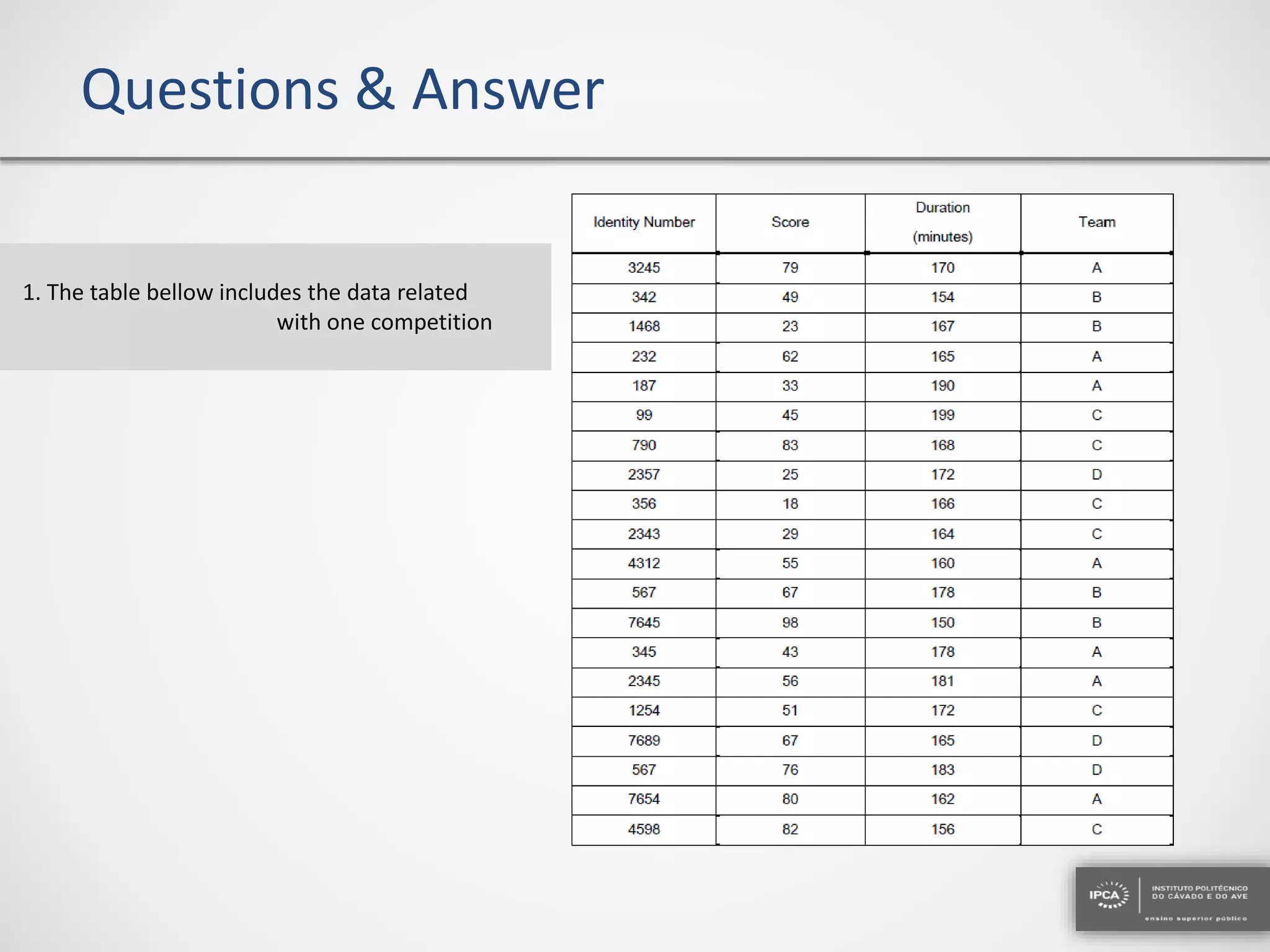
Questions & Answer
1. The table bellow includes the data related
with one competition
Applied Statistical Methods
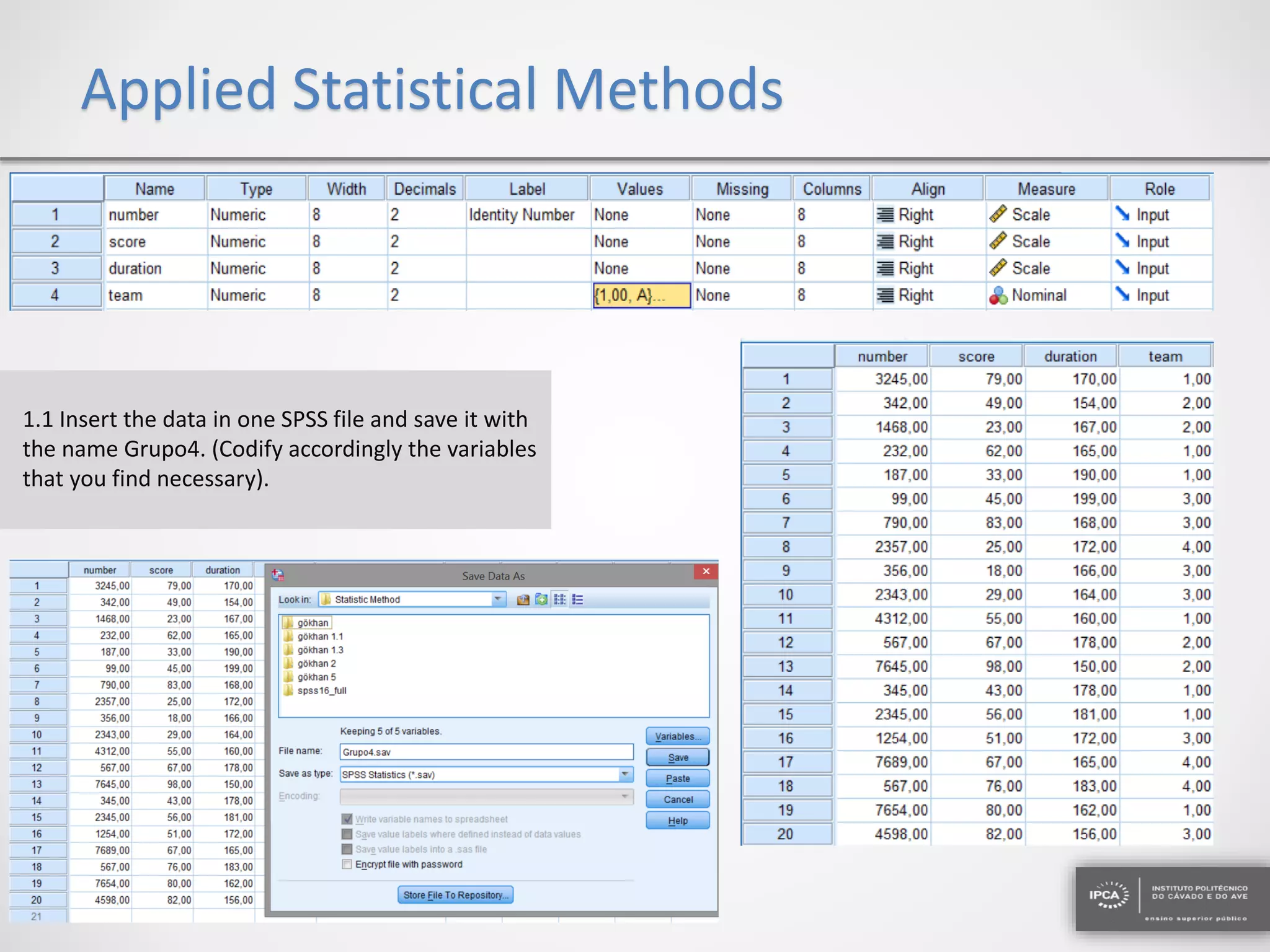
1.1 Insert the data in one SPSS file and save it with
the name Grupo4. (Codify accordingly the variables
that you find necessary).
Applied Statistical Methods
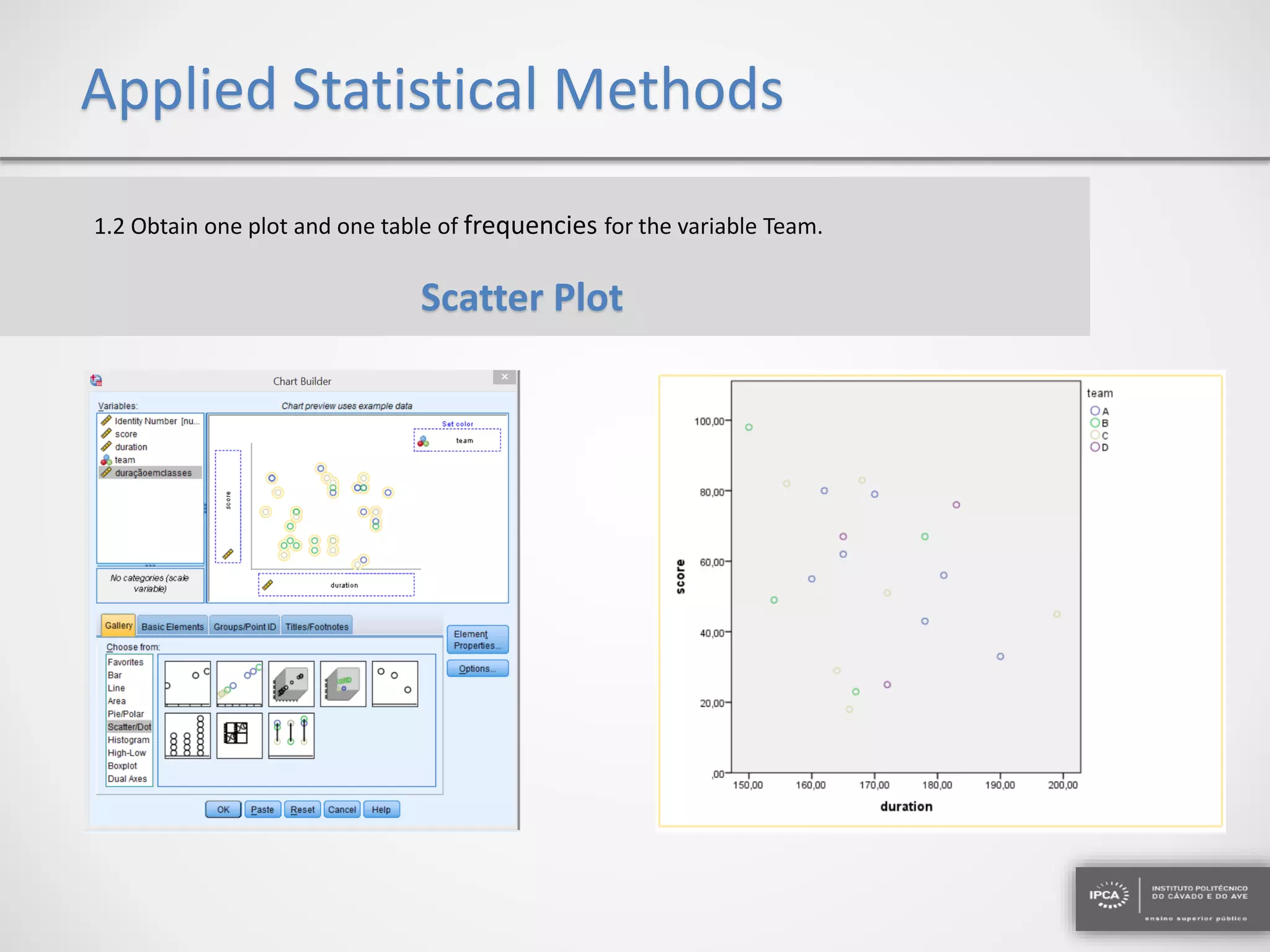
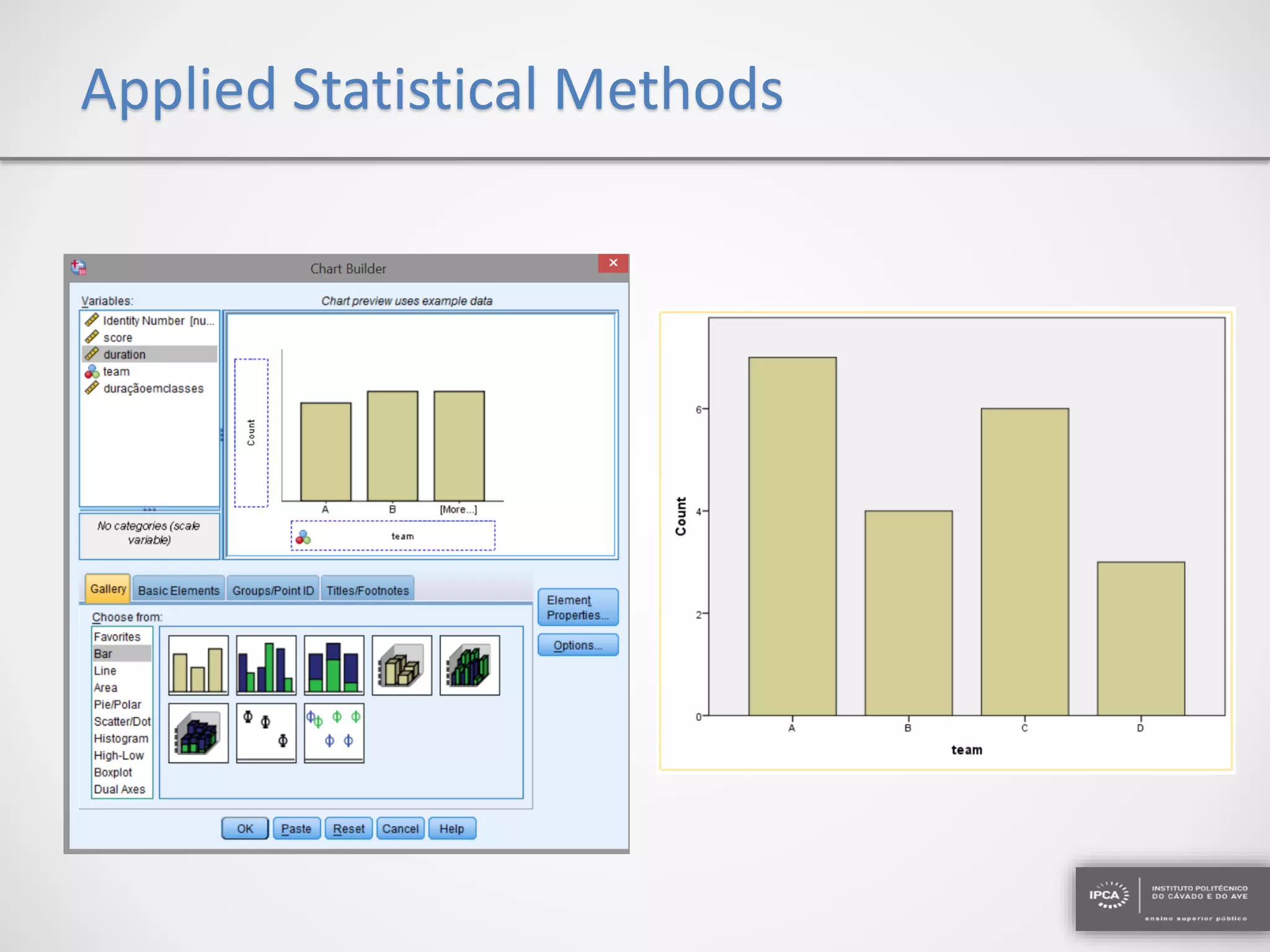
1.2 Obtain one plot and one table of frequencies for the variable Team.
Scatter Plot
Applied Statistical Methods
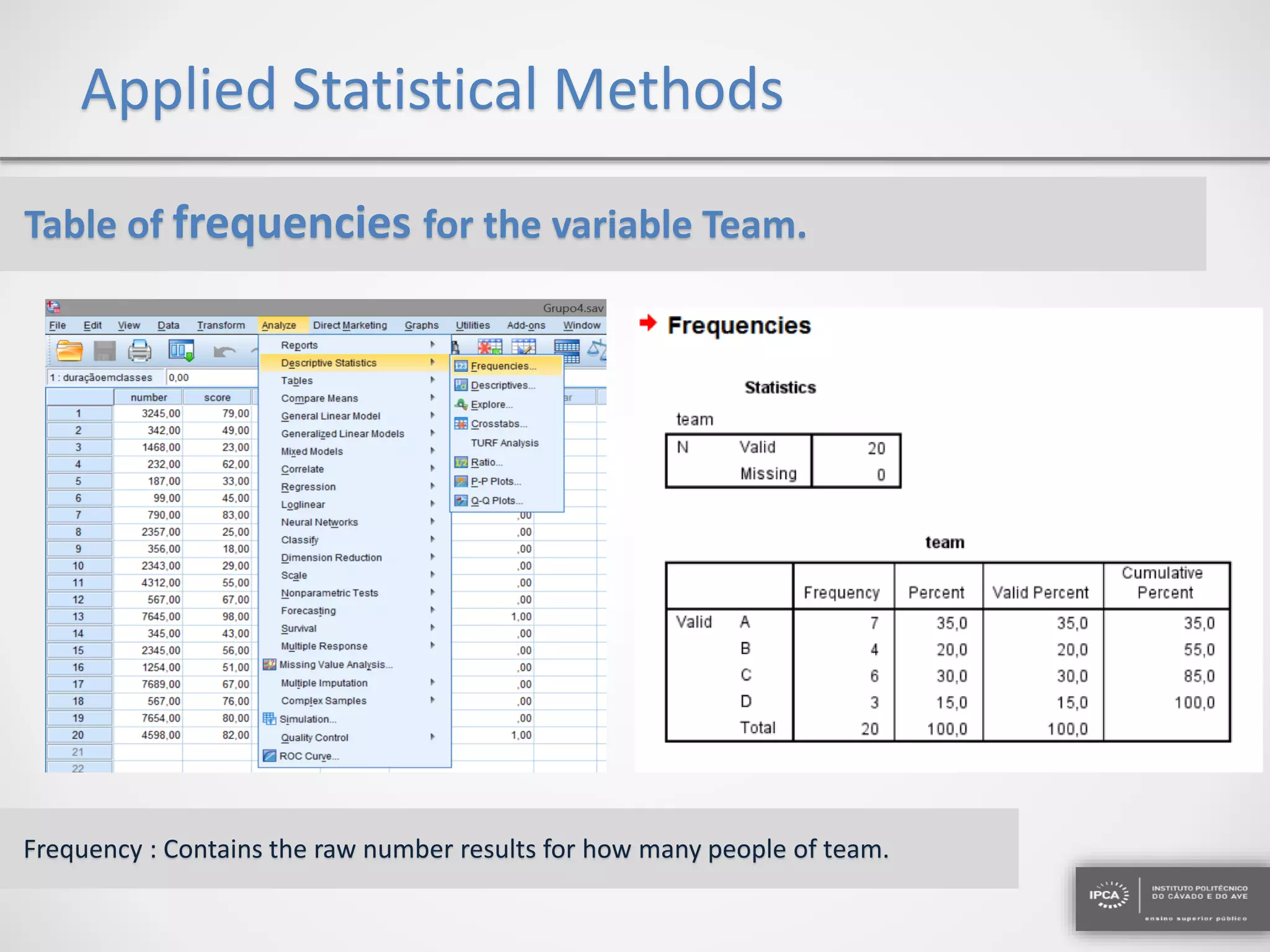
Table of frequencies for the variable Team.
Frequency : Contains the raw number results for how many people of team.
Applied Statistical Methods
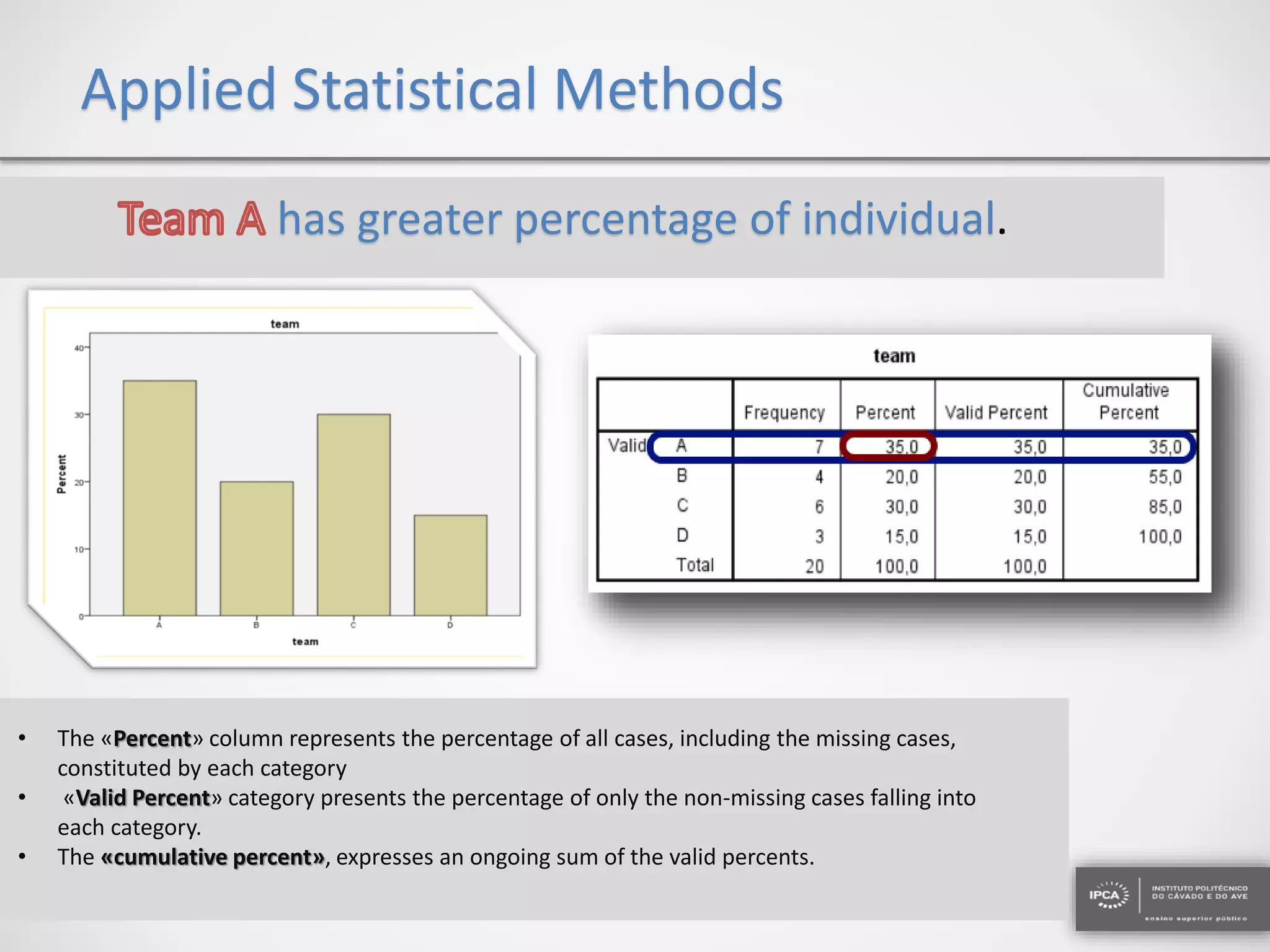
has greater percentage of individual.
• The «Percent» column represents the percentage of all cases, including the missing cases,
constituted by each category
• «Valid Percent» category presents the percentage of only the non-missing cases falling into
each category.
• The «cumulative percent», expresses an ongoing sum of the valid percents.
Applied Statistical Methods
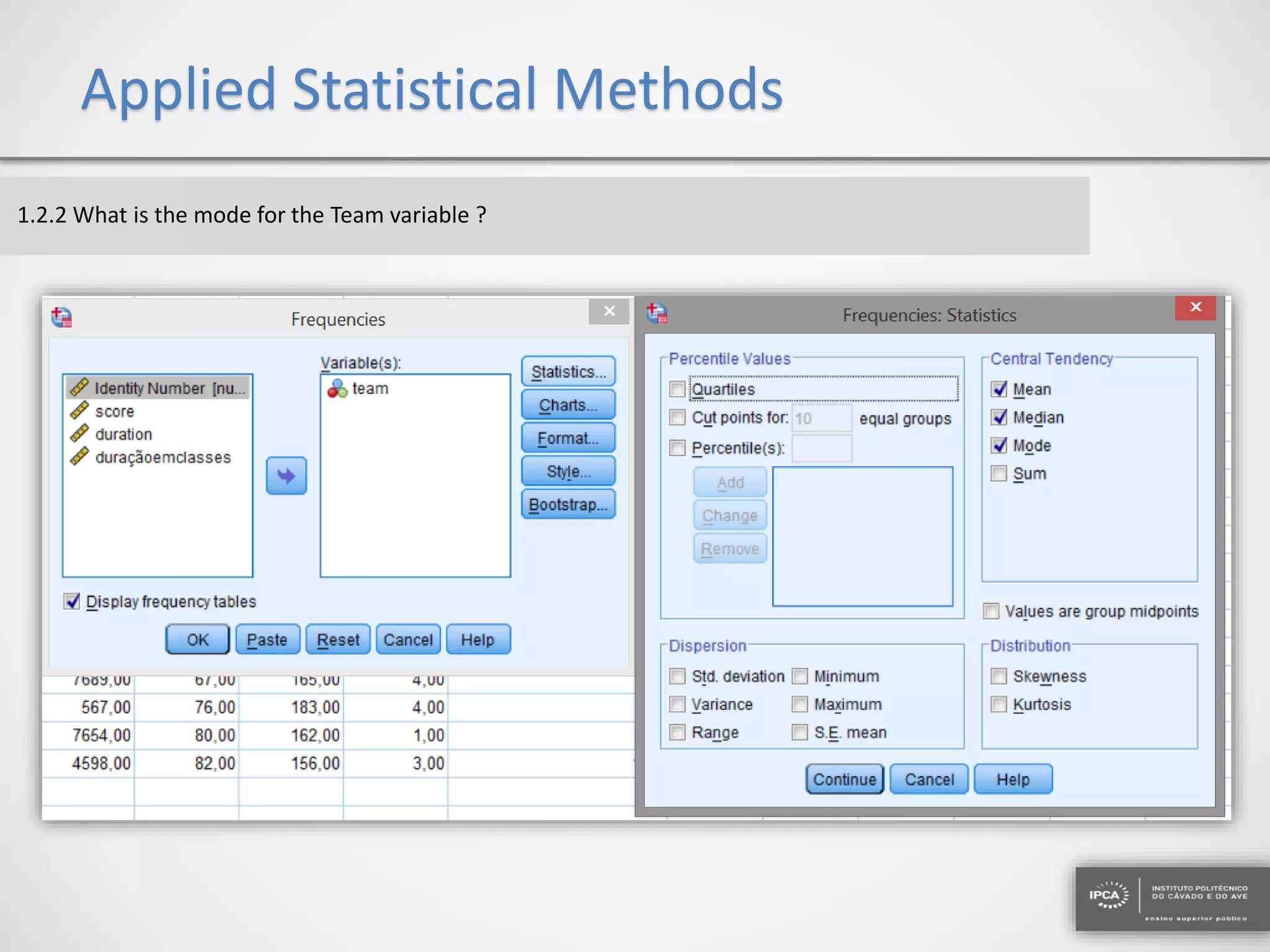
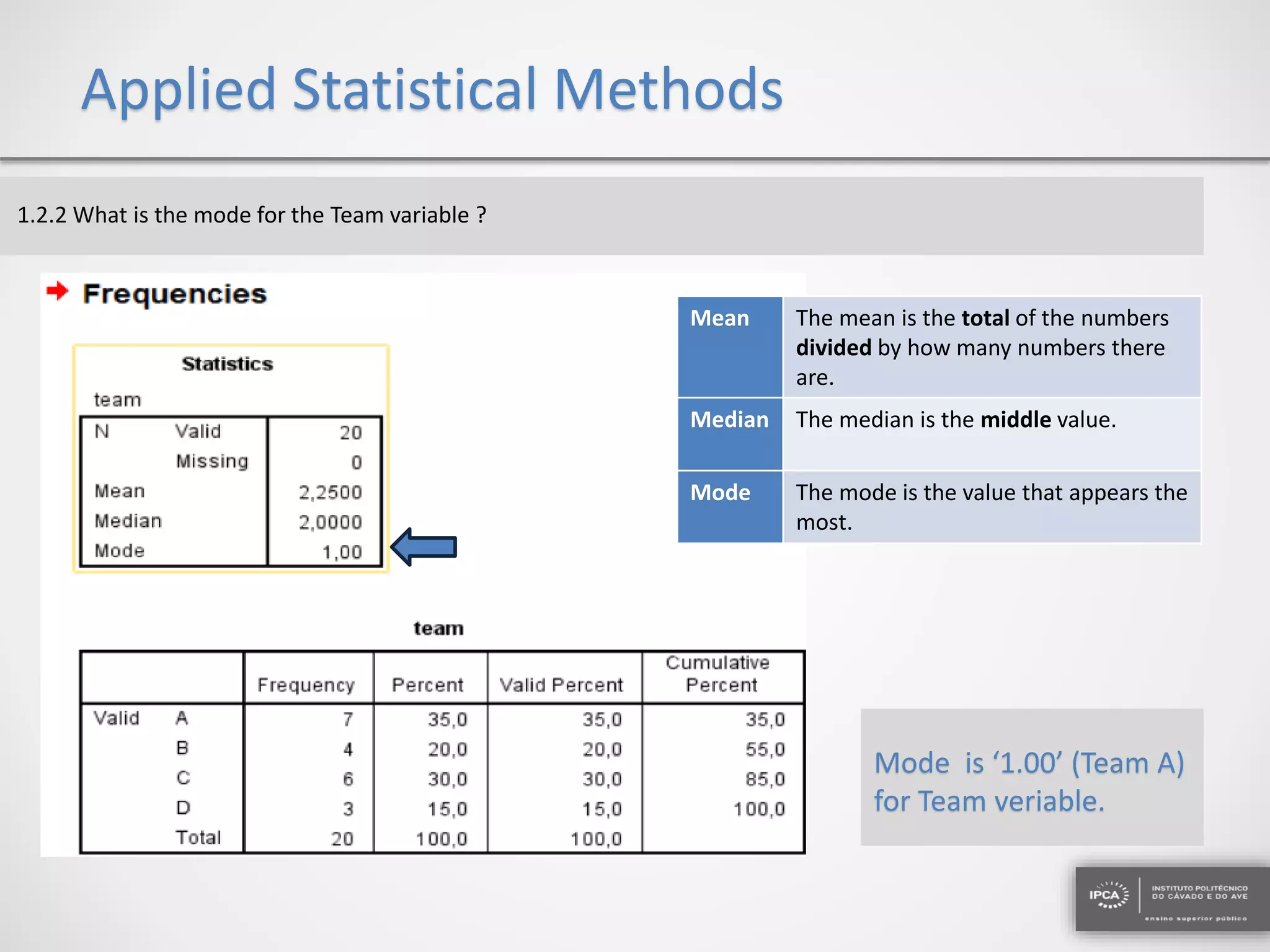
1.2.2 What is the mode for the Team variable ?
Applied Statistical Methods
1.2.2 What is the mode for the Team variable ?
Mode is ‘1.00’ (Team A)
for Team veriable.
Mean The mean is the total of the numbers
divided by how many numbers there
are.
Median The median is the middle value.
Mode The mode is the value that appears the
most.
Applied Statistical Methods
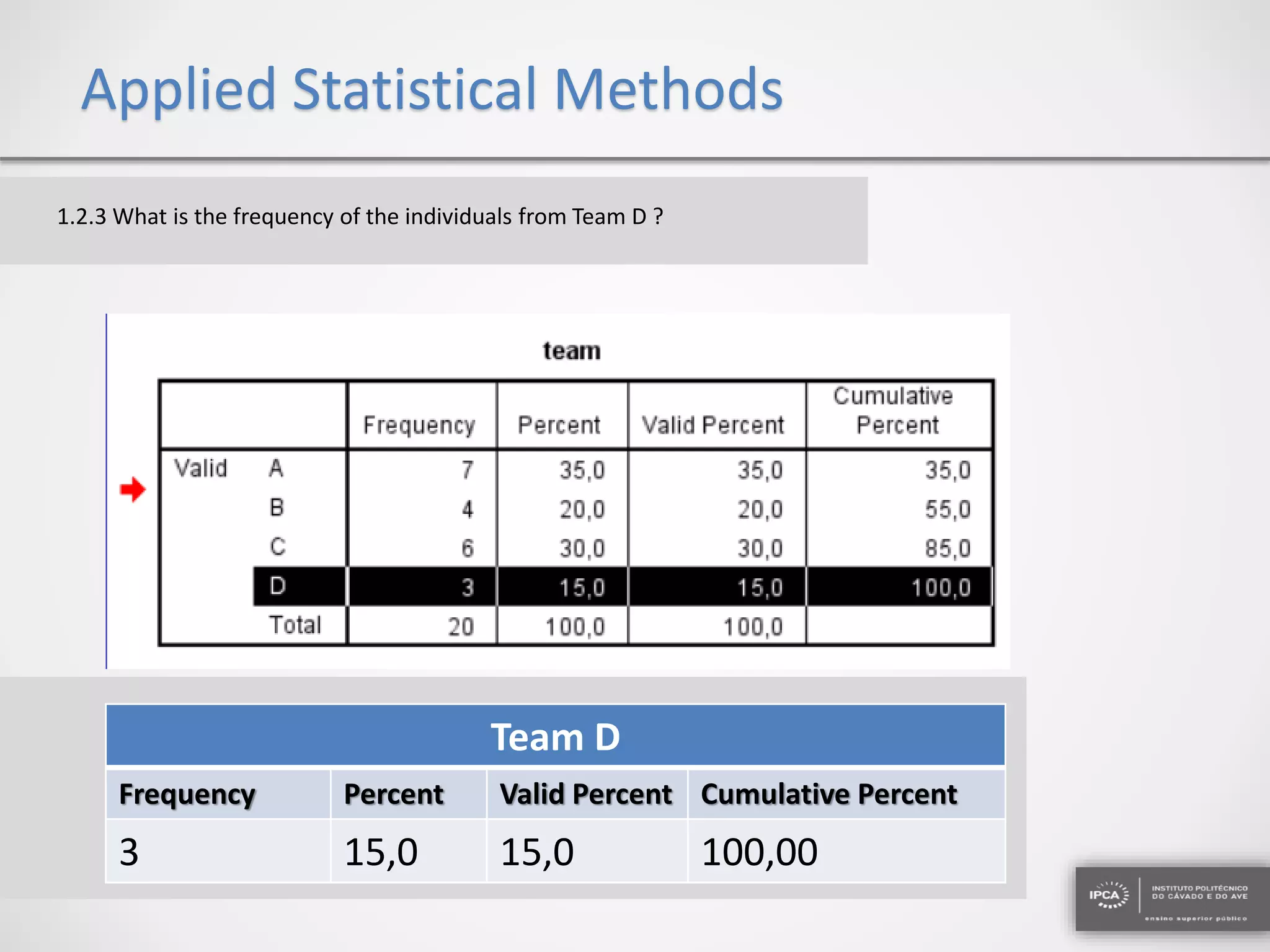
1.2.3 What is the frequency of the individuals from Team D ?
Team D
Frequency Percent Valid Percent Cumulative Percent
3 15,0 15,0 100,00
Applied Statistical Methods
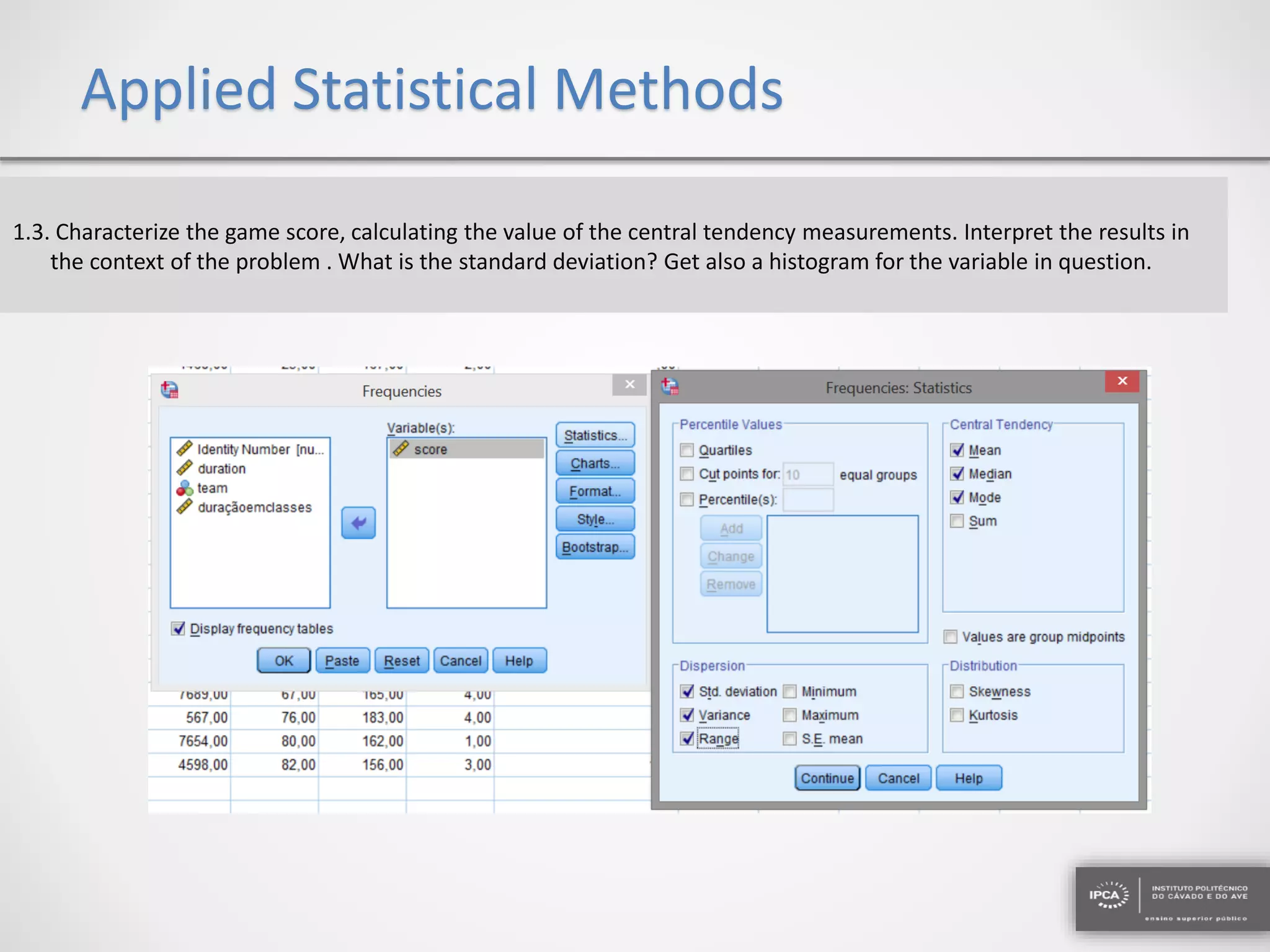
1.3. Characterize the game score, calculating the value of the central tendency measurements. Interpret the results in
the context of the problem . What is the standard deviation? Get also a histogram for the variable in question.
Applied Statistical Methods
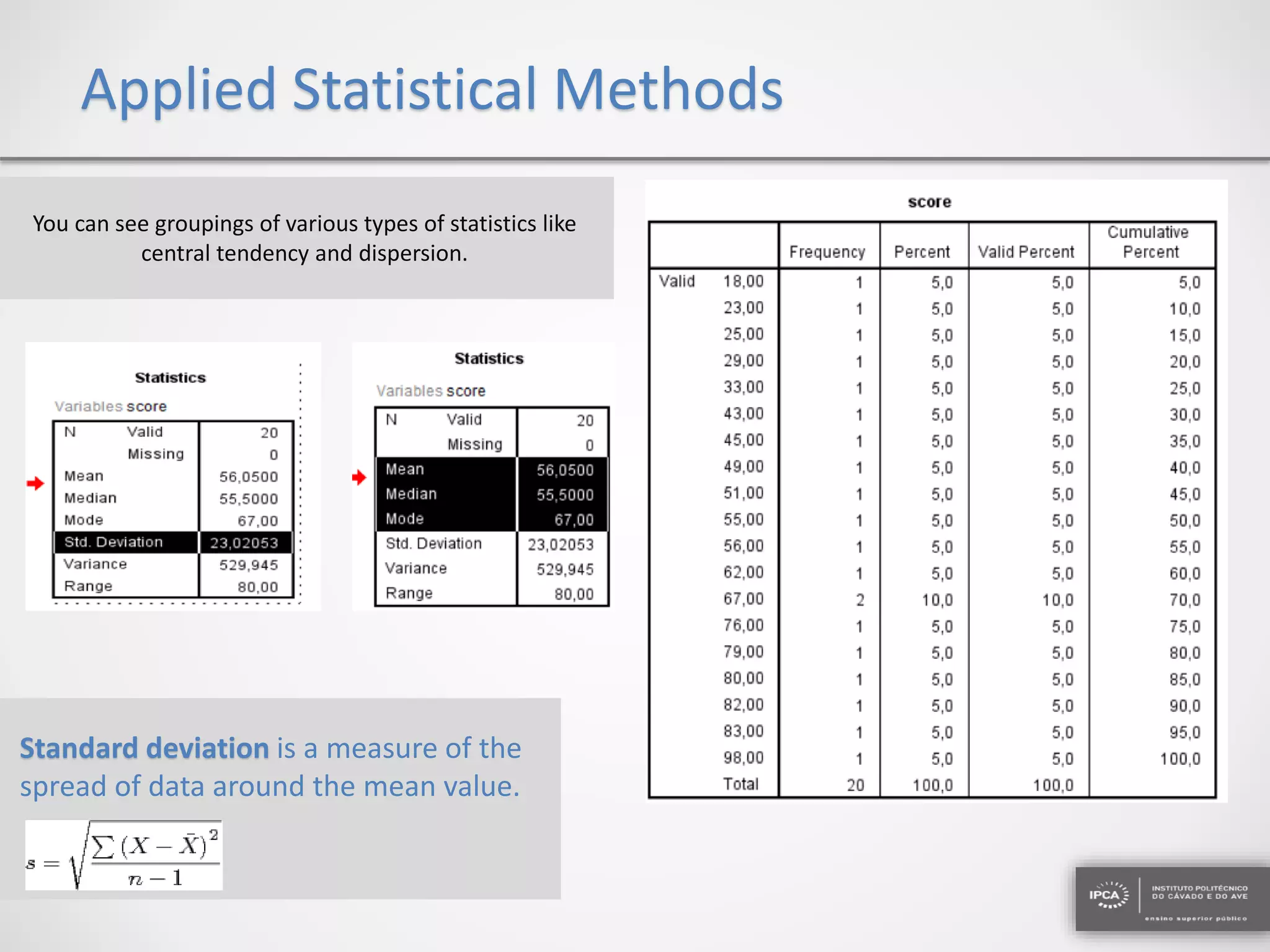
You can see groupings of various types of statistics like
central tendency and dispersion.
Standard deviation is a measure of the
spread of data around the mean value.
Applied Statistical Methods
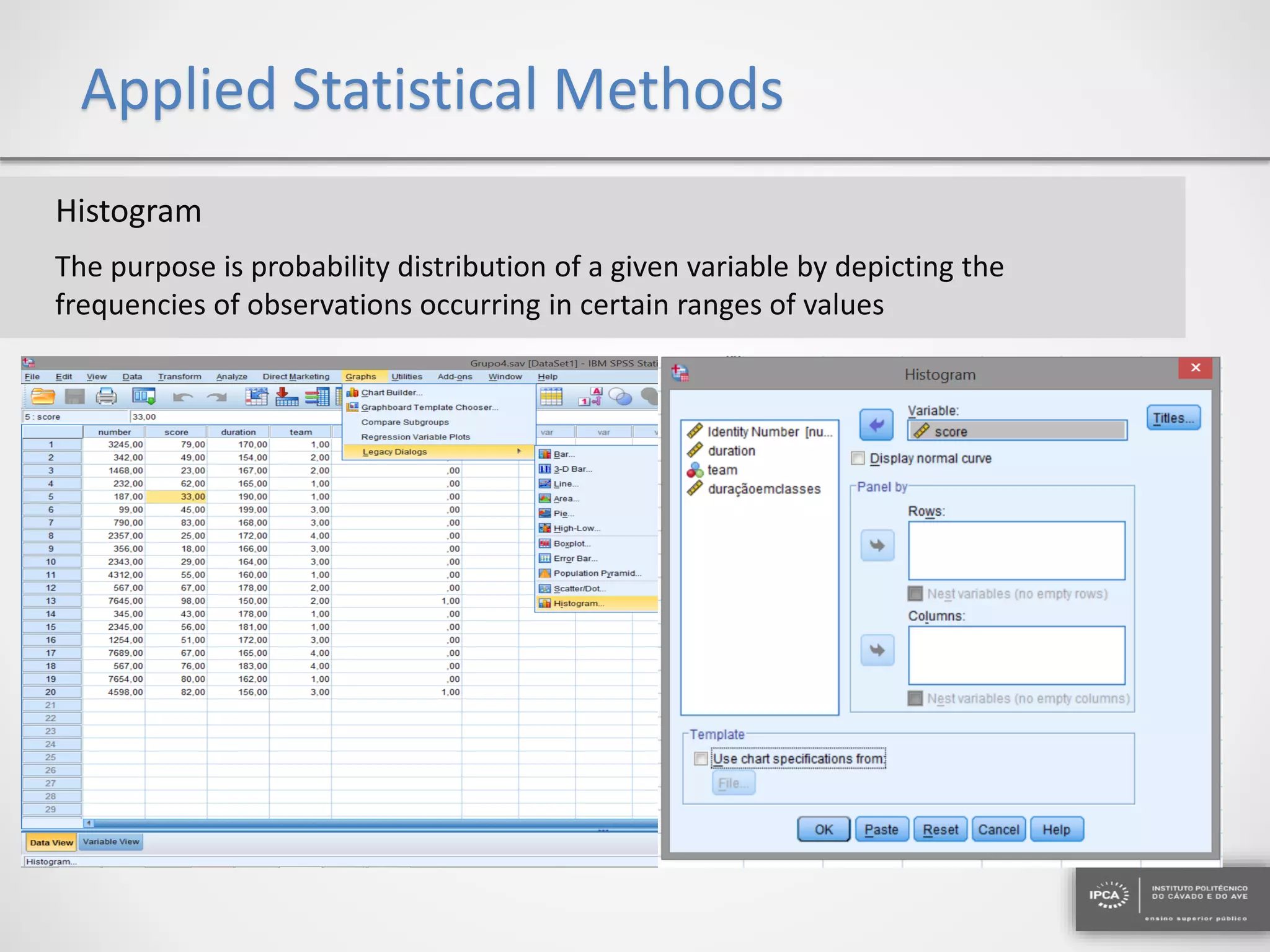
Histogram
The purpose is probability distribution of a given variable by depicting the
frequencies of observations occurring in certain ranges of values
Applied Statistical Methods
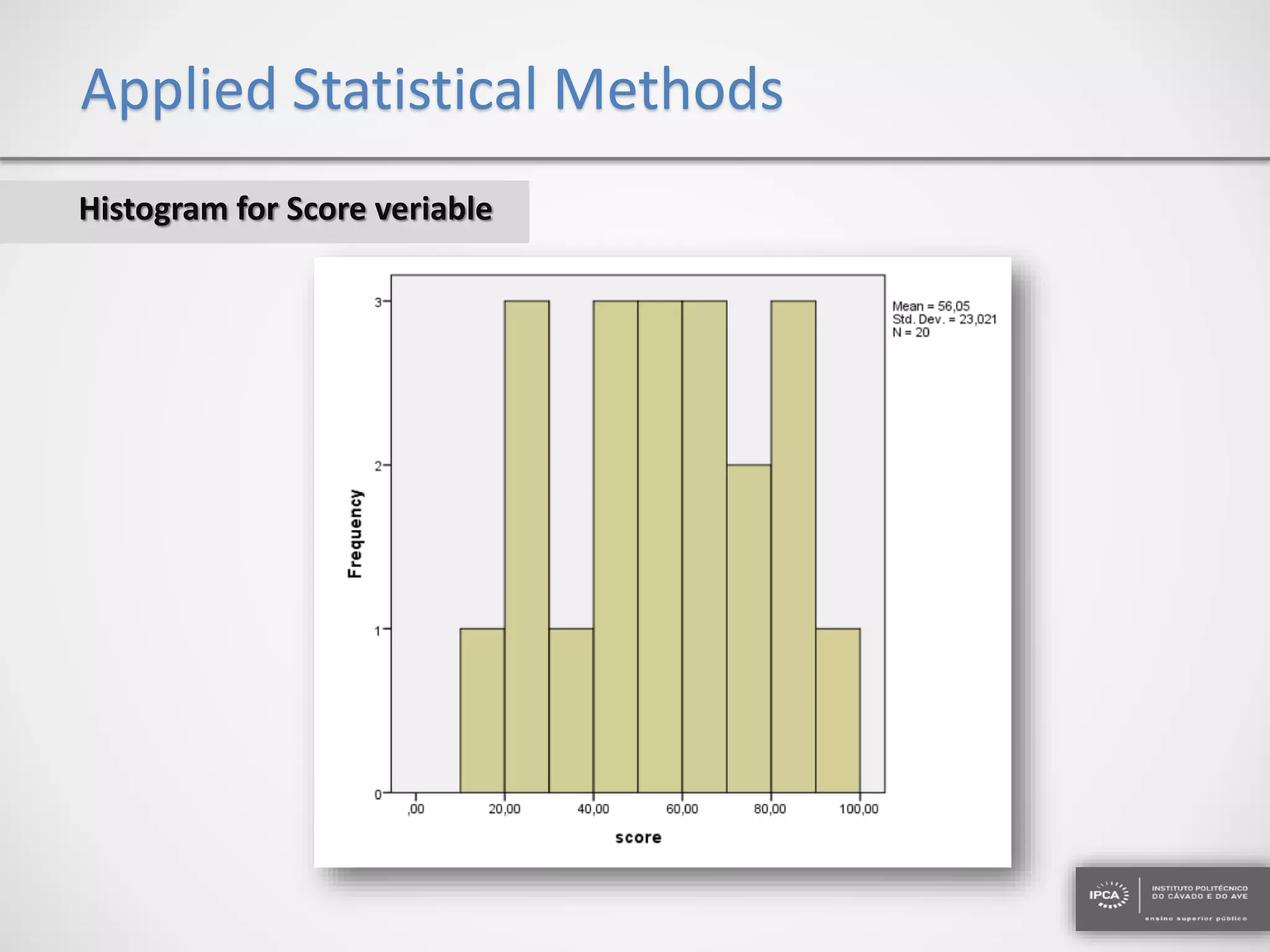
Histogram for Score veriable
Applied Statistical Methods
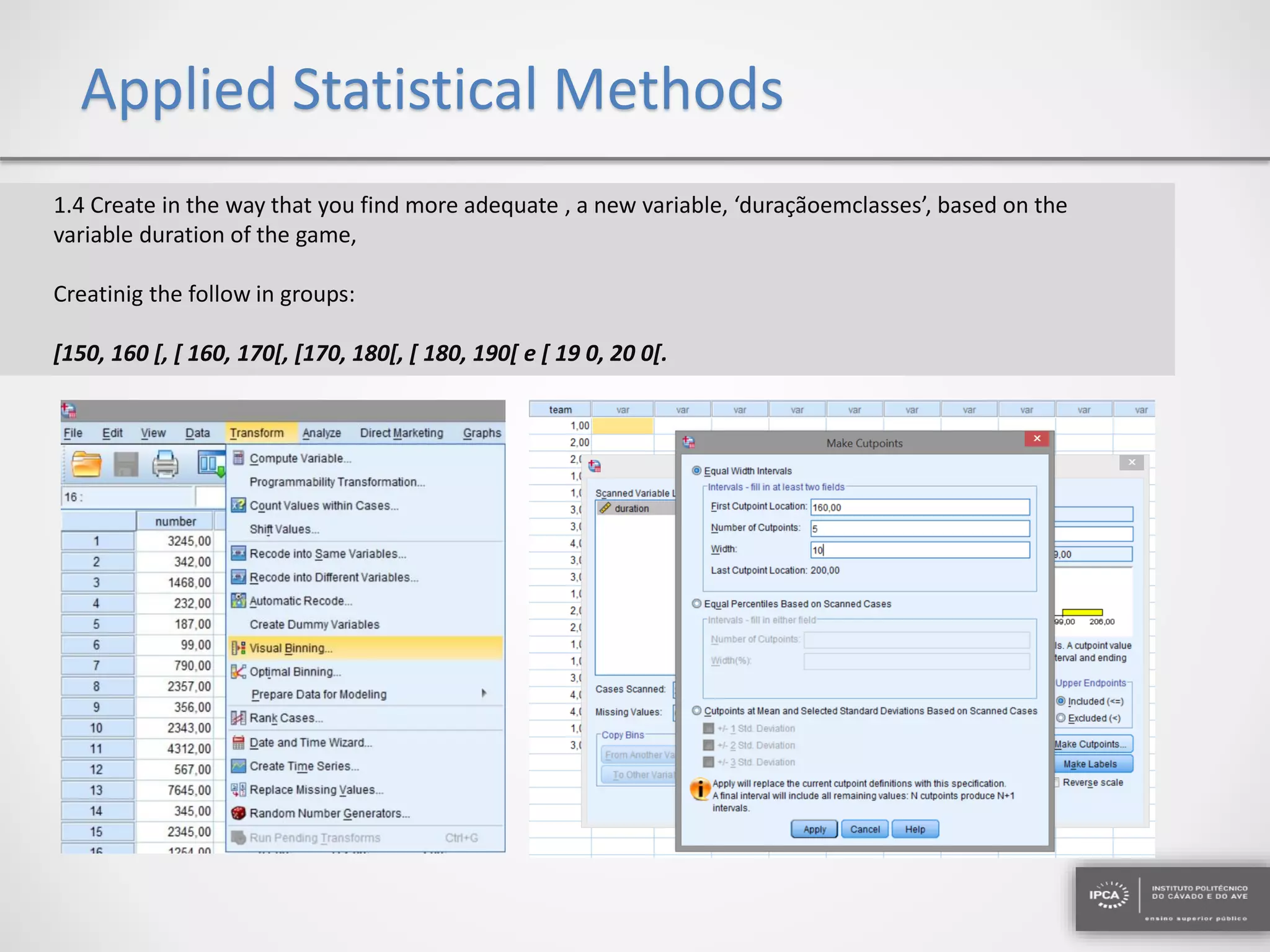
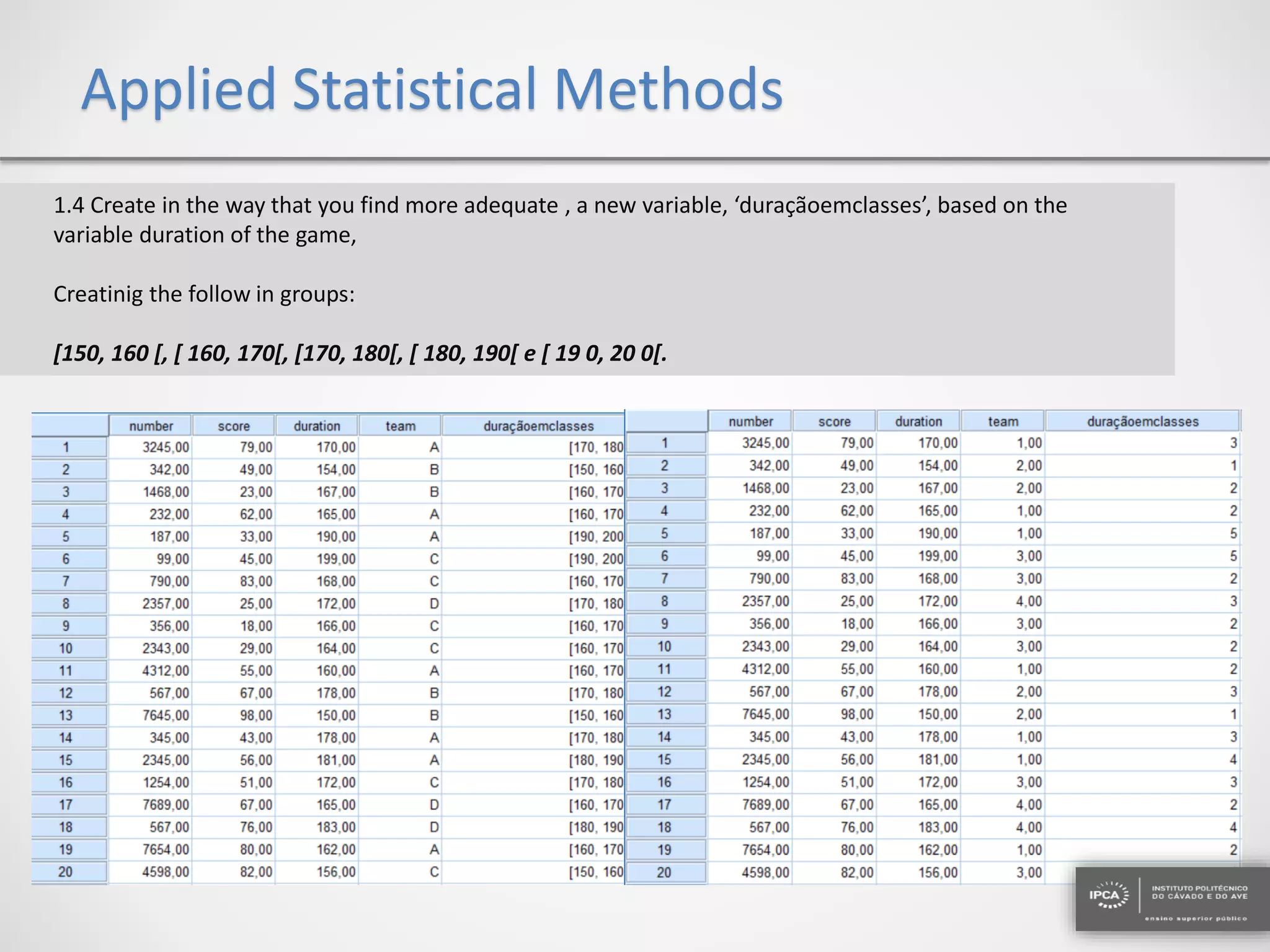
1.4 Create in the way that you find more adequate , a new variable, ‘duraçãoemclasses’, based on the
variable duration of the game,
Creatinig the follow in groups:
[150, 160 [, [ 160, 170[, [170, 180[, [ 180, 190[ e [ 19 0, 20 0[.
Applied Statistical Methods
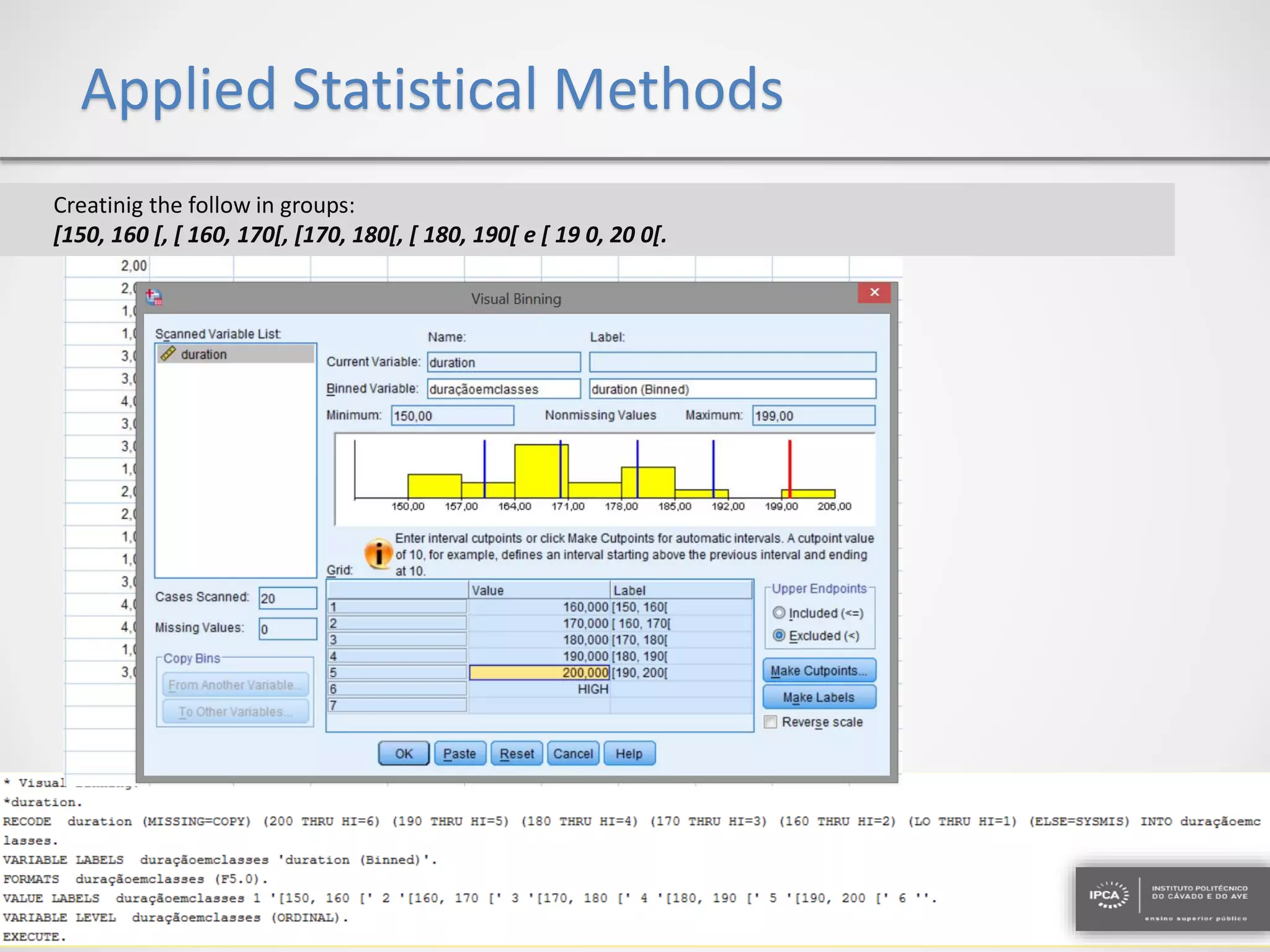
Creatinig the follow in groups:
[150, 160 [, [ 160, 170[, [170, 180[, [ 180, 190[ e [ 19 0, 20 0[.
Applied Statistical Methods
1.4 Create in the way that you find more adequate , a new variable, ‘duraçãoemclasses’, based on the
variable duration of the game,
Creatinig the follow in groups:
[150, 160 [, [ 160, 170[, [170, 180[, [ 180, 190[ e [ 19 0, 20 0[.
Applied Statistical Methods
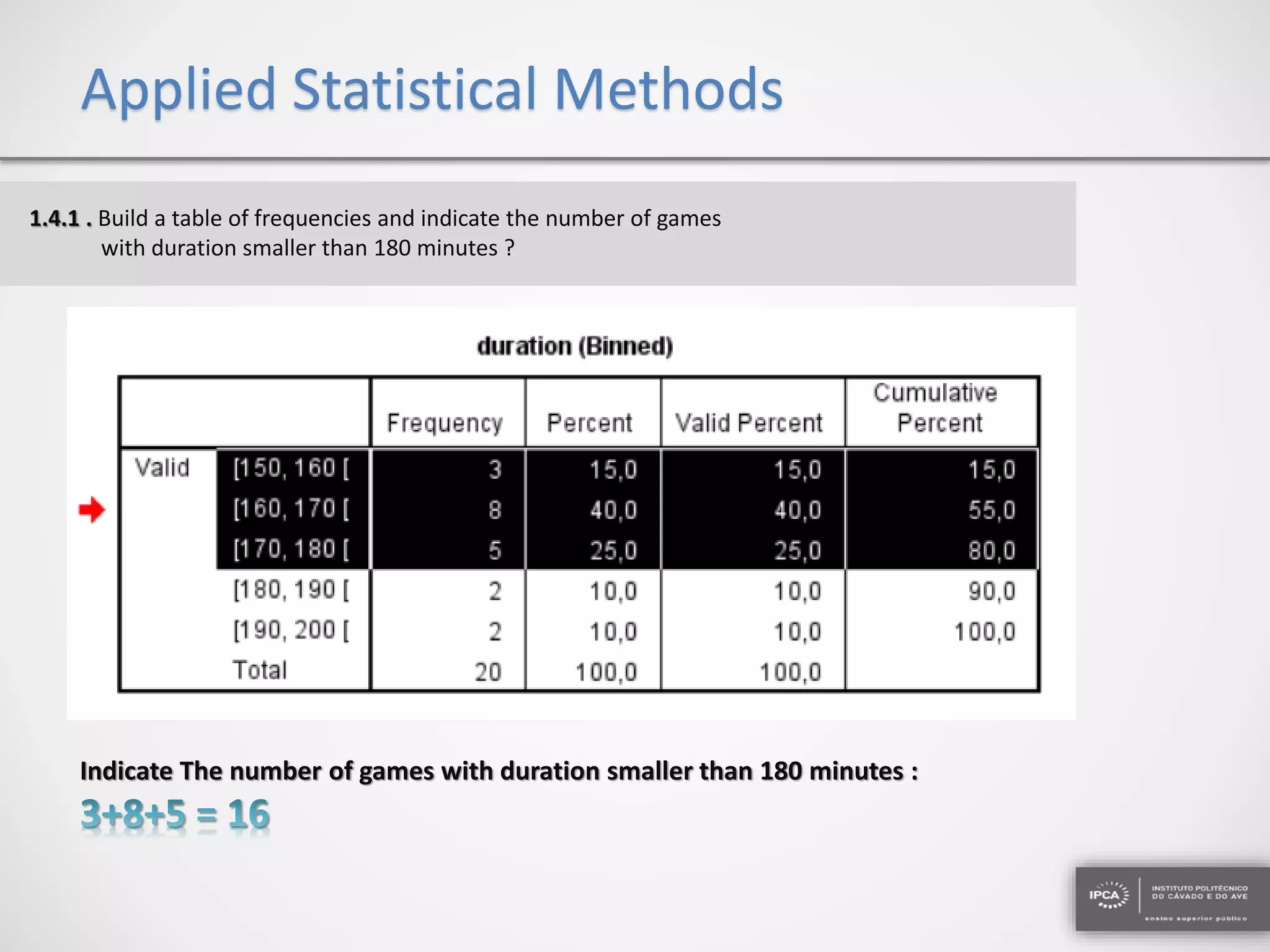
1.4.1 . Build a table of frequencies and indicate the number of games
with duration smaller than 180 minutes ?
Indicate The number of games with duration smaller than 180 minutes :
Applied Statistical Methods
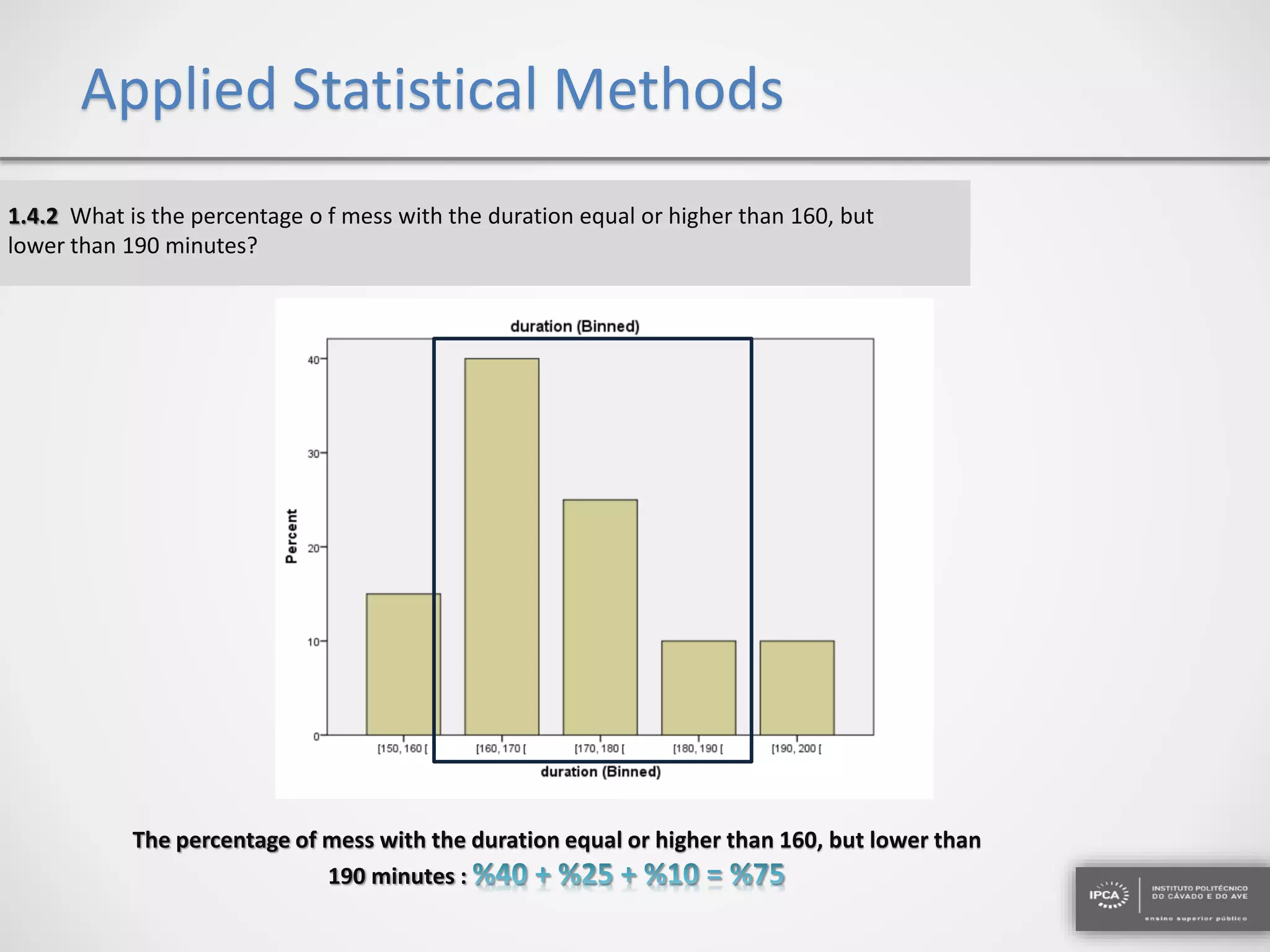
1.4.2 What is the percentage o f mess with the duration equal or higher than 160, but
lower than 190 minutes?
The percentage of mess with the duration equal or higher than 160, but lower than
190 minutes :
Applied Statistical Methods
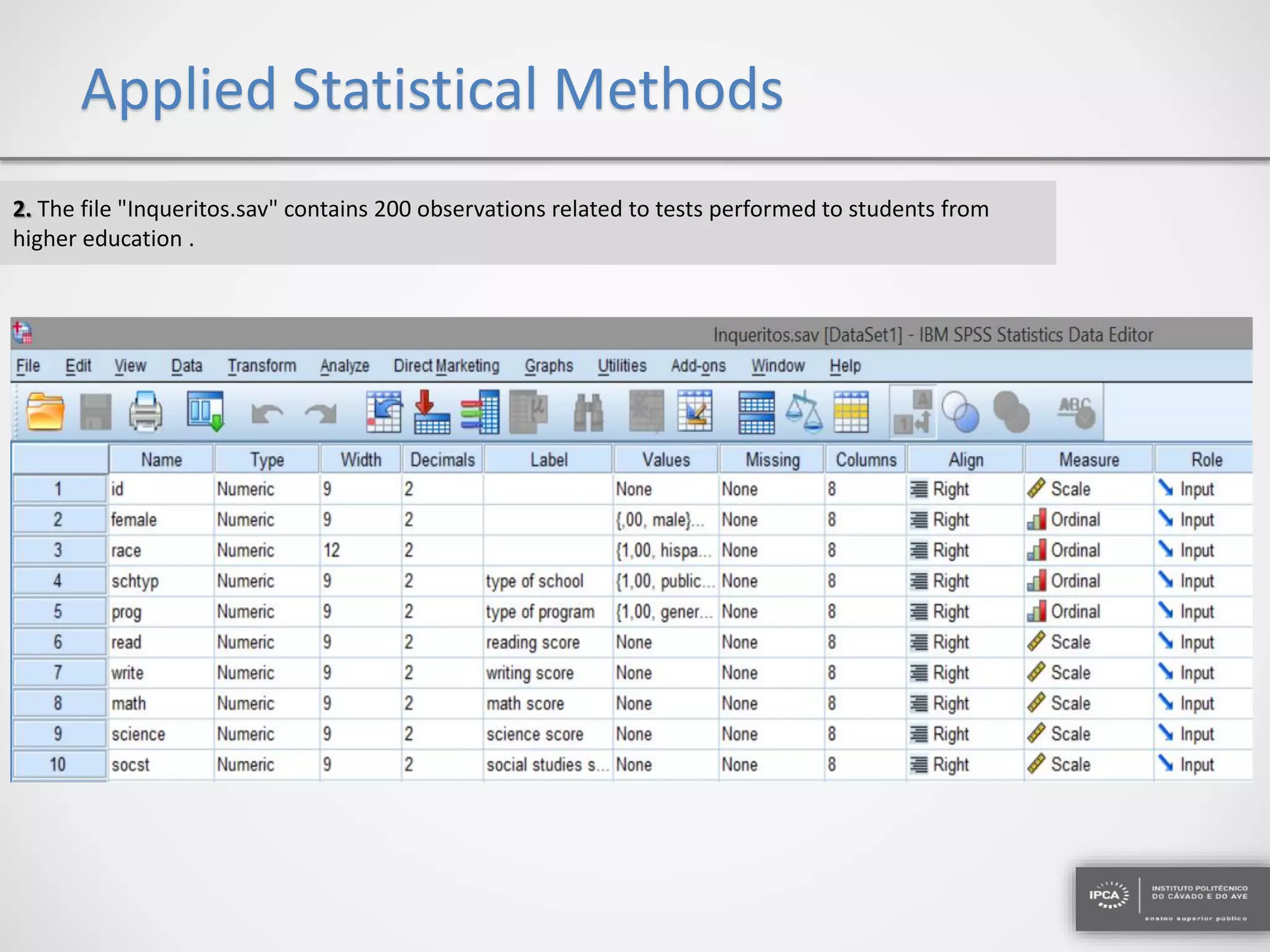
2. The file "Inqueritos.sav" contains 200 observations related to tests performed to students from
higher education .
Applied Statistical Methods
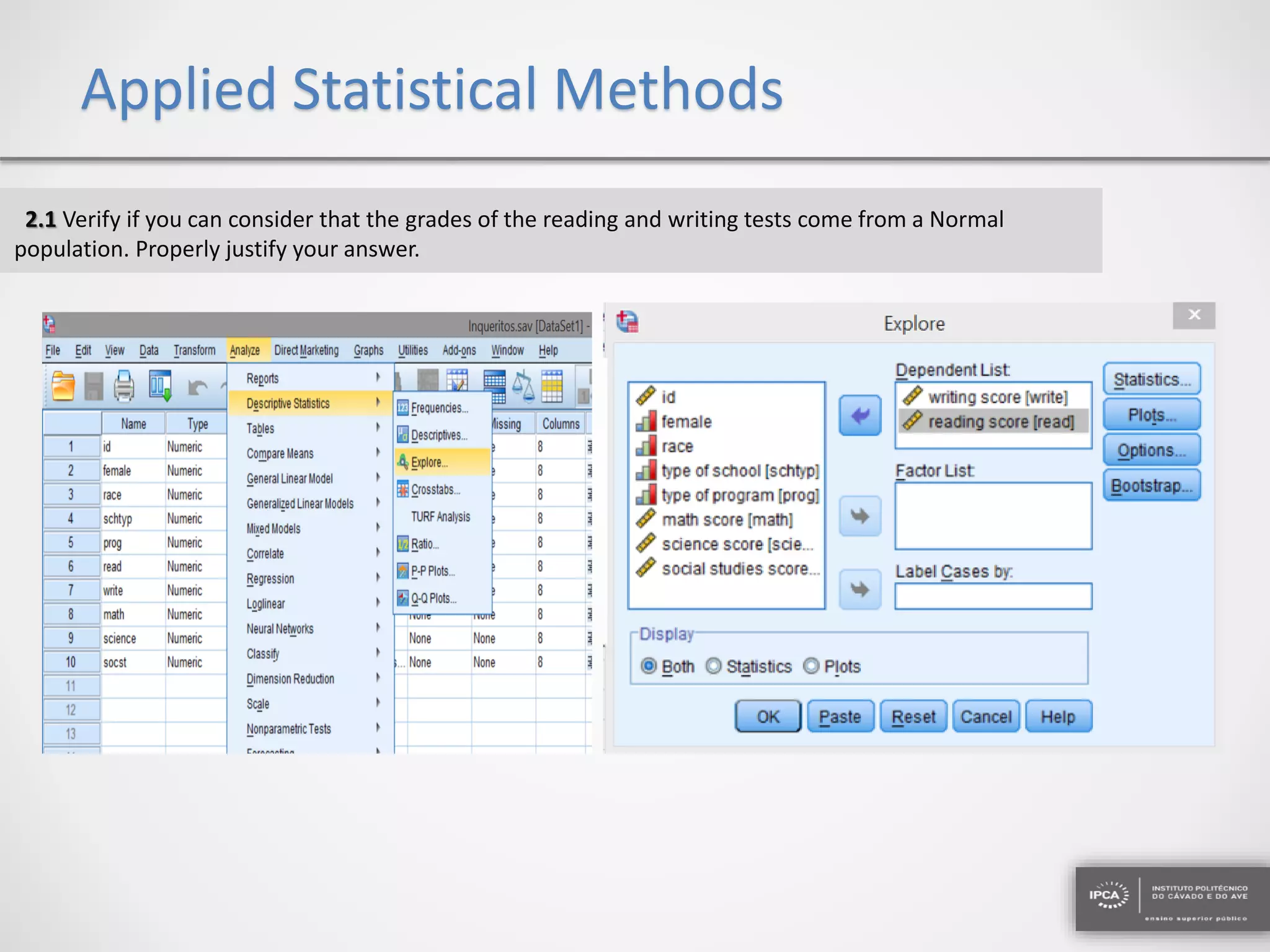
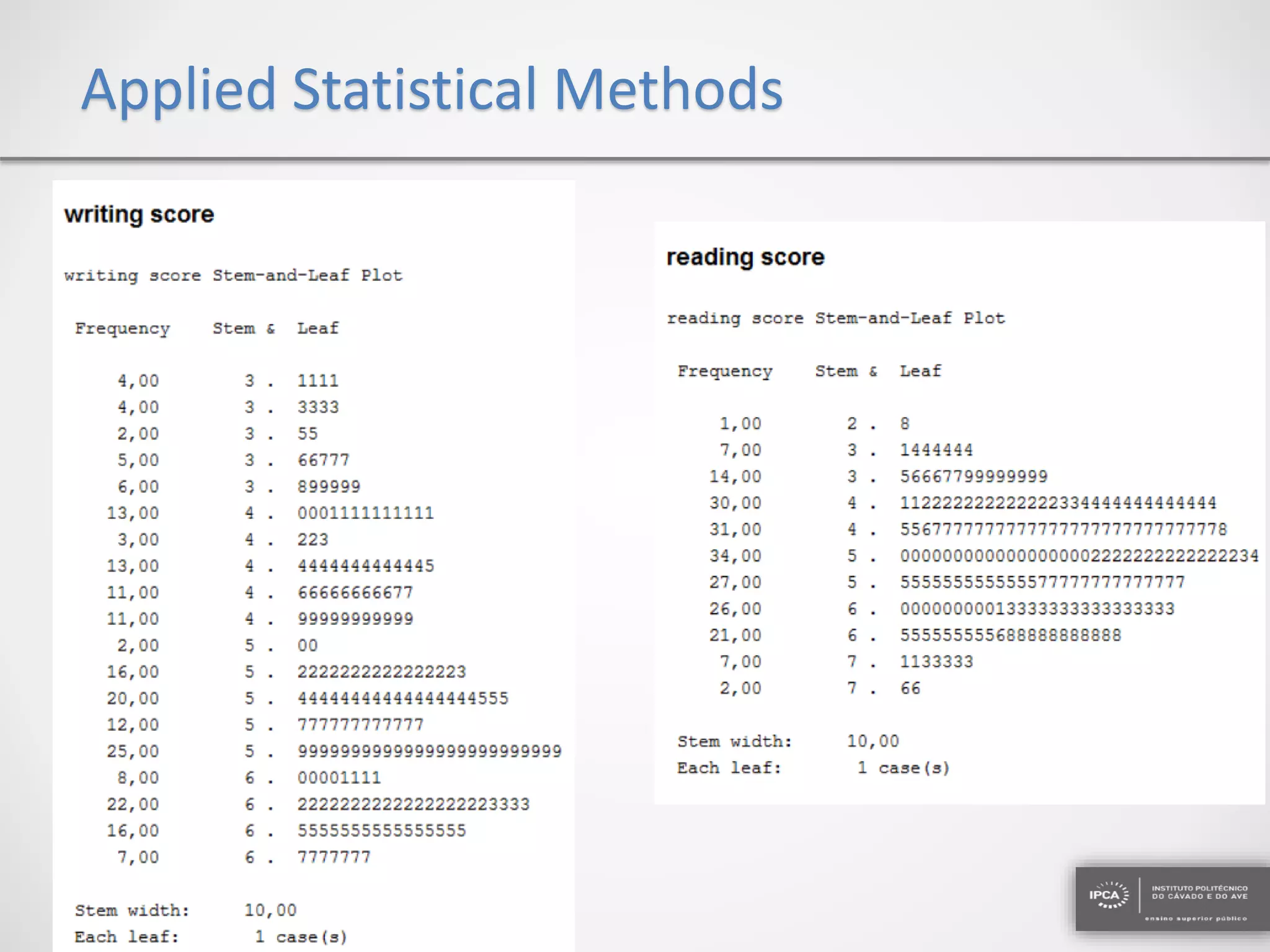
2.1 Verify if you can consider that the grades of the reading and writing tests come from a Normal
population. Properly justify your answer.
Applied Statistical Methods
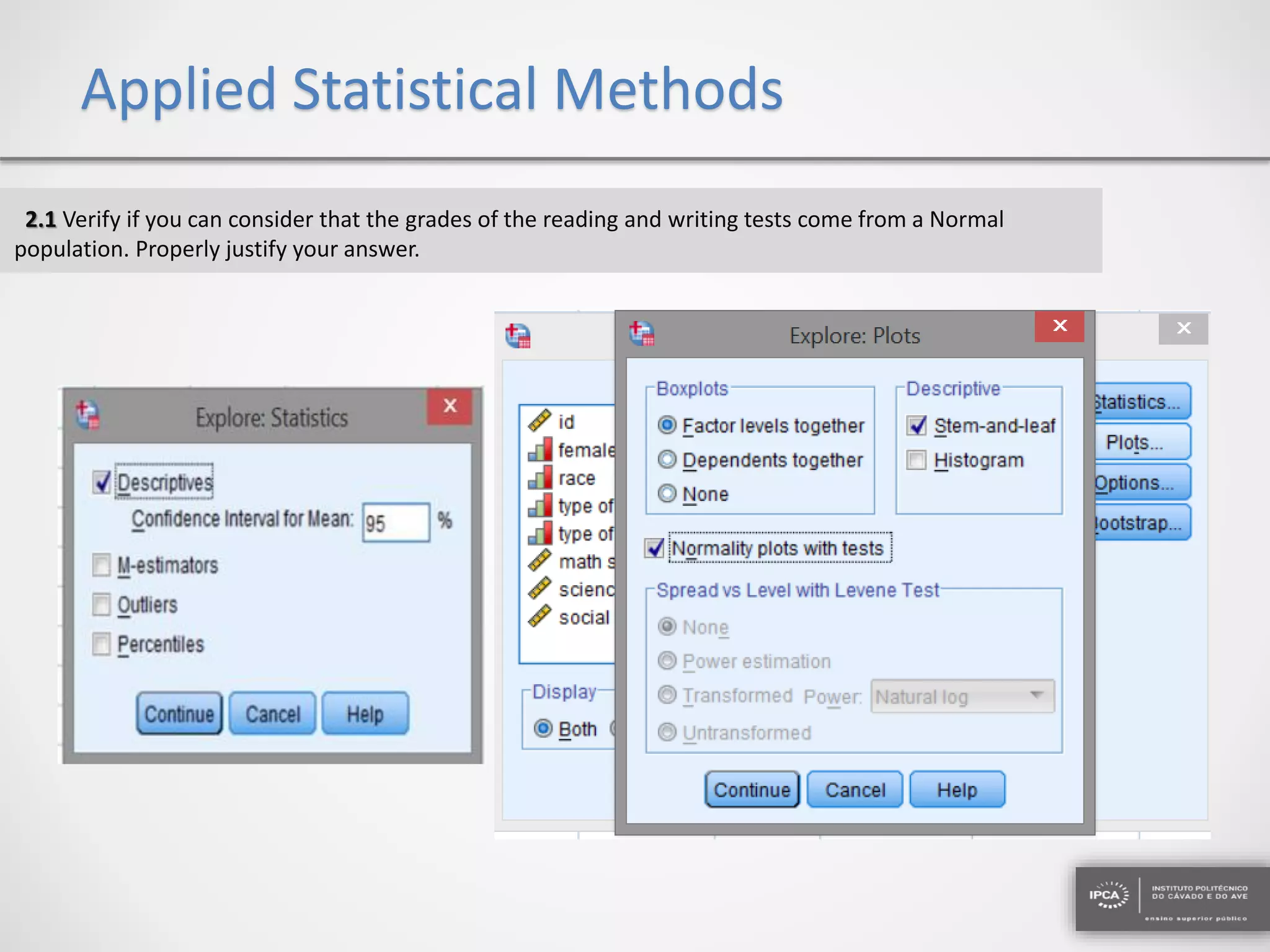
2.1 Verify if you can consider that the grades of the reading and writing tests come from a Normal
population. Properly justify your answer.
Applied Statistical Methods
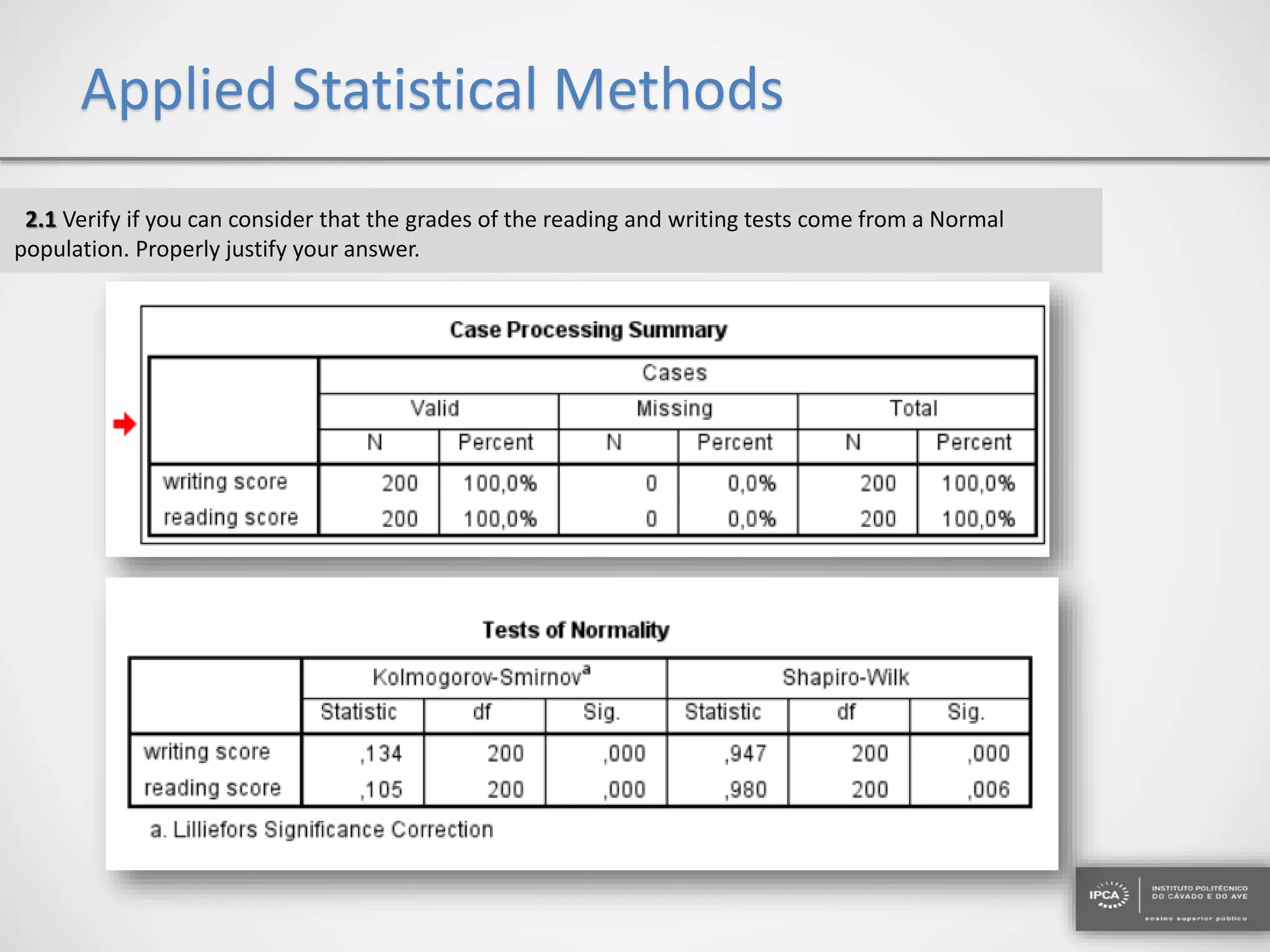
2.1 Verify if you can consider that the grades of the reading and writing tests come from a Normal
population. Properly justify your answer.
Applied Statistical Methods
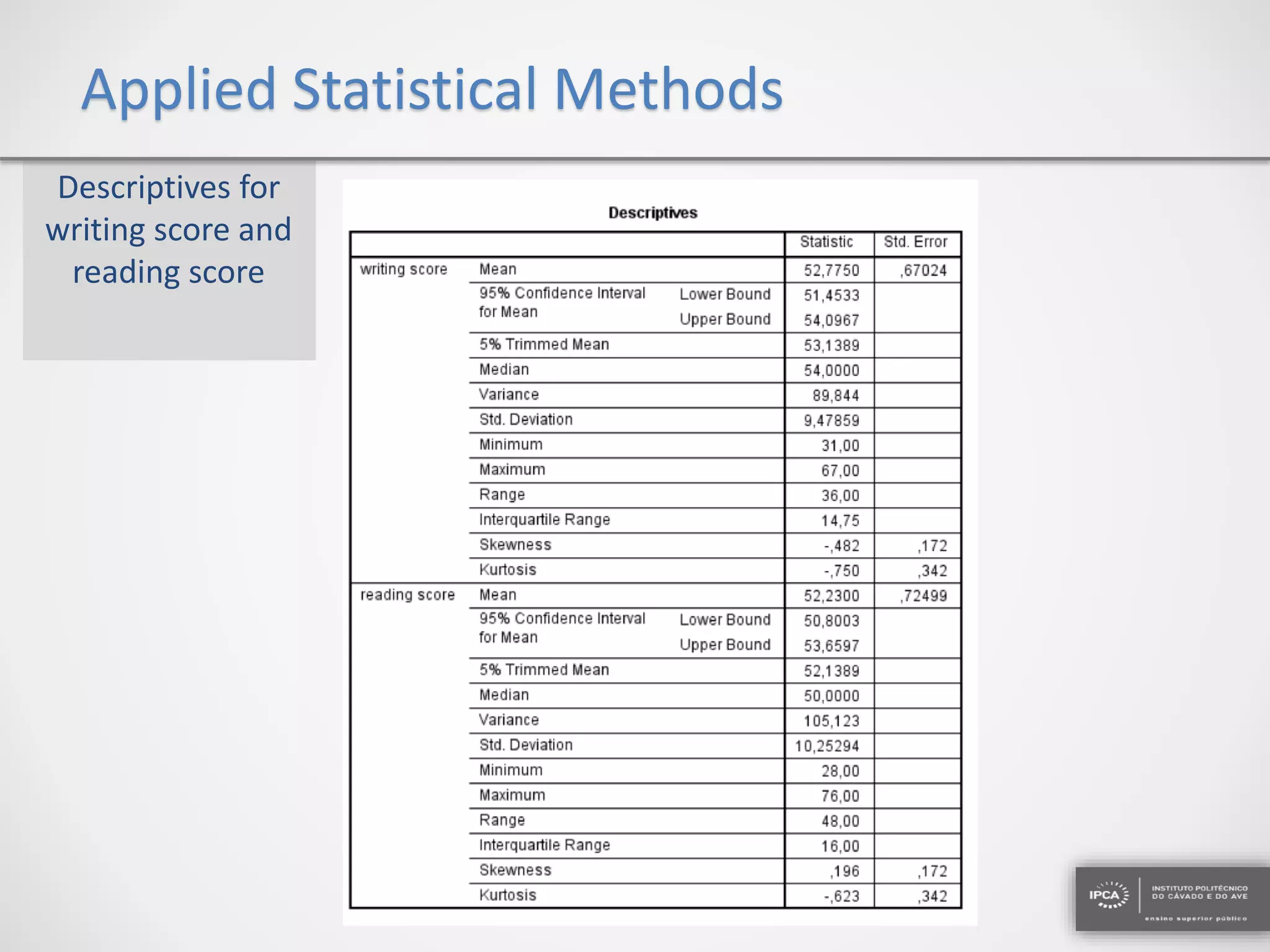
Descriptives for
writing score and
reading score
Applied Statistical Methods
Description
This is a sample text here.
Insert your desired text
here. This is a sample text.
Applied Statistical Methods
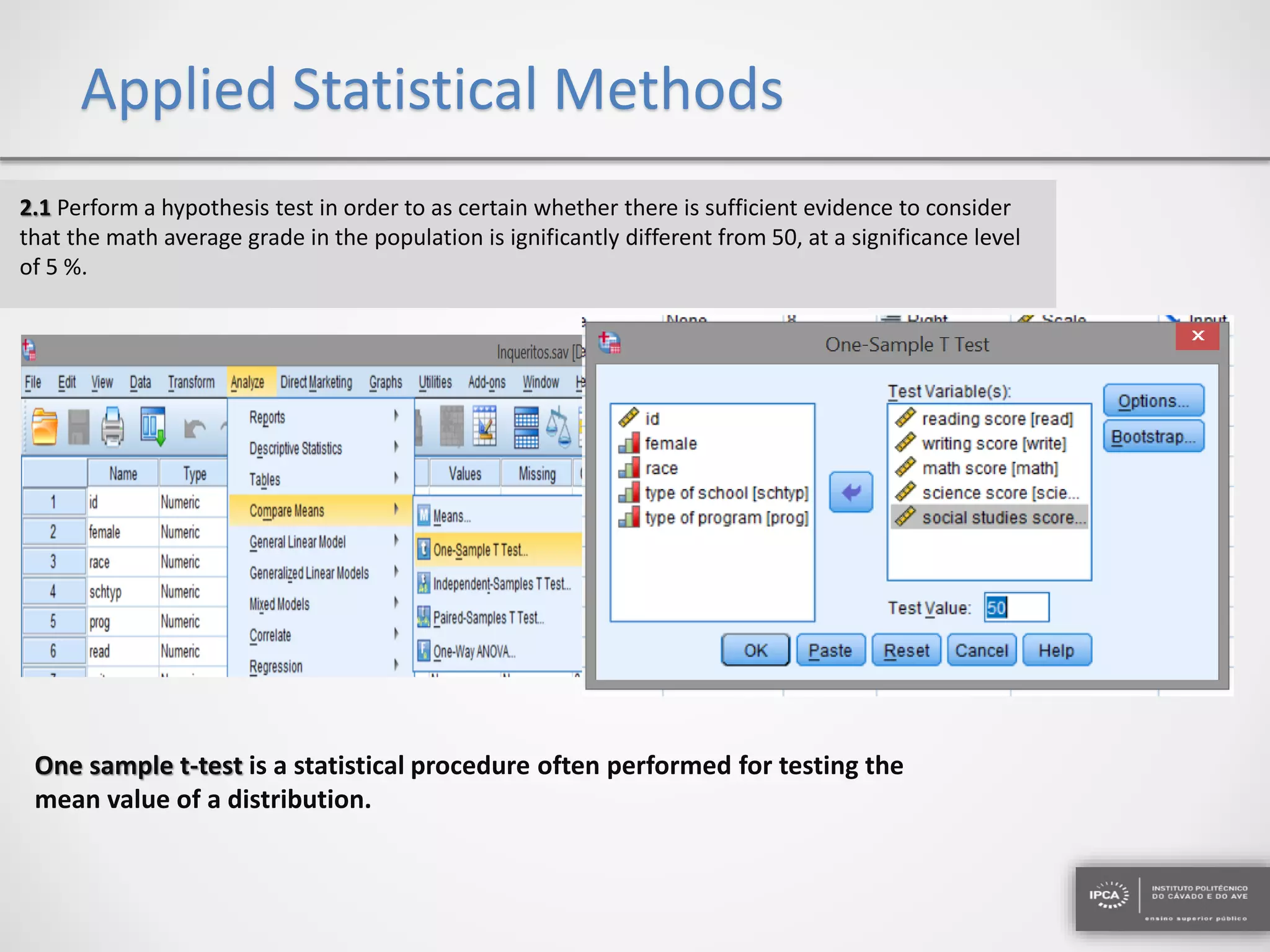
2.1 Perform a hypothesis test in order to as certain whether there is sufficient evidence to consider
that the math average grade in the population is ignificantly different from 50, at a significance level
of 5 %.
One sample t-test is a statistical procedure often performed for testing the
mean value of a distribution.
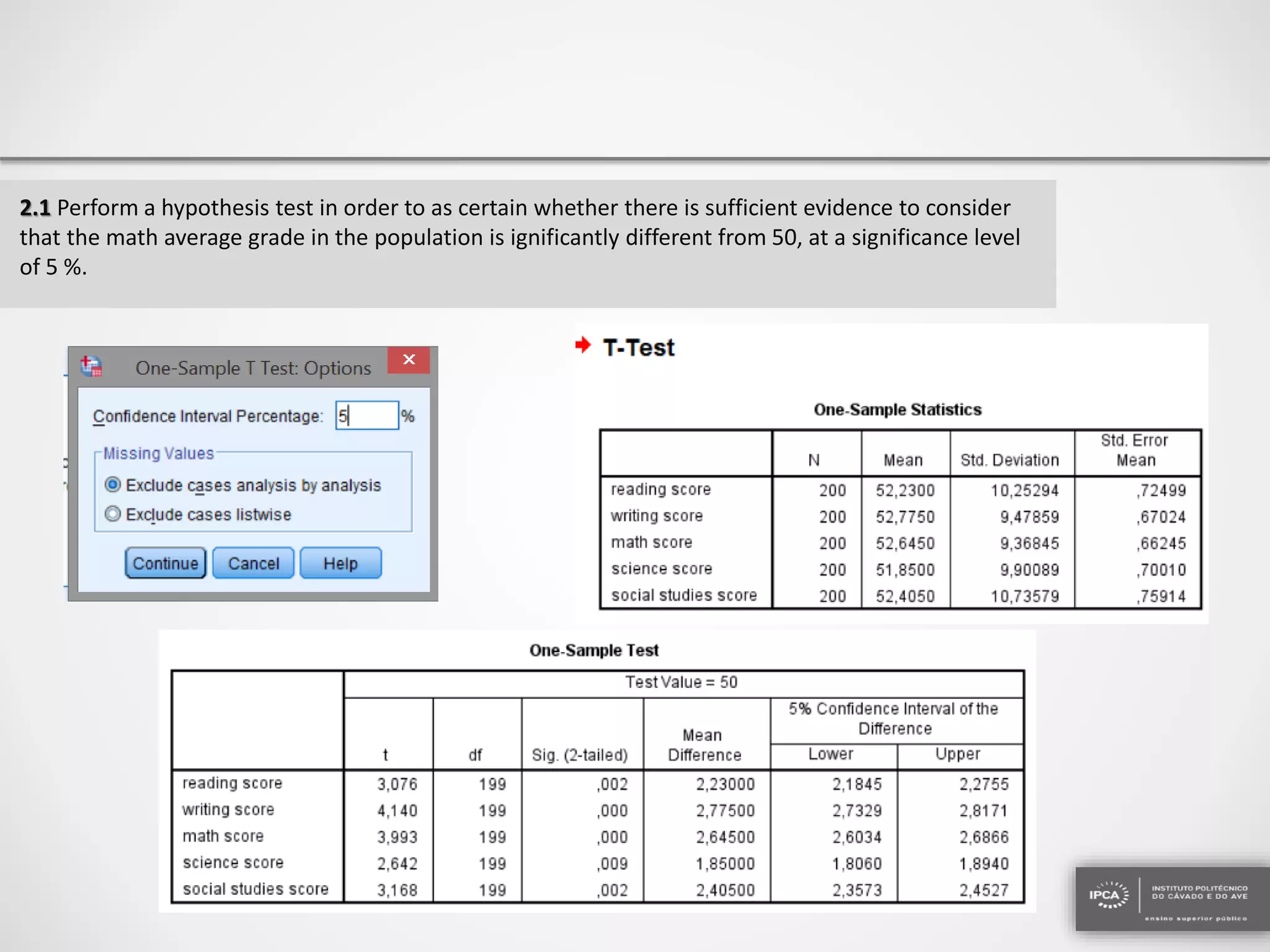
2.1 Perform a hypothesis test in order to as certain whether there is sufficient evidence to consider
that the math average grade in the population is ignificantly different from 50, at a significance level
of 5 %.
Applied Statistical Methods
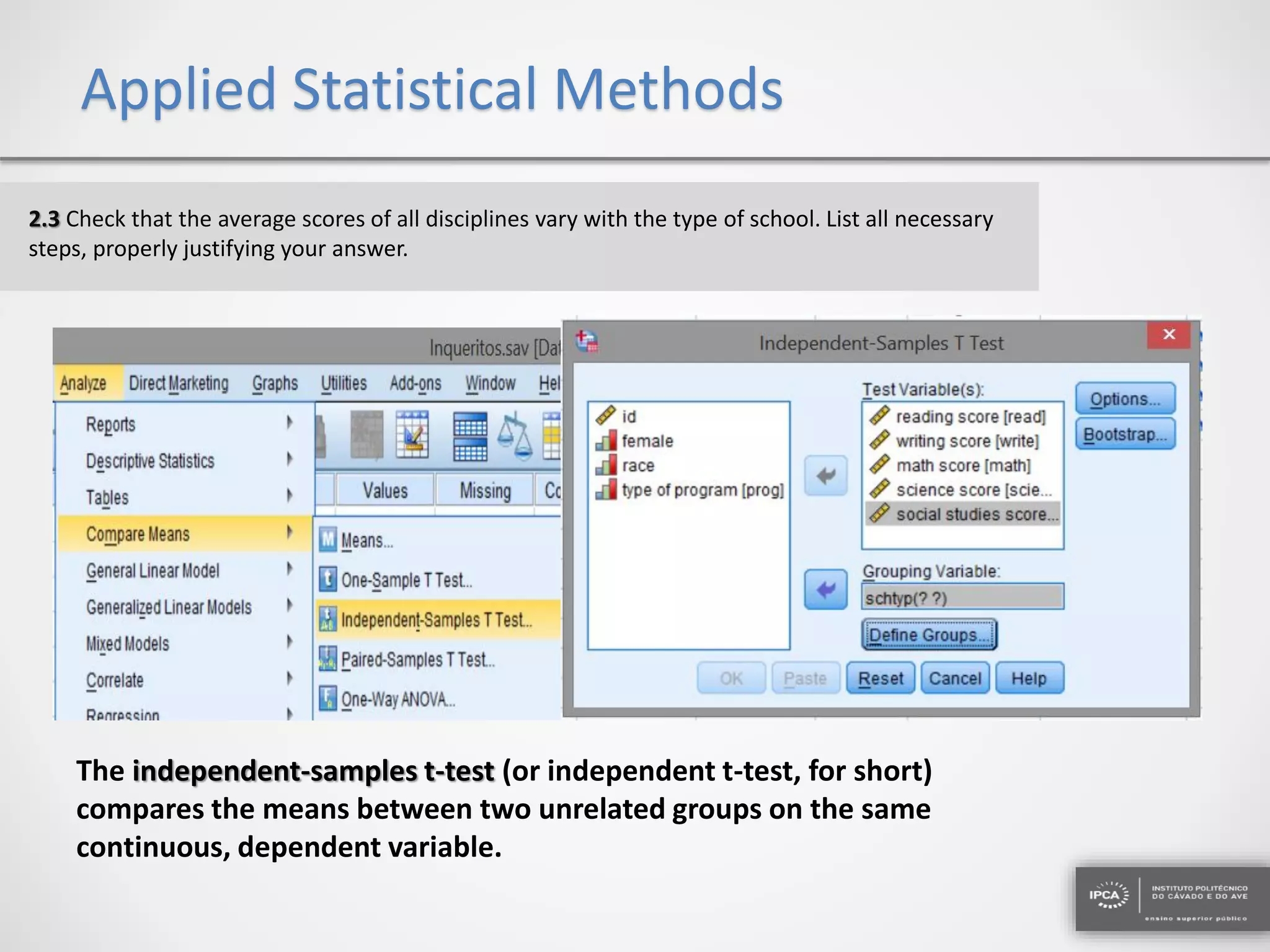
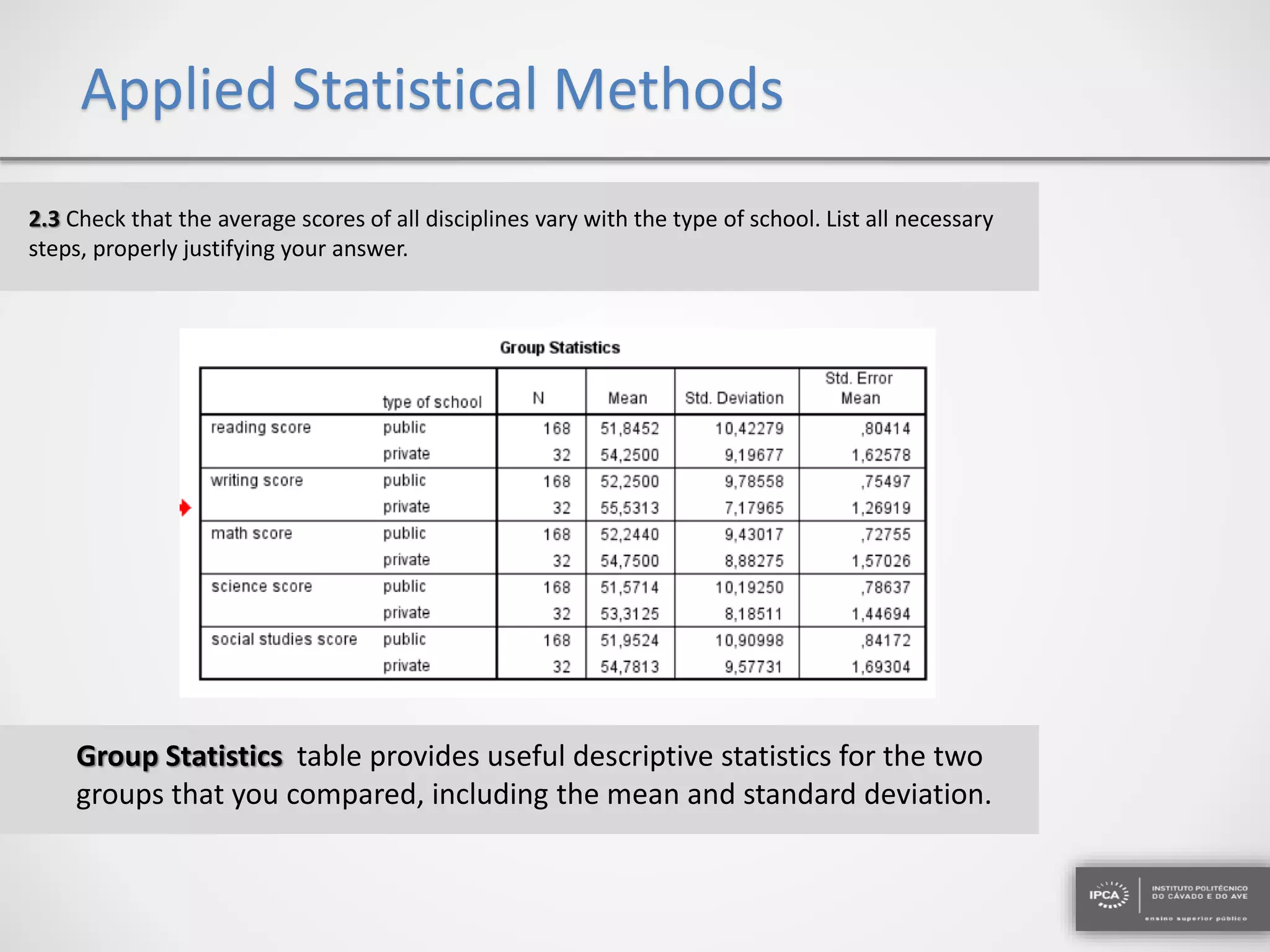
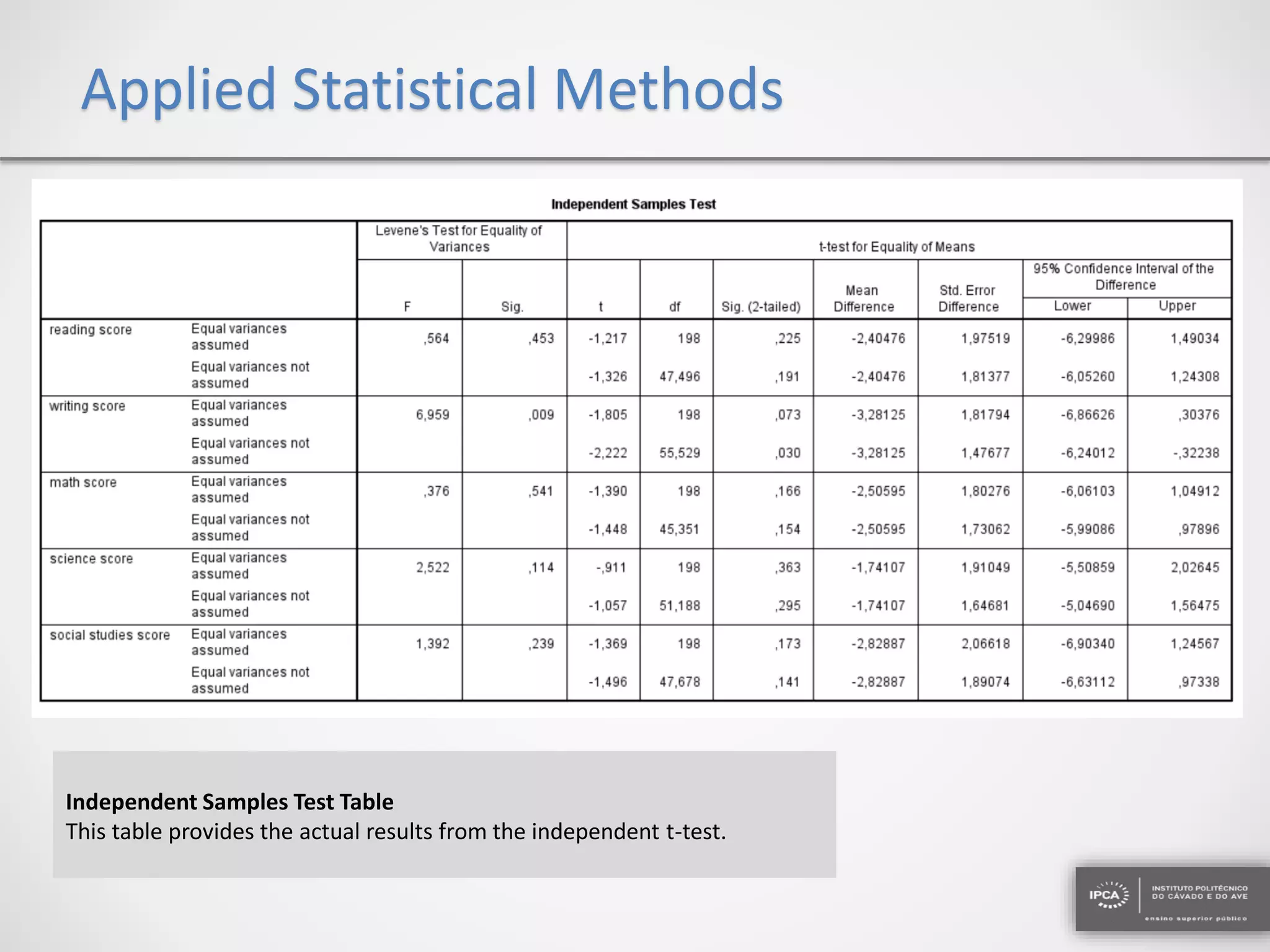
2.3 Check that the average scores of all disciplines vary with the type of school. List all necessary
steps, properly justifying your answer.
The independent-samples t-test (or independent t-test, for short)
compares the means between two unrelated groups on the same
continuous, dependent variable.
Applied Statistical Methods
2.3 Check that the average scores of all disciplines vary with the type of school. List all necessary
steps, properly justifying your answer.
Group Statistics table provides useful descriptive statistics for the two
groups that you compared, including the mean and standard deviation.
Applied Statistical Methods
Independent Samples Test Table
This table provides the actual results from the independent t-test.
Applied Statistical Methods
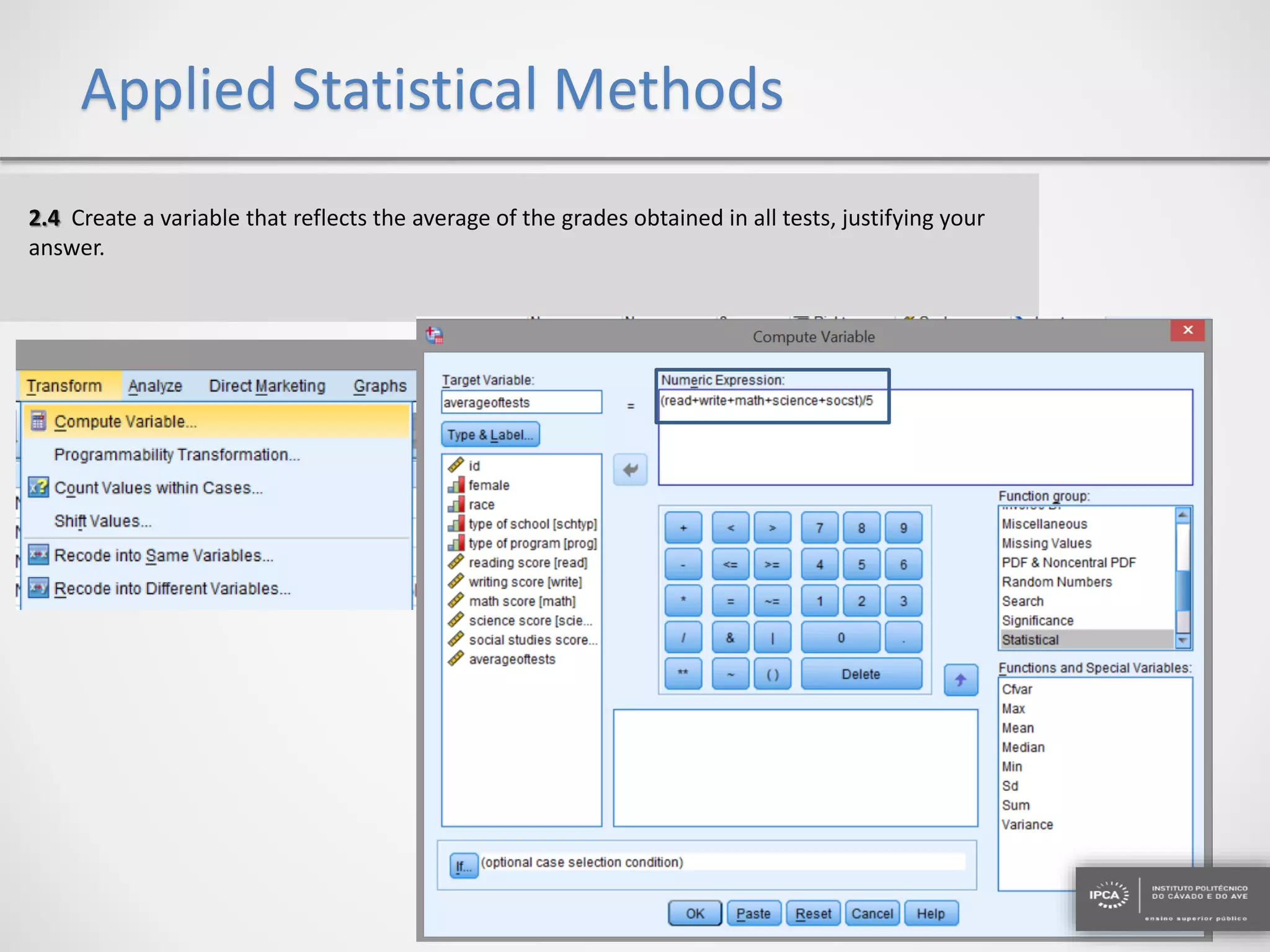
2.4 Create a variable that reflects the average of the grades obtained in all tests, justifying your
answer.
Applied Statistical Methods
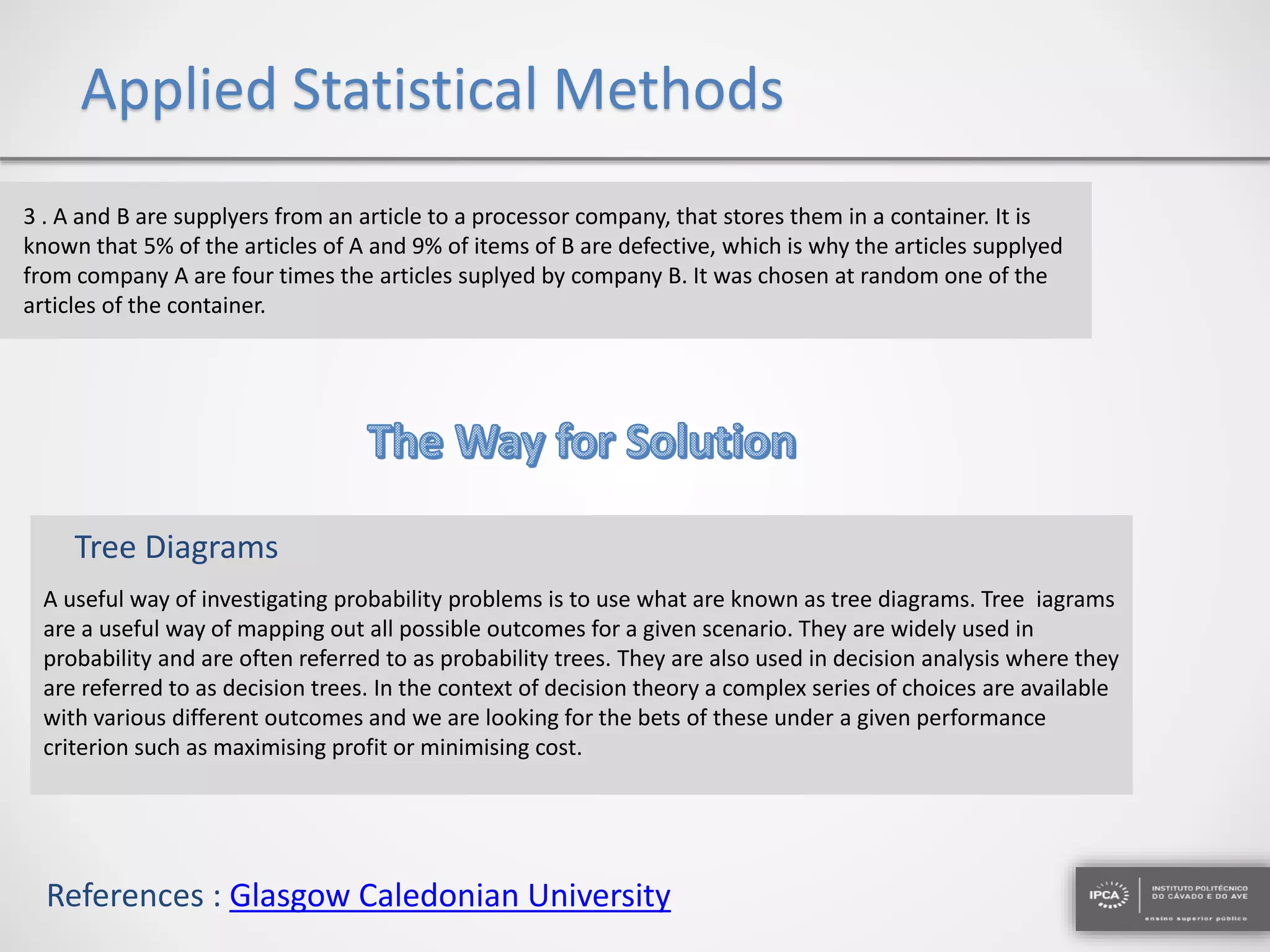
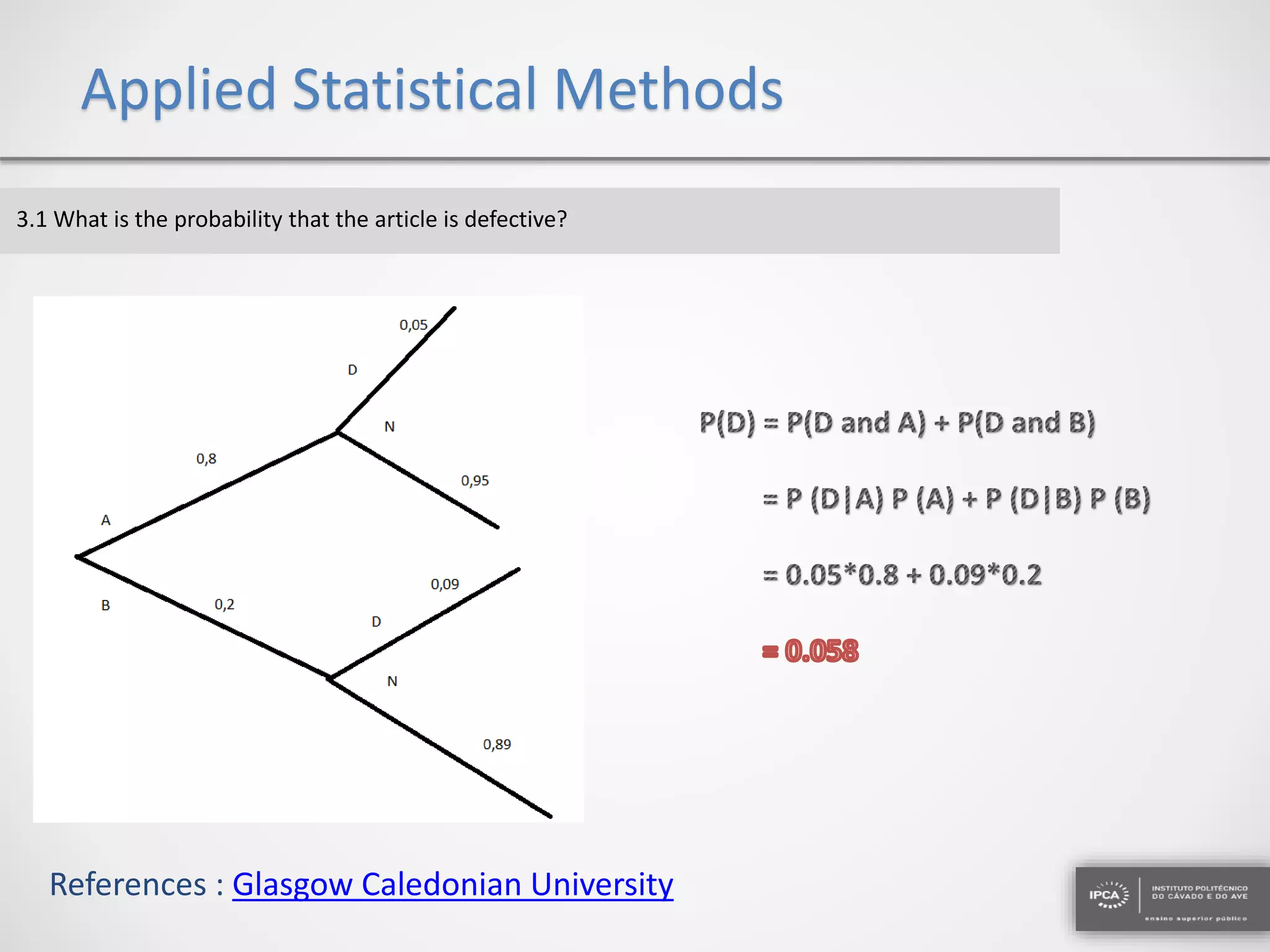
3 . A and B are supplyers from an article to a processor company, that stores them in a container. It is
known that 5% of the articles of A and 9% of items of B are defective, which is why the articles supplyed
from company A are four times the articles suplyed by company B. It was chosen at random one of the
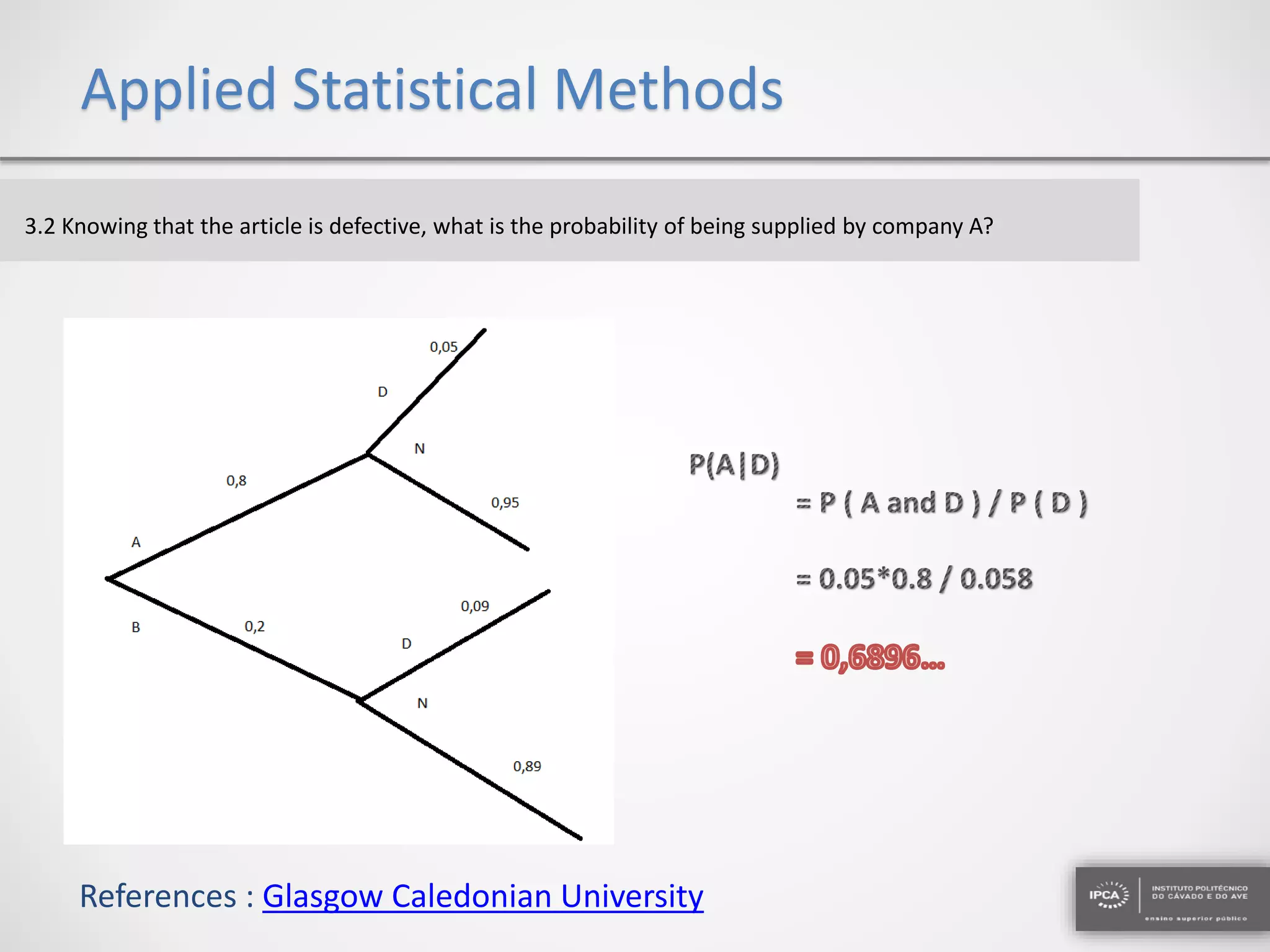
articles of the container.
A useful way of investigating probability problems is to use what are known as tree diagrams. Tree iagrams
are a useful way of mapping out all possible outcomes for a given scenario. They are widely used in
probability and are often referred to as probability trees. They are also used in decision analysis where they
are referred to as decision trees. In the context of decision theory a complex series of choices are available
with various different outcomes and we are looking for the bets of these under a given performance
criterion such as maximising profit or minimising cost.
Tree Diagrams
References : Glasgow Caledonian University
Applied Statistical Methods
3.1 What is the probability that the article is defective?
References : Glasgow Caledonian University
Applied Statistical Methods
References : Glasgow Caledonian University
3.2 Knowing that the article is defective, what is the probability of being supplied by company A?
Applied Statistical Methods
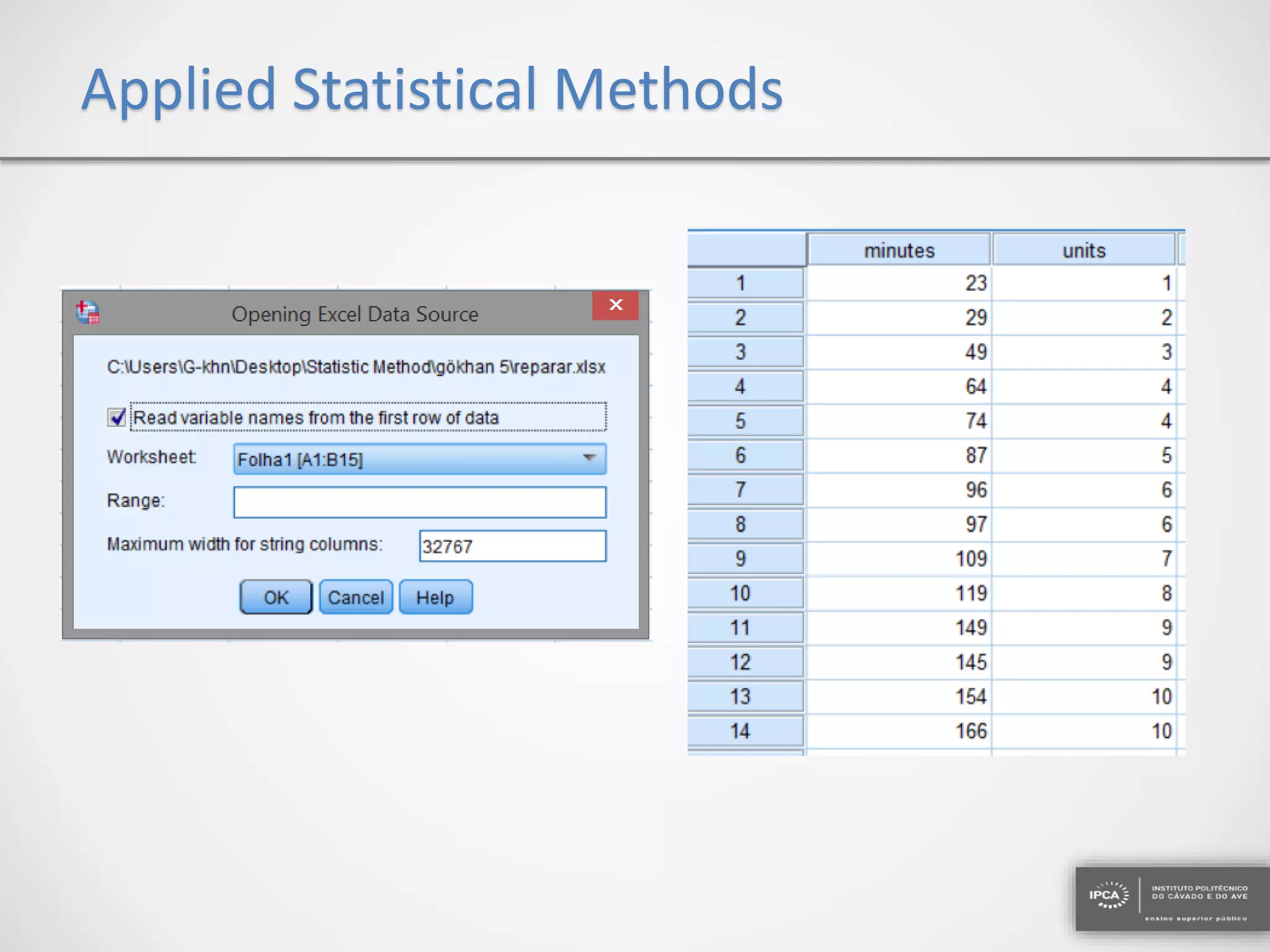
5. Certain company, dedicated to the commercialization and repair of computers expressed an interest in studying
the relationship between the duration of a repair service and the number of electronic components to be repaired
or replaced on a computer. This company has been registering computer repair times (in minutes) and the
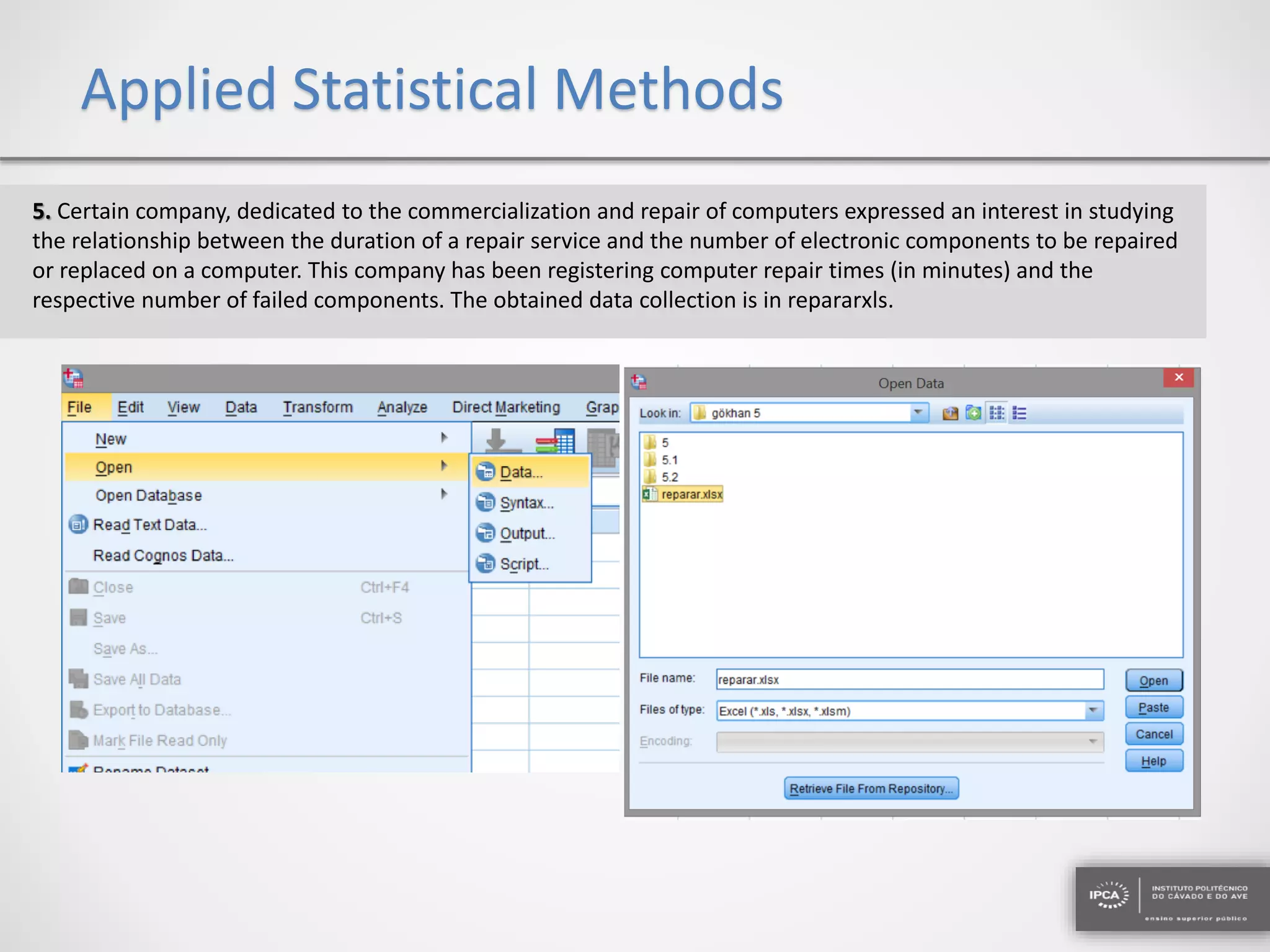
respective number of failed components. The obtained data collection is in repararxls.
Applied Statistical Methods
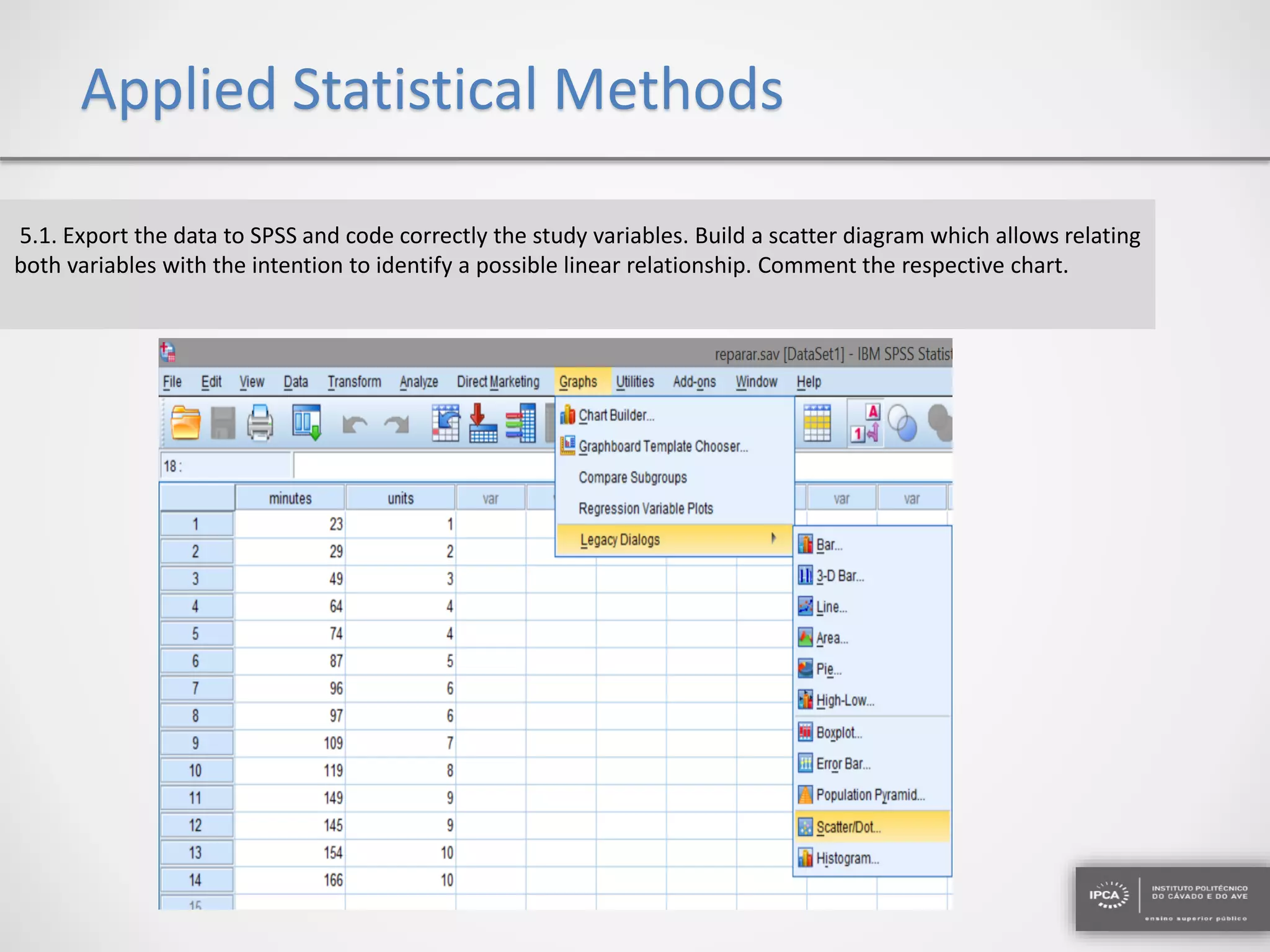
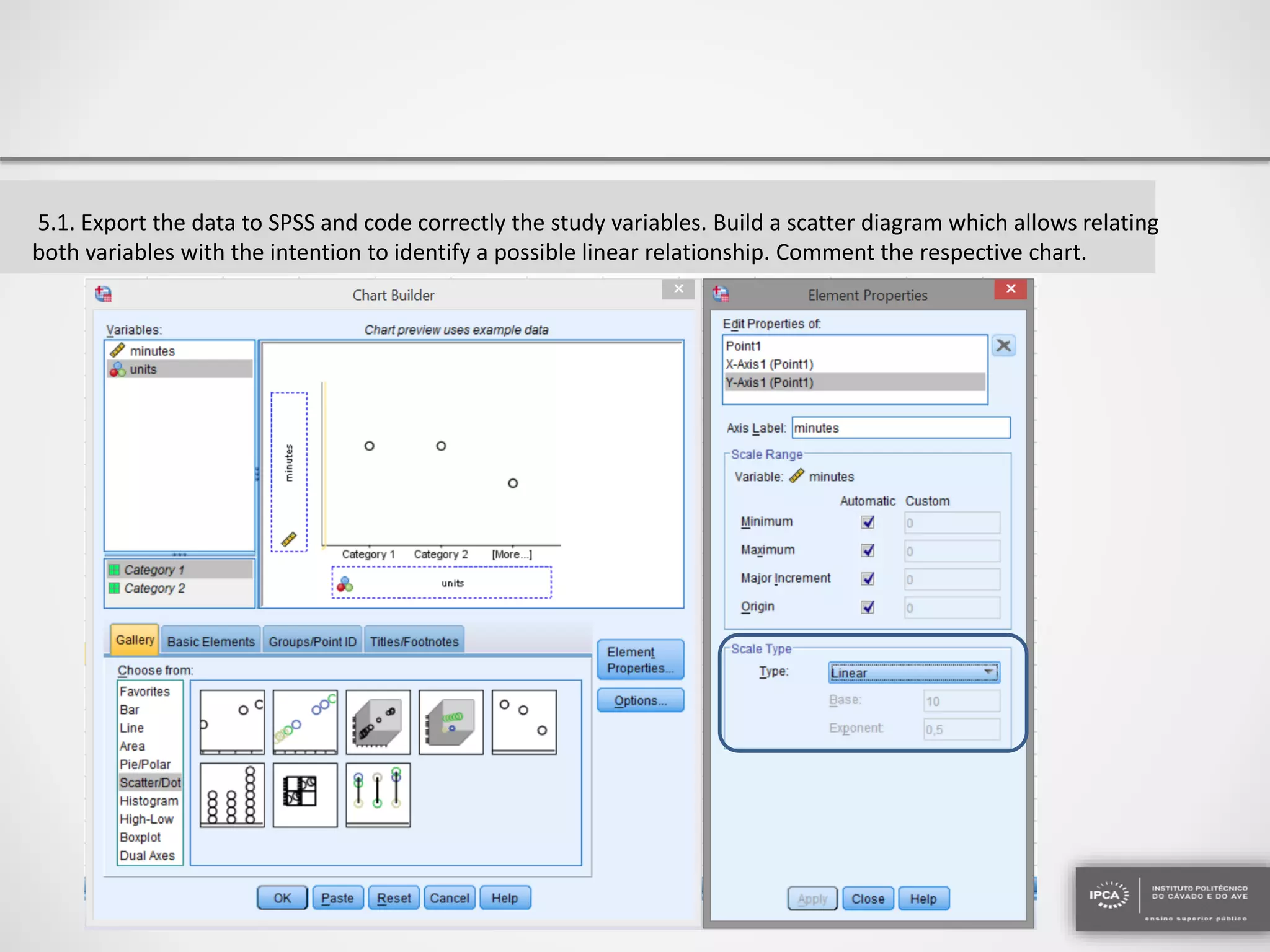
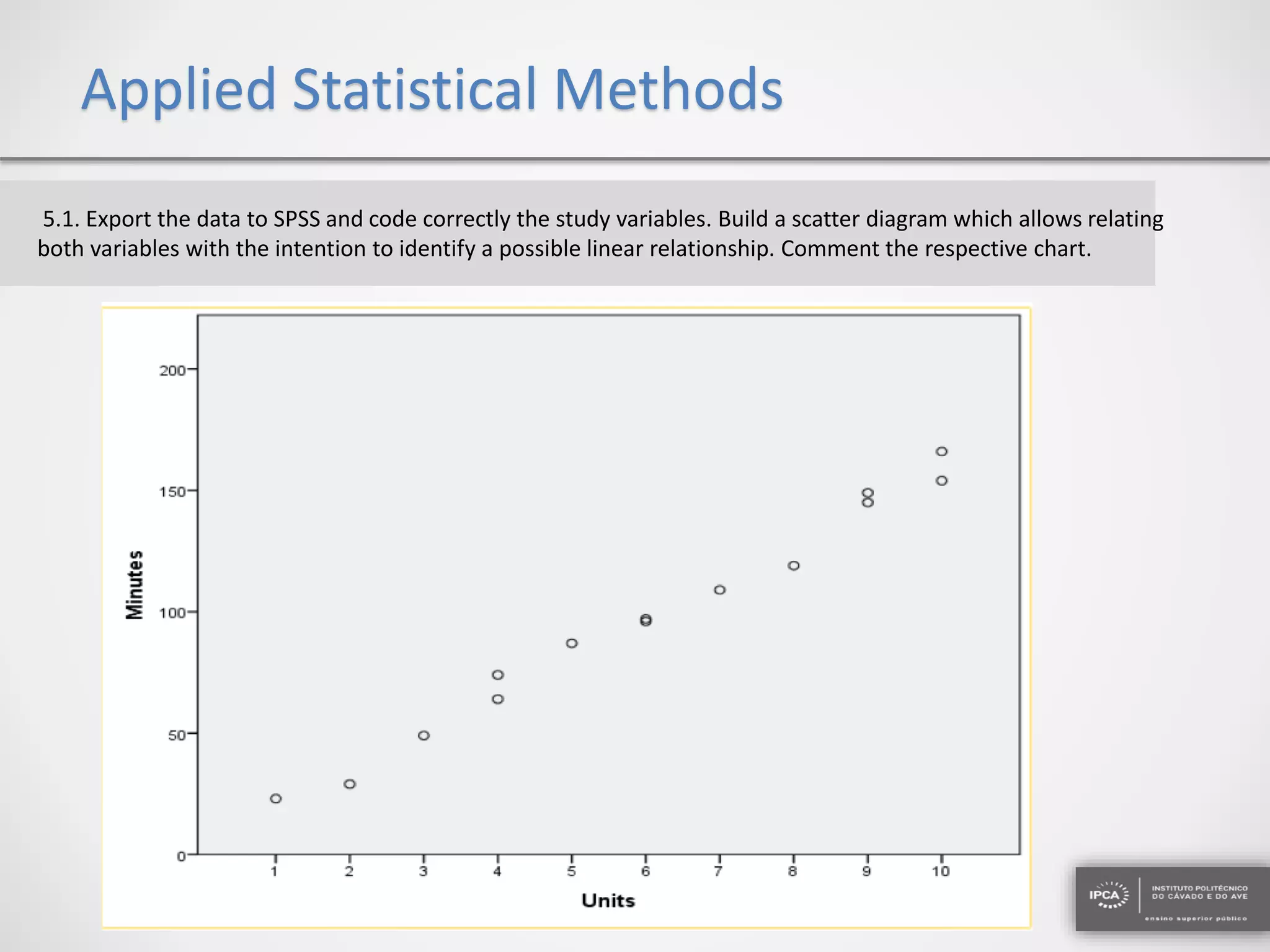
5.1. Export the data to SPSS and code correctly the study variables. Build a scatter diagram which allows relating
both variables with the intention to identify a possible linear relationship. Comment the respective chart.
5.1. Export the data to SPSS and code correctly the study variables. Build a scatter diagram which allows relating
both variables with the intention to identify a possible linear relationship. Comment the respective chart.
Applied Statistical Methods
5.1. Export the data to SPSS and code correctly the study variables. Build a scatter diagram which allows relating
both variables with the intention to identify a possible linear relationship. Comment the respective chart.
Applied Statistical Methods
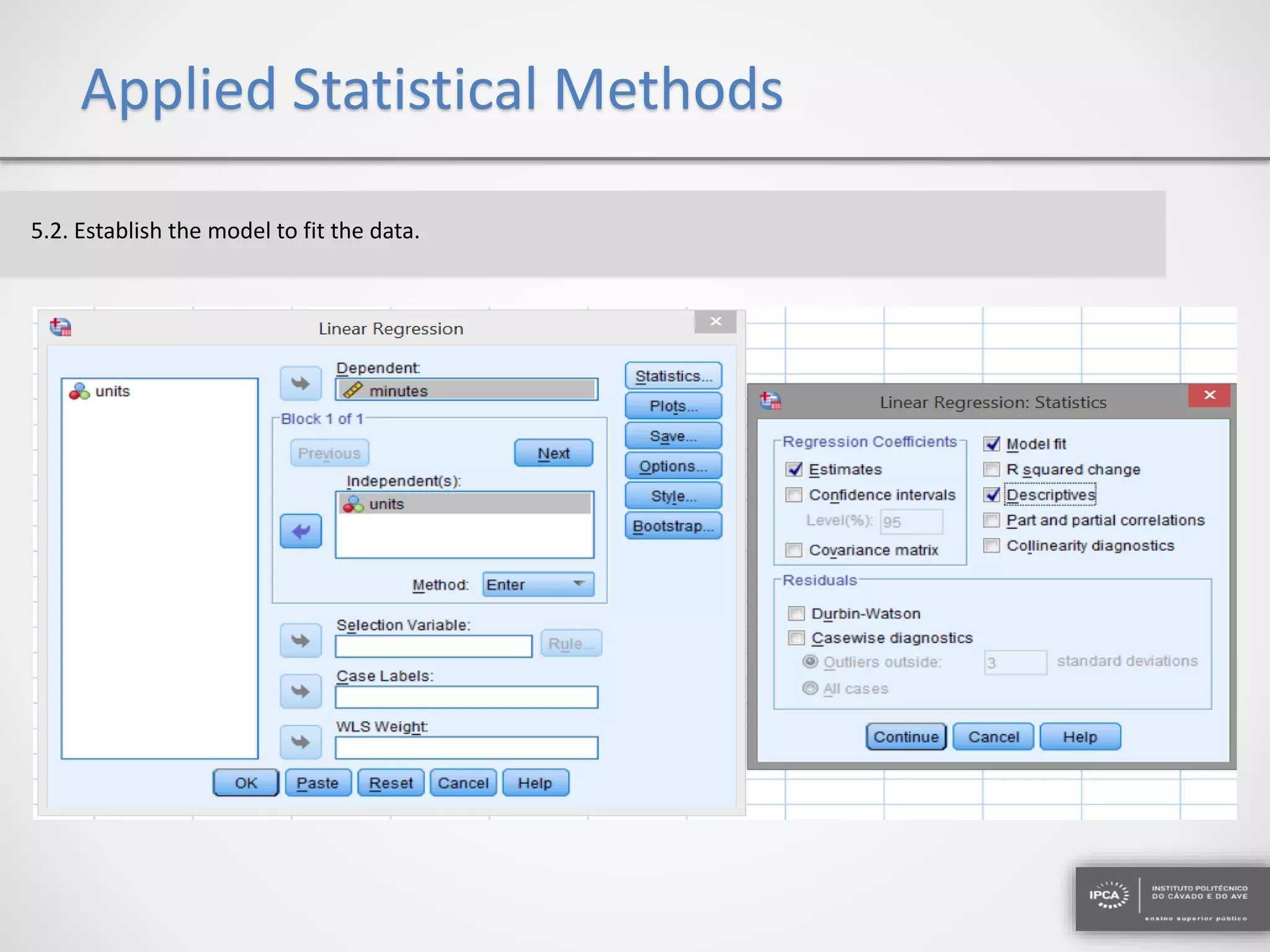
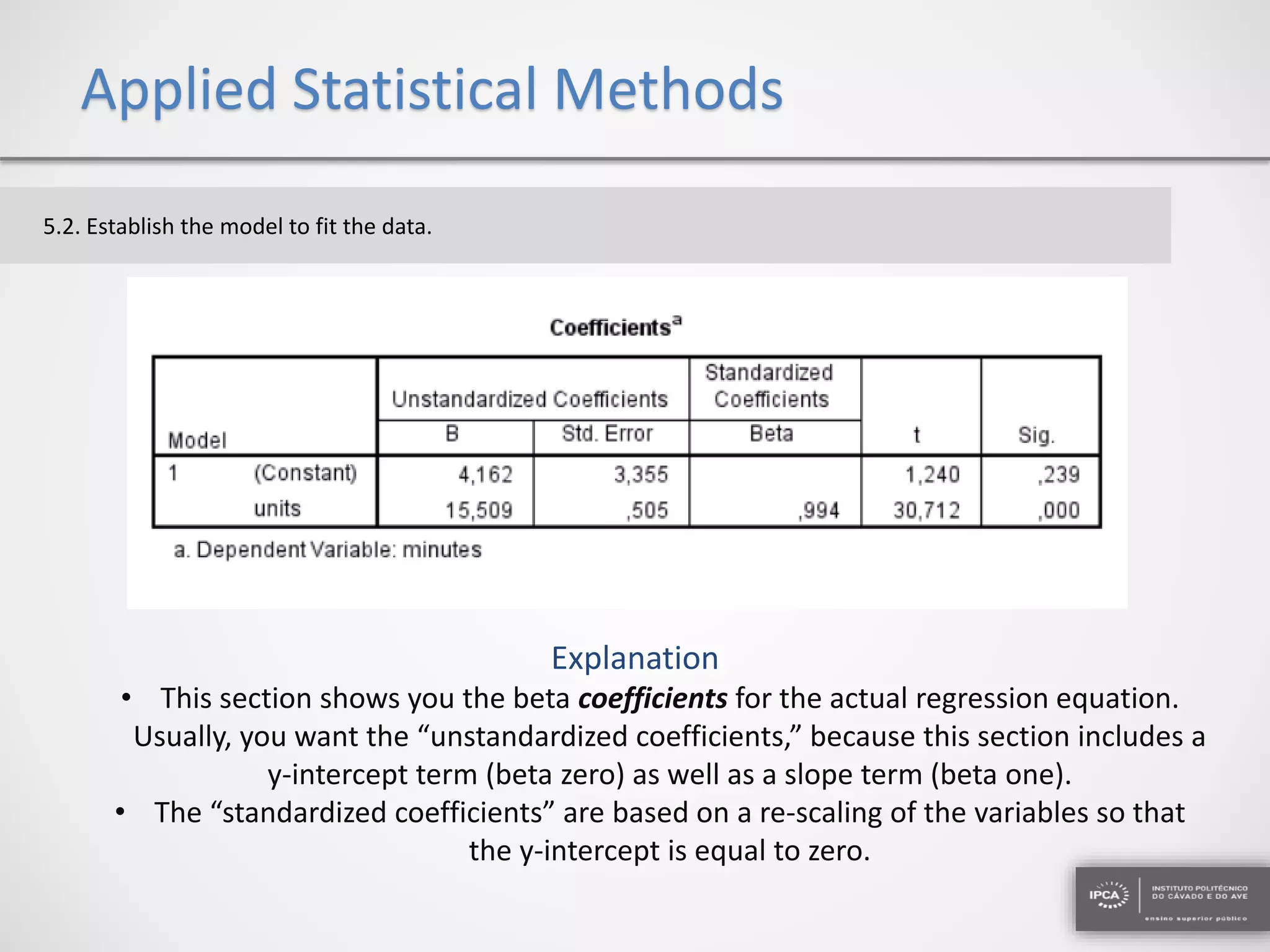
5.2. Establish the model to fit the data.
Applied Statistical Methods
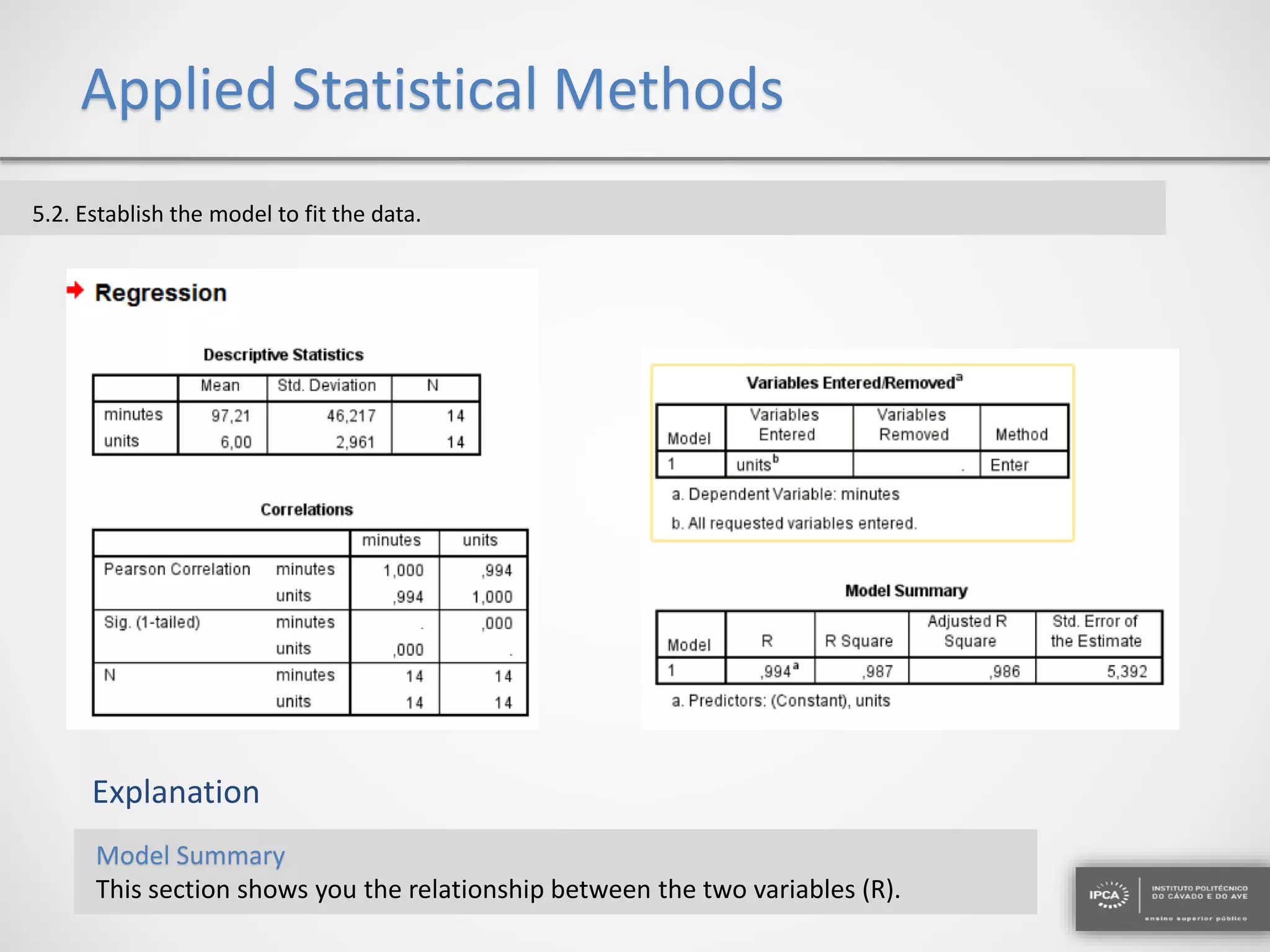
Explanation
5.2. Establish the model to fit the data.
Model Summary
This section shows you the relationship between the two variables (R).
Applied Statistical Methods
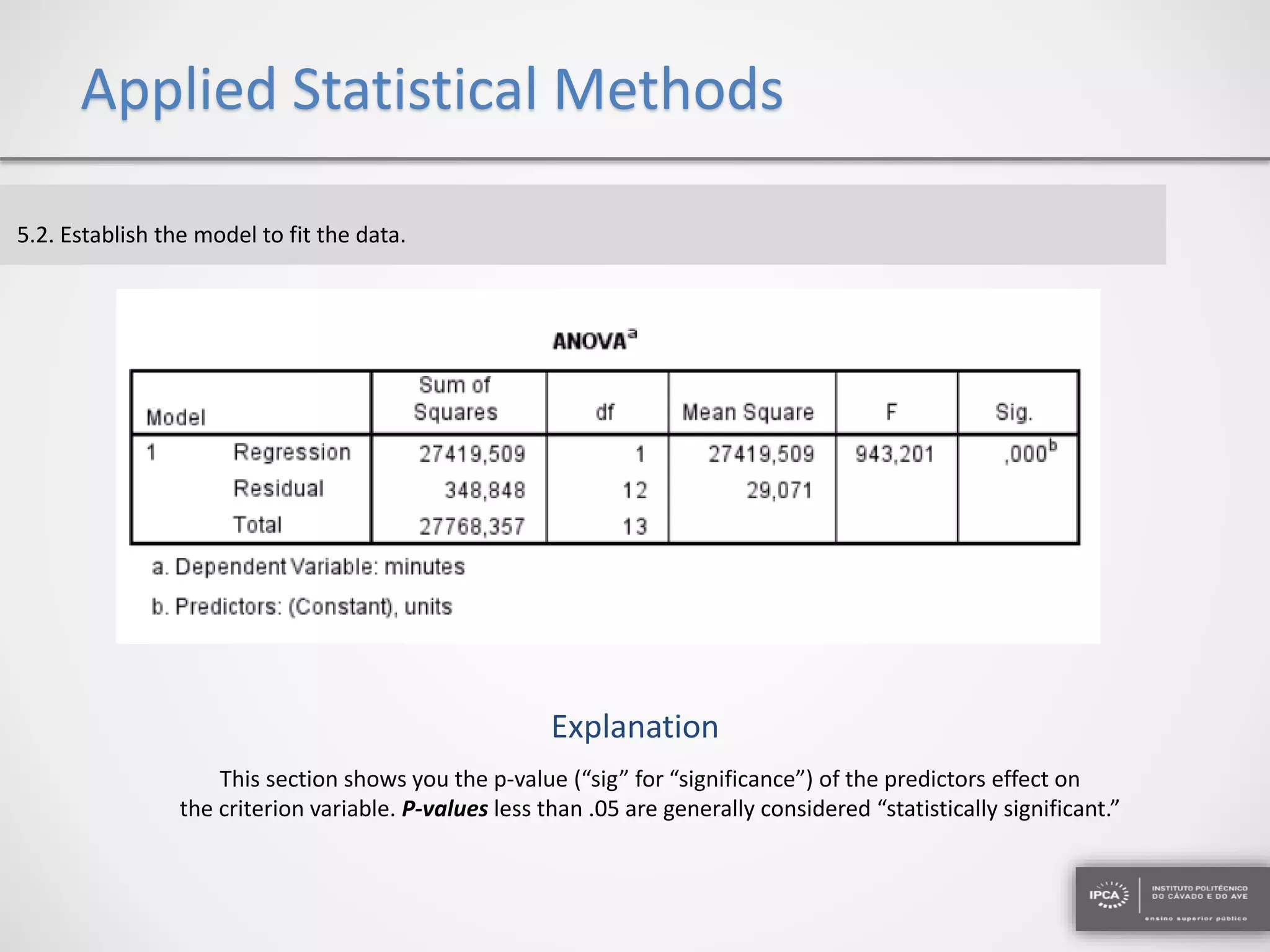
5.2. Establish the model to fit the data.
This section shows you the p-value (“sig” for “significance”) of the predictors effect on
the criterion variable. P-values less than .05 are generally considered “statistically significant.”
Explanation
Applied Statistical Methods
5.2. Establish the model to fit the data.
• This section shows you the beta coefficients for the actual regression equation.
Usually, you want the “unstandardized coefficients,” because this section includes a
y-intercept term (beta zero) as well as a slope term (beta one).
• The “standardized coefficients” are based on a re-scaling of the variables so that
the y-intercept is equal to zero.
Explanation
Applied Statistical Methods
5.3 Based on the obtained results, answer to the following questions:
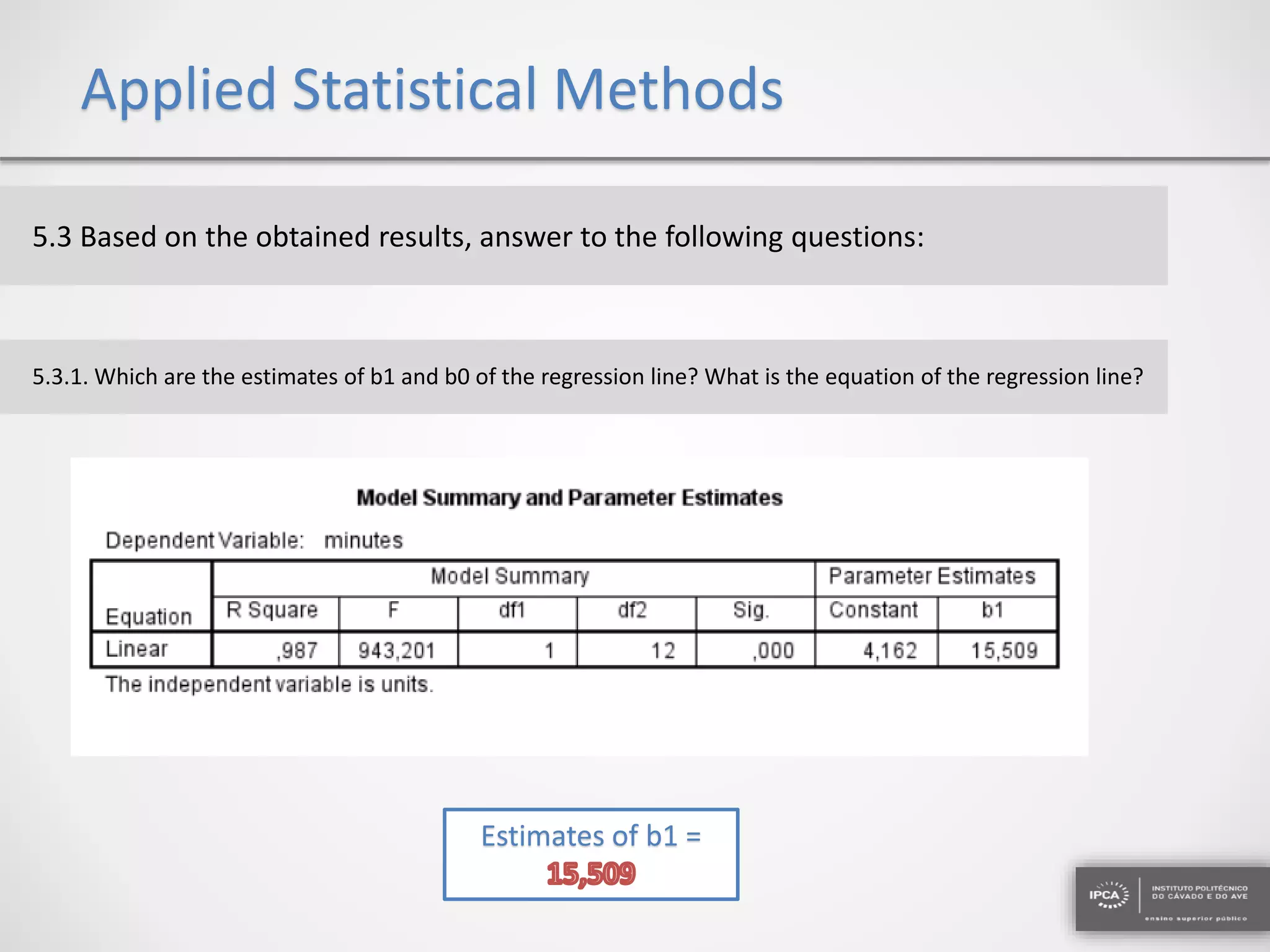
5.3.1. Which are the estimates of b1 and b0 of the regression line? What is the equation of the regression line?
Estimates of b1 =
Applied Statistical Methods
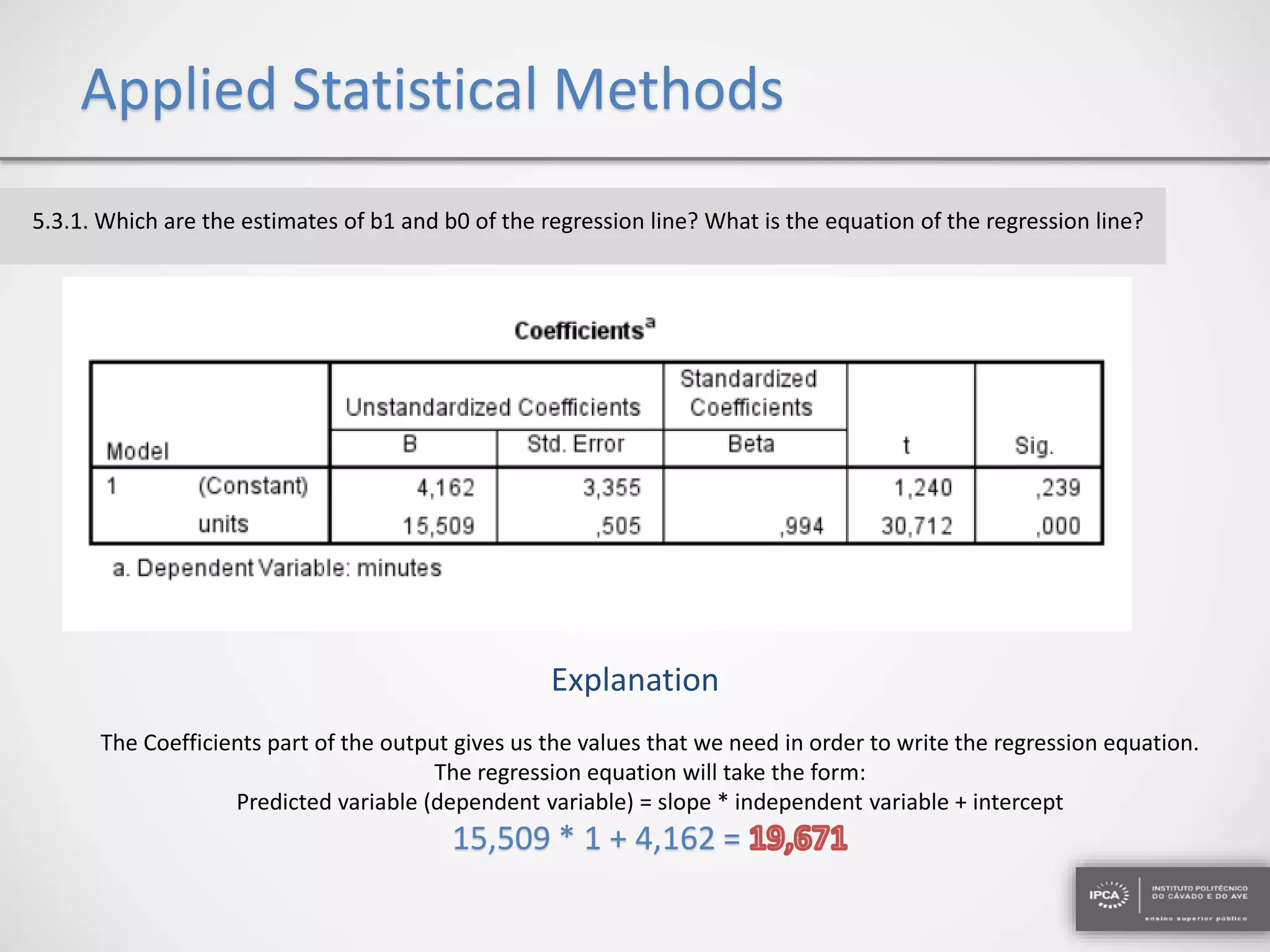
5.3.1. Which are the estimates of b1 and b0 of the regression line? What is the equation of the regression line?
Explanation
The Coefficients part of the output gives us the values that we need in order to write the regression equation.
The regression equation will take the form:
Predicted variable (dependent variable) = slope * independent variable + intercept
15,509 * 1 + 4,162 =
Applied Statistical Methods
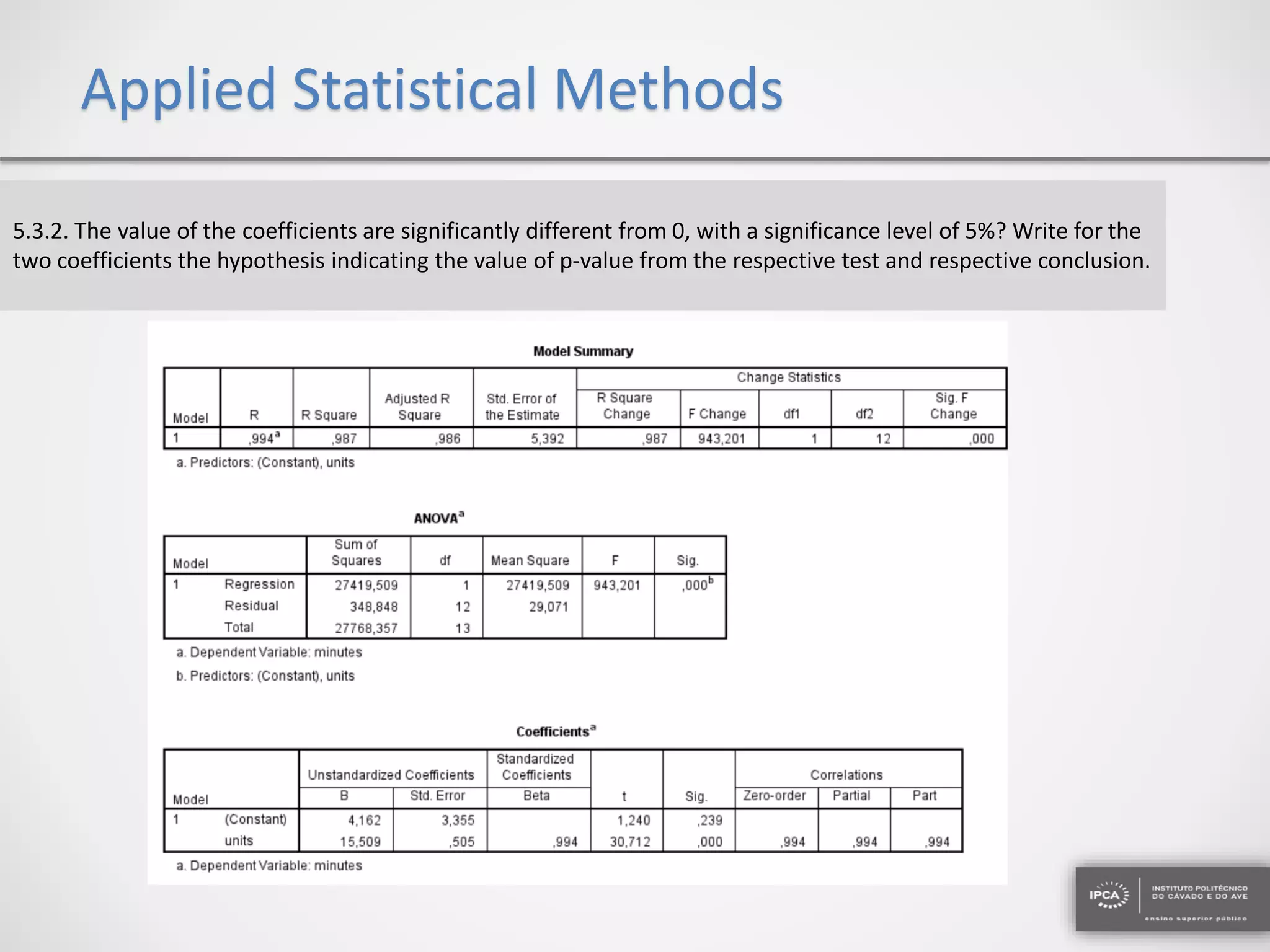
5.3.2. The value of the coefficients are significantly different from 0, with a significance level of 5%? Write for the
two coefficients the hypothesis indicating the value of p-value from the respective test and respective conclusion.
Applied Statistical Methods
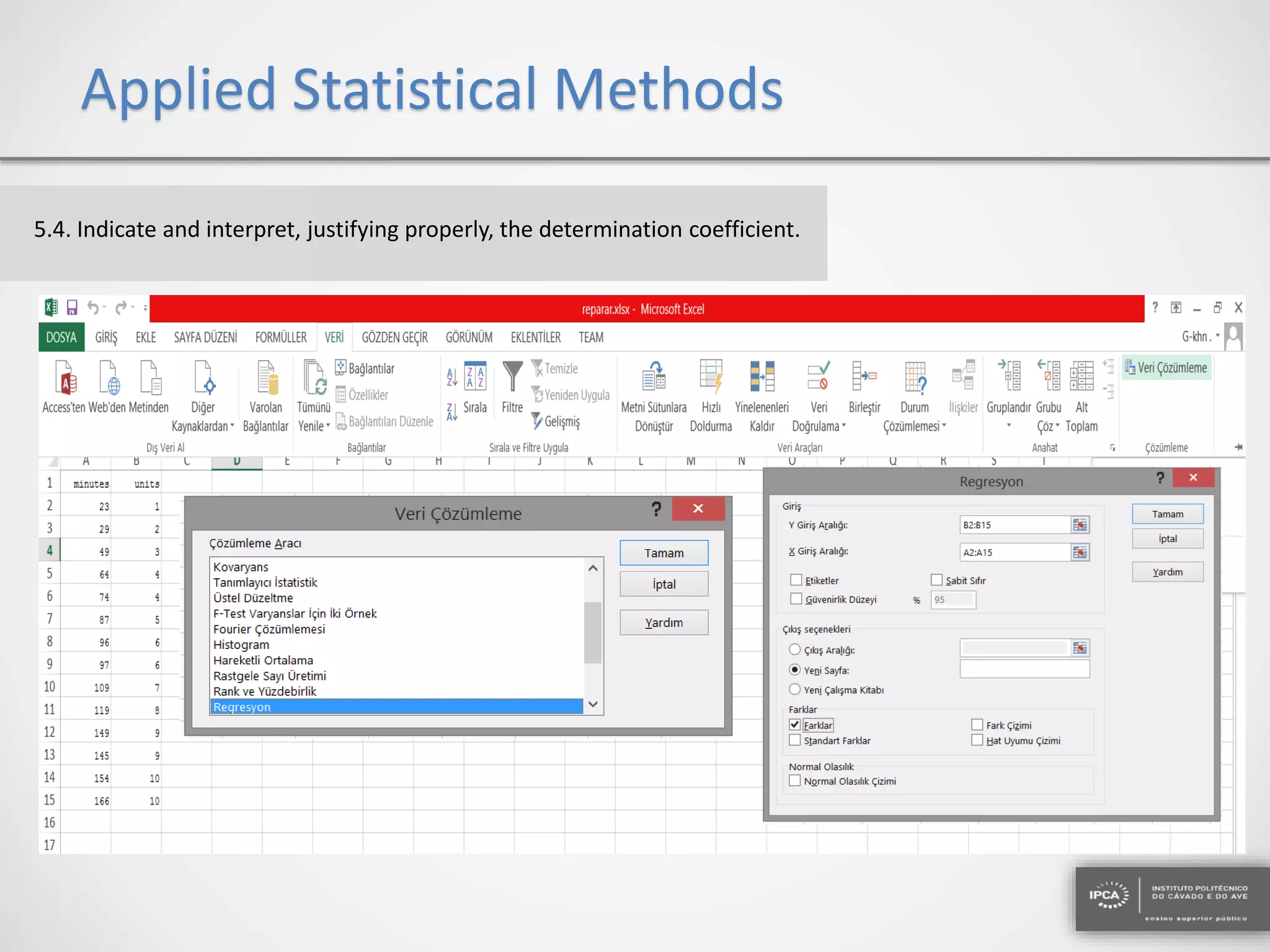
5.4. Indicate and interpret, justifying properly, the determination coefficient.
Description
5.1. Export the data to
SPSS and code correctly
the study variables. Build
a scatter diagram which
allows relating both
variables with the
intention to identify a
possible linear
relationship. Comment
the respective chart.
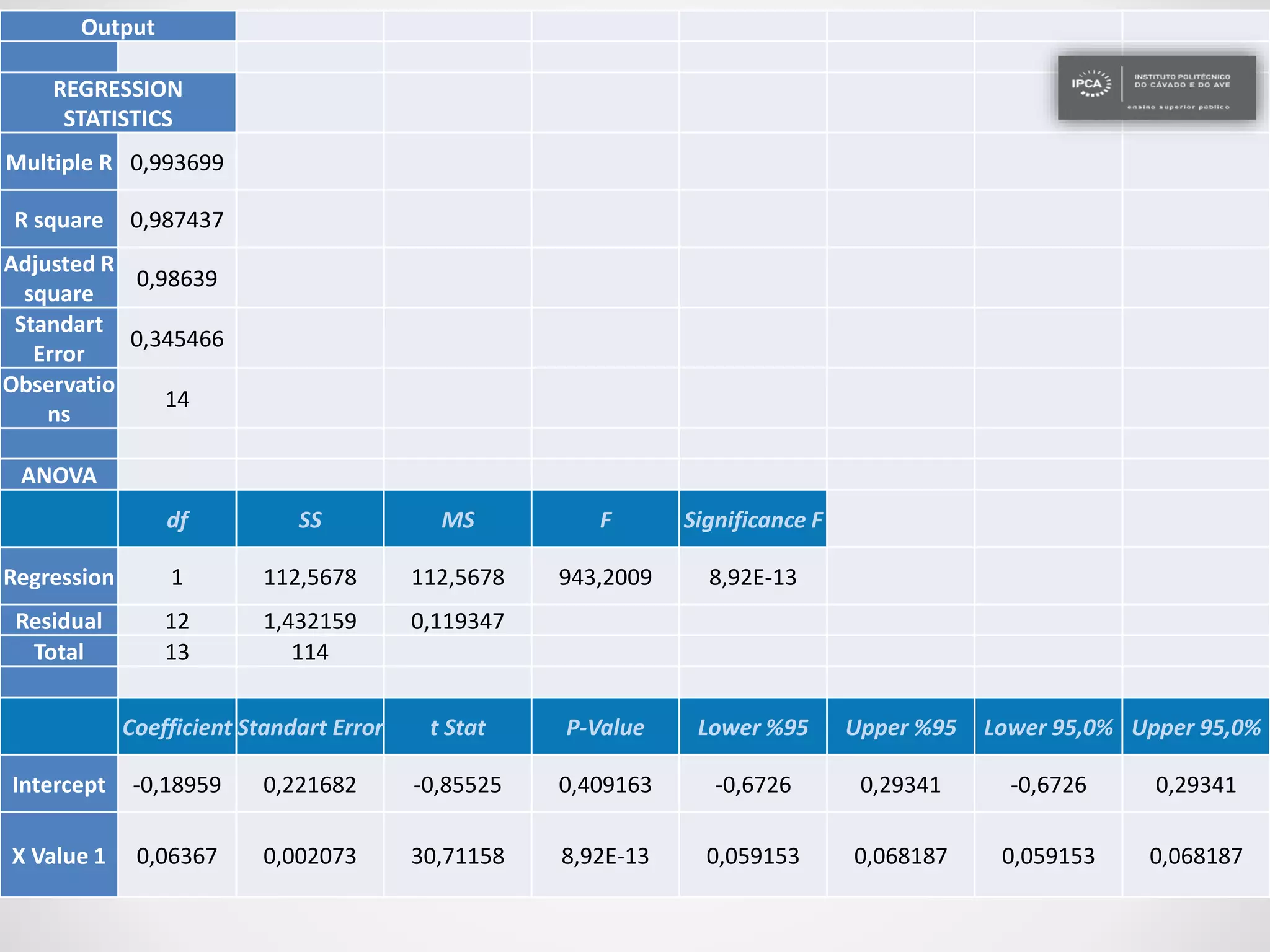
Output
REGRESSION
STATISTICS
Multiple R 0,993699
R square 0,987437
Adjusted R
square
0,98639
Standart
Error
0,345466
Observatio
ns
14
ANOVA
df SS MS F Significance F
Regression 1 112,5678 112,5678 943,2009 8,92E-13
Residual 12 1,432159 0,119347
Total 13 114
Coefficient Standart Error t Stat P-Value Lower %95 Upper %95 Lower 95,0% Upper 95,0%
Intercept -0,18959 0,221682 -0,85525 0,409163 -0,6726 0,29341 -0,6726 0,29341
X Value 1 0,06367 0,002073 30,71158 8,92E-13 0,059153 0,068187 0,059153 0,068187
Applied Statistical Methods
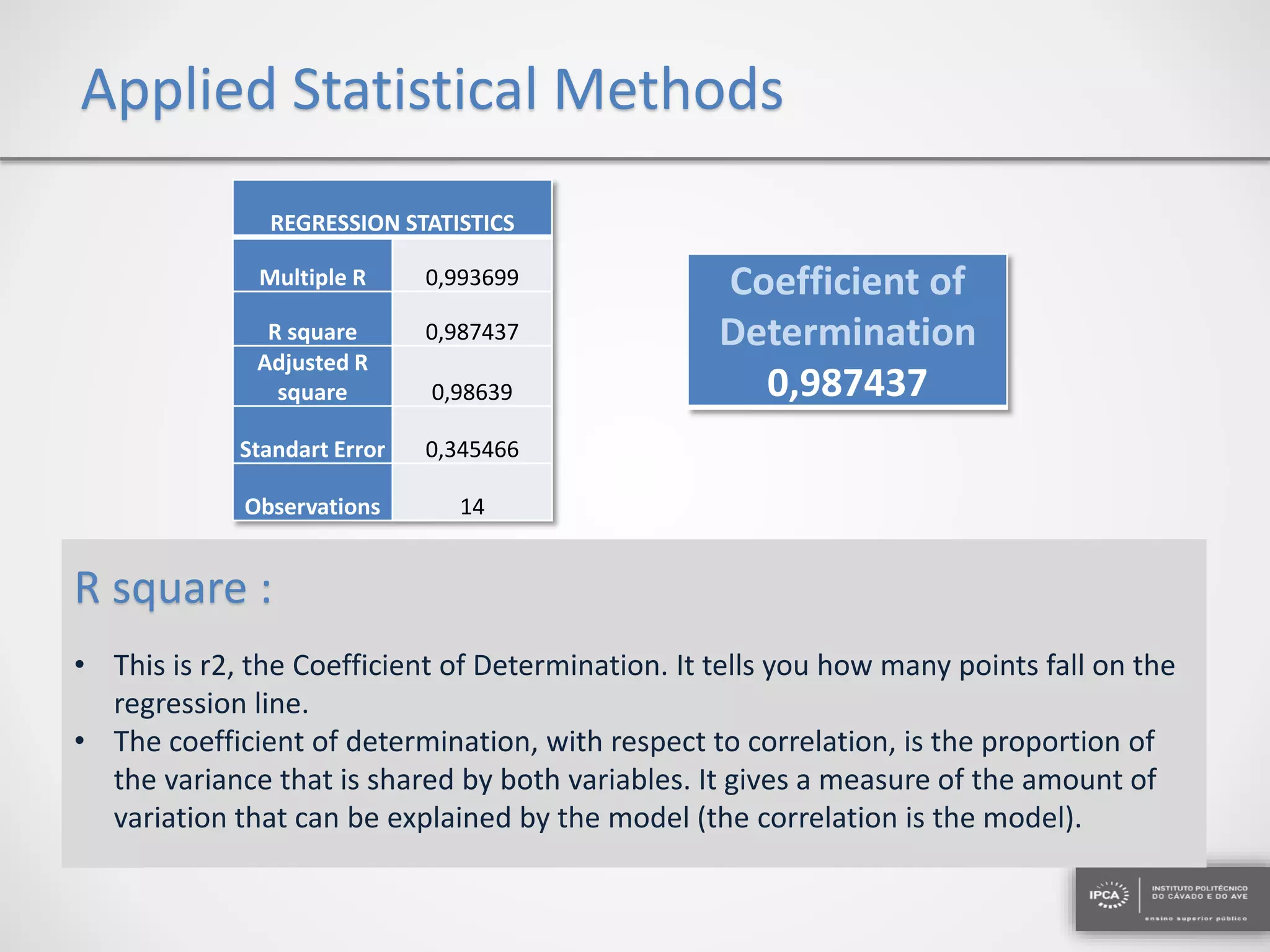
R square :
• This is r2, the Coefficient of Determination. It tells you how many points fall on the
regression line.
• The coefficient of determination, with respect to correlation, is the proportion of
the variance that is shared by both variables. It gives a measure of the amount of
variation that can be explained by the model (the correlation is the model).
REGRESSION STATISTICS
Multiple R 0,993699
R square 0,987437
Adjusted R
square 0,98639
Standart Error 0,345466
Observations 14
Coefficient of
Determination
0,987437
Tank You! Obrigado!
Teşekkür Ederim !
Estela Vilhena
Applied Statistic Method
Gökhan AYRANCIOGLU | a50236

Applied Statistical Methods - Question & Answer on SPSS

  • 1.
    gkhan.a.06@gmail.com & gkhanayrancioglu@gmail.com GökhanAYRANCIOGLU | a50236 Estela Vilhena Statistical Package for the Social Sciences SPSS
  • 2.
    Questions & Answer 1.The table bellow includes the data related with one competition
  • 3.
    Applied Statistical Methods 1.1Insert the data in one SPSS file and save it with the name Grupo4. (Codify accordingly the variables that you find necessary).
  • 4.
    Applied Statistical Methods 1.2Obtain one plot and one table of frequencies for the variable Team. Scatter Plot
  • 5.
  • 6.
    Applied Statistical Methods Tableof frequencies for the variable Team. Frequency : Contains the raw number results for how many people of team.
  • 7.
    Applied Statistical Methods hasgreater percentage of individual. • The «Percent» column represents the percentage of all cases, including the missing cases, constituted by each category • «Valid Percent» category presents the percentage of only the non-missing cases falling into each category. • The «cumulative percent», expresses an ongoing sum of the valid percents.
  • 8.
    Applied Statistical Methods 1.2.2What is the mode for the Team variable ?
  • 9.
    Applied Statistical Methods 1.2.2What is the mode for the Team variable ? Mode is ‘1.00’ (Team A) for Team veriable. Mean The mean is the total of the numbers divided by how many numbers there are. Median The median is the middle value. Mode The mode is the value that appears the most.
  • 10.
    Applied Statistical Methods 1.2.3What is the frequency of the individuals from Team D ? Team D Frequency Percent Valid Percent Cumulative Percent 3 15,0 15,0 100,00
  • 11.
    Applied Statistical Methods 1.3.Characterize the game score, calculating the value of the central tendency measurements. Interpret the results in the context of the problem . What is the standard deviation? Get also a histogram for the variable in question.
  • 12.
    Applied Statistical Methods Youcan see groupings of various types of statistics like central tendency and dispersion. Standard deviation is a measure of the spread of data around the mean value.
  • 13.
    Applied Statistical Methods Histogram Thepurpose is probability distribution of a given variable by depicting the frequencies of observations occurring in certain ranges of values
  • 14.
  • 15.
    Applied Statistical Methods 1.4Create in the way that you find more adequate , a new variable, ‘duraçãoemclasses’, based on the variable duration of the game, Creatinig the follow in groups: [150, 160 [, [ 160, 170[, [170, 180[, [ 180, 190[ e [ 19 0, 20 0[.
  • 16.
    Applied Statistical Methods Creatinigthe follow in groups: [150, 160 [, [ 160, 170[, [170, 180[, [ 180, 190[ e [ 19 0, 20 0[.
  • 17.
    Applied Statistical Methods 1.4Create in the way that you find more adequate , a new variable, ‘duraçãoemclasses’, based on the variable duration of the game, Creatinig the follow in groups: [150, 160 [, [ 160, 170[, [170, 180[, [ 180, 190[ e [ 19 0, 20 0[.
  • 18.
    Applied Statistical Methods 1.4.1. Build a table of frequencies and indicate the number of games with duration smaller than 180 minutes ? Indicate The number of games with duration smaller than 180 minutes :
  • 19.
    Applied Statistical Methods 1.4.2What is the percentage o f mess with the duration equal or higher than 160, but lower than 190 minutes? The percentage of mess with the duration equal or higher than 160, but lower than 190 minutes :
  • 20.
    Applied Statistical Methods 2.The file "Inqueritos.sav" contains 200 observations related to tests performed to students from higher education .
  • 21.
    Applied Statistical Methods 2.1Verify if you can consider that the grades of the reading and writing tests come from a Normal population. Properly justify your answer.
  • 22.
    Applied Statistical Methods 2.1Verify if you can consider that the grades of the reading and writing tests come from a Normal population. Properly justify your answer.
  • 23.
    Applied Statistical Methods 2.1Verify if you can consider that the grades of the reading and writing tests come from a Normal population. Properly justify your answer.
  • 24.
    Applied Statistical Methods Descriptivesfor writing score and reading score
  • 25.
    Applied Statistical Methods Description Thisis a sample text here. Insert your desired text here. This is a sample text.
  • 26.
    Applied Statistical Methods 2.1Perform a hypothesis test in order to as certain whether there is sufficient evidence to consider that the math average grade in the population is ignificantly different from 50, at a significance level of 5 %. One sample t-test is a statistical procedure often performed for testing the mean value of a distribution.
  • 27.
    2.1 Perform ahypothesis test in order to as certain whether there is sufficient evidence to consider that the math average grade in the population is ignificantly different from 50, at a significance level of 5 %.
  • 28.
    Applied Statistical Methods 2.3Check that the average scores of all disciplines vary with the type of school. List all necessary steps, properly justifying your answer. The independent-samples t-test (or independent t-test, for short) compares the means between two unrelated groups on the same continuous, dependent variable.
  • 29.
    Applied Statistical Methods 2.3Check that the average scores of all disciplines vary with the type of school. List all necessary steps, properly justifying your answer. Group Statistics table provides useful descriptive statistics for the two groups that you compared, including the mean and standard deviation.
  • 30.
    Applied Statistical Methods IndependentSamples Test Table This table provides the actual results from the independent t-test.
  • 31.
    Applied Statistical Methods 2.4Create a variable that reflects the average of the grades obtained in all tests, justifying your answer.
  • 32.
    Applied Statistical Methods 3. A and B are supplyers from an article to a processor company, that stores them in a container. It is known that 5% of the articles of A and 9% of items of B are defective, which is why the articles supplyed from company A are four times the articles suplyed by company B. It was chosen at random one of the articles of the container. A useful way of investigating probability problems is to use what are known as tree diagrams. Tree iagrams are a useful way of mapping out all possible outcomes for a given scenario. They are widely used in probability and are often referred to as probability trees. They are also used in decision analysis where they are referred to as decision trees. In the context of decision theory a complex series of choices are available with various different outcomes and we are looking for the bets of these under a given performance criterion such as maximising profit or minimising cost. Tree Diagrams References : Glasgow Caledonian University
  • 33.
    Applied Statistical Methods 3.1What is the probability that the article is defective? References : Glasgow Caledonian University
  • 34.
    Applied Statistical Methods References: Glasgow Caledonian University 3.2 Knowing that the article is defective, what is the probability of being supplied by company A?
  • 35.
    Applied Statistical Methods 5.Certain company, dedicated to the commercialization and repair of computers expressed an interest in studying the relationship between the duration of a repair service and the number of electronic components to be repaired or replaced on a computer. This company has been registering computer repair times (in minutes) and the respective number of failed components. The obtained data collection is in repararxls.
  • 36.
  • 37.
    Applied Statistical Methods 5.1.Export the data to SPSS and code correctly the study variables. Build a scatter diagram which allows relating both variables with the intention to identify a possible linear relationship. Comment the respective chart.
  • 38.
    5.1. Export thedata to SPSS and code correctly the study variables. Build a scatter diagram which allows relating both variables with the intention to identify a possible linear relationship. Comment the respective chart.
  • 39.
    Applied Statistical Methods 5.1.Export the data to SPSS and code correctly the study variables. Build a scatter diagram which allows relating both variables with the intention to identify a possible linear relationship. Comment the respective chart.
  • 40.
    Applied Statistical Methods 5.2.Establish the model to fit the data.
  • 41.
    Applied Statistical Methods Explanation 5.2.Establish the model to fit the data. Model Summary This section shows you the relationship between the two variables (R).
  • 42.
    Applied Statistical Methods 5.2.Establish the model to fit the data. This section shows you the p-value (“sig” for “significance”) of the predictors effect on the criterion variable. P-values less than .05 are generally considered “statistically significant.” Explanation
  • 43.
    Applied Statistical Methods 5.2.Establish the model to fit the data. • This section shows you the beta coefficients for the actual regression equation. Usually, you want the “unstandardized coefficients,” because this section includes a y-intercept term (beta zero) as well as a slope term (beta one). • The “standardized coefficients” are based on a re-scaling of the variables so that the y-intercept is equal to zero. Explanation
  • 44.
    Applied Statistical Methods 5.3Based on the obtained results, answer to the following questions: 5.3.1. Which are the estimates of b1 and b0 of the regression line? What is the equation of the regression line? Estimates of b1 =
  • 45.
    Applied Statistical Methods 5.3.1.Which are the estimates of b1 and b0 of the regression line? What is the equation of the regression line? Explanation The Coefficients part of the output gives us the values that we need in order to write the regression equation. The regression equation will take the form: Predicted variable (dependent variable) = slope * independent variable + intercept 15,509 * 1 + 4,162 =
  • 46.
    Applied Statistical Methods 5.3.2.The value of the coefficients are significantly different from 0, with a significance level of 5%? Write for the two coefficients the hypothesis indicating the value of p-value from the respective test and respective conclusion.
  • 47.
    Applied Statistical Methods 5.4.Indicate and interpret, justifying properly, the determination coefficient.
  • 48.
    Description 5.1. Export thedata to SPSS and code correctly the study variables. Build a scatter diagram which allows relating both variables with the intention to identify a possible linear relationship. Comment the respective chart. Output REGRESSION STATISTICS Multiple R 0,993699 R square 0,987437 Adjusted R square 0,98639 Standart Error 0,345466 Observatio ns 14 ANOVA df SS MS F Significance F Regression 1 112,5678 112,5678 943,2009 8,92E-13 Residual 12 1,432159 0,119347 Total 13 114 Coefficient Standart Error t Stat P-Value Lower %95 Upper %95 Lower 95,0% Upper 95,0% Intercept -0,18959 0,221682 -0,85525 0,409163 -0,6726 0,29341 -0,6726 0,29341 X Value 1 0,06367 0,002073 30,71158 8,92E-13 0,059153 0,068187 0,059153 0,068187
  • 49.
    Applied Statistical Methods Rsquare : • This is r2, the Coefficient of Determination. It tells you how many points fall on the regression line. • The coefficient of determination, with respect to correlation, is the proportion of the variance that is shared by both variables. It gives a measure of the amount of variation that can be explained by the model (the correlation is the model). REGRESSION STATISTICS Multiple R 0,993699 R square 0,987437 Adjusted R square 0,98639 Standart Error 0,345466 Observations 14 Coefficient of Determination 0,987437
  • 50.
    Tank You! Obrigado! TeşekkürEderim ! Estela Vilhena Applied Statistic Method Gökhan AYRANCIOGLU | a50236