UNDERSTANDING 
DATA 
By Kingsley Idehen 
Founder & CEO, OpenLink Software
Presentation Goals 
Deconstruct Data 
Understand Data Representation 
Understand Data Access 
Understand Data Integration 
License CC-BY-SA 4.0 (International).
SITUATION ANALYSIS 
License CC-BY-SA 4.0 (International).
EVERY DAY WE HEAR 
License CC-BY-SA 4.0 (International). 
DATA IS 
BIG 
DATA IS 
OPEN 
DATA IS 
LINKED
WE ALMOST NEVERHEAR ABOUT 
License CC-BY-SA 4.0 (International). 
WHAT DATA 
ACTUALLY IS 
HOW DATA IS 
REPRESENTED 
HOW DATA IS 
ACCESSED, 
SHARED, 
& INTEGRATED
Why is Data Important? 
Data is the basis of 
Information, Knowledge, and Wisdom. 
WISDOM 
KNOWLEDGE 
INFORMATION 
DATA 
License CC-BY-SA 4.0 (International).
What is Data? 
Data is how we 
express Observation 
in reusable form. 
License CC-BY-SA 4.0 (International).
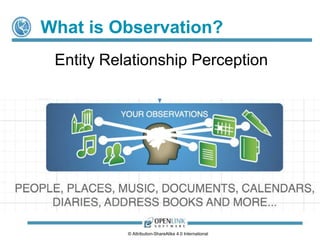
What is Observation? 
Observation is the Perception of 
Relationships between Entities. 
YOUR OBSERVATIONS 
PEOPLE, PLACES, MUSIC, DOCUMENTS, CALENDARS, 
DIARIES, ADDRESS BOOKS & MORE... 
License CC-BY-SA 4.0 (International).
What is an Entity? 
An Entity is a Distinctly Identifiable Thing 
License CC-BY-SA 4.0 (International).
How is an Entity Identified (Named) ? 
An Entity is Identified (or named) through the combined effects of 
Identifier based denotation (signification) and document content 
based connotation (description). 
License CC-BY-SA 4.0 (International).
How is an Entity Denoted? 
An Entity is Denoted (Signified) 
through the use of an Identifier. 
License CC-BY-SA 4.0 (International).
What is an Identifier? 
An Identifier is a Sign 
(or Token) that Signifies 
(Denotes, or 
“Stands For”) an Entity 
License CC-BY-SA 4.0 (International).
Identifier Types? 
Quoted Literals such as: 
“Kingsley Idehen” or ‘Kingsley Idehen’ 
Absolute References: 
<http://kingsley.idehen.net/dataspace/person/kidehen#this> 
Relative References: 
<#KingsleyIdehen> 
License CC-BY-SA 4.0 (International).
How is an Entity Described? 
Through entity relationships that are 
represented in reusable form via document 
content (sentences and statements). 
License CC-BY-SA 4.0 (International).
What is a Relationship? 
A Relationship is an Association 
between two or more Entities, 
where each has a specific Role. 
License CC-BY-SA 4.0 (International).
What is a Relationship Role? 
A Relationship Role is a 
Function performed by an Entity 
in a Relationship 
License CC-BY-SA 4.0 (International).
Relationship Role Types? 
• Entity Attribute Value EAV 
 Entity -- observation focal point 
 Attribute -- observation attribute name 
(relationship type determinant) 
 Value -- observation attribute value 
• RDF (WC3’s Resource Description Framework) 
 Subject -- observation focal point 
 Predicate -- observation attribute name 
(relationship type determinant) 
 Object -- observation attribute value 
License CC-BY-SA 4.0 (International).
Relationship Role: Predicate 
The Relationship Predicate is the Connector that 
associates an observation focal point (Subject) with 
something, in the form of an observation value (Object). 
License CC-BY-SA 4.0 (International).
Relationship Role: Subject 
Actual Entity being Observed 
License CC-BY-SA 4.0 (International).
Relationship Role: Object 
Value associated 
with an observation focal point (Subject) 
via a Relationship Predicate. 
License CC-BY-SA 4.0 (International).
Types of Values? 
• Untyped Literals (Strings) 
• Typed Literals 
 Numbers 
 Dates 
 Booleans 
 Etc. 
• References (Local and Global Hyperlinks) 
License CC-BY-SA 4.0 (International).
How are Relationships Expressed? 
Relationships are Expressed using a Language, 
i.e., a system of signs [for denotation], syntax 
[arrangement of signs to form sentences], and entity 
relation semantics [meaning of relationship roles] for 
encoding and decoding information. 
Example: 
Subject, Predicate, Object – 
Used by W3C’s Resource Description Framework (RDF) 
and Natural Language. 
License CC-BY-SA 4.0 (International).
How Are Entity Relationships Represented ? 
Entity Relationships are Represented using notations 
associated with a specific language. Examples 
include: 
• Entity Relationship Model (Network /Graph) 
Diagrams. 
• Tables (CSV files, Spreadsheets, and SQL Relational 
Database Management Systems). 
• RDF-Turtle, JSON-LD, RDF/XML, HTML+Microdata, 
HTML+RDFa etc.. 
License CC-BY-SA 4.0 (International).
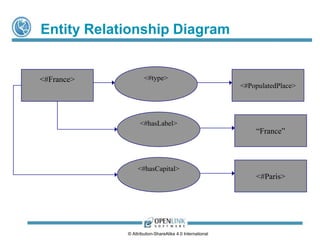
Entity Relationship Diagram 
<#hasCapital> 
License CC-BY-SA 4.0 (International). 
<#PopulatedPlace> 
“France” 
<#Paris> 
<#type> 
<#hasLabel> 
<#France>
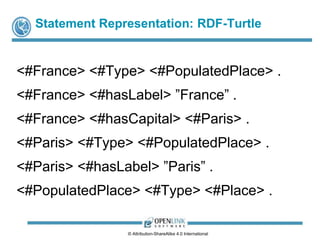
Turtle Notation Based Entity Relationship Statements 
<#France> <#Type> <#PopulatedPlace> . 
<#France> <#hasLabel> ”France” . 
<#France> <#hasCapital> <#Paris> . 
<#Paris> <#Type> <#PopulatedPlace> . 
<#Paris> <#hasLabel> ”Paris” . 
<#PopulatedPlace> <#Type> <#Place> . 
License CC-BY-SA 4.0 (International).
Entity Relationship Tables 
Delimiter: e.g., Comma 
Identifier Quote Character: Double-quotes 
Relation Header Row: Entity,Attribute,Value 
Relation Body 
Example: 
“Entity”, “Attribute” “Value” 
“France”, “Type” “PopulatedPlace” 
“France” , “hasLabel” “France” 
“France” , “hasCapital” “Paris” 
License CC-BY-SA 4.0 (International).
Statement Representation: Spreadsheet Tables 
Entity (Subject) Attribute (Predicate) Value (Object) 
#France #Type #PopulatedPlace 
#France #hasLabel “France” 
#France #hasCapital #Paris 
#Paris #Type #PopulatedPlace 
#Paris #hasLabel “Paris” 
#PopulatedPlace #Type #Place 
License CC-BY-SA 4.0 (International).
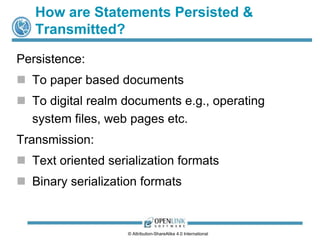
How are Statements Persisted & Transmitted? 
• Persistence: 
 To paper based documents 
 To digital realm documents 
(e.g., operating system files, web pages, etc.) 
• Transmission: 
 Text oriented serialization formats 
 Binary serialization formats 
License CC-BY-SA 4.0 (International).
Understanding Data (Recap) 
• The term “Data” refers to observation 
expressed in reusable form. 
• The term “Observation” refers to our 
perception of Entity Relationships. 
• Entity Relationships are expressed 
using a language. 
• Statements are represented using 
a variety of notations; persisted to paper 
or digital documents; and transmissible 
using a variety of serialization formats. 
License CC-BY-SA 4.0 (International).
DATA ACCESS 
License CC-BY-SA 4.0 (International).
Fundamental Challenge 
Access to Data Independent of: 
• Location 
(File or Database Management System) 
• Representation Notation 
• Serialization Format 
• Transmission Protocol 
• Host Operating Systems 
• Consumer Applications 
License CC-BY-SA 4.0 (International).
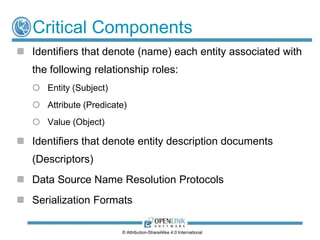
Critical Components 
• Identifiers that denote (signify) each entity associated with the 
following relationship roles: 
 Entity (Subject) 
 Attribute (Predicate) 
 Value (Object) 
• Identifiers that denote entity description documents 
(Descriptors) 
• Identifiers that provide entity naming (identification) via 
implicit or explicit [denotation]  [description document 
content] resolution using indirection (i.e., combined effect of 
denotation & connotation to deliver identification or sense) 
• Name Resolution Protocols 
• Document Content Serialization Formats 
License CC-BY-SA 4.0 (International).
Entity Identifiers (Names) 
Uniform Resource Identifier (URI) 
<http://kingsley.idehen.net/dataspace/person/kidehen#this> 
– WebID (i.e., an HTTP URI that denotes an Entity of Type: Agent 
(Person, Organization, Software, Robot etc) 
ODBC Data Source Name (DSN) 
DSN=CRM 
JDBC Data Source Name (DSN) 
DSN=CRM 
License CC-BY-SA 4.0 (International).
Entity Description Document Locators 
• Uniform Resource (Data) Locator (URL) 
o <http://kingsley.idehen.net/dataspace/person/kidehen> – an HTTP URI that denotes a 
Document on an HTTP Network 
• ODBC Data Source Name 
o DSN=CRM;HOST=crm.example.org;SVT=Oracle;DATABASE=CRM;TABLE=CUSTOMER – 
denotes an ODBC accessible Table in a SQL RDBMS 
• JDBC Data Source URL 
o jdbc:openlink://crm.example.org/SVT=Oracle/DATABASE=CRM/TABLE=CUSTOMER – 
denotes a JDBC accessible Table in a SQL RDBMS 
License CC-BY-SA 4.0 (International).
ODBC Data Source Name Challenges 
• SQL Relational Database Specific. 
• Identifiers are x.500 names that are only 
understood by operating system locked 
applications. 
• Identifiers denote RDBMS specific tables, views, 
users, and stored procedures. 
License CC-BY-SA 4.0 (International).
JDBC Data Source Name Challenges 
• SQL Relational Database Specific. 
• Identifiers are “jdbc:” scheme URIs that are only 
understood by JDBC compliant applications 
constrained by Java Virtual Machine (JVM). 
• Identifiers denote RDBMS specific tables, views, 
users, and stored procedures. 
License CC-BY-SA 4.0 (International).
HTTP URI based Data Source Name Virtues 
• Database Engine Independent. 
• Data Access Protocol Independent. 
• Data Representation Format Independent. 
• Identifiers are Literals and/or References 
(which globalize lookup scope). 
• Identifiers denote anything, i.e., an kind of entity. 
• Identifiers are “terms” that resolve to referent 
description documents, globally. 
License CC-BY-SA 4.0 (International).
Data Source Name Resolution Protocols 
• Internet based Computer Network – 
Domain Name Services (DNS) protocol 
provides Name Resolution for Computers. 
• World Wide Web Document Network – 
HTTP provides Name Resolution for Web 
Documents via HTTP URLs. 
• World Wide Web Data Network – 
HTTP provides Name Resolution for 
Entities via HTTP URIs . 
License CC-BY-SA 4.0 (International).
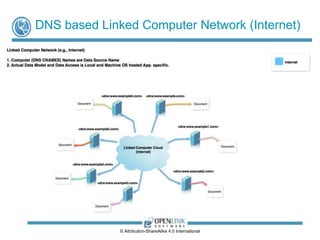
DNS based Linked Computer Network (Internet) 
Linked Computer Network (e.g., Internet) 
1. Computer (DNS CNAMES) Names are Data Source Name 
2. Actual Data Model and Data Access is Local and Machine OS hosted App. specific. 
License CC-BY-SA 4.0 (International). 
Internet
HTTP based Linked Document Network (Web 1.0 & 2.0) 
Linked Document Network (e.g., World Wide Web) 
1. Computer (DNS CNAMES) Names become irrelevant. 
2. Document Locators / Addresses (HTTP URLs) are Data Source Names (DSNs). 
3. One kind of Relation i.e., "LinksTo" is what connects the Documents. 
4. To machines: actual Data Model, Entity Relation Semantics, and Representation Notations are 
indecipherable from content. 
Internet 
Web 
License CC-BY-SA 4.0 (International).
HTTP based Linked Data Network (Web 3.0) 
Linked Data Network (e.g., Linked Open Data Cloud) 
1. Entity Names (HTTP URIs) are Data Source Names (DSNs) 
2. Computer (DNS CNAMES) & Document Names (HTTP URLs) become irrelevant 
3. Actual Data Model and Representation Notations are loosely coupled. 
License CC-BY-SA 4.0 (International). 
Internet 
Web 
Linked Data
LINKED DATA 
(WEBBY STRUCTURED DATA) 
License CC-BY-SA 4.0 (International).
Linked Data Fundamentals 
• Denote (“refer to” or name) entities unambiguously using URIs 
– similar to the role of “words” in natural language. 
• Use HTTP URIs so that the description of any entity can be 
looked up using any HTTP user agent – similar to the role of 
“terms “ in natural language. 
• Use human and machine readable statements 
(via open standards e.g., RDF) to create document content that 
describes entities. 
• Refer to other entities using their HTTP URI based names in 
your entity description documents – i.e., – expand the Web! 
License CC-BY-SA 4.0 (International).
Understanding HTTP URI Entity Name and 
Description Doc Address Duality 
An HTTP URI is a kind of 
identifier that denotes 
(“Refers To”) 
an entity while also 
resolving to its 
description document, 
over an HTTP Network. 
License CC-BY-SA 4.0 (International).
What is Linked Data? 
Linked Data is the use of Resolvable URIs 
to enhance Structured Data Representation. 
Basically: 
Representing Entity Relationships using Statements 
where the relationship role participants 
[Subject, Predicate, and Object (optionally)] 
are unambiguously “referred to” using Resolvable URIs. 
License CC-BY-SA 4.0 (International).
What is Linked Open Data? 
Linked Open Data is the use of HTTP URIs 
to enhance Structured Data Representation. 
Basically: 
Representing Entity Relationships using Statements 
where the relationship role participants 
[Subject, Predicate, and Object (optionally)] 
are unambiguously “referred to” using HTTP URIs. 
Note: URIs and HTTP are Open Standards 
License CC-BY-SA 4.0 (International).
Why is Linked Open Data Important? 
• It turns HTTP URIs (Hyperlinks) into Data Source Names. 
• It moves us from Open Database Connectivity to Open 
Data Connectivity – that scales from Private Data 
Spaces to the World Wide Web. 
• It delivers a powerful mechanism for virtualization of 
disparate and heterogeneous data sources (big or 
small) i.e., Data De-Silo-Fication. 
• It is inherently Platform Agnostic. 
• It delivers a Linked Open Data Cloud that scales to the 
World Wide Web. 
License CC-BY-SA 4.0 (International).
What is RDF based Linked Data? 
RDF-based Linked Data is the use of IRIs 
and Entity Relationship Type (aka. Relations) Semantics to 
enhance Structured Data Representation. 
Basically: 
Representing Entity Relationships using Statements 
where the relationship role participants 
[Subject, Predicate, and Object (optionally)] 
are unambiguously “referred to” using IRIs. 
Note: RDF and IRIs are Open Standards 
License CC-BY-SA 4.0 (International).
What is RDF based Linked Open Data? 
RDF-based Linked Open Data is the use of 
HTTP URIs & Entity Relationship Type (Relations) 
Semantics 
to enhance Structured Data Representation. 
Basically: 
Representing Entity Relationships and 
Relation Semantics using Statements 
where the relationship role participants 
[Subject, Predicate, and Object (optionally)] 
are unambiguously “referred to” using HTTP URIs. 
Note: RDF, HTTP and URIs are Open Standards 
License CC-BY-SA 4.0 (International).
What is RDF based Linked Data? 
RDF-based Linked Data is 
Web-Like Structured Data 
enhanced with RDF’s 
*explicit* machine-and 
human-comprehensible 
Entity Relationship 
Semantics. 
Identifiers, Structured Data Representation, and Logic 
License CC-BY-SA 4.0 (International). 
Linked 
Data 
RDF 
Predicate Logic 
(Entity Relationship 
Semantics)
RDF based Linked Open Data (Semantic Web) 
Semantically Enhanced Linked Data Network 
(e.g., Semantic Web of Big Linked Open Data) 
License CC-BY-SA 4.0 (International). 
Internet 
Web 
Linked Data 
Relation 
1. Entity Names (HTTP URIs) are Semantics 
Data Source Names (DSNs) 
2. Computer (DNS CNAMES) 
& Document Names (HTTP 
URLs) become irrelevant 
3. Actual Data Model and 
Representation Notations 
are loosely coupled 
4. RDF & RDF Schema Relation 
Semantics 
are accessible and 
comprehendible to 
humans and machines.
Local Linked Data (Inaccessible) 
Entity (Subject) Attribute (Predicate) Value (Object) 
urn:data:object:id:France urn:data:object:id:Type urn:data:object:id:Popula 
tedPlace 
urn:data:object:id:France urn:data:object:id:hasLabel “France” 
urn:data:object:id:France urn:data:object:id:hasCapital urn:data:object:id:Paris 
urn:data:object:id:Paris urn:data:object:id:Type urn:data:object:id:Popula 
tedPlace 
urn:data:object:id:Paris urn:data:object:id:hasLabel “Paris” 
urn:data:object:id:Populate 
dPlace 
urn:data:object:id:Type urn:data:object:id:Place 
License CC-BY-SA 4.0 (International).
Linked Data (Accessible Webby Data) 
Entity (Subject) Attribute (Predicate) Value (Object) 
http://dbpedia.org/resource/France 
http://www.w3.org/1999/02/22-rdf-syntax- 
ns#type 
http://dbpedia.org/ontology/Popula 
tedPlace 
http://dbpedia.org/resource/France 
http://www.w3.org/2000/01/rdf-schema# 
label 
“France” 
http://dbpedia.org/resource/France http://dbpedia.org/ontology/capital http://dbpedia.org/resource/Paris 
http://dbpedia.org/resource/Paris 
http://www.w3.org/1999/02/22-rdf-syntax- 
ns#type 
http://dbpedia.org/ontology/Popula 
tedPlace 
http://dbpedia.org/resource/Paris 
http://www.w3.org/2000/01/rdf-schema# 
label 
“Paris” 
http://dbpedia.org/ontology/Popula 
tedPlace 
http://www.w3.org/2000/01/rdf-schema# 
subClassOf 
http://dbpedia.org/ontology/Place 
License CC-BY-SA 4.0 (International).
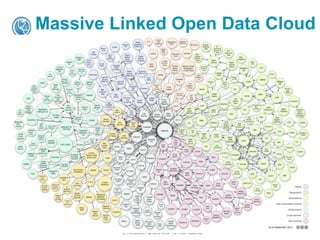
Massive Linked Open Data Cloud 
License CC-BY-SA 4.0 (International).
NATURAL LANGUAGE & DATA 
“Natural Languages are the most sophisticated systems of 
communication ever developed.” – John F. Sowa 
“Once you have a truly massive amount of information 
integrated as knowledge, then the human-software system 
will be superhuman, in the same sense that mankind with 
writing is superhuman compared to mankind before 
writing.” – Douglas Lenat 
License CC-BY-SA 4.0 (International).
Natural Language & Data 
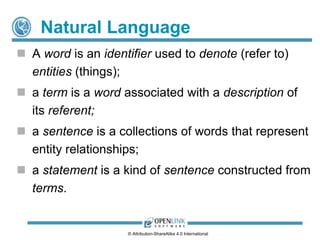
• A Word or Phrase is an identifier that names an Entity (thing) via 
implicit [denotation][referent description document content] 
resolution 
• A Term is a Word or Phrase that names an Entity via explicit, 
[denotation][referent description document content] 
resolution, using indirection. 
• A Sentence is a syntax rules constrained arrangement of Words 
and Phrases that represent types of Entity Relationships. 
• A Statement is a kind of Sentence constructed from Terms. 
License CC-BY-SA 4.0 (International).
Data (Recap) 
• A IRI is an Internationalized Identifier that has the entity naming 
characteristics of a Word or Phrase. 
• An HTTP URI is a kind of IRI that has the entity naming 
characteristics of a Term i.e., denotation (signification) and 
connotation (description) reference duality. 
• RDF enables digital sentence construction where IRIs are used to 
name Entities participating in the Subject, Predicate, and Object 
relationship roles. 
• RDF based Linked Data enables digital statement construction 
where HTTP URIs are used to denote Entities participating in the 
Subject, Predicate, and Object relationship roles. 
License CC-BY-SA 4.0 (International).
Natural Language & Data Connection 
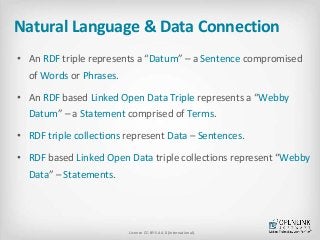
• An RDF triple represents a “Datum” – a Sentence compromised 
of Words or Phrases. 
• An RDF based Linked Open Data Triple represents a “Webby 
Datum” – a Statement comprised of Terms. 
• RDF triple collections represent Data – Sentences. 
• RDF based Linked Open Data triple collections represent “Webby 
Data” – Statements. 
License CC-BY-SA 4.0 (International).
Live Additional Information Links 
An Glossary of terms, in Linked Data form: 
• Data 
• Big Data 
• Open Data 
• Public Open Data 
• Linked Data 
• Linked Open Data 
• Semantic Web 
• Resource Description Framework (RDF) 
License CC-BY-SA 4.0 (International).
References 
• The Role of Logic and Ontology in Language and 
Reasoning --- John F. Sowa 
• Blogic – Pat Hayes 
• Unified View of Data – Peter Chen 
• Levels of Abstraction: Net, Web, Graph – Tim Berners- 
Lee 
• What is Data? What is a Datum – Ontolog Forum 
Thread 
• Data & Relations – Ontolog Forum Thread. 
License CC-BY-SA 4.0 (International).
Additional Information 
Web Sites 
OpenLink Software 
YouID – Digital Identity Card (Certificate) Generator 
OpenLink Data Spaces – Semantically enhanced Personal & Enterprise Data Spaces & 
Collaboration Platform 
OpenLink Virtuoso - Hybrid Data Management, Integration, Application, and Identity Server 
Universal Data Access Drivers - High-Performance ODBC, JDBC, ADO.NET, and OLE-DB 
Drivers 
Social Media Data spaces 
http://kidehen.blogspot.com (weblog) 
http://www.openlinksw.com/blog/~kidehen/ (weblog) 
https://plus.google.com/112399767740508618350/posts (Google+) 
https://twitter.com/#!/kidehen (Twitter) 
Hashtag: #LinkedData (Anywhere). 
License CC-BY-SA 4.0 (International).

Understanding Data

  • 1.
    UNDERSTANDING DATA ByKingsley Idehen Founder & CEO, OpenLink Software
  • 2.
    Presentation Goals DeconstructData Understand Data Representation Understand Data Access Understand Data Integration License CC-BY-SA 4.0 (International).
  • 3.
    SITUATION ANALYSIS LicenseCC-BY-SA 4.0 (International).
  • 4.
    EVERY DAY WEHEAR License CC-BY-SA 4.0 (International). DATA IS BIG DATA IS OPEN DATA IS LINKED
  • 5.
    WE ALMOST NEVERHEARABOUT License CC-BY-SA 4.0 (International). WHAT DATA ACTUALLY IS HOW DATA IS REPRESENTED HOW DATA IS ACCESSED, SHARED, & INTEGRATED
  • 6.
    Why is DataImportant? Data is the basis of Information, Knowledge, and Wisdom. WISDOM KNOWLEDGE INFORMATION DATA License CC-BY-SA 4.0 (International).
  • 7.
    What is Data? Data is how we express Observation in reusable form. License CC-BY-SA 4.0 (International).
  • 8.
    What is Observation? Observation is the Perception of Relationships between Entities. YOUR OBSERVATIONS PEOPLE, PLACES, MUSIC, DOCUMENTS, CALENDARS, DIARIES, ADDRESS BOOKS & MORE... License CC-BY-SA 4.0 (International).
  • 9.
    What is anEntity? An Entity is a Distinctly Identifiable Thing License CC-BY-SA 4.0 (International).
  • 10.
    How is anEntity Identified (Named) ? An Entity is Identified (or named) through the combined effects of Identifier based denotation (signification) and document content based connotation (description). License CC-BY-SA 4.0 (International).
  • 11.
    How is anEntity Denoted? An Entity is Denoted (Signified) through the use of an Identifier. License CC-BY-SA 4.0 (International).
  • 12.
    What is anIdentifier? An Identifier is a Sign (or Token) that Signifies (Denotes, or “Stands For”) an Entity License CC-BY-SA 4.0 (International).
  • 13.
    Identifier Types? QuotedLiterals such as: “Kingsley Idehen” or ‘Kingsley Idehen’ Absolute References: <http://kingsley.idehen.net/dataspace/person/kidehen#this> Relative References: <#KingsleyIdehen> License CC-BY-SA 4.0 (International).
  • 14.
    How is anEntity Described? Through entity relationships that are represented in reusable form via document content (sentences and statements). License CC-BY-SA 4.0 (International).
  • 15.
    What is aRelationship? A Relationship is an Association between two or more Entities, where each has a specific Role. License CC-BY-SA 4.0 (International).
  • 16.
    What is aRelationship Role? A Relationship Role is a Function performed by an Entity in a Relationship License CC-BY-SA 4.0 (International).
  • 17.
    Relationship Role Types? • Entity Attribute Value EAV  Entity -- observation focal point  Attribute -- observation attribute name (relationship type determinant)  Value -- observation attribute value • RDF (WC3’s Resource Description Framework)  Subject -- observation focal point  Predicate -- observation attribute name (relationship type determinant)  Object -- observation attribute value License CC-BY-SA 4.0 (International).
  • 18.
    Relationship Role: Predicate The Relationship Predicate is the Connector that associates an observation focal point (Subject) with something, in the form of an observation value (Object). License CC-BY-SA 4.0 (International).
  • 19.
    Relationship Role: Subject Actual Entity being Observed License CC-BY-SA 4.0 (International).
  • 20.
    Relationship Role: Object Value associated with an observation focal point (Subject) via a Relationship Predicate. License CC-BY-SA 4.0 (International).
  • 21.
    Types of Values? • Untyped Literals (Strings) • Typed Literals  Numbers  Dates  Booleans  Etc. • References (Local and Global Hyperlinks) License CC-BY-SA 4.0 (International).
  • 22.
    How are RelationshipsExpressed? Relationships are Expressed using a Language, i.e., a system of signs [for denotation], syntax [arrangement of signs to form sentences], and entity relation semantics [meaning of relationship roles] for encoding and decoding information. Example: Subject, Predicate, Object – Used by W3C’s Resource Description Framework (RDF) and Natural Language. License CC-BY-SA 4.0 (International).
  • 23.
    How Are EntityRelationships Represented ? Entity Relationships are Represented using notations associated with a specific language. Examples include: • Entity Relationship Model (Network /Graph) Diagrams. • Tables (CSV files, Spreadsheets, and SQL Relational Database Management Systems). • RDF-Turtle, JSON-LD, RDF/XML, HTML+Microdata, HTML+RDFa etc.. License CC-BY-SA 4.0 (International).
  • 24.
    Entity Relationship Diagram <#hasCapital> License CC-BY-SA 4.0 (International). <#PopulatedPlace> “France” <#Paris> <#type> <#hasLabel> <#France>
  • 25.
    Turtle Notation BasedEntity Relationship Statements <#France> <#Type> <#PopulatedPlace> . <#France> <#hasLabel> ”France” . <#France> <#hasCapital> <#Paris> . <#Paris> <#Type> <#PopulatedPlace> . <#Paris> <#hasLabel> ”Paris” . <#PopulatedPlace> <#Type> <#Place> . License CC-BY-SA 4.0 (International).
  • 26.
    Entity Relationship Tables Delimiter: e.g., Comma Identifier Quote Character: Double-quotes Relation Header Row: Entity,Attribute,Value Relation Body Example: “Entity”, “Attribute” “Value” “France”, “Type” “PopulatedPlace” “France” , “hasLabel” “France” “France” , “hasCapital” “Paris” License CC-BY-SA 4.0 (International).
  • 27.
    Statement Representation: SpreadsheetTables Entity (Subject) Attribute (Predicate) Value (Object) #France #Type #PopulatedPlace #France #hasLabel “France” #France #hasCapital #Paris #Paris #Type #PopulatedPlace #Paris #hasLabel “Paris” #PopulatedPlace #Type #Place License CC-BY-SA 4.0 (International).
  • 28.
    How are StatementsPersisted & Transmitted? • Persistence:  To paper based documents  To digital realm documents (e.g., operating system files, web pages, etc.) • Transmission:  Text oriented serialization formats  Binary serialization formats License CC-BY-SA 4.0 (International).
  • 29.
    Understanding Data (Recap) • The term “Data” refers to observation expressed in reusable form. • The term “Observation” refers to our perception of Entity Relationships. • Entity Relationships are expressed using a language. • Statements are represented using a variety of notations; persisted to paper or digital documents; and transmissible using a variety of serialization formats. License CC-BY-SA 4.0 (International).
  • 30.
    DATA ACCESS LicenseCC-BY-SA 4.0 (International).
  • 31.
    Fundamental Challenge Accessto Data Independent of: • Location (File or Database Management System) • Representation Notation • Serialization Format • Transmission Protocol • Host Operating Systems • Consumer Applications License CC-BY-SA 4.0 (International).
  • 32.
    Critical Components •Identifiers that denote (signify) each entity associated with the following relationship roles:  Entity (Subject)  Attribute (Predicate)  Value (Object) • Identifiers that denote entity description documents (Descriptors) • Identifiers that provide entity naming (identification) via implicit or explicit [denotation]  [description document content] resolution using indirection (i.e., combined effect of denotation & connotation to deliver identification or sense) • Name Resolution Protocols • Document Content Serialization Formats License CC-BY-SA 4.0 (International).
  • 33.
    Entity Identifiers (Names) Uniform Resource Identifier (URI) <http://kingsley.idehen.net/dataspace/person/kidehen#this> – WebID (i.e., an HTTP URI that denotes an Entity of Type: Agent (Person, Organization, Software, Robot etc) ODBC Data Source Name (DSN) DSN=CRM JDBC Data Source Name (DSN) DSN=CRM License CC-BY-SA 4.0 (International).
  • 34.
    Entity Description DocumentLocators • Uniform Resource (Data) Locator (URL) o <http://kingsley.idehen.net/dataspace/person/kidehen> – an HTTP URI that denotes a Document on an HTTP Network • ODBC Data Source Name o DSN=CRM;HOST=crm.example.org;SVT=Oracle;DATABASE=CRM;TABLE=CUSTOMER – denotes an ODBC accessible Table in a SQL RDBMS • JDBC Data Source URL o jdbc:openlink://crm.example.org/SVT=Oracle/DATABASE=CRM/TABLE=CUSTOMER – denotes a JDBC accessible Table in a SQL RDBMS License CC-BY-SA 4.0 (International).
  • 35.
    ODBC Data SourceName Challenges • SQL Relational Database Specific. • Identifiers are x.500 names that are only understood by operating system locked applications. • Identifiers denote RDBMS specific tables, views, users, and stored procedures. License CC-BY-SA 4.0 (International).
  • 36.
    JDBC Data SourceName Challenges • SQL Relational Database Specific. • Identifiers are “jdbc:” scheme URIs that are only understood by JDBC compliant applications constrained by Java Virtual Machine (JVM). • Identifiers denote RDBMS specific tables, views, users, and stored procedures. License CC-BY-SA 4.0 (International).
  • 37.
    HTTP URI basedData Source Name Virtues • Database Engine Independent. • Data Access Protocol Independent. • Data Representation Format Independent. • Identifiers are Literals and/or References (which globalize lookup scope). • Identifiers denote anything, i.e., an kind of entity. • Identifiers are “terms” that resolve to referent description documents, globally. License CC-BY-SA 4.0 (International).
  • 38.
    Data Source NameResolution Protocols • Internet based Computer Network – Domain Name Services (DNS) protocol provides Name Resolution for Computers. • World Wide Web Document Network – HTTP provides Name Resolution for Web Documents via HTTP URLs. • World Wide Web Data Network – HTTP provides Name Resolution for Entities via HTTP URIs . License CC-BY-SA 4.0 (International).
  • 39.
    DNS based LinkedComputer Network (Internet) Linked Computer Network (e.g., Internet) 1. Computer (DNS CNAMES) Names are Data Source Name 2. Actual Data Model and Data Access is Local and Machine OS hosted App. specific. License CC-BY-SA 4.0 (International). Internet
  • 40.
    HTTP based LinkedDocument Network (Web 1.0 & 2.0) Linked Document Network (e.g., World Wide Web) 1. Computer (DNS CNAMES) Names become irrelevant. 2. Document Locators / Addresses (HTTP URLs) are Data Source Names (DSNs). 3. One kind of Relation i.e., "LinksTo" is what connects the Documents. 4. To machines: actual Data Model, Entity Relation Semantics, and Representation Notations are indecipherable from content. Internet Web License CC-BY-SA 4.0 (International).
  • 41.
    HTTP based LinkedData Network (Web 3.0) Linked Data Network (e.g., Linked Open Data Cloud) 1. Entity Names (HTTP URIs) are Data Source Names (DSNs) 2. Computer (DNS CNAMES) & Document Names (HTTP URLs) become irrelevant 3. Actual Data Model and Representation Notations are loosely coupled. License CC-BY-SA 4.0 (International). Internet Web Linked Data
  • 42.
    LINKED DATA (WEBBYSTRUCTURED DATA) License CC-BY-SA 4.0 (International).
  • 43.
    Linked Data Fundamentals • Denote (“refer to” or name) entities unambiguously using URIs – similar to the role of “words” in natural language. • Use HTTP URIs so that the description of any entity can be looked up using any HTTP user agent – similar to the role of “terms “ in natural language. • Use human and machine readable statements (via open standards e.g., RDF) to create document content that describes entities. • Refer to other entities using their HTTP URI based names in your entity description documents – i.e., – expand the Web! License CC-BY-SA 4.0 (International).
  • 44.
    Understanding HTTP URIEntity Name and Description Doc Address Duality An HTTP URI is a kind of identifier that denotes (“Refers To”) an entity while also resolving to its description document, over an HTTP Network. License CC-BY-SA 4.0 (International).
  • 45.
    What is LinkedData? Linked Data is the use of Resolvable URIs to enhance Structured Data Representation. Basically: Representing Entity Relationships using Statements where the relationship role participants [Subject, Predicate, and Object (optionally)] are unambiguously “referred to” using Resolvable URIs. License CC-BY-SA 4.0 (International).
  • 46.
    What is LinkedOpen Data? Linked Open Data is the use of HTTP URIs to enhance Structured Data Representation. Basically: Representing Entity Relationships using Statements where the relationship role participants [Subject, Predicate, and Object (optionally)] are unambiguously “referred to” using HTTP URIs. Note: URIs and HTTP are Open Standards License CC-BY-SA 4.0 (International).
  • 47.
    Why is LinkedOpen Data Important? • It turns HTTP URIs (Hyperlinks) into Data Source Names. • It moves us from Open Database Connectivity to Open Data Connectivity – that scales from Private Data Spaces to the World Wide Web. • It delivers a powerful mechanism for virtualization of disparate and heterogeneous data sources (big or small) i.e., Data De-Silo-Fication. • It is inherently Platform Agnostic. • It delivers a Linked Open Data Cloud that scales to the World Wide Web. License CC-BY-SA 4.0 (International).
  • 48.
    What is RDFbased Linked Data? RDF-based Linked Data is the use of IRIs and Entity Relationship Type (aka. Relations) Semantics to enhance Structured Data Representation. Basically: Representing Entity Relationships using Statements where the relationship role participants [Subject, Predicate, and Object (optionally)] are unambiguously “referred to” using IRIs. Note: RDF and IRIs are Open Standards License CC-BY-SA 4.0 (International).
  • 49.
    What is RDFbased Linked Open Data? RDF-based Linked Open Data is the use of HTTP URIs & Entity Relationship Type (Relations) Semantics to enhance Structured Data Representation. Basically: Representing Entity Relationships and Relation Semantics using Statements where the relationship role participants [Subject, Predicate, and Object (optionally)] are unambiguously “referred to” using HTTP URIs. Note: RDF, HTTP and URIs are Open Standards License CC-BY-SA 4.0 (International).
  • 50.
    What is RDFbased Linked Data? RDF-based Linked Data is Web-Like Structured Data enhanced with RDF’s *explicit* machine-and human-comprehensible Entity Relationship Semantics. Identifiers, Structured Data Representation, and Logic License CC-BY-SA 4.0 (International). Linked Data RDF Predicate Logic (Entity Relationship Semantics)
  • 51.
    RDF based LinkedOpen Data (Semantic Web) Semantically Enhanced Linked Data Network (e.g., Semantic Web of Big Linked Open Data) License CC-BY-SA 4.0 (International). Internet Web Linked Data Relation 1. Entity Names (HTTP URIs) are Semantics Data Source Names (DSNs) 2. Computer (DNS CNAMES) & Document Names (HTTP URLs) become irrelevant 3. Actual Data Model and Representation Notations are loosely coupled 4. RDF & RDF Schema Relation Semantics are accessible and comprehendible to humans and machines.
  • 52.
    Local Linked Data(Inaccessible) Entity (Subject) Attribute (Predicate) Value (Object) urn:data:object:id:France urn:data:object:id:Type urn:data:object:id:Popula tedPlace urn:data:object:id:France urn:data:object:id:hasLabel “France” urn:data:object:id:France urn:data:object:id:hasCapital urn:data:object:id:Paris urn:data:object:id:Paris urn:data:object:id:Type urn:data:object:id:Popula tedPlace urn:data:object:id:Paris urn:data:object:id:hasLabel “Paris” urn:data:object:id:Populate dPlace urn:data:object:id:Type urn:data:object:id:Place License CC-BY-SA 4.0 (International).
  • 53.
    Linked Data (AccessibleWebby Data) Entity (Subject) Attribute (Predicate) Value (Object) http://dbpedia.org/resource/France http://www.w3.org/1999/02/22-rdf-syntax- ns#type http://dbpedia.org/ontology/Popula tedPlace http://dbpedia.org/resource/France http://www.w3.org/2000/01/rdf-schema# label “France” http://dbpedia.org/resource/France http://dbpedia.org/ontology/capital http://dbpedia.org/resource/Paris http://dbpedia.org/resource/Paris http://www.w3.org/1999/02/22-rdf-syntax- ns#type http://dbpedia.org/ontology/Popula tedPlace http://dbpedia.org/resource/Paris http://www.w3.org/2000/01/rdf-schema# label “Paris” http://dbpedia.org/ontology/Popula tedPlace http://www.w3.org/2000/01/rdf-schema# subClassOf http://dbpedia.org/ontology/Place License CC-BY-SA 4.0 (International).
  • 54.
    Massive Linked OpenData Cloud License CC-BY-SA 4.0 (International).
  • 55.
    NATURAL LANGUAGE &DATA “Natural Languages are the most sophisticated systems of communication ever developed.” – John F. Sowa “Once you have a truly massive amount of information integrated as knowledge, then the human-software system will be superhuman, in the same sense that mankind with writing is superhuman compared to mankind before writing.” – Douglas Lenat License CC-BY-SA 4.0 (International).
  • 56.
    Natural Language &Data • A Word or Phrase is an identifier that names an Entity (thing) via implicit [denotation][referent description document content] resolution • A Term is a Word or Phrase that names an Entity via explicit, [denotation][referent description document content] resolution, using indirection. • A Sentence is a syntax rules constrained arrangement of Words and Phrases that represent types of Entity Relationships. • A Statement is a kind of Sentence constructed from Terms. License CC-BY-SA 4.0 (International).
  • 57.
    Data (Recap) •A IRI is an Internationalized Identifier that has the entity naming characteristics of a Word or Phrase. • An HTTP URI is a kind of IRI that has the entity naming characteristics of a Term i.e., denotation (signification) and connotation (description) reference duality. • RDF enables digital sentence construction where IRIs are used to name Entities participating in the Subject, Predicate, and Object relationship roles. • RDF based Linked Data enables digital statement construction where HTTP URIs are used to denote Entities participating in the Subject, Predicate, and Object relationship roles. License CC-BY-SA 4.0 (International).
  • 58.
    Natural Language &Data Connection • An RDF triple represents a “Datum” – a Sentence compromised of Words or Phrases. • An RDF based Linked Open Data Triple represents a “Webby Datum” – a Statement comprised of Terms. • RDF triple collections represent Data – Sentences. • RDF based Linked Open Data triple collections represent “Webby Data” – Statements. License CC-BY-SA 4.0 (International).
  • 59.
    Live Additional InformationLinks An Glossary of terms, in Linked Data form: • Data • Big Data • Open Data • Public Open Data • Linked Data • Linked Open Data • Semantic Web • Resource Description Framework (RDF) License CC-BY-SA 4.0 (International).
  • 60.
    References • TheRole of Logic and Ontology in Language and Reasoning --- John F. Sowa • Blogic – Pat Hayes • Unified View of Data – Peter Chen • Levels of Abstraction: Net, Web, Graph – Tim Berners- Lee • What is Data? What is a Datum – Ontolog Forum Thread • Data & Relations – Ontolog Forum Thread. License CC-BY-SA 4.0 (International).
  • 61.
    Additional Information WebSites OpenLink Software YouID – Digital Identity Card (Certificate) Generator OpenLink Data Spaces – Semantically enhanced Personal & Enterprise Data Spaces & Collaboration Platform OpenLink Virtuoso - Hybrid Data Management, Integration, Application, and Identity Server Universal Data Access Drivers - High-Performance ODBC, JDBC, ADO.NET, and OLE-DB Drivers Social Media Data spaces http://kidehen.blogspot.com (weblog) http://www.openlinksw.com/blog/~kidehen/ (weblog) https://plus.google.com/112399767740508618350/posts (Google+) https://twitter.com/#!/kidehen (Twitter) Hashtag: #LinkedData (Anywhere). License CC-BY-SA 4.0 (International).

Editor's Notes

  • #30 Title previously read “Data Access Challenge”
  • #32 Previously read: A WebID that denotes a Person Entity Typo in word organization
  • #33 Previously read: Uniform Resource (Data) Locator (URL) http://kingsley.idehen.net/dataspace/person/kidehen – denotes an HTTP accessible Document comprised of structured data ODBC Data Source Name DSN=CRM;HOST=crm.example.org;SVT=Oracle;DATABASE=CRM;TABLE=CUSTOMER – denotes an ODBC accessible Table JDBC Data Source URL jdbc:openlink://crm.example.org/SVT=Oracle/DATABASE=CRM/TABLE=CUSTOMER – denotes a JDBC accessible Table
  • #42 Previously read: Linked data principles “Refer To” (Name or Denote) Entities unambiguously using URIs. Use resolvable URIs (e.g., HTTP URIs) so that Entity Names resolve to Entity Description Documents (Descriptors). Use Structured Data to enhance the content of Entity Description Documents. Expand the Web by referring to other entities using their HTTP URIs.
  • #43 Previously read: Understanding HTTP URI Duality Duality endowed Identifiers that denote (“Refer To”) an entity while also resolving to its description, over an HTTP Network.
  • #55 Please check over colour keyed words Deleted: Words play Subject, Predicate, or Object roles in Sentences.