Business Statistics, 6th ed.
by Ken Black
Chapter 6
Continuous
Probability
Distributions
Copyright 2010 John Wiley & Sons, Inc.
Understand concepts of the uniform distribution.
Appreciate the importance of the normal
distribution.
Recognize normal distribution problems, and know
how to solve them.
Decide when to use the normal distribution to
approximate binomial distribution problems, and
know how to work them.
Decide when to use the exponential distribution to
solve problems in business, and know how to work
them.
Copyright 2010 John Wiley & Sons, Inc. 2
Learning Objectives
Continuous Distributions
Continuous distributions
Continuous distributions are constructed from continuous
random variables in which values are taken for every point
over a given interval
With continuous distributions, probabilities of outcomes
occurring between particular points are determined by
calculating the area under the curve between these points
Copyright 2010 John Wiley & Sons, Inc. 3
Uniform Distribution
The uniform distribution is a relatively simple
continuous distribution in which the same height f(x),
is obtained over a range of values
Copyright 2010 John Wiley & Sons, Inc. 4
Uniform Distribution
f x
b a
for a x b
for
( ) =
−
 







1
0 all other values
Area = 1
f x( )
x
1
b a−
a b
Copyright 2010 John Wiley & Sons, Inc. 5
Uniform Distribution
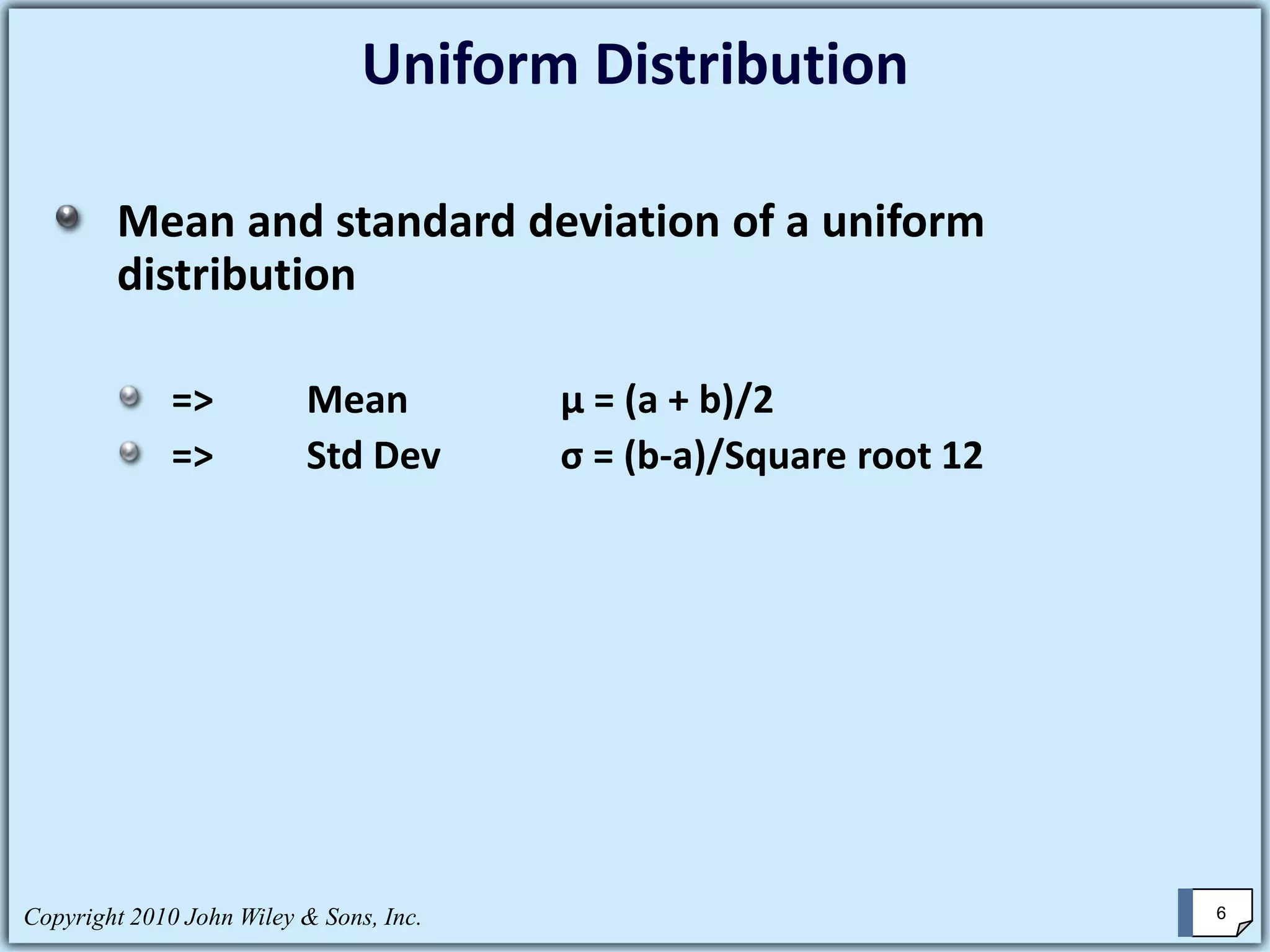
Mean and standard deviation of a uniform
distribution
=> Mean μ = (a + b)/2
=> Std Dev σ = (b-a)/Square root 12
Copyright 2010 John Wiley & Sons, Inc. 6
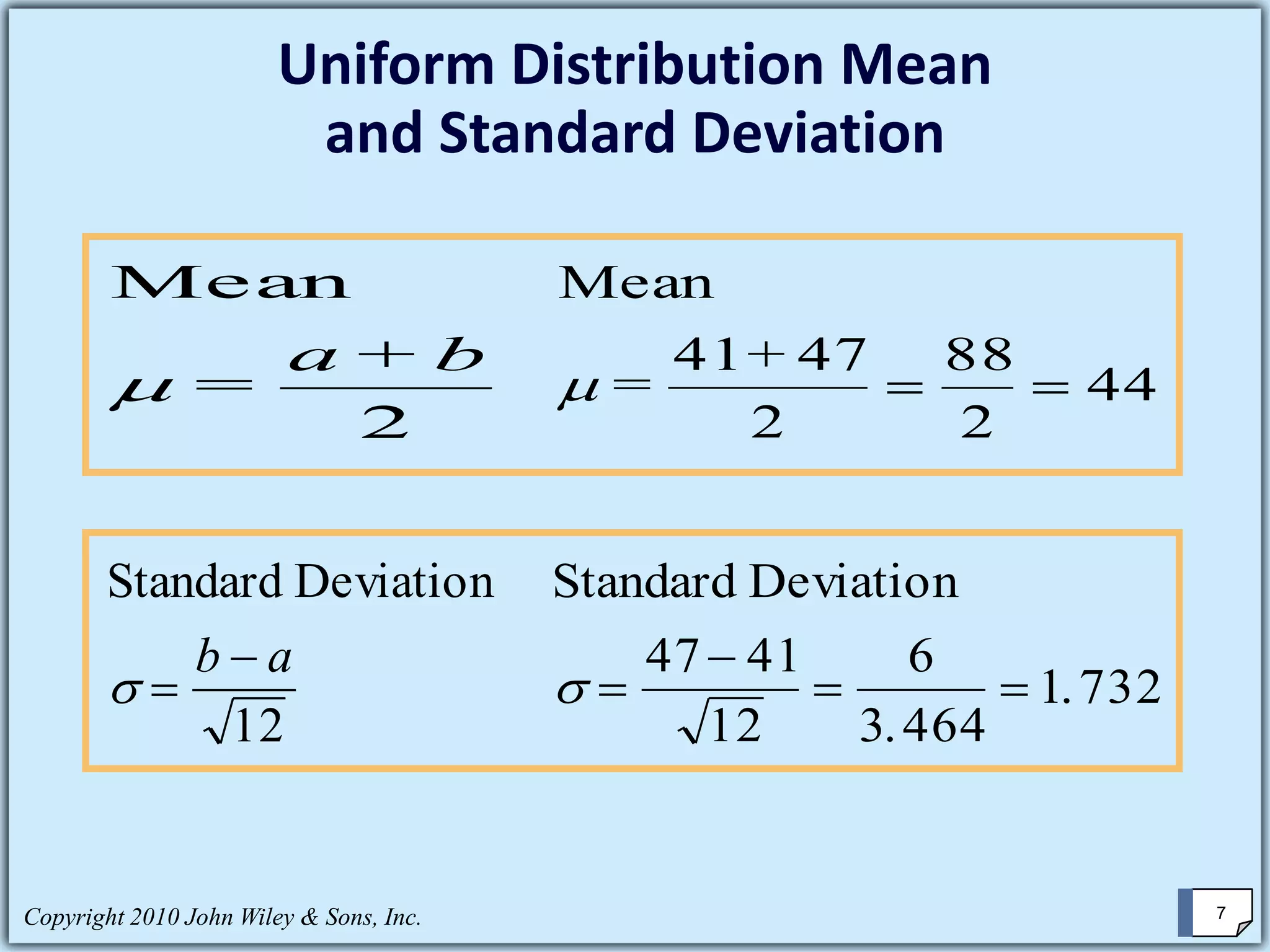
Uniform Distribution Mean
and Standard Deviation
Mean
=
+

a b
2
Mean
=
+

41 47
2
88
2
44= =
Standard Deviation
 =
−b a
12
Standard Deviation
 =
−
= =
47 41
12
6
3 464
1 732
.
.
Copyright 2010 John Wiley & Sons, Inc. 7
Uniform Distribution of Lot Weights
f x
for x
for
( ) =
−
 







1
47 41
41 47
0 all other values
Area = 1
f x( )
x
6
1
4147
1
=
−
41 47
Copyright 2010 John Wiley & Sons, Inc. 8
Uniform Distribution Probability
With discrete distributions, the probability function
yields the value of the probability
For continuous distributions, probabilities are
calculated by determining the area over an interval
of the function
Copyright 2010 John Wiley & Sons, Inc. 9
Demonstration Problem 6.1
Suppose the amount of time it takes to assemble a
plastic module ranges from 27 to 39 seconds and that
assembly times are uniformly distributed. Describe the
distribution. What is the probability that a given
assembly will take between 30 and 35 seconds? Fewer
than 30 seconds?
Copyright 2010 John Wiley & Sons, Inc. 10
Demonstration Problem 6.1
12
Solution
The height of the distribution is 1 12. The mean time is 33
seconds with a standard deviation of 3.464 seconds.
f (x) = 1/(39 – 27) = 1/12
μ = (a + b)/2 = (39 + 27)/2 = 33
σ = (b – a)/ = (39 – 27)/3.464 = 3.4643
112 =
12
112 = 3.464
Copyright 2010 John Wiley & Sons, Inc. 11
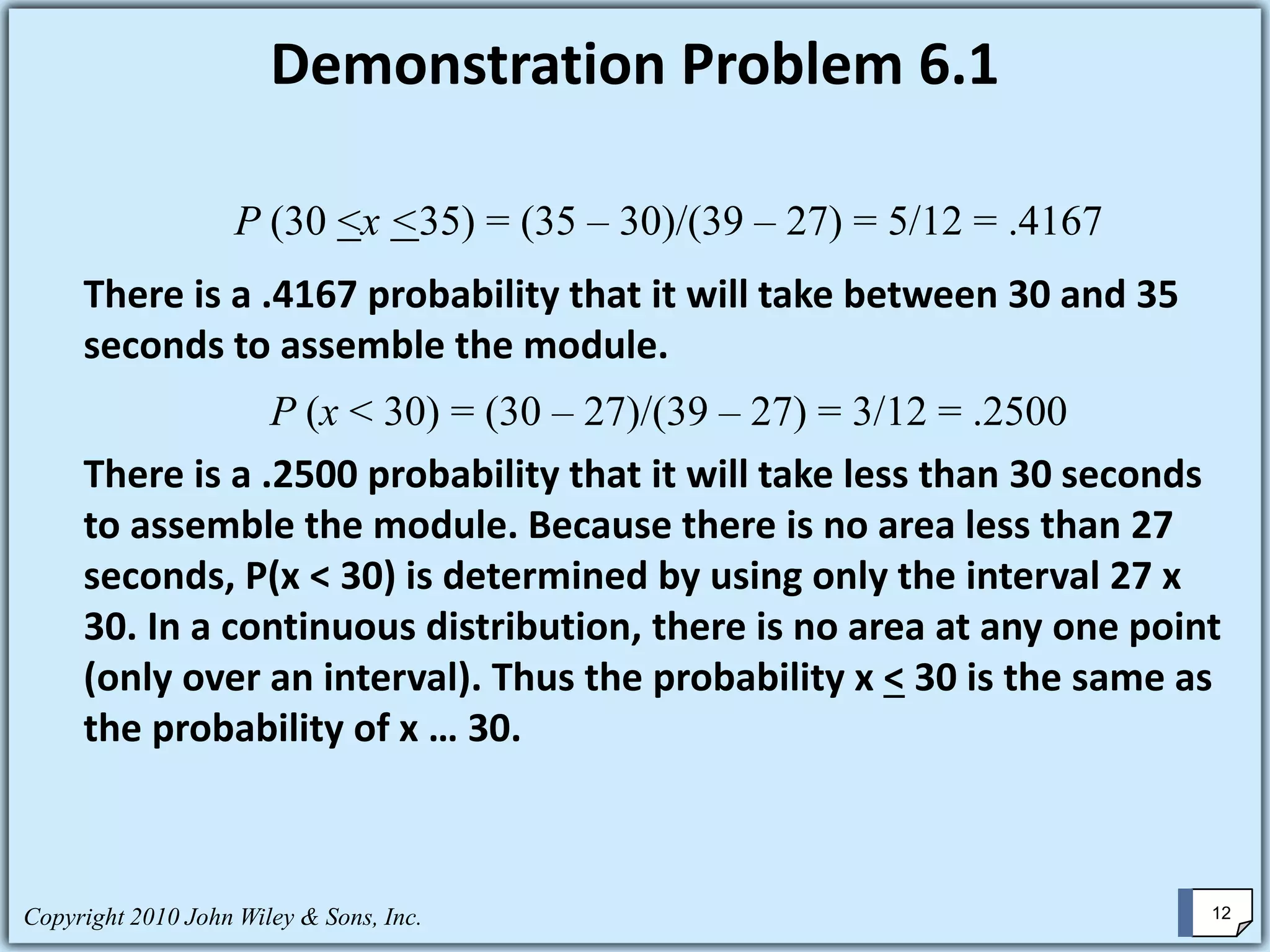
Demonstration Problem 6.1
P (30 <x <35) = (35 – 30)/(39 – 27) = 5/12 = .4167
There is a .4167 probability that it will take between 30 and 35
seconds to assemble the module.
P (x < 30) = (30 – 27)/(39 – 27) = 3/12 = .2500
There is a .2500 probability that it will take less than 30 seconds
to assemble the module. Because there is no area less than 27
seconds, P(x < 30) is determined by using only the interval 27 x
30. In a continuous distribution, there is no area at any one point
(only over an interval). Thus the probability x < 30 is the same as
the probability of x … 30.
Copyright 2010 John Wiley & Sons, Inc. 12
Properties of the Normal Distribution
Characteristics of the normal distribution:
Continuous distribution - Line does not break
Symmetrical distribution - Each half is a mirror of the other
half
Asymptotic to the horizontal axis - it does not touch the x
axis and goes on forever
Unimodal - means the values mound up in only one portion
of the graph
Area under the curve = 1; total of all probabilities = 1
Copyright 2010 John Wiley & Sons, Inc. 13
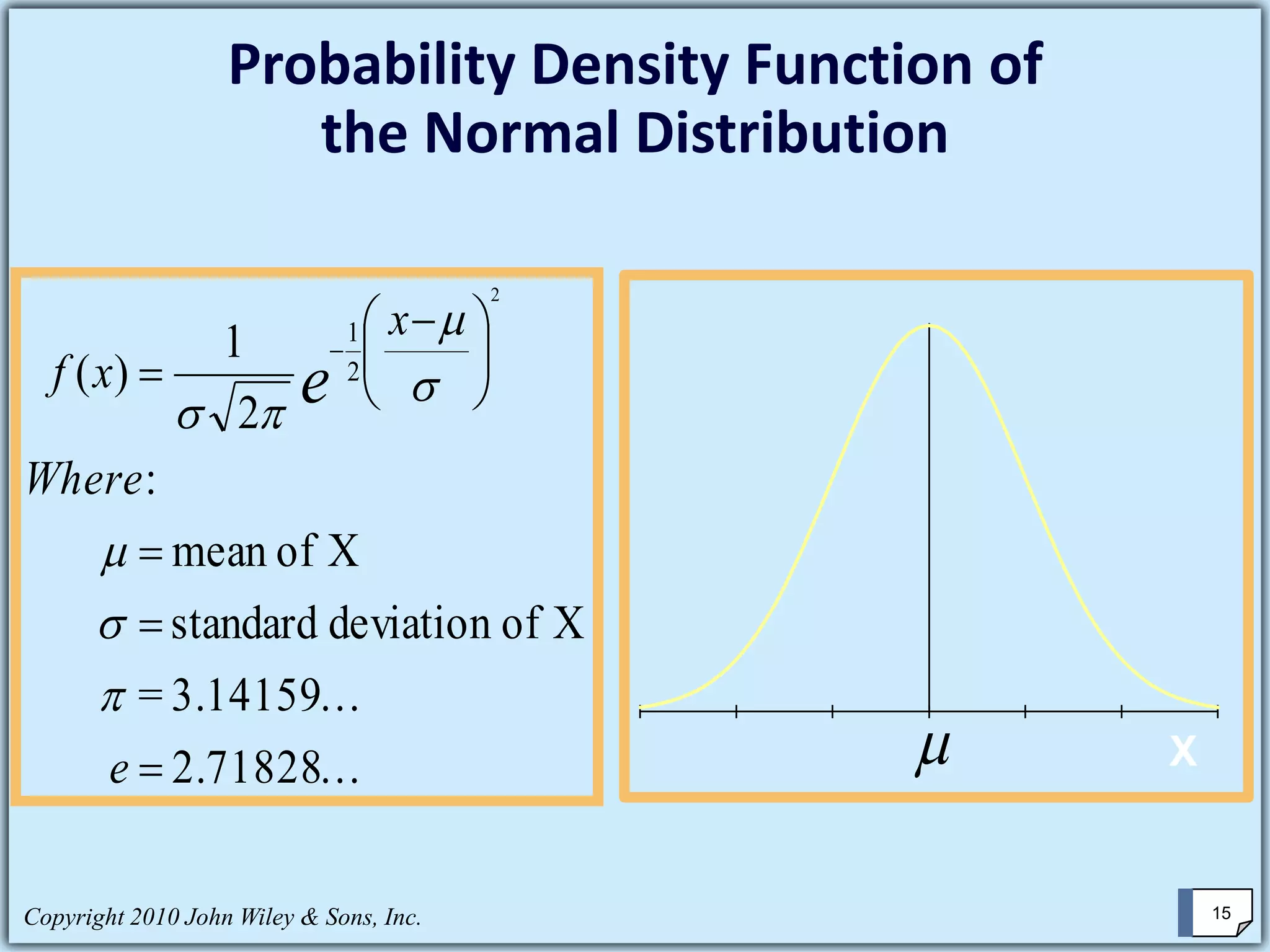
Probability Density Function of
the Normal Distribution
Normal distribution is characterized by the mean
and the Std Dev
Values of μ and σ produce a normal distribution
Copyright 2010 John Wiley & Sons, Inc. 14
Probability Density Function of
the Normal Distribution
...2.71828
...3.14159=
Xofdeviationstandard
Xofmean
:
2
1
)(
2
2
1
=
=
=





 −
=
−
e
Where
x
xf e






 X
Copyright 2010 John Wiley & Sons, Inc. 15
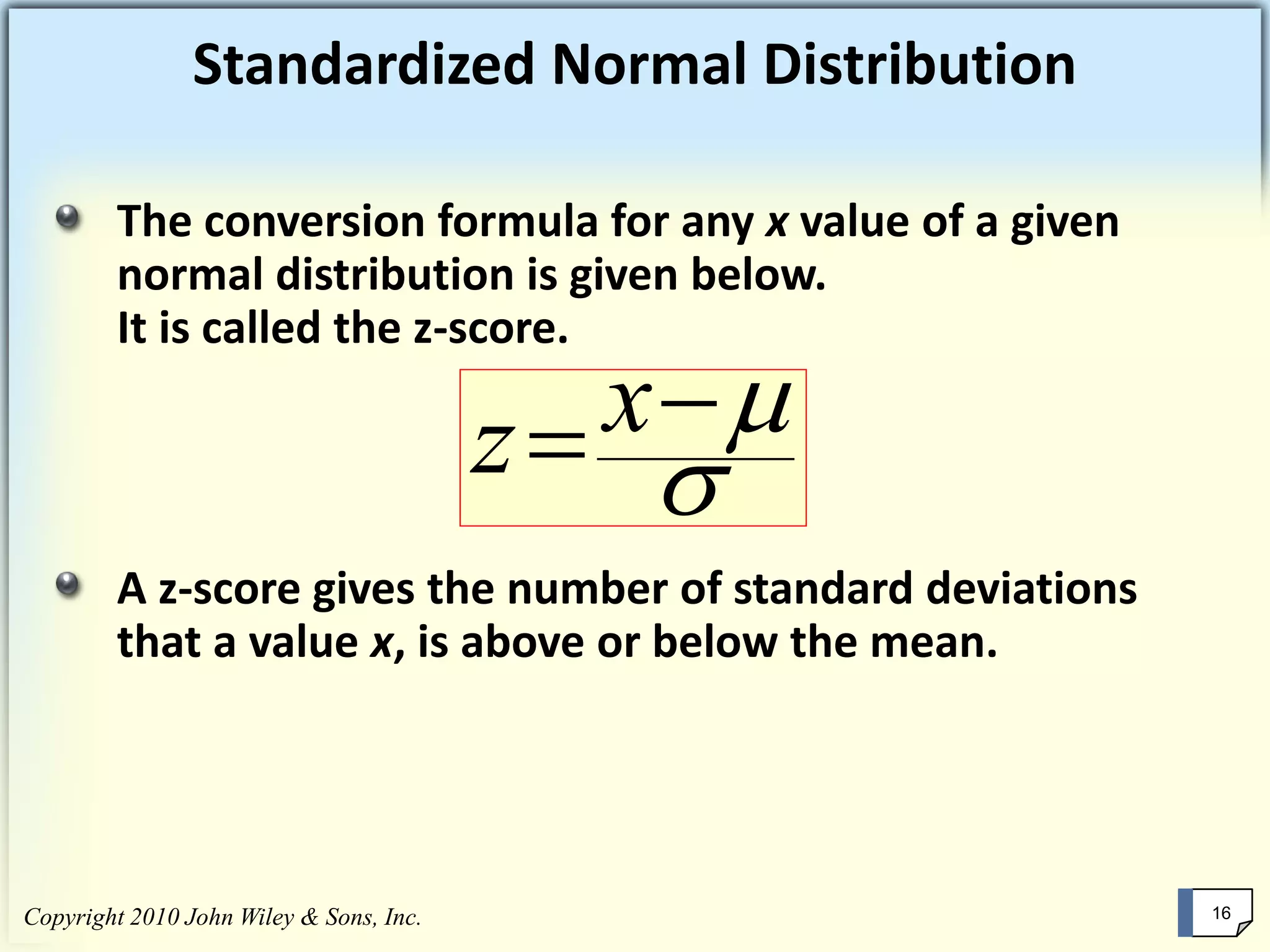
Standardized Normal Distribution
The conversion formula for any x value of a given
normal distribution is given below.
It is called the z-score.
A z-score gives the number of standard deviations
that a value x, is above or below the mean.

−= xz
Copyright 2010 John Wiley & Sons, Inc. 16
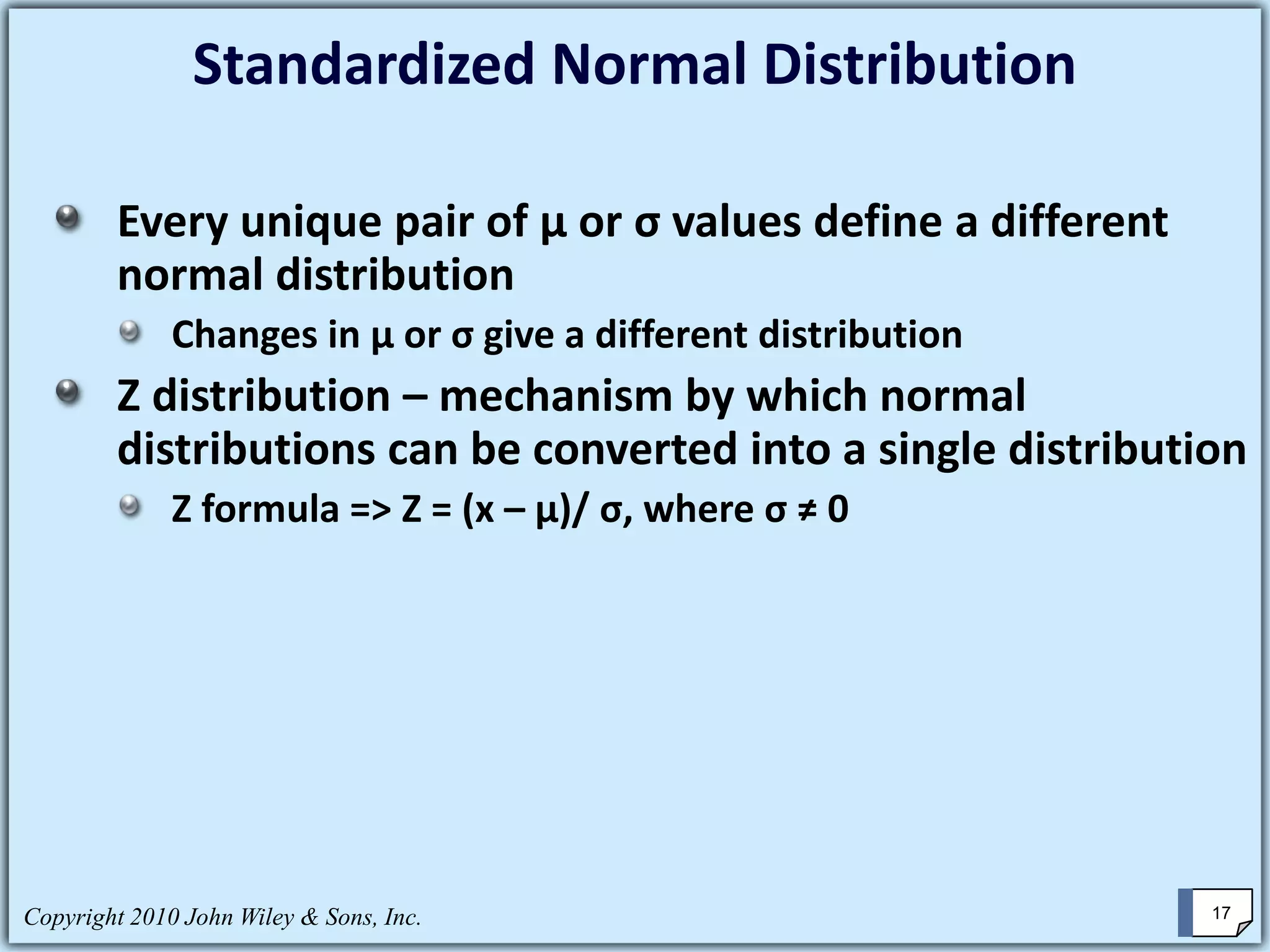
Standardized Normal Distribution
Every unique pair of μ or σ values define a different
normal distribution
Changes in μ or σ give a different distribution
Z distribution – mechanism by which normal
distributions can be converted into a single distribution
Z formula => Z = (x – μ)/ σ, where σ ≠ 0
Copyright 2010 John Wiley & Sons, Inc. 17
Standardized Normal Distribution
Z score is the number of Std Dev that a value, x, is
above or below the mean
If x value is less than the mean, the Z score is negative
If x value is greater than mean, the Z score is positive
Copyright 2010 John Wiley & Sons, Inc. 18
Z score can be used to find probabilities for any
normal curve problem that has been converted to Z
scores
Z distribution is normal distribution with a mean of 0
and a Std Dev of 1
Standardized Normal Distribution - Continued
Copyright 2010 John Wiley & Sons, Inc. 19
Standardized Normal Distribution - Continued
Z distribution probability values are given in table A5
Table A5 gives the total area under the Z curve
between 0 and any point on the positive Z axis
Since the curve is symmetric, the area under the curve
between Z and 0 is the same whether the Z curve is
positive or negative
Copyright 2010 John Wiley & Sons, Inc. 20
A normal distribution with
a mean of zero, and
a standard deviation of one
Z Formula
standardizes any normal distribution
Z Score
computed by the Z Formula
the number of standard
deviations which a value
is away from the mean

−
=
X
Z
 = 1
 = 0
Standardized Normal Distribution - Continued
Copyright 2010 John Wiley & Sons, Inc. 21
Standardized Normal Distribution - Continued
If x is normally distributed with a mean of  and a
standard deviation of , then the z-score will also be
normally distributed with a mean of 0 and a standard
deviation of 1.
Tables have been generated for standard normal
distribution which enable you to determine
probabilities for normal variables.
The tables are set to give the probabilities between
z = 0 and some other z value, z0 say, which is depicted
on the next slide.
Copyright 2010 John Wiley & Sons, Inc. 22
Z Table
Second Decimal Place in Z
Z 0.00 0.01 0.02 0.03 0.04 0.05 0.06 0.07 0.08 0.09
0.00 0.0000 0.0040 0.0080 0.0120 0.0160 0.0199 0.0239 0.0279 0.0319 0.0359
0.10 0.0398 0.0438 0.0478 0.0517 0.0557 0.0596 0.0636 0.0675 0.0714 0.0753
0.20 0.0793 0.0832 0.0871 0.0910 0.0948 0.0987 0.1026 0.1064 0.1103 0.1141
0.30 0.1179 0.1217 0.1255 0.1293 0.1331 0.1368 0.1406 0.1443 0.1480 0.1517
0.90 0.3159 0.3186 0.3212 0.3238 0.3264 0.3289 0.3315 0.3340 0.3365 0.3389
1.00 0.3413 0.3438 0.3461 0.3485 0.3508 0.3531 0.3554 0.3577 0.3599 0.3621
1.10 0.3643 0.3665 0.3686 0.3708 0.3729 0.3749 0.3770 0.3790 0.3810 0.3830
1.20 0.3849 0.3869 0.3888 0.3907 0.3925 0.3944 0.3962 0.3980 0.3997 0.4015
2.00 0.4772 0.4778 0.4783 0.4788 0.4793 0.4798 0.4803 0.4808 0.4812 0.4817
3.00 0.4987 0.4987 0.4987 0.4988 0.4988 0.4989 0.4989 0.4989 0.4990 0.4990
3.40 0.4997 0.4997 0.4997 0.4997 0.4997 0.4997 0.4997 0.4997 0.4997 0.4998
3.50 0.4998 0.4998 0.4998 0.4998 0.4998 0.4998 0.4998 0.4998 0.4998 0.4998
Copyright 2010 John Wiley & Sons, Inc. 23
Table Lookup of a Standard
Normal Probability
-3 -2 -1 0 1 2 3
P Z( ) .0 1 0 3413  =
Z 0.00 0.01 0.02
0.00 0.0000 0.0040 0.0080
0.10 0.0398 0.0438 0.0478
0.20 0.0793 0.0832 0.0871
1.00 0.3413 0.3438 0.3461
1.10 0.3643 0.3665 0.3686
1.20 0.3849 0.3869 0.3888
Copyright 2010 John Wiley & Sons, Inc. 24
Applying the Z Formula
X is normally distributed with = 485, and =105 
P X P Z( ) ( . ) .485 600 0 1 10 3643  =   =
For X = 485,
Z =
X-

=
−
=
485 485
105
0
10.1
105
485600-X
=Z
600,=XFor
=
−
=


Z 0.00 0.01 0.02
0.00 0.0000 0.0040 0.0080
0.10 0.0398 0.0438 0.0478
1.00 0.3413 0.3438 0.3461
1.10 0.3643 0.3665 0.3686
1.20 0.3849 0.3869 0.3888
Copyright 2010 John Wiley & Sons, Inc. 25
Applying the Z Formula
X is normally distributed with = 485, and =105 
P X P Z( ) ( . ) .485 600 0 1 10 3643  =   =
For X = 485,
Z =
X-

=
−
=
485 485
105
0
For X = 600,
Z =
X-

=
−
=
600 485
105
1 10.
Z 0.00 0.01 0.02
0.00 0.0000 0.0040 0.0080
0.10 0.0398 0.0438 0.0478
1.00 0.3413 0.3438 0.3461
1.10 0.3643 0.3665 0.3686
1.20 0.3849 0.3869 0.3888
Copyright 2010 John Wiley & Sons, Inc. 26
Applying the Z Formula
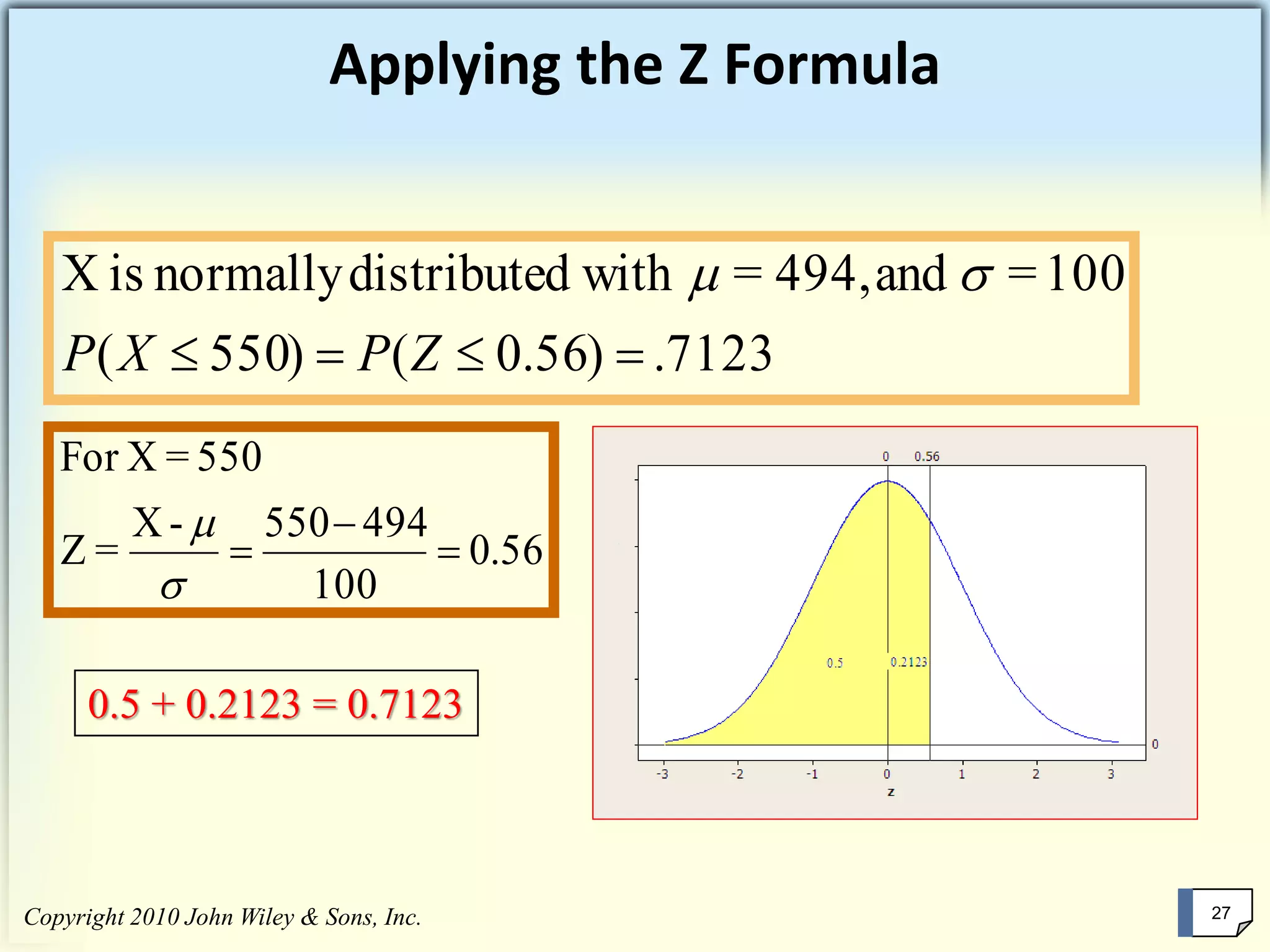
7123.)56.0()550(
100=and494,=withddistributenormallyisX
== ZPXP

56.0
100
494550-X
=Z
550=XFor
=
−
=


0.5 + 0.2123 = 0.7123
Copyright 2010 John Wiley & Sons, Inc. 27
Applying the Z Formula
0197.)06.2()700(
100=and494,=withddistributenormallyisX
== ZPXP

06.2
100
494700-X
=Z
700=XFor
=
−
=


0.5 – 0.4803 = 0.0197
Copyright 2010 John Wiley & Sons, Inc. 28
Applying the Z Formula
94.1
100
494300-X
=Z
300=XFor
−=
−
=


8292.)06.194.1()600300(
100=and494,=withddistributenormallyisX
=−= ZPXP

0.4738+ 0.3554 = 0.8292
06.1
100
494600-X
=Z
600=XFor
=
−
=


Copyright 2010 John Wiley & Sons, Inc. 29
Normal Approximation of the
Binomial Distribution
For certain types of binomial distributions, the
normal distribution can be used to approximate the
probabilities
At large sample sizes, binomial distributions approach the
normal distribution in shape regardless of the value of p
The normal distribution is a good approximate for binomial
distribution problems for large values of n
Copyright 2010 John Wiley & Sons, Inc. 30
Demonstration Problem 6.9
These types of problems can be solved quite easily
with the appropriate technology. The output shows
the MINITAB solution.
Copyright 2010 John Wiley & Sons, Inc. 31
Normal Approximation of Binomial:
Parameter Conversion
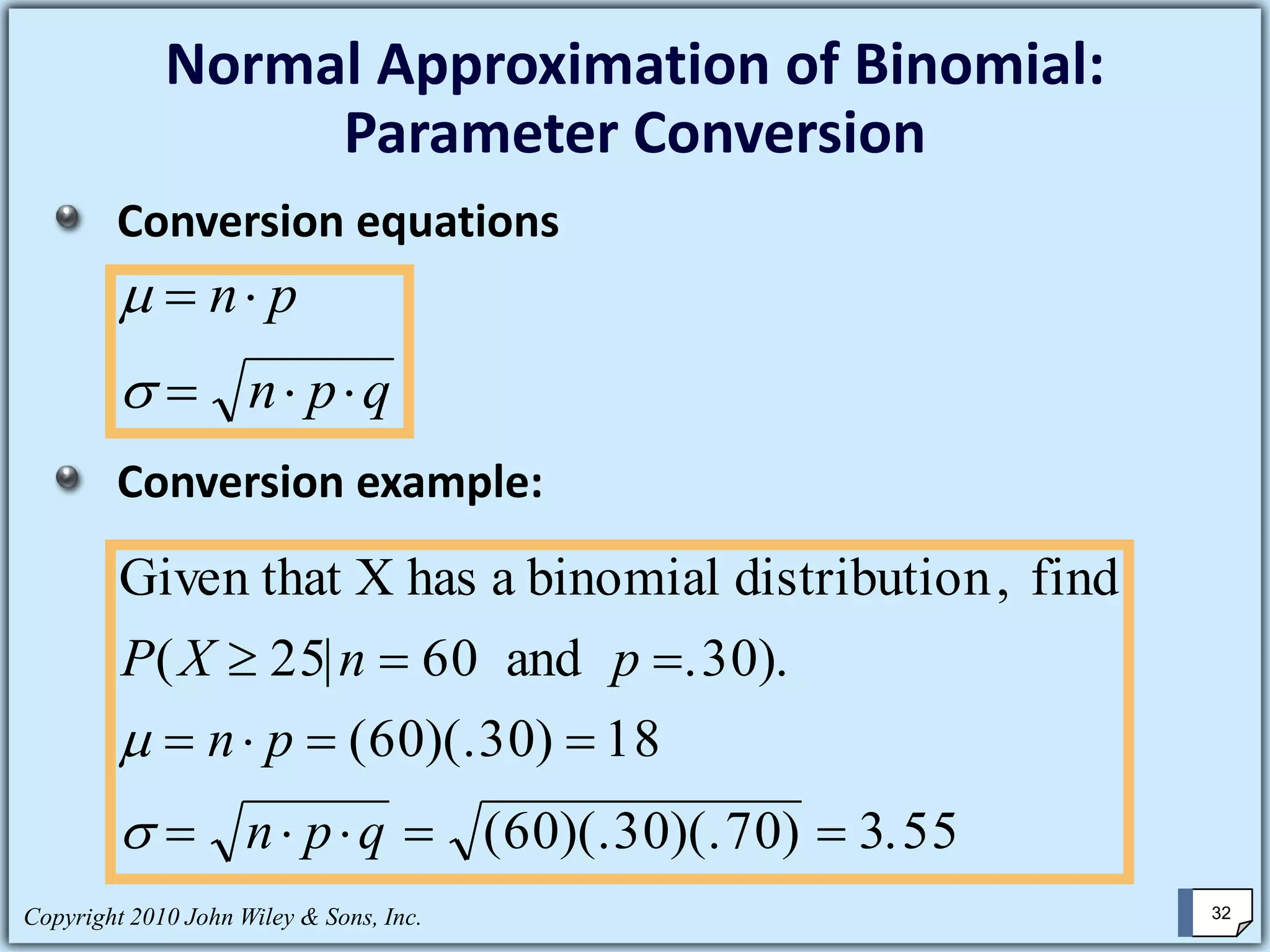
Conversion equations
Conversion example:


= 
=  
n p
n p q
Given that X has a binomial distribution, find
andP X n p
n p
n p q
( | . ).
( )(. )
( )(. )(. ) .
 = =
=  = =
=   = =
25 60 30
60 30 18
60 30 70 3 55


Copyright 2010 John Wiley & Sons, Inc. 32
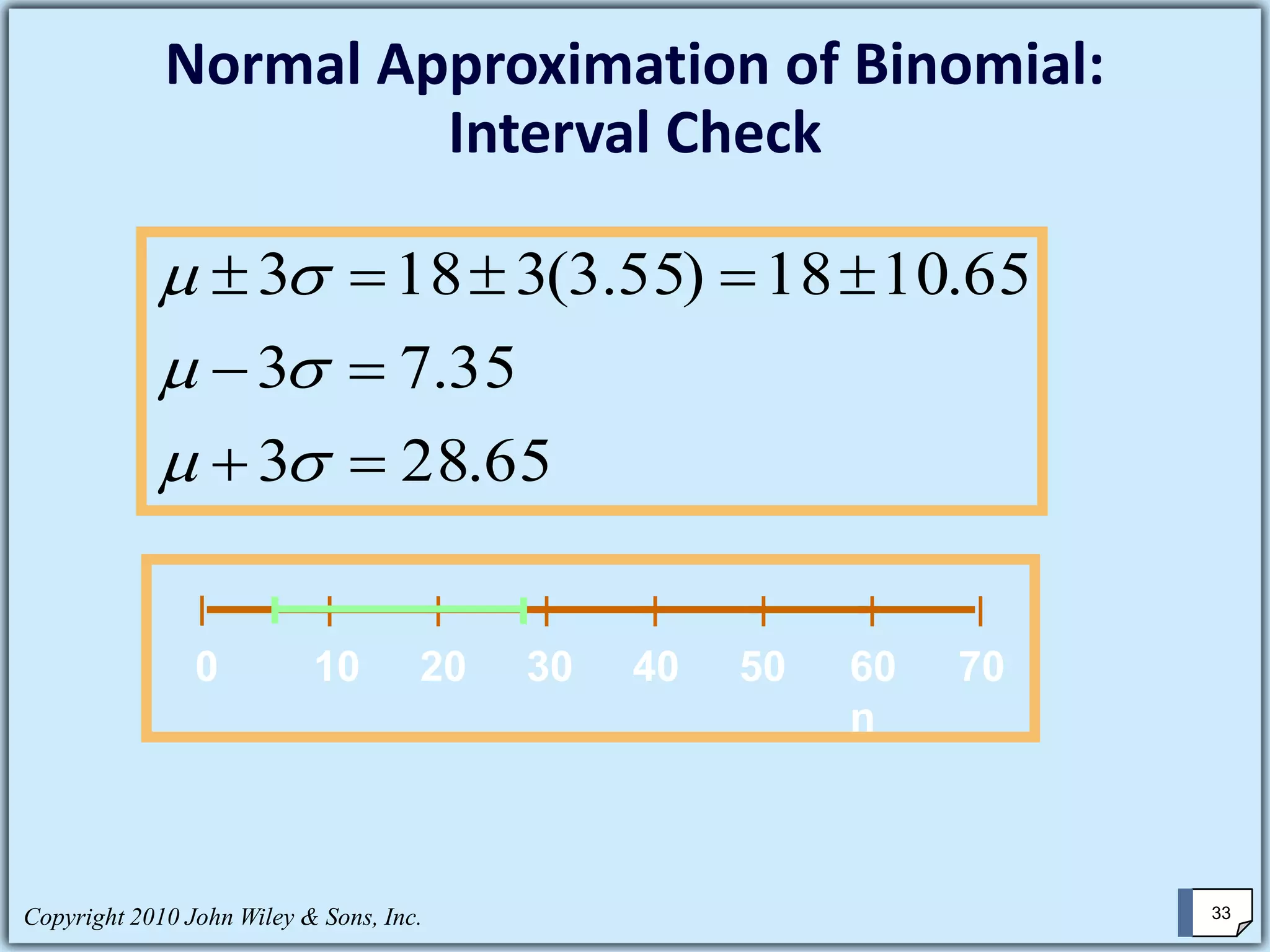
65.283
35.73
65.1018)55.3(3183
=+
=−
==



0 10 20 30 40 50 60
n
70
Normal Approximation of Binomial:
Interval Check
Copyright 2010 John Wiley & Sons, Inc. 33
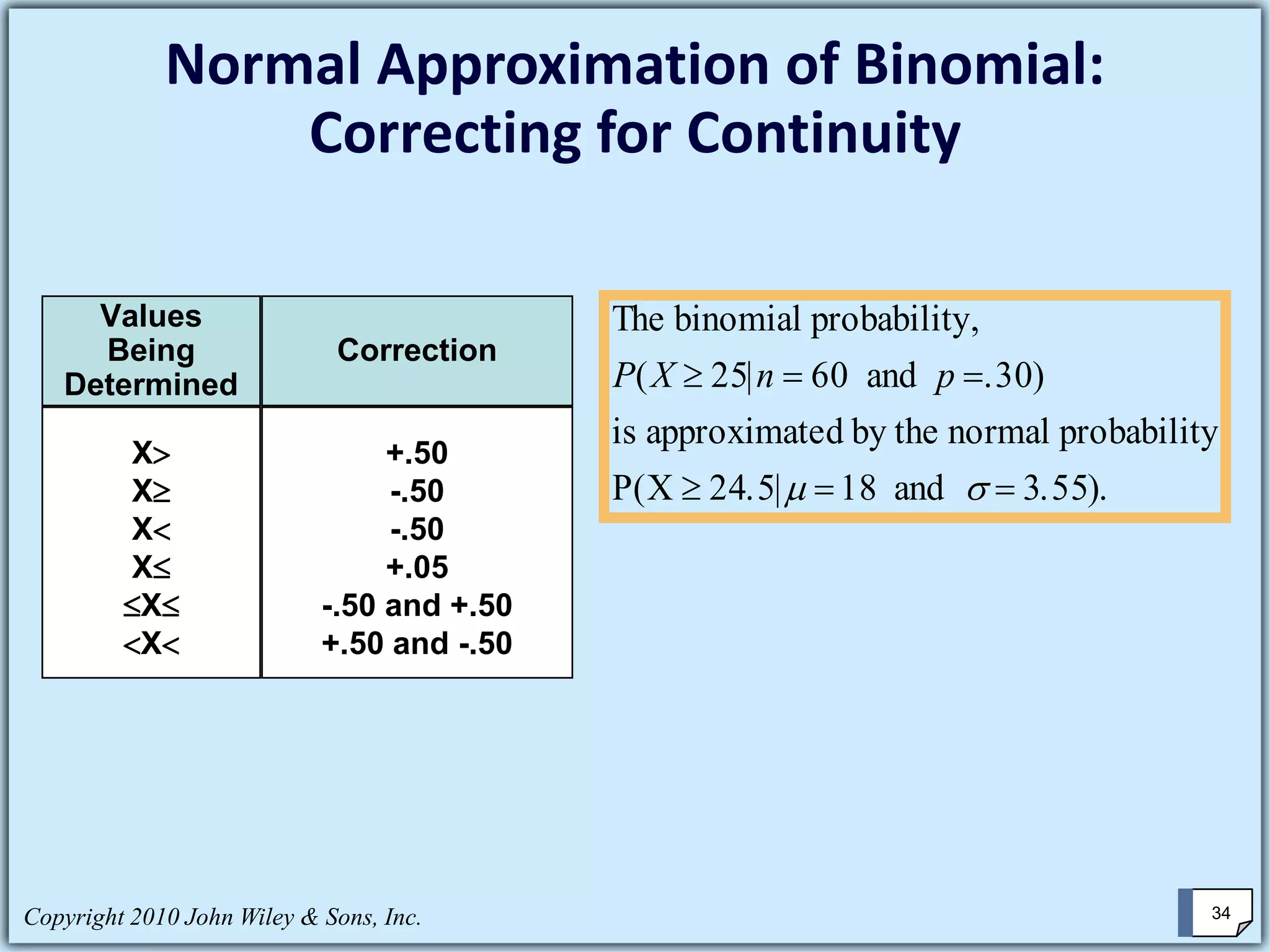
Normal Approximation of Binomial:
Correcting for Continuity
Values
Being
Determined
Correction
X
X
X
X
X
X
+.50
-.50
-.50
+.05
-.50 and +.50
+.50 and -.50
The binomial probability,
and
is approximated by the normal probability
P(X 24.5| and
P X n p( | . )
. ).
 = =
 = =
25 60 30
18 3 55 
Copyright 2010 John Wiley & Sons, Inc. 34
25
26
27
28
29
30
31
32
33
Total
0.0167
0.0096
0.0052
0.0026
0.0012
0.0005
0.0002
0.0001
0.0000
0.0361
X P(X)
( )
The normal approximation,
P(X 24.5| and = =
= 
−





= 
= −  
= −
=
 18 355
24 5 18
355
183
5 0 183
5 4664
0336
. )
.
.
( . )
. .
. .
.
P Z
P Z
P Z
Normal Approximation of Binomial:
Computations
Copyright 2010 John Wiley & Sons, Inc. 35
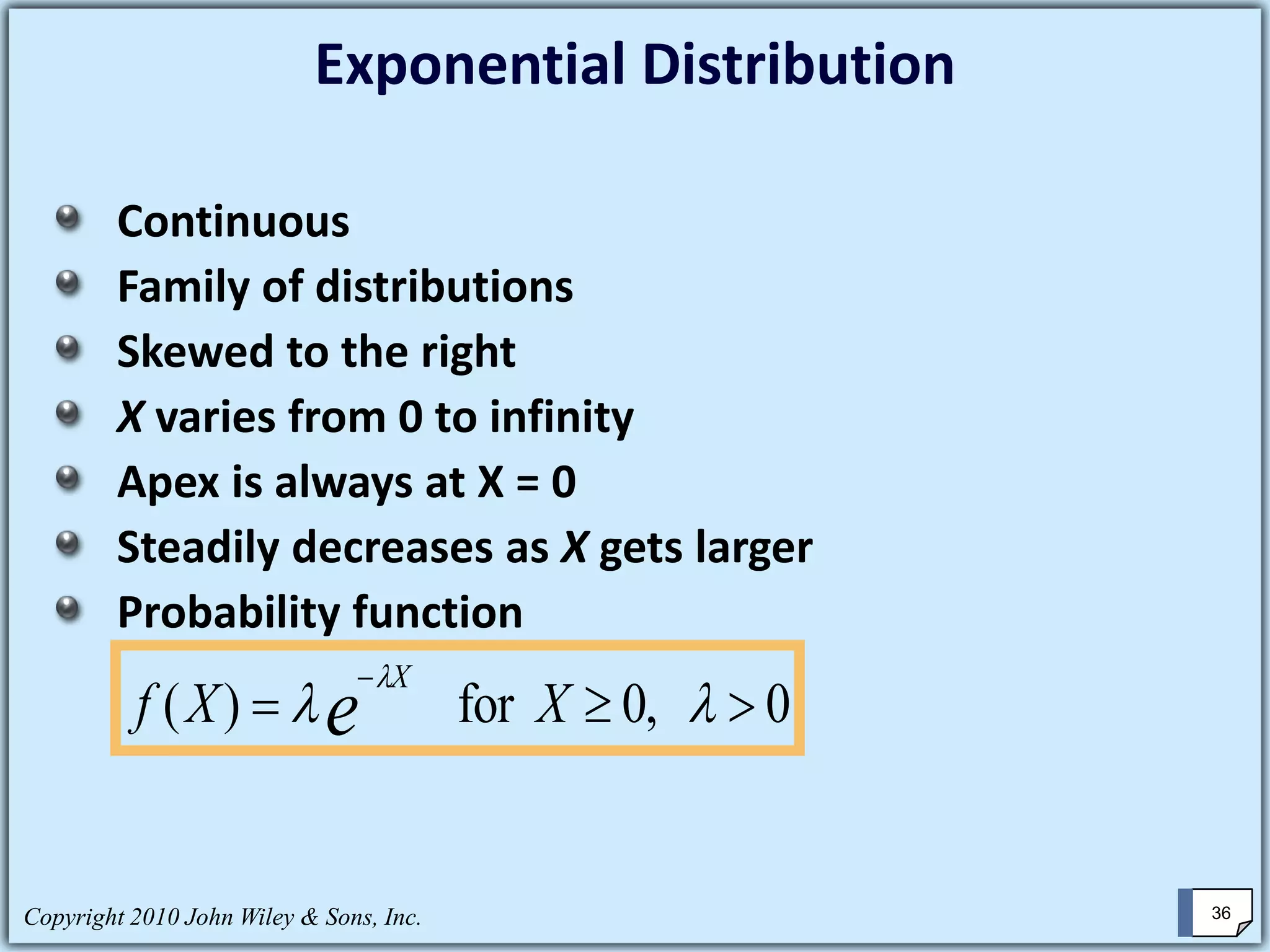
f X X
X
e( ) ,=  
−
 

for 0 0
Exponential Distribution
Continuous
Family of distributions
Skewed to the right
X varies from 0 to infinity
Apex is always at X = 0
Steadily decreases as X gets larger
Probability function
Copyright 2010 John Wiley & Sons, Inc. 36
Different Exponential Distributions
Copyright 2010 John Wiley & Sons, Inc. 37
0.0
0.2
0.4
0.6
0.8
1.0
1.2
0 1 2 3 4 5
 =  ( )
( )
P X X
X
P X
e
e
 =
−
 = =
−
=
0
0
2 12
12 2
0907

| .
( . )( )
.
Exponential Distribution: Probability
Computation
Copyright 2010 John Wiley & Sons, Inc. 38

Applied Business Statistics ,ken black , ch 6

  • 1.
    Business Statistics, 6thed. by Ken Black Chapter 6 Continuous Probability Distributions Copyright 2010 John Wiley & Sons, Inc.
  • 2.
    Understand concepts ofthe uniform distribution. Appreciate the importance of the normal distribution. Recognize normal distribution problems, and know how to solve them. Decide when to use the normal distribution to approximate binomial distribution problems, and know how to work them. Decide when to use the exponential distribution to solve problems in business, and know how to work them. Copyright 2010 John Wiley & Sons, Inc. 2 Learning Objectives
  • 3.
    Continuous Distributions Continuous distributions Continuousdistributions are constructed from continuous random variables in which values are taken for every point over a given interval With continuous distributions, probabilities of outcomes occurring between particular points are determined by calculating the area under the curve between these points Copyright 2010 John Wiley & Sons, Inc. 3
  • 4.
    Uniform Distribution The uniformdistribution is a relatively simple continuous distribution in which the same height f(x), is obtained over a range of values Copyright 2010 John Wiley & Sons, Inc. 4
  • 5.
    Uniform Distribution f x ba for a x b for ( ) = −          1 0 all other values Area = 1 f x( ) x 1 b a− a b Copyright 2010 John Wiley & Sons, Inc. 5
  • 6.
    Uniform Distribution Mean andstandard deviation of a uniform distribution => Mean μ = (a + b)/2 => Std Dev σ = (b-a)/Square root 12 Copyright 2010 John Wiley & Sons, Inc. 6
  • 7.
    Uniform Distribution Mean andStandard Deviation Mean = +  a b 2 Mean = +  41 47 2 88 2 44= = Standard Deviation  = −b a 12 Standard Deviation  = − = = 47 41 12 6 3 464 1 732 . . Copyright 2010 John Wiley & Sons, Inc. 7
  • 8.
    Uniform Distribution ofLot Weights f x for x for ( ) = −          1 47 41 41 47 0 all other values Area = 1 f x( ) x 6 1 4147 1 = − 41 47 Copyright 2010 John Wiley & Sons, Inc. 8
  • 9.
    Uniform Distribution Probability Withdiscrete distributions, the probability function yields the value of the probability For continuous distributions, probabilities are calculated by determining the area over an interval of the function Copyright 2010 John Wiley & Sons, Inc. 9
  • 10.
    Demonstration Problem 6.1 Supposethe amount of time it takes to assemble a plastic module ranges from 27 to 39 seconds and that assembly times are uniformly distributed. Describe the distribution. What is the probability that a given assembly will take between 30 and 35 seconds? Fewer than 30 seconds? Copyright 2010 John Wiley & Sons, Inc. 10
  • 11.
    Demonstration Problem 6.1 12 Solution Theheight of the distribution is 1 12. The mean time is 33 seconds with a standard deviation of 3.464 seconds. f (x) = 1/(39 – 27) = 1/12 μ = (a + b)/2 = (39 + 27)/2 = 33 σ = (b – a)/ = (39 – 27)/3.464 = 3.4643 112 = 12 112 = 3.464 Copyright 2010 John Wiley & Sons, Inc. 11
  • 12.
    Demonstration Problem 6.1 P(30 <x <35) = (35 – 30)/(39 – 27) = 5/12 = .4167 There is a .4167 probability that it will take between 30 and 35 seconds to assemble the module. P (x < 30) = (30 – 27)/(39 – 27) = 3/12 = .2500 There is a .2500 probability that it will take less than 30 seconds to assemble the module. Because there is no area less than 27 seconds, P(x < 30) is determined by using only the interval 27 x 30. In a continuous distribution, there is no area at any one point (only over an interval). Thus the probability x < 30 is the same as the probability of x … 30. Copyright 2010 John Wiley & Sons, Inc. 12
  • 13.
    Properties of theNormal Distribution Characteristics of the normal distribution: Continuous distribution - Line does not break Symmetrical distribution - Each half is a mirror of the other half Asymptotic to the horizontal axis - it does not touch the x axis and goes on forever Unimodal - means the values mound up in only one portion of the graph Area under the curve = 1; total of all probabilities = 1 Copyright 2010 John Wiley & Sons, Inc. 13
  • 14.
    Probability Density Functionof the Normal Distribution Normal distribution is characterized by the mean and the Std Dev Values of μ and σ produce a normal distribution Copyright 2010 John Wiley & Sons, Inc. 14
  • 15.
    Probability Density Functionof the Normal Distribution ...2.71828 ...3.14159= Xofdeviationstandard Xofmean : 2 1 )( 2 2 1 = = =       − = − e Where x xf e        X Copyright 2010 John Wiley & Sons, Inc. 15
  • 16.
    Standardized Normal Distribution Theconversion formula for any x value of a given normal distribution is given below. It is called the z-score. A z-score gives the number of standard deviations that a value x, is above or below the mean.  −= xz Copyright 2010 John Wiley & Sons, Inc. 16
  • 17.
    Standardized Normal Distribution Everyunique pair of μ or σ values define a different normal distribution Changes in μ or σ give a different distribution Z distribution – mechanism by which normal distributions can be converted into a single distribution Z formula => Z = (x – μ)/ σ, where σ ≠ 0 Copyright 2010 John Wiley & Sons, Inc. 17
  • 18.
    Standardized Normal Distribution Zscore is the number of Std Dev that a value, x, is above or below the mean If x value is less than the mean, the Z score is negative If x value is greater than mean, the Z score is positive Copyright 2010 John Wiley & Sons, Inc. 18
  • 19.
    Z score canbe used to find probabilities for any normal curve problem that has been converted to Z scores Z distribution is normal distribution with a mean of 0 and a Std Dev of 1 Standardized Normal Distribution - Continued Copyright 2010 John Wiley & Sons, Inc. 19
  • 20.
    Standardized Normal Distribution- Continued Z distribution probability values are given in table A5 Table A5 gives the total area under the Z curve between 0 and any point on the positive Z axis Since the curve is symmetric, the area under the curve between Z and 0 is the same whether the Z curve is positive or negative Copyright 2010 John Wiley & Sons, Inc. 20
  • 21.
    A normal distributionwith a mean of zero, and a standard deviation of one Z Formula standardizes any normal distribution Z Score computed by the Z Formula the number of standard deviations which a value is away from the mean  − = X Z  = 1  = 0 Standardized Normal Distribution - Continued Copyright 2010 John Wiley & Sons, Inc. 21
  • 22.
    Standardized Normal Distribution- Continued If x is normally distributed with a mean of  and a standard deviation of , then the z-score will also be normally distributed with a mean of 0 and a standard deviation of 1. Tables have been generated for standard normal distribution which enable you to determine probabilities for normal variables. The tables are set to give the probabilities between z = 0 and some other z value, z0 say, which is depicted on the next slide. Copyright 2010 John Wiley & Sons, Inc. 22
  • 23.
    Z Table Second DecimalPlace in Z Z 0.00 0.01 0.02 0.03 0.04 0.05 0.06 0.07 0.08 0.09 0.00 0.0000 0.0040 0.0080 0.0120 0.0160 0.0199 0.0239 0.0279 0.0319 0.0359 0.10 0.0398 0.0438 0.0478 0.0517 0.0557 0.0596 0.0636 0.0675 0.0714 0.0753 0.20 0.0793 0.0832 0.0871 0.0910 0.0948 0.0987 0.1026 0.1064 0.1103 0.1141 0.30 0.1179 0.1217 0.1255 0.1293 0.1331 0.1368 0.1406 0.1443 0.1480 0.1517 0.90 0.3159 0.3186 0.3212 0.3238 0.3264 0.3289 0.3315 0.3340 0.3365 0.3389 1.00 0.3413 0.3438 0.3461 0.3485 0.3508 0.3531 0.3554 0.3577 0.3599 0.3621 1.10 0.3643 0.3665 0.3686 0.3708 0.3729 0.3749 0.3770 0.3790 0.3810 0.3830 1.20 0.3849 0.3869 0.3888 0.3907 0.3925 0.3944 0.3962 0.3980 0.3997 0.4015 2.00 0.4772 0.4778 0.4783 0.4788 0.4793 0.4798 0.4803 0.4808 0.4812 0.4817 3.00 0.4987 0.4987 0.4987 0.4988 0.4988 0.4989 0.4989 0.4989 0.4990 0.4990 3.40 0.4997 0.4997 0.4997 0.4997 0.4997 0.4997 0.4997 0.4997 0.4997 0.4998 3.50 0.4998 0.4998 0.4998 0.4998 0.4998 0.4998 0.4998 0.4998 0.4998 0.4998 Copyright 2010 John Wiley & Sons, Inc. 23
  • 24.
    Table Lookup ofa Standard Normal Probability -3 -2 -1 0 1 2 3 P Z( ) .0 1 0 3413  = Z 0.00 0.01 0.02 0.00 0.0000 0.0040 0.0080 0.10 0.0398 0.0438 0.0478 0.20 0.0793 0.0832 0.0871 1.00 0.3413 0.3438 0.3461 1.10 0.3643 0.3665 0.3686 1.20 0.3849 0.3869 0.3888 Copyright 2010 John Wiley & Sons, Inc. 24
  • 25.
    Applying the ZFormula X is normally distributed with = 485, and =105  P X P Z( ) ( . ) .485 600 0 1 10 3643  =   = For X = 485, Z = X-  = − = 485 485 105 0 10.1 105 485600-X =Z 600,=XFor = − =   Z 0.00 0.01 0.02 0.00 0.0000 0.0040 0.0080 0.10 0.0398 0.0438 0.0478 1.00 0.3413 0.3438 0.3461 1.10 0.3643 0.3665 0.3686 1.20 0.3849 0.3869 0.3888 Copyright 2010 John Wiley & Sons, Inc. 25
  • 26.
    Applying the ZFormula X is normally distributed with = 485, and =105  P X P Z( ) ( . ) .485 600 0 1 10 3643  =   = For X = 485, Z = X-  = − = 485 485 105 0 For X = 600, Z = X-  = − = 600 485 105 1 10. Z 0.00 0.01 0.02 0.00 0.0000 0.0040 0.0080 0.10 0.0398 0.0438 0.0478 1.00 0.3413 0.3438 0.3461 1.10 0.3643 0.3665 0.3686 1.20 0.3849 0.3869 0.3888 Copyright 2010 John Wiley & Sons, Inc. 26
  • 27.
    Applying the ZFormula 7123.)56.0()550( 100=and494,=withddistributenormallyisX == ZPXP  56.0 100 494550-X =Z 550=XFor = − =   0.5 + 0.2123 = 0.7123 Copyright 2010 John Wiley & Sons, Inc. 27
  • 28.
    Applying the ZFormula 0197.)06.2()700( 100=and494,=withddistributenormallyisX == ZPXP  06.2 100 494700-X =Z 700=XFor = − =   0.5 – 0.4803 = 0.0197 Copyright 2010 John Wiley & Sons, Inc. 28
  • 29.
    Applying the ZFormula 94.1 100 494300-X =Z 300=XFor −= − =   8292.)06.194.1()600300( 100=and494,=withddistributenormallyisX =−= ZPXP  0.4738+ 0.3554 = 0.8292 06.1 100 494600-X =Z 600=XFor = − =   Copyright 2010 John Wiley & Sons, Inc. 29
  • 30.
    Normal Approximation ofthe Binomial Distribution For certain types of binomial distributions, the normal distribution can be used to approximate the probabilities At large sample sizes, binomial distributions approach the normal distribution in shape regardless of the value of p The normal distribution is a good approximate for binomial distribution problems for large values of n Copyright 2010 John Wiley & Sons, Inc. 30
  • 31.
    Demonstration Problem 6.9 Thesetypes of problems can be solved quite easily with the appropriate technology. The output shows the MINITAB solution. Copyright 2010 John Wiley & Sons, Inc. 31
  • 32.
    Normal Approximation ofBinomial: Parameter Conversion Conversion equations Conversion example:   =  =   n p n p q Given that X has a binomial distribution, find andP X n p n p n p q ( | . ). ( )(. ) ( )(. )(. ) .  = = =  = = =   = = 25 60 30 60 30 18 60 30 70 3 55   Copyright 2010 John Wiley & Sons, Inc. 32
  • 33.
    65.283 35.73 65.1018)55.3(3183 =+ =− ==    0 10 2030 40 50 60 n 70 Normal Approximation of Binomial: Interval Check Copyright 2010 John Wiley & Sons, Inc. 33
  • 34.
    Normal Approximation ofBinomial: Correcting for Continuity Values Being Determined Correction X X X X X X +.50 -.50 -.50 +.05 -.50 and +.50 +.50 and -.50 The binomial probability, and is approximated by the normal probability P(X 24.5| and P X n p( | . ) . ).  = =  = = 25 60 30 18 3 55  Copyright 2010 John Wiley & Sons, Inc. 34
  • 35.
    25 26 27 28 29 30 31 32 33 Total 0.0167 0.0096 0.0052 0.0026 0.0012 0.0005 0.0002 0.0001 0.0000 0.0361 X P(X) ( ) Thenormal approximation, P(X 24.5| and = = =  −      =  = −   = − =  18 355 24 5 18 355 183 5 0 183 5 4664 0336 . ) . . ( . ) . . . . . P Z P Z P Z Normal Approximation of Binomial: Computations Copyright 2010 John Wiley & Sons, Inc. 35
  • 36.
    f X X X e() ,=   −    for 0 0 Exponential Distribution Continuous Family of distributions Skewed to the right X varies from 0 to infinity Apex is always at X = 0 Steadily decreases as X gets larger Probability function Copyright 2010 John Wiley & Sons, Inc. 36
  • 37.
    Different Exponential Distributions Copyright2010 John Wiley & Sons, Inc. 37
  • 38.
    0.0 0.2 0.4 0.6 0.8 1.0 1.2 0 1 23 4 5  =  ( ) ( ) P X X X P X e e  = −  = = − = 0 0 2 12 12 2 0907  | . ( . )( ) . Exponential Distribution: Probability Computation Copyright 2010 John Wiley & Sons, Inc. 38