Szeged University
Food ScienceTechnology and Engineering
Subject : Alternative Food processing technologies
OZONE
SAED HABIB ELYAS
3.
1. What isOzone?
• Ozone (O₃) is a triatomic molecule of three
oxygen atoms.
• Powerful oxidizing agent, stronger than
chlorine.
• Chemical formula: O₃
• Nature: Unstable gas; decomposes to O₂
• Oxidation potential: 2.07 V (higher than
chlorine)(it’s like having strong pulling power to take
electrons away from other molecules.)
4.
2. Mechanism ofAction
• Oxidizes cell walls of microorganisms.
• Disrupts cellular structures, leading to
inactivation.
• Targets: Cell membranes, enzymes, nucleic
acids.
• Reactivity: Non-selective, reacts with organic
matter.
5.
🔹 Ozone isused in food processing environments, especially in water-based
systems.
🔹 Ozone breaks down into reactive oxygen species (ROS) like hydroxyl radicals
and superoxide, which penetrate the bacterial cell.
🔹 Inside the cell, these ROS cause major damage: proteins are oxidized and
clump together, enzymes are inactivated, and DNA is damaged beyond repair.
🔹 The bacteria's natural defenses, like the SOD enzyme, are overwhelmed.
🔹 As a result, the bacteria can’t function, replicate, or survive.
6.
3. Applications inFood Processing
• a. Surface Decontamination: Fruits,
vegetables, meat, seafood.
• b. Water Treatment: Disinfection, pesticide
removal.
• c. Storage Atmosphere: Shelf life extension,
mold control.
• d. Food Contact Surfaces: Equipment and
surface sanitization.
7.
4. Benefits ofUsing Ozone
• Broad-spectrum antimicrobial.
• No chemical residue; decomposes to oxygen.
• Environmentally friendly; no harmful
byproducts.
• Effective in gas and aqueous forms.
• GRAS approved by FDA (2001).
8.
5. Limitations andChallenges
• Instability: Must be generated on-site.
• Corrosiveness: Potential equipment damage.
• Health hazard: Toxic at high concentrations.
• Limited penetration: Less effective on soiled
surfaces.
9.
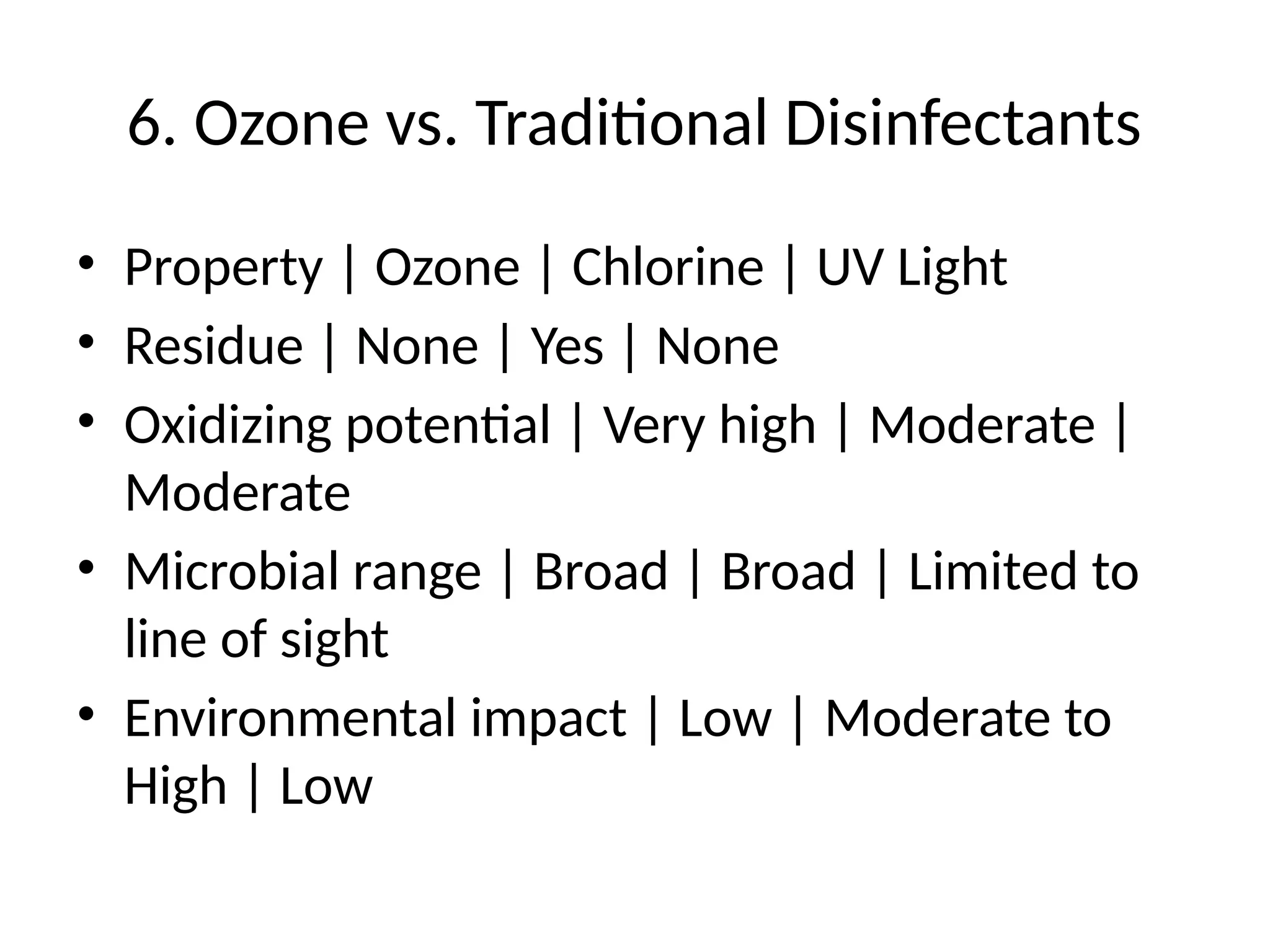
6. Ozone vs.Traditional Disinfectants
• Property | Ozone | Chlorine | UV Light
• Residue | None | Yes | None
• Oxidizing potential | Very high | Moderate |
Moderate
• Microbial range | Broad | Broad | Limited to
line of sight
• Environmental impact | Low | Moderate to
High | Low
10.
7. Regulatory Status
•USA (FDA, 2001): Approved for direct use in
food.
• EU: Allowed in some sectors (e.g., bottled
water).
• Canada and Japan: Approved in specific
applications.
11.
8. Examples ofUse in Industry
• Fruit processors: Washing apples, grapes,
berries.
• Meat plants: Ozone mist or rinse for carcasses.
• Seafood: Ozonated ice for freshness.
• Beverage industry: Sanitizing bottling lines and
water.
12.
9. Conclusion
• Highlyeffective, residue-free, eco-friendly
disinfectant.
• Ideal for disinfection, shelf-life extension, food
safety.
• Requires careful handling due to instability
and hazards.
13.
References
1. Rice, R.G.(2002). Applications of ozone for industrial wastewater treatment - a
review. Ozone: Science & Engineering, 24(1), pp.47–62.
2. Khadre, M.A., Yousef, A.E. and Kim, J.G. (2001). Microbiological aspects of
ozone applications in food: a review. Journal of Food Science, 66(9), pp.1242–
1252.
3. Restaino, L., Frampton, E.W., Hemphill, J.B. and Palnikar, P. (1995). Efficacy of
ozonated water against various food-related microorganisms. Applied and
Environmental Microbiology, 61(9), pp.3471–3475.
4. U.S. Food and Drug Administration (FDA) (2001). GRAS Notice for ozone used
as an antimicrobial agent. [online] Available at: https://www.fda.gov [Accessed
13 May 2025].
5. Food and Agriculture Organization (FAO) and World Health Organization
(WHO) (2008). Benefits and risks of the use of ozone in food processing. [online]
Available at: http://www.fao.org [Accessed 13 May 2025].
6. Gupta, S. and Tiwari, B.K. (2020). Ozone treatment in food processing:
potential benefits and limitations. Trends in Food Science & Technology, 99,
pp.267–281.
7. Ölmez, H. and Akbas, M.Y. (2009). Optimization of ozone treatment of fresh-cut
green leaf lettuce. Journal of Food Engineering, 90(4), pp.487–494.
8. Moore, G. and Griffith, C. (2002). A comparison of surface sampling methods
for detecting coliforms on food contact surfaces. Food Microbiology, 19(1),
pp.65–73.
9. Agarwal, A., Sharma, A., and Saxena, S. (2006). Ozone disinfection in food
industry: a review. International Journal of Food Microbiology, 109(1-2), pp.1–9.
10. Ozone Solutions (2024). Ozone Applications in the Food Industry. [online]
Available at: https://www.ozonesolutions.com [Accessed 13 May 2025].
11. Oxidation Technologies (2023). Global Regulations on Ozone in Food
Processing. [online] Available at: https://www.oxidationtech.com [Accessed 13
May 2025].
12. Food Safety Magazine (2021). Recent Ozone Applications in Food Processing
and Sanitation. [online] Available at: https://www.food-safety.com [Accessed 13
May 2025].
13. Wang, L., Hu, C., Shao, L., Zhang, C., Xu, Y., Wang, Y. and Ma, X., 2020. Mechanisms of ozone-induced
antimicrobial activity against Escherichia coli and Staphylococcus aureus: role of membrane damage and
oxidative stress. Analytical and Bioanalytical Chemistry, 412(29), pp.7291–7304. [online] Available at:
https://link.springer.com/article/10.1007/s00216-020-02810-6 [Accessed 13 May 2025].






![References
1. Rice, R.G. (2002). Applications of ozone for industrial wastewater treatment - a
review. Ozone: Science & Engineering, 24(1), pp.47–62.
2. Khadre, M.A., Yousef, A.E. and Kim, J.G. (2001). Microbiological aspects of
ozone applications in food: a review. Journal of Food Science, 66(9), pp.1242–
1252.
3. Restaino, L., Frampton, E.W., Hemphill, J.B. and Palnikar, P. (1995). Efficacy of
ozonated water against various food-related microorganisms. Applied and
Environmental Microbiology, 61(9), pp.3471–3475.
4. U.S. Food and Drug Administration (FDA) (2001). GRAS Notice for ozone used
as an antimicrobial agent. [online] Available at: https://www.fda.gov [Accessed
13 May 2025].
5. Food and Agriculture Organization (FAO) and World Health Organization
(WHO) (2008). Benefits and risks of the use of ozone in food processing. [online]
Available at: http://www.fao.org [Accessed 13 May 2025].
6. Gupta, S. and Tiwari, B.K. (2020). Ozone treatment in food processing:
potential benefits and limitations. Trends in Food Science & Technology, 99,
pp.267–281.
7. Ölmez, H. and Akbas, M.Y. (2009). Optimization of ozone treatment of fresh-cut
green leaf lettuce. Journal of Food Engineering, 90(4), pp.487–494.
8. Moore, G. and Griffith, C. (2002). A comparison of surface sampling methods
for detecting coliforms on food contact surfaces. Food Microbiology, 19(1),
pp.65–73.
9. Agarwal, A., Sharma, A., and Saxena, S. (2006). Ozone disinfection in food
industry: a review. International Journal of Food Microbiology, 109(1-2), pp.1–9.
10. Ozone Solutions (2024). Ozone Applications in the Food Industry. [online]
Available at: https://www.ozonesolutions.com [Accessed 13 May 2025].
11. Oxidation Technologies (2023). Global Regulations on Ozone in Food
Processing. [online] Available at: https://www.oxidationtech.com [Accessed 13
May 2025].
12. Food Safety Magazine (2021). Recent Ozone Applications in Food Processing
and Sanitation. [online] Available at: https://www.food-safety.com [Accessed 13
May 2025].
13. Wang, L., Hu, C., Shao, L., Zhang, C., Xu, Y., Wang, Y. and Ma, X., 2020. Mechanisms of ozone-induced
antimicrobial activity against Escherichia coli and Staphylococcus aureus: role of membrane damage and
oxidative stress. Analytical and Bioanalytical Chemistry, 412(29), pp.7291–7304. [online] Available at:
https://link.springer.com/article/10.1007/s00216-020-02810-6 [Accessed 13 May 2025].](https://image.slidesharecdn.com/ozoneinfoodprocessingpresentation-250522094044-596d65c4/75/Ozone_in_Food_Processing_Presentation-pptx-13-2048.jpg)


