APPLICATION OF
CORRELATION
CORRELATION
SUBMITTED TO- Dr. Vikas saxena
SUBMITEED BY-
GROUP -1
Aditi Prasad (820001) Bhavya Sachdev (820004)
Ankush Sharma (820002) Bipin Kumar (820005)
Anshu Sharma (820003) Jatin Kumar (820006)
CONTENTS
1. INTRODUCTION
2. TYPES OF CORRELATION
3. KARL PEARSON’S COEFFICIENT OF CORRELATION
4. RANK CORRELATION
5. TOPIC OF STUDY
6. OBJECTIVE OF THE STUDY
7. LITERATURE REVIEW
8. HYPOTHESIS
9. METHODOLOGY
10. RESULT AND DISCUSSION
11. CONCLUSION
INTRODUCTION
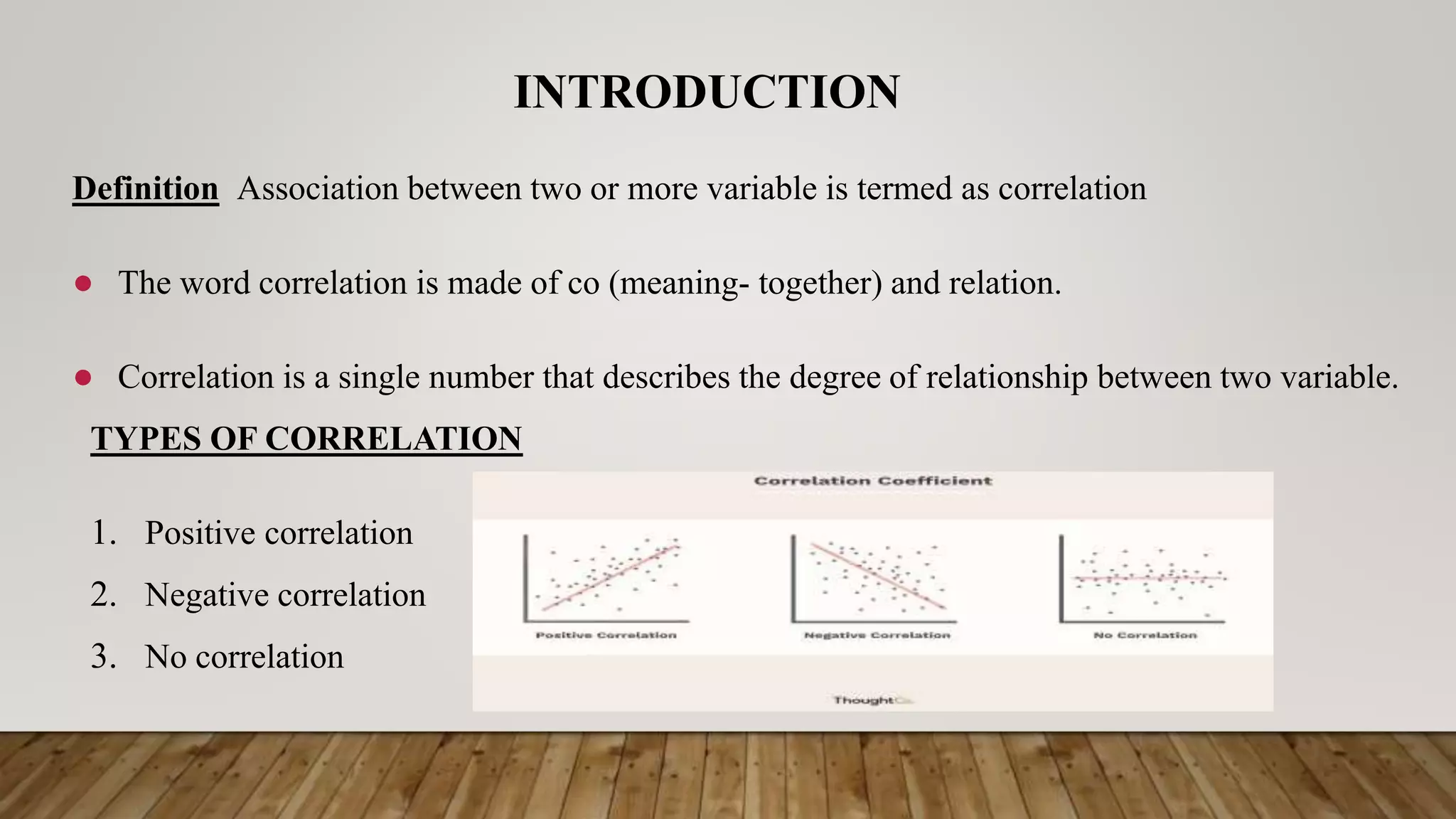
Definition Association between two or more variable is termed as correlation
● The word correlation is made of co (meaning- together) and relation.
● Correlation is a single number that describes the degree of relationship between two variable.
TYPES OF CORRELATION
1. Positive correlation
2. Negative correlation
3. No correlation
CORRELATION COEFFICIENT
1.KARL PEARSON’S Karl Pearson’s correlation coefficient between two variables X and Y ,
is denoted by r(X, Y ) or rXY , is a measure of linear relationship between them and is defined as:
r(X, Y ) = Cov(X, Y ) /σX σY
➢ Limits are: |r(X, Y )| ≤ 1 or −1 ≤ r(X, Y ) ≤ 1.
➢ Hence correlation coefficient cannot exceed unity numerically. It always lies between −1
and +1.
➢ If r = +1, the correlation is perfect and positive.
➢ If r = −1, correlation is perfect and negative.
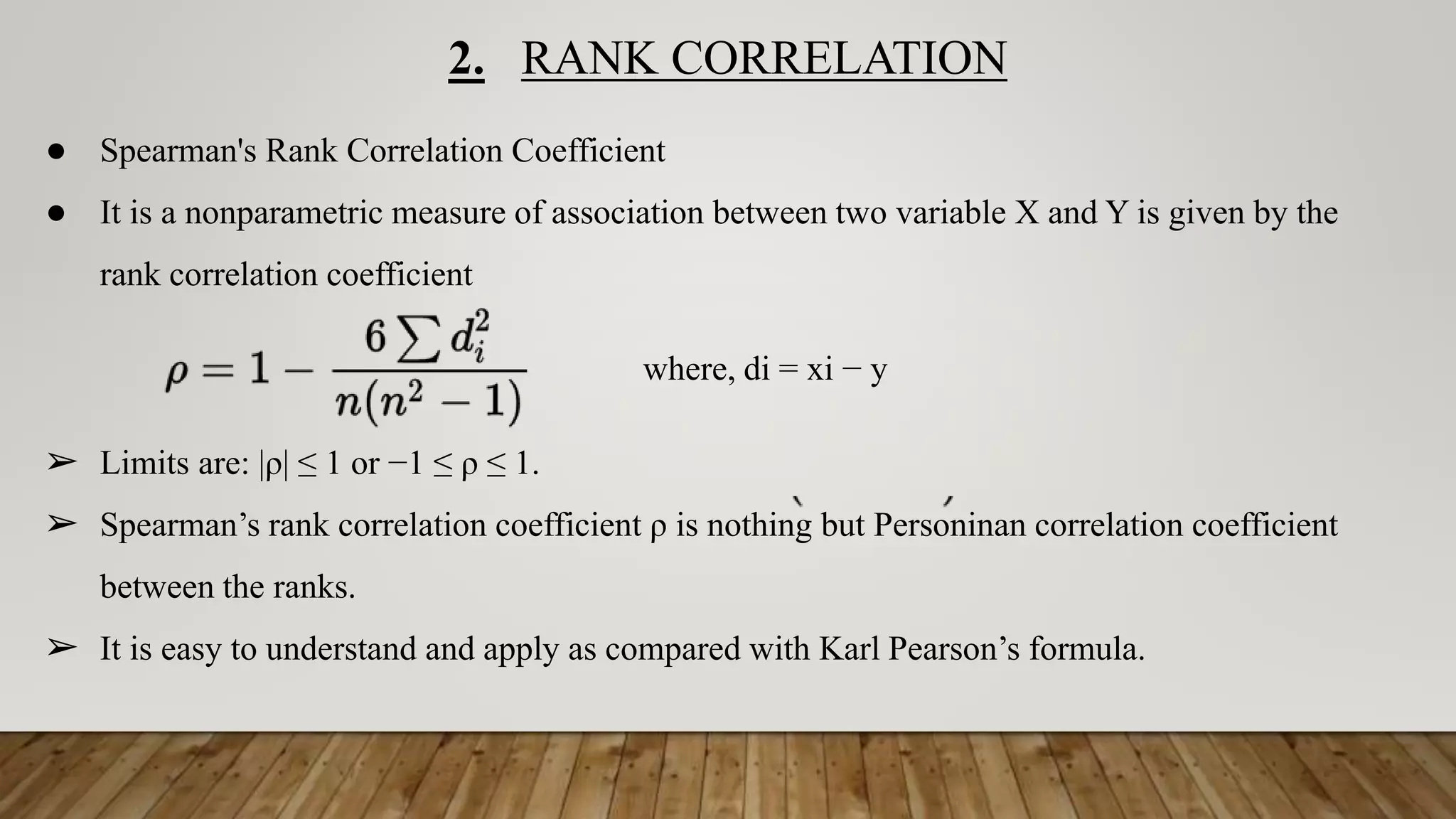
2. RANK CORRELATION
● Spearman's Rank Correlation Coefficient
● It is a nonparametric measure of association between two variable X and Y is given by the
rank correlation coefficient
where, di = xi − y
➢ Limits are: |ρ| ≤ 1 or −1 ≤ ρ ≤ 1.
➢ Spearman’s rank correlation coefficient ρ is nothing but Personinan correlation coefficient
between the ranks.
➢ It is easy to understand and apply as compared with Karl Pearson’s formula.
CASE STUDY :-
A CORRELATION STUDY OF PERSONAL ENTREPRENEURIAL COMPETENCY
AND THE ACADEMIC PERFORMANCE IN OPERATIONS MANAGEMENT OF
BUSINESS ADMINISTRATION STUDENTS.
JAKE M. LAGUADOR
LYCEUM OF THE PHILIPPINES UNIVERSITY
BATANGAS CITY, PHILIPPINES
ABSTRACT
● This study aimed to determine the Academic Performance of the Business Administration
3rd Year students in Operations Management course in terms of the result of their Prelim
Exam, Midterm Exam, and Semi-Final Exam.
● It also analyzed the Personal Entrepreneurial Competency rating. The BSBA – HRDM
students obtained low score in Prelim and Midterm examination where they find it
difficult to answer Math problems
● The demand for quality and information seeking revealed significant relationship in two
major examinations in Operations Management.
INTRODUCTION
An entrepreneur is one who organizes, manages, and assumes the risks of a business enterprise. Thus,
entrepreneurship is undeniably an important source of income, an important strategy for creating new
jobs and hastening the economic recovery and growth of the nation.
Operations management is an area of management concerned with managing the process that converts
inputs in the forms of materials, labor, and energy into outputs in the form of goods and services.
This study analyze the Personal Entrepreneurial Competency rating in terms of opportunity seeking,
persistence, commitment to work contract, demand for quality and efficiency, risk taking, goal
setting, information seeking, systematic planning and monitoring, persuasion and networking, and
self – confidence.
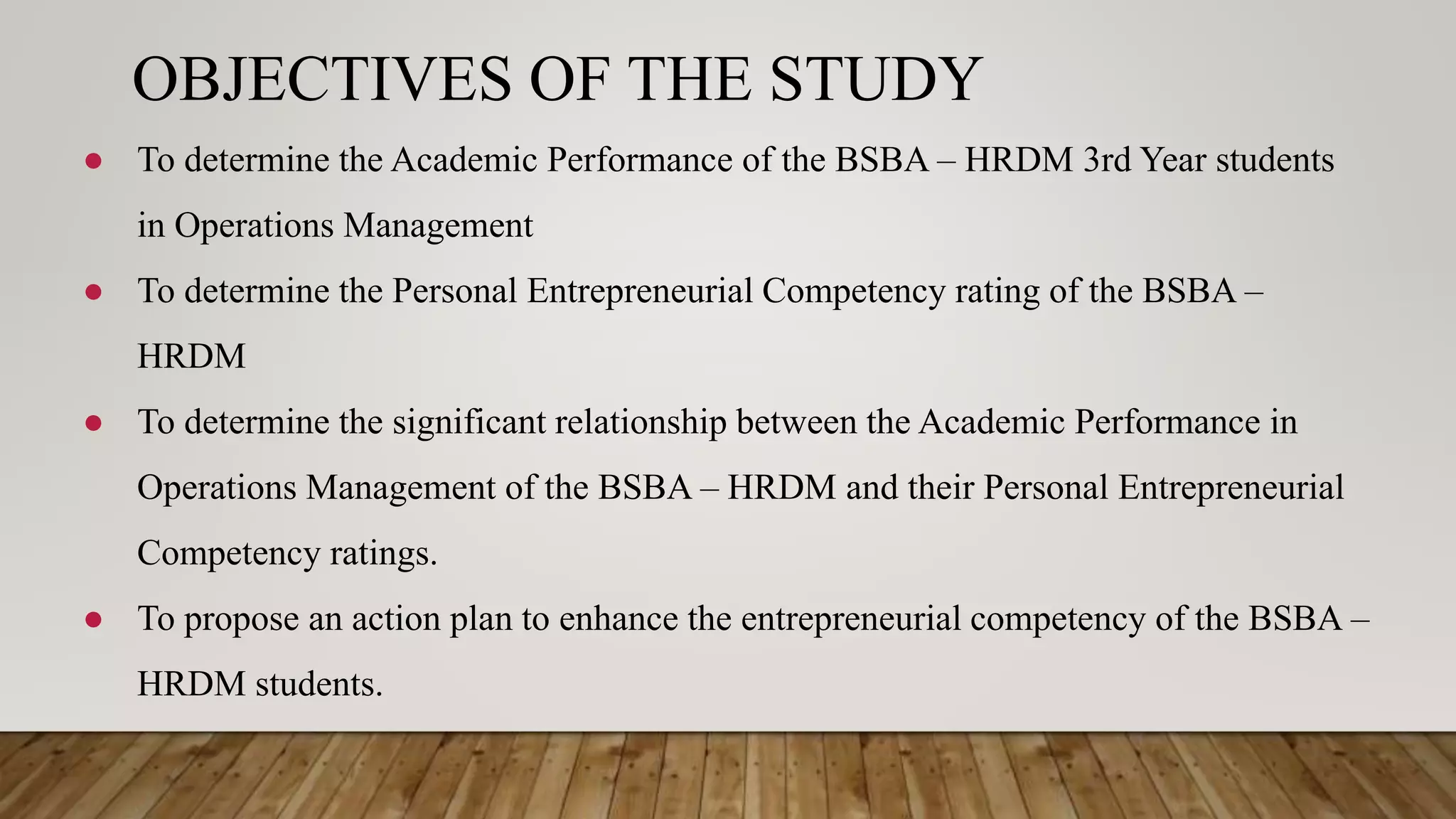
OBJECTIVES OF THE STUDY
● To determine the Academic Performance of the BSBA – HRDM 3rd Year students
in Operations Management
● To determine the Personal Entrepreneurial Competency rating of the BSBA –
HRDM
● To determine the significant relationship between the Academic Performance in
Operations Management of the BSBA – HRDM and their Personal Entrepreneurial
Competency ratings.
● To propose an action plan to enhance the entrepreneurial competency of the BSBA –
HRDM students.
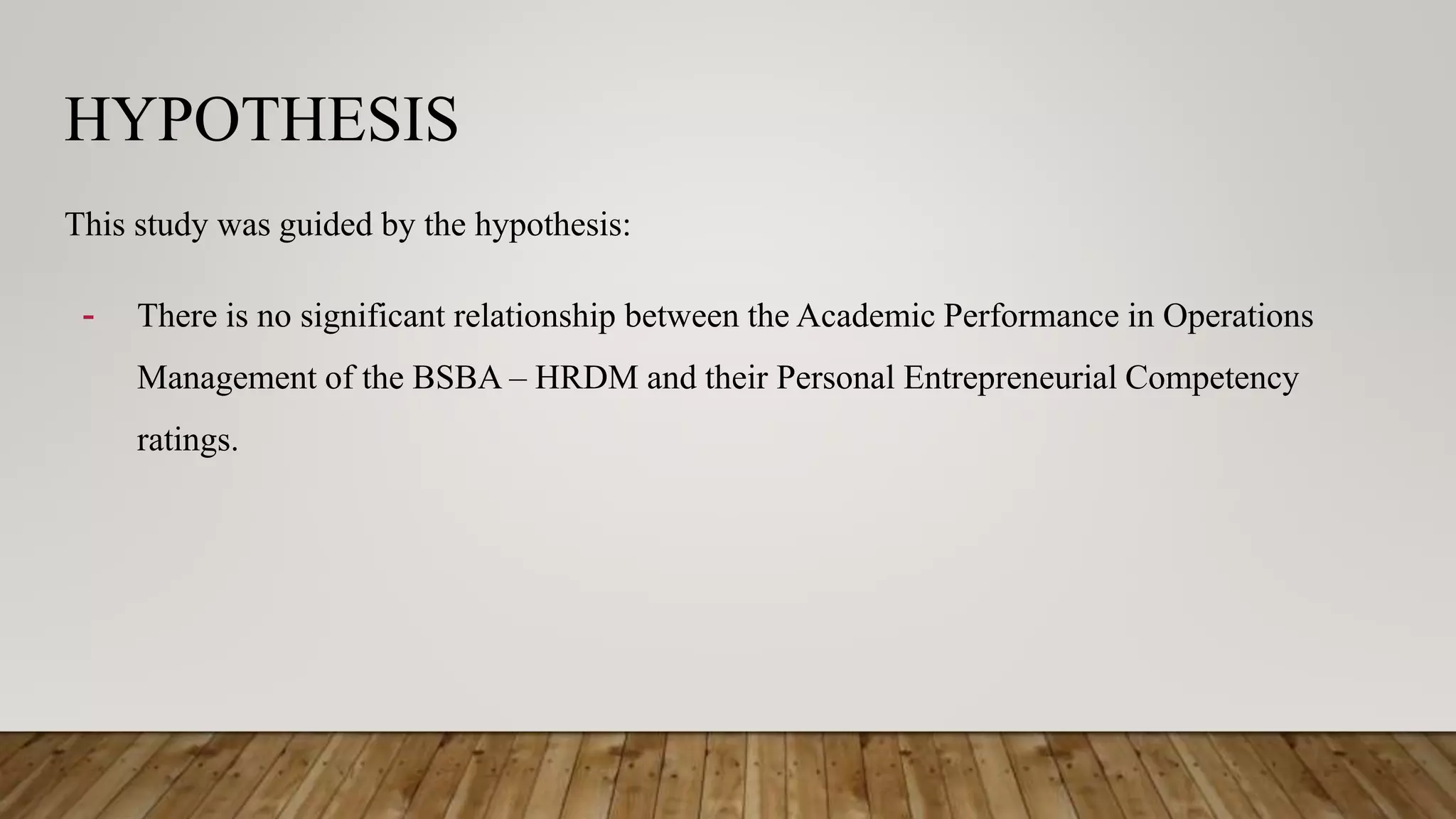
HYPOTHESIS
This study was guided by the hypothesis:
- There is no significant relationship between the Academic Performance in Operations
Management of the BSBA – HRDM and their Personal Entrepreneurial Competency
ratings.
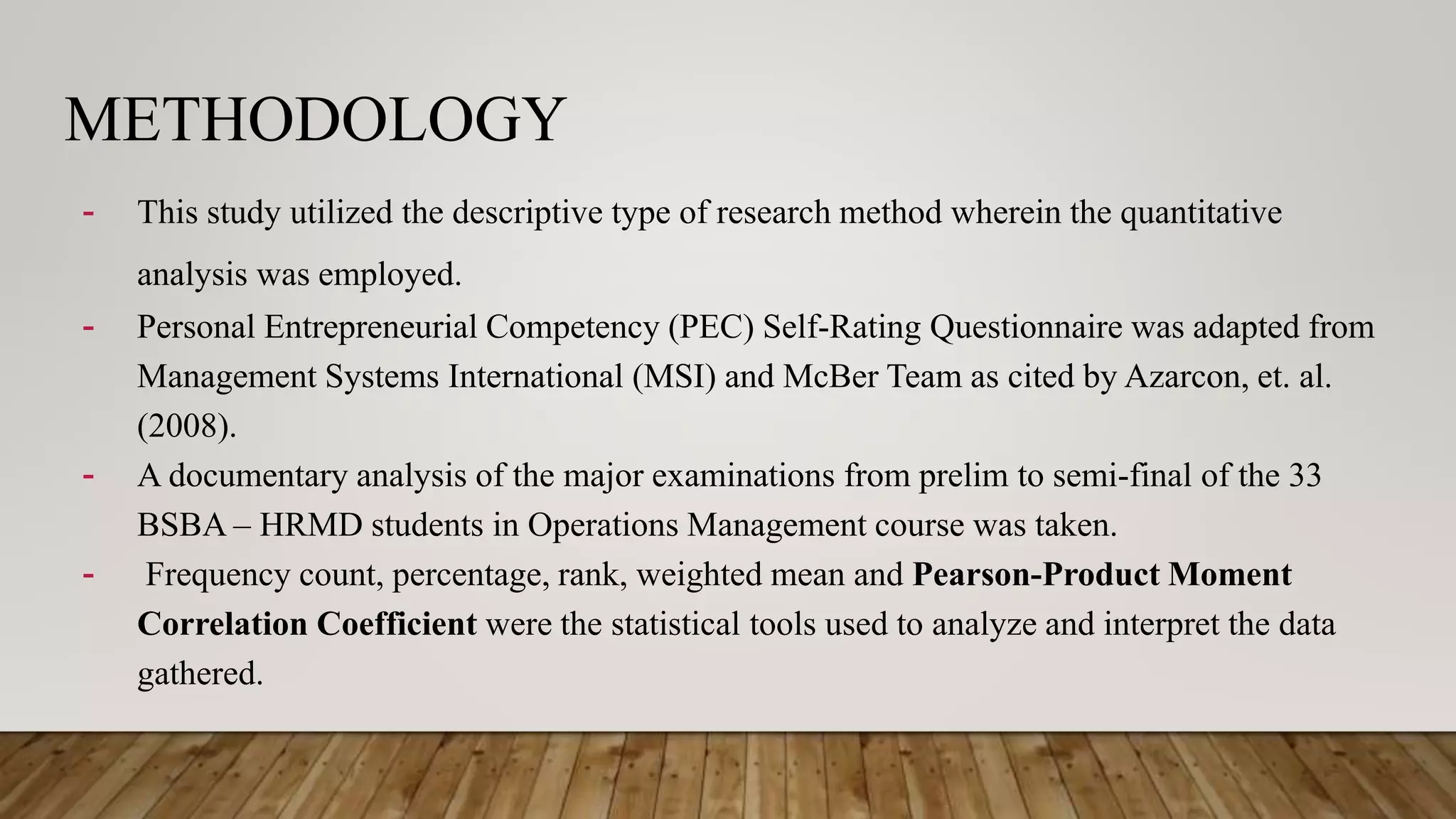
METHODOLOGY
- This study utilized the descriptive type of research method wherein the quantitative
analysis was employed.
- Personal Entrepreneurial Competency (PEC) Self-Rating Questionnaire was adapted from
Management Systems International (MSI) and McBer Team as cited by Azarcon, et. al.
(2008).
- A documentary analysis of the major examinations from prelim to semi-final of the 33
BSBA – HRMD students in Operations Management course was taken.
- Frequency count, percentage, rank, weighted mean and Pearson-Product Moment
Correlation Coefficient were the statistical tools used to analyze and interpret the data
gathered.
RESULTS
&
DISCUSSION
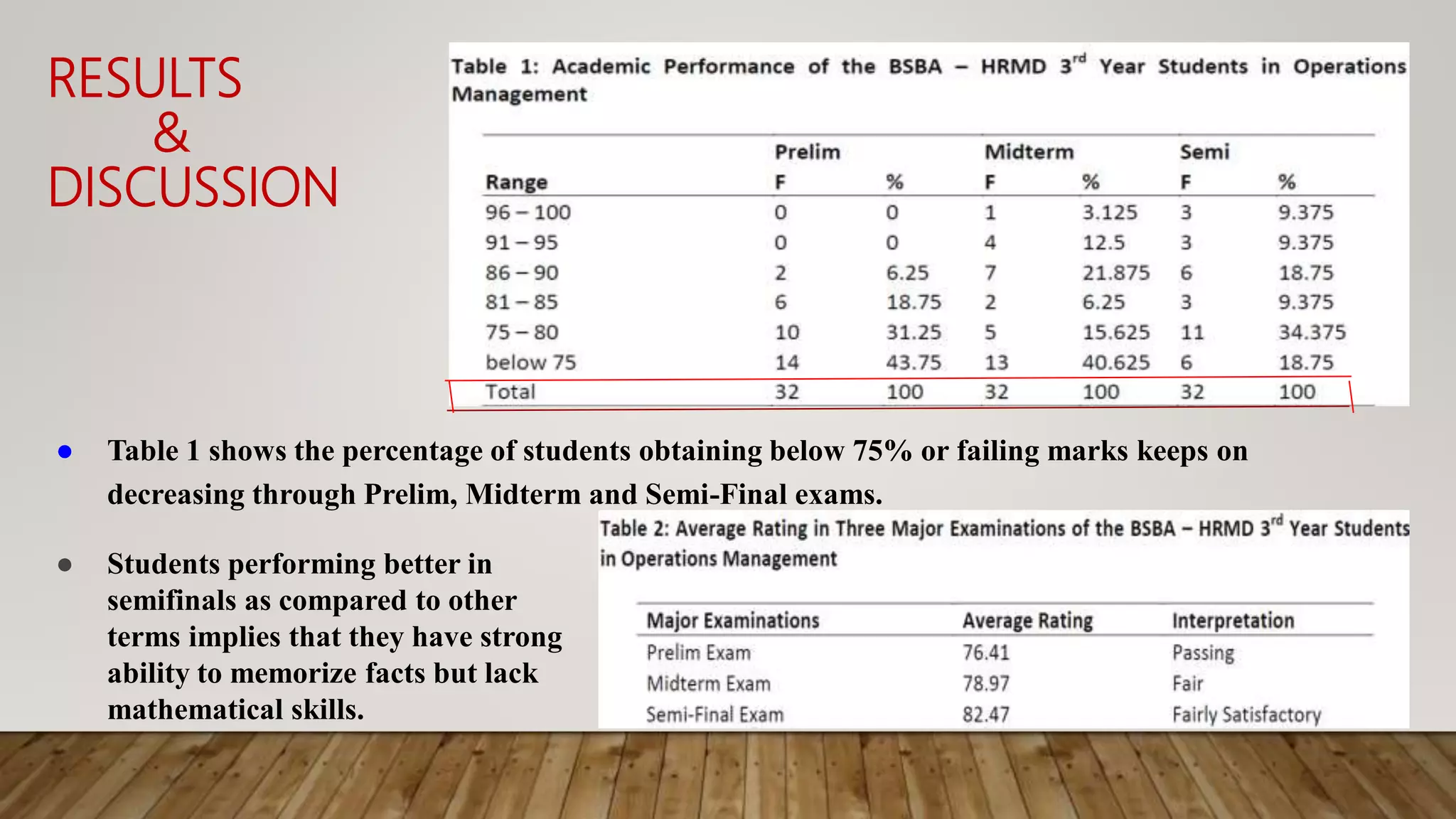
● Table 1 shows the percentage of students obtaining below 75% or failing marks keeps on
decreasing through Prelim, Midterm and Semi-Final exams.
● Students performing better in
semifinals as compared to other
terms implies that they have strong
ability to memorize facts but lack
mathematical skills.
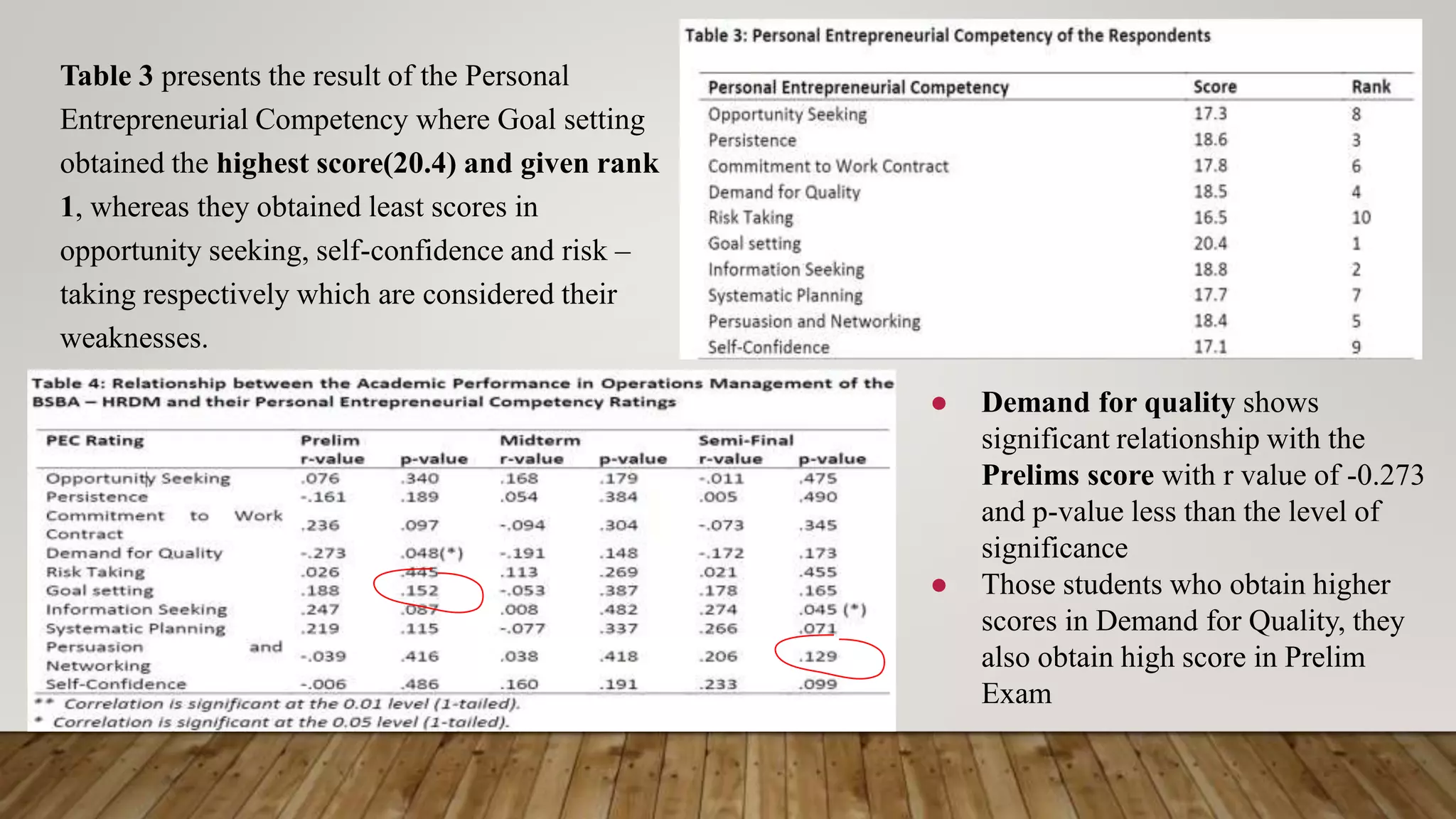
Table 3 presents the result of the Personal
Entrepreneurial Competency where Goal setting
obtained the highest score(20.4) and given rank
1, whereas they obtained least scores in
opportunity seeking, self-confidence and risk –
taking respectively which are considered their
weaknesses.
● Demand for quality shows
significant relationship with the
Prelims score with r value of -0.273
and p-value less than the level of
significance
● Those students who obtain higher
scores in Demand for Quality, they
also obtain high score in Prelim
Exam
CONCLUSION
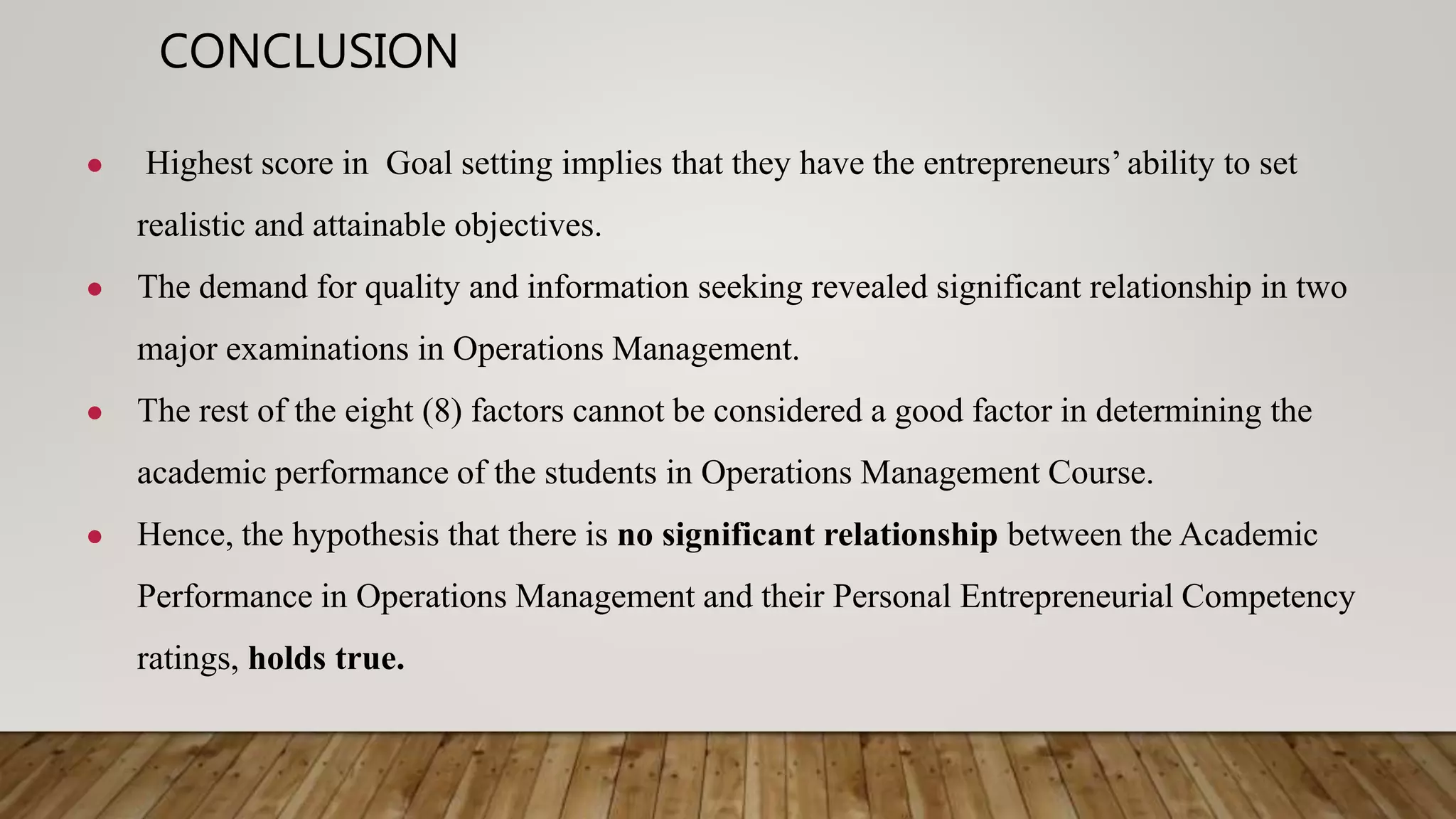
● Highest score in Goal setting implies that they have the entrepreneurs’ ability to set
realistic and attainable objectives.
● The demand for quality and information seeking revealed significant relationship in two
major examinations in Operations Management.
● The rest of the eight (8) factors cannot be considered a good factor in determining the
academic performance of the students in Operations Management Course.
● Hence, the hypothesis that there is no significant relationship between the Academic
Performance in Operations Management and their Personal Entrepreneurial Competency
ratings, holds true.

APPLICATION OF CORRELATION AND CASE STUDY

  • 1.
  • 2.
    CORRELATION SUBMITTED TO- Dr.Vikas saxena SUBMITEED BY- GROUP -1 Aditi Prasad (820001) Bhavya Sachdev (820004) Ankush Sharma (820002) Bipin Kumar (820005) Anshu Sharma (820003) Jatin Kumar (820006)
  • 3.
    CONTENTS 1. INTRODUCTION 2. TYPESOF CORRELATION 3. KARL PEARSON’S COEFFICIENT OF CORRELATION 4. RANK CORRELATION 5. TOPIC OF STUDY 6. OBJECTIVE OF THE STUDY 7. LITERATURE REVIEW 8. HYPOTHESIS 9. METHODOLOGY 10. RESULT AND DISCUSSION 11. CONCLUSION
  • 4.
    INTRODUCTION Definition Association betweentwo or more variable is termed as correlation ● The word correlation is made of co (meaning- together) and relation. ● Correlation is a single number that describes the degree of relationship between two variable. TYPES OF CORRELATION 1. Positive correlation 2. Negative correlation 3. No correlation
  • 5.
    CORRELATION COEFFICIENT 1.KARL PEARSON’SKarl Pearson’s correlation coefficient between two variables X and Y , is denoted by r(X, Y ) or rXY , is a measure of linear relationship between them and is defined as: r(X, Y ) = Cov(X, Y ) /σX σY ➢ Limits are: |r(X, Y )| ≤ 1 or −1 ≤ r(X, Y ) ≤ 1. ➢ Hence correlation coefficient cannot exceed unity numerically. It always lies between −1 and +1. ➢ If r = +1, the correlation is perfect and positive. ➢ If r = −1, correlation is perfect and negative.
  • 6.
    2. RANK CORRELATION ●Spearman's Rank Correlation Coefficient ● It is a nonparametric measure of association between two variable X and Y is given by the rank correlation coefficient where, di = xi − y ➢ Limits are: |ρ| ≤ 1 or −1 ≤ ρ ≤ 1. ➢ Spearman’s rank correlation coefficient ρ is nothing but Personinan correlation coefficient between the ranks. ➢ It is easy to understand and apply as compared with Karl Pearson’s formula.
  • 7.
    CASE STUDY :- ACORRELATION STUDY OF PERSONAL ENTREPRENEURIAL COMPETENCY AND THE ACADEMIC PERFORMANCE IN OPERATIONS MANAGEMENT OF BUSINESS ADMINISTRATION STUDENTS. JAKE M. LAGUADOR LYCEUM OF THE PHILIPPINES UNIVERSITY BATANGAS CITY, PHILIPPINES
  • 8.
    ABSTRACT ● This studyaimed to determine the Academic Performance of the Business Administration 3rd Year students in Operations Management course in terms of the result of their Prelim Exam, Midterm Exam, and Semi-Final Exam. ● It also analyzed the Personal Entrepreneurial Competency rating. The BSBA – HRDM students obtained low score in Prelim and Midterm examination where they find it difficult to answer Math problems ● The demand for quality and information seeking revealed significant relationship in two major examinations in Operations Management.
  • 9.
    INTRODUCTION An entrepreneur isone who organizes, manages, and assumes the risks of a business enterprise. Thus, entrepreneurship is undeniably an important source of income, an important strategy for creating new jobs and hastening the economic recovery and growth of the nation. Operations management is an area of management concerned with managing the process that converts inputs in the forms of materials, labor, and energy into outputs in the form of goods and services. This study analyze the Personal Entrepreneurial Competency rating in terms of opportunity seeking, persistence, commitment to work contract, demand for quality and efficiency, risk taking, goal setting, information seeking, systematic planning and monitoring, persuasion and networking, and self – confidence.
  • 10.
    OBJECTIVES OF THESTUDY ● To determine the Academic Performance of the BSBA – HRDM 3rd Year students in Operations Management ● To determine the Personal Entrepreneurial Competency rating of the BSBA – HRDM ● To determine the significant relationship between the Academic Performance in Operations Management of the BSBA – HRDM and their Personal Entrepreneurial Competency ratings. ● To propose an action plan to enhance the entrepreneurial competency of the BSBA – HRDM students.
  • 11.
    HYPOTHESIS This study wasguided by the hypothesis: - There is no significant relationship between the Academic Performance in Operations Management of the BSBA – HRDM and their Personal Entrepreneurial Competency ratings.
  • 12.
    METHODOLOGY - This studyutilized the descriptive type of research method wherein the quantitative analysis was employed. - Personal Entrepreneurial Competency (PEC) Self-Rating Questionnaire was adapted from Management Systems International (MSI) and McBer Team as cited by Azarcon, et. al. (2008). - A documentary analysis of the major examinations from prelim to semi-final of the 33 BSBA – HRMD students in Operations Management course was taken. - Frequency count, percentage, rank, weighted mean and Pearson-Product Moment Correlation Coefficient were the statistical tools used to analyze and interpret the data gathered.
  • 13.
    RESULTS & DISCUSSION ● Table 1shows the percentage of students obtaining below 75% or failing marks keeps on decreasing through Prelim, Midterm and Semi-Final exams. ● Students performing better in semifinals as compared to other terms implies that they have strong ability to memorize facts but lack mathematical skills.
  • 14.
    Table 3 presentsthe result of the Personal Entrepreneurial Competency where Goal setting obtained the highest score(20.4) and given rank 1, whereas they obtained least scores in opportunity seeking, self-confidence and risk – taking respectively which are considered their weaknesses. ● Demand for quality shows significant relationship with the Prelims score with r value of -0.273 and p-value less than the level of significance ● Those students who obtain higher scores in Demand for Quality, they also obtain high score in Prelim Exam
  • 15.
    CONCLUSION ● Highest scorein Goal setting implies that they have the entrepreneurs’ ability to set realistic and attainable objectives. ● The demand for quality and information seeking revealed significant relationship in two major examinations in Operations Management. ● The rest of the eight (8) factors cannot be considered a good factor in determining the academic performance of the students in Operations Management Course. ● Hence, the hypothesis that there is no significant relationship between the Academic Performance in Operations Management and their Personal Entrepreneurial Competency ratings, holds true.