BY ERICK OTIENO OKEYO
Background to the Study
Worldwide, business environments are characterized by
volatility, acute competition, and unprecedented threats
(Prahad 2009). Therefore, to operate and survive under
such conditions, a firm has to be agile. Strategic agility is a
critical tool that can enable a company to overcome crises
and achieve a competitive advantage, especially in a
volatile business environment (Alromeedy, 2019). Agility is
the organization’s ability to respond to changes in its
environment, simplify complex processes, and enhance its
responsiveness (Arteta & Giachetti, 2004). For firms to be
competitive locally, regionally, and globally, they must
adopt sound human, technological, and planning
attributes to enhance their strategic agility (Oyedijo, 2012).
Problem Statement
Over the years, Kenya Airway has been posting
poor financial results due to various reasons, such
as stiff competition. For instance, the airline’s
2020 financial performance declined by 59% due
to reduced flight capacity brought about by the
global downturn in commercial aviation (Kenya
Airways, 2021). Additionally, the year 2020 was
tough for the airline due to the effect of the
COVID-19 pandemic. Therefore, for the airline to
overcome the turbulence, it has to address various
aspects like making its network efficient and
enhancing its service quality.
Problem Statement Cont’d
Although some studies have been done to explore the
relationship between strategic agility and competitive
advantage, there is a paucity of research that has assessed
the mediating effect of competitive advantage on the
relationship between strategic agility and performance.
The current study will use competitive advantage as an
intervening variable between strategic agility and
performance.
Moreover, a quite number of studies on strategic agility –
performance relationships have been found to have
shortcomings, as explained hereunder:
Problem Statement Cont’d
Some of these studies have relied on a quantitative
approach (only questionnaires) in collecting data,
which made it challenging to collect in-depth
information (Alromeedy 2019; Abu-radi, 2015; Oyedijo,
2012; Tabe Khoshnood & Nematizadeh, 2017). The
current study will adopt a mixed approach
(questionnaires and interview schedules will be used
to collect data).
Problem Statement Cont’d
In some studies, it’s only qualitative approaches that have
been used to collect data (e.g., Shin et al.,2015). This makes
it difficult to generalize the study findings to the
population and other industries. Additionally, the use of
inappropriate sampling (purposeful) and a single
respondent from each firm in Chen’s (2019) study also
makes the generalization of the findings difficult.
Problem Statement Cont’d
Additionally, there are a lot of controversies surrounding the
results of strategic agility-performance relationships. For
instance, Some studies have reported a negative and
insignificant relationship between strategic agility and
organizational performance (e.g., Abu-radi ,2013; Shin et al.,
2015), whereas others have revealed a significant positive
relationship between strategic agility and business performance
(e.g., Alromeedy, 2019; Tabe Khoshnood &Nematizadeh, 2017).
Therefore, the current researcher seeks to fill the above gaps by
conducting a study on “Strategic agility, competitive advantage,
and performance of Kenya Airways.”
Objectives of the Study
 To determine relationship between
responsiveness and performance of
performance of Kenya Airways.
 To find out the effect of competency on the
performance of Kenya Airways.
 To assess the relationship between flexibility
and performance of Kenya Airways.
Objectives of the Study Cont’d
 To investigate the relationship between speed and
performance of Kenya Airways.
 To determine the mediating effect of competitive
advantage on the relationship between strategic agility and
performance of Kenya Airways.
Research Hypotheses
 There is no significant relationship between responsiveness
and performance of performance of Kenya Airways.
 There is no significant effect of competency on the
performance of Kenya Airways.
 There is no significant relationship between flexibility and
performance of Kenya Airways.
 There is no significant relationship between speed and
performance of Kenya Airways.
 Competitive advantage has no significant mediating effect
on the relationship between strategic agility and
performance of Kenya Airways.
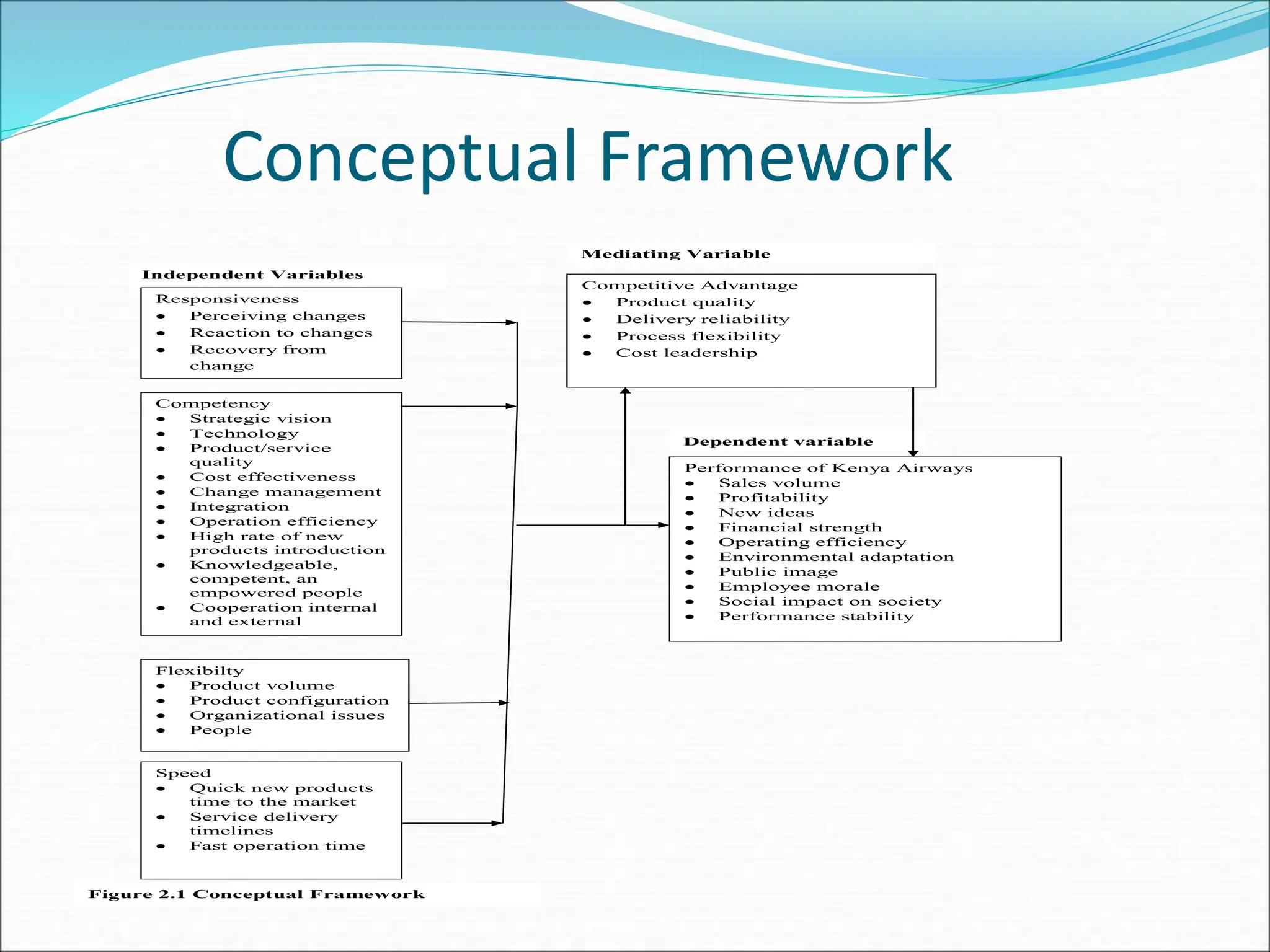
Conceptual Framework
Competency
 Strategic vision
 Technology
 Product/service
quality
 Cost effectiveness
 Change management
 Integration
 Operation efficiency
 High rate of new
products introduction
 Knowledgeable,
competent, an
empowered people
 Cooperation internal
and external
Independent Variables
Performance of Kenya Airways
 Sales volume
 Profitability
 New ideas
 Financial strength
 Operating efficiency
 Environmental adaptation
 Public image
 Employee morale
 Social impact on society
 Performance stability
Flexibilty
 Product volume
 Product configuration
 Organizational issues
 People
Speed
 Quick new products
time to the market
 Service delivery
timelines
 Fast operation time
Dependent variable
Figure 2.1 Conceptual Framework
Responsiveness
 Perceiving changes
 Reaction to changes
 Recovery from
change
Competitive Advantage
 Product quality
 Delivery reliability
 Process flexibility
 Cost leadership
Mediating Variable
Research Methodology
 Research Design
A research design is a strategy for carrying out an empirical
investigation to answer research questions (Bhattacherjee,
2012). At least three steps are involved in a study design:
data collecting, instrument design, and sampling. A cross-
sectional research design will be used in this investigation.
The method of gathering data on several cases at a single
moment in time to determine the link between variables is
known as a cross-sectional design (Bryman, 2016).
The study will use a combination of methods to collect
data, including surveys and interviews.
Research Methodology Cont’d
• Target Population
The target population will comprise 3986 employees
working for Kenya Airways, and the unit of analysis
will be the company’s staff (Kenya Airways, 2021).
Research Methodology Cont’d
 Sampling Procedures and Sample Size
According to Mugenda & Mugenda (2003), a sample
size of 10% to 30% of a population is sufficient for a
study. The sample size for this study will be 398
responders (10 percent of 3986). In addition, five
respondents (senior managers) from the population
will be chosen for interviews using purposeful
sampling. Purposive sampling, according to Sekaran
and Bougie (2016), is suggested when the subjects to
be chosen are the only ones in the best position to give
the data needed.
Research Methodology Cont’d
 Research Instruments and Data Collection
A semi-structured questionnaire will be used to
collect data from 398 participants. In addition, five
respondents will be interviewed using interview
guides to obtain qualitative data.
Research Methodology Cont’d
 Data Analysis
Quantitative data will be analyzed via the Statistical
Package for Social Scientists (SPSS), while qualitative
data will be analyzed through thematic analysis.
 Regression Model
The study will use the regression model to test the
hypotheses.
Thank You!

PhD Concept-Erik (1).ppt

  • 1.
  • 2.
    Background to theStudy Worldwide, business environments are characterized by volatility, acute competition, and unprecedented threats (Prahad 2009). Therefore, to operate and survive under such conditions, a firm has to be agile. Strategic agility is a critical tool that can enable a company to overcome crises and achieve a competitive advantage, especially in a volatile business environment (Alromeedy, 2019). Agility is the organization’s ability to respond to changes in its environment, simplify complex processes, and enhance its responsiveness (Arteta & Giachetti, 2004). For firms to be competitive locally, regionally, and globally, they must adopt sound human, technological, and planning attributes to enhance their strategic agility (Oyedijo, 2012).
  • 3.
    Problem Statement Over theyears, Kenya Airway has been posting poor financial results due to various reasons, such as stiff competition. For instance, the airline’s 2020 financial performance declined by 59% due to reduced flight capacity brought about by the global downturn in commercial aviation (Kenya Airways, 2021). Additionally, the year 2020 was tough for the airline due to the effect of the COVID-19 pandemic. Therefore, for the airline to overcome the turbulence, it has to address various aspects like making its network efficient and enhancing its service quality.
  • 4.
    Problem Statement Cont’d Althoughsome studies have been done to explore the relationship between strategic agility and competitive advantage, there is a paucity of research that has assessed the mediating effect of competitive advantage on the relationship between strategic agility and performance. The current study will use competitive advantage as an intervening variable between strategic agility and performance. Moreover, a quite number of studies on strategic agility – performance relationships have been found to have shortcomings, as explained hereunder:
  • 5.
    Problem Statement Cont’d Someof these studies have relied on a quantitative approach (only questionnaires) in collecting data, which made it challenging to collect in-depth information (Alromeedy 2019; Abu-radi, 2015; Oyedijo, 2012; Tabe Khoshnood & Nematizadeh, 2017). The current study will adopt a mixed approach (questionnaires and interview schedules will be used to collect data).
  • 6.
    Problem Statement Cont’d Insome studies, it’s only qualitative approaches that have been used to collect data (e.g., Shin et al.,2015). This makes it difficult to generalize the study findings to the population and other industries. Additionally, the use of inappropriate sampling (purposeful) and a single respondent from each firm in Chen’s (2019) study also makes the generalization of the findings difficult.
  • 7.
    Problem Statement Cont’d Additionally,there are a lot of controversies surrounding the results of strategic agility-performance relationships. For instance, Some studies have reported a negative and insignificant relationship between strategic agility and organizational performance (e.g., Abu-radi ,2013; Shin et al., 2015), whereas others have revealed a significant positive relationship between strategic agility and business performance (e.g., Alromeedy, 2019; Tabe Khoshnood &Nematizadeh, 2017). Therefore, the current researcher seeks to fill the above gaps by conducting a study on “Strategic agility, competitive advantage, and performance of Kenya Airways.”
  • 8.
    Objectives of theStudy  To determine relationship between responsiveness and performance of performance of Kenya Airways.  To find out the effect of competency on the performance of Kenya Airways.  To assess the relationship between flexibility and performance of Kenya Airways.
  • 9.
    Objectives of theStudy Cont’d  To investigate the relationship between speed and performance of Kenya Airways.  To determine the mediating effect of competitive advantage on the relationship between strategic agility and performance of Kenya Airways.
  • 10.
    Research Hypotheses  Thereis no significant relationship between responsiveness and performance of performance of Kenya Airways.  There is no significant effect of competency on the performance of Kenya Airways.  There is no significant relationship between flexibility and performance of Kenya Airways.  There is no significant relationship between speed and performance of Kenya Airways.  Competitive advantage has no significant mediating effect on the relationship between strategic agility and performance of Kenya Airways.
  • 11.
    Conceptual Framework Competency  Strategicvision  Technology  Product/service quality  Cost effectiveness  Change management  Integration  Operation efficiency  High rate of new products introduction  Knowledgeable, competent, an empowered people  Cooperation internal and external Independent Variables Performance of Kenya Airways  Sales volume  Profitability  New ideas  Financial strength  Operating efficiency  Environmental adaptation  Public image  Employee morale  Social impact on society  Performance stability Flexibilty  Product volume  Product configuration  Organizational issues  People Speed  Quick new products time to the market  Service delivery timelines  Fast operation time Dependent variable Figure 2.1 Conceptual Framework Responsiveness  Perceiving changes  Reaction to changes  Recovery from change Competitive Advantage  Product quality  Delivery reliability  Process flexibility  Cost leadership Mediating Variable
  • 12.
    Research Methodology  ResearchDesign A research design is a strategy for carrying out an empirical investigation to answer research questions (Bhattacherjee, 2012). At least three steps are involved in a study design: data collecting, instrument design, and sampling. A cross- sectional research design will be used in this investigation. The method of gathering data on several cases at a single moment in time to determine the link between variables is known as a cross-sectional design (Bryman, 2016). The study will use a combination of methods to collect data, including surveys and interviews.
  • 13.
    Research Methodology Cont’d •Target Population The target population will comprise 3986 employees working for Kenya Airways, and the unit of analysis will be the company’s staff (Kenya Airways, 2021).
  • 14.
    Research Methodology Cont’d Sampling Procedures and Sample Size According to Mugenda & Mugenda (2003), a sample size of 10% to 30% of a population is sufficient for a study. The sample size for this study will be 398 responders (10 percent of 3986). In addition, five respondents (senior managers) from the population will be chosen for interviews using purposeful sampling. Purposive sampling, according to Sekaran and Bougie (2016), is suggested when the subjects to be chosen are the only ones in the best position to give the data needed.
  • 15.
    Research Methodology Cont’d Research Instruments and Data Collection A semi-structured questionnaire will be used to collect data from 398 participants. In addition, five respondents will be interviewed using interview guides to obtain qualitative data.
  • 16.
    Research Methodology Cont’d Data Analysis Quantitative data will be analyzed via the Statistical Package for Social Scientists (SPSS), while qualitative data will be analyzed through thematic analysis.  Regression Model The study will use the regression model to test the hypotheses.
  • 17.