International Journal of Engineering and Management Research e-ISSN: 2250-0758 | p-ISSN: 2394-6962
Volume- 9, Issue- 5 (October 2019)
www.ijemr.net https://doi.org/10.31033/ijemr.9.5.9
54 This work is licensed under Creative Commons Attribution 4.0 International License.
The Influence of Career Management to Perceived Job Performance of
Bahrainis in Ebrahim Khalil Kanoo in the Kingdom of Bahrain
Manar Nader Alarrayedh1
and Dr. Mark P. Doblas2
1
MBA Student, College of Financial and Administrative Sciences, AMA International University, KINGDOM OF BAHRAIN
2
Assistant Professor, College of Financial and Administrative Sciences, AMA International University, KINGDOM OF
BAHRAIN
1
Correspondence Author: mano0or22@live.com
ABSTRACT
Like most organizations, EKK recognizes that career
management is essential in achieving organizational
objectives. In fact, it prides itself as one of the country’s best in
terms of managing employee career growth. As well as it has
an existing career management which been established from
1999 till now which is 20 years ago. However, it has been
noted that there is yet a formal study conducted in EKK to
assess the Influence of Career Management to Job
Performance of Bahrainis. Thus, this study aims to assess the
influence of Career Management Implementation to Perceived
Job Performance of Bahrainis in Ebrahim Khalil Kanoo in the
kingdom of Bahrain. The study utilized a descriptive research
design involving 162 sampled respondents. The research made
use of an adopted questionnaire as data gathering tool. The
results of the study showed that over-all implementation of
Career Management influences perceived employee
performance. In addition, the study also found that among all
dimensions of Career Management assessed in the study,
Basic, Formal, Active Planning and Active Management
Activities significantly influence Perceived Employee
Performance. Finally, Multi-Directional Activity does not
significantly influence perceived employee performance.
Keywords— Active Management, Active Planning, Basic
Activity Career Management, formal Activity, Perceived
Employee Performance, Multi Directional
I. INTRODUCTION
Ebrahim Khalil Kanoo (EKK) served Bahrain for
more than fifty years. The company’s core business is
automotive retail and sales, as well the after sales service
activities, for automobile owners’ in the Kingdom. The
company has more than 2700 employee. It is a well-known
international automobile brand provider that agents popular
products of Volvo, Isuzu, Subaru, Cherry, Sangung, Lexus,
Toyota, Mercantile, Michelin, and McLaren. The company
also operates Tyre Plus and Zibart, Kanoo Vehicle Leasing,
Kanoo daily rental and Kanoo pre-owner vehicle. As well
as it has an existing career management which been
established from 1999 till now which is 20 years ago.
Like most organizations, EKK recognizes that career
management is essential in achieving organizational
objectives. In fact, it prides itself as one of the country’s
best in terms of managing employee career growth. As
Adamson and others (2015) noted, the importance of career
management it is not only organizations benefit from an
effective career management system, but also the individual
employee. They suggest that a career can assist individuals
in the way that it offers structure, direction, meaning, and
purpose to daily activities.
Having a career can furthermore imply other
important consequences such as the financial return after
having invested time and labor in the employing
organization. A well-functioning career management
system will therefore to some extent ensure both an
organized working environment as well as the satisfaction
of basic economic needs and other higher needs such as for
example self-actualization and personal development needs
thus helps in the fulfillment of the psychological contract.
A well-working career management framework
will thusly to some degree guarantee both a composed
workplace just as the fulfillment of fundamental monetary
necessities and other higher needs such as self-completion
and self-improvement needs causes it to satisfaction of the
mental contract. However, it has been noted that there is yet
a formal study conducted in EKK to assess the Influence of
Career Management to Job Performance of Bahrainis.
Orpen (2014) has studied the relationship between
job performance and the management in a variety of
organizations both in private and public sectors in UK. He
studied career effectiveness in terms of salary growth,
promotion received, career performance and career
satisfaction. From the factor analysis conducted in his
study, he identified three components of organizational
career management, which includes career information,
career management policies and career development. The
results of his study demonstrated that career policies, career
development and career information do have a positive
correlation with performance. It also provided evidence
that career information has a stronger effect on
performance, compared to the other two factors.
International Journal of Engineering and Management Research e-ISSN: 2250-0758 | p-ISSN: 2394-6962
Volume- 9, Issue- 5 (October 2019)
www.ijemr.net https://doi.org/10.31033/ijemr.9.5.9
55 This work is licensed under Creative Commons Attribution 4.0 International License.
With the concepts and needs in place, this study seeks to
assess the influence of Career Management Implementation
to Perceived Employee Performance among Baharanis in
EKK. The results of the study will serve value in improving
the existing career management program of the
organization that would enable it to establish a career path
framework for the talented employees and retain the key
workers to achieve business advantage within Bahraini
labor market competitors in accordance to the 2030 vision
objectives.
Theoretical Framework
This research is anchored on three theories namely
Two Dimensional Model of Career Management (Baruch &
Peiperl, 2000) which describe there are five dimensions
under the career management: formal, basic, active
management, active planning and multi directional however
will explain the level of involvement and the level of
sophistication. The second framework Heuristic Framework
of Career Performance (Koopmans, 2017) explains the four
dimensions: Task Performance, Adaptive Performance,
Contextual Performance and Counterproductive work
behavior and how its link to the work performance. Finally
the third framework describes the relationship between the
variables (Khulida Yahya, 2004).
Career management implementation significantly
influence perceived level of performance for Bahrainis in
Ebrahim Khalil Kanoo in Kingdom of Bahrain Researchers
collect theoretical framework that include a philosophical
and methodological model to help design their work. A
formal theory provides context for the outcome of the
events conducted in the research.
Baruch & Peiperl (2000) built a framework of five
practices dimensions on career management. “Basic”
activities include job posting, formal education, pre-
retirement programs, and lateral moves.
“Active Planning” activities were associated with
dynamic, open, and proactive climates, include
performance appraisal (by the direct supervisor and by the
HR department) and succession planning. “Forman”
activities include written personal career planning, supply
dual career ladder, career books and/or pamphlets, and
common career paths. “Multi-Directional” activities were
correlated with open climates and include peer appraisal
and upward appraisal. This model can provide an effective
practice framework to managers to help employees’ career
development. “Active Management” cluster include
assessment centers, formal mentoring relationships, and
career workshops.
These activities all focus on knowing as much as
possible about the individual and his/her prospects, as well
as how the firm’s career system works.
Research has shown the existence of a general
factor, which accounts for substantial variation in job
performance ratings.
At the second level, four dimensions of individual
work performance are located. At the third level, the
individual measures corresponding to each dimension are
located. The importance of these dimensions, and the exact
indicators associated with each dimension, may differ
depending on the context involved. The first dimension,
task performance, refers to the proficiency with which
central job tasks are performed. The second dimension,
contextual performance, refers to behaviors that support the
organizational, social, and psychological environment in
which the technical core must function. As a third
dimension, adaptive performance is included in the
heuristic framework.
Although proactive and creative performance can
be a part of task performance in some jobs, we considered
this part of contextual performance, as both contribute to a
positive organizational, social, and psychological work
environment. Each of the four dimensions is latent,
meaning that they cannot be measured directly. Relations
between dimensions not only are the separate dimensions
related to the general factor of work performance, they are
also related to each other.
Task performance is distinct, albeit strongly
positively related, with contextual performance. Both types
of behavior in- dependently contribute to overall
performance, but through different means. Findings on the
relation between task performance and counterproductive
work behavior are inconclusive and have been found to be
either moderately or strongly negative.
The inconclusive findings could be caused by
differences in definition and measurement of task
performance. When task performance is defined as what a
person generally “will do,” it is more strongly related to
counterproductive work behavior than when task.
II. METHODOLOGY
The study utilized the descriptive design. An
organizationally – based, descriptive portion of design was
pursued through the use of relevant data via conducting
adoptive questionnaire.
The respondents were selected from Ebrahim
Khalil Kanoo Employees using quota sampling including
those who are assigned in Tubli branch, Salmabad branch,
Riffa branch, Arad branch and Manama branch. The total
population is 450 bahrain employee and the researcher will
take a sample of 162 respondents by using the published
table used by Miller, Kunce (1973),Halinski and Feldt
(1970) with margen error 0.05.
The researcher used adopted questionnaire by
(Baruch & Peiperl, 2000) which has three parts: the first
part will assess the status of career management
implementation for Bahrainis in Ebrahim Khalil kanoo in
International Journal of Engineering and Management Research e-ISSN: 2250-0758 | p-ISSN: 2394-6962
Volume- 9, Issue- 5 (October 2019)
www.ijemr.net https://doi.org/10.31033/ijemr.9.5.9
56 This work is licensed under Creative Commons Attribution 4.0 International License.
the kingdom of Bahrain in term of: Multi Directional,
Active Management, Active Planning, Formal and Basic.
The second part assessed the perceived on the
level of performance for the respondents in the company in
term of: Task Performance, Adaptive Performance,
Contextual Performance and Counterproductive work
behavior while the third part will be the open ended
recommendation from the respondents.
The questionnaire was tested in terms of validity
and reliability. In terms of validity, an assessment was done
involving three experts in the field of career management.
An assessment tool was used by the experts to evaluate the
validity of the content. The results showed that the
instrument was rated over all 4.2 weighted mean which are
implemented career management and very good level of
employee job performance. the three experts was from :
Trust re reinsurance company which give the researcher
4.11 weighted mean overall , Ashraf Company in Bahrain
4.3 weighted mean and kumon company 4.32 weighted
mean.
After validity was established, the reliability of
the instrument was measured thru internal consistency. A
pilot test was conducted involving 30 Bahraini employees
who were not included in the final sample. A Chronbach
alpha test yielded a value of 0.82 indicating the internal
consistency of the instrument.
The data gathering was organized, analyzed and
interpreted using the following statistical tools: mean,
standard deviation, multiple linear and regression analysis.
III. PRESENTATION, ANALYSIS AND
INTERPRETATION OF DATA
A. Career Management Implementation
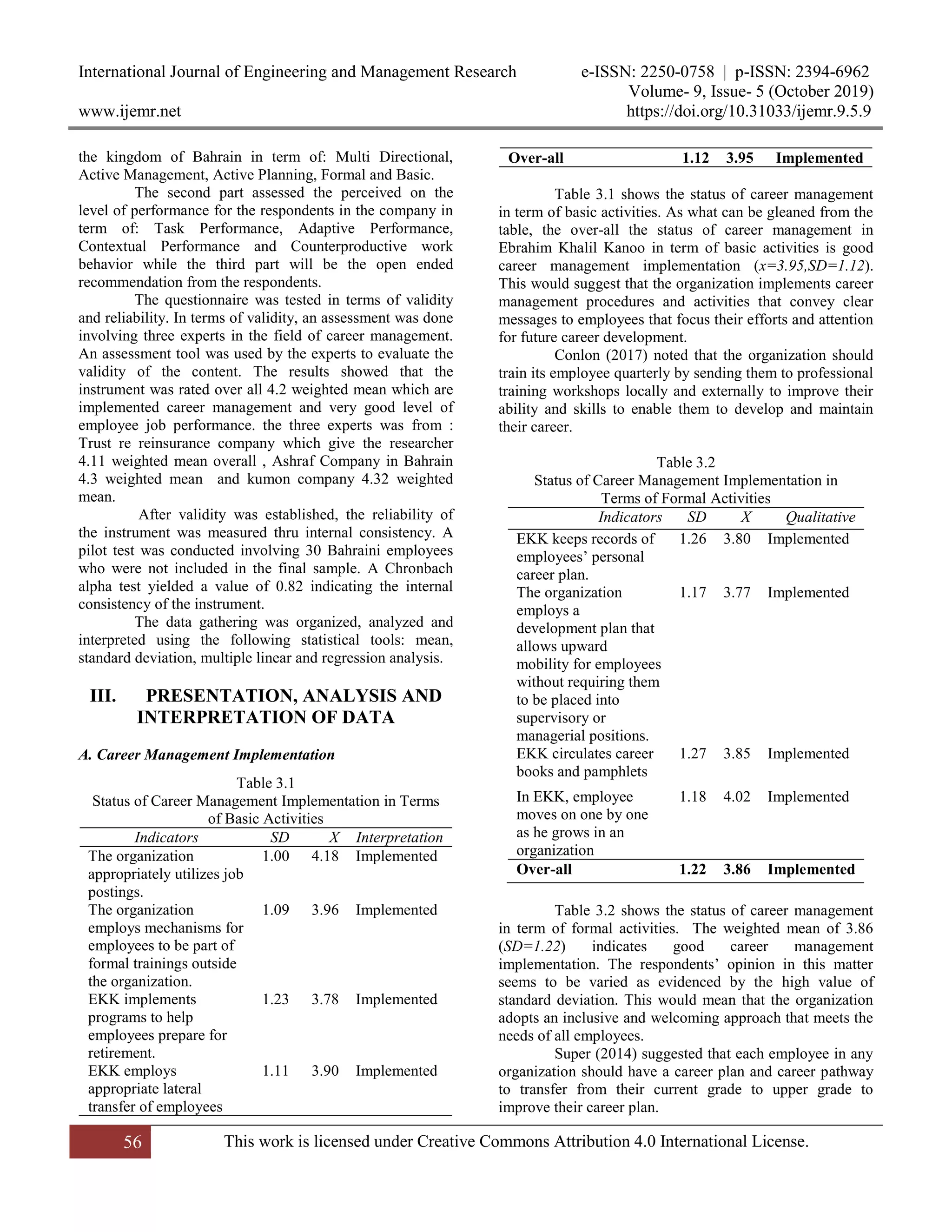
Table 3.1
Status of Career Management Implementation in Terms
of Basic Activities
Indicators SD X Interpretation
The organization
appropriately utilizes job
postings.
1.00 4.18 Implemented
The organization
employs mechanisms for
employees to be part of
formal trainings outside
the organization.
1.09 3.96 Implemented
EKK implements
programs to help
employees prepare for
retirement.
1.23 3.78 Implemented
EKK employs
appropriate lateral
transfer of employees
1.11 3.90 Implemented
Over-all 1.12 3.95 Implemented
Table 3.1 shows the status of career management
in term of basic activities. As what can be gleaned from the
table, the over-all the status of career management in
Ebrahim Khalil Kanoo in term of basic activities is good
career management implementation (x=3.95,SD=1.12).
This would suggest that the organization implements career
management procedures and activities that convey clear
messages to employees that focus their efforts and attention
for future career development.
Conlon (2017) noted that the organization should
train its employee quarterly by sending them to professional
training workshops locally and externally to improve their
ability and skills to enable them to develop and maintain
their career.
Table 3.2
Status of Career Management Implementation in
Terms of Formal Activities
Indicators SD X Qualitative
EKK keeps records of
employees’ personal
career plan.
1.26 3.80 Implemented
The organization
employs a
development plan that
allows upward
mobility for employees
without requiring them
to be placed into
supervisory or
managerial positions.
1.17 3.77 Implemented
EKK circulates career
books and pamphlets
1.27 3.85 Implemented
In EKK, employee
moves on one by one
as he grows in an
organization
1.18 4.02 Implemented
Over-all 1.22 3.86 Implemented
Table 3.2 shows the status of career management
in term of formal activities. The weighted mean of 3.86
(SD=1.22) indicates good career management
implementation. The respondents’ opinion in this matter
seems to be varied as evidenced by the high value of
standard deviation. This would mean that the organization
adopts an inclusive and welcoming approach that meets the
needs of all employees.
Super (2014) suggested that each employee in any
organization should have a career plan and career pathway
to transfer from their current grade to upper grade to
improve their career plan.
International Journal of Engineering and Management Research e-ISSN: 2250-0758 | p-ISSN: 2394-6962
Volume- 9, Issue- 5 (October 2019)
www.ijemr.net https://doi.org/10.31033/ijemr.9.5.9
57 This work is licensed under Creative Commons Attribution 4.0 International License.
Table 3.3
Status of Career Management Implementation in Terms of
Directional Activities
Indicators SD X Interpretation
In my organization,
employees can freely
evaluate each other
1.13 3.93 Implemented
Superiors are
appropriately evaluated
by the subordinates.
1.18 3.81 Implemented
Over-all 1.16 3.87 Implemented
Table 3.3 shows the status of career management
in term of multi directional. As what can be gleaned from
the table, the over-all mean indicates that the organization
has in place a good level of implementation (x=3.87,
SD=1.16). However, the respondents’ opinion in this matter
seems to be varied as evidenced by the high value of
standard deviation.
Table 3.4
Status of Career Management in Terms of Active
Management
Indicators SD X Interpretation
Assessment canters are
established in EKK for
objective evaluations
1.12 3.98 Implemented
EKK have seniors
mentor juniors and new
hires
1.10 4.12 Implemented
Career workshops are
organized by the
organization
1.11 3.94 Implemented
Over-all 1.11 4.01 Implemented
The status of career management in term of active
management shown in Table 4.4. As what can be gleaned
from the table, the overall mean of this dimension is rated at
4.01 (SD=1.11) suggesting a good level of implementation.
The organization demonstrates good practices
having seniors mentor juniors and new hires, organizing
career workshops by the organization, assessment canters
are established in EKK for objective evaluations. This is a
good sign for Ebrahim Khalil Kanoo as Organizational
policies and practices that relate to the availability of
resources and support to improve the career management
within the company
Table 3.5
Status of Career Management in Terms of Active planning
Indicators SD X Interpretation
In EKK, Performance
appraisal as a basis for
1.22 3.91 Implemented
career planning
Direct supervisors
objectively evaluates
subordinates
1.16 3.91 Implemented
HR Department
appropriately plans the
career moves of the
employees
1.32 3.72 Implemented
Succession planning is
effectively implemented
in EKK
1.20 3.85 Implemented
Over-all 1.22 3.85 Implemented
Finally, table 3.5 shows the status of career
management in term of active planning. As what is
presented in the table, the over-all weighted mean suggests
(x=3.85, SD=1.22). This would mean that, in general, the
organization is implementing the career management
internally with the employees in a good level. In fact,
employees say they Performance appraisal as a basis for
career planning. In addition, direct supervisors objectively
evaluate subordinates. In addition, Succession planning is
effectively implemented in EKK. While the HR Department
appropriately plans the career moves of the employees.
B. Perceived Job Performance
Table 3.6
Perceived Level of Performance
Indicators SD X Interpretation
TASK PERFORMANCE
I complete the given tasks
on time.
1.02 4.16 Very good
My output is considered by
my superior neat and
accurate.
0.95 4.09 Very good
If given a chance, I solve
work problems effectively
0.99 4.27 Excellent
I am capable of making
sure that in my work,
resources are properly
utilized.
0.95 4.10 Very good
I am organized in
dispensing my tasks in
work.
1.06 4.10 Very good
CONTEXTUAL PERFORMANCE
I perform my job with
enthusiasm
1.04 4.17 Very good
I take initiative when I see
it necessary
0.99 4.23 Excellent
I am creative in my work 1.04 4.19 Very good
I help my co-workers in
times when they are in need
1.01 4.28 Excellent
I am persistent in doing the
things I do in work. 1.01 4.20 Very good
ADAPTIVE PERFORMANCE
I find new ways in doing my 0.99 4.06 Very good
International Journal of Engineering and Management Research e-ISSN: 2250-0758 | p-ISSN: 2394-6962
Volume- 9, Issue- 5 (October 2019)
www.ijemr.net https://doi.org/10.31033/ijemr.9.5.9
58 This work is licensed under Creative Commons Attribution 4.0 International License.
work.
I easily adjust to changes in
work policies
1.00 4.06 Very good
I embrace cultural diversity
in the workplace
0.97 4.19 Very good
I easily learn the new tasks
given to me
0.97 4.28 Excellent
In work, I stay calm under
pressure.
1.06 4.06 Very good
COUNTER PRODUCTIVE BEHAVIOURS
If given an opportunity, I will
not take longer breaks than
allowed
1.26 4.77 Very good
I will not participate in office
gossip about our superiors
and co-workers.
1.22 4.83
Very good
I regard safety in performing
my job.
1.27 4.73 Very good
I don’t take absences even
without a valid reason.
1.34 4.67 Very good
I never been late in work. 1.26 4.64 Very good
Over-all Employee
Performance
0.13 3.55 Very good
Table 3.6 shows the perceived employee
performance in Ebrahim Khalil Kanoo. As the over-all
results show, as perceived by the respondents, the
organization is performing at a very good level (x=3.55,
SD=0.13) in terms of task performance, contextual
performance, adoptive performance and counterproductive
behaviors.
Looking at the individual dimensions, contextual
performance tends to be the highest contributor of the
company overall performance. It is an evidence that the
employees are highly engaged in their work by doing their
job and extra work , being innovative bringing new idea to
be implemented, have the inspiration and the motivation to
do the job effectively and efficiency .Besides it means that
the company cares about the employee and it makes effort
to satisfy the employee. As well as the Counter Productive
Behaviors which is excellent as the employee love their
jobs and happy to be part of the organization and well
engaged.
C. Career Management Implementation and its Influence
Perceived Level of Performance
Table 3.7
Regression Statistics for the Influence of Career
Management Implementation on Perceived level of
performance
Multiple R 0.60287
0.36345R Square
Adjusted R Square 0.34305
Standard Error 0.44580
Observations 162
Table 3.7 presents the Regression Analysis to test the
influence of career management implementation on
respondents’ perceived level of performance. As the table
shows, table 4.8 present the computed F value is 17.8145
which is significant at 0.01 (p<0.01). This means that over-
all implementation of Career Management significantly
influences the employee’s perceived level of performance.
In fact, the computed adjusted R square suggests that
around 34% of the variations in performance are influenced
by Career Management Implementation.
Table 3.8
Analysis of Variance
df SS MS F Significance
Regression 5 17.70 3.54 17.8 6.01E-14
Residual 156 31.00 0.19
Total 161 48.70
Table 3.9
Regression Coefficients
Coefficients SE t P
Intercept 2.176 0.162 13.424 8.407E-28**
Bas-Act 0.188 0.073 2.556 0.011*
Form -0.167 0.076 -2.205 0.028*
Mult-Direc -0.07 0.049 -1.416 0.158
Act-Mgt 0.206 0.067 3.083 0.002**
Act-Plan 0.187 0.066 2.841 0.005**
**significant at 0.01
**significant at 0.05
Legend:
Bas.Act = Basic activities
Form= formal activities
Mult-Direc = Multi-directional
Act-Mgt=Active
management
Act-Plan = Active planning
Looking at Table 4.9 the individual dimensions of
Career Management Implementation, however, only Multi-
Directional Activity does not significantly influence
Perceived Employee Performance (p=0.158). Both Basic
and Formal Activities are significant at 0.05 in influencing
Perceived Performance with p values of 0.011 and 0.028
respectively. Finally, Active Planning and Active
Management Activities are significant at 0.01 with p values
of 0.005 and 0.002, respectively.
IV. CONCLUSION
After careful analysis of the findings of the study,
the researcher derived several conclusions. Firstly, the
study concludes that over-all implementation of Career
Management influences perceived employee performance.
Second, the study also found that among all dimensions of
Career Management assessed in the study, Basic, Formal,
Active Planning and Active Management Activities
significantly influence Perceived Employee Performance.
Finally, Multi-Directional Activity does not significantly
influence perceived employee performance.
International Journal of Engineering and Management Research e-ISSN: 2250-0758 | p-ISSN: 2394-6962
Volume- 9, Issue- 5 (October 2019)
www.ijemr.net https://doi.org/10.31033/ijemr.9.5.9
59 This work is licensed under Creative Commons Attribution 4.0 International License.
RECOMMENDATION
Based on the findings of the study, the following
recommendations are set forth;
1. EKK should improve more in implementing
programs to help employees to be prepared for
retirement. The researcher suggests to put the
retirement details in first contract by the
recruitment department to let the employee plan
well from inception for his retirement.
2. Organizations need to design programs and
initiatives for career management in such a way
that they can be seamlessly integrated into the
organization and that workers see them as a chance
to increase their productivity and their learning.
3. EKK needs to design programs and initiatives for
career management in such a way that they can be
seamlessly integrated into the organization and
that workers see them as a chance to increase their
productivity and their learning. To ensure long-
term growth through the career pathway,
organizations need to emphasize the integration
and learning perspective as a motivation for both
administrators and its workforce.
4. Finally, future research should be conducted about
career management with special attention on the
varying effects of the dimensions. More
respondents may be included to have more
conclusive findings. Also the heuristic framework
of individual work performance that is presented
in the current review can serve as a guide for
future research and practice.
REFERENCES
[1] Adamson. (2015). A study about the importance of
career management. International Journal of Career
Management in UK, 444-555.
[2] Orpen. (2014). The effects of organizational and
individual career management on career success.
International Journal of Manpower, 15(1), 27-37.
[3] Kulida Yahya. (2004). The relationship between
organization career management and individual’s
performance. Available at:
http://citeseerx.ist.psu.edu/viewdoc/download?doi=10.1.1.4
70.7415&rep=rep1&type=pdf.
[4] Conlon. (2004). Employee training and workshop
internally and externally Career. UK Journal, 34, 84-85.
[5] Super, Donald E. (2014). Career plan approach to career
management. Journal of Vocational Behavior, 16, 282-
298.
[6] Koopman. (2017). Four dimension of career
performance. The International Journal of Public Sector
Management, 13(5), 417-446.
[7] Baruch, Y. & Peiperl. M. (2000). Career management
practices: An empirical survey and implications. Human
Resource Management Book, Wiley Online Library, 347-
366.
[8] Miller, D. E. & Kunce, J. T. (1973). Prediction and
statistical overkill revisited. Measurement and Evaluation
in Guidance, 6(3), 157-163.
[9] Halinski & Feldt. (1970). Prediction and statistical
overkill revisited. Measurement and Evaluation in
Guidance, 6(3), 164-167.

The Influence of Career Management to Perceived Job Performance of Bahrainis in Ebrahim Khalil Kanoo in the Kingdom of Bahrain

  • 1.
    International Journal ofEngineering and Management Research e-ISSN: 2250-0758 | p-ISSN: 2394-6962 Volume- 9, Issue- 5 (October 2019) www.ijemr.net https://doi.org/10.31033/ijemr.9.5.9 54 This work is licensed under Creative Commons Attribution 4.0 International License. The Influence of Career Management to Perceived Job Performance of Bahrainis in Ebrahim Khalil Kanoo in the Kingdom of Bahrain Manar Nader Alarrayedh1 and Dr. Mark P. Doblas2 1 MBA Student, College of Financial and Administrative Sciences, AMA International University, KINGDOM OF BAHRAIN 2 Assistant Professor, College of Financial and Administrative Sciences, AMA International University, KINGDOM OF BAHRAIN 1 Correspondence Author: mano0or22@live.com ABSTRACT Like most organizations, EKK recognizes that career management is essential in achieving organizational objectives. In fact, it prides itself as one of the country’s best in terms of managing employee career growth. As well as it has an existing career management which been established from 1999 till now which is 20 years ago. However, it has been noted that there is yet a formal study conducted in EKK to assess the Influence of Career Management to Job Performance of Bahrainis. Thus, this study aims to assess the influence of Career Management Implementation to Perceived Job Performance of Bahrainis in Ebrahim Khalil Kanoo in the kingdom of Bahrain. The study utilized a descriptive research design involving 162 sampled respondents. The research made use of an adopted questionnaire as data gathering tool. The results of the study showed that over-all implementation of Career Management influences perceived employee performance. In addition, the study also found that among all dimensions of Career Management assessed in the study, Basic, Formal, Active Planning and Active Management Activities significantly influence Perceived Employee Performance. Finally, Multi-Directional Activity does not significantly influence perceived employee performance. Keywords— Active Management, Active Planning, Basic Activity Career Management, formal Activity, Perceived Employee Performance, Multi Directional I. INTRODUCTION Ebrahim Khalil Kanoo (EKK) served Bahrain for more than fifty years. The company’s core business is automotive retail and sales, as well the after sales service activities, for automobile owners’ in the Kingdom. The company has more than 2700 employee. It is a well-known international automobile brand provider that agents popular products of Volvo, Isuzu, Subaru, Cherry, Sangung, Lexus, Toyota, Mercantile, Michelin, and McLaren. The company also operates Tyre Plus and Zibart, Kanoo Vehicle Leasing, Kanoo daily rental and Kanoo pre-owner vehicle. As well as it has an existing career management which been established from 1999 till now which is 20 years ago. Like most organizations, EKK recognizes that career management is essential in achieving organizational objectives. In fact, it prides itself as one of the country’s best in terms of managing employee career growth. As Adamson and others (2015) noted, the importance of career management it is not only organizations benefit from an effective career management system, but also the individual employee. They suggest that a career can assist individuals in the way that it offers structure, direction, meaning, and purpose to daily activities. Having a career can furthermore imply other important consequences such as the financial return after having invested time and labor in the employing organization. A well-functioning career management system will therefore to some extent ensure both an organized working environment as well as the satisfaction of basic economic needs and other higher needs such as for example self-actualization and personal development needs thus helps in the fulfillment of the psychological contract. A well-working career management framework will thusly to some degree guarantee both a composed workplace just as the fulfillment of fundamental monetary necessities and other higher needs such as self-completion and self-improvement needs causes it to satisfaction of the mental contract. However, it has been noted that there is yet a formal study conducted in EKK to assess the Influence of Career Management to Job Performance of Bahrainis. Orpen (2014) has studied the relationship between job performance and the management in a variety of organizations both in private and public sectors in UK. He studied career effectiveness in terms of salary growth, promotion received, career performance and career satisfaction. From the factor analysis conducted in his study, he identified three components of organizational career management, which includes career information, career management policies and career development. The results of his study demonstrated that career policies, career development and career information do have a positive correlation with performance. It also provided evidence that career information has a stronger effect on performance, compared to the other two factors.
  • 2.
    International Journal ofEngineering and Management Research e-ISSN: 2250-0758 | p-ISSN: 2394-6962 Volume- 9, Issue- 5 (October 2019) www.ijemr.net https://doi.org/10.31033/ijemr.9.5.9 55 This work is licensed under Creative Commons Attribution 4.0 International License. With the concepts and needs in place, this study seeks to assess the influence of Career Management Implementation to Perceived Employee Performance among Baharanis in EKK. The results of the study will serve value in improving the existing career management program of the organization that would enable it to establish a career path framework for the talented employees and retain the key workers to achieve business advantage within Bahraini labor market competitors in accordance to the 2030 vision objectives. Theoretical Framework This research is anchored on three theories namely Two Dimensional Model of Career Management (Baruch & Peiperl, 2000) which describe there are five dimensions under the career management: formal, basic, active management, active planning and multi directional however will explain the level of involvement and the level of sophistication. The second framework Heuristic Framework of Career Performance (Koopmans, 2017) explains the four dimensions: Task Performance, Adaptive Performance, Contextual Performance and Counterproductive work behavior and how its link to the work performance. Finally the third framework describes the relationship between the variables (Khulida Yahya, 2004). Career management implementation significantly influence perceived level of performance for Bahrainis in Ebrahim Khalil Kanoo in Kingdom of Bahrain Researchers collect theoretical framework that include a philosophical and methodological model to help design their work. A formal theory provides context for the outcome of the events conducted in the research. Baruch & Peiperl (2000) built a framework of five practices dimensions on career management. “Basic” activities include job posting, formal education, pre- retirement programs, and lateral moves. “Active Planning” activities were associated with dynamic, open, and proactive climates, include performance appraisal (by the direct supervisor and by the HR department) and succession planning. “Forman” activities include written personal career planning, supply dual career ladder, career books and/or pamphlets, and common career paths. “Multi-Directional” activities were correlated with open climates and include peer appraisal and upward appraisal. This model can provide an effective practice framework to managers to help employees’ career development. “Active Management” cluster include assessment centers, formal mentoring relationships, and career workshops. These activities all focus on knowing as much as possible about the individual and his/her prospects, as well as how the firm’s career system works. Research has shown the existence of a general factor, which accounts for substantial variation in job performance ratings. At the second level, four dimensions of individual work performance are located. At the third level, the individual measures corresponding to each dimension are located. The importance of these dimensions, and the exact indicators associated with each dimension, may differ depending on the context involved. The first dimension, task performance, refers to the proficiency with which central job tasks are performed. The second dimension, contextual performance, refers to behaviors that support the organizational, social, and psychological environment in which the technical core must function. As a third dimension, adaptive performance is included in the heuristic framework. Although proactive and creative performance can be a part of task performance in some jobs, we considered this part of contextual performance, as both contribute to a positive organizational, social, and psychological work environment. Each of the four dimensions is latent, meaning that they cannot be measured directly. Relations between dimensions not only are the separate dimensions related to the general factor of work performance, they are also related to each other. Task performance is distinct, albeit strongly positively related, with contextual performance. Both types of behavior in- dependently contribute to overall performance, but through different means. Findings on the relation between task performance and counterproductive work behavior are inconclusive and have been found to be either moderately or strongly negative. The inconclusive findings could be caused by differences in definition and measurement of task performance. When task performance is defined as what a person generally “will do,” it is more strongly related to counterproductive work behavior than when task. II. METHODOLOGY The study utilized the descriptive design. An organizationally – based, descriptive portion of design was pursued through the use of relevant data via conducting adoptive questionnaire. The respondents were selected from Ebrahim Khalil Kanoo Employees using quota sampling including those who are assigned in Tubli branch, Salmabad branch, Riffa branch, Arad branch and Manama branch. The total population is 450 bahrain employee and the researcher will take a sample of 162 respondents by using the published table used by Miller, Kunce (1973),Halinski and Feldt (1970) with margen error 0.05. The researcher used adopted questionnaire by (Baruch & Peiperl, 2000) which has three parts: the first part will assess the status of career management implementation for Bahrainis in Ebrahim Khalil kanoo in
  • 3.
    International Journal ofEngineering and Management Research e-ISSN: 2250-0758 | p-ISSN: 2394-6962 Volume- 9, Issue- 5 (October 2019) www.ijemr.net https://doi.org/10.31033/ijemr.9.5.9 56 This work is licensed under Creative Commons Attribution 4.0 International License. the kingdom of Bahrain in term of: Multi Directional, Active Management, Active Planning, Formal and Basic. The second part assessed the perceived on the level of performance for the respondents in the company in term of: Task Performance, Adaptive Performance, Contextual Performance and Counterproductive work behavior while the third part will be the open ended recommendation from the respondents. The questionnaire was tested in terms of validity and reliability. In terms of validity, an assessment was done involving three experts in the field of career management. An assessment tool was used by the experts to evaluate the validity of the content. The results showed that the instrument was rated over all 4.2 weighted mean which are implemented career management and very good level of employee job performance. the three experts was from : Trust re reinsurance company which give the researcher 4.11 weighted mean overall , Ashraf Company in Bahrain 4.3 weighted mean and kumon company 4.32 weighted mean. After validity was established, the reliability of the instrument was measured thru internal consistency. A pilot test was conducted involving 30 Bahraini employees who were not included in the final sample. A Chronbach alpha test yielded a value of 0.82 indicating the internal consistency of the instrument. The data gathering was organized, analyzed and interpreted using the following statistical tools: mean, standard deviation, multiple linear and regression analysis. III. PRESENTATION, ANALYSIS AND INTERPRETATION OF DATA A. Career Management Implementation Table 3.1 Status of Career Management Implementation in Terms of Basic Activities Indicators SD X Interpretation The organization appropriately utilizes job postings. 1.00 4.18 Implemented The organization employs mechanisms for employees to be part of formal trainings outside the organization. 1.09 3.96 Implemented EKK implements programs to help employees prepare for retirement. 1.23 3.78 Implemented EKK employs appropriate lateral transfer of employees 1.11 3.90 Implemented Over-all 1.12 3.95 Implemented Table 3.1 shows the status of career management in term of basic activities. As what can be gleaned from the table, the over-all the status of career management in Ebrahim Khalil Kanoo in term of basic activities is good career management implementation (x=3.95,SD=1.12). This would suggest that the organization implements career management procedures and activities that convey clear messages to employees that focus their efforts and attention for future career development. Conlon (2017) noted that the organization should train its employee quarterly by sending them to professional training workshops locally and externally to improve their ability and skills to enable them to develop and maintain their career. Table 3.2 Status of Career Management Implementation in Terms of Formal Activities Indicators SD X Qualitative EKK keeps records of employees’ personal career plan. 1.26 3.80 Implemented The organization employs a development plan that allows upward mobility for employees without requiring them to be placed into supervisory or managerial positions. 1.17 3.77 Implemented EKK circulates career books and pamphlets 1.27 3.85 Implemented In EKK, employee moves on one by one as he grows in an organization 1.18 4.02 Implemented Over-all 1.22 3.86 Implemented Table 3.2 shows the status of career management in term of formal activities. The weighted mean of 3.86 (SD=1.22) indicates good career management implementation. The respondents’ opinion in this matter seems to be varied as evidenced by the high value of standard deviation. This would mean that the organization adopts an inclusive and welcoming approach that meets the needs of all employees. Super (2014) suggested that each employee in any organization should have a career plan and career pathway to transfer from their current grade to upper grade to improve their career plan.
  • 4.
    International Journal ofEngineering and Management Research e-ISSN: 2250-0758 | p-ISSN: 2394-6962 Volume- 9, Issue- 5 (October 2019) www.ijemr.net https://doi.org/10.31033/ijemr.9.5.9 57 This work is licensed under Creative Commons Attribution 4.0 International License. Table 3.3 Status of Career Management Implementation in Terms of Directional Activities Indicators SD X Interpretation In my organization, employees can freely evaluate each other 1.13 3.93 Implemented Superiors are appropriately evaluated by the subordinates. 1.18 3.81 Implemented Over-all 1.16 3.87 Implemented Table 3.3 shows the status of career management in term of multi directional. As what can be gleaned from the table, the over-all mean indicates that the organization has in place a good level of implementation (x=3.87, SD=1.16). However, the respondents’ opinion in this matter seems to be varied as evidenced by the high value of standard deviation. Table 3.4 Status of Career Management in Terms of Active Management Indicators SD X Interpretation Assessment canters are established in EKK for objective evaluations 1.12 3.98 Implemented EKK have seniors mentor juniors and new hires 1.10 4.12 Implemented Career workshops are organized by the organization 1.11 3.94 Implemented Over-all 1.11 4.01 Implemented The status of career management in term of active management shown in Table 4.4. As what can be gleaned from the table, the overall mean of this dimension is rated at 4.01 (SD=1.11) suggesting a good level of implementation. The organization demonstrates good practices having seniors mentor juniors and new hires, organizing career workshops by the organization, assessment canters are established in EKK for objective evaluations. This is a good sign for Ebrahim Khalil Kanoo as Organizational policies and practices that relate to the availability of resources and support to improve the career management within the company Table 3.5 Status of Career Management in Terms of Active planning Indicators SD X Interpretation In EKK, Performance appraisal as a basis for 1.22 3.91 Implemented career planning Direct supervisors objectively evaluates subordinates 1.16 3.91 Implemented HR Department appropriately plans the career moves of the employees 1.32 3.72 Implemented Succession planning is effectively implemented in EKK 1.20 3.85 Implemented Over-all 1.22 3.85 Implemented Finally, table 3.5 shows the status of career management in term of active planning. As what is presented in the table, the over-all weighted mean suggests (x=3.85, SD=1.22). This would mean that, in general, the organization is implementing the career management internally with the employees in a good level. In fact, employees say they Performance appraisal as a basis for career planning. In addition, direct supervisors objectively evaluate subordinates. In addition, Succession planning is effectively implemented in EKK. While the HR Department appropriately plans the career moves of the employees. B. Perceived Job Performance Table 3.6 Perceived Level of Performance Indicators SD X Interpretation TASK PERFORMANCE I complete the given tasks on time. 1.02 4.16 Very good My output is considered by my superior neat and accurate. 0.95 4.09 Very good If given a chance, I solve work problems effectively 0.99 4.27 Excellent I am capable of making sure that in my work, resources are properly utilized. 0.95 4.10 Very good I am organized in dispensing my tasks in work. 1.06 4.10 Very good CONTEXTUAL PERFORMANCE I perform my job with enthusiasm 1.04 4.17 Very good I take initiative when I see it necessary 0.99 4.23 Excellent I am creative in my work 1.04 4.19 Very good I help my co-workers in times when they are in need 1.01 4.28 Excellent I am persistent in doing the things I do in work. 1.01 4.20 Very good ADAPTIVE PERFORMANCE I find new ways in doing my 0.99 4.06 Very good
  • 5.
    International Journal ofEngineering and Management Research e-ISSN: 2250-0758 | p-ISSN: 2394-6962 Volume- 9, Issue- 5 (October 2019) www.ijemr.net https://doi.org/10.31033/ijemr.9.5.9 58 This work is licensed under Creative Commons Attribution 4.0 International License. work. I easily adjust to changes in work policies 1.00 4.06 Very good I embrace cultural diversity in the workplace 0.97 4.19 Very good I easily learn the new tasks given to me 0.97 4.28 Excellent In work, I stay calm under pressure. 1.06 4.06 Very good COUNTER PRODUCTIVE BEHAVIOURS If given an opportunity, I will not take longer breaks than allowed 1.26 4.77 Very good I will not participate in office gossip about our superiors and co-workers. 1.22 4.83 Very good I regard safety in performing my job. 1.27 4.73 Very good I don’t take absences even without a valid reason. 1.34 4.67 Very good I never been late in work. 1.26 4.64 Very good Over-all Employee Performance 0.13 3.55 Very good Table 3.6 shows the perceived employee performance in Ebrahim Khalil Kanoo. As the over-all results show, as perceived by the respondents, the organization is performing at a very good level (x=3.55, SD=0.13) in terms of task performance, contextual performance, adoptive performance and counterproductive behaviors. Looking at the individual dimensions, contextual performance tends to be the highest contributor of the company overall performance. It is an evidence that the employees are highly engaged in their work by doing their job and extra work , being innovative bringing new idea to be implemented, have the inspiration and the motivation to do the job effectively and efficiency .Besides it means that the company cares about the employee and it makes effort to satisfy the employee. As well as the Counter Productive Behaviors which is excellent as the employee love their jobs and happy to be part of the organization and well engaged. C. Career Management Implementation and its Influence Perceived Level of Performance Table 3.7 Regression Statistics for the Influence of Career Management Implementation on Perceived level of performance Multiple R 0.60287 0.36345R Square Adjusted R Square 0.34305 Standard Error 0.44580 Observations 162 Table 3.7 presents the Regression Analysis to test the influence of career management implementation on respondents’ perceived level of performance. As the table shows, table 4.8 present the computed F value is 17.8145 which is significant at 0.01 (p<0.01). This means that over- all implementation of Career Management significantly influences the employee’s perceived level of performance. In fact, the computed adjusted R square suggests that around 34% of the variations in performance are influenced by Career Management Implementation. Table 3.8 Analysis of Variance df SS MS F Significance Regression 5 17.70 3.54 17.8 6.01E-14 Residual 156 31.00 0.19 Total 161 48.70 Table 3.9 Regression Coefficients Coefficients SE t P Intercept 2.176 0.162 13.424 8.407E-28** Bas-Act 0.188 0.073 2.556 0.011* Form -0.167 0.076 -2.205 0.028* Mult-Direc -0.07 0.049 -1.416 0.158 Act-Mgt 0.206 0.067 3.083 0.002** Act-Plan 0.187 0.066 2.841 0.005** **significant at 0.01 **significant at 0.05 Legend: Bas.Act = Basic activities Form= formal activities Mult-Direc = Multi-directional Act-Mgt=Active management Act-Plan = Active planning Looking at Table 4.9 the individual dimensions of Career Management Implementation, however, only Multi- Directional Activity does not significantly influence Perceived Employee Performance (p=0.158). Both Basic and Formal Activities are significant at 0.05 in influencing Perceived Performance with p values of 0.011 and 0.028 respectively. Finally, Active Planning and Active Management Activities are significant at 0.01 with p values of 0.005 and 0.002, respectively. IV. CONCLUSION After careful analysis of the findings of the study, the researcher derived several conclusions. Firstly, the study concludes that over-all implementation of Career Management influences perceived employee performance. Second, the study also found that among all dimensions of Career Management assessed in the study, Basic, Formal, Active Planning and Active Management Activities significantly influence Perceived Employee Performance. Finally, Multi-Directional Activity does not significantly influence perceived employee performance.
  • 6.
    International Journal ofEngineering and Management Research e-ISSN: 2250-0758 | p-ISSN: 2394-6962 Volume- 9, Issue- 5 (October 2019) www.ijemr.net https://doi.org/10.31033/ijemr.9.5.9 59 This work is licensed under Creative Commons Attribution 4.0 International License. RECOMMENDATION Based on the findings of the study, the following recommendations are set forth; 1. EKK should improve more in implementing programs to help employees to be prepared for retirement. The researcher suggests to put the retirement details in first contract by the recruitment department to let the employee plan well from inception for his retirement. 2. Organizations need to design programs and initiatives for career management in such a way that they can be seamlessly integrated into the organization and that workers see them as a chance to increase their productivity and their learning. 3. EKK needs to design programs and initiatives for career management in such a way that they can be seamlessly integrated into the organization and that workers see them as a chance to increase their productivity and their learning. To ensure long- term growth through the career pathway, organizations need to emphasize the integration and learning perspective as a motivation for both administrators and its workforce. 4. Finally, future research should be conducted about career management with special attention on the varying effects of the dimensions. More respondents may be included to have more conclusive findings. Also the heuristic framework of individual work performance that is presented in the current review can serve as a guide for future research and practice. REFERENCES [1] Adamson. (2015). A study about the importance of career management. International Journal of Career Management in UK, 444-555. [2] Orpen. (2014). The effects of organizational and individual career management on career success. International Journal of Manpower, 15(1), 27-37. [3] Kulida Yahya. (2004). The relationship between organization career management and individual’s performance. Available at: http://citeseerx.ist.psu.edu/viewdoc/download?doi=10.1.1.4 70.7415&rep=rep1&type=pdf. [4] Conlon. (2004). Employee training and workshop internally and externally Career. UK Journal, 34, 84-85. [5] Super, Donald E. (2014). Career plan approach to career management. Journal of Vocational Behavior, 16, 282- 298. [6] Koopman. (2017). Four dimension of career performance. The International Journal of Public Sector Management, 13(5), 417-446. [7] Baruch, Y. & Peiperl. M. (2000). Career management practices: An empirical survey and implications. Human Resource Management Book, Wiley Online Library, 347- 366. [8] Miller, D. E. & Kunce, J. T. (1973). Prediction and statistical overkill revisited. Measurement and Evaluation in Guidance, 6(3), 157-163. [9] Halinski & Feldt. (1970). Prediction and statistical overkill revisited. Measurement and Evaluation in Guidance, 6(3), 164-167.