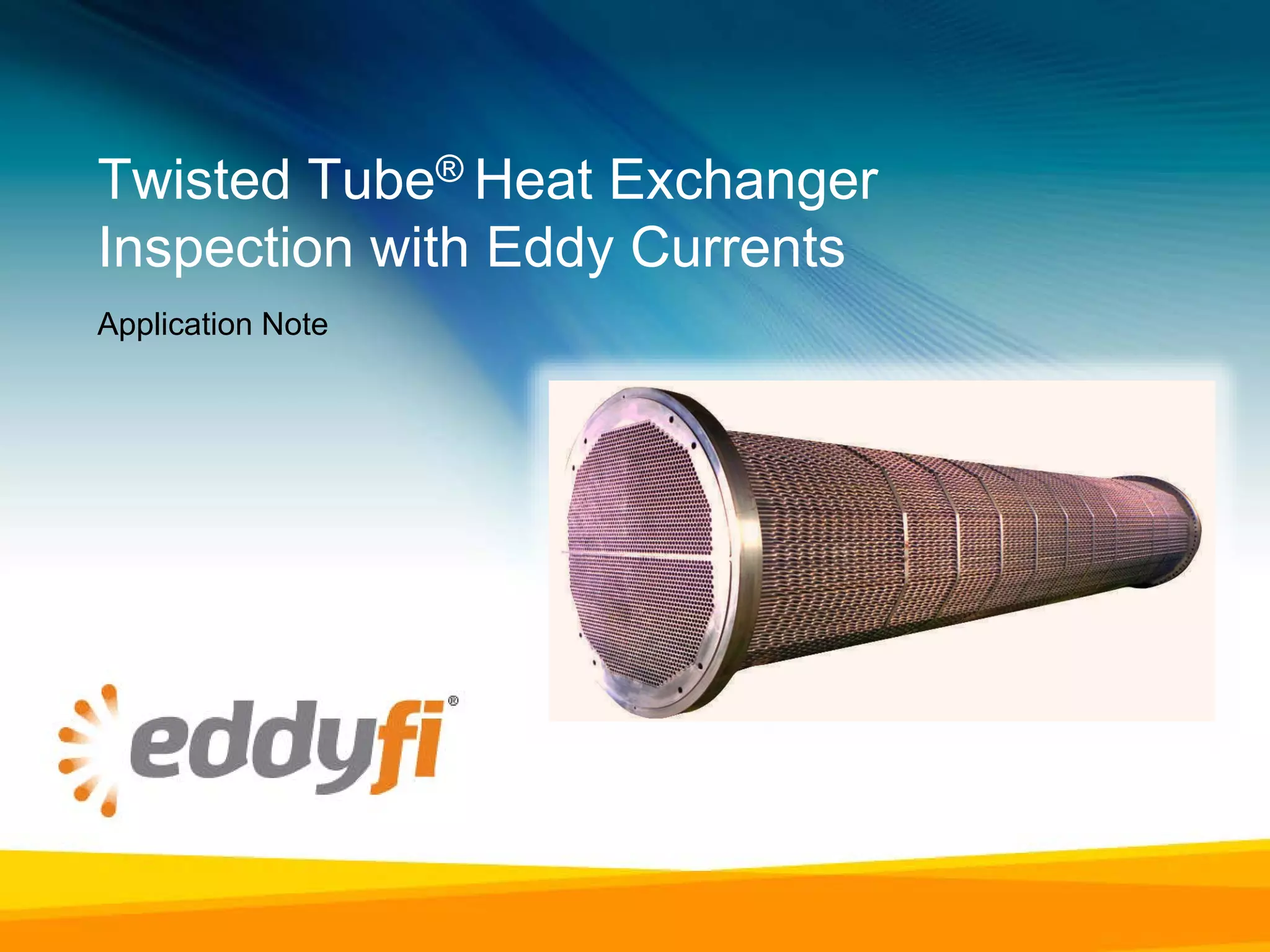
Twisted Tube® Heat Exchanger
Inspection with Eddy Currents
Application Note
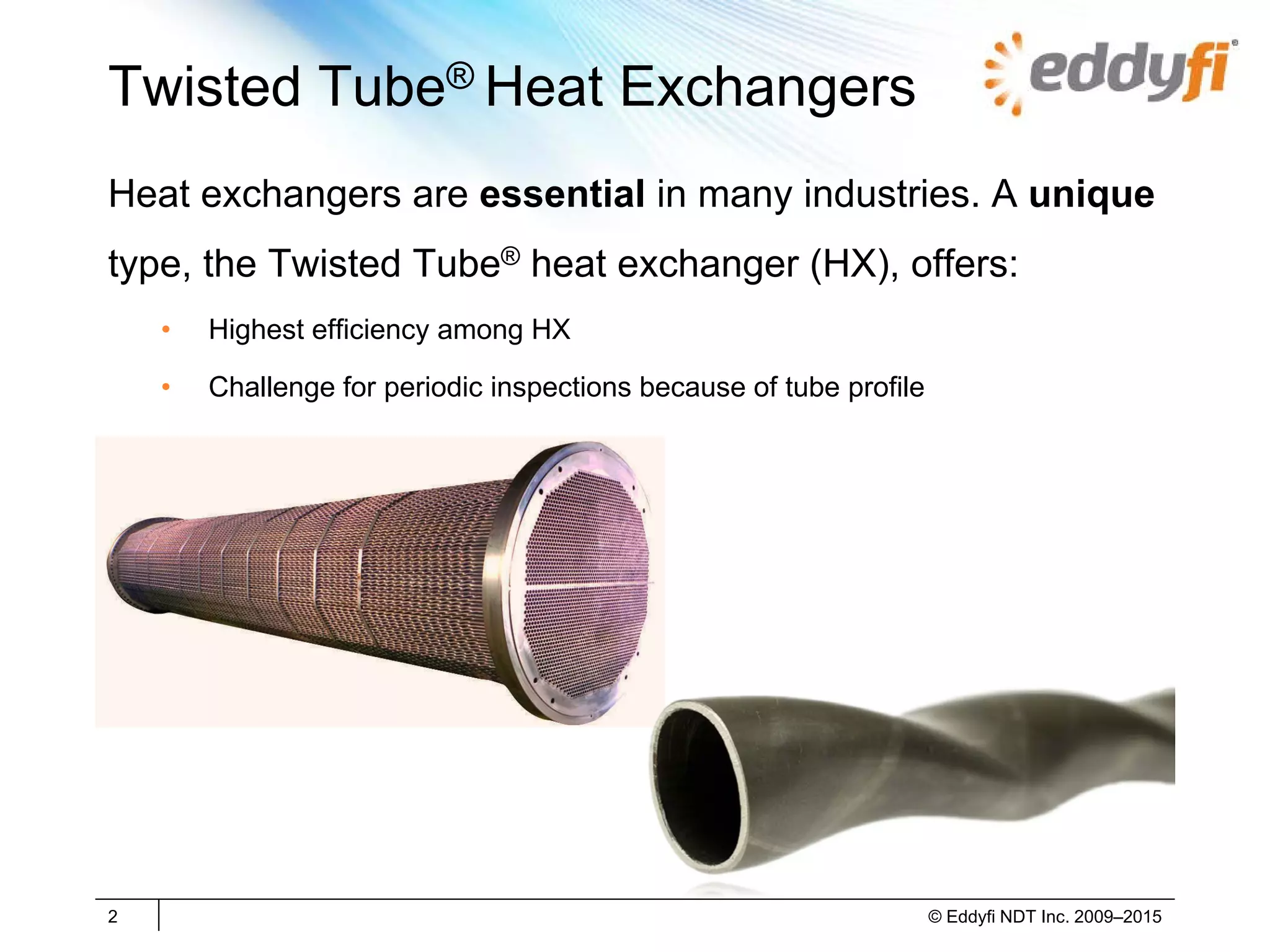
Twisted Tube® Heat Exchangers
Heat exchangers are essential in many industries. A unique
type, the Twisted Tube® heat exchanger (HX), offers:
• Highest efficiency among HX
• Challenge for periodic inspections because of tube profile
2 © Eddyfi NDT Inc. 2009–2015
The Challenge
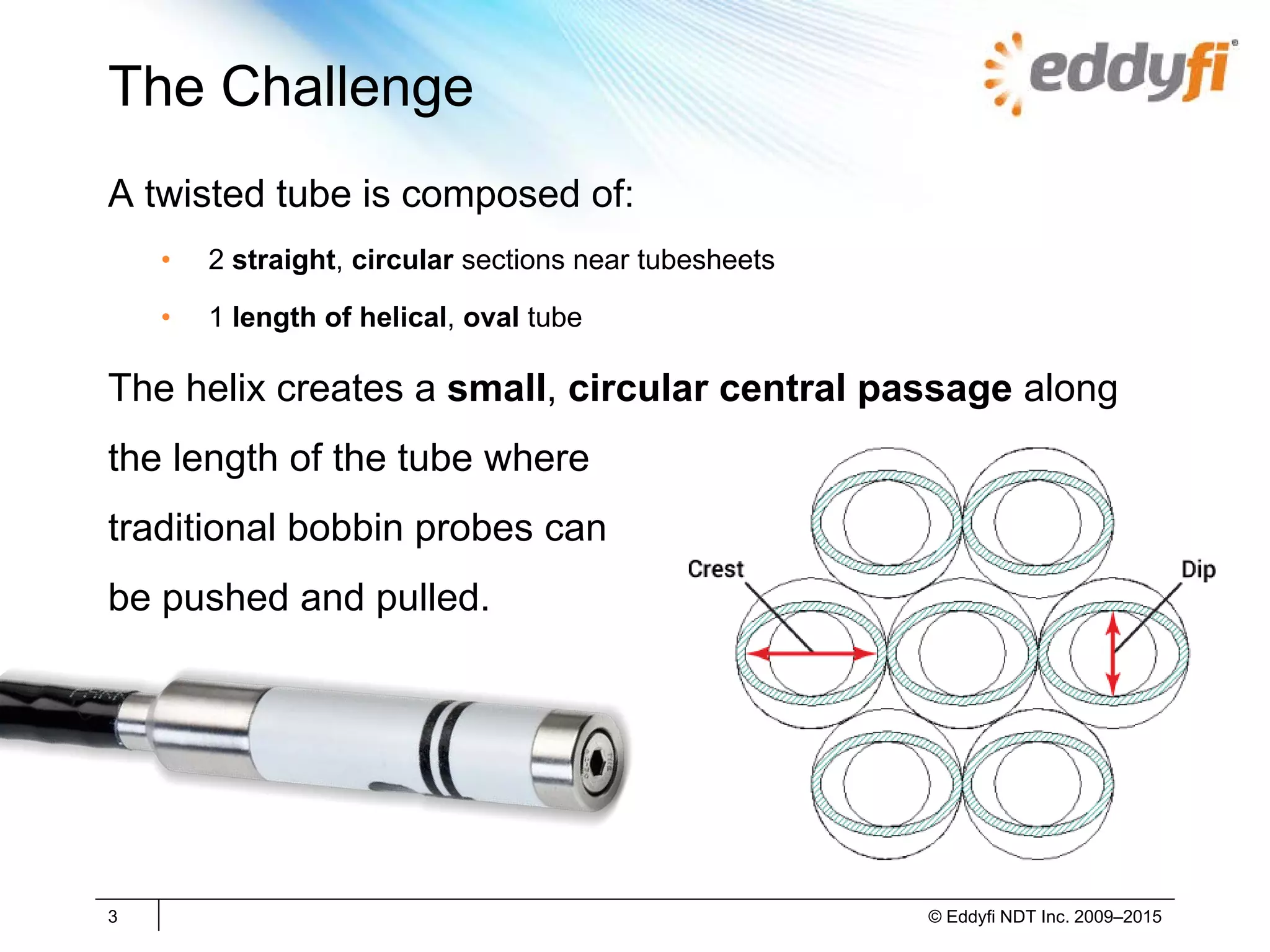
A twisted tube is composed of:
• 2 straight, circular sections near tubesheets
• 1 length of helical, oval tube
The helix creates a small, circular central passage along
the length of the tube where
traditional bobbin probes can
be pushed and pulled.
3 © Eddyfi NDT Inc. 2009–2015
The Challenge
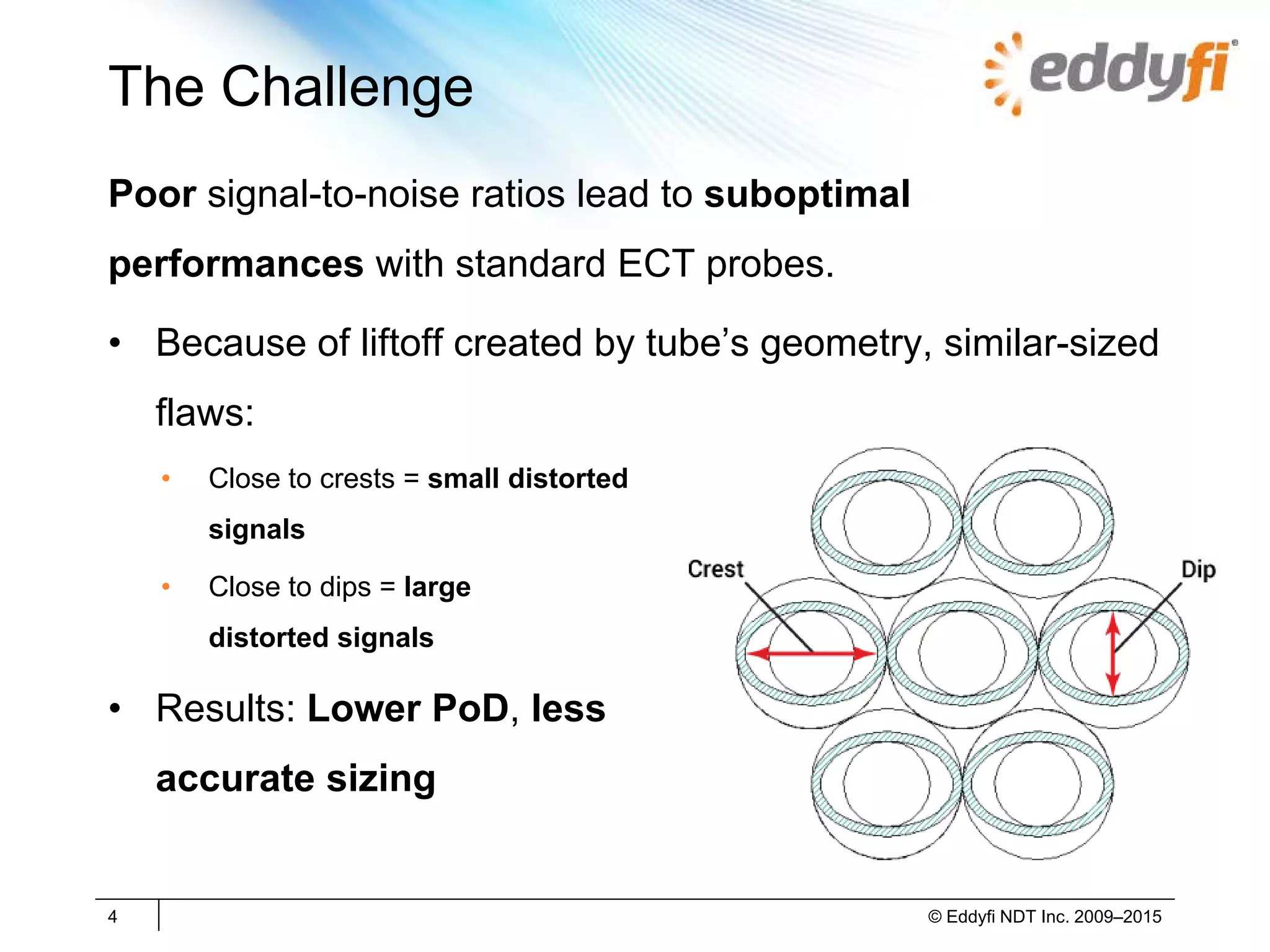
Poor signal-to-noise ratios lead to suboptimal
performances with standard ECT probes.
• Because of liftoff created by tube’s geometry, similar-sized
flaws:
• Close to crests = small distorted
signals
• Close to dips = large
distorted signals
• Results: Lower PoD, less
accurate sizing
4 © Eddyfi NDT Inc. 2009–2015
The Challenge
• Common sizing method to determine flaw depth are
inaccurate because:
• Reduced sensitivity
• Large tube signal variations from flaw locations (crest/dip)
• IRIS also affected by non-linear geometry
• Reflecting echoes not perpendicular to inspected wall. Not an alternative.
• Tubes in Twisted Tube® HX come in variety of:
• Pitches
• Diameters (typical: 19.1–25.4 mm [0.75–1 in])
• Non-ferromagnetic and ferromagnetic materials
5 © Eddyfi NDT Inc. 2009–2015
The Solution
A probe that:
• Fits most Twisted Tube® HX
• Dynamically adjusts to changing geometry to minimize liftoff and optimize
inspection results
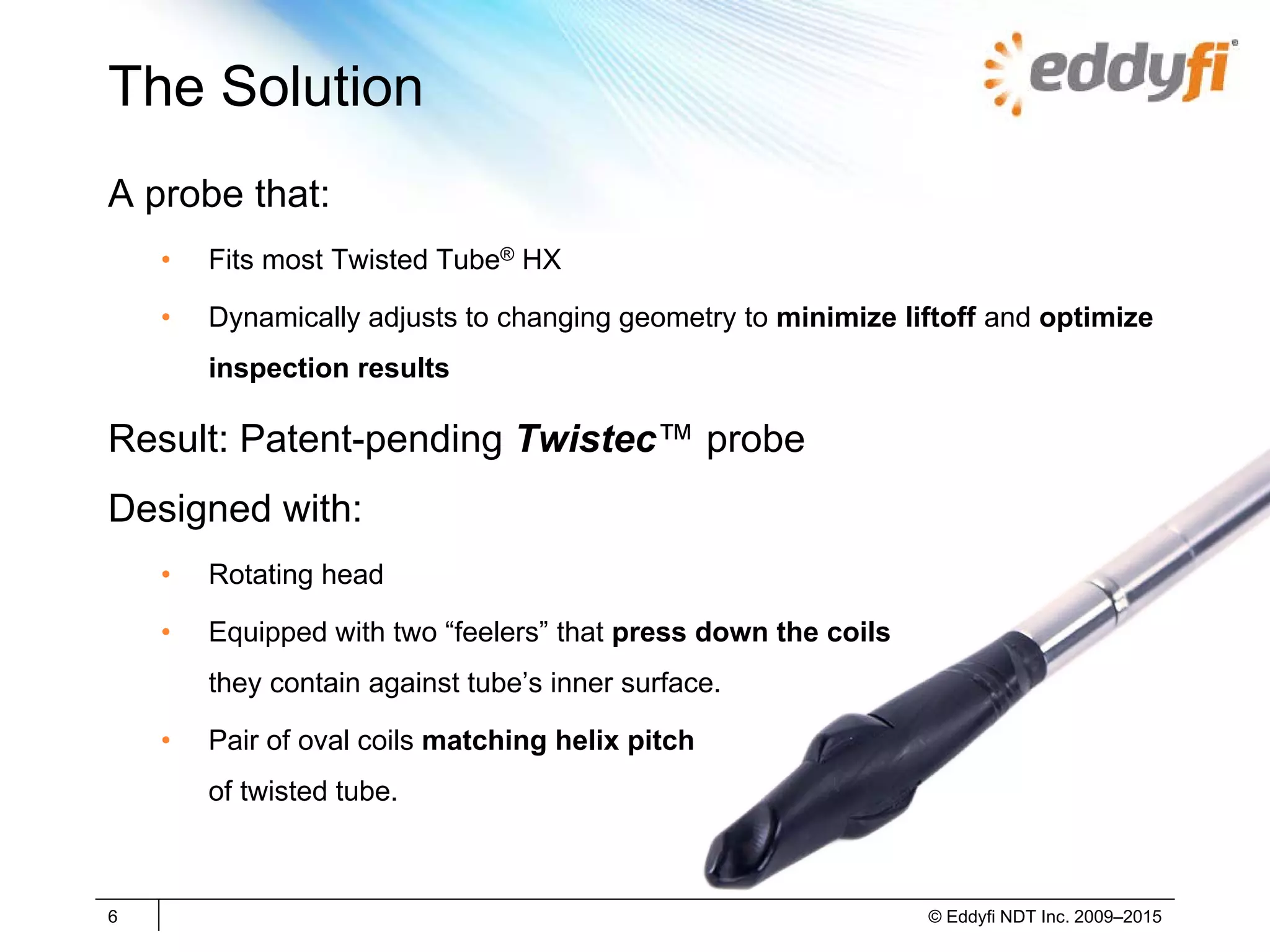
Result: Patent-pending Twistec™ probe
Designed with:
• Rotating head
• Equipped with two “feelers” that press down the coils
they contain against tube’s inner surface.
• Pair of oval coils matching helix pitch
of twisted tube.
6 © Eddyfi NDT Inc. 2009–2015
The Solution
Twistec probe remains close to surface under test for
more precise inspection data
• Feelers compress to fit through circular section at the tubesheet
Pulling speed:
• Approximately 0.3 m/s (12 in/s)
Life:
• 1500 tubes (60 to 80 tubes/h)
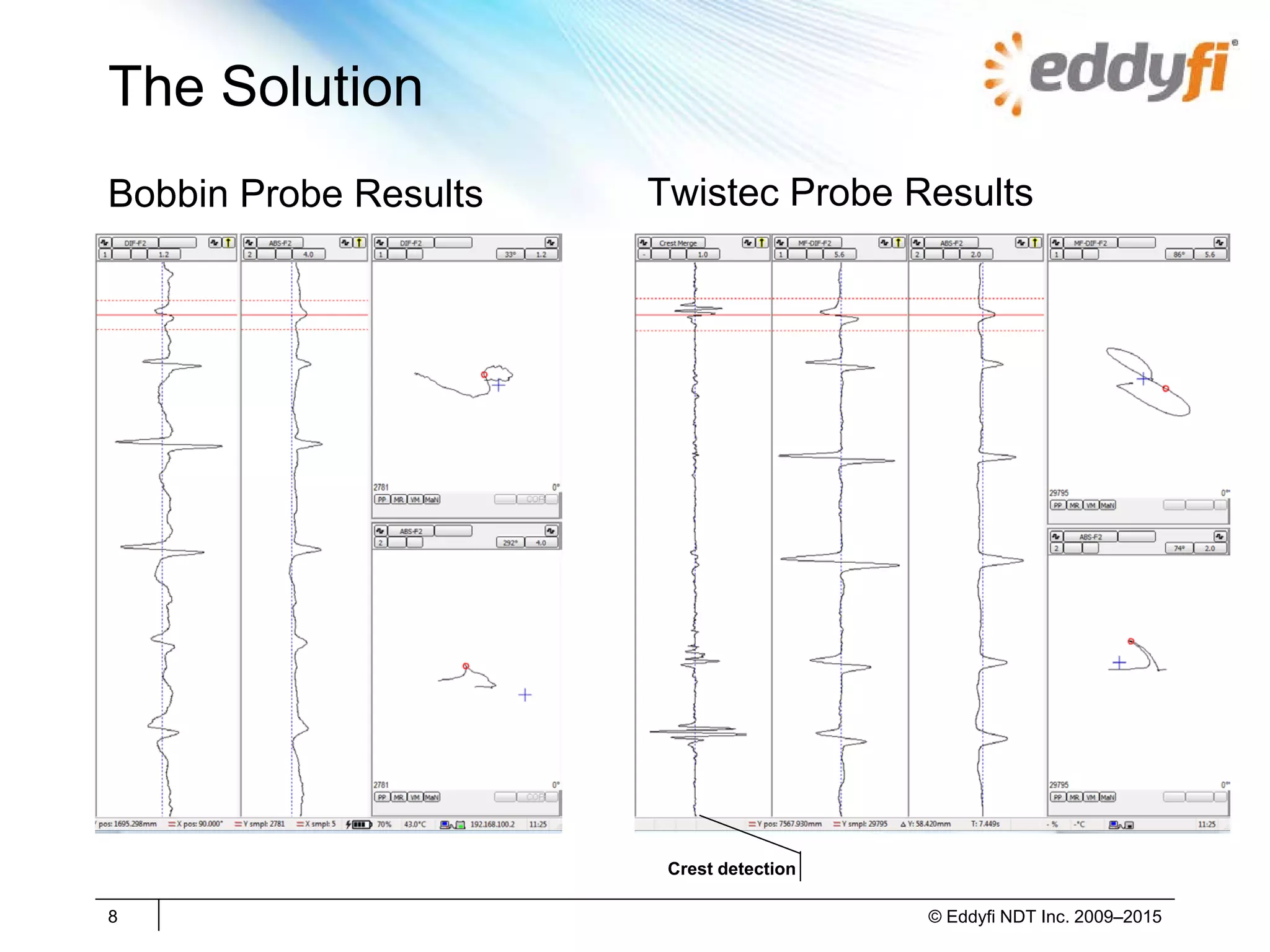
Results allow defects to be clearly identified. Twistec
probe signals are less noisy than those from a conventional
bobbin probe.
7 © Eddyfi NDT Inc. 2009–2015
The Solution
8 © Eddyfi NDT Inc. 2009–2015
Bobbin Probe Results Twistec Probe Results
Crest detection
The Benefits
• Minimized liftoff
• Minimized noise
• Optimized results
• Inner/outer-diameter defect distinction
• Determine whether defects are in crests or dips
• Easier-to-analyze scan results
• More accurate scan results
• Longer asset life
9 © Eddyfi NDT Inc. 2009–2015
www.eddyfi.com

Twisted Tube ® Heat Exchanger Inspection with Eddy Currents

  • 1.
    Twisted Tube® HeatExchanger Inspection with Eddy Currents Application Note
  • 2.
    Twisted Tube® HeatExchangers Heat exchangers are essential in many industries. A unique type, the Twisted Tube® heat exchanger (HX), offers: • Highest efficiency among HX • Challenge for periodic inspections because of tube profile 2 © Eddyfi NDT Inc. 2009–2015
  • 3.
    The Challenge A twistedtube is composed of: • 2 straight, circular sections near tubesheets • 1 length of helical, oval tube The helix creates a small, circular central passage along the length of the tube where traditional bobbin probes can be pushed and pulled. 3 © Eddyfi NDT Inc. 2009–2015
  • 4.
    The Challenge Poor signal-to-noiseratios lead to suboptimal performances with standard ECT probes. • Because of liftoff created by tube’s geometry, similar-sized flaws: • Close to crests = small distorted signals • Close to dips = large distorted signals • Results: Lower PoD, less accurate sizing 4 © Eddyfi NDT Inc. 2009–2015
  • 5.
    The Challenge • Commonsizing method to determine flaw depth are inaccurate because: • Reduced sensitivity • Large tube signal variations from flaw locations (crest/dip) • IRIS also affected by non-linear geometry • Reflecting echoes not perpendicular to inspected wall. Not an alternative. • Tubes in Twisted Tube® HX come in variety of: • Pitches • Diameters (typical: 19.1–25.4 mm [0.75–1 in]) • Non-ferromagnetic and ferromagnetic materials 5 © Eddyfi NDT Inc. 2009–2015
  • 6.
    The Solution A probethat: • Fits most Twisted Tube® HX • Dynamically adjusts to changing geometry to minimize liftoff and optimize inspection results Result: Patent-pending Twistec™ probe Designed with: • Rotating head • Equipped with two “feelers” that press down the coils they contain against tube’s inner surface. • Pair of oval coils matching helix pitch of twisted tube. 6 © Eddyfi NDT Inc. 2009–2015
  • 7.
    The Solution Twistec proberemains close to surface under test for more precise inspection data • Feelers compress to fit through circular section at the tubesheet Pulling speed: • Approximately 0.3 m/s (12 in/s) Life: • 1500 tubes (60 to 80 tubes/h) Results allow defects to be clearly identified. Twistec probe signals are less noisy than those from a conventional bobbin probe. 7 © Eddyfi NDT Inc. 2009–2015
  • 8.
    The Solution 8 ©Eddyfi NDT Inc. 2009–2015 Bobbin Probe Results Twistec Probe Results Crest detection
  • 9.
    The Benefits • Minimizedliftoff • Minimized noise • Optimized results • Inner/outer-diameter defect distinction • Determine whether defects are in crests or dips • Easier-to-analyze scan results • More accurate scan results • Longer asset life 9 © Eddyfi NDT Inc. 2009–2015
  • 10.