12th EPRI Balance-of-Plant Symposium
August 6th-8th, 2012
Inspection of stainless steel heat exchanger
tube with eddy current array probe
Introduction
12th EPRI BoP Symposium 2
 Context
 Eddy Current Array + Bobbin probe design
 Overview
 Operating principle
 Result on various calibration defects
 Comparison with low resolution array probe
 Results on real tube
 Conclusions
Context
12th EPRI BoP Symposium 3
 Non ferrous heat exchanger and condenser tubes may be affected
by several damage mechanisms:
 Pitting
 Erosion
 Fretting
 Cracking
 The bobbin probe inspection faces major limitations with respect
to:
 Detection and sizing circumferential cracking
 Evaluate circumferential extent of volumetric flaws
 Rotating probe can be use to improve the inspection but this
solution remains slow
 The Eddy Current Array + Bobbin probe technology is the solution
to perform high resolution inspection at the bobbin speed in a
single pass.
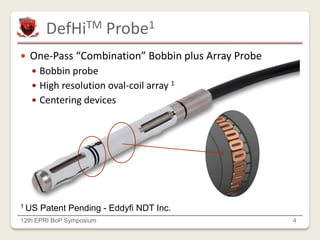
 One-Pass “Combination” Bobbin plus Array Probe
 Bobbin probe
 High resolution oval-coil array 1
 Centering devices
DefHiTM Probe1
12th EPRI BoP Symposium 4
1 US Patent Pending - Eddyfi NDT Inc.
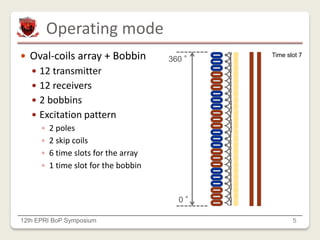
Operating mode
12th EPRI BoP Symposium 5
 Oval-coils array + Bobbin
 12 transmitter
 12 receivers
 2 bobbins
 Excitation pattern
 2 poles
 2 skip coils
 6 time slots for the array
 1 time slot for the bobbin
Time slot 1Time slot 2Time slot 3Time slot 4Time slot 5Time slot 6Time slot 7
360 °
0 °
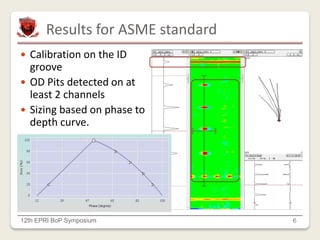
Results for ASME standard
12th EPRI BoP Symposium 6
 Calibration on the ID
groove
 OD Pits detected on at
least 2 channels
 Sizing based on phase to
depth curve.
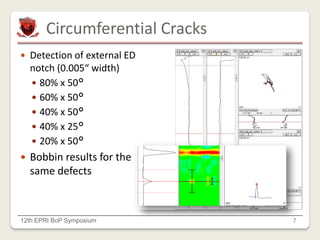
Circumferential Cracks
12th EPRI BoP Symposium 7
 Detection of external EDM
notch (0.005“ width)
 80% x 50°
 60% x 50°
 40% x 50°
 40% x 25°
 20% x 50°
 Bobbin results for the
same defects
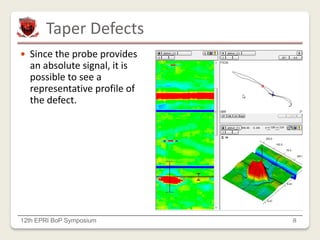
Taper Defects
12th EPRI BoP Symposium 8
 Since the probe provides
an absolute signal, it is
possible to see a
representative profile of
the defect.
Shallow Small Defects
12th EPRI BoP Symposium 9
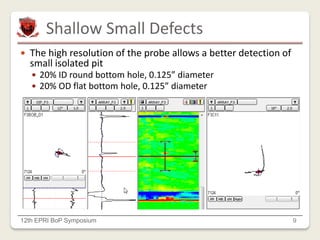
 The high resolution of the probe allows a better detection of
small isolated pit
 20% ID round bottom hole, 0.125” diameter
 20% OD flat bottom hole, 0.125” diameter
Defects at Support Plate
12th EPRI BoP Symposium 10
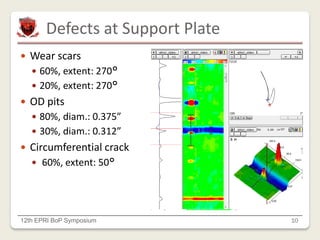
 Wear scars
 60%, extent: 270°
 20%, extent: 270°
 OD pits
 80%, diam.: 0.375”
 30%, diam.: 0.312”
 Circumferential crack
 60%, extent: 50°
Sensitivity vs Lift-Off
12th EPRI BoP Symposium 11
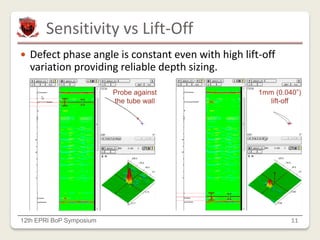
 Defect phase angle is constant even with high lift-off
variation providing reliable depth sizing.
Probe against
the tube wall
1mm (0.040”)
lift-off
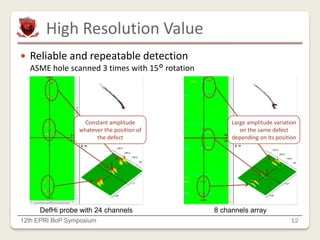
8 channels array
Large amplitude variation
on the same defect
depending on its position
DefHi probe with 24 channels
Constant amplitude
whatever the position of
the defect
High Resolution Value
12th EPRI BoP Symposium 12
 Reliable and repeatable detection
ASME hole scanned 3 times with 15° rotation
High Resolution Value
12th EPRI BoP Symposium 13
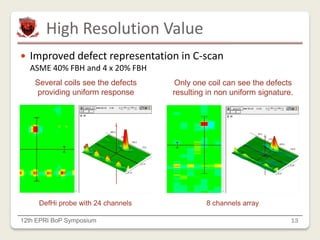
 Improved defect representation in C-scan
ASME 40% FBH and 4 x 20% FBH
DefHi probe with 24 channels
Several coils see the defects
providing uniform response
8 channels array
Only one coil can see the defects
resulting in non uniform signature.
Data from real tube
12th EPRI BoP Symposium 14
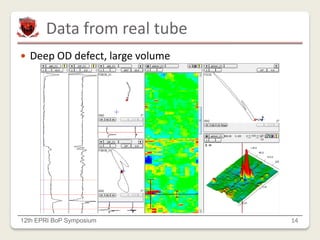
 Deep OD defect, large volume
Data from real tube
12th EPRI BoP Symposium 15
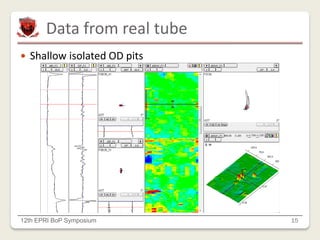
 Shallow isolated OD pits
Data from real tube
12th EPRI BoP Symposium 16
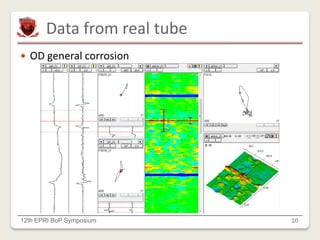
 OD general corrosion
Data from real tube
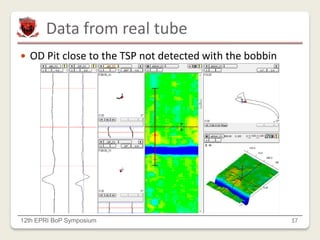
12th EPRI BoP Symposium 17
 OD Pit close to the TSP not detected with the bobbin
Data from real tube
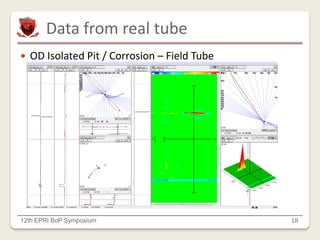
12th EPRI BoP Symposium 18
 OD Isolated Pit / Corrosion – Field Tube
Conclusions
12th EPRI BoP Symposium 19
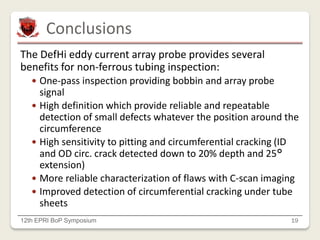
The DefHi eddy current array probe provides several
benefits for non-ferrous tubing inspection:
 One-pass inspection providing bobbin and array probe
signal
 High definition which provide reliable and repeatable
detection of small defects whatever the position around the
circumference
 High sensitivity to pitting and circumferential cracking (ID
and OD circ. crack detected down to 20% depth and 25°
extension)
 More reliable characterization of flaws with C-scan imaging
 Improved detection of circumferential cracking under tube
sheets

Inspection of Stainless Steel Heat Exchanger Tubes with Eddy Current Array Probe

  • 1.
    12th EPRI Balance-of-PlantSymposium August 6th-8th, 2012 Inspection of stainless steel heat exchanger tube with eddy current array probe
  • 2.
    Introduction 12th EPRI BoPSymposium 2  Context  Eddy Current Array + Bobbin probe design  Overview  Operating principle  Result on various calibration defects  Comparison with low resolution array probe  Results on real tube  Conclusions
  • 3.
    Context 12th EPRI BoPSymposium 3  Non ferrous heat exchanger and condenser tubes may be affected by several damage mechanisms:  Pitting  Erosion  Fretting  Cracking  The bobbin probe inspection faces major limitations with respect to:  Detection and sizing circumferential cracking  Evaluate circumferential extent of volumetric flaws  Rotating probe can be use to improve the inspection but this solution remains slow  The Eddy Current Array + Bobbin probe technology is the solution to perform high resolution inspection at the bobbin speed in a single pass.
  • 4.
     One-Pass “Combination”Bobbin plus Array Probe  Bobbin probe  High resolution oval-coil array 1  Centering devices DefHiTM Probe1 12th EPRI BoP Symposium 4 1 US Patent Pending - Eddyfi NDT Inc.
  • 5.
    Operating mode 12th EPRIBoP Symposium 5  Oval-coils array + Bobbin  12 transmitter  12 receivers  2 bobbins  Excitation pattern  2 poles  2 skip coils  6 time slots for the array  1 time slot for the bobbin Time slot 1Time slot 2Time slot 3Time slot 4Time slot 5Time slot 6Time slot 7 360 ° 0 °
  • 6.
    Results for ASMEstandard 12th EPRI BoP Symposium 6  Calibration on the ID groove  OD Pits detected on at least 2 channels  Sizing based on phase to depth curve.
  • 7.
    Circumferential Cracks 12th EPRIBoP Symposium 7  Detection of external EDM notch (0.005“ width)  80% x 50°  60% x 50°  40% x 50°  40% x 25°  20% x 50°  Bobbin results for the same defects
  • 8.
    Taper Defects 12th EPRIBoP Symposium 8  Since the probe provides an absolute signal, it is possible to see a representative profile of the defect.
  • 9.
    Shallow Small Defects 12thEPRI BoP Symposium 9  The high resolution of the probe allows a better detection of small isolated pit  20% ID round bottom hole, 0.125” diameter  20% OD flat bottom hole, 0.125” diameter
  • 10.
    Defects at SupportPlate 12th EPRI BoP Symposium 10  Wear scars  60%, extent: 270°  20%, extent: 270°  OD pits  80%, diam.: 0.375”  30%, diam.: 0.312”  Circumferential crack  60%, extent: 50°
  • 11.
    Sensitivity vs Lift-Off 12thEPRI BoP Symposium 11  Defect phase angle is constant even with high lift-off variation providing reliable depth sizing. Probe against the tube wall 1mm (0.040”) lift-off
  • 12.
    8 channels array Largeamplitude variation on the same defect depending on its position DefHi probe with 24 channels Constant amplitude whatever the position of the defect High Resolution Value 12th EPRI BoP Symposium 12  Reliable and repeatable detection ASME hole scanned 3 times with 15° rotation
  • 13.
    High Resolution Value 12thEPRI BoP Symposium 13  Improved defect representation in C-scan ASME 40% FBH and 4 x 20% FBH DefHi probe with 24 channels Several coils see the defects providing uniform response 8 channels array Only one coil can see the defects resulting in non uniform signature.
  • 14.
    Data from realtube 12th EPRI BoP Symposium 14  Deep OD defect, large volume
  • 15.
    Data from realtube 12th EPRI BoP Symposium 15  Shallow isolated OD pits
  • 16.
    Data from realtube 12th EPRI BoP Symposium 16  OD general corrosion
  • 17.
    Data from realtube 12th EPRI BoP Symposium 17  OD Pit close to the TSP not detected with the bobbin
  • 18.
    Data from realtube 12th EPRI BoP Symposium 18  OD Isolated Pit / Corrosion – Field Tube
  • 19.
    Conclusions 12th EPRI BoPSymposium 19 The DefHi eddy current array probe provides several benefits for non-ferrous tubing inspection:  One-pass inspection providing bobbin and array probe signal  High definition which provide reliable and repeatable detection of small defects whatever the position around the circumference  High sensitivity to pitting and circumferential cracking (ID and OD circ. crack detected down to 20% depth and 25° extension)  More reliable characterization of flaws with C-scan imaging  Improved detection of circumferential cracking under tube sheets