Inspecting Laser Welds in
Component Manufacturing
Application Note
The Challenge
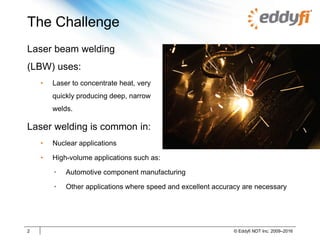
Laser beam welding
(LBW) uses:
• Laser to concentrate heat, very
quickly producing deep, narrow
welds.
Laser welding is common in:
• Nuclear applications
• High-volume applications such as:
• Automotive component manufacturing
• Other applications where speed and excellent accuracy are necessary
2 © Eddyfi NDT Inc. 2009–2016
The Challenge
Disadvantages of LBW:
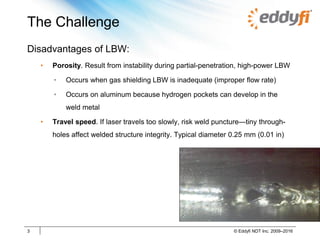
• Porosity. Result from instability during partial-penetration, high-power LBW
• Occurs when gas shielding LBW is inadequate (improper flow rate)
• Occurs on aluminum because hydrogen pockets can develop in the
weld metal
• Travel speed. If laser travels too slowly, risk weld puncture—tiny through-
holes affect welded structure integrity. Typical diameter 0.25 mm (0.01 in)
3 © Eddyfi NDT Inc. 2009–2016
The Challenge
Disadvantages of LBW:
• High cooling rate. Produces solidification cracking (especially in high-
carbon steel). Cracks appear in various locations and orientations—most
commonly longitudinal, subsurface, and surface breaking.
4 © Eddyfi NDT Inc. 2009–2016
The Challenge
Inspecting laser welds with eddy current testing (ECT) pencil
probes is:
• Very operator dependant
• Slow
• Varying quality
Inspecting laser welds with radiographic testing (RT) is:
• Time consuming (requires specialized personnel/equipment)
• Health and safety issue
Inspecting laser welds with ultrasonic testing (UT):
• Requires couplant
• Is virtually blind to shallow surface-breaking defects
5 © Eddyfi NDT Inc. 2009–2016
The Challenge
LBW sometimes:
• Involves simultaneously inspecting numerous welds
• Generates an impressive amount of data—need help identify potential
problems
6 © Eddyfi NDT Inc. 2009–2016
The Solution
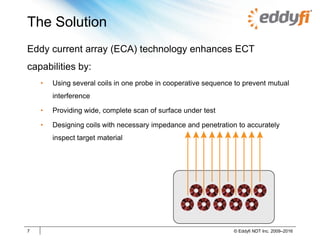
Eddy current array (ECA) technology enhances ECT
capabilities by:
• Using several coils in one probe in cooperative sequence to prevent mutual
interference
• Providing wide, complete scan of surface under test
• Designing coils with necessary impedance and penetration to accurately
inspect target material
7 © Eddyfi NDT Inc. 2009–2016
The Solution
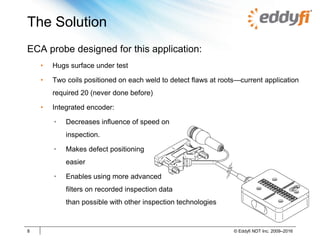
ECA probe designed for this application:
• Hugs surface under test
• Two coils positioned on each weld to detect flaws at roots—current application
required 20 (never done before)
• Integrated encoder:
• Decreases influence of speed on
inspection.
• Makes defect positioning
easier
• Enables using more advanced
filters on recorded inspection data
than possible with other inspection technologies
8 © Eddyfi NDT Inc. 2009–2016
The Solution
9 © Eddyfi NDT Inc. 2009–2016
This type of application is mainly concerned with
identifying and positioning defects.
• Magnifi® (acquisition and analysis software), displays scan data as
easy-to-read C-scans
• Displays clear indications of defects
• Probe encoder supplies spatial positioning information
Probe designed to scan several parallel welds
• C-scans displayed side-by-side in Magnifi
The Solution
10 © Eddyfi NDT Inc. 2009–2016
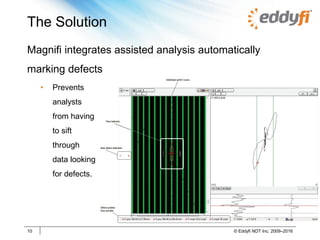
Magnifi integrates assisted analysis automatically
marking defects
• Prevents
analysts
from having
to sift
through
data looking
for defects.
The Benefits
Solution offers several benefits over ECT, RT, and UT:
• Shaped to specific laser-weld profiles
• Rapid, stable, simultaneous scan of multiple welds
• Easy to handle — no need for expensive robotic solutions
• On-the-fly assisted analysis
• Easier analysis with C-scan imaging
• Fully computerized data recording and archiving capabilities
11 © Eddyfi NDT Inc. 2009–2016
www.eddyfi.com

Inspecting Laser Welds in Component Manufacturing

  • 1.
    Inspecting Laser Weldsin Component Manufacturing Application Note
  • 2.
    The Challenge Laser beamwelding (LBW) uses: • Laser to concentrate heat, very quickly producing deep, narrow welds. Laser welding is common in: • Nuclear applications • High-volume applications such as: • Automotive component manufacturing • Other applications where speed and excellent accuracy are necessary 2 © Eddyfi NDT Inc. 2009–2016
  • 3.
    The Challenge Disadvantages ofLBW: • Porosity. Result from instability during partial-penetration, high-power LBW • Occurs when gas shielding LBW is inadequate (improper flow rate) • Occurs on aluminum because hydrogen pockets can develop in the weld metal • Travel speed. If laser travels too slowly, risk weld puncture—tiny through- holes affect welded structure integrity. Typical diameter 0.25 mm (0.01 in) 3 © Eddyfi NDT Inc. 2009–2016
  • 4.
    The Challenge Disadvantages ofLBW: • High cooling rate. Produces solidification cracking (especially in high- carbon steel). Cracks appear in various locations and orientations—most commonly longitudinal, subsurface, and surface breaking. 4 © Eddyfi NDT Inc. 2009–2016
  • 5.
    The Challenge Inspecting laserwelds with eddy current testing (ECT) pencil probes is: • Very operator dependant • Slow • Varying quality Inspecting laser welds with radiographic testing (RT) is: • Time consuming (requires specialized personnel/equipment) • Health and safety issue Inspecting laser welds with ultrasonic testing (UT): • Requires couplant • Is virtually blind to shallow surface-breaking defects 5 © Eddyfi NDT Inc. 2009–2016
  • 6.
    The Challenge LBW sometimes: •Involves simultaneously inspecting numerous welds • Generates an impressive amount of data—need help identify potential problems 6 © Eddyfi NDT Inc. 2009–2016
  • 7.
    The Solution Eddy currentarray (ECA) technology enhances ECT capabilities by: • Using several coils in one probe in cooperative sequence to prevent mutual interference • Providing wide, complete scan of surface under test • Designing coils with necessary impedance and penetration to accurately inspect target material 7 © Eddyfi NDT Inc. 2009–2016
  • 8.
    The Solution ECA probedesigned for this application: • Hugs surface under test • Two coils positioned on each weld to detect flaws at roots—current application required 20 (never done before) • Integrated encoder: • Decreases influence of speed on inspection. • Makes defect positioning easier • Enables using more advanced filters on recorded inspection data than possible with other inspection technologies 8 © Eddyfi NDT Inc. 2009–2016
  • 9.
    The Solution 9 ©Eddyfi NDT Inc. 2009–2016 This type of application is mainly concerned with identifying and positioning defects. • Magnifi® (acquisition and analysis software), displays scan data as easy-to-read C-scans • Displays clear indications of defects • Probe encoder supplies spatial positioning information Probe designed to scan several parallel welds • C-scans displayed side-by-side in Magnifi
  • 10.
    The Solution 10 ©Eddyfi NDT Inc. 2009–2016 Magnifi integrates assisted analysis automatically marking defects • Prevents analysts from having to sift through data looking for defects.
  • 11.
    The Benefits Solution offersseveral benefits over ECT, RT, and UT: • Shaped to specific laser-weld profiles • Rapid, stable, simultaneous scan of multiple welds • Easy to handle — no need for expensive robotic solutions • On-the-fly assisted analysis • Easier analysis with C-scan imaging • Fully computerized data recording and archiving capabilities 11 © Eddyfi NDT Inc. 2009–2016
  • 12.