Application
Harmonisation
using Design
Principles in LeanIX
Rainer Bartsch,
RWE Supply & Trading GmbH
EA Connect Days,
Bonn, 22./23. November 2018
Our heart – Europe‘s largest Energy Trading Floor
Question: in the context of your company’s IT function,
which of the following do you think is true?
A) We don’t have a collective view of what ‘good looks like’
B) There are too many conflicting viewpoints and too many parochial
concerns in the IT organisation
C) There is little discipline within the IT organisation – so we need to
think more ‘architecturally’
D) We have a real mix of competencies within the IT organisation, and
some people shout louder than others
Answer: I think they are all true!
This is effectively the challenge! So if we want good IT, we …
• need to know what ‘good looks like’ – before we can start any
kind of harmonisation measures
• must transcend our parochial (i.e. narrow, local) perspectives
• have to be disciplined
skilled
people
A man with a hammer …
- a database admin tries to solve
problems with database capabilities
unskilled
people
Dunning-Kruger effect …
- often too unskilled to know it and
suffer from illusory superiority
Questions:
how do we know
what “good
looks like” ?
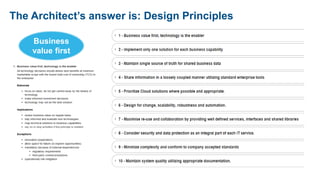
The Architect’s answer is: Design Principles
Business
value first
We are using Design Principles to define
what “good looks like”, because:
• provide guideline with clear direction
• express the value of our organization
• help to inform our decisions
The Architect’s answer is: Design Principles
Business
value first
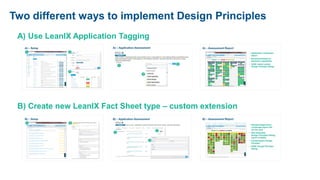
Two different ways to implement Design Principles
A) Use LeanIX Application Tagging
B) Create new LeanIX Fact Sheet type – custom extension
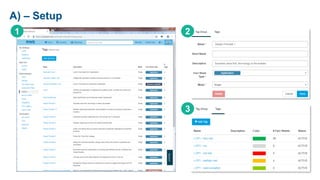
A) – Setup
1 2
3
A) – Application Assessment
1
2
3
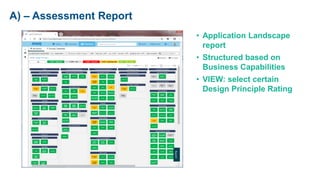
A) – Assessment Report
• Application Landscape
report
• Structured based on
Business Capabilities
• VIEW: select certain
Design Principle Rating
B) – Setup
1 2
B) – Application Assessment
Add
1
2
3
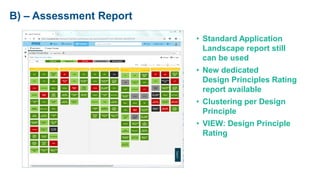
B) – Assessment Report
• Standard Application
Landscape report still
can be used
• New dedicated
Design Principles Rating
report available
• Clustering per Design
Principle
• VIEW: Design Principle
Rating
Approach to take decisions for application harmonisation
#DP TI EOI
1 1,0 -
2 0,5 0,5
3 0,5 0,5
5 1 -
10 1 -
Avg. 0,8 0,5
Business Value
Based on Business
Continuity Rating
10m EUR
Invest
MigrateEliminate
Tolerate
Business Value
TechnicalIntegrity
Low
Low High
High
ATD2
0,8
10m
Priority
Action
Consider
Avoid
(Eliminate)
Business Value
EaseofImplementation
Low High
Low
Easy
0,5
10m
move+/-
ATD2
ATD2
What else is important to consider?
A) Add further values to the relation / assessment
- “Ease of Implementation” (effort to remove Technical Debt)
B) Review Completeness & Consistency
- have all Design Principles been applied to each application?
C) Hierarchy
- model parent / child relationships to detail DPs further
- P/C: too complex to model → capture details at relation
D) Implement TIME and PACE reports in LeanIX
E) Any other idea?
Rainer Bartsch
RWE Supply & Trading GmbH
Enterprise Architecture
Altenessener Strasse 27, D-45141 Essen
Tel.: +49 201 5179 2113
Mobile: +49 162 2514405
E-Mail: rainer.bartsch@rwe.com

Application Harmonisation using Design Principles in LeanIX

  • 1.
    Application Harmonisation using Design Principles inLeanIX Rainer Bartsch, RWE Supply & Trading GmbH EA Connect Days, Bonn, 22./23. November 2018
  • 2.
    Our heart –Europe‘s largest Energy Trading Floor
  • 3.
    Question: in thecontext of your company’s IT function, which of the following do you think is true? A) We don’t have a collective view of what ‘good looks like’ B) There are too many conflicting viewpoints and too many parochial concerns in the IT organisation C) There is little discipline within the IT organisation – so we need to think more ‘architecturally’ D) We have a real mix of competencies within the IT organisation, and some people shout louder than others
  • 4.
    Answer: I thinkthey are all true! This is effectively the challenge! So if we want good IT, we … • need to know what ‘good looks like’ – before we can start any kind of harmonisation measures • must transcend our parochial (i.e. narrow, local) perspectives • have to be disciplined skilled people A man with a hammer … - a database admin tries to solve problems with database capabilities unskilled people Dunning-Kruger effect … - often too unskilled to know it and suffer from illusory superiority Questions: how do we know what “good looks like” ?
  • 5.
    The Architect’s answeris: Design Principles Business value first We are using Design Principles to define what “good looks like”, because: • provide guideline with clear direction • express the value of our organization • help to inform our decisions
  • 6.
    The Architect’s answeris: Design Principles Business value first
  • 7.
    Two different waysto implement Design Principles A) Use LeanIX Application Tagging B) Create new LeanIX Fact Sheet type – custom extension
  • 8.
  • 9.
    A) – ApplicationAssessment 1 2 3
  • 10.
    A) – AssessmentReport • Application Landscape report • Structured based on Business Capabilities • VIEW: select certain Design Principle Rating
  • 11.
  • 12.
    B) – ApplicationAssessment Add 1 2 3
  • 13.
    B) – AssessmentReport • Standard Application Landscape report still can be used • New dedicated Design Principles Rating report available • Clustering per Design Principle • VIEW: Design Principle Rating
  • 14.
    Approach to takedecisions for application harmonisation #DP TI EOI 1 1,0 - 2 0,5 0,5 3 0,5 0,5 5 1 - 10 1 - Avg. 0,8 0,5 Business Value Based on Business Continuity Rating 10m EUR Invest MigrateEliminate Tolerate Business Value TechnicalIntegrity Low Low High High ATD2 0,8 10m Priority Action Consider Avoid (Eliminate) Business Value EaseofImplementation Low High Low Easy 0,5 10m move+/- ATD2 ATD2
  • 15.
    What else isimportant to consider? A) Add further values to the relation / assessment - “Ease of Implementation” (effort to remove Technical Debt) B) Review Completeness & Consistency - have all Design Principles been applied to each application? C) Hierarchy - model parent / child relationships to detail DPs further - P/C: too complex to model → capture details at relation D) Implement TIME and PACE reports in LeanIX E) Any other idea?
  • 16.
    Rainer Bartsch RWE Supply& Trading GmbH Enterprise Architecture Altenessener Strasse 27, D-45141 Essen Tel.: +49 201 5179 2113 Mobile: +49 162 2514405 E-Mail: rainer.bartsch@rwe.com