Design Operations
Dave Malouf - @daveixd
Intersection - 7 September 2017
How do we amplify
the value of design
investment, and thus
increase that
investment further?
The largest obstacle to
design success is the
misalignment of the
value proposition that
design itself provides an
organization.
Value …
… answers the question, “why should I come
to you?”
… justifies investment through perceived
return.
… suggests what should be measured to
understand return on that investment.
Proposed value of design
• Driving Understanding & Empathy
• Creating Clarity & Behavioral Fit
• Exploration
• Envisioning
Tools to create that value
• Storytelling
• Visual Thinking
• Information Presentation
• Workshops
• Prototyping/Simulations
Disciplines and their value
Research: move past surface symptoms towards framing problems and needs.
Facilitation: align understanding utilizing tools, frameworks, and visualizations.
Interaction Design: convert understood problems and needs into flows and
interactivity models that not just meet needs but fit behaviors.
Information Architecture: Brings clarity by converting data sets into
information spaces that help people gain insights, navigate smoothly, make
better decisions.
User Interface Design: Creates handles and buttons, and information displays
that allow people to understand possibilities, make better decisions, act within a
system with confidence, know equally confidently the system reaction.
The value of design
is as relevant to the
organization as it is
to its customers.
DevOps
Not Developer Operations
•Is IT operations built
around the goals of
continuous integration
& continuous delivery
•Is foundational
component of digital
transformation.
Lessons learned from DevOps
• Continuous Integration /

Continuous Delivery 

(CI/CD)
• Automation / self-healing

Software used to build,
maintain, check software
• Measure as you go
• Share, Share, Share
• Cattle vs. Pets
• Culture matters: Openness,
Accountability, Autonomy
Culture of Learning (at pace)
1. Set up your team for success
2. Increase the value of your
organization’s investment 

in design
Goals of Design Operations:
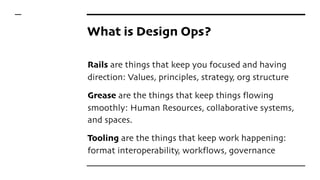
What is Design Ops?
Rails are things that keep you focused and having
direction: Values, principles, strategy, org structure
Grease are the things that keep things flowing
smoothly: Human Resources, collaborative systems,
and spaces.
Tooling are the things that keep work happening:
format interoperability, workflows, governance
Rails
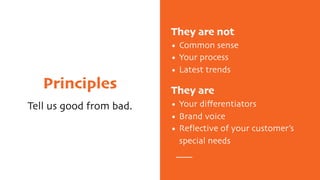
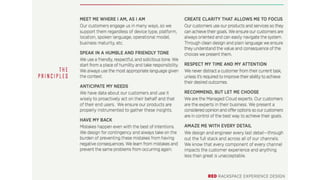
Principles
Tell us good from bad.
They are not
• Common sense
• Your process
• Latest trends
They are
• Your differentiators
• Brand voice
• Reflective of your customer’s
special needs
Organizational
Structure
“Now where should I put
my design organization this
year … ok, this week.?”
•Scaling over time
•Transforming vs.
building
•Cultural issues/values
If you are not working to
get your top design
leader to be a peer with
both engineering and
product you are doing it
wrong.
Designing Your Organization
• Requires the whole team across functions.
• Based on understanding the value of design
contribution to your organization.
• Guided by a “roadmap” towards a strategic
vision.
• Focus on balancing required skills.
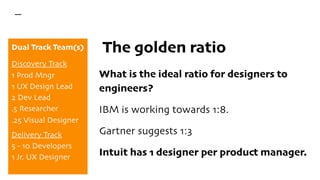
The golden ratio
What is the ideal ratio for designers to
engineers?
IBM is working towards 1:8.
Gartner suggests 1:3
Intuit has 1 designer per product manager.
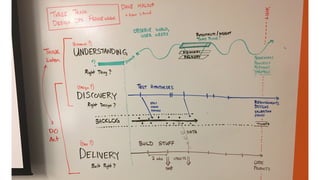
Dual Track Team(s)
Discovery Track
1 Prod Mngr
1 UX Design Lead
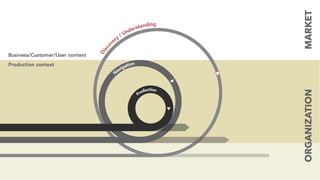
2 Dev Lead
.5 Researcher
.25 Visual Designer
Delivery Track
5 - 10 Developers
1 Jr. UX Designer
Design leadership
Tradecraft: the tangible crafting of experiences themselves. Led
best by principals and player coaches and other lead makers.
Stagecraft: Setting the scene, creating the immediate environment
for success. Led by by line managers who are driving execution.
Statecraft: The act of diplomacy and vision. Led best by executives
who are breaking silos, creating relationships, driving vision and
gaining followership for it.
Told to me by Uday Gajendar (via Slack)
Grease
Human
Resources
It’s all about the people.
•Recruitment
•Onboarding
•Career path
•Compensation
•Benefits
•Rewards & Recognition
•Development & Education
Developing your team
• Keep team’s skills balanced.
• Move from generalists to specialists as your
organization scales.
• Invest in your people; they deserve it and
you need it.
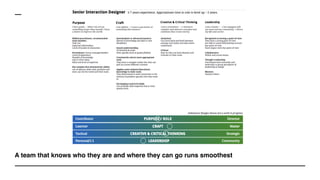
A team that knows who they are and where they can go runs smoothest
Collaborate
Openness, Transparency,
Instruction, and Criticism.
•The right tools to
increase engagement
•The right space(s) to
externalize work.
•The right mindset to
contribute, critique, and
instruct.
Collaboration should
feel natural and
fluid. If it requires
effort there is room
for improvement.
Collaboration is
working together.
Coordination is
working apart and
reporting back.
Tools
Tools
Software, equipment,
supplies
•Interoperability of formats
•Keeping people connected
•Enabling remote
experiences
•Connecting designers to
stakeholders &
collaborators
IT & Procurement need
to empower managers
and individual
contributors.
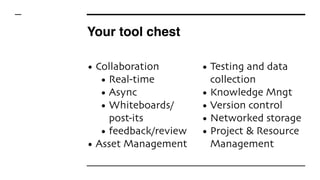
Your tool chest
• Collaboration
• Real-time
• Async
• Whiteboards/
post-its
• feedback/review
• Asset Management
• Testing and data
collection
• Knowledge Mngt
• Version control
• Networked storage
• Project & Resource
Management
Workflow
Intake, Collaboration, and
Delivery
•The connections and
processes that move
to go.
•Contributing to
continuous delivery
& learning.
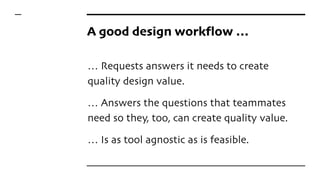
A good design workflow …
… Requests answers it needs to create
quality design value.
… Answers the questions that teammates
need so they, too, can create quality value.
… Is as tool agnostic as is feasible.
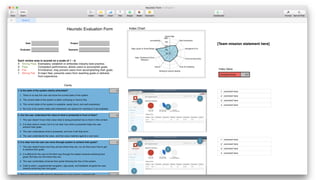
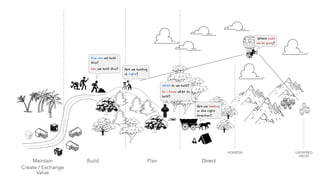
Process framework
Governance matters
• Decision making
• Autonomy
• Risk management
• Security & Privacy
Research
Operations
It’s own thing
Research is best run as
a separate practice
area directly
connected to design,
but with its own ops.
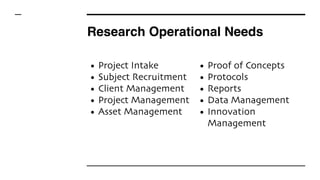
Research Operational Needs
• Project Intake
• Subject Recruitment
• Client Management
• Project Management
• Asset Management
• Proof of Concepts
• Protocols
• Reports
• Data Management
• Innovation
Management
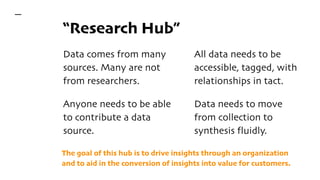
“Research Hub”
Data comes from many
sources. Many are not
from researchers.
Anyone needs to be able
to contribute a data
source.
All data needs to be
accessible, tagged, with
relationships in tact.
Data needs to move
from collection to
synthesis fluidly.
The goal of this hub is to drive insights through an organization
and to aid in the conversion of insights into value for customers.
Leading
Design
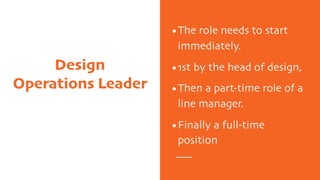
Operations Leader
•The role needs to start
immediately.
•1st by the head of design,
•Then a part-time role of a
line manager.
•Finally a full-time
position
The role includes
Team project mngt
Team communications
Team culture mngt
Team wide critiques
Procurement lead
Recruiting lead
Design system owner
Team IT Administration
Design Operations Lead
has a systems oriented
mind, experience in
different design contexts,
and is an influencer.
Qualifications for a Design Operations Leader
Systems: can map flows, relationships, and goals to
understand complexity and communicate it clearly.
Design depth: Community depth to gain insights. Plus
personal experience to extrapolate solutions.
Relationships: Needs to be able to build a wide net around
themselves to align and influence.
Understanding & Alignment: facilitate differing view
points to drive organizations towards action.
Culture
Put a bow on it
Take the culture of
learning of DevOps,
and infuse it with
empathy, inclusion,
and vision.
Making it happen
• Boil bays > sounds > gulfs > seas > oceans
• Be sure to include and collaborate
• Drill hard into aligning value and meaning
• Measure continuously, adjust accordingly
• Imagine success and work to make it happen
http://DesignOpsSummit.com/
Dave Malouf
me@davemalouf.com
@daveixd || @Des_Ops
http://medium.com/@daveixd

Design Operations

  • 1.
    Design Operations Dave Malouf- @daveixd Intersection - 7 September 2017
  • 2.
    How do weamplify the value of design investment, and thus increase that investment further?
  • 3.
    The largest obstacleto design success is the misalignment of the value proposition that design itself provides an organization.
  • 4.
    Value … … answersthe question, “why should I come to you?” … justifies investment through perceived return. … suggests what should be measured to understand return on that investment.
  • 5.
    Proposed value ofdesign • Driving Understanding & Empathy • Creating Clarity & Behavioral Fit • Exploration • Envisioning
  • 6.
    Tools to createthat value • Storytelling • Visual Thinking • Information Presentation • Workshops • Prototyping/Simulations
  • 7.
    Disciplines and theirvalue Research: move past surface symptoms towards framing problems and needs. Facilitation: align understanding utilizing tools, frameworks, and visualizations. Interaction Design: convert understood problems and needs into flows and interactivity models that not just meet needs but fit behaviors. Information Architecture: Brings clarity by converting data sets into information spaces that help people gain insights, navigate smoothly, make better decisions. User Interface Design: Creates handles and buttons, and information displays that allow people to understand possibilities, make better decisions, act within a system with confidence, know equally confidently the system reaction.
  • 8.
    The value ofdesign is as relevant to the organization as it is to its customers.
  • 9.
    DevOps Not Developer Operations •IsIT operations built around the goals of continuous integration & continuous delivery •Is foundational component of digital transformation.
  • 10.
    Lessons learned fromDevOps • Continuous Integration /
 Continuous Delivery 
 (CI/CD) • Automation / self-healing
 Software used to build, maintain, check software • Measure as you go • Share, Share, Share • Cattle vs. Pets • Culture matters: Openness, Accountability, Autonomy Culture of Learning (at pace)
  • 11.
    1. Set upyour team for success 2. Increase the value of your organization’s investment 
 in design Goals of Design Operations:
  • 12.
    What is DesignOps? Rails are things that keep you focused and having direction: Values, principles, strategy, org structure Grease are the things that keep things flowing smoothly: Human Resources, collaborative systems, and spaces. Tooling are the things that keep work happening: format interoperability, workflows, governance
  • 13.
  • 14.
    Principles Tell us goodfrom bad. They are not • Common sense • Your process • Latest trends They are • Your differentiators • Brand voice • Reflective of your customer’s special needs
  • 17.
    Organizational Structure “Now where shouldI put my design organization this year … ok, this week.?” •Scaling over time •Transforming vs. building •Cultural issues/values
  • 18.
    If you arenot working to get your top design leader to be a peer with both engineering and product you are doing it wrong.
  • 19.
    Designing Your Organization •Requires the whole team across functions. • Based on understanding the value of design contribution to your organization. • Guided by a “roadmap” towards a strategic vision. • Focus on balancing required skills.
  • 20.
    The golden ratio Whatis the ideal ratio for designers to engineers? IBM is working towards 1:8. Gartner suggests 1:3 Intuit has 1 designer per product manager. Dual Track Team(s) Discovery Track 1 Prod Mngr 1 UX Design Lead 2 Dev Lead .5 Researcher .25 Visual Designer Delivery Track 5 - 10 Developers 1 Jr. UX Designer
  • 21.
    Design leadership Tradecraft: thetangible crafting of experiences themselves. Led best by principals and player coaches and other lead makers. Stagecraft: Setting the scene, creating the immediate environment for success. Led by by line managers who are driving execution. Statecraft: The act of diplomacy and vision. Led best by executives who are breaking silos, creating relationships, driving vision and gaining followership for it. Told to me by Uday Gajendar (via Slack)
  • 22.
  • 23.
    Human Resources It’s all aboutthe people. •Recruitment •Onboarding •Career path •Compensation •Benefits •Rewards & Recognition •Development & Education
  • 24.
    Developing your team •Keep team’s skills balanced. • Move from generalists to specialists as your organization scales. • Invest in your people; they deserve it and you need it.
  • 25.
    A team thatknows who they are and where they can go runs smoothest
  • 26.
    Collaborate Openness, Transparency, Instruction, andCriticism. •The right tools to increase engagement •The right space(s) to externalize work. •The right mindset to contribute, critique, and instruct.
  • 27.
    Collaboration should feel naturaland fluid. If it requires effort there is room for improvement.
  • 28.
    Collaboration is working together. Coordinationis working apart and reporting back.
  • 29.
  • 30.
    Tools Software, equipment, supplies •Interoperability offormats •Keeping people connected •Enabling remote experiences •Connecting designers to stakeholders & collaborators
  • 31.
    IT & Procurementneed to empower managers and individual contributors.
  • 32.
    Your tool chest •Collaboration • Real-time • Async • Whiteboards/ post-its • feedback/review • Asset Management • Testing and data collection • Knowledge Mngt • Version control • Networked storage • Project & Resource Management
  • 33.
    Workflow Intake, Collaboration, and Delivery •Theconnections and processes that move to go. •Contributing to continuous delivery & learning.
  • 34.
    A good designworkflow … … Requests answers it needs to create quality design value. … Answers the questions that teammates need so they, too, can create quality value. … Is as tool agnostic as is feasible.
  • 35.
  • 39.
    Governance matters • Decisionmaking • Autonomy • Risk management • Security & Privacy
  • 40.
    Research Operations It’s own thing Researchis best run as a separate practice area directly connected to design, but with its own ops.
  • 41.
    Research Operational Needs •Project Intake • Subject Recruitment • Client Management • Project Management • Asset Management • Proof of Concepts • Protocols • Reports • Data Management • Innovation Management
  • 42.
    “Research Hub” Data comesfrom many sources. Many are not from researchers. Anyone needs to be able to contribute a data source. All data needs to be accessible, tagged, with relationships in tact. Data needs to move from collection to synthesis fluidly. The goal of this hub is to drive insights through an organization and to aid in the conversion of insights into value for customers.
  • 43.
  • 44.
    Design Operations Leader •The roleneeds to start immediately. •1st by the head of design, •Then a part-time role of a line manager. •Finally a full-time position
  • 45.
    The role includes Teamproject mngt Team communications Team culture mngt Team wide critiques Procurement lead Recruiting lead Design system owner Team IT Administration
  • 46.
    Design Operations Lead hasa systems oriented mind, experience in different design contexts, and is an influencer.
  • 47.
    Qualifications for aDesign Operations Leader Systems: can map flows, relationships, and goals to understand complexity and communicate it clearly. Design depth: Community depth to gain insights. Plus personal experience to extrapolate solutions. Relationships: Needs to be able to build a wide net around themselves to align and influence. Understanding & Alignment: facilitate differing view points to drive organizations towards action.
  • 48.
    Culture Put a bowon it Take the culture of learning of DevOps, and infuse it with empathy, inclusion, and vision.
  • 49.
    Making it happen •Boil bays > sounds > gulfs > seas > oceans • Be sure to include and collaborate • Drill hard into aligning value and meaning • Measure continuously, adjust accordingly • Imagine success and work to make it happen
  • 50.
  • 51.
    Dave Malouf me@davemalouf.com @daveixd ||@Des_Ops http://medium.com/@daveixd