iPhone Development Ahmed Essam Software Research Engineer @ Unisoft
Agenda Mobile Application Development iPhone Development methods iPhone Development tools Introduction to Objective C Introduction to iPhone SDK Demo
Advice Be neutral when it comes to technology to be able to make the right decision
Mobile Application There is three ways to do mobile applications Mobile Web Interface  Develop for Java or Flash Develop for the native platform
Mobile Web Applications This application is mostly connected, so most of the time user can’t handle it without internet or cached history Javascript provides reach function to access some hardware like GPS and other devices specific hardware Developer doesn’t have much authority over the device, tied by the browser.
Java In some cases you can use Java but not all platforms supports Java as it is for instance BlackBerry You can use Java but it must be compiled using BB tools iPhone Doesn’t Support Java at all Android It is Java but not as J2ME developers used to.
Flash Can be used if the application is all about interface currently flash can be used to act like real application, it has access to camera, GPS... etc iPhone doesn’t support it.
Native Applications You can do what ever you want to,except what the framework doesn’t allow you to do.
Native Development Windows Mobile SDK C#, C/C++ (Very easy to do apps on this SDK) Android SDK C (Doing libraries that will be used by Java Apps), Java BlackBerry SDK Java ( You need to package the Java code using the SDK ) Nokia SDK Java, C++ ( I call it Symbian’s C++, needs some time to use it)
Why not Java Every device has its own characteristics and style Java is annoying to protect the user, “Do you allow this application to do .....?” You can’t know the (keyboard or keypad) layout Canvas or default system controls When using canvas you have to handle little everything Many features can’t be used.
Personally I like: Windows mobile (Low level guys will enjoy it) iPhone (Most of the work REALLY done) Android (I love the idea of Open Source)
iPhone Development Methods iPhone Web Applications Normal web site with specified for iPhone using some JS functions that is provided by the Safari  iPhone Native Applications Using Objective C iPhone SDK Jailbreak iPhone development tools
Jailbreak iPhone development I don’t know much about it but You can do really what every you like all the undocumented functions are yours You can’t publish such app in the apps store You can publish such app in Cydia
Needed to develop for iPhone Knowledge of C Mac OS X Intel based machine iPhone Developer program iPhone or iPod touch
iPhone Development tools Xcode Interface Builder Instruments
Objective C You can consider it Extension for C language ObjC add more dynamicity to C Language Single inheritance from super class and protocols is used as interfaces Totally new syntax but still can use C with it.
Objective C New concepts Class definition Protocol implementation Class messages All objects are heap based & no stack objects Classes and Instances are both objects Class is a blue print to create instance
Classes and Objects Classes declare the state and behavior State (class data) is instance variables and behavior is methods Instances are hidden, it can be accessed through getters and setters
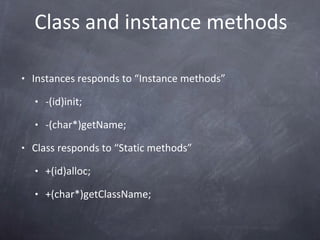
Class and instance methods Instances responds to “Instance methods” -(id)init; -(char*)getName; Class responds to “Static methods” +(id)alloc; +(char*)getClassName;
Message syntax (calling methods) Function calling in Objective C called message, this is to give more dynamicity to the language, some times if the method is not implemented the calling result will be nil = null [objectOfClass functionName]; [objectOfClass functionName:Arg1]; Calling staic method [Class functionName]; [Class functionName:Arg1]; Function also called selector, this is helpful in cases of passing the function name as parameter.
Objective C Dot Syntax It is only working in Objective C 2.0 It is only used for properties of object Dynamic Casting  Using type “id” , id is pointer to void “C Style void*” id object = [Class new]; Static casting Class* object = [Class new];
Objective C nil is equivalents to null  Objective C Class has no operators overloading Objective C Class has no constructors or destructors Boolean type is, BOOL YES is TRUE NO is FALSE Pointer to function in class called selector SEL method = [object event]; [object setEvent:@selecyot(function:)]; SEL function = @selector(function::);
iPhone frameworks Foundation  UIKit CoreGrphics CFNetwork CoreLocation CoreData ExternalAccessory GameKit MapKit IOKit MediaPlayer AddressBook MobileCoreSerivces OpenGL Security  StoreKit And many more
iPhone Development It is true that Objective C is not as strong as any other language but the huge coverage of frameworks that is provided by Apple makes it Ok to use such SDK From My experience I can tell, that there is too many things already done for me in way that make me use it in no time considering other platforms
Demo
Refernces iPhone Development course form Stanford CS193P Objective C developers guide Google
Contact me Ahmed Essam Naiem [email_address] http://www.ahmed-essam.com http://www.twitter.com/Neo_4583 http://www.facebook.com/aessam

I Phone Development Presentation

  • 1.
    iPhone Development AhmedEssam Software Research Engineer @ Unisoft
  • 2.
    Agenda Mobile ApplicationDevelopment iPhone Development methods iPhone Development tools Introduction to Objective C Introduction to iPhone SDK Demo
  • 3.
    Advice Be neutralwhen it comes to technology to be able to make the right decision
  • 4.
    Mobile Application Thereis three ways to do mobile applications Mobile Web Interface Develop for Java or Flash Develop for the native platform
  • 5.
    Mobile Web ApplicationsThis application is mostly connected, so most of the time user can’t handle it without internet or cached history Javascript provides reach function to access some hardware like GPS and other devices specific hardware Developer doesn’t have much authority over the device, tied by the browser.
  • 6.
    Java In somecases you can use Java but not all platforms supports Java as it is for instance BlackBerry You can use Java but it must be compiled using BB tools iPhone Doesn’t Support Java at all Android It is Java but not as J2ME developers used to.
  • 7.
    Flash Can beused if the application is all about interface currently flash can be used to act like real application, it has access to camera, GPS... etc iPhone doesn’t support it.
  • 8.
    Native Applications Youcan do what ever you want to,except what the framework doesn’t allow you to do.
  • 9.
    Native Development WindowsMobile SDK C#, C/C++ (Very easy to do apps on this SDK) Android SDK C (Doing libraries that will be used by Java Apps), Java BlackBerry SDK Java ( You need to package the Java code using the SDK ) Nokia SDK Java, C++ ( I call it Symbian’s C++, needs some time to use it)
  • 10.
    Why not JavaEvery device has its own characteristics and style Java is annoying to protect the user, “Do you allow this application to do .....?” You can’t know the (keyboard or keypad) layout Canvas or default system controls When using canvas you have to handle little everything Many features can’t be used.
  • 11.
    Personally I like:Windows mobile (Low level guys will enjoy it) iPhone (Most of the work REALLY done) Android (I love the idea of Open Source)
  • 12.
    iPhone Development MethodsiPhone Web Applications Normal web site with specified for iPhone using some JS functions that is provided by the Safari iPhone Native Applications Using Objective C iPhone SDK Jailbreak iPhone development tools
  • 13.
    Jailbreak iPhone developmentI don’t know much about it but You can do really what every you like all the undocumented functions are yours You can’t publish such app in the apps store You can publish such app in Cydia
  • 14.
    Needed to developfor iPhone Knowledge of C Mac OS X Intel based machine iPhone Developer program iPhone or iPod touch
  • 15.
    iPhone Development toolsXcode Interface Builder Instruments
  • 16.
    Objective C Youcan consider it Extension for C language ObjC add more dynamicity to C Language Single inheritance from super class and protocols is used as interfaces Totally new syntax but still can use C with it.
  • 17.
    Objective C Newconcepts Class definition Protocol implementation Class messages All objects are heap based & no stack objects Classes and Instances are both objects Class is a blue print to create instance
  • 18.
    Classes and ObjectsClasses declare the state and behavior State (class data) is instance variables and behavior is methods Instances are hidden, it can be accessed through getters and setters
  • 19.
    Class and instancemethods Instances responds to “Instance methods” -(id)init; -(char*)getName; Class responds to “Static methods” +(id)alloc; +(char*)getClassName;
  • 20.
    Message syntax (callingmethods) Function calling in Objective C called message, this is to give more dynamicity to the language, some times if the method is not implemented the calling result will be nil = null [objectOfClass functionName]; [objectOfClass functionName:Arg1]; Calling staic method [Class functionName]; [Class functionName:Arg1]; Function also called selector, this is helpful in cases of passing the function name as parameter.
  • 21.
    Objective C DotSyntax It is only working in Objective C 2.0 It is only used for properties of object Dynamic Casting Using type “id” , id is pointer to void “C Style void*” id object = [Class new]; Static casting Class* object = [Class new];
  • 22.
    Objective C nilis equivalents to null Objective C Class has no operators overloading Objective C Class has no constructors or destructors Boolean type is, BOOL YES is TRUE NO is FALSE Pointer to function in class called selector SEL method = [object event]; [object setEvent:@selecyot(function:)]; SEL function = @selector(function::);
  • 23.
    iPhone frameworks Foundation UIKit CoreGrphics CFNetwork CoreLocation CoreData ExternalAccessory GameKit MapKit IOKit MediaPlayer AddressBook MobileCoreSerivces OpenGL Security StoreKit And many more
  • 24.
    iPhone Development Itis true that Objective C is not as strong as any other language but the huge coverage of frameworks that is provided by Apple makes it Ok to use such SDK From My experience I can tell, that there is too many things already done for me in way that make me use it in no time considering other platforms
  • 25.
  • 26.
    Refernces iPhone Developmentcourse form Stanford CS193P Objective C developers guide Google
  • 27.
    Contact me AhmedEssam Naiem [email_address] http://www.ahmed-essam.com http://www.twitter.com/Neo_4583 http://www.facebook.com/aessam