APPLANATION
TONOMETER AND NON CONTACT
TONOMETER
SREELAKSHMI S
APPLANATION TONOMETER
Applanation Tonometer is used to measure Intraocular pressure
The concept of applanation tonometer was introduced by
Goldmann in 1954
Principle:
It is based on limbert fick‘s law which states that
“The pressure inside the sphere is equal to force required to flatten its
surface divided by area of its flattening”
Types of applanation tonometer
• Goldmann’s tonometer
• Perkins applanation tonometer
• Pneumatic tonometer
• Tonopen
Goldmann’s applanation tonometer
It is the most popular and accurate tonometer
It consists of a double prism mounted on a standard slit lamp.
Two extra forces acting on cornea
• Capillary attraction of tear meniscus(T),tends to pull tonometer
towards cornea
• Corneal rigidity(C) resists flattening
• These two forces cancel each other when flattened area has a
diameter of 3.06 mm
• Applanation tonometry displaces only about 0.5 microlitre of
aqueous humor , which raises IOP by about 3%.Because the volume
displaced is so small , ocular rigidity , or stretchability of the globe has
little effect on pressure reading
TECHNIQUE
• Cornea is anaesthetised using 2% Xylocaine
• Tear film is stained with fluorescein
• Now the patient is made to sit in front of the slit lamp
• The cornea and biprisms are illuminated with cobalt blue from the slit
lamp
• Biprism is then advanced until it touches
the apex of cornea
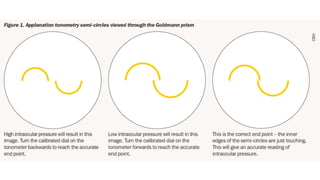
• At this point two fluorescent semicircles
are viewed through prism
• Then the applanation force against cornea is
adjusted until the inner edges of two circles meet
• This is endpoint
• The intraocular pressure is determined
by multiplying dial reading with ten
Perkins applanation tonometer
This is a handheld tonometer utilizing the same biprism as in the
Goldmann tonometer.
Advantages:
It is small ,easy to carry and doesn’t require slit lamp.
Disadvantages:
It requires practice before reliable readings are obtained
Pneumatic Tonometer
In pneumatic tonometer cornea is applanated by touching the
apex of the sialistic diaphragm by covering the sensing nozzle (which is
connected to the central chamber containing the pressurised air)
In this tonometer there is pneumatic to electronic transducer,
which converts the air pressure recording on a paperstrip from where
iop is read
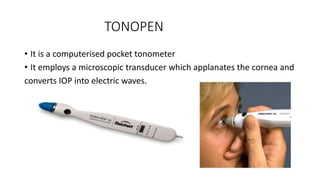
TONOPEN
• It is a computerised pocket tonometer
• It employs a microscopic transducer which applanates the cornea and
converts IOP into electric waves.
NON CONTACT TONOMETER
• It is a fast and simple way to screen for high intra ocular pressure.
• Introduced by Grolman.
• PRINCIPLE OF NCT : A puff of air creates a constant force which
momentarily deforms cornea. It is difficult to determine the exact
nature of corneal deformation, although it is postulated that the
central cornea is flattened at the moment the pressure measurement
is made.
Types of NCT
• 1. Table mounted – Xpert NCT.
• 2.Hand held – Pulsair tonometer from Keeler.
Parts of NCT
• 1. Alignment system – allows operator to optically align the patients
cornea is 3 dimensions – axial, vertical and lateral.
• 2.Monitoring system – consists of transmitter, detector and receiver.
• 3.Pneumatic system- generates a puff of air which is directed against
the cornea.
THANK YOU

applanation tonometer ophthal.pptx

  • 1.
    APPLANATION TONOMETER AND NONCONTACT TONOMETER SREELAKSHMI S
  • 2.
    APPLANATION TONOMETER Applanation Tonometeris used to measure Intraocular pressure The concept of applanation tonometer was introduced by Goldmann in 1954 Principle: It is based on limbert fick‘s law which states that “The pressure inside the sphere is equal to force required to flatten its surface divided by area of its flattening”
  • 3.
    Types of applanationtonometer • Goldmann’s tonometer • Perkins applanation tonometer • Pneumatic tonometer • Tonopen
  • 4.
    Goldmann’s applanation tonometer Itis the most popular and accurate tonometer It consists of a double prism mounted on a standard slit lamp. Two extra forces acting on cornea • Capillary attraction of tear meniscus(T),tends to pull tonometer towards cornea • Corneal rigidity(C) resists flattening
  • 5.
    • These twoforces cancel each other when flattened area has a diameter of 3.06 mm • Applanation tonometry displaces only about 0.5 microlitre of aqueous humor , which raises IOP by about 3%.Because the volume displaced is so small , ocular rigidity , or stretchability of the globe has little effect on pressure reading
  • 7.
    TECHNIQUE • Cornea isanaesthetised using 2% Xylocaine • Tear film is stained with fluorescein • Now the patient is made to sit in front of the slit lamp • The cornea and biprisms are illuminated with cobalt blue from the slit lamp
  • 8.
    • Biprism isthen advanced until it touches the apex of cornea • At this point two fluorescent semicircles are viewed through prism • Then the applanation force against cornea is adjusted until the inner edges of two circles meet • This is endpoint • The intraocular pressure is determined by multiplying dial reading with ten
  • 12.
    Perkins applanation tonometer Thisis a handheld tonometer utilizing the same biprism as in the Goldmann tonometer. Advantages: It is small ,easy to carry and doesn’t require slit lamp. Disadvantages: It requires practice before reliable readings are obtained
  • 14.
  • 15.
    In pneumatic tonometercornea is applanated by touching the apex of the sialistic diaphragm by covering the sensing nozzle (which is connected to the central chamber containing the pressurised air) In this tonometer there is pneumatic to electronic transducer, which converts the air pressure recording on a paperstrip from where iop is read
  • 16.
    TONOPEN • It isa computerised pocket tonometer • It employs a microscopic transducer which applanates the cornea and converts IOP into electric waves.
  • 17.
    NON CONTACT TONOMETER •It is a fast and simple way to screen for high intra ocular pressure. • Introduced by Grolman. • PRINCIPLE OF NCT : A puff of air creates a constant force which momentarily deforms cornea. It is difficult to determine the exact nature of corneal deformation, although it is postulated that the central cornea is flattened at the moment the pressure measurement is made.
  • 18.
    Types of NCT •1. Table mounted – Xpert NCT. • 2.Hand held – Pulsair tonometer from Keeler.
  • 19.
    Parts of NCT •1. Alignment system – allows operator to optically align the patients cornea is 3 dimensions – axial, vertical and lateral. • 2.Monitoring system – consists of transmitter, detector and receiver. • 3.Pneumatic system- generates a puff of air which is directed against the cornea.
  • 20.