Acute Appendicitis
Dr Bahauddin Baha,
Resident Emergency Physician.
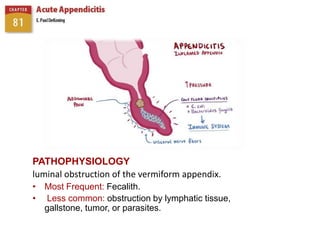
PATHOPHYSIOLOGY
luminal obstruction of the vermiform appendix.
• Most Frequent: Fecalith.
• Less common: obstruction by lymphatic tissue,
gallstone, tumor, or parasites.
Clinical Features.
• In early stage generalized malaise.
• Bowel Irregularity.
• Anorexia (Common one)
• Periumbilical or central abdominal pain after nonspecific signs.
• Nausia, vomiting doesn’t have to be present always.
• Fever
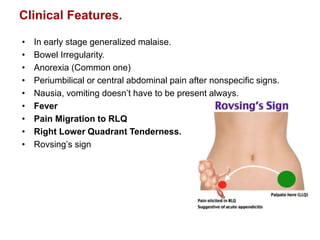
• Pain Migration to RLQ
• Right Lower Quadrant Tenderness.
• Rovsing’s sign
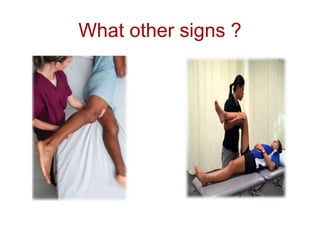
What other signs ?
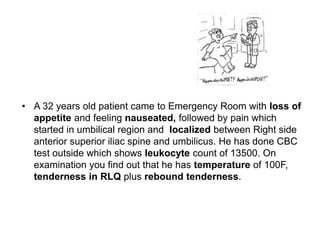
• A 32 years old patient came to Emergency Room with loss of
appetite and feeling nauseated, followed by pain which
started in umbilical region and localized between Right side
anterior superior iliac spine and umbilicus. He has done CBC
test outside which shows leukocyte count of 13500. On
examination you find out that he has temperature of 100F,
tenderness in RLQ plus rebound tenderness.
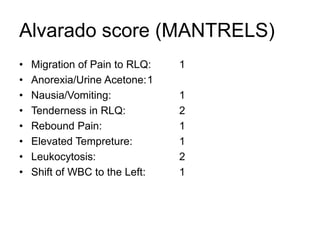
Alvarado score (MANTRELS)
• Migration of Pain to RLQ: 1
• Anorexia/Urine Acetone:1
• Nausia/Vomiting: 1
• Tenderness in RLQ: 2
• Rebound Pain: 1
• Elevated Tempreture: 1
• Leukocytosis: 2
• Shift of WBC to the Left: 1
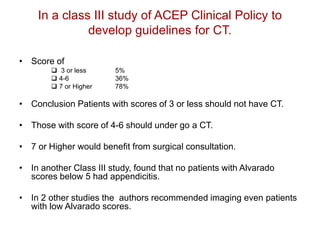
In a class III study of ACEP Clinical Policy to
develop guidelines for CT.
• Score of
 3 or less 5%
 4-6 36%
 7 or Higher 78%
• Conclusion Patients with scores of 3 or less should not have CT.
• Those with score of 4-6 should under go a CT.
• 7 or Higher would benefit from surgical consultation.
• In another Class III study, found that no patients with Alvarado
scores below 5 had appendicitis.
• In 2 other studies the authors recommended imaging even patients
with low Alvarado scores.
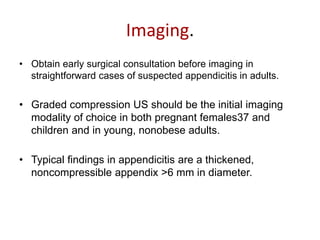
Imaging.
• Obtain early surgical consultation before imaging in
straightforward cases of suspected appendicitis in adults.
• Graded compression US should be the initial imaging
modality of choice in both pregnant females37 and
children and in young, nonobese adults.
• Typical findings in appendicitis are a thickened,
noncompressible appendix >6 mm in diameter.
• Abdominopelvic CT.
Dilated appendix >6 mm with a thickened wall,
periappendiceal inflammation, and potential visualization
of an appendicolith or abscess.
• Oral and IV Contrast versus Nonenhanced CT.
Multiple studies indicate that nonenhanced CT has
excellent performance in the diagnosis of acute
appendicitis.
• An 18-year-old male presents with abdominal pain that began
approximately 8 hours ago. Initially, he experienced nausea
with periumbilical pain that is now primarily in the right lower
quadrant. He has never been hospitalized or had any
surgeries. On exam, his temperature is 100.6◦F, and his
abdominal exam reveals tenderness at McBurney’s point.
What should be the next step?
•
• (A) CBC and urinalysis
• (B) CTscan of the abdomen/pelvis
• (C) Plain films of the abdomen
• (D) Surgical consultation
• (E) Ultrasound of the abdomen
DISPOSITION AND FOLLOW-UP
• Surgery is the accepted standard of care for
acute appendicitis.
• Can schedule a Patient for reevaluation after 12
hours.

Appendicitis

  • 1.
    Acute Appendicitis Dr BahauddinBaha, Resident Emergency Physician.
  • 2.
    PATHOPHYSIOLOGY luminal obstruction ofthe vermiform appendix. • Most Frequent: Fecalith. • Less common: obstruction by lymphatic tissue, gallstone, tumor, or parasites.
  • 3.
    Clinical Features. • Inearly stage generalized malaise. • Bowel Irregularity. • Anorexia (Common one) • Periumbilical or central abdominal pain after nonspecific signs. • Nausia, vomiting doesn’t have to be present always. • Fever • Pain Migration to RLQ • Right Lower Quadrant Tenderness. • Rovsing’s sign
  • 4.
  • 5.
    • A 32years old patient came to Emergency Room with loss of appetite and feeling nauseated, followed by pain which started in umbilical region and localized between Right side anterior superior iliac spine and umbilicus. He has done CBC test outside which shows leukocyte count of 13500. On examination you find out that he has temperature of 100F, tenderness in RLQ plus rebound tenderness.
  • 6.
    Alvarado score (MANTRELS) •Migration of Pain to RLQ: 1 • Anorexia/Urine Acetone:1 • Nausia/Vomiting: 1 • Tenderness in RLQ: 2 • Rebound Pain: 1 • Elevated Tempreture: 1 • Leukocytosis: 2 • Shift of WBC to the Left: 1
  • 7.
    In a classIII study of ACEP Clinical Policy to develop guidelines for CT. • Score of  3 or less 5%  4-6 36%  7 or Higher 78% • Conclusion Patients with scores of 3 or less should not have CT. • Those with score of 4-6 should under go a CT. • 7 or Higher would benefit from surgical consultation. • In another Class III study, found that no patients with Alvarado scores below 5 had appendicitis. • In 2 other studies the authors recommended imaging even patients with low Alvarado scores.
  • 8.
    Imaging. • Obtain earlysurgical consultation before imaging in straightforward cases of suspected appendicitis in adults. • Graded compression US should be the initial imaging modality of choice in both pregnant females37 and children and in young, nonobese adults. • Typical findings in appendicitis are a thickened, noncompressible appendix >6 mm in diameter.
  • 9.
    • Abdominopelvic CT. Dilatedappendix >6 mm with a thickened wall, periappendiceal inflammation, and potential visualization of an appendicolith or abscess. • Oral and IV Contrast versus Nonenhanced CT. Multiple studies indicate that nonenhanced CT has excellent performance in the diagnosis of acute appendicitis.
  • 10.
    • An 18-year-oldmale presents with abdominal pain that began approximately 8 hours ago. Initially, he experienced nausea with periumbilical pain that is now primarily in the right lower quadrant. He has never been hospitalized or had any surgeries. On exam, his temperature is 100.6◦F, and his abdominal exam reveals tenderness at McBurney’s point. What should be the next step? • • (A) CBC and urinalysis • (B) CTscan of the abdomen/pelvis • (C) Plain films of the abdomen • (D) Surgical consultation • (E) Ultrasound of the abdomen
  • 11.
    DISPOSITION AND FOLLOW-UP •Surgery is the accepted standard of care for acute appendicitis. • Can schedule a Patient for reevaluation after 12 hours.