Inflammatory Bowel
disease IBD
Crohn’s
disease
Ulcerative
colitis
General introduction:
Inflammatory bowel disease (IBD) is a chronic condition
that includes two major entities :
1 Crohn’s disease
2 ulcerative colitis
The distinction betweenulcerative colitis
and Crohn disease is based, in large part, on:
1. the distribution of affected sites
2. the morphologic expression of disease at those sites
General introduction:
Ulcerative colitis islimited to the colon and
rectum and extends only into the mucosa and
submucosa.
Crohn’s disease may involve any area of the
gastrointestinal tract and frequently is
transmural
Causes
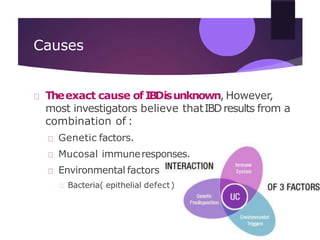
Theexact cause of IBDisunknown, However,
most investigators believe thatIBDresults from a
combination of :
Genetic factors.
Mucosal immuneresponses.
Environmental factors
Bacteria( epithelial defect)
Genetic factors
Risk of disease is increased when there is an
affected familymember.
InCrohn disease, the concordance ratefor
monozygotic twins isapproximately 50%.
Inulcerative colitis concordance rate formonozygotic
twins isonly 16%.
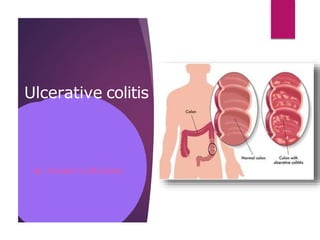
Ulcerative colitis
By :Khaled H.Alkhodari
Introduction
Isa disease in which extensive areas of the walls of the
large intestine become inflamed and ulcerated.
The motilityof the ulcerated colon is often so great that
mass movements occur much of the day.
The colon’s secretionsaregreatly enhanced  the
patient has repeated diarrheal bowel movements.
Introduction
Begins gradually and can become worse over time.
Isan autoimmune disease characterized by T-cellsinfiltrating
the colon.
Ulcerative colitis usually involves the rectum and isconfined
tothecolon, with occasional involvement of theileum.
Signs and symptoms
The most common are diarrhea withblood or
pusand abdominal discomfort. Other signs and
symptoms include:
An urgent need to have a bowel movement.
Feeling tired.
Nausea or loss of appetite.
Weight loss.
Fever.
Anemia.
Laboratory Tests
 Hemogram
C-Reactive protein, ESR and Platelet count-
increased
Hemoglobin-Decreased
Diagnosis
Laboratory Tests
Stool sample
Endoscopy
Radigraphy
Biopsy
Treatment -Medications
No medication cures ulcerative colitis, many
can reduce symptoms.The goals of medication
therapy are:
Inducing and maintainingremission.
Improving the person's quality of life.
Medications thatbesttreat symptoms:
Aminosalicylates (Aspirin and Ibuprofen.).
Corticosteroids (prednisone).
Immunomodulators.
Other medications.
Surgery in patient’s with chronic
ulcerative colitis is curative.
Reconstructive Protocolectomy w ith
ileal pouch
Proctocolectomy & ileostomy
Rectal and Anal Dessection
Colostomy w ith Ileorectal anastomosis
Ileostomy w ith intra abdominal pouch
Treatment –Surgery
Complications
Rectal bleeding.
Dehydration and malabsorbtion.
Changes inbones.
Inflammation in other areas of the body.
Megacolon
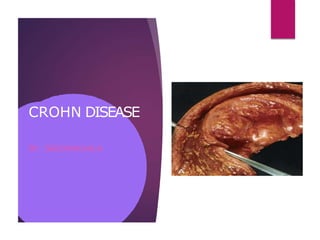
CROHN DISEASE
BY : SADINAKHALA
Crohn’s disease:
also knownas regional
enteritis, may occur inany
area ofthegastrointestinal
tract !!
Themostcommon sitesinvolved by
Crohn’s disease at presentation are:
1-terminalileum.
2-ileocecal valve.
3-cecum.
Clinical features:
1-Inmostpatients, disease begins with:
-mild diarrhea
-fever and abdominal pain
2-Irondeficiency anemia may develop inpersonswith
colonic disease
3-extensivesmallbowel disease may resultin :
-serumprotein loss
-generalized nutrientmalabsorption
(VB12and bile salts)
Treatment :
1 Anti-inflammatory drugs(reduces inflammation)
2 Immunesystemsuppressors(suppress immune
systemthatincreases inflammation )
3 Antibiotics (reduce harmfulintestinalbacteria )
4 Surgery
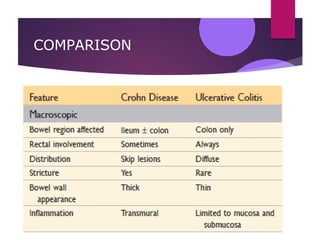
COMPARISON
Lifestyle and home remedies
Foods to limit or avoid
•Limit dairy products.
•Limit fiber, if it's a problem food.
•Avoid other problem foods-Spicy foods, alcohol and
caffeine may make your signs and symptoms worse.
Other dietary measures
•Eat small meals.
•Drink plenty of liquids
•Talk to a dietitian.
Thank you 
29

Ibd pptx.

  • 1.
  • 2.
    General introduction: Inflammatory boweldisease (IBD) is a chronic condition that includes two major entities : 1 Crohn’s disease 2 ulcerative colitis The distinction betweenulcerative colitis and Crohn disease is based, in large part, on: 1. the distribution of affected sites 2. the morphologic expression of disease at those sites
  • 3.
    General introduction: Ulcerative colitisislimited to the colon and rectum and extends only into the mucosa and submucosa. Crohn’s disease may involve any area of the gastrointestinal tract and frequently is transmural
  • 4.
    Causes Theexact cause ofIBDisunknown, However, most investigators believe thatIBDresults from a combination of : Genetic factors. Mucosal immuneresponses. Environmental factors Bacteria( epithelial defect)
  • 5.
    Genetic factors Risk ofdisease is increased when there is an affected familymember. InCrohn disease, the concordance ratefor monozygotic twins isapproximately 50%. Inulcerative colitis concordance rate formonozygotic twins isonly 16%.
  • 6.
  • 7.
    Introduction Isa disease inwhich extensive areas of the walls of the large intestine become inflamed and ulcerated. The motilityof the ulcerated colon is often so great that mass movements occur much of the day. The colon’s secretionsaregreatly enhanced  the patient has repeated diarrheal bowel movements.
  • 8.
    Introduction Begins gradually andcan become worse over time. Isan autoimmune disease characterized by T-cellsinfiltrating the colon. Ulcerative colitis usually involves the rectum and isconfined tothecolon, with occasional involvement of theileum.
  • 9.
    Signs and symptoms Themost common are diarrhea withblood or pusand abdominal discomfort. Other signs and symptoms include: An urgent need to have a bowel movement. Feeling tired. Nausea or loss of appetite. Weight loss. Fever. Anemia.
  • 10.
    Laboratory Tests  Hemogram C-Reactiveprotein, ESR and Platelet count- increased Hemoglobin-Decreased Diagnosis Laboratory Tests Stool sample Endoscopy Radigraphy Biopsy
  • 11.
    Treatment -Medications No medicationcures ulcerative colitis, many can reduce symptoms.The goals of medication therapy are: Inducing and maintainingremission. Improving the person's quality of life. Medications thatbesttreat symptoms: Aminosalicylates (Aspirin and Ibuprofen.). Corticosteroids (prednisone). Immunomodulators. Other medications.
  • 12.
    Surgery in patient’swith chronic ulcerative colitis is curative. Reconstructive Protocolectomy w ith ileal pouch Proctocolectomy & ileostomy Rectal and Anal Dessection Colostomy w ith Ileorectal anastomosis Ileostomy w ith intra abdominal pouch Treatment –Surgery
  • 13.
    Complications Rectal bleeding. Dehydration andmalabsorbtion. Changes inbones. Inflammation in other areas of the body. Megacolon
  • 14.
    CROHN DISEASE BY :SADINAKHALA
  • 15.
    Crohn’s disease: also knownasregional enteritis, may occur inany area ofthegastrointestinal tract !!
  • 16.
    Themostcommon sitesinvolved by Crohn’sdisease at presentation are: 1-terminalileum. 2-ileocecal valve. 3-cecum.
  • 17.
    Clinical features: 1-Inmostpatients, diseasebegins with: -mild diarrhea -fever and abdominal pain 2-Irondeficiency anemia may develop inpersonswith colonic disease 3-extensivesmallbowel disease may resultin : -serumprotein loss -generalized nutrientmalabsorption (VB12and bile salts)
  • 18.
    Treatment : 1 Anti-inflammatorydrugs(reduces inflammation) 2 Immunesystemsuppressors(suppress immune systemthatincreases inflammation ) 3 Antibiotics (reduce harmfulintestinalbacteria ) 4 Surgery
  • 19.
  • 20.
    Lifestyle and homeremedies Foods to limit or avoid •Limit dairy products. •Limit fiber, if it's a problem food. •Avoid other problem foods-Spicy foods, alcohol and caffeine may make your signs and symptoms worse. Other dietary measures •Eat small meals. •Drink plenty of liquids •Talk to a dietitian.
  • 21.