BUILDING A SIMPLE FINANCIAL MODEL 1
© Rick Rasmussen 2018
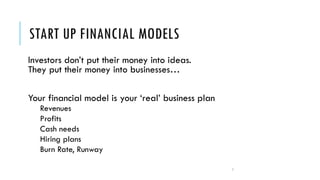
START UP FINANCIAL MODELS
Investors don’t put their money into ideas.
They put their money into businesses…
Your financial model is your ‘real’ business plan
Revenues
Profits
Cash needs
Hiring plans
Burn Rate, Runway
2
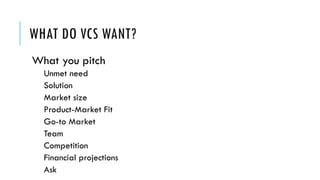
WHAT DO VCS WANT?
What you pitch
Unmet need
Solution
Market size
Product-Market Fit
Go-to Market
Team
Competition
Financial projections
Ask
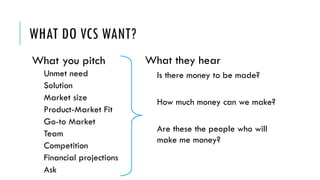
WHAT DO VCS WANT?
What you pitch
Unmet need
Solution
Market size
Product-Market Fit
Go-to Market
Team
Competition
Financial projections
Ask
What they hear
Is there money to be made?
How much money can we make?
Are these the people who will
make me money?
INVESTORS EXPECT:
A 5-year Profit & Loss (P&L)
A simplified Income Statement
Broken out by Year in the presentation
HOW CAN YOU DO THIS?
You’re predicting the future
With little or no real evidence
Trying to reassure investors
that your guesses are valid
6
TELL A STORY
Startup financials are your
story expressed in numbers
Build out your story and then
translate
7
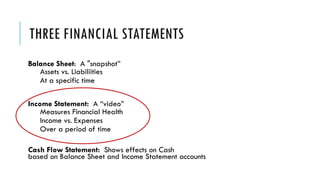
THREE FINANCIAL STATEMENTS
Balance Sheet: A "snapshot”
Assets vs. Liabilities
At a specific time
Income Statement: A “video”
Measures Financial Health
Income vs. Expenses
Over a period of time
Cash Flow Statement: Shows effects on Cash
based on Balance Sheet and Income Statement accounts
THREE FINANCIAL STATEMENTS
Balance Sheet: A "snapshot”
Assets vs. Liabiliities
At a specific time
Income Statement: A “video”
Measures Financial Health
Income vs. Expenses
Over a period of time
Cash Flow Statement: Shows effects on Cash
based on Balance Sheet and Income Statement accounts
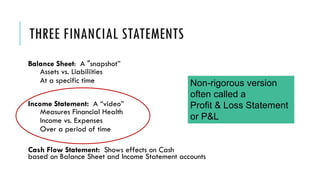
THREE FINANCIAL STATEMENTS
Balance Sheet: A "snapshot”
Assets vs. Liabiliities
At a specific time
Income Statement: A “video”
Measures Financial Health
Income vs. Expenses
Over a period of time
Cash Flow Statement: Shows effects on Cash
based on Balance Sheet and Income Statement accounts
Non-rigorous version
often called a
Profit & Loss Statement
or P&L
P&L: BASIC STRUCTURE
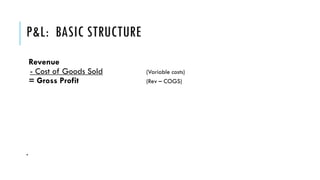
Revenue
- Cost of Goods Sold (Variable costs)
= Gross Profit (Rev – COGS)
.
P&L: BASIC STRUCTURE
Revenue
- Cost of Goods Sold (Variable costs)
= Gross Profit (Rev – COGS)
Gross Profit
- Expenses (Fixed Costs)
R&D
Sales and Mktg
General and Administrative (G&A)
= Net Profit [Gross Profit - Expenses]
.
P&L: BASIC STRUCTURE
Revenue
- Cost of Goods Sold (Variable costs)
= Gross Profit (Rev – COGS)
Gross Profit
- Expenses (Fixed Costs)
R&D
Sales and Mktg
General and Administrative (G&A)
= Net Profit [Gross Profit - Expenses]
+/- Other Income (expense)
= Net Income
THREE THINGS TO FIGURE OUT…
Revenue
- Cost of Goods Sold (Variable costs)
= Gross Profit (Rev – COGS)
Gross Profit
- Expenses (Fixed Costs)
R&D
Sales and Mktg
General and Administrative (G&A)
= Net Profit [Gross Profit - Expenses]
+/- Other Income (expense)
= Net Income
16
Cash flow positive
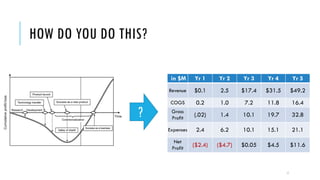
HOW DO YOU DO THIS?
17
in $M Yr 1 Yr 2 Yr 3 Yr 4 Yr 5
Revenue $0.1 2.5 $17.4 $31.5 $49.2
COGS 0.2 1.0 7.2 11.8 16.4
Gross
Profit
(.02) 1.4 10.1 19.7 32.8
Expenses 2.4 6.2 10.1 15.1 21.1
Net
Profit
($2.4) ($4.7) $0.05 $4.5 $11.6
?
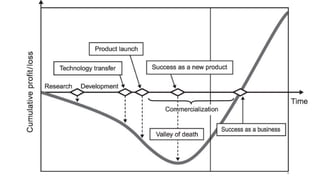
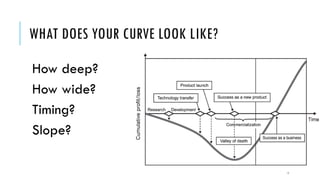
WHAT DOES YOUR CURVE LOOK LIKE?
How deep?
How wide?
Timing?
Slope?
18
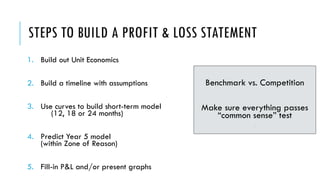
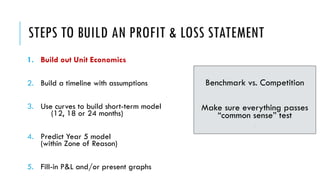
STEPS TO BUILD A PROFIT & LOSS STATEMENT
1. Build out Unit Economics
2. Build a timeline with assumptions
3. Use curves to build short-term model
(12, 18 or 24 months)
4. Predict Year 5 model
(within Zone of Reason)
5. Fill-in P&L and/or present graphs
Benchmark vs. Competition
Make sure everything passes
“common sense” test
.
UNIT ECONOMICS
UNIT ECONOMICS
Fundamental building block of
any financial model
What does it take to
build and sell one?
­One product delivered
­One software license
­One job completed
­One client serviced
UNIT ECONOMICS
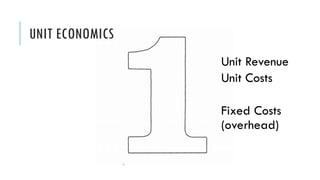
Unit Revenue
Unit Costs
Fixed Costs
(overhead)
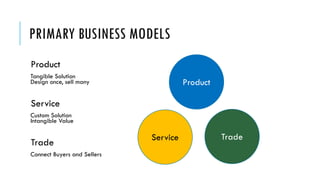
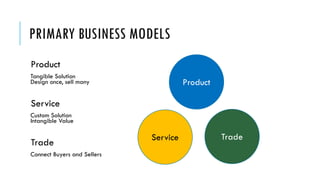
PRIMARY BUSINESS MODELS
Product
Tangible Solution
Design once, sell many
Service
Custom Solution
Intangible Value
Trade
Connect Buyers and Sellers
Product
Service Trade
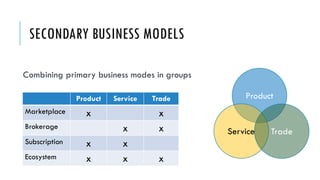
SECONDARY BUSINESS MODELS
Combining primary business modes in groups
Product Service Trade
Marketplace x x
Brokerage x x
Subscription x x
Ecosystem x x x
Product
Service Trade
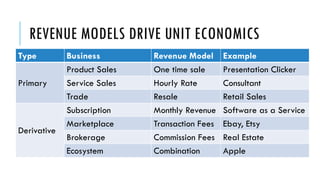
REVENUE MODELS DRIVE UNIT ECONOMICS
Type Business Revenue Model Example
Primary
Product Sales One time sale Presentation Clicker
Service Sales Hourly Rate Consultant
Trade Resale Retail Sales
Derivative
Subscription Monthly Revenue Software as a Service
Marketplace Transaction Fees Ebay, Etsy
Brokerage Commission Fees Real Estate
Ecosystem Combination Apple
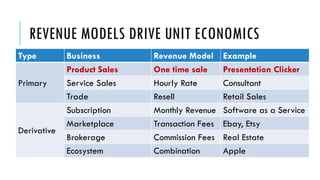
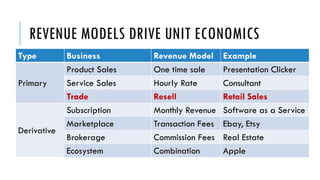
REVENUE MODELS DRIVE UNIT ECONOMICS
Type Business Revenue Model Example
Primary
Product Sales One time sale Presentation Clicker
Service Sales Hourly Rate Consultant
Trade Resell Retail Sales
Derivative
Subscription Monthly Revenue Software as a Service
Marketplace Transaction Fees Ebay, Etsy
Brokerage Commission Fees Real Estate
Ecosystem Combination Apple
Example: Product Sales
Behold the lowly clicker
Getting into the
Clicker business
What type of
business?
Existing?
Re-segmented?
New?
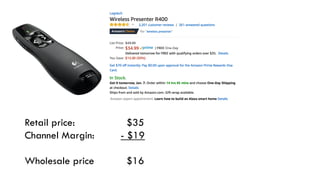
Retail price: $35
Retail price: $35
Channel Margin: - $19
Wholesale price $16
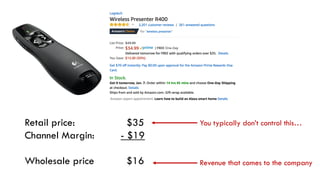
Retail price: $35
Channel Margin: - $19
Wholesale price $16
You typically don’t control this…
Revenue that comes to the company
UNIT ECONOMICS
1. Unit Price $16
2. Each unit has a Cost
This is your variable cost
Also called COGS for Cost Of Goods Sold
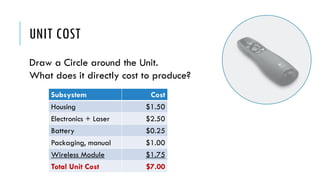
UNIT COST
Subsystem Cost
Housing $1.50
Electronics + Laser $2.50
Battery $0.25
Packaging, manual $1.00
Wireless Module $1.75
Total Unit Cost $7.00
Draw a Circle around the Unit.
What does it directly cost to produce?
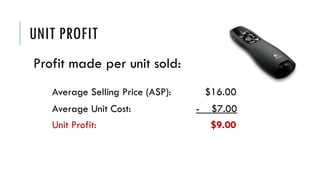
UNIT PROFIT
This is the profit you make per unit sold
Unit Price
minus Unit Cost
UNIT PROFIT
UNIT PROFIT
Profit made per unit sold:
Average Selling Price (ASP): $16.00
Average Unit Cost: - $7.00
Unit Profit: $9.00
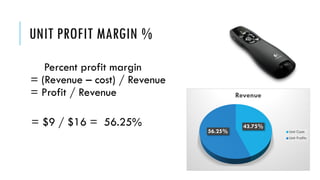
UNIT PROFIT MARGIN %
Percent profit margin
= (Revenue – cost) / Revenue
= Profit / Revenue
= $9 / $16 = 56.25% 43.75%
56.25%
Revenue
Unit Costs
Unit Profits
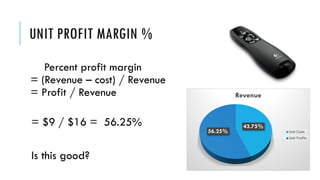
UNIT PROFIT MARGIN %
Percent profit margin
= (Revenue – cost) / Revenue
= Profit / Revenue
= $9 / $16 = 56.25%
Is this good?
43.75%
56.25%
Revenue
Unit Costs
Unit Profits
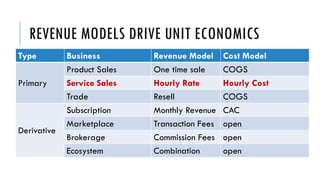
REVENUE MODELS DRIVE UNIT ECONOMICS
Type Business Revenue Model Cost Model
Primary
Product Sales One time sale COGS
Service Sales Hourly Rate Hourly Cost
Trade Resell COGS
Derivative
Subscription Monthly Revenue CAC
Marketplace Transaction Fees open
Brokerage Commission Fees open
Ecosystem Combination open
Law Firm
Working for hourly
billings
Billing Rate
- Hourly Pay
Hourly Profit
SERVICE EXAMPLE
REVENUE MODELS DRIVE UNIT ECONOMICS
Type Business Revenue Model Example
Primary
Product Sales One time sale Presentation Clicker
Service Sales Hourly Rate Consultant
Trade Resell Retail Sales
Derivative
Subscription Monthly Revenue Software as a Service
Marketplace Transaction Fees Ebay, Etsy
Brokerage Commission Fees Real Estate
Ecosystem Combination Apple
Sales
- Returns
Net Sales
TRADE EXAMPLE
FIXED VS. VARIABLE COSTS
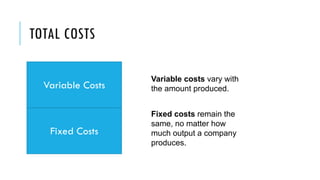
TOTAL COSTS
Variable Costs
Fixed Costs
Variable costs vary with
the amount produced.
Fixed costs remain the
same, no matter how
much output a company
produces.
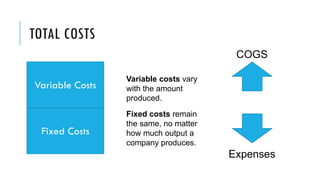
TOTAL COSTS
Variable Costs
Fixed Costs
Variable costs vary
with the amount
produced.
Fixed costs remain
the same, no matter
how much output a
company produces.
COGS
Expenses
FIXED COSTS
Business costs that are constant independent of units
produced
Generally includes:
­ Salaries
­ Rent, Insurance and Utilities
­ Marketing
All stay the same whether you sell one or 1M units
FIXED COSTS?
If you have employees, you have Salary costs
If you have a physical building, you pay
Rent, Insurance, Utilities
If you promote, Marketing and Sales are a primary
expense
* Exception to both would be large factories where Capital cost considerations
need to be added
SALARIES
How many people needed to run
your business?
­Management
­Engineers
­Marketing, Sales, etc.
Factory workers are considered
Direct Labor, part of COGS
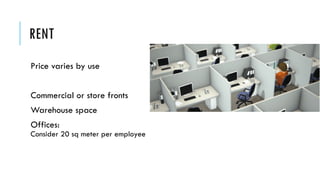
RENT
Price varies by use
Commercial or store fronts
Warehouse space
Offices:
Consider 20 sq meter per employee
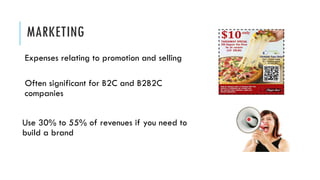
MARKETING
Expenses relating to promotion and selling
Often significant for B2C and B2B2C
companies
Use 30% to 55% of revenues if you need to
build a brand
IS MARKETING VARIABLE OR FIXED?
… It depends
Yes:
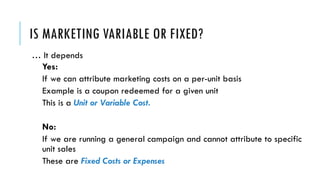
If we can attribute marketing costs on a per-unit basis
Example is a coupon redeemed for a given unit
This is a Unit or Variable Cost.
No:
If we are running a general campaign and cannot attribute to specific
unit sales
These are Fixed Costs or Expenses
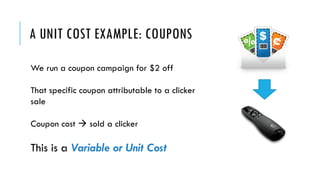
A UNIT COST EXAMPLE: COUPONS
We run a coupon campaign for $2 off
That specific coupon attributable to a clicker
sale
Coupon cost à sold a clicker
This is a Variable or Unit Cost
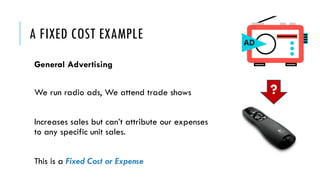
A FIXED COST EXAMPLE
General Advertising
We run radio ads, We attend trade shows
Increases sales but can’t attribute our expenses
to any specific unit sales.
This is a Fixed Cost or Expense
?
VARIABLE VS. FIXED COSTS
Variable Costs
Direct Materials
Direct Labor
CAC
Fixed Costs
Corporate Expenses
Rent
Salaries
Insurance
Training
Research
It Depends
Marketing Campaigns
Shipping, Delivery
Sales Commissions
Utilities
Scrap
Recalls
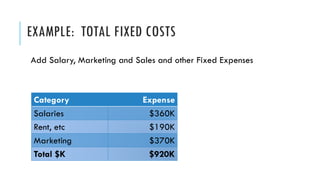
EXAMPLE: TOTAL FIXED COSTS
Add Salary, Marketing and Sales and other Fixed Expenses
Category Expense
Salaries $360K
Rent, etc $190K
Marketing $370K
Total $K $920K
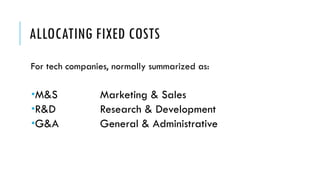
ALLOCATING FIXED COSTS
For tech companies, normally summarized as:
­M&S Marketing & Sales
­R&D Research & Development
­G&A General & Administrative
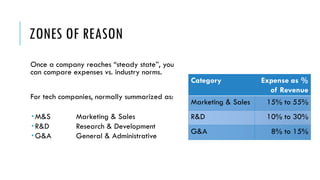
ZONES OF REASON
Once a company reaches “steady state”, you
can compare expenses vs. industry norms.
For tech companies, normally summarized as:
­ M&S Marketing & Sales
­ R&D Research & Development
­ G&A General & Administrative
Category Expense as %
of Revenue
Marketing & Sales 15% to 55%
R&D 10% to 30%
G&A 8% to 15%
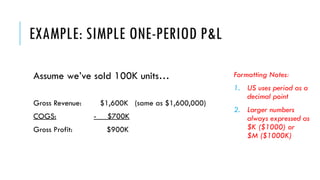
EXAMPLE: SIMPLE ONE-PERIOD P&L
Assume we’ve sold 100K units…
Gross Revenue: $1,600K (same as $1,600,000)
COGS: - $700K
Gross Profit: $900K
Formatting Notes:
1. US uses period as a
decimal point
2. Larger numbers
always expressed as
$K ($1000) or
$M ($1000K)
UNITS SOLD à GROSS PROFIT
Units Sold (K) 100K
Average Selling Price (ASP) $16
Gross Revenue ($K) $1,600
Average Cost $7
COGS ($K) $700
Gross Profit ($K) $900
Step 1
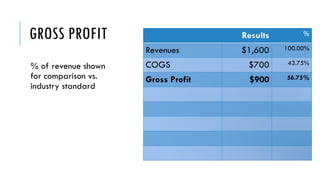
GROSS PROFIT
% of revenue shown
for comparison vs.
industry standard
Results %
Revenues $1,600 100.00%
COGS $700 43.75%
Gross Profit $900 56.75%
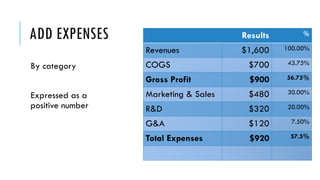
ADD EXPENSES
By category
Expressed as a
positive number
Results %
Revenues $1,600 100.00%
COGS $700 43.75%
Gross Profit $900 56.75%
Marketing & Sales $480 30.00%
R&D $320 20.00%
G&A $120 7.50%
Total Expenses $920 57.5%
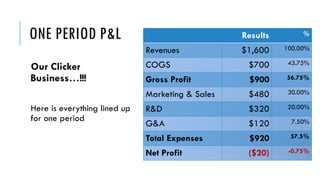
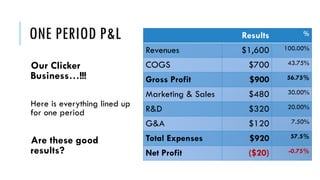
ONE PERIOD P&L
Our Clicker
Business…!!!
Here is everything lined up
for one period
Results %
Revenues $1,600 100.00%
COGS $700 43.75%
Gross Profit $900 56.75%
Marketing & Sales $480 30.00%
R&D $320 20.00%
G&A $120 7.50%
Total Expenses $920 57.5%
Net Profit ($20) -0.75%
ONE PERIOD P&L
Our Clicker
Business…!!!
Here is everything lined up
for one period
Are these good
results?
Results %
Revenues $1,600 100.00%
COGS $700 43.75%
Gross Profit $900 56.75%
Marketing & Sales $480 30.00%
R&D $320 20.00%
G&A $120 7.50%
Total Expenses $920 57.5%
Net Profit ($20) -0.75%
BUILDING THE FINAL MODEL
STEPS TO BUILD AN PROFIT & LOSS STATEMENT
1. Build out Unit Economics
2. Build a timeline with assumptions
3. Use curves to build short-term model
(12, 18 or 24 months)
4. Predict Year 5 model
(within Zone of Reason)
5. Fill-in P&L and/or present graphs
Benchmark vs. Competition
Make sure everything passes
“common sense” test
.
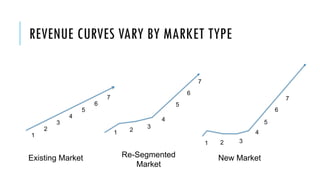
REVENUE CURVES VARY BY MARKET TYPE
Existing Market Re-Segmented
Market
New Market
1
2
3
4
5
6
7
1 2
3
4
5
6
7
1 2 3
4
5
6
7
PRIMARY BUSINESS MODELS
Product
Tangible Solution
Design once, sell many
Service
Custom Solution
Intangible Value
Trade
Connect Buyers and Sellers
Product
Service Trade
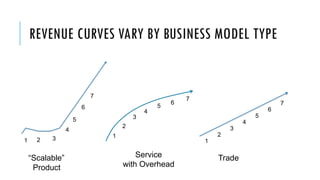
REVENUE CURVES VARY BY BUSINESS MODEL TYPE
“Scalable”
Product
Service
with Overhead
Trade
1
2
3
4
5
6
7
1 2 3
4
5
6
7
1
2
3
4
5
6
7
REVENUE CURVES VARY AS A FUNCTION OF THE
BUSINESS
Sales Volume = Height
Time to Market = Length
Sales Growth = Slope
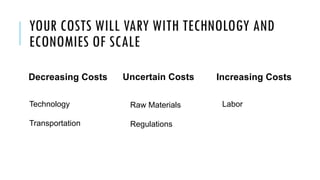
YOUR COSTS WILL VARY WITH TECHNOLOGY AND
ECONOMIES OF SCALE
Decreasing Costs Uncertain Costs Increasing Costs
Technology
Transportation
LaborRaw Materials
Regulations
YOUR COMPANY TIMELINE
Q3Q1 Q2 Q7Q6 Q8
Series B
Company
Starts
First
Production
Full
Production
Series A
Second
Production
Cost
Reduction
First
Orders
Seed Funding
Q4 Q5
Employees: 6 10 14 18 22 25 29 33
50K/month
Shipments
NEW COMPANY
Introducing NewCo
World’s best
Fidget spinners…!!!
74
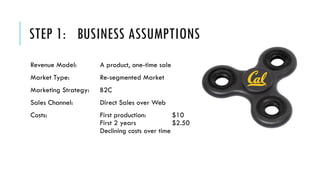
STEP 1: BUSINESS ASSUMPTIONS
Revenue Model: A product, one-time sale
Market Type: Re-segmented Market
Marketing Strategy: B2C
Sales Channel: Direct Sales over Web
Costs: First production: $10
First 2 years $2.50
Declining costs over time
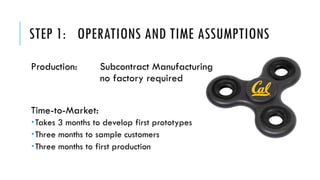
STEP 1: OPERATIONS AND TIME ASSUMPTIONS
Production: Subcontract Manufacturing
no factory required
Time-to-Market:
­Takes 3 months to develop first prototypes
­Three months to sample customers
­Three months to first production
STEP 2: UNIT ECONOMICS
Our unit is one spinner
Unit Price: $6.00
Unit Cost: $2.50
Unit Profit: $3.50
Unit Margin: 58.3%
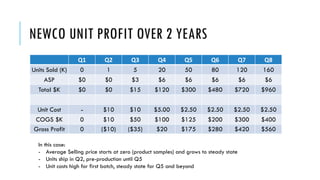
NEWCO UNIT PROFIT OVER 2 YEARS
Q1 Q2 Q3 Q4 Q5 Q6 Q7 Q8
Units Sold (K) 0 1 5 20 50 80 120 160
ASP $0 $0 $3 $6 $6 $6 $6 $6
Total $K $0 $0 $15 $120 $300 $480 $720 $960
Unit Cost - $10 $10 $5.00 $2.50 $2.50 $2.50 $2.50
COGS $K 0 $10 $50 $100 $125 $200 $300 $400
Gross Profit 0 ($10) ($35) $20 $175 $280 $420 $560
In this case:
- Average Selling price starts at zero (product samples) and grows to steady state
- Units ship in Q2, pre-production until Q5
- Unit costs high for first batch, steady state for Q5 and beyond
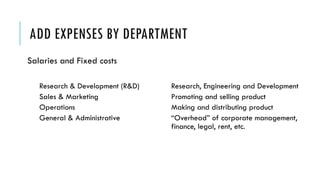
ADD EXPENSES BY DEPARTMENT
Salaries and Fixed costs
Research & Development (R&D) Research, Engineering and Development
Sales & Marketing Promoting and selling product
Operations Making and distributing product
General & Administrative “Overhead” of corporate management,
finance, legal, rent, etc.
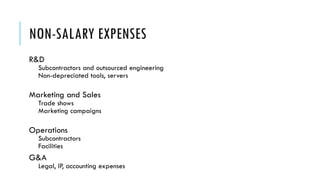
NON-SALARY EXPENSES
R&D
Subcontractors and outsourced engineering
Non-depreciated tools, servers
Marketing and Sales
Trade shows
Marketing campaigns
Operations
Subcontractors
Facilities
G&A
Legal, IP, accounting expenses
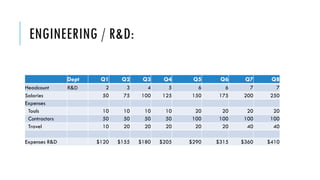
ENGINEERING / R&D:
Dept Q1 Q2 Q3 Q4 Q5 Q6 Q7 Q8
Headcount R&D 2 3 4 5 6 6 7 7
Salaries 50 75 100 125 150 175 200 250
Expenses
Tools 10 10 10 10 20 20 20 20
Contractors 50 50 50 50 100 100 100 100
Travel 10 20 20 20 20 20 40 40
Expenses R&D $120 $155 $180 $205 $290 $315 $360 $410
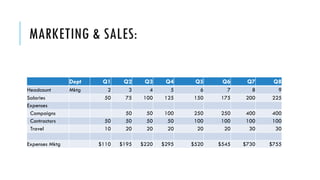
MARKETING & SALES:
Dept Q1 Q2 Q3 Q4 Q5 Q6 Q7 Q8
Headcount Mktg 2 3 4 5 6 7 8 9
Salaries 50 75 100 125 150 175 200 225
Expenses
Campaigns 50 50 100 250 250 400 400
Contractors 50 50 50 50 100 100 100 100
Travel 10 20 20 20 20 20 30 30
Expenses Mktg $110 $195 $220 $295 $520 $545 $730 $755
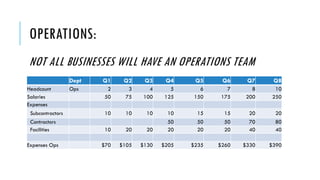
OPERATIONS:
Dept Q1 Q2 Q3 Q4 Q5 Q6 Q7 Q8
Headcount Ops 2 3 4 5 6 7 8 10
Salaries 50 75 100 125 150 175 200 250
Expenses
Subcontractors 10 10 10 10 15 15 20 20
Contractors 50 50 50 70 80
Facilities 10 20 20 20 20 20 40 40
Expenses Ops $70 $105 $130 $205 $235 $260 $330 $390
NOT ALL BUSINESSES WILL HAVE AN OPERATIONS TEAM
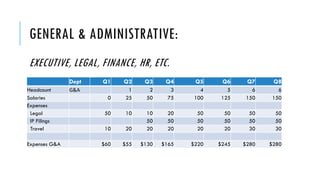
GENERAL & ADMINISTRATIVE:
Dept Q1 Q2 Q3 Q4 Q5 Q6 Q7 Q8
Headcount G&A 1 2 3 4 5 6 6
Salaries 0 25 50 75 100 125 150 150
Expenses
Legal 50 10 10 20 50 50 50 50
IP Filings 50 50 50 50 50 50
Travel 10 20 20 20 20 20 30 30
Expenses G&A $60 $55 $130 $165 $220 $245 $280 $280
EXECUTIVE, LEGAL, FINANCE, HR, ETC.
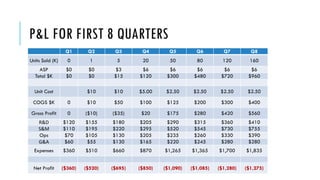
P&L FOR FIRST 8 QUARTERS
Q1 Q2 Q3 Q4 Q5 Q6 Q7 Q8
Units Sold (K) 0 1 5 20 50 80 120 160
ASP $0 $0 $3 $6 $6 $6 $6 $6
Total $K $0 $0 $15 $120 $300 $480 $720 $960
Unit Cost $10 $10 $5.00 $2.50 $2.50 $2.50 $2.50
COGS $K 0 $10 $50 $100 $125 $200 $300 $400
Gross Profit 0 ($10) ($35) $20 $175 $280 $420 $560
R&D $120 $155 $180 $205 $290 $315 $360 $410
S&M $110 $195 $220 $295 $520 $545 $730 $755
Ops $70 $105 $130 $205 $235 $260 $330 $390
G&A $60 $55 $130 $165 $220 $245 $280 $280
Expenses $360 $510 $660 $870 $1,265 $1,365 $1,700 $1,835
Net Profit ($360) ($520) ($695) ($850) ($1,090) ($1,085) ($1,280) ($1,275)
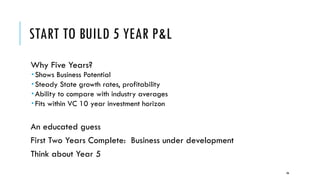
START TO BUILD 5 YEAR P&L
Why Five Years?
­ Shows Business Potential
­ Steady State growth rates, profitability
­ Ability to compare with industry averages
­ Fits within VC 10 year investment horizon
An educated guess
First Two Years Complete: Business under development
Think about Year 5
86
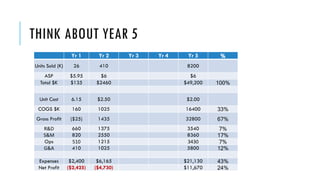
THINK ABOUT YEAR 5
Yr 1 Yr 2 Yr 3 Yr 4 Yr 5 %
Units Sold (K) 26 410 8200
ASP $5.95 $6 $6
Total $K $135 $2460 $49,200 100%
Unit Cost 6.15 $2.50 $2.00
COGS $K 160 1025 16400 33%
Gross Profit ($25) 1435 32800 67%
R&D 660 1375 3540 7%
S&M 820 2550 8360 17%
Ops 510 1215 3430 7%
G&A 410 1025 5800 12%
Expenses $2,400 $6,165 $21,130 43%
Net Profit ($2,425) ($4,730) $11,670 24%
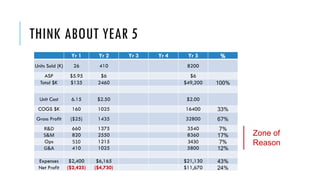
THINK ABOUT YEAR 5
Yr 1 Yr 2 Yr 3 Yr 4 Yr 5 %
Units Sold (K) 26 410 8200
ASP $5.95 $6 $6
Total $K $135 2460 $49,200 100%
Unit Cost 6.15 $2.50 $2.00
COGS $K 160 1025 16400 33%
Gross Profit ($25) 1435 32800 67%
R&D 660 1375 3540 7%
S&M 820 2550 8360 17%
Ops 510 1215 3430 7%
G&A 410 1025 5800 12%
Expenses $2,400 $6,165 $21,130 43%
Net Profit ($2,425) ($4,730) $11,670 24%
Zone of
Reason
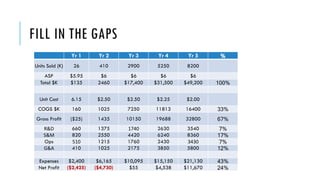
FILL IN THE GAPS
Yr 1 Yr 2 Yr 3 Yr 4 Yr 5 %
Units Sold (K) 26 410 2900 5250 8200
ASP $5.95 $6 $6 $6 $6
Total $K $135 2460 $17,400 $31,500 $49,200 100%
Unit Cost 6.15 $2.50 $2.50 $2.25 $2.00
COGS $K 160 1025 7250 11813 16400 33%
Gross Profit ($25) 1435 10150 19688 32800 67%
R&D 660 1375 1740 2630 3540 7%
S&M 820 2550 4420 6240 8360 17%
Ops 510 1215 1760 2430 3430 7%
G&A 410 1025 2175 3850 5800 12%
Expenses $2,400 $6,165 $10,095 $15,150 $21,130 43%
Net Profit ($2,425) ($4,730) $55 $4,538 $11,670 24%
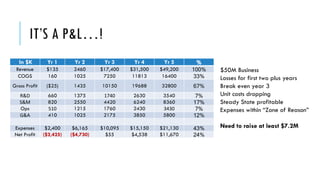
IT’S A P&L…!
In $K Yr 1 Yr 2 Yr 3 Yr 4 Yr 5 %
Revenue $135 2460 $17,400 $31,500 $49,200 100%
COGS 160 1025 7250 11813 16400 33%
Gross Profit ($25) 1435 10150 19688 32800 67%
R&D 660 1375 1740 2630 3540 7%
S&M 820 2550 4420 6240 8360 17%
Ops 510 1215 1760 2430 3430 7%
G&A 410 1025 2175 3850 5800 12%
Expenses $2,400 $6,165 $10,095 $15,150 $21,130 43%
Net Profit ($2,425) ($4,730) $55 $4,538 $11,670 24%
$50M Business
Losses for first two plus years
Break even year 3
Unit costs dropping
Steady State profitable
Expenses within “Zone of Reason”
Need to raise at least $7.2M
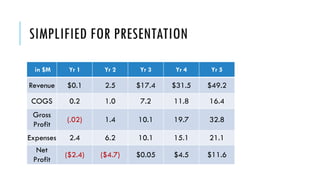
SIMPLIFIED FOR PRESENTATION
in $M Yr 1 Yr 2 Yr 3 Yr 4 Yr 5
Revenue $0.1 2.5 $17.4 $31.5 $49.2
COGS 0.2 1.0 7.2 11.8 16.4
Gross
Profit
(.02) 1.4 10.1 19.7 32.8
Expenses 2.4 6.2 10.1 15.1 21.1
Net
Profit
($2.4) ($4.7) $0.05 $4.5 $11.6
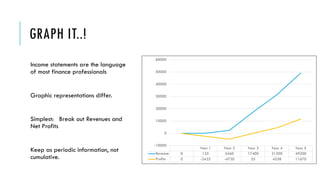
GRAPH IT..!
Income statements are the language
of most finance professionals
Graphic representations differ.
Simplest: Break out Revenues and
Net Profits
Keep as periodic information, not
cumulative.
Year 1 Year 2 Year 3 Year 4 Year 5
Revenue 0 135 2460 17400 31500 49200
Profits 0 -2425 -4730 55 4538 11670
-10000
0
10000
20000
30000
40000
50000
60000
YOU DID IT..!
Congratulations!
You’re an amazing
financial genius
Get ready to present
to the investors..!

APIA2018 - Rick Rasmussen - Building a Financial Model

  • 1.
    BUILDING A SIMPLEFINANCIAL MODEL 1 © Rick Rasmussen 2018
  • 2.
    START UP FINANCIALMODELS Investors don’t put their money into ideas. They put their money into businesses… Your financial model is your ‘real’ business plan Revenues Profits Cash needs Hiring plans Burn Rate, Runway 2
  • 3.
    WHAT DO VCSWANT? What you pitch Unmet need Solution Market size Product-Market Fit Go-to Market Team Competition Financial projections Ask
  • 4.
    WHAT DO VCSWANT? What you pitch Unmet need Solution Market size Product-Market Fit Go-to Market Team Competition Financial projections Ask What they hear Is there money to be made? How much money can we make? Are these the people who will make me money?
  • 5.
    INVESTORS EXPECT: A 5-yearProfit & Loss (P&L) A simplified Income Statement Broken out by Year in the presentation
  • 6.
    HOW CAN YOUDO THIS? You’re predicting the future With little or no real evidence Trying to reassure investors that your guesses are valid 6
  • 7.
    TELL A STORY Startupfinancials are your story expressed in numbers Build out your story and then translate 7
  • 8.
    THREE FINANCIAL STATEMENTS BalanceSheet: A "snapshot” Assets vs. Liabilities At a specific time Income Statement: A “video” Measures Financial Health Income vs. Expenses Over a period of time Cash Flow Statement: Shows effects on Cash based on Balance Sheet and Income Statement accounts
  • 9.
    THREE FINANCIAL STATEMENTS BalanceSheet: A "snapshot” Assets vs. Liabiliities At a specific time Income Statement: A “video” Measures Financial Health Income vs. Expenses Over a period of time Cash Flow Statement: Shows effects on Cash based on Balance Sheet and Income Statement accounts
  • 10.
    THREE FINANCIAL STATEMENTS BalanceSheet: A "snapshot” Assets vs. Liabiliities At a specific time Income Statement: A “video” Measures Financial Health Income vs. Expenses Over a period of time Cash Flow Statement: Shows effects on Cash based on Balance Sheet and Income Statement accounts Non-rigorous version often called a Profit & Loss Statement or P&L
  • 11.
  • 12.
    P&L: BASIC STRUCTURE Revenue -Cost of Goods Sold (Variable costs) = Gross Profit (Rev – COGS) .
  • 13.
    P&L: BASIC STRUCTURE Revenue -Cost of Goods Sold (Variable costs) = Gross Profit (Rev – COGS) Gross Profit - Expenses (Fixed Costs) R&D Sales and Mktg General and Administrative (G&A) = Net Profit [Gross Profit - Expenses] .
  • 14.
    P&L: BASIC STRUCTURE Revenue -Cost of Goods Sold (Variable costs) = Gross Profit (Rev – COGS) Gross Profit - Expenses (Fixed Costs) R&D Sales and Mktg General and Administrative (G&A) = Net Profit [Gross Profit - Expenses] +/- Other Income (expense) = Net Income
  • 15.
    THREE THINGS TOFIGURE OUT… Revenue - Cost of Goods Sold (Variable costs) = Gross Profit (Rev – COGS) Gross Profit - Expenses (Fixed Costs) R&D Sales and Mktg General and Administrative (G&A) = Net Profit [Gross Profit - Expenses] +/- Other Income (expense) = Net Income
  • 16.
  • 17.
    HOW DO YOUDO THIS? 17 in $M Yr 1 Yr 2 Yr 3 Yr 4 Yr 5 Revenue $0.1 2.5 $17.4 $31.5 $49.2 COGS 0.2 1.0 7.2 11.8 16.4 Gross Profit (.02) 1.4 10.1 19.7 32.8 Expenses 2.4 6.2 10.1 15.1 21.1 Net Profit ($2.4) ($4.7) $0.05 $4.5 $11.6 ?
  • 18.
    WHAT DOES YOURCURVE LOOK LIKE? How deep? How wide? Timing? Slope? 18
  • 19.
    STEPS TO BUILDA PROFIT & LOSS STATEMENT 1. Build out Unit Economics 2. Build a timeline with assumptions 3. Use curves to build short-term model (12, 18 or 24 months) 4. Predict Year 5 model (within Zone of Reason) 5. Fill-in P&L and/or present graphs Benchmark vs. Competition Make sure everything passes “common sense” test .
  • 20.
  • 21.
    UNIT ECONOMICS Fundamental buildingblock of any financial model What does it take to build and sell one? ­One product delivered ­One software license ­One job completed ­One client serviced
  • 22.
    UNIT ECONOMICS Unit Revenue UnitCosts Fixed Costs (overhead)
  • 25.
    PRIMARY BUSINESS MODELS Product TangibleSolution Design once, sell many Service Custom Solution Intangible Value Trade Connect Buyers and Sellers Product Service Trade
  • 26.
    SECONDARY BUSINESS MODELS Combiningprimary business modes in groups Product Service Trade Marketplace x x Brokerage x x Subscription x x Ecosystem x x x Product Service Trade
  • 27.
    REVENUE MODELS DRIVEUNIT ECONOMICS Type Business Revenue Model Example Primary Product Sales One time sale Presentation Clicker Service Sales Hourly Rate Consultant Trade Resale Retail Sales Derivative Subscription Monthly Revenue Software as a Service Marketplace Transaction Fees Ebay, Etsy Brokerage Commission Fees Real Estate Ecosystem Combination Apple
  • 28.
    REVENUE MODELS DRIVEUNIT ECONOMICS Type Business Revenue Model Example Primary Product Sales One time sale Presentation Clicker Service Sales Hourly Rate Consultant Trade Resell Retail Sales Derivative Subscription Monthly Revenue Software as a Service Marketplace Transaction Fees Ebay, Etsy Brokerage Commission Fees Real Estate Ecosystem Combination Apple
  • 29.
  • 30.
    Getting into the Clickerbusiness What type of business? Existing? Re-segmented? New?
  • 31.
  • 32.
    Retail price: $35 ChannelMargin: - $19 Wholesale price $16
  • 33.
    Retail price: $35 ChannelMargin: - $19 Wholesale price $16 You typically don’t control this… Revenue that comes to the company
  • 34.
    UNIT ECONOMICS 1. UnitPrice $16 2. Each unit has a Cost This is your variable cost Also called COGS for Cost Of Goods Sold
  • 35.
    UNIT COST Subsystem Cost Housing$1.50 Electronics + Laser $2.50 Battery $0.25 Packaging, manual $1.00 Wireless Module $1.75 Total Unit Cost $7.00 Draw a Circle around the Unit. What does it directly cost to produce?
  • 36.
    UNIT PROFIT This isthe profit you make per unit sold Unit Price minus Unit Cost UNIT PROFIT
  • 37.
    UNIT PROFIT Profit madeper unit sold: Average Selling Price (ASP): $16.00 Average Unit Cost: - $7.00 Unit Profit: $9.00
  • 38.
    UNIT PROFIT MARGIN% Percent profit margin = (Revenue – cost) / Revenue = Profit / Revenue = $9 / $16 = 56.25% 43.75% 56.25% Revenue Unit Costs Unit Profits
  • 39.
    UNIT PROFIT MARGIN% Percent profit margin = (Revenue – cost) / Revenue = Profit / Revenue = $9 / $16 = 56.25% Is this good? 43.75% 56.25% Revenue Unit Costs Unit Profits
  • 40.
    REVENUE MODELS DRIVEUNIT ECONOMICS Type Business Revenue Model Cost Model Primary Product Sales One time sale COGS Service Sales Hourly Rate Hourly Cost Trade Resell COGS Derivative Subscription Monthly Revenue CAC Marketplace Transaction Fees open Brokerage Commission Fees open Ecosystem Combination open
  • 41.
    Law Firm Working forhourly billings Billing Rate - Hourly Pay Hourly Profit SERVICE EXAMPLE
  • 42.
    REVENUE MODELS DRIVEUNIT ECONOMICS Type Business Revenue Model Example Primary Product Sales One time sale Presentation Clicker Service Sales Hourly Rate Consultant Trade Resell Retail Sales Derivative Subscription Monthly Revenue Software as a Service Marketplace Transaction Fees Ebay, Etsy Brokerage Commission Fees Real Estate Ecosystem Combination Apple
  • 43.
  • 44.
  • 45.
    TOTAL COSTS Variable Costs FixedCosts Variable costs vary with the amount produced. Fixed costs remain the same, no matter how much output a company produces.
  • 46.
    TOTAL COSTS Variable Costs FixedCosts Variable costs vary with the amount produced. Fixed costs remain the same, no matter how much output a company produces. COGS Expenses
  • 47.
    FIXED COSTS Business coststhat are constant independent of units produced Generally includes: ­ Salaries ­ Rent, Insurance and Utilities ­ Marketing All stay the same whether you sell one or 1M units
  • 48.
    FIXED COSTS? If youhave employees, you have Salary costs If you have a physical building, you pay Rent, Insurance, Utilities If you promote, Marketing and Sales are a primary expense * Exception to both would be large factories where Capital cost considerations need to be added
  • 49.
    SALARIES How many peopleneeded to run your business? ­Management ­Engineers ­Marketing, Sales, etc. Factory workers are considered Direct Labor, part of COGS
  • 50.
    RENT Price varies byuse Commercial or store fronts Warehouse space Offices: Consider 20 sq meter per employee
  • 51.
    MARKETING Expenses relating topromotion and selling Often significant for B2C and B2B2C companies Use 30% to 55% of revenues if you need to build a brand
  • 52.
    IS MARKETING VARIABLEOR FIXED? … It depends Yes: If we can attribute marketing costs on a per-unit basis Example is a coupon redeemed for a given unit This is a Unit or Variable Cost. No: If we are running a general campaign and cannot attribute to specific unit sales These are Fixed Costs or Expenses
  • 53.
    A UNIT COSTEXAMPLE: COUPONS We run a coupon campaign for $2 off That specific coupon attributable to a clicker sale Coupon cost à sold a clicker This is a Variable or Unit Cost
  • 54.
    A FIXED COSTEXAMPLE General Advertising We run radio ads, We attend trade shows Increases sales but can’t attribute our expenses to any specific unit sales. This is a Fixed Cost or Expense ?
  • 55.
    VARIABLE VS. FIXEDCOSTS Variable Costs Direct Materials Direct Labor CAC Fixed Costs Corporate Expenses Rent Salaries Insurance Training Research It Depends Marketing Campaigns Shipping, Delivery Sales Commissions Utilities Scrap Recalls
  • 56.
    EXAMPLE: TOTAL FIXEDCOSTS Add Salary, Marketing and Sales and other Fixed Expenses Category Expense Salaries $360K Rent, etc $190K Marketing $370K Total $K $920K
  • 57.
    ALLOCATING FIXED COSTS Fortech companies, normally summarized as: ­M&S Marketing & Sales ­R&D Research & Development ­G&A General & Administrative
  • 58.
    ZONES OF REASON Oncea company reaches “steady state”, you can compare expenses vs. industry norms. For tech companies, normally summarized as: ­ M&S Marketing & Sales ­ R&D Research & Development ­ G&A General & Administrative Category Expense as % of Revenue Marketing & Sales 15% to 55% R&D 10% to 30% G&A 8% to 15%
  • 59.
    EXAMPLE: SIMPLE ONE-PERIODP&L Assume we’ve sold 100K units… Gross Revenue: $1,600K (same as $1,600,000) COGS: - $700K Gross Profit: $900K Formatting Notes: 1. US uses period as a decimal point 2. Larger numbers always expressed as $K ($1000) or $M ($1000K)
  • 60.
    UNITS SOLD àGROSS PROFIT Units Sold (K) 100K Average Selling Price (ASP) $16 Gross Revenue ($K) $1,600 Average Cost $7 COGS ($K) $700 Gross Profit ($K) $900 Step 1
  • 61.
    GROSS PROFIT % ofrevenue shown for comparison vs. industry standard Results % Revenues $1,600 100.00% COGS $700 43.75% Gross Profit $900 56.75%
  • 62.
    ADD EXPENSES By category Expressedas a positive number Results % Revenues $1,600 100.00% COGS $700 43.75% Gross Profit $900 56.75% Marketing & Sales $480 30.00% R&D $320 20.00% G&A $120 7.50% Total Expenses $920 57.5%
  • 63.
    ONE PERIOD P&L OurClicker Business…!!! Here is everything lined up for one period Results % Revenues $1,600 100.00% COGS $700 43.75% Gross Profit $900 56.75% Marketing & Sales $480 30.00% R&D $320 20.00% G&A $120 7.50% Total Expenses $920 57.5% Net Profit ($20) -0.75%
  • 64.
    ONE PERIOD P&L OurClicker Business…!!! Here is everything lined up for one period Are these good results? Results % Revenues $1,600 100.00% COGS $700 43.75% Gross Profit $900 56.75% Marketing & Sales $480 30.00% R&D $320 20.00% G&A $120 7.50% Total Expenses $920 57.5% Net Profit ($20) -0.75%
  • 65.
  • 66.
    STEPS TO BUILDAN PROFIT & LOSS STATEMENT 1. Build out Unit Economics 2. Build a timeline with assumptions 3. Use curves to build short-term model (12, 18 or 24 months) 4. Predict Year 5 model (within Zone of Reason) 5. Fill-in P&L and/or present graphs Benchmark vs. Competition Make sure everything passes “common sense” test .
  • 67.
    REVENUE CURVES VARYBY MARKET TYPE Existing Market Re-Segmented Market New Market 1 2 3 4 5 6 7 1 2 3 4 5 6 7 1 2 3 4 5 6 7
  • 68.
    PRIMARY BUSINESS MODELS Product TangibleSolution Design once, sell many Service Custom Solution Intangible Value Trade Connect Buyers and Sellers Product Service Trade
  • 69.
    REVENUE CURVES VARYBY BUSINESS MODEL TYPE “Scalable” Product Service with Overhead Trade 1 2 3 4 5 6 7 1 2 3 4 5 6 7 1 2 3 4 5 6 7
  • 70.
    REVENUE CURVES VARYAS A FUNCTION OF THE BUSINESS Sales Volume = Height Time to Market = Length Sales Growth = Slope
  • 71.
    YOUR COSTS WILLVARY WITH TECHNOLOGY AND ECONOMIES OF SCALE Decreasing Costs Uncertain Costs Increasing Costs Technology Transportation LaborRaw Materials Regulations
  • 72.
    YOUR COMPANY TIMELINE Q3Q1Q2 Q7Q6 Q8 Series B Company Starts First Production Full Production Series A Second Production Cost Reduction First Orders Seed Funding Q4 Q5 Employees: 6 10 14 18 22 25 29 33 50K/month Shipments
  • 73.
    NEW COMPANY Introducing NewCo World’sbest Fidget spinners…!!! 74
  • 74.
    STEP 1: BUSINESSASSUMPTIONS Revenue Model: A product, one-time sale Market Type: Re-segmented Market Marketing Strategy: B2C Sales Channel: Direct Sales over Web Costs: First production: $10 First 2 years $2.50 Declining costs over time
  • 75.
    STEP 1: OPERATIONSAND TIME ASSUMPTIONS Production: Subcontract Manufacturing no factory required Time-to-Market: ­Takes 3 months to develop first prototypes ­Three months to sample customers ­Three months to first production
  • 76.
    STEP 2: UNITECONOMICS Our unit is one spinner Unit Price: $6.00 Unit Cost: $2.50 Unit Profit: $3.50 Unit Margin: 58.3%
  • 77.
    NEWCO UNIT PROFITOVER 2 YEARS Q1 Q2 Q3 Q4 Q5 Q6 Q7 Q8 Units Sold (K) 0 1 5 20 50 80 120 160 ASP $0 $0 $3 $6 $6 $6 $6 $6 Total $K $0 $0 $15 $120 $300 $480 $720 $960 Unit Cost - $10 $10 $5.00 $2.50 $2.50 $2.50 $2.50 COGS $K 0 $10 $50 $100 $125 $200 $300 $400 Gross Profit 0 ($10) ($35) $20 $175 $280 $420 $560 In this case: - Average Selling price starts at zero (product samples) and grows to steady state - Units ship in Q2, pre-production until Q5 - Unit costs high for first batch, steady state for Q5 and beyond
  • 78.
    ADD EXPENSES BYDEPARTMENT Salaries and Fixed costs Research & Development (R&D) Research, Engineering and Development Sales & Marketing Promoting and selling product Operations Making and distributing product General & Administrative “Overhead” of corporate management, finance, legal, rent, etc.
  • 79.
    NON-SALARY EXPENSES R&D Subcontractors andoutsourced engineering Non-depreciated tools, servers Marketing and Sales Trade shows Marketing campaigns Operations Subcontractors Facilities G&A Legal, IP, accounting expenses
  • 80.
    ENGINEERING / R&D: DeptQ1 Q2 Q3 Q4 Q5 Q6 Q7 Q8 Headcount R&D 2 3 4 5 6 6 7 7 Salaries 50 75 100 125 150 175 200 250 Expenses Tools 10 10 10 10 20 20 20 20 Contractors 50 50 50 50 100 100 100 100 Travel 10 20 20 20 20 20 40 40 Expenses R&D $120 $155 $180 $205 $290 $315 $360 $410
  • 81.
    MARKETING & SALES: DeptQ1 Q2 Q3 Q4 Q5 Q6 Q7 Q8 Headcount Mktg 2 3 4 5 6 7 8 9 Salaries 50 75 100 125 150 175 200 225 Expenses Campaigns 50 50 100 250 250 400 400 Contractors 50 50 50 50 100 100 100 100 Travel 10 20 20 20 20 20 30 30 Expenses Mktg $110 $195 $220 $295 $520 $545 $730 $755
  • 82.
    OPERATIONS: Dept Q1 Q2Q3 Q4 Q5 Q6 Q7 Q8 Headcount Ops 2 3 4 5 6 7 8 10 Salaries 50 75 100 125 150 175 200 250 Expenses Subcontractors 10 10 10 10 15 15 20 20 Contractors 50 50 50 70 80 Facilities 10 20 20 20 20 20 40 40 Expenses Ops $70 $105 $130 $205 $235 $260 $330 $390 NOT ALL BUSINESSES WILL HAVE AN OPERATIONS TEAM
  • 83.
    GENERAL & ADMINISTRATIVE: DeptQ1 Q2 Q3 Q4 Q5 Q6 Q7 Q8 Headcount G&A 1 2 3 4 5 6 6 Salaries 0 25 50 75 100 125 150 150 Expenses Legal 50 10 10 20 50 50 50 50 IP Filings 50 50 50 50 50 50 Travel 10 20 20 20 20 20 30 30 Expenses G&A $60 $55 $130 $165 $220 $245 $280 $280 EXECUTIVE, LEGAL, FINANCE, HR, ETC.
  • 84.
    P&L FOR FIRST8 QUARTERS Q1 Q2 Q3 Q4 Q5 Q6 Q7 Q8 Units Sold (K) 0 1 5 20 50 80 120 160 ASP $0 $0 $3 $6 $6 $6 $6 $6 Total $K $0 $0 $15 $120 $300 $480 $720 $960 Unit Cost $10 $10 $5.00 $2.50 $2.50 $2.50 $2.50 COGS $K 0 $10 $50 $100 $125 $200 $300 $400 Gross Profit 0 ($10) ($35) $20 $175 $280 $420 $560 R&D $120 $155 $180 $205 $290 $315 $360 $410 S&M $110 $195 $220 $295 $520 $545 $730 $755 Ops $70 $105 $130 $205 $235 $260 $330 $390 G&A $60 $55 $130 $165 $220 $245 $280 $280 Expenses $360 $510 $660 $870 $1,265 $1,365 $1,700 $1,835 Net Profit ($360) ($520) ($695) ($850) ($1,090) ($1,085) ($1,280) ($1,275)
  • 85.
    START TO BUILD5 YEAR P&L Why Five Years? ­ Shows Business Potential ­ Steady State growth rates, profitability ­ Ability to compare with industry averages ­ Fits within VC 10 year investment horizon An educated guess First Two Years Complete: Business under development Think about Year 5 86
  • 86.
    THINK ABOUT YEAR5 Yr 1 Yr 2 Yr 3 Yr 4 Yr 5 % Units Sold (K) 26 410 8200 ASP $5.95 $6 $6 Total $K $135 $2460 $49,200 100% Unit Cost 6.15 $2.50 $2.00 COGS $K 160 1025 16400 33% Gross Profit ($25) 1435 32800 67% R&D 660 1375 3540 7% S&M 820 2550 8360 17% Ops 510 1215 3430 7% G&A 410 1025 5800 12% Expenses $2,400 $6,165 $21,130 43% Net Profit ($2,425) ($4,730) $11,670 24%
  • 87.
    THINK ABOUT YEAR5 Yr 1 Yr 2 Yr 3 Yr 4 Yr 5 % Units Sold (K) 26 410 8200 ASP $5.95 $6 $6 Total $K $135 2460 $49,200 100% Unit Cost 6.15 $2.50 $2.00 COGS $K 160 1025 16400 33% Gross Profit ($25) 1435 32800 67% R&D 660 1375 3540 7% S&M 820 2550 8360 17% Ops 510 1215 3430 7% G&A 410 1025 5800 12% Expenses $2,400 $6,165 $21,130 43% Net Profit ($2,425) ($4,730) $11,670 24% Zone of Reason
  • 88.
    FILL IN THEGAPS Yr 1 Yr 2 Yr 3 Yr 4 Yr 5 % Units Sold (K) 26 410 2900 5250 8200 ASP $5.95 $6 $6 $6 $6 Total $K $135 2460 $17,400 $31,500 $49,200 100% Unit Cost 6.15 $2.50 $2.50 $2.25 $2.00 COGS $K 160 1025 7250 11813 16400 33% Gross Profit ($25) 1435 10150 19688 32800 67% R&D 660 1375 1740 2630 3540 7% S&M 820 2550 4420 6240 8360 17% Ops 510 1215 1760 2430 3430 7% G&A 410 1025 2175 3850 5800 12% Expenses $2,400 $6,165 $10,095 $15,150 $21,130 43% Net Profit ($2,425) ($4,730) $55 $4,538 $11,670 24%
  • 89.
    IT’S A P&L…! In$K Yr 1 Yr 2 Yr 3 Yr 4 Yr 5 % Revenue $135 2460 $17,400 $31,500 $49,200 100% COGS 160 1025 7250 11813 16400 33% Gross Profit ($25) 1435 10150 19688 32800 67% R&D 660 1375 1740 2630 3540 7% S&M 820 2550 4420 6240 8360 17% Ops 510 1215 1760 2430 3430 7% G&A 410 1025 2175 3850 5800 12% Expenses $2,400 $6,165 $10,095 $15,150 $21,130 43% Net Profit ($2,425) ($4,730) $55 $4,538 $11,670 24% $50M Business Losses for first two plus years Break even year 3 Unit costs dropping Steady State profitable Expenses within “Zone of Reason” Need to raise at least $7.2M
  • 90.
    SIMPLIFIED FOR PRESENTATION in$M Yr 1 Yr 2 Yr 3 Yr 4 Yr 5 Revenue $0.1 2.5 $17.4 $31.5 $49.2 COGS 0.2 1.0 7.2 11.8 16.4 Gross Profit (.02) 1.4 10.1 19.7 32.8 Expenses 2.4 6.2 10.1 15.1 21.1 Net Profit ($2.4) ($4.7) $0.05 $4.5 $11.6
  • 91.
    GRAPH IT..! Income statementsare the language of most finance professionals Graphic representations differ. Simplest: Break out Revenues and Net Profits Keep as periodic information, not cumulative. Year 1 Year 2 Year 3 Year 4 Year 5 Revenue 0 135 2460 17400 31500 49200 Profits 0 -2425 -4730 55 4538 11670 -10000 0 10000 20000 30000 40000 50000 60000
  • 92.
    YOU DID IT..! Congratulations! You’rean amazing financial genius Get ready to present to the investors..!