


Investor Pitch Deck
Showcase your opportunity to investors
David JW Bailey
www.linkedin.com/in/davidjwbailey
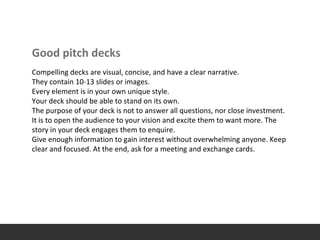
Good pitch decks
Compelling decks are visual, concise, and have a clear narrative.
They contain 10-13 slides or images.
Every element is in your own unique style.
Your deck should be able to stand on its own.
The purpose of your deck is not to answer all questions, nor close investment.
It is to open the audience to your vision and excite them to want more. The
story in your deck engages them to enquire.
Give enough information to gain interest without overwhelming anyone. Keep
clear and focused. At the end, ask for a meeting and exchange cards.
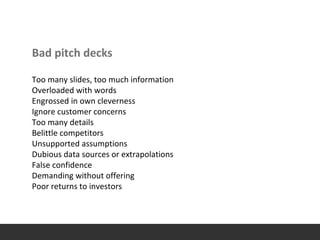
Bad pitch decks
Too many slides, too much information
Overloaded with words
Engrossed in own cleverness
Ignore customer concerns
Too many details
Belittle competitors
Unsupported assumptions
Dubious data sources or extrapolations
False confidence
Demanding without offering
Poor returns to investors
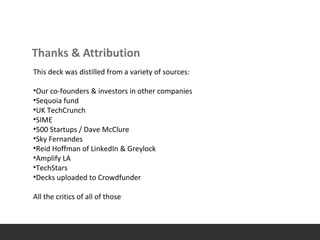
Thanks & Attribution
This deck was distilled from a variety of sources:
•Our co-founders & investors in other companies
•Sequoia fund
•UK TechCrunch
•SIME
•500 Startups / Dave McClure
•Sky Fernandes
•Reid Hoffman of LinkedIn & Greylock
•Amplify LA
•TechStars
•Decks uploaded to Crowdfunder
All the critics of all of those
This is a content guide, not a visual guide.
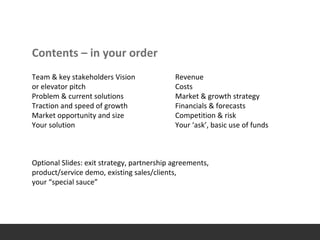
Contents – in your order
Team & key stakeholders Vision
or elevator pitch
Problem & current solutions
Traction and speed of growth
Market opportunity and size
Your solution
Optional Slides: exit strategy, partnership agreements,
product/service demo, existing sales/clients,
your “special sauce”
Revenue
Costs
Market & growth strategy
Financials & forecasts
Competition & risk
Your ‘ask’, basic use of funds
Team
Key team members, prior positions, successes, domain expertise
Past exits, past capital gains, past value created, PR value
Demonstrate current and relevant experience
Which roles are the keys to success in your company/space?
Vision or Elevator Pitch
A quick one-liner on the mission of your company
Keep it short and memorable
Try making it relatable, as in “We are X for Y”
“We are AirBNB for event spaces”
“We are the Starbucks of frozen yogurt”
While avoiding clichés and chasing bandwagons!
The Problem
Define the real problem/need you’re solving, and for whom.
Give a real example of the pain this causes, in hours or £
Describe a specific user case if you can
Say who is already doing this, and how are they going about it.
Compare what are they get right and wrong
Say what customers do if they can’t buy your answer
Current Sol ut i ons
Product / Service
Demo the product / service for real if you can
Tell the story of your customer
Show how customers use and value your product or service in their own words
Images and visuals are better than lots of text: show don’t tell
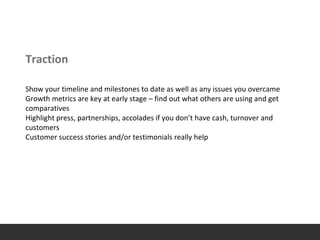
Traction
Show your timeline and milestones to date as well as any issues you overcame
Growth metrics are key at early stage – find out what others are using and get
comparatives
Highlight press, partnerships, accolades if you don’t have cash, turnover and
customers
Customer success stories and/or testimonials really help
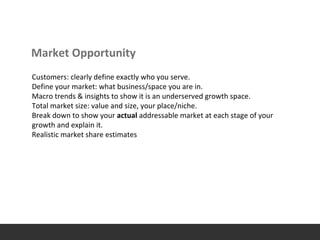
Market Opportunity
Customers: clearly define exactly who you serve.
Define your market: what business/space you are in.
Macro trends & insights to show it is an underserved growth space.
Total market size: value and size, your place/niche.
Break down to show your actual addressable market at each stage of your
growth and explain it.
Realistic market share estimates
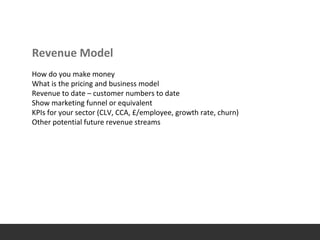
Revenue Model
How do you make money
What is the pricing and business model
Revenue to date – customer numbers to date
Show marketing funnel or equivalent
KPIs for your sector (CLV, CCA, £/employee, growth rate, churn)
Other potential future revenue streams
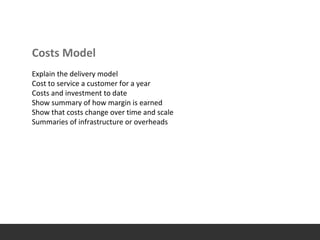
Costs Model
Explain the delivery model
Cost to service a customer for a year
Costs and investment to date
Show summary of how margin is earned
Show that costs change over time and scale
Summaries of infrastructure or overheads
Marketing & Growth Strategy
Where are your customers looking today and finding solutions?
Where will you get in attention?
How will you achieve your target growth rates?
What are the most important and unique channels and methods you will use
to find and win customers?
How are you doing it differently than others in the space? (or who is doing it
best that you can crib from?)
Financials & Forecasts
Include 3-ish years of summary financial projections
Explain critical assumptions in your model
Highlight each of these for at least 3 years:
•total customers
•total revenue
•growth rate
•total expense
•EBITDA
•gross assets
•free cash
Competition / Risk
Where do you exist in the larger overall market space?
Who are the competitors, why have they succeeded, and how do you
truly differentiate from them?
What are your advantages?
How is your place in the market unique to you, and the right one for
your company growth and customers?
What might kill your plans, and how can you avoid it?
Investment
What you have raised so far
Your existing & notable investors
The amount you want now, and how: equity, debt, convertible notes
Timing issues
Recent successes in this space
What were their multiples:
•At investment
•At exit
Use of proceeds
•Founder salaries
•New hires
•Sales & marketing
•Technology development
•Capital expenses / equipment

Investor pitch deck template for startups

  • 1.
    Investor Pitch Deck Showcaseyour opportunity to investors David JW Bailey www.linkedin.com/in/davidjwbailey
  • 2.
    Good pitch decks Compellingdecks are visual, concise, and have a clear narrative. They contain 10-13 slides or images. Every element is in your own unique style. Your deck should be able to stand on its own. The purpose of your deck is not to answer all questions, nor close investment. It is to open the audience to your vision and excite them to want more. The story in your deck engages them to enquire. Give enough information to gain interest without overwhelming anyone. Keep clear and focused. At the end, ask for a meeting and exchange cards.
  • 3.
    Bad pitch decks Toomany slides, too much information Overloaded with words Engrossed in own cleverness Ignore customer concerns Too many details Belittle competitors Unsupported assumptions Dubious data sources or extrapolations False confidence Demanding without offering Poor returns to investors
  • 4.
    Thanks & Attribution Thisdeck was distilled from a variety of sources: •Our co-founders & investors in other companies •Sequoia fund •UK TechCrunch •SIME •500 Startups / Dave McClure •Sky Fernandes •Reid Hoffman of LinkedIn & Greylock •Amplify LA •TechStars •Decks uploaded to Crowdfunder All the critics of all of those
  • 5.
    This is acontent guide, not a visual guide.
  • 6.
    Contents – inyour order Team & key stakeholders Vision or elevator pitch Problem & current solutions Traction and speed of growth Market opportunity and size Your solution Optional Slides: exit strategy, partnership agreements, product/service demo, existing sales/clients, your “special sauce” Revenue Costs Market & growth strategy Financials & forecasts Competition & risk Your ‘ask’, basic use of funds
  • 7.
    Team Key team members,prior positions, successes, domain expertise Past exits, past capital gains, past value created, PR value Demonstrate current and relevant experience Which roles are the keys to success in your company/space?
  • 8.
    Vision or ElevatorPitch A quick one-liner on the mission of your company Keep it short and memorable Try making it relatable, as in “We are X for Y” “We are AirBNB for event spaces” “We are the Starbucks of frozen yogurt” While avoiding clichés and chasing bandwagons!
  • 9.
    The Problem Define thereal problem/need you’re solving, and for whom. Give a real example of the pain this causes, in hours or £ Describe a specific user case if you can Say who is already doing this, and how are they going about it. Compare what are they get right and wrong Say what customers do if they can’t buy your answer Current Sol ut i ons
  • 10.
    Product / Service Demothe product / service for real if you can Tell the story of your customer Show how customers use and value your product or service in their own words Images and visuals are better than lots of text: show don’t tell
  • 11.
    Traction Show your timelineand milestones to date as well as any issues you overcame Growth metrics are key at early stage – find out what others are using and get comparatives Highlight press, partnerships, accolades if you don’t have cash, turnover and customers Customer success stories and/or testimonials really help
  • 12.
    Market Opportunity Customers: clearlydefine exactly who you serve. Define your market: what business/space you are in. Macro trends & insights to show it is an underserved growth space. Total market size: value and size, your place/niche. Break down to show your actual addressable market at each stage of your growth and explain it. Realistic market share estimates
  • 13.
    Revenue Model How doyou make money What is the pricing and business model Revenue to date – customer numbers to date Show marketing funnel or equivalent KPIs for your sector (CLV, CCA, £/employee, growth rate, churn) Other potential future revenue streams
  • 14.
    Costs Model Explain thedelivery model Cost to service a customer for a year Costs and investment to date Show summary of how margin is earned Show that costs change over time and scale Summaries of infrastructure or overheads
  • 15.
    Marketing & GrowthStrategy Where are your customers looking today and finding solutions? Where will you get in attention? How will you achieve your target growth rates? What are the most important and unique channels and methods you will use to find and win customers? How are you doing it differently than others in the space? (or who is doing it best that you can crib from?)
  • 16.
    Financials & Forecasts Include3-ish years of summary financial projections Explain critical assumptions in your model Highlight each of these for at least 3 years: •total customers •total revenue •growth rate •total expense •EBITDA •gross assets •free cash
  • 17.
    Competition / Risk Wheredo you exist in the larger overall market space? Who are the competitors, why have they succeeded, and how do you truly differentiate from them? What are your advantages? How is your place in the market unique to you, and the right one for your company growth and customers? What might kill your plans, and how can you avoid it?
  • 18.
    Investment What you haveraised so far Your existing & notable investors The amount you want now, and how: equity, debt, convertible notes Timing issues Recent successes in this space What were their multiples: •At investment •At exit Use of proceeds •Founder salaries •New hires •Sales & marketing •Technology development •Capital expenses / equipment