UNIT ECONOMICS © 2017 Rick Rasmussen
UNIT ECONOMICS
Fundamental building block of any
financial model
­Unit Revenue
­Unit Costs
­Fixed Costs (overhead)
MODULE OBJECTIVES
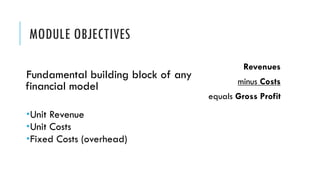
Revenues
minus Costs
equals Gross Profit
Fundamental building block of any
financial model
­Unit Revenue
­Unit Costs
­Fixed Costs (overhead)
MODULE OBJECTIVES
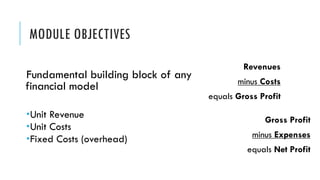
Gross Profit
minus Expenses
equals Net Profit
Revenues
minus Costs
equals Gross Profit
Fundamental building block of any
financial model
­Unit Revenue
­Unit Costs
­Fixed Costs (overhead)
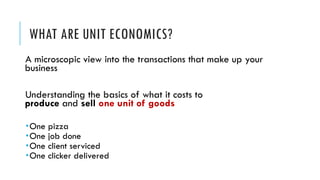
WHAT ARE UNIT ECONOMICS?
A microscopic view into the transactions that make up your
business
Understanding the basics of what it costs to
produce and sell one unit of goods
­One pizza
­One job done
­One client serviced
­One clicker delivered
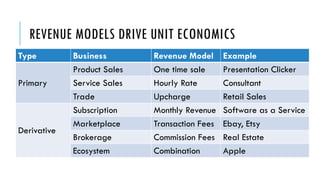
REVENUE MODELS DRIVE UNIT ECONOMICS
Type Business Revenue Model Example
Primary
Product Sales One time sale Presentation Clicker
Service Sales Hourly Rate Consultant
Trade Upcharge Retail Sales
Derivative
Subscription Monthly Revenue Software as a Service
Marketplace Transaction Fees Ebay, Etsy
Brokerage Commission Fees Real Estate
Ecosystem Combination Apple
Example: Product Sales
Behold the lowly clicker
Getting into the
Clicker business
What type of
business?
Existing?
Re-segmented?
New?
Getting into the
Clicker business
What’s the
TAM?
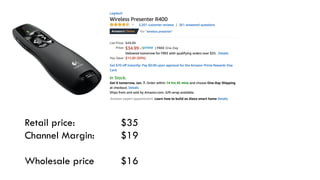
Retail price: $35
Channel Margin: $19
Wholesale price $16
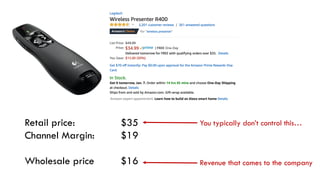
Retail price: $35
Channel Margin: $19
Wholesale price $16
You typically don’t control this…
Revenue that comes to the company
UNIT ECONOMICS
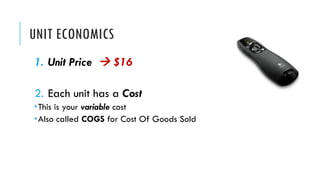
1. Unit Price à $16
2. Each unit has a Cost
­This is your variable cost
­Also called COGS for Cost Of Goods Sold
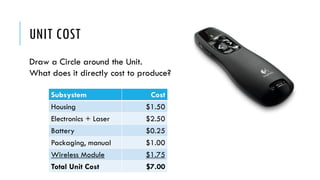
UNIT COST
Subsystem Cost
Housing $1.50
Electronics + Laser $2.50
Battery $0.25
Packaging, manual $1.00
Wireless Module $1.75
Total Unit Cost $7.00
Draw a Circle around the Unit.
What does it directly cost to produce?
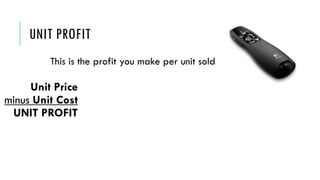
UNIT PROFIT
This is the profit you make per unit sold
Unit Price
minus Unit Cost
UNIT PROFIT
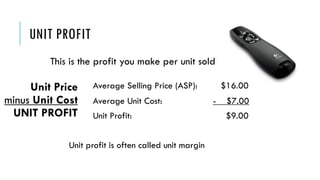
UNIT PROFIT
This is the profit you make per unit sold
Average Selling Price (ASP): $16.00
Average Unit Cost: - $7.00
Unit Profit: $9.00
Unit profit is often called unit margin
Unit Price
minus Unit Cost
UNIT PROFIT
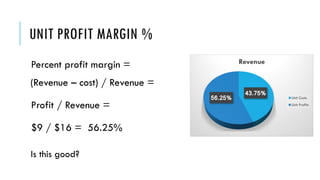
UNIT PROFIT MARGIN %
Percent profit margin =
(Revenue – cost) / Revenue =
Profit / Revenue =
$9 / $16 = 56.25%
Is this good?
43.75%
56.25%
Revenue
Unit Costs
Unit Profits
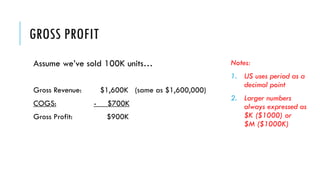
GROSS PROFIT
Assume we’ve sold 100K units…
Gross Revenue: $1,600K (same as $1,600,000)
COGS: - $700K
Gross Profit: $900K
Notes:
1. US uses period as a
decimal point
2. Larger numbers
always expressed as
$K ($1000) or
$M ($1000K)
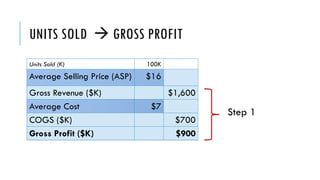
UNITS SOLD à GROSS PROFIT
Units Sold (K) 100K
Average Selling Price (ASP) $16
Gross Revenue ($K) $1,600
Average Cost $7
COGS ($K) $700
Gross Profit ($K) $900
Step 1
FIXED COSTS
Generally includes:
­Rent, Insurance and Utilities
­Salaries
­Marketing
­Other (Interest payments
All stay the same whether you sell one or 1M units
DO YOU HAVE FIXED COSTS?
If you have a physical building, you probably pay Rent,
Insurance, Utilities
If you have employees, you have Salary costs
If you promote, add Marketing and Sales as a primary
expense
* Exception to both would be large factories where Capital cost considerations
need to be added
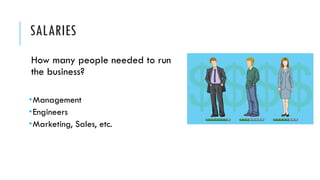
SALARIES
How many people needed to run
the business?
­Management
­Engineers
­Marketing, Sales, etc.
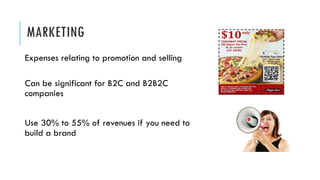
MARKETING
Expenses relating to promotion and selling
Can be significant for B2C and B2B2C
companies
Use 30% to 55% of revenues if you need to
build a brand
TOTAL FIXED COSTS
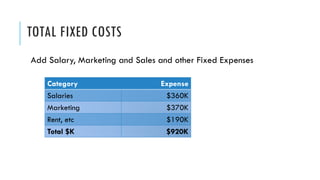
Add Salary, Marketing and Sales and other Fixed Expenses
Category Expense
Salaries $360K
Marketing $370K
Rent, etc $190K
Total $K $920K
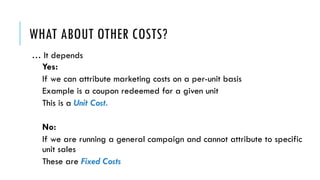
WHAT ABOUT OTHER COSTS?
… It depends
Yes:
If we can attribute marketing costs on a per-unit basis
Example is a coupon redeemed for a given unit
This is a Unit Cost.
No:
If we are running a general campaign and cannot attribute to specific
unit sales
These are Fixed Costs
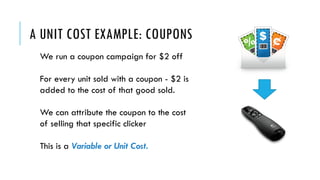
A UNIT COST EXAMPLE: COUPONS
We run a coupon campaign for $2 off
For every unit sold with a coupon - $2 is
added to the cost of that good sold.
We can attribute the coupon to the cost
of selling that specific clicker
This is a Variable or Unit Cost.
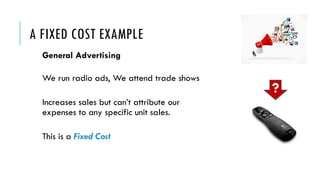
A FIXED COST EXAMPLE
General Advertising
We run radio ads, We attend trade shows
Increases sales but can’t attribute our
expenses to any specific unit sales.
This is a Fixed Cost
?
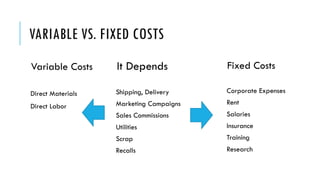
VARIABLE VS. FIXED COSTS
Variable Costs
Direct Materials
Direct Labor
Fixed Costs
Corporate Expenses
Rent
Salaries
Insurance
Training
Research
It Depends
Shipping, Delivery
Marketing Campaigns
Sales Commissions
Utilities
Scrap
Recalls
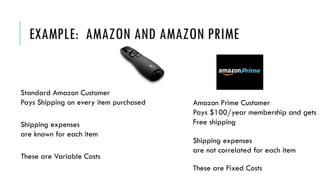
EXAMPLE: AMAZON AND AMAZON PRIME
Standard Amazon Customer
Pays Shipping on every item purchased
Shipping expenses
are known for each item
These are Variable Costs
These are Fixed Costs
Amazon Prime Customer
Pays $100/year membership and gets
Free shipping
Shipping expenses
are not correlated for each item
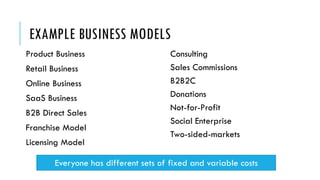
EXAMPLE BUSINESS MODELS
Product Business
Retail Business
Online Business
SaaS Business
B2B Direct Sales
Franchise Model
Licensing Model
Consulting
Sales Commissions
B2B2C
Donations
Not-for-Profit
Social Enterprise
Two-sided-markets
Everyone has different sets of fixed and variable costs
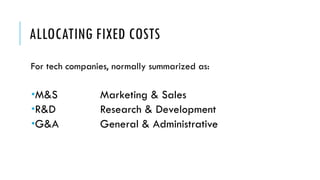
ALLOCATING FIXED COSTS
For tech companies, normally summarized as:
­M&S Marketing & Sales
­R&D Research & Development
­G&A General & Administrative
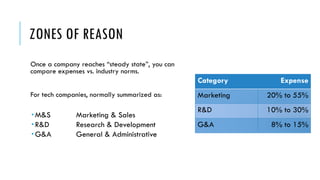
ZONES OF REASON
Once a company reaches “steady state”, you can
compare expenses vs. industry norms.
For tech companies, normally summarized as:
­ M&S Marketing & Sales
­ R&D Research & Development
­ G&A General & Administrative
Category Expense
Marketing 20% to 55%
R&D 10% to 30%
G&A 8% to 15%
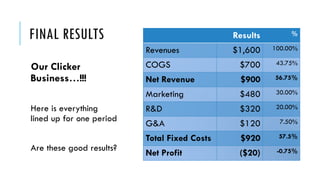
FINAL RESULTS
Our Clicker
Business…!!!
Here is everything
lined up for one period
Are these good results?
Results %
Revenues $1,600 100.00%
COGS $700 43.75%
Net Revenue $900 56.75%
Marketing $480 30.00%
R&D $320 20.00%
G&A $120 7.50%
Total Fixed Costs $920 57.5%
Net Profit ($20) -0.75%
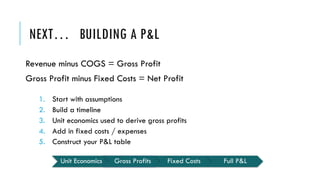
NEXT… BUILDING A P&L
Revenue minus COGS = Gross Profit
Gross Profit minus Fixed Costs = Net Profit
1. Start with assumptions
2. Build a timeline
3. Unit economics used to derive gross profits
4. Add in fixed costs / expenses
5. Construct your P&L table
Unit Economics Gross Profits Fixed Costs Full P&L

AIA2018 - Rick Rasmussen - Startup Financials

  • 1.
    UNIT ECONOMICS ©2017 Rick Rasmussen
  • 2.
    UNIT ECONOMICS Fundamental buildingblock of any financial model ­Unit Revenue ­Unit Costs ­Fixed Costs (overhead)
  • 3.
    MODULE OBJECTIVES Revenues minus Costs equalsGross Profit Fundamental building block of any financial model ­Unit Revenue ­Unit Costs ­Fixed Costs (overhead)
  • 4.
    MODULE OBJECTIVES Gross Profit minusExpenses equals Net Profit Revenues minus Costs equals Gross Profit Fundamental building block of any financial model ­Unit Revenue ­Unit Costs ­Fixed Costs (overhead)
  • 5.
    WHAT ARE UNITECONOMICS? A microscopic view into the transactions that make up your business Understanding the basics of what it costs to produce and sell one unit of goods ­One pizza ­One job done ­One client serviced ­One clicker delivered
  • 6.
    REVENUE MODELS DRIVEUNIT ECONOMICS Type Business Revenue Model Example Primary Product Sales One time sale Presentation Clicker Service Sales Hourly Rate Consultant Trade Upcharge Retail Sales Derivative Subscription Monthly Revenue Software as a Service Marketplace Transaction Fees Ebay, Etsy Brokerage Commission Fees Real Estate Ecosystem Combination Apple
  • 7.
  • 8.
    Getting into the Clickerbusiness What type of business? Existing? Re-segmented? New?
  • 9.
    Getting into the Clickerbusiness What’s the TAM?
  • 10.
    Retail price: $35 ChannelMargin: $19 Wholesale price $16
  • 11.
    Retail price: $35 ChannelMargin: $19 Wholesale price $16 You typically don’t control this… Revenue that comes to the company
  • 12.
    UNIT ECONOMICS 1. UnitPrice à $16 2. Each unit has a Cost ­This is your variable cost ­Also called COGS for Cost Of Goods Sold
  • 13.
    UNIT COST Subsystem Cost Housing$1.50 Electronics + Laser $2.50 Battery $0.25 Packaging, manual $1.00 Wireless Module $1.75 Total Unit Cost $7.00 Draw a Circle around the Unit. What does it directly cost to produce?
  • 14.
    UNIT PROFIT This isthe profit you make per unit sold Unit Price minus Unit Cost UNIT PROFIT
  • 15.
    UNIT PROFIT This isthe profit you make per unit sold Average Selling Price (ASP): $16.00 Average Unit Cost: - $7.00 Unit Profit: $9.00 Unit profit is often called unit margin Unit Price minus Unit Cost UNIT PROFIT
  • 16.
    UNIT PROFIT MARGIN% Percent profit margin = (Revenue – cost) / Revenue = Profit / Revenue = $9 / $16 = 56.25% Is this good? 43.75% 56.25% Revenue Unit Costs Unit Profits
  • 17.
    GROSS PROFIT Assume we’vesold 100K units… Gross Revenue: $1,600K (same as $1,600,000) COGS: - $700K Gross Profit: $900K Notes: 1. US uses period as a decimal point 2. Larger numbers always expressed as $K ($1000) or $M ($1000K)
  • 18.
    UNITS SOLD àGROSS PROFIT Units Sold (K) 100K Average Selling Price (ASP) $16 Gross Revenue ($K) $1,600 Average Cost $7 COGS ($K) $700 Gross Profit ($K) $900 Step 1
  • 20.
    FIXED COSTS Generally includes: ­Rent,Insurance and Utilities ­Salaries ­Marketing ­Other (Interest payments All stay the same whether you sell one or 1M units
  • 21.
    DO YOU HAVEFIXED COSTS? If you have a physical building, you probably pay Rent, Insurance, Utilities If you have employees, you have Salary costs If you promote, add Marketing and Sales as a primary expense * Exception to both would be large factories where Capital cost considerations need to be added
  • 22.
    SALARIES How many peopleneeded to run the business? ­Management ­Engineers ­Marketing, Sales, etc.
  • 23.
    MARKETING Expenses relating topromotion and selling Can be significant for B2C and B2B2C companies Use 30% to 55% of revenues if you need to build a brand
  • 24.
    TOTAL FIXED COSTS AddSalary, Marketing and Sales and other Fixed Expenses Category Expense Salaries $360K Marketing $370K Rent, etc $190K Total $K $920K
  • 25.
    WHAT ABOUT OTHERCOSTS? … It depends Yes: If we can attribute marketing costs on a per-unit basis Example is a coupon redeemed for a given unit This is a Unit Cost. No: If we are running a general campaign and cannot attribute to specific unit sales These are Fixed Costs
  • 26.
    A UNIT COSTEXAMPLE: COUPONS We run a coupon campaign for $2 off For every unit sold with a coupon - $2 is added to the cost of that good sold. We can attribute the coupon to the cost of selling that specific clicker This is a Variable or Unit Cost.
  • 27.
    A FIXED COSTEXAMPLE General Advertising We run radio ads, We attend trade shows Increases sales but can’t attribute our expenses to any specific unit sales. This is a Fixed Cost ?
  • 28.
    VARIABLE VS. FIXEDCOSTS Variable Costs Direct Materials Direct Labor Fixed Costs Corporate Expenses Rent Salaries Insurance Training Research It Depends Shipping, Delivery Marketing Campaigns Sales Commissions Utilities Scrap Recalls
  • 29.
    EXAMPLE: AMAZON ANDAMAZON PRIME Standard Amazon Customer Pays Shipping on every item purchased Shipping expenses are known for each item These are Variable Costs These are Fixed Costs Amazon Prime Customer Pays $100/year membership and gets Free shipping Shipping expenses are not correlated for each item
  • 30.
    EXAMPLE BUSINESS MODELS ProductBusiness Retail Business Online Business SaaS Business B2B Direct Sales Franchise Model Licensing Model Consulting Sales Commissions B2B2C Donations Not-for-Profit Social Enterprise Two-sided-markets Everyone has different sets of fixed and variable costs
  • 31.
    ALLOCATING FIXED COSTS Fortech companies, normally summarized as: ­M&S Marketing & Sales ­R&D Research & Development ­G&A General & Administrative
  • 32.
    ZONES OF REASON Oncea company reaches “steady state”, you can compare expenses vs. industry norms. For tech companies, normally summarized as: ­ M&S Marketing & Sales ­ R&D Research & Development ­ G&A General & Administrative Category Expense Marketing 20% to 55% R&D 10% to 30% G&A 8% to 15%
  • 33.
    FINAL RESULTS Our Clicker Business…!!! Hereis everything lined up for one period Are these good results? Results % Revenues $1,600 100.00% COGS $700 43.75% Net Revenue $900 56.75% Marketing $480 30.00% R&D $320 20.00% G&A $120 7.50% Total Fixed Costs $920 57.5% Net Profit ($20) -0.75%
  • 34.
    NEXT… BUILDING AP&L Revenue minus COGS = Gross Profit Gross Profit minus Fixed Costs = Net Profit 1. Start with assumptions 2. Build a timeline 3. Unit economics used to derive gross profits 4. Add in fixed costs / expenses 5. Construct your P&L table Unit Economics Gross Profits Fixed Costs Full P&L