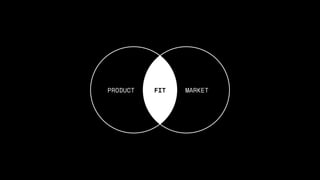








FIT
PRODUCT MARKET
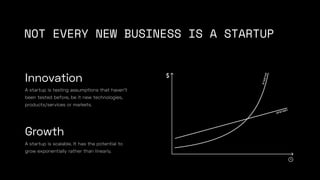
NOT EVERY NEW BUSINESS IS A STARTUP
A startup is scalable. It has the potential to
grow exponentially rather than linearly.
Growth
Innovation
A startup is testing assumptions that haven’t
been tested before, be it new technologies,
products/services or markets.
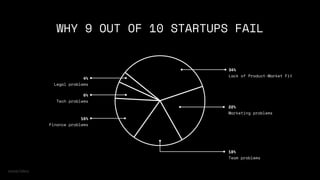
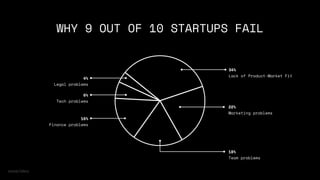
34%
Lack of Product-Market Fit
22%
Marketing problems
18%
Team problems
16%
Finance problems
6%
Tech problems
4%
Legal problems
WHY 9 OUT OF 10 STARTUPS FAIL
source Failory
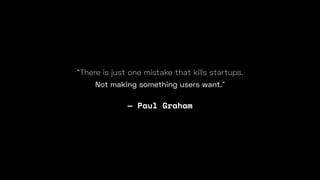
“There is just one mistake that kills startups.
Not making something users want.”
— Paul Graham
— Paul Graham
“If you wonder how someone crazy or incompetent can be the
CEO of a successful startup, the answer is that some startups
are so viral that they'll grow almost regardless of who's in charge.”
WORD-OF-MOUTH
“We knew we were on to something when our
friends who were using it were asking if they could
invite their friends, and those people invited their
friends, and those people invited their friends. We
put up a waiting list and it
fi
— Patrick Collison, co-founder Stripe
WORD-OF-MOUTH
“We had zero marketing budget and still grew
like weed. Word-of-mouth was uncontrollable.”
— Ryan Graves,
fi
rst CEO Uber
“Before, we were struggling for tra
ffi
— Marc Randolph, co-founder Net
fl
ix
MARKET PULL
MARKET PULL
“Before we had any sort of
fi
— Calvin French-Owen, co-founder Segment
USERS PULL OUT THEIR WALLETS
“We o
— Tom Preston-Werner, co-founder Github
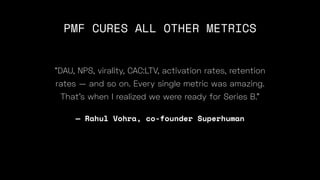
PMF CURES ALL OTHER METRICS
“DAU, NPS, virality, CAC:LTV, activation rates, retention
rates — and so on. Every single metric was amazing.
That’s when I realized we were ready for Series B.”
— Rahul Vohra, co-founder Superhuman
34%
Lack of Product-Market Fit
22%
Marketing problems
18%
Team problems
16%
Finance problems
6%
Tech problems
4%
Legal problems
WHY 9 OUT OF 10 STARTUPS FAIL
source Failory
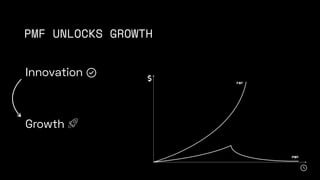
PMF UNLOCKS GROWTH
Growth
Innovation
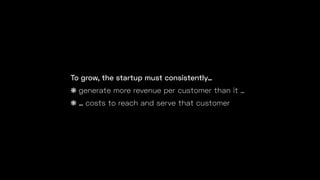
To grow, the startup must consistently…
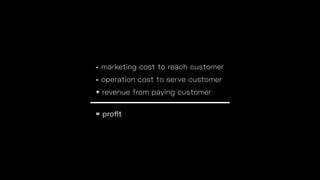
❋ generate more revenue per customer than it …
❋ … costs to reach and serve that customer
- marketing cost to reach customer
- operation cost to serve customer
+ revenue from paying customer
= pro
fi
t
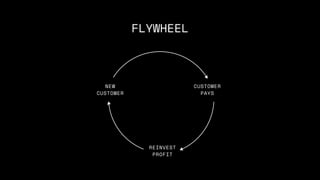
FLYWHEEL
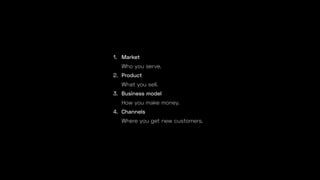
1. Market
Who you serve.
2. Product
What you sell.
3. Business model
How you make money.
4. Channels
Where you get new customers.
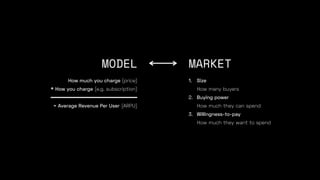
1. Size
How many buyers
2. Buying power
How much they can spend
3. Willingness-to-pay
How much they want to spend
How much you charge (price)
* How you charge (e.g. subscription)
= Average Revenue Per User (ARPU)
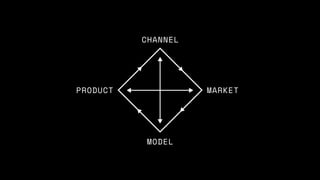
MODEL MARKET
source Christoph Janz
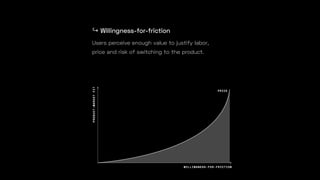
↪ Willingness-for-friction
Users perceive enough value to justify labor,
price and risk of switching to the product.
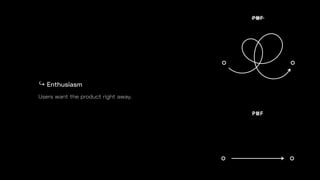
↪ Enthusiasm
Users want the product right away.
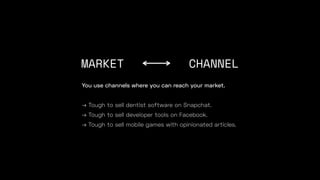
MARKET CHANNEL
You use channels where you can reach your market.
→ Tough to sell dentist software on Snapchat.
→ Tough to sell developer tools on Facebook.
→ Tough to sell mobile games with opinionated articles.
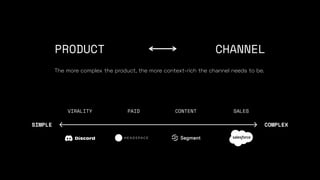
PRODUCT CHANNEL
The more complex the product, the more context-rich the channel needs to be.
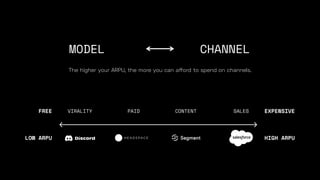
MODEL CHANNEL
The higher your ARPU, the more you can a
ff
ord to spend on channels.
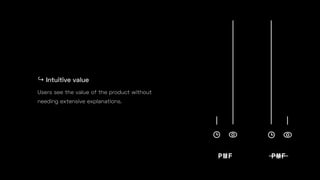
↪ Intuitive value
Users see the value of the product without
needing extensive explanations.
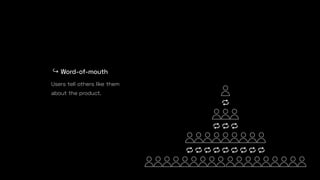
Users tell others like them
about the product.
↪ Word-of-mouth
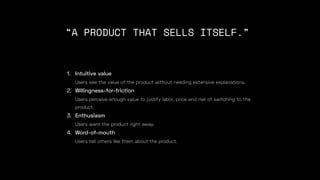
“A PRODUCT THAT SELLS ITSELF.”
1. Intuitive value
Users see the value of the product without needing extensive explanations.
2. Willingness-for-friction
Users perceive enough value to justify labor, price and risk of switching to the
product.
3. Enthusiasm
Users want the product right away.
4. Word-of-mouth
Users tell others like them about the product.
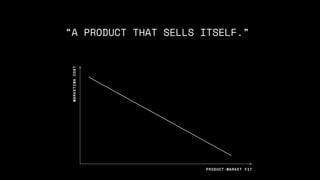
“A PRODUCT THAT SELLS ITSELF.”
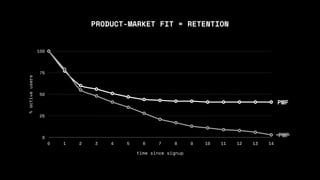
PRODUCT-MARKET FIT = RETENTION
%
active
users
0
25
50
75
100
time since signup
0 1 2 3 4 5 6 7 8 9 10 11 12 13 14
PMF
PMF
Who are the users that stay?
→ Why do they love the product?
→ Where can I
fi
nd more users like them?
Who are the users that leave?
→ What holds them back from loving the product?
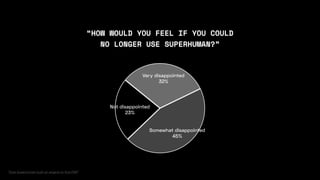
“HOW WOULD YOU FEEL IF YOU COULD
NO LONGER USE SUPERHUMAN?”
Not disappointed
23%
Somewhat disappointed
45%
Very disappointed
32%
“How Superhuman built an engine to
fi
SOMEWHAT DISAPPOINTED
NOT DISAPPOINTED
VERY DISAPPOINTED
Main value from Superhuman?
= Speed
Main value from Superhuman?
= Speed
Main value from Superhuman?
≠
SOMEWHAT DISAPPOINTED
VERY DISAPPOINTED
Main value from Superhuman?
=
Main value from Superhuman?
=
SOMEWHAT DISAPPOINTEDNOTSPEED
How can we improve Superman for you?
= Mobile app
NOT DISAPPOINTED
+
SPEED, FOCUS, SHORTCUTS MOBILE, INTEGRATIONS
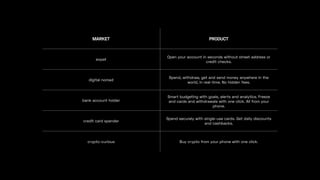
MARKET PRODUCT
expat
Open your account in seconds without street address or
credit checks.
digital nomad
Spend, withdraw, get and send money anywhere in the
world, in real-time. No hidden fees.
bank account holder
Smart budgeting with goals, alerts and analytics. Freeze
and cards and withdrawals with one click. All from your
phone.
credit card spender
Spend securely with single-use cards. Get daily discounts
and cashbacks.
crypto-curious Buy crypto from your phone with one click.
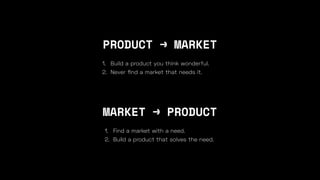
1. Build a product you think wonderful.
2. Never
fi
nd a market that needs it.
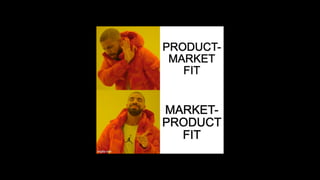
PRODUCT → MARKET
1. Find a market with a need.
2. Build a product that solves the need.
MARKET → PRODUCT
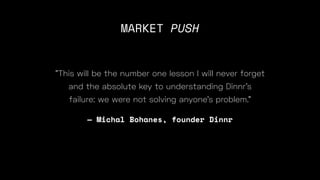
— Michal Bohanes, founder Dinnr
"This will be the number one lesson I will never forget
and the absolute key to understanding Dinnr’s
failure: we were not solving anyone’s problem."
MARKET PUSH
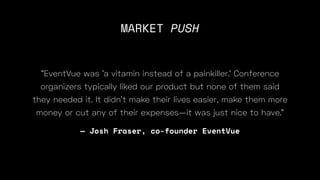
— Josh Fraser, co-founder EventVue
"EventVue was 'a vitamin instead of a painkiller.' Conference
organizers typically
MARKET PUSH
— Marc Andreessen, co-founder a16z
You can always feel when product/market
MARKET PUSH
And you can always feel product/market
ff
MARKET PULL
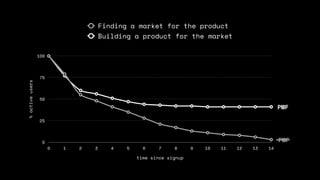
%
active
users
0
25
50
75
100
time since signup
0 1 2 3 4 5 6 7 8 9 10 11 12 13 14
Finding a market for the product
Building a product for the market
PMF
PMF
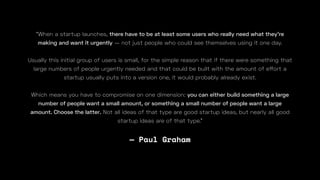
— Paul Graham
“When a startup launches, there have to be at least some users who really need what they're
making and want it urgently — not just people who could see themselves using it one day.
Usually this initial group of users is small, for the simple reason that if there were something that
large numbers of people urgently needed and that could be built with the amount of e
Which means you have to compromise on one dimension: you can either build something a large
number of people want a small amount, or something a small number of people want a large
amount. Choose the latter. Not all ideas of that type are good startup ideas, but nearly all good
startup ideas are of that type.”
Build for one,
build for many.
Build for many,
build for none.
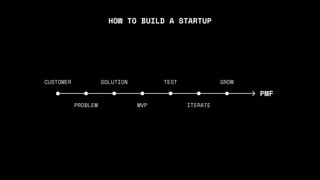
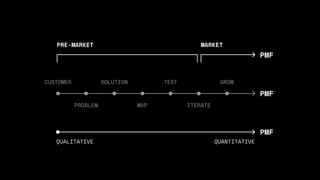
HOW TO BUILD A STARTUP
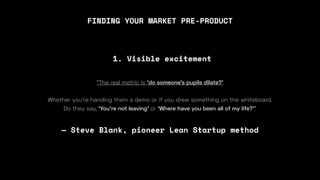
FINDING YOUR MARKET PRE-PRODUCT
“The real metric is ‘do someone’s pupils dilate?’
Whether you’re handing them a demo or if you drew something on the whiteboard.
Do they say, ‘You’re not leaving’ or ‘Where have you been all of my life?’”
— Steve Blank, pioneer Lean Startup method
1. Visible excitement
FINDING YOUR MARKET PRE-PRODUCT
“You have very strong customer feedback, even from a small group of people. For
example, at Color early on, we were
— Elad Gil, tech founder and investor
1. Visible excitement
FINDING YOUR MARKET PRE-PRODUCT
Are people willing to pay you for this product?
Ask them directly. Even try to get them to pay you now to get early access to the
product. There is no better PMF signal than a paying customer.
2. People are willing to pay (now)
1. Find at least 100 potential customers that are representative of the target audience.
2. Ask each to rank your idea or prototype out of 10 on how likely they are to put down a cash deposit for it.
3. Count the percentage of 9-10 respondents. That gets you an idea the market share you appeal to and
therefore how big your idea is,
4. Understand what makes the 9s-10s di
ff
erent from the others. What do they have in common that is
di
ff
erent from the others? Use that insight to
fi
nd more of those people.
↺ Rinse and repeat.
FINDING YOUR MARKET PRE-PRODUCT
If no 9s and 10s, focus on 7-8s and understand why they’re on the fence (i.e.
what keeps them from 9-10). Use that insight to refocus the idea.
❋ How are you currently solving this problem?
❋ What annoys you about your current approach?
❋ If you had a magic wand, how would you solve this problem?
❋ How much would you pay for this if it existed?
❋ Why is this a problem for you?
↺ Rinse and repeat.
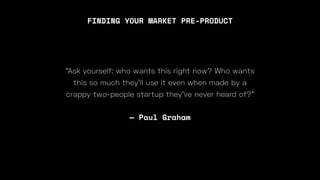
“Ask yourself: who wants this right now? Who wants
this so much they’ll use it even when made by a
crappy two-people startup they’ve never heard of?”
— Paul Graham
FINDING YOUR MARKET PRE-PRODUCT
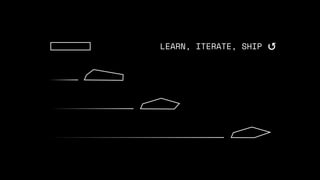
LEARN, ITERATE, SHIP ↺
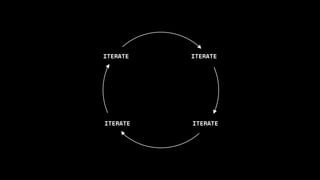
SOLVE THROUGH ITERATION
GET PAID THROUGH REPETITION
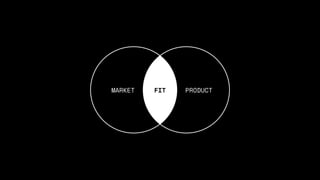
FIT
MARKET PRODUCT

PMF_EIA23 by Giles DC

  • 1.
  • 2.
    NOT EVERY NEWBUSINESS IS A STARTUP A startup is scalable. It has the potential to grow exponentially rather than linearly. Growth Innovation A startup is testing assumptions that haven’t been tested before, be it new technologies, products/services or markets.
  • 3.
    34% Lack of Product-MarketFit 22% Marketing problems 18% Team problems 16% Finance problems 6% Tech problems 4% Legal problems WHY 9 OUT OF 10 STARTUPS FAIL source Failory
  • 4.
    “There is justone mistake that kills startups. Not making something users want.” — Paul Graham
  • 5.
    — Paul Graham “Ifyou wonder how someone crazy or incompetent can be the CEO of a successful startup, the answer is that some startups are so viral that they'll grow almost regardless of who's in charge.”
  • 6.
    WORD-OF-MOUTH “We knew wewere on to something when our friends who were using it were asking if they could invite their friends, and those people invited their friends, and those people invited their friends. We put up a waiting list and it fi — Patrick Collison, co-founder Stripe
  • 7.
    WORD-OF-MOUTH “We had zeromarketing budget and still grew like weed. Word-of-mouth was uncontrollable.” — Ryan Graves, fi rst CEO Uber
  • 8.
    “Before, we werestruggling for tra ffi — Marc Randolph, co-founder Net fl ix MARKET PULL
  • 9.
    MARKET PULL “Before wehad any sort of fi — Calvin French-Owen, co-founder Segment
  • 10.
    USERS PULL OUTTHEIR WALLETS “We o — Tom Preston-Werner, co-founder Github
  • 11.
    PMF CURES ALLOTHER METRICS “DAU, NPS, virality, CAC:LTV, activation rates, retention rates — and so on. Every single metric was amazing. That’s when I realized we were ready for Series B.” — Rahul Vohra, co-founder Superhuman
  • 12.
    34% Lack of Product-MarketFit 22% Marketing problems 18% Team problems 16% Finance problems 6% Tech problems 4% Legal problems WHY 9 OUT OF 10 STARTUPS FAIL source Failory
  • 13.
  • 14.
    To grow, thestartup must consistently… ❋ generate more revenue per customer than it … ❋ … costs to reach and serve that customer
  • 15.
    - marketing costto reach customer - operation cost to serve customer + revenue from paying customer = pro fi t
  • 16.
  • 17.
    1. Market Who youserve. 2. Product What you sell. 3. Business model How you make money. 4. Channels Where you get new customers.
  • 19.
    1. Size How manybuyers 2. Buying power How much they can spend 3. Willingness-to-pay How much they want to spend How much you charge (price) * How you charge (e.g. subscription) = Average Revenue Per User (ARPU) MODEL MARKET
  • 20.
  • 21.
    ↪ Willingness-for-friction Users perceiveenough value to justify labor, price and risk of switching to the product.
  • 22.
    ↪ Enthusiasm Users wantthe product right away.
  • 23.
    MARKET CHANNEL You usechannels where you can reach your market. → Tough to sell dentist software on Snapchat. → Tough to sell developer tools on Facebook. → Tough to sell mobile games with opinionated articles.
  • 24.
    PRODUCT CHANNEL The morecomplex the product, the more context-rich the channel needs to be.
  • 25.
    MODEL CHANNEL The higheryour ARPU, the more you can a ff ord to spend on channels.
  • 26.
    ↪ Intuitive value Userssee the value of the product without needing extensive explanations.
  • 27.
    Users tell otherslike them about the product. ↪ Word-of-mouth
  • 28.
    “A PRODUCT THATSELLS ITSELF.” 1. Intuitive value Users see the value of the product without needing extensive explanations. 2. Willingness-for-friction Users perceive enough value to justify labor, price and risk of switching to the product. 3. Enthusiasm Users want the product right away. 4. Word-of-mouth Users tell others like them about the product.
  • 29.
    “A PRODUCT THATSELLS ITSELF.”
  • 30.
    PRODUCT-MARKET FIT =RETENTION % active users 0 25 50 75 100 time since signup 0 1 2 3 4 5 6 7 8 9 10 11 12 13 14 PMF PMF
  • 31.
    Who are theusers that stay? → Why do they love the product? → Where can I fi nd more users like them? Who are the users that leave? → What holds them back from loving the product?
  • 32.
    “HOW WOULD YOUFEEL IF YOU COULD NO LONGER USE SUPERHUMAN?” Not disappointed 23% Somewhat disappointed 45% Very disappointed 32% “How Superhuman built an engine to fi
  • 33.
    SOMEWHAT DISAPPOINTED NOT DISAPPOINTED VERYDISAPPOINTED Main value from Superhuman? = Speed Main value from Superhuman? = Speed Main value from Superhuman? ≠
  • 35.
    SOMEWHAT DISAPPOINTED VERY DISAPPOINTED Mainvalue from Superhuman? = Main value from Superhuman? = SOMEWHAT DISAPPOINTEDNOTSPEED How can we improve Superman for you? = Mobile app NOT DISAPPOINTED +
  • 37.
    SPEED, FOCUS, SHORTCUTSMOBILE, INTEGRATIONS
  • 38.
    MARKET PRODUCT expat Open youraccount in seconds without street address or credit checks. digital nomad Spend, withdraw, get and send money anywhere in the world, in real-time. No hidden fees. bank account holder Smart budgeting with goals, alerts and analytics. Freeze and cards and withdrawals with one click. All from your phone. credit card spender Spend securely with single-use cards. Get daily discounts and cashbacks. crypto-curious Buy crypto from your phone with one click.
  • 40.
    1. Build aproduct you think wonderful. 2. Never fi nd a market that needs it. PRODUCT → MARKET 1. Find a market with a need. 2. Build a product that solves the need. MARKET → PRODUCT
  • 41.
    — Michal Bohanes,founder Dinnr "This will be the number one lesson I will never forget and the absolute key to understanding Dinnr’s failure: we were not solving anyone’s problem." MARKET PUSH
  • 42.
    — Josh Fraser,co-founder EventVue "EventVue was 'a vitamin instead of a painkiller.' Conference organizers typically MARKET PUSH
  • 43.
    — Marc Andreessen,co-founder a16z You can always feel when product/market MARKET PUSH And you can always feel product/market ff MARKET PULL
  • 44.
    % active users 0 25 50 75 100 time since signup 01 2 3 4 5 6 7 8 9 10 11 12 13 14 Finding a market for the product Building a product for the market PMF PMF
  • 45.
    — Paul Graham “Whena startup launches, there have to be at least some users who really need what they're making and want it urgently — not just people who could see themselves using it one day. Usually this initial group of users is small, for the simple reason that if there were something that large numbers of people urgently needed and that could be built with the amount of e Which means you have to compromise on one dimension: you can either build something a large number of people want a small amount, or something a small number of people want a large amount. Choose the latter. Not all ideas of that type are good startup ideas, but nearly all good startup ideas are of that type.”
  • 46.
    Build for one, buildfor many. Build for many, build for none.
  • 48.
    HOW TO BUILDA STARTUP
  • 50.
    FINDING YOUR MARKETPRE-PRODUCT “The real metric is ‘do someone’s pupils dilate?’ Whether you’re handing them a demo or if you drew something on the whiteboard. Do they say, ‘You’re not leaving’ or ‘Where have you been all of my life?’” — Steve Blank, pioneer Lean Startup method 1. Visible excitement
  • 51.
    FINDING YOUR MARKETPRE-PRODUCT “You have very strong customer feedback, even from a small group of people. For example, at Color early on, we were — Elad Gil, tech founder and investor 1. Visible excitement
  • 52.
    FINDING YOUR MARKETPRE-PRODUCT Are people willing to pay you for this product? Ask them directly. Even try to get them to pay you now to get early access to the product. There is no better PMF signal than a paying customer. 2. People are willing to pay (now)
  • 53.
    1. Find atleast 100 potential customers that are representative of the target audience. 2. Ask each to rank your idea or prototype out of 10 on how likely they are to put down a cash deposit for it. 3. Count the percentage of 9-10 respondents. That gets you an idea the market share you appeal to and therefore how big your idea is, 4. Understand what makes the 9s-10s di ff erent from the others. What do they have in common that is di ff erent from the others? Use that insight to fi nd more of those people. ↺ Rinse and repeat. FINDING YOUR MARKET PRE-PRODUCT
  • 54.
    FINDING YOUR MARKETPRE-PRODUCT If no 9s and 10s, focus on 7-8s and understand why they’re on the fence (i.e. what keeps them from 9-10). Use that insight to refocus the idea. ❋ How are you currently solving this problem? ❋ What annoys you about your current approach? ❋ If you had a magic wand, how would you solve this problem? ❋ How much would you pay for this if it existed? ❋ Why is this a problem for you? ↺ Rinse and repeat.
  • 55.
    “Ask yourself: whowants this right now? Who wants this so much they’ll use it even when made by a crappy two-people startup they’ve never heard of?” — Paul Graham FINDING YOUR MARKET PRE-PRODUCT
  • 57.
  • 58.
    SOLVE THROUGH ITERATION GETPAID THROUGH REPETITION
  • 59.