GENERAL AWARENESS OF
API SPEC Q1 9th edition-Specification for Quality
Management System Requirements for Manufacturing Organizations for
the Petroleum and Natural Gas Industry
Publish date: 01 June 2013
Effective date: 01 June 2014
Prepared By: Kajol Bharti
Working as Management Representative
What Is Quality Management System
part of a management system with regard to quality
Management System
set of interrelated or interacting elements of an organization to establish
policies and objectives, and processes to achieve those objectives.
Simply we can say Quality Management System is a systematic set of
processes to achieve desired quality product.
The processes includes contract Review (Sales & Marketing), Design &
Development, Planning of Product Manufacturing, Purchasing, Production,
Maintenance, Quality Control, Storage, Assembly, Packing & Dispatch and
Human Resources etc.
All these processes are aligned in a systematic way so that the output of one
process can become the input of the other process.
QMS is based on PDCA Cycle, which can be briefly described as follows:
— Plan: establish the objectives of the system and its processes, and the
resources needed to deliver results in accordance with customers’
requirements and the organization’s policies, and identify and address risks
and opportunities;
— Do: implement what was planned;
— Check: monitor and (where applicable) measure processes and the
resulting products and services against policies, objectives, requirements and
planned activities, and report the results;
— Act: take actions to improve performance, as necessary.
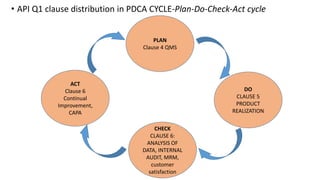
• API Q1 clause distribution in PDCA CYCLE-Plan-Do-Check-Act cycle
PLAN
Clause 4 QMS
ACT
Clause 6
Continual
Improvement,
CAPA
CHECK
CLAUSE 6:
ANALYSIS OF
DATA, INTERNAL
AUDIT, MRM,
customer
satisfaction
DO
CLAUSE 5
PRODUCT
REALIZATION
Clause
1 Scope : Defining Applicability / boundary of API Q1, and exclusion taken
This clause talks about the working boundaries of an organization as in the
work an organization is planning to do such as machining of parts, any job
work activity heat treatment & coating process etc., manufacturing of
products, design of items, supply of items, providing any services.
The exclusion in scope means leaving out any particular clause requirement
that is not being performed by an organization.
The clause in which exclusion can be taken as defined by API Q1 are
— 5.4, Design and Development;
— 5.7.1.2, Servicing;
— 5.7.1.5, Validation of Processes for Production and Servicing;
— 5.7.5, Customer-supplied Property;
— 5.8, Control of Testing, Measuring, and Monitoring Equipment.
For example:
1. If an organization is manufacturing a part as per the design provided by its
customer, that organization can exclude DESIGN & DEVELOPMENT clause of
API Q1, as it is not performing the design activity itself. In that case the
DESIGN & DEVELOPMENT clause will also be not audited by API.
2. An API instrument/ gauge trader can exclude “5.7.1.5 Validation of Processes
for Production and Servicing” as there are no processes which requires
validation.
3. A raw material trader can exclude Design & Development, Validation of
Processes for Production and Servicing and Customer-supplied Property.
Key point:
The organization needs to define and document its QMS scope and any exclusion
taken, and shall also document the reason for the exclusion they wish to take.
2 Normative References :
Documents / other Standards referred in standard which are mandatory to
follow.
API Q1 9th edition provides reference of ISO 9000:2005
3 Terms, Definitions, and Abbreviations:
Definitions of critical terms used in API Q1
PLAN
4 Quality Management System Requirements
4.1 Quality Management System :
1. Development of Quality Policy
Key Points:
 Shall be approved by Top Management
 shall include a commitment to comply with requirements
 shall include a commitment to continually improve the effectiveness of the quality management system.
 Shall be reviewed by Top management
 Shall be communicated within the organization and with interested parties as well
2. Development of Quality Objectives
Key Points:
 Shall be measurable (Quantifiable)
 Shall be consistent with Quality Policy
 Shall include objectives to meet customer and product requirements.
 Shall be approved by Top Management
3. Planning of implementation of QMS as per API Spec Q1,
Key Points:
Criteria and method required for the control of QMS
4. Internal / external communication
Internal communication
Key Points:
Shall communicate effectiveness of QMS
Shall communicate result of data analysis
Shall communicate importance of meeting customer, legal, and other applicable requirements
External communication
Key Points
Shall communicate with customer for execution of enquiries, contracts and amendments
Product information including non-conformities identified after delivery to customer
Customer complaint and customer feedback
When required by contract, QAP and any changes in it
4.2 Management Responsibility:
Key Points
Top management is responsible to provide resources to implement, maintain
and improve the QMS in form of
a. human resources and specialized skills,
b. organizational infrastructure,
c. financial resources, and
d. technology.
Top Management shall appoint an MR.
Management is responsible to determine objectives and KPI’s and
Management is responsible to conduct MRM.
Management is also responsible for defining roles & responsibilities of
employees
4.3 Organization Capability :
Required a documented procedure for defining personnel competency and
identifying training requirements
Key Points
Capability to provide resources,
human resource,
define personnel competency,
achieve competency through providing training and awareness.
Provide appropriate environment conditions for work such as building,
equipment, transport, communication, sitting arrangement, ventilation,
lighting
4.4 Documentation Requirements :
Required a documented procedure for control of documents including responsibility
for approval & re-approval of documents
Key Points
QMS shall have following documentation:
Quality Policy,
Quality Objective,
Quality Manual including scope and exclusion including justification for exclusion,
sequence and interaction of processes, process requiring validation and reference
to procedures.
Documented procedures,
other documents and records,
legal and other applicable requirements.
External origin documents
4.5 Control of Records :
Required Documented Procedure to define the control and responsibility
required for
Key Points
Legibility,
identification,
collection,
storage,
protection,
retrieval,
retention time, and
disposition of Records including records of outsourced processes
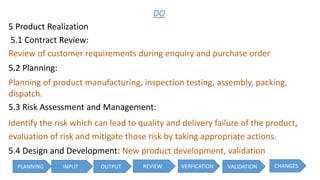
DO
5 Product Realization
5.1 Contract Review:
Review of customer requirements during enquiry and purchase order
5.2 Planning:
Planning of product manufacturing, inspection testing, assembly, packing,
dispatch.
5.3 Risk Assessment and Management:
Identify the risk which can lead to quality and delivery failure of the product,
evaluation of risk and mitigate those risk by taking appropriate actions.
5.4 Design and Development: New product development, validation
PLANNING INPUT OUTPUT REVIEW VERFICATION VALIDATION CHANGES
5.5 Contingency Planning:
Prepare backup plan for any risk which has high chances of occurring, so that if
that risk occurs in actual you can have a B plan to mitigate that risk.
5.6 Purchasing:
Purchase the required materials for product manufacturing, supplier shall be
evaluated to verify conformance with the requirements before making any
purchase.
5.7 Production and Servicing Provision:
Manufacturing of product, inspection and testing as per plan.
5.8 Control of Testing, Measuring, and Monitoring Equipment:
TMME calibration, handling and storage.
5.9 Product Release:
Release of product by authorized person after final verification of requirements.
5.10 Control of Nonconforming Product:
Identification, segregation, scrap, rework, deviation activities if any non-
conforming part is identified.
5.11 Management of Change (MOC):
Identify the changes in organization and manage them to ensure effective
implementation.
CHECK
6 Quality Management System Monitoring, Measurement, Analysis, and
Improvement
6.1 General
6.2 Monitoring, Measuring, and Improving:
Monitor and measure the customer satisfaction, quality objectives, perform
internal audits to check if QMS requirements are being implemented and
being followed.
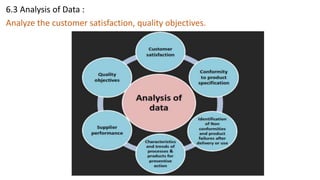
6.3 Analysis of Data :
Analyze the customer satisfaction, quality objectives.
ACT
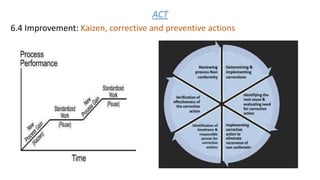
6.4 Improvement: Kaizen, corrective and preventive actions
6.5 Management Review:
Top Management shall perform MRM to review the QMS for effective
implementation and continuity
Annex A (informative) Use of API Monogram by Licensees:
Control of API monogram, who, when & how to apply and remove the
monogram

API Q1.pptx

  • 1.
    GENERAL AWARENESS OF APISPEC Q1 9th edition-Specification for Quality Management System Requirements for Manufacturing Organizations for the Petroleum and Natural Gas Industry Publish date: 01 June 2013 Effective date: 01 June 2014 Prepared By: Kajol Bharti Working as Management Representative
  • 2.
    What Is QualityManagement System part of a management system with regard to quality Management System set of interrelated or interacting elements of an organization to establish policies and objectives, and processes to achieve those objectives. Simply we can say Quality Management System is a systematic set of processes to achieve desired quality product. The processes includes contract Review (Sales & Marketing), Design & Development, Planning of Product Manufacturing, Purchasing, Production, Maintenance, Quality Control, Storage, Assembly, Packing & Dispatch and Human Resources etc. All these processes are aligned in a systematic way so that the output of one process can become the input of the other process.
  • 3.
    QMS is basedon PDCA Cycle, which can be briefly described as follows: — Plan: establish the objectives of the system and its processes, and the resources needed to deliver results in accordance with customers’ requirements and the organization’s policies, and identify and address risks and opportunities; — Do: implement what was planned; — Check: monitor and (where applicable) measure processes and the resulting products and services against policies, objectives, requirements and planned activities, and report the results; — Act: take actions to improve performance, as necessary.
  • 4.
    • API Q1clause distribution in PDCA CYCLE-Plan-Do-Check-Act cycle PLAN Clause 4 QMS ACT Clause 6 Continual Improvement, CAPA CHECK CLAUSE 6: ANALYSIS OF DATA, INTERNAL AUDIT, MRM, customer satisfaction DO CLAUSE 5 PRODUCT REALIZATION
  • 5.
    Clause 1 Scope :Defining Applicability / boundary of API Q1, and exclusion taken This clause talks about the working boundaries of an organization as in the work an organization is planning to do such as machining of parts, any job work activity heat treatment & coating process etc., manufacturing of products, design of items, supply of items, providing any services. The exclusion in scope means leaving out any particular clause requirement that is not being performed by an organization. The clause in which exclusion can be taken as defined by API Q1 are — 5.4, Design and Development; — 5.7.1.2, Servicing; — 5.7.1.5, Validation of Processes for Production and Servicing; — 5.7.5, Customer-supplied Property; — 5.8, Control of Testing, Measuring, and Monitoring Equipment.
  • 6.
    For example: 1. Ifan organization is manufacturing a part as per the design provided by its customer, that organization can exclude DESIGN & DEVELOPMENT clause of API Q1, as it is not performing the design activity itself. In that case the DESIGN & DEVELOPMENT clause will also be not audited by API. 2. An API instrument/ gauge trader can exclude “5.7.1.5 Validation of Processes for Production and Servicing” as there are no processes which requires validation. 3. A raw material trader can exclude Design & Development, Validation of Processes for Production and Servicing and Customer-supplied Property. Key point: The organization needs to define and document its QMS scope and any exclusion taken, and shall also document the reason for the exclusion they wish to take.
  • 7.
    2 Normative References: Documents / other Standards referred in standard which are mandatory to follow. API Q1 9th edition provides reference of ISO 9000:2005 3 Terms, Definitions, and Abbreviations: Definitions of critical terms used in API Q1
  • 8.
    PLAN 4 Quality ManagementSystem Requirements 4.1 Quality Management System : 1. Development of Quality Policy Key Points:  Shall be approved by Top Management  shall include a commitment to comply with requirements  shall include a commitment to continually improve the effectiveness of the quality management system.  Shall be reviewed by Top management  Shall be communicated within the organization and with interested parties as well 2. Development of Quality Objectives Key Points:  Shall be measurable (Quantifiable)  Shall be consistent with Quality Policy  Shall include objectives to meet customer and product requirements.  Shall be approved by Top Management
  • 9.
    3. Planning ofimplementation of QMS as per API Spec Q1, Key Points: Criteria and method required for the control of QMS 4. Internal / external communication Internal communication Key Points: Shall communicate effectiveness of QMS Shall communicate result of data analysis Shall communicate importance of meeting customer, legal, and other applicable requirements External communication Key Points Shall communicate with customer for execution of enquiries, contracts and amendments Product information including non-conformities identified after delivery to customer Customer complaint and customer feedback When required by contract, QAP and any changes in it
  • 10.
    4.2 Management Responsibility: KeyPoints Top management is responsible to provide resources to implement, maintain and improve the QMS in form of a. human resources and specialized skills, b. organizational infrastructure, c. financial resources, and d. technology. Top Management shall appoint an MR. Management is responsible to determine objectives and KPI’s and Management is responsible to conduct MRM. Management is also responsible for defining roles & responsibilities of employees
  • 11.
    4.3 Organization Capability: Required a documented procedure for defining personnel competency and identifying training requirements Key Points Capability to provide resources, human resource, define personnel competency, achieve competency through providing training and awareness. Provide appropriate environment conditions for work such as building, equipment, transport, communication, sitting arrangement, ventilation, lighting
  • 12.
    4.4 Documentation Requirements: Required a documented procedure for control of documents including responsibility for approval & re-approval of documents Key Points QMS shall have following documentation: Quality Policy, Quality Objective, Quality Manual including scope and exclusion including justification for exclusion, sequence and interaction of processes, process requiring validation and reference to procedures. Documented procedures, other documents and records, legal and other applicable requirements. External origin documents
  • 13.
    4.5 Control ofRecords : Required Documented Procedure to define the control and responsibility required for Key Points Legibility, identification, collection, storage, protection, retrieval, retention time, and disposition of Records including records of outsourced processes
  • 14.
    DO 5 Product Realization 5.1Contract Review: Review of customer requirements during enquiry and purchase order 5.2 Planning: Planning of product manufacturing, inspection testing, assembly, packing, dispatch. 5.3 Risk Assessment and Management: Identify the risk which can lead to quality and delivery failure of the product, evaluation of risk and mitigate those risk by taking appropriate actions. 5.4 Design and Development: New product development, validation PLANNING INPUT OUTPUT REVIEW VERFICATION VALIDATION CHANGES
  • 15.
    5.5 Contingency Planning: Preparebackup plan for any risk which has high chances of occurring, so that if that risk occurs in actual you can have a B plan to mitigate that risk. 5.6 Purchasing: Purchase the required materials for product manufacturing, supplier shall be evaluated to verify conformance with the requirements before making any purchase. 5.7 Production and Servicing Provision: Manufacturing of product, inspection and testing as per plan. 5.8 Control of Testing, Measuring, and Monitoring Equipment: TMME calibration, handling and storage. 5.9 Product Release: Release of product by authorized person after final verification of requirements.
  • 16.
    5.10 Control ofNonconforming Product: Identification, segregation, scrap, rework, deviation activities if any non- conforming part is identified. 5.11 Management of Change (MOC): Identify the changes in organization and manage them to ensure effective implementation.
  • 17.
    CHECK 6 Quality ManagementSystem Monitoring, Measurement, Analysis, and Improvement 6.1 General 6.2 Monitoring, Measuring, and Improving: Monitor and measure the customer satisfaction, quality objectives, perform internal audits to check if QMS requirements are being implemented and being followed.
  • 18.
    6.3 Analysis ofData : Analyze the customer satisfaction, quality objectives.
  • 19.
    ACT 6.4 Improvement: Kaizen,corrective and preventive actions
  • 20.
    6.5 Management Review: TopManagement shall perform MRM to review the QMS for effective implementation and continuity Annex A (informative) Use of API Monogram by Licensees: Control of API monogram, who, when & how to apply and remove the monogram