dinar.indra|qms|shafco 
interpretation of 
(for a beginner auditor)
dinar.indra@shafco.com 
dinar surtikarani 
click here for icon set
before we begin, lets agree on 
9common definitions 
based on ISO 9000:2008
productis defined as result of a process 
processis defined as set of interrelated or interacting activities which transforms inputs into outputs
quality 
defined as degree to which a set of inherent characteristics fulfils requirements 
requirement 
need or expectation that is stated, generally implied or obligatory 
customer satisfaction 
customer’s perceptionof the degree to which the customer’s requirements have been fulfilled
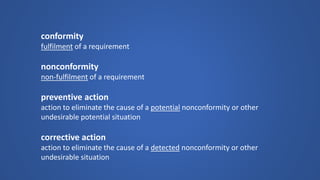
conformity 
fulfilmentof a requirement 
nonconformitynon-fulfilmentof a requirement 
preventive action 
action to eliminate the cause of a potentialnonconformity or other undesirable potential situation 
corrective action 
action to eliminate the cause of a detectednonconformity or other undesirable situation
DO 
WE 
HAVE 
TO? 
dinar.indra|qms|shafco
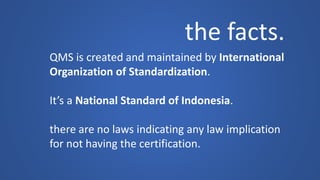
the facts. 
QMS is created and maintained by International 
Organization of Standardization. 
It’s a National Standard of Indonesia. 
there are no laws indicating any law implication 
for not having the certification.
the facts. 
BUT… 
ISO certified meansthe company operate in 
away to produce good quality, in a good price, 
with reliable delivery, and world class service
the opinion.
she got two 
business pitches 
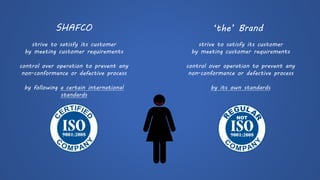
SHAFCO 
‘the’ Brand
strive to satisfy its customer 
by meeting customer requirements 
control over operation to prevent any 
non-conformance or defective process 
by following a certain international 
standards 
strive to satisfy its customer 
by meeting customer requirements 
control over operation to prevent any 
non-conformance or defective process 
by its own standards 
SHAFCO 
‘the’ Brand
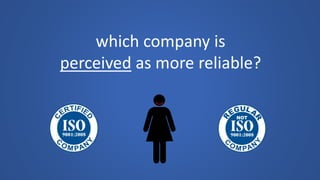
which company is 
perceivedas more reliable?
the opinion. 
WHICH COMPANY WILL SHE CHOOSE?
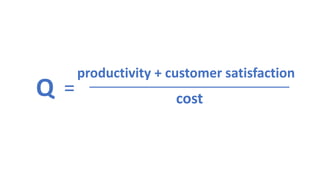
Q 
= 
cost 
productivity + customer satisfaction
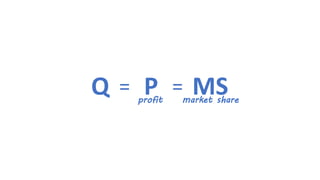
Q 
= 
P 
= 
MS 
profit 
market share
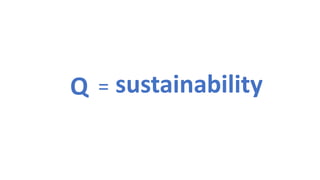
sustainability 
Q 
=
the benefit of a systemic process 
is to create consistency
who’d wants an occasionalsuccess? 
who’d wants an occasional 
world class products?
in order to sustain our business 
and win the market
we need our processes to consistently 
creating world class products
HOW TO 
IMPLEMENT 
ISO 9001 
photo by Mehmet Goren (mgoren) freeimages.com
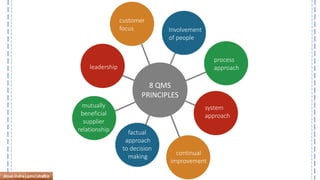
8 QMS 
PRINCIPLES 
customer 
focus 
Involvement 
of people 
process 
approach 
system 
approach 
continual 
improvement 
factual 
approach 
to decision 
making 
mutually 
beneficial 
supplier 
relationship 
leadership 
dinar.indra|qms|shafco
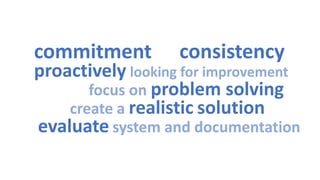
commitment 
consistency 
proactivelylooking for improvement 
focus on problem solving 
create a realisticsolution 
evaluatesystem and documentation
dinar.indra|qms|shafco 
inside 
ISO 9001
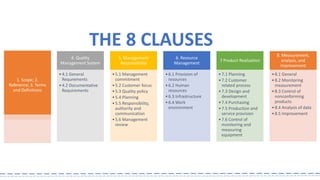
THE 8 CLAUSES 
1. Scope; 2. Reference; 3. Terms and Definitions 
4. Quality Management System 
•4.1 General Requrements 
•4.2 DocumentativeRequirements 
5. Management Responsibility 
•5.1 Management commitment 
•5.2 Customer focus 
•5.3 Quality policy 
•5.4 Planning 
•5.5 Responsibility, authority and communication 
•5.6 Management review 
6. Resource Management 
•6.1 Provision of resources 
•6.2 Human resources 
•6.3 Infrastructure 
•6.4 Work environment 
7 Product Realization 
•7.1 Planning 
•7.2 Customer related process 
•7.3 Design and development 
•7.4 Purchasing 
•7.5 Production and service provision 
•7.6 Control of monitoring and measuring equipment 
8. Measurement, analysis, and improvement 
•8.1 General 
•8.2 Monitoring measurement 
•8.3 Control of nonconforming products 
•8.4 Analysis of data 
•8.5 Improvement
oops, 
did I just give you 
headache?
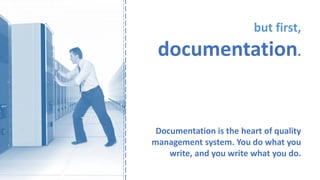
but first, 
documentation. 
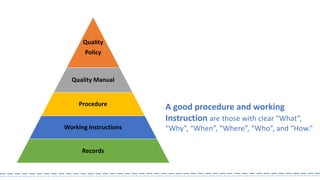
Documentation is the heart of quality management system. You do what you write, and you write what you do.
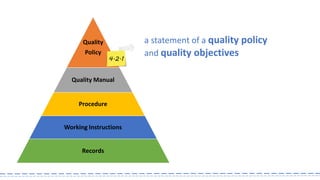
Quality 
Policy 
Quality Manual 
Procedure 
Working Instructions 
Records 
a statement of a quality policy 
and quality objectives 
4.2.1
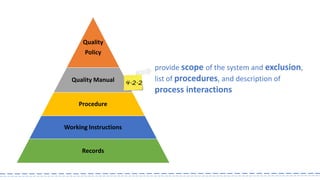
Quality 
Policy 
Quality Manual 
Procedure 
Working Instructions 
Records 
provide scopeof the system and exclusion, 
list of procedures, and description of 
processinteractions 
4.2.2
Quality 
Policy 
Quality Manual 
Procedure 
Working Instructions 
Records 
A good procedure and working 
Instruction are those with clear “What”, 
“Why”, “When”, “Where”, “Who”, and “How.”
Quality 
Policy 
Quality Manual 
Procedure 
Working Instructions 
Records 
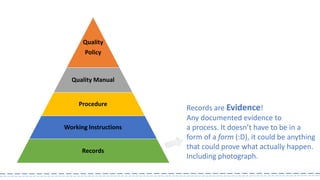
Records are Evidence! 
Any documented evidence to 
a process. It doesn’t have to be in a 
form of a form(:D), it could be anything 
that could prove what actually happen. 
Including photograph.
Quality 
Policy 
Quality Manual 
Procedure 
Working Instructions 
Records 
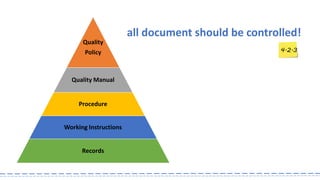
all document should be controlled! 
4.2.3
two of the most 
important principles are 
process approach and continual improvement
Continual improvementis a set of recurringactivities that an organization carries out in order to enhance its ability tomeet requirements. 
www.praxiom.com
ContinualImprovementscan be achieved bycarrying outaudits, self-assessments, managementreviews,and benchmarking projects 
www.praxiom.com
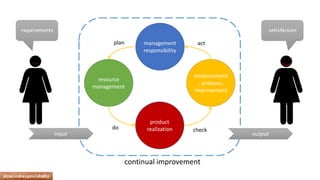
product 
realization 
measurement, analyses, improvement 
management responsibility 
resource 
management 
input 
output 
continual improvement 
dinar.indra|qms|shafco 
requirements 
satisfaction 
plan 
do 
check 
act
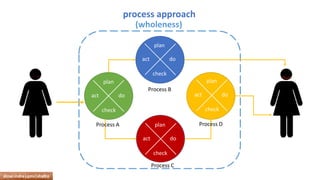
process approachis a management strategy. It means that they managethe processes that make up their organization, the interactionbetween these processes, and the inputs and outputs thattie these processes together. 
www.praxiom.com
plan 
act 
check 
do 
dinar.indra|qms|shafco 
plan 
act 
check 
do 
plan 
act 
check 
do 
plan 
act 
check 
do 
process approach 
Process A 
Process B 
Process C 
Process D 
(wholeness)
let’s simulate it
dinar.indra|qms|shafco 
requirements 
satisfaction 
plan 
RND 
purchasing 
warehouse 
production 
distribution 
human resource 
facility 
TQM 
equipment 
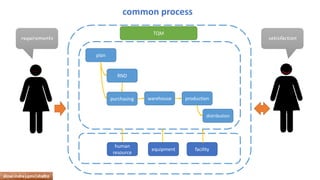
common process
dinar.indra|qms|shafco 
requirements 
satisfaction 
plan 
RND 
purchasing 
warehouse 
production 
distribution 
human resource 
facility 
TQM 
equipment 
7.2 
8.2.1 
7.6 
6.2 
7.5 
7.5.5 
7.4.3 
7.4.1 
7.4.2 
7.3 
5.2- 
5.4 
7.1 
6.3 
6.4 
4.1 
4.2 
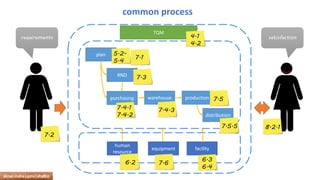
common process
as an internal auditor 
your first task is simple 
to memorize all the clauses
sadly, you will not rememberany of it 
(without exercise)
ONE 
search the document for 
mandatory procedures
HINT 
there are 6 of them
TWO 
search the document for 
mandatory records
HINT 
there are 21 of them
dinar.indra|qms|shafco 
interpretation of 
(for a beginner auditor, part 2)
dinar.indra@shafco.com 
dinar surtikarani 
click here for icon set
before we begin, lets agree on 
5common definitions 
based on ISO 19011:2011
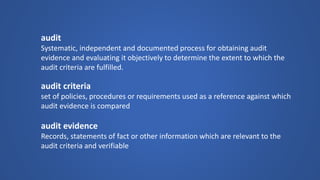
audit 
Systematic, independent and documented process for obtaining audit evidence and evaluating it objectively to determine the extent to which the audit criteria are fulfilled. 
audit criteria 
set of policies, procedures or requirements used as a reference against which audit evidence is compared 
audit evidence 
Records, statements of fact or other information which are relevant to the audit criteria and verifiable
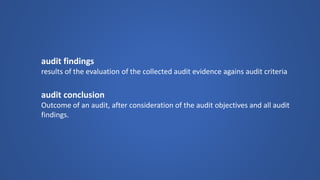
audit findings 
results of the evaluation of the collected audit evidence againsaudit criteria 
audit conclusion 
Outcome of an audit, after consideration of the audit objectives and all audit findings.
INTERNAL 
AUDIT 
101
INTERNAL 
AUDIT 
101 
8.2.2
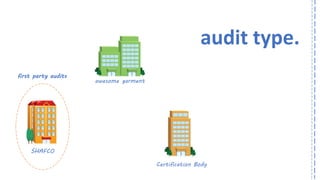
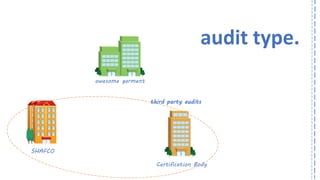
audit type. 
SHAFCO 
Certification Body 
first party audits 
awesome garment
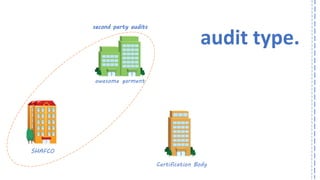
audit type. 
SHAFCO 
awesome garment 
Certification Body 
second party audits
audit type. 
SHAFCO 
Certification Body 
third party audits 
awesome garment
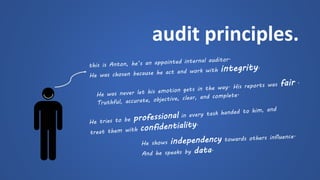
audit principles.
he’s single by the way. 
Anyone?
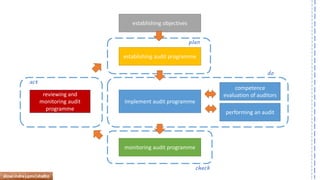
establishing objectives 
establishing audit programme 
Implement audit programme 
competence evaluation of auditors 
performing an audit 
monitoring audit programme 
reviewing and monitoring audit programme 
plan 
do 
check 
act 
dinar.indra|qms|shafco
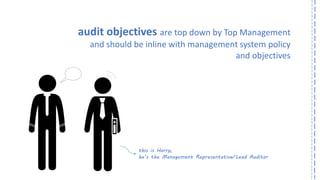
audit objectives are top down by Top Management 
and should be inline with management system policy 
and objectives 
this is Harry, 
he’s the Management Representative/Lead Auditor
planning is essential. 
Management Representative should plan programme 
duration, procedures, and all necessary resources. 
he/she should also evaluate any potential risk.
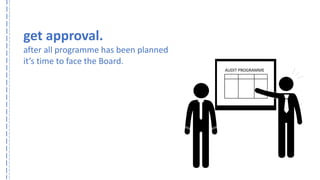
AUDIT PROGRAMME 
get approval. 
after all programmehas been planned 
it’s time to face the Board.
individual audit plan. 
a programmeconsist of several (if not much) 
individual audit activities. Each of these activities 
should also be well prepared. Every individual plan 
should not conflicts the programmeplan.
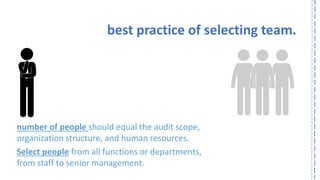
best practice of selecting team. 
number of people should equal the audit scope, 
organization structure, and human resources. 
Select peoplefrom all functions or departments, 
from staff to senior management.
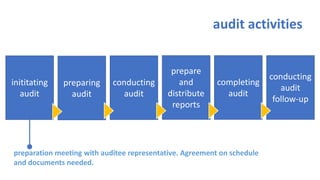
inititatingaudit 
preparing audit 
conducting audit 
prepare and distribute reports 
completing audit 
conducting audit follow-up 
audit activities 
preparation meetingwith auditeerepresentative. Agreement on schedule 
and documents needed.
inititatingaudit 
preparing audit 
conducting audit 
prepare and distribute reports 
completing audit 
conducting audit follow-up 
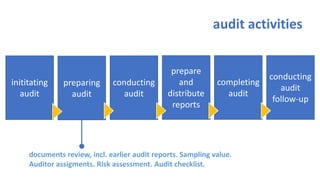
audit activities 
documents review, incl. earlier audit reports. Sampling value. 
Auditor assigments. Risk assessment. Audit checklist.
inititatingaudit 
preparing audit 
conducting audit 
prepare and distribute reports 
completing audit 
conducting audit follow-up 
audit activities 
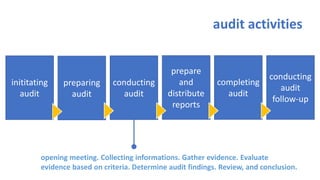
opening meeting. Collecting informations. Gather evidence. Evaluate evidence based on criteria. Determine audit findings. Review, and conclusion.
inititatingaudit 
preparing audit 
conducting audit 
prepare and distribute reports 
completing audit 
conducting audit follow-up 
audit activities 
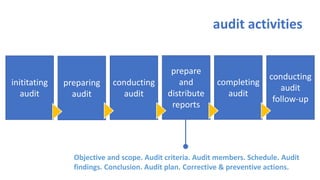
Objective and scope. Audit criteria. Audit members. Schedule. Audit findings. Conclusion. Audit plan. Corrective & preventive actions.
inititatingaudit 
preparing audit 
conducting audit 
prepare and distribute reports 
completing audit 
conducting audit follow-up 
audit activities 
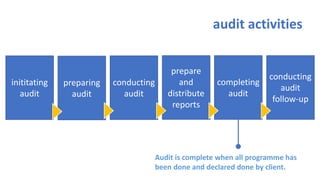
Audit is complete when all programmehas been done and declared done by client.
inititatingaudit 
preparing audit 
conducting audit 
prepare and distribute reports 
completing audit 
conducting audit follow-up 
audit activities 
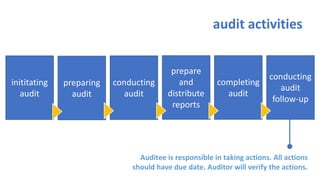
Auditeeis responsible in taking actions. All actions should have due date. Auditor will verify the actions.
Here’s some tips from Anton!
DO! 
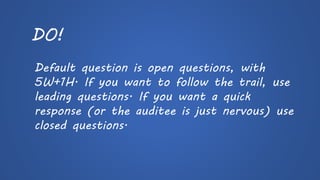
Default question is open questions, with 5W+1H. If you want to follow the trail, use leading questions. If you want a quick response (or the auditeeis just nervous) use closed questions.
DO! 
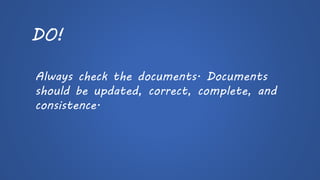
Always check the documents. Documents should be updated, correct, complete, and consistence.
DO! 
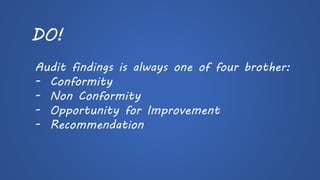
Audit findings is always one of four brother: 
-Conformity 
-Non Conformity 
-Opportunity for Improvement 
-Recommendation
DO! 
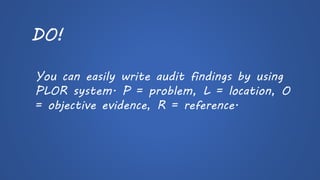
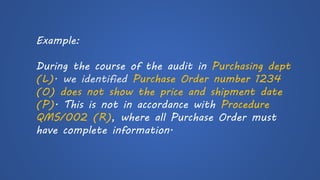
You can easily write audit findings by using PLOR system. P = problem, L = location, O = objective evidence, R = reference.
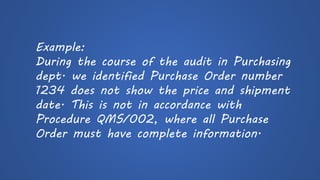
Example: 
During the course of the audit in Purchasing dept. we identified Purchase Order number 1234 does not show the price and shipment date. This is not in accordance with Procedure QMS/002, where all Purchase Order must have complete information.
Example: 
During the course of the audit in Purchasing dept(L). we identified Purchase Order number 1234 (O)does not show the price and shipment date (P). This is not in accordance with Procedure QMS/002 (R), where all Purchase Order must have complete information.
DON’Ts! 
Don’t loose track! Beware of bogged down. Don’t assume. Speak by data.
Beware of aggressive auditee, nervous auditee, missing people or documents during audits (:D). 
If sample is chosen by auditee, its fishy. 
If you are being bullied by auditee, it’s fishy.
dinar.indra@shafco.com 
dinar surtikarani 
click here for icon set 
References: 
Quality Management System ISO 9001:2008 Interpretation & Internal Audit Course, SGS Academy 
SNI ISO 9001:2008 
SNI ISO 9000:2008 
ISO 19011:2011(E) 
Pictures from all-free-download.com

Quality Management System ISO 9001 Interpretation and Internal Audit

  • 1.
  • 2.
  • 3.
    before we begin,lets agree on 9common definitions based on ISO 9000:2008
  • 4.
    productis defined asresult of a process processis defined as set of interrelated or interacting activities which transforms inputs into outputs
  • 5.
    quality defined asdegree to which a set of inherent characteristics fulfils requirements requirement need or expectation that is stated, generally implied or obligatory customer satisfaction customer’s perceptionof the degree to which the customer’s requirements have been fulfilled
  • 6.
    conformity fulfilmentof arequirement nonconformitynon-fulfilmentof a requirement preventive action action to eliminate the cause of a potentialnonconformity or other undesirable potential situation corrective action action to eliminate the cause of a detectednonconformity or other undesirable situation
  • 7.
    DO WE HAVE TO? dinar.indra|qms|shafco
  • 8.
    the facts. QMSis created and maintained by International Organization of Standardization. It’s a National Standard of Indonesia. there are no laws indicating any law implication for not having the certification.
  • 9.
    the facts. BUT… ISO certified meansthe company operate in away to produce good quality, in a good price, with reliable delivery, and world class service
  • 10.
  • 11.
    she got two business pitches SHAFCO ‘the’ Brand
  • 12.
    strive to satisfyits customer by meeting customer requirements control over operation to prevent any non-conformance or defective process by following a certain international standards strive to satisfy its customer by meeting customer requirements control over operation to prevent any non-conformance or defective process by its own standards SHAFCO ‘the’ Brand
  • 13.
    which company is perceivedas more reliable?
  • 14.
    the opinion. WHICHCOMPANY WILL SHE CHOOSE?
  • 15.
    Q = cost productivity + customer satisfaction
  • 16.
    Q = P = MS profit market share
  • 17.
  • 18.
    the benefit ofa systemic process is to create consistency
  • 19.
    who’d wants anoccasionalsuccess? who’d wants an occasional world class products?
  • 20.
    in order tosustain our business and win the market
  • 21.
    we need ourprocesses to consistently creating world class products
  • 22.
    HOW TO IMPLEMENT ISO 9001 photo by Mehmet Goren (mgoren) freeimages.com
  • 23.
    8 QMS PRINCIPLES customer focus Involvement of people process approach system approach continual improvement factual approach to decision making mutually beneficial supplier relationship leadership dinar.indra|qms|shafco
  • 24.
    commitment consistency proactivelylookingfor improvement focus on problem solving create a realisticsolution evaluatesystem and documentation
  • 25.
  • 26.
    THE 8 CLAUSES 1. Scope; 2. Reference; 3. Terms and Definitions 4. Quality Management System •4.1 General Requrements •4.2 DocumentativeRequirements 5. Management Responsibility •5.1 Management commitment •5.2 Customer focus •5.3 Quality policy •5.4 Planning •5.5 Responsibility, authority and communication •5.6 Management review 6. Resource Management •6.1 Provision of resources •6.2 Human resources •6.3 Infrastructure •6.4 Work environment 7 Product Realization •7.1 Planning •7.2 Customer related process •7.3 Design and development •7.4 Purchasing •7.5 Production and service provision •7.6 Control of monitoring and measuring equipment 8. Measurement, analysis, and improvement •8.1 General •8.2 Monitoring measurement •8.3 Control of nonconforming products •8.4 Analysis of data •8.5 Improvement
  • 28.
    oops, did Ijust give you headache?
  • 29.
    but first, documentation. Documentation is the heart of quality management system. You do what you write, and you write what you do.
  • 30.
    Quality Policy QualityManual Procedure Working Instructions Records a statement of a quality policy and quality objectives 4.2.1
  • 31.
    Quality Policy QualityManual Procedure Working Instructions Records provide scopeof the system and exclusion, list of procedures, and description of processinteractions 4.2.2
  • 32.
    Quality Policy QualityManual Procedure Working Instructions Records A good procedure and working Instruction are those with clear “What”, “Why”, “When”, “Where”, “Who”, and “How.”
  • 33.
    Quality Policy QualityManual Procedure Working Instructions Records Records are Evidence! Any documented evidence to a process. It doesn’t have to be in a form of a form(:D), it could be anything that could prove what actually happen. Including photograph.
  • 34.
    Quality Policy QualityManual Procedure Working Instructions Records all document should be controlled! 4.2.3
  • 35.
    two of themost important principles are process approach and continual improvement
  • 36.
    Continual improvementis aset of recurringactivities that an organization carries out in order to enhance its ability tomeet requirements. www.praxiom.com
  • 37.
    ContinualImprovementscan be achievedbycarrying outaudits, self-assessments, managementreviews,and benchmarking projects www.praxiom.com
  • 38.
    product realization measurement,analyses, improvement management responsibility resource management input output continual improvement dinar.indra|qms|shafco requirements satisfaction plan do check act
  • 39.
    process approachis amanagement strategy. It means that they managethe processes that make up their organization, the interactionbetween these processes, and the inputs and outputs thattie these processes together. www.praxiom.com
  • 40.
    plan act check do dinar.indra|qms|shafco plan act check do plan act check do plan act check do process approach Process A Process B Process C Process D (wholeness)
  • 41.
  • 42.
    dinar.indra|qms|shafco requirements satisfaction plan RND purchasing warehouse production distribution human resource facility TQM equipment common process
  • 43.
    dinar.indra|qms|shafco requirements satisfaction plan RND purchasing warehouse production distribution human resource facility TQM equipment 7.2 8.2.1 7.6 6.2 7.5 7.5.5 7.4.3 7.4.1 7.4.2 7.3 5.2- 5.4 7.1 6.3 6.4 4.1 4.2 common process
  • 44.
    as an internalauditor your first task is simple to memorize all the clauses
  • 45.
    sadly, you willnot rememberany of it (without exercise)
  • 46.
    ONE search thedocument for mandatory procedures
  • 47.
    HINT there are6 of them
  • 48.
    TWO search thedocument for mandatory records
  • 49.
    HINT there are21 of them
  • 51.
    dinar.indra|qms|shafco interpretation of (for a beginner auditor, part 2)
  • 52.
  • 53.
    before we begin,lets agree on 5common definitions based on ISO 19011:2011
  • 54.
    audit Systematic, independentand documented process for obtaining audit evidence and evaluating it objectively to determine the extent to which the audit criteria are fulfilled. audit criteria set of policies, procedures or requirements used as a reference against which audit evidence is compared audit evidence Records, statements of fact or other information which are relevant to the audit criteria and verifiable
  • 55.
    audit findings resultsof the evaluation of the collected audit evidence againsaudit criteria audit conclusion Outcome of an audit, after consideration of the audit objectives and all audit findings.
  • 56.
  • 57.
  • 58.
    audit type. SHAFCO Certification Body first party audits awesome garment
  • 59.
    audit type. SHAFCO awesome garment Certification Body second party audits
  • 60.
    audit type. SHAFCO Certification Body third party audits awesome garment
  • 61.
  • 62.
    he’s single bythe way. Anyone?
  • 64.
    establishing objectives establishingaudit programme Implement audit programme competence evaluation of auditors performing an audit monitoring audit programme reviewing and monitoring audit programme plan do check act dinar.indra|qms|shafco
  • 65.
    audit objectives aretop down by Top Management and should be inline with management system policy and objectives this is Harry, he’s the Management Representative/Lead Auditor
  • 66.
    planning is essential. Management Representative should plan programme duration, procedures, and all necessary resources. he/she should also evaluate any potential risk.
  • 67.
    AUDIT PROGRAMME getapproval. after all programmehas been planned it’s time to face the Board.
  • 68.
    individual audit plan. a programmeconsist of several (if not much) individual audit activities. Each of these activities should also be well prepared. Every individual plan should not conflicts the programmeplan.
  • 69.
    best practice ofselecting team. number of people should equal the audit scope, organization structure, and human resources. Select peoplefrom all functions or departments, from staff to senior management.
  • 71.
    inititatingaudit preparing audit conducting audit prepare and distribute reports completing audit conducting audit follow-up audit activities preparation meetingwith auditeerepresentative. Agreement on schedule and documents needed.
  • 72.
    inititatingaudit preparing audit conducting audit prepare and distribute reports completing audit conducting audit follow-up audit activities documents review, incl. earlier audit reports. Sampling value. Auditor assigments. Risk assessment. Audit checklist.
  • 73.
    inititatingaudit preparing audit conducting audit prepare and distribute reports completing audit conducting audit follow-up audit activities opening meeting. Collecting informations. Gather evidence. Evaluate evidence based on criteria. Determine audit findings. Review, and conclusion.
  • 74.
    inititatingaudit preparing audit conducting audit prepare and distribute reports completing audit conducting audit follow-up audit activities Objective and scope. Audit criteria. Audit members. Schedule. Audit findings. Conclusion. Audit plan. Corrective & preventive actions.
  • 75.
    inititatingaudit preparing audit conducting audit prepare and distribute reports completing audit conducting audit follow-up audit activities Audit is complete when all programmehas been done and declared done by client.
  • 76.
    inititatingaudit preparing audit conducting audit prepare and distribute reports completing audit conducting audit follow-up audit activities Auditeeis responsible in taking actions. All actions should have due date. Auditor will verify the actions.
  • 77.
    Here’s some tipsfrom Anton!
  • 78.
    DO! Default questionis open questions, with 5W+1H. If you want to follow the trail, use leading questions. If you want a quick response (or the auditeeis just nervous) use closed questions.
  • 79.
    DO! Always checkthe documents. Documents should be updated, correct, complete, and consistence.
  • 80.
    DO! Audit findingsis always one of four brother: -Conformity -Non Conformity -Opportunity for Improvement -Recommendation
  • 81.
    DO! You caneasily write audit findings by using PLOR system. P = problem, L = location, O = objective evidence, R = reference.
  • 82.
    Example: During thecourse of the audit in Purchasing dept. we identified Purchase Order number 1234 does not show the price and shipment date. This is not in accordance with Procedure QMS/002, where all Purchase Order must have complete information.
  • 83.
    Example: During thecourse of the audit in Purchasing dept(L). we identified Purchase Order number 1234 (O)does not show the price and shipment date (P). This is not in accordance with Procedure QMS/002 (R), where all Purchase Order must have complete information.
  • 84.
    DON’Ts! Don’t loosetrack! Beware of bogged down. Don’t assume. Speak by data.
  • 85.
    Beware of aggressiveauditee, nervous auditee, missing people or documents during audits (:D). If sample is chosen by auditee, its fishy. If you are being bullied by auditee, it’s fishy.
  • 86.
    dinar.indra@shafco.com dinar surtikarani click here for icon set References: Quality Management System ISO 9001:2008 Interpretation & Internal Audit Course, SGS Academy SNI ISO 9001:2008 SNI ISO 9000:2008 ISO 19011:2011(E) Pictures from all-free-download.com