ISO 9001:2008


      Awareness Program
Purpose of Program

 Awareness of ISO 9001:2008.
 Self Improvement
 Improvements in routine working
 To improve the health of organization’s
 Quality Management System
FAQ?

 What is ISO?
 From where it comes?
 How it is helpful for us?
 How it works?
 What we have to do?
Contents Of Program

 Background of ISO
 ISO Family
 Quality Management Principle
 Process Approach
 ISO 9001:2008 Overview
 Detail Of Different Clauses Of ISO
 9001:2008
What is ISO 9001:2008?

ISO = International Organization for
Standardization
ISO has representation from 162 countries
and has issued many standards
ISO 9001:2008 is a model for a quality
management system.
Who created the standard?

 International Organization for
 Standardization - Geneva
 Standards created in 1987
    To eliminate country to country differences
    To eliminate terminology confusion
    To increase quality awareness
ISO 9000:2005 Consists of 3 Areas

 ISO 9000:2005 Quality Management Systems:
 fundamentals and vocabulary
 ISO 9001:2008 Quality Management Systems –
 Requirements (required for certification)
     Management responsibility
     Resource management
     Product/service realization
     Measurement, analysis, improvement
 ISO 9004-2009 Quality Management Systems –
 Guidelines for performance improvement
Generic standards

ISO 9001 is a generic standards.
Generic means that the same standards can
  be applied:
  to any organization, large or small,
  whatever its product or service,
  in any sector of activity, and
  whether it is a business enterprise, a public
  administration, or a government department.
Generic standards (cont.)

Generic also signifies that
 no matter what the organization's scope of
 activity
 if it wants to establish a quality
 management system, ISO 9001 gives the
 essential features
Certification and registration

 Certification is known in some countries as
 registration.
 It means that an independent, external
 body has audited an organization's
 management system and verified that it
 conforms to the requirements specified in the
 standard (ISO 9001).
 ISO does not carry out certification and
 does not issue or approve certificates,
Accreditation

 Accreditation is like certification of the certification
 body.
 It means the formal approval by a specialized body -
 an accreditation body - that a certification body is
 competent to carry out ISO 9001:2008 certification in
 specified business sectors.
 Certificates issued by accredited certification bodies
 - and known as accredited certificates - may be
 perceived on the market as having increased
 credibility.
 ISO does not carry out or approve accreditation.
Certification not a requirement

 Certification is not a requirement of ISO
 9001.
 The organization can implement and take
 benefit from an ISO 9001 system without
 having it certified.
 The organization can implement them for the
 internal benefits without spending money
 on a certification programme.
Certification is a business
decision

 Certification is a decision to be taken for
 business reasons:
 if it is a contractual, regulatory, or market
 requirement,
 If it meets customer preferences
 if it will motivate staff by setting a clear goal.
Ten Steps to ISO Registration
                        10. Registration!

                     9. Final assessment by registrar

                   8. Take corrective actions

                7. Pre-assessment by registrar

              6. Submit quality manual for approval

           5. Perform self-analysis audit

         4. Select a third-party registrar and apply

       3. Develop and implement the quality system

    2. Select the appropriate standard

 1. Set the registration objective
What is a Quality Management
System?


 A Quality Management System is a
 web of interconnected processes
 that are used to manage a
 business.
Operating Cycle of ISO.

 The Plan – Do – Check – Act (PDCA) cycle is the
 operating principle of ISO's management system
 standards

 Plan – establish objectives and make plans (analyze your
 organization's situation, establish your overall objectives
 and set your interim targets, and develop plans to
 achieve them).
 Do – implement your plans (do what you planned to).
 Check – measure your results (measure/monitor how far
 your actual achievements meet your planned objectives).
 Act – correct and improve your plans and how you put
 them into practice (correct and learn from your mistakes
 to improve your plans in order to achieve better results
 next time).
ISO 9001:2008
                 CONTINUAL IMPROVEMENT OF THE QUALITY
                 CONTINUAL IMPROVEMENT OF THE QUALITY
                         MANAGEMENT SYSTEM
                          MANAGEMENT SYSTEM


                                          Management                                   Customers
                                          responsibility

Customers         Clause 6                  Clause 5
                                                              Measurement,
                    Resource
                    Resource                                   analysis and            Satisfaction
                   management
                   management                                 improvement

                                                                     Clause
                                                                     8

                                     Product                                  Output
               Input
Requirements                                                        Product
                                                                    Product
                                    realization

                                                   Clause 7

                         Value adding activities
                         Information flow
PROCESS REQUIREMENTS
    With What?                                     WHO?
(Materials / Equipment)   Objectives   Special Skills? / Competence?
                             and
                           Targets


                           Process
 Inputs                                                  Outputs


       How?                                        Measure
                            Process
(Methods / Procedure)      Linkages
Management Principles

 A Quality Management Principle is a
 comprehensive and fundamental rule or
 belief, for leading and operating an
 organization, aimed at continually improving
 performance over the long term by focusing
 on customers while addressing the needs of
 all stakeholders.
8 Management Principles

 Principle 1 : Customer Focus
 Principle 2 : Leadership
 Principle 3 : Involvement Of People
 Principle 4 : Process Approach
 Principle 5 : System approach to management
 Principle 6 : Continual Improvement
 Principle 7 : Factual approach to decision making
 Principle 8 : Mutually beneficial supplier
 relationships
Principle 1 : Customer Focus

   Organizations depend on their customers &
 therefore should understand current & future
 customer needs, should meet customer
 requirements & strive to exceed customer
 expectations
Principle 2 : Leadership

 Leaders establish unity & direction of the
 organization. They should create & maintain
 the internal environment in which people can
 become fully involved in achieving the
 organization's objectives.
Principle 3 : Involvement Of
People

 People at all levels are the essence of an
 organization and their full involvement
 enables their abilities to be utilized for the
 organization's mutual benefit.
Principle 4 : Process Approach

 The application of a system of processes within
 an organization, together with the identification
 and interaction of these processes, and their
 management to produce the desired outcome,
 can be called “Process Approach”
Principle 5 : System approach to
management

 Identifying, understanding & managing
 interrelated processes as a system
 contributes to the organization's
 effectiveness & efficiency in achieving its
 objectives.
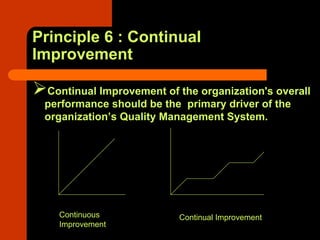
Principle 6 : Continual
Improvement

 Continual Improvement of the organization's overall
 performance should be the primary driver of the
 organization’s Quality Management System.


   Continuous             Continual Improvement
   Improvement
Principle 7 : Factual approach to
decision making

 Effective decisions are based on the analysis
 of data & information
Principle 8 : Mutually beneficial
supplier relationships

 An organization & its suppliers are
 interdependent, and a mutually beneficial
 relationship enhances the ability of both to
 create value
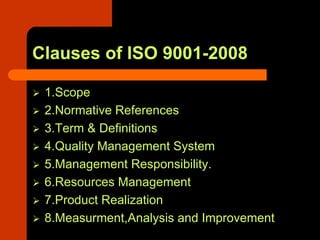
Clauses of ISO 9001-2008

 1.Scope
 2.Normative References
 3.Term & Definitions
 4.Quality Management System
 5.Management Responsibility.
 6.Resources Management
 7.Product Realization
 8.Measurment,Analysis and Improvement
SCOPE OF STANDARD

1. Scope
     General
     Application

2. Normative reference

3. Terms and definition
   e.g., Supplier Organization Customer
QUALITY MANAGEMENT SYSTEM
REQUIREMENTS

4.1 General requirements
      Document, implement, maintain and
      continually improve
      Identify and determine sequence and
      interaction of processes
      Determine criteria and methods needed
      Ensure availability of resources
      Monitor, measure and analyze processes
      Implement actions to achieve planned
      results
QUALITY MANAGEMENT SYSTEM
REQUIREMENTS

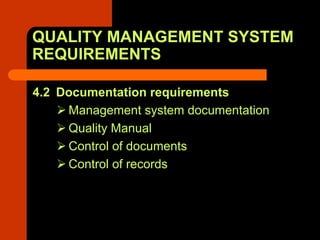
4.2 Documentation requirements
     Management system documentation
     Quality Manual
     Control of documents
     Control of records
QUALITY SYSTEM
DOCUMENTATION STRUCTURE
          1st Level             Policy and Objectives
      Quality Manual            What the company wishes to
                                achieve
          2nd Level
         Procedures                 How the company
                                    implements its policy
           3rd Level                Structured to reflect
      Work Instructions             process flow of events
   Machine instructions
   Computer inputs                        Detailed instructions
   Detailed work instructions             How to complete
                                          a job or task
            4th Level
         Technical Data
  International standards
  Computer operating manuals
  Detailed product specifications
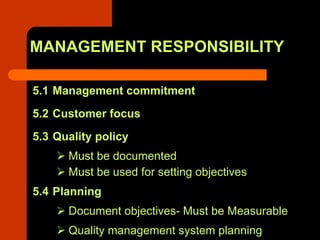
MANAGEMENT RESPONSIBILITY

5.1 Management commitment
5.2 Customer focus
5.3 Quality policy
      Must be documented
      Must be used for setting objectives
5.4 Planning
      Document objectives- Must be Measurable
      Quality management system planning
MANAGEMENT RESPONSIBILITY

5.5 Responsibility, authority and
   communication
    Responsibility and authority
    Management representative
    Internal communication
MANAGEMENT RESPONSIBILITY

5.6 Management Review
   General
   Review input
   Review output
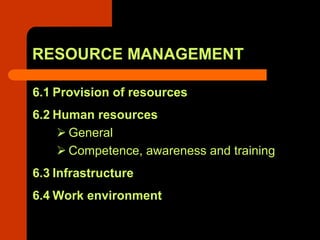
RESOURCE MANAGEMENT

6.1 Provision of resources
6.2 Human resources
      General
      Competence, awareness and training
6.3 Infrastructure
6.4 Work environment
PRODUCT REALIZATION


7.1 Planning of product
    realization
7.2 Customer-related processes
     Determination of requirements related to the
     product
     Review of requirements related to the product
     Customer communication
PRODUCT REALIZATION

7.3 Design and development
     Planning, inputs, outputs, systematic
     reviews, verification and validation, control
     of changes

7.4 Purchasing
     Supplier evaluation and selection
     Relevant purchasing information
     Verification of purchased product
     - receiving, source
PRODUCT REALIZATION

7.5 Production and service provision
    Controlled conditions including product
    characteristics, work instructions (as necessary),
    suitable equipment, monitoring and measuring
    devices, monitoring and measurement, and
    release, delivery and post- delivery activities
    Validation of processes when no other method
    Identification and traceability of product and it’s
    status
    Care of customer property
    Preservation of product
       Includes constituent parts
PRODUCT REALIZATION

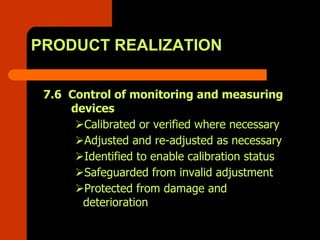
 7.6 Control of monitoring and measuring
     devices
       Calibrated or verified where necessary
       Adjusted and re-adjusted as necessary
       Identified to enable calibration status
       Safeguarded from invalid adjustment
       Protected from damage and
       deterioration
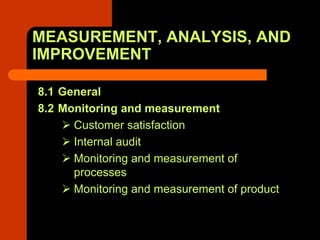
MEASUREMENT, ANALYSIS, AND
IMPROVEMENT

8.1 General
8.2 Monitoring and measurement
      Customer satisfaction
      Internal audit
      Monitoring and measurement of
      processes
      Monitoring and measurement of product
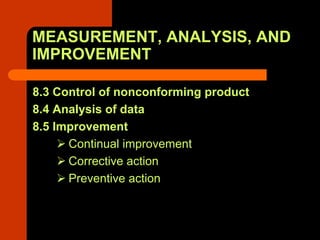
MEASUREMENT, ANALYSIS, AND
IMPROVEMENT

8.3 Control of nonconforming product
8.4 Analysis of data
8.5 Improvement
      Continual improvement
      Corrective action
      Preventive action
Any Questions or
Query?
Thanks
    Varinder Sandhu
    Abhived Bhardwaj
    Balram Sharma

Iso 9001 training

  • 1.
    ISO 9001:2008 Awareness Program
  • 2.
    Purpose of Program Awareness of ISO 9001:2008. Self Improvement Improvements in routine working To improve the health of organization’s Quality Management System
  • 3.
    FAQ? What isISO? From where it comes? How it is helpful for us? How it works? What we have to do?
  • 4.
    Contents Of Program Background of ISO ISO Family Quality Management Principle Process Approach ISO 9001:2008 Overview Detail Of Different Clauses Of ISO 9001:2008
  • 5.
    What is ISO9001:2008? ISO = International Organization for Standardization ISO has representation from 162 countries and has issued many standards ISO 9001:2008 is a model for a quality management system.
  • 6.
    Who created thestandard? International Organization for Standardization - Geneva Standards created in 1987 To eliminate country to country differences To eliminate terminology confusion To increase quality awareness
  • 7.
    ISO 9000:2005 Consistsof 3 Areas ISO 9000:2005 Quality Management Systems: fundamentals and vocabulary ISO 9001:2008 Quality Management Systems – Requirements (required for certification) Management responsibility Resource management Product/service realization Measurement, analysis, improvement ISO 9004-2009 Quality Management Systems – Guidelines for performance improvement
  • 8.
    Generic standards ISO 9001is a generic standards. Generic means that the same standards can be applied: to any organization, large or small, whatever its product or service, in any sector of activity, and whether it is a business enterprise, a public administration, or a government department.
  • 9.
    Generic standards (cont.) Genericalso signifies that no matter what the organization's scope of activity if it wants to establish a quality management system, ISO 9001 gives the essential features
  • 10.
    Certification and registration Certification is known in some countries as registration. It means that an independent, external body has audited an organization's management system and verified that it conforms to the requirements specified in the standard (ISO 9001). ISO does not carry out certification and does not issue or approve certificates,
  • 11.
    Accreditation Accreditation islike certification of the certification body. It means the formal approval by a specialized body - an accreditation body - that a certification body is competent to carry out ISO 9001:2008 certification in specified business sectors. Certificates issued by accredited certification bodies - and known as accredited certificates - may be perceived on the market as having increased credibility. ISO does not carry out or approve accreditation.
  • 12.
    Certification not arequirement Certification is not a requirement of ISO 9001. The organization can implement and take benefit from an ISO 9001 system without having it certified. The organization can implement them for the internal benefits without spending money on a certification programme.
  • 13.
    Certification is abusiness decision Certification is a decision to be taken for business reasons: if it is a contractual, regulatory, or market requirement, If it meets customer preferences if it will motivate staff by setting a clear goal.
  • 14.
    Ten Steps toISO Registration 10. Registration! 9. Final assessment by registrar 8. Take corrective actions 7. Pre-assessment by registrar 6. Submit quality manual for approval 5. Perform self-analysis audit 4. Select a third-party registrar and apply 3. Develop and implement the quality system 2. Select the appropriate standard 1. Set the registration objective
  • 15.
    What is aQuality Management System? A Quality Management System is a web of interconnected processes that are used to manage a business.
  • 16.
    Operating Cycle ofISO. The Plan – Do – Check – Act (PDCA) cycle is the operating principle of ISO's management system standards Plan – establish objectives and make plans (analyze your organization's situation, establish your overall objectives and set your interim targets, and develop plans to achieve them). Do – implement your plans (do what you planned to). Check – measure your results (measure/monitor how far your actual achievements meet your planned objectives). Act – correct and improve your plans and how you put them into practice (correct and learn from your mistakes to improve your plans in order to achieve better results next time).
  • 17.
    ISO 9001:2008 CONTINUAL IMPROVEMENT OF THE QUALITY CONTINUAL IMPROVEMENT OF THE QUALITY MANAGEMENT SYSTEM MANAGEMENT SYSTEM Management Customers responsibility Customers Clause 6 Clause 5 Measurement, Resource Resource analysis and Satisfaction management management improvement Clause 8 Product Output Input Requirements Product Product realization Clause 7 Value adding activities Information flow
  • 18.
    PROCESS REQUIREMENTS With What? WHO? (Materials / Equipment) Objectives Special Skills? / Competence? and Targets Process Inputs Outputs How? Measure Process (Methods / Procedure) Linkages
  • 19.
    Management Principles AQuality Management Principle is a comprehensive and fundamental rule or belief, for leading and operating an organization, aimed at continually improving performance over the long term by focusing on customers while addressing the needs of all stakeholders.
  • 20.
    8 Management Principles Principle 1 : Customer Focus Principle 2 : Leadership Principle 3 : Involvement Of People Principle 4 : Process Approach Principle 5 : System approach to management Principle 6 : Continual Improvement Principle 7 : Factual approach to decision making Principle 8 : Mutually beneficial supplier relationships
  • 21.
    Principle 1 :Customer Focus Organizations depend on their customers & therefore should understand current & future customer needs, should meet customer requirements & strive to exceed customer expectations
  • 22.
    Principle 2 :Leadership Leaders establish unity & direction of the organization. They should create & maintain the internal environment in which people can become fully involved in achieving the organization's objectives.
  • 23.
    Principle 3 :Involvement Of People People at all levels are the essence of an organization and their full involvement enables their abilities to be utilized for the organization's mutual benefit.
  • 24.
    Principle 4 :Process Approach The application of a system of processes within an organization, together with the identification and interaction of these processes, and their management to produce the desired outcome, can be called “Process Approach”
  • 25.
    Principle 5 :System approach to management Identifying, understanding & managing interrelated processes as a system contributes to the organization's effectiveness & efficiency in achieving its objectives.
  • 26.
    Principle 6 :Continual Improvement Continual Improvement of the organization's overall performance should be the primary driver of the organization’s Quality Management System. Continuous Continual Improvement Improvement
  • 27.
    Principle 7 :Factual approach to decision making Effective decisions are based on the analysis of data & information
  • 28.
    Principle 8 :Mutually beneficial supplier relationships An organization & its suppliers are interdependent, and a mutually beneficial relationship enhances the ability of both to create value
  • 29.
    Clauses of ISO9001-2008 1.Scope 2.Normative References 3.Term & Definitions 4.Quality Management System 5.Management Responsibility. 6.Resources Management 7.Product Realization 8.Measurment,Analysis and Improvement
  • 30.
    SCOPE OF STANDARD 1.Scope General Application 2. Normative reference 3. Terms and definition e.g., Supplier Organization Customer
  • 31.
    QUALITY MANAGEMENT SYSTEM REQUIREMENTS 4.1General requirements Document, implement, maintain and continually improve Identify and determine sequence and interaction of processes Determine criteria and methods needed Ensure availability of resources Monitor, measure and analyze processes Implement actions to achieve planned results
  • 32.
    QUALITY MANAGEMENT SYSTEM REQUIREMENTS 4.2Documentation requirements Management system documentation Quality Manual Control of documents Control of records
  • 33.
    QUALITY SYSTEM DOCUMENTATION STRUCTURE 1st Level Policy and Objectives Quality Manual What the company wishes to achieve 2nd Level Procedures How the company implements its policy 3rd Level Structured to reflect Work Instructions process flow of events Machine instructions Computer inputs Detailed instructions Detailed work instructions How to complete a job or task 4th Level Technical Data International standards Computer operating manuals Detailed product specifications
  • 34.
    MANAGEMENT RESPONSIBILITY 5.1 Managementcommitment 5.2 Customer focus 5.3 Quality policy Must be documented Must be used for setting objectives 5.4 Planning Document objectives- Must be Measurable Quality management system planning
  • 35.
    MANAGEMENT RESPONSIBILITY 5.5 Responsibility,authority and communication Responsibility and authority Management representative Internal communication
  • 36.
    MANAGEMENT RESPONSIBILITY 5.6 ManagementReview General Review input Review output
  • 37.
    RESOURCE MANAGEMENT 6.1 Provisionof resources 6.2 Human resources General Competence, awareness and training 6.3 Infrastructure 6.4 Work environment
  • 38.
    PRODUCT REALIZATION 7.1 Planningof product realization 7.2 Customer-related processes Determination of requirements related to the product Review of requirements related to the product Customer communication
  • 39.
    PRODUCT REALIZATION 7.3 Designand development Planning, inputs, outputs, systematic reviews, verification and validation, control of changes 7.4 Purchasing Supplier evaluation and selection Relevant purchasing information Verification of purchased product - receiving, source
  • 40.
    PRODUCT REALIZATION 7.5 Productionand service provision Controlled conditions including product characteristics, work instructions (as necessary), suitable equipment, monitoring and measuring devices, monitoring and measurement, and release, delivery and post- delivery activities Validation of processes when no other method Identification and traceability of product and it’s status Care of customer property Preservation of product Includes constituent parts
  • 41.
    PRODUCT REALIZATION 7.6Control of monitoring and measuring devices Calibrated or verified where necessary Adjusted and re-adjusted as necessary Identified to enable calibration status Safeguarded from invalid adjustment Protected from damage and deterioration
  • 42.
    MEASUREMENT, ANALYSIS, AND IMPROVEMENT 8.1General 8.2 Monitoring and measurement Customer satisfaction Internal audit Monitoring and measurement of processes Monitoring and measurement of product
  • 43.
    MEASUREMENT, ANALYSIS, AND IMPROVEMENT 8.3Control of nonconforming product 8.4 Analysis of data 8.5 Improvement Continual improvement Corrective action Preventive action
  • 44.
  • 45.
    Thanks Varinder Sandhu Abhived Bhardwaj Balram Sharma