©2013 DataStax Confidential. Do not distribute without consent.
@PatrickMcFadin
Patrick McFadin

Chief Evangelist for Apache Cassandra
Apache Cassandra and Spark
You got the lighter, let’s spark the fire
1
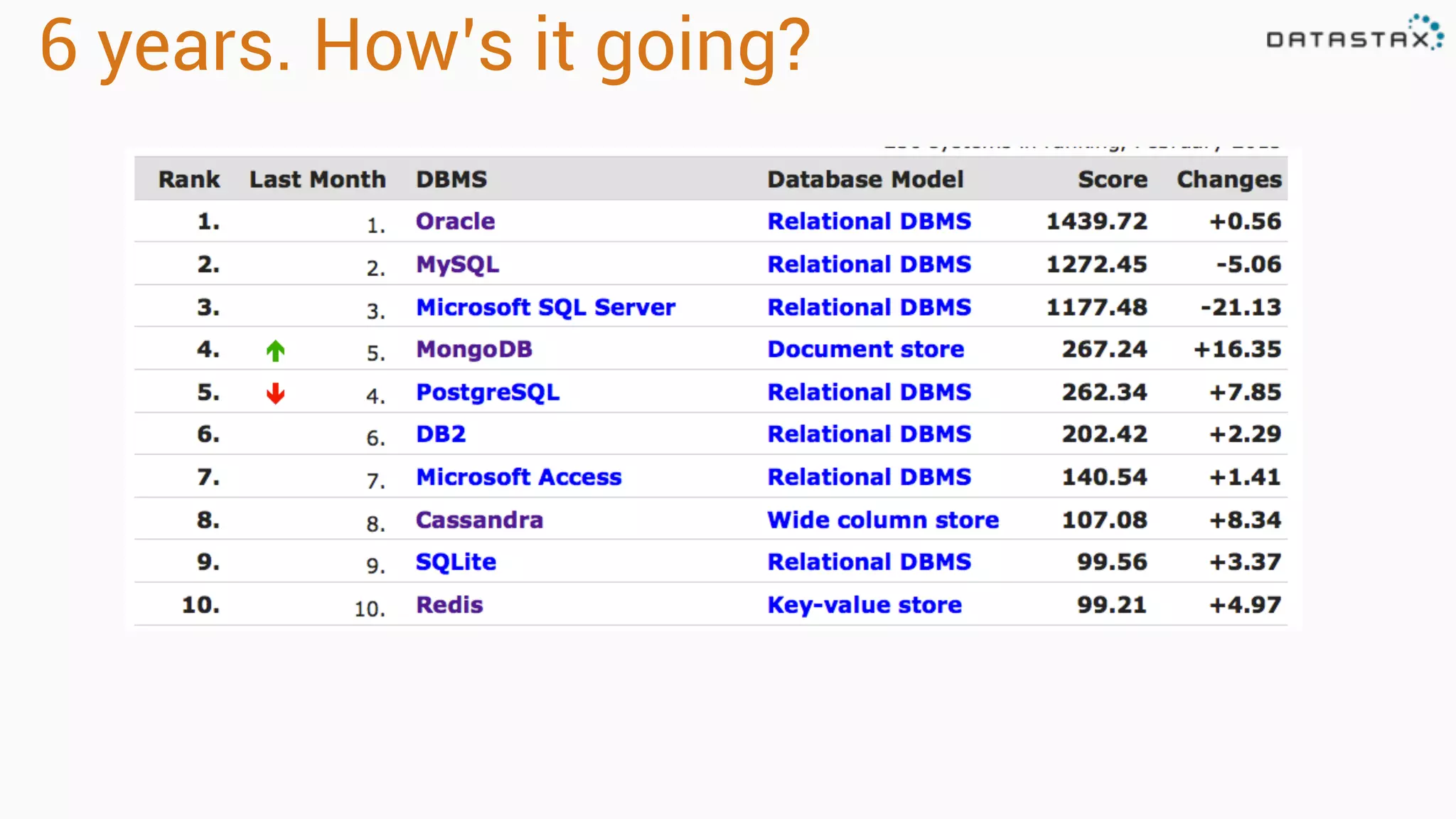
6 years. How’s it going?
Cassandra 3.0 & 3.1
Spring and Fall
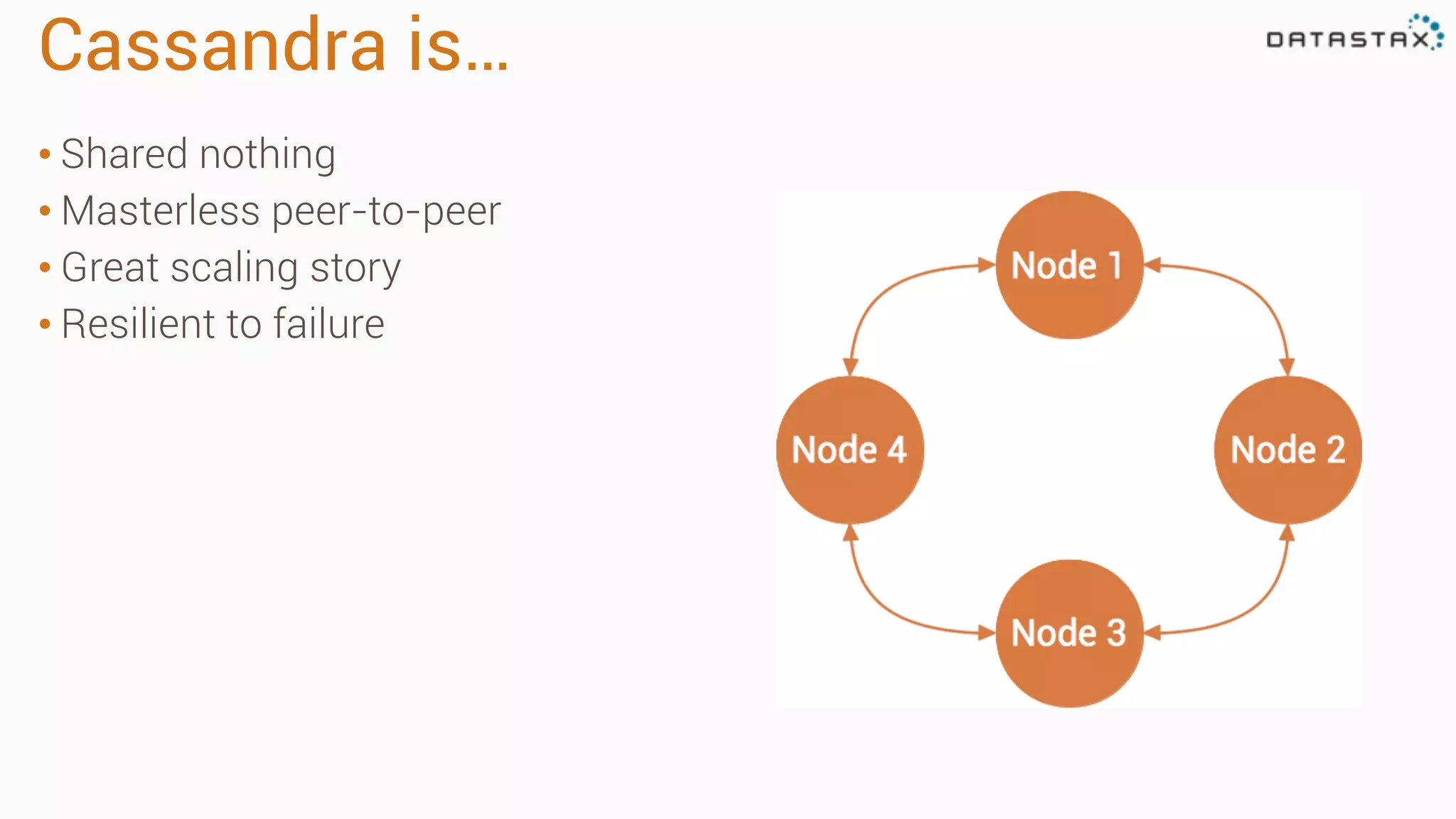
Cassandra is…
• Shared nothing
• Masterless peer-to-peer
• Great scaling story
• Resilient to failure
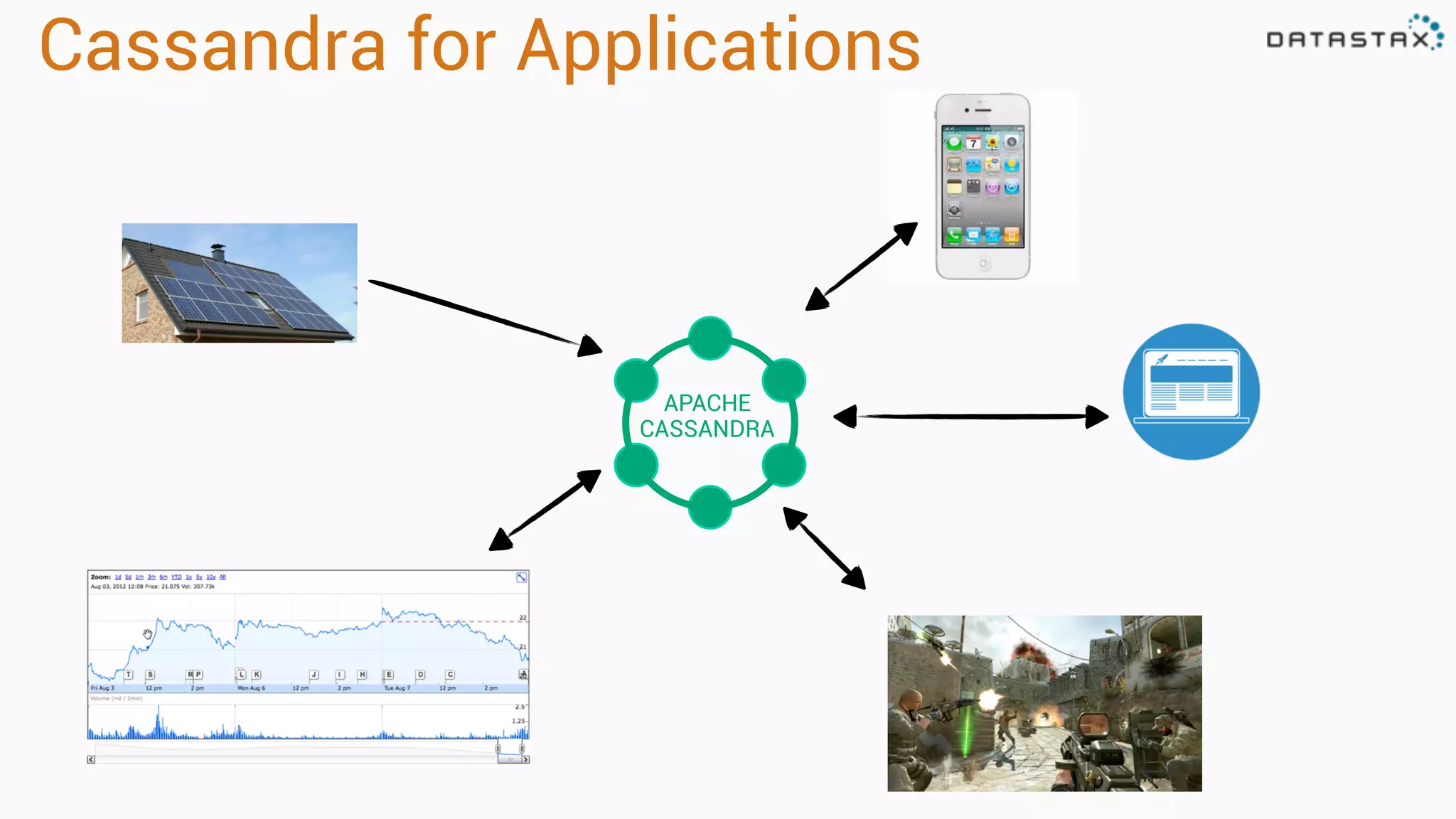
Cassandra for Applications
APACHE
CASSANDRA
A Data Ocean or Pond., Lake
An In-Memory Database
A Key-Value Store
A magical database unicorn that farts rainbows
Apache Spark
Apache Spark
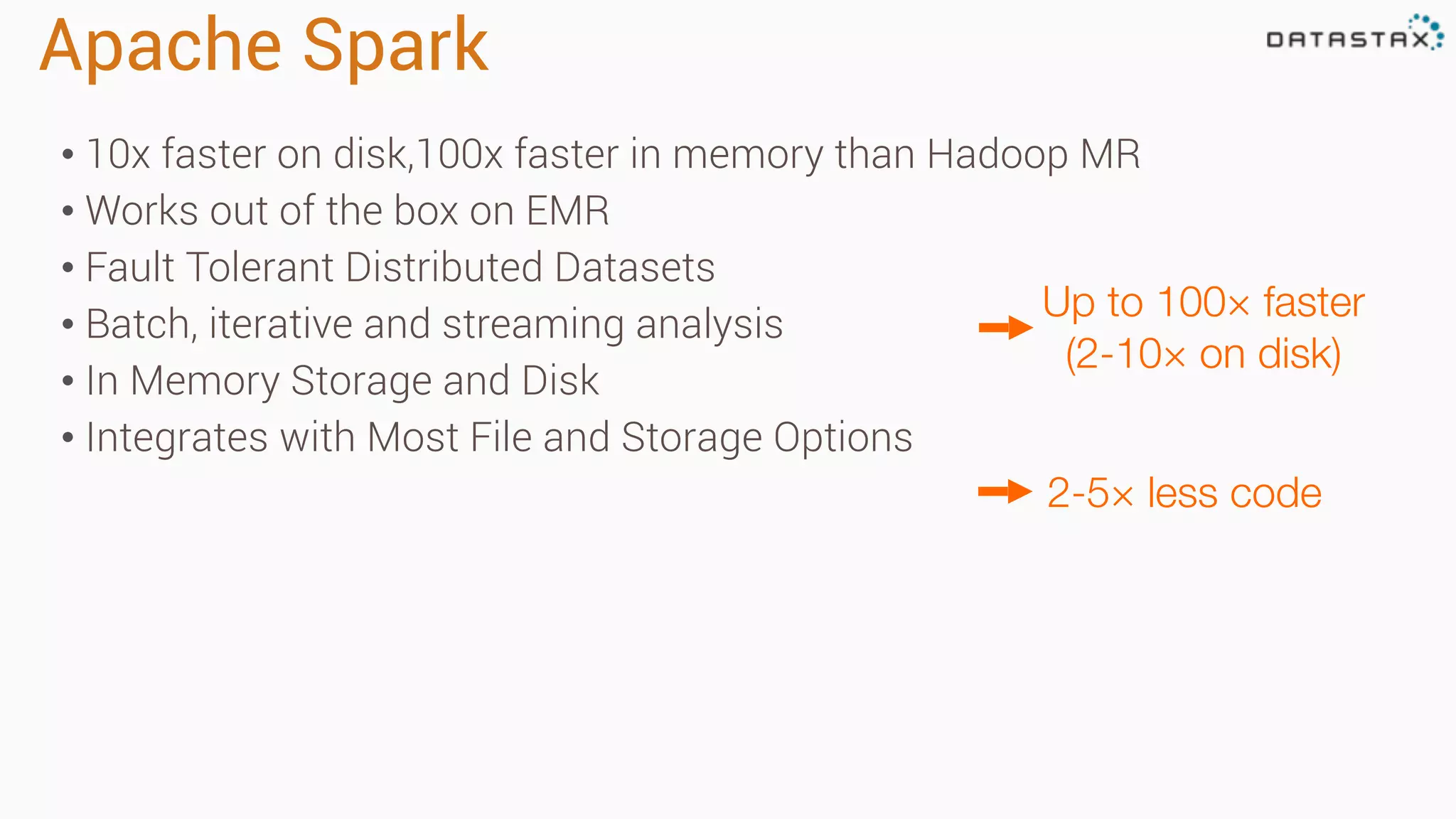
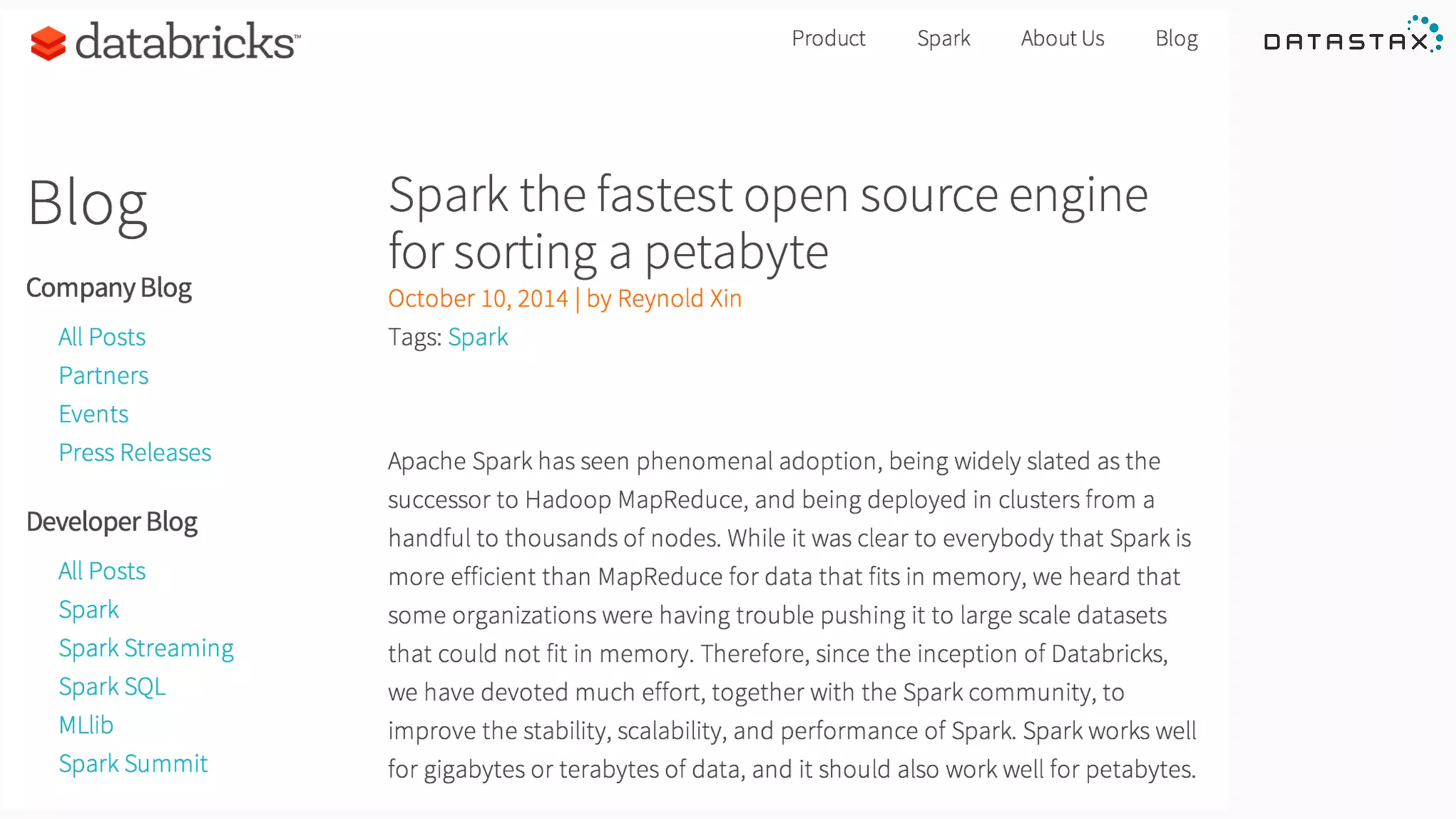
• 10x faster on disk,100x faster in memory than Hadoop MR
• Works out of the box on EMR
• Fault Tolerant Distributed Datasets
• Batch, iterative and streaming analysis
• In Memory Storage and Disk
• Integrates with Most File and Storage Options
Up to 100× faster
(2-10× on disk)
2-5× less code
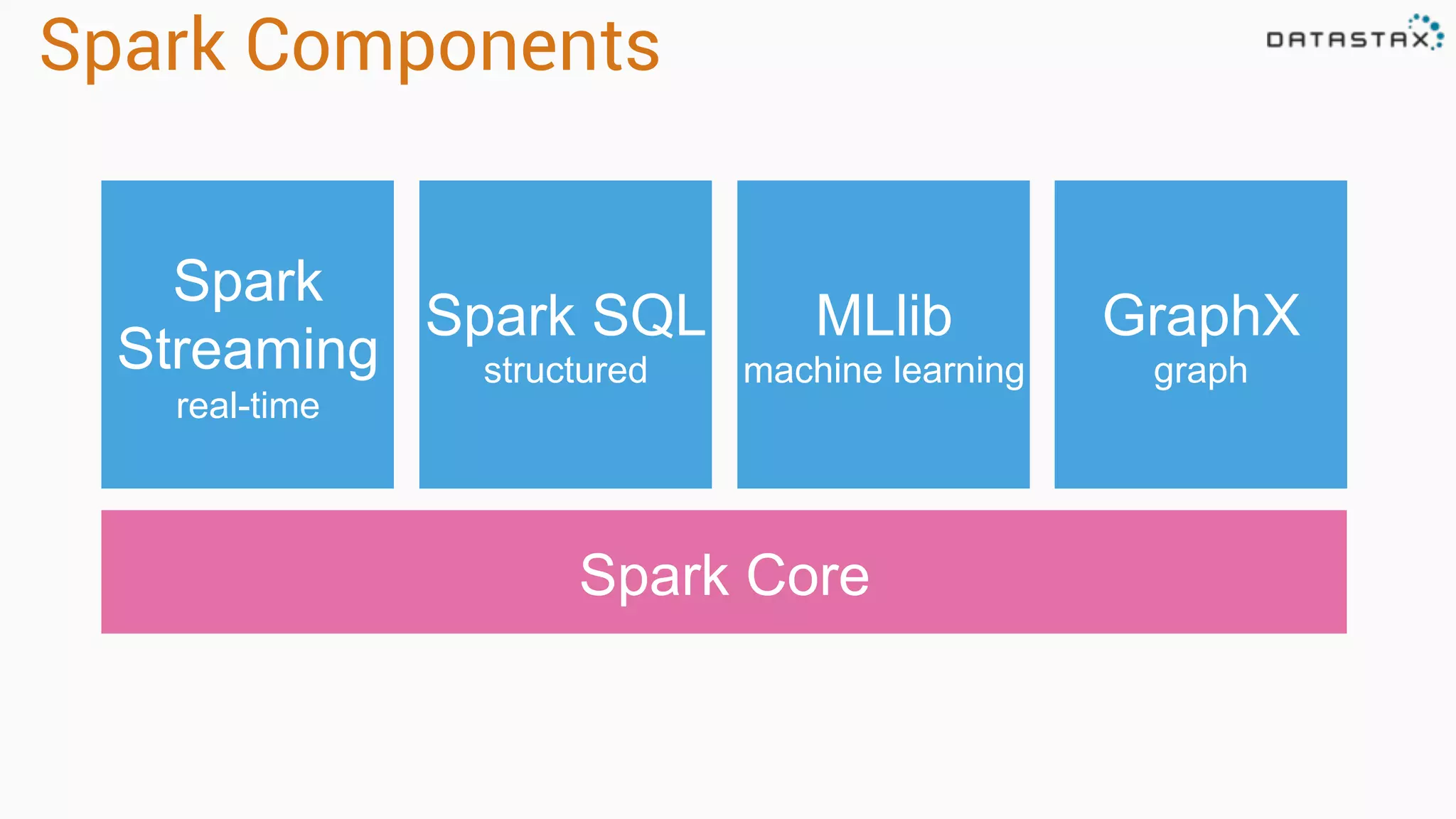
Spark Components
Spark Core
Spark SQL
structured
Spark
Streaming
real-time
MLlib
machine learning
GraphX
graph
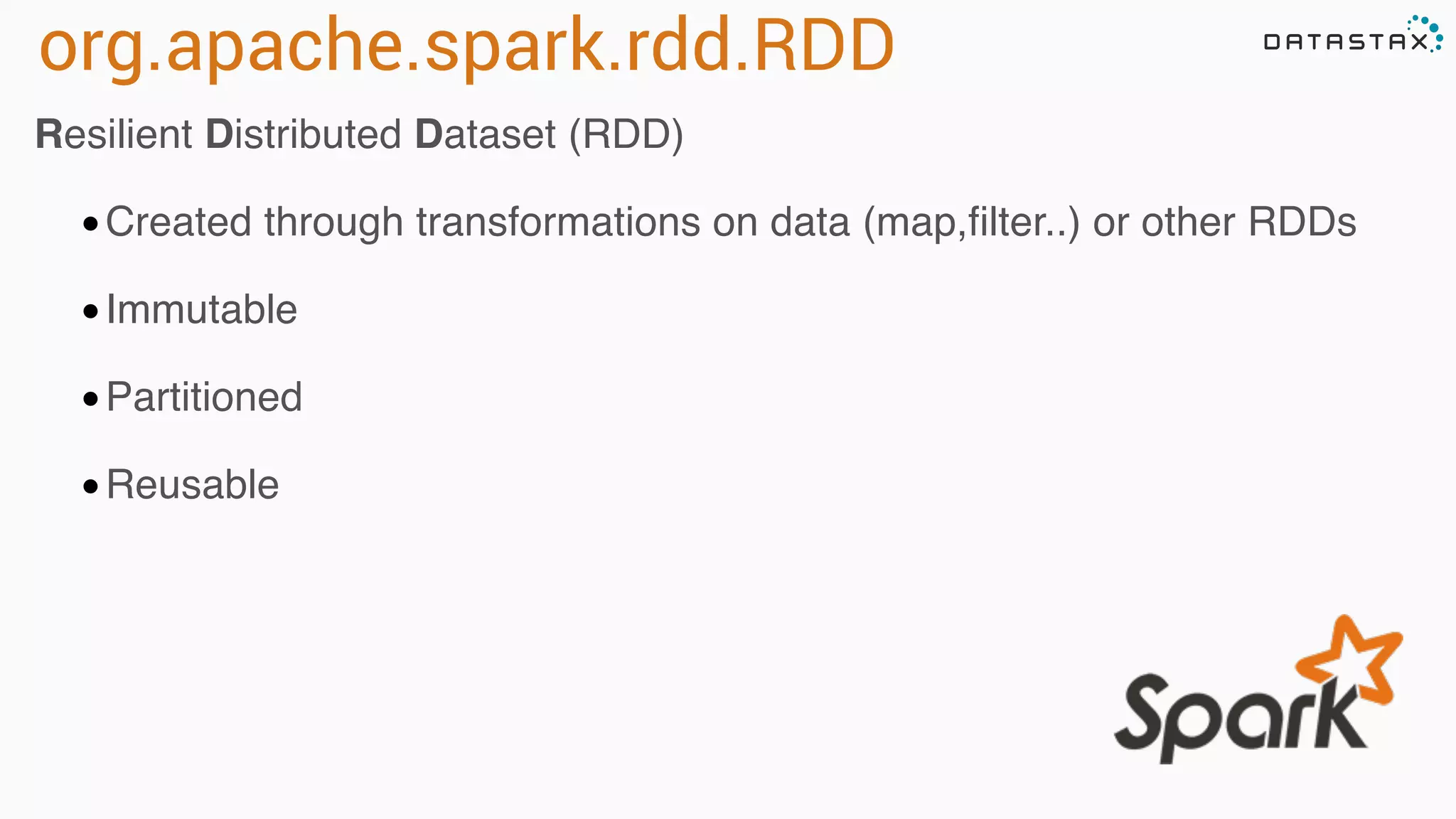
org.apache.spark.rdd.RDD
Resilient Distributed Dataset (RDD)
•Created through transformations on data (map,filter..) or other RDDs
•Immutable
•Partitioned
•Reusable
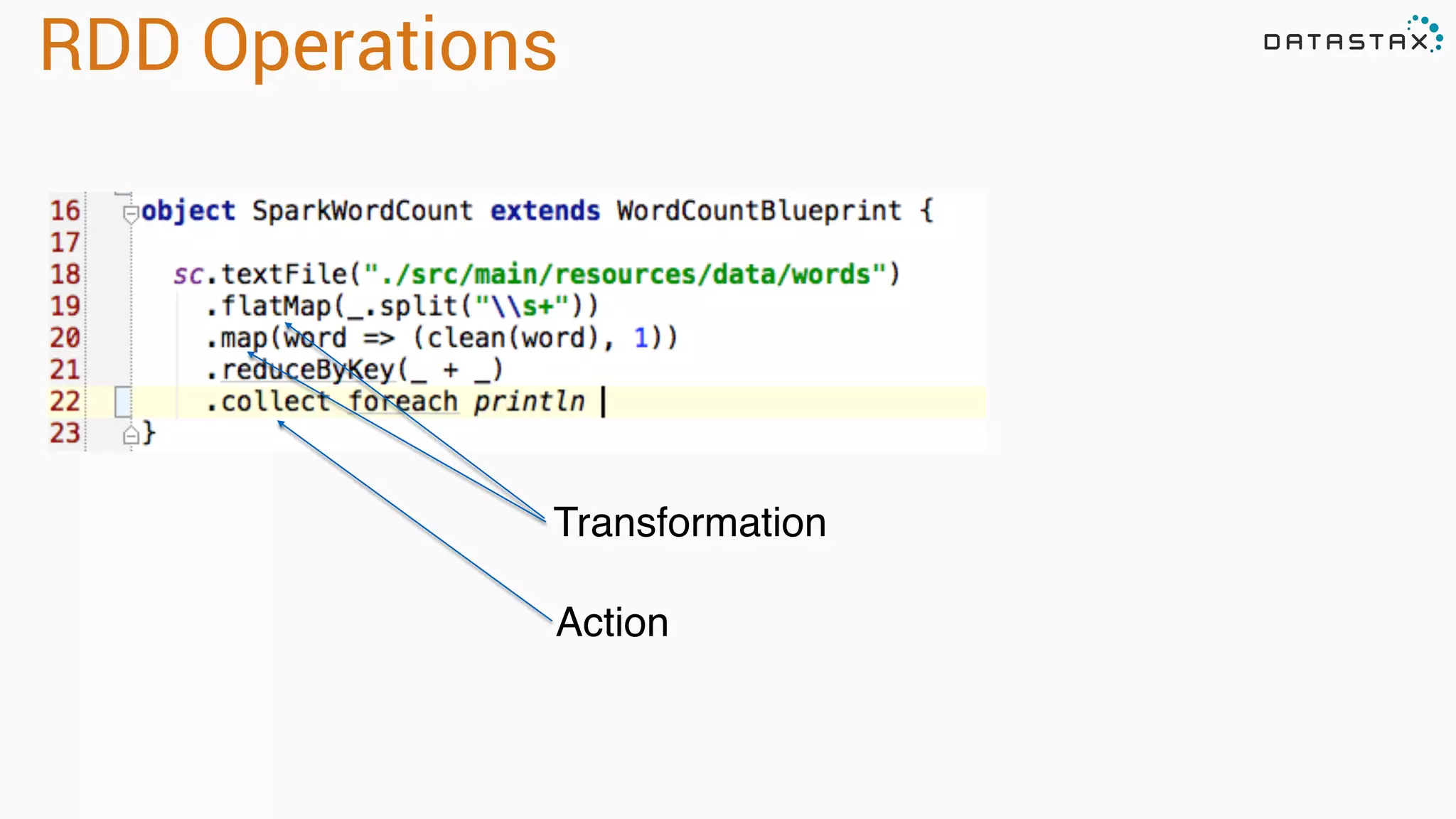
RDD Operations
•Transformations - Similar to scala collections API
•Produce new RDDs
•filter, flatmap, map, distinct, groupBy, union, zip,
reduceByKey, subtract
•Actions
•Require materialization of the records to generate a value
•collect: Array[T], count, fold, reduce..
Analytic
Analytic
Search
Transformation
Action
RDD Operations
Cassandra and Spark
Cassandra & Spark: A Great Combo
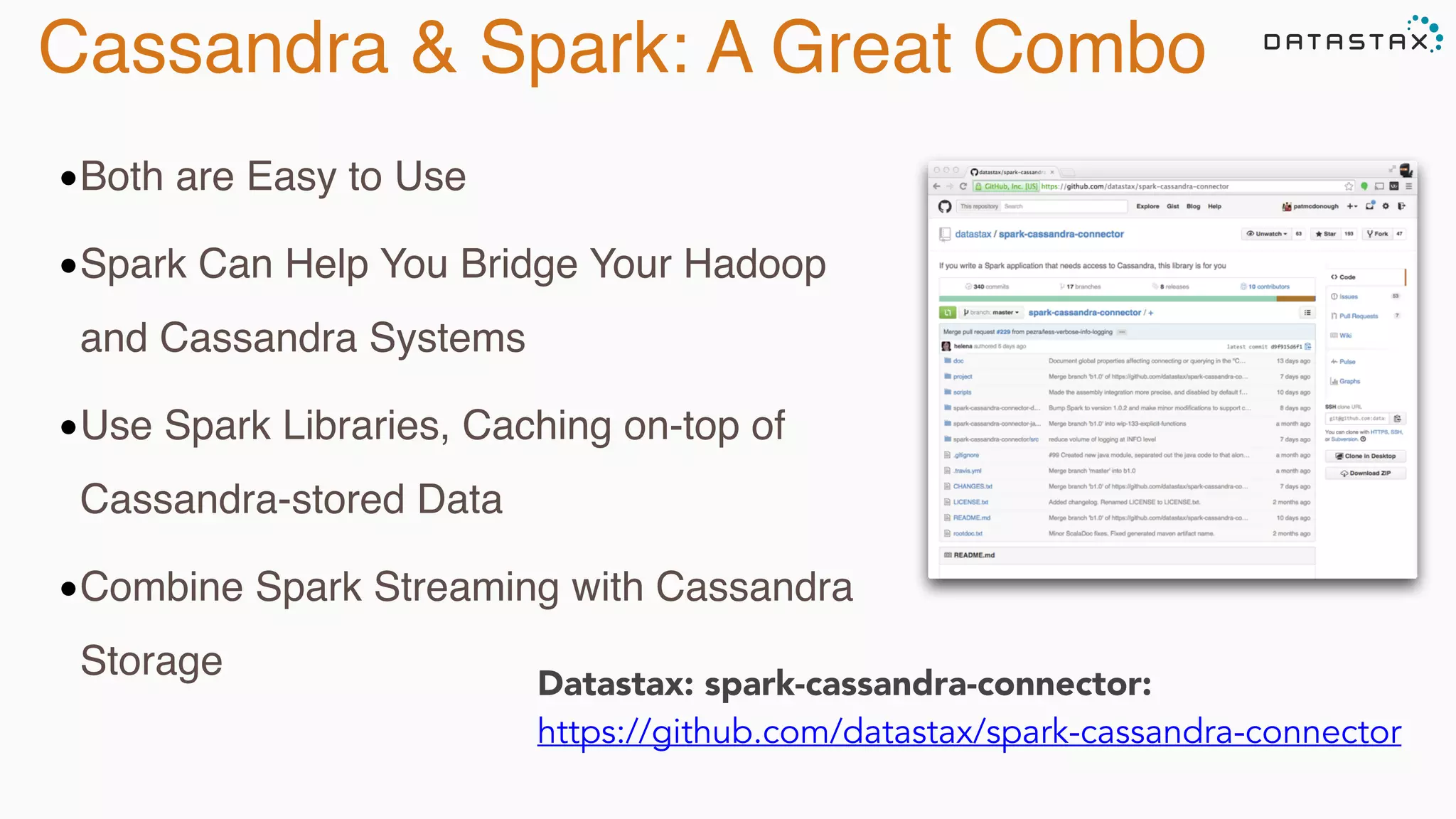
Datastax: spark-cassandra-connector:

https://github.com/datastax/spark-cassandra-connector
•Both are Easy to Use
•Spark Can Help You Bridge Your Hadoop
and Cassandra Systems
•Use Spark Libraries, Caching on-top of
Cassandra-stored Data
•Combine Spark Streaming with Cassandra
Storage
Spark On Cassandra
•Server-Side filters (where clauses)
•Cross-table operations (JOIN, UNION, etc.)
•Data locality-aware (speed)
•Data transformation, aggregation, etc.
•Natural Time Series Integration
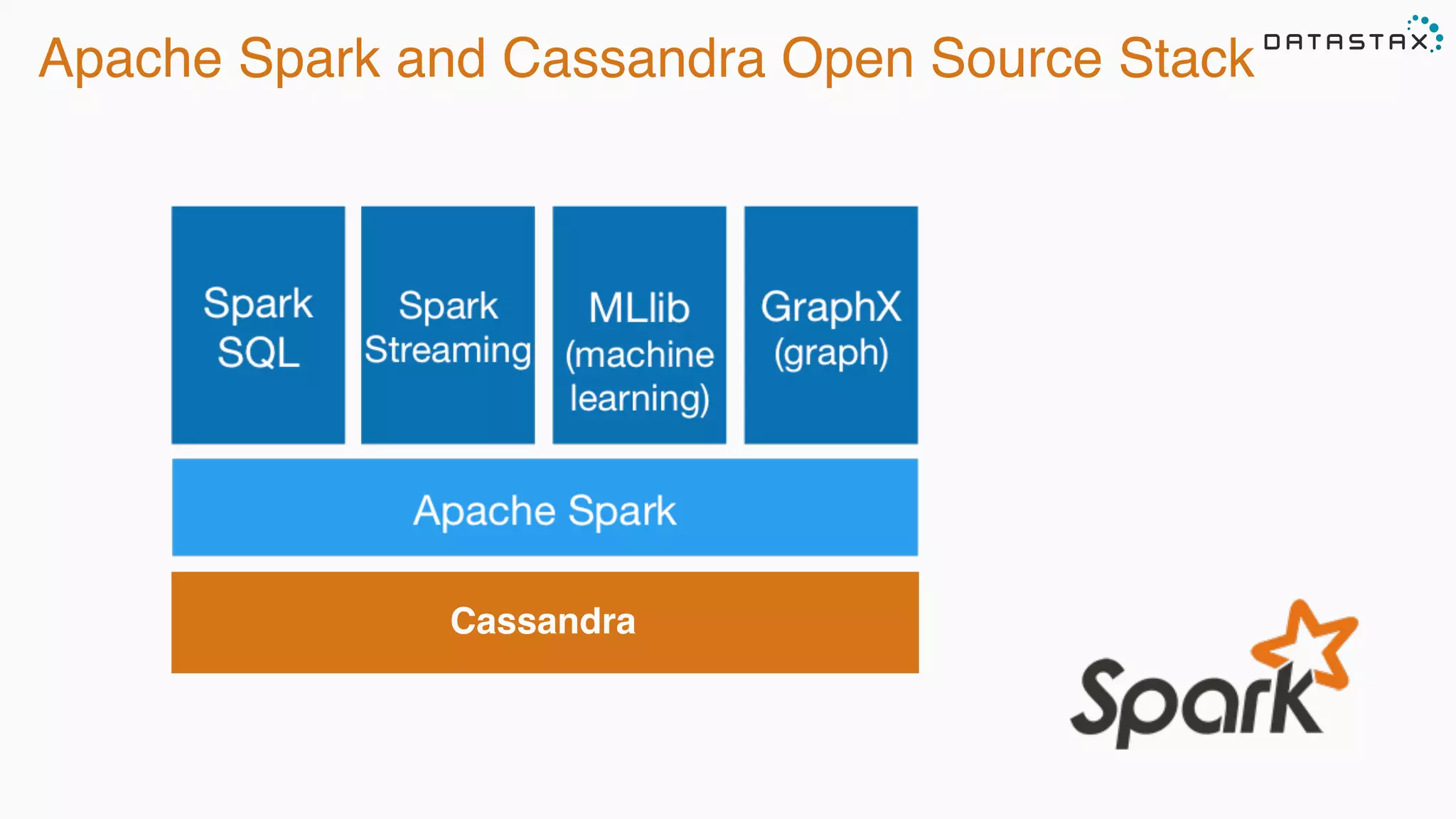
Apache Spark and Cassandra Open Source Stack
Cassandra
Spark Cassandra Connector
18
Spark Cassandra Connector
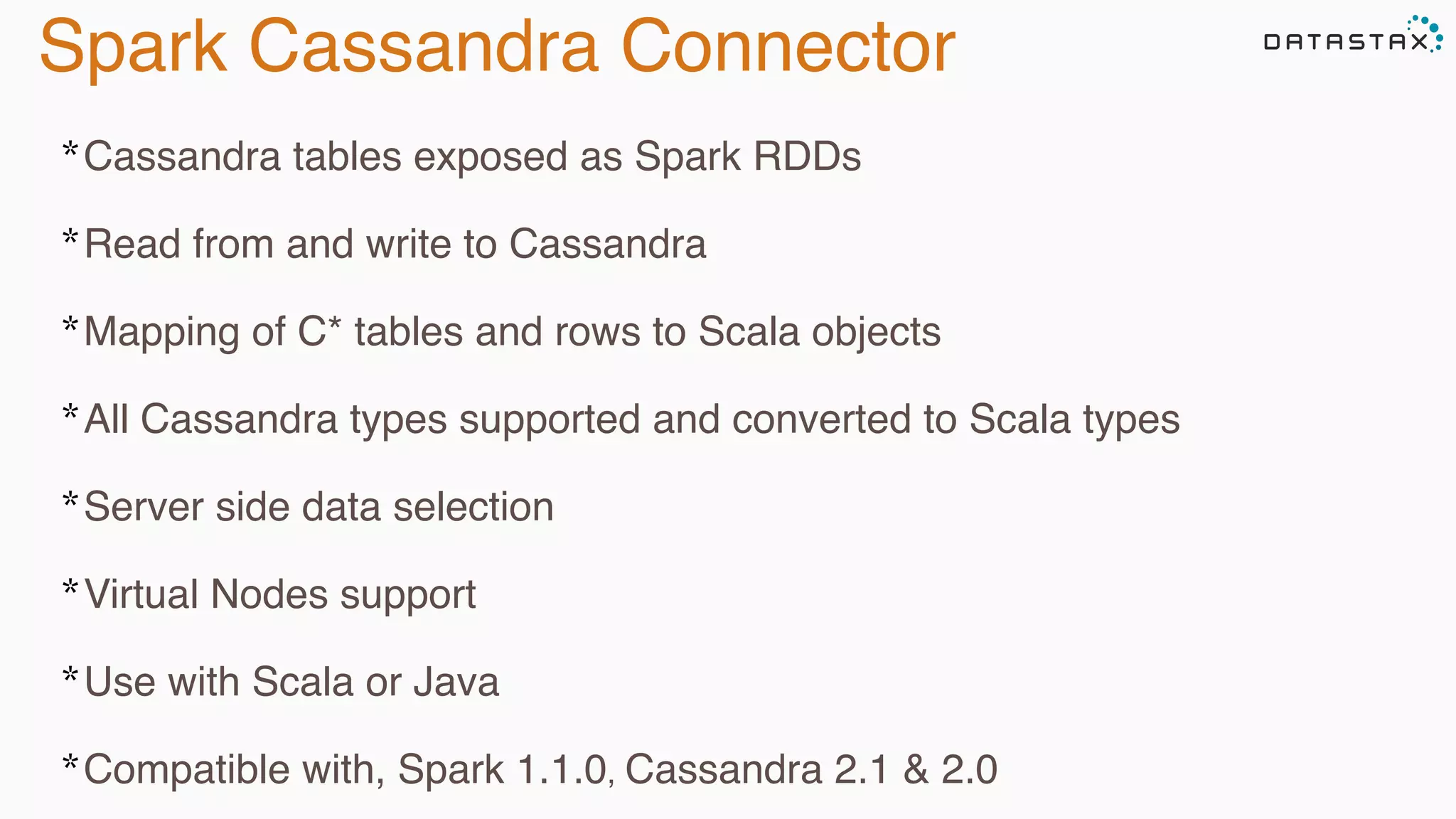
*Cassandra tables exposed as Spark RDDs
*Read from and write to Cassandra
*Mapping of C* tables and rows to Scala objects
*All Cassandra types supported and converted to Scala types
*Server side data selection
*Virtual Nodes support
*Use with Scala or Java
*Compatible with, Spark 1.1.0, Cassandra 2.1 & 2.0
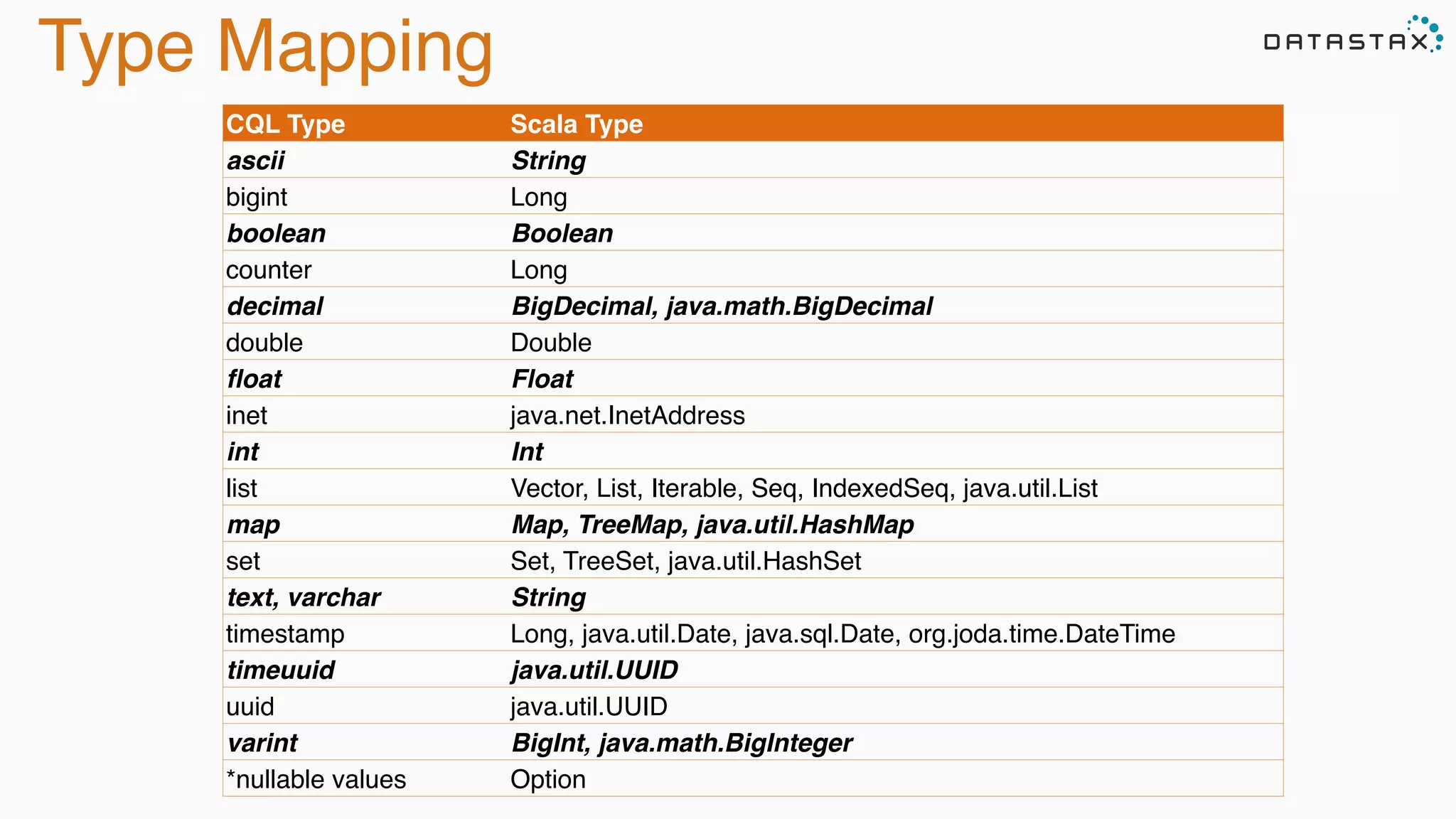
Type Mapping
CQL Type Scala Type
ascii String
bigint Long
boolean Boolean
counter Long
decimal BigDecimal, java.math.BigDecimal
double Double
float Float
inet java.net.InetAddress
int Int
list Vector, List, Iterable, Seq, IndexedSeq, java.util.List
map Map, TreeMap, java.util.HashMap
set Set, TreeSet, java.util.HashSet
text, varchar String
timestamp Long, java.util.Date, java.sql.Date, org.joda.time.DateTime
timeuuid java.util.UUID
uuid java.util.UUID
varint BigInt, java.math.BigInteger
*nullable values Option
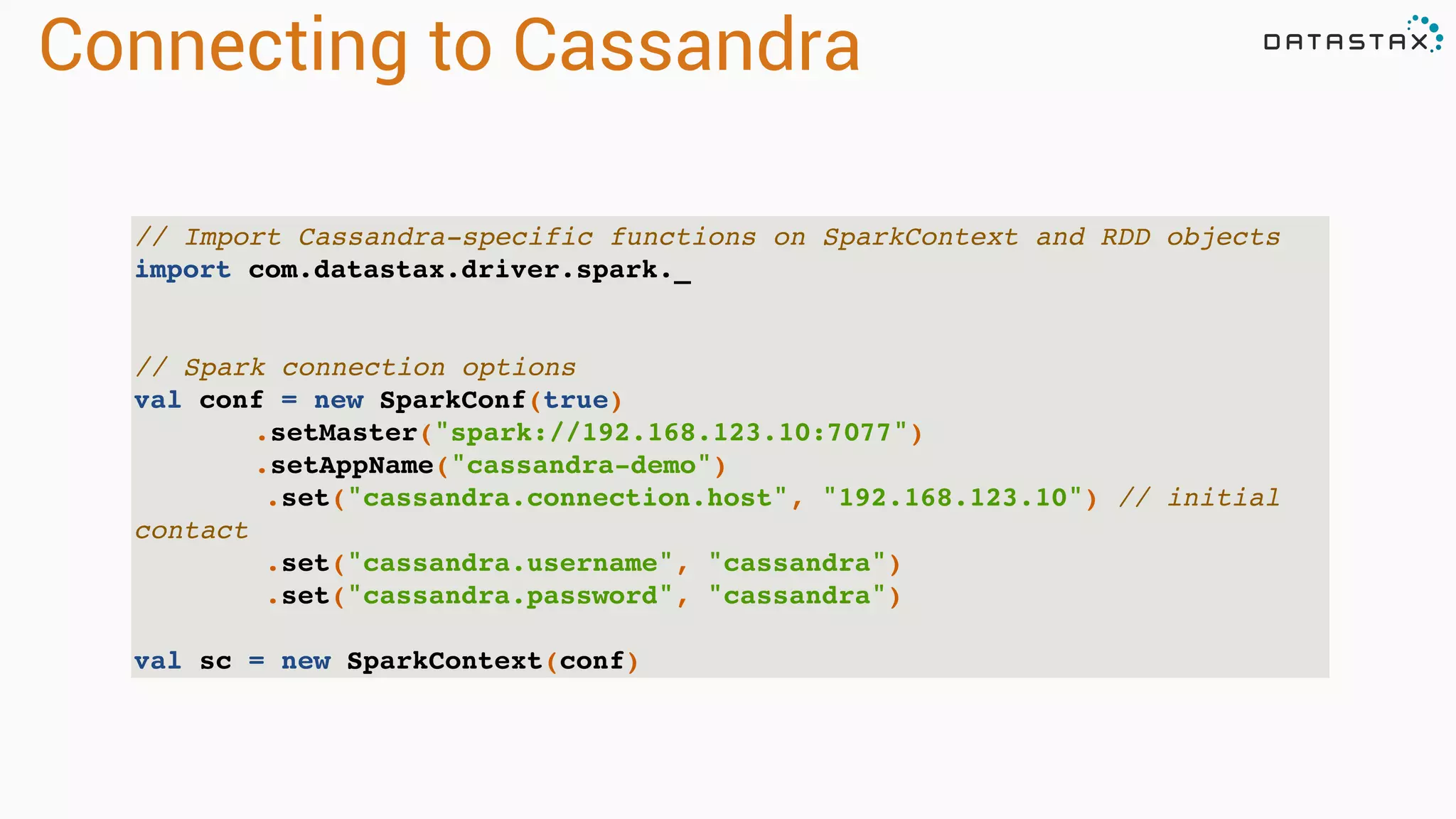
Connecting to Cassandra
// Import Cassandra-specific functions on SparkContext and RDD objects
import com.datastax.driver.spark._
// Spark connection options
val conf = new SparkConf(true)
.setMaster("spark://192.168.123.10:7077")
.setAppName("cassandra-demo")
.set("cassandra.connection.host", "192.168.123.10") // initial
contact
.set("cassandra.username", "cassandra")
.set("cassandra.password", "cassandra")
val sc = new SparkContext(conf)
Accessing Data
CREATE TABLE test.words (word text PRIMARY KEY, count int);
INSERT INTO test.words (word, count) VALUES ('bar', 30);
INSERT INTO test.words (word, count) VALUES ('foo', 20);
// Use table as RDD
val rdd = sc.cassandraTable("test", "words")
// rdd: CassandraRDD[CassandraRow] = CassandraRDD[0]
rdd.toArray.foreach(println)
// CassandraRow[word: bar, count: 30]
// CassandraRow[word: foo, count: 20]
rdd.columnNames // Stream(word, count)
rdd.size // 2
val firstRow = rdd.first // firstRow: CassandraRow = CassandraRow[word: bar,
count: 30]
firstRow.getInt("count") // Int = 30
*Accessing table above as RDD:
Saving Data
val newRdd = sc.parallelize(Seq(("cat", 40), ("fox", 50)))
// newRdd: org.apache.spark.rdd.RDD[(String, Int)] = ParallelCollectionRDD[2]
newRdd.saveToCassandra("test", "words", Seq("word", "count"))
SELECT * FROM test.words;
word | count
------+-------
bar | 30
foo | 20
cat | 40
fox | 50
(4 rows)
*RDD above saved to Cassandra:
Spark Cassandra Connector
https://github.com/datastax/spark-­‐cassandra-­‐connector
Keyspace Table
Cassandra Spark
RDD[CassandraRow]
RDD[Tuples]
Bundled	
  and	
  Supported	
  with	
  DSE	
  4.5!
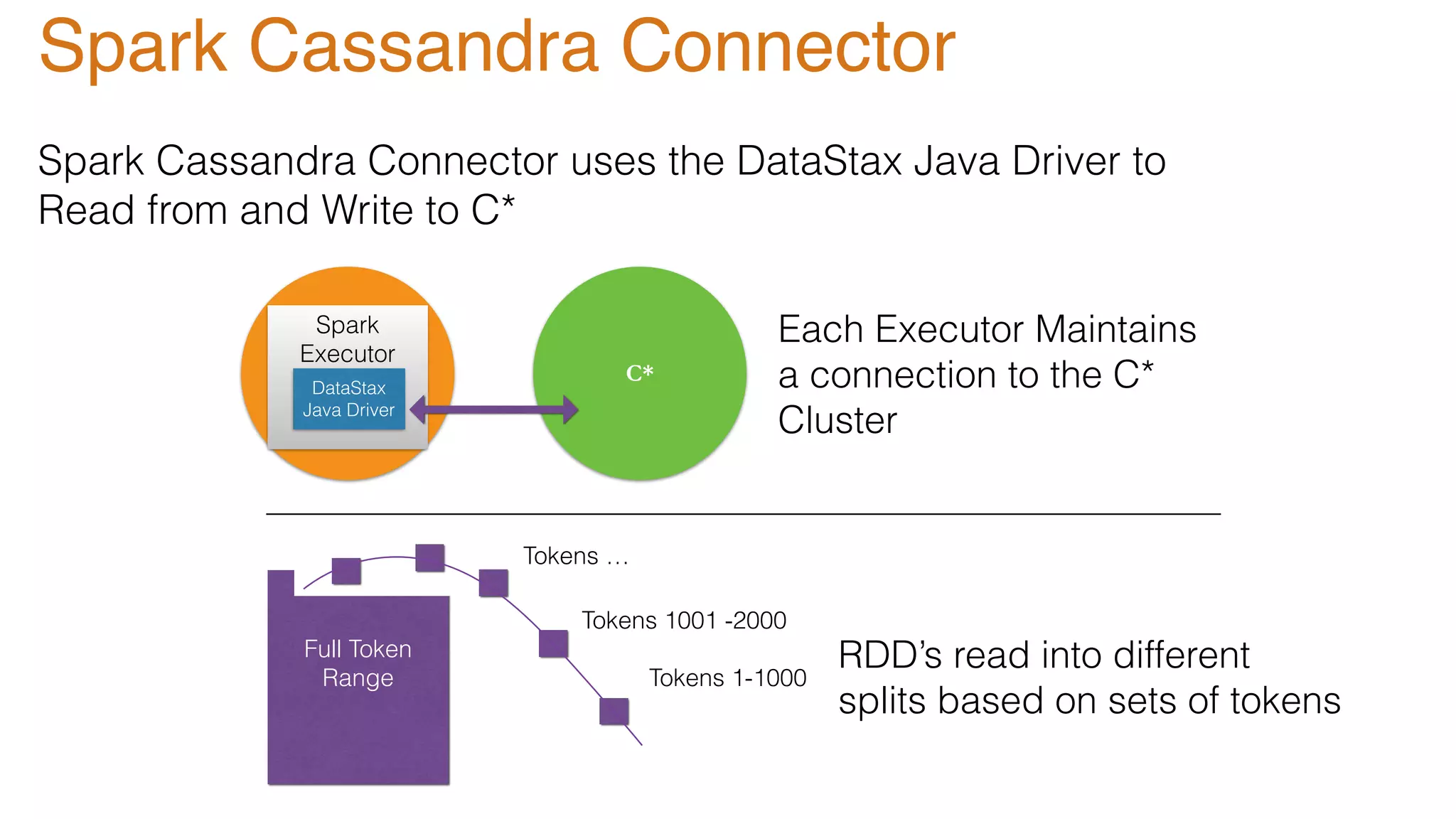
Spark Cassandra Connector uses the DataStax Java Driver to
Read from and Write to C*
Spark C*
Full Token
Range
Each Executor Maintains
a connection to the C*
Cluster
Spark
Executor
DataStax
Java Driver
Tokens 1-1000
Tokens 1001 -2000
Tokens …
RDD’s read into different
splits based on sets of tokens
Spark Cassandra Connector
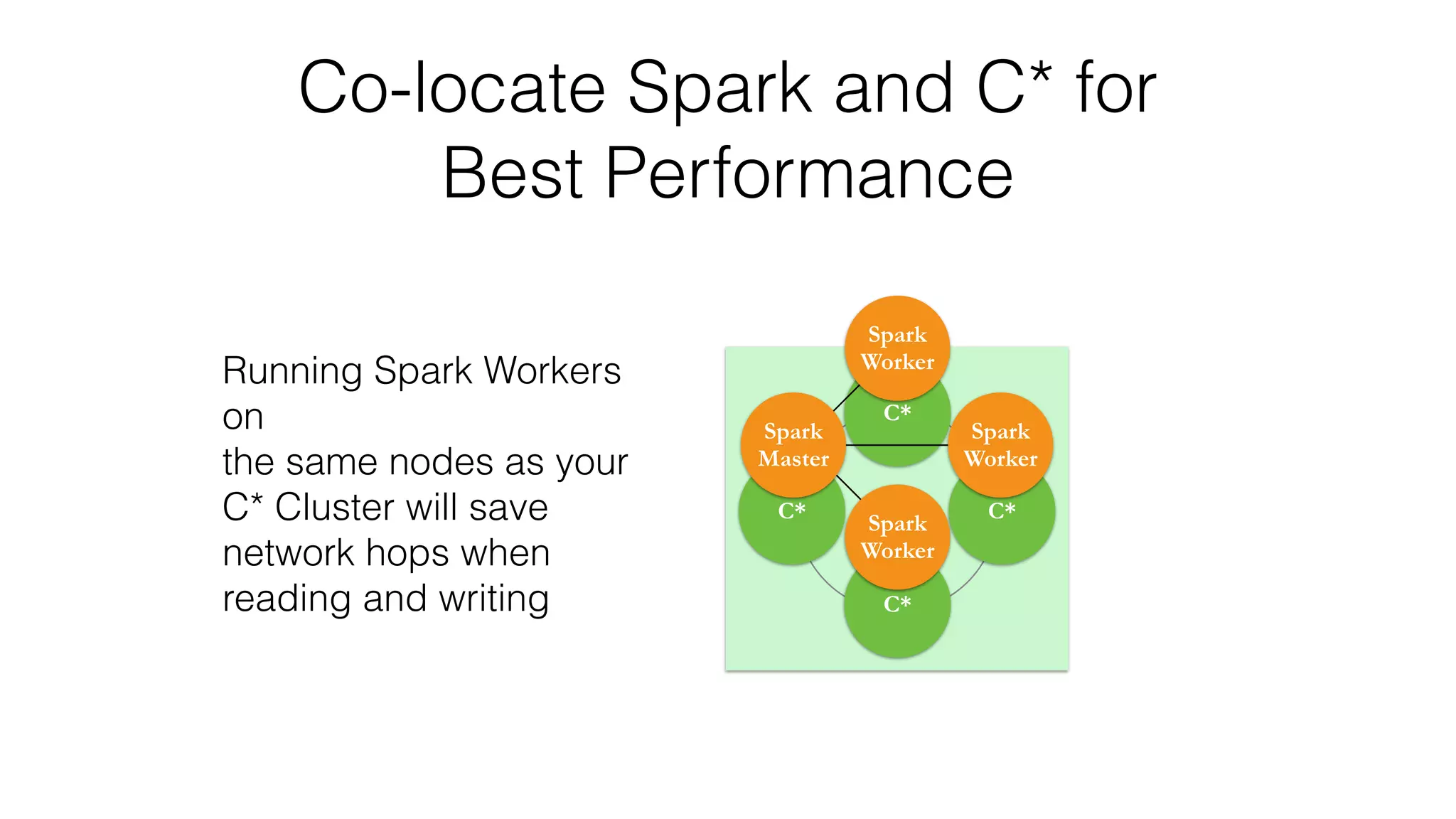
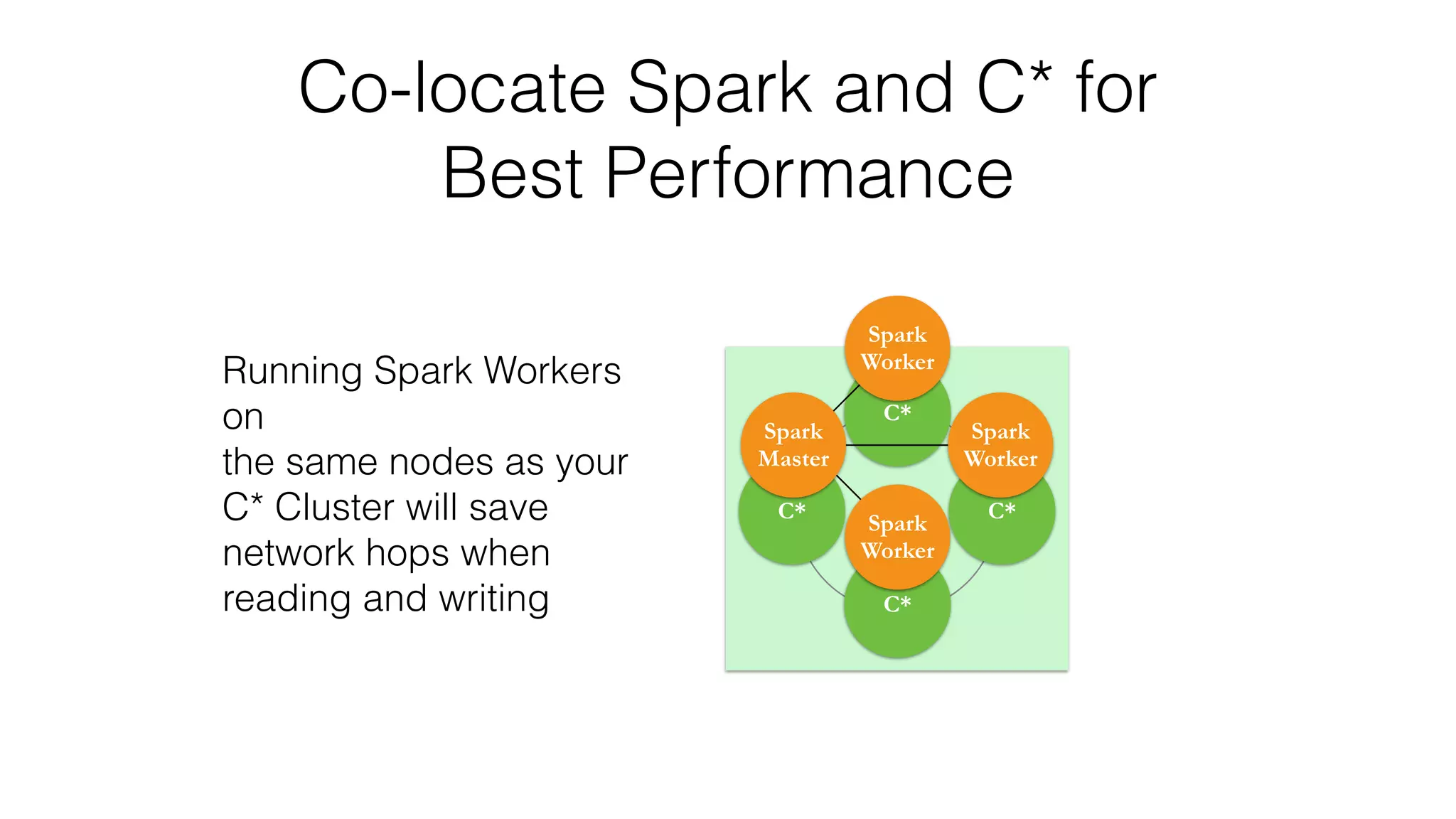
Co-locate Spark and C* for
Best Performance
C*
C*C*
C*
Spark

Worker
Spark

Worker
Spark
Master
Spark
Worker
Running Spark Workers
on
the same nodes as your
C* Cluster will save
network hops when
reading and writing
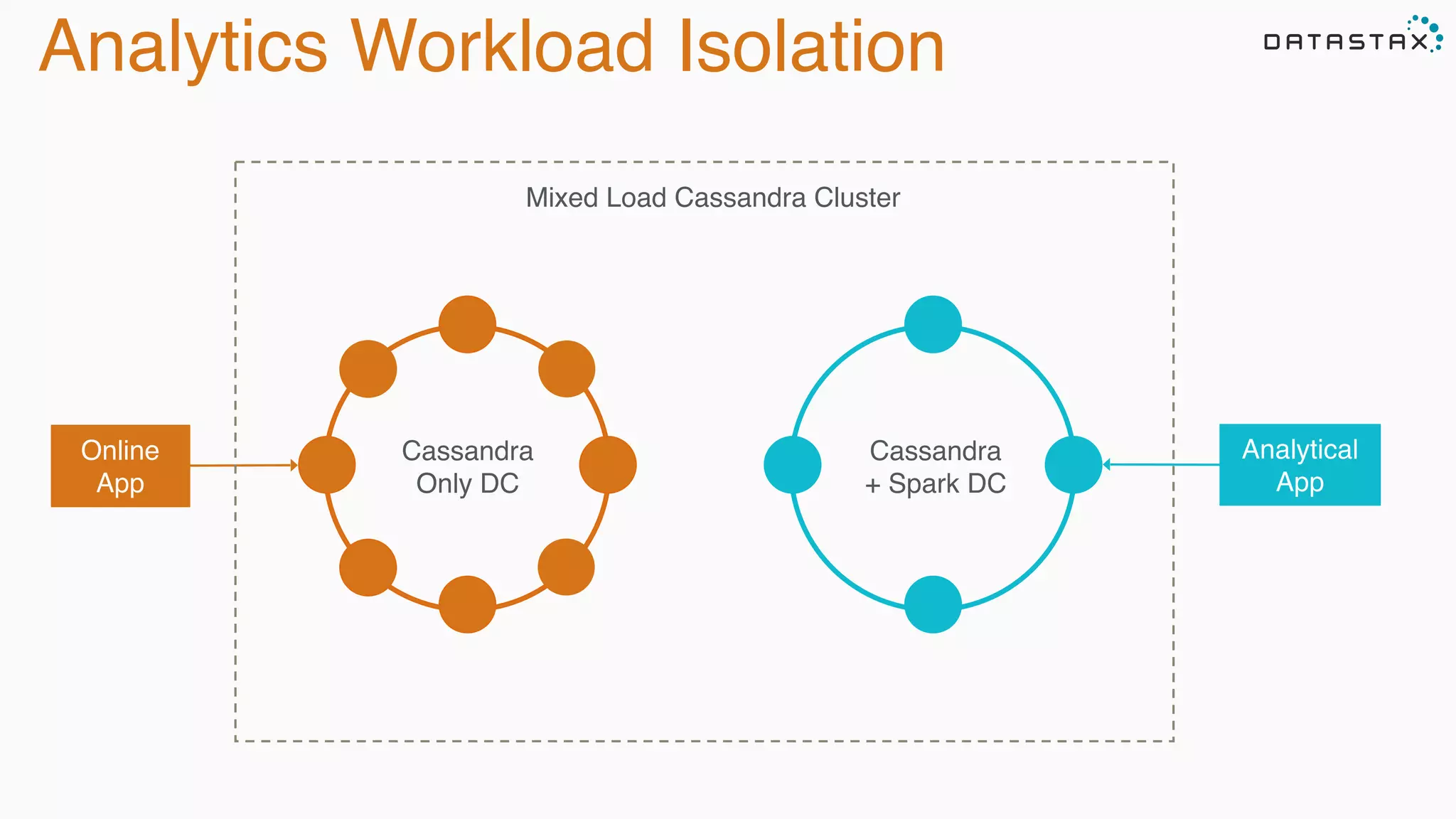
Analytics Workload Isolation
Cassandra
+ Spark DC
Cassandra
Only DC
Online
App
Analytical
App
Mixed Load Cassandra Cluster
Data Locality
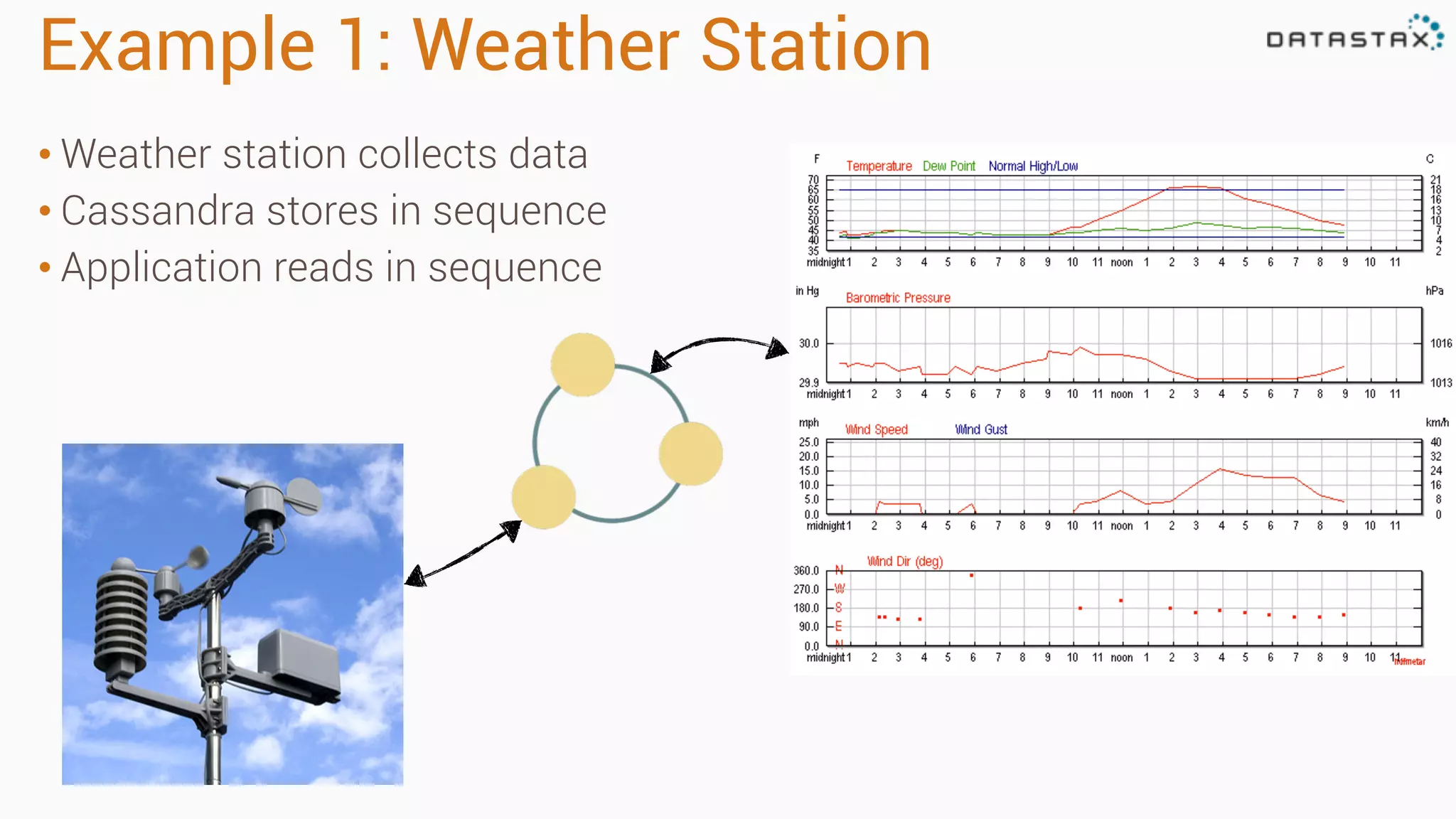
Example 1: Weather Station
• Weather station collects data
• Cassandra stores in sequence
• Application reads in sequence
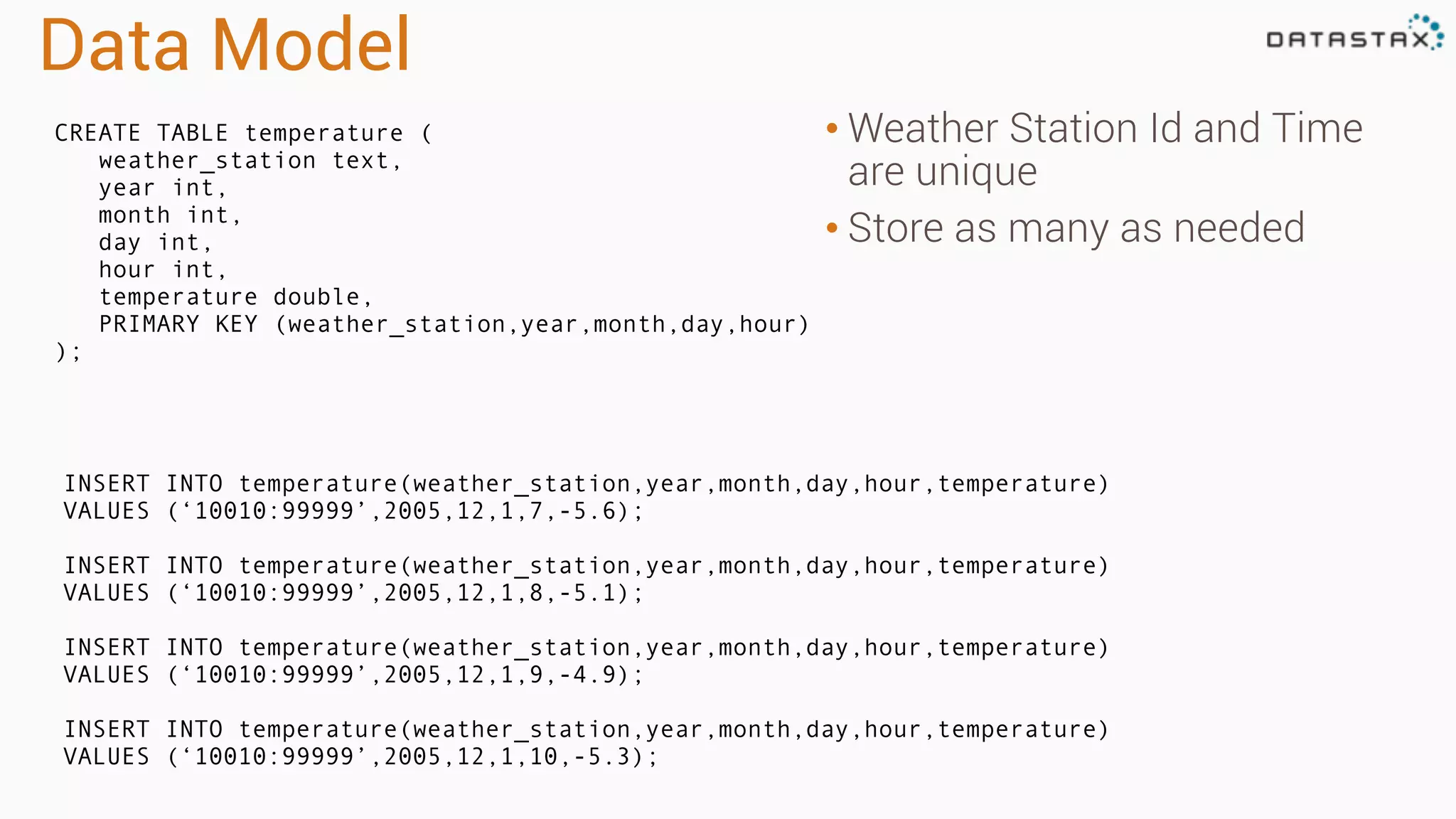
Data Model
• Weather Station Id and Time
are unique
• Store as many as needed
CREATE TABLE temperature (
weather_station text,
year int,
month int,
day int,
hour int,
temperature double,
PRIMARY KEY (weather_station,year,month,day,hour)
);
INSERT INTO temperature(weather_station,year,month,day,hour,temperature)
VALUES (‘10010:99999’,2005,12,1,7,-5.6);
INSERT INTO temperature(weather_station,year,month,day,hour,temperature)
VALUES (‘10010:99999’,2005,12,1,8,-5.1);
INSERT INTO temperature(weather_station,year,month,day,hour,temperature)
VALUES (‘10010:99999’,2005,12,1,9,-4.9);
INSERT INTO temperature(weather_station,year,month,day,hour,temperature)
VALUES (‘10010:99999’,2005,12,1,10,-5.3);
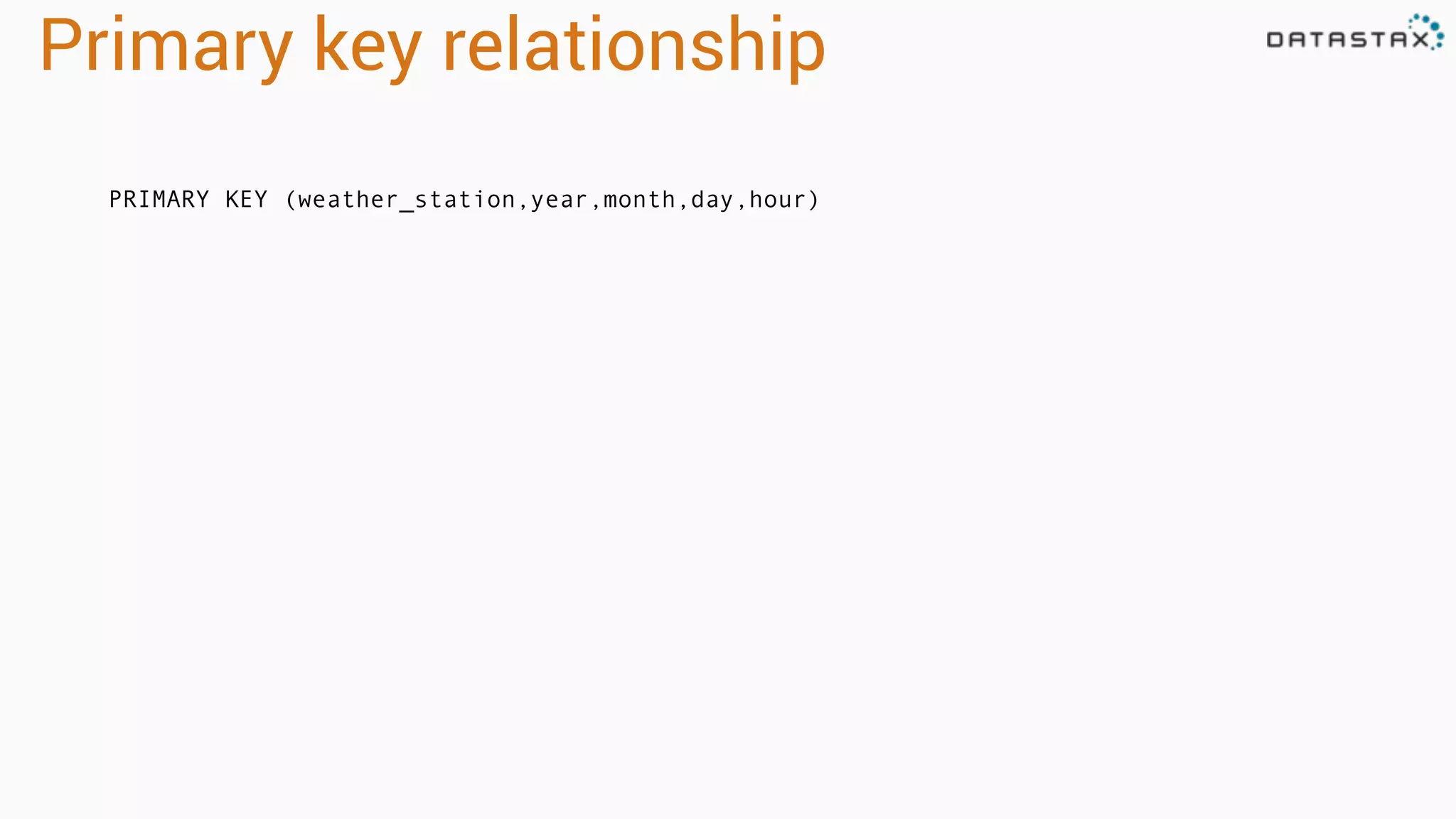
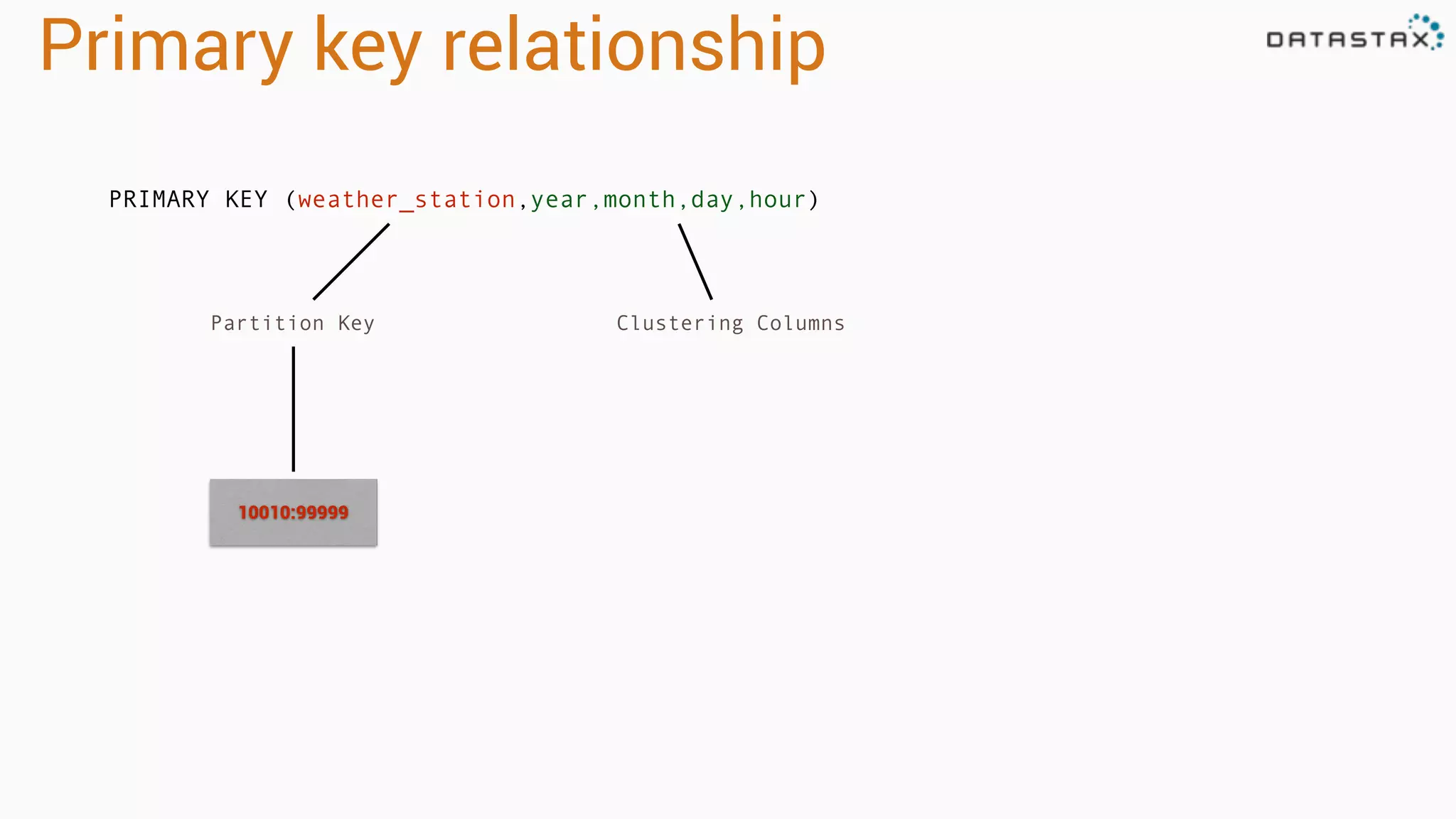
Primary key relationship
PRIMARY KEY (weather_station,year,month,day,hour)
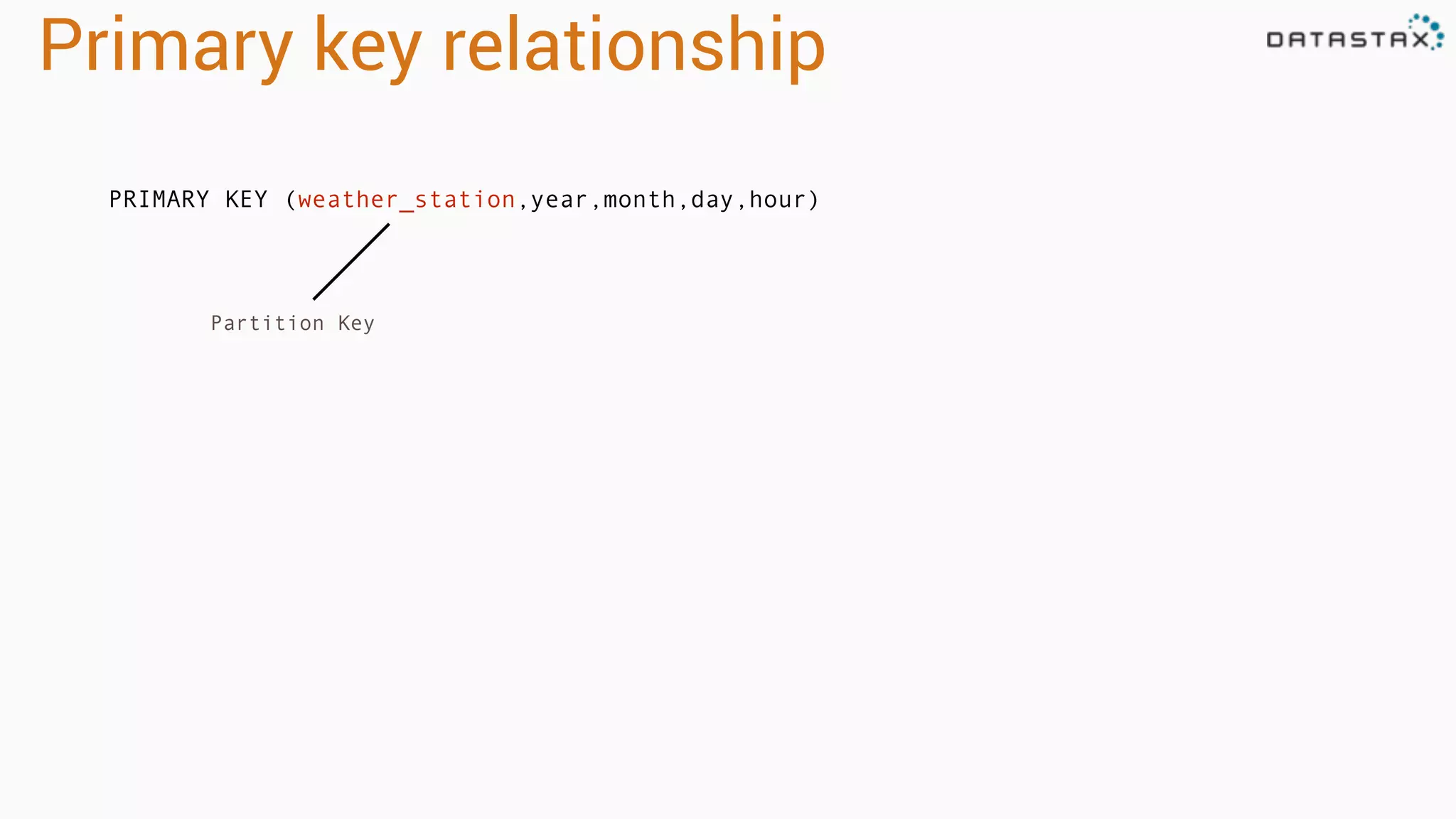
Primary key relationship
PRIMARY KEY (weather_station,year,month,day,hour)
Partition Key
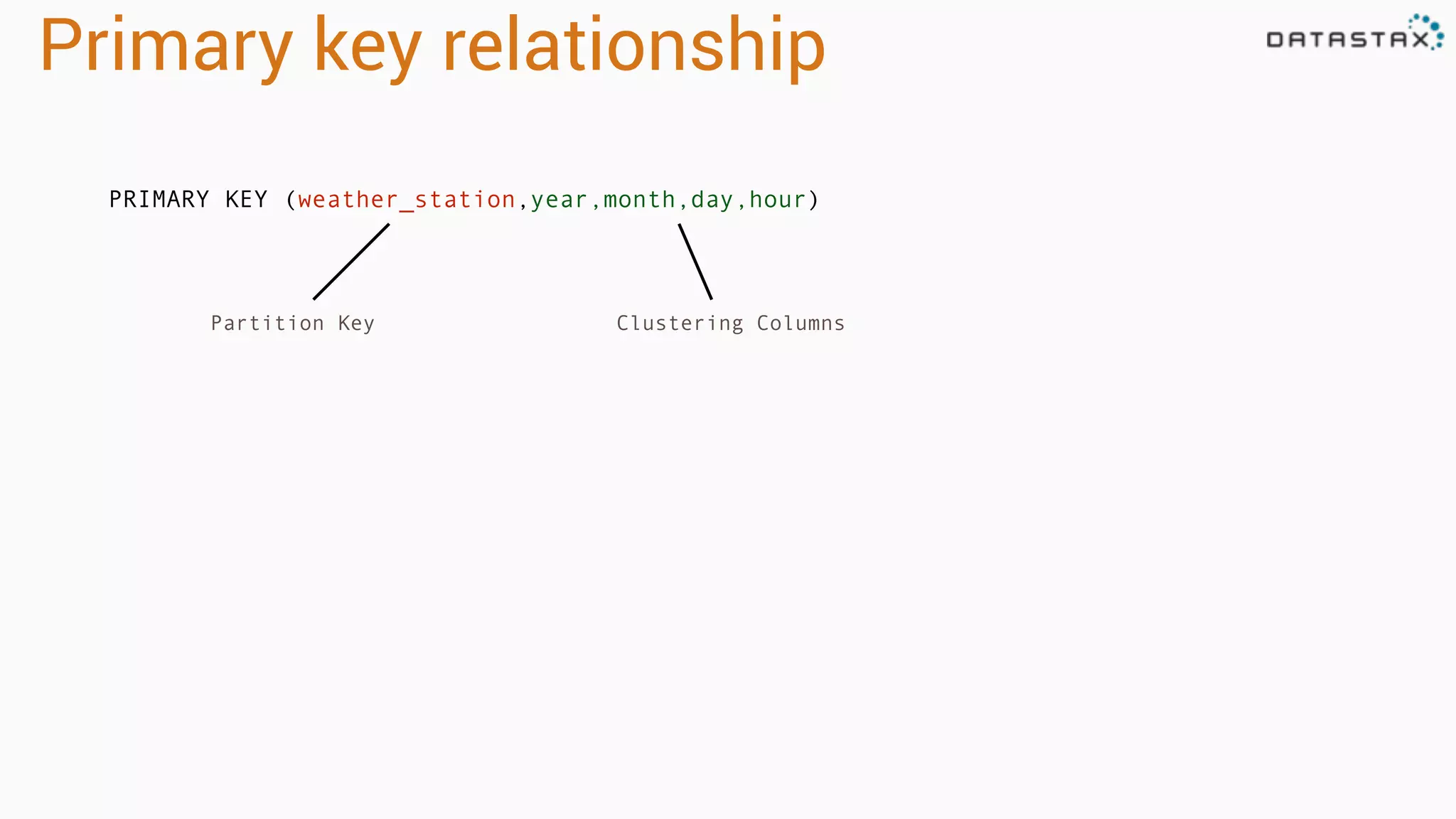
Primary key relationship
PRIMARY KEY (weather_station,year,month,day,hour)
Partition Key Clustering Columns
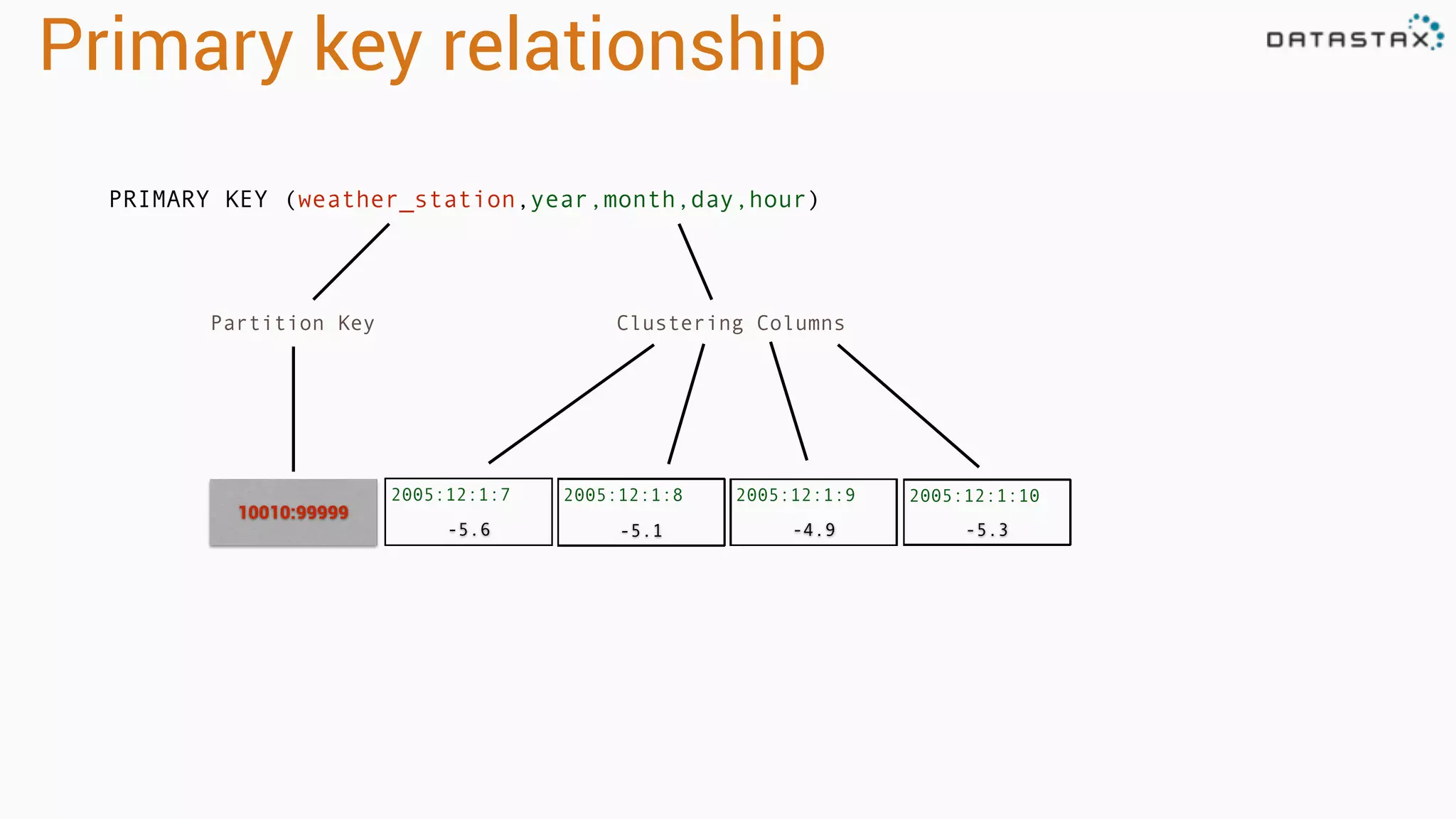
Primary key relationship
PRIMARY KEY (weather_station,year,month,day,hour)
Partition Key Clustering Columns
10010:99999
2005:12:1:7
-5.6
Primary key relationship
PRIMARY KEY (weather_station,year,month,day,hour)
Partition Key Clustering Columns
10010:99999
-5.3-4.9-5.1
2005:12:1:8 2005:12:1:9 2005:12:1:10
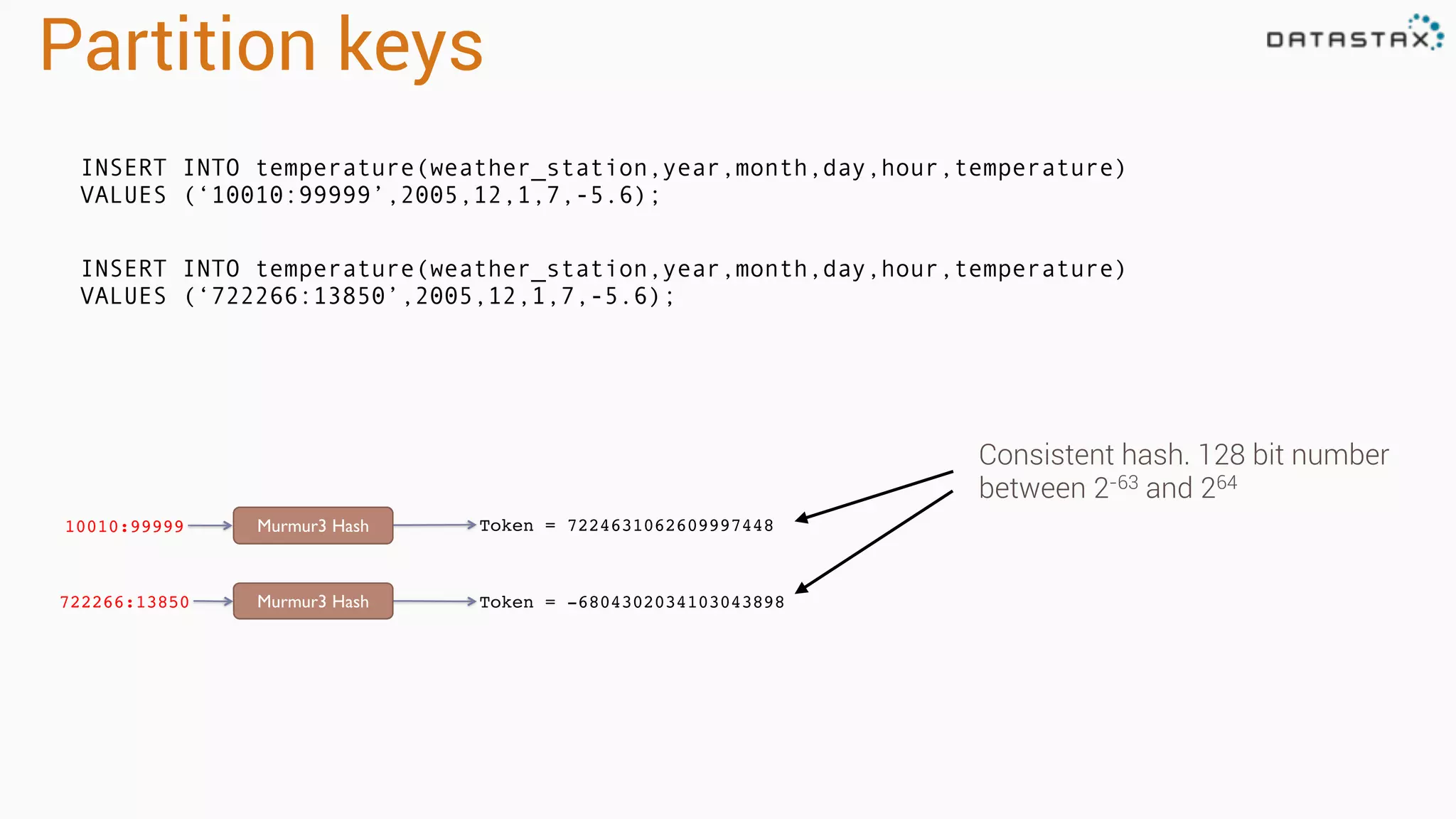
Partition keys
10010:99999 Murmur3 Hash Token = 7224631062609997448
722266:13850 Murmur3 Hash Token = -6804302034103043898
INSERT INTO temperature(weather_station,year,month,day,hour,temperature)
VALUES (‘10010:99999’,2005,12,1,7,-5.6);
INSERT INTO temperature(weather_station,year,month,day,hour,temperature)
VALUES (‘722266:13850’,2005,12,1,7,-5.6);
Consistent hash. 128 bit number
between 2-63 and 264
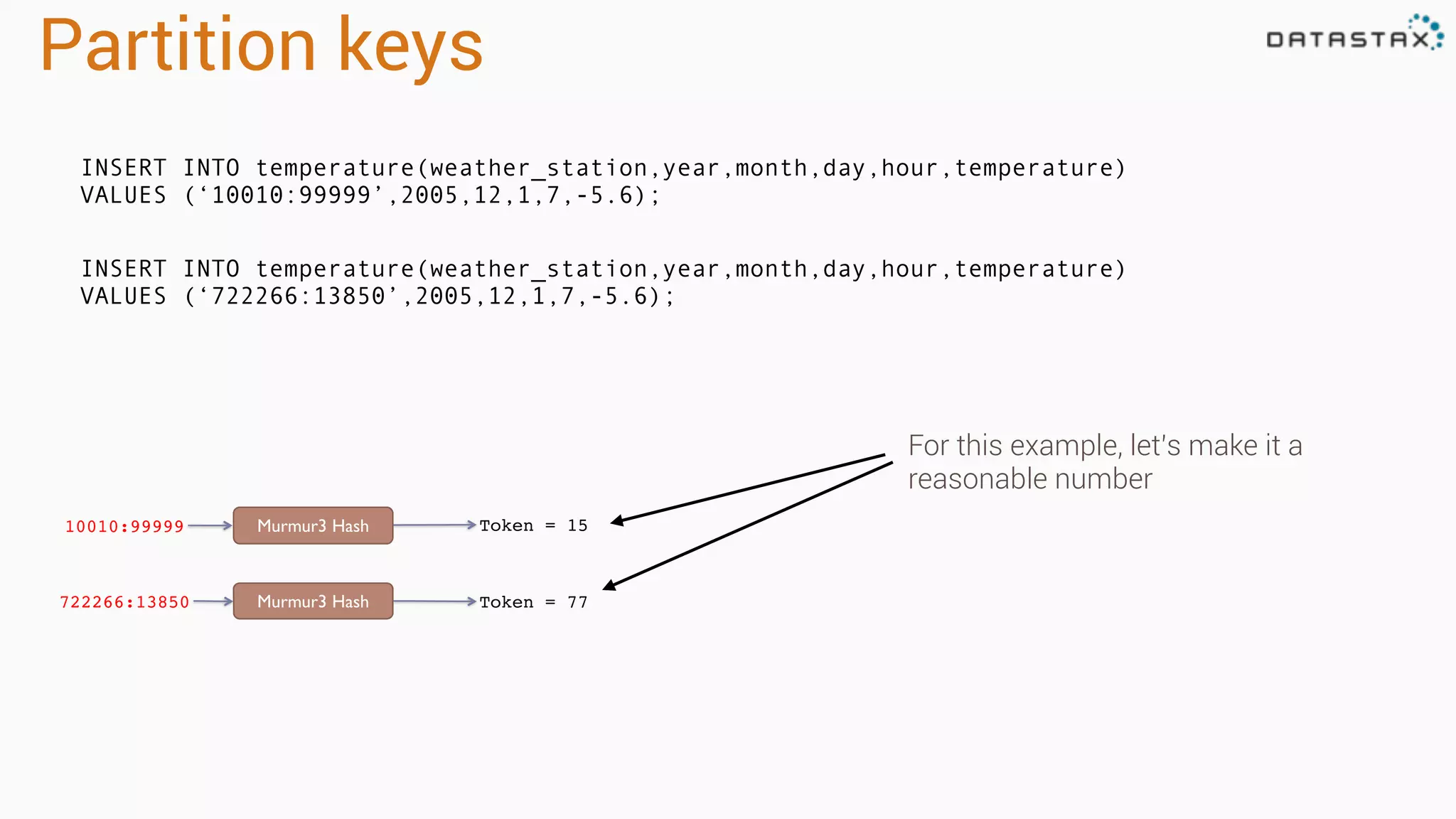
Partition keys
10010:99999 Murmur3 Hash Token = 15
722266:13850 Murmur3 Hash Token = 77
INSERT INTO temperature(weather_station,year,month,day,hour,temperature)
VALUES (‘10010:99999’,2005,12,1,7,-5.6);
INSERT INTO temperature(weather_station,year,month,day,hour,temperature)
VALUES (‘722266:13850’,2005,12,1,7,-5.6);
For this example, let’s make it a
reasonable number
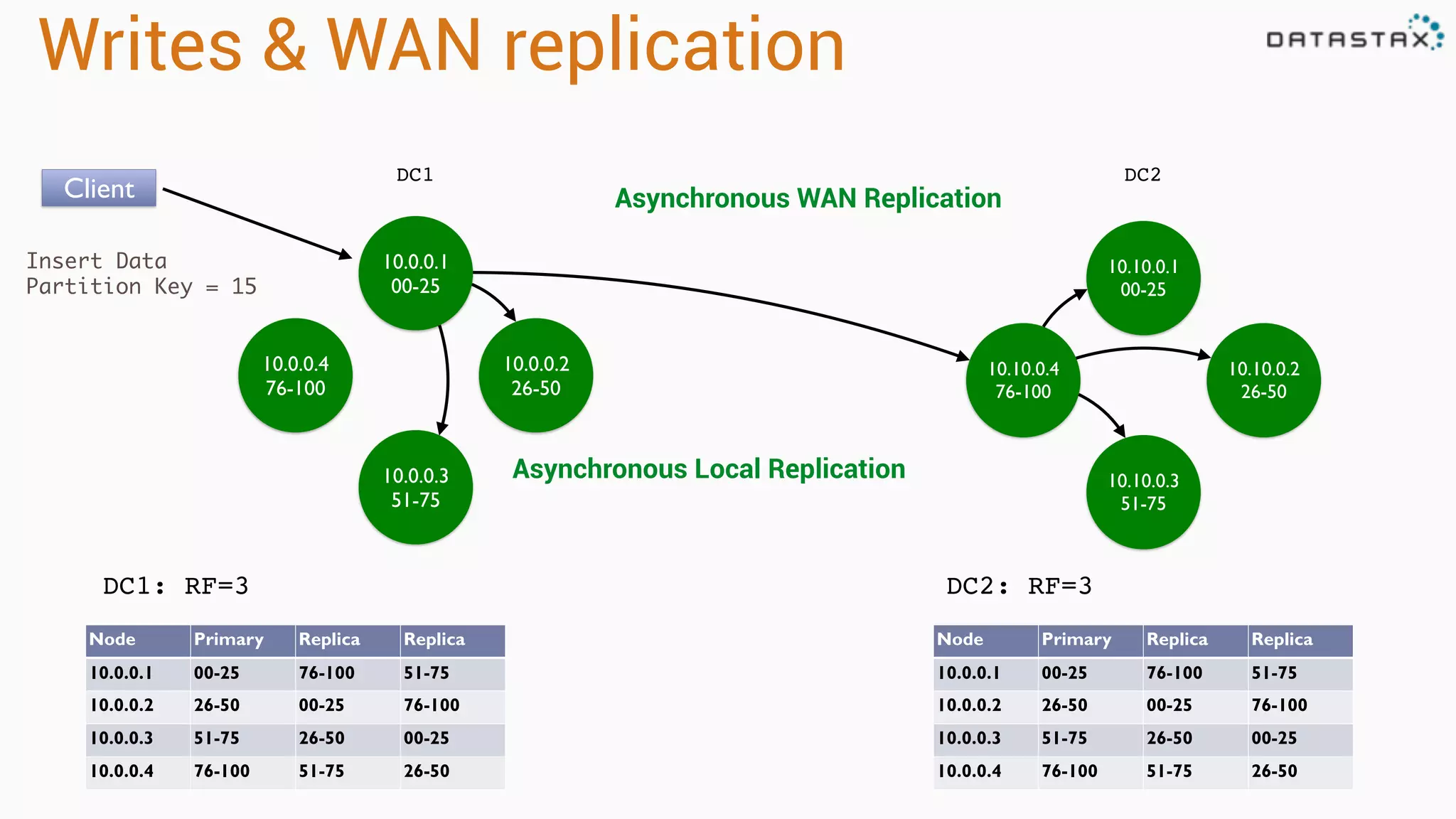
Writes & WAN replication
10.0.0.1
00-25
10.0.0.4
76-100
10.0.0.2
26-50
10.0.0.3
51-75
DC1
DC1: RF=3
Node Primary Replica Replica
10.0.0.1 00-25 76-100 51-75
10.0.0.2 26-50 00-25 76-100
10.0.0.3 51-75 26-50 00-25
10.0.0.4 76-100 51-75 26-50
10.10.0.1
00-25
10.10.0.4
76-100
10.10.0.2
26-50
10.10.0.3
51-75
DC2
Node Primary Replica Replica
10.0.0.1 00-25 76-100 51-75
10.0.0.2 26-50 00-25 76-100
10.0.0.3 51-75 26-50 00-25
10.0.0.4 76-100 51-75 26-50
DC2: RF=3
Client
Insert Data
Partition Key = 15
Asynchronous Local Replication
Asynchronous WAN Replication
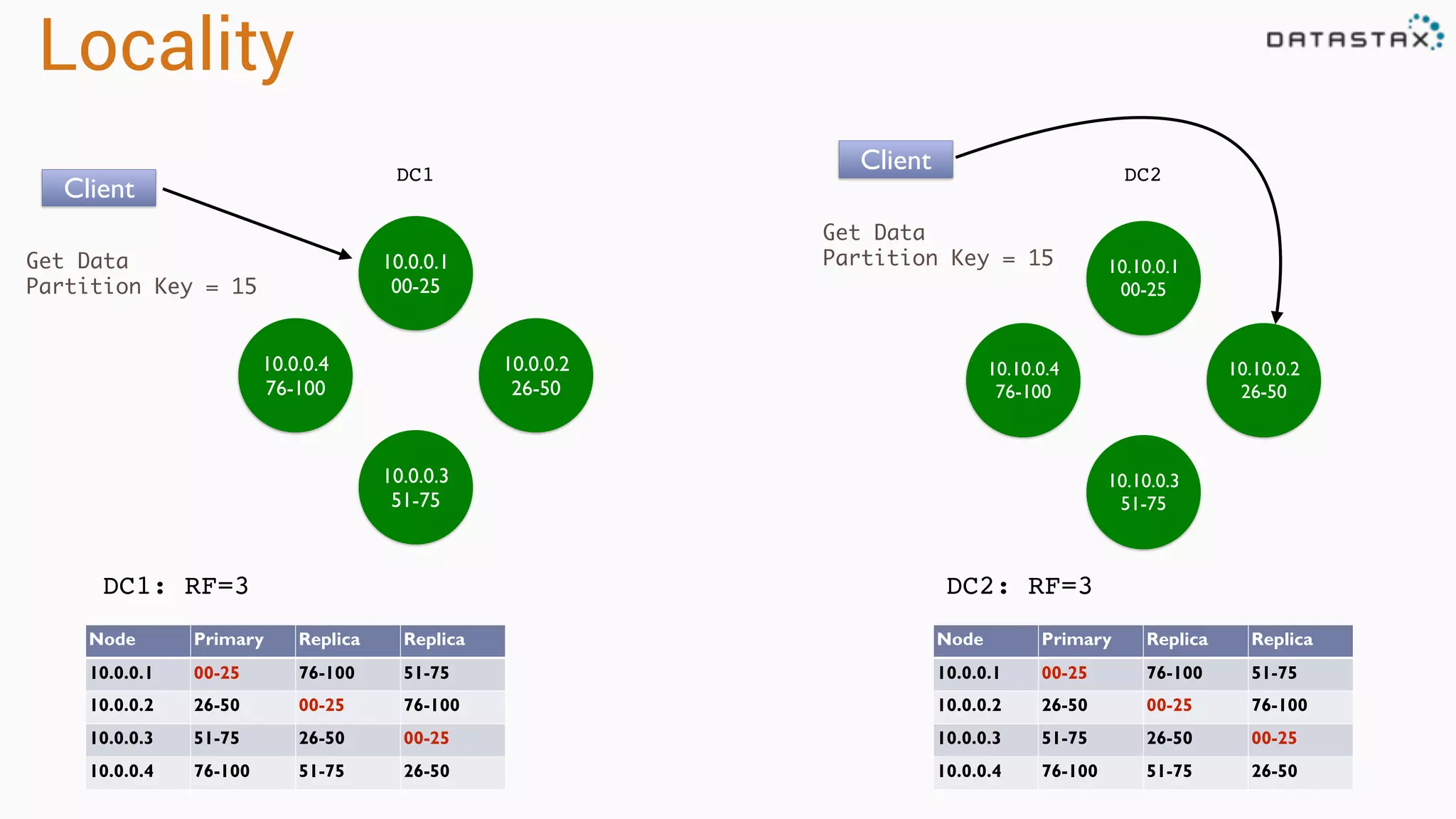
Locality
10.0.0.1
00-25
10.0.0.4
76-100
10.0.0.2
26-50
10.0.0.3
51-75
DC1
DC1: RF=3
Node Primary Replica Replica
10.0.0.1 00-25 76-100 51-75
10.0.0.2 26-50 00-25 76-100
10.0.0.3 51-75 26-50 00-25
10.0.0.4 76-100 51-75 26-50
10.10.0.1
00-25
10.10.0.4
76-100
10.10.0.2
26-50
10.10.0.3
51-75
DC2
Node Primary Replica Replica
10.0.0.1 00-25 76-100 51-75
10.0.0.2 26-50 00-25 76-100
10.0.0.3 51-75 26-50 00-25
10.0.0.4 76-100 51-75 26-50
DC2: RF=3
Client
Get Data
Partition Key = 15
Client
Get Data
Partition Key = 15
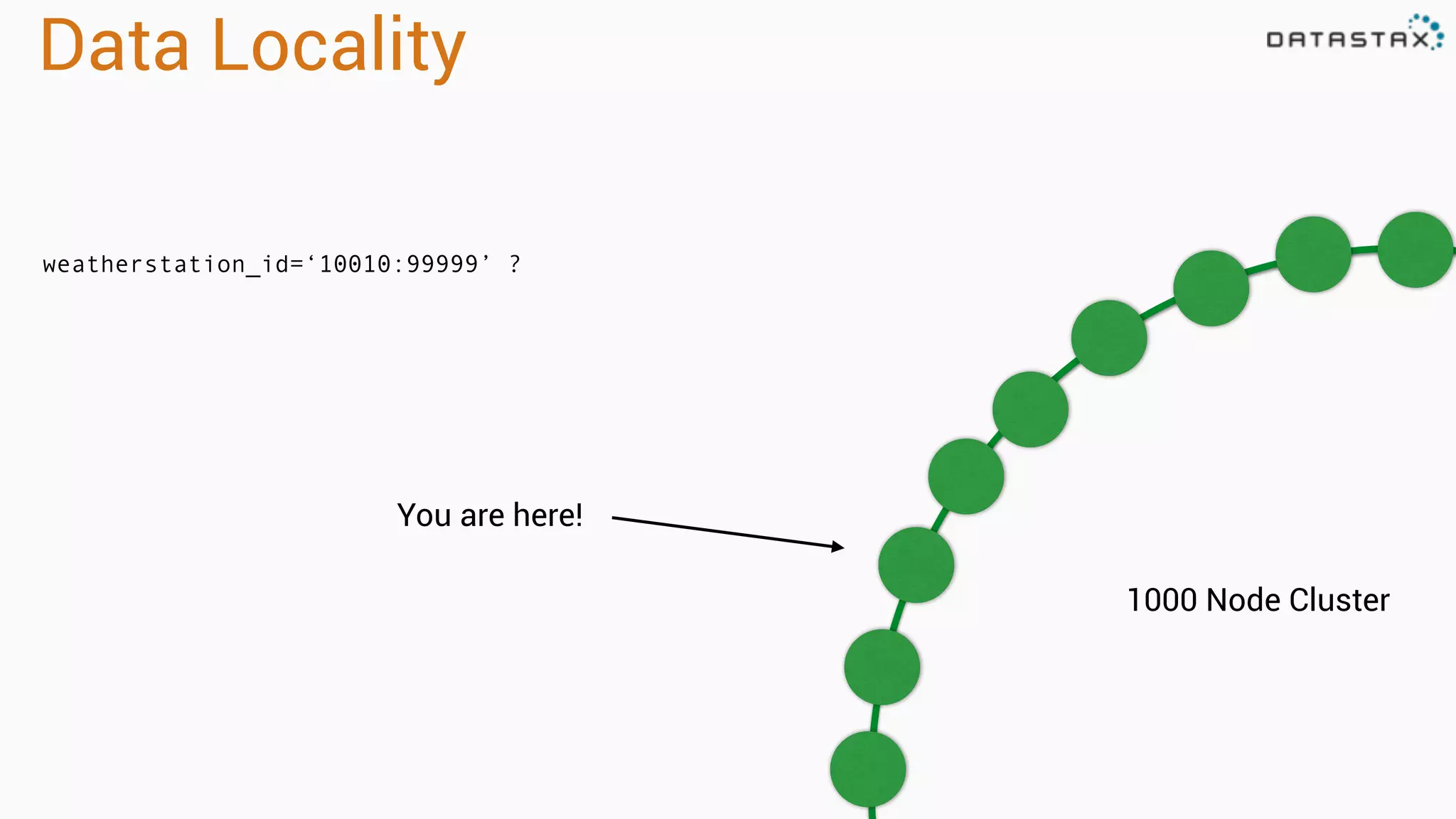
Data Locality
weatherstation_id=‘10010:99999’ ?
1000 Node Cluster
You are here!
Spark Reads on Cassandra
Awesome animation by DataStax’s own Russel Spitzer
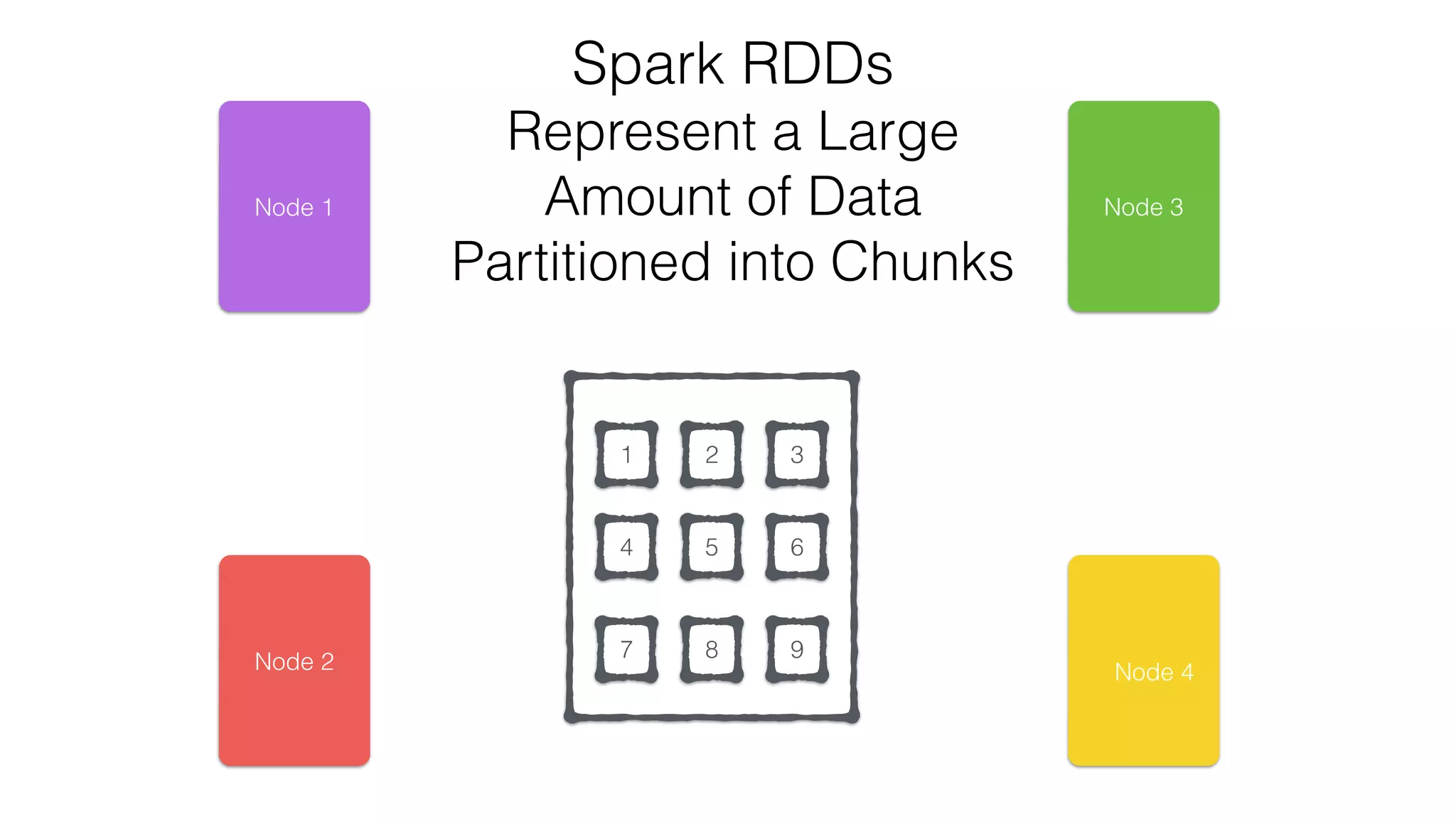
Spark RDDs
Represent a Large
Amount of Data
Partitioned into Chunks
RDD
1 2 3
4 5 6
7 8 9Node 2
Node 1 Node 3
Node 4
Node 2
Node 1
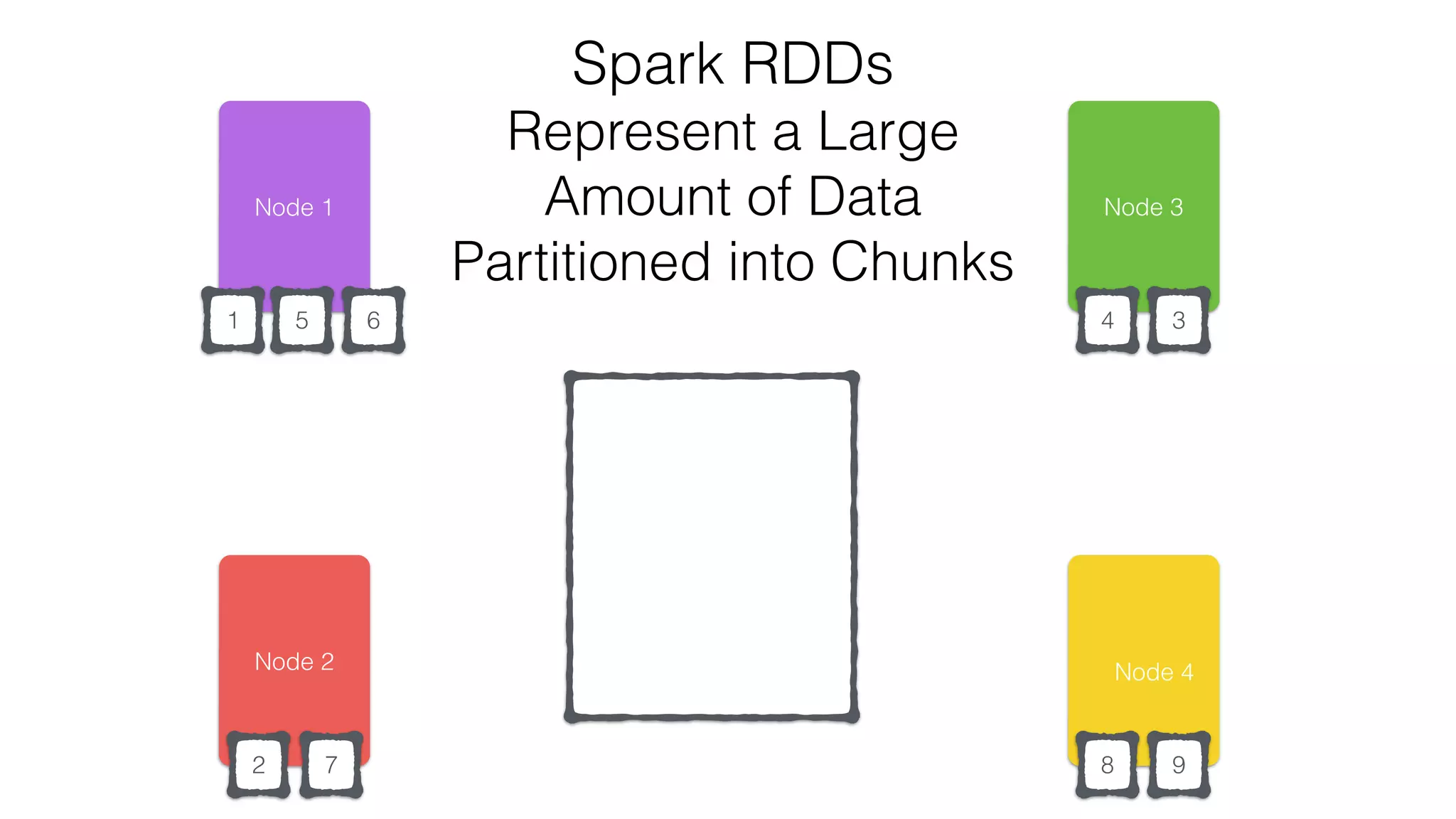
Spark RDDs
Represent a Large
Amount of Data
Partitioned into Chunks
RDD
2
346
7 8 9
Node 3
Node 4
1 5
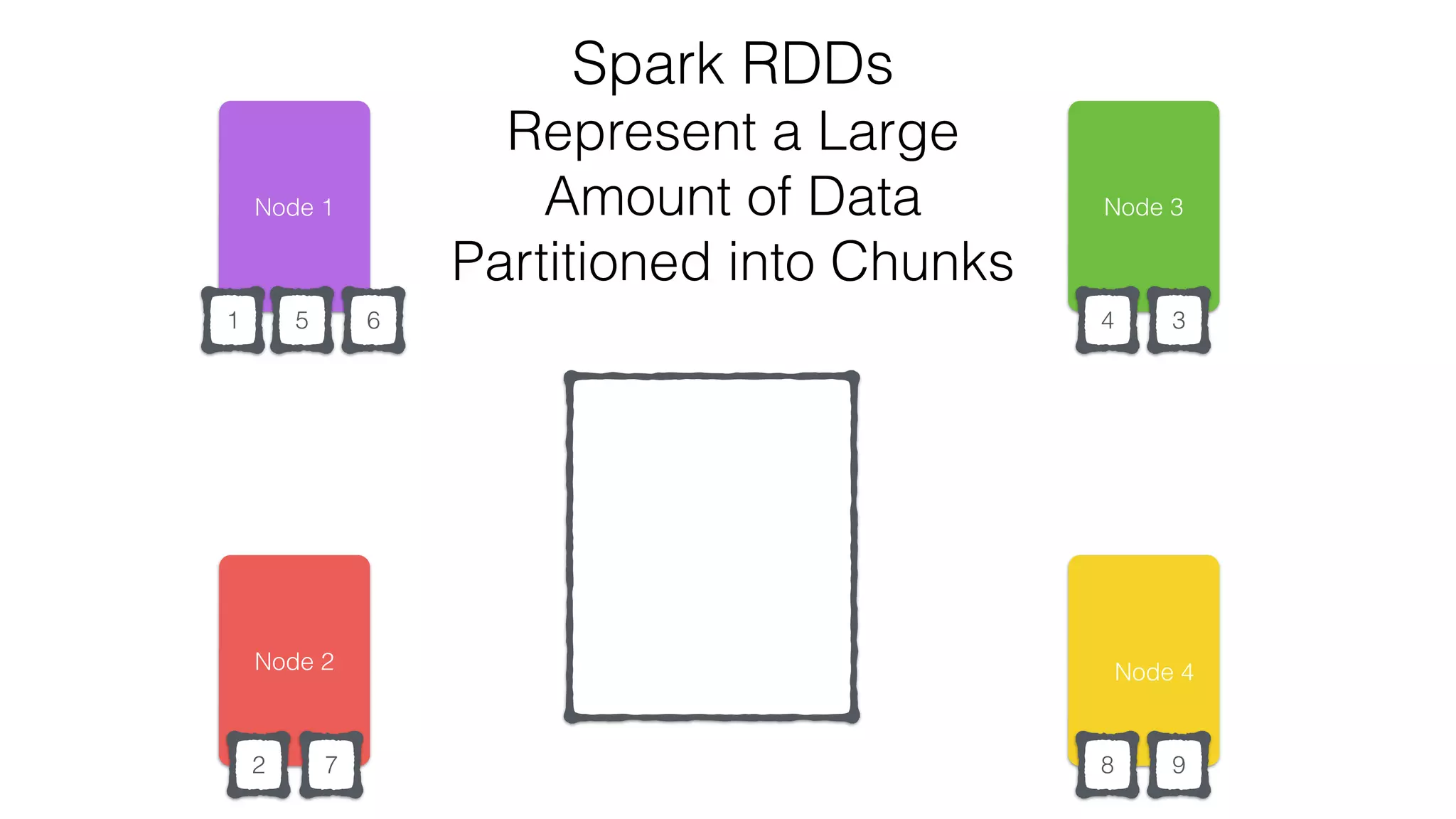
Node 2
Node 1
RDD
2
346
7 8 9
Node 3
Node 4
1 5
Spark RDDs
Represent a Large
Amount of Data
Partitioned into Chunks
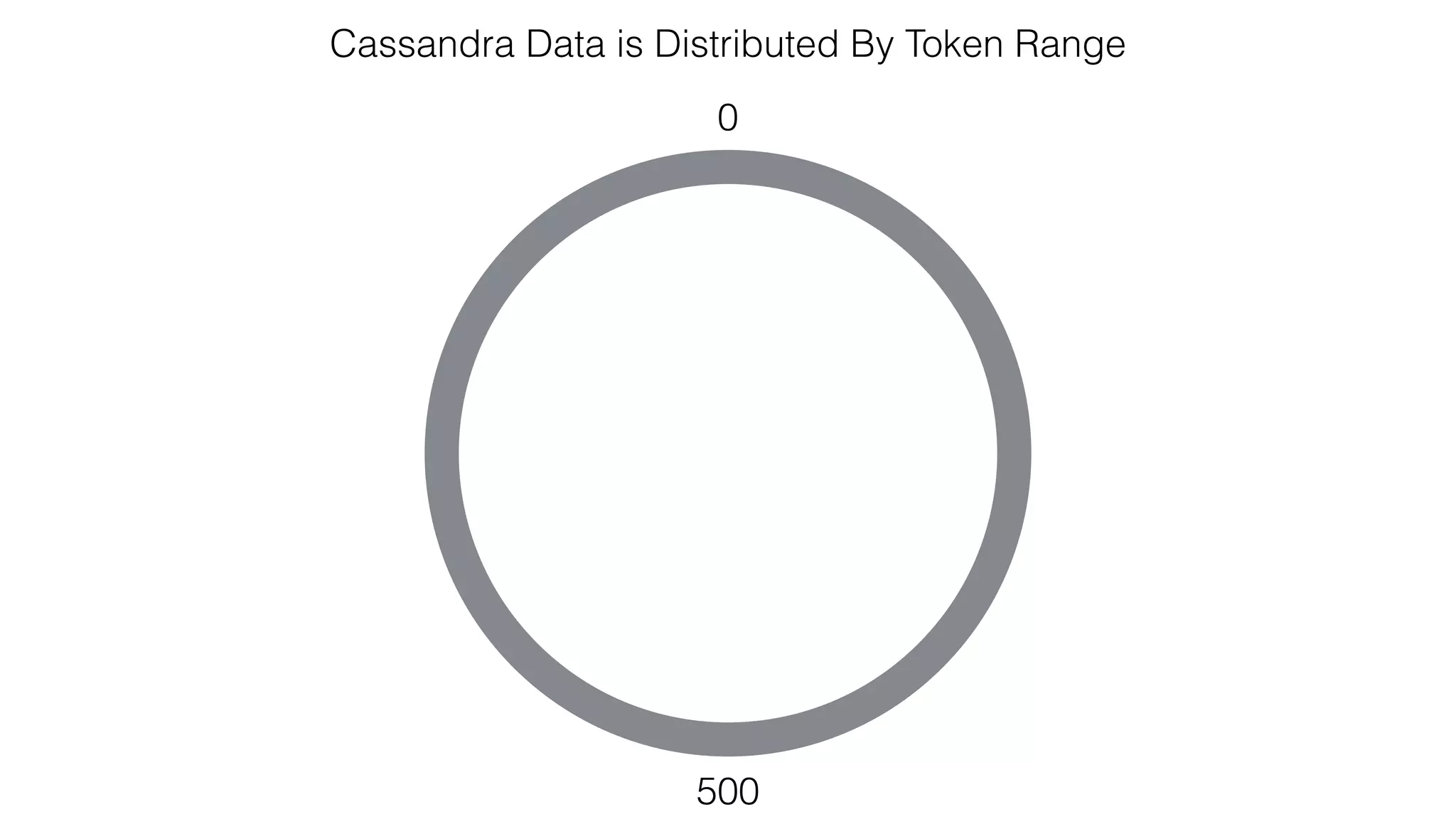
Cassandra Data is Distributed By Token Range
0
500
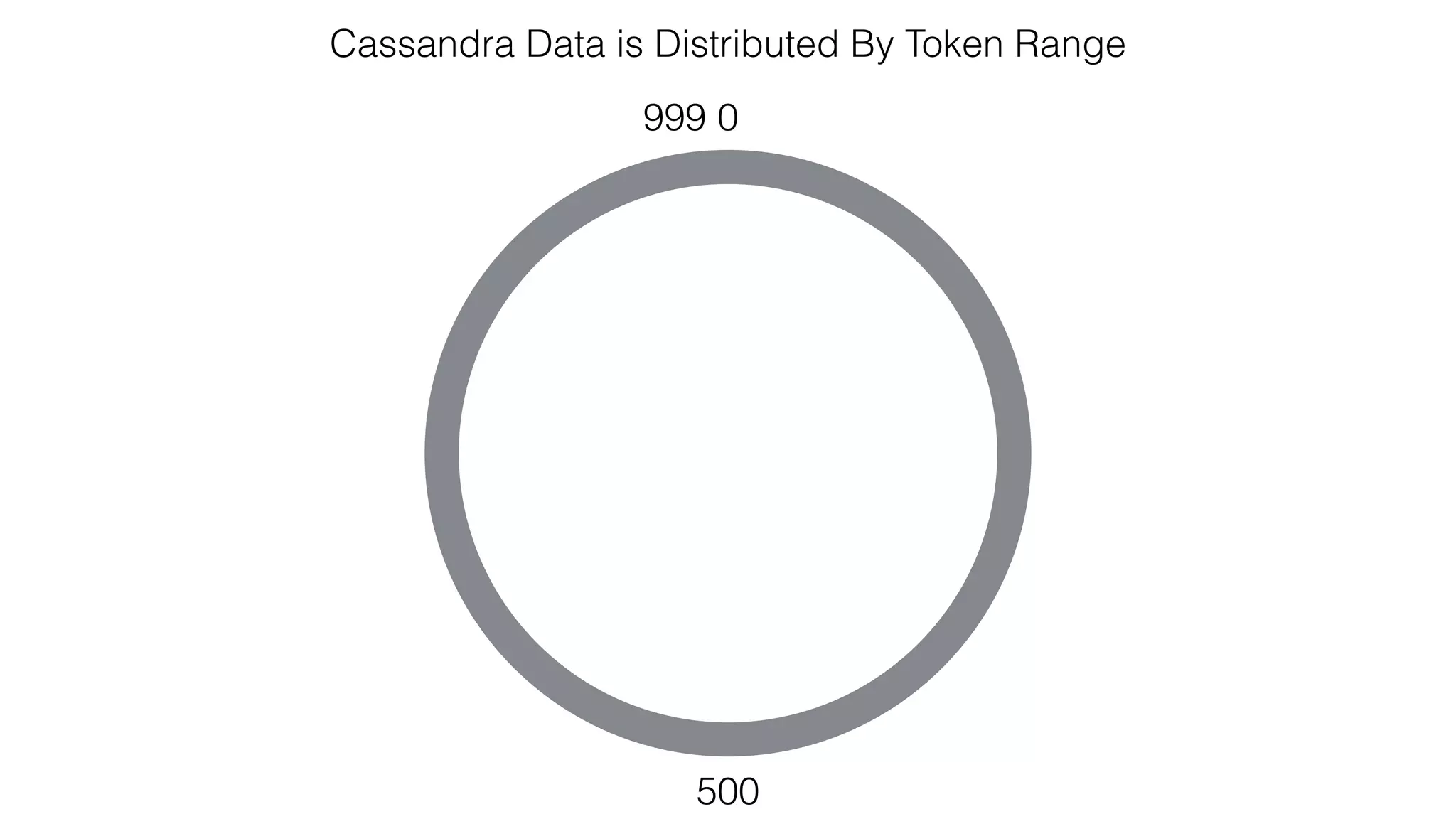
Cassandra Data is Distributed By Token Range
0
500
999
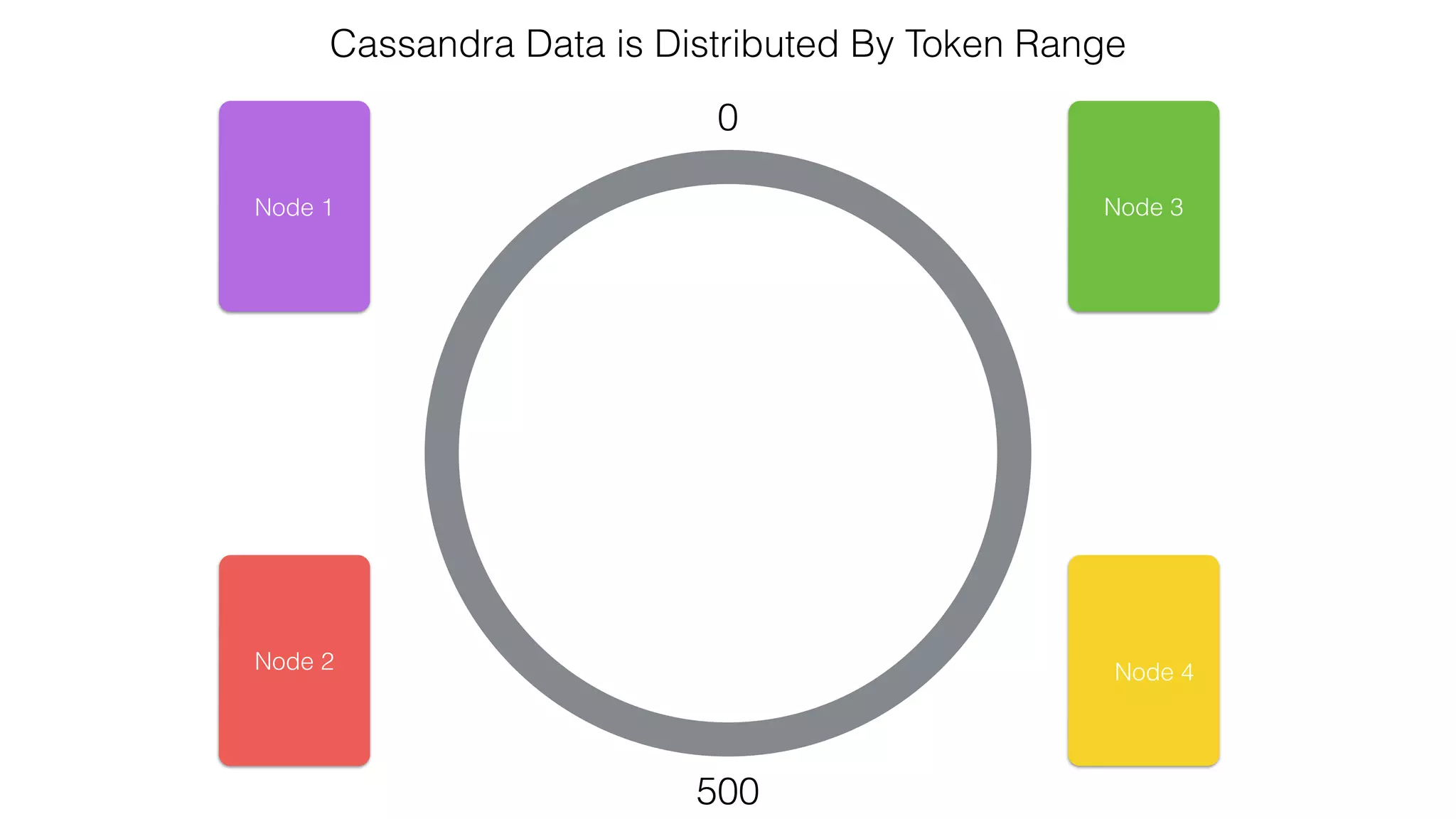
Cassandra Data is Distributed By Token Range
0
500
Node 1
Node 2
Node 3
Node 4
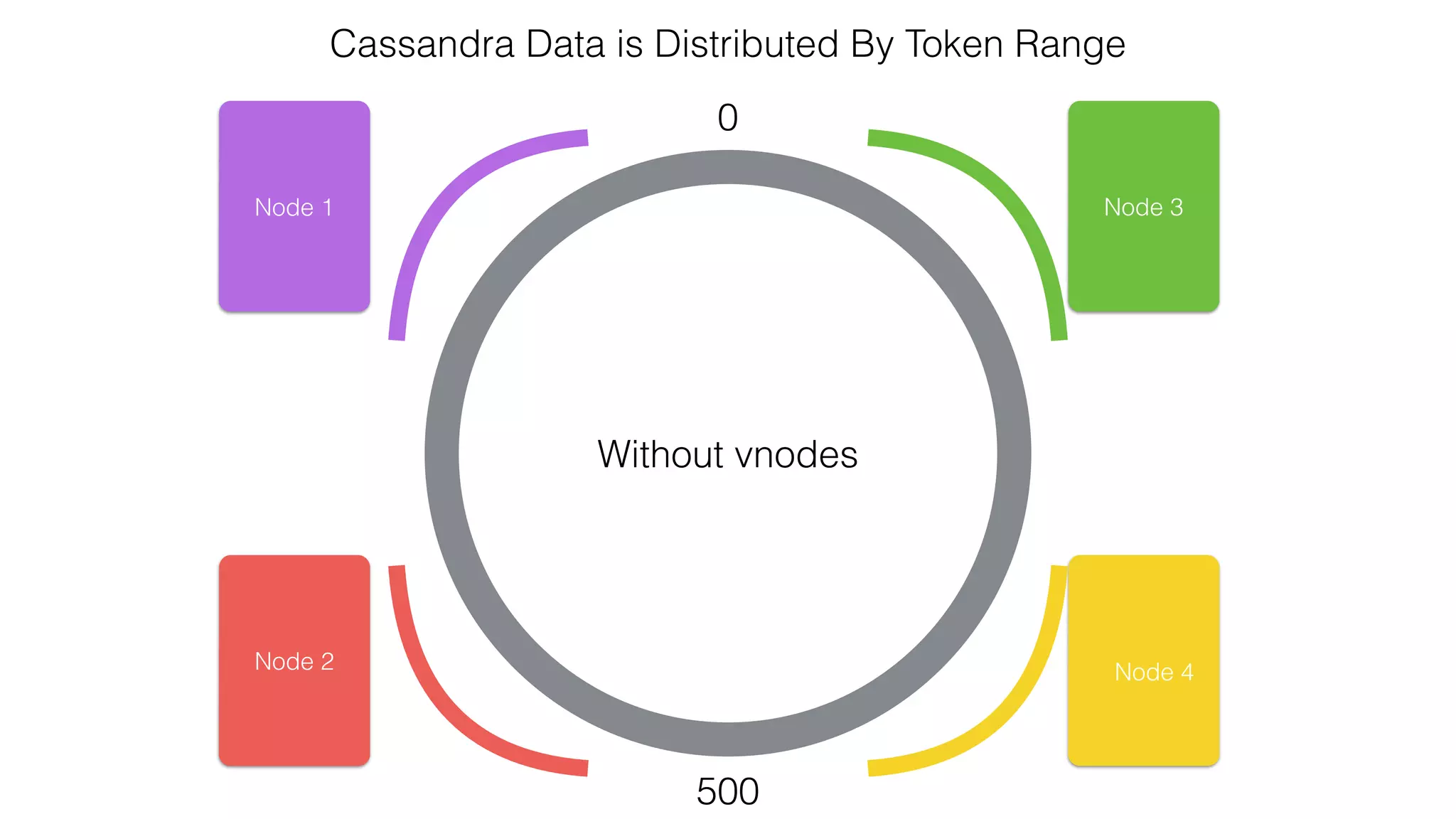
Cassandra Data is Distributed By Token Range
0
500
Node 1
Node 2
Node 3
Node 4
Without vnodes
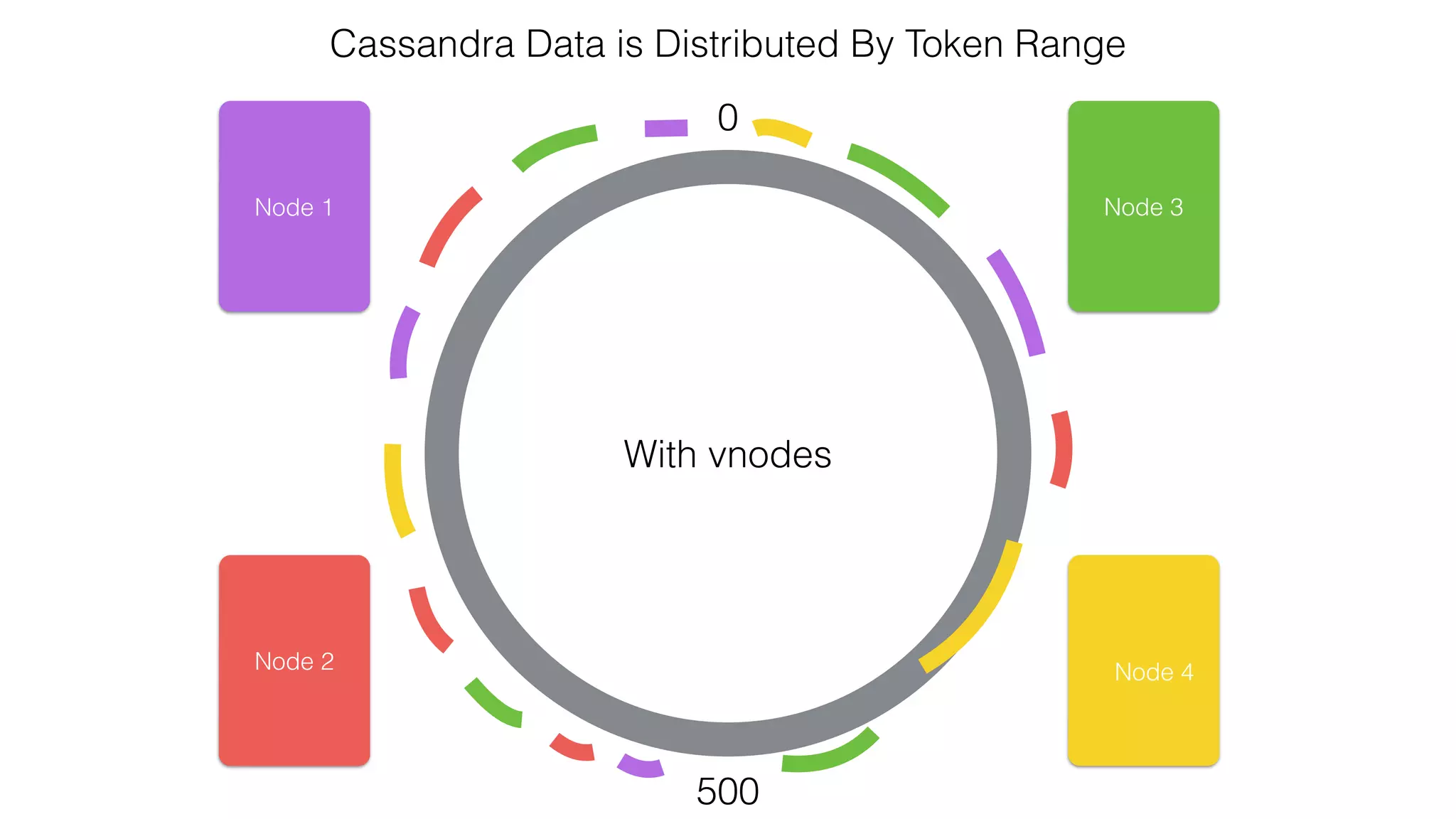
Cassandra Data is Distributed By Token Range
0
500
Node 1
Node 2
Node 3
Node 4
With vnodes
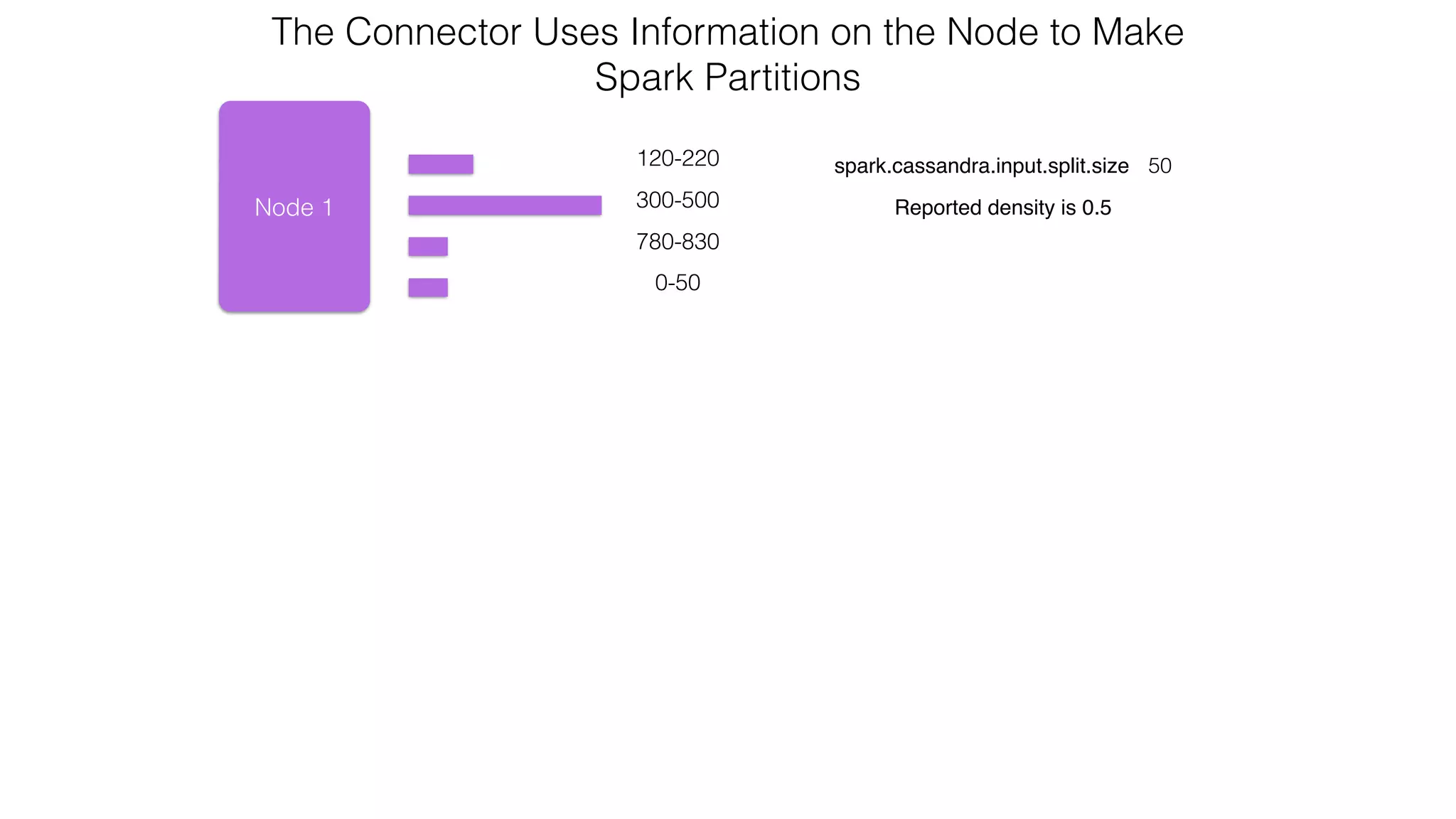
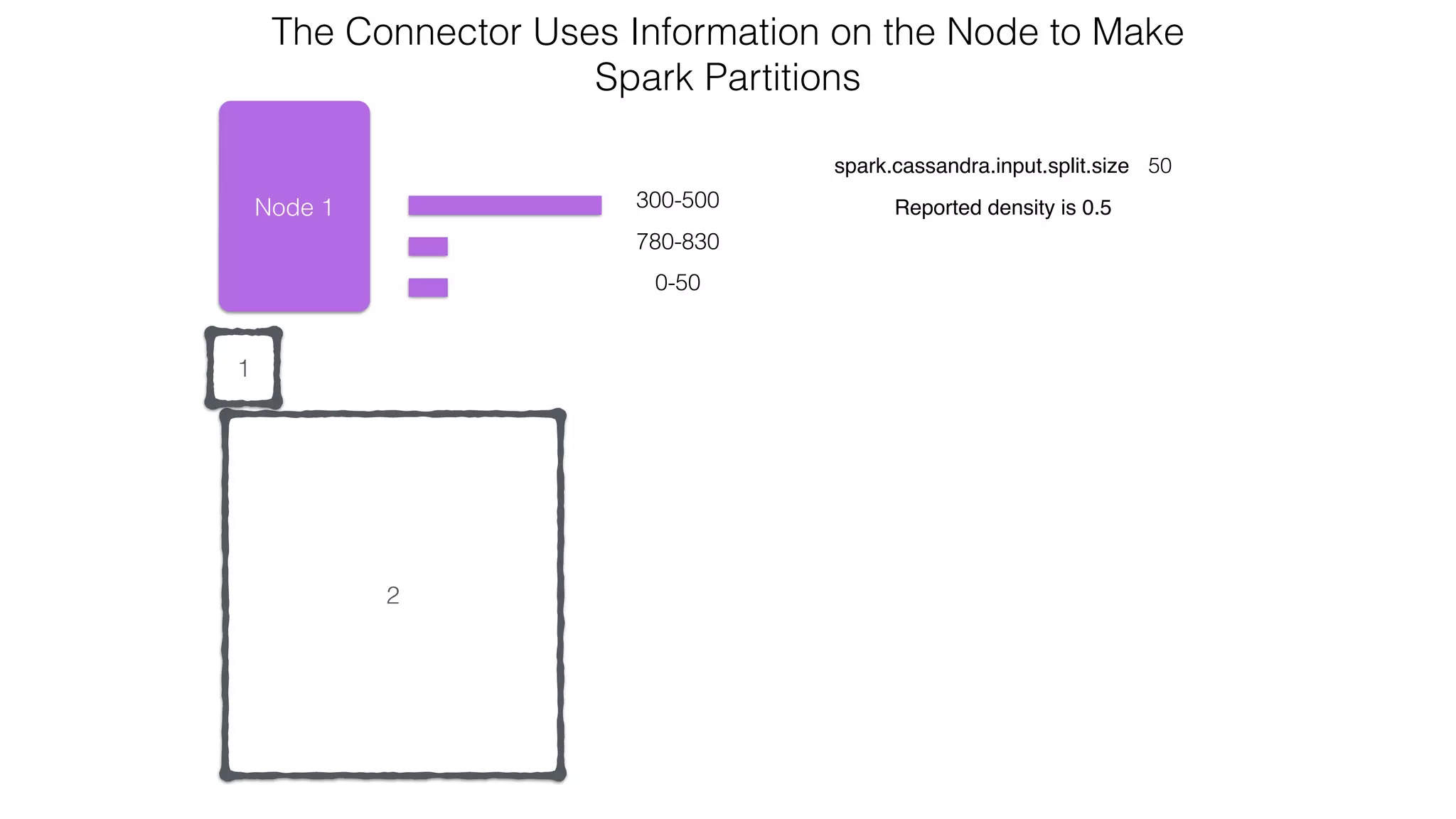
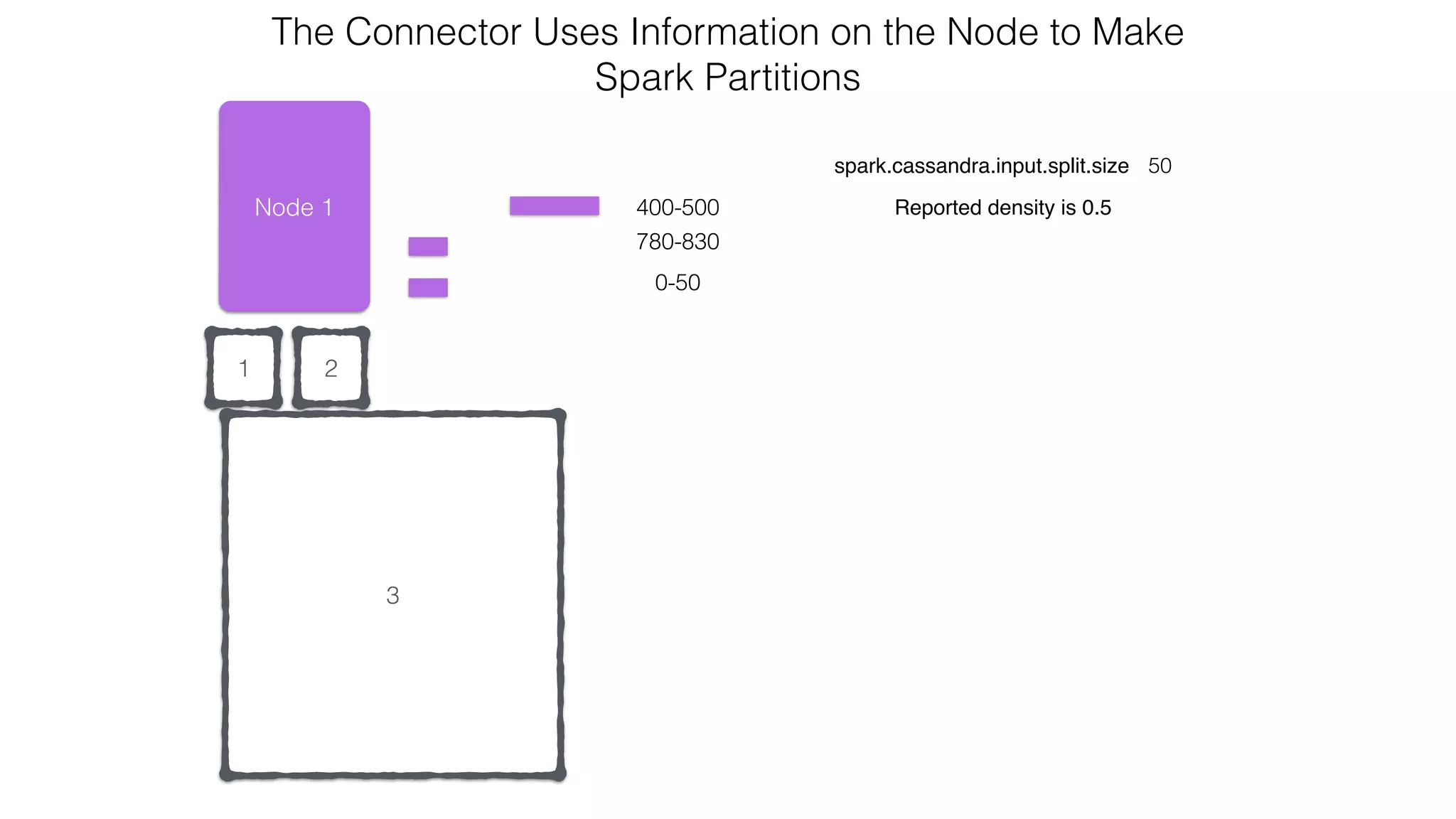
Node 1
120-220
300-500
780-830
0-50
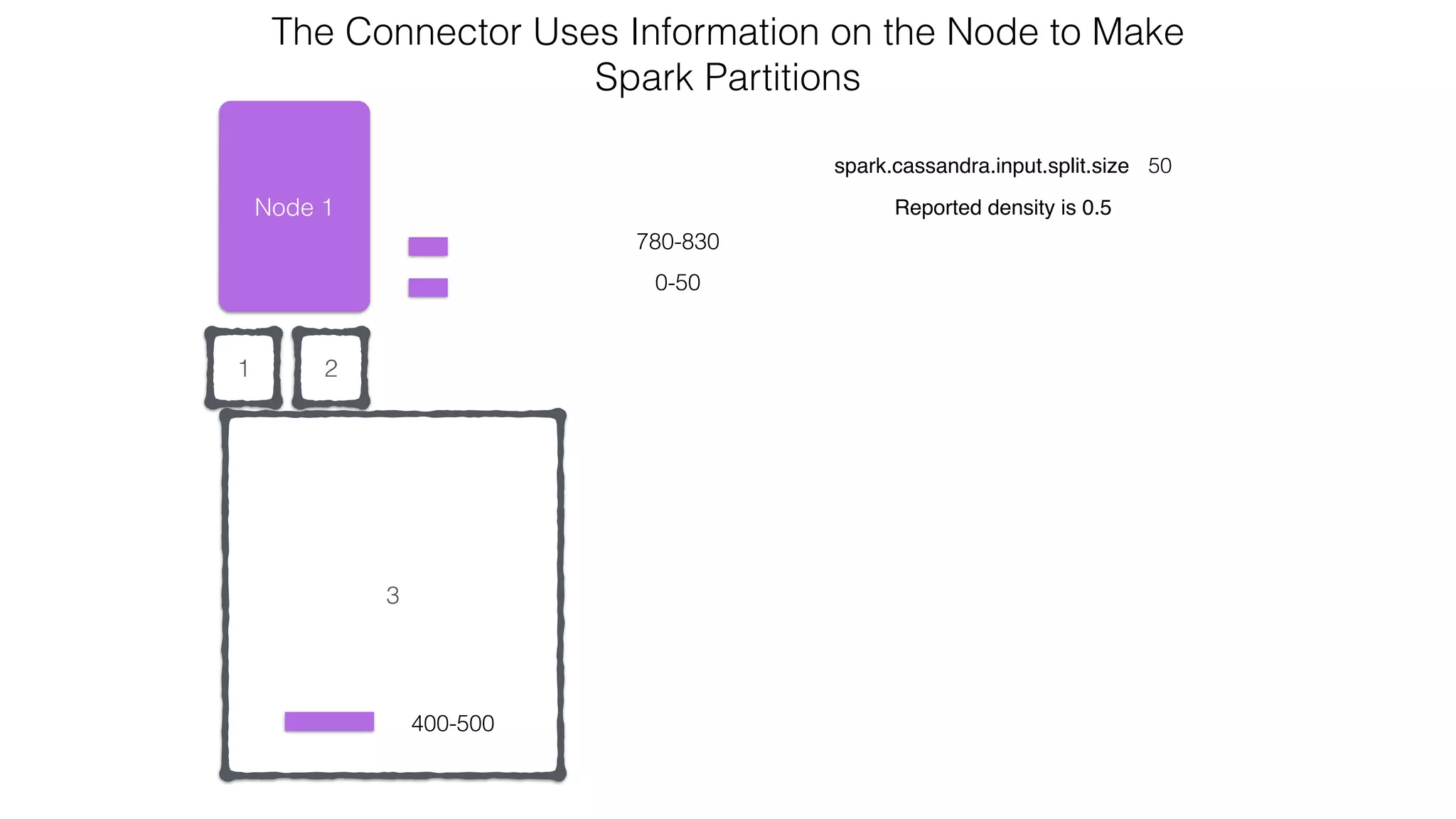
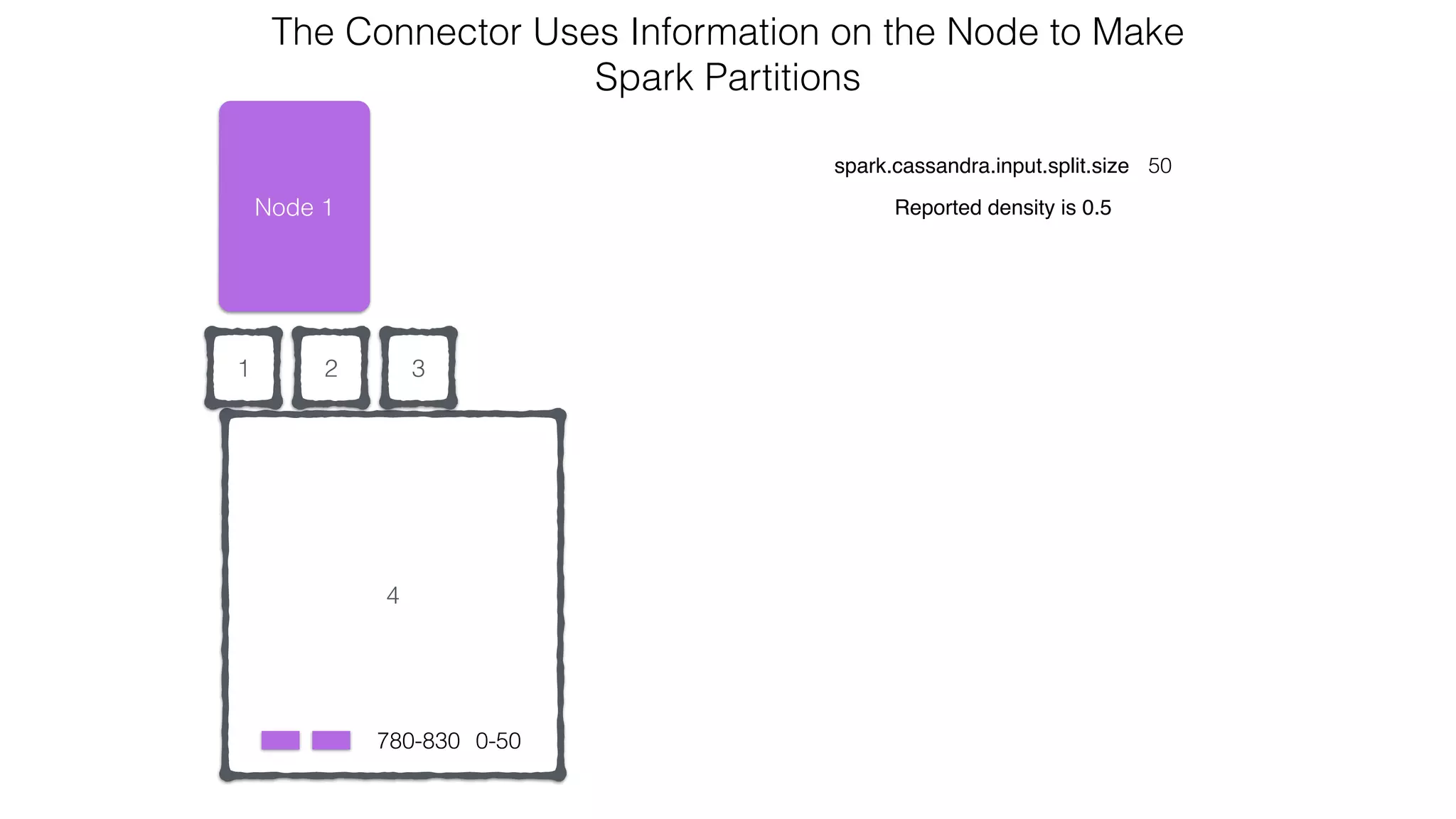
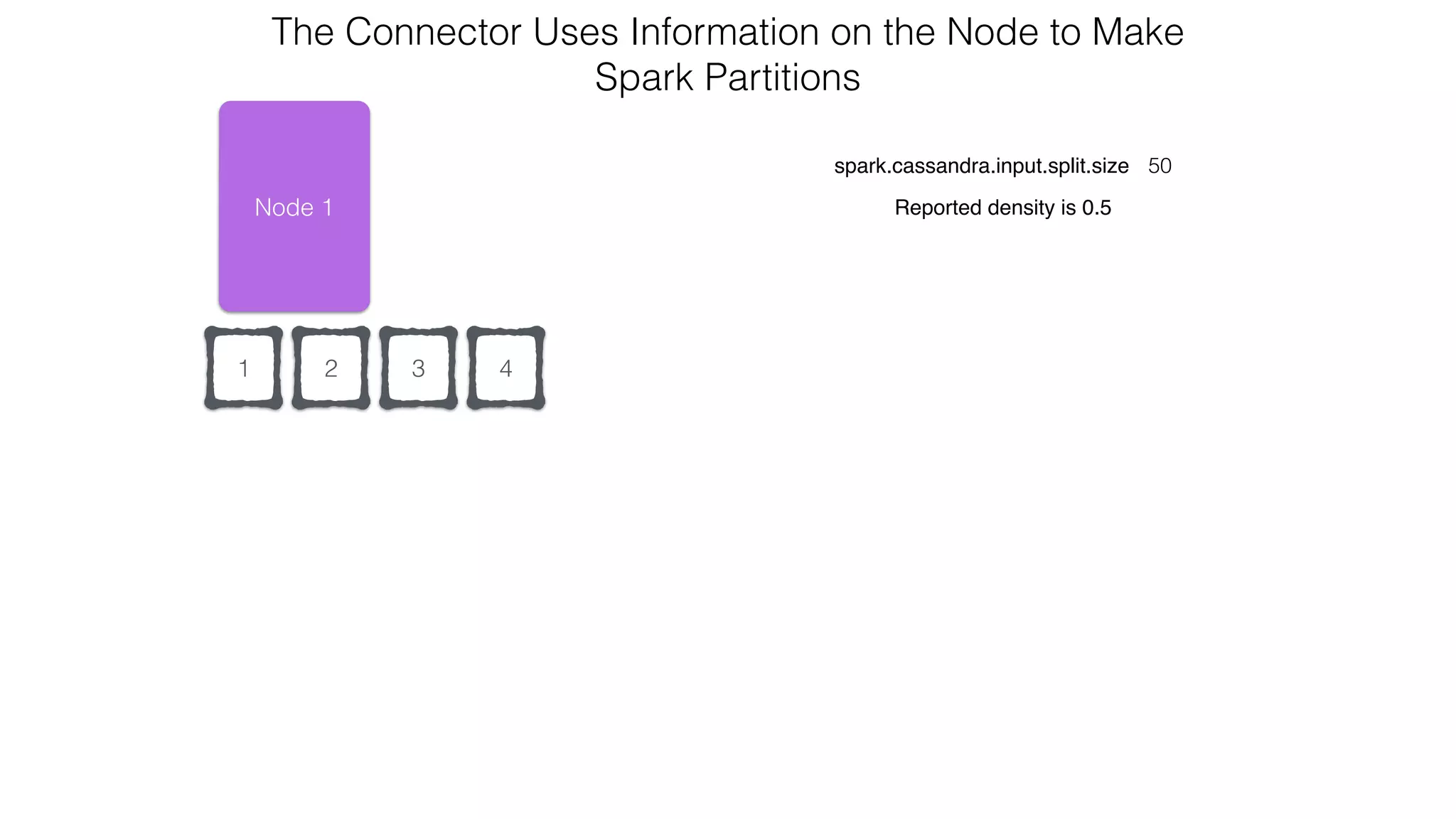
spark.cassandra.input.split.size 50
Reported density is 0.5
The Connector Uses Information on the Node to Make 

Spark Partitions
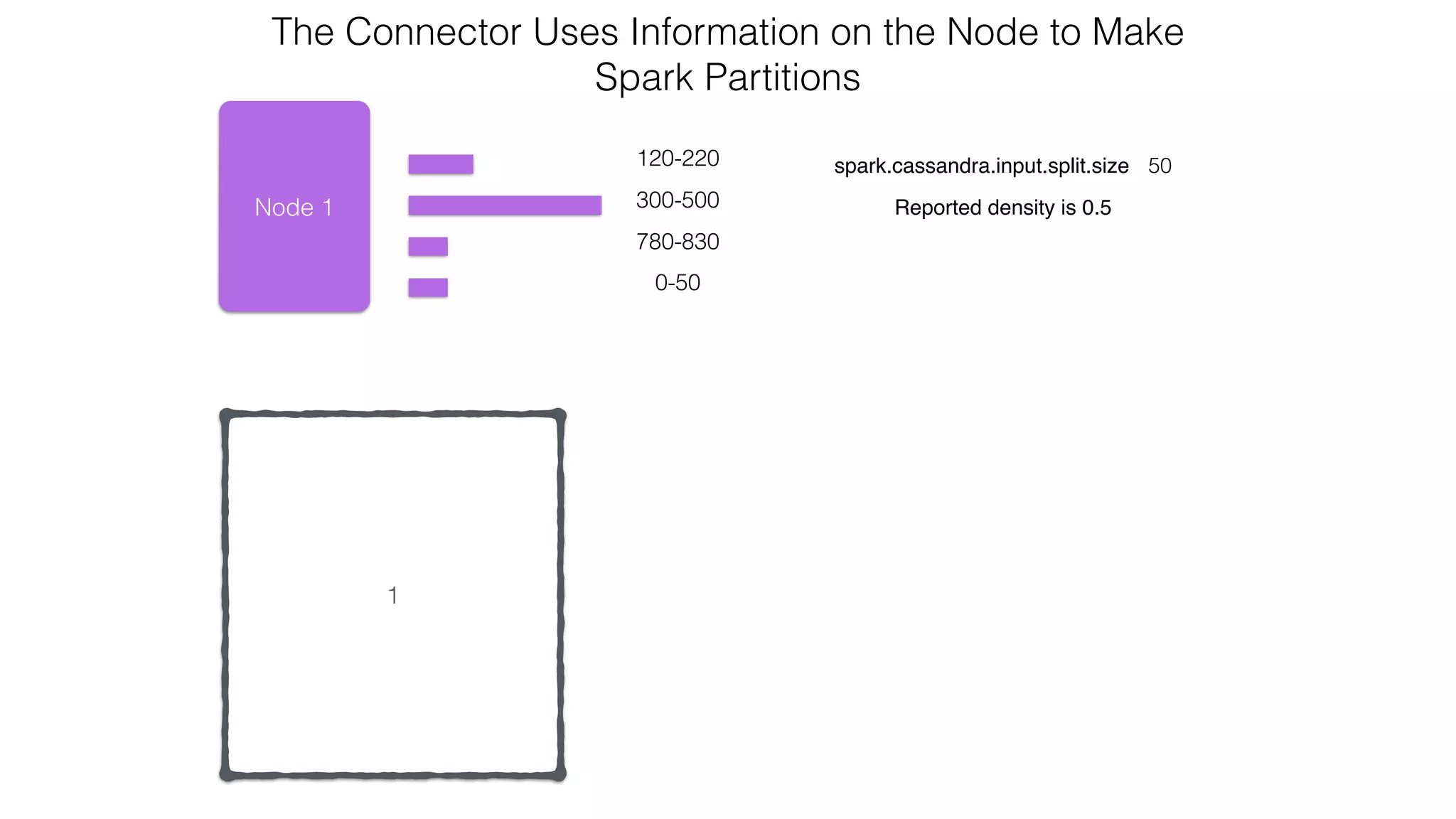
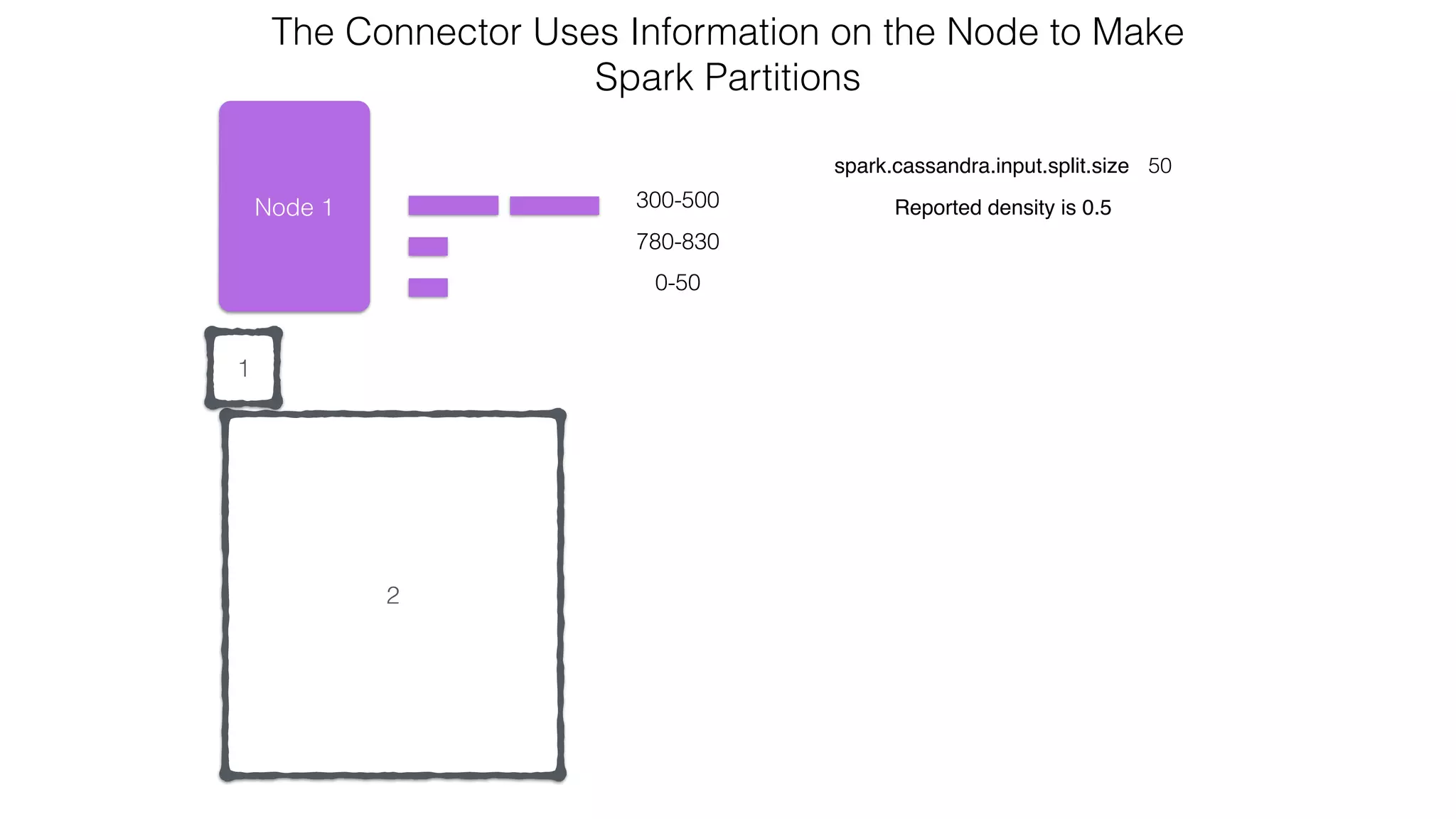
Node 1
120-220
300-500
0-50
spark.cassandra.input.split.size 50
Reported density is 0.5
The Connector Uses Information on the Node to Make 

Spark Partitions
1
780-830
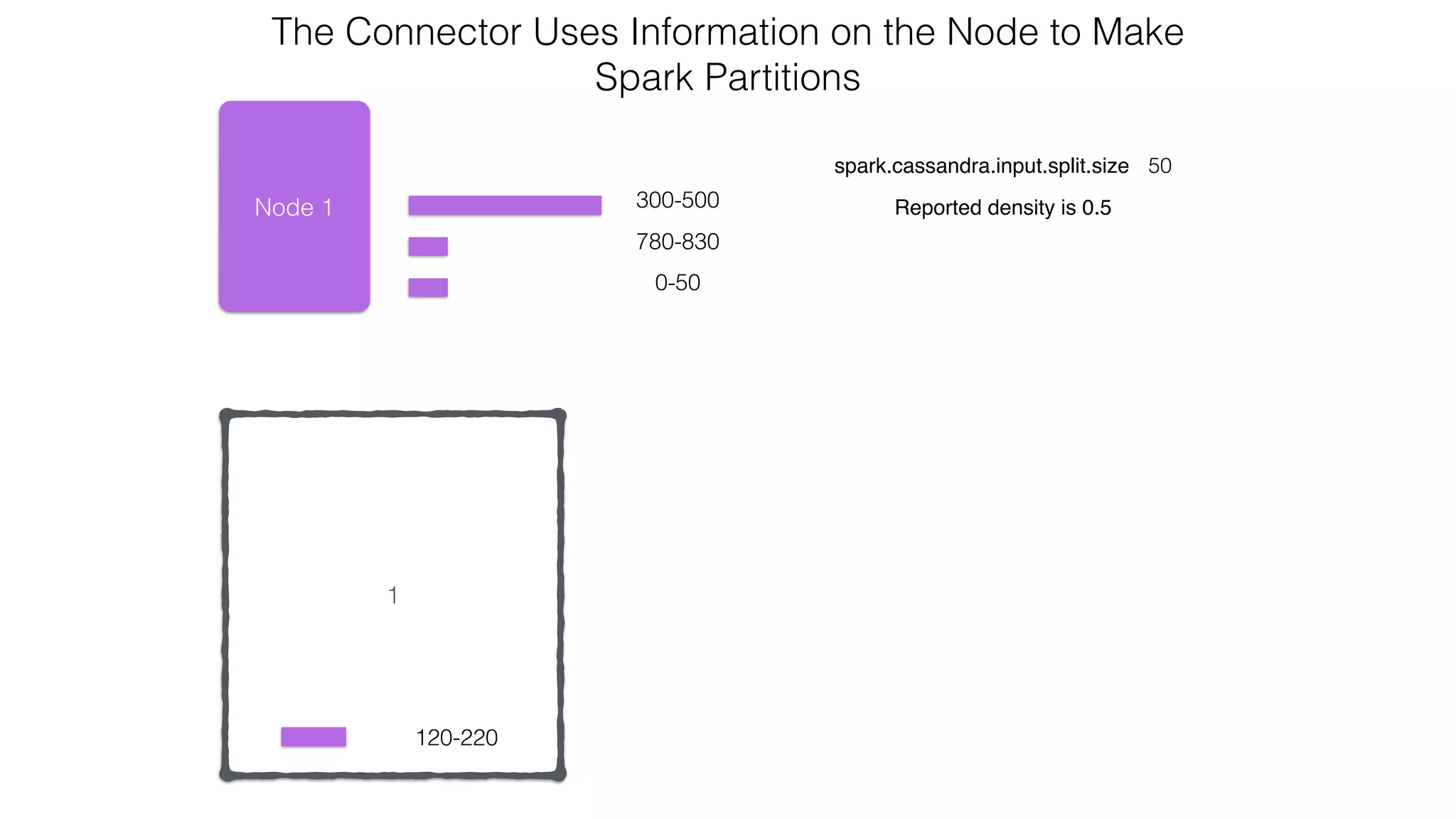
1
Node 1
120-220
300-500
0-50
spark.cassandra.input.split.size 50
Reported density is 0.5
The Connector Uses Information on the Node to Make 

Spark Partitions
780-830
2
1
Node 1 300-500
0-50
spark.cassandra.input.split.size 50
Reported density is 0.5
The Connector Uses Information on the Node to Make 

Spark Partitions
780-830
2
1
Node 1 300-500
0-50
spark.cassandra.input.split.size 50
Reported density is 0.5
The Connector Uses Information on the Node to Make 

Spark Partitions
780-830
2
1
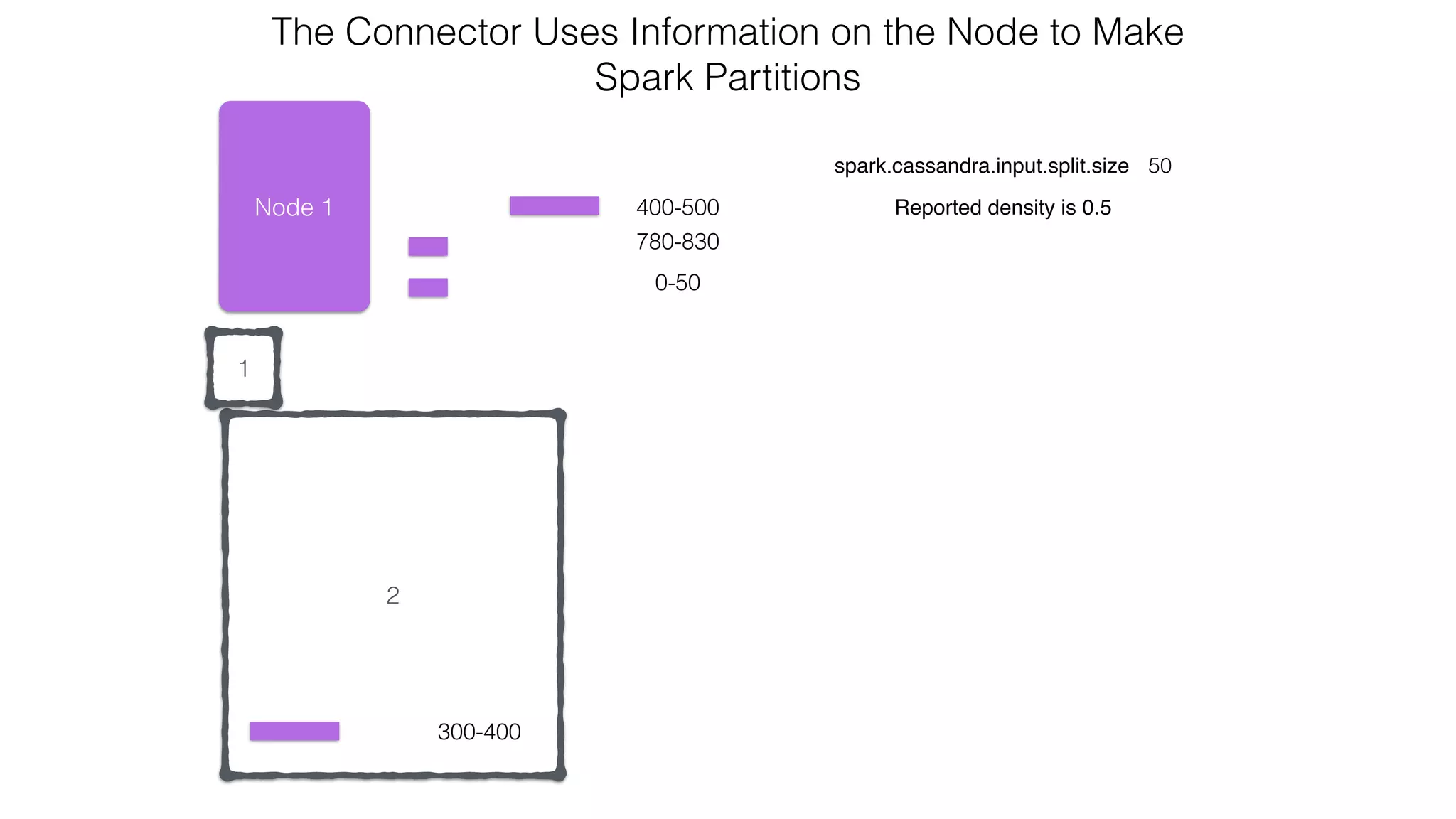
Node 1
300-400
0-50
spark.cassandra.input.split.size 50
Reported density is 0.5
The Connector Uses Information on the Node to Make 

Spark Partitions
780-830
400-500
21
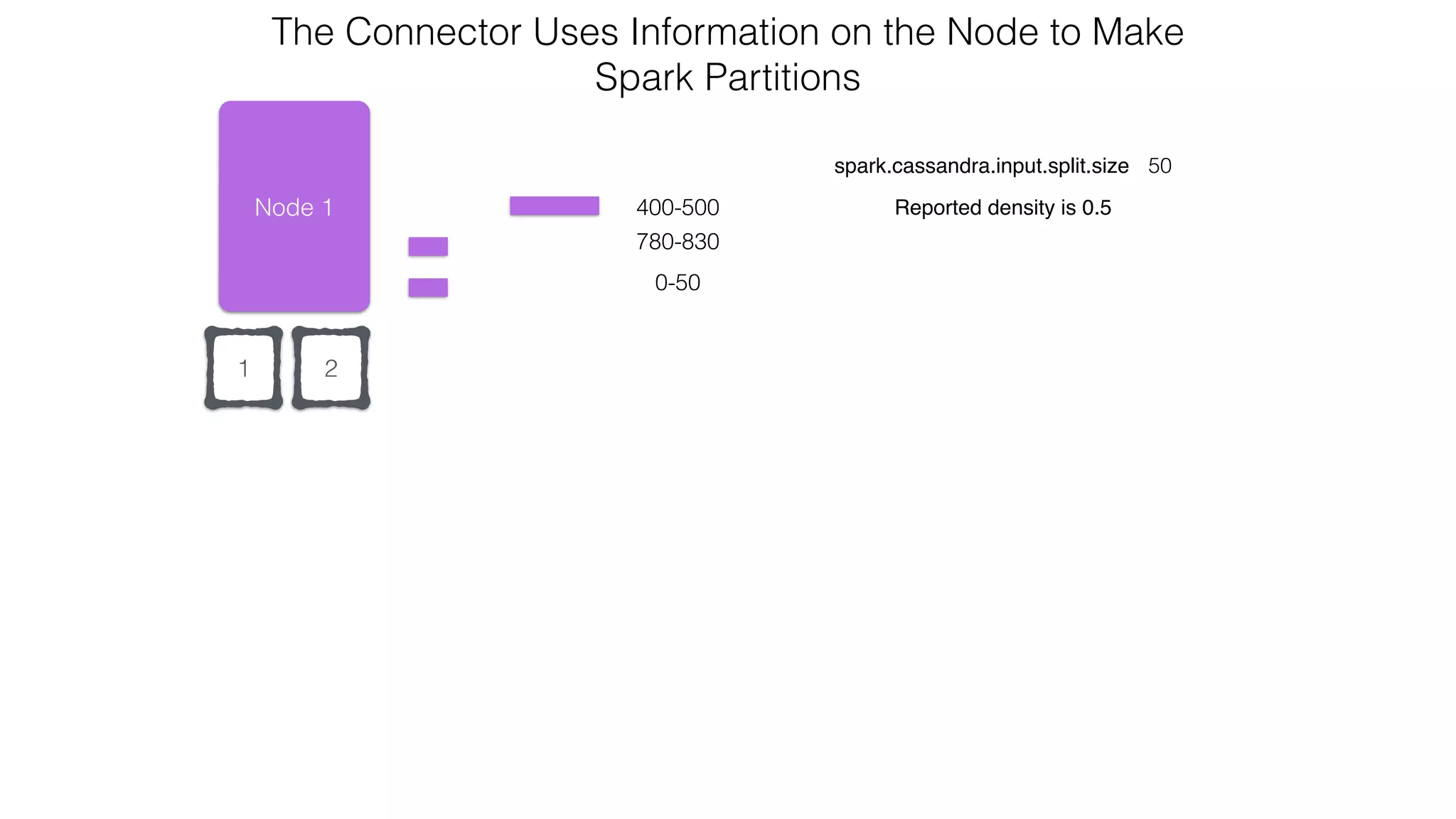
Node 1
0-50
spark.cassandra.input.split.size 50
Reported density is 0.5
The Connector Uses Information on the Node to Make 

Spark Partitions
780-830
400-500
21
Node 1
0-50
spark.cassandra.input.split.size 50
Reported density is 0.5
The Connector Uses Information on the Node to Make 

Spark Partitions
780-830
400-500
3
21
Node 1
0-50
spark.cassandra.input.split.size 50
Reported density is 0.5
The Connector Uses Information on the Node to Make 

Spark Partitions
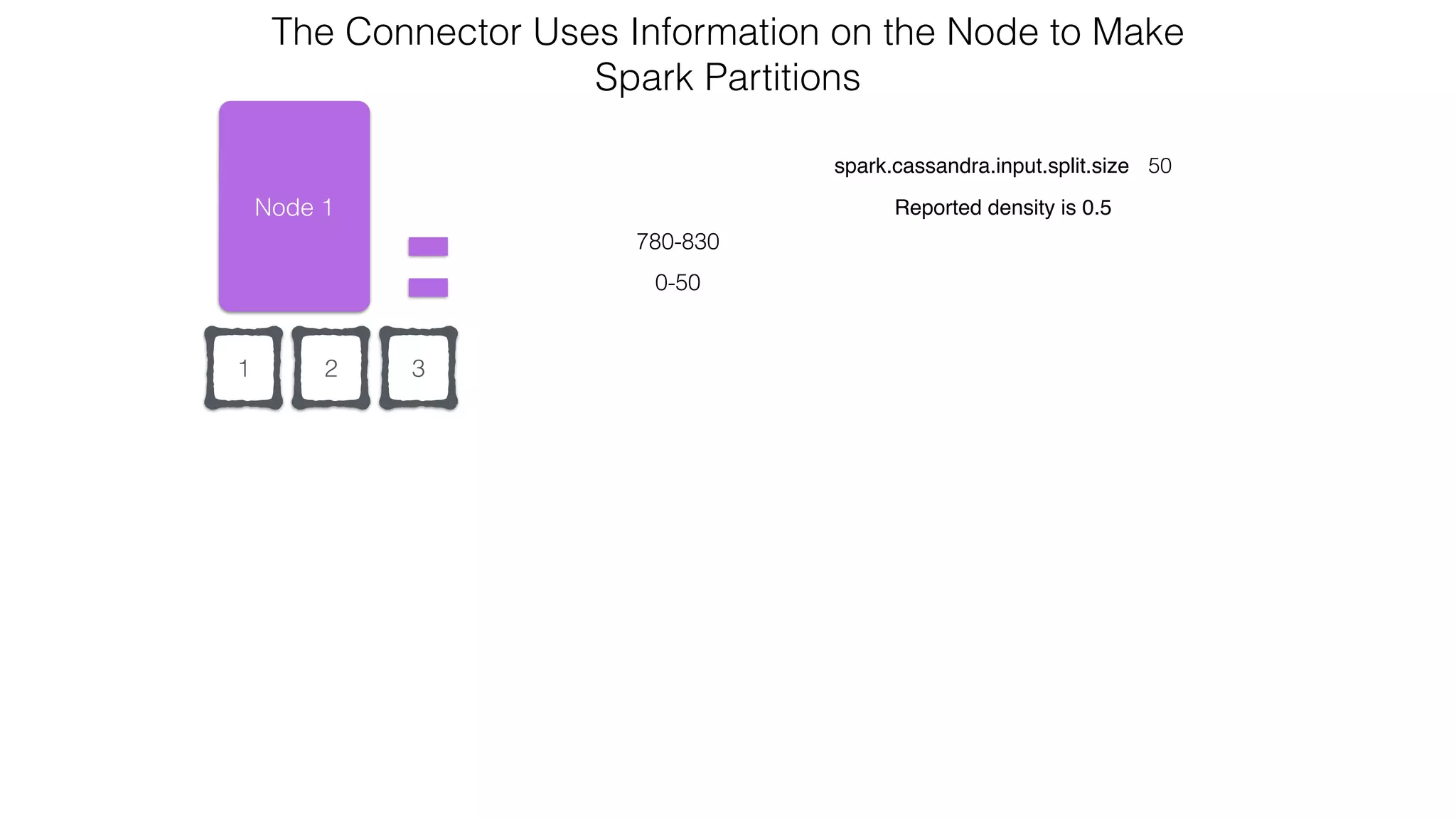
780-830
3
400-500
21
Node 1
0-50
spark.cassandra.input.split.size 50
Reported density is 0.5
The Connector Uses Information on the Node to Make 

Spark Partitions
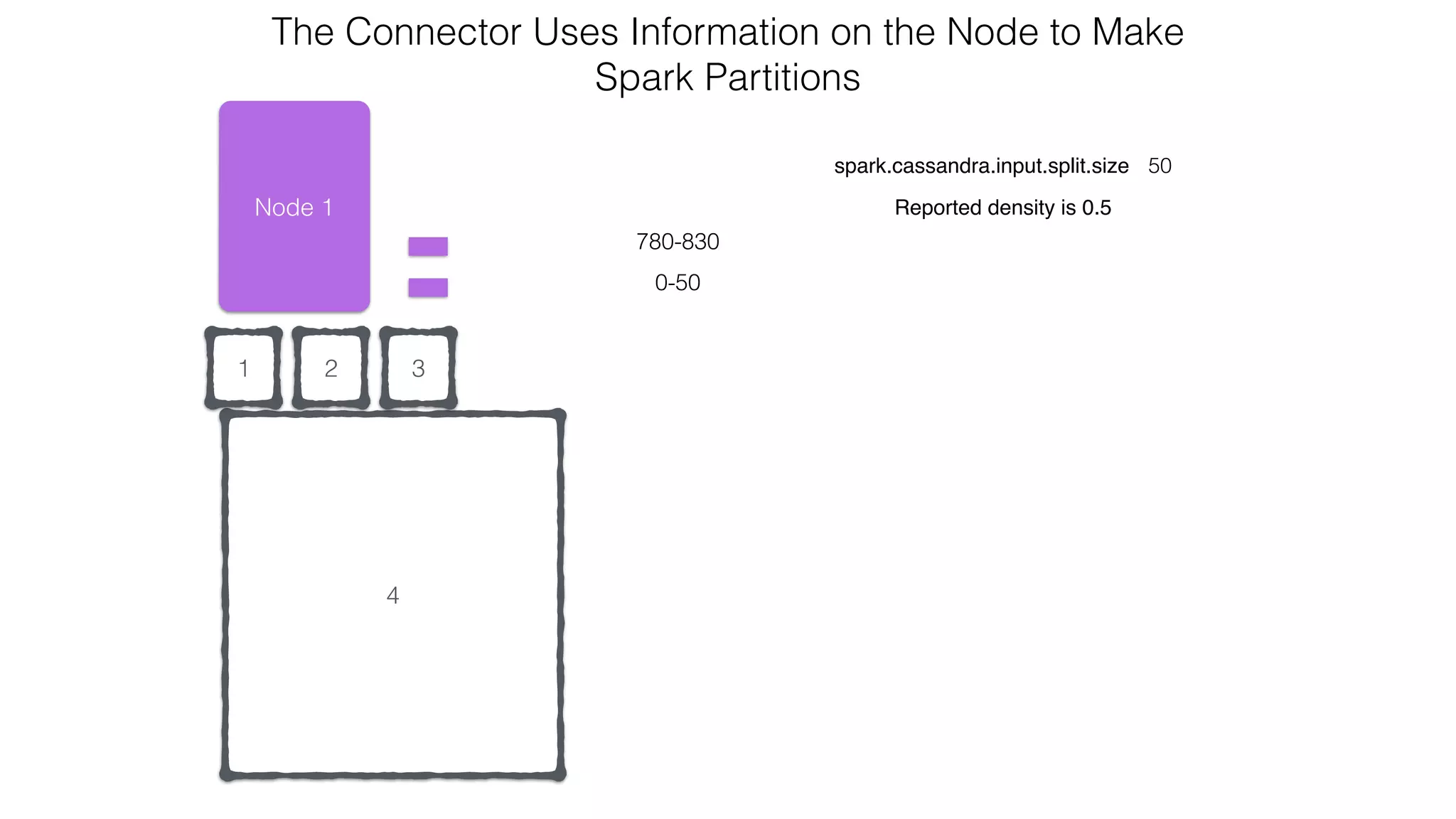
780-830
3
4
21
Node 1
0-50
spark.cassandra.input.split.size 50
Reported density is 0.5
The Connector Uses Information on the Node to Make 

Spark Partitions
780-830
3
4
21
Node 1
0-50
spark.cassandra.input.split.size 50
Reported density is 0.5
The Connector Uses Information on the Node to Make 

Spark Partitions
780-830
3
421
Node 1
spark.cassandra.input.split.size 50
Reported density is 0.5
The Connector Uses Information on the Node to Make 

Spark Partitions
3
4
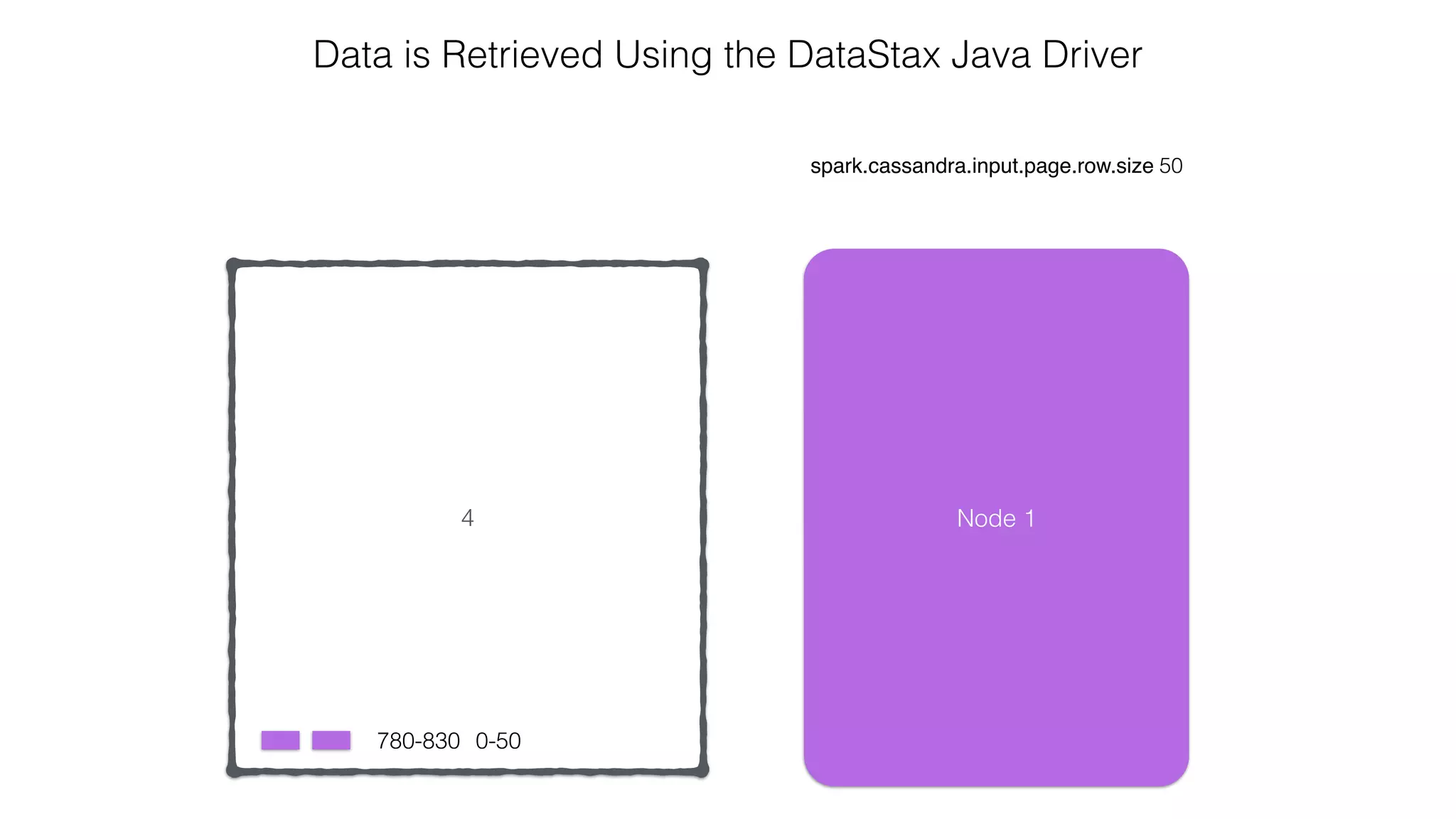
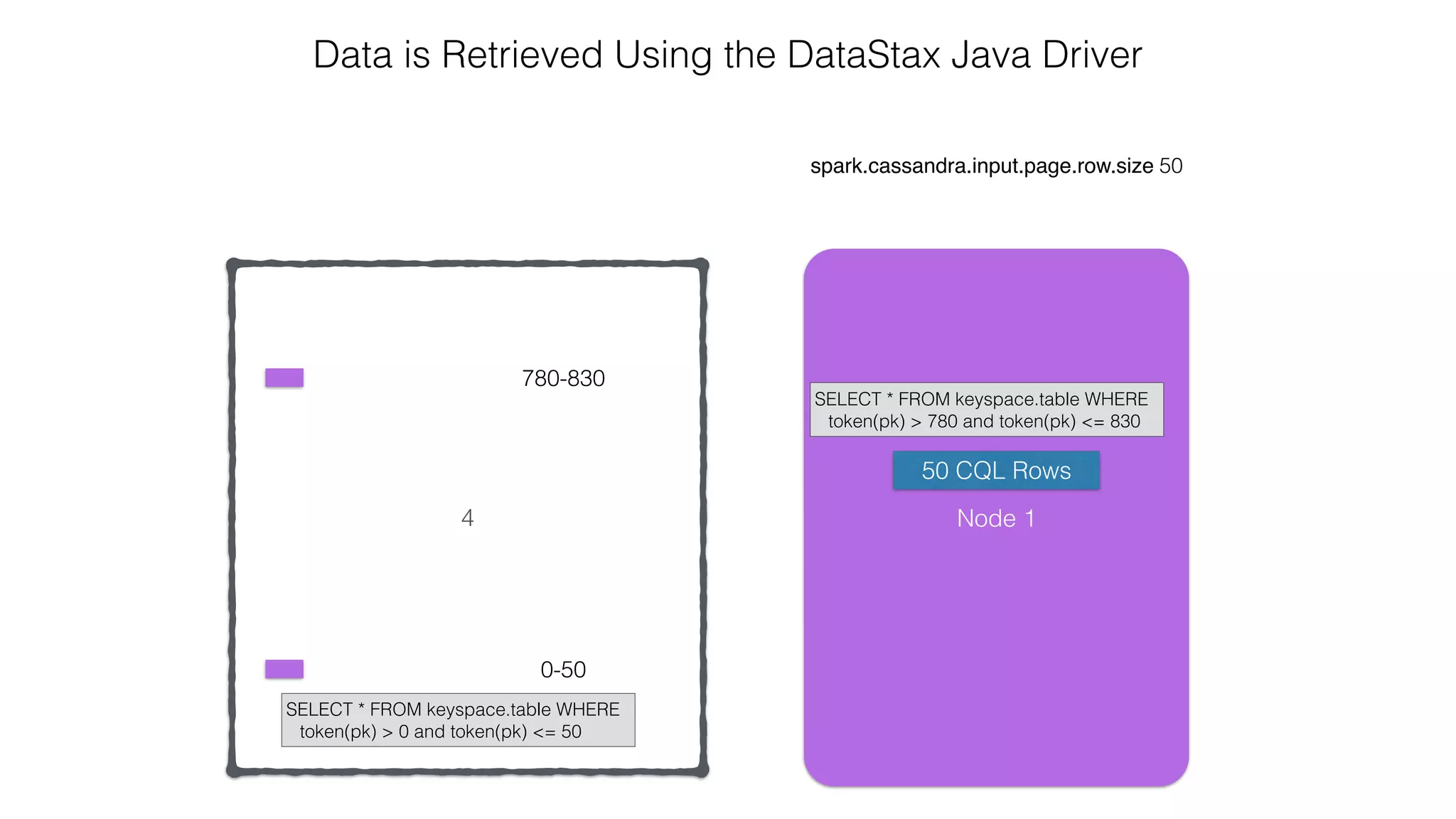
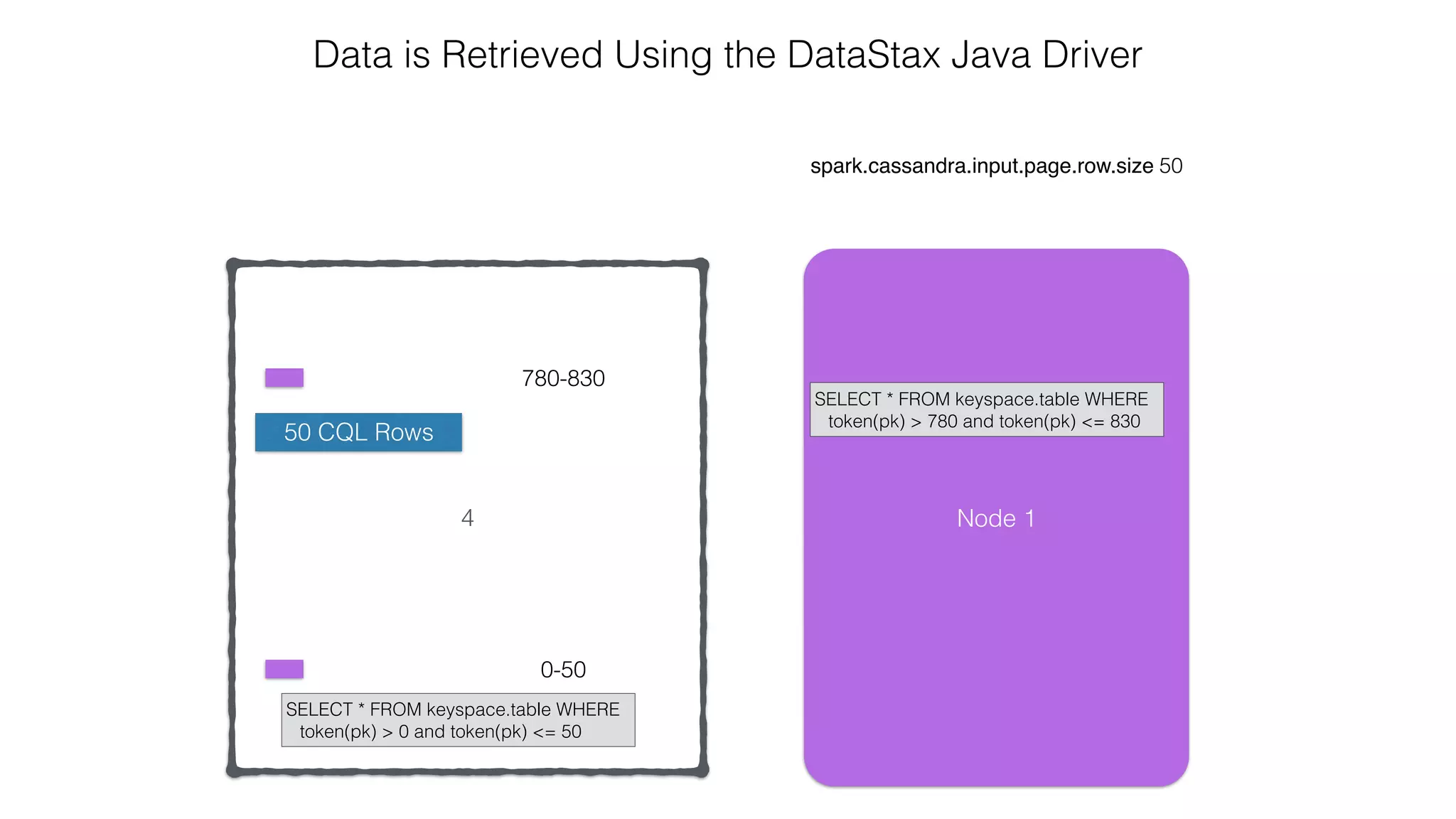
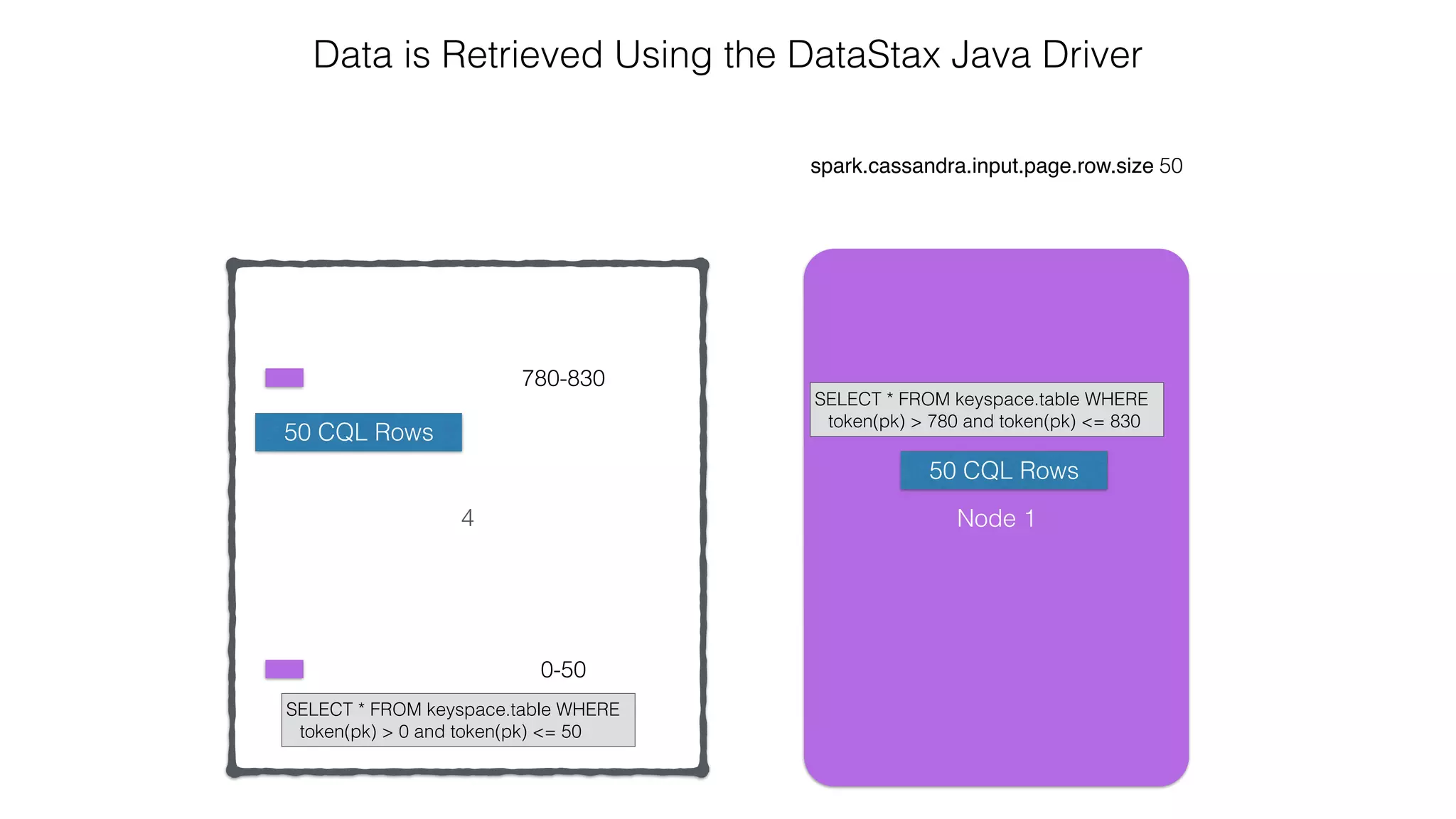
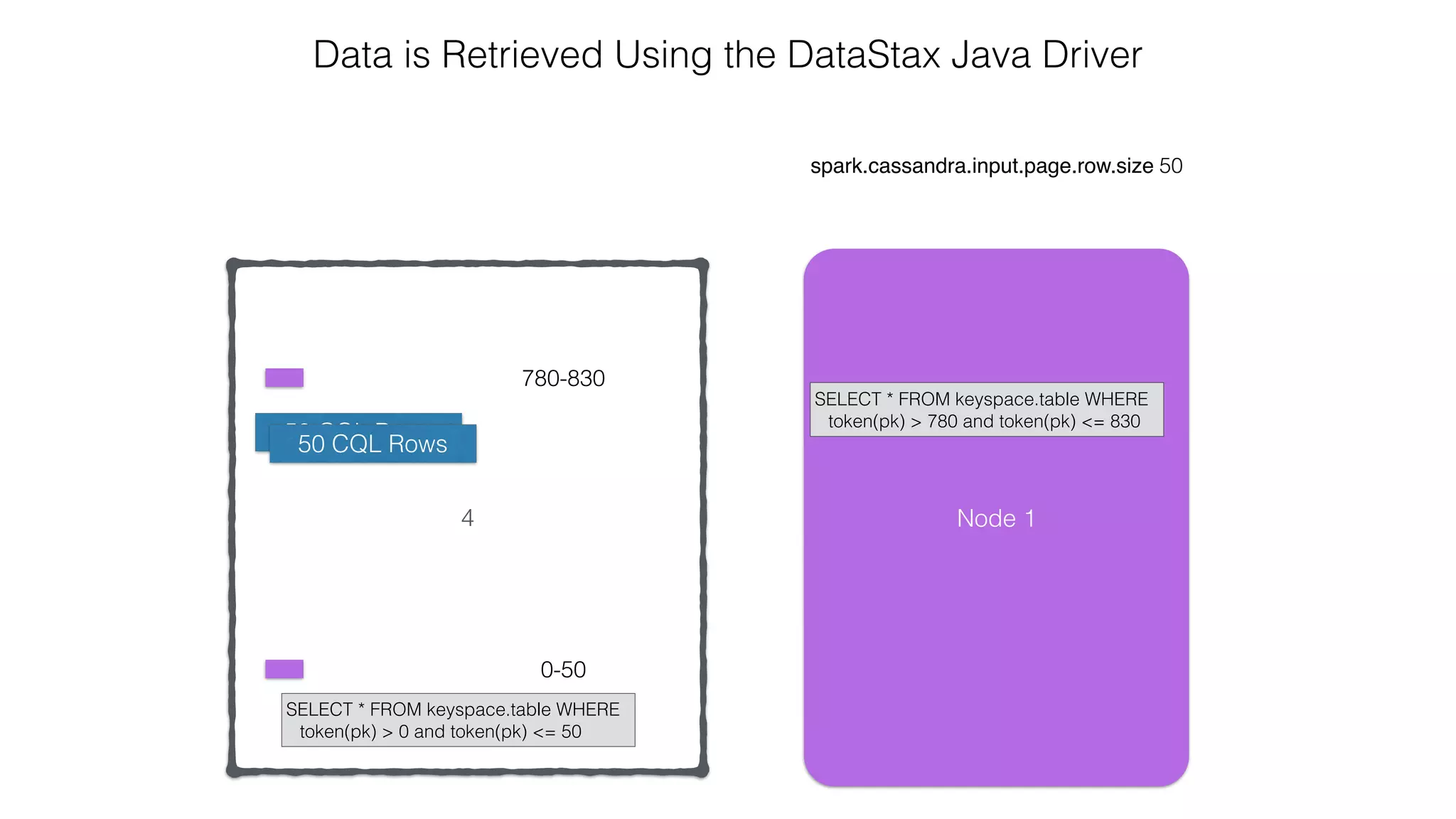
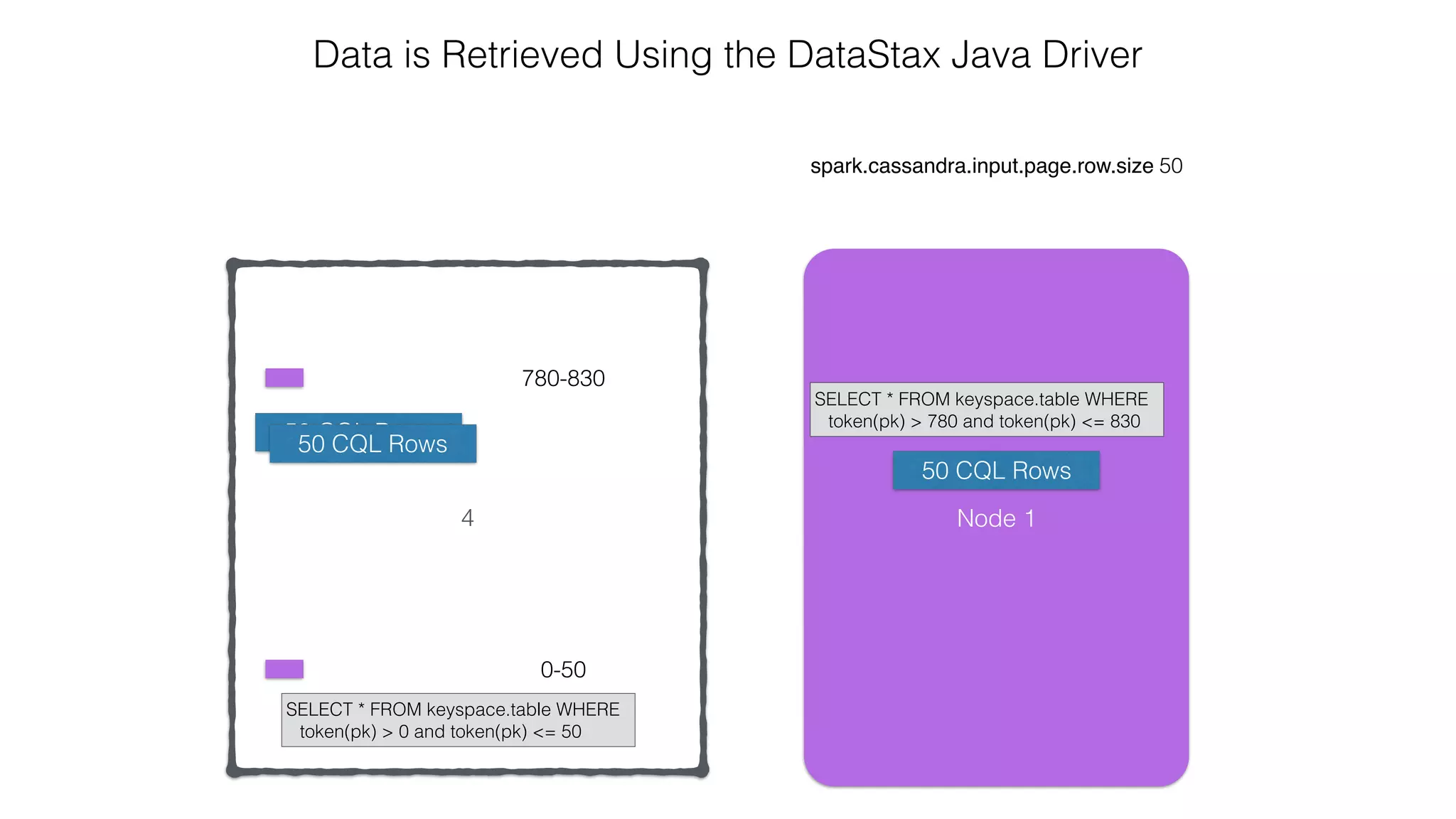
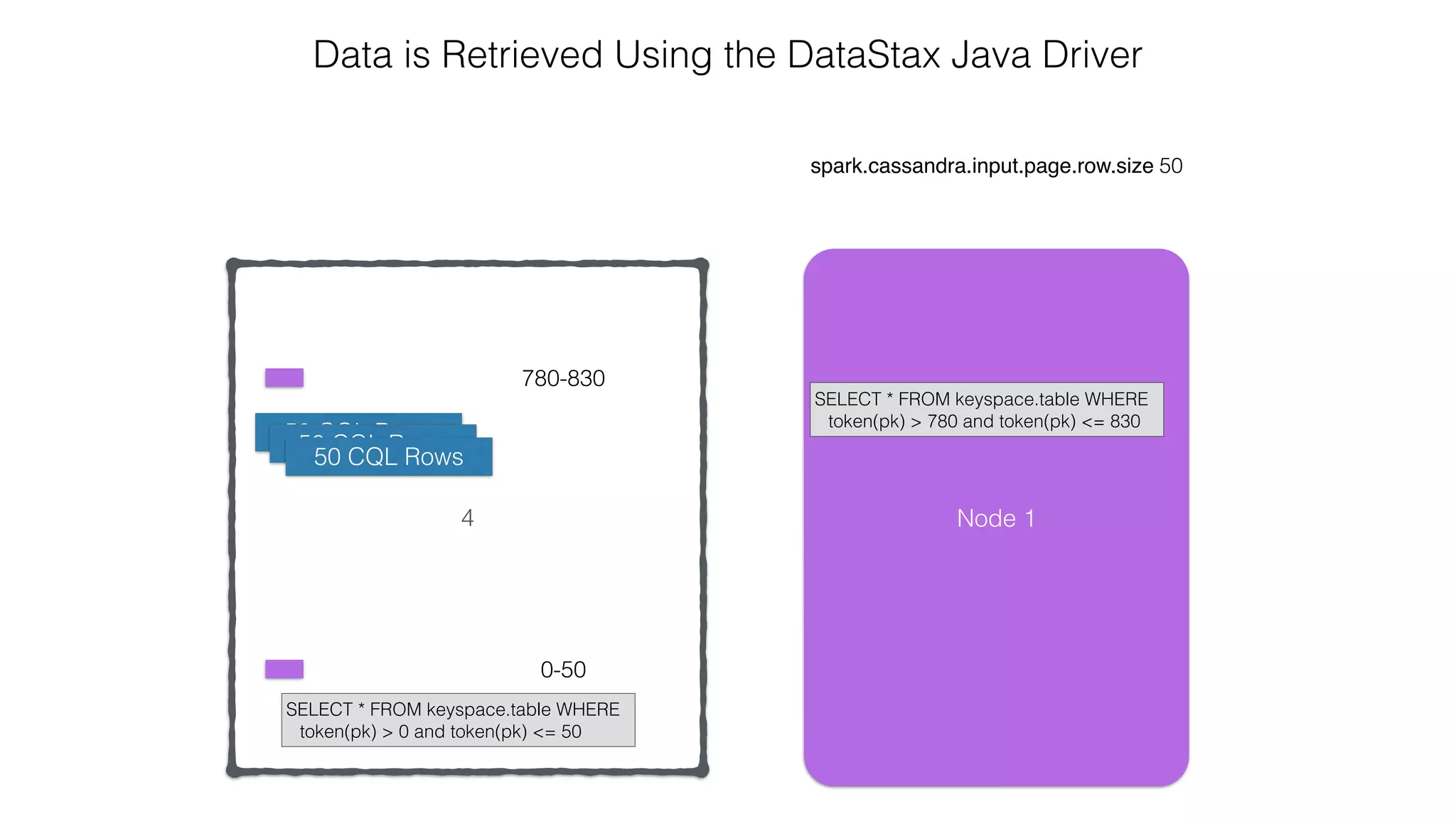
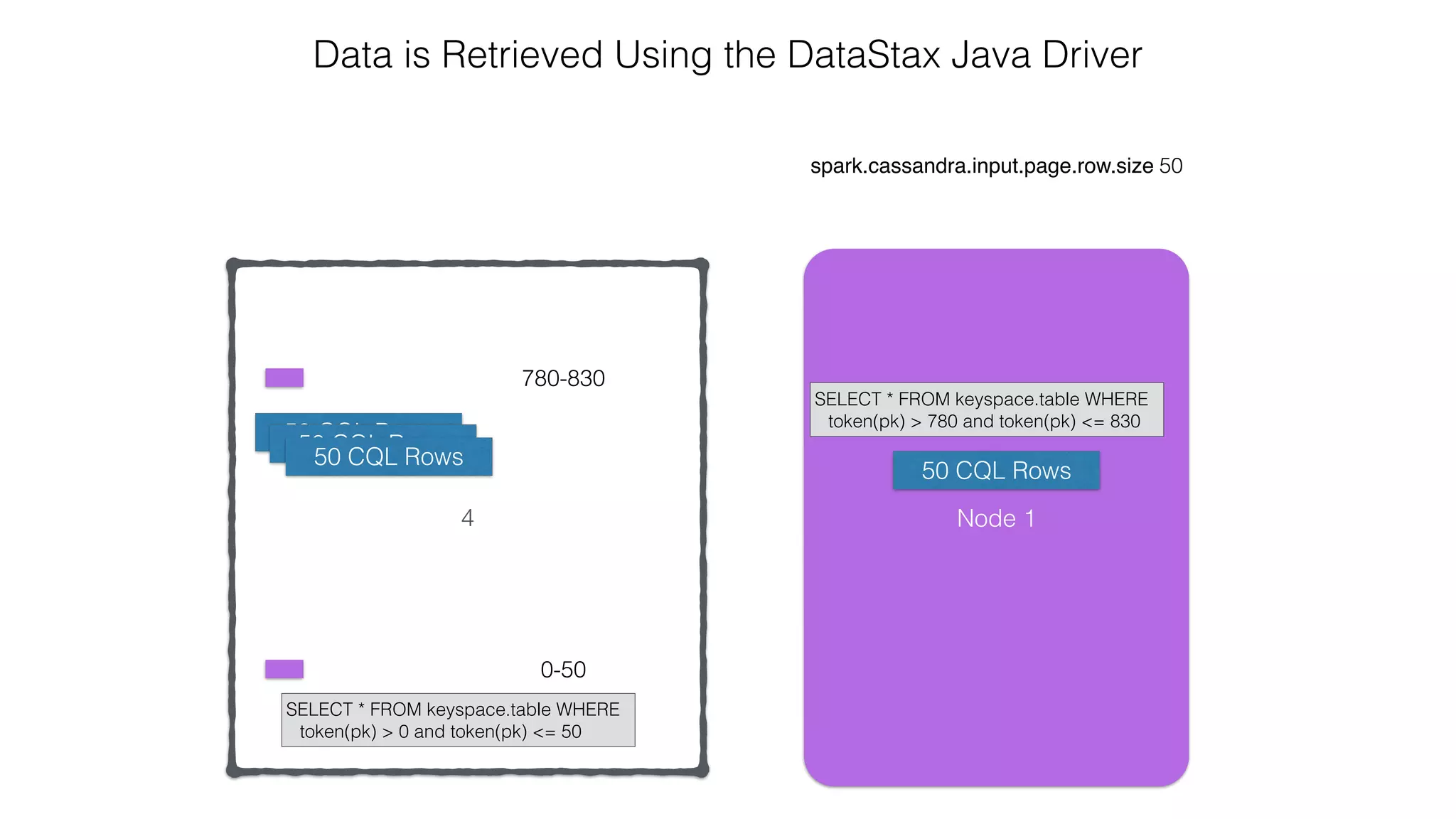
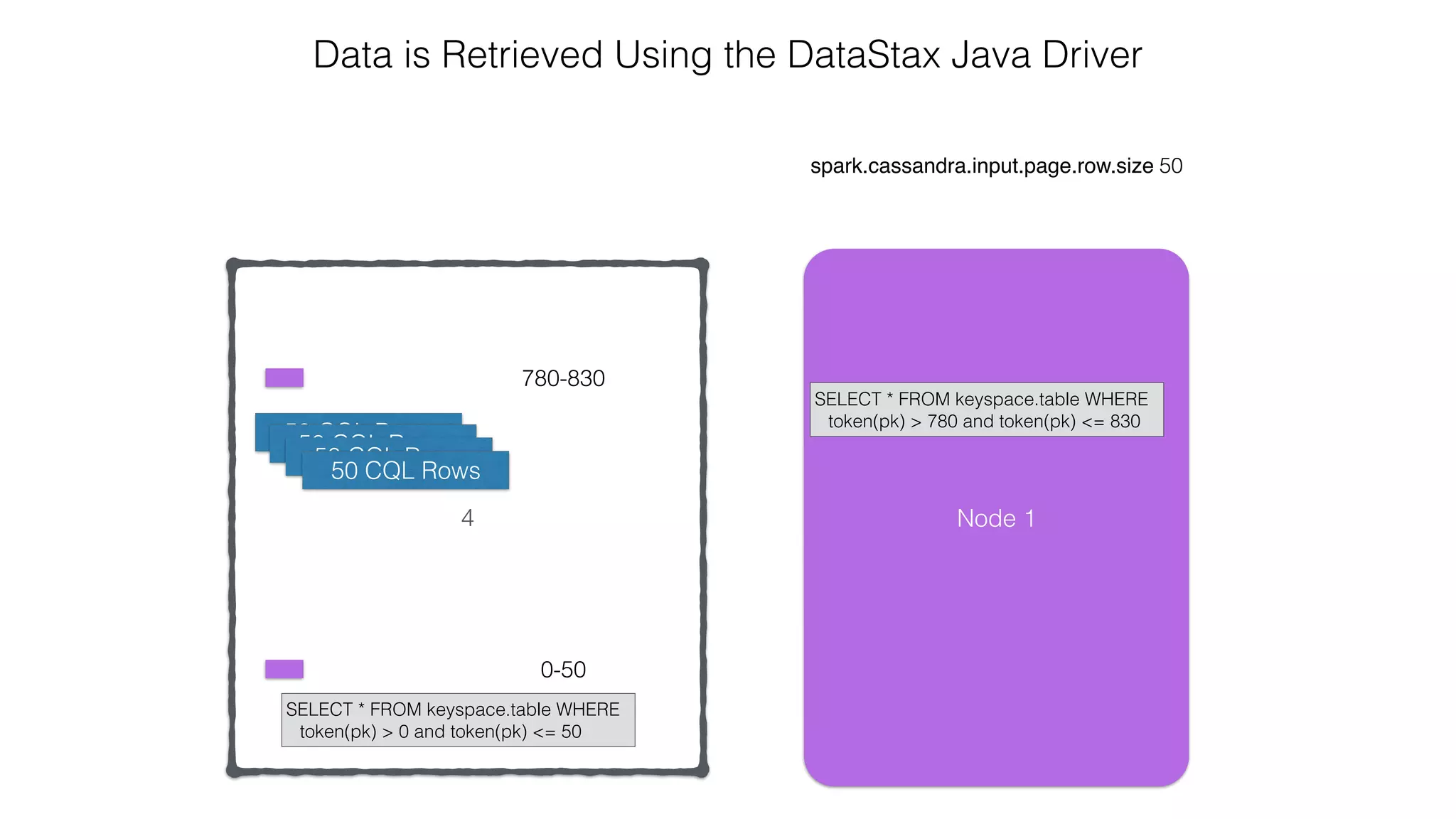
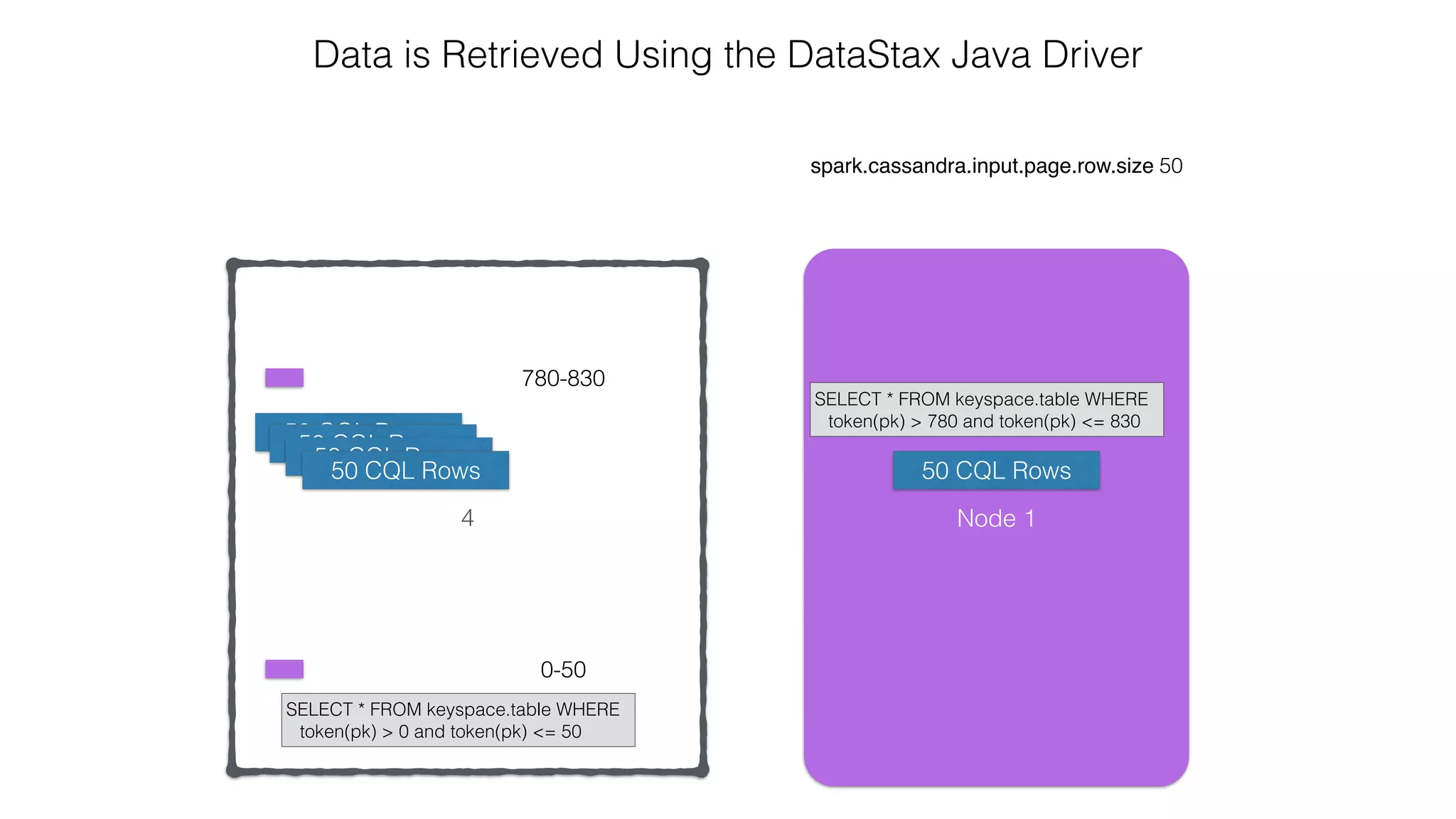
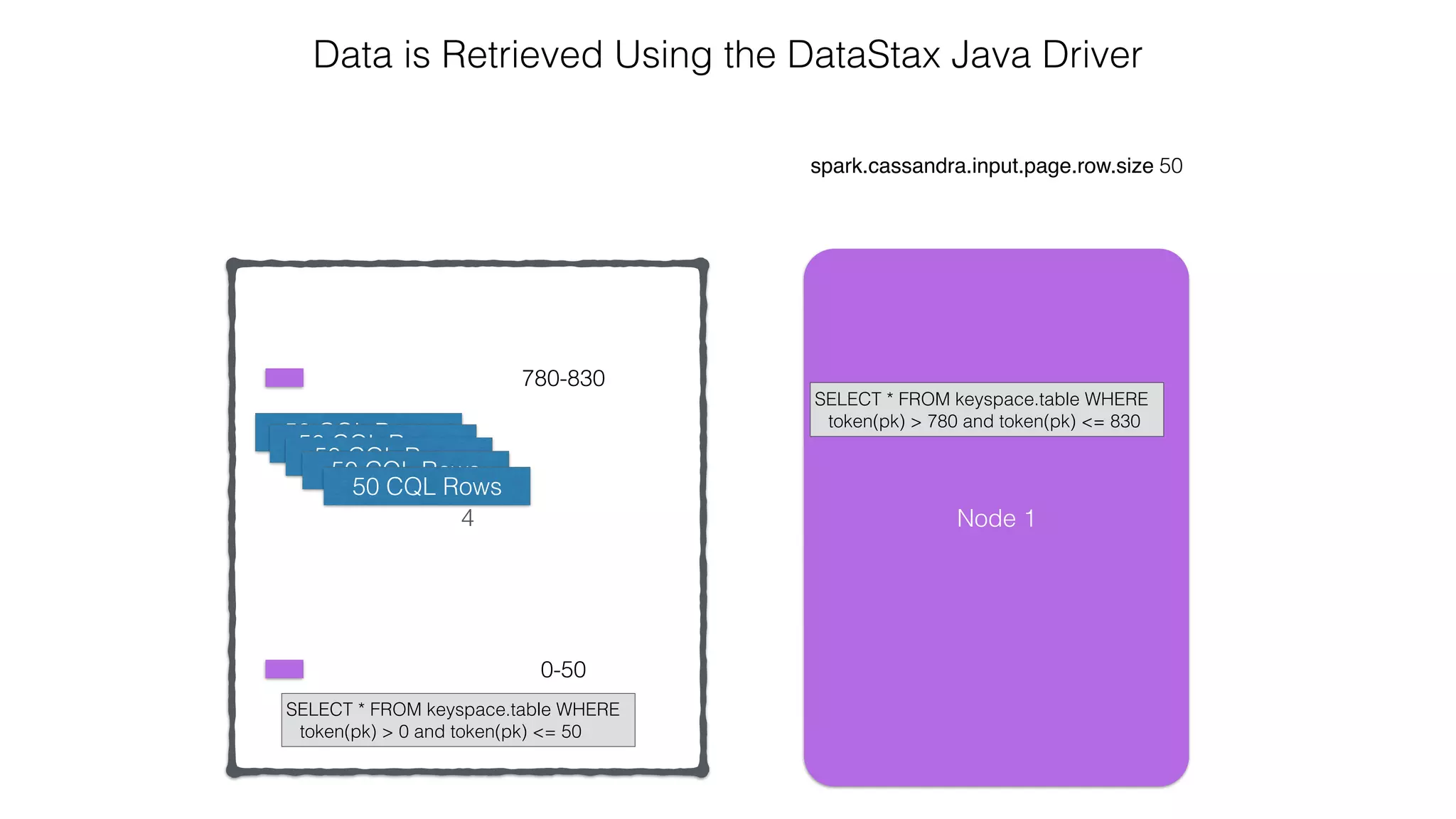
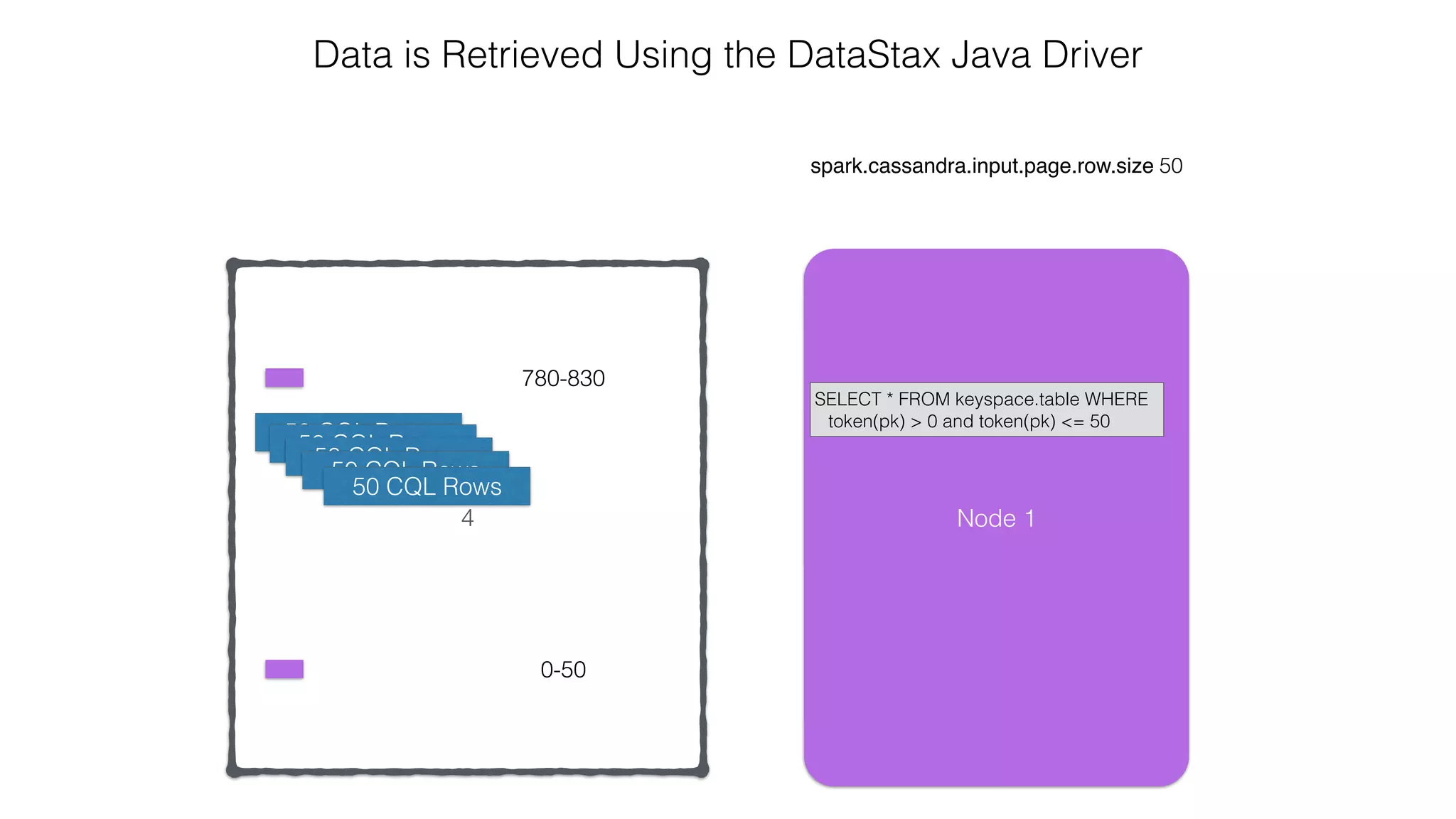
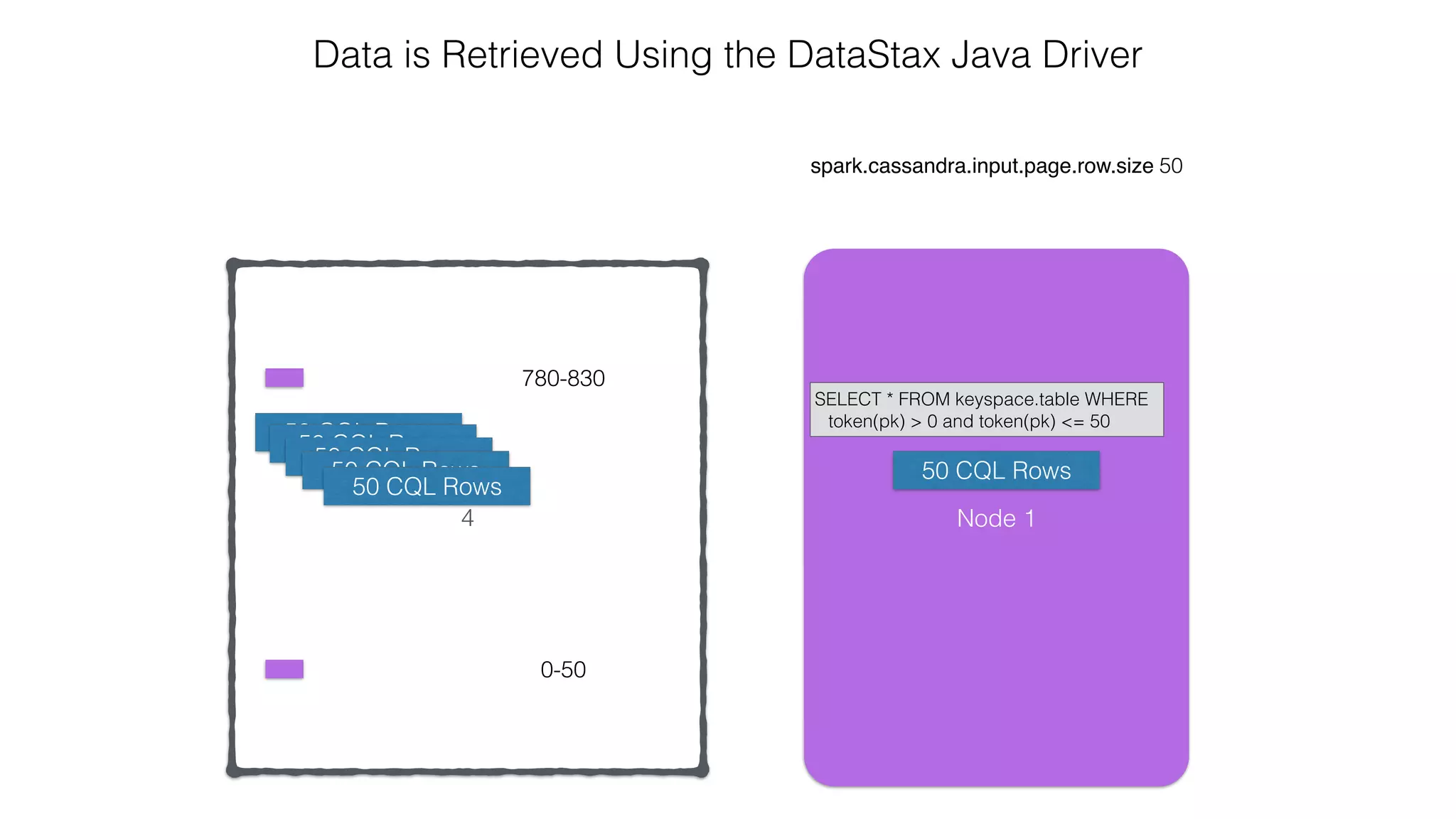
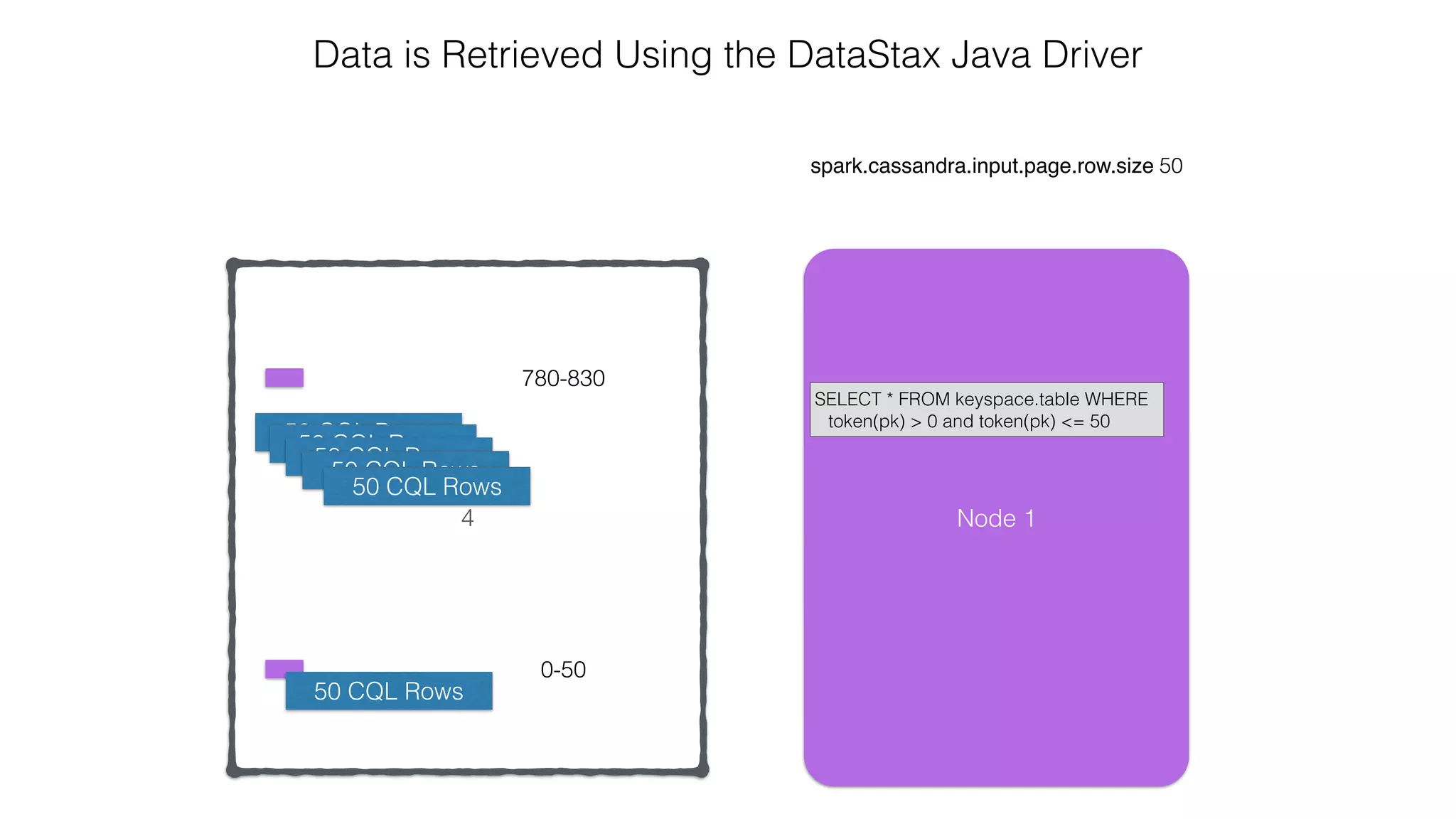
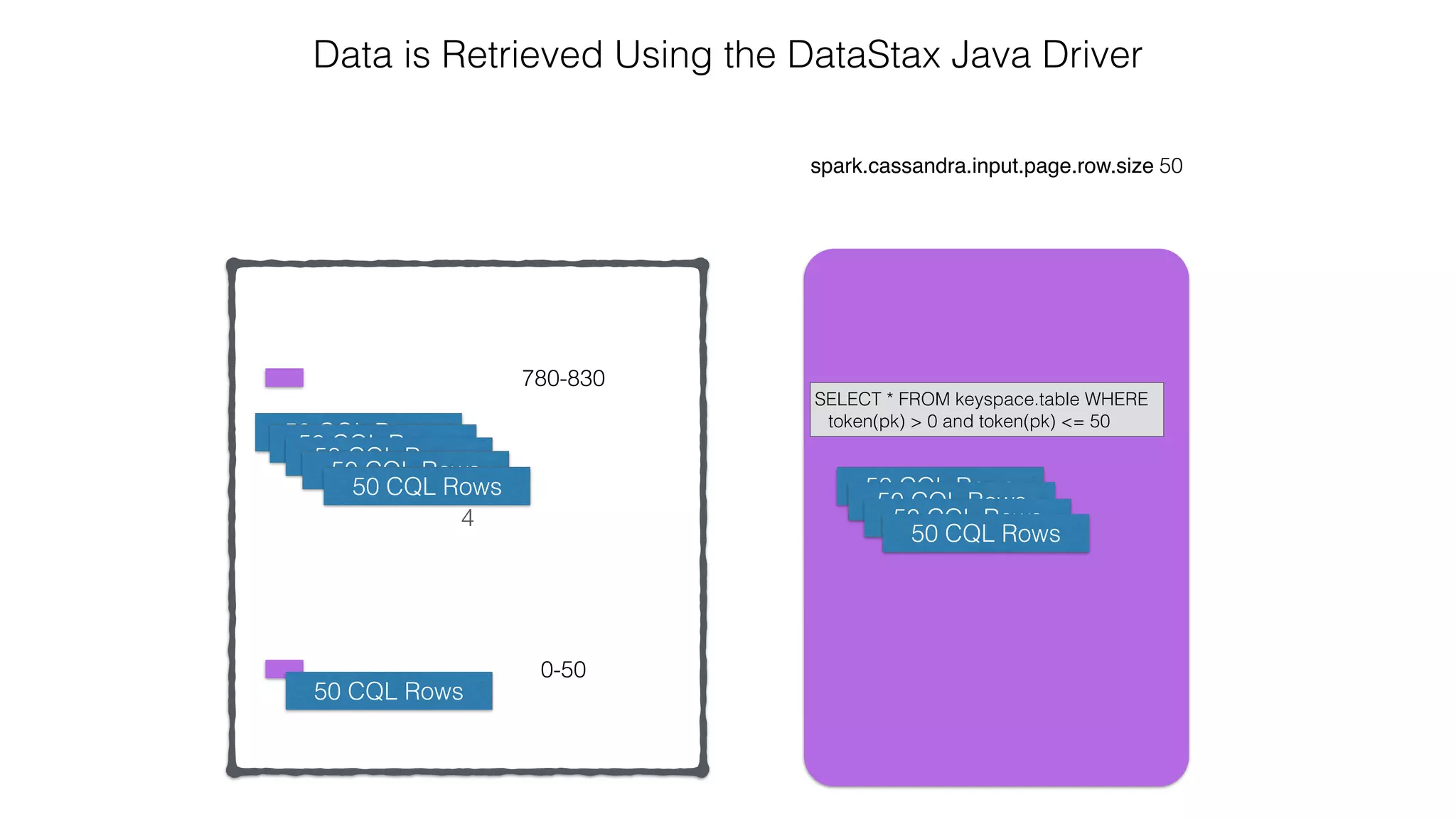
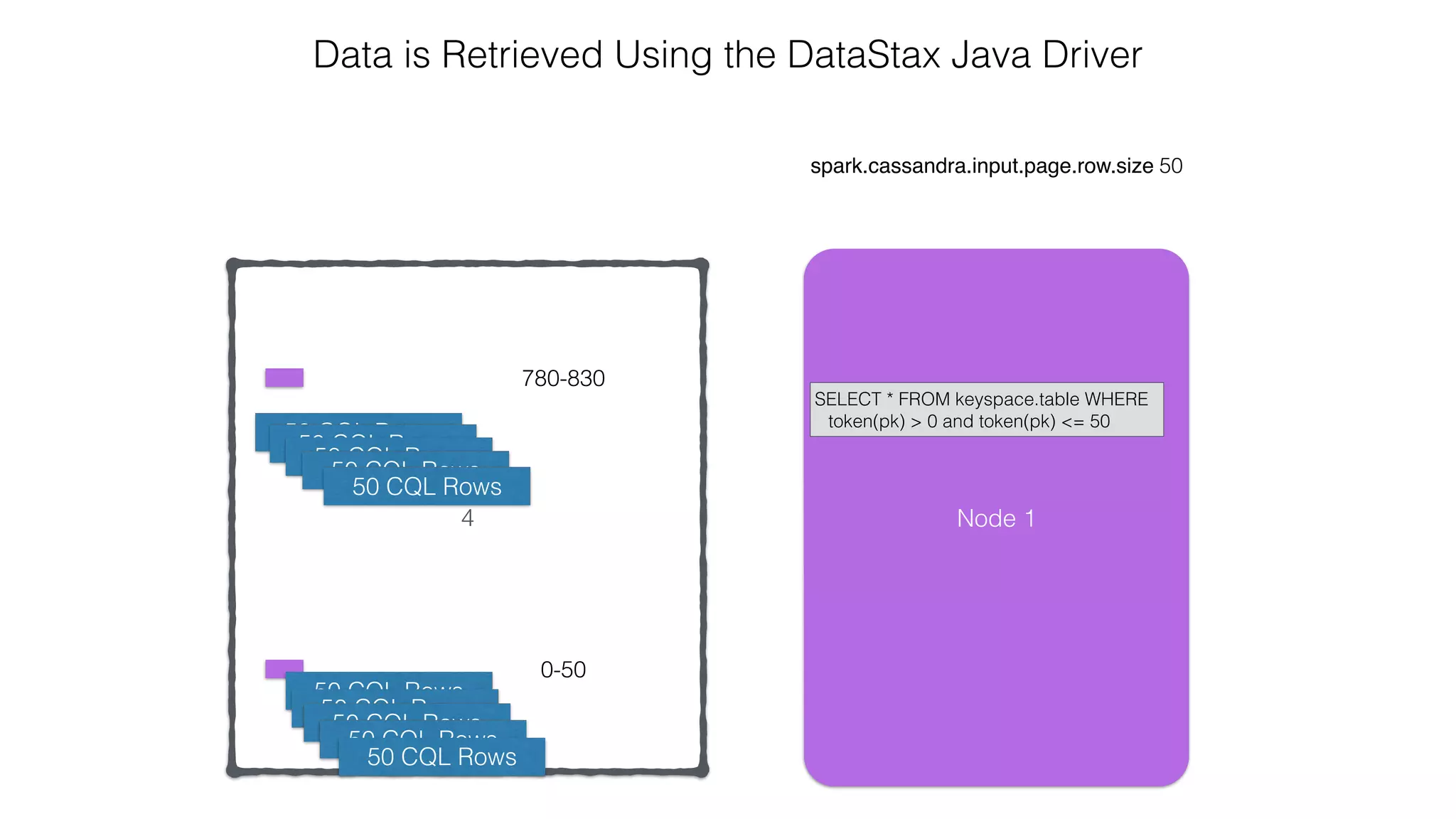
spark.cassandra.input.page.row.size 50
Data is Retrieved Using the DataStax Java Driver
0-50780-830
Node 1
4
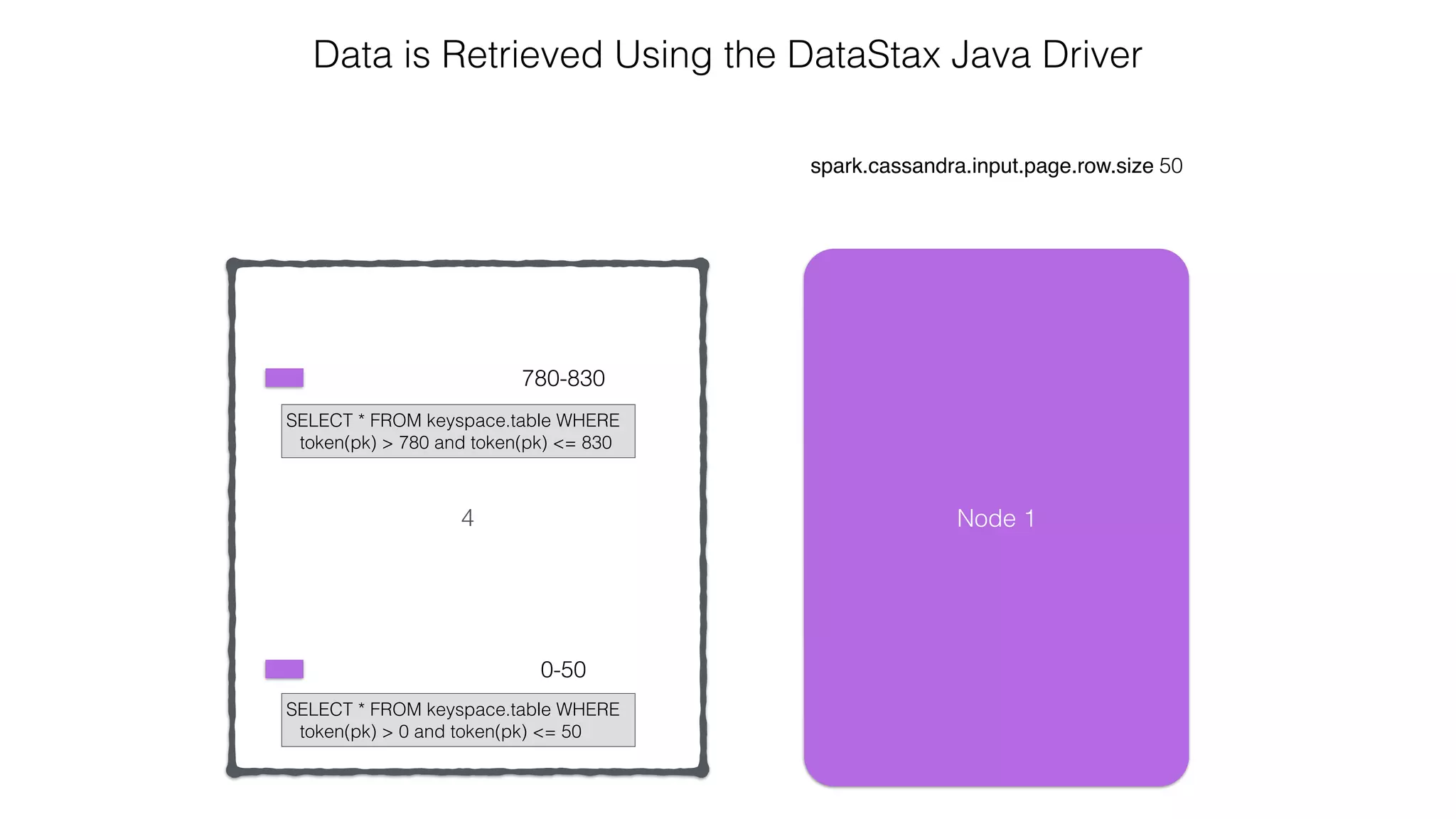
spark.cassandra.input.page.row.size 50
Data is Retrieved Using the DataStax Java Driver
0-50
780-830
Node 1
SELECT * FROM keyspace.table WHERE
token(pk) > 780 and token(pk) <= 830
SELECT * FROM keyspace.table WHERE
token(pk) > 0 and token(pk) <= 50
4
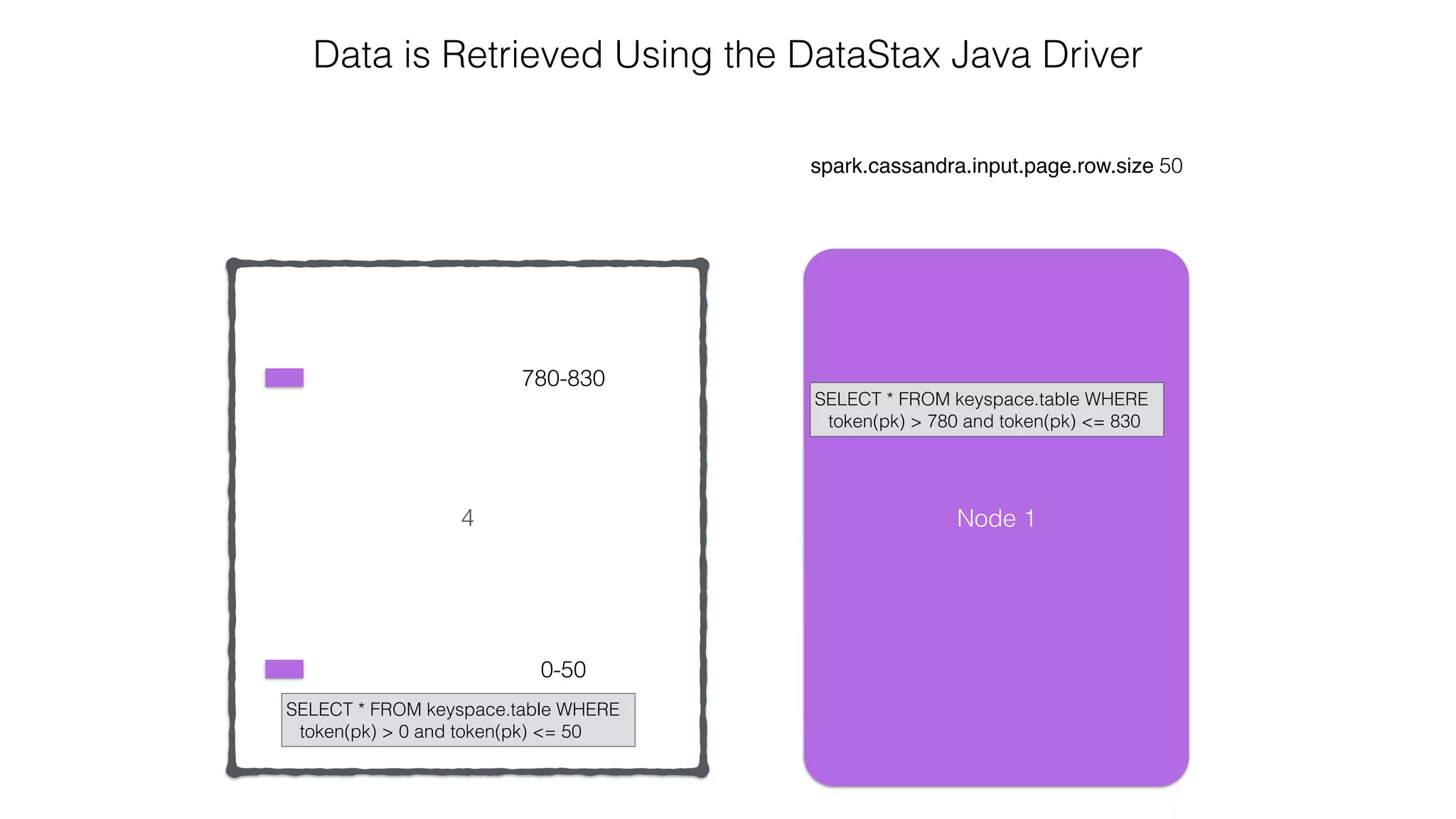
spark.cassandra.input.page.row.size 50
Data is Retrieved Using the DataStax Java Driver
0-50
780-830
Node 1
SELECT * FROM keyspace.table WHERE
token(pk) > 780 and token(pk) <= 830
SELECT * FROM keyspace.table WHERE
token(pk) > 0 and token(pk) <= 50
4
spark.cassandra.input.page.row.size 50
Data is Retrieved Using the DataStax Java Driver
0-50
780-830
Node 1
SELECT * FROM keyspace.table WHERE
token(pk) > 780 and token(pk) <= 830
SELECT * FROM keyspace.table WHERE
token(pk) > 0 and token(pk) <= 50
50 CQL Rows
4
spark.cassandra.input.page.row.size 50
Data is Retrieved Using the DataStax Java Driver
0-50
780-830
Node 1
SELECT * FROM keyspace.table WHERE
token(pk) > 780 and token(pk) <= 830
SELECT * FROM keyspace.table WHERE
token(pk) > 0 and token(pk) <= 50
50 CQL Rows
4
spark.cassandra.input.page.row.size 50
Data is Retrieved Using the DataStax Java Driver
0-50
780-830
Node 1
SELECT * FROM keyspace.table WHERE
token(pk) > 780 and token(pk) <= 830
SELECT * FROM keyspace.table WHERE
token(pk) > 0 and token(pk) <= 50
50 CQL Rows
50 CQL Rows
4
spark.cassandra.input.page.row.size 50
Data is Retrieved Using the DataStax Java Driver
0-50
780-830
Node 1
SELECT * FROM keyspace.table WHERE
token(pk) > 780 and token(pk) <= 830
SELECT * FROM keyspace.table WHERE
token(pk) > 0 and token(pk) <= 50
50 CQL Rows50 CQL Rows
4
spark.cassandra.input.page.row.size 50
Data is Retrieved Using the DataStax Java Driver
0-50
780-830
Node 1
SELECT * FROM keyspace.table WHERE
token(pk) > 780 and token(pk) <= 830
SELECT * FROM keyspace.table WHERE
token(pk) > 0 and token(pk) <= 50
50 CQL Rows50 CQL Rows
50 CQL Rows
4
spark.cassandra.input.page.row.size 50
Data is Retrieved Using the DataStax Java Driver
0-50
780-830
Node 1
SELECT * FROM keyspace.table WHERE
token(pk) > 780 and token(pk) <= 830
SELECT * FROM keyspace.table WHERE
token(pk) > 0 and token(pk) <= 50
50 CQL Rows50 CQL Rows
50 CQL Rows
4
spark.cassandra.input.page.row.size 50
Data is Retrieved Using the DataStax Java Driver
0-50
780-830
Node 1
SELECT * FROM keyspace.table WHERE
token(pk) > 780 and token(pk) <= 830
SELECT * FROM keyspace.table WHERE
token(pk) > 0 and token(pk) <= 50
50 CQL Rows50 CQL Rows
50 CQL Rows
50 CQL Rows
4
spark.cassandra.input.page.row.size 50
Data is Retrieved Using the DataStax Java Driver
0-50
780-830
Node 1
SELECT * FROM keyspace.table WHERE
token(pk) > 780 and token(pk) <= 830
SELECT * FROM keyspace.table WHERE
token(pk) > 0 and token(pk) <= 50
50 CQL Rows50 CQL Rows
50 CQL Rows
50 CQL Rows
4
spark.cassandra.input.page.row.size 50
Data is Retrieved Using the DataStax Java Driver
0-50
780-830
Node 1
SELECT * FROM keyspace.table WHERE
token(pk) > 780 and token(pk) <= 830
SELECT * FROM keyspace.table WHERE
token(pk) > 0 and token(pk) <= 50
50 CQL Rows50 CQL Rows
50 CQL Rows
50 CQL Rows 50 CQL Rows
4
spark.cassandra.input.page.row.size 50
Data is Retrieved Using the DataStax Java Driver
0-50
780-830
Node 1
SELECT * FROM keyspace.table WHERE
token(pk) > 780 and token(pk) <= 830
SELECT * FROM keyspace.table WHERE
token(pk) > 0 and token(pk) <= 50
50 CQL Rows50 CQL Rows
50 CQL Rows
50 CQL Rows
50 CQL Rows
4
spark.cassandra.input.page.row.size 50
Data is Retrieved Using the DataStax Java Driver
0-50
780-830
Node 1
SELECT * FROM keyspace.table WHERE
token(pk) > 0 and token(pk) <= 50
50 CQL Rows50 CQL Rows
50 CQL Rows
50 CQL Rows
50 CQL Rows
4
spark.cassandra.input.page.row.size 50
Data is Retrieved Using the DataStax Java Driver
0-50
780-830
Node 1
SELECT * FROM keyspace.table WHERE
token(pk) > 0 and token(pk) <= 50
50 CQL Rows50 CQL Rows
50 CQL Rows
50 CQL Rows
50 CQL Rows
50 CQL Rows
4
spark.cassandra.input.page.row.size 50
Data is Retrieved Using the DataStax Java Driver
0-50
780-830
Node 1
SELECT * FROM keyspace.table WHERE
token(pk) > 0 and token(pk) <= 50
50 CQL Rows50 CQL Rows
50 CQL Rows
50 CQL Rows
50 CQL Rows
50 CQL Rows
4
spark.cassandra.input.page.row.size 50
Data is Retrieved Using the DataStax Java Driver
0-50
780-830
Node 1
SELECT * FROM keyspace.table WHERE
token(pk) > 0 and token(pk) <= 50
50 CQL Rows50 CQL Rows
50 CQL Rows
50 CQL Rows
50 CQL Rows
50 CQL Rows
50 CQL Rows
50 CQL Rows
50 CQL Rows
50 CQL Rows
4
spark.cassandra.input.page.row.size 50
Data is Retrieved Using the DataStax Java Driver
0-50
780-830
Node 1
SELECT * FROM keyspace.table WHERE
token(pk) > 0 and token(pk) <= 50
50 CQL Rows50 CQL Rows
50 CQL Rows
50 CQL Rows
50 CQL Rows
50 CQL Rows
50 CQL Rows
50 CQL Rows
50 CQL Rows
50 CQL Rows
Co-locate Spark and C* for
Best Performance
C*
C*C*
C*
Spark

Worker
Spark

Worker
Spark
Master
Spark
Worker
Running Spark Workers
on
the same nodes as your
C* Cluster will save
network hops when
reading and writing
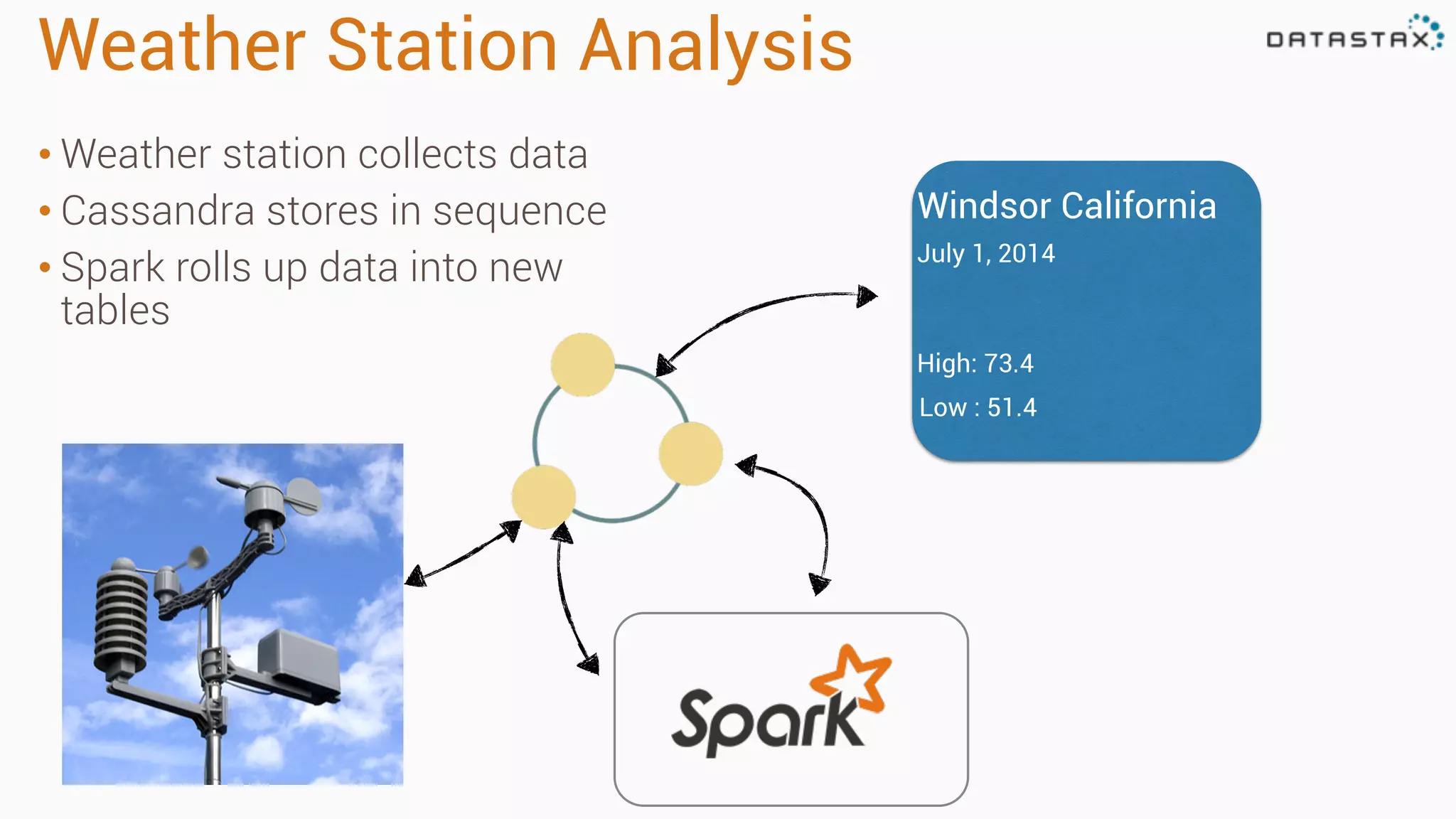
Weather Station Analysis
• Weather station collects data
• Cassandra stores in sequence
• Spark rolls up data into new
tables
Windsor California
July 1, 2014
High: 73.4
Low : 51.4
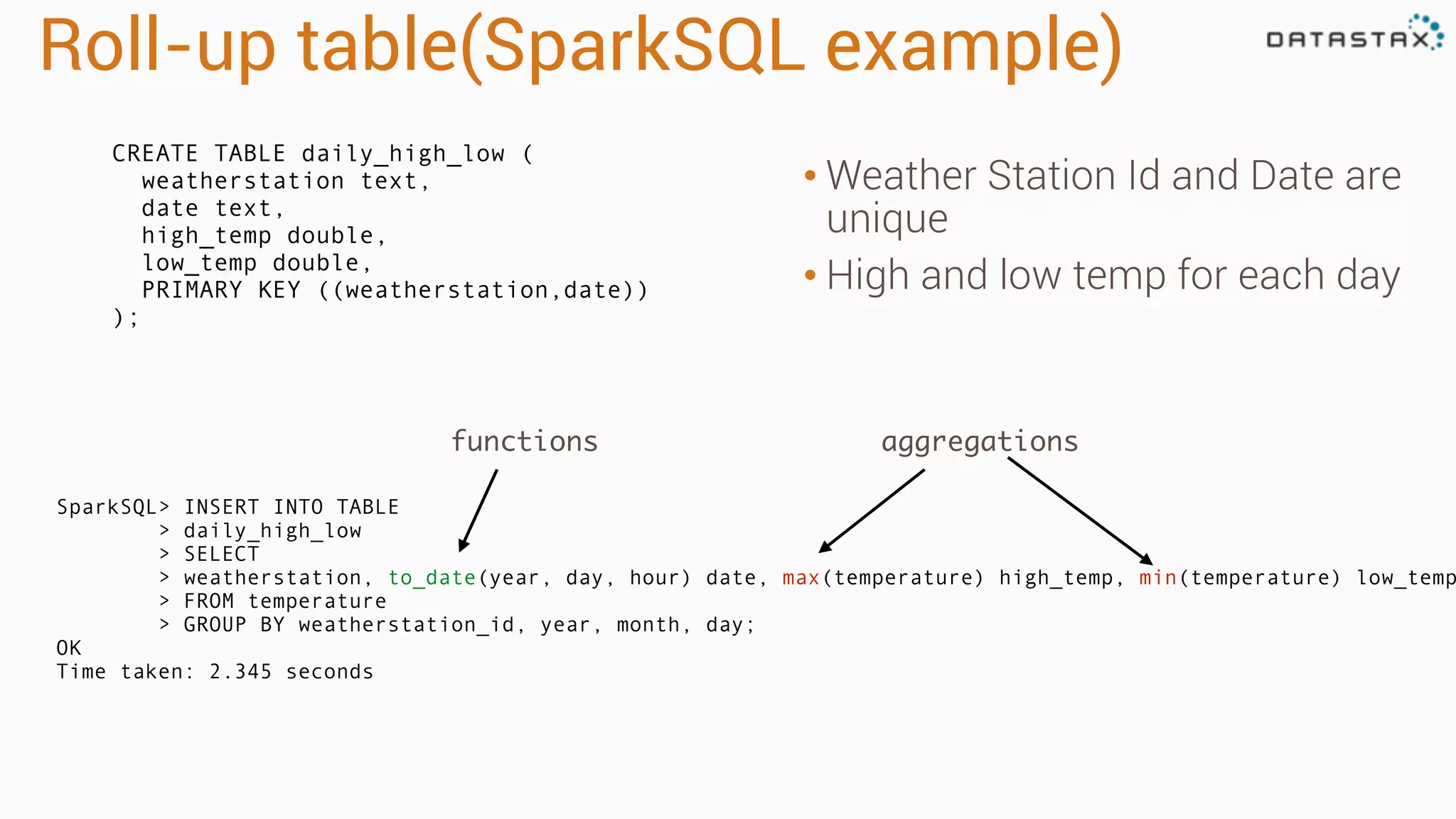
Roll-up table(SparkSQL example)
CREATE TABLE daily_high_low (
weatherstation text,
date text,
high_temp double,
low_temp double,
PRIMARY KEY ((weatherstation,date))
);
• Weather Station Id and Date are
unique
• High and low temp for each day
SparkSQL> INSERT INTO TABLE
> daily_high_low
> SELECT
> weatherstation, to_date(year, day, hour) date, max(temperature) high_temp, min(temperature) low_temp
> FROM temperature
> GROUP BY weatherstation_id, year, month, day;
OK
Time taken: 2.345 seconds
functions aggregations
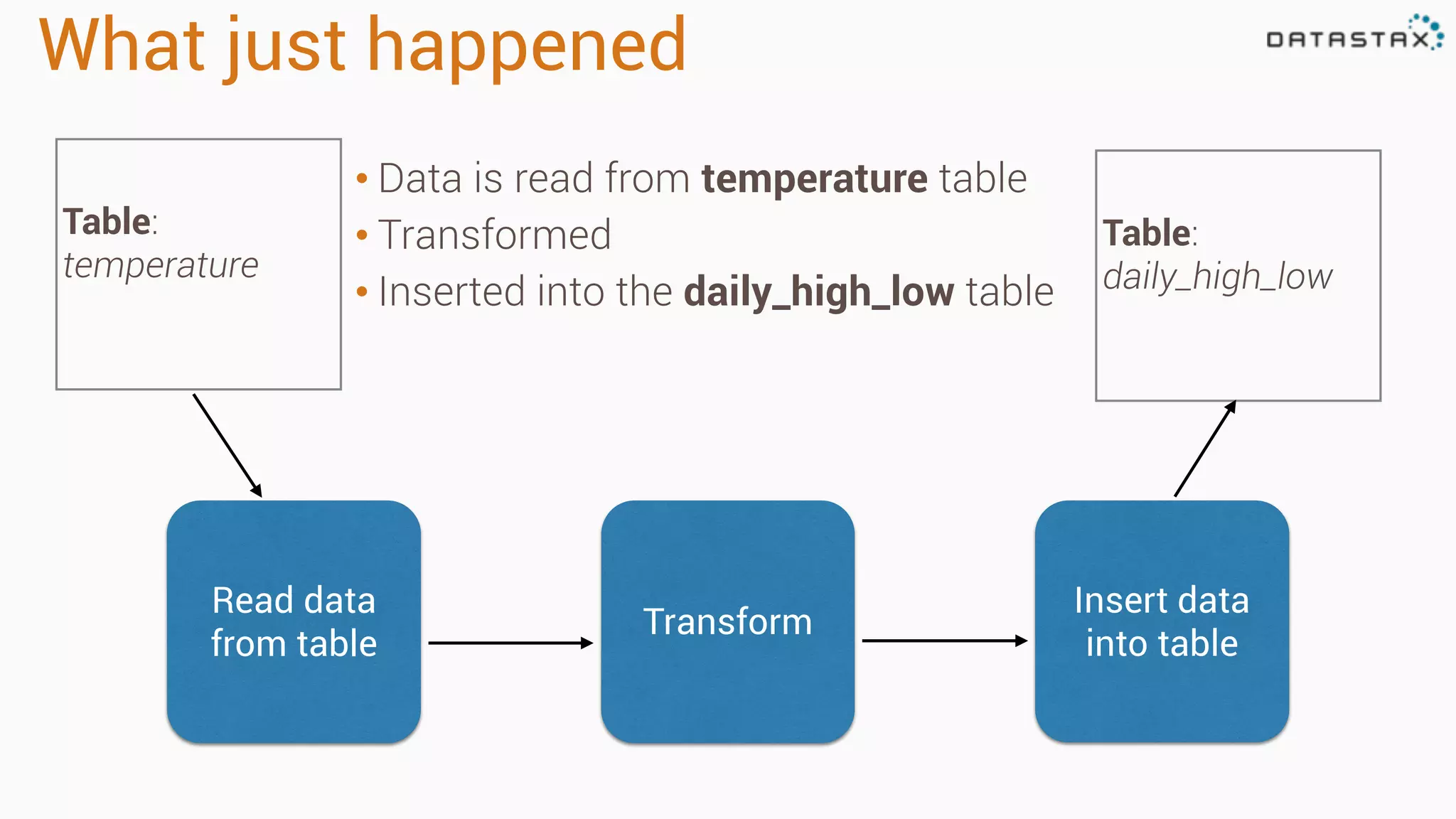
What just happened
• Data is read from temperature table
• Transformed
• Inserted into the daily_high_low table
Table:
temperature
Table:
daily_high_low
Read data
from table
Transform
Insert data
into table
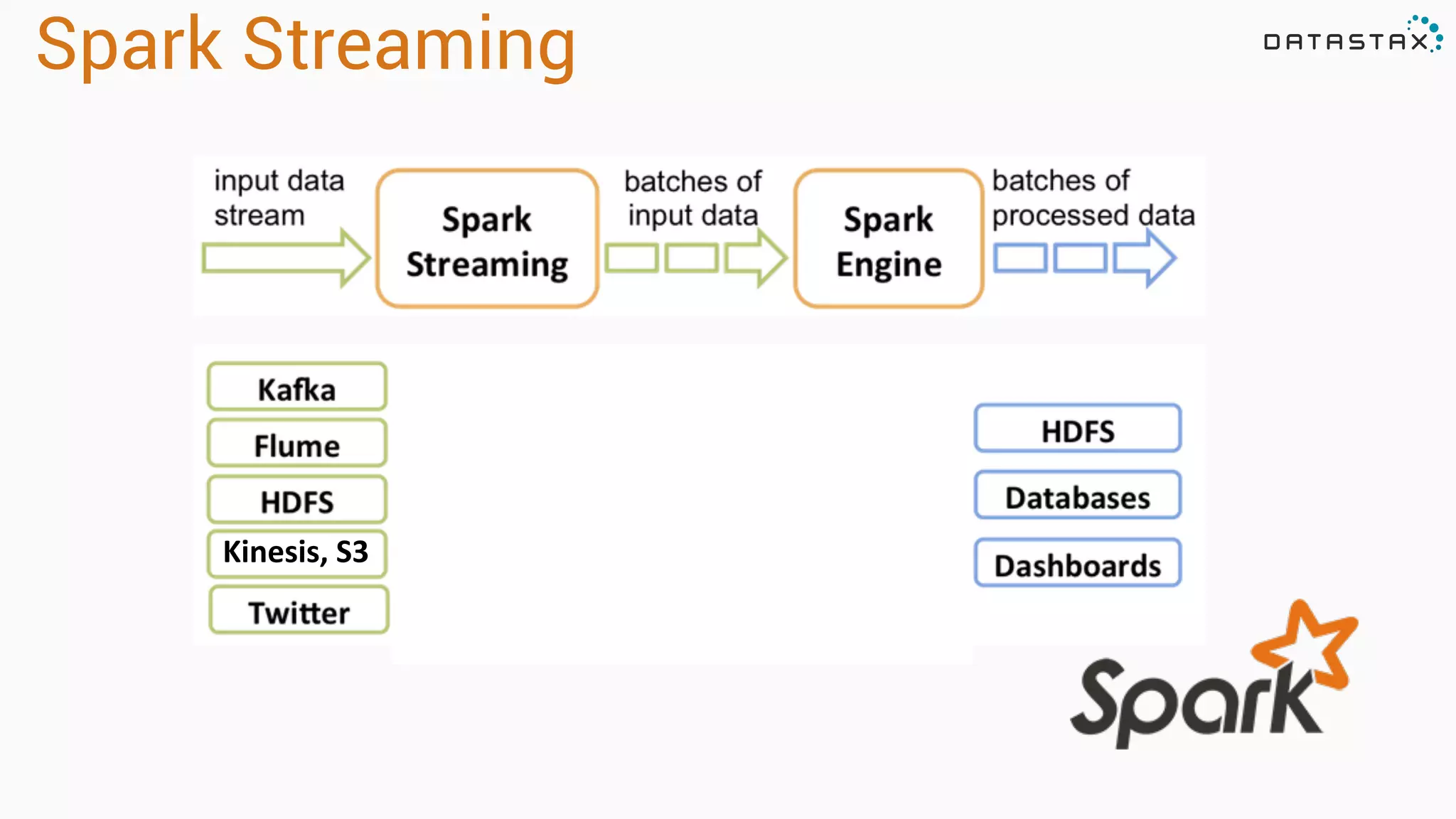
Spark Streaming
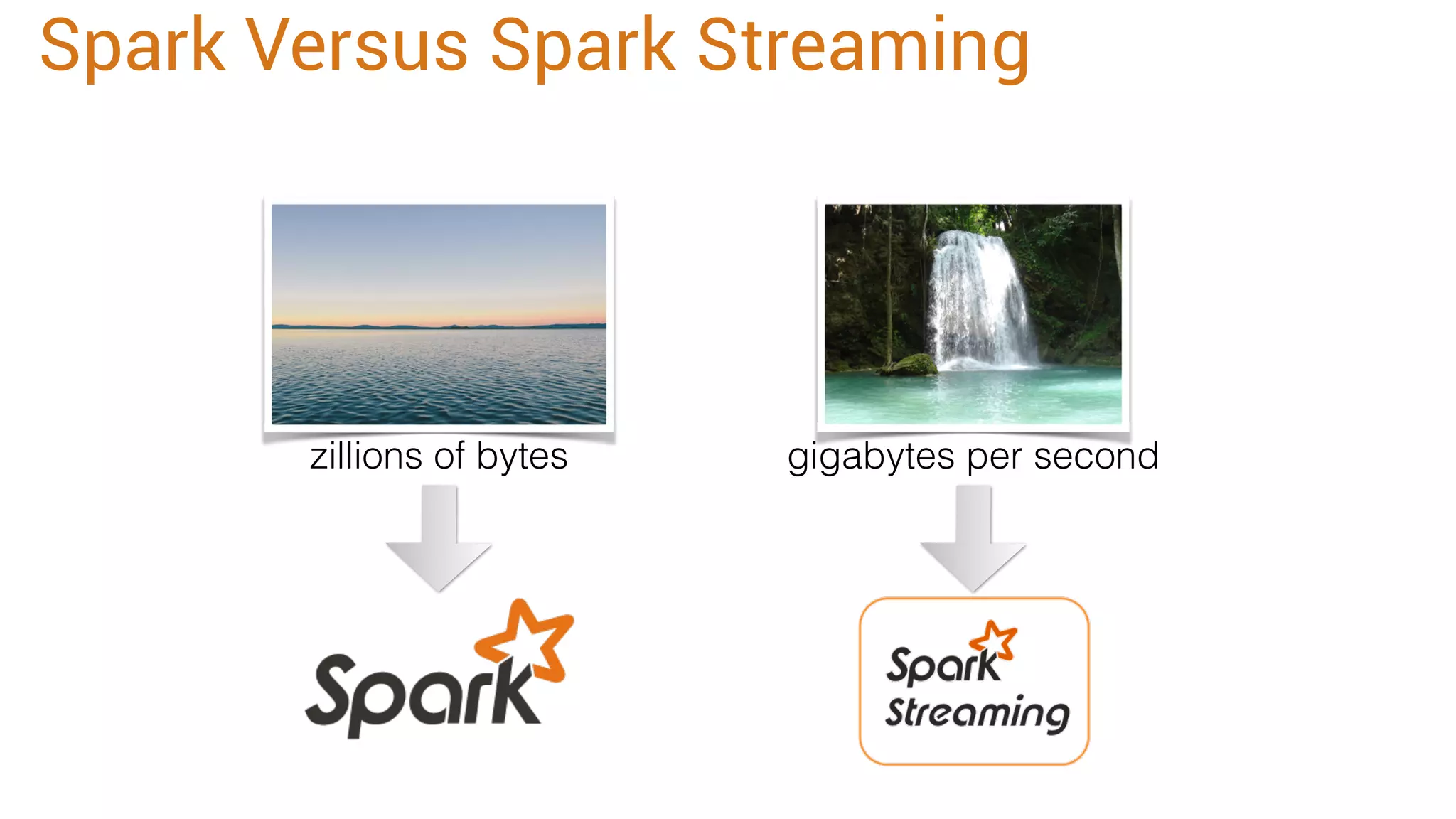
zillions of bytes gigabytes per second
Spark Versus Spark Streaming
Analytic
Analytic
Search
Spark Streaming
Kinesis,'S3'
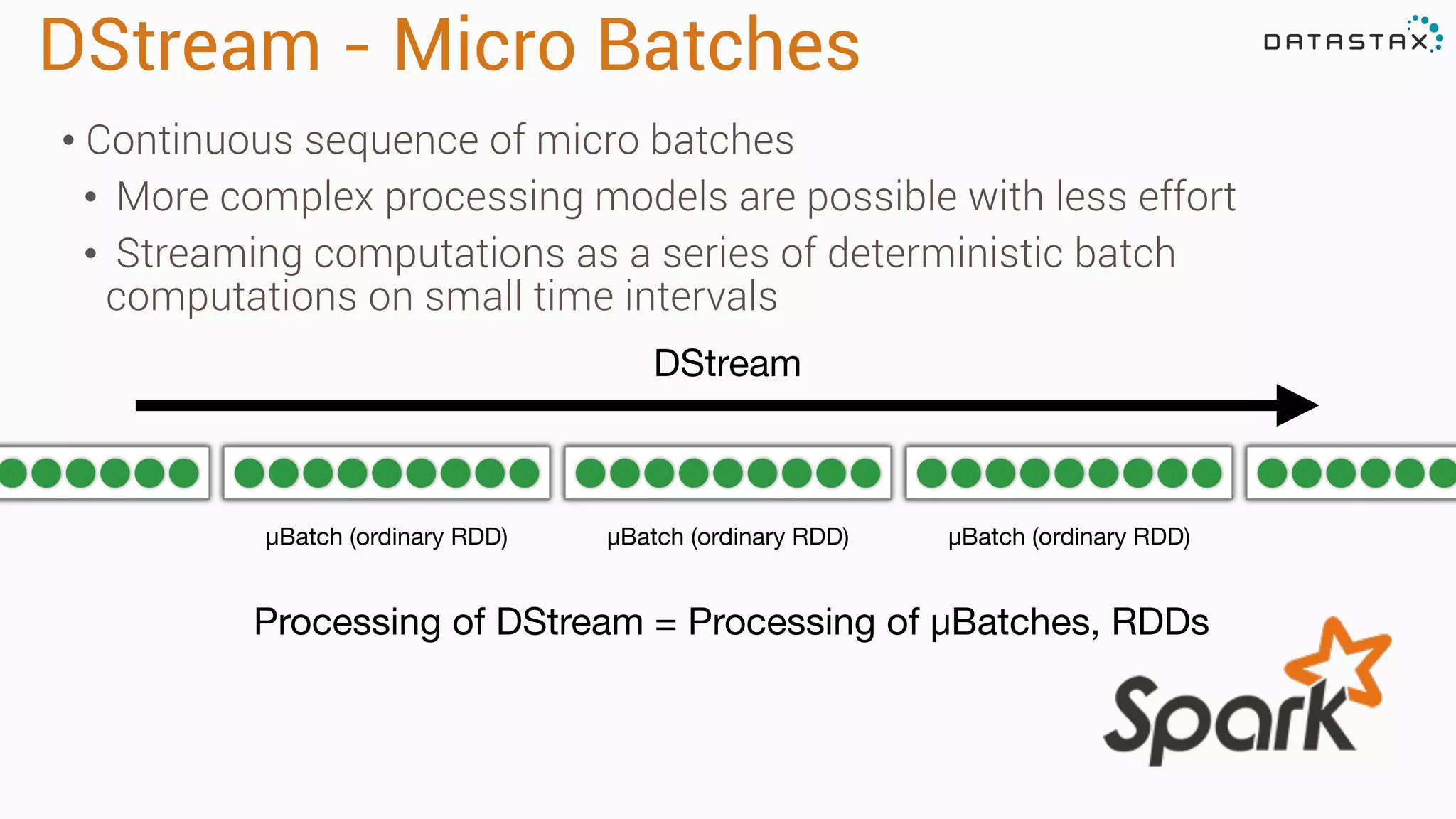
DStream - Micro Batches
μBatch (ordinary RDD) μBatch (ordinary RDD) μBatch (ordinary RDD)
Processing of DStream = Processing of μBatches, RDDs
DStream
• Continuous sequence of micro batches
• More complex processing models are possible with less effort
• Streaming computations as a series of deterministic batch
computations on small time intervals
Spark Streaming Example
val conf = new SparkConf(loadDefaults = true)
.set("spark.cassandra.connection.host", "127.0.0.1")
.setMaster("spark://127.0.0.1:7077")
val sc = new SparkContext(conf)
val table: CassandraRDD[CassandraRow] = sc.cassandraTable("keyspace", "tweets")


val ssc = new StreamingContext(sc, Seconds(30))


val stream = KafkaUtils.createStream[String, String, StringDecoder,
StringDecoder](

ssc, kafka.kafkaParams, Map(topic -> 1), StorageLevel.MEMORY_ONLY)


stream.map(_._2).countByValue().saveToCassandra("demo", "wordcount")


ssc.start()

ssc.awaitTermination()
Initialization
Transformations
and Action
CassandraRDD
Stream Initialization
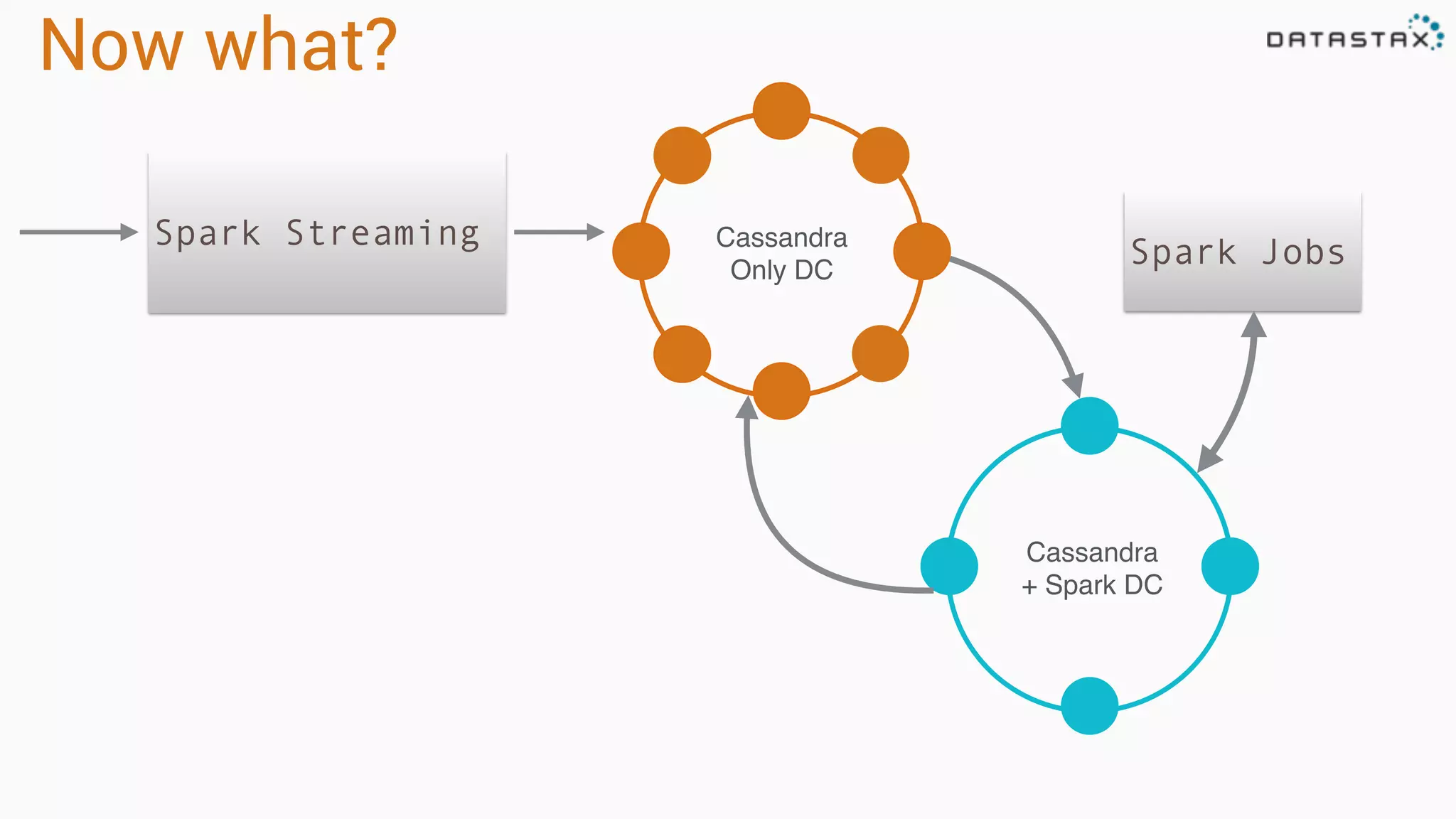
Now what?
Cassandra
Only DC
Cassandra
+ Spark DC
Spark Jobs
Spark Streaming
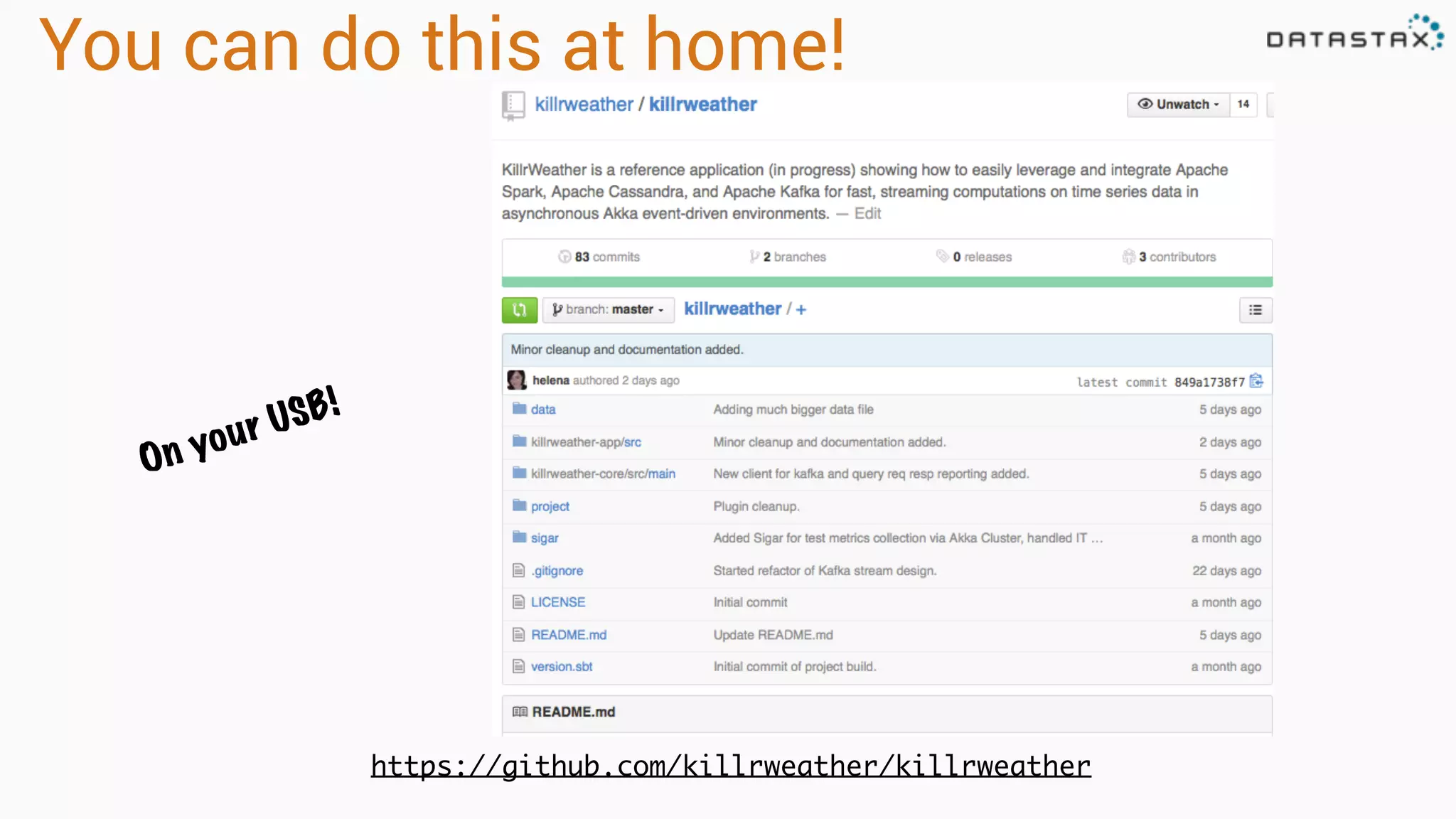
You can do this at home!
https://github.com/killrweather/killrweather
On your USB!
Thank you!
Bring the questions
Follow me on twitter
@PatrickMcFadin

Apache cassandra and spark. you got the the lighter, let's start the fire

  • 1.
    ©2013 DataStax Confidential.Do not distribute without consent. @PatrickMcFadin Patrick McFadin
 Chief Evangelist for Apache Cassandra Apache Cassandra and Spark You got the lighter, let’s spark the fire 1
  • 2.
  • 3.
    Cassandra 3.0 &3.1 Spring and Fall
  • 4.
    Cassandra is… • Sharednothing • Masterless peer-to-peer • Great scaling story • Resilient to failure
  • 5.
  • 6.
    A Data Oceanor Pond., Lake An In-Memory Database A Key-Value Store A magical database unicorn that farts rainbows
  • 7.
  • 8.
    Apache Spark • 10xfaster on disk,100x faster in memory than Hadoop MR • Works out of the box on EMR • Fault Tolerant Distributed Datasets • Batch, iterative and streaming analysis • In Memory Storage and Disk • Integrates with Most File and Storage Options Up to 100× faster (2-10× on disk) 2-5× less code
  • 9.
    Spark Components Spark Core SparkSQL structured Spark Streaming real-time MLlib machine learning GraphX graph
  • 11.
    org.apache.spark.rdd.RDD Resilient Distributed Dataset(RDD) •Created through transformations on data (map,filter..) or other RDDs •Immutable •Partitioned •Reusable
  • 12.
    RDD Operations •Transformations -Similar to scala collections API •Produce new RDDs •filter, flatmap, map, distinct, groupBy, union, zip, reduceByKey, subtract •Actions •Require materialization of the records to generate a value •collect: Array[T], count, fold, reduce..
  • 13.
  • 14.
  • 15.
    Cassandra & Spark:A Great Combo Datastax: spark-cassandra-connector:
 https://github.com/datastax/spark-cassandra-connector •Both are Easy to Use •Spark Can Help You Bridge Your Hadoop and Cassandra Systems •Use Spark Libraries, Caching on-top of Cassandra-stored Data •Combine Spark Streaming with Cassandra Storage
  • 16.
    Spark On Cassandra •Server-Sidefilters (where clauses) •Cross-table operations (JOIN, UNION, etc.) •Data locality-aware (speed) •Data transformation, aggregation, etc. •Natural Time Series Integration
  • 17.
    Apache Spark andCassandra Open Source Stack Cassandra
  • 18.
  • 19.
    Spark Cassandra Connector *Cassandratables exposed as Spark RDDs *Read from and write to Cassandra *Mapping of C* tables and rows to Scala objects *All Cassandra types supported and converted to Scala types *Server side data selection *Virtual Nodes support *Use with Scala or Java *Compatible with, Spark 1.1.0, Cassandra 2.1 & 2.0
  • 20.
    Type Mapping CQL TypeScala Type ascii String bigint Long boolean Boolean counter Long decimal BigDecimal, java.math.BigDecimal double Double float Float inet java.net.InetAddress int Int list Vector, List, Iterable, Seq, IndexedSeq, java.util.List map Map, TreeMap, java.util.HashMap set Set, TreeSet, java.util.HashSet text, varchar String timestamp Long, java.util.Date, java.sql.Date, org.joda.time.DateTime timeuuid java.util.UUID uuid java.util.UUID varint BigInt, java.math.BigInteger *nullable values Option
  • 21.
    Connecting to Cassandra //Import Cassandra-specific functions on SparkContext and RDD objects import com.datastax.driver.spark._ // Spark connection options val conf = new SparkConf(true) .setMaster("spark://192.168.123.10:7077") .setAppName("cassandra-demo") .set("cassandra.connection.host", "192.168.123.10") // initial contact .set("cassandra.username", "cassandra") .set("cassandra.password", "cassandra") val sc = new SparkContext(conf)
  • 22.
    Accessing Data CREATE TABLEtest.words (word text PRIMARY KEY, count int); INSERT INTO test.words (word, count) VALUES ('bar', 30); INSERT INTO test.words (word, count) VALUES ('foo', 20); // Use table as RDD val rdd = sc.cassandraTable("test", "words") // rdd: CassandraRDD[CassandraRow] = CassandraRDD[0] rdd.toArray.foreach(println) // CassandraRow[word: bar, count: 30] // CassandraRow[word: foo, count: 20] rdd.columnNames // Stream(word, count) rdd.size // 2 val firstRow = rdd.first // firstRow: CassandraRow = CassandraRow[word: bar, count: 30] firstRow.getInt("count") // Int = 30 *Accessing table above as RDD:
  • 23.
    Saving Data val newRdd= sc.parallelize(Seq(("cat", 40), ("fox", 50))) // newRdd: org.apache.spark.rdd.RDD[(String, Int)] = ParallelCollectionRDD[2] newRdd.saveToCassandra("test", "words", Seq("word", "count")) SELECT * FROM test.words; word | count ------+------- bar | 30 foo | 20 cat | 40 fox | 50 (4 rows) *RDD above saved to Cassandra:
  • 24.
    Spark Cassandra Connector https://github.com/datastax/spark-­‐cassandra-­‐connector KeyspaceTable Cassandra Spark RDD[CassandraRow] RDD[Tuples] Bundled  and  Supported  with  DSE  4.5!
  • 25.
    Spark Cassandra Connectoruses the DataStax Java Driver to Read from and Write to C* Spark C* Full Token Range Each Executor Maintains a connection to the C* Cluster Spark Executor DataStax Java Driver Tokens 1-1000 Tokens 1001 -2000 Tokens … RDD’s read into different splits based on sets of tokens Spark Cassandra Connector
  • 26.
    Co-locate Spark andC* for Best Performance C* C*C* C* Spark
 Worker Spark
 Worker Spark Master Spark Worker Running Spark Workers on the same nodes as your C* Cluster will save network hops when reading and writing
  • 27.
    Analytics Workload Isolation Cassandra +Spark DC Cassandra Only DC Online App Analytical App Mixed Load Cassandra Cluster
  • 28.
  • 29.
    Example 1: WeatherStation • Weather station collects data • Cassandra stores in sequence • Application reads in sequence
  • 30.
    Data Model • WeatherStation Id and Time are unique • Store as many as needed CREATE TABLE temperature ( weather_station text, year int, month int, day int, hour int, temperature double, PRIMARY KEY (weather_station,year,month,day,hour) ); INSERT INTO temperature(weather_station,year,month,day,hour,temperature) VALUES (‘10010:99999’,2005,12,1,7,-5.6); INSERT INTO temperature(weather_station,year,month,day,hour,temperature) VALUES (‘10010:99999’,2005,12,1,8,-5.1); INSERT INTO temperature(weather_station,year,month,day,hour,temperature) VALUES (‘10010:99999’,2005,12,1,9,-4.9); INSERT INTO temperature(weather_station,year,month,day,hour,temperature) VALUES (‘10010:99999’,2005,12,1,10,-5.3);
  • 31.
    Primary key relationship PRIMARYKEY (weather_station,year,month,day,hour)
  • 32.
    Primary key relationship PRIMARYKEY (weather_station,year,month,day,hour) Partition Key
  • 33.
    Primary key relationship PRIMARYKEY (weather_station,year,month,day,hour) Partition Key Clustering Columns
  • 34.
    Primary key relationship PRIMARYKEY (weather_station,year,month,day,hour) Partition Key Clustering Columns 10010:99999
  • 35.
    2005:12:1:7 -5.6 Primary key relationship PRIMARYKEY (weather_station,year,month,day,hour) Partition Key Clustering Columns 10010:99999 -5.3-4.9-5.1 2005:12:1:8 2005:12:1:9 2005:12:1:10
  • 36.
    Partition keys 10010:99999 Murmur3Hash Token = 7224631062609997448 722266:13850 Murmur3 Hash Token = -6804302034103043898 INSERT INTO temperature(weather_station,year,month,day,hour,temperature) VALUES (‘10010:99999’,2005,12,1,7,-5.6); INSERT INTO temperature(weather_station,year,month,day,hour,temperature) VALUES (‘722266:13850’,2005,12,1,7,-5.6); Consistent hash. 128 bit number between 2-63 and 264
  • 37.
    Partition keys 10010:99999 Murmur3Hash Token = 15 722266:13850 Murmur3 Hash Token = 77 INSERT INTO temperature(weather_station,year,month,day,hour,temperature) VALUES (‘10010:99999’,2005,12,1,7,-5.6); INSERT INTO temperature(weather_station,year,month,day,hour,temperature) VALUES (‘722266:13850’,2005,12,1,7,-5.6); For this example, let’s make it a reasonable number
  • 38.
    Writes & WANreplication 10.0.0.1 00-25 10.0.0.4 76-100 10.0.0.2 26-50 10.0.0.3 51-75 DC1 DC1: RF=3 Node Primary Replica Replica 10.0.0.1 00-25 76-100 51-75 10.0.0.2 26-50 00-25 76-100 10.0.0.3 51-75 26-50 00-25 10.0.0.4 76-100 51-75 26-50 10.10.0.1 00-25 10.10.0.4 76-100 10.10.0.2 26-50 10.10.0.3 51-75 DC2 Node Primary Replica Replica 10.0.0.1 00-25 76-100 51-75 10.0.0.2 26-50 00-25 76-100 10.0.0.3 51-75 26-50 00-25 10.0.0.4 76-100 51-75 26-50 DC2: RF=3 Client Insert Data Partition Key = 15 Asynchronous Local Replication Asynchronous WAN Replication
  • 39.
    Locality 10.0.0.1 00-25 10.0.0.4 76-100 10.0.0.2 26-50 10.0.0.3 51-75 DC1 DC1: RF=3 Node PrimaryReplica Replica 10.0.0.1 00-25 76-100 51-75 10.0.0.2 26-50 00-25 76-100 10.0.0.3 51-75 26-50 00-25 10.0.0.4 76-100 51-75 26-50 10.10.0.1 00-25 10.10.0.4 76-100 10.10.0.2 26-50 10.10.0.3 51-75 DC2 Node Primary Replica Replica 10.0.0.1 00-25 76-100 51-75 10.0.0.2 26-50 00-25 76-100 10.0.0.3 51-75 26-50 00-25 10.0.0.4 76-100 51-75 26-50 DC2: RF=3 Client Get Data Partition Key = 15 Client Get Data Partition Key = 15
  • 40.
  • 41.
    Spark Reads onCassandra Awesome animation by DataStax’s own Russel Spitzer
  • 42.
    Spark RDDs Represent aLarge Amount of Data Partitioned into Chunks RDD 1 2 3 4 5 6 7 8 9Node 2 Node 1 Node 3 Node 4
  • 43.
    Node 2 Node 1 SparkRDDs Represent a Large Amount of Data Partitioned into Chunks RDD 2 346 7 8 9 Node 3 Node 4 1 5
  • 44.
    Node 2 Node 1 RDD 2 346 78 9 Node 3 Node 4 1 5 Spark RDDs Represent a Large Amount of Data Partitioned into Chunks
  • 45.
    Cassandra Data isDistributed By Token Range
  • 46.
    Cassandra Data isDistributed By Token Range 0 500
  • 47.
    Cassandra Data isDistributed By Token Range 0 500 999
  • 48.
    Cassandra Data isDistributed By Token Range 0 500 Node 1 Node 2 Node 3 Node 4
  • 49.
    Cassandra Data isDistributed By Token Range 0 500 Node 1 Node 2 Node 3 Node 4 Without vnodes
  • 50.
    Cassandra Data isDistributed By Token Range 0 500 Node 1 Node 2 Node 3 Node 4 With vnodes
  • 51.
    Node 1 120-220 300-500 780-830 0-50 spark.cassandra.input.split.size 50 Reporteddensity is 0.5 The Connector Uses Information on the Node to Make 
 Spark Partitions
  • 52.
    Node 1 120-220 300-500 0-50 spark.cassandra.input.split.size 50 Reporteddensity is 0.5 The Connector Uses Information on the Node to Make 
 Spark Partitions 1 780-830
  • 53.
    1 Node 1 120-220 300-500 0-50 spark.cassandra.input.split.size 50 Reporteddensity is 0.5 The Connector Uses Information on the Node to Make 
 Spark Partitions 780-830
  • 54.
    2 1 Node 1 300-500 0-50 spark.cassandra.input.split.size50 Reported density is 0.5 The Connector Uses Information on the Node to Make 
 Spark Partitions 780-830
  • 55.
    2 1 Node 1 300-500 0-50 spark.cassandra.input.split.size50 Reported density is 0.5 The Connector Uses Information on the Node to Make 
 Spark Partitions 780-830
  • 56.
    2 1 Node 1 300-400 0-50 spark.cassandra.input.split.size 50 Reporteddensity is 0.5 The Connector Uses Information on the Node to Make 
 Spark Partitions 780-830 400-500
  • 57.
    21 Node 1 0-50 spark.cassandra.input.split.size 50 Reporteddensity is 0.5 The Connector Uses Information on the Node to Make 
 Spark Partitions 780-830 400-500
  • 58.
    21 Node 1 0-50 spark.cassandra.input.split.size 50 Reporteddensity is 0.5 The Connector Uses Information on the Node to Make 
 Spark Partitions 780-830 400-500 3
  • 59.
    21 Node 1 0-50 spark.cassandra.input.split.size 50 Reporteddensity is 0.5 The Connector Uses Information on the Node to Make 
 Spark Partitions 780-830 3 400-500
  • 60.
    21 Node 1 0-50 spark.cassandra.input.split.size 50 Reporteddensity is 0.5 The Connector Uses Information on the Node to Make 
 Spark Partitions 780-830 3
  • 61.
    4 21 Node 1 0-50 spark.cassandra.input.split.size 50 Reporteddensity is 0.5 The Connector Uses Information on the Node to Make 
 Spark Partitions 780-830 3
  • 62.
    4 21 Node 1 0-50 spark.cassandra.input.split.size 50 Reporteddensity is 0.5 The Connector Uses Information on the Node to Make 
 Spark Partitions 780-830 3
  • 63.
    421 Node 1 spark.cassandra.input.split.size 50 Reporteddensity is 0.5 The Connector Uses Information on the Node to Make 
 Spark Partitions 3
  • 64.
    4 spark.cassandra.input.page.row.size 50 Data isRetrieved Using the DataStax Java Driver 0-50780-830 Node 1
  • 65.
    4 spark.cassandra.input.page.row.size 50 Data isRetrieved Using the DataStax Java Driver 0-50 780-830 Node 1 SELECT * FROM keyspace.table WHERE token(pk) > 780 and token(pk) <= 830 SELECT * FROM keyspace.table WHERE token(pk) > 0 and token(pk) <= 50
  • 66.
    4 spark.cassandra.input.page.row.size 50 Data isRetrieved Using the DataStax Java Driver 0-50 780-830 Node 1 SELECT * FROM keyspace.table WHERE token(pk) > 780 and token(pk) <= 830 SELECT * FROM keyspace.table WHERE token(pk) > 0 and token(pk) <= 50
  • 67.
    4 spark.cassandra.input.page.row.size 50 Data isRetrieved Using the DataStax Java Driver 0-50 780-830 Node 1 SELECT * FROM keyspace.table WHERE token(pk) > 780 and token(pk) <= 830 SELECT * FROM keyspace.table WHERE token(pk) > 0 and token(pk) <= 50 50 CQL Rows
  • 68.
    4 spark.cassandra.input.page.row.size 50 Data isRetrieved Using the DataStax Java Driver 0-50 780-830 Node 1 SELECT * FROM keyspace.table WHERE token(pk) > 780 and token(pk) <= 830 SELECT * FROM keyspace.table WHERE token(pk) > 0 and token(pk) <= 50 50 CQL Rows
  • 69.
    4 spark.cassandra.input.page.row.size 50 Data isRetrieved Using the DataStax Java Driver 0-50 780-830 Node 1 SELECT * FROM keyspace.table WHERE token(pk) > 780 and token(pk) <= 830 SELECT * FROM keyspace.table WHERE token(pk) > 0 and token(pk) <= 50 50 CQL Rows 50 CQL Rows
  • 70.
    4 spark.cassandra.input.page.row.size 50 Data isRetrieved Using the DataStax Java Driver 0-50 780-830 Node 1 SELECT * FROM keyspace.table WHERE token(pk) > 780 and token(pk) <= 830 SELECT * FROM keyspace.table WHERE token(pk) > 0 and token(pk) <= 50 50 CQL Rows50 CQL Rows
  • 71.
    4 spark.cassandra.input.page.row.size 50 Data isRetrieved Using the DataStax Java Driver 0-50 780-830 Node 1 SELECT * FROM keyspace.table WHERE token(pk) > 780 and token(pk) <= 830 SELECT * FROM keyspace.table WHERE token(pk) > 0 and token(pk) <= 50 50 CQL Rows50 CQL Rows 50 CQL Rows
  • 72.
    4 spark.cassandra.input.page.row.size 50 Data isRetrieved Using the DataStax Java Driver 0-50 780-830 Node 1 SELECT * FROM keyspace.table WHERE token(pk) > 780 and token(pk) <= 830 SELECT * FROM keyspace.table WHERE token(pk) > 0 and token(pk) <= 50 50 CQL Rows50 CQL Rows 50 CQL Rows
  • 73.
    4 spark.cassandra.input.page.row.size 50 Data isRetrieved Using the DataStax Java Driver 0-50 780-830 Node 1 SELECT * FROM keyspace.table WHERE token(pk) > 780 and token(pk) <= 830 SELECT * FROM keyspace.table WHERE token(pk) > 0 and token(pk) <= 50 50 CQL Rows50 CQL Rows 50 CQL Rows 50 CQL Rows
  • 74.
    4 spark.cassandra.input.page.row.size 50 Data isRetrieved Using the DataStax Java Driver 0-50 780-830 Node 1 SELECT * FROM keyspace.table WHERE token(pk) > 780 and token(pk) <= 830 SELECT * FROM keyspace.table WHERE token(pk) > 0 and token(pk) <= 50 50 CQL Rows50 CQL Rows 50 CQL Rows 50 CQL Rows
  • 75.
    4 spark.cassandra.input.page.row.size 50 Data isRetrieved Using the DataStax Java Driver 0-50 780-830 Node 1 SELECT * FROM keyspace.table WHERE token(pk) > 780 and token(pk) <= 830 SELECT * FROM keyspace.table WHERE token(pk) > 0 and token(pk) <= 50 50 CQL Rows50 CQL Rows 50 CQL Rows 50 CQL Rows 50 CQL Rows
  • 76.
    4 spark.cassandra.input.page.row.size 50 Data isRetrieved Using the DataStax Java Driver 0-50 780-830 Node 1 SELECT * FROM keyspace.table WHERE token(pk) > 780 and token(pk) <= 830 SELECT * FROM keyspace.table WHERE token(pk) > 0 and token(pk) <= 50 50 CQL Rows50 CQL Rows 50 CQL Rows 50 CQL Rows 50 CQL Rows
  • 77.
    4 spark.cassandra.input.page.row.size 50 Data isRetrieved Using the DataStax Java Driver 0-50 780-830 Node 1 SELECT * FROM keyspace.table WHERE token(pk) > 0 and token(pk) <= 50 50 CQL Rows50 CQL Rows 50 CQL Rows 50 CQL Rows 50 CQL Rows
  • 78.
    4 spark.cassandra.input.page.row.size 50 Data isRetrieved Using the DataStax Java Driver 0-50 780-830 Node 1 SELECT * FROM keyspace.table WHERE token(pk) > 0 and token(pk) <= 50 50 CQL Rows50 CQL Rows 50 CQL Rows 50 CQL Rows 50 CQL Rows 50 CQL Rows
  • 79.
    4 spark.cassandra.input.page.row.size 50 Data isRetrieved Using the DataStax Java Driver 0-50 780-830 Node 1 SELECT * FROM keyspace.table WHERE token(pk) > 0 and token(pk) <= 50 50 CQL Rows50 CQL Rows 50 CQL Rows 50 CQL Rows 50 CQL Rows 50 CQL Rows
  • 80.
    4 spark.cassandra.input.page.row.size 50 Data isRetrieved Using the DataStax Java Driver 0-50 780-830 Node 1 SELECT * FROM keyspace.table WHERE token(pk) > 0 and token(pk) <= 50 50 CQL Rows50 CQL Rows 50 CQL Rows 50 CQL Rows 50 CQL Rows 50 CQL Rows 50 CQL Rows 50 CQL Rows 50 CQL Rows 50 CQL Rows
  • 81.
    4 spark.cassandra.input.page.row.size 50 Data isRetrieved Using the DataStax Java Driver 0-50 780-830 Node 1 SELECT * FROM keyspace.table WHERE token(pk) > 0 and token(pk) <= 50 50 CQL Rows50 CQL Rows 50 CQL Rows 50 CQL Rows 50 CQL Rows 50 CQL Rows 50 CQL Rows 50 CQL Rows 50 CQL Rows 50 CQL Rows
  • 82.
    Co-locate Spark andC* for Best Performance C* C*C* C* Spark
 Worker Spark
 Worker Spark Master Spark Worker Running Spark Workers on the same nodes as your C* Cluster will save network hops when reading and writing
  • 83.
    Weather Station Analysis •Weather station collects data • Cassandra stores in sequence • Spark rolls up data into new tables Windsor California July 1, 2014 High: 73.4 Low : 51.4
  • 84.
    Roll-up table(SparkSQL example) CREATETABLE daily_high_low ( weatherstation text, date text, high_temp double, low_temp double, PRIMARY KEY ((weatherstation,date)) ); • Weather Station Id and Date are unique • High and low temp for each day SparkSQL> INSERT INTO TABLE > daily_high_low > SELECT > weatherstation, to_date(year, day, hour) date, max(temperature) high_temp, min(temperature) low_temp > FROM temperature > GROUP BY weatherstation_id, year, month, day; OK Time taken: 2.345 seconds functions aggregations
  • 85.
    What just happened •Data is read from temperature table • Transformed • Inserted into the daily_high_low table Table: temperature Table: daily_high_low Read data from table Transform Insert data into table
  • 86.
  • 87.
    zillions of bytesgigabytes per second Spark Versus Spark Streaming
  • 88.
  • 89.
    DStream - MicroBatches μBatch (ordinary RDD) μBatch (ordinary RDD) μBatch (ordinary RDD) Processing of DStream = Processing of μBatches, RDDs DStream • Continuous sequence of micro batches • More complex processing models are possible with less effort • Streaming computations as a series of deterministic batch computations on small time intervals
  • 90.
    Spark Streaming Example valconf = new SparkConf(loadDefaults = true) .set("spark.cassandra.connection.host", "127.0.0.1") .setMaster("spark://127.0.0.1:7077") val sc = new SparkContext(conf) val table: CassandraRDD[CassandraRow] = sc.cassandraTable("keyspace", "tweets") 
 val ssc = new StreamingContext(sc, Seconds(30))
 
 val stream = KafkaUtils.createStream[String, String, StringDecoder, StringDecoder](
 ssc, kafka.kafkaParams, Map(topic -> 1), StorageLevel.MEMORY_ONLY)
 
 stream.map(_._2).countByValue().saveToCassandra("demo", "wordcount")
 
 ssc.start()
 ssc.awaitTermination() Initialization Transformations and Action CassandraRDD Stream Initialization
  • 91.
    Now what? Cassandra Only DC Cassandra +Spark DC Spark Jobs Spark Streaming
  • 92.
    You can dothis at home! https://github.com/killrweather/killrweather On your USB!
  • 93.
    Thank you! Bring thequestions Follow me on twitter @PatrickMcFadin