Analyzing Time Series Data with
Apache Spark and Cassandra
1
Patrick McFadin

Chief Evangelist for Apache Cassandra, DataStax
@PatrickMcFadin
Apache Cassandra
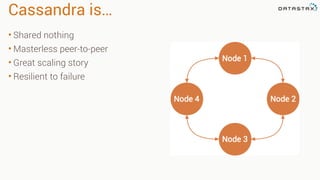
Cassandra is…
• Shared nothing
• Masterless peer-to-peer
• Great scaling story
• Resilient to failure
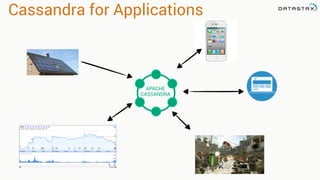
Cassandra for Applications
APACHE
CASSANDRA
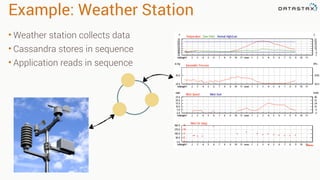
Example: Weather Station
• Weather station collects data
• Cassandra stores in sequence
• Application reads in sequence
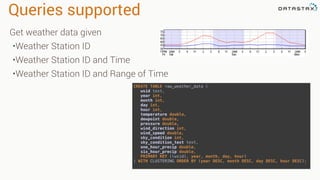
Queries supported
CREATE TABLE raw_weather_data (

wsid text,

year int,

month int,

day int,

hour int,

temperature double,

dewpoint double,

pressure double,

wind_direction int,

wind_speed double,

sky_condition int,

sky_condition_text text,

one_hour_precip double,

six_hour_precip double,

PRIMARY KEY ((wsid), year, month, day, hour)
) WITH CLUSTERING ORDER BY (year DESC, month DESC, day DESC, hour DESC);
Get weather data given
•Weather Station ID
•Weather Station ID and Time
•Weather Station ID and Range of Time
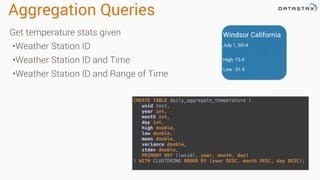
Aggregation Queries
CREATE TABLE daily_aggregate_temperature (

wsid text,

year int,

month int,

day int,

high double,

low double,

mean double,

variance double,

stdev double,

PRIMARY KEY ((wsid), year, month, day)

) WITH CLUSTERING ORDER BY (year DESC, month DESC, day DESC);
Get temperature stats given
•Weather Station ID
•Weather Station ID and Time
•Weather Station ID and Range of Time
Windsor California
July 1, 2014
High: 73.4
Low : 51.4
Apache Spark
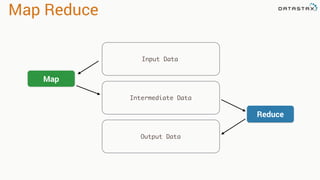
Map Reduce
Input Data
Map
Reduce
Intermediate Data
Output Data
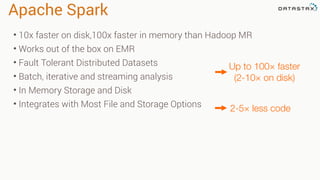
Apache Spark
• 10x faster on disk,100x faster in memory than Hadoop MR
• Works out of the box on EMR
• Fault Tolerant Distributed Datasets
• Batch, iterative and streaming analysis
• In Memory Storage and Disk
• Integrates with Most File and Storage Options
Up to 100× faster
(2-10× on disk)
2-5× less code
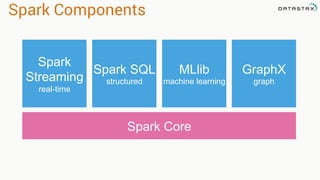
Spark Components
Spark Core
Spark SQL
structured
Spark
Streaming
real-time
MLlib
machine learning
GraphX
graph
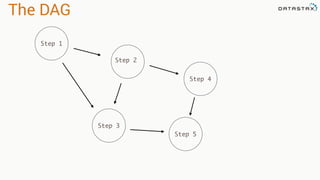
The DAG
Step 1
Step 2
Step 3
Step 4
Step 5
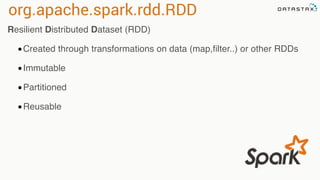
org.apache.spark.rdd.RDD
Resilient Distributed Dataset (RDD)
•Created through transformations on data (map,filter..) or other RDDs
•Immutable
•Partitioned
•Reusable
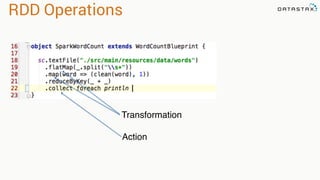
RDD Operations
•Transformations - Similar to scala collections API
•Produce new RDDs
•filter, flatmap, map, distinct, groupBy, union, zip,
reduceByKey, subtract
•Actions
•Require materialization of the records to generate a value
•collect: Array[T], count, fold, reduce..
Analytic
Analytic
Search
Transformation
Action
RDD Operations
Cassandra and Spark
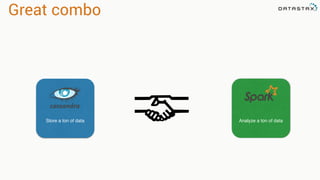
Great combo
Store a ton of data Analyze a ton of data
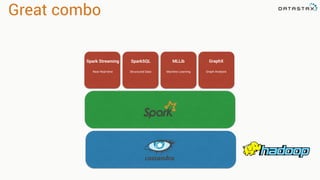
Great combo
Spark Streaming
Near Real-time
SparkSQL
Structured Data
MLLib
Machine Learning
GraphX
Graph Analysis
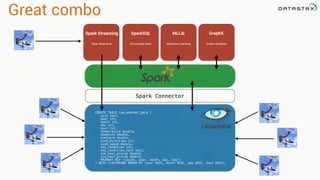
Great combo
Spark Streaming
Near Real-time
SparkSQL
Structured Data
MLLib
Machine Learning
GraphX
Graph Analysis
CREATE TABLE raw_weather_data (
wsid text,
year int,
month int,
day int,
hour int,
temperature double,
dewpoint double,
pressure double,
wind_direction int,
wind_speed double,
sky_condition int,
sky_condition_text text,
one_hour_precip double,
six_hour_precip double,
PRIMARY KEY ((wsid), year, month, day, hour)
) WITH CLUSTERING ORDER BY (year DESC, month DESC, day DESC, hour DESC);
Spark Connector
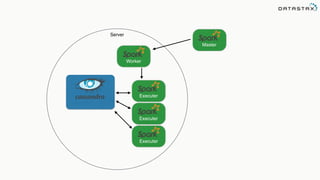
Executer
Master
Worker
Executer
Executer
Server
Master
Worker
Worker
Worker Worker
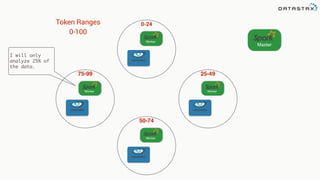
0-24Token Ranges
0-100
25-49
50-74
75-99
I will only
analyze 25% of
the data.
Master
Worker
Worker
Worker Worker
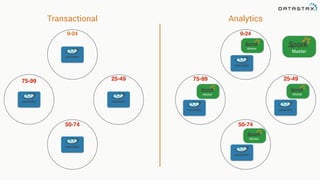
0-24
25-49
50-74
75-9975-99
0-24
25-49
50-74
AnalyticsTransactional
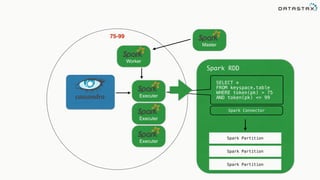
Executer
Master
Worker
Executer
Executer
75-99
SELECT *
FROM keyspace.table
WHERE token(pk) > 75
AND token(pk) <= 99
Spark RDD
Spark Partition
Spark Partition
Spark Partition
Spark Connector
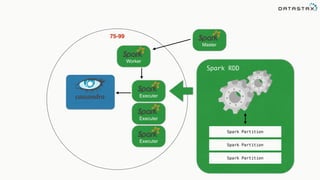
Executer
Master
Worker
Executer
Executer
75-99
Spark RDD
Spark Partition
Spark Partition
Spark Partition
Spark Reads on Cassandra
Awesome animation by DataStax’s own Russell Spitzer
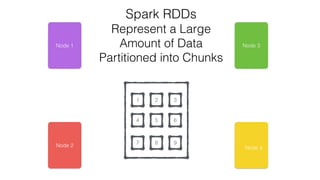
Spark RDDs
Represent a Large
Amount of Data
Partitioned into Chunks
RDD
1 2 3
4 5 6
7 8 9Node 2
Node 1 Node 3
Node 4
Node 2
Node 1
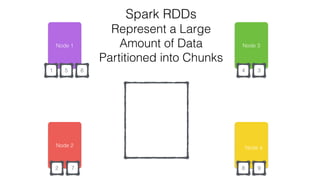
Spark RDDs
Represent a Large
Amount of Data
Partitioned into Chunks
RDD
2
346
7 8 9
Node 3
Node 4
1 5
Node 2
Node 1
RDD
2
346
7 8 9
Node 3
Node 4
1 5
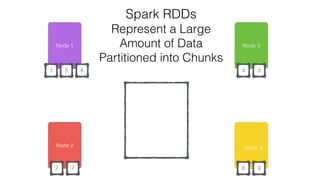
Spark RDDs
Represent a Large
Amount of Data
Partitioned into Chunks
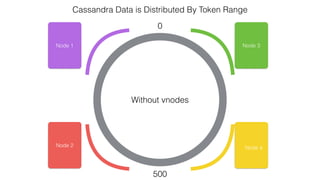
Cassandra Data is Distributed By Token Range
0
500
Cassandra Data is Distributed By Token Range
0
500
999
Cassandra Data is Distributed By Token Range
0
500
Node 1
Node 2
Node 3
Node 4
Cassandra Data is Distributed By Token Range
0
500
Node 1
Node 2
Node 3
Node 4
Without vnodes
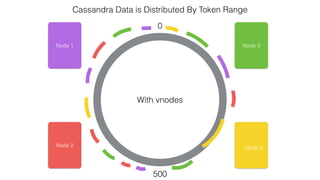
Cassandra Data is Distributed By Token Range
0
500
Node 1
Node 2
Node 3
Node 4
With vnodes
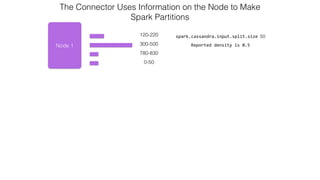
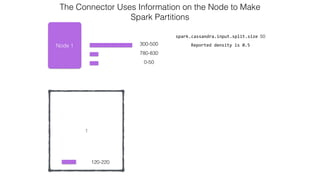
Node 1
120-220
300-500
780-830
0-50
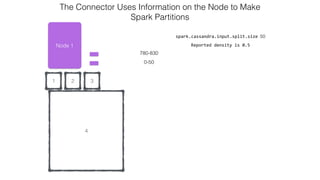
spark.cassandra.input.split.size 50
Reported  density  is  0.5
The Connector Uses Information on the Node to Make 

Spark Partitions
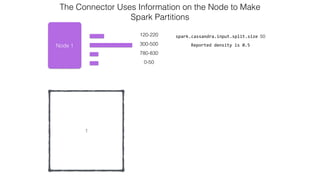
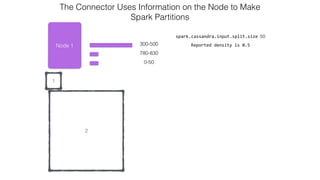
Node 1
120-220
300-500
0-50
spark.cassandra.input.split.size 50
Reported  density  is  0.5
The Connector Uses Information on the Node to Make 

Spark Partitions
1
780-830
1
Node 1
120-220
300-500
0-50
spark.cassandra.input.split.size 50
Reported  density  is  0.5
The Connector Uses Information on the Node to Make 

Spark Partitions
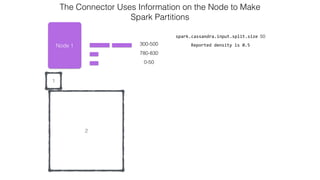
780-830
2
1
Node 1 300-500
0-50
spark.cassandra.input.split.size 50
Reported  density  is  0.5
The Connector Uses Information on the Node to Make 

Spark Partitions
780-830
2
1
Node 1 300-500
0-50
spark.cassandra.input.split.size 50
Reported  density  is  0.5
The Connector Uses Information on the Node to Make 

Spark Partitions
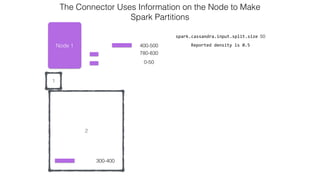
780-830
2
1
Node 1
300-400
0-50
spark.cassandra.input.split.size 50
Reported  density  is  0.5
The Connector Uses Information on the Node to Make 

Spark Partitions
780-830
400-500
21
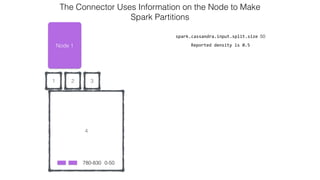
Node 1
0-50
spark.cassandra.input.split.size 50
Reported  density  is  0.5
The Connector Uses Information on the Node to Make 

Spark Partitions
780-830
400-500
21
Node 1
0-50
spark.cassandra.input.split.size 50
Reported  density  is  0.5
The Connector Uses Information on the Node to Make 

Spark Partitions
780-830
400-500
3
21
Node 1
0-50
spark.cassandra.input.split.size 50
Reported  density  is  0.5
The Connector Uses Information on the Node to Make 

Spark Partitions
780-830
3
400-500
21
Node 1
0-50
spark.cassandra.input.split.size 50
Reported  density  is  0.5
The Connector Uses Information on the Node to Make 

Spark Partitions
780-830
3
4
21
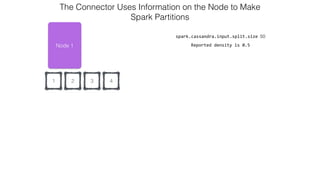
Node 1
0-50
spark.cassandra.input.split.size 50
Reported  density  is  0.5
The Connector Uses Information on the Node to Make 

Spark Partitions
780-830
3
4
21
Node 1
0-50
spark.cassandra.input.split.size 50
Reported  density  is  0.5
The Connector Uses Information on the Node to Make 

Spark Partitions
780-830
3
421
Node 1
spark.cassandra.input.split.size 50
Reported  density  is  0.5
The Connector Uses Information on the Node to Make 

Spark Partitions
3
4
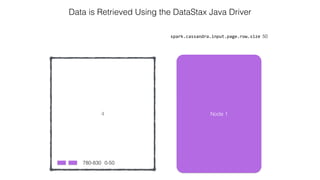
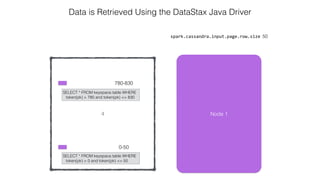
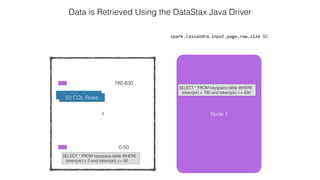
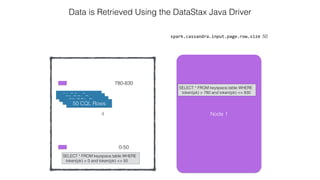
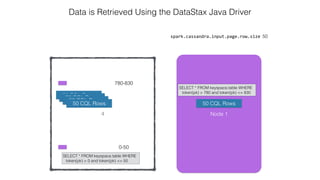
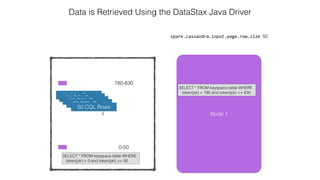
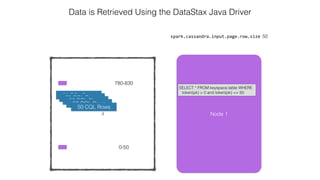
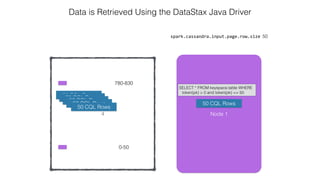
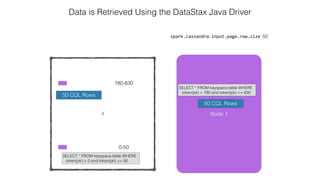
spark.cassandra.input.page.row.size 50
Data is Retrieved Using the DataStax Java Driver
0-50780-830
Node 1
4
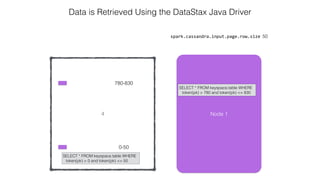
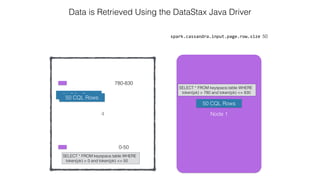
spark.cassandra.input.page.row.size 50
Data is Retrieved Using the DataStax Java Driver
0-50
780-830
Node 1
SELECT * FROM keyspace.table WHERE
token(pk) > 780 and token(pk) <= 830
SELECT * FROM keyspace.table WHERE
token(pk) > 0 and token(pk) <= 50
4
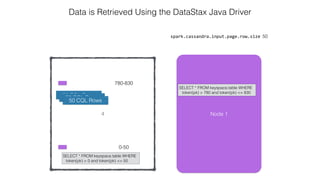
spark.cassandra.input.page.row.size 50
Data is Retrieved Using the DataStax Java Driver
0-50
780-830
Node 1
SELECT * FROM keyspace.table WHERE
token(pk) > 780 and token(pk) <= 830
SELECT * FROM keyspace.table WHERE
token(pk) > 0 and token(pk) <= 50
4
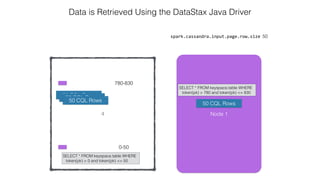
spark.cassandra.input.page.row.size 50
Data is Retrieved Using the DataStax Java Driver
0-50
780-830
Node 1
SELECT * FROM keyspace.table WHERE
token(pk) > 780 and token(pk) <= 830
SELECT * FROM keyspace.table WHERE
token(pk) > 0 and token(pk) <= 50
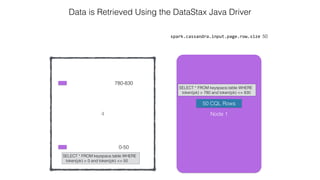
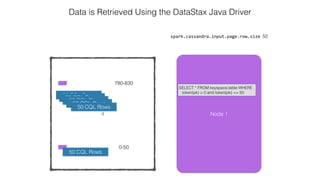
50 CQL Rows
4
spark.cassandra.input.page.row.size 50
Data is Retrieved Using the DataStax Java Driver
0-50
780-830
Node 1
SELECT * FROM keyspace.table WHERE
token(pk) > 780 and token(pk) <= 830
SELECT * FROM keyspace.table WHERE
token(pk) > 0 and token(pk) <= 50
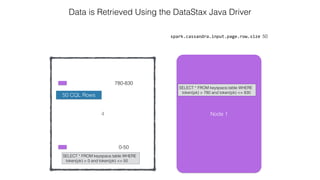
50 CQL Rows
4
spark.cassandra.input.page.row.size 50
Data is Retrieved Using the DataStax Java Driver
0-50
780-830
Node 1
SELECT * FROM keyspace.table WHERE
token(pk) > 780 and token(pk) <= 830
SELECT * FROM keyspace.table WHERE
token(pk) > 0 and token(pk) <= 50
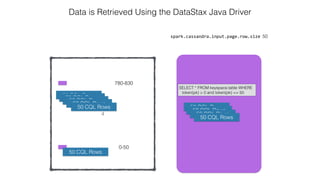
50 CQL Rows
50 CQL Rows
4
spark.cassandra.input.page.row.size 50
Data is Retrieved Using the DataStax Java Driver
0-50
780-830
Node 1
SELECT * FROM keyspace.table WHERE
token(pk) > 780 and token(pk) <= 830
SELECT * FROM keyspace.table WHERE
token(pk) > 0 and token(pk) <= 50
50 CQL Rows50 CQL Rows
4
spark.cassandra.input.page.row.size 50
Data is Retrieved Using the DataStax Java Driver
0-50
780-830
Node 1
SELECT * FROM keyspace.table WHERE
token(pk) > 780 and token(pk) <= 830
SELECT * FROM keyspace.table WHERE
token(pk) > 0 and token(pk) <= 50
50 CQL Rows50 CQL Rows
50 CQL Rows
4
spark.cassandra.input.page.row.size 50
Data is Retrieved Using the DataStax Java Driver
0-50
780-830
Node 1
SELECT * FROM keyspace.table WHERE
token(pk) > 780 and token(pk) <= 830
SELECT * FROM keyspace.table WHERE
token(pk) > 0 and token(pk) <= 50
50 CQL Rows50 CQL Rows
50 CQL Rows
4
spark.cassandra.input.page.row.size 50
Data is Retrieved Using the DataStax Java Driver
0-50
780-830
Node 1
SELECT * FROM keyspace.table WHERE
token(pk) > 780 and token(pk) <= 830
SELECT * FROM keyspace.table WHERE
token(pk) > 0 and token(pk) <= 50
50 CQL Rows50 CQL Rows
50 CQL Rows
50 CQL Rows
4
spark.cassandra.input.page.row.size 50
Data is Retrieved Using the DataStax Java Driver
0-50
780-830
Node 1
SELECT * FROM keyspace.table WHERE
token(pk) > 780 and token(pk) <= 830
SELECT * FROM keyspace.table WHERE
token(pk) > 0 and token(pk) <= 50
50 CQL Rows50 CQL Rows
50 CQL Rows
50 CQL Rows
4
spark.cassandra.input.page.row.size 50
Data is Retrieved Using the DataStax Java Driver
0-50
780-830
Node 1
SELECT * FROM keyspace.table WHERE
token(pk) > 780 and token(pk) <= 830
SELECT * FROM keyspace.table WHERE
token(pk) > 0 and token(pk) <= 50
50 CQL Rows50 CQL Rows
50 CQL Rows
50 CQL Rows 50 CQL Rows
4
spark.cassandra.input.page.row.size 50
Data is Retrieved Using the DataStax Java Driver
0-50
780-830
Node 1
SELECT * FROM keyspace.table WHERE
token(pk) > 780 and token(pk) <= 830
SELECT * FROM keyspace.table WHERE
token(pk) > 0 and token(pk) <= 50
50 CQL Rows50 CQL Rows
50 CQL Rows
50 CQL Rows
50 CQL Rows
4
spark.cassandra.input.page.row.size 50
Data is Retrieved Using the DataStax Java Driver
0-50
780-830
Node 1
SELECT * FROM keyspace.table WHERE
token(pk) > 0 and token(pk) <= 50
50 CQL Rows50 CQL Rows
50 CQL Rows
50 CQL Rows
50 CQL Rows
4
spark.cassandra.input.page.row.size 50
Data is Retrieved Using the DataStax Java Driver
0-50
780-830
Node 1
SELECT * FROM keyspace.table WHERE
token(pk) > 0 and token(pk) <= 50
50 CQL Rows50 CQL Rows
50 CQL Rows
50 CQL Rows
50 CQL Rows
50 CQL Rows
4
spark.cassandra.input.page.row.size 50
Data is Retrieved Using the DataStax Java Driver
0-50
780-830
Node 1
SELECT * FROM keyspace.table WHERE
token(pk) > 0 and token(pk) <= 50
50 CQL Rows50 CQL Rows
50 CQL Rows
50 CQL Rows
50 CQL Rows
50 CQL Rows
4
spark.cassandra.input.page.row.size 50
Data is Retrieved Using the DataStax Java Driver
0-50
780-830
Node 1
SELECT * FROM keyspace.table WHERE
token(pk) > 0 and token(pk) <= 50
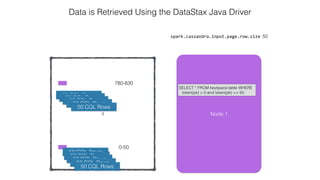
50 CQL Rows50 CQL Rows
50 CQL Rows
50 CQL Rows
50 CQL Rows
50 CQL Rows
50 CQL Rows
50 CQL Rows
50 CQL Rows
50 CQL Rows
4
spark.cassandra.input.page.row.size 50
Data is Retrieved Using the DataStax Java Driver
0-50
780-830
Node 1
SELECT * FROM keyspace.table WHERE
token(pk) > 0 and token(pk) <= 50
50 CQL Rows50 CQL Rows
50 CQL Rows
50 CQL Rows
50 CQL Rows
50 CQL Rows
50 CQL Rows
50 CQL Rows
50 CQL Rows
50 CQL Rows
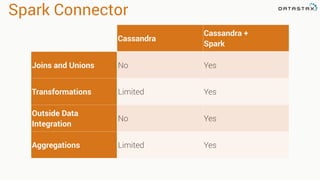
Spark Connector
Cassandra
Cassandra +
Spark
Joins and Unions No Yes
Transformations Limited Yes
Outside Data
Integration
No Yes
Aggregations Limited Yes
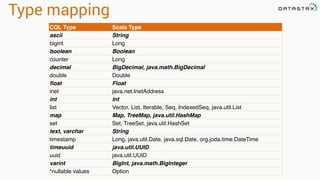
Type mapping
CQL Type Scala Type
ascii String
bigint Long
boolean Boolean
counter Long
decimal BigDecimal, java.math.BigDecimal
double Double
float Float
inet java.net.InetAddress
int Int
list Vector, List, Iterable, Seq, IndexedSeq, java.util.List
map Map, TreeMap, java.util.HashMap
set Set, TreeSet, java.util.HashSet
text, varchar String
timestamp Long, java.util.Date, java.sql.Date, org.joda.time.DateTime
timeuuid java.util.UUID
uuid java.util.UUID
varint BigInt, java.math.BigInteger
*nullable values Option
Attaching to Spark and Cassandra
// Import Cassandra-specific functions on SparkContext and RDD objects
import org.apache.spark.{SparkContext, SparkConf}

import com.datastax.spark.connector._
/** The setMaster("local") lets us run & test the job right in our IDE */

val conf = new SparkConf(true)
.set("spark.cassandra.connection.host", "127.0.0.1")
.setMaster(“local[*]")
.setAppName(getClass.getName)
// Optionally

.set("cassandra.username", "cassandra")

.set("cassandra.password", “cassandra")


val sc = new SparkContext(conf)
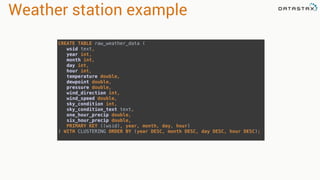
Weather station example
CREATE TABLE raw_weather_data (

wsid text, 

year int, 

month int, 

day int, 

hour int, 

temperature double, 

dewpoint double, 

pressure double, 

wind_direction int, 

wind_speed double, 

sky_condition int, 

sky_condition_text text, 

one_hour_precip double, 

six_hour_precip double, 

PRIMARY KEY ((wsid), year, month, day, hour)

) WITH CLUSTERING ORDER BY (year DESC, month DESC, day DESC, hour DESC);
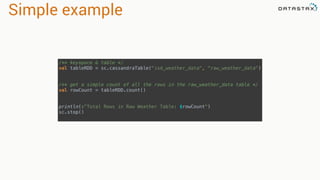
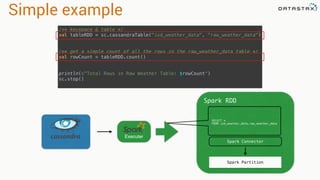
Simple example
/** keyspace & table */

val tableRDD = sc.cassandraTable("isd_weather_data", "raw_weather_data")


/** get a simple count of all the rows in the raw_weather_data table */

val rowCount = tableRDD.count()


println(s"Total Rows in Raw Weather Table: $rowCount")

sc.stop()
Simple example
/** keyspace & table */

val tableRDD = sc.cassandraTable("isd_weather_data", "raw_weather_data")


/** get a simple count of all the rows in the raw_weather_data table */

val rowCount = tableRDD.count()


println(s"Total Rows in Raw Weather Table: $rowCount")

sc.stop()
Executer
SELECT *
FROM isd_weather_data.raw_weather_data
Spark RDD
Spark Partition
Spark Connector
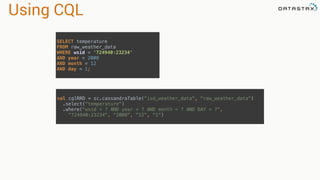
Using CQL
SELECT temperature

FROM raw_weather_data

WHERE wsid = '724940:23234'

AND year = 2008

AND month = 12

AND day = 1;
val cqlRRD = sc.cassandraTable("isd_weather_data", "raw_weather_data")

.select("temperature")

.where("wsid = ? AND year = ? AND month = ? AND DAY = ?",

"724940:23234", "2008", "12", “1")
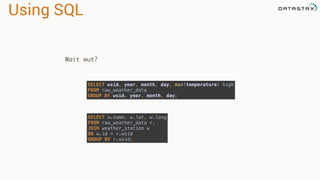
Using SQL
SELECT wsid, year, month, day, max(temperature) high

FROM raw_weather_data

GROUP BY wsid, year, month, day;
Wait wut?
SELECT w.name, w.lat, w.long

FROM raw_weather_data r,

JOIN weather_station w

ON w.id = r.wsid

GROUP BY r.wsid;
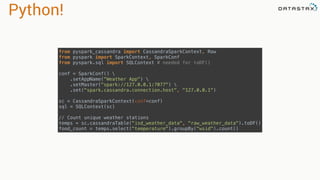
Python!
from pyspark_cassandra import CassandraSparkContext, Row

from pyspark import SparkContext, SparkConf

from pyspark.sql import SQLContext # needed for toDF()


conf = SparkConf() 

.setAppName("Weather App") 

.setMaster("spark://127.0.0.1:7077") 

.set("spark.cassandra.connection.host", "127.0.0.1")


sc = CassandraSparkContext(conf=conf)

sql = SQLContext(sc)

// Count unique weather stations

temps = sc.cassandraTable("isd_weather_data", "raw_weather_data").toDF()

food_count = temps.select("temperature").groupBy("wsid").count()
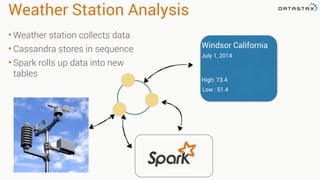
Weather Station Analysis
• Weather station collects data
• Cassandra stores in sequence
• Spark rolls up data into new
tables
Windsor California
July 1, 2014
High: 73.4
Low : 51.4
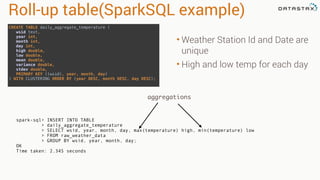
Roll-up table(SparkSQL example)
• Weather Station Id and Date are
unique
• High and low temp for each day
spark-sql> INSERT INTO TABLE
> daily_aggregate_temperature
> SELECT wsid, year, month, day, max(temperature) high, min(temperature) low
> FROM raw_weather_data
> GROUP BY wsid, year, month, day;
OK
Time taken: 2.345 seconds
aggregations
CREATE TABLE daily_aggregate_temperature (

wsid text,

year int,

month int,

day int,

high double,

low double,

mean double,

variance double,

stdev double,

PRIMARY KEY ((wsid), year, month, day)

) WITH CLUSTERING ORDER BY (year DESC, month DESC, day DESC);
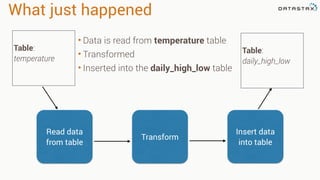
What just happened
• Data is read from temperature table
• Transformed
• Inserted into the daily_high_low table
Table:
temperature
Table:
daily_high_low
Read data
from table
Transform
Insert data
into table
Spark Streaming
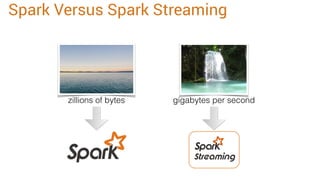
zillions of bytes gigabytes per second
Spark Versus Spark Streaming
Analytic
Analytic
Search
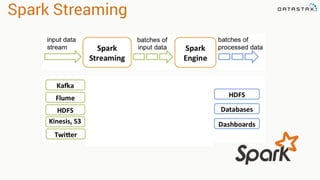
Spark Streaming
Kinesis,'S3'
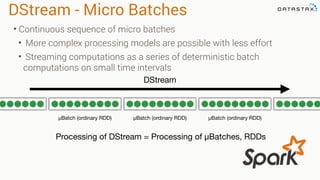
DStream - Micro Batches
μBatch (ordinary RDD) μBatch (ordinary RDD) μBatch (ordinary RDD)
Processing of DStream = Processing of μBatches, RDDs
DStream
• Continuous sequence of micro batches
• More complex processing models are possible with less effort
• Streaming computations as a series of deterministic batch
computations on small time intervals
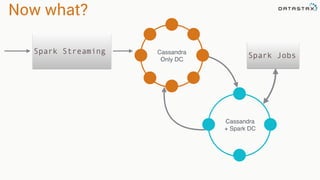
Now what?
Cassandra
Only DC
Cassandra
+ Spark DC
Spark Jobs
Spark Streaming
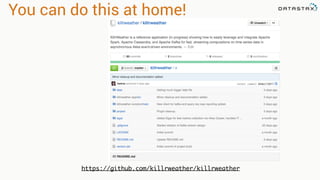
You can do this at home!
https://github.com/killrweather/killrweather
Thank you!
Bring the questions
Follow me on twitter
@PatrickMcFadin

Analyzing Time Series Data with Apache Spark and Cassandra

  • 1.
    Analyzing Time SeriesData with Apache Spark and Cassandra 1 Patrick McFadin
 Chief Evangelist for Apache Cassandra, DataStax @PatrickMcFadin
  • 2.
  • 3.
    Cassandra is… • Sharednothing • Masterless peer-to-peer • Great scaling story • Resilient to failure
  • 4.
  • 5.
    Example: Weather Station •Weather station collects data • Cassandra stores in sequence • Application reads in sequence
  • 6.
    Queries supported CREATE TABLEraw_weather_data (
 wsid text,
 year int,
 month int,
 day int,
 hour int,
 temperature double,
 dewpoint double,
 pressure double,
 wind_direction int,
 wind_speed double,
 sky_condition int,
 sky_condition_text text,
 one_hour_precip double,
 six_hour_precip double,
 PRIMARY KEY ((wsid), year, month, day, hour)
 ) WITH CLUSTERING ORDER BY (year DESC, month DESC, day DESC, hour DESC); Get weather data given •Weather Station ID •Weather Station ID and Time •Weather Station ID and Range of Time
  • 7.
    Aggregation Queries CREATE TABLEdaily_aggregate_temperature (
 wsid text,
 year int,
 month int,
 day int,
 high double,
 low double,
 mean double,
 variance double,
 stdev double,
 PRIMARY KEY ((wsid), year, month, day)
 ) WITH CLUSTERING ORDER BY (year DESC, month DESC, day DESC); Get temperature stats given •Weather Station ID •Weather Station ID and Time •Weather Station ID and Range of Time Windsor California July 1, 2014 High: 73.4 Low : 51.4
  • 8.
  • 9.
  • 10.
    Apache Spark • 10xfaster on disk,100x faster in memory than Hadoop MR • Works out of the box on EMR • Fault Tolerant Distributed Datasets • Batch, iterative and streaming analysis • In Memory Storage and Disk • Integrates with Most File and Storage Options Up to 100× faster (2-10× on disk) 2-5× less code
  • 11.
    Spark Components Spark Core SparkSQL structured Spark Streaming real-time MLlib machine learning GraphX graph
  • 13.
    The DAG Step 1 Step2 Step 3 Step 4 Step 5
  • 14.
    org.apache.spark.rdd.RDD Resilient Distributed Dataset(RDD) •Created through transformations on data (map,filter..) or other RDDs •Immutable •Partitioned •Reusable
  • 15.
    RDD Operations •Transformations -Similar to scala collections API •Produce new RDDs •filter, flatmap, map, distinct, groupBy, union, zip, reduceByKey, subtract •Actions •Require materialization of the records to generate a value •collect: Array[T], count, fold, reduce..
  • 16.
  • 17.
  • 18.
    Great combo Store aton of data Analyze a ton of data
  • 19.
    Great combo Spark Streaming NearReal-time SparkSQL Structured Data MLLib Machine Learning GraphX Graph Analysis
  • 20.
    Great combo Spark Streaming NearReal-time SparkSQL Structured Data MLLib Machine Learning GraphX Graph Analysis CREATE TABLE raw_weather_data ( wsid text, year int, month int, day int, hour int, temperature double, dewpoint double, pressure double, wind_direction int, wind_speed double, sky_condition int, sky_condition_text text, one_hour_precip double, six_hour_precip double, PRIMARY KEY ((wsid), year, month, day, hour) ) WITH CLUSTERING ORDER BY (year DESC, month DESC, day DESC, hour DESC); Spark Connector
  • 21.
  • 22.
  • 23.
  • 24.
    Executer Master Worker Executer Executer 75-99 SELECT * FROM keyspace.table WHEREtoken(pk) > 75 AND token(pk) <= 99 Spark RDD Spark Partition Spark Partition Spark Partition Spark Connector
  • 25.
  • 26.
    Spark Reads onCassandra Awesome animation by DataStax’s own Russell Spitzer
  • 27.
    Spark RDDs Represent aLarge Amount of Data Partitioned into Chunks RDD 1 2 3 4 5 6 7 8 9Node 2 Node 1 Node 3 Node 4
  • 28.
    Node 2 Node 1 SparkRDDs Represent a Large Amount of Data Partitioned into Chunks RDD 2 346 7 8 9 Node 3 Node 4 1 5
  • 29.
    Node 2 Node 1 RDD 2 346 78 9 Node 3 Node 4 1 5 Spark RDDs Represent a Large Amount of Data Partitioned into Chunks
  • 30.
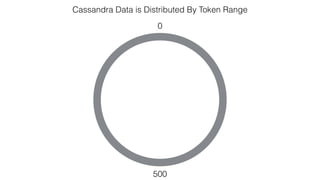
    Cassandra Data isDistributed By Token Range
  • 31.
    Cassandra Data isDistributed By Token Range 0 500
  • 32.
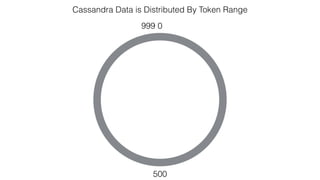
    Cassandra Data isDistributed By Token Range 0 500 999
  • 33.
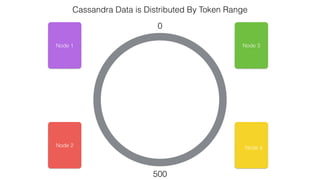
    Cassandra Data isDistributed By Token Range 0 500 Node 1 Node 2 Node 3 Node 4
  • 34.
    Cassandra Data isDistributed By Token Range 0 500 Node 1 Node 2 Node 3 Node 4 Without vnodes
  • 35.
    Cassandra Data isDistributed By Token Range 0 500 Node 1 Node 2 Node 3 Node 4 With vnodes
  • 36.
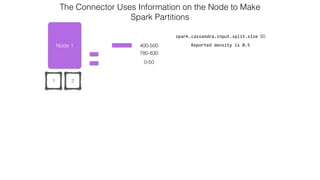
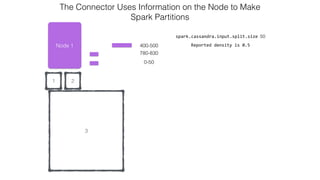
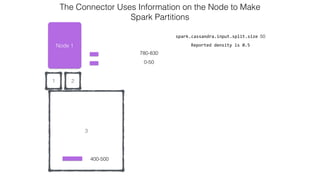
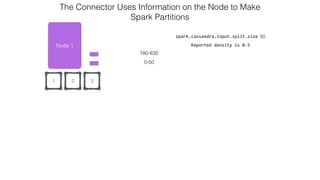
    Node 1 120-220 300-500 780-830 0-50 spark.cassandra.input.split.size 50 Reported density  is  0.5 The Connector Uses Information on the Node to Make 
 Spark Partitions
  • 37.
    Node 1 120-220 300-500 0-50 spark.cassandra.input.split.size 50 Reported density  is  0.5 The Connector Uses Information on the Node to Make 
 Spark Partitions 1 780-830
  • 38.
    1 Node 1 120-220 300-500 0-50 spark.cassandra.input.split.size 50 Reported density  is  0.5 The Connector Uses Information on the Node to Make 
 Spark Partitions 780-830
  • 39.
    2 1 Node 1 300-500 0-50 spark.cassandra.input.split.size50 Reported  density  is  0.5 The Connector Uses Information on the Node to Make 
 Spark Partitions 780-830
  • 40.
    2 1 Node 1 300-500 0-50 spark.cassandra.input.split.size50 Reported  density  is  0.5 The Connector Uses Information on the Node to Make 
 Spark Partitions 780-830
  • 41.
    2 1 Node 1 300-400 0-50 spark.cassandra.input.split.size 50 Reported density  is  0.5 The Connector Uses Information on the Node to Make 
 Spark Partitions 780-830 400-500
  • 42.
    21 Node 1 0-50 spark.cassandra.input.split.size 50 Reported density  is  0.5 The Connector Uses Information on the Node to Make 
 Spark Partitions 780-830 400-500
  • 43.
    21 Node 1 0-50 spark.cassandra.input.split.size 50 Reported density  is  0.5 The Connector Uses Information on the Node to Make 
 Spark Partitions 780-830 400-500 3
  • 44.
    21 Node 1 0-50 spark.cassandra.input.split.size 50 Reported density  is  0.5 The Connector Uses Information on the Node to Make 
 Spark Partitions 780-830 3 400-500
  • 45.
    21 Node 1 0-50 spark.cassandra.input.split.size 50 Reported density  is  0.5 The Connector Uses Information on the Node to Make 
 Spark Partitions 780-830 3
  • 46.
    4 21 Node 1 0-50 spark.cassandra.input.split.size 50 Reported density  is  0.5 The Connector Uses Information on the Node to Make 
 Spark Partitions 780-830 3
  • 47.
    4 21 Node 1 0-50 spark.cassandra.input.split.size 50 Reported density  is  0.5 The Connector Uses Information on the Node to Make 
 Spark Partitions 780-830 3
  • 48.
    421 Node 1 spark.cassandra.input.split.size 50 Reported density  is  0.5 The Connector Uses Information on the Node to Make 
 Spark Partitions 3
  • 49.
    4 spark.cassandra.input.page.row.size 50 Data isRetrieved Using the DataStax Java Driver 0-50780-830 Node 1
  • 50.
    4 spark.cassandra.input.page.row.size 50 Data isRetrieved Using the DataStax Java Driver 0-50 780-830 Node 1 SELECT * FROM keyspace.table WHERE token(pk) > 780 and token(pk) <= 830 SELECT * FROM keyspace.table WHERE token(pk) > 0 and token(pk) <= 50
  • 51.
    4 spark.cassandra.input.page.row.size 50 Data isRetrieved Using the DataStax Java Driver 0-50 780-830 Node 1 SELECT * FROM keyspace.table WHERE token(pk) > 780 and token(pk) <= 830 SELECT * FROM keyspace.table WHERE token(pk) > 0 and token(pk) <= 50
  • 52.
    4 spark.cassandra.input.page.row.size 50 Data isRetrieved Using the DataStax Java Driver 0-50 780-830 Node 1 SELECT * FROM keyspace.table WHERE token(pk) > 780 and token(pk) <= 830 SELECT * FROM keyspace.table WHERE token(pk) > 0 and token(pk) <= 50 50 CQL Rows
  • 53.
    4 spark.cassandra.input.page.row.size 50 Data isRetrieved Using the DataStax Java Driver 0-50 780-830 Node 1 SELECT * FROM keyspace.table WHERE token(pk) > 780 and token(pk) <= 830 SELECT * FROM keyspace.table WHERE token(pk) > 0 and token(pk) <= 50 50 CQL Rows
  • 54.
    4 spark.cassandra.input.page.row.size 50 Data isRetrieved Using the DataStax Java Driver 0-50 780-830 Node 1 SELECT * FROM keyspace.table WHERE token(pk) > 780 and token(pk) <= 830 SELECT * FROM keyspace.table WHERE token(pk) > 0 and token(pk) <= 50 50 CQL Rows 50 CQL Rows
  • 55.
    4 spark.cassandra.input.page.row.size 50 Data isRetrieved Using the DataStax Java Driver 0-50 780-830 Node 1 SELECT * FROM keyspace.table WHERE token(pk) > 780 and token(pk) <= 830 SELECT * FROM keyspace.table WHERE token(pk) > 0 and token(pk) <= 50 50 CQL Rows50 CQL Rows
  • 56.
    4 spark.cassandra.input.page.row.size 50 Data isRetrieved Using the DataStax Java Driver 0-50 780-830 Node 1 SELECT * FROM keyspace.table WHERE token(pk) > 780 and token(pk) <= 830 SELECT * FROM keyspace.table WHERE token(pk) > 0 and token(pk) <= 50 50 CQL Rows50 CQL Rows 50 CQL Rows
  • 57.
    4 spark.cassandra.input.page.row.size 50 Data isRetrieved Using the DataStax Java Driver 0-50 780-830 Node 1 SELECT * FROM keyspace.table WHERE token(pk) > 780 and token(pk) <= 830 SELECT * FROM keyspace.table WHERE token(pk) > 0 and token(pk) <= 50 50 CQL Rows50 CQL Rows 50 CQL Rows
  • 58.
    4 spark.cassandra.input.page.row.size 50 Data isRetrieved Using the DataStax Java Driver 0-50 780-830 Node 1 SELECT * FROM keyspace.table WHERE token(pk) > 780 and token(pk) <= 830 SELECT * FROM keyspace.table WHERE token(pk) > 0 and token(pk) <= 50 50 CQL Rows50 CQL Rows 50 CQL Rows 50 CQL Rows
  • 59.
    4 spark.cassandra.input.page.row.size 50 Data isRetrieved Using the DataStax Java Driver 0-50 780-830 Node 1 SELECT * FROM keyspace.table WHERE token(pk) > 780 and token(pk) <= 830 SELECT * FROM keyspace.table WHERE token(pk) > 0 and token(pk) <= 50 50 CQL Rows50 CQL Rows 50 CQL Rows 50 CQL Rows
  • 60.
    4 spark.cassandra.input.page.row.size 50 Data isRetrieved Using the DataStax Java Driver 0-50 780-830 Node 1 SELECT * FROM keyspace.table WHERE token(pk) > 780 and token(pk) <= 830 SELECT * FROM keyspace.table WHERE token(pk) > 0 and token(pk) <= 50 50 CQL Rows50 CQL Rows 50 CQL Rows 50 CQL Rows 50 CQL Rows
  • 61.
    4 spark.cassandra.input.page.row.size 50 Data isRetrieved Using the DataStax Java Driver 0-50 780-830 Node 1 SELECT * FROM keyspace.table WHERE token(pk) > 780 and token(pk) <= 830 SELECT * FROM keyspace.table WHERE token(pk) > 0 and token(pk) <= 50 50 CQL Rows50 CQL Rows 50 CQL Rows 50 CQL Rows 50 CQL Rows
  • 62.
    4 spark.cassandra.input.page.row.size 50 Data isRetrieved Using the DataStax Java Driver 0-50 780-830 Node 1 SELECT * FROM keyspace.table WHERE token(pk) > 0 and token(pk) <= 50 50 CQL Rows50 CQL Rows 50 CQL Rows 50 CQL Rows 50 CQL Rows
  • 63.
    4 spark.cassandra.input.page.row.size 50 Data isRetrieved Using the DataStax Java Driver 0-50 780-830 Node 1 SELECT * FROM keyspace.table WHERE token(pk) > 0 and token(pk) <= 50 50 CQL Rows50 CQL Rows 50 CQL Rows 50 CQL Rows 50 CQL Rows 50 CQL Rows
  • 64.
    4 spark.cassandra.input.page.row.size 50 Data isRetrieved Using the DataStax Java Driver 0-50 780-830 Node 1 SELECT * FROM keyspace.table WHERE token(pk) > 0 and token(pk) <= 50 50 CQL Rows50 CQL Rows 50 CQL Rows 50 CQL Rows 50 CQL Rows 50 CQL Rows
  • 65.
    4 spark.cassandra.input.page.row.size 50 Data isRetrieved Using the DataStax Java Driver 0-50 780-830 Node 1 SELECT * FROM keyspace.table WHERE token(pk) > 0 and token(pk) <= 50 50 CQL Rows50 CQL Rows 50 CQL Rows 50 CQL Rows 50 CQL Rows 50 CQL Rows 50 CQL Rows 50 CQL Rows 50 CQL Rows 50 CQL Rows
  • 66.
    4 spark.cassandra.input.page.row.size 50 Data isRetrieved Using the DataStax Java Driver 0-50 780-830 Node 1 SELECT * FROM keyspace.table WHERE token(pk) > 0 and token(pk) <= 50 50 CQL Rows50 CQL Rows 50 CQL Rows 50 CQL Rows 50 CQL Rows 50 CQL Rows 50 CQL Rows 50 CQL Rows 50 CQL Rows 50 CQL Rows
  • 67.
    Spark Connector Cassandra Cassandra + Spark Joinsand Unions No Yes Transformations Limited Yes Outside Data Integration No Yes Aggregations Limited Yes
  • 68.
    Type mapping CQL TypeScala Type ascii String bigint Long boolean Boolean counter Long decimal BigDecimal, java.math.BigDecimal double Double float Float inet java.net.InetAddress int Int list Vector, List, Iterable, Seq, IndexedSeq, java.util.List map Map, TreeMap, java.util.HashMap set Set, TreeSet, java.util.HashSet text, varchar String timestamp Long, java.util.Date, java.sql.Date, org.joda.time.DateTime timeuuid java.util.UUID uuid java.util.UUID varint BigInt, java.math.BigInteger *nullable values Option
  • 69.
    Attaching to Sparkand Cassandra // Import Cassandra-specific functions on SparkContext and RDD objects import org.apache.spark.{SparkContext, SparkConf}
 import com.datastax.spark.connector._ /** The setMaster("local") lets us run & test the job right in our IDE */
 val conf = new SparkConf(true) .set("spark.cassandra.connection.host", "127.0.0.1") .setMaster(“local[*]") .setAppName(getClass.getName) // Optionally
 .set("cassandra.username", "cassandra")
 .set("cassandra.password", “cassandra") 
 val sc = new SparkContext(conf)
  • 70.
    Weather station example CREATETABLE raw_weather_data (
 wsid text, 
 year int, 
 month int, 
 day int, 
 hour int, 
 temperature double, 
 dewpoint double, 
 pressure double, 
 wind_direction int, 
 wind_speed double, 
 sky_condition int, 
 sky_condition_text text, 
 one_hour_precip double, 
 six_hour_precip double, 
 PRIMARY KEY ((wsid), year, month, day, hour)
 ) WITH CLUSTERING ORDER BY (year DESC, month DESC, day DESC, hour DESC);
  • 71.
    Simple example /** keyspace& table */
 val tableRDD = sc.cassandraTable("isd_weather_data", "raw_weather_data")
 
 
 /** get a simple count of all the rows in the raw_weather_data table */
 val rowCount = tableRDD.count()
 
 
 println(s"Total Rows in Raw Weather Table: $rowCount")
 sc.stop()
  • 72.
    Simple example /** keyspace& table */
 val tableRDD = sc.cassandraTable("isd_weather_data", "raw_weather_data")
 
 
 /** get a simple count of all the rows in the raw_weather_data table */
 val rowCount = tableRDD.count()
 
 
 println(s"Total Rows in Raw Weather Table: $rowCount")
 sc.stop() Executer SELECT * FROM isd_weather_data.raw_weather_data Spark RDD Spark Partition Spark Connector
  • 73.
    Using CQL SELECT temperature
 FROMraw_weather_data
 WHERE wsid = '724940:23234'
 AND year = 2008
 AND month = 12
 AND day = 1; val cqlRRD = sc.cassandraTable("isd_weather_data", "raw_weather_data")
 .select("temperature")
 .where("wsid = ? AND year = ? AND month = ? AND DAY = ?",
 "724940:23234", "2008", "12", “1")
  • 74.
    Using SQL SELECT wsid,year, month, day, max(temperature) high
 FROM raw_weather_data
 GROUP BY wsid, year, month, day; Wait wut? SELECT w.name, w.lat, w.long
 FROM raw_weather_data r,
 JOIN weather_station w
 ON w.id = r.wsid
 GROUP BY r.wsid;
  • 75.
    Python! from pyspark_cassandra importCassandraSparkContext, Row
 from pyspark import SparkContext, SparkConf
 from pyspark.sql import SQLContext # needed for toDF()
 
 conf = SparkConf() 
 .setAppName("Weather App") 
 .setMaster("spark://127.0.0.1:7077") 
 .set("spark.cassandra.connection.host", "127.0.0.1")
 
 sc = CassandraSparkContext(conf=conf)
 sql = SQLContext(sc)
 // Count unique weather stations
 temps = sc.cassandraTable("isd_weather_data", "raw_weather_data").toDF()
 food_count = temps.select("temperature").groupBy("wsid").count()
  • 76.
    Weather Station Analysis •Weather station collects data • Cassandra stores in sequence • Spark rolls up data into new tables Windsor California July 1, 2014 High: 73.4 Low : 51.4
  • 77.
    Roll-up table(SparkSQL example) •Weather Station Id and Date are unique • High and low temp for each day spark-sql> INSERT INTO TABLE > daily_aggregate_temperature > SELECT wsid, year, month, day, max(temperature) high, min(temperature) low > FROM raw_weather_data > GROUP BY wsid, year, month, day; OK Time taken: 2.345 seconds aggregations CREATE TABLE daily_aggregate_temperature (
 wsid text,
 year int,
 month int,
 day int,
 high double,
 low double,
 mean double,
 variance double,
 stdev double,
 PRIMARY KEY ((wsid), year, month, day)
 ) WITH CLUSTERING ORDER BY (year DESC, month DESC, day DESC);
  • 78.
    What just happened •Data is read from temperature table • Transformed • Inserted into the daily_high_low table Table: temperature Table: daily_high_low Read data from table Transform Insert data into table
  • 79.
  • 80.
    zillions of bytesgigabytes per second Spark Versus Spark Streaming
  • 81.
  • 82.
    DStream - MicroBatches μBatch (ordinary RDD) μBatch (ordinary RDD) μBatch (ordinary RDD) Processing of DStream = Processing of μBatches, RDDs DStream • Continuous sequence of micro batches • More complex processing models are possible with less effort • Streaming computations as a series of deterministic batch computations on small time intervals
  • 83.
    Now what? Cassandra Only DC Cassandra +Spark DC Spark Jobs Spark Streaming
  • 84.
    You can dothis at home! https://github.com/killrweather/killrweather
  • 86.
    Thank you! Bring thequestions Follow me on twitter @PatrickMcFadin