APA STYLE 7THEDITION
MSUB WRITING CENTER IN THE ASC
HTTPS://WWW.MSUBILLINGS.EDU/ASC/
2.
WHAT IS APA?
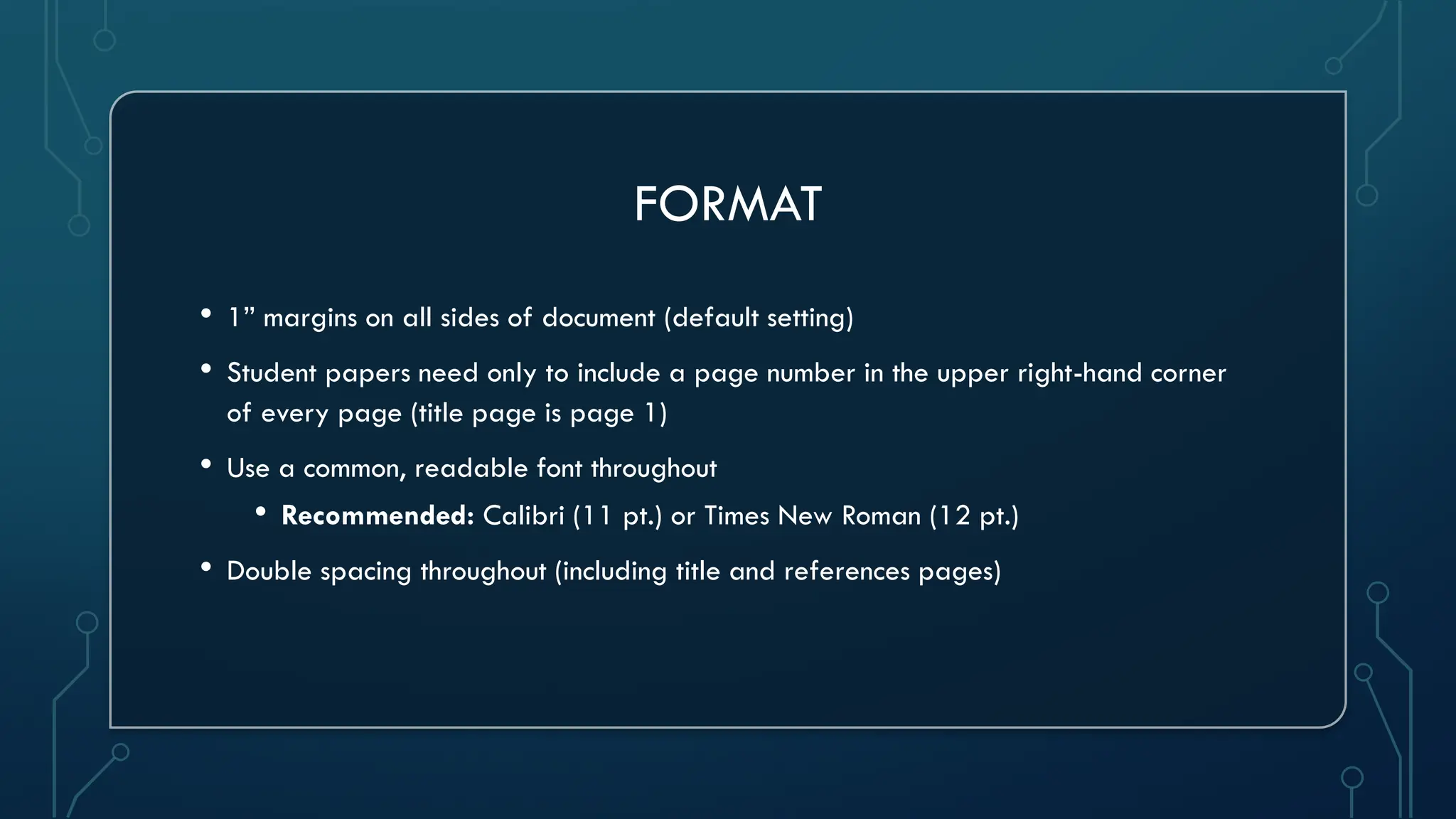
TheAmerican Psychological Association (APA) “style provides a foundation for effective
scholarly communication because it helps authors present their ideas in a clear, concise, and
organized manner” (APA, 2020, p. xvii).
Disciplines that Use APA: APA regulates:
Business Style and language
Health Sciences Document format
Sciences In-text citations
Social Sciences References
3.
FORMAT
• 1” marginson all sides of document (default setting)
• Student papers need only to include a page number in the upper right-hand corner
of every page (title page is page 1)
• Use a common, readable font throughout
• Recommended: Calibri (11 pt.) or Times New Roman (12 pt.)
• Double spacing throughout (including title and references pages)
4.
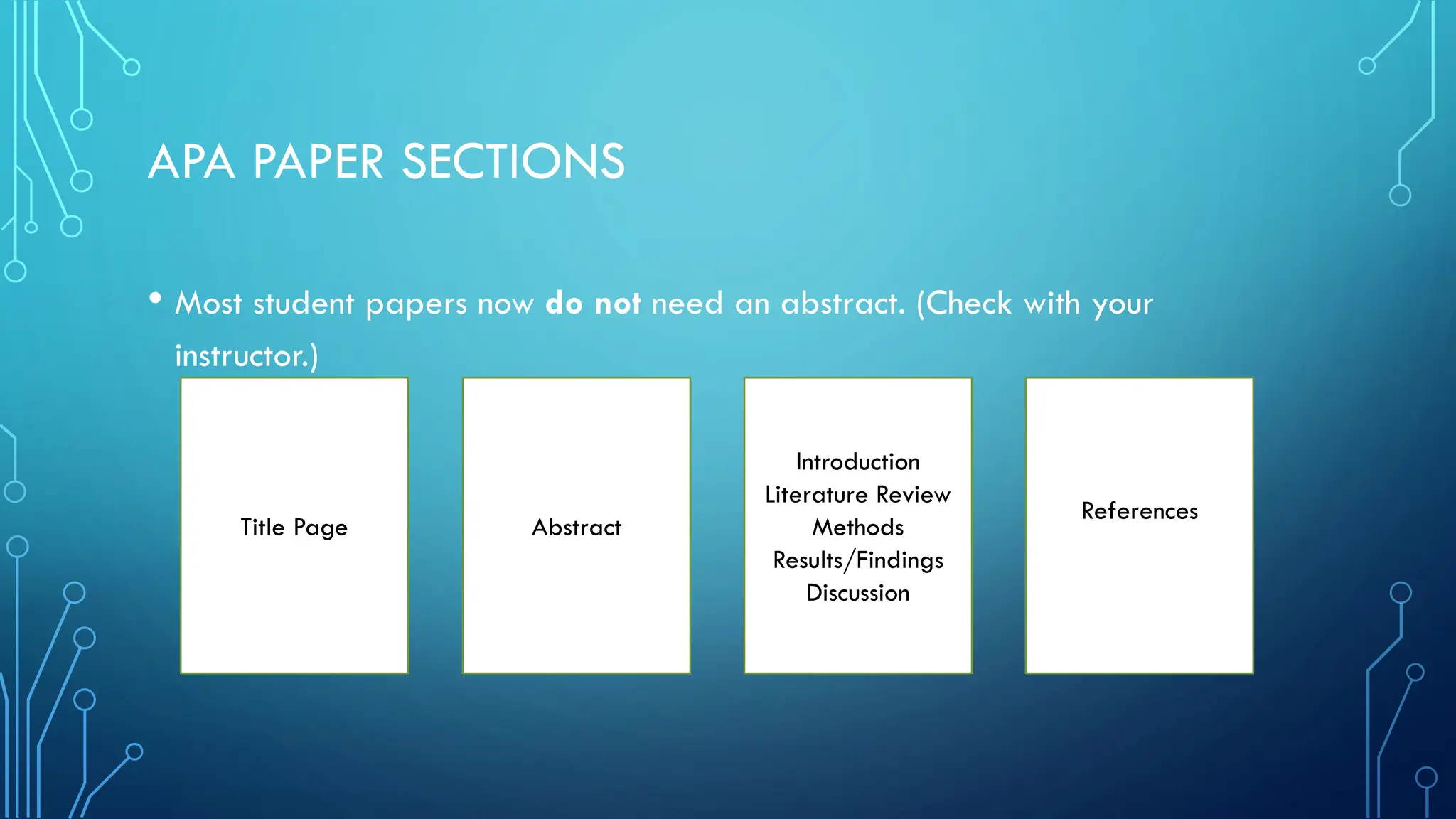
APA PAPER SECTIONS
•Most student papers now do not need an abstract. (Check with your
instructor.)
References
Introduction
Literature Review
Methods
Results/Findings
Discussion
Abstract
Title Page
5.
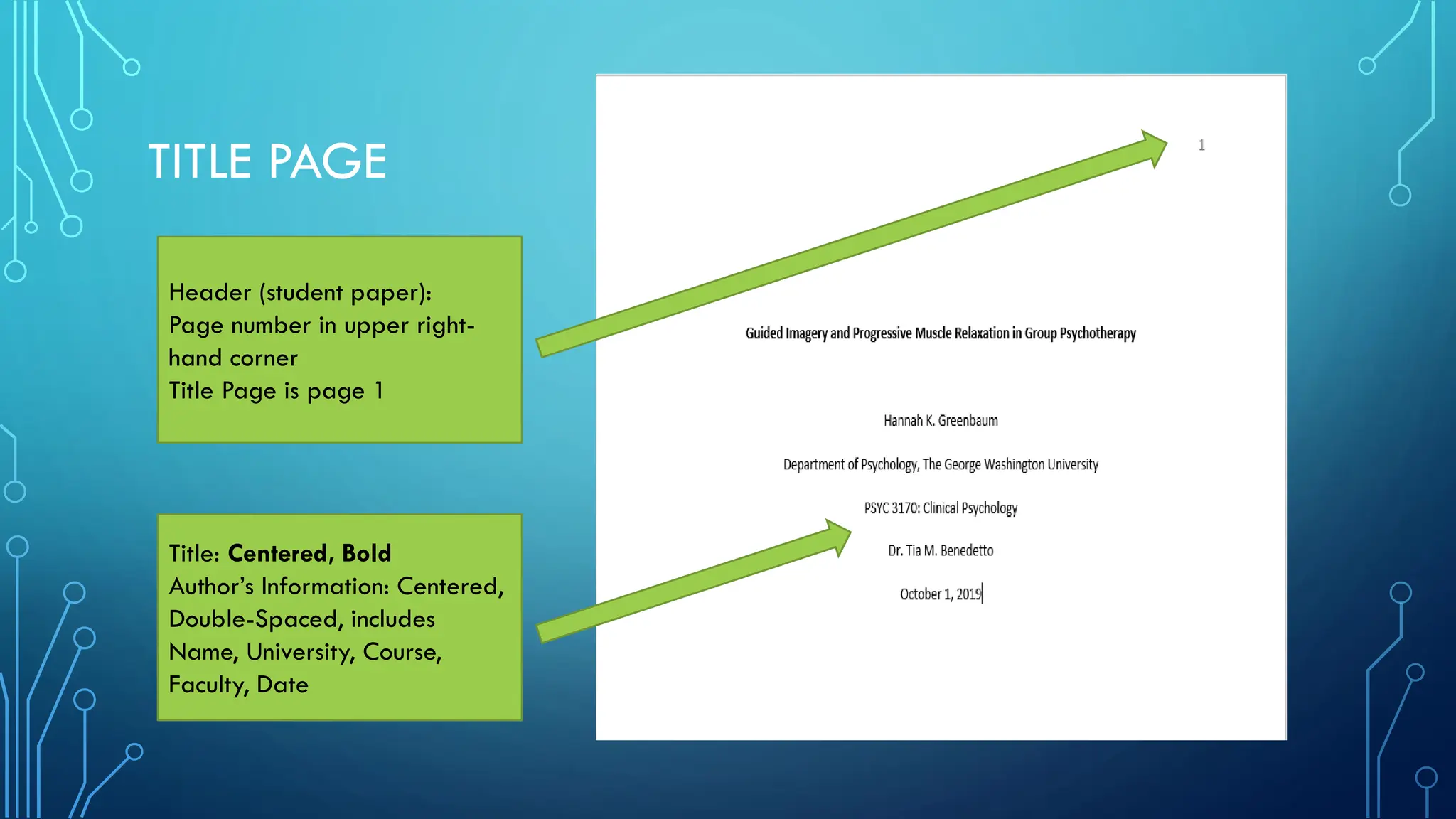
TITLE PAGE
Header (studentpaper):
Page number in upper right-
hand corner
Title Page is page 1
Title: Centered, Bold
Author’s Information: Centered,
Double-Spaced, includes
Name, University, Course,
Faculty, Date
6.
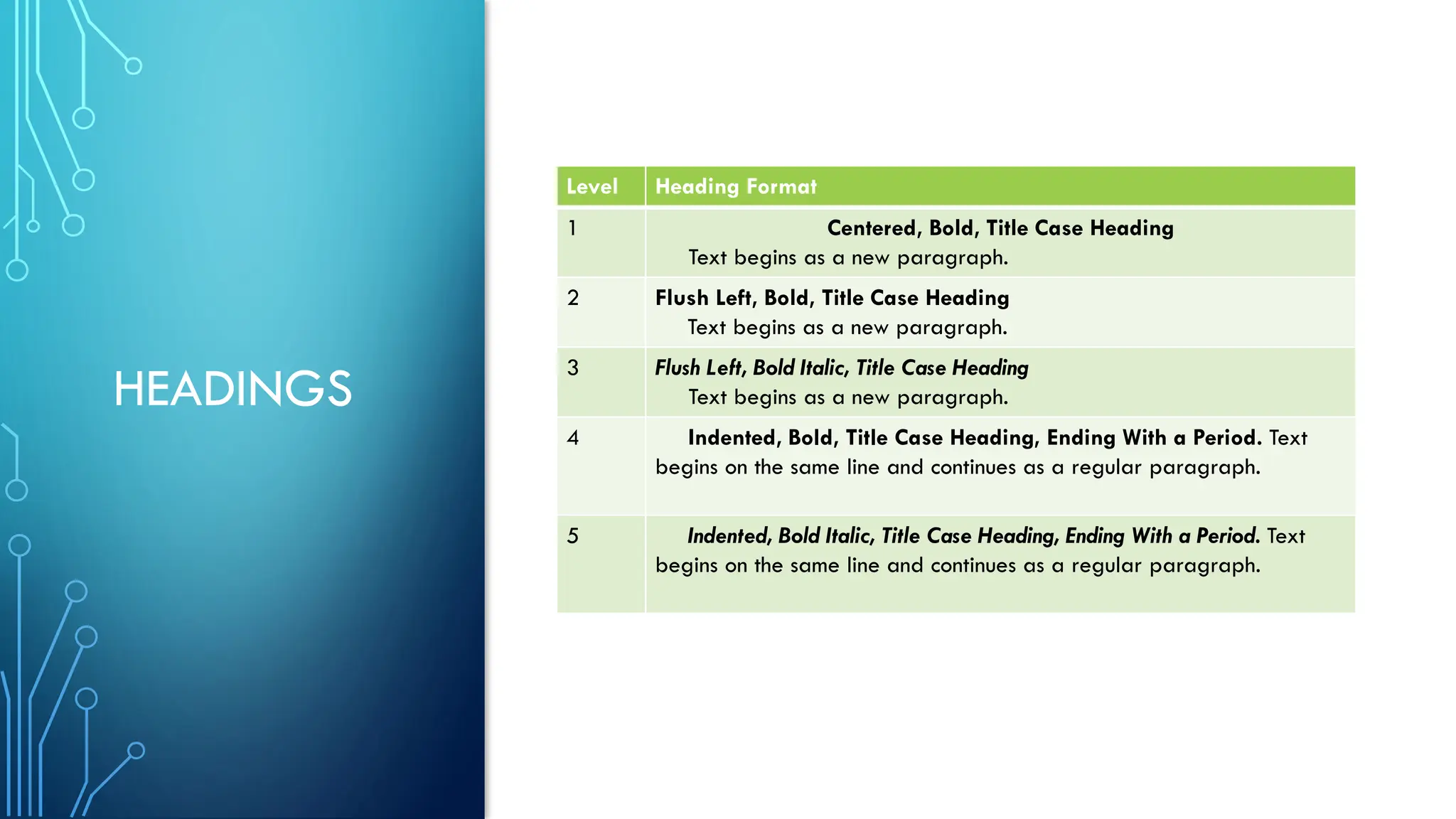
HEADINGS
Level Heading Format
1Centered, Bold, Title Case Heading
Text begins as a new paragraph.
2 Flush Left, Bold, Title Case Heading
Text begins as a new paragraph.
3 Flush Left, Bold Italic, Title Case Heading
Text begins as a new paragraph.
4 Indented, Bold, Title Case Heading, Ending With a Period. Text
begins on the same line and continues as a regular paragraph.
5 Indented, Bold Italic, Title Case Heading, Ending With a Period. Text
begins on the same line and continues as a regular paragraph.
7.
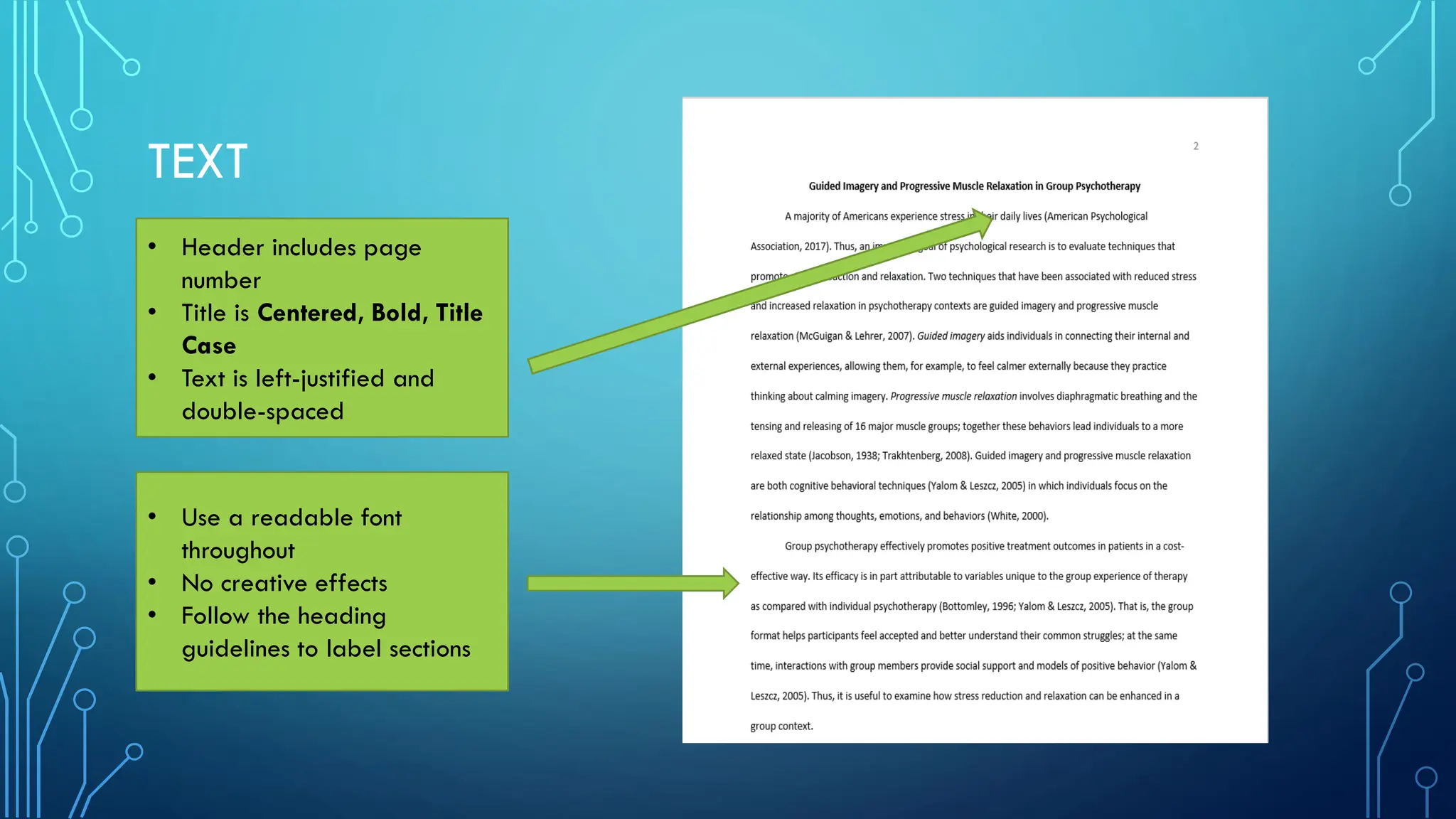
TEXT
• Header includespage
number
• Title is Centered, Bold, Title
Case
• Text is left-justified and
double-spaced
• Use a readable font
throughout
• No creative effects
• Follow the heading
guidelines to label sections
8.
STYLE GUIDELINES
• Useclear, concise language; avoid contractions and colloquialisms
• Numerals under 10 should be spelled out; 10 and above expressed as a number
• Past tense verbs should be used to refer to events that occurred at a specific point in the past (such
as a researcher’s work)
• Use “I” in place of editorial “we”
• Do not use “he” or “she” as a generic pronoun; it is acceptable to use “they” or rephrase the
sentence
• Avoid biased language that reveals sex, gender, race, disability, socio-economic status
OVERVIEW
• Credit ideas,texts, research and media that have directly influenced your work
• Author-date citation system (corresponds to the first word of the references entry)
• Parenthetical:
This is an example of a parenthetical in-text citation (Karas, 2020).
• Narrative:
Karas (2020) offered an example of a narrative in-text citation.
11.
PARAPHRASES
• Paraphrases statethe ideas of another in the author’s own words.
• APA prioritizes paraphrasing over quoting
• Published authors primarily paraphrase, and students should learn to emulate this style
• Use the author-date citation system to attribute paraphrased ideas
Paraphrases allow the author to condense information and synthesize ideas
from multiple sources (American Psychological Association [APA], 2020).
12.
DIRECT
QUOTES
Quote sparingly. Reservequotes for vivid, impactful
language
For direct quotes of fewer than 40 words, use the author-
date citation system, include a page number (p. or pp.) or
other locator, and incorporate the quote into the paragraph.
Narrative: According to the APA (2020), “a direct quotation
reproduces words verbatim from another work” (p. 270).
Parenthetical: “A direct quotation reproduces words
verbatim from another work” (APA, 2020, p. 270).
13.
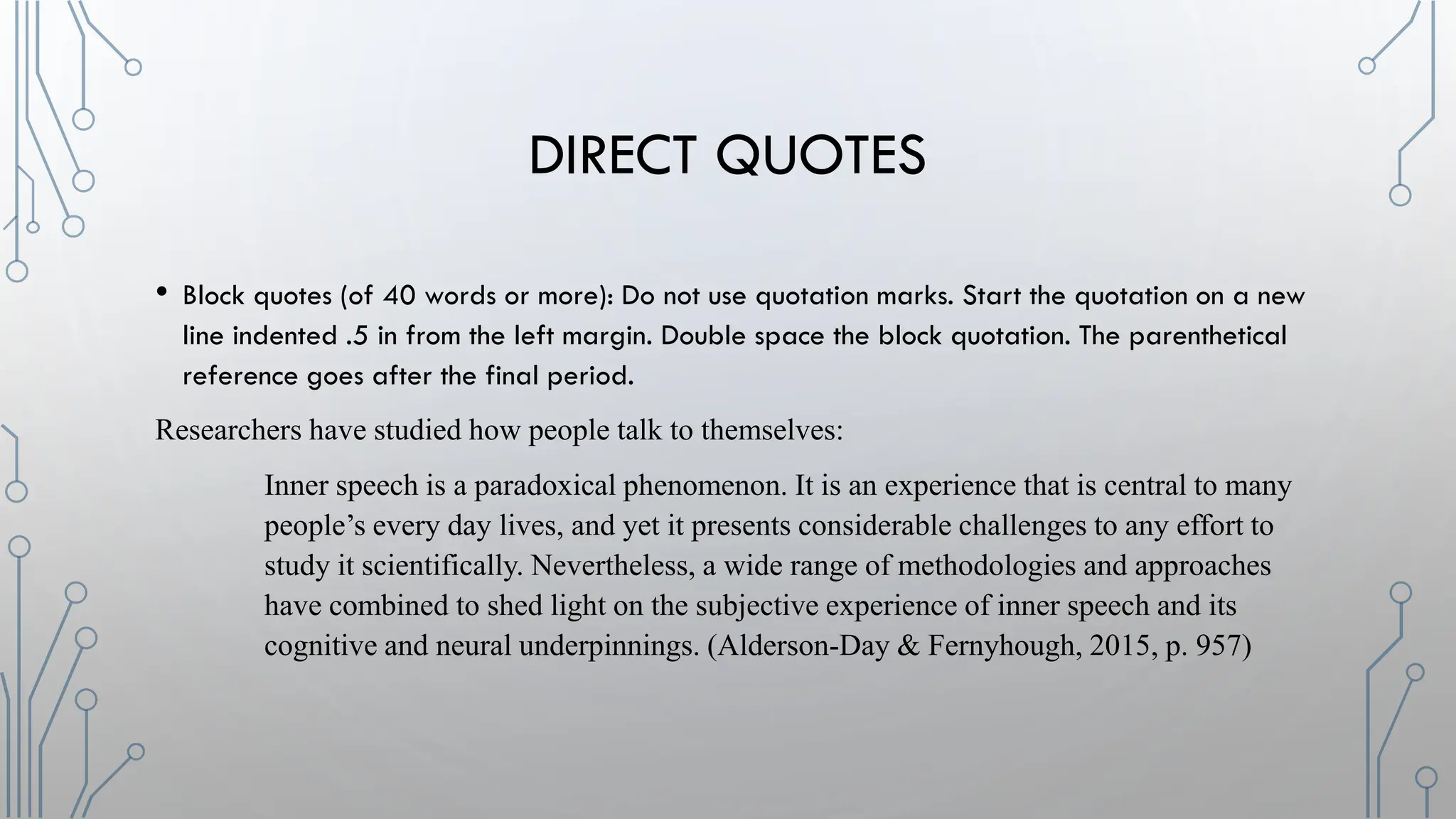
DIRECT QUOTES
• Blockquotes (of 40 words or more): Do not use quotation marks. Start the quotation on a new
line indented .5 in from the left margin. Double space the block quotation. The parenthetical
reference goes after the final period.
Researchers have studied how people talk to themselves:
Inner speech is a paradoxical phenomenon. It is an experience that is central to many
people’s every day lives, and yet it presents considerable challenges to any effort to
study it scientifically. Nevertheless, a wide range of methodologies and approaches
have combined to shed light on the subjective experience of inner speech and its
cognitive and neural underpinnings. (Alderson-Day & Fernyhough, 2015, p. 957)
14.
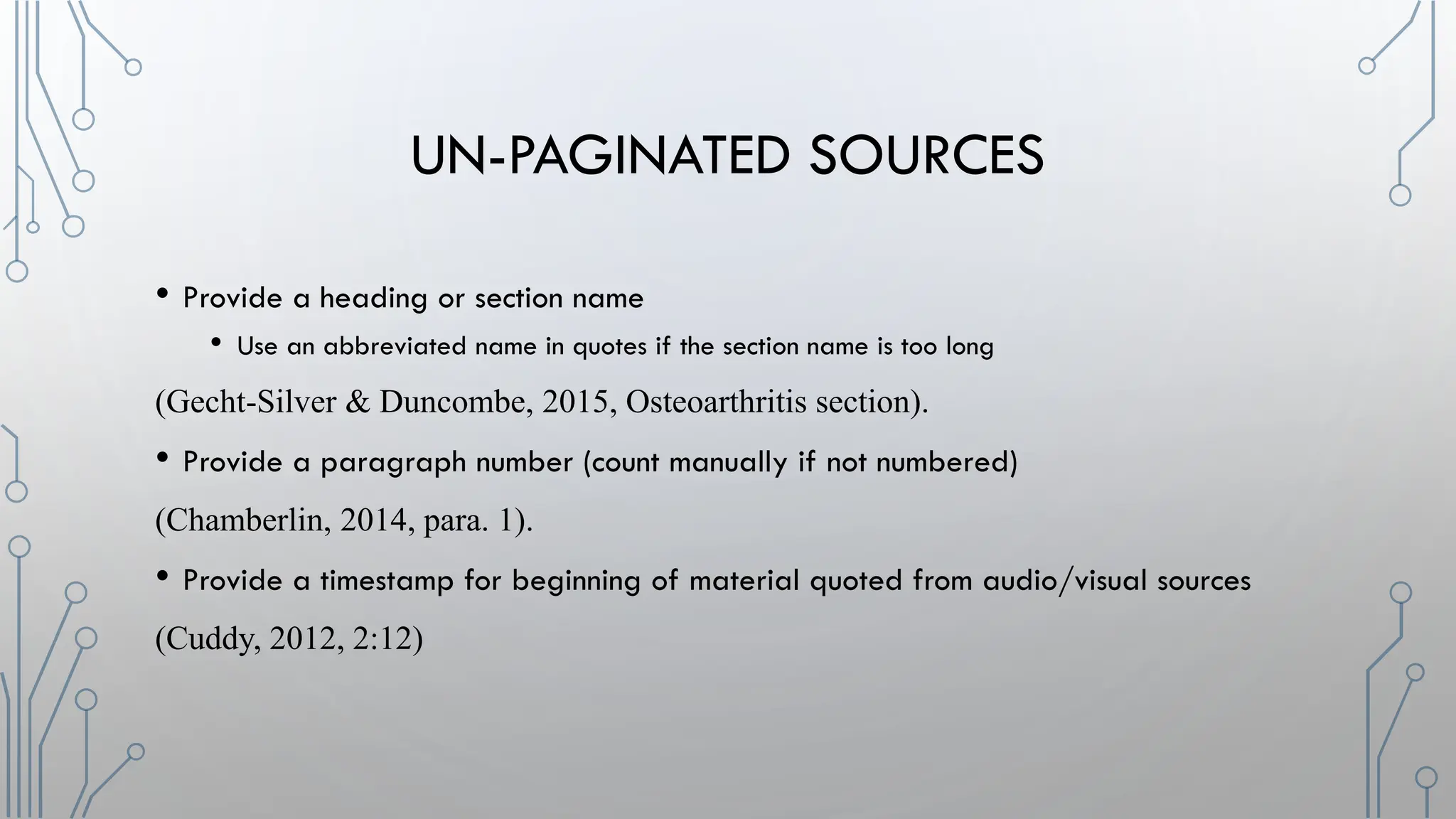
UN-PAGINATED SOURCES
• Providea heading or section name
• Use an abbreviated name in quotes if the section name is too long
(Gecht-Silver & Duncombe, 2015, Osteoarthritis section).
• Provide a paragraph number (count manually if not numbered)
(Chamberlin, 2014, para. 1).
• Provide a timestamp for beginning of material quoted from audio/visual sources
(Cuddy, 2012, 2:12)
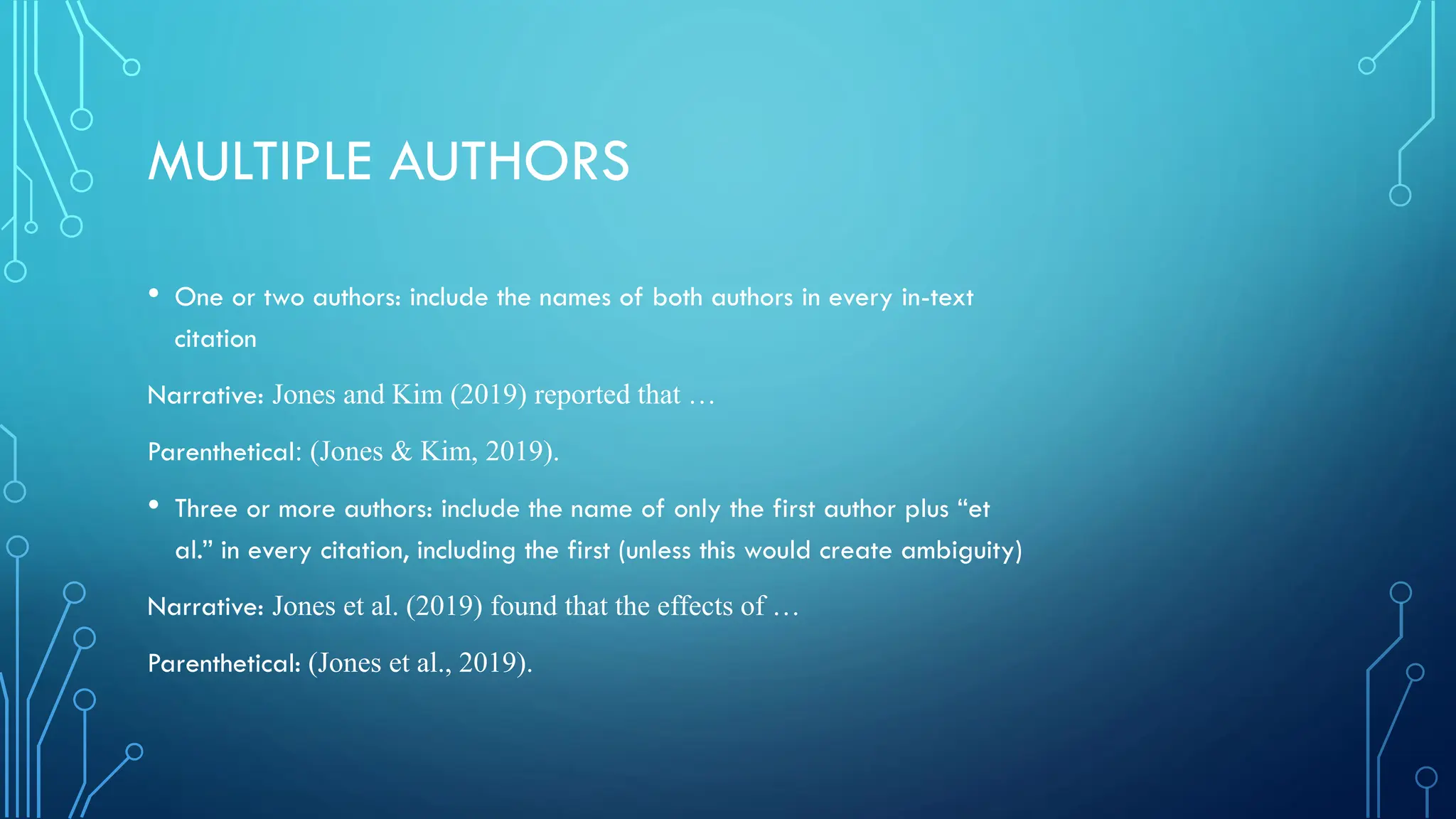
15.
MULTIPLE AUTHORS
• Oneor two authors: include the names of both authors in every in-text
citation
Narrative: Jones and Kim (2019) reported that …
Parenthetical: (Jones & Kim, 2019).
• Three or more authors: include the name of only the first author plus “et
al.” in every citation, including the first (unless this would create ambiguity)
Narrative: Jones et al. (2019) found that the effects of …
Parenthetical: (Jones et al., 2019).
16.
UNKNOWN AUTHOR
ORGANIZATION ASAUTHOR
• Unknown author: include the title and year of publication
Narrative: In 2015, “Tech Seeds” reported … (p. 30)
Parenthetical: (“Tech Seeds,” 2015, p. 30).
• Organization as author: name the organization and year of publication
According to the International Society for Technology in Education (2016), …
First citation: (Food and Drug Administration [FDA], 2012)
Later citations: (FDA, 2012)
17.
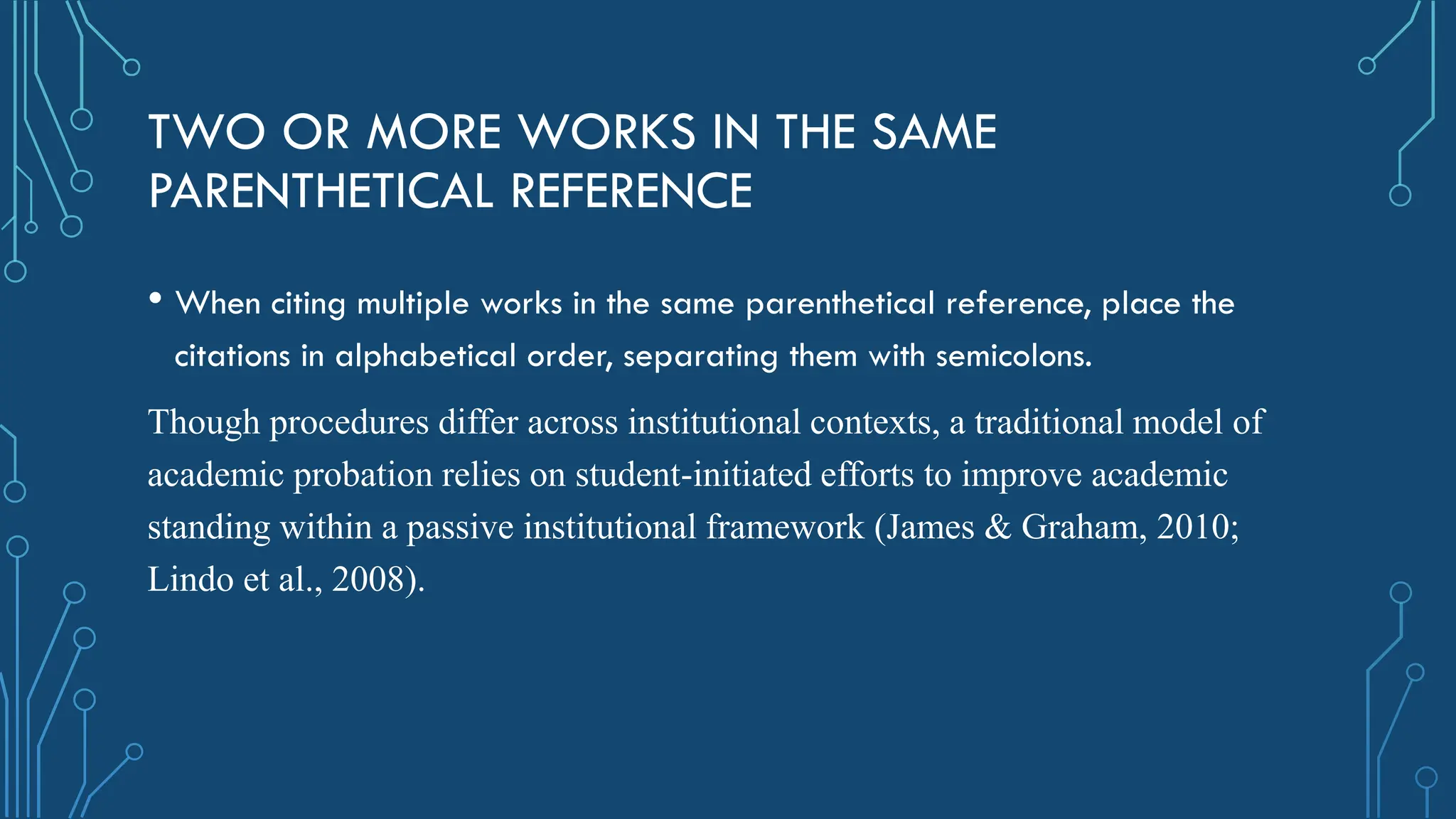
TWO OR MOREWORKS IN THE SAME
PARENTHETICAL REFERENCE
• When citing multiple works in the same parenthetical reference, place the
citations in alphabetical order, separating them with semicolons.
Though procedures differ across institutional contexts, a traditional model of
academic probation relies on student-initiated efforts to improve academic
standing within a passive institutional framework (James & Graham, 2010;
Lindo et al., 2008).
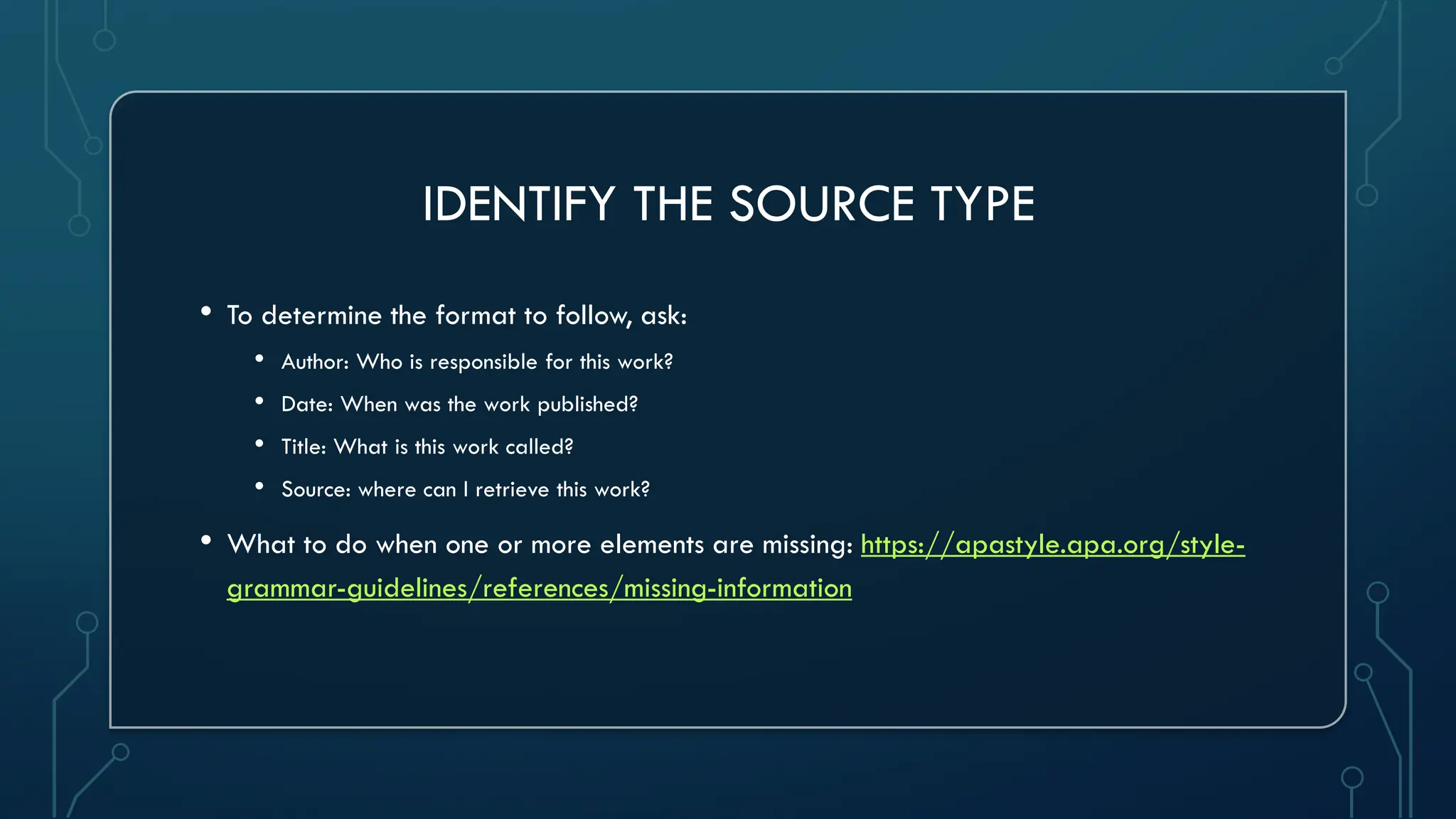
IDENTIFY THE SOURCETYPE
• To determine the format to follow, ask:
• Author: Who is responsible for this work?
• Date: When was the work published?
• Title: What is this work called?
• Source: where can I retrieve this work?
• What to do when one or more elements are missing: https://apastyle.apa.org/style-
grammar-guidelines/references/missing-information
21.
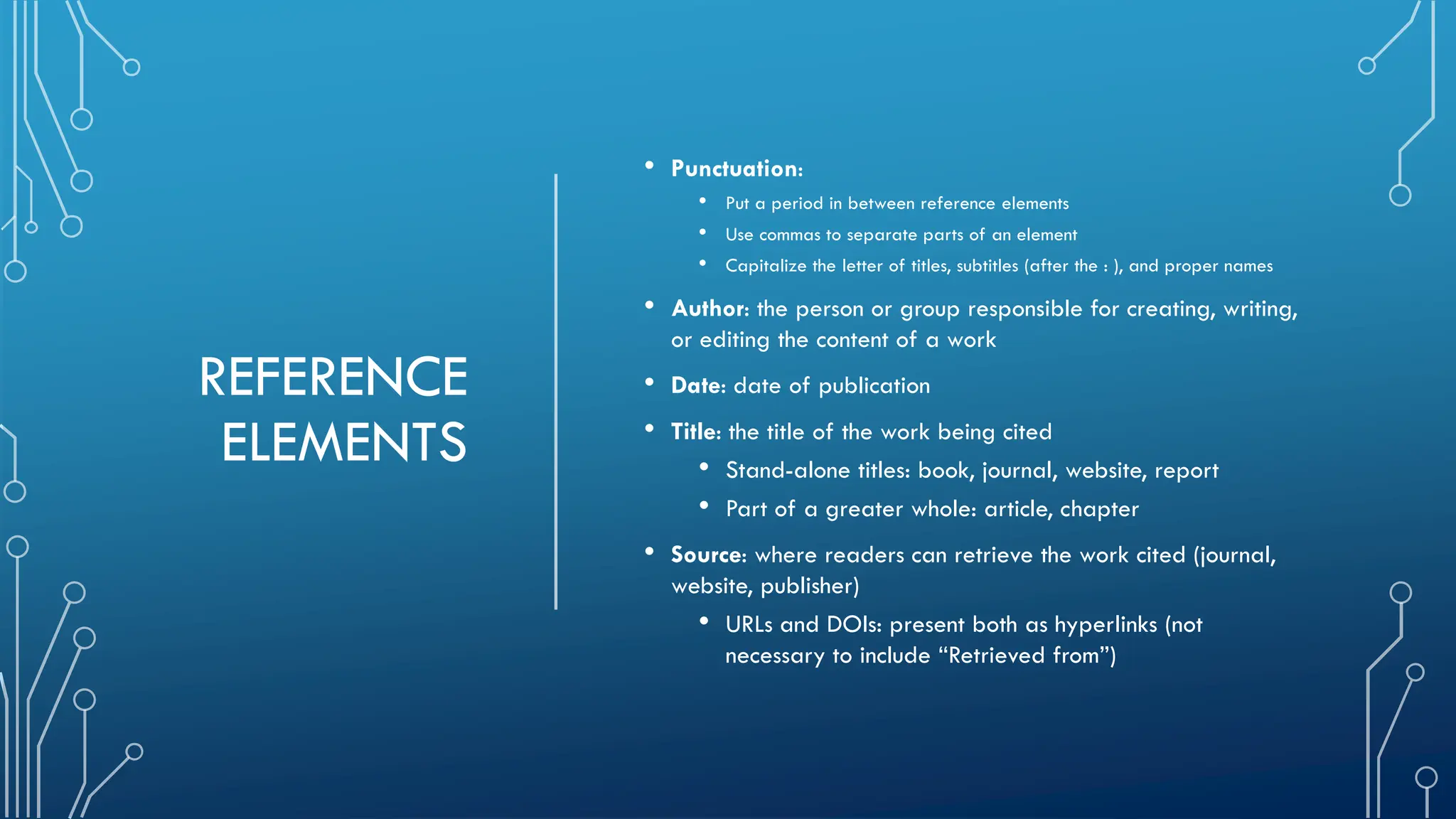
REFERENCE
ELEMENTS
• Punctuation:
• Puta period in between reference elements
• Use commas to separate parts of an element
• Capitalize the letter of titles, subtitles (after the : ), and proper names
• Author: the person or group responsible for creating, writing,
or editing the content of a work
• Date: date of publication
• Title: the title of the work being cited
• Stand-alone titles: book, journal, website, report
• Part of a greater whole: article, chapter
• Source: where readers can retrieve the work cited (journal,
website, publisher)
• URLs and DOIs: present both as hyperlinks (not
necessary to include “Retrieved from”)
22.
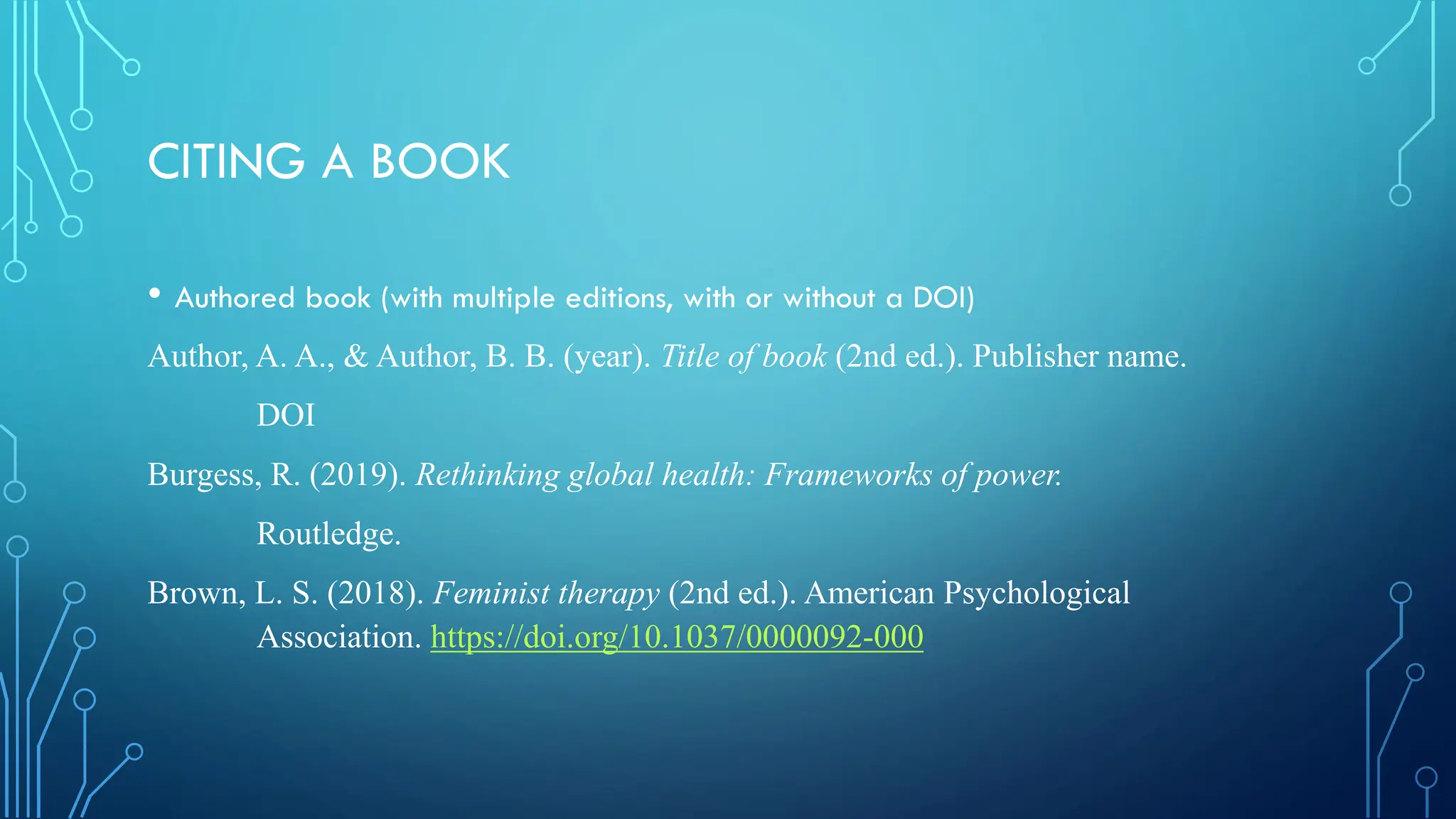
CITING A BOOK
•Authored book (with multiple editions, with or without a DOI)
Author, A. A., & Author, B. B. (year). Title of book (2nd ed.). Publisher name.
DOI
Burgess, R. (2019). Rethinking global health: Frameworks of power.
Routledge.
Brown, L. S. (2018). Feminist therapy (2nd ed.). American Psychological
Association. https://doi.org/10.1037/0000092-000
23.
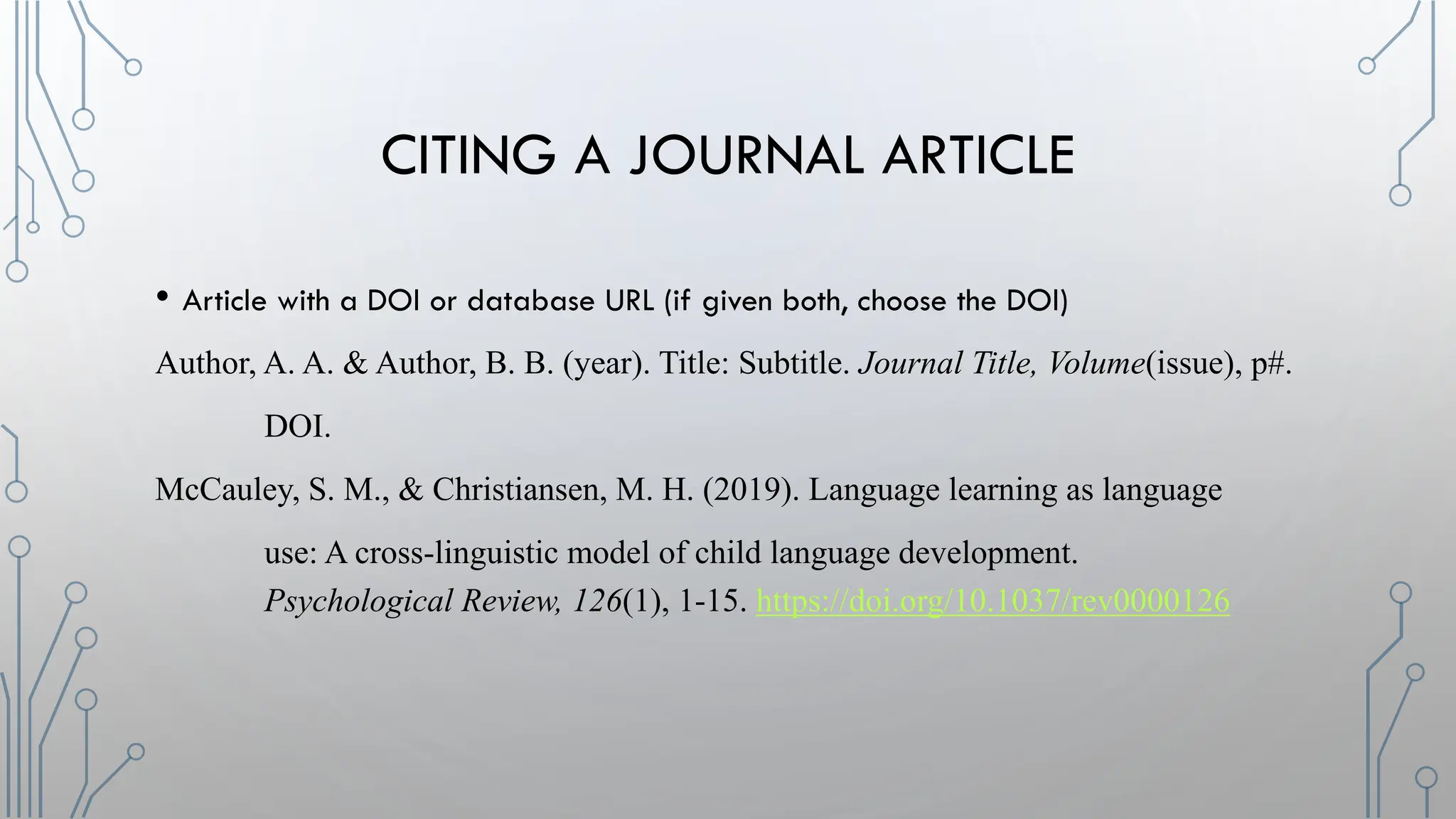
CITING A JOURNALARTICLE
• Article with a DOI or database URL (if given both, choose the DOI)
Author, A. A. & Author, B. B. (year). Title: Subtitle. Journal Title, Volume(issue), p#.
DOI.
McCauley, S. M., & Christiansen, M. H. (2019). Language learning as language
use: A cross-linguistic model of child language development.
Psychological Review, 126(1), 1-15. https://doi.org/10.1037/rev0000126
24.
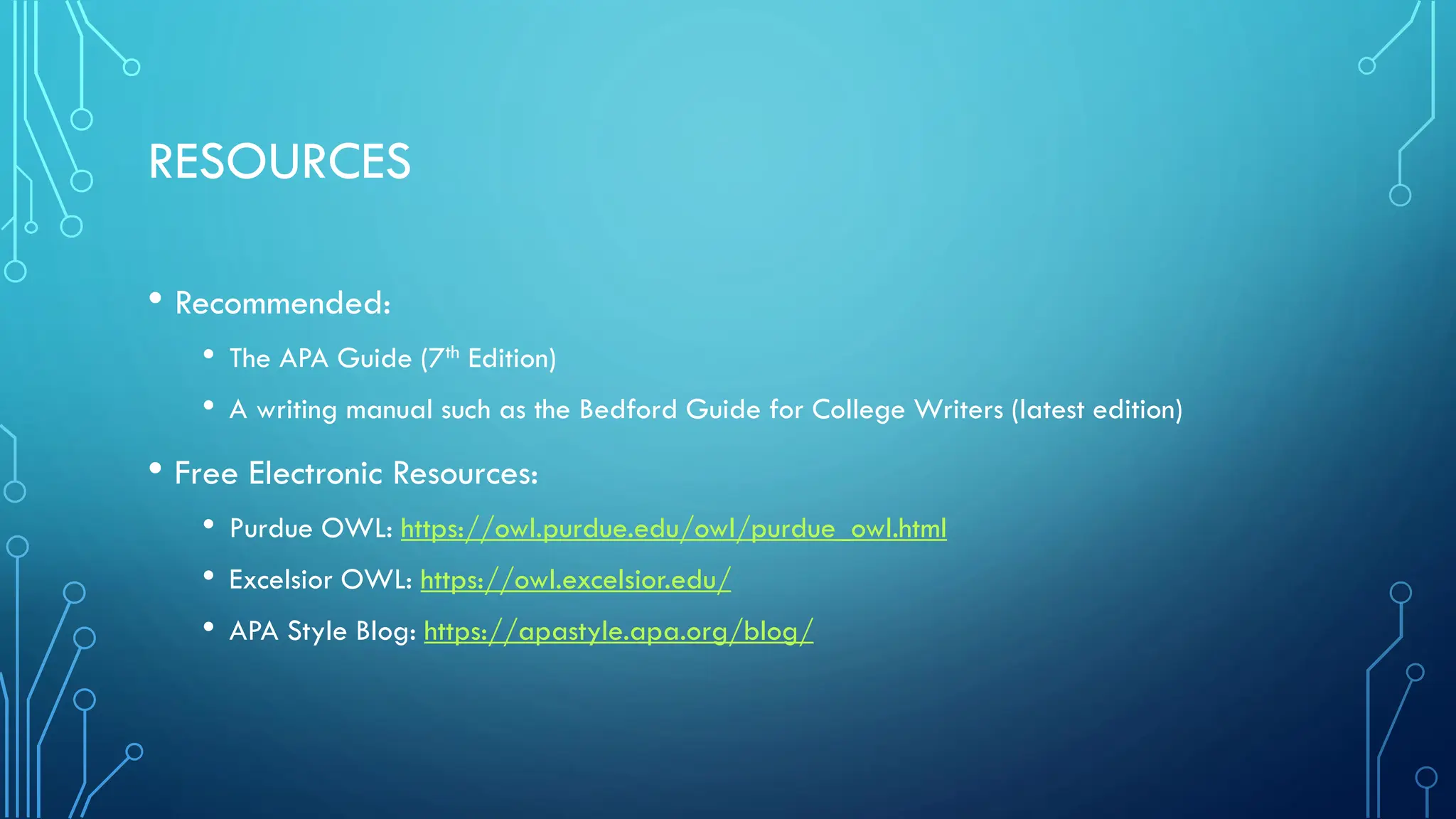
RESOURCES
• Recommended:
• TheAPA Guide (7th Edition)
• A writing manual such as the Bedford Guide for College Writers (latest edition)
• Free Electronic Resources:
• Purdue OWL: https://owl.purdue.edu/owl/purdue_owl.html
• Excelsior OWL: https://owl.excelsior.edu/
• APA Style Blog: https://apastyle.apa.org/blog/
25.
PRESENTATION REFERENCES
American PsychologicalAssociation. (2020). Publication manual of the American
Psychological Association: The official guide to APA style (7th ed). American
Psychological Association.
American Psychological Association. (2020). Sample papers.
https://apastyle.apa.org/style-grammar-guidelines/paper-format/sample-
papers
![PARAPHRASES
• Paraphrases state the ideas of another in the author’s own words.
• APA prioritizes paraphrasing over quoting
• Published authors primarily paraphrase, and students should learn to emulate this style
• Use the author-date citation system to attribute paraphrased ideas
Paraphrases allow the author to condense information and synthesize ideas
from multiple sources (American Psychological Association [APA], 2020).](https://image.slidesharecdn.com/apa-7th-edition-250223093725-432bb7f2/75/APA-7th-Edition-pdf-11-2048.jpg)
![UNKNOWN AUTHOR
ORGANIZATION AS AUTHOR
• Unknown author: include the title and year of publication
Narrative: In 2015, “Tech Seeds” reported … (p. 30)
Parenthetical: (“Tech Seeds,” 2015, p. 30).
• Organization as author: name the organization and year of publication
According to the International Society for Technology in Education (2016), …
First citation: (Food and Drug Administration [FDA], 2012)
Later citations: (FDA, 2012)](https://image.slidesharecdn.com/apa-7th-edition-250223093725-432bb7f2/75/APA-7th-Edition-pdf-16-2048.jpg)