HRMT 5120: Communications for
HR Professionals
Week 3
Susan Francis, BBA, MA
Today’s
Agenda
1. Plain Style Writing
2. Intro to Research
3. Academic Integrity &
Plagiarism
4. Intro to APA (citations and
Reference page)
5. Introduce Assignment 2
Plain
style
writing
and
language
• Video:
https://www.youtube.com/
watch?v=Dz8E8UOBFJQ&lis
t=PLF9A468788928A351
Plain
style
writing
and
language
• Plain style / Plain language
– Common, everyday words
– Reasonable sentence lengths
(no more than 20 words)
– Active voice
– Personal pronouns (I, you,
we)
– Saves time and improves
clarity
– Endorsed by government,
businesses, professions, and
industries
4
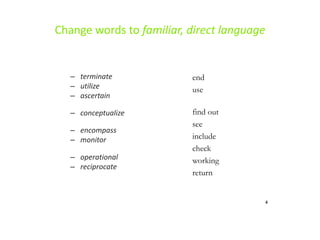
Change words to familiar, direct language
– terminate
– utilize
– ascertain
– conceptualize
– encompass
– monitor
– operational
– reciprocate
end
use
find out
see
include
check
working
return
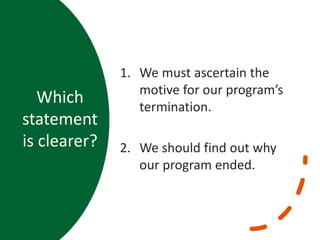
Which
statement
is clearer?
1. We must ascertain the
motive for our program’s
termination.
2. We should find out why
our program ended.
Inclusive Language
Image retrieved from counseling.northwestern.edu
Use
Inclusive
Language
• Don’t make discriminatory
comments
• Use gender-neutral job
titles and salutations
• Use gender-neutral
pronouns – they/them
• Use person/group’s
preferred terms
– Indigenous vs. native
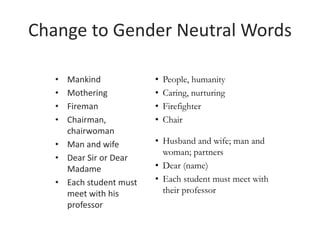
• Mankind
• Mothering
• Fireman
• Chairman,
chairwoman
• Man and wife
• Dear Sir or Dear
Madame
• Each student must
meet with his
professor
Change to Gender Neutral Words
• People, humanity
• Caring, nurturing
• Firefighter
• Chair
• Husband and wife; man and
woman; partners
• Dear (name)
• Each student must meet with
their professor
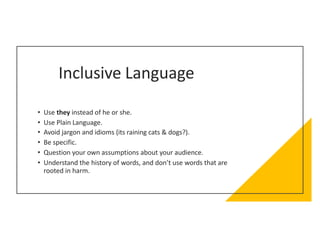
Inclusive Language
• Use they instead of he or she.
• Use Plain Language.
• Avoid jargon and idioms (its raining cats & dogs?).
• Be specific.
• Question your own assumptions about your audience.
• Understand the history of words, and don’t use words that are
rooted in harm.
Activity: Plain writing style
• Locate a helpful resource on plain language or plain
style writing.
• Explain the resource you located. What did your team
learn?
• Provide the link to your resource and brief description.
• Post in Moodle forum.
BREAK
TIME…
WHAT IS YOUR
EXPERIENCE WITH
APA POLL?
Primary vs. Secondary Research
Research Starts
with a Question
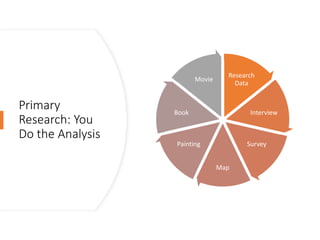
Primary
Research: You
Do the Analysis
Research
Data
Interview
Survey
Map
Painting
Book
Movie
Image retrieved from https://www.achievers.com/blog/employee-pulse-survey/
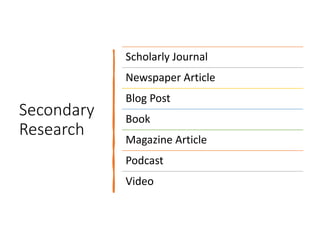
Secondary
Research
Scholarly Journal
Newspaper Article
Blog Post
Book
Magazine Article
Podcast
Video
Plagiarism
• Definition: “the practice of
taking someone else's work
or ideas and passing them
off as one's own.”
• In Latin means kidnapping
This Photo by Unknown Author is licensed under CC BY-SA
Plagiarism is…
*Information taken from
http://www.kwantlen.bc.ca/library/guides/citingyourresources.html
Copying sentences, paragraphs, data or visuals without properly
citing their source
Quoting material without proper use of quotation marks (even if
otherwise cited appropriately)
Paraphrasing or summarizing information from a source without
proper acknowledgement
Paying someone for writing the assignment (includes tutors).
Listing a source in the reference list that was not cited in the
assignment
How to avoid
plagiarism
Cite sources for…
• Any facts or figures you have quoted or referred to
• Information you summarized or paraphrased
• Words, ideas or data that is not your own
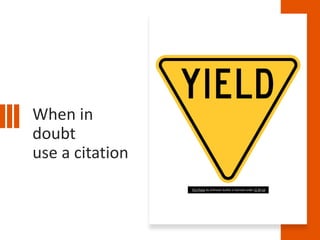
When in
doubt
use a citation
This Photo by Unknown Author is licensed under CC BY-SA
Why do we
cite our
sources?
• Improves your credibility
• Allows readers to check or pursue
the subject further
• Accepted way to give credit to the
people whose work you have drawn
from
• Required skill set for university
studies and workplace reports
True or False?
You MUST include BOTH
an in-text citation in your
writing and enter the source
in the References page
TRUE
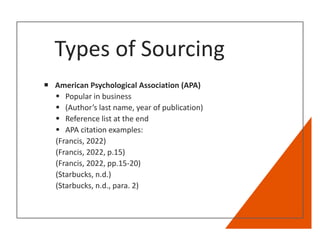
Types of Sourcing
 American Psychological Association (APA)
 Popular in business
 (Author’s last name, year of publication)
 Reference list at the end
 APA citation examples:
(Francis, 2022)
(Francis, 2022, p.15)
(Francis, 2022, pp.15-20)
(Starbucks, n.d.)
(Starbucks, n.d., para. 2)
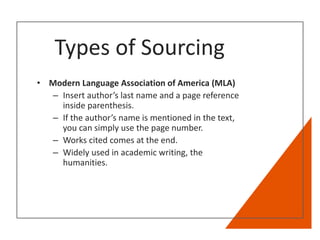
Types of Sourcing
• Modern Language Association of America (MLA)
– Insert author’s last name and a page reference
inside parenthesis.
– If the author’s name is mentioned in the text,
you can simply use the page number.
– Works cited comes at the end.
– Widely used in academic writing, the
humanities.
HRMT 5120
We will use APA format in this course
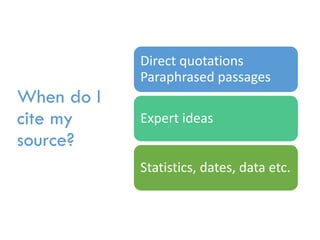
When do I
cite my
source?
Direct quotations
Paraphrased passages
Expert ideas
Statistics, dates, data etc.
Common knowledge vs. cited
information*
• Paris is the capital of France.
• Each day, 1.63 million people take the subway into London, England.
• World War 2 ended in 1945.
• In 1986, 7,821 news stories about the Vancouver Expo were published and broadcast
to 2.34 million viewers.
*Some details invented for the sake of educational demonstration.
Wikipedia is NOT a
credible source. Please
do not use it in your
academic assignments.
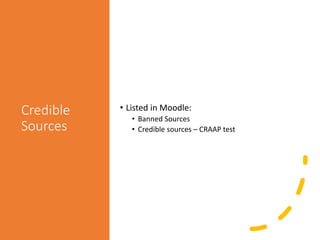
Credible
Sources
• Listed in Moodle:
• Banned Sources
• Credible sources – CRAAP test
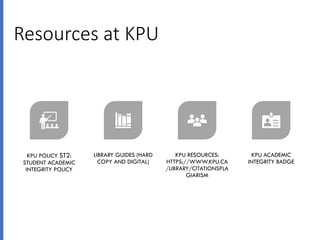
Resources at KPU
KPU POLICY ST2:
STUDENT ACADEMIC
INTEGRITY POLICY
LIBRARY GUIDES (HARD
COPY AND DIGITAL)
KPU RESOURCES:
HTTPS://WWW.KPU.CA
/LIBRARY/CITATIONSPLA
GIARISM
KPU ACADEMIC
INTEGRITY BADGE
KPU Academic Integrity Badge
• Free tutorial through KPU library
• Four quiz modules you take
online.
• Pass the modules and you get an
academic integrity badge that
you can post on your Moodle
profile.
• It is good for two years.
https://libguides.kpu.ca/academicintegrity/tutorial
• https://owl.purdue.edu/owl/research
_and_citation/apa_style/apa_style_intr
oduction.html
APA 7th Edition Video
Humber Libraries
• https://library.humber.ca/help/apa
APA References Page
• Memorize the four basic parts of the reference page entry. Despite how
complicated APA references look, they all comprise four basic elements in
the same order:
1. WHO (author, editor, producer, “organization as author,” title if no author
or organization is named)
2. WHEN (date of publication — usually just the year, but could also include
month, day, season, or n.d. (no date))
3. WHAT (title of book, article, movie, report, etc.)
4. WHERE (publisher, URL, DOI, name of periodical)
All items on your References page should follow that basic pattern.
Different formats of publication will have different ways of expressing the four
basic parts, but the pattern doesn’t change.
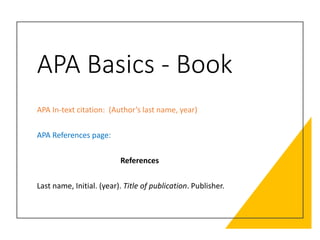
APA Basics - Book
APA In-text citation: (Author’s last name, year)
APA References page:
References
Last name, Initial. (year). Title of publication. Publisher.
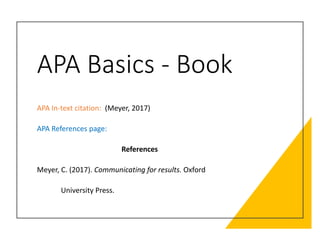
APA Basics - Book
APA In-text citation: (Meyer, 2017)
APA References page:
References
Meyer, C. (2017). Communicating for results. Oxford
University Press.
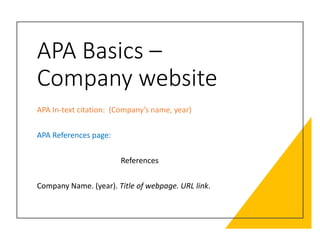
APA Basics –
Company website
APA In-text citation: (Company’s name, year)
APA References page:
References
Company Name. (year). Title of webpage. URL link.
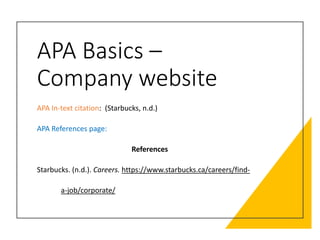
APA Basics –
Company website
APA In-text citation: (Starbucks, n.d.)
APA References page:
References
Starbucks. (n.d.). Careers. https://www.starbucks.ca/careers/find-
a-job/corporate/
In-class Activity
Put the following information in APA format:
1. Go back to your description about your Plain Style Language source and either
paraphrase or use a direct quote from your source. Use an APA citation and create
a Reference page entry.
*As a group write APA from scratch. Do not use any tools to help you.
Post in Discussion Board in Week 3
Assignment 2
Job Ad
Homework
Complete all homework in Week 3 Moodle

Week 3 Slides (Plain Style and APAnknlk).pdf

  • 1.
    HRMT 5120: Communicationsfor HR Professionals Week 3 Susan Francis, BBA, MA
  • 2.
    Today’s Agenda 1. Plain StyleWriting 2. Intro to Research 3. Academic Integrity & Plagiarism 4. Intro to APA (citations and Reference page) 5. Introduce Assignment 2
  • 3.
  • 4.
    Plain style writing and language • Plain style/ Plain language – Common, everyday words – Reasonable sentence lengths (no more than 20 words) – Active voice – Personal pronouns (I, you, we) – Saves time and improves clarity – Endorsed by government, businesses, professions, and industries
  • 5.
    4 Change words tofamiliar, direct language – terminate – utilize – ascertain – conceptualize – encompass – monitor – operational – reciprocate end use find out see include check working return
  • 6.
    Which statement is clearer? 1. Wemust ascertain the motive for our program’s termination. 2. We should find out why our program ended.
  • 7.
    Inclusive Language Image retrievedfrom counseling.northwestern.edu
  • 8.
    Use Inclusive Language • Don’t makediscriminatory comments • Use gender-neutral job titles and salutations • Use gender-neutral pronouns – they/them • Use person/group’s preferred terms – Indigenous vs. native
  • 9.
    • Mankind • Mothering •Fireman • Chairman, chairwoman • Man and wife • Dear Sir or Dear Madame • Each student must meet with his professor Change to Gender Neutral Words • People, humanity • Caring, nurturing • Firefighter • Chair • Husband and wife; man and woman; partners • Dear (name) • Each student must meet with their professor
  • 10.
    Inclusive Language • Usethey instead of he or she. • Use Plain Language. • Avoid jargon and idioms (its raining cats & dogs?). • Be specific. • Question your own assumptions about your audience. • Understand the history of words, and don’t use words that are rooted in harm.
  • 11.
    Activity: Plain writingstyle • Locate a helpful resource on plain language or plain style writing. • Explain the resource you located. What did your team learn? • Provide the link to your resource and brief description. • Post in Moodle forum.
  • 12.
  • 13.
  • 14.
  • 15.
  • 16.
    Primary Research: You Do theAnalysis Research Data Interview Survey Map Painting Book Movie
  • 17.
    Image retrieved fromhttps://www.achievers.com/blog/employee-pulse-survey/
  • 18.
    Secondary Research Scholarly Journal Newspaper Article BlogPost Book Magazine Article Podcast Video
  • 19.
    Plagiarism • Definition: “thepractice of taking someone else's work or ideas and passing them off as one's own.” • In Latin means kidnapping This Photo by Unknown Author is licensed under CC BY-SA
  • 20.
    Plagiarism is… *Information takenfrom http://www.kwantlen.bc.ca/library/guides/citingyourresources.html Copying sentences, paragraphs, data or visuals without properly citing their source Quoting material without proper use of quotation marks (even if otherwise cited appropriately) Paraphrasing or summarizing information from a source without proper acknowledgement Paying someone for writing the assignment (includes tutors). Listing a source in the reference list that was not cited in the assignment
  • 21.
    How to avoid plagiarism Citesources for… • Any facts or figures you have quoted or referred to • Information you summarized or paraphrased • Words, ideas or data that is not your own
  • 22.
    When in doubt use acitation This Photo by Unknown Author is licensed under CC BY-SA
  • 23.
    Why do we citeour sources? • Improves your credibility • Allows readers to check or pursue the subject further • Accepted way to give credit to the people whose work you have drawn from • Required skill set for university studies and workplace reports
  • 24.
    True or False? YouMUST include BOTH an in-text citation in your writing and enter the source in the References page TRUE
  • 25.
    Types of Sourcing American Psychological Association (APA)  Popular in business  (Author’s last name, year of publication)  Reference list at the end  APA citation examples: (Francis, 2022) (Francis, 2022, p.15) (Francis, 2022, pp.15-20) (Starbucks, n.d.) (Starbucks, n.d., para. 2)
  • 26.
    Types of Sourcing •Modern Language Association of America (MLA) – Insert author’s last name and a page reference inside parenthesis. – If the author’s name is mentioned in the text, you can simply use the page number. – Works cited comes at the end. – Widely used in academic writing, the humanities.
  • 27.
    HRMT 5120 We willuse APA format in this course
  • 28.
    When do I citemy source? Direct quotations Paraphrased passages Expert ideas Statistics, dates, data etc.
  • 29.
    Common knowledge vs.cited information* • Paris is the capital of France. • Each day, 1.63 million people take the subway into London, England. • World War 2 ended in 1945. • In 1986, 7,821 news stories about the Vancouver Expo were published and broadcast to 2.34 million viewers. *Some details invented for the sake of educational demonstration.
  • 30.
    Wikipedia is NOTa credible source. Please do not use it in your academic assignments.
  • 31.
    Credible Sources • Listed inMoodle: • Banned Sources • Credible sources – CRAAP test
  • 32.
    Resources at KPU KPUPOLICY ST2: STUDENT ACADEMIC INTEGRITY POLICY LIBRARY GUIDES (HARD COPY AND DIGITAL) KPU RESOURCES: HTTPS://WWW.KPU.CA /LIBRARY/CITATIONSPLA GIARISM KPU ACADEMIC INTEGRITY BADGE
  • 33.
    KPU Academic IntegrityBadge • Free tutorial through KPU library • Four quiz modules you take online. • Pass the modules and you get an academic integrity badge that you can post on your Moodle profile. • It is good for two years. https://libguides.kpu.ca/academicintegrity/tutorial
  • 34.
  • 35.
    APA 7th EditionVideo Humber Libraries • https://library.humber.ca/help/apa
  • 36.
    APA References Page •Memorize the four basic parts of the reference page entry. Despite how complicated APA references look, they all comprise four basic elements in the same order: 1. WHO (author, editor, producer, “organization as author,” title if no author or organization is named) 2. WHEN (date of publication — usually just the year, but could also include month, day, season, or n.d. (no date)) 3. WHAT (title of book, article, movie, report, etc.) 4. WHERE (publisher, URL, DOI, name of periodical) All items on your References page should follow that basic pattern. Different formats of publication will have different ways of expressing the four basic parts, but the pattern doesn’t change.
  • 37.
    APA Basics -Book APA In-text citation: (Author’s last name, year) APA References page: References Last name, Initial. (year). Title of publication. Publisher.
  • 38.
    APA Basics -Book APA In-text citation: (Meyer, 2017) APA References page: References Meyer, C. (2017). Communicating for results. Oxford University Press.
  • 39.
    APA Basics – Companywebsite APA In-text citation: (Company’s name, year) APA References page: References Company Name. (year). Title of webpage. URL link.
  • 40.
    APA Basics – Companywebsite APA In-text citation: (Starbucks, n.d.) APA References page: References Starbucks. (n.d.). Careers. https://www.starbucks.ca/careers/find- a-job/corporate/
  • 41.
    In-class Activity Put thefollowing information in APA format: 1. Go back to your description about your Plain Style Language source and either paraphrase or use a direct quote from your source. Use an APA citation and create a Reference page entry. *As a group write APA from scratch. Do not use any tools to help you. Post in Discussion Board in Week 3
  • 42.
  • 43.