GRAVITY
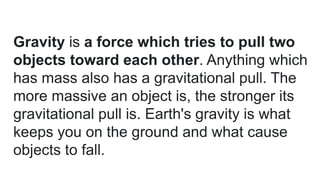
Gravity is a force which tries to pull two
objects toward each other. Anything which
has mass also has a gravitational pull. The
more massive an object is, the stronger its
gravitational pull is. Earth's gravity is what
keeps you on the ground and what cause
objects to fall.
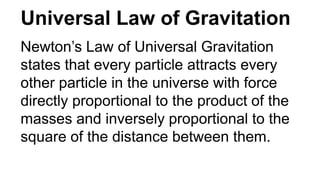
Universal Law of Gravitation
Newton’s Law of Universal Gravitation
states that every particle attracts every
other particle in the universe with force
directly proportional to the product of the
masses and inversely proportional to the
square of the distance between them.
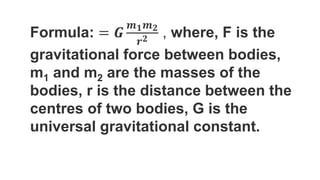
Formula: = 𝑮
𝒎𝟏𝒎𝟐
𝒓𝟐 , where, F is the
gravitational force between bodies,
m1 and m2 are the masses of the
bodies, r is the distance between the
centres of two bodies, G is the
universal gravitational constant.
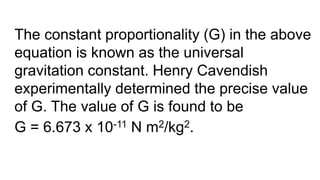
The constant proportionality (G) in the above
equation is known as the universal
gravitation constant. Henry Cavendish
experimentally determined the precise value
of G. The value of G is found to be
G = 6.673 x 10⁻¹¹ N m2/kg2.
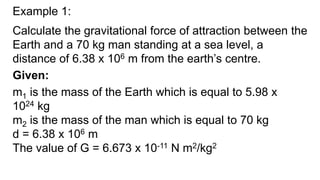
Example 1:
Calculate the gravitational force of attraction between the
Earth and a 70 kg man standing at a sea level, a
distance of 6.38 x 10⁶ m from the earth’s centre.
Given:
m1 is the mass of the Earth which is equal to 5.98 x
1024 kg
m2 is the mass of the man which is equal to 70 kg
d = 6.38 x 10⁶ m
The value of G = 6.673 x 10⁻¹¹ N m2/kg2
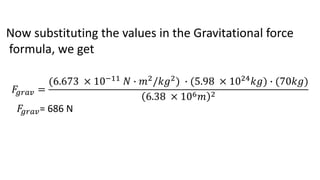
Now substituting the values in the Gravitational force
formula, we get
𝐹
𝑔𝑟𝑎𝑣 =
(6.673 × 10⁻¹¹
𝑁 ∙ 𝑚2
/𝑘𝑔2
) ∙ (5.98 × 1024
𝑘𝑔) ∙ (70𝑘𝑔)
6.38 × 10⁶𝑚 2
𝐹
𝑔𝑟𝑎𝑣= 686 N
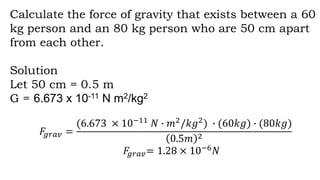
Calculate the force of gravity that exists between a 60
kg person and an 80 kg person who are 50 cm apart
from each other.
Solution
Let 50 cm = 0.5 m
G = 6.673 x 10⁻¹¹ N m2/kg2
𝐹
𝑔𝑟𝑎𝑣 =
(6.673 × 10⁻¹¹
𝑁 ∙ 𝑚2
/𝑘𝑔2
) ∙ (60𝑘𝑔) ∙ (80𝑘𝑔)
0.5𝑚 2
𝐹
𝑔𝑟𝑎𝑣= 1.28 × 10⁻⁶
𝑁
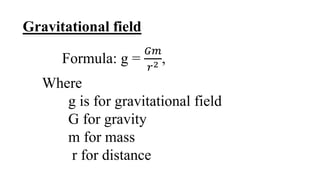
Gravitational field
Formula: g =
𝐺𝑚
𝑟2 ,
Where
g is for gravitational field
G for gravity
m for mass
r for distance
The gravitational field is the gravitational
force per unit mass that would be exerted
on a small mass at that point. It is
a vector field, and points in the direction
of the force that the mass would feel.
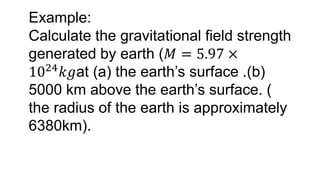
Example:
Calculate the gravitational field strength
generated by earth (𝑀 = 5.97 ×
1024
𝑘𝑔at (a) the earth’s surface .(b)
5000 km above the earth’s surface. (
the radius of the earth is approximately
6380km).
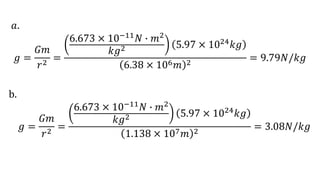
𝑎.
𝑔 =
𝐺𝑚
𝑟2
=
6.673 × 10⁻¹¹
𝑁 ∙ 𝑚2
𝑘𝑔2 5.97 × 1024
𝑘𝑔
6.38 × 10⁶𝑚 2
= 9.79𝑁/𝑘𝑔
b.
𝑔 =
𝐺𝑚
𝑟2
=
6.673 × 10⁻¹¹
𝑁 ∙ 𝑚2
𝑘𝑔2 5.97 × 1024
𝑘𝑔
1.138 × 10⁷𝑚 2
= 3.08𝑁/𝑘𝑔
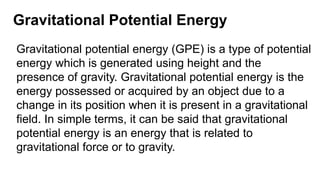
Gravitational Potential Energy
Gravitational potential energy (GPE) is a type of potential
energy which is generated using height and the
presence of gravity. Gravitational potential energy is the
energy possessed or acquired by an object due to a
change in its position when it is present in a gravitational
field. In simple terms, it can be said that gravitational
potential energy is an energy that is related to
gravitational force or to gravity.
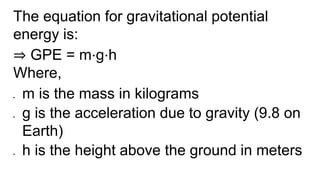
The equation for gravitational potential
energy is:
⇒ GPE = m⋅g⋅h
Where,
 m is the mass in kilograms
 g is the acceleration due to gravity (9.8 on
Earth)
 h is the height above the ground in meters
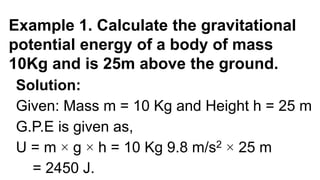
Example 1. Calculate the gravitational
potential energy of a body of mass
10Kg and is 25m above the ground.
Solution:
Given: Mass m = 10 Kg and Height h = 25 m
G.P.E is given as,
U = m × g × h = 10 Kg 9.8 m/s2 × 25 m
= 2450 J.
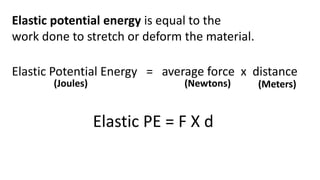
Elastic potential energy is equal to the
work done to stretch or deform the material.
Elastic Potential Energy = average force x distance
(Joules) (Newtons) (Meters)
Elastic PE = F X d
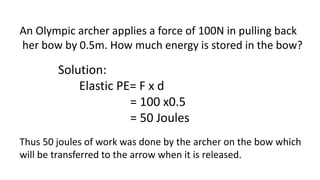
An Olympic archer applies a force of 100N in pulling back
her bow by 0.5m. How much energy is stored in the bow?
Solution:
Elastic PE= F x d
= 100 x0.5
= 50 Joules
Thus 50 joules of work was done by the archer on the bow which
will be transferred to the arrow when it is released.

GRADE 12 GRAVITY.pptx

  • 1.
  • 2.
    Gravity is aforce which tries to pull two objects toward each other. Anything which has mass also has a gravitational pull. The more massive an object is, the stronger its gravitational pull is. Earth's gravity is what keeps you on the ground and what cause objects to fall.
  • 3.
    Universal Law ofGravitation Newton’s Law of Universal Gravitation states that every particle attracts every other particle in the universe with force directly proportional to the product of the masses and inversely proportional to the square of the distance between them.
  • 4.
    Formula: = 𝑮 𝒎𝟏𝒎𝟐 𝒓𝟐, where, F is the gravitational force between bodies, m1 and m2 are the masses of the bodies, r is the distance between the centres of two bodies, G is the universal gravitational constant.
  • 5.
    The constant proportionality(G) in the above equation is known as the universal gravitation constant. Henry Cavendish experimentally determined the precise value of G. The value of G is found to be G = 6.673 x 10⁻¹¹ N m2/kg2.
  • 6.
    Example 1: Calculate thegravitational force of attraction between the Earth and a 70 kg man standing at a sea level, a distance of 6.38 x 10⁶ m from the earth’s centre. Given: m1 is the mass of the Earth which is equal to 5.98 x 1024 kg m2 is the mass of the man which is equal to 70 kg d = 6.38 x 10⁶ m The value of G = 6.673 x 10⁻¹¹ N m2/kg2
  • 7.
    Now substituting thevalues in the Gravitational force formula, we get 𝐹 𝑔𝑟𝑎𝑣 = (6.673 × 10⁻¹¹ 𝑁 ∙ 𝑚2 /𝑘𝑔2 ) ∙ (5.98 × 1024 𝑘𝑔) ∙ (70𝑘𝑔) 6.38 × 10⁶𝑚 2 𝐹 𝑔𝑟𝑎𝑣= 686 N
  • 8.
    Calculate the forceof gravity that exists between a 60 kg person and an 80 kg person who are 50 cm apart from each other. Solution Let 50 cm = 0.5 m G = 6.673 x 10⁻¹¹ N m2/kg2 𝐹 𝑔𝑟𝑎𝑣 = (6.673 × 10⁻¹¹ 𝑁 ∙ 𝑚2 /𝑘𝑔2 ) ∙ (60𝑘𝑔) ∙ (80𝑘𝑔) 0.5𝑚 2 𝐹 𝑔𝑟𝑎𝑣= 1.28 × 10⁻⁶ 𝑁
  • 9.
    Gravitational field Formula: g= 𝐺𝑚 𝑟2 , Where g is for gravitational field G for gravity m for mass r for distance
  • 10.
    The gravitational fieldis the gravitational force per unit mass that would be exerted on a small mass at that point. It is a vector field, and points in the direction of the force that the mass would feel.
  • 11.
    Example: Calculate the gravitationalfield strength generated by earth (𝑀 = 5.97 × 1024 𝑘𝑔at (a) the earth’s surface .(b) 5000 km above the earth’s surface. ( the radius of the earth is approximately 6380km).
  • 12.
    𝑎. 𝑔 = 𝐺𝑚 𝑟2 = 6.673 ×10⁻¹¹ 𝑁 ∙ 𝑚2 𝑘𝑔2 5.97 × 1024 𝑘𝑔 6.38 × 10⁶𝑚 2 = 9.79𝑁/𝑘𝑔 b. 𝑔 = 𝐺𝑚 𝑟2 = 6.673 × 10⁻¹¹ 𝑁 ∙ 𝑚2 𝑘𝑔2 5.97 × 1024 𝑘𝑔 1.138 × 10⁷𝑚 2 = 3.08𝑁/𝑘𝑔
  • 13.
    Gravitational Potential Energy Gravitationalpotential energy (GPE) is a type of potential energy which is generated using height and the presence of gravity. Gravitational potential energy is the energy possessed or acquired by an object due to a change in its position when it is present in a gravitational field. In simple terms, it can be said that gravitational potential energy is an energy that is related to gravitational force or to gravity.
  • 14.
    The equation forgravitational potential energy is: ⇒ GPE = m⋅g⋅h Where,  m is the mass in kilograms  g is the acceleration due to gravity (9.8 on Earth)  h is the height above the ground in meters
  • 15.
    Example 1. Calculatethe gravitational potential energy of a body of mass 10Kg and is 25m above the ground. Solution: Given: Mass m = 10 Kg and Height h = 25 m G.P.E is given as, U = m × g × h = 10 Kg 9.8 m/s2 × 25 m = 2450 J.
  • 16.
    Elastic potential energyis equal to the work done to stretch or deform the material. Elastic Potential Energy = average force x distance (Joules) (Newtons) (Meters) Elastic PE = F X d
  • 17.
    An Olympic archerapplies a force of 100N in pulling back her bow by 0.5m. How much energy is stored in the bow? Solution: Elastic PE= F x d = 100 x0.5 = 50 Joules Thus 50 joules of work was done by the archer on the bow which will be transferred to the arrow when it is released.