M O D U L E 7 L E SSO N 1:
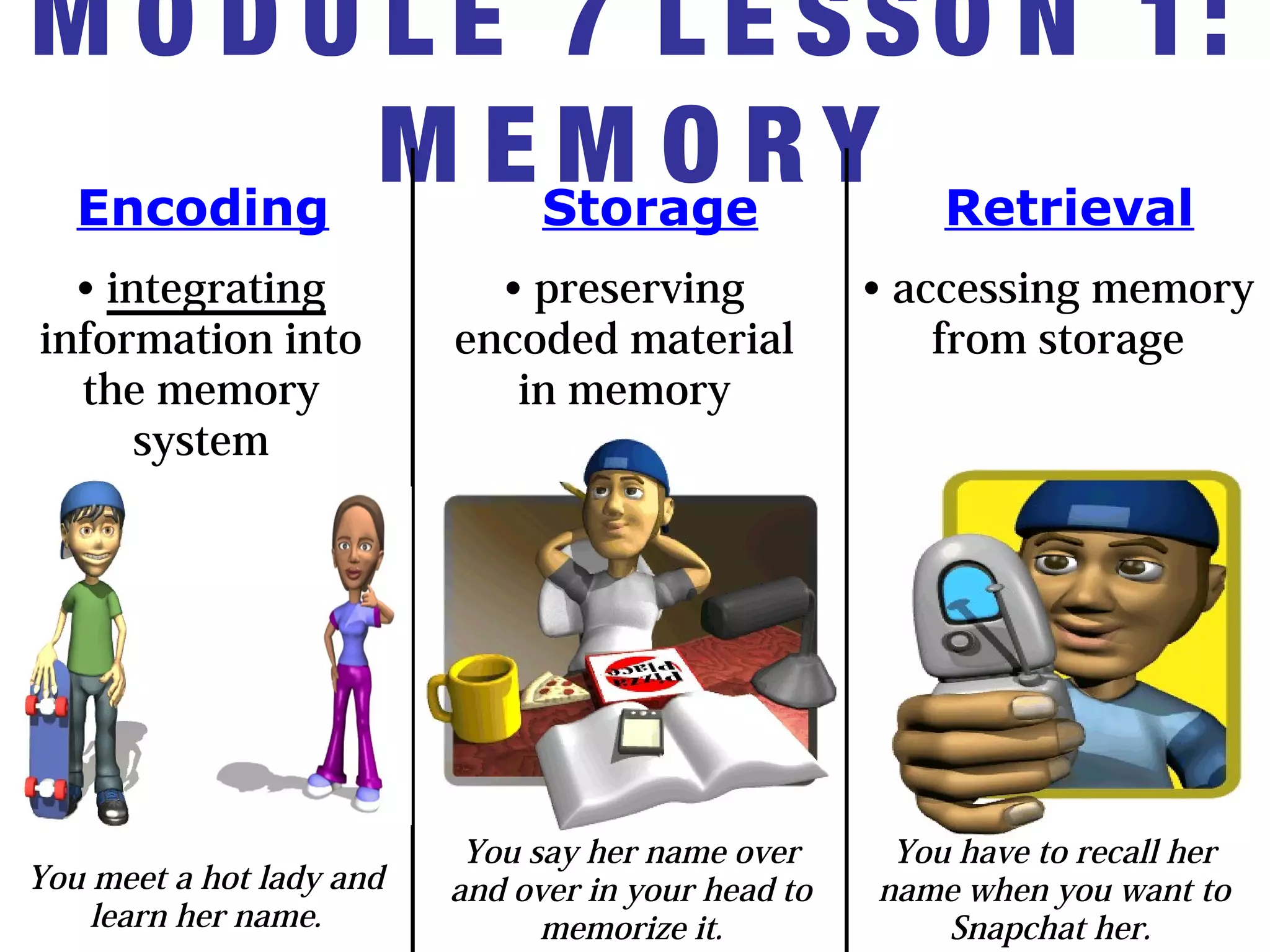
M E M O R YEncoding Storage Retrieval
• integrating
information into
the memory
system
• preserving
encoded material
in memory
• accessing memory
from storage
You meet a hot lady and
learn her name.
You say her name over
and over in your head to
memorize it.
You have to recall her
name when you want to
Snapchat her.
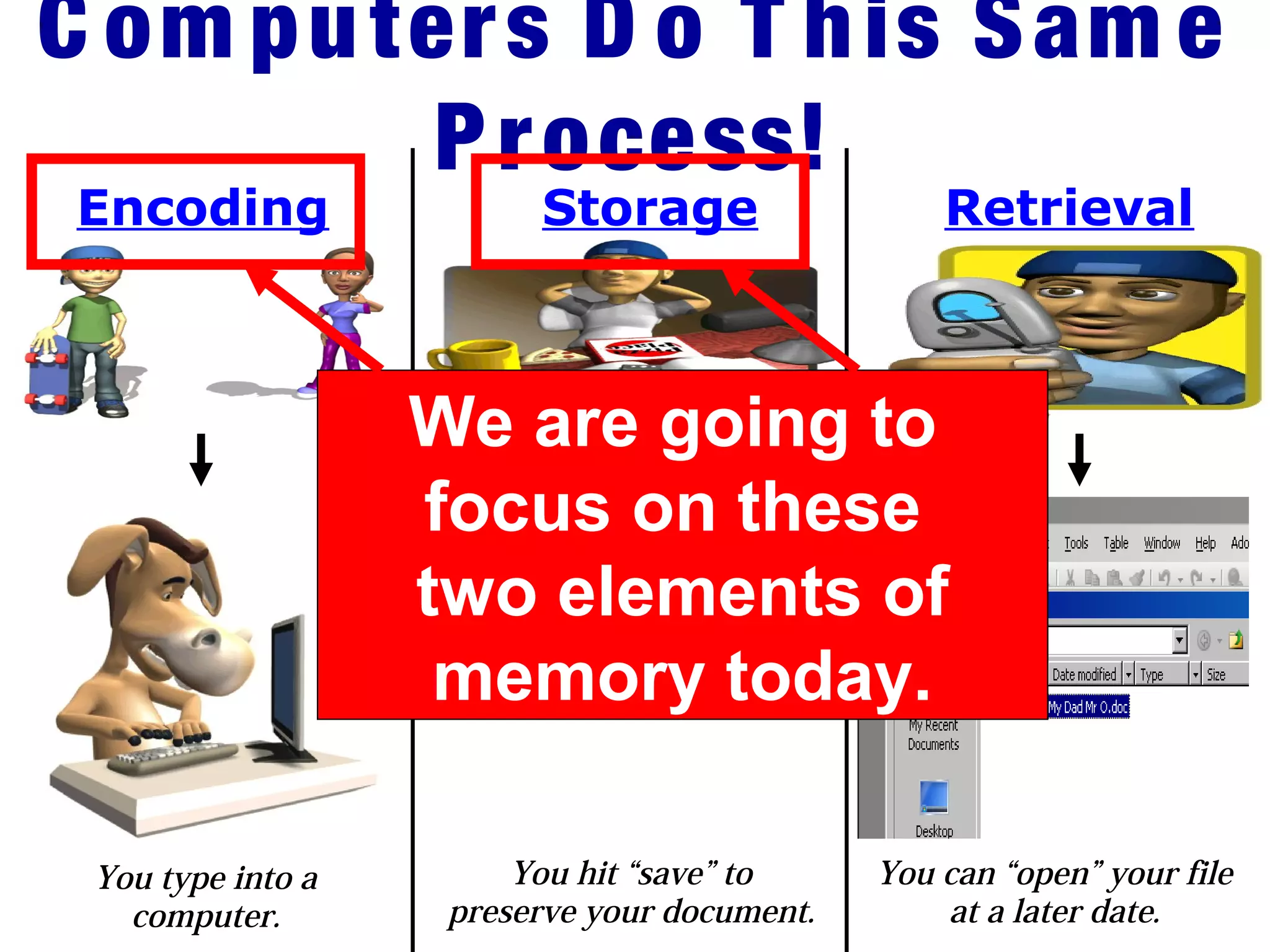
C om puters D o T his Sam e
Process!
Encoding Storage Retrieval
You type into a
computer.
You hit “save” to
preserve your document.
You can “open” your file
at a later date.
We are going to
focus on these
two elements of
memory today.
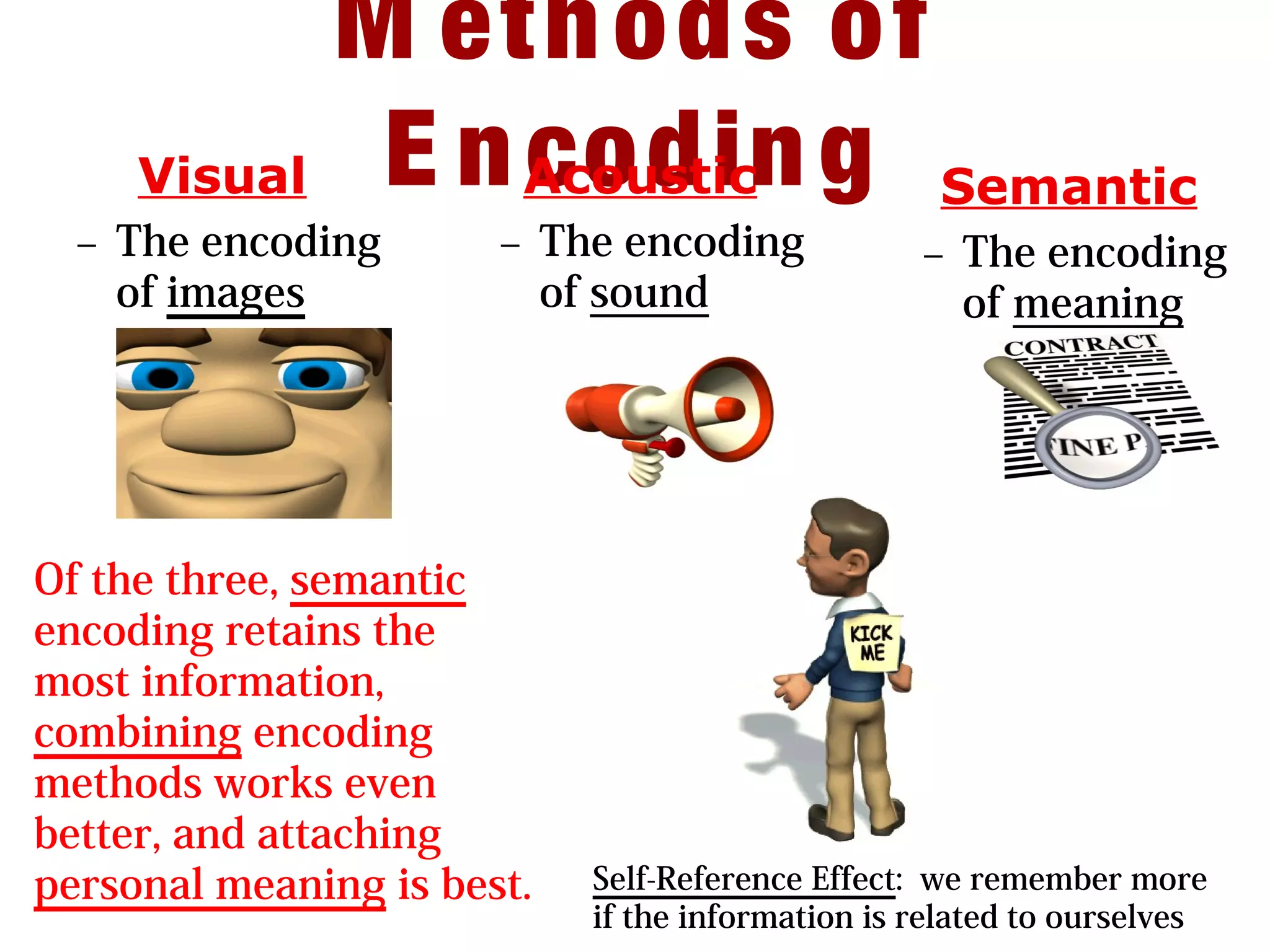
M ethods of
E ncodingVisual
– The encoding
of images
Acoustic
– The encoding
of sound
Semantic
– The encoding
of meaning
Of the three, semantic
encoding retains the
most information,
combining encoding
methods works even
better, and attaching
personal meaning is best. Self-Reference Effect: we remember more
if the information is related to ourselves
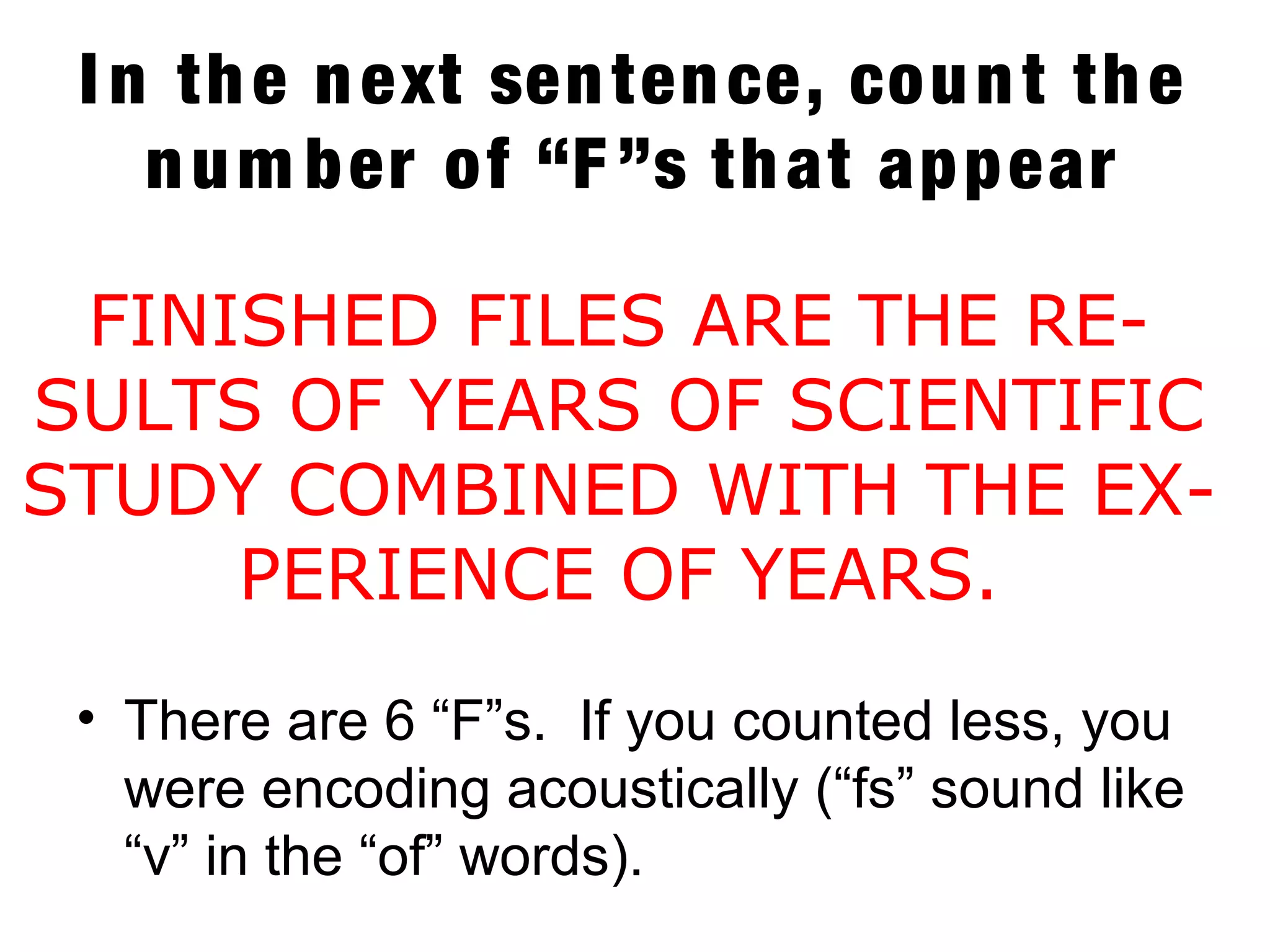
I n the next sentence, count the
num ber of “F ”s that appear
• There are 6 “F”s. If you counted less, you
were encoding acoustically (“fs” sound like
“v” in the “of” words).
FINISHED FILES ARE THE RE-
SULTS OF YEARS OF SCIENTIFIC
STUDY COMBINED WITH THE EX-
PERIENCE OF YEARS.
Processing M em ory
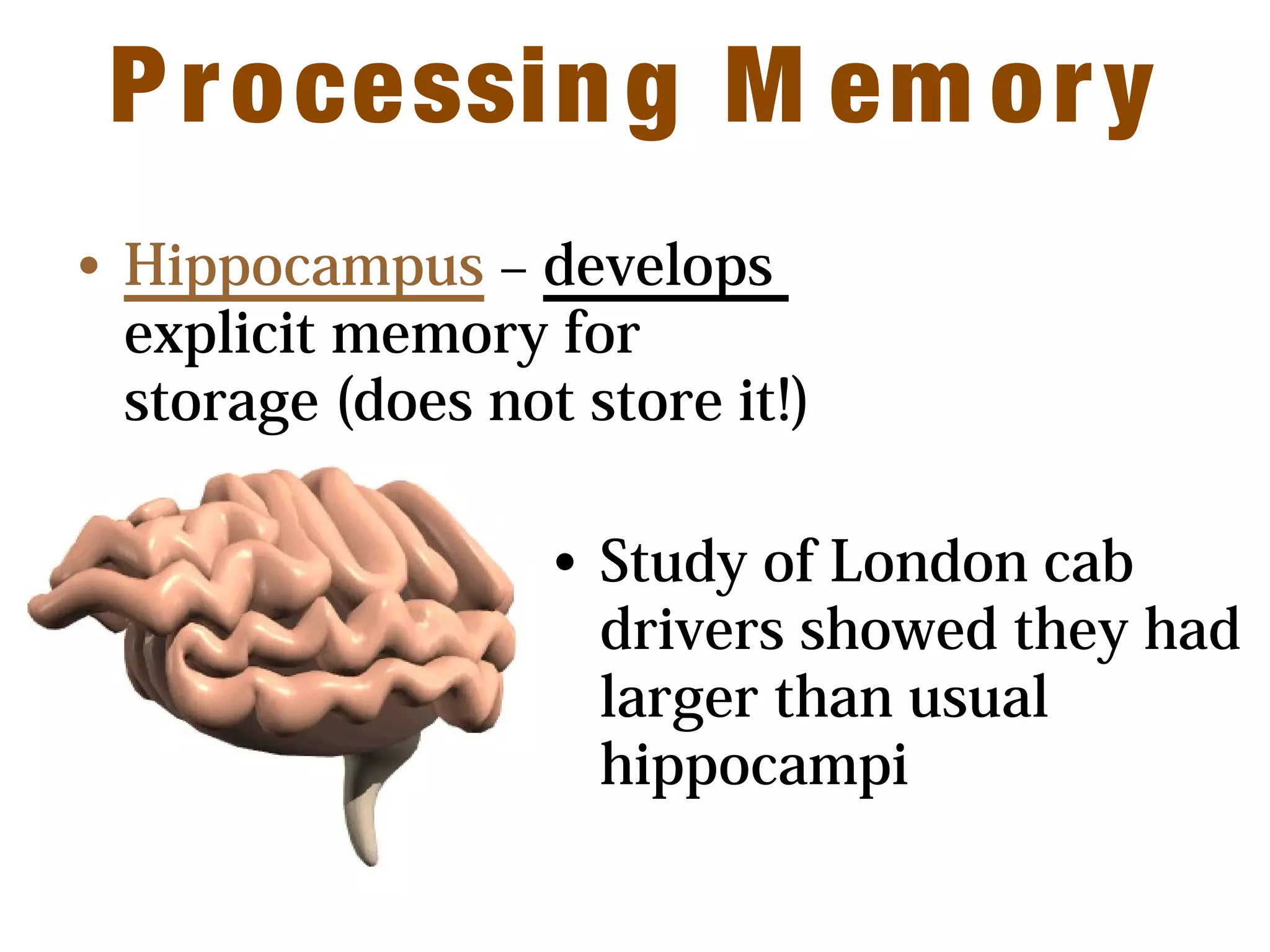
• Hippocampus – develops
explicit memory for
storage (does not store it!)
• Study of London cab
drivers showed they had
larger than usual
hippocampi
Processing M em ory
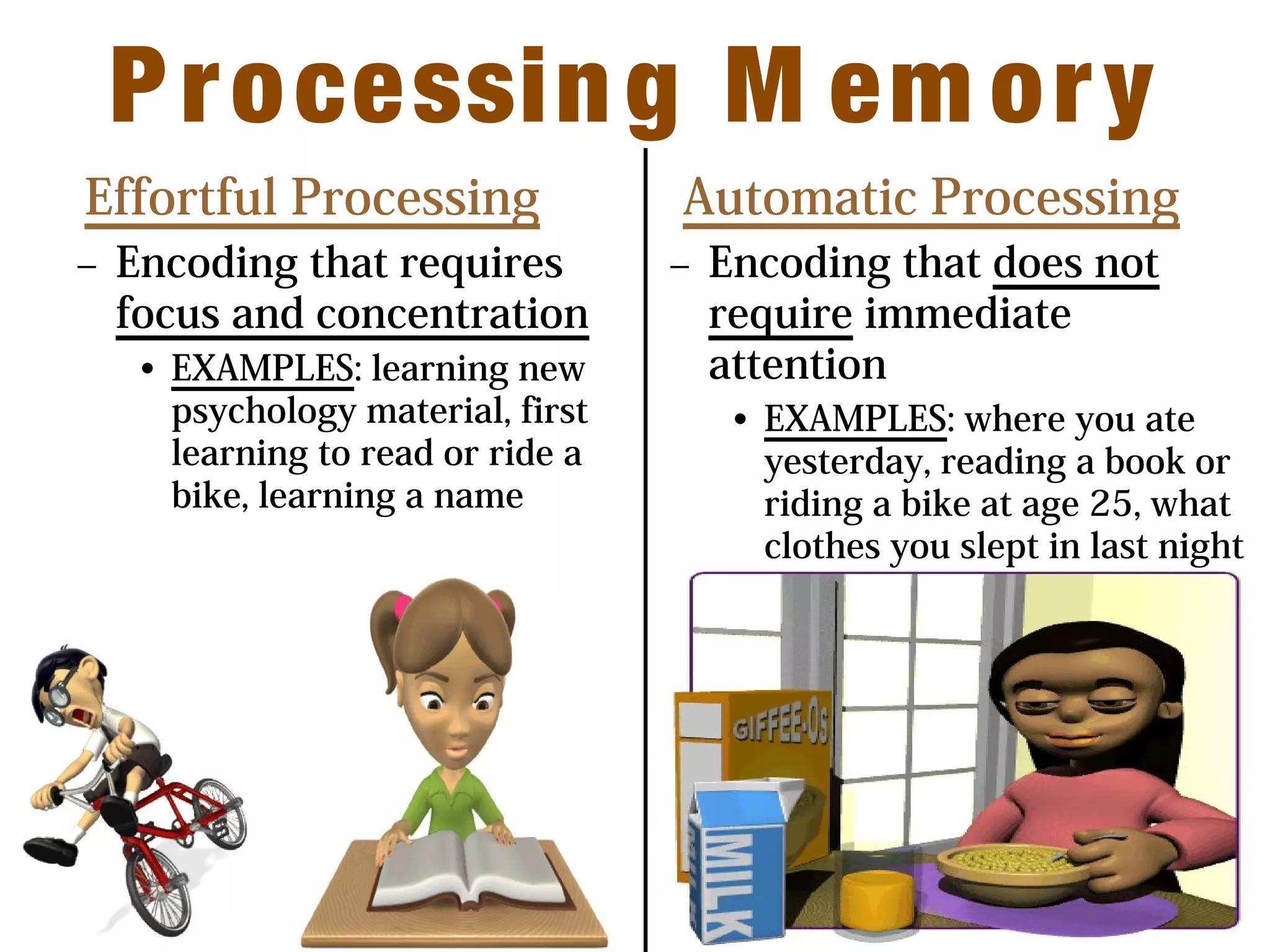
Effortful Processing
– Encoding that requires
focus and concentration
• EXAMPLES: learning new
psychology material, first
learning to read or ride a
bike, learning a name
Automatic Processing
– Encoding that does not
require immediate
attention
• EXAMPLES: where you ate
yesterday, reading a book or
riding a bike at age 25, what
clothes you slept in last night
Aids for Encoding
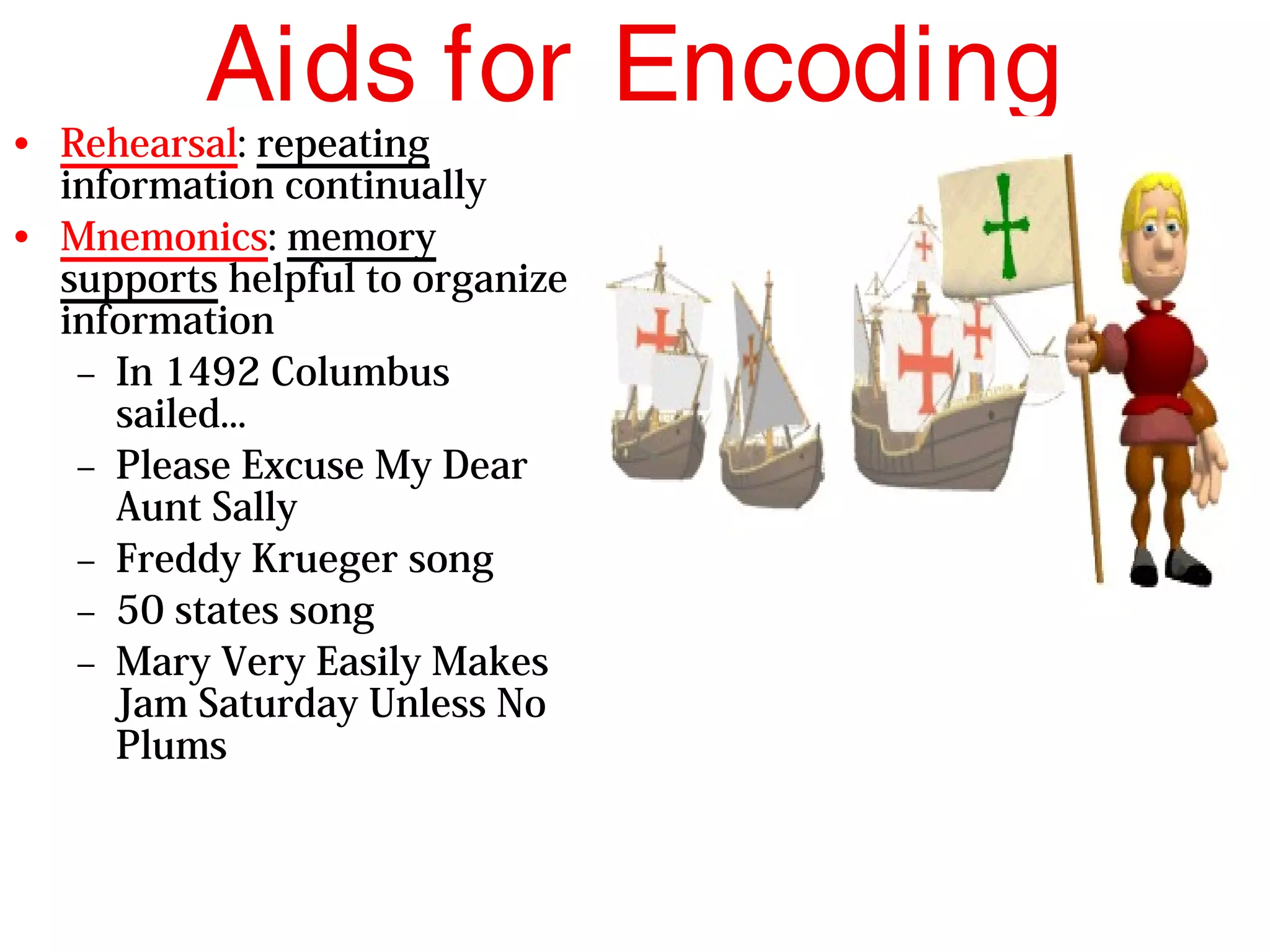
• Rehearsal: repeating
information continually
• Mnemonics: memory
supports helpful to organize
information
– In 1492 Columbus
sailed...
– Please Excuse My Dear
Aunt Sally
– Freddy Krueger song
– 50 states song
– Mary Very Easily Makes
Jam Saturday Unless No
Plums
Aids for Encoding
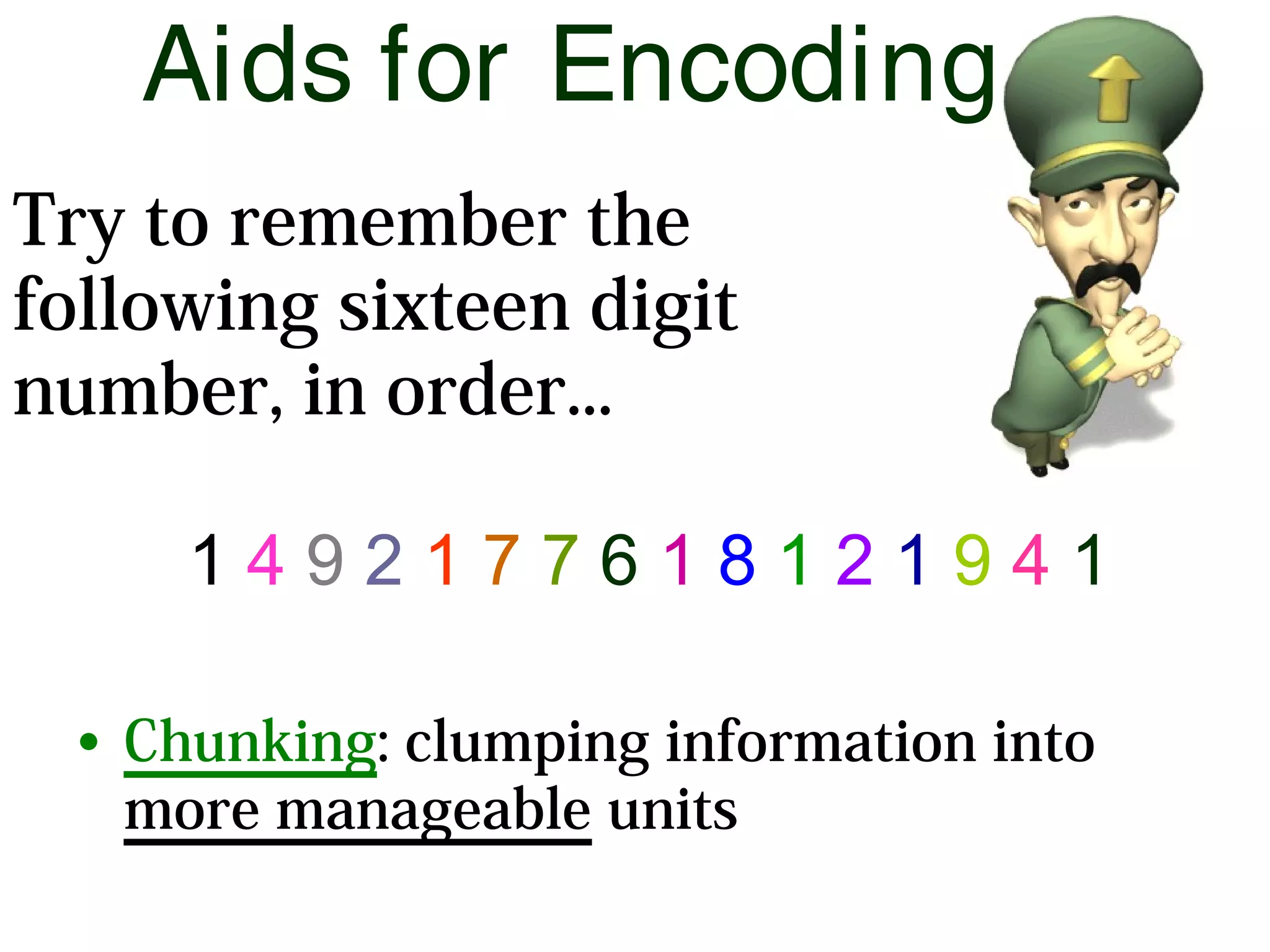
1 4 9 2 1 7 7 6 1 8 1 2 1 9 4 1
• Chunking: clumping information into
more manageable units
Try to remember the
following sixteen digit
number, in order...
Aids for Encoding
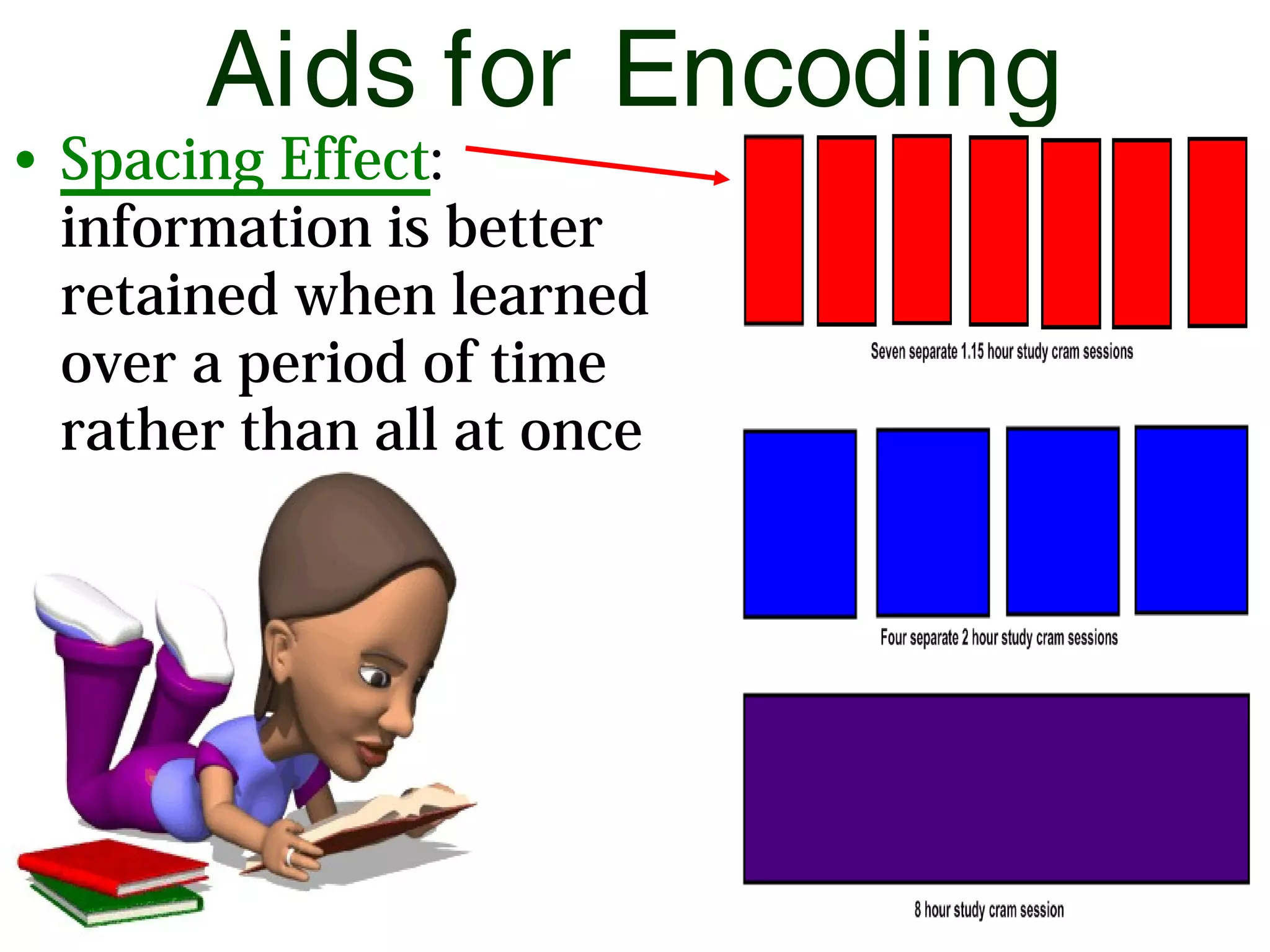
• Spacing Effect:
information is better
retained when learned
over a period of time
rather than all at once
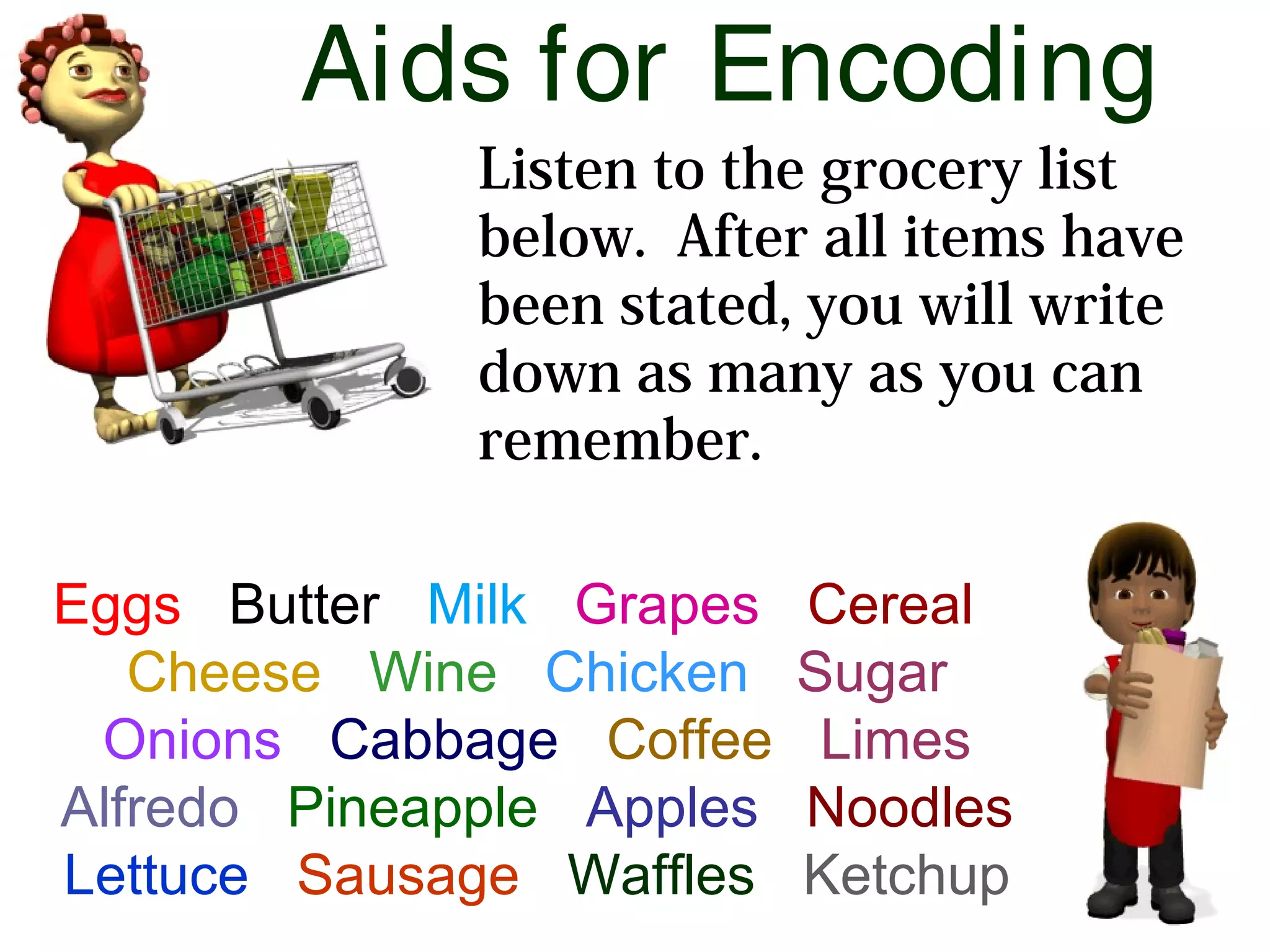
Eggs Butter Milk Grapes Cereal
Cheese Wine Chicken Sugar
Onions Cabbage Coffee Limes
Alfredo Pineapple Apples Noodles
Lettuce Sausage Waffles Ketchup
Listen to the grocery list
below. After all items have
been stated, you will write
down as many as you can
remember.
Aids for Encoding
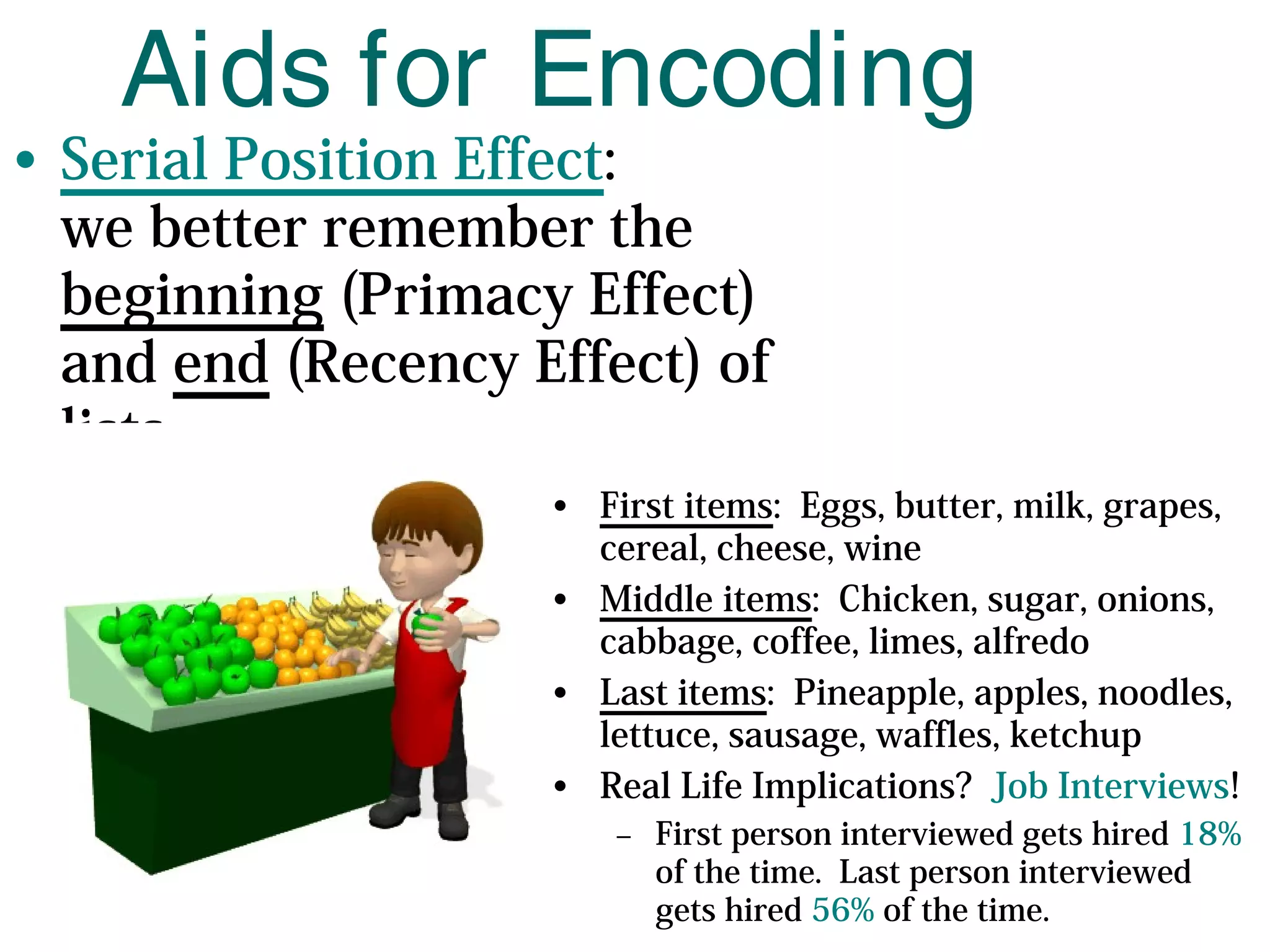
• Serial Position Effect:
we better remember the
beginning (Primacy Effect)
and end (Recency Effect) of
lists
Aids for Encoding
• First items: Eggs, butter, milk, grapes,
cereal, cheese, wine
• Middle items: Chicken, sugar, onions,
cabbage, coffee, limes, alfredo
• Last items: Pineapple, apples, noodles,
lettuce, sausage, waffles, ketchup
• Real Life Implications? Job Interviews!
– First person interviewed gets hired 18%
of the time. Last person interviewed
gets hired 56% of the time.
Storage
preserving encoded material in
memory
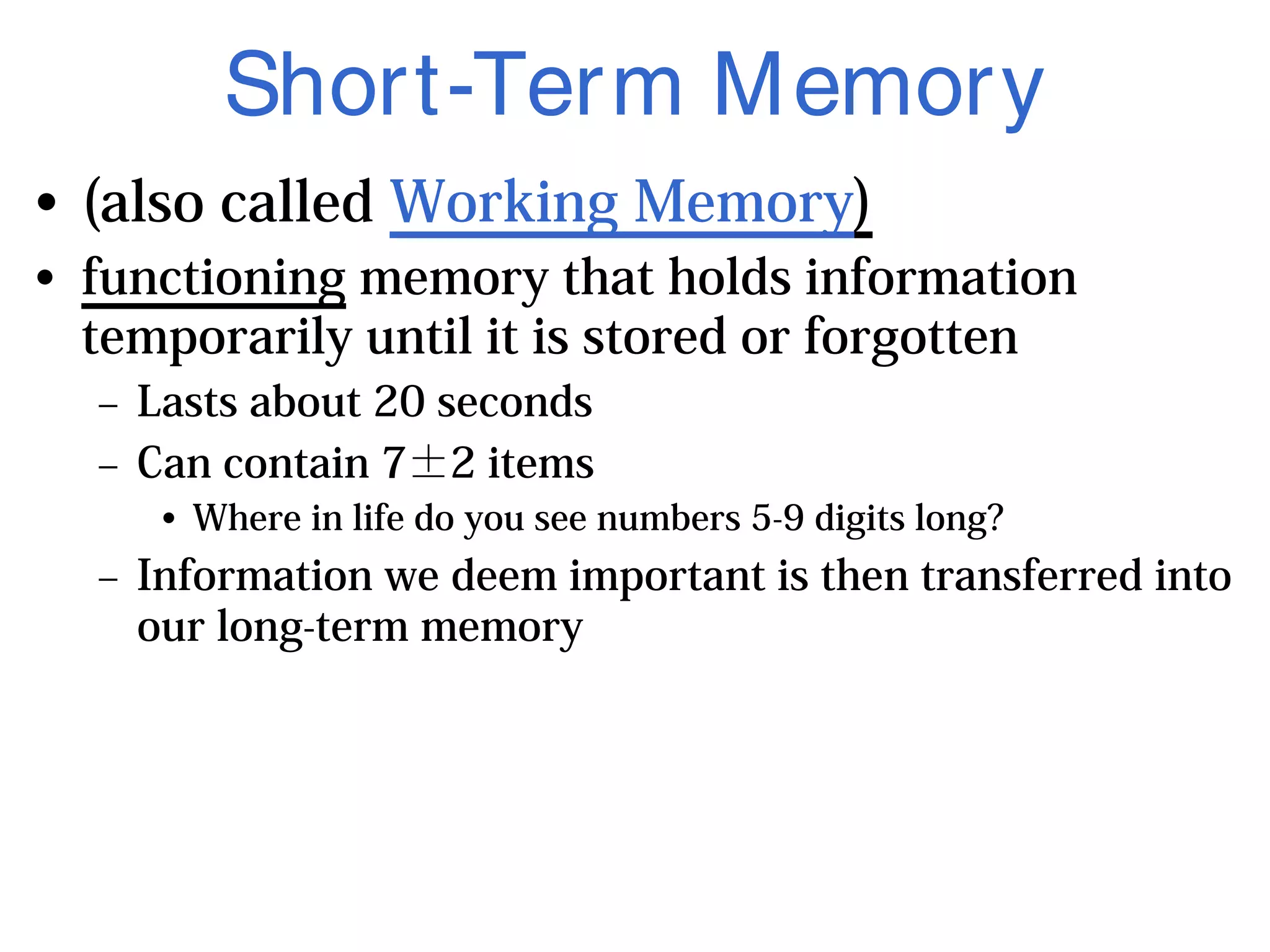
Short-Term Memory
• (also called Working Memory)
• functioning memory that holds information
temporarily until it is stored or forgotten
– Lasts about 20 seconds
– Can contain 7±2 items
• Where in life do you see numbers 5-9 digits long?
– Information we deem important is then transferred into
our long-term memory
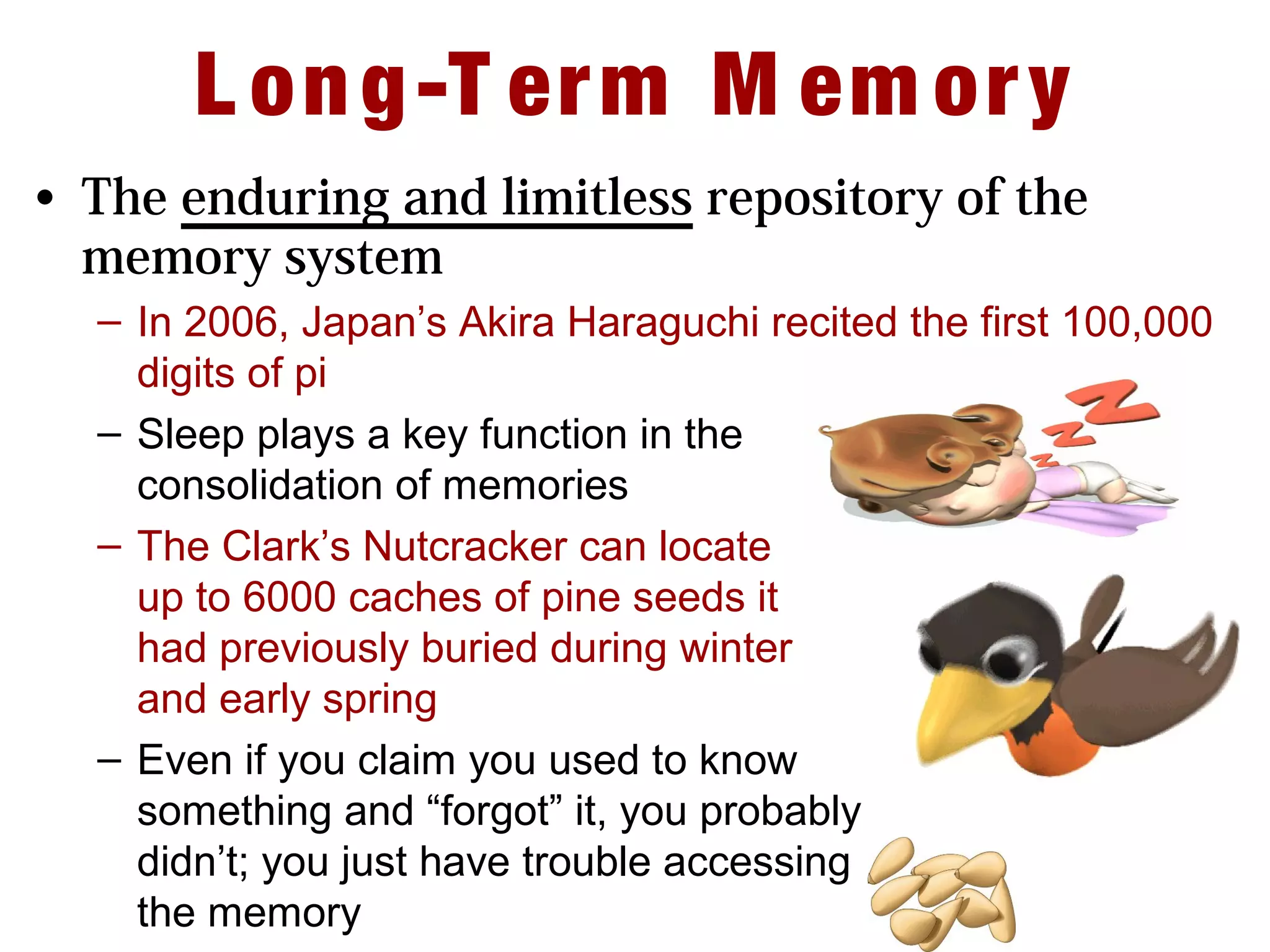
L ong-T erm M em ory
• The enduring and limitless repository of the
memory system
– In 2006, Japan’s Akira Haraguchi recited the first 100,000
digits of pi
– Sleep plays a key function in the
consolidation of memories
– The Clark’s Nutcracker can locate
up to 6000 caches of pine seeds it
had previously buried during winter
and early spring
– Even if you claim you used to know
something and “forgot” it, you probably
didn’t; you just have trouble accessing
the memory
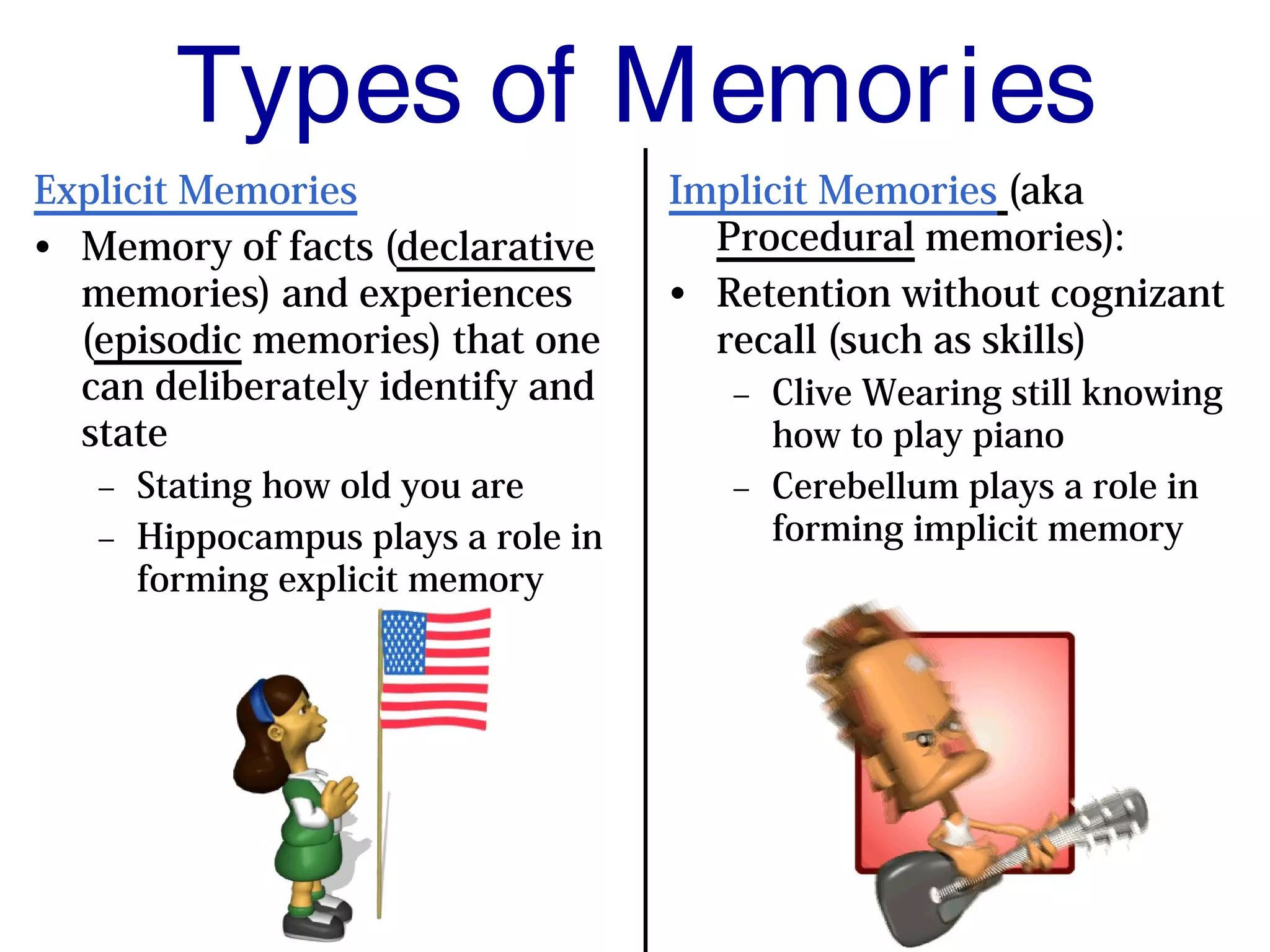
Types of Memories
Explicit Memories
• Memory of facts (declarative
memories) and experiences
(episodic memories) that one
can deliberately identify and
state
– Stating how old you are
– Hippocampus plays a role in
forming explicit memory
Implicit Memories (aka
Procedural memories):
• Retention without cognizant
recall (such as skills)
– Clive Wearing still knowing
how to play piano
– Cerebellum plays a role in
forming implicit memory
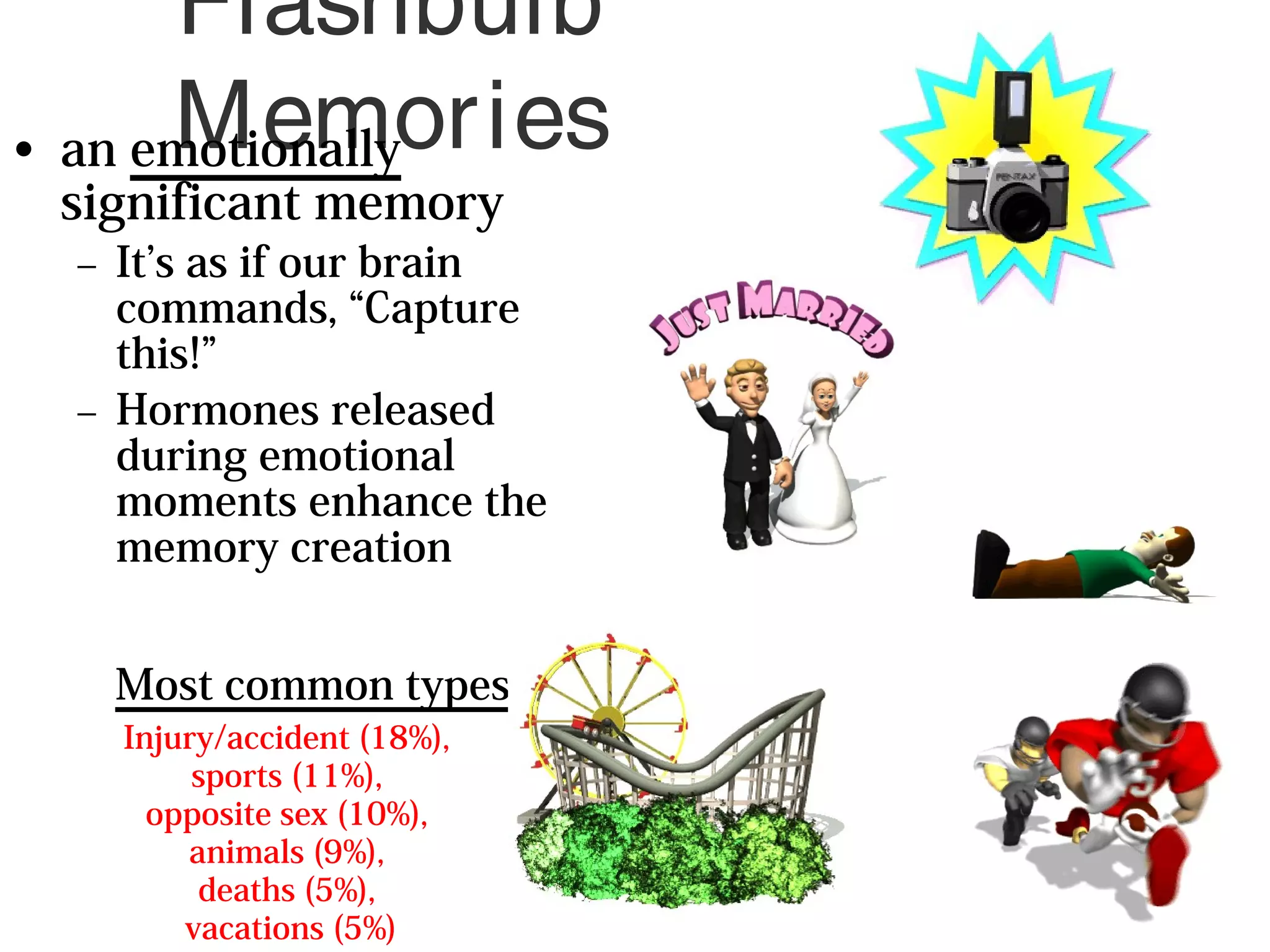
Flashbulb
Memories• an emotionally
significant memory
– It’s as if our brain
commands, “Capture
this!”
– Hormones released
during emotional
moments enhance the
memory creation
Most common types:
Injury/accident (18%),
sports (11%),
opposite sex (10%),
animals (9%),
deaths (5%),
vacations (5%)
CITATIONS
• All images from this presentation from
OpenClipArt. Author: C. Hwozdek.
Retrieved March 27, 2017.
Creative Commons Zero 1.0 Public Domain Li

Module 7 Lesson 1: Memory

  • 1.
    M O DU L E 7 L E SSO N 1: M E M O R YEncoding Storage Retrieval • integrating information into the memory system • preserving encoded material in memory • accessing memory from storage You meet a hot lady and learn her name. You say her name over and over in your head to memorize it. You have to recall her name when you want to Snapchat her.
  • 2.
    C om putersD o T his Sam e Process! Encoding Storage Retrieval You type into a computer. You hit “save” to preserve your document. You can “open” your file at a later date. We are going to focus on these two elements of memory today.
  • 3.
    M ethods of EncodingVisual – The encoding of images Acoustic – The encoding of sound Semantic – The encoding of meaning Of the three, semantic encoding retains the most information, combining encoding methods works even better, and attaching personal meaning is best. Self-Reference Effect: we remember more if the information is related to ourselves
  • 4.
    I n thenext sentence, count the num ber of “F ”s that appear • There are 6 “F”s. If you counted less, you were encoding acoustically (“fs” sound like “v” in the “of” words). FINISHED FILES ARE THE RE- SULTS OF YEARS OF SCIENTIFIC STUDY COMBINED WITH THE EX- PERIENCE OF YEARS.
  • 5.
    Processing M emory • Hippocampus – develops explicit memory for storage (does not store it!) • Study of London cab drivers showed they had larger than usual hippocampi
  • 6.
    Processing M emory Effortful Processing – Encoding that requires focus and concentration • EXAMPLES: learning new psychology material, first learning to read or ride a bike, learning a name Automatic Processing – Encoding that does not require immediate attention • EXAMPLES: where you ate yesterday, reading a book or riding a bike at age 25, what clothes you slept in last night
  • 7.
    Aids for Encoding •Rehearsal: repeating information continually • Mnemonics: memory supports helpful to organize information – In 1492 Columbus sailed... – Please Excuse My Dear Aunt Sally – Freddy Krueger song – 50 states song – Mary Very Easily Makes Jam Saturday Unless No Plums
  • 8.
    Aids for Encoding 14 9 2 1 7 7 6 1 8 1 2 1 9 4 1 • Chunking: clumping information into more manageable units Try to remember the following sixteen digit number, in order...
  • 9.
    Aids for Encoding •Spacing Effect: information is better retained when learned over a period of time rather than all at once
  • 10.
    Eggs Butter MilkGrapes Cereal Cheese Wine Chicken Sugar Onions Cabbage Coffee Limes Alfredo Pineapple Apples Noodles Lettuce Sausage Waffles Ketchup Listen to the grocery list below. After all items have been stated, you will write down as many as you can remember. Aids for Encoding
  • 11.
    • Serial PositionEffect: we better remember the beginning (Primacy Effect) and end (Recency Effect) of lists Aids for Encoding • First items: Eggs, butter, milk, grapes, cereal, cheese, wine • Middle items: Chicken, sugar, onions, cabbage, coffee, limes, alfredo • Last items: Pineapple, apples, noodles, lettuce, sausage, waffles, ketchup • Real Life Implications? Job Interviews! – First person interviewed gets hired 18% of the time. Last person interviewed gets hired 56% of the time.
  • 12.
  • 13.
    Short-Term Memory • (alsocalled Working Memory) • functioning memory that holds information temporarily until it is stored or forgotten – Lasts about 20 seconds – Can contain 7±2 items • Where in life do you see numbers 5-9 digits long? – Information we deem important is then transferred into our long-term memory
  • 14.
    L ong-T ermM em ory • The enduring and limitless repository of the memory system – In 2006, Japan’s Akira Haraguchi recited the first 100,000 digits of pi – Sleep plays a key function in the consolidation of memories – The Clark’s Nutcracker can locate up to 6000 caches of pine seeds it had previously buried during winter and early spring – Even if you claim you used to know something and “forgot” it, you probably didn’t; you just have trouble accessing the memory
  • 15.
    Types of Memories ExplicitMemories • Memory of facts (declarative memories) and experiences (episodic memories) that one can deliberately identify and state – Stating how old you are – Hippocampus plays a role in forming explicit memory Implicit Memories (aka Procedural memories): • Retention without cognizant recall (such as skills) – Clive Wearing still knowing how to play piano – Cerebellum plays a role in forming implicit memory
  • 16.
    Flashbulb Memories• an emotionally significantmemory – It’s as if our brain commands, “Capture this!” – Hormones released during emotional moments enhance the memory creation Most common types: Injury/accident (18%), sports (11%), opposite sex (10%), animals (9%), deaths (5%), vacations (5%)
  • 17.
    CITATIONS • All imagesfrom this presentation from OpenClipArt. Author: C. Hwozdek. Retrieved March 27, 2017. Creative Commons Zero 1.0 Public Domain Li

Editor's Notes

  • #8 Please Excuse… is order of math operations (parenthesis, then exponents, then multiplication, etc.) Freddy Krueger song is song to survive A Nightmare on Elm Street… (1,2, Freddy’s coming for you, 3, 4, Better lock your door, etc.) May Very Easily is for the planet names and order in relevance to the sun