Memory Chapter 9
Memory The Phenomenon of Memory Information Processing Encoding: Getting Information in How We Encode What We Encode
Memory Storage: Retaining Information Sensory Memory Working/Short-term Memory Long-Term Memory Storing Memories in the Brain
Memory Retrieval: Getting Information Out Retrieval Cues Forgetting Encoding Failure Storage Decay Retrieval Failure
Memory Memory Construction Misinformation and Imagination Effect Source Amnesia Discerning True and False Memories Children’s Eyewitness Recall Repressed or Constructed Memories of Abuse?
Memory Improving Memory
Memory Memory is the basis for knowing your friends, your neighbors, the English language, the national anthem, and yourself. If memory was nonexistent, everyone would be a stranger to you; every language foreign; every task new; and even you yourself would be a stranger.
The Phenomenon of Memory Memory is any indication that learning has persisted over time. It is our ability to store and retrieve information.
Flashbulb Memory A unique and highly emotional moment may give rise to a clear, strong, and persistent memory called  flashbulb memory . However, this memory is not free from errors. President Bush being told of 9/11 attack. Ruters/ Corbis
Stages of Memory Keyboard (Encoding) Disk (Storage) Monitor (Retrieval) Sequential Process
Information Processing The Atkinson-Schiffrin (1968) three-stage model of memory includes a)  sensory memory ,   b)  short-term memory,  and c)  long-term memory . Bob Daemmrich/ The Image Works Bob Daemmrich/ The Image Works Frank Wartenberg/ Picture Press/ Corbis
Problems with the Model Some information skips the first two stages and enters long-term memory automatically. Since we cannot focus all the sensory information in the environment, we select information (through attention) that is important to us. The nature of short-term memory is more complex.
Working Memory Alan Baddeley (2002) proposes that working memory contains auditory and visual processing controlled by the central executive through an episodic buffer.
Encoding: Getting Information In How We Encode Some information (route to your school) is automatically processed. However, new or unusual information (friend’s new cell-phone number) requires attention and effort.
Automatic Processing We process an enormous amount of information effortlessly, such as the following:  Space:  While reading a textbook, you automatically encode the place of a picture on a page. Time:  We unintentionally note the events that take place in a day. Frequency:  You effortlessly keep track of things that happen to you.
Effortful Processing Committing novel information to memory requires effort just like learning a concept from a textbook. Such processing leads to durable and accessible memories. Spencer Grant/ Photo Edit © Bananastock/ Alamy
Rehearsal Effortful learning usually requires rehearsal or conscious repetition.  Ebbinghaus studied rehearsal by using  nonsense syllables : TUV YOF GEK XOZ Hermann Ebbinghaus (1850-1909) http://www.isbn3-540-21358-9.de
Rehearsal The more times the nonsense syllables were practiced on Day 1, the fewer repetitions were required to remember them on Day 2.
Memory Effects Next-in-line-Effect:  When you are so anxious about being next that you cannot remember what the person just before you in line says, but you can recall what other people around you say.  Spacing Effect:  We retain information better when we rehearse over time. Serial Position Effect:  When your recall is better for first and last items on a list, but poor for middle items.
Spacing Effect Distributing rehearsal ( spacing effect ) is better than practicing all at once. Robert Frost’s poem could be memorized with fair ease if spread over time. ACQUAINTED WITH THE NIGHT Robert Frost I have been one acquainted with the night. I have walked out in rain — and back in rain. I have outwalked the furthest city light.  … …
Serial Position Effect TUV ZOF GEK WAV XOZ TIK FUT WIB SAR POZ REY GIJ Better recall Better recall Poor recall
What We Encode Encoding by meaning Encoding by images Encoding by organization
Encoding Meaning Q: Did the word begin with a capital letter? Structural Encoding Q: Did the word rhyme with the word “ weight”? Q: Would the word fit in the sentence? He met a __________  in the street. Phonemic Encoding Semantic Encoding “ Whale” Craik and Lockhart (1972) Intermediate Deep Shallow
Results
Visual Encoding Mental pictures (imagery) are a powerful aid to effortful processing, especially when combined with semantic encoding. Showing adverse effects of tanning and smoking  in a picture may be more powerful than simply talking about it. Both photos: Ho/AP Photo
Mnemonics Imagery is at the heart of many memory aids. Mnemonic techniques use vivid imagery in aiding memory. Method of Loci Link Method
Method of Loci List of Items Charcoal Pens Bed Sheets Hammer . . . Rug Imagined Locations Backyard Study Bedroom Garage . . . Living Room
Link Method Involves forming a mental image of items to be remembered in a way that links them together. List of Items Newspaper Shaving cream Pen Umbrella . . . Lamp
Break down complex information into broad concepts and further subdivide them into categories and subcategories. Organizing Information for Encoding Chunking Hierarchy
Chunking Organizing items into a familiar, manageable unit. Try to remember the numbers below. 1-7-7-6-1-4-9-2-1-8-1-2-1-9-4-1 If you are well versed with American history, chunk the numbers together and see if you can recall them better.  1776 1492 1812 1941.
Chunking Acronyms are another way of chunking information to remember it. HOMES =  H uron,  O ntario,  M ichigan,   E rie,  S uperior PEMDAS =  P arentheses,  E xponent,  M ultiply,  D ivide,  A dd,  S ubtract ROY G. BIV =  R ed,  O range,  Y ellow,  G reen,  B lue,  I ndigo,  V iolet
Hierarchy Complex information broken down into broad concepts and further subdivided into categories and subcategories.
Encoding Summarized in a Hierarchy
Storage: Retaining Information Storage is at the heart of memory. Three stores of memory are shown below: Sensory Memory Working Memory Long-term Memory Encoding Retrieval Encoding Events Retrieval
Sensory Memory Sensory Memory Working Memory Long-term Memory Encoding Retrieval Encoding Events Retrieval
Whole Report The exposure time for the stimulus is so small that items cannot be rehearsed. R  G  T F  M  Q L  Z  S 50 ms (1/20 second) “ Recall” R T M Z (44% recall) Sperling (1960)
Partial Report Low Tone Medium Tone High Tone “ Recall” J R S (100% recall) Sperling (1960) argued that sensory memory capacity was larger than what was originally thought. 50 ms (1/20 second) S  X  T J  R  S P  K  Y
Time Delay “ Recall” N _ _ (33% recall) Time Delay 50 ms (1/20 second) A  D  I N  L  V O  G  H Low Tone Medium Tone High Tone
Sensory Memory The longer the delay, the greater the memory loss. 20 40 60 80 Percent Recognized 0.15 0.30 0.50 1.00 Time (Seconds)
Sensory Memories The duration of sensory memory varies for the different senses. Iconic 0.5 sec. long Echoic 3-4 sec. long Hepatic < 1 sec. long
Working Memory Sensory Memory Working Memory Long-term Memory Encoding Retrieval Encoding Events Retrieval
Working Memory Working memory, the new name for short-term memory, has a limited capacity (7±2) and a short duration (20 seconds).  Sir George Hamilton observed that he could accurately remember up to 7 beans thrown on the floor. If there were more beans, he guessed.
Capacity You should be able to recall 7±2 letters. The Magical Number Seven, Plus or Minus Two: Some Limits on Our Capacity for Processing Information  (1956). George Miller M U T G I K T L R S Y P Ready?
Chunking F-B-I-T-W-A-C-I-A-I-B-M  The capacity of the working memory may be increased by  “Chunking.” FBI  TWA  CIA  IBM 4 chunks
Duration Brown/Peterson and Peterson (1958/1959) measured the duration of working memory by manipulating rehearsal. CH?? The duration of the working memory is about 20 sec. CHJ MKT HIJ 547 547 544 541 …
Working Memory Duration
Long-Term Memory Sensory Memory Working Memory Long-term Memory Encoding Retrieval Encoding Events Retrieval
Long-Term Memory Unlimited capacity store. Estimates on capacity range from 1000 billion to 1,000,000 billion bits of information (Landauer, 1986).  The Clark’s nutcracker can locate 6,000 caches of buried pine seeds during winter and spring. R.J. Erwin/ Photo Researchers
Memory Feats
Memory Stores Years 20 sec. 0.25 sec. Duration Very Large 7±2 Chunks Unlimited Capacity Semantic Phonemic Copy Encoding LTM Working Memory Sensory Memory Feature
Storing Memories in the Brain Through electrical stimulation of the brain, Wilder Penfield (1967) concluded that old memories were etched into the brain. Loftus and Loftus (1980) reviewed Penfield's data and showed that only a handful of brain stimulated patients reported flashbacks. Using rats, Lashley (1950) suggested that even after removing parts of the brain, the animals retain partial memory of the maze.
Synaptic Changes In  Aplysia,  Kandel and Schwartz (1982) showed that serotonin release from neurons increased after conditioning. Photo: Scientific American
Synaptic Changes Long-Term Potentiation (LTP)   refers to synaptic enhancement after learning (Lynch, 2002). An increase in neurotransmitter release or receptors on the receiving neuron indicates strengthening of synapses. Both Photos: From N. Toni et al., Nature, 402, Nov. 25 1999. Courtesy of Dominique Muller
Stress Hormones & Memory Heightened emotions (stress-related or otherwise) make for stronger memories. Continued stress may disrupt memory. Scott Barbour/ Getty Images
Storing Implicit & Explicit Memories Explicit Memory   refers to facts and experiences that one can consciously know and declare.  Implicit memory  involves learning an action while the individual does not know or declare what she knows.
Hippocampus Hippocampus  – a neural center in the limbic system that processes explicit memories. Weidenfield & Nicolson archives
Anterograde Amnesia Anterograde Amnesia (HM) No New Memories Surgery After losing his hippocampus in surgery, patient Henry M. (HM) remembered everything before the operation but cannot make new memories. We call this  anterograde amnesia . Memory Intact
Implicit Memory HM learned the Tower of Hanoi (game) after his surgery. Each time he plays it, he is unable to remember the fact that he has already played the game. HM is unable to make new memories that are declarative (explicit), but he can form new memories that are procedural (implicit). C B A
Cerebellum Cerebellum  – a neural center in the hindbrain that processes implicit memories.
Retrieval: Getting Information Out Retrieval refers to getting information out of the memory store. Spanky’s Yearbook Archive Spanky’s Yearbook Archive
Measures of Memory In  recognition,  the person must identify an item amongst other choices. (A multiple-choice test requires recognition.) Name the capital of France. Brussels Rome London Paris
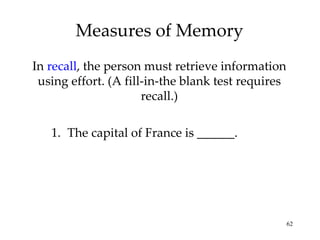
Measures of Memory In  recall ,   the person must retrieve information using effort. (A fill-in-the blank test requires recall.) The capital of France is ______.
Measures of Memory In  relearning ,   the individual shows how much time (or effort) is saved when learning material for the second time. List Jet Dagger Tree Kite … Silk Frog Ring It took  10  trials to learn this list List Jet Dagger Tree Kite … Silk Frog Ring It took  5  trials to learn the list 1 day later Saving Original Trials Relearning Trials Relearning Trials 10 5 10 50% X 100 X 100
Retrieval Cues Memories are held in storage by a web of associations. These associations are like anchors that help retrieve memory. Fire Truck truck red fire heat smoke smell water hose
Priming To retrieve a specific memory from the web of associations, you must first activate one of the strands that leads to it. This process is called  priming .
Context Effects Scuba divers recall more words underwater if they learned the list underwater, while they recall more words on land if they learned that list on land (Godden & Baddeley, 1975). Fred McConnaughey/ Photo Researchers
Déja Vu Déja Vu means “I've experienced this before.” Cues from the current situation may unconsciously trigger retrieval of an earlier similar experience.  © The New Yorker Collection, 1990. Leo Cullum from  cartoonbank.com. All Rights Reserved
Context Effects After learning to move a mobile by kicking, infants most strongly respond when retested in the same context rather than in a different context (Butler & Rovee-Collier, 1989). Courtesy of Carolyn Rovee-Collier,  Rutgers University
Moods and Memories We usually recall experiences that are consistent with our current mood. Emotions, or moods, serve as retrieval cues. Jorgen Schytte/ Still Pictures
Forgetting An inability to retrieve information due to poor encoding, storage, or retrieval.
Encoding Failure We cannot remember what we do not encode.
Which penny is real?
Storage Decay Poor durability of stored memories leads to their decay. Ebbinghaus showed this with his forgetting curve.
Retaining Spanish Bahrick (1984) showed a similar pattern of forgetting and retaining over 50 years. Andrew Holbrooke/ Corbis
Retrieval Failure Although the information is retained in the memory store, it cannot be accessed. Tip-of-the-tongue (TOT) is a retrieval failure phenomenon. Given a cue (What makes blood cells red?) the subject says the word begins with an  H  (hemoglobin).
Interference Learning some new information may disrupt retrieval of other information.
Retroactive Interference Sleep prevents retroactive interference. Therefore, it leads to better recall.
Motivated Forgetting Motivated Forgetting:   People unknowingly revise their memories. Repression:   A   defense mechanism that banishes anxiety-arousing thoughts, feelings, and memories from consciousness. Sigmund Freud Culver Pictures
Why do we forget? Forgetting can occur at any memory stage. We filter, alter, or lose much information during these stages.
Memory Construction While tapping our memories, we filter or fill in missing pieces of information to make our recall more coherent. Misinformation Effect:   Incorporating misleading information into one's memory of an event.
Eyewitnesses reconstruct their memories when questioned about the event. Misinformation and Imagination Effects  Depiction of the actual accident.
Misinformation Group A: How fast were the cars going when they  hit  each other? Group B: How fast were the cars going when they  smashed into  each other?
Memory Construction A week later they were asked: Was there any broken glass?  Group B ( smashed into)  reported more broken glass than  Group A ( hit ) .
Source Amnesia Source Amnesia:   Attributing an event to the wrong source that we experienced, heard, read, or imagined (misattribution).
Discerning True & False Memories Just like true perception and illusion, real memories and memories that seem real are difficult to discern. When students formed a happy or angry memory of morphed (computer blended) faces, they made  the (computer assisted) faces (a), either happier or (b) angrier. © Simon Niedsenthal
Repressed or Constructed? Some adults actually do forget childhood episodes of abuse. False Memory Syndrome A condition in which a person’s identity and relationships center around a false but strongly believed memory of a traumatic experience, which is sometimes induced by well-meaning therapists. False Memories
Children’s eyewitness recall can be unreliable if leading questions are posed. However, if cognitive interviews are neutrally worded, the accuracy of their recall increases.  In cases of sexual abuse, this usually suggests a lower percentage of abuse. Children’s Eyewitness Recall
Are memories of abuse repressed or constructed? Many psychotherapists believe that early childhood sexual abuse results in repressed memories. However, other psychologists question such beliefs and think that such memories may be constructed. Memories of Abuse
Constructed Memories Loftus’ research shows that if false memories (lost at the mall or drowned in a lake) are implanted in individuals, they construct (fabricate) their memories. Don Shrubshell
Consensus on Childhood Abuse Injustice happens. Incest and other sexual abuse happens. People may forget. Recovered memories are commonplace. Recovered memories under hypnosis or drugs are unreliable. Memories of things happening before 3 years of age are unreliable. Memories, whether real or false, are emotionally upsetting. Leading psychological associations of the world agree on the following concerning childhood sexual abuse:
Improving Memory Study repeatedly to boost long-term recall. Spend more time rehearsing or actively thinking about the material. Make material personally meaningful. Use mnemonic devices: associate with peg words — something already stored make up a story chunk — acronyms
Improving Memory Activate retrieval cues — mentally recreate the situation and mood. Recall events while they are fresh — before you encounter misinformation. Minimize interference: Test your own knowledge. Rehearse and then determine what you do not yet know. © LWA-Dann Tardiff/ Corbis

Chapter9

  • 1.
  • 2.
    Memory The Phenomenonof Memory Information Processing Encoding: Getting Information in How We Encode What We Encode
  • 3.
    Memory Storage: RetainingInformation Sensory Memory Working/Short-term Memory Long-Term Memory Storing Memories in the Brain
  • 4.
    Memory Retrieval: GettingInformation Out Retrieval Cues Forgetting Encoding Failure Storage Decay Retrieval Failure
  • 5.
    Memory Memory ConstructionMisinformation and Imagination Effect Source Amnesia Discerning True and False Memories Children’s Eyewitness Recall Repressed or Constructed Memories of Abuse?
  • 6.
  • 7.
    Memory Memory isthe basis for knowing your friends, your neighbors, the English language, the national anthem, and yourself. If memory was nonexistent, everyone would be a stranger to you; every language foreign; every task new; and even you yourself would be a stranger.
  • 8.
    The Phenomenon ofMemory Memory is any indication that learning has persisted over time. It is our ability to store and retrieve information.
  • 9.
    Flashbulb Memory Aunique and highly emotional moment may give rise to a clear, strong, and persistent memory called flashbulb memory . However, this memory is not free from errors. President Bush being told of 9/11 attack. Ruters/ Corbis
  • 10.
    Stages of MemoryKeyboard (Encoding) Disk (Storage) Monitor (Retrieval) Sequential Process
  • 11.
    Information Processing TheAtkinson-Schiffrin (1968) three-stage model of memory includes a) sensory memory , b) short-term memory, and c) long-term memory . Bob Daemmrich/ The Image Works Bob Daemmrich/ The Image Works Frank Wartenberg/ Picture Press/ Corbis
  • 12.
    Problems with theModel Some information skips the first two stages and enters long-term memory automatically. Since we cannot focus all the sensory information in the environment, we select information (through attention) that is important to us. The nature of short-term memory is more complex.
  • 13.
    Working Memory AlanBaddeley (2002) proposes that working memory contains auditory and visual processing controlled by the central executive through an episodic buffer.
  • 14.
    Encoding: Getting InformationIn How We Encode Some information (route to your school) is automatically processed. However, new or unusual information (friend’s new cell-phone number) requires attention and effort.
  • 15.
    Automatic Processing Weprocess an enormous amount of information effortlessly, such as the following: Space: While reading a textbook, you automatically encode the place of a picture on a page. Time: We unintentionally note the events that take place in a day. Frequency: You effortlessly keep track of things that happen to you.
  • 16.
    Effortful Processing Committingnovel information to memory requires effort just like learning a concept from a textbook. Such processing leads to durable and accessible memories. Spencer Grant/ Photo Edit © Bananastock/ Alamy
  • 17.
    Rehearsal Effortful learningusually requires rehearsal or conscious repetition. Ebbinghaus studied rehearsal by using nonsense syllables : TUV YOF GEK XOZ Hermann Ebbinghaus (1850-1909) http://www.isbn3-540-21358-9.de
  • 18.
    Rehearsal The moretimes the nonsense syllables were practiced on Day 1, the fewer repetitions were required to remember them on Day 2.
  • 19.
    Memory Effects Next-in-line-Effect: When you are so anxious about being next that you cannot remember what the person just before you in line says, but you can recall what other people around you say. Spacing Effect: We retain information better when we rehearse over time. Serial Position Effect: When your recall is better for first and last items on a list, but poor for middle items.
  • 20.
    Spacing Effect Distributingrehearsal ( spacing effect ) is better than practicing all at once. Robert Frost’s poem could be memorized with fair ease if spread over time. ACQUAINTED WITH THE NIGHT Robert Frost I have been one acquainted with the night. I have walked out in rain — and back in rain. I have outwalked the furthest city light. … …
  • 21.
    Serial Position EffectTUV ZOF GEK WAV XOZ TIK FUT WIB SAR POZ REY GIJ Better recall Better recall Poor recall
  • 22.
    What We EncodeEncoding by meaning Encoding by images Encoding by organization
  • 23.
    Encoding Meaning Q:Did the word begin with a capital letter? Structural Encoding Q: Did the word rhyme with the word “ weight”? Q: Would the word fit in the sentence? He met a __________ in the street. Phonemic Encoding Semantic Encoding “ Whale” Craik and Lockhart (1972) Intermediate Deep Shallow
  • 24.
  • 25.
    Visual Encoding Mentalpictures (imagery) are a powerful aid to effortful processing, especially when combined with semantic encoding. Showing adverse effects of tanning and smoking in a picture may be more powerful than simply talking about it. Both photos: Ho/AP Photo
  • 26.
    Mnemonics Imagery isat the heart of many memory aids. Mnemonic techniques use vivid imagery in aiding memory. Method of Loci Link Method
  • 27.
    Method of LociList of Items Charcoal Pens Bed Sheets Hammer . . . Rug Imagined Locations Backyard Study Bedroom Garage . . . Living Room
  • 28.
    Link Method Involvesforming a mental image of items to be remembered in a way that links them together. List of Items Newspaper Shaving cream Pen Umbrella . . . Lamp
  • 29.
    Break down complexinformation into broad concepts and further subdivide them into categories and subcategories. Organizing Information for Encoding Chunking Hierarchy
  • 30.
    Chunking Organizing itemsinto a familiar, manageable unit. Try to remember the numbers below. 1-7-7-6-1-4-9-2-1-8-1-2-1-9-4-1 If you are well versed with American history, chunk the numbers together and see if you can recall them better. 1776 1492 1812 1941.
  • 31.
    Chunking Acronyms areanother way of chunking information to remember it. HOMES = H uron, O ntario, M ichigan, E rie, S uperior PEMDAS = P arentheses, E xponent, M ultiply, D ivide, A dd, S ubtract ROY G. BIV = R ed, O range, Y ellow, G reen, B lue, I ndigo, V iolet
  • 32.
    Hierarchy Complex informationbroken down into broad concepts and further subdivided into categories and subcategories.
  • 33.
  • 34.
    Storage: Retaining InformationStorage is at the heart of memory. Three stores of memory are shown below: Sensory Memory Working Memory Long-term Memory Encoding Retrieval Encoding Events Retrieval
  • 35.
    Sensory Memory SensoryMemory Working Memory Long-term Memory Encoding Retrieval Encoding Events Retrieval
  • 36.
    Whole Report Theexposure time for the stimulus is so small that items cannot be rehearsed. R G T F M Q L Z S 50 ms (1/20 second) “ Recall” R T M Z (44% recall) Sperling (1960)
  • 37.
    Partial Report LowTone Medium Tone High Tone “ Recall” J R S (100% recall) Sperling (1960) argued that sensory memory capacity was larger than what was originally thought. 50 ms (1/20 second) S X T J R S P K Y
  • 38.
    Time Delay “Recall” N _ _ (33% recall) Time Delay 50 ms (1/20 second) A D I N L V O G H Low Tone Medium Tone High Tone
  • 39.
    Sensory Memory Thelonger the delay, the greater the memory loss. 20 40 60 80 Percent Recognized 0.15 0.30 0.50 1.00 Time (Seconds)
  • 40.
    Sensory Memories Theduration of sensory memory varies for the different senses. Iconic 0.5 sec. long Echoic 3-4 sec. long Hepatic < 1 sec. long
  • 41.
    Working Memory SensoryMemory Working Memory Long-term Memory Encoding Retrieval Encoding Events Retrieval
  • 42.
    Working Memory Workingmemory, the new name for short-term memory, has a limited capacity (7±2) and a short duration (20 seconds). Sir George Hamilton observed that he could accurately remember up to 7 beans thrown on the floor. If there were more beans, he guessed.
  • 43.
    Capacity You shouldbe able to recall 7±2 letters. The Magical Number Seven, Plus or Minus Two: Some Limits on Our Capacity for Processing Information (1956). George Miller M U T G I K T L R S Y P Ready?
  • 44.
    Chunking F-B-I-T-W-A-C-I-A-I-B-M The capacity of the working memory may be increased by “Chunking.” FBI TWA CIA IBM 4 chunks
  • 45.
    Duration Brown/Peterson andPeterson (1958/1959) measured the duration of working memory by manipulating rehearsal. CH?? The duration of the working memory is about 20 sec. CHJ MKT HIJ 547 547 544 541 …
  • 46.
  • 47.
    Long-Term Memory SensoryMemory Working Memory Long-term Memory Encoding Retrieval Encoding Events Retrieval
  • 48.
    Long-Term Memory Unlimitedcapacity store. Estimates on capacity range from 1000 billion to 1,000,000 billion bits of information (Landauer, 1986). The Clark’s nutcracker can locate 6,000 caches of buried pine seeds during winter and spring. R.J. Erwin/ Photo Researchers
  • 49.
  • 50.
    Memory Stores Years20 sec. 0.25 sec. Duration Very Large 7±2 Chunks Unlimited Capacity Semantic Phonemic Copy Encoding LTM Working Memory Sensory Memory Feature
  • 51.
    Storing Memories inthe Brain Through electrical stimulation of the brain, Wilder Penfield (1967) concluded that old memories were etched into the brain. Loftus and Loftus (1980) reviewed Penfield's data and showed that only a handful of brain stimulated patients reported flashbacks. Using rats, Lashley (1950) suggested that even after removing parts of the brain, the animals retain partial memory of the maze.
  • 52.
    Synaptic Changes In Aplysia, Kandel and Schwartz (1982) showed that serotonin release from neurons increased after conditioning. Photo: Scientific American
  • 53.
    Synaptic Changes Long-TermPotentiation (LTP) refers to synaptic enhancement after learning (Lynch, 2002). An increase in neurotransmitter release or receptors on the receiving neuron indicates strengthening of synapses. Both Photos: From N. Toni et al., Nature, 402, Nov. 25 1999. Courtesy of Dominique Muller
  • 54.
    Stress Hormones &Memory Heightened emotions (stress-related or otherwise) make for stronger memories. Continued stress may disrupt memory. Scott Barbour/ Getty Images
  • 55.
    Storing Implicit &Explicit Memories Explicit Memory refers to facts and experiences that one can consciously know and declare. Implicit memory involves learning an action while the individual does not know or declare what she knows.
  • 56.
    Hippocampus Hippocampus – a neural center in the limbic system that processes explicit memories. Weidenfield & Nicolson archives
  • 57.
    Anterograde Amnesia AnterogradeAmnesia (HM) No New Memories Surgery After losing his hippocampus in surgery, patient Henry M. (HM) remembered everything before the operation but cannot make new memories. We call this anterograde amnesia . Memory Intact
  • 58.
    Implicit Memory HMlearned the Tower of Hanoi (game) after his surgery. Each time he plays it, he is unable to remember the fact that he has already played the game. HM is unable to make new memories that are declarative (explicit), but he can form new memories that are procedural (implicit). C B A
  • 59.
    Cerebellum Cerebellum – a neural center in the hindbrain that processes implicit memories.
  • 60.
    Retrieval: Getting InformationOut Retrieval refers to getting information out of the memory store. Spanky’s Yearbook Archive Spanky’s Yearbook Archive
  • 61.
    Measures of MemoryIn recognition, the person must identify an item amongst other choices. (A multiple-choice test requires recognition.) Name the capital of France. Brussels Rome London Paris
  • 62.
    Measures of MemoryIn recall , the person must retrieve information using effort. (A fill-in-the blank test requires recall.) The capital of France is ______.
  • 63.
    Measures of MemoryIn relearning , the individual shows how much time (or effort) is saved when learning material for the second time. List Jet Dagger Tree Kite … Silk Frog Ring It took 10 trials to learn this list List Jet Dagger Tree Kite … Silk Frog Ring It took 5 trials to learn the list 1 day later Saving Original Trials Relearning Trials Relearning Trials 10 5 10 50% X 100 X 100
  • 64.
    Retrieval Cues Memoriesare held in storage by a web of associations. These associations are like anchors that help retrieve memory. Fire Truck truck red fire heat smoke smell water hose
  • 65.
    Priming To retrievea specific memory from the web of associations, you must first activate one of the strands that leads to it. This process is called priming .
  • 66.
    Context Effects Scubadivers recall more words underwater if they learned the list underwater, while they recall more words on land if they learned that list on land (Godden & Baddeley, 1975). Fred McConnaughey/ Photo Researchers
  • 67.
    Déja Vu DéjaVu means “I've experienced this before.” Cues from the current situation may unconsciously trigger retrieval of an earlier similar experience. © The New Yorker Collection, 1990. Leo Cullum from cartoonbank.com. All Rights Reserved
  • 68.
    Context Effects Afterlearning to move a mobile by kicking, infants most strongly respond when retested in the same context rather than in a different context (Butler & Rovee-Collier, 1989). Courtesy of Carolyn Rovee-Collier, Rutgers University
  • 69.
    Moods and MemoriesWe usually recall experiences that are consistent with our current mood. Emotions, or moods, serve as retrieval cues. Jorgen Schytte/ Still Pictures
  • 70.
    Forgetting An inabilityto retrieve information due to poor encoding, storage, or retrieval.
  • 71.
    Encoding Failure Wecannot remember what we do not encode.
  • 72.
  • 73.
    Storage Decay Poordurability of stored memories leads to their decay. Ebbinghaus showed this with his forgetting curve.
  • 74.
    Retaining Spanish Bahrick(1984) showed a similar pattern of forgetting and retaining over 50 years. Andrew Holbrooke/ Corbis
  • 75.
    Retrieval Failure Althoughthe information is retained in the memory store, it cannot be accessed. Tip-of-the-tongue (TOT) is a retrieval failure phenomenon. Given a cue (What makes blood cells red?) the subject says the word begins with an H (hemoglobin).
  • 76.
    Interference Learning somenew information may disrupt retrieval of other information.
  • 77.
    Retroactive Interference Sleepprevents retroactive interference. Therefore, it leads to better recall.
  • 78.
    Motivated Forgetting MotivatedForgetting: People unknowingly revise their memories. Repression: A defense mechanism that banishes anxiety-arousing thoughts, feelings, and memories from consciousness. Sigmund Freud Culver Pictures
  • 79.
    Why do weforget? Forgetting can occur at any memory stage. We filter, alter, or lose much information during these stages.
  • 80.
    Memory Construction Whiletapping our memories, we filter or fill in missing pieces of information to make our recall more coherent. Misinformation Effect: Incorporating misleading information into one's memory of an event.
  • 81.
    Eyewitnesses reconstruct theirmemories when questioned about the event. Misinformation and Imagination Effects Depiction of the actual accident.
  • 82.
    Misinformation Group A:How fast were the cars going when they hit each other? Group B: How fast were the cars going when they smashed into each other?
  • 83.
    Memory Construction Aweek later they were asked: Was there any broken glass? Group B ( smashed into) reported more broken glass than Group A ( hit ) .
  • 84.
    Source Amnesia SourceAmnesia: Attributing an event to the wrong source that we experienced, heard, read, or imagined (misattribution).
  • 85.
    Discerning True &False Memories Just like true perception and illusion, real memories and memories that seem real are difficult to discern. When students formed a happy or angry memory of morphed (computer blended) faces, they made the (computer assisted) faces (a), either happier or (b) angrier. © Simon Niedsenthal
  • 86.
    Repressed or Constructed?Some adults actually do forget childhood episodes of abuse. False Memory Syndrome A condition in which a person’s identity and relationships center around a false but strongly believed memory of a traumatic experience, which is sometimes induced by well-meaning therapists. False Memories
  • 87.
    Children’s eyewitness recallcan be unreliable if leading questions are posed. However, if cognitive interviews are neutrally worded, the accuracy of their recall increases. In cases of sexual abuse, this usually suggests a lower percentage of abuse. Children’s Eyewitness Recall
  • 88.
    Are memories ofabuse repressed or constructed? Many psychotherapists believe that early childhood sexual abuse results in repressed memories. However, other psychologists question such beliefs and think that such memories may be constructed. Memories of Abuse
  • 89.
    Constructed Memories Loftus’research shows that if false memories (lost at the mall or drowned in a lake) are implanted in individuals, they construct (fabricate) their memories. Don Shrubshell
  • 90.
    Consensus on ChildhoodAbuse Injustice happens. Incest and other sexual abuse happens. People may forget. Recovered memories are commonplace. Recovered memories under hypnosis or drugs are unreliable. Memories of things happening before 3 years of age are unreliable. Memories, whether real or false, are emotionally upsetting. Leading psychological associations of the world agree on the following concerning childhood sexual abuse:
  • 91.
    Improving Memory Studyrepeatedly to boost long-term recall. Spend more time rehearsing or actively thinking about the material. Make material personally meaningful. Use mnemonic devices: associate with peg words — something already stored make up a story chunk — acronyms
  • 92.
    Improving Memory Activateretrieval cues — mentally recreate the situation and mood. Recall events while they are fresh — before you encounter misinformation. Minimize interference: Test your own knowledge. Rehearse and then determine what you do not yet know. © LWA-Dann Tardiff/ Corbis

Editor's Notes

  • #8 An event is such a little piece of time and space, leaving only a mindglow behind like the tail of a shooting star. Far a lack of a better word, we call that scintillation memory. Diane Ackerman, An Alchemy of Mind, 2004
  • #9 OBJECTIVE 1 | Define memory, and explain how flashbulb memories differ from other memories.
  • #12 OBJECTIVE 2 | Describe Atkinson-Schiffrin’s classic three-stage model of memory and explain how contemporary model of working memory differs.
  • #16 OBJECTIVE 3 | Describe the types of information we encode automatically.
  • #17 OBJECTIVE 4 | Contrast effortful processing with automatic processing, and discuss the next-in-line effect, the spacing effect and the serial position effect.
  • #24 OBJECTIVE 5 | Compare the benefits of visual, acoustic, and semantic encoding in remembering verbal information, and describe a memory-enhancing strategy related to the self-referent effect.
  • #26 OBJECTIVE 6 | Explain how encoding imagery aids effortful processing, and describes some memory-enhancing strategies that use visual encoding.
  • #30 OBJECTIVE 7 | Discuss the use of chunking and hierarchies in effortful processing.
  • #36 OBJECTIVE 8 | Contrast two types of sensory memory.
  • #42 OBJECTIVE 9 | Describe the duration and working capacity of short-term memory.
  • #48 OBJECTIVE 10 | Describe the capacity and duration of long-term memory.
  • #53 OBJECTIVE 11 | Discuss the synaptic changes that accompany memory formation and storage.
  • #55 OBJECTIVE 12 | Discuss some ways stress hormones can affect memory.
  • #56 OBJECTIVE 13 | Distinguish between implicit and explicit memory, and identify the main brain structure associated with each.
  • #61 OBJECTIVE 14 | Contrast the recall, recognition, and relearning measures of memory.
  • #65 OBJECTIVE 15 | Explain how retrieval cues help us access stored memories, and describe the process of priming.
  • #69 OBJECTIVE 16 | Cite some ways that context can affect retrieval.
  • #70 OBJECTIVE 17 | Describe the effects of internal states on retrieval.
  • #71 OBJECTIVE 18 | Explain why we should value our ability to forget, and distinguish three general ways our memory fails us.
  • #72 OBJECTIVE 19 | Discuss the role of encoding failure in forgetting.
  • #74 OBJECTIVE 20 | Discuss the concept of storage decay, and describe Ebbinghaus’ forgetting curve.
  • #77 OBJECTIVE 21 | Contrast proactive and retroactive interference, and explain how they can cause retrieval failure.
  • #79 OBJECTIVE 22 | Summarize Freud&apos;s concept of repression, and state whether this view is reflected in current memory research.
  • #82 OBJECTIVE 23 | Explain how misinformation and imagination can distort our memory of an event.
  • #85 OBJECTIVE 24 | Describe source amnesia’s contributions to false memories.
  • #86 OBJECTIVE 25 | List some differences and similarities between true and false memories.
  • #88 OBJECTIVE 26 | Give arguments supporting and rejecting the position that very young children&apos;s reports are reliable.
  • #89 OBJECTIVE 27 | Discuss the controversy over reports of repressed and recovered memories of childhood sexual abuse.
  • #92 OBJECTIVE 28 | Explain how an understanding of memory can contribute to effective study techniques.