*vijay* D:/Thomson_Learning_Projects/Atkinson_31033/z_production/z_3B2_3D_files/Atkinson_1844807282_ch08.3d, 3/23/9, 10:52, page: 270
CHAPTER 8
MEMORY
©
RUI
MATOS
|
DREAMSTIME.COM
For more Cengage Learning textbooks, visit www.cengagebrain.co.uk
*vijay* D:/Thomson_Learning_Projects/Atkinson_31033/z_production/z_3B2_3D_files/Atkinson_1844807282_ch08.3d, 3/23/9, 10:52, page: 271
In December 1986, a man named Ronald Cotton went on trial, accused of
brutally raping a university student named Jennifer Thompson. From the
witness stand, Ms. Thompson testified that during her ordeal, which occurred
in the nighttime darkness of her apartment bedroom, she intently studied the
rapist’s face. In a newspaper column, written 15 years later, she stated that,
‘I looked at his hairline; I looked for scars, for tattoos, for anything that would
help me identify him.’ Based on what she presumed to be the resulting very
strong memory of her attacker’s appearance, she confidently identified
Mr. Cotton as the man who raped her. Based on Ms. Thompson’s identifica-
tion, Mr. Cotton, despite a strong alibi for the night in question, was convicted
and was sentenced by the judge to serve life plus 54 years.
On the face of it, it would seem that the jury did the right thing in convicting
Mr. Cotton: Alibi or no, Ms. Thompson’s identification was pretty convincing.
She described, as recounted above, the vivid memory she had formed of her
attacker’s appearance; she eventually picked Mr. Cotton out of a collection of
police photos; she picked him again out of a police lineup; and her trial tes-
timony left the jury with no doubt that she believed she had picked the right
man. As she later wrote, ‘I knew this was the man. I was completely confident.
I was sure. . . . If there was the possibility of a death sentence, I wanted him to
die. I wanted to flip the switch.’
As the years passed, Ronald Cotton appealed his conviction from his jail
cell, always maintaining his innocence. Eventually, another man, a prison
inmate, Bobby Poole was discovered to have boasted to his cellmates about
having committed the rape for which Mr. Cotton had been convicted. As a
precaution, Jennifer Thompson was shown Mr. Poole and asked about the
possibility that he, not Mr. Cotton could have been her attacker. Ms.
Thompson stuck to her guns, proclaiming confidently, ‘I have never seen this
man [Bobby Poole] in my life. I have no idea who he is.’
But Jennifer Thompson was wrong, both in her identification of Ronald
Cotton and in her rejection of Bobby Poole as the man who raped her. After
serving 11 years in prison, Mr. Cotton was exonerated of the crime by the
emerging science of DNA matching; moreover, the same evidence confirmed
that Bobby Poole was indeed the rapist. Jennifer Thompson, finally convinced
of her false memory, but profoundly shocked by it, became a strong advocate
of extreme caution when convicting a defendant solely on the basis of some-
one’s memory.
CHAPTER OUTLINE
THREE IMPORTANT DISTINCTIONS
Three stages of memory
Three memory stores
Different memories for different kinds of
information
SENSORY MEMORY
Sperling’s experiments: the partial-report
experiment
Visible persistence: the temporal
integration experiment
Partial report, visible persistence, and a
theory that integrates them
WORKING MEMORY
Encoding
Current conceptions of working memory
Storage
Retrieval
Working memory and thought
Transfer from working memory to
long-term memory
Division of brain labor between working
memory and long-term memory
LONG-TERM MEMORY
Encoding
Retrieval
Forgetting: loss of information from storage
Interactions between encoding and
retrieval
Emotional factors in forgetting
IMPLICIT MEMORY
Memory in amnesia
A variety of memory systems
Implicit memory in normal individuals
CUTTING EDGE RESEARCH: BRAIN
STATES DURING EXPERIENCING
AND REMEMBERING
CONSTRUCTIVE MEMORY
Piaget’s childhood memory
Constructive processes at the time of
memory encoding
Post-event memory reconstruction
Constructive memory and the legal system
Memory errors and normal memory
IMPROVING MEMORY
Chunking and memory span
Imagery and encoding
Elaboration and encoding
Context and retrieval
Organization.
Practicing retrieval
SEEING BOTH SIDES: ARE
REPRESSED MEMORIES VALID?
271
For more Cengage Learning textbooks, visit www.cengagebrain.co.uk
*vijay* D:/Thomson_Learning_Projects/Atkinson_31033/z_production/z_3B2_3D_files/Atkinson_1844807282_ch08.3d, 3/23/9, 10:53, page: 272
In their landmark book Actual Innocence, Barry
Scheck, Peter Newfeld, and Jim Dwyer described the
Innocence Project, a program devoted to using DNA
evidence as a means of exonerating the falsely accused. In
their accounts of dozens of other plights similar to that of
Ronald Cotton, the authors note that, ‘In a study of DNA
exonerations, by the Innocence Project, 84% of the
wrongful convictions rested, at least in part, on mistaken
identification by an eyewitness or victim’, and they go on
to point out that, dramatic as these results are, they only
confirm a century of social science research and judicial
fact finding. It is, in large part, this research with which
we are concerned in this chapter. Our memories are
usually more or less correct – if they weren’t, we’d have a
tough go of it through life. However, they are incorrect
more often than we might think, and sometimes the
consequences of incorrect memories are dramatic.
A moment’s thought should convince you that the
memory is the most critical mental facility we possess with
regard to our ability to operate as humans. It is based on
memory of one sort or another, that we make almost all
decisions about what to do. Even a person deprived of the
sensory input that most of us take for granted – for
instance a blind and deaf person like Helen Keller – is
entirely capable of living a superbly fulfilling life. In con-
trast, as is attested by anyone who knows a person rav-
aged by Alzheimer’s disease, even with normal sensory
input, lack of memory is profoundly debilitating.
It is not surprising, therefore, that memory is the focus
of a great amount of research, both in psychology and in
the biological sciences; and in this chapter we describe a
small portion of that research. To appreciate the scientific
study of memory, however, we need to understand how
researchers divide the field into manageable units.
THREE IMPORTANT DISTINCTIONS
Psychologists today make three major distinctions about
memory. The first concerns three stages of memory:
encoding, storage, and retrieval. The second deals with
different memories for storing information for short and
long periods. The third distinction is about different
memories being used to store different kinds of informa-
tion (for example, one system for facts and another for
skills). For each of these distinctions, there is evidence that
the entities being distinguished – say, working versus long-
term memory – are mediated in part by different structures
in the brain.
Three stages of memory
Suppose that you are introduced to another student
and told that her name is Barbara Cohn. That afternoon
you see her again and say something like, ‘You’re Barbara
Cohn. We met this morning.’ Clearly, you have remem-
bered her name. But how exactly did you remember it?
This memory feat can be divided into three stages (see
Figure 8.1). First, when you were introduced, you some-
how entered Barbara Cohn’s name into memory; this is
the encoding stage. You transformed a physical input
(sound waves) corresponding to her spoken name into the
kind of code or representation that memory accepts, and
you ‘placed’ that representation in memory; you likewise
transformed another physical input, the pattern of light
corresponding to her face, into a memory for her face;
and you connected the two representations. Second, you
retained – or stored – the information corresponding to
her name and her face during the time between the two
meetings; this is the storage stage. Third, based on the
stored representation of her face, you recognized her in
the afternoon as someone you had met in the morning
and, based on this recognition, you recovered her name
ª
ISTOCKPHOTO.COM/SCOTT
DUNLAP
Memory has three stages. The first stage, encoding, consists of
placing a fact in memory. This occurs when we study. The
second stage is storage, when the fact is retained in memory.
The third stage, retrieval, occurs when the fact is recovered from
storage – for example, when we take an exam.
272 CHAPTER 8 MEMORY
For more Cengage Learning textbooks, visit www.cengagebrain.co.uk
*vijay* D:/Thomson_Learning_Projects/Atkinson_31033/z_production/z_3B2_3D_files/Atkinson_1844807282_ch08.3d, 3/23/9, 10:53, page: 273
from storage at the time of your second meeting. All of
this is the retrieval stage.
Memory can fail at any of these three stages. Had you
been unable to recall Barbara’s name at the second
meeting, this could have reflected a failure in encoding
(you didn’t properly store her face to begin with), in
storage (you forgot her name somewhere along the way),
or retrieval (you hadn’t connected her name to her face in
such a way that you could conjure up one from the other).
Much of current research on memory attempts to specify
the mental operations that occur at each of the three
stages of memory and explain how these operations can
go awry and result in memory failure.
A number of recent studies suggest that the different
stages of memory are mediated by different structures in
the brain. The most striking evidence comes from brain-
scanning studies. These experiments involve two parts. In
Part 1, which focuses on encoding, participants study a
set of verbal items – for example, pairs consisting of
categories and uncommon instances (furniture–side-
board); in Part 2, which focuses on retrieval, participants
have to recognize or recall the items when cued with the
category name. In both parts, positron emission tomog-
raphy (PET) measures of brain activity are recorded while
participants are engaged in their task. The most striking
finding is that during encoding most of the activated brain
regions are in the left hemisphere, whereas during
retrieval most of the activated brain areas are in the
right hemisphere (Shallice et al., 1994; Tulving et al.,
1994).
Three memory stores
The three stages of memory do not operate the same way
in all situations. Memory processes differ between sit-
uations that require us to store material (1) for less than a
second, (2) for a matter of seconds and (3) for longer
intervals ranging from minutes to years.
The Atkinson-Shiffrin theory
A classic basis for the distinction between different mem-
ories corresponding to different time intervals was for-
malized by Richard Atkinson and Richard Shiffrin in
1968. The basic tenets of this theory were as follows.
1. Information arriving from the environment is first
placed into what was termed sensory store, which has
the following characteristics (see Massaro & Loftus,
1996). First it is large – the sensory store pertaining to
a given sense organ contained all the information
impinging on that sense organ from the environment.
Second, it is transient. Information from sensory store
decayed over a time period ranging from a few tenths
of a second for visual sensory store to a few seconds for
auditory sensory store. Third, that small portion of
information in sensory store that was attended to
(see Chapter 5) was transferred out of sensory store
into the next major component of the system, short-
term memory.
2. Short-term memory is, as just indicated, the next
repository of information. Short-term memory has the
following characteristics. First, it can be roughly
identified with consciousness; information in short-
term memory is information that you are conscious of.
Second, information in short-term memory is readily
accessible; it can be used as the foundation of making
decisions or carrying out tasks in times on the order of
seconds or less. Third, all else being equal, information
in short-term memory will decay – will be forgotten –
over a period of approximately 20 seconds. Fourth,
information can be prevented from decaying if it is
rehearsed, that is, repeated over and over (see Sperling,
1967), Fifth, information that is rehearsed, as just
defined, or that undergoes other forms of processing,
collectively known as elaboration (for example, being
transformed into a suitable visual image) is transferred
from short-term memory into the third repository of
information, long-term store.
3. Long-term store is, as the name implies, the large
repository of information in which is maintained all
information that is generally available to us. Long-term
store has the following characteristics. First, as just
Maintain in memory Recover from memory
RETRIEVAL
Put into memory
ENCODING STORAGE
Figure 8.1 Three Stages of Memory. Theories of memory
attribute forgetting to a failure at one or more of these stages.
(A. W. Melton (1963) ‘Implication of Short-Term Memory for a General
Theory of Memory’ from Journal of Verbal Learning and Verbal Behavior,
2:1-21. Adapted by permission of the Academic Press.)
ª
ROB
LACEY
/
VIVIDSTOCK.NET
/
ALAMY
Jazz pianist Herbie Hancock in concert. Recent evidence indi-
cates that we use a different long-term memory for storing skills
like the ability to play the piano than we do for retaining facts.
THREE IMPORTANT DISTINCTIONS 273
For more Cengage Learning textbooks, visit www.cengagebrain.co.uk
*vijay* D:/Thomson_Learning_Projects/Atkinson_31033/z_production/z_3B2_3D_files/Atkinson_1844807282_ch08.3d, 3/23/9, 10:53, page: 274
indicated, information enters it via various kinds of
elaborative processes, from short-term memory.
Second, the size of long-term store is, as far as is
known, unlimited. Third, information is acquired from
long-term store via the process of retrieval (discussed
briefly above) and placed back into short-term
memory where it can be manipulated and used to carry
out the task at hand.
Different memories for different
kinds of information
Until about three decades ago, psychologists generally
assumed that the same memory system was used for all
kinds of memories. For example, the same long-term
memory was presumably used to store both one’s recol-
lection of a grandmother’s funeral and the skills one needs
to ride a bike. More recent evidence indicates that this
assumption is wrong. In particular, we seem to use a
different long-term memory for storing facts (such as who
had lunch with us yesterday) than we do for retaining
skills (such as how to ride a bicycle). The evidence for this
difference, as usual, includes both psychological and
biological findings; these are considered later in the
chapter.
The kind of memory situation that we understand best
is explicit memory, in which a person consciously recollects
an event in the past, where this recollection is experienced
as occurring in a particular time and place. In contrast,
implicit memory is one in which a person unconsciously
remembers information of various sorts – for example,
information required to carry out some physical task such
as kicking a soccer ball.
INTERIM SUMMARY
l There are three stages of memory: encoding, storage,
and retrieval. There is increasing biological evidence for
these distinctions. Recent brain-scanning studies of
long-term memory indicate that most of the brain
regions activated during encoding are in the left
hemisphere and that most of the regions activated
during retrieval are in the right hemisphere.
l There are three kinds of memory that differ in terms of
their temporal characteristics: Sensory memory lasts
over a few hundreds of milliseconds; short-term store
(now called working memory) operates over seconds;
long-term store operates over times ranging from
minutes to years.
l Explicit memory is conscious, and implicit memory is
unconscious.
CRITICAL THINKING QUESTIONS
1 Suppose that a friend complained to you, ‘I have a
terrible memory?’ What questions might you ask in view
of what you’ve just learned about memory in this
section?
SENSORY MEMORY
The information initially acquired from the environment
via the sense organs is placed into a short-lasting memory
called sensory memory. We have briefly described sensory
memory: It holds a large amount of information, it holds
a fairly faithful representation of the sensory information
that enters the sense organ, and it is short-lasting. When
you have the dramatic experience of seeing an otherwise
dark world briefly lit up by a lightning flash, you are
experiencing the sensory memory corresponding to
vision, called iconic memory.
There are probably sensory memories corresponding
to all sensory modalities, but, as with sensation and per-
ception, those that have been studied most extensively are
the ones corresponding to vision (iconic memory) and to
audition (echoic memory). For purposes of brevity we
will, in what follows, concentrate on the most-studied
sensory memory, iconic memory.
Sperling’s experiments: the partial-report
experiment
In 1960, George Sperling published a seminal paper based
on his Harvard doctoral dissertation. Sperling began with
the observation that when people were briefly presented
with a large amount of information – say 12 digits
arranged as three rows of four columns per row – they
typically could only report about 4 or 5 of the digits. This
amount, known as the span of apprehension had been
known for almost a century and was assumed to repre-
sent the maximum amount of information a person could
acquire from such an informational array. However,
people had two intuitions that indicated that things were
not quite so simple. The first was that they were able to
see more than they could report but that they quickly
forgot it: ‘By the time we are able to write down 4 or
5 digits’, they complained, ‘we can’t remember the rest of
the display any more’. The second intuition was that the
image of the display appeared to persist longer than the
display itself. Both these intuitions are easy to demon-
strate: Go into a pitch-dark closet with a book; open the
book to a random page, and fire a flash with a camera
(the picture doesn’t matter, just the flash). You will find
that you can ‘see’ much of the text in the book, but you
274 CHAPTER 8 MEMORY
For more Cengage Learning textbooks, visit www.cengagebrain.co.uk
*vijay* D:/Thomson_Learning_Projects/Atkinson_31033/z_production/z_3B2_3D_files/Atkinson_1844807282_ch08.3d, 3/23/9, 10:53, page: 275
won’t be able to report much of it. Moreover, although
the flash lasts only microseconds, your image of the book
will appear to last in the order of half a second.
Sperling tested these intuitions using an ingenious
experimental procedure called a partial-report procedure
which is demonstrated in Figure 8.2. In this procedure
an array of letters was flashed to observers for a brief
period – about a twentieth of a second. The number of
letters in the array was varied and the letters were
arranged in rows. In Figure 8.2a, there are three rows of
four digits per row. There were two report conditions. In
the standard, whole-report condition, the observer simply
reported as many letters as possible. In the new, partial-
report condition the observer had to report only one of
the rows of letters. An auditory cue presented immedi-
ately after the array and told the observer which row was
to be reported: A high tone indicated the top row, a
medium tone indicated the middle row, and a low tone
indicated the bottom row. In the partial-report condition,
Sperling estimated how many letters the observer had
available by multiplying the average numbers of letters
the observer was able to report from the indicated row by
the number of rows. Thus, for example, if the observer
could report three letters from the indicated row, the
inference was that s/he must have had three letters
available from each of the three rows (since s/he didn’t
know which row to report until after the array was
physically gone) or 3  3 ¼ 9 letters in all. Figure 8.2b
shows the results of this experiment. As the number of
letters in the array increased, the number of reported
letters leveled out at about 4.5 for the whole-report
condition – simply a replication of past results. However,
in the partial-report condition, the number of letters
reported continued to rise with the number of letters
presented, thereby implying that the observers’ first
intuition was correct: They had more letters available
than they were able to report in the traditional whole-
report condition.
In a second experiment Sperling kept the number of
letters in the array constant – 12 in our example – but
varied the delay between the offset of the letter array and
the auditory row-indicating cue, using a partial-report
procedure. As can be seen in Figure 8.2d, the results
were dramatic: As cue delay interval increased, the
estimated number of letters available dropped with cue
interval up to around 300 ms. The implication is that
iconic memory fades away over a period of about a third
of a second.
Visible persistence: the temporal
integration experiment
Soon after Sperling’s seminal work, came a series of
experiments demonstrating the essentially visual aspects of
iconic memory. These experiments are best exemplified by
a paradigm invented and described by Di Lollo (Di Lollo,
1980; DiLollo et al., 2001). In this paradigm, 24 dots are
presented in 24 of the 25 squares of an imaginary 5  5
array, as shown in Figure 8.3a, and the observer’s task is to
report the location of the missing dot. Even when the array
is shown briefly, the missing dot’s location can be easily
reported; however, the trick is that the 24-dot stimulus
was presented as two ‘frames’ of 12 dots per frame, sep-
arated in time. Figure 8.3b shows the result of this
experiment: When the time between the two frames was
brief, the missing dot location could be reported with high
probability; however, performance declined precipitously
as the inter-frame interval increased up to about 150 ms.
G
W
A
R
S
R
L
K
E
H
L
G
Estimated
letters
available
Delay between stimulus offset and cue
–0.1
0
2
4
6
8
10
12
0.0 0.1 0.3 0.5
Whole
report
performance
Estimated
letters
available
Number of letters in stimulus array
0
0
2
4
6
8
10
12
2 4 6 8 10 12
Partial report
Whole report
Figure 8.2 The Partial-Report Experiment. The left panel shows the stimulus configuration: three rows of four letters per row. A
high, medium, or low tone (cue) signals the observer to report the top, middle, or bottom row. The middle and right panels show data
from this kind of experiment. The middle panel shows that as the number of letters in the display increases, whole-report performance
levels off at 4.5 letters; however, partial-report performance continues to increase, thereby demonstrating the basic existence of a large-
capacity sensory memory. The right panel shows that as the delay between the array’s offset and the signaling tone increases, partial-
report performance declines, reflecting the rapid decay of sensory memory. The bar at the far right of the right panel graph represents
whole-report performance – about 4.5 letters.
SENSORY MEMORY 275
For more Cengage Learning textbooks, visit www.cengagebrain.co.uk
*vijay* D:/Thomson_Learning_Projects/Atkinson_31033/z_production/z_3B2_3D_files/Atkinson_1844807282_ch08.3d, 3/23/9, 10:53, page: 276
The interpretation was that as the first frame’s iconic
memory decreased over time, the first frame became less
visible and could be less easily integrated with the image of
the second frame.
Partial report, visible persistence,
and a theory that integrates them
Initially, the partial-report paradigm and the temporal
integration paradigm were thought to measure pretty
much the same thing. It soon became clear, however, that
these two aspects of iconic memory – that part that
allowed information to be extracted and that part that
was visible – had somewhat different characteristics
(Coltheart, 1980) which meant that the two tasks were
not simply two measures of the same thing. Busey and
Loftus (1994) proposed a theory designed to integrate
both paradigms as well as to integrate work on sensation
and perception on the one hand and work on memory on
the other. The mathematics of this theory are beyond the
scope of this introductory text; however the basics of it
are as follows.
1. A briefly presented visual stimulus (e.g., an array of
letters or an array of dots or the world lit up by a
lightening flash) triggers what is called a sensory
response in the nervous system. This response can be
conceptualized as the magnitude of nervous activity,
whose general time course is shown in Figure 8.4:
Response magnitude rises with the onset of the
stimulus, continues to rise for a short time following
the offset of the stimulus, and then decays to zero.
2. The amount of information acquired from the
stimulus (that, for example, can be used as a basis
for responding in Sperling’s experiments) is related to
the area under the sensory-response function.
3. The visibility of the stimulus is related to the rate at
which the observer is acquiring information from the
stimulus.
This last point, equating visibility to information-
acquisition rate, is not quite so odd as it might seem at
first glance. Have you ever had the experience of day-
dreaming while driving a car and then suddenly realizing
that you had not been conscious of any of the scenery that
you were passing? This is tantamount to saying that your
conscious awareness of the passing scenery – that is, its
visibility – depends on the degree to which you were
acquiring information from it: No information acquisi-
tion, no visibility.
Missing-dot
detection
probability
Interval between frames (seconds)
0.0
0.2
0.4
0.6
0.8
1.0
Frame 1 Frame 2
+ =
Overlapping
0.00 0.04 0.08 0.12 0.16 0.20
b)
a)
Figure 8.3 The Temporal-Integration Task. (a) The stimulus
configuration. Two frames of 12 dots per frame form, when
overlapping, a 5 x 5 array of dots with one dot missing. (b) Data
from this kind of experiment are plotted. As the interval between
the two frames increases, performance declines, demonstrating
the quick decline of the visible persistence necessary to visually
integrate the two frames.
Sensory
response
magnitude
Time since stimulus onset
(milliseconds)
0 40 80 120 160 200 240 280
Stimulus offset (40 milliseconds)
Figure 8.4 Sensory Response Magnitude. A sensory
response function generated by a stimulus presented for
40 milliseconds. The magnitude of the assumed neural response
is plotted as a function of time since the onset of the stimulus.
The area under the curve determines information acquired from
the stimulus, and the height of the curve at any given point largely
determines how visible the stimulus is.
276 CHAPTER 8 MEMORY
For more Cengage Learning textbooks, visit www.cengagebrain.co.uk
*vijay* D:/Thomson_Learning_Projects/Atkinson_31033/z_production/z_3B2_3D_files/Atkinson_1844807282_ch08.3d, 3/23/9, 10:53, page: 277
INTERIM SUMMARY
l Sensory memory, first explored in detail by George
Sperling, has a very large capacity but decays in a very
short time. Information within sensory memory that is
attended to is transferred to the next memory, working
memory.
l Visible persistence is information that maintains a
persisting, conscious, visual representation over a
period of several tenths of a second.
l A sensory response function is a concept that allows
integration of sensory memory and visible persistence.
CRITICAL THINKING QUESTIONS
1 In what ways are Sperling’s partial-report experiment
analogous to a college teacher’s testing you on the
material learned in a class? In what ways are the
experiment and the exam process different?
2 Do you think that the partial-report experiment or the
temporal-integration experiment more closely measures
the contents of consciousness? Explain the reasons for
your answer.
WORKING MEMORY
As noted earlier, sensory memory contains an enormous
amount of quickly decaying information. Only informa-
tion that is attended to is transferred from sensory
memory to the next memory store. Atkinson and Shiffrin
referred to this memory store as short-term memory.
Experiments demonstrate that a short-term memory sys-
tem exists that is separate from both the sensory stores
and long-term memory (e.g., Brown, 1958; Peterson 
Peterson, 1959). In this section we first discuss classic
findings about how information is encoded, stored, and
retrieved from short-term memory. We then discuss the
contemporary view of short-term memory as a ‘work-
space’ for performing mental computations on informa-
tion that is relevant to the task at hand so that we may
perform tasks effectively. Theorists who take this view use
the term working memory to refer to the short-term
memory, to highlight its role in thinking rather than as
simply a storage space.
Encoding
To encode information into working memory, we must
attend to it. Since we are selective about what we attend
to (see Chapter 5), our working memory will contain only
what has been selected. This means that much of what we
are exposed to never even enters working memory and, of
course, will not be available for later retrieval. Indeed,
many ‘memory problems’ are really lapses in attention.
For example, if you bought some groceries and someone
later asked you the color of the checkout clerk’s eyes, you
might be unable to answer, not because of a failure of
memory but because you had not paid attention to the
clerk’s eyes in the first place. This phenomenon is nicely
illustrated (on the next page) by a Doonesbury cartoon
published some years ago.
Phonological coding
When information is encoded into memory, it is entered
in a certain code or representation. For example, when
you look up a phone number and retain it until you have
dialed it, in what form do you represent the digits? Is the
representation visual – a mental picture of the digits? Is it
phonological – the sounds of the names of the digits?
Research indicates that we can use both of these possi-
bilities to encode information into working memory,
although we favor a phonological code when we are
trying to keep the information active through rehearsal –
that is, by repeating an item over and over. Rehearsal is a
particularly popular strategy when the information con-
sists of verbal items such as digits, letters, or words. So in
trying to remember a phone number, we are most likely to
encode the number as the sounds of the digit names and
to rehearse these sounds to ourselves until we have dialed
the number.
In a classic experiment that provided evidence for a
phonological code, researchers briefly showed partic-
ipants a list of six consonants (for example, RLBKSJ);
when the letters were removed, they had to write all six
letters in order. Although the entire procedure took only a
second or two, participants occasionally made errors.
When they did, the incorrect letter tended to be similar in
sound to the correct one. For the list mentioned, a par-
ticipant might have written RLTKSJ, replacing the B with
the similar-sounding T (Conrad, 1964). This finding
supports the hypothesis that the participants encoded
each letter phonologically (for example, ‘bee’ for B),
sometimes lost part of this code (only the ‘ee’ part of the
sound remained), and then responded with a letter (‘tee’)
that was consistent with the remaining part of the code.
This hypothesis also explains why it is more difficult to
recall the items in order when they are acoustically similar
(for example, TBCGVE) than when they are acoustically
distinct (RLTKSJ).
Visual coding
If need be, we can also maintain verbal items in a visual
form. Experiments indicate that while we can use a visual
code for verbal material, the code fades quickly. When a
person must store nonverbal items (such as pictures that
WORKING MEMORY 277
For more Cengage Learning textbooks, visit www.cengagebrain.co.uk
*vijay* D:/Thomson_Learning_Projects/Atkinson_31033/z_production/z_3B2_3D_files/Atkinson_1844807282_ch08.3d, 3/23/9, 10:53, page: 278
are difficult to describe and therefore difficult to rehearse
phonologically), the visual code becomes more important.
For example, imagine the task of fitting several pieces of
luggage into the back of one’s car. An effective strategy
might be to encode a short-term representation of each
bag, and to then imagine its placement in the car to
determine whether it would fit. People are quite variable
in their abilities to make such mental images. While most
of us can maintain some kind of visual image in working
memory, a few people are able to maintain images that
are almost photographic in clarity. This ability occurs
mainly in children. Such children can look briefly at a
picture and, when it is removed, still experience the image
before their eyes. They can maintain the image for as long
as several minutes and, when questioned, provide a
wealth of detail, such as the number of stripes on a cat’s
tail (see Figure 8.5). Such children seem to be reading the
details directly from an eidetic (or photographic) image
(Haber, 1969). Eidetic imagery is very rare, though. Some
studies with children indicate that only about 5 percent
report visual images that are long-lasting and possess
sharp detail.
Moreover, when the criteria for possessing true photo-
graphic imagery are made more stringent – for example,
DOONESBURY
ª
GARY
B.
TRUDEAU.
REPRINTED
WITH
PERMISSION
OF
UNIVERSAL
PRESS
SYNDICATE.
ALL
RIGHTS
RESERVED.
278 CHAPTER 8 MEMORY
For more Cengage Learning textbooks, visit www.cengagebrain.co.uk
*vijay* D:/Thomson_Learning_Projects/Atkinson_31033/z_production/z_3B2_3D_files/Atkinson_1844807282_ch08.3d, 3/23/9, 10:53, page: 279
being able to read an imaged page of text as easily from
the bottom up as from the top down – the frequency of
eidetic imagery becomes minuscule, even among children
(Haber, 1979). The visual code in working memory,
then, is something short of a photograph. This makes
complete sense when we think back about how the retina
of the eye is organized (Chapter 4). The high-resolution
central fovea allows detailed perception only of the cen-
tral area of the scene; the periphery is progressively
lower-resolution. So even if the brain were able to ‘take a
photograph’ of a scene as perceived while the eyes were
steady, the result would be a picture that, while clear and
focused at the center, became progressively blurrier
toward the periphery.
Current conceptions of working memory
The existence of both phonological and visual codes led
researchers to argue that working memory consists of
several distinct workspaces or buffers. One system
(referred to as the phonological loop) is for storing and
operating upon information in an acoustic code. Infor-
mation in this system may be rapidly forgotten but may
be maintained indefinitely through the process of
rehearsal. A second is referred to as the visual-spatial
sketchpad, which holds and operates upon visual or
spatial information (Baddeley, 1986). For example, look
at the picture that follows. Try to figure out whether each
object in the left panel does or does not match each of the
right-panel counterparts, that is, whether the two objects
are identical or are mirror-images of one another. Most
people make this determination by first making a mental
image of one object, and then mentally rotating it so that
it is in the same spatial orientation as the comparison
object. This task illustrates many of the attributes of
working memory. First, the visual information is not only
being stored for the short term – it is also being actively
operated upon in order to perform some ongoing real-
world task. Second, the visual information is being held
Figure 8.5 Testing for Eidetic Images. This test picture was
shown to elementary school children for 30 seconds. After the
picture was removed, one boy saw in his eidetic image ‘about
14’ stripes in the cat’s tail. The painting, by Marjorie Torrey,
appears in Lewis Carroll’s Alice in Wonderland, abridged by
Josette Frank. (From Alice in Wonderland, abridged by Josette Frank,
Random House, 1955)
ª
MARKRUBRICO
j
DREAMSTIME.COM
When you look up a phone number and retain it until you
have dialed it, do you retain it visually, phonologically, or
semantically?
WORKING MEMORY 279
For more Cengage Learning textbooks, visit www.cengagebrain.co.uk
*vijay* D:/Thomson_Learning_Projects/Atkinson_31033/z_production/z_3B2_3D_files/Atkinson_1844807282_ch08.3d, 3/23/9, 10:53, page: 280
for the short term, and will be replaced by different
information as soon as the person is done with the task.
Finally, note that you are aware of the information while
it is present in working memory. As will be discussed
later, the contents of working memory constitute much of
what we are currently conscious of (some people have
gone so far as to equate working memory and con-
sciousness, e.g., Baddeley  Andrade, 2000).
Various types of evidence indicate that the phono-
logical loop and the visual-spatial sketchpad are medi-
ated by different brain structures. For instance,
Warrington and Shallice (1969) reported a patient who,
following a brain injury, could repeat back only two or
three consecutive digits presented to him (normal indi-
viduals can report back about seven digits). However,
this same individual performed normally on visual-spa-
tial working memory tasks such as the mental rotations
task described earlier. This pattern suggests that the
patient had suffered damage to his phonological loop,
but not to his visual-spatial sketchpad. Brain imaging
experiments further support separate working memory
components. In one experiment, on every trial partic-
ipants saw a sequence of letters in which both the
identity and the position of the letter varied from one
item to another (see Figure 8.6). On some trials, partic-
ipants had to attend only to the identity of the letters;
their task was to determine whether each letter presented
was identical to the one presented three back in the
sequence. On other trials, participants had to attend
only to the position of the letters; their task was to
determine whether each letter’s position was identical to
the position of the letter presented three back in the
sequence (see Figure 8.6). Thus, the actual stimuli were
identical in all cases; what varied was whether the par-
ticipants were storing verbal information (the identities
of the letters) or spatial information (the positions of the
letters). Presumably, the verbal information was being
kept in the phonological loop and the spatial informa-
tion in the visual-spatial sketchpad.
On both the identity and the spatial trials, PET mea-
sures of brain activity were recorded. The results indicated
that the two buffers are in different hemispheres. On trials
in which participants had to store verbal information
(acoustic buffer), most of the brain activity was in the left
hemisphere; on trials in which participants had to store
spatial information (visual-spatial buffer), most of the
brain activity was in the right hemisphere. The two buffers
seem to be distinct systems (Smith, Jonides,  Koeppe,
1996). This finding is not very surprising, considering the
brain’s tendency toward hemispheric specialization as
discussed in Chapter 2.
How do the phonological loop and the visual-spatial
sketchpad interact with one another? Baddeley and Hitch
(1974) proposed that both of these systems are controlled
by another ‘master’ system called the executive. This
system controls the other two systems by deciding what
information will be encoded into them (that is, it directs
attention), and what operations will be performed on that
information. Because the other two systems are under the
control of the executive they are sometimes referred
to as ‘slave systems’. Finally, Baddeley (2000) recently
acknowledged the need to propose an additional com-
ponent of working memory, called the episodic buffer.
An important function of this subsystem is to bind or
associate different aspects of a memory. For instance, the
phonological loop may store a person’s name, and the
Mental rotation stimuli
‘NO’
‘NO’
‘YES’
‘NO’
‘NO’
‘NO’
‘YES’
‘NO’
P
G
G
L
P
G
D
L
Time
Figure 8.6 An Experiment on Acoustic and Visual Buffers.
Participants had to decide whether each item was identical to
the one three back in the sequence. The top half of the figure
shows a typical sequence of events in which participants had
to attend only to the identity of the letters, along with the
responses required to each item. The bottom half of the figure
shows the trial events when individuals had to attend only to the
position of the letters, along with the responses required to each
item. (After Smith et al., 1995)
280 CHAPTER 8 MEMORY
For more Cengage Learning textbooks, visit www.cengagebrain.co.uk
*vijay* D:/Thomson_Learning_Projects/Atkinson_31033/z_production/z_3B2_3D_files/Atkinson_1844807282_ch08.3d, 3/23/9, 10:53, page: 281
visual-spatial sketchpad her face–but the episodic buffer
would associate the two so that the name and face ‘go
together’.
Storage
Perhaps the most striking fact about working memory is
that its capacity is very limited. For the phonological
loop, the limit is seven items, give or take two (7  2).
Some people store as few as five items; others can retain
as many as nine. It may seem strange to give such an exact
number to cover all people when it is clear that individ-
uals differ greatly in memory ability. These differences,
however, are due primarily to long-term memory. For
working memory, most normal adults have a capacity of
7  2. This constancy has been known since the earliest
days of experimental psychology. Hermann Ebbinghaus,
who began the experimental study of memory in 1885,
reported results showing that his own limit was seven
items. Some 70 years later, George Miller (1956) was so
struck by the consistency of this finding that he referred to
it as the ‘magic number seven’, and we now know that the
limit holds in non-Western cultures as well as Western
ones (Yu et al., 1985).
Psychologists determined this number by showing
people various sequences of unrelated items (digits, letters,
or words) and asking them to recall the items in order. The
items are presented rapidly, and the individual does not
have time to relate them to information stored in long-
term memory; hence, the number of items recalled reflects
only the storage capacity of the individual’s working
memory. On the initial trials, participants have to recall
just a few items – say, three or four digits – which they can
easily do. In subsequent trials, the number of digits
increases until the experimenter determines the partic-
ipant’s memory span – the maximum number of items
(almost always between five and nine) that the participant
can recall in perfect order. This task is so simple that you
can easily try it yourself. The next time you come across a
list of names (a directory in a business or university
building, for example), read through the list once and then
look away and see how many names you can recall in
order. It will probably be between five and nine.
Chunking
As just noted, the memory-span procedure discourages
individuals from connecting the items to be remembered
to information in long-term memory. When such con-
nections are possible, performance on the memory-span
task can change substantially. To illustrate this change,
suppose that you were presented with the letter
string SRUOYYLERECNIS. Because your memory span is
7  2, you would probably be unable to repeat the entire
letter sequence since it contains 14 letters. If, however,
you noticed that these letters spell the phrase SINCERELY
YOURS in reverse order, your task would become easier. By
using this knowledge, you have decreased the number of
items that must be held in working memory from 14 to 2
(the 2 words). But where did this spelling knowledge
come from? From long-term memory, where knowledge
about words is stored. Thus, you can use long-term
memory to perform what is known as chunking, or
recoding new material into larger, more meaningful units
and storing those units in working memory. Such units
are called chunks, and the capacity of working memory
is best expressed as 7  2 chunks (Miller, 1956).
Chunking can occur with numbers as well. The string
106614921918 is beyond our capacity, but 1066 – 1492 –
1918 is well within it or it is if you are knowledgeable
about European history. The general principle is that we
can boost our working memory by regrouping sequences
of letters and digits into units that can be found in long-
term memory (Bower  Springston, 1970).
Forgetting
We may be able to hold on to seven items briefly, but in
most cases they will soon be forgotten. Forgetting occurs
either because the items ‘decay’ over time or because they
are displaced by new items.
Information in working memory may simply decay as
time passes. We may think of the representation of an
item as a trace that fades within a matter of seconds. One
of the best pieces of evidence for this hypothesis is that
our working memory span holds fewer words when the
words take longer to say; for example, the span is less for
long words such as ‘harpoon’ and ‘cyclone’ than for
shorter words such as ‘cat’ and ‘pen’ (try saying the words
to yourself to see the difference in duration). Presumably
this effect arises because as the words are presented we
say them to ourselves, and the longer it takes to do this,
the more likely it is that some of the words’ traces will
have faded before they can be recalled (Baddeley,
Thompson,  Buchanan, 1975).
The other major cause of forgetting in working mem-
ory is the displacement of old items by new ones. The
notion of displacement fits with the idea that working
memory has a fixed capacity. Being in working memory
may correspond to being in a state of activation. The
more items we try to keep active, the less activation there
is for any one of them. Perhaps only about seven items
can be simultaneously maintained at a level of activation
that permits all of them to be recalled. Once seven items
are active, the activation given to a new item will be taken
away from items that were presented earlier; conse-
quently, those items may fall below the critical level of
activation needed for recall (Anderson, 1983).
Retrieval
Let us continue to think of the contents of working
memory as being active in consciousness. Intuition sug-
gests that access to this information is immediate. You do
WORKING MEMORY 281
For more Cengage Learning textbooks, visit www.cengagebrain.co.uk
*vijay* D:/Thomson_Learning_Projects/Atkinson_31033/z_production/z_3B2_3D_files/Atkinson_1844807282_ch08.3d, 3/23/9, 10:53, page: 282
not have to dig for it; it is right there. Retrieval, then,
should not depend on the number of items in conscious-
ness. But in this case intuition is wrong.
Research has shown that the more items there are in
working memory, the slower retrieval becomes. Most of
the evidence for this comes from a type of experiment
introduced by Sternberg (1966). On each trial of the
experiment, a participant is shown a set of digits, called
the memory list, that he or she must temporarily maintain
in working memory. It is easy for the participant to do so
because the memory list contains between one and six
digits. The memory list is then removed from view and a
probe digit is presented. The participant must decide
whether the probe was on the memory list. For example,
if the memory list is 3 6 1 and the probe is 6, the par-
ticipant should respond ‘yes’; given the same memory list
and a probe of 2, the participant should respond ‘no’.
Participants rarely make an error on this task; what is of
interest, however, is the decision time, which is the
elapsed time between the onset of the probe and
the participant’s pressing of a ‘yes’ or a ‘no’ button.
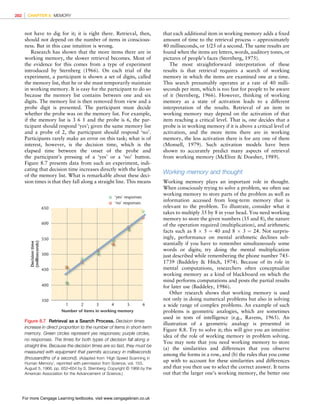
Figure 8.7 presents data from such an experiment, indi-
cating that decision time increases directly with the length
of the memory list. What is remarkable about these deci-
sion times is that they fall along a straight line. This means
that each additional item in working memory adds a fixed
amount of time to the retrieval process – approximately
40 milliseconds, or 1/25 of a second. The same results are
found when the items are letters, words, auditory tones, or
pictures of people’s faces (Sternberg, 1975).
The most straightforward interpretation of these
results is that retrieval requires a search of working
memory in which the items are examined one at a time.
This search presumably operates at a rate of 40 milli-
seconds per item, which is too fast for people to be aware
of it (Sternberg, 1966). However, thinking of working
memory as a state of activation leads to a different
interpretation of the results. Retrieval of an item in
working memory may depend on the activation of that
item reaching a critical level. That is, one decides that a
probe is in working memory if it is above a critical level of
activation, and the more items there are in working
memory, the less activation there is for any one of them
(Monsell, 1979). Such activation models have been
shown to accurately predict many aspects of retrieval
from working memory (McElree  Doesher, 1989).
Working memory and thought
Working memory plays an important role in thought.
When consciously trying to solve a problem, we often use
working memory to store parts of the problem as well as
information accessed from long-term memory that is
relevant to the problem. To illustrate, consider what it
takes to multiply 35 by 8 in your head. You need working
memory to store the given numbers (35 and 8), the nature
of the operation required (multiplication), and arithmetic
facts such as 8  5 ¼ 40 and 8  3 ¼ 24. Not surpris-
ingly, performance on mental arithmetic declines sub-
stantially if you have to remember simultaneously some
words or digits; try doing the mental multiplication
just described while remembering the phone number 745-
1739 (Baddeley  Hitch, 1974). Because of its role in
mental computations, researchers often conceptualize
working memory as a kind of blackboard on which the
mind performs computations and posts the partial results
for later use (Baddeley, 1986).
Other research shows that working memory is used
not only in doing numerical problems but also in solving
a wide range of complex problems. An example of such
problems is geometric analogies, which are sometimes
used in tests of intelligence (e.g., Ravens, 1965). An
illustration of a geometric analogy is presented in
Figure 8.8. Try to solve it; this will give you an intuitive
idea of the role of working memory in problem solving.
You may note that you need working memory to store
(a) the similarities and differences that you observe
among the forms in a row, and (b) the rules that you come
up with to account for these similarities and differences
and that you then use to select the correct answer. It turns
out that the larger one’s working memory, the better one
Decision
time
(milliseconds)
Number of items in working memory
350
400
450
500
550
600
650
1 2 3 4 5 6
‘yes’ responses
‘no’ responses
Figure 8.7 Retrieval as a Search Process. Decision times
increase in direct proportion to the number of items in short-term
memory. Green circles represent yes responses; purple circles,
no responses. The times for both types of decision fall along a
straight line. Because the decision times are so fast, they must be
measured with equipment that permits accuracy in milliseconds
(thousandths of a second). (Adapted from ‘High Speed Scanning in
Human Memory’, reprinted with permission from Science, vol. 153,
August 5, 1966, pp. 652–654 by S. Sternberg. Copyright © 1966 by the
American Association for the Advancement of Science.)
282 CHAPTER 8 MEMORY
For more Cengage Learning textbooks, visit www.cengagebrain.co.uk
*vijay* D:/Thomson_Learning_Projects/Atkinson_31033/z_production/z_3B2_3D_files/Atkinson_1844807282_ch08.3d, 3/23/9, 10:53, page: 283
does on problems like these (even though there is
relatively little variation among people in the
capacity of their working memory). Moreover,
when computers are programmed to simulate
people solving problems such as the one in Figure
8.8, one of the most important determinants of
how well the program does is the size of the
working memory created by the programmer.
There seems to be little doubt that part of the
difficulty of many complex problems is the load
they place on working memory (Carpenter, Just,
 Shell, 1990).
Working memory is also crucial for language
processes like following a conversation or reading
a text. When reading for understanding, often we
must consciously relate new sentences to some
prior material in the text. This relating of new to
old seems to occur in working memory because
people who have more working-memory capacity
score higher than others on reading comprehen-
sion tests (Daneman  Carpenter, 1980; Just 
Carpenter, 1992).
Transfer from working memory
to long-term memory
From what we have seen so far, working memory
serves two important functions: It stores material
that is needed for short periods, and it serves as a work
space for mental computations. Another possible function
is serving as a way station to long-term memory. That is,
information may reside in working memory while it is
being encoded or transferred into long-term memory
(Atkinson  Shiffrin, 1971a,b; Raaijmakers  Shiffrin,
1992). While there are a number of different ways to
implement the transfer, one way that has been the subject
of considerable research is rehearsal, the conscious repe-
tition of information in working memory. Rehearsal
apparently not only maintains the item in working
memory but also can cause it to be transferred to long-
term memory. Thus, the term ‘maintenance rehearsal’ is
used to refer to active efforts to hold information in
working memory; elaborative rehearsal refers to efforts to
encode information in long-term memory.
Some of the best evidence for the ‘way-station’ func-
tion of working memory comes from experiments on free
recall. In a free-recall experiment, participants first see a
list of perhaps 40 unrelated words that are presented one
at a time. After all the words have been presented, par-
ticipants must immediately recall them in any order
(hence the designation ‘free’). The results from such an
experiment are shown in Figure 8.9. The chance of cor-
rectly recalling a word is graphed as a function of the
word’s position in the list. The part of the curve to the left
in the graph is for the first few words presented, and the
part to the right is for the last few words presented.
ª
1985,
REPRINTED
COURTESY
OF
BILL
HOEST
AND
PARADE
MAGAZINE
1 2 3 4
5 6 7 8
Figure 8.8 Illustration of a Geometric Analogy. The task is to
inspect the forms in the top matrix in which the bottom right entry
is missing, and to determine which of the eight alternatives given
below is the missing entry. To do this, you have to look across
each row and determine the rules that specify how the forms
vary, and then do the same thing for each column. (P. A. Carpenter,
M. A. Just, and P. Shell (1990), “What one intelligence test measures: a
theoretical account of the processing in the Raven Progressive Matrices
Test,” Psychological Review, 97(3):404–431. Adapted by permission of
the American Psychological Association.)
WORKING MEMORY 283
For more Cengage Learning textbooks, visit www.cengagebrain.co.uk
*vijay* D:/Thomson_Learning_Projects/Atkinson_31033/z_production/z_3B2_3D_files/Atkinson_1844807282_ch08.3d, 3/23/9, 10:53, page: 284
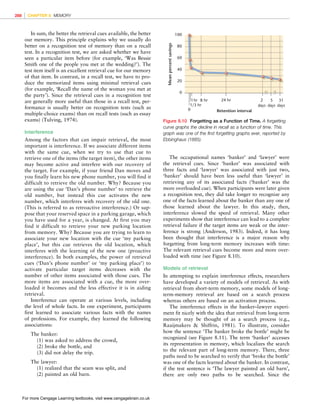
Presumably, at the time of recall the last few words
presented are still likely to be in working memory,
whereas the remaining words are in long-term memory.
Hence, we would expect recall of the last few words to be
high because items in working memory can be retrieved
easily. Figure 8.9 shows that this is indeed the case; it is
called the recency effect. But recall for the first words
presented is also quite good; this is called the primacy
effect. Why does the primacy effect occur? This is where
rehearsal enters the picture. When the first words were
presented, they were entered into working memory and
rehearsed. Since there was little else in working memory,
they were rehearsed often and therefore were likely to be
transferred to long-term memory. As more items were
presented, working memory quickly filled up and the
opportunity to rehearse and transfer any given item to
long-term memory decreased. So only the first few items
presented enjoyed the extra opportunity for transfer,
which is why they were later recalled so well from long-
term memory.
A classic demonstration of this explanation was pro-
vided by the American psychologist, Dewey Rundus, in
1971. Rundus carried out a free-recall experiment in
which subjects were required to rehearse the words they
were learning, that is, they were asked to speak the words
aloud as the list was being presented. Which of the list
words the subjects spoke at any moment was up to them
as long as they included only list words. Rundus recorded
the words as they were being spoken; thus he eventually
had, for each word in each list, (1) the number of times it
was rehearsed and (2) its probability of being recalled.
Rundus discovered that, not surprisingly, earlier list
words received more rehearsals and, as we have noted,
were also recalled better. What is more important, how-
ever, is that Rundus found that the number of rehearsals
was sufficient to explain the primacy effect. Consider, for
instance, a word near the beginning of the list that hap-
pened to be rehearsed relatively few times. Such a word
was recalled no better than a word with an equal number
of rehearsals from the middle of the list. Conversely, a
word from the middle of the list that, for whatever rea-
son, happened to be rehearsed many times was remem-
bered as well as an equally rehearsed word from the
beginning of the list. Thus, the primacy effect (and,
Rundus discovered, several other classic free-recall
effects) were mediated by the number of rehearsals
accorded a particular word.
In sum, working memory is a system that can hold
roughly 7  2 chunks of information in either a phono-
logical or a visual format. Information is lost from
working memory through either decay or displacement,
and is retrieved from this system by a process that is
sensitive to the total number of items being kept active at
any given time. Lastly, working memory is used to store
and process information that is needed during problem
solving, and therefore is critical for thought.
Division of brain labor between working
memory and long-term memory
It has been known for some time that working memory
and long-term memory are implemented by somewhat
different brain structures. In particular, the hippocampus,
a structure located near the middle of the brain beneath
the cortex, is critical for long-term memory but not for
working memory. Much of the relevant evidence comes
from experiments with monkeys and other nonhuman
species. In some experiments, one group of monkeys is
first subjected to damage to the hippocampus and the
surrounding cortex, and a second group is subjected to
damage in a completely different region, the front of the
cortex. Both groups of monkeys then have to perform a
delayed-response task. On each trial, first one stimulus
(such as a square) is presented and then, after a delay, a
second stimulus (such as a triangle) is presented; the
animal has to respond only when the second stimulus
differs from the first. How well the animal performs on
this task depends on the kind of brain damage it has
suffered and the length of the delay between the two
stimuli.
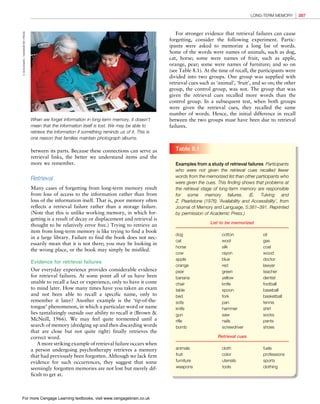
Short-term
memory
Long-term
memory
Probability
of
recall
Position of word in list
0
0.2
0.4
0.6
0.8
1
0 5 10 15 20 25 30 35 40
Figure 8.9 Results of a Free Recall Experiment. The proba-
bility of recall varies with an item’s position in a list, with the
probability being highest for the last five or so positions, next
highest for the first few positions, and lowest for the intermediate
positions. Recall of the last few items is based on short-term
memory, whereas recall of the remaining items is based on long-
term memory. (B. B. Murdock (1962) ‘The Serial Position Effect in Free
Recall’, from Journal of Experimental Psychology, 64:482–488. Copyright
© 1962 by the American Psychological Association. Adapted by
permission.)
284 CHAPTER 8 MEMORY
For more Cengage Learning textbooks, visit www.cengagebrain.co.uk
*vijay* D:/Thomson_Learning_Projects/Atkinson_31033/z_production/z_3B2_3D_files/Atkinson_1844807282_ch08.3d, 3/23/9, 10:53, page: 285
When the delay is long (15 seconds or more), animals
with damage to the hippocampus perform poorly, but
those with damage in the front of the cortex perform
relatively normally. Because a long delay between stimuli
requires long-term memory for storage of the first stim-
ulus, these results fit with the idea that the hippocampus is
critical for long-term memory. When the delay between
the two stimuli is short (just a few seconds), the opposite
results occur: Now animals with damage in the front of
the cortex perform poorly and those with hippocampal
damage perform relatively normally. Because a short
delay between stimuli requires working memory for
storage of the first stimulus, these results indicate that
regions in the frontal cortex are involved in working
memory. Hence, different regions of the brain are
involved in working memory and long-term memory
(Goldman-Rakic, 1987; Zola-Morgan  Squire, 1985).
What evidence is there for this distinction in humans?
Patients who happen to have suffered damage in certain
brain regions provide an ‘experiment of nature’. Specifi-
cally, some patients have suffered damage to the hippo-
campus and surrounding cortex, and consequently show
a severe memory loss; because the hippocampus is located
in the middle of the temporal lobe, these patients are said
to have medial-temporal lobe amnesia. Such patients have
profound difficulty remembering material for long inter-
vals but rarely have any trouble remembering material for
a few seconds. Thus, a patient with medial-temporal lobe
amnesia may be unable to recognize his doctor when she
enters the room – even though the patient has seen this
doctor every day for years – yet will have no trouble
repeating the physician’s name when she is reintroduced
(Milner, Corkin,  Teuber, 1968). Such a patient has a
severe impairment in long-term memory but a normal
working memory.
Other patients, however, show the opposite problem.
They cannot correctly repeat a string of even three words,
yet they are relatively normal when tested on their long-
term memory for words. Such patients have an impaired
working memory but an intact long-term memory. And
their brain damage is never in the medial temporal lobe
(Shallice, 1988). Thus, for humans as well as for other
mammals, working memory and long-term memory are
mediated by different brain structures.
Recent research using brain-scanning techniques has
revealed that neurons in the prefrontal lobes, just
behind the forehead, hold information for short-term
use, such as a phone number that is about to be dialed.
These neurons appear to act like a computer’s random
access memory (RAM) chips, which hold data tempo-
rarily for current use and switch quickly to other data as
needed. These cells are also able to draw information
from other regions of the brain and retain it as long as it
is needed for a specific task (Goldman-Rakic, cited in
Goleman, 1995).
INTERIM SUMMARY
l Information in working memory tends to be encoded
acoustically, although we can also use a visual code.
l Working memory is conceptualized as being divided into
an ‘auditory’ part, the phonological loop and a ‘visual’
part, the visual-spatial sketchpad.
l The auditory storage capacity is limited to 7  2 chunks.
The amount of information in working memory can be
increased by increasing the amount of information in
each chunk, e.g., by chunking sequences of letters into
meaningful units like words.
l Retrieval from working memory slows down as the
number of items in working memory increases.
l Working memory is used in solving various kinds of
problems, such as mental arithmetic, geometric
analogies, and answering questions about text.
l Working memory acts as a buffer from which
information may be transferred to long-term memory.
l Experiments with the hippocampus and surrounding
brain areas support a qualitative distinction between
working memory and long-term memory.
CRITICAL THINKING QUESTIONS
1 Why do you think that phonological encoding is such a
major part of how working memory is organized?
2 How might an increase in the size of your working
memory affect your performance on a standardized test
of comprehension like the SAT? Try to explain how
underlying comprehension processes might be affected.
LONG-TERM MEMORY
Long-term memory is involved when information has to
be retained for intervals as brief as a few minutes (such as
a point made earlier in a conversation) or as long as a
lifetime (such as an adult’s childhood memories). In
experiments on long-term memory, psychologists have
generally studied forgetting over intervals of minutes,
hours, or weeks, but a few studies have involved years or
even decades. Experiments that use intervals of years
often involve the recall of personal experience (called
autobiographical memory) rather than the recall of lab-
oratory materials. In what follows, studies using both
kinds of material are intermixed because they seem to
reflect many of the same principles.
LONG-TERM MEMORY 285
For more Cengage Learning textbooks, visit www.cengagebrain.co.uk
*vijay* D:/Thomson_Learning_Projects/Atkinson_31033/z_production/z_3B2_3D_files/Atkinson_1844807282_ch08.3d, 3/23/9, 10:53, page: 286
Our discussion of long-term memory will again dis-
tinguish among the three stages of memory – encoding,
storage, and retrieval – but this time there are two com-
plications. First, unlike the situation with working mem-
ory, important interactions between encoding and
retrieval occur in long-term memory. In view of these
interactions, we will consider some aspects of retrieval in
our discussion of encoding and present a separate dis-
cussion of interactions between encoding and retrieval.
The other complication is that it is often difficult to know
whether forgetting from long-term memory is due to a
loss from storage or to a failure in retrieval. To deal with
this problem, we will delay our discussion of storage
until after we have considered retrieval so that we have
a clearer idea of what constitutes good evidence for a
storage loss.
Encoding
Encoding meaning
For verbal material, the dominant long-term memory
representation is neither acoustic nor visual; instead, it is
based on the meanings of the items. Encoding items
according to their meaning occurs even when the items
are isolated words, but it is more striking when they are
sentences. Several minutes after hearing a sentence, most
of what you can recall or recognize is the sentence’s
meaning. Suppose that you heard the sentence, ‘The
author sent the committee a long letter’. The evidence
indicates that two minutes later you would do no better
than chance in telling whether you had heard that sen-
tence or one that has the same meaning: ‘A long letter was
sent to the committee by the author’ (Sachs, 1967).
Encoding of meaning is pervasive in everyday memory
situations. When people report on complex social or
political situations, they may misremember many of the
specifics (who said what to whom, when something was
said, who else was there) yet can accurately describe the
basic situation. Thus, in the Watergate scandal of the
early 1970s that led to the downfall of American Presi-
dent Nixon, the chief government witness (John Dean)
was subsequently shown to have made many mistakes
about what was said in particular situations, yet his
overall testimony is generally thought to accurately
describe the events that occurred (Neisser, 1982).
Although meaning may be the dominant way of rep-
resenting verbal material in long-term memory, we
sometimes code other aspects as well. We can, for
example, memorize poems and recite them word for
word. In such cases we have coded not only the meaning
of the poem but the exact words themselves. We can also
use a phonological code in long-term memory. When you
get a phone call and the other party says ‘Hello’. you
often recognize the voice. In a case like this, you must
have coded the sound of that person’s voice in long-term
memory. Visual impressions, tastes, and smells are also
coded in long-term memory. Thus, long-term memory has
a preferred code for verbal material (namely, meaning),
but other codes can be used as well.
Adding meaningful connections
Often the items that we need to remember are meaningful
but the connections between them are not. In such cases
memory can be improved by creating real or artificial
links between the items. For example, people who are
learning to read music must remember that the five lines
in printed music are referred to as EGBDF; although the
symbols themselves are meaningful (they refer to notes on
a keyboard), their order seems arbitrary. What many
learners do is convert the symbols into the sentence ‘Every
Good Boy Does Fine’; the first letter of each word names
each symbol, and the relationships between the words in
the sentence supply meaningful connections between the
symbols. These connections aid memory because they
provide retrieval paths between the words: Once the word
‘Good’ has been retrieved, for example, there is a path or
connection to ‘Boy’, the next word that must be recalled.
One of the best ways to add connections is to elaborate
on the meaning of the material while encoding it. The
more deeply or elaborately one encodes the meaning, the
better the resulting memory will be (Craik  Tulving,
1975). Thus, if you have to remember a point made in a
textbook, you will recall it better if you concentrate on its
meaning rather than on the exact words. And the more
deeply and thoroughly you expand on its meaning, the
better you will recall it.
An experiment by Bradshaw and Anderson (1982)
illustrates some of these points. Participants read facts
about famous people that they would later have to recall,
such as ‘At a critical point in his life, Mozart made a
journey from Munich to Paris’. Some facts were elabo-
rated according to either their causes or their con-
sequences, as in ‘Mozart wanted to leave Munich to avoid
a romantic entanglement’. Other facts were presented
alone. Later the participants were tested on their memory
of just the facts (not the elaborations). Participants
recalled more facts that had been given elaborations than
facts that had been presented alone. Presumably, in
adding the cause (or consequence) to their memory rep-
resentation, they set up a retrieval path from the cause to
the target fact in the following manner:
l Mozart journeyed from Munich to Paris.
l Mozart wanted to avoid a romantic entanglement in
Munich.
At the time of recall, participants could either retrieve
the target fact directly or retrieve it indirectly by following
the path from its cause. Even if they forgot the target fact,
they could infer it if they retrieved the cause.
Results like these establish an intimate connection
between understanding and memory. The better we
understand some material, the more connections we see
286 CHAPTER 8 MEMORY
For more Cengage Learning textbooks, visit www.cengagebrain.co.uk
*vijay* D:/Thomson_Learning_Projects/Atkinson_31033/z_production/z_3B2_3D_files/Atkinson_1844807282_ch08.3d, 3/23/9, 10:53, page: 287
between its parts. Because these connections can serve as
retrieval links, the better we understand items and the
more we remember.
Retrieval
Many cases of forgetting from long-term memory result
from loss of access to the information rather than from
loss of the information itself. That is, poor memory often
reflects a retrieval failure rather than a storage failure.
(Note that this is unlike working memory, in which for-
getting is a result of decay or displacement and retrieval is
thought to be relatively error free.) Trying to retrieve an
item from long-term memory is like trying to find a book
in a large library. Failure to find the book does not nec-
essarily mean that it is not there; you may be looking in
the wrong place, or the book may simply be misfiled.
Evidence for retrieval failures
Our everyday experience provides considerable evidence
for retrieval failures. At some point all of us have been
unable to recall a fact or experience, only to have it come
to mind later. How many times have you taken an exam
and not been able to recall a specific name, only to
remember it later? Another example is the ‘tip-of-the-
tongue’ phenomenon, in which a particular word or name
lies tantalizingly outside our ability to recall it (Brown 
McNeill, 1966). We may feel quite tormented until a
search of memory (dredging up and then discarding words
that are close but not quite right) finally retrieves the
correct word.
A more striking example of retrieval failure occurs when
a person undergoing psychotherapy retrieves a memory
that had previously been forgotten. Although we lack firm
evidence for such occurrences, they suggest that some
seemingly forgotten memories are not lost but merely dif-
ficult to get at.
For stronger evidence that retrieval failures can cause
forgetting, consider the following experiment. Partic-
ipants were asked to memorize a long list of words.
Some of the words were names of animals, such as dog,
cat, horse; some were names of fruit, such as apple,
orange, pear; some were names of furniture; and so on
(see Table 8.1). At the time of recall, the participants were
divided into two groups. One group was supplied with
retrieval cues such as ‘animal’, ‘fruit’, and so on; the other
group, the control group, was not. The group that was
given the retrieval cues recalled more words than the
control group. In a subsequent test, when both groups
were given the retrieval cues, they recalled the same
number of words. Hence, the initial difference in recall
between the two groups must have been due to retrieval
failures.
ª
SHACKMAN
/
MONKMEYER
PRESS
When we forget information in long-term memory, it doesn’t
mean that the information itself is lost. We may be able to
retrieve the information if something reminds us of it. This is
one reason that families maintain photograph albums.
Table 8.1
Examples from a study of retrieval failures Participants
who were not given the retrieval cues recalled fewer
words from the memorized list than other participants who
were given the cues. This finding shows that problems at
the retrieval stage of long-term memory are responsible
for some memory failures. (E. Tulving and
Z. Pearlstone (1976) ‘Availability and Accessibility’, from
Journal of Memory and Language, 5:381–391. Reprinted
by permission of Academic Press.)
List to be memorized
dog cotton oil
cat wool gas
horse silk coal
cow rayon wood
apple blue doctor
orange red lawyer
pear green teacher
banana yellow dentist
chair knife football
table spoon baseball
bed fork basketball
sofa pan tennis
knife hammer shirt
gun saw socks
rifle nails pants
bomb screwdriver shoes
Retrieval cues
animals cloth fuels
fruit color professions
furniture utensils sports
weapons tools clothing
LONG-TERM MEMORY 287
For more Cengage Learning textbooks, visit www.cengagebrain.co.uk
*vijay* D:/Thomson_Learning_Projects/Atkinson_31033/z_production/z_3B2_3D_files/Atkinson_1844807282_ch08.3d, 3/23/9, 10:53, page: 288
In sum, the better the retrieval cues available, the better
our memory. This principle explains why we usually do
better on a recognition test of memory than on a recall
test. In a recognition test, we are asked whether we have
seen a particular item before (for example, ‘Was Bessie
Smith one of the people you met at the wedding?’). The
test item itself is an excellent retrieval cue for our memory
of that item. In contrast, in a recall test, we have to pro-
duce the memorized items using minimal retrieval cues
(for example, ‘Recall the name of the woman you met at
the party’). Since the retrieval cues in a recognition test
are generally more useful than those in a recall test, per-
formance is usually better on recognition tests (such as
multiple-choice exams) than on recall tests (such as essay
exams) (Tulving, 1974).
Interference
Among the factors that can impair retrieval, the most
important is interference. If we associate different items
with the same cue, when we try to use that cue to
retrieve one of the items (the target item), the other items
may become active and interfere with our recovery of
the target. For example, if your friend Dan moves and
you finally learn his new phone number, you will find it
difficult to retrieve the old number. Why? Because you
are using the cue ‘Dan’s phone number’ to retrieve the
old number, but instead this cue activates the new
number, which interferes with recovery of the old one.
(This is referred to as retroactive interference.) Or sup-
pose that your reserved space in a parking garage, which
you have used for a year, is changed. At first you may
find it difficult to retrieve your new parking location
from memory. Why? Because you are trying to learn to
associate your new location with the cue ‘my parking
place’, but this cue retrieves the old location, which
interferes with the learning of the new one (proactive
interference). In both examples, the power of retrieval
cues (‘Dan’s phone number’ or ‘my parking place’) to
activate particular target items decreases with the
number of other items associated with those cues. The
more items are associated with a cue, the more over-
loaded it becomes and the less effective it is in aiding
retrieval.
Interference can operate at various levels, including
the level of whole facts. In one experiment, participants
first learned to associate various facts with the names
of professions. For example, they learned the following
associations:
The banker:
(1) was asked to address the crowd,
(2) broke the bottle, and
(3) did not delay the trip.
The lawyer:
(1) realized that the seam was split, and
(2) painted an old barn.
The occupational names ‘banker’ and ‘lawyer’ were
the retrieval cues. Since ‘banker’ was associated with
three facts and ‘lawyer’ was associated with just two,
‘banker’ should have been less useful than ‘lawyer’ in
retrieving any of its associated facts (‘banker’ was the
more overloaded cue). When participants were later given
a recognition test, they did take longer to recognize any
one of the facts learned about the banker than any one of
those learned about the lawyer. In this study, then,
interference slowed the speed of retrieval. Many other
experiments show that interference can lead to a complete
retrieval failure if the target items are weak or the inter-
ference is strong (Anderson, 1983). Indeed, it has long
been thought that interference is a major reason why
forgetting from long-term memory increases with time:
The relevant retrieval cues become more and more over-
loaded with time (see Figure 8.10).
Models of retrieval
In attempting to explain interference effects, researchers
have developed a variety of models of retrieval. As with
retrieval from short-term memory, some models of long-
term-memory retrieval are based on a search process
whereas others are based on an activation process.
The interference effects in the banker–lawyer experi-
ment fit nicely with the idea that retrieval from long-term
memory may be thought of as a search process (e.g.,
Raaijmakers  Shiffrin, 1981). To illustrate, consider
how the sentence ‘The banker broke the bottle’ might be
recognized (see Figure 8.11). The term ‘banker’ accesses
its representation in memory, which localizes the search
to the relevant part of long-term memory. There, three
paths need to be searched to verify that ‘broke the bottle’
was one of the facts learned about the banker. In contrast,
if the test sentence is ‘The lawyer painted an old barn’,
there are only two paths to be searched. Since the
0
20
40
60
80
100
Mean
percent
savings
Retention interval
0
1/3 hr
1hr 8 hr 24 hr 5
days
2
days
31
days
Figure 8.10 Forgetting as a Function of Time. A forgetting
curve graphs the decline in recall as a function of time. This
graph was one of the first forgetting graphs ever, reported by
Ebbinghaus (1885).
288 CHAPTER 8 MEMORY
For more Cengage Learning textbooks, visit www.cengagebrain.co.uk
*vijay* D:/Thomson_Learning_Projects/Atkinson_31033/z_production/z_3B2_3D_files/Atkinson_1844807282_ch08.3d, 3/23/9, 10:53, page: 289
duration of a search increases with the number of paths to
be considered, retrieval will be slower for the ‘banker’
sentence than for the ‘lawyer’ one.
An alternative way to think about the retrieval process
is in terms of activation. When trying to recognize ‘The
banker broke the bottle’, for example, the participant
activates the representation for ‘banker’ and the activa-
tion then spreads simultaneously along the three paths
emanating from ‘banker’ (see Figure 8.11). When suffi-
cient activation reaches ‘broke the bottle’, the sentence
can be recognized. Interference arises because the acti-
vation from the banker representation must be sub-
divided among the paths emanating from it. Hence,
the more facts associated with ‘banker’, the thinner
the activation will be on each path and the longer it will
take for sufficient activation to reach any particular fact.
Thus, thinking of retrieval in terms of spreading activa-
tion can also account for why interference slows retrieval
(Anderson, 1983).
Forgetting: loss of information from storage
The fact that some forgetting is due to retrieval failures
does not imply that all forgetting is. It seems most unlikely
that everything we ever learned is still there in memory
waiting for the right retrieval cue. Some information is
almost certainly forgotten, that is, lost from storage
(Loftus  Loftus, 1980).
Some evidence of storage loss comes from people who
receive electroconvulsive therapy to alleviate severe
depression (a mild electric current applied to the brain
produces a brief epileptic-like seizure and momentary
unconsciousness; see Chapter 16). In such cases the
patient loses some memory for events that occurred in the
months just prior to the shock, but not for earlier events
(Squire  Fox, 1980). These memory losses are unlikely
to be due to retrieval failures because if the shock dis-
rupted retrieval, all memories should be affected, not just
the recent ones. More likely, the shock disrupts storage
processes that consolidate new memories over a period of
months or longer, and information that is not con-
solidated is lost from storage.
Most research on storage in long-term memory is done
at the biological level. Researchers have made substantial
progress in determining the neuroanatomical bases of
consolidation. It appears that the critical brain structures
involved are the hippocampus and the cortex surrounding
the hippocampus (which includes the enthorhinal, peri-
rhinal, and parahippocampal cortices; they are involved
in the exchange of information between the hippocampus
and much of the cerebral cortex). The hippocampus’s role
in consolidation seems to be that of a cross-referencing
system, linking together aspects of a particular memory
that are stored in separate parts of the brain (Squire,
1992). While a global memory loss in humans usually
occurs only when the surrounding cortex as well as the
‘The banker broke the bottle’
Realized the seam was split
Broke the bottle Did not delay the trip
Asked to address the crowd
BANKER
‘The lawyer painted an old barn’
Painted an old barn
LAWYER
Figure 8.11 Retrieval as a Search Process Versus an Activation Process. When the sentence ‘The banker broke the bottle’ is
presented, the term banker accesses the banker representation in long-term memory. Once at this representation, there are three paths
to be searched. When the sentence ‘The lawyer painted an old barn’ is presented, lawyer accesses the lawyer representation, from
which there are two paths to be searched. Alternatively, the term banker may activate the banker representation, and this activation then
spreads simultaneously along the three paths (and similarly for the ‘lawyer’ example).
LONG-TERM MEMORY 289
For more Cengage Learning textbooks, visit www.cengagebrain.co.uk
*vijay* D:/Thomson_Learning_Projects/Atkinson_31033/z_production/z_3B2_3D_files/Atkinson_1844807282_ch08.3d, 3/23/9, 10:53, page: 290
hippocampus is impaired, damage to the hippocampus
alone can result in severe memory disturbance. This fact
was demonstrated by a study that started with an analysis
of a particular patient’s memory problems (due to com-
plications from coronary bypass surgery) and ended with
a detailed autopsy of his brain after his death; the autopsy
revealed that the hippocampus was the only brain struc-
ture that was damaged (Zola-Morgan, Squire,  Amaral,
1989).
A study using monkeys provides the best evidence we
have that the function of the hippocampus is to consoli-
date relatively new memories. A group of experimental
monkeys learned to discriminate between items in
100 pairs of objects. For each pair, there was food under
one object, which the monkey got only if it chose that
object. Since all the objects differed, the monkeys essen-
tially learned 100 different problems. Twenty of the
problems were learned 16 weeks before the researchers
removed the monkeys’ hippocampus; additional sets of
20 problems were learned either 12, 8, 4, or 2 weeks
before the hippocampal surgery. Two weeks after the
surgery, the researchers tested the monkeys’ memory with
a single trial of each of the 100 pairs. The key finding was
that the experimental monkeys remembered discrim-
inations that they had learned 8, 12, or 16 weeks before
surgery as well as normal control monkeys did, but
remembered the discriminations learned 2 or 4 weeks
before surgery less well than the control monkeys did.
Moreover, the experimental monkeys actually remem-
bered less about the discriminations learned 2 to 4 weeks
before surgery than about the discriminations learned
earlier. These results suggest that memories need to be
processed by the hippocampus for a period of a few
weeks, for it is only during this period that memory is
impaired by removal of the hippocampus. Permanent
long-term memory storage is almost certainly localized in
the cortex, particularly in the regions where sensory
information is interpreted (Squire, 1992; Zola- Morgan 
Squire, 1990).
Interactions between encoding and retrieval
In describing the encoding stage, we noted that operations
carried out during encoding, such as elaboration,
make retrieval easier. Two other encoding factors also
increase the chances of successful retrieval: (a) organizing
the information at the time of encoding and (b) ensuring
that the context in which information is encoded is similar
to that in which it will be retrieved.
Organization
The more we organize the material we encode, the easier
it is to retrieve. Suppose that you were at a conference at
which you met various professionals – doctors, lawyers,
and journalists. When you later try to recall their names,
you will do better if you initially organize the information
by profession. Then you can ask yourself, ‘Who were the
doctors I met? Who were the lawyers?’ and so forth. A list
of names or words is far easier to recall when we encode
the information into categories and then retrieve it on a
category-by-category basis (e.g., Bower, Clark, Winzenz,
 Lesgold, 1969).
Context
It is easier to retrieve a particular fact or episode if you are
in the same context in which you encoded it (Estes, 1972).
For example, it is a good bet that your ability to retrieve
the names of your classmates in the first and second
grades would improve if you were to walk through the
corridors of your elementary school. Similarly, your
ability to retrieve an emotional moment with a close
friend – for example, an argument with her in a
restaurant – would be greater if you were back in the
place where the incident occurred. This may explain why
we are sometimes overcome with a torrent of memories
when we visit a place where we once lived. The context in
which an event was encoded is one of the most powerful
retrieval cues (see Figure 8.12).
Context is not always external to the individual. It can
include what is happening inside us when we encode
information – that is, our internal state. For example,
individuals who learned a list of words while under the
influence of marijuana recalled more of the words when
tested in the same drug-induced state than when tested in
a nondrugged state, and individuals who learned the list
in a nondrugged state recalled more words when tested in
a nondrugged state than when tested in a drug-induced
state (Eich, 1980). Such cases are referred to as state-
dependent learning because memory is partly dependent
on the internal state prevailing during learning. It is
thought that feelings evoked by the altered state serve as
cues for retrieving information encoded while in that
state. The evidence for this phenomenon is controversial,
but it does suggest that memory does improve when our
internal state during retrieval matches our internal state
during encoding (Eich, 1980).
Emotional factors in forgetting
So far we have treated memory as if it were entirely
separate from emotion. But don’t we sometimes remem-
ber or forget material because of its emotional content?
There has been a great deal of research on this question.
The results suggest that emotion can influence long-term
memory in five distinct ways: rehearsal, flashbulb mem-
ories, retrieval interference via anxiety, context effects,
and repression.
Rehearsal
The simplest idea is that we tend to think about emo-
tionally charged situations, negative as well as positive,
290 CHAPTER 8 MEMORY
For more Cengage Learning textbooks, visit www.cengagebrain.co.uk
*vijay* D:/Thomson_Learning_Projects/Atkinson_31033/z_production/z_3B2_3D_files/Atkinson_1844807282_ch08.3d, 3/23/9, 10:53, page: 292
learned of an emotionally charged, significant event. An
example is the explosion of the space shuttle Challenger in
1986, which was witnessed by millions of people on
television. Many people in their twenties remember
exactly where they were when they learned of the Chal-
lenger disaster and exactly who told them about it, even
though these are the kinds of details that we usually forget
quickly. Americans age 30 or older may have flashbulb
memories of the assassination attempt on Ronald Reagan
in 1981, while those age 40 or older may have such
memories of the assassinations of John F. Kennedy and
Martin Luther King, Jr., in the 1960s. There is a published
report indicating that a century ago Americans had
flashbulb memories of the assassination of Abraham
Lincoln. When Colegrove (1899) interviewed 179 people,
127 of them were able to give full particulars as to where
they were and what they were doing when they heard of
Lincoln’s assassination.
The problem with early studies of flashbulb memories,
such as Colegrove’s, is that there was no way of assessing
whether they were correct. One man, for example,
described detailed memories of a powerful 1960 earth-
quake in Chile, recalling being woken up early in the
morning by the violent shaking of his house and noticing,
among other things, that his grandfather clock had stop-
ped at 6:00 a.m. sharp. Many years later, he discovered
that the earthquake had actually taken place at 2:11 p.m.:
Although the earthquake was certainly real, his vivid
‘flashbulb’ memories of its taking place in the morning
were not. Later we discuss the reconstructive processes
that lead to such vivid, but incorrect memories. For the
moment, it is important to point out that when flashbulb
memories are carefully studied in conjunction with a rec-
ord or what actually happened, flashbulb memories turn
out to be susceptible to decay and interference just like
other kinds of memories (e.g., Curci, Oliver, Finkenauer,
 Gisle, 2001; Neisser  Harsch, 1993; Schmolck, Buf-
falo,  Squire, 2000; Sierra  Berrios, 2000).
Retrieval interference via anxiety
There are also cases in which negative emotions hinder
retrieval, which brings us to the third way emotion can
affect memory. An experience that many students have at
one time or another illustrates this process:
You are taking an exam about which you are not
very confident. You can barely understand the initial
question, let alone answer it. Signs of panic appear.
Although the second question really isn’t hard, the
anxiety triggered by the previous question spreads to
this one. By the time you look at the third question,
it wouldn’t matter whether it only asked for your
phone number. There’s no way you can answer it.
You’re in a complete panic.
What is happening to memory here? Failure to deal with
the first question produced anxiety. Anxiety is often
accompanied by extraneous thoughts, such as ‘I’m going
to fail’ or ‘Everybody will think I’m stupid’. These
thoughts fill our consciousness and interfere with attempts
to retrieve information that is relevant to the question; this
may be why memory fails. According to this view, anxiety
does not directly cause memory failure; rather, it causes, or
is associated with, extraneous thoughts, and these
thoughts cause memory failure by interfering with retrieval
(Holmes, 1974).
Context effects
Emotion may also affect memory through a context
effect. As noted earlier, memory is best when the context
at the time of retrieval matches that at the time of
encoding. Since our emotional state during learning is
part of the context, if the material we are learning makes
us feel sad, perhaps we can best retrieve that material
when we feel sad again. Experimenters have demon-
strated such an emotional-context effect. Participants
agreed to keep diaries for a week, recording every emo-
tional incident that occurred and noting whether it was
pleasant or unpleasant. One week after they handed in
their diaries, the participants returned to the laboratory
and were hypnotized. Half the participants were put in a
pleasant mood and the other half in an unpleasant mood.
All were asked to recall the incidents recorded in their
diaries. For participants in a pleasant mood, most of the
incidents they recalled had been rated as pleasant at the
time that they were experienced; for participants in an
unpleasant mood at retrieval, most of the incidents
recalled had been rated as unpleasant at the time that they
were experienced. As expected, recall was best when the
dominant emotion during retrieval matched that during
encoding (Bower, 1981).
Repression
Thus far, all of the means by which emotions can
influence memory rely on principles already discussed –
namely, rehearsal, interference, and context effects.
Another view of emotion and memory, Freud’s theory of
the unconscious, brings up new principles. Freud pro-
posed that some emotional experiences in childhood are
so traumatic that allowing them to enter consciousness
many years later would cause the individual to be totally
overwhelmed by anxiety. Such traumatic experiences are
said to be repressed, or stored in the unconscious, and
they can be retrieved only when some of the emotion
associated with them is defused. Repression, therefore,
represents the ultimate retrieval failure: Access to the
target memories is actively blocked. This notion of active
blocking makes the repression hypothesis qualitatively
different from the ideas about forgetting discussed earlier.
(For a discussion of Freud’s theory, see Chapter 13.)
292 CHAPTER 8 MEMORY
For more Cengage Learning textbooks, visit www.cengagebrain.co.uk
*vijay* D:/Thomson_Learning_Projects/Atkinson_31033/z_production/z_3B2_3D_files/Atkinson_1844807282_ch08.3d, 3/23/9, 10:53, page: 293
Repression is such a striking phenomenon that we
would of course like to study it in the laboratory, but it
has proved difficult to do this. To induce true repression
in the laboratory, the experimenter must cause the par-
ticipant to experience something extremely traumatic, but
this obviously would be unethical. The studies that have
been done have exposed participants to mildly upsetting
experiences, and the results have been mixed (Baddeley,
1990; Erdelyi, 1985).
In sum, long-term memory is a system that can hold
information for days, years, or decades, typically in a
code based on meaning, although other codes are possi-
ble. Retrieval of information from this system is sensitive
to interference; many apparent ‘storage losses’ are really
retrieval failures. Storage in this system involves consoli-
dation, a process that is mediated by the hippocampal
system. Many aspects of long-term memory can be
influenced by emotion; such influences may reflect selec-
tive rehearsal, retrieval interference, the effects of context,
or two special mechanisms: flashbulb memories and
repression.
INTERIM SUMMARY
l Information in long-term memory is usually encoded
according to its meaning.
l Forgetting in long-term memory is due to retrieval
failures (the information is there but cannot be found)
and to interference by new information.
l Some forgetting from long-term memory is due to a loss
from storage, particularly when there is a disruption
of the processes that consolidate new memories.
The biological locus of consolidation includes the
hippocampus and surrounding cortex. Recent research
suggests that consolidation takes a few weeks to be
completed.
l Retrieval failures in long-term memory are less likely
when the items are organized during encoding and
when the context at the time of retrieval is similar to
the context at the time of encoding.
l Retrieval processes can also be disrupted by emotional
factors.
CRITICAL THINKING QUESTION
1 We reviewed various proposals about how emotion
affects explicit long-term memory. Some of these
proposals imply that emotion helps memory, whereas
others suggest that emotion hurts memory. How can
you reconcile these apparent differences?
IMPLICIT MEMORY
Thus far, we have been concerned mainly with situations
in which people remember personal facts. In such cases
memory is a matter of consciously recollecting the past,
and is said to be expressed explicitly. But there seems to
be another kind of memory, one that is often manifested
in skills and shows up as an improvement in the perfor-
mance of some perceptual, motor, or cognitive task
without conscious recollection of the experiences that led
to the improvement. For example, with practice we can
steadily improve our ability to recognize words in a for-
eign language, but at the moment that we are recognizing
a word, and thereby demonstrating our skill, we need not
have any conscious recollection of the lessons that led to
our improvement. In such cases, memory is expressed
implicitly (Schacter, 1989).
Memory in amnesia
Much of what is known about implicit memory has been
learned from people who suffer amnesia, or partial loss of
memory. Amnesia may result from very different causes,
including accidental injuries to the brain, strokes,
encephalitis, alcoholism, electroconvulsive shock, and
surgical procedures (for example, removal of the hippo-
campus to reduce epilepsy). Whatever its cause, the pri-
mary symptom of amnesia is a profound inability to
remember day-to-day events and, hence, to acquire new
factual information; this is referred to as anterograde
amnesia, and it can be extensive. There is an intensively
studied patient, identified as N.A., who is unable to
participate in a normal conversation because at the least
distraction he loses his train of thought. Another patient,
identified as H.M., reads the same magazines over and
over and continually needs to be reintroduced to doctors
who have been treating him for decades.
H.M. is the most famous of the brain-damaged patients
whose memory functioning has been studied extensively
(Milner, 1970; Squire, 1992). At the age of 27, H.M., who
suffered from severe epilepsy, underwent surgery to
remove portions of the temporal lobe and limbic system
on both sides of his brain. The surgery left him unable to
form new memories, although he could remember events
that had occurred prior to the surgery.
H.M. can retain new information as long as he focuses
on it, but as soon as he is distracted he forgets the
information, and he is unable to recall it later. On one
occasion, for example, he kept the number 584 in mind
for 15 minutes, using the following mnemonic system: ‘5,
8, 4 add to 17. You remember 8, subtract from 17 and it
leaves 9. Divide 9 by half and you get 5 and 4, and there
you are – 584’ (quoted in Milner, 1970). A few minutes
later, however, H.M.’s attention shifted and he could no
IMPLICIT MEMORY 293
For more Cengage Learning textbooks, visit www.cengagebrain.co.uk
*vijay* D:/Thomson_Learning_Projects/Atkinson_31033/z_production/z_3B2_3D_files/Atkinson_1844807282_ch08.3d, 3/23/9, 10:53, page: 294
longer remember either the number or his method for
remembering it.
A secondary symptom of amnesia is inability to
remember events that occurred prior to the injury or dis-
ease. The extent of such retrograde amnesia varies from
one patient to another. Aside from retrograde and ante-
rograde memory losses, the typical amnesiac appears rel-
atively normal: He or she has a normal vocabulary, the
usual knowledge about the world (at least before the onset
of the amnesia), and generally no loss of intelligence.
Skills and priming
A striking aspect of amnesia is that not all kinds of
memory are disrupted. Thus, while amnesiacs generally
are unable to either remember old facts about their lives
or learn new ones, they have no difficulty remembering
and learning perceptual and motor skills. This suggests
that there is a different memory for facts than for skills.
More generally, it suggests that explicit and implicit
memory (which encode facts and skills, respectively) are
different systems.
The skills that are preserved in amnesia include motor
skills, such as tying one’s shoelaces or riding a bike, and
perceptual skills, such as normal reading or reading
words that are projected into a mirror (and hence
reversed). Consider the ability of reading mirror-reversed
words. To do this well takes a bit of practice (try holding
this book in front of a mirror and reading it). Amnesiacs
improve with practice at the same rate as normal partic-
ipants, although they may have no memory of having
participated in earlier practice sessions (Cohen  Squire,
1980). They show normal memory for the skill but vir-
tually no memory for the learning episodes that developed
it (the latter being facts).
A similar pattern emerges in situations in which prior
exposure to a stimulus facilitates or primes later proc-
essing of that stimulus. This pattern is illustrated in
the experiment outlined in Table 8.2. In Stage 1 of the
experiment, amnesiac and normal participants were given
a list of words to study. In Stage 2, stems of words on the
list and stems of words not on the list were presented, and
the participants tried to complete them (see Table 8.2).
The normal participants performed as expected, com-
pleting more stems when they were drawn from words on
the list than when they were drawn from words not on the
list. This difference is referred to as priming because the
words presented in Stage 1 facilitated or primed perfor-
mance on the stem completion problems presented in
Stage 2. Significantly, amnesiacs also completed more
stems in Stage 2 when they were drawn from words on
ª
ISTOCKPHOTO.COM/LAURA
EISENBERG
Memory for skills such as tying one’s shoelaces is referred to as
implicit memory.
Table 8.2
Procedure for an experiment to study implicit memory
in amnesia (Reprinted from Neuropsychologia, Vol. 16.
pp. 169–172 by W. K. Warrington and L. Weiskrantz,
‘Further Analysis of the Proper Learning Effect in Amnesiac
Parents’. Copyright © 1978, with permission from Elsevier
Science, Ltd.)
Stage 1 Example
Present list of words for study MOTEL
Stage 2
Present stems of list words and nonlist
words for completion. Number of list words
completed minus number of nonlist words
completed ¼ Priming
MOT
BLA
Stage 3
Present original list of words plus new words
for recognition
MOTEL
STAND
294 CHAPTER 8 MEMORY
For more Cengage Learning textbooks, visit www.cengagebrain.co.uk
*vijay* D:/Thomson_Learning_Projects/Atkinson_31033/z_production/z_3B2_3D_files/Atkinson_1844807282_ch08.3d, 3/23/9, 10:53, page: 295
the list than when they were drawn from words not on the
list. In fact, the degree of priming for amnesiacs was
exactly the same as for normals. This finding indicates
that when memory is manifested implicitly, as in priming,
amnesiacs perform normally.
In Stage 3 of the experiment, the original words were
presented again along with some novel words, and
participants had to recognize which words had
appeared on the list. Now amnesiacs remembered far
fewer words than normals. Thus, when memory is tested
explicitly, as in recognition, amnesiacs perform far
below normals.
There is an interesting variation of the preceding study
that further strengthens its conclusion. Suppose that in
Stage 2 participants are instructed that they will perform
better on the stem-completion task if they try to think of
the words presented earlier. This instruction makes stem
completion into an explicit memory task (because con-
scious recollection is being emphasized). Now amnesiacs
show substantially less priming than normal participants
(Graf  Mandler, 1984).
Childhood amnesia
One of the most striking aspects of human memory is
that everyone suffers from a particular kind of amnesia:
Virtually no one can recall events from the first years of
life, even though this is the time when experience is at its
richest. This curious phenomenon was first discussed by
Freud (1905), who called it childhood amnesia.
Freud discovered the phenomenon by observing that
his patients were generally unable to recall events from
their first three to five years of life. At first you might
think that there is nothing unusual about this, because
memory for events declines with time, and for adults there
has been a lot of intervening time since early childhood.
But childhood amnesia cannot be reduced to normal
forgetting. Most 30-year-olds can recall a good deal
about their high school years, but it is a rare 18-year-old
who can tell you anything about his or her third year of
life; yet the time interval – about 15 years – is roughly the
same in each case.
In some studies, people have been asked to recall and
date their childhood memories. For most people, their
first memory is of something that occurred when they
were age 3 or older; a few individuals will report mem-
ories prior to the age of 1. A problem with these reports,
however, is that we can never be sure that the ‘remem-
bered’ event actually occurred (the person may have
reconstructed what he or she thought happened). This
problem was overcome in an experiment in which par-
ticipants were asked a total of 20 questions about a
childhood event that was known to have occurred – the
birth of a younger sibling – the details of which could be
verified by another person. The questions asked of each
participant dealt with events that occurred when the
mother left to go to the hospital (for example, ‘What
time of day did she leave?’), when the mother was in
the hospital (‘Did you visit her?’), and when the mother
and infant returned home (‘What time of day did they
come home?’). The participants were college students,
and their ages at the time that their siblings were born
varied from 1 to 17 years. The results are shown in
Figure 8.13. The number of questions answered is
plotted as a function of the participant’s age when the
sibling was born. If the sibling was born before the
participant was 3 years old, the person could not recall a
thing about it. If the birth occurred after that, recall
increased with age at the time of the event. These results
suggest almost total amnesia for the first three years of
life. More recent research, however, suggests that such
recall may be improved if more cues are given and the
cues are more specific (Fivush  Hamond, 1991). Still,
the bulk of the evidence indicates that we should be
skeptical about reports of memory from the first few
years of life.
What causes childhood amnesia? A generally accepted
explanation is that childhood amnesia is due to a massive
difference between how young children encode experience
and how adults organize their memories. Adults structure
their memories in terms of categories and schemas (‘She’s
that kind of person’, ‘It’s that kind of situation’), while
young children encode their experiences without embel-
lishing them or connecting them to related events. Once a
child begins to form associations between events and to
0
5
10
15
1–3 3–5 5–7 7–9 9+
Questions
answered
Age of subject when sibling was born
Figure 8.13 Recall of an Early Memory. In an experiment on
childhood amnesia, college-age individuals were asked 20
questions about the events surrounding the birth of a younger
sibling. The average number of questions answered is plotted as
a function of the individual’s age when the sibling was born. If the
birth occurred before the fourth year of life, no individual could
recall a thing about it. If the birth occurred after that, recall
increased with age at the time of the event. (After Sheingold 
Tenney, 1982)
IMPLICIT MEMORY 295
For more Cengage Learning textbooks, visit www.cengagebrain.co.uk
*vijay* D:/Thomson_Learning_Projects/Atkinson_31033/z_production/z_3B2_3D_files/Atkinson_1844807282_ch08.3d, 3/23/9, 10:53, page: 296
categorize those events, early experiences become lost
(Schachtel, 1982).
What causes the shift from early childhood to adult
forms of memory? One factor is biological development.
The hippocampus, which is known to be involved in
consolidating memories, is not mature until roughly a
year or two after birth. Therefore, events that take place
in the first two years of life cannot be sufficiently con-
solidated and consequently cannot be recalled later.
Other causes of the shift to adult memory are better
understood at the psychological level. These include
cognitive factors, particularly the development of lan-
guage and the beginning of schooling. Both language and
the kind of thinking emphasized in school provide new
ways of organizing experiences, ways that may be
incompatible with the way the young child encodes
experiences. Interestingly, language development reaches
an early peak at age 3, while schooling often begins at age
5; and the age span from 3 to 5 is the time when child-
hood amnesia seems to end.
Conceptual implicit memory
There is substantial evidence suggesting that in addition
to skills and words, concepts may be implicitly stored
and unconsciously activated. For instance, if a person is
presented a word (e.g. aubergine) and asked to write
down words that come to mind, and is later asked to
name the vegetables contained in ratatouille, it is more
likely that the person will include aubergine in her
answer even is she fails to consciously remember the
previous presentation (e.g., Blaxton, 1989). The notion
of conceptual implicit memory plays an important role in
most modern theories of prejudice. The idea is that even
a well-intentioned person may store negative implicit
conceptual information about a social group based on
social experiences such as media presentations. This may
lead to prejudiced behaviors in situations where those
implicit memories are automatically activated. For
example, consider a simple experiment where partic-
ipants read word pairs as quickly as possible and then
press a button to receive the next word pair. Even Cau-
casian American college students who claim to have
positive attitudes towards African Americans are likely
to respond more quickly to the word pair black-lazy than
to the pair black-smart (e.g., Kawakami  Dovidio,
2001).
A variety of memory systems
On the basis of work with various brain-damaged
patients, researchers have proposed that both explicit
and implicit memory come in various forms. One such
proposal is presented in the nearby Concept Review
Table. The basic distinction is between explicit and
implicit memory. (Recall that explicit memory involves
consciously recollecting the past, while implicit memory
shows up as improved performance of a skill without
conscious recollection of the lessons that led to it.) With
regard to implicit memory, a further distinction is made
between perceptual-motor skills, such as reading mir-
ror-reversed words, and priming, as occurs in word-
stem completions. The reason for assuming that skills
and priming may involve different memory stores is that
there are patients with brain damage (individuals in the
early stages of Alzheimer’s disease) who are able to learn
motor skills but show less priming than normal. In
contrast, there are other brain-damaged patients (indi-
viduals with Huntington’s disease) who show normal
priming but have difficulty learning new motor skills
(Schacter, 1989).
The concept review table also distinguishes between
two kinds of explicit memory, which are referred to as
episodic and semantic. Episodic facts refer to personal
episodes and semantic facts to general truths. To illus-
trate, your memory of your high-school graduation is an
episodic fact, and so is your memory for what you had
for dinner last night. In each of these cases, the episode is
encoded with respect to you, the individual (your
graduation, your dinner, and so on), and often with
respect to a specific time and place as well. In contrast,
semantic facts, such as your memory or knowledge that
the word ‘bachelor’ means an unmarried man and that
September has 30 days, is encoded in relation to other
knowledge rather than in relation to yourself, and there
is no coding of time and place (Tulving, 1985). This
distinction between semantic and episodic memory fits
with the fact that although amnesiacs have severe diffi-
culty remembering personal episodes, they seem rela-
tively normal in their general knowledge.
CONCEPT REVIEW TABLE
Proposed classification of memory stores
Squire et al. (1990) propose that there are several different
memory systems. The basic distinction is between explicit
and implicit memory (which they refer to as declarative and
nondeclarative, respectively).
Explicit (Declarative)
memory
Implicit (Nondeclarative)
memory
Episodic Skills
Semantic Priming
Conditioning
Nonassociative
296 CHAPTER 8 MEMORY
For more Cengage Learning textbooks, visit www.cengagebrain.co.uk
*vijay* D:/Thomson_Learning_Projects/Atkinson_31033/z_production/z_3B2_3D_files/Atkinson_1844807282_ch08.3d, 3/23/9, 10:53, page: 297
Implicit memory in normal individuals
Studies using normal individuals also suggest that there
are separate systems for explicit and implicit memories.
There seem to be fundamental differences in how these
two kinds of memories are implemented in the brain.
The critical evidence comes from brain-scanning
experiments (PET). In one experiment (Squire et al.,
1992), participants first studied a list of 15 words and
then were exposed to three different conditions. The
CUTTING EDGE RESEARCH
Brain states during experiencing and
remembering
One of the oldest questions in memory research is: How are
memories represented in the brain? One of the best known
research studies addressing this issue was carried out at
McGill University in Montreal by the physician, Wilder Penfield
in the 1950s (described, for example, in Penfield and Roberts,
1963). Penfield worked with epileptic patients who, during
brain surgery, remained conscious and thus could relate their
experiences (this is possible because there aren’t pain
receptors in the part of the brain being operated on). Penfield
reported that – astonishingly – when particular regions of the
brain were electrically stimulated, patients reported vividly
‘reliving’ previous experiences. This was long taken as evi-
dence that memories were stored in a faithful, videotape-like
manner, somewhere in the brain, waiting only for the right
stimulus to spring back into consciousness.
Eventually, however, cracks began to appear in this
interpretation of Penfield’s dramatic findings. Elizabeth and
Geoffrey Loftus (1980) for instance, pointed out that many of
the ‘relived’ experiences entailed patients who watched
themselves from some vantage point other than their own
eyes, e.g., a woman who watched herself giving birth to her
child from across the room. This suggests that the memories
elicited by Penfield’s electrodes were memories constructed
from past experience rather than literal reproductions of
original long-ago experiences.
Very recently, however, the Israeli neuroscientist, Hagar
Gelbard-Sagiv, along with several other Israeli and American
colleagues, Roy Mukamel, Michael Harel, Fafael Malach, and
Itzhak Fried (2008) presented results that, at least for mem-
ories of relatively short-term experiences, the brain may rep-
resent the memory for the experience in somewhat the same
way as it represented the experience itself as it was ongoing.
Like Penfield, they had access to the brain of epileptic patients
undergoing surgery. Unlike Penfield, they did not stimulate the
brain, but rather they recorded from single neurons in the
medial temporal lobe – particularly the hippocampus – brain
sections that respond to complex stimuli, that is, real-world
experiences and translate them into eventual memories.
These researchers presented their patients with 5–10 second
film clips of familiar people, places, events, or movies such as:
Niagara Falls, a tusunami, The Matrix, Osama Bin Laden, the
Eiffel Tower, and Harry Potter, just to name a few. They
recorded from a number of single neurons during these film-
viewing sessions, and kept track of which neurons responded
most vigorously to which particular parts of which particular
clips. One surprising finding was that, during this part of the
experiment, some of the cells continued to fire beyond
the clip’s ending – just as if they were spending some time
memorizing, or at least ‘thinking about’ what they had just
been reacting to. For example, one neuron of one of the
patients seemed to be particularly interested in a 5-second
clip of The Simpsons; specifically, its firing rate was raised by
a factor of 6-7 during that clip compared to any of the other
clips, and it continued at that brisk pace for at least 5 seconds
following the clip’s offset (this particular neuron seemed to
enjoy comedy in that it also responded, albeit somewhat less
vigorously, to a Seinfeld clip). Other neurons seemed to be
specifically interested in particular people, for example one
fired particularly rapidly to the actor, Tom Cruise, in two
separate clips – one depicting Mr. Cruise in an interview, and
the other showing him in a movie.
Following a short break, the subjects were then asked to
free recall – to recollect as much as they could about the film
clips that they had just recently seen. The dramatic finding
was that there was a strong correspondence between neu-
rons that fired during the original clip and then again during
free-recall or memory only of what was depicted in the being-
remembered clip. For example, the neuron that fired selec-
tively to The Simpsons when it was originally shown also
responded selectively when the neuron’s owner recalled The
Simpsons clip when, we emphasize, the clip itself was no
longer in view. Indeed, a particular selective neuron would
begin to fire about 1.5 second before the patient initiated the
recall, suggesting that the neuron’s firing was what launched
the memory rather than the other way around.
It’s important to note that this research isn’t the first to
suggest a correspondence between brain activity during
experience and memory. However, the previous research
addressed recognition rather than recall, both in humans and
in animals, that is, it determined that brain activity was similar
when a stimulus was seen originally and then subsequently
when the same stimulus was eventually recognized. As is
apparent, however, recognition requires that the relevant
stimulus be present both originally and during recognition.
The exciting and compelling nature of this new research is
that it involves recall rather than recognition: The corre-
spondences in brain activity occurs when a particular stimulus
is originally experienced and when it is later simply thought
about. This suggests a tight activity between experience on
the one hand and memory on the other, thereby providing a
substantial leap in our basic understanding of how memory
works.
IMPLICIT MEMORY 297
For more Cengage Learning textbooks, visit www.cengagebrain.co.uk
*vijay* D:/Thomson_Learning_Projects/Atkinson_31033/z_production/z_3B2_3D_files/Atkinson_1844807282_ch08.3d, 3/23/9, 10:53, page: 298
implicit-memory condition was the stem-completion
task. Half the stems were drawn from the 15 words
originally studied and the other half were new; partic-
ipants were instructed to complete the stems with the
first words that came to mind. The second condition of
interest involved explicit memory. Again word stems
were presented, but now participants were instructed to
use them to recall words from the initial list of 15. The
third condition was a control. Word stems were pre-
sented, and participants were instructed to complete
them with the first words that came to mind, but now
none of the stems were drawn from the words initially
studied. The control condition therefore requires no
memory. Participants performed all three of these tasks
while their brains were being scanned.
Consider first what the brain is doing during the
explicit-memory task. From the material presented in
the first section of this chapter, we might expect that
(1) the hippocampus is involved (remember, this structure
is critical in forming long-term memories) and (2) most of
the brain activity will be in the right hemisphere (because
the task emphasized retrieval, and long-term retrieval
involves mainly right-hemisphere processes). This is
exactly what was found. More specifically, when brain
activity in the explicit-memory condition was compared
with that in the control condition, there was increased
activation of hippocampal and frontal regions in the right
hemisphere.
Now consider the implicit-memory condition. Com-
pared with the control condition, it showed decreases in
activation rather than increases. That is, priming is
reflected in less-than-usual neural activity, as if there has
been a ‘greasing of the neural wheels’. Implicit memory,
then, has the opposite neural consequences of explicit
memory, demonstrating a biological difference between
the two kinds of memory.
This evidence points up once again the inter-
connections between biological and psychological
research. In fact, throughout this chapter we have seen
instances of the role of biological evidence in explaining
psychological phenomena. In many cases the psycholog-
ical evidence was obtained first and used to direct sub-
sequent biological research. For example, the cognitive
distinction between short-term and long-term memory
was made in papers published about a century ago, but
only relatively recently have biologically oriented
researchers been able to demonstrate some of the neural
bases for this key distinction. Biological research is con-
tributing to other areas of the study of memory as well.
We now know something about the biological basis of
storage in explicit long-term memory and about storage
in the visual and verbal buffers of short-term memory.
Such knowledge is not only useful in its own right but
may also prove helpful in combating the ravages of
memory brought about by diseases of aging such as
stroke and Alzheimer’s.
INTERIM SUMMARY
l Explicit memory refers to the kind of memory manifested
in recall or recognition, when we consciously recollect
the past. Implicit memory refers to the kind of memory
that manifests itself as an improvement on some
perceptual, motor, or cognitive task, with no conscious
recollection of the experiences that led to the
improvement.
l Although explicit memory – particularly recall and
recognition of facts – breaks down in amnesia, implicit
memory is usually spared. This suggests that there may
be separate storage systems for explicit and implicit
memory.
l Research with normal individuals also indicates that
there are separate systems for explicit and implicit
memory. Brain-scanning studies with normal individuals
show that explicit memory is accompanied by increased
neural activity in certain regions, whereas implicit
memory is accompanied by a decrease in neural activity
in critical regions.
CRITICAL THINKING QUESTIONS
1 On the basis of what you have learned about explicit
long-term memory, how would you go about studying
for an exam that emphasizes factual recall?
2 We noted that childhood amnesia is related to the
development of the hippocampus. What psychological
factors might also contribute to childhood amnesia?
(Think of things that change dramatically around age 3.)
CONSTRUCTIVE MEMORY
Our description of memory processes so far might leave
the impression that a good metaphor for creating, main-
taining, and using information in long-term store would
be creating, maintaining, and using a video tape. Consider
the correspondences:
1. Information is acquired and placed into memory via
sensation, perception, and attention in the same way as
information is acquired and placed onto a videotape
via a video camera.
2. Information is forgotten from long-term store in the
same way as videotapes gradually become degraded.
3. Information cannot be retrieved from long-term store
in the same way as it is difficult to find a particular
298 CHAPTER 8 MEMORY
For more Cengage Learning textbooks, visit www.cengagebrain.co.uk
*vijay* D:/Thomson_Learning_Projects/Atkinson_31033/z_production/z_3B2_3D_files/Atkinson_1844807282_ch08.3d, 3/23/9, 10:53, page: 299
scene on a home video – particularly if there are a lot of
scenes on the video and/or it has been a long time since
you last retrieved and viewed the scene.
Despite these apparent similarities, it would be a grave
mistake to use a video recorder as the primary metaphor
for understanding memory, because there is a very
important and fundamental difference between how
memory works and how a video tape works. Unlike a
videotape, memory is a constructive and reconstructive
process; that is, the memory for an event can and does
depart systematically from the objective reality that gave
rise to it, both at the time it is formed and then later over
time. This crucial difference leads to some of the most
interesting and counterintuitive aspects of memory. It
almost certainly, for example, underlies Jennifer
Thompson’s seemingly strange, and certainly catastrophic
memory misidentification of the man who raped her. In
the subsections that follow, we will first recount a well
known personal anecdote that nicely illustrates the
reconstructive nature of memory. We will then trace the
reconstructive nature of memory from original perception
through long-term retrieval. Finally we will briefly discuss
the already alluded-to relevance of reconstructive memory
to the legal system.
Piaget’s childhood memory
The renowned Swiss developmental psychologist, Jean
Piaget once described a vivid memory from his childhood:
one of my first memories would date, if it were true,
from my second year. I can still see, most clearly, the
following scene, in which I believed until I was about
fifteen. I was sitting in my pram, which my nurse was
pushing in the Champs Elysees, when a man tried to
kidnap me. I was held in by the strap fastened round
me while my nurse bravely tried to stand between
me and the thief. She received various scratches, and
I can still see vaguely those on her face. Then a crowd
gathered, a policeman with a short cloak and a white
baton came up, and the man took to his heels. I can
still see the whole scene, and can even place it near
the tube station.
A vivid memory indeed! Why then did Piaget believe in it
only ‘until I was about fifteen’? What happened then?
When I was about fifteen, my parents received a letter
from my former nurse saying that she had been con-
verted to the Salvation Army. She wanted to confess
her past faults, and in particular, to return the watch
she had been given as a reward [for saving Baby Jean
from the kidnapper]. She had made up the whole story,
faking the scratches. I, therefore, must have heard, as
a child, the account of this story, which my parents
believed, and projected into the past in the form of a
visual memory.
So as it happened, Piaget discovered that this memory,
vivid though it seemed, was not merely incorrect, but
fabricated from whole cloth. When you think about it, the
implications of this anecdote are far-reaching: At least
some of what we firmly believe to be true is probably
fiction. As we will discuss below, this implication is not
quite as disturbing as it might seem at first glance, because
(1) it takes a special set of circumstances to create a false
memory that is this dramatic, and (2) even when such
memories are created, they generally do not have any
serious real-world consequences. Be that as it may,
however, some false memories, like Jennifer Thompson’s,
can sometimes have devastating consequences.
How do such memories come about? The answer is
that they arise from a combination of constructive pro-
cesses, which can be divided into those occurring at the
time of the original encoding of the to-be-remembered
event and those occurring after the memory of the
remembered event has already been formed.
Constructive processes at the time of memory
encoding
Memory encoding refers to processes that occur at the
time that the long-term memory representation of some
event is being established. From the perspective of
establishing a long-term representation, encoding has two
stages: Initial perception (transfer of information into
short-term memory) and then whatever processes are
entailed in the transfer of information from short-term
memory to long-term store. Construction of a false
memory can occur at either or both of these stages.
Constructive perception
In Chapter 5, we discussed the systematic ways in which
what is perceived does not necessarily correspond to what
is objectively out in the world. In many instances, per-
ception is determined not only by the ‘bottom-up’ proc-
essing of raw, objective, sensory data, but also by the ‘top-
down’ influences of history, knowledge, and expectations.
It is important to emphasize here what this means for later
memory: What is perceived forms the basis for the initial
memory; therefore, if what is originally perceived differs
systematically from the objective world, the perceiver’s
initial memory – and, likely, later memories as well – of
what happened will likewise be distorted.
To illustrate such constructive perception, we first turn
to another personal anecdote, this one from one of the
authors of this book (GL). In 1973, GL was visiting a
friend who showed him a ‘music box’, consisting of a cube,
approximately six inches on a side, with translucent faces.
The box was connected to a stereo system, and as music
played, colored lights inside the box lit up in various
sequences. With particular light combinations, certain
images became clearly visible on the box’s translucent
CONSTRUCTIVE MEMORY 299
For more Cengage Learning textbooks, visit www.cengagebrain.co.uk
*vijay* D:/Thomson_Learning_Projects/Atkinson_31033/z_production/z_3B2_3D_files/Atkinson_1844807282_ch08.3d, 3/23/9, 10:53, page: 300
sides: For instance, there was a Viet Cong soldier on one
side, a picture of Bob Dylan on another side, and a picture
of the Beatles on yet a third side. Intrigued by this sequence
of images, GL and his friend became curious about how
they were formed. They supposed that pictures from news
magazines had been clipped and affixed to the inside of the
box’s translucent sides in such a way that they became
visible only with certain combinations of colored lights. At
length, they took the box apart to investigate. To their
amazement, they discovered that there was nothing but
random splatters of paint on the translucent sides: The
vivid images they had perceived were not there in the
world; rather they had been constructed out of random-
ness. And, even though GL and his friend discovered that
their perceptions were illusory, GL maintains to this day a
vivid memory of the music-box images that his perceptual
system so artfully constructed.
A good example of how constructive perception can
demonstrated in the scientific laboratory is found in a
phenomenon known as perceptual interference. Perceptual
interference was originally described in a 1964 Science
article by Jerome Bruner and Mary Potter, who showed
observers pictures of common objects (say a rocket) and
asked the observers to name the object. The catch was that
the objects began by being out-of-focus – sufficiently out-of-
focus that they were pretty much unrecognizable – and then
were gradually brought into focus. There were two main
conditions in the experiment. In the very-out-of-focus
(VOF) condition, the objects started out very out of focus,
while in the moderately-out-of-focus (MOF) condition, the
objects started out only moderately out of focus. The main
finding was that the objects had to eventually be more
focused in order that the observers were able to recognize
them in the VOF condition than in the MOF condition.
Why was this? The hypothesis offered by Bruner and
Potter was that, upon seeing any out-of-focus object, an
observer would generate hypotheses about what the
object was (for instance, an observer might initially
hypothesize an out-of-focus rocket to be a pencil). Once a
hypothesis was generated, the hypothesis itself largely
drove the observer’s perception – that is, as the object
became more and more focused, the observer would
continue to hold the incorrect perception even past the
focus level that would allow another observer who hadn’t
generated any incorrect expectations to perceive the
object correctly. Because observers in the VOF condition
had more opportunity to form incorrect hypotheses than
observers in the MOF condition, it would require a
greater degree of focus for eventual correct recognition
for the VOF than for the MOF observers.
Generation of inferences
As we have pointed out, perception is not sufficient to
form a lasting memory of some event. Other processes
have to occur that serve to transfer information corre-
sponding to the event from short-term memory to
long-term store. Constructive processes can occur here in
the form of inferences.
Let’s illustrate using memory for verbal material. Even
when we read something as simple as a sentence we often
draw inferences from it and store them along with the
sentence in long-term store. This tendency is particularly
strong when reading text because inferences are often
needed to connect different lines. To illustrate, consider
the following story, which was presented to participants
in an experiment.
1. Provo is a picturesque kingdom in France.
2. Corman was heir to the throne of Provo.
3. He was so tired of waiting.
4. He thought arsenic would work well.
When reading this story, participants draw inferences at
certain points. At line 3, they infer that Corman wanted to
be king, which permits them to connect line 3 to the pre-
ceding line. But this is not a necessary inference (Corman
could have been waiting for the king to receive him). At
line 4, participants infer that Corman had decided to
poison the king, so they can connect this line to what
preceded it. Again, the inference is not a necessary one
(there are people other than the king to poison, and there
are other uses of arsenic). When participants’ memories
were later tested for exactly which lines had been pre-
sented, they had trouble distinguishing the story lines from
the inferences we just described. It is hard to keep what was
actually presented separate from what we added to it
(Seifert, Robertson,  Black, 1985).
Post-event memory reconstruction
Earlier we cautioned against thinking of a videotape as an
metaphor for memory. A better metaphor would be a file
folder (either a physical, cardboard folder or a computer
folder) containing the components of some complex
enterprise we’re working on – say the material for a novel
we’re writing, which would include our notes, our chap-
ters-in-progress, our photographs, and so on. Every time
we open this folder, the contents of it change in some
fashion, as our work progresses. And so it is with our
memory for some event: Every time we revisit some
memory in our minds, the memory changes in some fash-
ion. We may, as we do during memory formation, generate
inferences and store these inferences as part of our mem-
ory. We may strip away information that doesn’t seem to
make sense in light of other facts we know or we’ve
learned. We may add new information that is suggested to
us by others. All of these kinds of processes fall into the
category of post-event memory reconstruction.
Internally generated inferences
There are many ways in which people can make infer-
ences which they then incorporate into their memory. A
300 CHAPTER 8 MEMORY
For more Cengage Learning textbooks, visit www.cengagebrain.co.uk
*vijay* D:/Thomson_Learning_Projects/Atkinson_31033/z_production/z_3B2_3D_files/Atkinson_1844807282_ch08.3d, 3/23/9, 10:53, page: 301
recent example reported by Hannigan and Reinitz (2001)
described inference in visual memory. In their experiment,
observers viewed a slide sequence depicting some com-
mon activity, for example shopping in a supermarket. As
part of the sequence they saw scenes depicting some rel-
atively unusual situation (e.g., seeing oranges scattered
over the supermarket floor). Later, the observers con-
fidently asserted that they had seen a picture that rea-
sonably depicted a possible cause of this situation (e.g., a
slide of a woman pulling an orange from the bottom of
the pile) when in fact they had never seen the slide. These
and related results strongly suggest that, in these sit-
uations, viewers make inferences about what must have
happened, and incorporate the results of such inferences
into their memory of the event.
Inferences can also be made based on schemas, a term
used to refer to a mental representation of a class of
people, objects, events, or situations. Stereotypes, on
which we will focus momentarily, are a kind of schema
because they represent classes of people (for example,
Italians, women, athletes). Schemas can also be used to
describe our knowledge about how to act in certain
situations.
For example, most adults have a schema for how to eat
in a restaurant (enter the restaurant, find a table, get a
menu from the waiter, order food, and so on). Perceiving
and thinking in terms of schemas enables us to process
large amounts of information swiftly and economically.
Instead of having to perceive and remember all the details
of each new person, object, or event we encounter, we can
simply note that it is like a schema already in our memory
and encode and remember only its most distinctive fea-
tures. The price we pay for such ‘cognitive economy’,
however, is that an object or event can be distorted if the
schema used to encode it does not fit well.
Bartlett (1932) was perhaps the first psychologist to
systematically study the effects of schemas on memory.
He suggested that memory distortions much like those
that occur when we fit people into stereotypes can occur
when we attempt to fit stories into schemas. Research has
confirmed Bartlett’s suggestion. For example, after read-
ing a brief story about a character going to a restaurant,
people are likely to recall statements about the character
eating and paying for a meal even though those actions
were never mentioned in the story (Bower, Black, 
Turner, 1979).
Situations in which memory is driven by schemas seem
a far cry from the simpler situations discussed earlier in
the chapter. Consider, for example, memory for a list of
unrelated words: Here memory processes appear more
bottom-up; that is, they function more to preserve the
input than to construct something new. However, there is
a constructive aspect even to this simple situation, for
techniques such as using imagery add meaning to the
input. Similarly, when we read a paragraph about a
schema-based activity we must still preserve some of its
specifics if we are to recall it correctly. Thus, the two
aspects of memory – to preserve and to construct – may
always be present, although their relative emphasis may
depend on the exact situation.
As noted, one important kind of schema is a social
stereotype, which concerns personality traits or physical
attributes of a whole class of people. We may, for
example, have a stereotype of the typical German (intel-
ligent, meticulous, serious) or of the typical Italian
(artistic, carefree, fun-loving). These descriptions rarely
apply to many people in the class and can often be mis-
leading guides for social interaction. Our concern here,
however, is not with the effects of stereotypes on social
interaction (see Chapter 18 for a discussion of this) but
with their effects on memory.
When presented with information about a person, we
sometimes stereotype that person (for example, ‘He’s
your typical Italian’) and combine the information pre-
sented with that in our stereotype. Our memory of the
person thus is partly constructed from the stereotype. To
the extent that our stereotype does not fit the person, our
recall can be seriously distorted. A British psychologist
provides a firsthand account of such a distortion:
In the week beginning 23 October, I encountered
in the university, a male student of very conspicuously
Scandinavian appearance. I recall being very
forcibly impressed by the man’s Nordic, Viking-like
appearance – his fair hair, his blue eyes, and long
bones. On several occasions, I recalled his appearance
in connection with a Scandinavian correspondence I
was then conducting and thought of him as the ‘per-
fect Viking’, visualizing him at the helm of a longship
crossing the North Sea in quest of adventure. When I
again saw the man on 23 November, I did not rec-
ognize him, and he had to introduce himself. It was
not that I had forgotten what he looked like but that
ª
IMAGESTATE
/
ALAMY
The stereotype of a ‘typical rugby player’ may interfere with our
encoding of information about these people who could have
entirely different characteristics from those included in the
stereotype.
CONSTRUCTIVE MEMORY 301
For more Cengage Learning textbooks, visit www.cengagebrain.co.uk
*vijay* D:/Thomson_Learning_Projects/Atkinson_31033/z_production/z_3B2_3D_files/Atkinson_1844807282_ch08.3d, 3/23/9, 10:53, page: 302
his appearance, as I recalled it, had become grossly
distorted. He was very different from my recollection
of him. His hair was darker, his eyes less blue, his
build less muscular, and he was wearing spectacles
(as he always does).
(Hunter, 1974, pp. 265–66)
The psychologist’s stereotype of Scandinavians seems
to have so overwhelmed any information he actually
encoded about the student’s appearance that the result
was a highly constructed memory. It bore so little
resemblance to the student that it could not even serve as
a basis for recognition.
Externally provided suggestions
Post-event reconstruction may also occur as a result of
information provided by others. A classic experiment,
reported in Elizabeth Loftus and John Palmer (1974)
illustrates this process. In the Loftus and Palmer experi-
ment, a group of subjects were shown a film of a car
accident (one car running into another). After the film, the
subjects were asked a series of questions about the accident
that they had just seen. The subjects were divided into two
subgroups that were treated identically except for a single
word in one of the questions. In particular, the ‘hit’ group
was asked the following question about speed: ‘How fast
was the car going when it hit the other car?’ The corre-
sponding question asked to the ‘smashed’ group was,
‘How fast was the car going when it smashed into the other
car?’ Other than that, the ‘hit’ and ‘smashed’ groups were
treated identically.
The first finding to emerge from this experiment was
that the ‘smashed’ group provided a higher speed estimate
than the ‘hit’ group (roughly 10.5 mph vs 8 mph). This is
interesting, in that it demonstrates the effects of leading
questions on the answers that are given. More relevant to
the issue of post-event reconstruction, however, was the
next part of the procedure: All subjects returned
approximately a week later and were asked some addi-
tional questions about the accident. One of the questions
was ‘Did you see any broken glass?’ In fact, there had
been no broken glass, so the correct answer to the ques-
tion was ‘no’. However, the subjects who had originally
been asked about speed using the verb ‘smashed’ were
substantially more likely to incorrectly report the presence
of broken glass than were subjects who had originally
been asked about speed using the verb ‘hit’.
The interpretation of this finding is that the verb
‘smashed’ constituted post-event information. Upon hear-
ing this word, the subjects reconstructed their memory for
the accident in such a way as to be consistent with a
violent accident in which two cars ‘smashed’ into one
another. Integration into their memory of the broken
glass was one consequence of such reconstruction. That is
how the non-existent broken glass appeared in those
subjects’ memories a week later.
How powerful is the effect of suggestive information?
The Loftus and Palmer study, along with thousands of
others that have replicated its basic result over the past
three decades, demonstrates the ease of structuring a sit-
uation such that a real event is remembered incorrectly
with respect to incidental details. Is it possible that, in like
fashion, a memory of an entirely fictional event could be
created? This seems less likely, based on intuition and
common sense; yet intuition and common sense are
incorrect in this regard.
To begin with, there are anecdotes of false memories
similar to Piaget’s described earlier. Even more dramat-
ically, there are occasional reports by people who claim
to have experienced events that would be generally
considered to be impossible, such as being abducted and
experimented on by aliens. Given that these people
actually believe that these experiences occurred, they
would likely constitute prima facie evidence of false
memories for complete events. However, interpretation
of such anecdotal reports is problematical. First,
implausible though such events are, we cannot com-
pletely rule out the possibility that they actually occur-
red. Second, and of somewhat more concern, we do not
know that the witnesses are being truthful. One could
argue that a few publicity-seeking members of the pop-
ulation carefully make up, and stick to such stories to
gain attention.
More persuasive scientific evidence comes from recent
laboratory studies in which memories of entirely fictional
events have been shown to be implantable under con-
trolled conditions. For example, Hyman, Husband, and
Billings (1995) reported a study in which college students
were asked whether they remembered a relatively
unusual, and entirely fictional event (for example,
attending a wedding reception and accidentally spilling a
punch bowl on the parents of the bride) that subjects were
ª
EKATERINA
PETRYAKOVA
j
DREAMSTIME.COM
In remembering what happened in a traffic accident, we may use
general knowledge (such as our knowledge of rules of the road or
of the meaning of traffic signals) to construct a more detailed
memory.
302 CHAPTER 8 MEMORY
For more Cengage Learning textbooks, visit www.cengagebrain.co.uk
*vijay* D:/Thomson_Learning_Projects/Atkinson_31033/z_production/z_3B2_3D_files/Atkinson_1844807282_ch08.3d, 3/23/9, 10:53, page: 303
told occurred when they were relatively young (around
5 years old). Initially, no one remembered these events.
However following two interviews about the ‘event’ a
substantial proportion of the students (20 to 25%)
reported quite clear ‘memories’ for parts or all of the
events. Indeed, many of the students began ‘remembering’
details that had never been presented to them (and which,
of course, could not have corresponded to objective
reality). For example, one subject initially had no recall of
the wedding event, but by the second interview, stated, ‘It
was an outdoor wedding, and I think we were running
around and knocked something over like the punch bowl
or something and, um, made a big mess and of course got
yelled at for it’. Other studies (e.g., Loftus  Pickrell,
1995; Loftus, Coan  Pickrell, 1996) have reported
similar findings, and another study (Garry, Manning,
Loftus,  Sherman, 1996) has reported that it is possible
to induce such memories by merely having people imagine
fictional renderings of their pasts.
It thus appears that in these studies, subjects are using
post-event information provided by the experimenters to
create memories of entire events that never occurred. In
addition, the process of imagining these events sponta-
neously led to additional, self-generated post-event
information, involving additional details, which then also
was incorporated.
As noted, not all subjects in these experiments actually
remembered these false events. In general the percentage
of people remembering was approximately 25 percent.
The Hyman et al. (1995) study reported some personality
correlates of false memory creation. The first was score
on the Dissociative Experiences Scale, which measures the
extent to which a person has lapses in memory and
attention or fails to integrate awareness, thought, and
memory. The second correlate was score on the Creative
Imagination Scale, which is a measure of hypnotizability
and can also be construed as a self-report measure of the
vividness of visual imagery.
Constructive memory and the legal system
As we have suggested in several of our discussions and
examples, constructive memory is particularly important
in the legal system where cases are frequently won or
lost – and defendants are or are not meted out punish-
ments ranging from prison sentences to death – on the
basis of a witness’s memory of what did or did not hap-
pen. A dramatic example of the consequences of a false
memory is the years spent by Ronald Cotton languishing
in prison as a result of Jennifer Thompson’s false memory
of who raped her. This is by no means an isolated incident
but, sadly, is one of many known cases and countless
unknown cases of miscarriages of justice caused by false
memories. In this section, we will spend some time spe-
cifically describing the importance of memory in the legal
system.
Confidence and accuracy
A scientist studying memory in the scientific laboratory
has the luxury of knowing whether a participant’s
memory is correct or incorrect. This is because the sci-
entist, having created the event that the witness is trying
to remember, is in a position to compare the participant’s
response to objective reality. In the real world, however –
particularly the real world of a witness whose memory is
crucial to the outcome of some legal case – no one has the
ability to judge objectively whether the witness is correct
or incorrect, because there is no objective record of the
original event (with a few minor exceptions, such as
the discovery that a crime was captured on video as in the
infamous Rodney King case). Therefore the main indica-
tion of whether a witness is or is not correct is the wit-
ness’s confidence that his or her memory is accurate: A
witness who says, ‘I’m 100% sure that that’s the man
who raped me’, is judged to be more likely correct than a
witness who says, ‘I’m 75% sure that that’s the man who
raped me’. This means that a critical question for the
legal system is: How good is a witness’s confidence as an
index of the witness’s memory? Common sense says that
it’s a pretty good indicant. Does scientific evidence back
this up?
The answer is that although in both the scientific lab-
oratory and in normal everyday life, high confidence is
often predictive of high accuracy, psychologists have also
delineated the circumstances in which – contrary to
common sense – this normal predictive power vanishes.
Such circumstances include (1) some original event that
causes poor encoding to begin with (e.g., because of short
duration, poor lighting, lack of appropriate attention or
any of a number of other factors), (2) some form of post-
event reconstruction (e.g., inferences or information sug-
gested by others), and (3) the motivation and opportunity
to rehearse the reconstructed memory. (For summaries
and specific experiments, see Busey, Tunnicliff, Loftus, 
Loftus (2000); Deffenbacher (1980); Penrod  Cutler
(1995); and Wells, Ferguson,  Lindsay (1981).)
For example, Deffenbacher (1980) examined 45
experiments that had measured the relationship between
confidence in some memory and the accuracy of that
memory. In approximately half of those studies, there was
the positive relation between confidence and accuracy
that our intuitions would lead us to believe: that is, higher
confidence was associated with higher accuracy. In the
other half of the experiments, however, there was no
relation (or, in some instances, even a negative relation)
between confidence and accuracy.
Which result was found – that is, whether accuracy
was or was not positively related to confidence –
depended on the overall circumstances surrounding the
formation of the memory. Favorable circumstances (e.g.,
good lighting, no stress, no post-event information, etc.)
lead to the expected positive relation between confidence
and accuracy. However, unfavorable circumstances lead
CONSTRUCTIVE MEMORY 303
For more Cengage Learning textbooks, visit www.cengagebrain.co.uk
*vijay* D:/Thomson_Learning_Projects/Atkinson_31033/z_production/z_3B2_3D_files/Atkinson_1844807282_ch08.3d, 3/23/9, 10:53, page: 304
to no relation, or a negative relation between confidence
and accuracy.
The reason for this is summarized nicely by Leippe
(1980). When encoding circumstances are poor, initial
memory is filled with gaps. Suppose, for example, that a
person experiences a near-accident in a car (say is almost
hit by another car). Because of the brevity and stress of
the situation, the person probably would not remember
many details – for example, he or she might not remember
the make or color of the other car, or whether or not there
was a passenger in the car. These would be gaps in the
person’s memory. But because the event was salient,
the person would rehearse the event in his or her mind. In
the process of rehearsing, the memory gaps would tend to
be filled in. Such filling in could be random, it could be
due to expectations, it could be due to post-event infor-
mation – it could be due to many things, few of them
likely to be accurate. The resulting memory would
therefore be generally inaccurate. But the rehearsal of this
inaccurate memory would leads to a strong memory, in
which the person would have relatively high confidence.
An important practical conclusion issues from these
studies: When a witness expresses great confidence in
some memory (e.g., in the identification of a defendant as
the remembered culprit in some crime) the jury would do
well to learn of the events that led up to this confident
memory. If the circumstances for forming the original
memory were good and there was little cause for post-
event memory reconstruction, the jury can reasonably
accept the high confidence as evidence of the memory’s
accuracy. If, on the other hand, the circumstances for
forming the original memory were poor, and there was
ample reason for post-event memory reconstruction, the
jury should discount the witness’s high confidence as an
index of the memory’s accuracy.
It is noteworthy that the legal system is finally begin-
ning to take these research findings into account. In April
2001, the state of New Jersey adopted new General
Guidelines for identification procedures that were based
largely on the kind of research that we have just descri-
bed. In an accompanying memo, New Jersey Attorney
General James Farmer noted that it is important to guard
against identification procedures which may invest a
witness with a false sense of confidence, and goes on to
say, ‘Studies have established that the confidence level
that witnesses demonstrate regarding their identifications
is the primary determinant of whether jurors accept
identifications as accurate and reliable’.
Suggestive information and childrens’ memories
Young children appear to be particularly susceptible to
suggestive information, particularly while they are being
interviewed. Ceci and Bruck (1993) describe a variety of
studies demonstrating this kind of suggestibility. The
problem is particularly acute because children are often
interviewed about crimes by interviewers who, wittingly
or unwittingly, provide a great deal of suggestive infor-
mation in the course of the interview.
An example of a recently reported experiment dem-
onstrating the consequences of this sort of confirmatory
interview technique worked as follows. First, a trained
social worker was given a fact sheet about a particular
event in which a child had participated. This fact sheet
contained both actual actions that had happened during
the event, and false actions – actions that had not actually
occurred. The social worker was then asked to interview
the child about the event. She was asked specifically not
to ask leading questions.
Several results emerged from this procedure. First, the
child being interviewed eventually recalled the false
actions with a good deal of confidence, thereby indicating
that the interviewer had ‘infected’ the child with her
preconceptions about what had happened. Second, other
professionals couldn’t tell which of the things the child
recalled were the real actions, and which were the falsely
implanted actions.
So this is a noteworthy example of an instance in
which the interview itself – unbiased though the profes-
sional interviewer tried to make it – was obviously
effective in conveying the interviewer’s pre-existing biases
to the child and actually altering the child’s memory
about what happened – indeed, altering it in such a
fashion that other professionals couldn’t tell what in the
ª
GAITANO/CORBIS
A very confident eyewitness, while persuasive to a jury, may
nevertheless be completely incorrect.
304 CHAPTER 8 MEMORY
For more Cengage Learning textbooks, visit www.cengagebrain.co.uk
*vijay* D:/Thomson_Learning_Projects/Atkinson_31033/z_production/z_3B2_3D_files/Atkinson_1844807282_ch08.3d, 3/23/9, 10:53, page: 305
child’s memory was based on actual experience and what
was based on after-the-fact suggested information.
Forced confessions
A growing body of work has demonstrated that interro-
gation techniques carried out by police and other inves-
tigators have been able to produce genuinely false
memories (and confessions) of crimes that the suspects
can be objectively shown not to have committed. Detailed
reports and summaries of these general issues are pro-
vided by Kassin (1997), Leo (1996) and Ofshe (1992).
These writers have demonstrated that false memories can
be created in the minds of innocent people by techniques
that include, but are not limited to, (a) being told that
there is unambiguous evidence (such as fingerprints)
proving their culpability, (b) being told that they were
drunk or were otherwise impaired so that they wouldn’t
have remembered the crime, (c) being told that awful
crimes are repressed and if they try hard they will be able
to ‘recover’ these repressed memories, and (d) being told
that they are suffering from multiple personality disorder
and that the crime was committed by another of their
personalities.
Richard Ofshe (1992) provides a dramatic, indisput-
able example of such a sequence of false memories. In a
well-known case (described in a series of New Yorker
articles) Paul Ingram, a high-ranking employee of the
Thurston County (WA) Sheriff’s Department, was
accused by his two daughters of having raped and abused
them over many years as part of a series of satanic cult
rituals. Ingram initially claimed innocence, but following
a lengthy series of police interrogations began to admit to
the crimes and also began to have increasingly vivid
‘memories’ of the details. Ofshe, a sociologist at the
University of California, Berkeley with expertise in cult-
related matters was retained by the prosecution to advise
them in the Ingram case. In the course of his investigation,
Ofshe concluded that (a) there was zero evidence of the
presumed cult activity that constituted the foundation of
the accusations against Ingram and (b) that many of
Ingram’s ‘memories’ – detailed though they were, and
confident of their validity as Ingram was – could not
logically be true, but rather were almost certainly created
as a result of the intense suggestion provided during
interrogations by police officers and other authority fig-
ures. To confirm his false-memory hypothesis, Ofshe
carried out an experiment wherein he accused Ingram of a
specific event that all other participants agreed did not
happen (this fictional event consisted of Ingram’s suc-
cessfully demanding that his son and daughter have sex
with one another and observing them do so). Ingram
initially reported not remembering this event. However,
upon intensely thinking about the possibility of it having
happened, in conjunction with the accusation by a trusted
authority figure (Ofshe), Ingram began to not only
‘remember’ the fabricated event itself, but also to generate
minute details about how the event unfolded. Ingram
eventually claimed this memory to be very real to him.
Even when stupendous efforts by all parties (Ofshe, the
police, and all other interrogators) were eventually made
to convince Ingram that the event was not real, but was
part of an experiment, Ingram still steadfastly and sin-
cerely refused to cease believing that the incident had
actually occurred. Eventually, however, following the
cessation of the intense interrogation, Mr. Ingram began
to question and recant the memories that he had origi-
nally formed.
The Ingram case, while probably the most public and
dramatic of false memories created by interrogation, is
not an isolated anomaly. Kassin (1997) follows a
description of this same case by remarking that,
There are other remarkable cases as well that involve
coerced-internalized confessions [by which Kassin
means confessions based on false memories that are
actually believed by the defendant to be true]. The
names, places, and dates may change, but they all
have two factors in common: (a) a suspect who is
‘vulnerable’ – that is, one whose memory is vulnerable
by virtue of his or her youth, interpersonal trust,
naiveté, suggestibility, lack of intelligence, stress,
fatigue, alcohol or drug abuse and (b) the presentation
of false evidence such as a rigged polygraph or forensic
tests (e.g., bloodstains, semen, hair, fingerprints),
statements supposedly made by an accomplice, or a
staged eyewitness identification as a way to convince
the beleaguered suspect that he or she is guilty.
(p. 227)
Jennifer Thompson’s memory
We conclude this section by returning to the case of
Jennifer Thompson. Why was it that Ms. Thompson both
misidentified Ronald Cotton and failed to identify the
actual rapist? Although we don’t know the answers to
these questions with absolute certainty, we can, on the
basis of what is known about reconstructive memory,
certainly offer some reasonable hypotheses.
To begin with, the circumstances surrounding the
original event – the rape – were far from optimal from the
perspective of Ms. Thompson’s being able to memorize
the rapist’s appearance. It was dark, Ms. Thompson was
terrified, and her attention was likely on what was most
important at the moment – trying to avoid being raped
and/or to escape – than with what her attacker looked
like. Therefore it is likely that her original memory was
poor.
Why then did Ms. Thompson identify Mr. Cotton to
begin with? This is unclear; however, based on other
evidence the police believed that he was the culprit and
may well have suggested this to her during her original
identification of him from mug shots. Once she had
identified him in this fashion, however, she re-identified
CONSTRUCTIVE MEMORY 305
For more Cengage Learning textbooks, visit www.cengagebrain.co.uk
*vijay* D:/Thomson_Learning_Projects/Atkinson_31033/z_production/z_3B2_3D_files/Atkinson_1844807282_ch08.3d, 3/23/9, 10:53, page: 306
him in a live lineup – but one containing Cotton, whose
picture she had already seen, along with five other indi-
viduals who were completely unfamiliar to her; it is
therefore no surprise that she picked out Mr. Cotton from
the lineup. The important thing, however, is that
Mr. Cotton’s picture that she selected during the original
identification, along with Mr. Cotton himself whom she
selected from the lineup, provided a fertile source of
post-event information – information that allowed
Ms. Thompson to reconstruct her memory for the origi-
nal event such that her originally hazy memory of the
original rapist was transformed into a very vivid
memory of Mr. Cotton. This reconstruction had three
important consequences. First, it formed the basis for
Ms. Thompson’s very confident in-court identification
that proved to be the basis for Mr. Cotton’s conviction.
Second, it prevented her from correctly recognizing
Bobby Poole as the man who had actually been there.
Finally, it evidently formed the basis for Ms. Thompson’s
recollection of how well she had studied him. Notice how
she described this process: ‘I looked at his hairline; I
looked for scars, for tattoos, for anything that would help
me identify him’. But did she? If so, why did she recognize
the wrong man? The answer is probably that after having
constructed an excellent memory of Ronald Cotton as a
result of seeing him during the identification procedures,
she constructed an accompanying memory of the process
by which her image of him got formed.
Memory errors and normal memory
As the previous sections illustrate, memory is often far
from accurate. Recently psychologists and neuroscientists
have begun an attempt to delineate the various mecha-
nisms that produce memory illusions, which occur when
people confidently ‘remember’ events that did not occur
at all. The study of memory illusions is rapidly gaining in
popularity because it has obvious real-world applications
(for instance, to legal issues involving eyewitness testi-
mony) while at the same time contributing to our
understanding of normal memory processes. Many spe-
cific memory illusions have been identified. Some have
already been described in this text, including the inte-
gration of post-event information into memories and
misremembering inferred information as events that were
experienced. One especially heavily studied memory illu-
sion is the DRM effect (the letters refer to James Deese,
Henry Roediger, and Kathleen McDermott, who have
extensively studied the illusion). Here participants are
read lists of words and then immediately asked to recall
them. The trick is that the words on each list are all close
associates (e.g., sit, table, seat, etc.) of a central ‘theme’
word (e.g., chair) which is not included on the list. The
startling finding is that participants are more likely to
‘remember’ the never-presented theme word than to
remember words that had actually been presented on the
list (Roediger  McDermott, 1995). Memory conjunc-
tion errors are another popular illusion to study. Here
participants are presented with to-be-remembered items
(e.g., words, such as SOMEPLACE and ANYWHERE), and then
receive a recognition test including new items constructed
from parts of previously studied items (e.g., SOMEWHERE).
Participants have a very strong tendency to claim that
these new items had been presented previously (e.g.,
Reinitz  Hannigan, 2004).
Although each of these illusions is distinct, they may
each be described as a failure to accurately remember the
source of information in memory. Marcia Johnson and
her colleagues (Mitchell  Johnson, 2000; Johnson,
Hashtroudi,  Lindsay, 1993) have proposed that an
important memory process, called source monitoring,
involves attributing information in memory to its source.
For instance, if you remember having heard that a new
film is worth seeing it is helpful to be able to remember
who told you this so that you can decide whether you
share a taste in films. Source monitoring processes identify
the most likely source in an inferential manner – for
instance, if you know that you heard about the film very
recently then you will consider only sources that you have
recently encountered. Because source monitoring is based
in inference it sometimes fails, leading to inaccurate
memories for the source of information. This may help
explain a number of memory illusions. For example, peo-
ple may misattribute the source of post-event information
to the event itself, leading to confident but erroneous
memories. Similarly, the presentation of multiple asso-
ciated words in a DRM experiment may cause the theme
word to come to mind; participants may then misattribute
the source of their recent memory for the theme word to the
lists they had heard. In the case of memory conjunction
errors, participants may misremember the word parts as
arising from the same source word. Thus memory illusions
illustrate that memory for information is separate from
memory for its source, and show the importance of source
monitoring for memory accuracy. Source memory has
been shown to decline as a part of normal cognitive aging.
For instance, in an experiment by Schacter et al. (1991) two
different individuals read words out loud to younger and
older adult participants. Participants in the two age groups
were about the same at distinguishing old from new words
on a recognition test; however, the younger group was
much more accurate at remembering the source of the
words (which of the individuals had originally read each
word). Thus older adults are likely to be more susceptible
to many memory illusions. This in turn may lead to diffi-
culties for older adults – for instance, some older adults
complain that they sometimes have trouble remembering
whether they recently took their medicine, or whether they
instead recently thought about taking their medicine. In
this case they have a recent memory about taking medicine,
but have difficulty remembering whether the source was an
internal thought or an actual behavior.
306 CHAPTER 8 MEMORY
For more Cengage Learning textbooks, visit www.cengagebrain.co.uk
*vijay* D:/Thomson_Learning_Projects/Atkinson_31033/z_production/z_3B2_3D_files/Atkinson_1844807282_ch08.3d, 3/23/9, 10:53, page: 307
INTERIM SUMMARY
l Both experimental and anecdotal evidence indicate
that, unlike a videotape, a memory is constructed
and reconstructed on the basis of expectations and
knowledge. In this sense, memory for some event
often shows systematic departures from the event’s
objective reality.
l Memory reconstruction can occur at the time the
memory is originally formed via perceptual errors of
various sorts.
l More often, memory reconstruction occurs at varying
times after its formation on the basis of various kinds of
post-event information.
l Memory reconstruction forms the basis for memories
that, although systematically incorrect, seem very real
and are recounted with a great deal of confidence. This
is critical in various practical settings, notably the legal
system, which often relies heavily on eyewitness
memory.
l Like perceptual errors such as those entailed in illusions
(see Chapter 5) errors are a normal, and probably a
useful characteristic of normal memory. If memories
were complete and accurate, they would overwhelm
our information-processing systems!
CRITICAL THINKING QUESTIONS
1 Suppose that on their tenth anniversary, Jason and his
wife Kate are discussing their wedding. Jason laughingly
recounts the story of how Kate’s mother accidentally
stumbled over the food table and spilled a bottle of
champagne. Kate, not so laughingly, claims that it was
Jason’s mother who had had the embarrassing
accident. Use what is known about constructive and
reconstructive memories to construct a sequence of
events that might have led to this disagreement.
2 It is generally agreed that the accuracy of memory
declines over time. Describe two separate reasons for
why this occurs. (Hint: You learned about one in the
previous section and about the other in this section).
IMPROVING MEMORY
Having considered the basics of working memory and
long-term memory, we are ready to tackle the question of
how memory can be improved, focusing primarily on
explicit memory. First we will consider how to increase
the working memory span. Then we will turn to a variety
of methods for improving long-term memory; these
methods work by increasing the efficiency of encoding
and retrieval.
Chunking and memory span
For most of us, the capacity of working memory cannot
be increased beyond 7  2 chunks. However, we can
enlarge the size of a chunk and thereby increase the
number of items in our memory span. We demonstrated
this point earlier: Given the string 149-2177-619-96, we
can recall all 12 digits if we recode the string into three
chunks – 1492-1776-1996 – and store them in working
memory. Although recoding digits into familiar dates
works nicely in this example, it will not work with most
digit strings because we have not memorized enough sig-
nificant dates. But if a recoding system could be developed
that worked with virtually any string, working memory
span for numbers could be dramatically improved.
Psychologists have studied an individual who dis-
covered such a general-purpose recoding system and used
it to increase his memory span from 7 to almost 80 ran-
dom digits (see Figure 8.14). This person, referred to as
S.F., had average memory abilities and average intelli-
gence for a college student. For a year and a half he
engaged in a memory-span task for about three to five
hours per week. During this extensive practice S.F., a good
long-distance runner, devised the strategy of recoding sets
of four digits into running times. For example, S.F. would
0
20
40
60
80
0 10 20 30 40
Digit
span
Practice days
Figure 8.14 Number of Digits Recalled by S.F. S.F. greatly
increased his memory span for digits by devising a recoding
system that used chunking and hierachical organization. Total
practice time was about 215 hours. (Adapted from ‘Acquisition of a
Memory Skill’, reprinted by permission from Science, Vol. 208, 1980,
pp. 1181–1182 by I. A. Ericsson, et al. Copyright © 1980 by American
Association for the Advancement of Science.)
IMPROVING MEMORY 307
For more Cengage Learning textbooks, visit www.cengagebrain.co.uk
*vijay* D:/Thomson_Learning_Projects/Atkinson_31033/z_production/z_3B2_3D_files/Atkinson_1844807282_ch08.3d, 3/23/9, 10:53, page: 308
recode 3492 as ‘3:49.2 – world class time for the mile’,
which for him was a single chunk. Since S.F. was familiar
with many running times (that is, he had them stored in
long-term memory), he could readily chunk most sets of
four digits. In cases in which he could not (for example,
1771 cannot be a running time because the third digit is
too large), he tried to recode the four digits into either a
familiar date or the age of some person or object known
to him.
Use of these recoding systems enabled S.F. to increase
his memory span from 7 to 28 digits (because each of
S.F.’s 7 chunks contains 4 digits). He then built up his
memory span to nearly 80 digits by organizing the running
times in a hierarchy. Thus, one chunk in S.F.’s working
memory might have pointed to three running times; at the
time of recall, S.F. would go from this chunk to the first
running time and produce its 4 digits, then move to the
second running time in the chunk and produce its digits,
and so on. One chunk was therefore worth 12 digits. In this
way S.F. achieved his remarkable memory span. The
expansion of his memory capacity was due to increasing
the size of a chunk (by relating the items to information in
long-term memory), not to increasing the number of
chunks that working memory can hold. When he switched
from digits to letters, his memory span went back to 7 –
that is, 7 letters (Ericsson, Chase,  Faloon, 1980).
This research on working memory is fairly recent.
Interest in expanding long-term memory has a longer
history and is the focus of the rest of this section. We will
look first at how material can be encoded to make it
easier to retrieve and then consider how the act of
retrieval itself can be improved.
Imagery and encoding
We mentioned earlier that we can improve the recall of
unrelated items by adding meaningful connections
between them at the time of encoding, for these con-
nections will facilitate later retrieval. Mental images have
been found to be particularly useful for connecting pairs
of unrelated items, and for this reason imagery is the
major ingredient in many mnemonic systems, or systems
for aiding memory.
A well-known mnemonic system is the method of loci
(loci is the Latin word for ‘places’). This method works
especially well with an ordered sequence of arbitrary items
such as unrelated words. The first step is to commit to
memory an ordered sequence of places – such as the loca-
tions you would come upon during a slow walk through
your house. You enter through the front door into a hall-
way, move next to the bookcase in the living room, then to
the television in the living room, then to the curtains at the
window, and so on. Once you can easily take this mental
walk, you are ready to memorize as many unrelated words
as there are locations on your walk. You form an image
that relates the first word to the first location, another
image that relates the second word to the second location,
and so on. If the words are items on a shopping list – for
example, ‘bread’, ‘eggs’, ‘beer’, ‘milk’, and ‘bacon’ – you
might imagine a slice of bread nailed to your front door, an
egg hanging from the light cord in the hallway, a can of beer
in the bookcase, a milk commercial playing on your televi-
sion, and curtains made from giant strips of bacon (see
Figure 8.15). Once you have memorized the items in this
way, you can easily recall them in order by simply taking
your mentalwalk again. Eachlocation will retrievean image,
and each image will retrieve a word. The method clearly
works and is a favorite among people who perform memory
feats professionally.
Imagery is also used in the key-word method for
learning words in a foreign language. (See Table 8.3).
Suppose that you had to learn that the Spanish word
caballo means ‘horse’. The key-word method has two
steps. The first is to find a part of the foreign word that
sounds like an English word. Since caballo is pronounced,
roughly, ‘cob-eye-yo’, ‘eye’ could serve as the key word.
The next step is to form an image that connects the key
word and the English equivalent – for example, a giant
eye being kicked by a horse (see Figure 8.16). This should
establish a meaningful connection between the Spanish
and English words. To recall the meaning of caballo, you
would first retrieve the key word ‘eye’ and then the stored
image that links it to ‘horse’. The key-word method may
sound complicated, but studies have shown that it is very
helpful in learning the vocabulary of a foreign language
(Atkinson, 1975; Pressley, Levin,  Delaney, 1982).
Figure 8.15 A Mnemonic System. The method of loci aids
memory by associating items (here, entries on a shopping list)
with an ordered sequence of places.
308 CHAPTER 8 MEMORY
For more Cengage Learning textbooks, visit www.cengagebrain.co.uk
*vijay* D:/Thomson_Learning_Projects/Atkinson_31033/z_production/z_3B2_3D_files/Atkinson_1844807282_ch08.3d, 3/23/9, 10:53, page: 309
Elaboration and encoding
We have seen that the more we elaborate items, the more
we can subsequently recall or recognize them. This phe-
nomenon arises because the more connections we estab-
lish between items, the larger the number of retrieval
possibilities. The practical implications of these findings
are straightforward: If you want to remember a particular
fact, expand on its meaning. To illustrate, suppose you
read a newspaper article about an epidemic in Brooklyn
that health officials are trying to contain. To expand on
this, you could ask yourself questions about the causes
and consequences of the epidemic: Was the disease car-
ried by a person or by an animal? Was it transmitted
through the water supply? To contain the epidemic, will
officials go so far as to stop outsiders from visiting
Brooklyn? How long is the epidemic likely to last?
Questions about the causes and consequences of an event
are especially effective because each question sets up a
meaningful connection, or retrieval path, to the event.
Context and retrieval
Since context is a powerful retrieval cue, we can improve
our memory by restoring the context in which the learn-
ing took place. If your psychology class always meets in a
particular room, your recall of the lecture material may be
better when you are in that room than when you are in a
different building because the context of the room serves
as a cue for retrieving the lecture material. Most often,
though, when we have to remember something we cannot
physically return to the context in which we learned it. If
you are having difficulty remembering the name of a
school classmate, you are not about to go back to your
school just to recall it. However, you can try to re-create
the context mentally. To retrieve the long-forgotten name,
you might think of different classes, clubs, and other
activities that you participated in during school to see
whether any of these bring to mind the name you are
seeking. When participants used these techniques in an
actual experiment, they were often able to recall the
names of school classmates that they were sure they had
forgotten (Williams  Hollan, 1981).
Organization
We know that organization during encoding improves
subsequent retrieval. This principle can be put to great
practical use: We are capable of storing and retrieving
a massive amount of information if we organize it
appropriately.
Some experiments have investigated organizational
devices that can be used to learn many unrelated items. In
one study, participants memorized lists of unrelated
words by organizing the words in each list into a story, as
illustrated in Figure 8.17. When tested for 12 such lists (a
Table 8.3
The Key-Word Method Examples of key words used to
link Spanish words to their English translations. For
example, when the Spanish word muleta is pronounced,
part of it sounds like the English word ‘mule’. Thus, ‘mule’
could be used as the key word and linked to the English
translation by forming an image of a mule standing erect on
a crutch.
Spanish Key word English
caballo (eye) horse
charco (charcoal) puddle
muleta (mule) crutch
clavo (claw) nail
lagartija (log) lizard
payaso (pie) clown
hiio (eel) thread
tenaza (tennis) pliers
jabon (bone) soap
carpa (carp) tent
pato (pot) duck
Caballo eye Horse
Pato pot Duck
Figure 8.16 Foreign Language Learning. Mental images can
be used to associate spoken Spanish words with corresponding
English words. Here, possible images for learning the Spanish
words for ‘horse’ and ‘duck’ are illustrated.
IMPROVING MEMORY 309
For more Cengage Learning textbooks, visit www.cengagebrain.co.uk
*vijay* D:/Thomson_Learning_Projects/Atkinson_31033/z_production/z_3B2_3D_files/Atkinson_1844807282_ch08.3d, 3/23/9, 10:53, page: 310
total of 120 words), participants recalled more than
90 percent of the words. Control participants, who did
not use an organizational strategy, recalled only about
10 percent of the words! The performance of the exper-
imental participants appears to be a remarkable memory
feat, but anyone armed with an organizational strategy
can do it.
At this point you might concede that psychologists
have devised some ingenious techniques for organizing
lists of unrelated items. But, you argue, what you have to
remember are not lists of unrelated items but stories you
were told, lectures you have heard, and readings like the
text of this chapter. Isn’t this kind of material already
organized, and doesn’t this mean that the previously
mentioned techniques are of limited value? Yes and no.
Yes, this chapter is more than a list of unrelated sen-
tences, but – and this is the essential point – there is
always a problem of organization with any lengthy
material. Later you may be able to recall that elaborating
meaning aids learning, but this may not bring to mind
anything about, for example, acoustic coding in short-
term memory. The two topics do not seem to be inti-
mately related, but there is a relationship between them:
Both deal with encoding phenomena. The best way to
see that relationship is to note the headings and sub-
headings in the chapter, because these show how the
material in the chapter is organized.
An effective way to study is to keep this organization in
mind. You might, for example, try to capture part of the
chapter’s organization by sketching a hierarchical tree
like the one shown in Figure 8.18. You can use this
hierarchy to guide your memory search whenever you
have to retrieve information about this chapter. It may be
even more helpful, though, to make your own hierarchi-
cal outline of the chapter. Memory seems to benefit most
when the organization is done by the person who needs to
remember the material.
A LUMBERJACK DARTed out of a forest, SKATEd around a
HEDGE past a COLONY of DUCKs. He tripped on some
FURNITURE, tearing his STOCKING while hastening toward the
PILLOW where his MISTRESS lay.
A VEGETABLE can be a useful INSTRUMENT for a
COLLEGE student. A carrot can be a NAIL for your FENCE or
BASIN. But a MERCHANT of the QUEEN would SCALE that
fence and feed the carrot to a GOAT.
One night at DINNER I had the NERVE to bring my
TEACHER. There had been a FLOOD that day, and the rain
BARREL was sure to RATTLE. There was, however, a VESSEL in
the HARBOR carrying this ARTIST to my CASTLE.
Figure 8.17 Organizing Words Into a Story. Three examples
in which a list of 10 unrelated words is turned into a story. The
capitalized items are the words on the list. (After Bower  Clark,
1969)
Consolidation
Storage Retrieval
Acoustic code Visual code
Encoding Retrieval
Encoding
Errors in
the recall of
consonants
Fades quickly
Limited
capacity
( 7 ± 2 )
displacement
and decay
Search and
activation
models Adding
meaningful
connections;
elaboration
of meaning
Retrieval
failures;
interference;
search and
activation
models
Storage
Role of
hippocampus
LONG-TERM
(explicit)
MEMORY
WORKING
Figure 8.18 A Hierarchical Tree. Creating hierarchical trees of chapters in textbooks can help students retrieve information about
those chapters. This tree represents the organization of part of this chapter.
310 CHAPTER 8 MEMORY
For more Cengage Learning textbooks, visit www.cengagebrain.co.uk
*vijay* D:/Thomson_Learning_Projects/Atkinson_31033/z_production/z_3B2_3D_files/Atkinson_1844807282_ch08.3d, 3/23/9, 10:53, page: 311
Practicing retrieval
Another way to improve retrieval is to practice it – that is,
to ask yourself questions about what you are trying to
learn. Suppose that you have two hours in which to study
an assignment that can be read in approximately
30 minutes. Reading and rereading the assignment four
times is generally less effective than reading it once and
asking yourself questions about it. You can then reread
selected parts to clear up points that were difficult to
retrieve the first time around, perhaps elaborating these
points so that they become well connected to one another
and to the rest of the assignment. Attempting retrieval is
an efficient use of study time. This was demonstrated long
ago by experiments using material similar to that actually
learned in courses (see Figure 8.19).
A procedure akin to practicing retrieval may be useful
in implicit memory situations. The procedure, referred to
as mental practice, consists of imagining the rehearsal of
a perceptual motor skill without actually moving any
part of the body. For example, you might imagine
yourself swinging at a tennis ball, making mental cor-
rections when the imagined swing seems faulty, without
moving your arm. Such mental practice can improve
performance of the skill, particularly if the mental
practice is interspersed with actual physical practice
(Swets  Bjork, 1990).
INTERIM SUMMARY
l Although we cannot increase the capacity of working
memory, we can use recoding schemes to enlarge the
size of a chunk and thereby increase the memory span.
l One way to improve encoding and retrieval is to use
imagery, which is the basic principle underlying
mnemonic systems such as the method of loci and the
key word method.
l Other ways to improve encoding (and subsequent
retrieval) are to elaborate the meaning of the items and
to organize the material during encoding (hierarchical
organization seems preferable).
CRITICAL THINKING QUESTIONS
1 Suppose that an actor has a very long speech to
memorize. How might she best go about such
memorization?
2 Given what we know about context and retrieval, what
would be the most efficient way to study for a statistics
exam?
Immediate
recall
Recall after
4 hours
Percentage
of
recall
Percentage of study time
spent in self-recitation
0
10
20
30
40
50
60
70
80
0 20 40 60 80
Figure 8.19 Practicing Retrieval. Recall can be improved by
spending a large proportion of study time attempting retrieval
rather than silently studying. Results are shown for tests given
immediately and 4 hours after completing study. (After Gates,
1917)
IMPROVING MEMORY 311
For more Cengage Learning textbooks, visit www.cengagebrain.co.uk
*vijay* D:/Thomson_Learning_Projects/Atkinson_31033/z_production/z_3B2_3D_files/Atkinson_1844807282_ch08.3d, 3/23/9, 10:53, page: 312
SEEING BOTH SIDES
ARE REPRESSED MEMORIES VALID?
Recovered memories or false memories?
Kathy Pezdek, Clairmont College
In recent years, a number of critical questions have been raised
regarding the credibility of adults’ memory for their childhood
experiences. At the heart of these claims is the view that it is
relatively easy to plant memories for events that did not occur.
Let me say up front that surely there have been some false
memories for incest, and surely some therapeutic techniques are
more likely to foster false memories than others. Further, it is
surely possible to find some individuals who are so highly sug-
gestible that one could readily get them to believe anything.
However, the claim by those who promote the suggestibility
explanation for long forgotten memories of childhood sexual
abuse assumes an extremely strong construct of memory sug-
gestibility. The truth is that the cognitive research on the sug-
gestibility of memory simply does not support the existence of a
suggestibility construct that is sufficiently robust to explain this
phenomenon.
How do cognitive psychologists study the suggestibility of
memory? This text refers to an experiment by Loftus, Schooler,
and Wagenaar (1985) in which participants were more likely to
think that they saw broken glass in the film of a traffic accident
(broken glass was not present in the film) if they had been asked
a previous question that included the word ‘smashed’ rather
than ‘hit’. This finding is real, but it involves an insignificant detail
of an insignificant event, and even so, across a number of studies
using this paradigm, the difference in the rate of responding
positively to the question about the broken glass, for example, in
the control (‘hit’) versus the misled (‘smashed’) condition is typ-
ically only 20%–30%. Thus, although this suggestibility effect is a
real one, it is neither large nor robust.
What evidence supports the conclusion that a memory can
be planted for an event that never occurred? The most frequently
cited study in this regard is the ‘lost in the mall’ study by Loftus
and Pickrell (1995). These researchers had 24 volunteers sug-
gest to offspring or younger siblings that they had been lost in a
shopping mall as a child. Six of the 24 participants reported full or
partial memory of the false event. However, these results would
not be expected to generalize to the situation of having a ther-
apist plant a false memory for incest. Being lost while shopping is
not such a remarkable memory implant. Children are often
warned about the dangers of getting lost, have fears about
getting lost, are commonly read classic tales about children who
get lost (e.g., Hansel and Gretel, Pinocchio, Goldilocks and the
Three Bears), and, in fact, often do get lost, if only for a few
frightening minutes. Therefore, it would be expected that most
children would have a pre-existing script for getting lost that
would be accessed by the suggestion of a particular instance of
getting lost in the Loftus study. In sharp contrast, it is hardly likely
that most children would have a pre-existing script for incestuous
sexual contact.
My graduate students and I have conducted a number of
studies to test whether Loftus’s findings regarding planting a
false memory generalize to less plausible events. In one of these
studies (Pezdek, Finger,  Hodge, 1997), 20 volunteers read
descriptions of one true event and two false events to a younger
sibling or close relative. The plausible false event described the
relative being lost in a mall while shopping; the implausible false
event described the relative receiving a rectal enema. After being
read each event, participants were asked what they remembered
about the event. Only three of the false events were ‘remem-
bered’ by any of the participants, and all were the plausible event
regarding being lost in the mall. No one believed the implausible
false event. Implausible events such as parent–child intercourse
or receiving an enema are simply unlikely to be suggestively
planted in memory because most children do not have pre-
existing scripts for these events.
At a broader level, it is also important to consider that
although the ‘false memory debate’ most often concerns
reported memories for childhood sexual abuse, this is only one of
the many sources of psychogenic amnesia for which memory
recovery has been reported. It is well documented that combat
exposure and other violent events can produce psychogenic
amnesia (for a review, see Arrigo  Pezdek, 1997). Those
who doubt the reality of repressed memory for sexual abuse
need to explain psychogenic amnesia for these other types of
trauma as well.
In conclusion, cognitive research
offers no support for the claim that
implausible false events such as
childhood sexual abuse are easily
planted in memory. Although there
are some techniques that can be
used to suggestively plant bizarre
false memories in some highly
suggestive individuals, there is no
evidence that this is a widespread
phenomenon, and promoting this
view is not only misleading, it is not
good science.
Kathy Pezdek
312 CHAPTER 8 MEMORY
For more Cengage Learning textbooks, visit www.cengagebrain.co.uk
*vijay* D:/Thomson_Learning_Projects/Atkinson_31033/z_production/z_3B2_3D_files/Atkinson_1844807282_ch08.3d, 3/23/9, 10:53, page: 313
SEEING BOTH SIDES
ARE REPRESSED MEMORIES VALID?
Repressed Memories: A Dangerous Belief?
Elizabeth F. Loftus, University of California, Irvine
In a land transformed by science, pseudoscientific beliefs live on.
It was a set of wild, wacky, and dangerous beliefs that led to
serious problems for Nadean Cool, a 44-year-old nurse’s aide in
Appleton, Wisconsin. Nadean had sought therapy in late 1986 to
help her cope with her reaction to a traumatic event that her
daughter had experienced. During therapy, her psychiatrist used
hypnosis and other methods to dig out allegedly buried memo-
ries of abuse. In the process his patient became convinced that
she had repressed memories of being in a satanic cult, of eating
babies, of being raped, of having sex with animals, of being
forced to watch the murder of her 8-year-old friend. She came to
believe that she had over 120 separate personalities – children,
adults, angels, and even a duck – all because, she was told, she
had experienced such severe childhood sexual and physical
abuse. In addition to hypnosis and other suggestive techniques,
the psychiatrist also performed exorcisms on Nadean, one of
which lasted five hours, replete with the sprinkling of holy water
and screams for Satan to leave Nadean’s body. When Nadean
came to realize that false memories had been planted, she sued
for malpractice; her case settled, mid-trial, in early 1997, for
$2.4 million dollars (see McHugh et al., 2004 for more cases like
Nadean’s, and an analysis of what happens to these individuals
and their families after this kind of experience).
Hundreds of people, mostly women, have developed mem-
ories in therapy of extensive brutalization that they claimed they
repressed, and they later retracted these. How do we know that
the abuse memories aren’t real and the retractions false? One
clue is that the women would sometimes develop memories that
were psychologically or biologically impossible, such as detailed
memories of abuse occurring at the age of 3 months or mem-
ories of being forced to abort a baby by coat hanger when
physical evidence confirmed virginity.
How is it possible for people to develop such elaborate and
confident false memories? I began studying how false memories
take root back in the early 1970s, with a series of experiments on
the ‘misinformation effect’. When people witness an event and
are later exposed to new and misleading information about that
event, their recollections often become distorted. The misinfor-
mation invades us, like a Trojan horse, precisely because we do
not detect its influence. We showed it was relatively easy, with a
little bit of suggestion to, for example, make witnesses to an
accident believe they saw a car go through a stop sign, when it
was actually a yield sign. For a review of 30 years of research on
the misinformation effect, see Loftus (2005). Later studies
showed that suggestive information not only can alter the details
of a recent experience, but also can plant entirely false beliefs
and memories in the minds of people. People have been con-
vinced that, as children, they were lost in a shopping mall for an
extended time and rescued by an elderly person, that they had
an accident at a family wedding, that they nearly drowned and
were rescued by a lifeguard, and that they were victims of a
vicious animal attack. In some studies as many as half the indi-
viduals who underwent suggestive interviewing came to develop
either full or partial false childhood memories. (For a review of
many of these studies and a comprehensive review of the
science of false memory see Brainerd  Reyna, 2005). Hypnosis,
suggestive dream interpretation, and guided imagination –
techniques used by some psychotherapists – have all been
shown to be successful ways of feeding people erroneous
material and getting them to accept it, and develop ‘rich false
memories’. By this I mean false memories that contain lots of
sensory detail, are held with confidence, and expressed with
emotion.
Of course, simply because we can plant false childhood
memories in subjects in no way implies that memories that arise
after suggestion, or imagination, or dream interpretation are all
necessarily false. In no way does this invalidate the experiences
of the many thousands of individuals who have truly been
abused and are later in life reminded of the experience. This
happens. But we need to keep in mind the words of Richard
McNally from Harvard University who had this to say in his
book Remembering Trauma: ‘The notion that the mind protects
itself by repressing or dissociating memories of trauma, render-
ing them inaccessible to awareness, is a piece of psychiatric
folklore devoid of convincing empirical support’ (McNally, 2003,
pp. 111–12).
Sadly, the mental health professionals who contributed to the
problems experienced by patients like Nadean Cool almost never
admit that they were wrong (Tavris  Aronson, 2007). They
should realize, and we too need to keep in mind, that without
corroboration, there is little that even the most experienced
evaluator can use to differentiate the
true memories from those suggestively
planted. Apart from bearing on the
controversy about repressed memo-
ries that plagued our society for more
than a decade, the modern research
does reveal important ways in which
our memories are malleable, and it
reveals much about the rather flimsy
curtain that sometimes separates
memory and imagination. Elizabeth F. Loftus
IMPROVING MEMORY 313
For more Cengage Learning textbooks, visit www.cengagebrain.co.uk
*vijay* D:/Thomson_Learning_Projects/Atkinson_31033/z_production/z_3B2_3D_files/Atkinson_1844807282_ch08.3d, 3/23/9, 10:53, page: 314
CHAPTER SUMMARY
1 There are three stages of memory: encoding,
storage, and retrieval. Encoding refers to the
transformation of information into the kind of
code or representation that memory can accept;
storage refers to retention of the encoded infor-
mation; and retrieval refers to the process by
which information is recovered from memory.
The three stages may operate differently in sit-
uations that require us to store material for a
matter of seconds (working memory) and in sit-
uations that require us to store material for longer
intervals (long-term memory). Moreover, different
long-term memory systems seem to be involved in
storing facts, which are part of explicit memory,
and skills, which are part of implicit memory.
2 There is increasing biological evidence for these
distinctions. Recent brain-scanning studies of
long-term memory indicate that most of the brain
regions activated during encoding are in the left
hemisphere and that most of the regions activated
during retrieval are in the right hemisphere. Evi-
dence from both animal studies and studies of
humans with brain damage indicates that different
brain regions may mediate working memory and
long-term memory. In particular, in both humans
and other mammals, damage to the hippocampal
system impairs performance on long-term mem-
ory tasks but not on working memory tasks.
3 There are three kinds of memory that differ in
terms of their temporal characteristics: Sensory
memory lasts over a few hundreds of milliseconds;
short-term memory (now called working memory)
operates over seconds; long-term store operates
over times ranging from minutes to years.
4 Sensory memory has a very large capacity but
decays in a very short time. Information within
sensory memory that is attended to is transferred
to the next memory, working memory.
5 Information in working memory may be encoded
acoustically or visually depending on the nature of
the task at hand. The most striking fact about
working memory is that its storage capacity is
limited to 7  2 items, or chunks. While we are
limited in the number of chunks we can remem-
ber, we can increase the size of a chunk by using
information in long-term memory to recode
incoming material into larger meaningful units.
Information can be lost or forgotten from work-
ing memory. One cause of forgetting is that
information decays with time; another is that new
items displace old ones.
6 Retrieval slows down as the number of items in
working memory increases. Some have taken this
result to indicate that retrieval involves a search
process, whereas others have interpreted the result
in terms of an activation process.
7 Working memory is used in solving various kinds
of problems, such as mental arithmetic, geometric
analogies, and answering questions about text.
However, working memory does not seem to be
involved in the understanding of relatively simple
sentences. Working memory may also serve as a
way station to permanent memory, in that infor-
mation may reside in working memory while it is
being encoded into long-term memory.
8 Information in long-term memory is usually
encoded according to its meaning. If the items to
be remembered are meaningful but the con-
nections between them are not, memory can be
improved by adding meaningful connections that
provide retrieval paths. The more one elaborates
the meaning of material, the better memory of that
material will be.
9 Many cases of forgetting in long-term memory are
due to retrieval failures (the information is there
but cannot be found). Retrieval failures are more
likely to occur when there is interference from
items associated with the same retrieval cue. Such
interference effects suggest that retrieval from
long-term memory may be accomplished through
a sequential search process or a spreading acti-
vation process.
10 Some forgetting from long-term memory is due to
a loss from storage, particularly when there is a
disruption of the processes that consolidate new
memories. The biological locus of consolidation
includes the hippocampus and surrounding cor-
tex. Recent research suggests that consolidation
takes a few weeks to be completed.
314 CHAPTER 8 MEMORY
For more Cengage Learning textbooks, visit www.cengagebrain.co.uk
*vijay* D:/Thomson_Learning_Projects/Atkinson_31033/z_production/z_3B2_3D_files/Atkinson_1844807282_ch08.3d, 3/23/9, 10:53, page: 315
11 Retrieval failures in long-term memory are less
likely when the items are organized during
encoding and when the context at the time of
retrieval is similar to the context at the time of
encoding. Retrieval processes can also be dis-
rupted by emotional factors. In some cases, anx-
ious thoughts interfere with retrieval of the target
memory; in others, the target memory may be
actively blocked (repressed). In still other cases,
emotion can enhance memory, as in flashbulb
memories.
12 Explicit memory refers to the kind of memory
manifested in recall or recognition, in which we
consciously recollect the past. Implicit memory
refers to the kind of memory that manifests itself
as an improvement on some perceptual, motor, or
cognitive task, with no conscious recollection of
the experiences that led to the improvement.
While explicit memory – particularly recall and
recognition of facts – breaks down in amnesia,
implicit memory is usually spared. This suggests
that there may be separate storage systems for
explicit and implicit memory.
13 Research with normal individuals also suggests
that there may be separate systems for explicit and
implicit memory. Much of this research has relied
on a measure of implicit memory called priming
(for example, the extent to which prior exposure
to a list of words later facilitates completing stems
of these words). Some studies reveal that an
independent variable that affects explicit memory
(amount of elaboration during encoding) has no
effect on priming, while other studies show that a
variable that affects implicit memory has no effect
on explicit memory. Brain-scanning studies with
normal individuals show that explicit memory is
accompanied by increased neural activity in cer-
tain regions whereas implicit memory is accom-
panied by a decrease in neural activity in critical
regions.
14 Unlike a videotape, a memory is constructed and
reconstructed on the basis of expectations and
knowledge: It shows systematic departures from
the objective reality that underlies it. This kind of
reconstruction can occur at the time the memory
is originally formed, or at varying time periods
following its formation. This kind of reconstruc-
tion forms the basis for memories that, while
systematically incorrect, seem very real, and are
recounted with a great deal of confidence.
15 Although we cannot increase the capacity of
working memory, we can use recoding schemes to
enlarge the size of a chunk and thereby increase
the memory span. Long-term memory for facts
can be improved at the encoding and retrieval
stages. One way to improve encoding and
retrieval is to use imagery, which is the basic
principle underlying mnemonic systems such as
the method of loci and the key-word method.
16 Other ways to improve encoding (and subsequent
retrieval) are to elaborate the meaning of the items
and to organize the material during encoding
(hierarchical organization seems preferable). The
best ways to improve retrieval are to attempt to
restore the encoding context at the time of
retrieval and to practice retrieving information
while learning it.
CHAPTER SUMMARY 315
For more Cengage Learning textbooks, visit www.cengagebrain.co.uk
*vijay* D:/Thomson_Learning_Projects/Atkinson_31033/z_production/z_3B2_3D_files/Atkinson_1844807282_ch08.3d, 3/23/9, 10:53, page: 316
WEB RESOURCES
http://www.atkinsonhilgard.com/
Take a quiz, try the activities and exercises, and explore web links.
http://www.exploratorium.edu/memory/index.html
Think you have a good memory? Put it to the test on this site! You can also explore an interactive dissection of a
sheep brain, which will help you see where memory processes take place.
http://human-factors.arc.nasa.gov/ihi/cognition/tutorials.php
This site, hosted by NASA, allows you to explore issues in cognitive psychology. There are interactive exercises
involving recognition, recall, interference, and short-term memory.
http://psych.athabascau.ca/html/aupr/cognitive.shtml#Memory
This website includes numerous links to memory-related resources online.
CORE CONCEPTS
encoding stage
storage stage
retrieval stage
sensory store
short-term memory
rehearsal
elaboration
long-term store
explicit memory
implicit memory
sensory memory
span of apprehension
partial-report procedure
sensory response
working memory
phonological loop
visual-spatial sketchpad
memory span
chunking
flashbulb memory
long-term memory
amnesia
constructive and reconstructive
processes
constructive memory
encoding
perceptual interference
inferences
post-event memory reconstruction
schema
stereotype
social stereotype
post-event information
memory illusion
source monitoring
mnemonic system
316 CHAPTER 8 MEMORY
For more Cengage Learning textbooks, visit www.cengagebrain.co.uk

Memory in Psychology chapter 8_memory

  • 1.
    *vijay* D:/Thomson_Learning_Projects/Atkinson_31033/z_production/z_3B2_3D_files/Atkinson_1844807282_ch08.3d, 3/23/9,10:52, page: 270 CHAPTER 8 MEMORY © RUI MATOS | DREAMSTIME.COM For more Cengage Learning textbooks, visit www.cengagebrain.co.uk
  • 2.
    *vijay* D:/Thomson_Learning_Projects/Atkinson_31033/z_production/z_3B2_3D_files/Atkinson_1844807282_ch08.3d, 3/23/9,10:52, page: 271 In December 1986, a man named Ronald Cotton went on trial, accused of brutally raping a university student named Jennifer Thompson. From the witness stand, Ms. Thompson testified that during her ordeal, which occurred in the nighttime darkness of her apartment bedroom, she intently studied the rapist’s face. In a newspaper column, written 15 years later, she stated that, ‘I looked at his hairline; I looked for scars, for tattoos, for anything that would help me identify him.’ Based on what she presumed to be the resulting very strong memory of her attacker’s appearance, she confidently identified Mr. Cotton as the man who raped her. Based on Ms. Thompson’s identifica- tion, Mr. Cotton, despite a strong alibi for the night in question, was convicted and was sentenced by the judge to serve life plus 54 years. On the face of it, it would seem that the jury did the right thing in convicting Mr. Cotton: Alibi or no, Ms. Thompson’s identification was pretty convincing. She described, as recounted above, the vivid memory she had formed of her attacker’s appearance; she eventually picked Mr. Cotton out of a collection of police photos; she picked him again out of a police lineup; and her trial tes- timony left the jury with no doubt that she believed she had picked the right man. As she later wrote, ‘I knew this was the man. I was completely confident. I was sure. . . . If there was the possibility of a death sentence, I wanted him to die. I wanted to flip the switch.’ As the years passed, Ronald Cotton appealed his conviction from his jail cell, always maintaining his innocence. Eventually, another man, a prison inmate, Bobby Poole was discovered to have boasted to his cellmates about having committed the rape for which Mr. Cotton had been convicted. As a precaution, Jennifer Thompson was shown Mr. Poole and asked about the possibility that he, not Mr. Cotton could have been her attacker. Ms. Thompson stuck to her guns, proclaiming confidently, ‘I have never seen this man [Bobby Poole] in my life. I have no idea who he is.’ But Jennifer Thompson was wrong, both in her identification of Ronald Cotton and in her rejection of Bobby Poole as the man who raped her. After serving 11 years in prison, Mr. Cotton was exonerated of the crime by the emerging science of DNA matching; moreover, the same evidence confirmed that Bobby Poole was indeed the rapist. Jennifer Thompson, finally convinced of her false memory, but profoundly shocked by it, became a strong advocate of extreme caution when convicting a defendant solely on the basis of some- one’s memory. CHAPTER OUTLINE THREE IMPORTANT DISTINCTIONS Three stages of memory Three memory stores Different memories for different kinds of information SENSORY MEMORY Sperling’s experiments: the partial-report experiment Visible persistence: the temporal integration experiment Partial report, visible persistence, and a theory that integrates them WORKING MEMORY Encoding Current conceptions of working memory Storage Retrieval Working memory and thought Transfer from working memory to long-term memory Division of brain labor between working memory and long-term memory LONG-TERM MEMORY Encoding Retrieval Forgetting: loss of information from storage Interactions between encoding and retrieval Emotional factors in forgetting IMPLICIT MEMORY Memory in amnesia A variety of memory systems Implicit memory in normal individuals CUTTING EDGE RESEARCH: BRAIN STATES DURING EXPERIENCING AND REMEMBERING CONSTRUCTIVE MEMORY Piaget’s childhood memory Constructive processes at the time of memory encoding Post-event memory reconstruction Constructive memory and the legal system Memory errors and normal memory IMPROVING MEMORY Chunking and memory span Imagery and encoding Elaboration and encoding Context and retrieval Organization. Practicing retrieval SEEING BOTH SIDES: ARE REPRESSED MEMORIES VALID? 271 For more Cengage Learning textbooks, visit www.cengagebrain.co.uk
  • 3.
    *vijay* D:/Thomson_Learning_Projects/Atkinson_31033/z_production/z_3B2_3D_files/Atkinson_1844807282_ch08.3d, 3/23/9,10:53, page: 272 In their landmark book Actual Innocence, Barry Scheck, Peter Newfeld, and Jim Dwyer described the Innocence Project, a program devoted to using DNA evidence as a means of exonerating the falsely accused. In their accounts of dozens of other plights similar to that of Ronald Cotton, the authors note that, ‘In a study of DNA exonerations, by the Innocence Project, 84% of the wrongful convictions rested, at least in part, on mistaken identification by an eyewitness or victim’, and they go on to point out that, dramatic as these results are, they only confirm a century of social science research and judicial fact finding. It is, in large part, this research with which we are concerned in this chapter. Our memories are usually more or less correct – if they weren’t, we’d have a tough go of it through life. However, they are incorrect more often than we might think, and sometimes the consequences of incorrect memories are dramatic. A moment’s thought should convince you that the memory is the most critical mental facility we possess with regard to our ability to operate as humans. It is based on memory of one sort or another, that we make almost all decisions about what to do. Even a person deprived of the sensory input that most of us take for granted – for instance a blind and deaf person like Helen Keller – is entirely capable of living a superbly fulfilling life. In con- trast, as is attested by anyone who knows a person rav- aged by Alzheimer’s disease, even with normal sensory input, lack of memory is profoundly debilitating. It is not surprising, therefore, that memory is the focus of a great amount of research, both in psychology and in the biological sciences; and in this chapter we describe a small portion of that research. To appreciate the scientific study of memory, however, we need to understand how researchers divide the field into manageable units. THREE IMPORTANT DISTINCTIONS Psychologists today make three major distinctions about memory. The first concerns three stages of memory: encoding, storage, and retrieval. The second deals with different memories for storing information for short and long periods. The third distinction is about different memories being used to store different kinds of informa- tion (for example, one system for facts and another for skills). For each of these distinctions, there is evidence that the entities being distinguished – say, working versus long- term memory – are mediated in part by different structures in the brain. Three stages of memory Suppose that you are introduced to another student and told that her name is Barbara Cohn. That afternoon you see her again and say something like, ‘You’re Barbara Cohn. We met this morning.’ Clearly, you have remem- bered her name. But how exactly did you remember it? This memory feat can be divided into three stages (see Figure 8.1). First, when you were introduced, you some- how entered Barbara Cohn’s name into memory; this is the encoding stage. You transformed a physical input (sound waves) corresponding to her spoken name into the kind of code or representation that memory accepts, and you ‘placed’ that representation in memory; you likewise transformed another physical input, the pattern of light corresponding to her face, into a memory for her face; and you connected the two representations. Second, you retained – or stored – the information corresponding to her name and her face during the time between the two meetings; this is the storage stage. Third, based on the stored representation of her face, you recognized her in the afternoon as someone you had met in the morning and, based on this recognition, you recovered her name ª ISTOCKPHOTO.COM/SCOTT DUNLAP Memory has three stages. The first stage, encoding, consists of placing a fact in memory. This occurs when we study. The second stage is storage, when the fact is retained in memory. The third stage, retrieval, occurs when the fact is recovered from storage – for example, when we take an exam. 272 CHAPTER 8 MEMORY For more Cengage Learning textbooks, visit www.cengagebrain.co.uk
  • 4.
    *vijay* D:/Thomson_Learning_Projects/Atkinson_31033/z_production/z_3B2_3D_files/Atkinson_1844807282_ch08.3d, 3/23/9,10:53, page: 273 from storage at the time of your second meeting. All of this is the retrieval stage. Memory can fail at any of these three stages. Had you been unable to recall Barbara’s name at the second meeting, this could have reflected a failure in encoding (you didn’t properly store her face to begin with), in storage (you forgot her name somewhere along the way), or retrieval (you hadn’t connected her name to her face in such a way that you could conjure up one from the other). Much of current research on memory attempts to specify the mental operations that occur at each of the three stages of memory and explain how these operations can go awry and result in memory failure. A number of recent studies suggest that the different stages of memory are mediated by different structures in the brain. The most striking evidence comes from brain- scanning studies. These experiments involve two parts. In Part 1, which focuses on encoding, participants study a set of verbal items – for example, pairs consisting of categories and uncommon instances (furniture–side- board); in Part 2, which focuses on retrieval, participants have to recognize or recall the items when cued with the category name. In both parts, positron emission tomog- raphy (PET) measures of brain activity are recorded while participants are engaged in their task. The most striking finding is that during encoding most of the activated brain regions are in the left hemisphere, whereas during retrieval most of the activated brain areas are in the right hemisphere (Shallice et al., 1994; Tulving et al., 1994). Three memory stores The three stages of memory do not operate the same way in all situations. Memory processes differ between sit- uations that require us to store material (1) for less than a second, (2) for a matter of seconds and (3) for longer intervals ranging from minutes to years. The Atkinson-Shiffrin theory A classic basis for the distinction between different mem- ories corresponding to different time intervals was for- malized by Richard Atkinson and Richard Shiffrin in 1968. The basic tenets of this theory were as follows. 1. Information arriving from the environment is first placed into what was termed sensory store, which has the following characteristics (see Massaro & Loftus, 1996). First it is large – the sensory store pertaining to a given sense organ contained all the information impinging on that sense organ from the environment. Second, it is transient. Information from sensory store decayed over a time period ranging from a few tenths of a second for visual sensory store to a few seconds for auditory sensory store. Third, that small portion of information in sensory store that was attended to (see Chapter 5) was transferred out of sensory store into the next major component of the system, short- term memory. 2. Short-term memory is, as just indicated, the next repository of information. Short-term memory has the following characteristics. First, it can be roughly identified with consciousness; information in short- term memory is information that you are conscious of. Second, information in short-term memory is readily accessible; it can be used as the foundation of making decisions or carrying out tasks in times on the order of seconds or less. Third, all else being equal, information in short-term memory will decay – will be forgotten – over a period of approximately 20 seconds. Fourth, information can be prevented from decaying if it is rehearsed, that is, repeated over and over (see Sperling, 1967), Fifth, information that is rehearsed, as just defined, or that undergoes other forms of processing, collectively known as elaboration (for example, being transformed into a suitable visual image) is transferred from short-term memory into the third repository of information, long-term store. 3. Long-term store is, as the name implies, the large repository of information in which is maintained all information that is generally available to us. Long-term store has the following characteristics. First, as just Maintain in memory Recover from memory RETRIEVAL Put into memory ENCODING STORAGE Figure 8.1 Three Stages of Memory. Theories of memory attribute forgetting to a failure at one or more of these stages. (A. W. Melton (1963) ‘Implication of Short-Term Memory for a General Theory of Memory’ from Journal of Verbal Learning and Verbal Behavior, 2:1-21. Adapted by permission of the Academic Press.) ª ROB LACEY / VIVIDSTOCK.NET / ALAMY Jazz pianist Herbie Hancock in concert. Recent evidence indi- cates that we use a different long-term memory for storing skills like the ability to play the piano than we do for retaining facts. THREE IMPORTANT DISTINCTIONS 273 For more Cengage Learning textbooks, visit www.cengagebrain.co.uk
  • 5.
    *vijay* D:/Thomson_Learning_Projects/Atkinson_31033/z_production/z_3B2_3D_files/Atkinson_1844807282_ch08.3d, 3/23/9,10:53, page: 274 indicated, information enters it via various kinds of elaborative processes, from short-term memory. Second, the size of long-term store is, as far as is known, unlimited. Third, information is acquired from long-term store via the process of retrieval (discussed briefly above) and placed back into short-term memory where it can be manipulated and used to carry out the task at hand. Different memories for different kinds of information Until about three decades ago, psychologists generally assumed that the same memory system was used for all kinds of memories. For example, the same long-term memory was presumably used to store both one’s recol- lection of a grandmother’s funeral and the skills one needs to ride a bike. More recent evidence indicates that this assumption is wrong. In particular, we seem to use a different long-term memory for storing facts (such as who had lunch with us yesterday) than we do for retaining skills (such as how to ride a bicycle). The evidence for this difference, as usual, includes both psychological and biological findings; these are considered later in the chapter. The kind of memory situation that we understand best is explicit memory, in which a person consciously recollects an event in the past, where this recollection is experienced as occurring in a particular time and place. In contrast, implicit memory is one in which a person unconsciously remembers information of various sorts – for example, information required to carry out some physical task such as kicking a soccer ball. INTERIM SUMMARY l There are three stages of memory: encoding, storage, and retrieval. There is increasing biological evidence for these distinctions. Recent brain-scanning studies of long-term memory indicate that most of the brain regions activated during encoding are in the left hemisphere and that most of the regions activated during retrieval are in the right hemisphere. l There are three kinds of memory that differ in terms of their temporal characteristics: Sensory memory lasts over a few hundreds of milliseconds; short-term store (now called working memory) operates over seconds; long-term store operates over times ranging from minutes to years. l Explicit memory is conscious, and implicit memory is unconscious. CRITICAL THINKING QUESTIONS 1 Suppose that a friend complained to you, ‘I have a terrible memory?’ What questions might you ask in view of what you’ve just learned about memory in this section? SENSORY MEMORY The information initially acquired from the environment via the sense organs is placed into a short-lasting memory called sensory memory. We have briefly described sensory memory: It holds a large amount of information, it holds a fairly faithful representation of the sensory information that enters the sense organ, and it is short-lasting. When you have the dramatic experience of seeing an otherwise dark world briefly lit up by a lightning flash, you are experiencing the sensory memory corresponding to vision, called iconic memory. There are probably sensory memories corresponding to all sensory modalities, but, as with sensation and per- ception, those that have been studied most extensively are the ones corresponding to vision (iconic memory) and to audition (echoic memory). For purposes of brevity we will, in what follows, concentrate on the most-studied sensory memory, iconic memory. Sperling’s experiments: the partial-report experiment In 1960, George Sperling published a seminal paper based on his Harvard doctoral dissertation. Sperling began with the observation that when people were briefly presented with a large amount of information – say 12 digits arranged as three rows of four columns per row – they typically could only report about 4 or 5 of the digits. This amount, known as the span of apprehension had been known for almost a century and was assumed to repre- sent the maximum amount of information a person could acquire from such an informational array. However, people had two intuitions that indicated that things were not quite so simple. The first was that they were able to see more than they could report but that they quickly forgot it: ‘By the time we are able to write down 4 or 5 digits’, they complained, ‘we can’t remember the rest of the display any more’. The second intuition was that the image of the display appeared to persist longer than the display itself. Both these intuitions are easy to demon- strate: Go into a pitch-dark closet with a book; open the book to a random page, and fire a flash with a camera (the picture doesn’t matter, just the flash). You will find that you can ‘see’ much of the text in the book, but you 274 CHAPTER 8 MEMORY For more Cengage Learning textbooks, visit www.cengagebrain.co.uk
  • 6.
    *vijay* D:/Thomson_Learning_Projects/Atkinson_31033/z_production/z_3B2_3D_files/Atkinson_1844807282_ch08.3d, 3/23/9,10:53, page: 275 won’t be able to report much of it. Moreover, although the flash lasts only microseconds, your image of the book will appear to last in the order of half a second. Sperling tested these intuitions using an ingenious experimental procedure called a partial-report procedure which is demonstrated in Figure 8.2. In this procedure an array of letters was flashed to observers for a brief period – about a twentieth of a second. The number of letters in the array was varied and the letters were arranged in rows. In Figure 8.2a, there are three rows of four digits per row. There were two report conditions. In the standard, whole-report condition, the observer simply reported as many letters as possible. In the new, partial- report condition the observer had to report only one of the rows of letters. An auditory cue presented immedi- ately after the array and told the observer which row was to be reported: A high tone indicated the top row, a medium tone indicated the middle row, and a low tone indicated the bottom row. In the partial-report condition, Sperling estimated how many letters the observer had available by multiplying the average numbers of letters the observer was able to report from the indicated row by the number of rows. Thus, for example, if the observer could report three letters from the indicated row, the inference was that s/he must have had three letters available from each of the three rows (since s/he didn’t know which row to report until after the array was physically gone) or 3 3 ¼ 9 letters in all. Figure 8.2b shows the results of this experiment. As the number of letters in the array increased, the number of reported letters leveled out at about 4.5 for the whole-report condition – simply a replication of past results. However, in the partial-report condition, the number of letters reported continued to rise with the number of letters presented, thereby implying that the observers’ first intuition was correct: They had more letters available than they were able to report in the traditional whole- report condition. In a second experiment Sperling kept the number of letters in the array constant – 12 in our example – but varied the delay between the offset of the letter array and the auditory row-indicating cue, using a partial-report procedure. As can be seen in Figure 8.2d, the results were dramatic: As cue delay interval increased, the estimated number of letters available dropped with cue interval up to around 300 ms. The implication is that iconic memory fades away over a period of about a third of a second. Visible persistence: the temporal integration experiment Soon after Sperling’s seminal work, came a series of experiments demonstrating the essentially visual aspects of iconic memory. These experiments are best exemplified by a paradigm invented and described by Di Lollo (Di Lollo, 1980; DiLollo et al., 2001). In this paradigm, 24 dots are presented in 24 of the 25 squares of an imaginary 5 5 array, as shown in Figure 8.3a, and the observer’s task is to report the location of the missing dot. Even when the array is shown briefly, the missing dot’s location can be easily reported; however, the trick is that the 24-dot stimulus was presented as two ‘frames’ of 12 dots per frame, sep- arated in time. Figure 8.3b shows the result of this experiment: When the time between the two frames was brief, the missing dot location could be reported with high probability; however, performance declined precipitously as the inter-frame interval increased up to about 150 ms. G W A R S R L K E H L G Estimated letters available Delay between stimulus offset and cue –0.1 0 2 4 6 8 10 12 0.0 0.1 0.3 0.5 Whole report performance Estimated letters available Number of letters in stimulus array 0 0 2 4 6 8 10 12 2 4 6 8 10 12 Partial report Whole report Figure 8.2 The Partial-Report Experiment. The left panel shows the stimulus configuration: three rows of four letters per row. A high, medium, or low tone (cue) signals the observer to report the top, middle, or bottom row. The middle and right panels show data from this kind of experiment. The middle panel shows that as the number of letters in the display increases, whole-report performance levels off at 4.5 letters; however, partial-report performance continues to increase, thereby demonstrating the basic existence of a large- capacity sensory memory. The right panel shows that as the delay between the array’s offset and the signaling tone increases, partial- report performance declines, reflecting the rapid decay of sensory memory. The bar at the far right of the right panel graph represents whole-report performance – about 4.5 letters. SENSORY MEMORY 275 For more Cengage Learning textbooks, visit www.cengagebrain.co.uk
  • 7.
    *vijay* D:/Thomson_Learning_Projects/Atkinson_31033/z_production/z_3B2_3D_files/Atkinson_1844807282_ch08.3d, 3/23/9,10:53, page: 276 The interpretation was that as the first frame’s iconic memory decreased over time, the first frame became less visible and could be less easily integrated with the image of the second frame. Partial report, visible persistence, and a theory that integrates them Initially, the partial-report paradigm and the temporal integration paradigm were thought to measure pretty much the same thing. It soon became clear, however, that these two aspects of iconic memory – that part that allowed information to be extracted and that part that was visible – had somewhat different characteristics (Coltheart, 1980) which meant that the two tasks were not simply two measures of the same thing. Busey and Loftus (1994) proposed a theory designed to integrate both paradigms as well as to integrate work on sensation and perception on the one hand and work on memory on the other. The mathematics of this theory are beyond the scope of this introductory text; however the basics of it are as follows. 1. A briefly presented visual stimulus (e.g., an array of letters or an array of dots or the world lit up by a lightening flash) triggers what is called a sensory response in the nervous system. This response can be conceptualized as the magnitude of nervous activity, whose general time course is shown in Figure 8.4: Response magnitude rises with the onset of the stimulus, continues to rise for a short time following the offset of the stimulus, and then decays to zero. 2. The amount of information acquired from the stimulus (that, for example, can be used as a basis for responding in Sperling’s experiments) is related to the area under the sensory-response function. 3. The visibility of the stimulus is related to the rate at which the observer is acquiring information from the stimulus. This last point, equating visibility to information- acquisition rate, is not quite so odd as it might seem at first glance. Have you ever had the experience of day- dreaming while driving a car and then suddenly realizing that you had not been conscious of any of the scenery that you were passing? This is tantamount to saying that your conscious awareness of the passing scenery – that is, its visibility – depends on the degree to which you were acquiring information from it: No information acquisi- tion, no visibility. Missing-dot detection probability Interval between frames (seconds) 0.0 0.2 0.4 0.6 0.8 1.0 Frame 1 Frame 2 + = Overlapping 0.00 0.04 0.08 0.12 0.16 0.20 b) a) Figure 8.3 The Temporal-Integration Task. (a) The stimulus configuration. Two frames of 12 dots per frame form, when overlapping, a 5 x 5 array of dots with one dot missing. (b) Data from this kind of experiment are plotted. As the interval between the two frames increases, performance declines, demonstrating the quick decline of the visible persistence necessary to visually integrate the two frames. Sensory response magnitude Time since stimulus onset (milliseconds) 0 40 80 120 160 200 240 280 Stimulus offset (40 milliseconds) Figure 8.4 Sensory Response Magnitude. A sensory response function generated by a stimulus presented for 40 milliseconds. The magnitude of the assumed neural response is plotted as a function of time since the onset of the stimulus. The area under the curve determines information acquired from the stimulus, and the height of the curve at any given point largely determines how visible the stimulus is. 276 CHAPTER 8 MEMORY For more Cengage Learning textbooks, visit www.cengagebrain.co.uk
  • 8.
    *vijay* D:/Thomson_Learning_Projects/Atkinson_31033/z_production/z_3B2_3D_files/Atkinson_1844807282_ch08.3d, 3/23/9,10:53, page: 277 INTERIM SUMMARY l Sensory memory, first explored in detail by George Sperling, has a very large capacity but decays in a very short time. Information within sensory memory that is attended to is transferred to the next memory, working memory. l Visible persistence is information that maintains a persisting, conscious, visual representation over a period of several tenths of a second. l A sensory response function is a concept that allows integration of sensory memory and visible persistence. CRITICAL THINKING QUESTIONS 1 In what ways are Sperling’s partial-report experiment analogous to a college teacher’s testing you on the material learned in a class? In what ways are the experiment and the exam process different? 2 Do you think that the partial-report experiment or the temporal-integration experiment more closely measures the contents of consciousness? Explain the reasons for your answer. WORKING MEMORY As noted earlier, sensory memory contains an enormous amount of quickly decaying information. Only informa- tion that is attended to is transferred from sensory memory to the next memory store. Atkinson and Shiffrin referred to this memory store as short-term memory. Experiments demonstrate that a short-term memory sys- tem exists that is separate from both the sensory stores and long-term memory (e.g., Brown, 1958; Peterson Peterson, 1959). In this section we first discuss classic findings about how information is encoded, stored, and retrieved from short-term memory. We then discuss the contemporary view of short-term memory as a ‘work- space’ for performing mental computations on informa- tion that is relevant to the task at hand so that we may perform tasks effectively. Theorists who take this view use the term working memory to refer to the short-term memory, to highlight its role in thinking rather than as simply a storage space. Encoding To encode information into working memory, we must attend to it. Since we are selective about what we attend to (see Chapter 5), our working memory will contain only what has been selected. This means that much of what we are exposed to never even enters working memory and, of course, will not be available for later retrieval. Indeed, many ‘memory problems’ are really lapses in attention. For example, if you bought some groceries and someone later asked you the color of the checkout clerk’s eyes, you might be unable to answer, not because of a failure of memory but because you had not paid attention to the clerk’s eyes in the first place. This phenomenon is nicely illustrated (on the next page) by a Doonesbury cartoon published some years ago. Phonological coding When information is encoded into memory, it is entered in a certain code or representation. For example, when you look up a phone number and retain it until you have dialed it, in what form do you represent the digits? Is the representation visual – a mental picture of the digits? Is it phonological – the sounds of the names of the digits? Research indicates that we can use both of these possi- bilities to encode information into working memory, although we favor a phonological code when we are trying to keep the information active through rehearsal – that is, by repeating an item over and over. Rehearsal is a particularly popular strategy when the information con- sists of verbal items such as digits, letters, or words. So in trying to remember a phone number, we are most likely to encode the number as the sounds of the digit names and to rehearse these sounds to ourselves until we have dialed the number. In a classic experiment that provided evidence for a phonological code, researchers briefly showed partic- ipants a list of six consonants (for example, RLBKSJ); when the letters were removed, they had to write all six letters in order. Although the entire procedure took only a second or two, participants occasionally made errors. When they did, the incorrect letter tended to be similar in sound to the correct one. For the list mentioned, a par- ticipant might have written RLTKSJ, replacing the B with the similar-sounding T (Conrad, 1964). This finding supports the hypothesis that the participants encoded each letter phonologically (for example, ‘bee’ for B), sometimes lost part of this code (only the ‘ee’ part of the sound remained), and then responded with a letter (‘tee’) that was consistent with the remaining part of the code. This hypothesis also explains why it is more difficult to recall the items in order when they are acoustically similar (for example, TBCGVE) than when they are acoustically distinct (RLTKSJ). Visual coding If need be, we can also maintain verbal items in a visual form. Experiments indicate that while we can use a visual code for verbal material, the code fades quickly. When a person must store nonverbal items (such as pictures that WORKING MEMORY 277 For more Cengage Learning textbooks, visit www.cengagebrain.co.uk
  • 9.
    *vijay* D:/Thomson_Learning_Projects/Atkinson_31033/z_production/z_3B2_3D_files/Atkinson_1844807282_ch08.3d, 3/23/9,10:53, page: 278 are difficult to describe and therefore difficult to rehearse phonologically), the visual code becomes more important. For example, imagine the task of fitting several pieces of luggage into the back of one’s car. An effective strategy might be to encode a short-term representation of each bag, and to then imagine its placement in the car to determine whether it would fit. People are quite variable in their abilities to make such mental images. While most of us can maintain some kind of visual image in working memory, a few people are able to maintain images that are almost photographic in clarity. This ability occurs mainly in children. Such children can look briefly at a picture and, when it is removed, still experience the image before their eyes. They can maintain the image for as long as several minutes and, when questioned, provide a wealth of detail, such as the number of stripes on a cat’s tail (see Figure 8.5). Such children seem to be reading the details directly from an eidetic (or photographic) image (Haber, 1969). Eidetic imagery is very rare, though. Some studies with children indicate that only about 5 percent report visual images that are long-lasting and possess sharp detail. Moreover, when the criteria for possessing true photo- graphic imagery are made more stringent – for example, DOONESBURY ª GARY B. TRUDEAU. REPRINTED WITH PERMISSION OF UNIVERSAL PRESS SYNDICATE. ALL RIGHTS RESERVED. 278 CHAPTER 8 MEMORY For more Cengage Learning textbooks, visit www.cengagebrain.co.uk
  • 10.
    *vijay* D:/Thomson_Learning_Projects/Atkinson_31033/z_production/z_3B2_3D_files/Atkinson_1844807282_ch08.3d, 3/23/9,10:53, page: 279 being able to read an imaged page of text as easily from the bottom up as from the top down – the frequency of eidetic imagery becomes minuscule, even among children (Haber, 1979). The visual code in working memory, then, is something short of a photograph. This makes complete sense when we think back about how the retina of the eye is organized (Chapter 4). The high-resolution central fovea allows detailed perception only of the cen- tral area of the scene; the periphery is progressively lower-resolution. So even if the brain were able to ‘take a photograph’ of a scene as perceived while the eyes were steady, the result would be a picture that, while clear and focused at the center, became progressively blurrier toward the periphery. Current conceptions of working memory The existence of both phonological and visual codes led researchers to argue that working memory consists of several distinct workspaces or buffers. One system (referred to as the phonological loop) is for storing and operating upon information in an acoustic code. Infor- mation in this system may be rapidly forgotten but may be maintained indefinitely through the process of rehearsal. A second is referred to as the visual-spatial sketchpad, which holds and operates upon visual or spatial information (Baddeley, 1986). For example, look at the picture that follows. Try to figure out whether each object in the left panel does or does not match each of the right-panel counterparts, that is, whether the two objects are identical or are mirror-images of one another. Most people make this determination by first making a mental image of one object, and then mentally rotating it so that it is in the same spatial orientation as the comparison object. This task illustrates many of the attributes of working memory. First, the visual information is not only being stored for the short term – it is also being actively operated upon in order to perform some ongoing real- world task. Second, the visual information is being held Figure 8.5 Testing for Eidetic Images. This test picture was shown to elementary school children for 30 seconds. After the picture was removed, one boy saw in his eidetic image ‘about 14’ stripes in the cat’s tail. The painting, by Marjorie Torrey, appears in Lewis Carroll’s Alice in Wonderland, abridged by Josette Frank. (From Alice in Wonderland, abridged by Josette Frank, Random House, 1955) ª MARKRUBRICO j DREAMSTIME.COM When you look up a phone number and retain it until you have dialed it, do you retain it visually, phonologically, or semantically? WORKING MEMORY 279 For more Cengage Learning textbooks, visit www.cengagebrain.co.uk
  • 11.
    *vijay* D:/Thomson_Learning_Projects/Atkinson_31033/z_production/z_3B2_3D_files/Atkinson_1844807282_ch08.3d, 3/23/9,10:53, page: 280 for the short term, and will be replaced by different information as soon as the person is done with the task. Finally, note that you are aware of the information while it is present in working memory. As will be discussed later, the contents of working memory constitute much of what we are currently conscious of (some people have gone so far as to equate working memory and con- sciousness, e.g., Baddeley Andrade, 2000). Various types of evidence indicate that the phono- logical loop and the visual-spatial sketchpad are medi- ated by different brain structures. For instance, Warrington and Shallice (1969) reported a patient who, following a brain injury, could repeat back only two or three consecutive digits presented to him (normal indi- viduals can report back about seven digits). However, this same individual performed normally on visual-spa- tial working memory tasks such as the mental rotations task described earlier. This pattern suggests that the patient had suffered damage to his phonological loop, but not to his visual-spatial sketchpad. Brain imaging experiments further support separate working memory components. In one experiment, on every trial partic- ipants saw a sequence of letters in which both the identity and the position of the letter varied from one item to another (see Figure 8.6). On some trials, partic- ipants had to attend only to the identity of the letters; their task was to determine whether each letter presented was identical to the one presented three back in the sequence. On other trials, participants had to attend only to the position of the letters; their task was to determine whether each letter’s position was identical to the position of the letter presented three back in the sequence (see Figure 8.6). Thus, the actual stimuli were identical in all cases; what varied was whether the par- ticipants were storing verbal information (the identities of the letters) or spatial information (the positions of the letters). Presumably, the verbal information was being kept in the phonological loop and the spatial informa- tion in the visual-spatial sketchpad. On both the identity and the spatial trials, PET mea- sures of brain activity were recorded. The results indicated that the two buffers are in different hemispheres. On trials in which participants had to store verbal information (acoustic buffer), most of the brain activity was in the left hemisphere; on trials in which participants had to store spatial information (visual-spatial buffer), most of the brain activity was in the right hemisphere. The two buffers seem to be distinct systems (Smith, Jonides, Koeppe, 1996). This finding is not very surprising, considering the brain’s tendency toward hemispheric specialization as discussed in Chapter 2. How do the phonological loop and the visual-spatial sketchpad interact with one another? Baddeley and Hitch (1974) proposed that both of these systems are controlled by another ‘master’ system called the executive. This system controls the other two systems by deciding what information will be encoded into them (that is, it directs attention), and what operations will be performed on that information. Because the other two systems are under the control of the executive they are sometimes referred to as ‘slave systems’. Finally, Baddeley (2000) recently acknowledged the need to propose an additional com- ponent of working memory, called the episodic buffer. An important function of this subsystem is to bind or associate different aspects of a memory. For instance, the phonological loop may store a person’s name, and the Mental rotation stimuli ‘NO’ ‘NO’ ‘YES’ ‘NO’ ‘NO’ ‘NO’ ‘YES’ ‘NO’ P G G L P G D L Time Figure 8.6 An Experiment on Acoustic and Visual Buffers. Participants had to decide whether each item was identical to the one three back in the sequence. The top half of the figure shows a typical sequence of events in which participants had to attend only to the identity of the letters, along with the responses required to each item. The bottom half of the figure shows the trial events when individuals had to attend only to the position of the letters, along with the responses required to each item. (After Smith et al., 1995) 280 CHAPTER 8 MEMORY For more Cengage Learning textbooks, visit www.cengagebrain.co.uk
  • 12.
    *vijay* D:/Thomson_Learning_Projects/Atkinson_31033/z_production/z_3B2_3D_files/Atkinson_1844807282_ch08.3d, 3/23/9,10:53, page: 281 visual-spatial sketchpad her face–but the episodic buffer would associate the two so that the name and face ‘go together’. Storage Perhaps the most striking fact about working memory is that its capacity is very limited. For the phonological loop, the limit is seven items, give or take two (7 2). Some people store as few as five items; others can retain as many as nine. It may seem strange to give such an exact number to cover all people when it is clear that individ- uals differ greatly in memory ability. These differences, however, are due primarily to long-term memory. For working memory, most normal adults have a capacity of 7 2. This constancy has been known since the earliest days of experimental psychology. Hermann Ebbinghaus, who began the experimental study of memory in 1885, reported results showing that his own limit was seven items. Some 70 years later, George Miller (1956) was so struck by the consistency of this finding that he referred to it as the ‘magic number seven’, and we now know that the limit holds in non-Western cultures as well as Western ones (Yu et al., 1985). Psychologists determined this number by showing people various sequences of unrelated items (digits, letters, or words) and asking them to recall the items in order. The items are presented rapidly, and the individual does not have time to relate them to information stored in long- term memory; hence, the number of items recalled reflects only the storage capacity of the individual’s working memory. On the initial trials, participants have to recall just a few items – say, three or four digits – which they can easily do. In subsequent trials, the number of digits increases until the experimenter determines the partic- ipant’s memory span – the maximum number of items (almost always between five and nine) that the participant can recall in perfect order. This task is so simple that you can easily try it yourself. The next time you come across a list of names (a directory in a business or university building, for example), read through the list once and then look away and see how many names you can recall in order. It will probably be between five and nine. Chunking As just noted, the memory-span procedure discourages individuals from connecting the items to be remembered to information in long-term memory. When such con- nections are possible, performance on the memory-span task can change substantially. To illustrate this change, suppose that you were presented with the letter string SRUOYYLERECNIS. Because your memory span is 7 2, you would probably be unable to repeat the entire letter sequence since it contains 14 letters. If, however, you noticed that these letters spell the phrase SINCERELY YOURS in reverse order, your task would become easier. By using this knowledge, you have decreased the number of items that must be held in working memory from 14 to 2 (the 2 words). But where did this spelling knowledge come from? From long-term memory, where knowledge about words is stored. Thus, you can use long-term memory to perform what is known as chunking, or recoding new material into larger, more meaningful units and storing those units in working memory. Such units are called chunks, and the capacity of working memory is best expressed as 7 2 chunks (Miller, 1956). Chunking can occur with numbers as well. The string 106614921918 is beyond our capacity, but 1066 – 1492 – 1918 is well within it or it is if you are knowledgeable about European history. The general principle is that we can boost our working memory by regrouping sequences of letters and digits into units that can be found in long- term memory (Bower Springston, 1970). Forgetting We may be able to hold on to seven items briefly, but in most cases they will soon be forgotten. Forgetting occurs either because the items ‘decay’ over time or because they are displaced by new items. Information in working memory may simply decay as time passes. We may think of the representation of an item as a trace that fades within a matter of seconds. One of the best pieces of evidence for this hypothesis is that our working memory span holds fewer words when the words take longer to say; for example, the span is less for long words such as ‘harpoon’ and ‘cyclone’ than for shorter words such as ‘cat’ and ‘pen’ (try saying the words to yourself to see the difference in duration). Presumably this effect arises because as the words are presented we say them to ourselves, and the longer it takes to do this, the more likely it is that some of the words’ traces will have faded before they can be recalled (Baddeley, Thompson, Buchanan, 1975). The other major cause of forgetting in working mem- ory is the displacement of old items by new ones. The notion of displacement fits with the idea that working memory has a fixed capacity. Being in working memory may correspond to being in a state of activation. The more items we try to keep active, the less activation there is for any one of them. Perhaps only about seven items can be simultaneously maintained at a level of activation that permits all of them to be recalled. Once seven items are active, the activation given to a new item will be taken away from items that were presented earlier; conse- quently, those items may fall below the critical level of activation needed for recall (Anderson, 1983). Retrieval Let us continue to think of the contents of working memory as being active in consciousness. Intuition sug- gests that access to this information is immediate. You do WORKING MEMORY 281 For more Cengage Learning textbooks, visit www.cengagebrain.co.uk
  • 13.
    *vijay* D:/Thomson_Learning_Projects/Atkinson_31033/z_production/z_3B2_3D_files/Atkinson_1844807282_ch08.3d, 3/23/9,10:53, page: 282 not have to dig for it; it is right there. Retrieval, then, should not depend on the number of items in conscious- ness. But in this case intuition is wrong. Research has shown that the more items there are in working memory, the slower retrieval becomes. Most of the evidence for this comes from a type of experiment introduced by Sternberg (1966). On each trial of the experiment, a participant is shown a set of digits, called the memory list, that he or she must temporarily maintain in working memory. It is easy for the participant to do so because the memory list contains between one and six digits. The memory list is then removed from view and a probe digit is presented. The participant must decide whether the probe was on the memory list. For example, if the memory list is 3 6 1 and the probe is 6, the par- ticipant should respond ‘yes’; given the same memory list and a probe of 2, the participant should respond ‘no’. Participants rarely make an error on this task; what is of interest, however, is the decision time, which is the elapsed time between the onset of the probe and the participant’s pressing of a ‘yes’ or a ‘no’ button. Figure 8.7 presents data from such an experiment, indi- cating that decision time increases directly with the length of the memory list. What is remarkable about these deci- sion times is that they fall along a straight line. This means that each additional item in working memory adds a fixed amount of time to the retrieval process – approximately 40 milliseconds, or 1/25 of a second. The same results are found when the items are letters, words, auditory tones, or pictures of people’s faces (Sternberg, 1975). The most straightforward interpretation of these results is that retrieval requires a search of working memory in which the items are examined one at a time. This search presumably operates at a rate of 40 milli- seconds per item, which is too fast for people to be aware of it (Sternberg, 1966). However, thinking of working memory as a state of activation leads to a different interpretation of the results. Retrieval of an item in working memory may depend on the activation of that item reaching a critical level. That is, one decides that a probe is in working memory if it is above a critical level of activation, and the more items there are in working memory, the less activation there is for any one of them (Monsell, 1979). Such activation models have been shown to accurately predict many aspects of retrieval from working memory (McElree Doesher, 1989). Working memory and thought Working memory plays an important role in thought. When consciously trying to solve a problem, we often use working memory to store parts of the problem as well as information accessed from long-term memory that is relevant to the problem. To illustrate, consider what it takes to multiply 35 by 8 in your head. You need working memory to store the given numbers (35 and 8), the nature of the operation required (multiplication), and arithmetic facts such as 8 5 ¼ 40 and 8 3 ¼ 24. Not surpris- ingly, performance on mental arithmetic declines sub- stantially if you have to remember simultaneously some words or digits; try doing the mental multiplication just described while remembering the phone number 745- 1739 (Baddeley Hitch, 1974). Because of its role in mental computations, researchers often conceptualize working memory as a kind of blackboard on which the mind performs computations and posts the partial results for later use (Baddeley, 1986). Other research shows that working memory is used not only in doing numerical problems but also in solving a wide range of complex problems. An example of such problems is geometric analogies, which are sometimes used in tests of intelligence (e.g., Ravens, 1965). An illustration of a geometric analogy is presented in Figure 8.8. Try to solve it; this will give you an intuitive idea of the role of working memory in problem solving. You may note that you need working memory to store (a) the similarities and differences that you observe among the forms in a row, and (b) the rules that you come up with to account for these similarities and differences and that you then use to select the correct answer. It turns out that the larger one’s working memory, the better one Decision time (milliseconds) Number of items in working memory 350 400 450 500 550 600 650 1 2 3 4 5 6 ‘yes’ responses ‘no’ responses Figure 8.7 Retrieval as a Search Process. Decision times increase in direct proportion to the number of items in short-term memory. Green circles represent yes responses; purple circles, no responses. The times for both types of decision fall along a straight line. Because the decision times are so fast, they must be measured with equipment that permits accuracy in milliseconds (thousandths of a second). (Adapted from ‘High Speed Scanning in Human Memory’, reprinted with permission from Science, vol. 153, August 5, 1966, pp. 652–654 by S. Sternberg. Copyright © 1966 by the American Association for the Advancement of Science.) 282 CHAPTER 8 MEMORY For more Cengage Learning textbooks, visit www.cengagebrain.co.uk
  • 14.
    *vijay* D:/Thomson_Learning_Projects/Atkinson_31033/z_production/z_3B2_3D_files/Atkinson_1844807282_ch08.3d, 3/23/9,10:53, page: 283 does on problems like these (even though there is relatively little variation among people in the capacity of their working memory). Moreover, when computers are programmed to simulate people solving problems such as the one in Figure 8.8, one of the most important determinants of how well the program does is the size of the working memory created by the programmer. There seems to be little doubt that part of the difficulty of many complex problems is the load they place on working memory (Carpenter, Just, Shell, 1990). Working memory is also crucial for language processes like following a conversation or reading a text. When reading for understanding, often we must consciously relate new sentences to some prior material in the text. This relating of new to old seems to occur in working memory because people who have more working-memory capacity score higher than others on reading comprehen- sion tests (Daneman Carpenter, 1980; Just Carpenter, 1992). Transfer from working memory to long-term memory From what we have seen so far, working memory serves two important functions: It stores material that is needed for short periods, and it serves as a work space for mental computations. Another possible function is serving as a way station to long-term memory. That is, information may reside in working memory while it is being encoded or transferred into long-term memory (Atkinson Shiffrin, 1971a,b; Raaijmakers Shiffrin, 1992). While there are a number of different ways to implement the transfer, one way that has been the subject of considerable research is rehearsal, the conscious repe- tition of information in working memory. Rehearsal apparently not only maintains the item in working memory but also can cause it to be transferred to long- term memory. Thus, the term ‘maintenance rehearsal’ is used to refer to active efforts to hold information in working memory; elaborative rehearsal refers to efforts to encode information in long-term memory. Some of the best evidence for the ‘way-station’ func- tion of working memory comes from experiments on free recall. In a free-recall experiment, participants first see a list of perhaps 40 unrelated words that are presented one at a time. After all the words have been presented, par- ticipants must immediately recall them in any order (hence the designation ‘free’). The results from such an experiment are shown in Figure 8.9. The chance of cor- rectly recalling a word is graphed as a function of the word’s position in the list. The part of the curve to the left in the graph is for the first few words presented, and the part to the right is for the last few words presented. ª 1985, REPRINTED COURTESY OF BILL HOEST AND PARADE MAGAZINE 1 2 3 4 5 6 7 8 Figure 8.8 Illustration of a Geometric Analogy. The task is to inspect the forms in the top matrix in which the bottom right entry is missing, and to determine which of the eight alternatives given below is the missing entry. To do this, you have to look across each row and determine the rules that specify how the forms vary, and then do the same thing for each column. (P. A. Carpenter, M. A. Just, and P. Shell (1990), “What one intelligence test measures: a theoretical account of the processing in the Raven Progressive Matrices Test,” Psychological Review, 97(3):404–431. Adapted by permission of the American Psychological Association.) WORKING MEMORY 283 For more Cengage Learning textbooks, visit www.cengagebrain.co.uk
  • 15.
    *vijay* D:/Thomson_Learning_Projects/Atkinson_31033/z_production/z_3B2_3D_files/Atkinson_1844807282_ch08.3d, 3/23/9,10:53, page: 284 Presumably, at the time of recall the last few words presented are still likely to be in working memory, whereas the remaining words are in long-term memory. Hence, we would expect recall of the last few words to be high because items in working memory can be retrieved easily. Figure 8.9 shows that this is indeed the case; it is called the recency effect. But recall for the first words presented is also quite good; this is called the primacy effect. Why does the primacy effect occur? This is where rehearsal enters the picture. When the first words were presented, they were entered into working memory and rehearsed. Since there was little else in working memory, they were rehearsed often and therefore were likely to be transferred to long-term memory. As more items were presented, working memory quickly filled up and the opportunity to rehearse and transfer any given item to long-term memory decreased. So only the first few items presented enjoyed the extra opportunity for transfer, which is why they were later recalled so well from long- term memory. A classic demonstration of this explanation was pro- vided by the American psychologist, Dewey Rundus, in 1971. Rundus carried out a free-recall experiment in which subjects were required to rehearse the words they were learning, that is, they were asked to speak the words aloud as the list was being presented. Which of the list words the subjects spoke at any moment was up to them as long as they included only list words. Rundus recorded the words as they were being spoken; thus he eventually had, for each word in each list, (1) the number of times it was rehearsed and (2) its probability of being recalled. Rundus discovered that, not surprisingly, earlier list words received more rehearsals and, as we have noted, were also recalled better. What is more important, how- ever, is that Rundus found that the number of rehearsals was sufficient to explain the primacy effect. Consider, for instance, a word near the beginning of the list that hap- pened to be rehearsed relatively few times. Such a word was recalled no better than a word with an equal number of rehearsals from the middle of the list. Conversely, a word from the middle of the list that, for whatever rea- son, happened to be rehearsed many times was remem- bered as well as an equally rehearsed word from the beginning of the list. Thus, the primacy effect (and, Rundus discovered, several other classic free-recall effects) were mediated by the number of rehearsals accorded a particular word. In sum, working memory is a system that can hold roughly 7 2 chunks of information in either a phono- logical or a visual format. Information is lost from working memory through either decay or displacement, and is retrieved from this system by a process that is sensitive to the total number of items being kept active at any given time. Lastly, working memory is used to store and process information that is needed during problem solving, and therefore is critical for thought. Division of brain labor between working memory and long-term memory It has been known for some time that working memory and long-term memory are implemented by somewhat different brain structures. In particular, the hippocampus, a structure located near the middle of the brain beneath the cortex, is critical for long-term memory but not for working memory. Much of the relevant evidence comes from experiments with monkeys and other nonhuman species. In some experiments, one group of monkeys is first subjected to damage to the hippocampus and the surrounding cortex, and a second group is subjected to damage in a completely different region, the front of the cortex. Both groups of monkeys then have to perform a delayed-response task. On each trial, first one stimulus (such as a square) is presented and then, after a delay, a second stimulus (such as a triangle) is presented; the animal has to respond only when the second stimulus differs from the first. How well the animal performs on this task depends on the kind of brain damage it has suffered and the length of the delay between the two stimuli. Short-term memory Long-term memory Probability of recall Position of word in list 0 0.2 0.4 0.6 0.8 1 0 5 10 15 20 25 30 35 40 Figure 8.9 Results of a Free Recall Experiment. The proba- bility of recall varies with an item’s position in a list, with the probability being highest for the last five or so positions, next highest for the first few positions, and lowest for the intermediate positions. Recall of the last few items is based on short-term memory, whereas recall of the remaining items is based on long- term memory. (B. B. Murdock (1962) ‘The Serial Position Effect in Free Recall’, from Journal of Experimental Psychology, 64:482–488. Copyright © 1962 by the American Psychological Association. Adapted by permission.) 284 CHAPTER 8 MEMORY For more Cengage Learning textbooks, visit www.cengagebrain.co.uk
  • 16.
    *vijay* D:/Thomson_Learning_Projects/Atkinson_31033/z_production/z_3B2_3D_files/Atkinson_1844807282_ch08.3d, 3/23/9,10:53, page: 285 When the delay is long (15 seconds or more), animals with damage to the hippocampus perform poorly, but those with damage in the front of the cortex perform relatively normally. Because a long delay between stimuli requires long-term memory for storage of the first stim- ulus, these results fit with the idea that the hippocampus is critical for long-term memory. When the delay between the two stimuli is short (just a few seconds), the opposite results occur: Now animals with damage in the front of the cortex perform poorly and those with hippocampal damage perform relatively normally. Because a short delay between stimuli requires working memory for storage of the first stimulus, these results indicate that regions in the frontal cortex are involved in working memory. Hence, different regions of the brain are involved in working memory and long-term memory (Goldman-Rakic, 1987; Zola-Morgan Squire, 1985). What evidence is there for this distinction in humans? Patients who happen to have suffered damage in certain brain regions provide an ‘experiment of nature’. Specifi- cally, some patients have suffered damage to the hippo- campus and surrounding cortex, and consequently show a severe memory loss; because the hippocampus is located in the middle of the temporal lobe, these patients are said to have medial-temporal lobe amnesia. Such patients have profound difficulty remembering material for long inter- vals but rarely have any trouble remembering material for a few seconds. Thus, a patient with medial-temporal lobe amnesia may be unable to recognize his doctor when she enters the room – even though the patient has seen this doctor every day for years – yet will have no trouble repeating the physician’s name when she is reintroduced (Milner, Corkin, Teuber, 1968). Such a patient has a severe impairment in long-term memory but a normal working memory. Other patients, however, show the opposite problem. They cannot correctly repeat a string of even three words, yet they are relatively normal when tested on their long- term memory for words. Such patients have an impaired working memory but an intact long-term memory. And their brain damage is never in the medial temporal lobe (Shallice, 1988). Thus, for humans as well as for other mammals, working memory and long-term memory are mediated by different brain structures. Recent research using brain-scanning techniques has revealed that neurons in the prefrontal lobes, just behind the forehead, hold information for short-term use, such as a phone number that is about to be dialed. These neurons appear to act like a computer’s random access memory (RAM) chips, which hold data tempo- rarily for current use and switch quickly to other data as needed. These cells are also able to draw information from other regions of the brain and retain it as long as it is needed for a specific task (Goldman-Rakic, cited in Goleman, 1995). INTERIM SUMMARY l Information in working memory tends to be encoded acoustically, although we can also use a visual code. l Working memory is conceptualized as being divided into an ‘auditory’ part, the phonological loop and a ‘visual’ part, the visual-spatial sketchpad. l The auditory storage capacity is limited to 7 2 chunks. The amount of information in working memory can be increased by increasing the amount of information in each chunk, e.g., by chunking sequences of letters into meaningful units like words. l Retrieval from working memory slows down as the number of items in working memory increases. l Working memory is used in solving various kinds of problems, such as mental arithmetic, geometric analogies, and answering questions about text. l Working memory acts as a buffer from which information may be transferred to long-term memory. l Experiments with the hippocampus and surrounding brain areas support a qualitative distinction between working memory and long-term memory. CRITICAL THINKING QUESTIONS 1 Why do you think that phonological encoding is such a major part of how working memory is organized? 2 How might an increase in the size of your working memory affect your performance on a standardized test of comprehension like the SAT? Try to explain how underlying comprehension processes might be affected. LONG-TERM MEMORY Long-term memory is involved when information has to be retained for intervals as brief as a few minutes (such as a point made earlier in a conversation) or as long as a lifetime (such as an adult’s childhood memories). In experiments on long-term memory, psychologists have generally studied forgetting over intervals of minutes, hours, or weeks, but a few studies have involved years or even decades. Experiments that use intervals of years often involve the recall of personal experience (called autobiographical memory) rather than the recall of lab- oratory materials. In what follows, studies using both kinds of material are intermixed because they seem to reflect many of the same principles. LONG-TERM MEMORY 285 For more Cengage Learning textbooks, visit www.cengagebrain.co.uk
  • 17.
    *vijay* D:/Thomson_Learning_Projects/Atkinson_31033/z_production/z_3B2_3D_files/Atkinson_1844807282_ch08.3d, 3/23/9,10:53, page: 286 Our discussion of long-term memory will again dis- tinguish among the three stages of memory – encoding, storage, and retrieval – but this time there are two com- plications. First, unlike the situation with working mem- ory, important interactions between encoding and retrieval occur in long-term memory. In view of these interactions, we will consider some aspects of retrieval in our discussion of encoding and present a separate dis- cussion of interactions between encoding and retrieval. The other complication is that it is often difficult to know whether forgetting from long-term memory is due to a loss from storage or to a failure in retrieval. To deal with this problem, we will delay our discussion of storage until after we have considered retrieval so that we have a clearer idea of what constitutes good evidence for a storage loss. Encoding Encoding meaning For verbal material, the dominant long-term memory representation is neither acoustic nor visual; instead, it is based on the meanings of the items. Encoding items according to their meaning occurs even when the items are isolated words, but it is more striking when they are sentences. Several minutes after hearing a sentence, most of what you can recall or recognize is the sentence’s meaning. Suppose that you heard the sentence, ‘The author sent the committee a long letter’. The evidence indicates that two minutes later you would do no better than chance in telling whether you had heard that sen- tence or one that has the same meaning: ‘A long letter was sent to the committee by the author’ (Sachs, 1967). Encoding of meaning is pervasive in everyday memory situations. When people report on complex social or political situations, they may misremember many of the specifics (who said what to whom, when something was said, who else was there) yet can accurately describe the basic situation. Thus, in the Watergate scandal of the early 1970s that led to the downfall of American Presi- dent Nixon, the chief government witness (John Dean) was subsequently shown to have made many mistakes about what was said in particular situations, yet his overall testimony is generally thought to accurately describe the events that occurred (Neisser, 1982). Although meaning may be the dominant way of rep- resenting verbal material in long-term memory, we sometimes code other aspects as well. We can, for example, memorize poems and recite them word for word. In such cases we have coded not only the meaning of the poem but the exact words themselves. We can also use a phonological code in long-term memory. When you get a phone call and the other party says ‘Hello’. you often recognize the voice. In a case like this, you must have coded the sound of that person’s voice in long-term memory. Visual impressions, tastes, and smells are also coded in long-term memory. Thus, long-term memory has a preferred code for verbal material (namely, meaning), but other codes can be used as well. Adding meaningful connections Often the items that we need to remember are meaningful but the connections between them are not. In such cases memory can be improved by creating real or artificial links between the items. For example, people who are learning to read music must remember that the five lines in printed music are referred to as EGBDF; although the symbols themselves are meaningful (they refer to notes on a keyboard), their order seems arbitrary. What many learners do is convert the symbols into the sentence ‘Every Good Boy Does Fine’; the first letter of each word names each symbol, and the relationships between the words in the sentence supply meaningful connections between the symbols. These connections aid memory because they provide retrieval paths between the words: Once the word ‘Good’ has been retrieved, for example, there is a path or connection to ‘Boy’, the next word that must be recalled. One of the best ways to add connections is to elaborate on the meaning of the material while encoding it. The more deeply or elaborately one encodes the meaning, the better the resulting memory will be (Craik Tulving, 1975). Thus, if you have to remember a point made in a textbook, you will recall it better if you concentrate on its meaning rather than on the exact words. And the more deeply and thoroughly you expand on its meaning, the better you will recall it. An experiment by Bradshaw and Anderson (1982) illustrates some of these points. Participants read facts about famous people that they would later have to recall, such as ‘At a critical point in his life, Mozart made a journey from Munich to Paris’. Some facts were elabo- rated according to either their causes or their con- sequences, as in ‘Mozart wanted to leave Munich to avoid a romantic entanglement’. Other facts were presented alone. Later the participants were tested on their memory of just the facts (not the elaborations). Participants recalled more facts that had been given elaborations than facts that had been presented alone. Presumably, in adding the cause (or consequence) to their memory rep- resentation, they set up a retrieval path from the cause to the target fact in the following manner: l Mozart journeyed from Munich to Paris. l Mozart wanted to avoid a romantic entanglement in Munich. At the time of recall, participants could either retrieve the target fact directly or retrieve it indirectly by following the path from its cause. Even if they forgot the target fact, they could infer it if they retrieved the cause. Results like these establish an intimate connection between understanding and memory. The better we understand some material, the more connections we see 286 CHAPTER 8 MEMORY For more Cengage Learning textbooks, visit www.cengagebrain.co.uk
  • 18.
    *vijay* D:/Thomson_Learning_Projects/Atkinson_31033/z_production/z_3B2_3D_files/Atkinson_1844807282_ch08.3d, 3/23/9,10:53, page: 287 between its parts. Because these connections can serve as retrieval links, the better we understand items and the more we remember. Retrieval Many cases of forgetting from long-term memory result from loss of access to the information rather than from loss of the information itself. That is, poor memory often reflects a retrieval failure rather than a storage failure. (Note that this is unlike working memory, in which for- getting is a result of decay or displacement and retrieval is thought to be relatively error free.) Trying to retrieve an item from long-term memory is like trying to find a book in a large library. Failure to find the book does not nec- essarily mean that it is not there; you may be looking in the wrong place, or the book may simply be misfiled. Evidence for retrieval failures Our everyday experience provides considerable evidence for retrieval failures. At some point all of us have been unable to recall a fact or experience, only to have it come to mind later. How many times have you taken an exam and not been able to recall a specific name, only to remember it later? Another example is the ‘tip-of-the- tongue’ phenomenon, in which a particular word or name lies tantalizingly outside our ability to recall it (Brown McNeill, 1966). We may feel quite tormented until a search of memory (dredging up and then discarding words that are close but not quite right) finally retrieves the correct word. A more striking example of retrieval failure occurs when a person undergoing psychotherapy retrieves a memory that had previously been forgotten. Although we lack firm evidence for such occurrences, they suggest that some seemingly forgotten memories are not lost but merely dif- ficult to get at. For stronger evidence that retrieval failures can cause forgetting, consider the following experiment. Partic- ipants were asked to memorize a long list of words. Some of the words were names of animals, such as dog, cat, horse; some were names of fruit, such as apple, orange, pear; some were names of furniture; and so on (see Table 8.1). At the time of recall, the participants were divided into two groups. One group was supplied with retrieval cues such as ‘animal’, ‘fruit’, and so on; the other group, the control group, was not. The group that was given the retrieval cues recalled more words than the control group. In a subsequent test, when both groups were given the retrieval cues, they recalled the same number of words. Hence, the initial difference in recall between the two groups must have been due to retrieval failures. ª SHACKMAN / MONKMEYER PRESS When we forget information in long-term memory, it doesn’t mean that the information itself is lost. We may be able to retrieve the information if something reminds us of it. This is one reason that families maintain photograph albums. Table 8.1 Examples from a study of retrieval failures Participants who were not given the retrieval cues recalled fewer words from the memorized list than other participants who were given the cues. This finding shows that problems at the retrieval stage of long-term memory are responsible for some memory failures. (E. Tulving and Z. Pearlstone (1976) ‘Availability and Accessibility’, from Journal of Memory and Language, 5:381–391. Reprinted by permission of Academic Press.) List to be memorized dog cotton oil cat wool gas horse silk coal cow rayon wood apple blue doctor orange red lawyer pear green teacher banana yellow dentist chair knife football table spoon baseball bed fork basketball sofa pan tennis knife hammer shirt gun saw socks rifle nails pants bomb screwdriver shoes Retrieval cues animals cloth fuels fruit color professions furniture utensils sports weapons tools clothing LONG-TERM MEMORY 287 For more Cengage Learning textbooks, visit www.cengagebrain.co.uk
  • 19.
    *vijay* D:/Thomson_Learning_Projects/Atkinson_31033/z_production/z_3B2_3D_files/Atkinson_1844807282_ch08.3d, 3/23/9,10:53, page: 288 In sum, the better the retrieval cues available, the better our memory. This principle explains why we usually do better on a recognition test of memory than on a recall test. In a recognition test, we are asked whether we have seen a particular item before (for example, ‘Was Bessie Smith one of the people you met at the wedding?’). The test item itself is an excellent retrieval cue for our memory of that item. In contrast, in a recall test, we have to pro- duce the memorized items using minimal retrieval cues (for example, ‘Recall the name of the woman you met at the party’). Since the retrieval cues in a recognition test are generally more useful than those in a recall test, per- formance is usually better on recognition tests (such as multiple-choice exams) than on recall tests (such as essay exams) (Tulving, 1974). Interference Among the factors that can impair retrieval, the most important is interference. If we associate different items with the same cue, when we try to use that cue to retrieve one of the items (the target item), the other items may become active and interfere with our recovery of the target. For example, if your friend Dan moves and you finally learn his new phone number, you will find it difficult to retrieve the old number. Why? Because you are using the cue ‘Dan’s phone number’ to retrieve the old number, but instead this cue activates the new number, which interferes with recovery of the old one. (This is referred to as retroactive interference.) Or sup- pose that your reserved space in a parking garage, which you have used for a year, is changed. At first you may find it difficult to retrieve your new parking location from memory. Why? Because you are trying to learn to associate your new location with the cue ‘my parking place’, but this cue retrieves the old location, which interferes with the learning of the new one (proactive interference). In both examples, the power of retrieval cues (‘Dan’s phone number’ or ‘my parking place’) to activate particular target items decreases with the number of other items associated with those cues. The more items are associated with a cue, the more over- loaded it becomes and the less effective it is in aiding retrieval. Interference can operate at various levels, including the level of whole facts. In one experiment, participants first learned to associate various facts with the names of professions. For example, they learned the following associations: The banker: (1) was asked to address the crowd, (2) broke the bottle, and (3) did not delay the trip. The lawyer: (1) realized that the seam was split, and (2) painted an old barn. The occupational names ‘banker’ and ‘lawyer’ were the retrieval cues. Since ‘banker’ was associated with three facts and ‘lawyer’ was associated with just two, ‘banker’ should have been less useful than ‘lawyer’ in retrieving any of its associated facts (‘banker’ was the more overloaded cue). When participants were later given a recognition test, they did take longer to recognize any one of the facts learned about the banker than any one of those learned about the lawyer. In this study, then, interference slowed the speed of retrieval. Many other experiments show that interference can lead to a complete retrieval failure if the target items are weak or the inter- ference is strong (Anderson, 1983). Indeed, it has long been thought that interference is a major reason why forgetting from long-term memory increases with time: The relevant retrieval cues become more and more over- loaded with time (see Figure 8.10). Models of retrieval In attempting to explain interference effects, researchers have developed a variety of models of retrieval. As with retrieval from short-term memory, some models of long- term-memory retrieval are based on a search process whereas others are based on an activation process. The interference effects in the banker–lawyer experi- ment fit nicely with the idea that retrieval from long-term memory may be thought of as a search process (e.g., Raaijmakers Shiffrin, 1981). To illustrate, consider how the sentence ‘The banker broke the bottle’ might be recognized (see Figure 8.11). The term ‘banker’ accesses its representation in memory, which localizes the search to the relevant part of long-term memory. There, three paths need to be searched to verify that ‘broke the bottle’ was one of the facts learned about the banker. In contrast, if the test sentence is ‘The lawyer painted an old barn’, there are only two paths to be searched. Since the 0 20 40 60 80 100 Mean percent savings Retention interval 0 1/3 hr 1hr 8 hr 24 hr 5 days 2 days 31 days Figure 8.10 Forgetting as a Function of Time. A forgetting curve graphs the decline in recall as a function of time. This graph was one of the first forgetting graphs ever, reported by Ebbinghaus (1885). 288 CHAPTER 8 MEMORY For more Cengage Learning textbooks, visit www.cengagebrain.co.uk
  • 20.
    *vijay* D:/Thomson_Learning_Projects/Atkinson_31033/z_production/z_3B2_3D_files/Atkinson_1844807282_ch08.3d, 3/23/9,10:53, page: 289 duration of a search increases with the number of paths to be considered, retrieval will be slower for the ‘banker’ sentence than for the ‘lawyer’ one. An alternative way to think about the retrieval process is in terms of activation. When trying to recognize ‘The banker broke the bottle’, for example, the participant activates the representation for ‘banker’ and the activa- tion then spreads simultaneously along the three paths emanating from ‘banker’ (see Figure 8.11). When suffi- cient activation reaches ‘broke the bottle’, the sentence can be recognized. Interference arises because the acti- vation from the banker representation must be sub- divided among the paths emanating from it. Hence, the more facts associated with ‘banker’, the thinner the activation will be on each path and the longer it will take for sufficient activation to reach any particular fact. Thus, thinking of retrieval in terms of spreading activa- tion can also account for why interference slows retrieval (Anderson, 1983). Forgetting: loss of information from storage The fact that some forgetting is due to retrieval failures does not imply that all forgetting is. It seems most unlikely that everything we ever learned is still there in memory waiting for the right retrieval cue. Some information is almost certainly forgotten, that is, lost from storage (Loftus Loftus, 1980). Some evidence of storage loss comes from people who receive electroconvulsive therapy to alleviate severe depression (a mild electric current applied to the brain produces a brief epileptic-like seizure and momentary unconsciousness; see Chapter 16). In such cases the patient loses some memory for events that occurred in the months just prior to the shock, but not for earlier events (Squire Fox, 1980). These memory losses are unlikely to be due to retrieval failures because if the shock dis- rupted retrieval, all memories should be affected, not just the recent ones. More likely, the shock disrupts storage processes that consolidate new memories over a period of months or longer, and information that is not con- solidated is lost from storage. Most research on storage in long-term memory is done at the biological level. Researchers have made substantial progress in determining the neuroanatomical bases of consolidation. It appears that the critical brain structures involved are the hippocampus and the cortex surrounding the hippocampus (which includes the enthorhinal, peri- rhinal, and parahippocampal cortices; they are involved in the exchange of information between the hippocampus and much of the cerebral cortex). The hippocampus’s role in consolidation seems to be that of a cross-referencing system, linking together aspects of a particular memory that are stored in separate parts of the brain (Squire, 1992). While a global memory loss in humans usually occurs only when the surrounding cortex as well as the ‘The banker broke the bottle’ Realized the seam was split Broke the bottle Did not delay the trip Asked to address the crowd BANKER ‘The lawyer painted an old barn’ Painted an old barn LAWYER Figure 8.11 Retrieval as a Search Process Versus an Activation Process. When the sentence ‘The banker broke the bottle’ is presented, the term banker accesses the banker representation in long-term memory. Once at this representation, there are three paths to be searched. When the sentence ‘The lawyer painted an old barn’ is presented, lawyer accesses the lawyer representation, from which there are two paths to be searched. Alternatively, the term banker may activate the banker representation, and this activation then spreads simultaneously along the three paths (and similarly for the ‘lawyer’ example). LONG-TERM MEMORY 289 For more Cengage Learning textbooks, visit www.cengagebrain.co.uk
  • 21.
    *vijay* D:/Thomson_Learning_Projects/Atkinson_31033/z_production/z_3B2_3D_files/Atkinson_1844807282_ch08.3d, 3/23/9,10:53, page: 290 hippocampus is impaired, damage to the hippocampus alone can result in severe memory disturbance. This fact was demonstrated by a study that started with an analysis of a particular patient’s memory problems (due to com- plications from coronary bypass surgery) and ended with a detailed autopsy of his brain after his death; the autopsy revealed that the hippocampus was the only brain struc- ture that was damaged (Zola-Morgan, Squire, Amaral, 1989). A study using monkeys provides the best evidence we have that the function of the hippocampus is to consoli- date relatively new memories. A group of experimental monkeys learned to discriminate between items in 100 pairs of objects. For each pair, there was food under one object, which the monkey got only if it chose that object. Since all the objects differed, the monkeys essen- tially learned 100 different problems. Twenty of the problems were learned 16 weeks before the researchers removed the monkeys’ hippocampus; additional sets of 20 problems were learned either 12, 8, 4, or 2 weeks before the hippocampal surgery. Two weeks after the surgery, the researchers tested the monkeys’ memory with a single trial of each of the 100 pairs. The key finding was that the experimental monkeys remembered discrim- inations that they had learned 8, 12, or 16 weeks before surgery as well as normal control monkeys did, but remembered the discriminations learned 2 or 4 weeks before surgery less well than the control monkeys did. Moreover, the experimental monkeys actually remem- bered less about the discriminations learned 2 to 4 weeks before surgery than about the discriminations learned earlier. These results suggest that memories need to be processed by the hippocampus for a period of a few weeks, for it is only during this period that memory is impaired by removal of the hippocampus. Permanent long-term memory storage is almost certainly localized in the cortex, particularly in the regions where sensory information is interpreted (Squire, 1992; Zola- Morgan Squire, 1990). Interactions between encoding and retrieval In describing the encoding stage, we noted that operations carried out during encoding, such as elaboration, make retrieval easier. Two other encoding factors also increase the chances of successful retrieval: (a) organizing the information at the time of encoding and (b) ensuring that the context in which information is encoded is similar to that in which it will be retrieved. Organization The more we organize the material we encode, the easier it is to retrieve. Suppose that you were at a conference at which you met various professionals – doctors, lawyers, and journalists. When you later try to recall their names, you will do better if you initially organize the information by profession. Then you can ask yourself, ‘Who were the doctors I met? Who were the lawyers?’ and so forth. A list of names or words is far easier to recall when we encode the information into categories and then retrieve it on a category-by-category basis (e.g., Bower, Clark, Winzenz, Lesgold, 1969). Context It is easier to retrieve a particular fact or episode if you are in the same context in which you encoded it (Estes, 1972). For example, it is a good bet that your ability to retrieve the names of your classmates in the first and second grades would improve if you were to walk through the corridors of your elementary school. Similarly, your ability to retrieve an emotional moment with a close friend – for example, an argument with her in a restaurant – would be greater if you were back in the place where the incident occurred. This may explain why we are sometimes overcome with a torrent of memories when we visit a place where we once lived. The context in which an event was encoded is one of the most powerful retrieval cues (see Figure 8.12). Context is not always external to the individual. It can include what is happening inside us when we encode information – that is, our internal state. For example, individuals who learned a list of words while under the influence of marijuana recalled more of the words when tested in the same drug-induced state than when tested in a nondrugged state, and individuals who learned the list in a nondrugged state recalled more words when tested in a nondrugged state than when tested in a drug-induced state (Eich, 1980). Such cases are referred to as state- dependent learning because memory is partly dependent on the internal state prevailing during learning. It is thought that feelings evoked by the altered state serve as cues for retrieving information encoded while in that state. The evidence for this phenomenon is controversial, but it does suggest that memory does improve when our internal state during retrieval matches our internal state during encoding (Eich, 1980). Emotional factors in forgetting So far we have treated memory as if it were entirely separate from emotion. But don’t we sometimes remem- ber or forget material because of its emotional content? There has been a great deal of research on this question. The results suggest that emotion can influence long-term memory in five distinct ways: rehearsal, flashbulb mem- ories, retrieval interference via anxiety, context effects, and repression. Rehearsal The simplest idea is that we tend to think about emo- tionally charged situations, negative as well as positive, 290 CHAPTER 8 MEMORY For more Cengage Learning textbooks, visit www.cengagebrain.co.uk
  • 23.
    *vijay* D:/Thomson_Learning_Projects/Atkinson_31033/z_production/z_3B2_3D_files/Atkinson_1844807282_ch08.3d, 3/23/9,10:53, page: 292 learned of an emotionally charged, significant event. An example is the explosion of the space shuttle Challenger in 1986, which was witnessed by millions of people on television. Many people in their twenties remember exactly where they were when they learned of the Chal- lenger disaster and exactly who told them about it, even though these are the kinds of details that we usually forget quickly. Americans age 30 or older may have flashbulb memories of the assassination attempt on Ronald Reagan in 1981, while those age 40 or older may have such memories of the assassinations of John F. Kennedy and Martin Luther King, Jr., in the 1960s. There is a published report indicating that a century ago Americans had flashbulb memories of the assassination of Abraham Lincoln. When Colegrove (1899) interviewed 179 people, 127 of them were able to give full particulars as to where they were and what they were doing when they heard of Lincoln’s assassination. The problem with early studies of flashbulb memories, such as Colegrove’s, is that there was no way of assessing whether they were correct. One man, for example, described detailed memories of a powerful 1960 earth- quake in Chile, recalling being woken up early in the morning by the violent shaking of his house and noticing, among other things, that his grandfather clock had stop- ped at 6:00 a.m. sharp. Many years later, he discovered that the earthquake had actually taken place at 2:11 p.m.: Although the earthquake was certainly real, his vivid ‘flashbulb’ memories of its taking place in the morning were not. Later we discuss the reconstructive processes that lead to such vivid, but incorrect memories. For the moment, it is important to point out that when flashbulb memories are carefully studied in conjunction with a rec- ord or what actually happened, flashbulb memories turn out to be susceptible to decay and interference just like other kinds of memories (e.g., Curci, Oliver, Finkenauer, Gisle, 2001; Neisser Harsch, 1993; Schmolck, Buf- falo, Squire, 2000; Sierra Berrios, 2000). Retrieval interference via anxiety There are also cases in which negative emotions hinder retrieval, which brings us to the third way emotion can affect memory. An experience that many students have at one time or another illustrates this process: You are taking an exam about which you are not very confident. You can barely understand the initial question, let alone answer it. Signs of panic appear. Although the second question really isn’t hard, the anxiety triggered by the previous question spreads to this one. By the time you look at the third question, it wouldn’t matter whether it only asked for your phone number. There’s no way you can answer it. You’re in a complete panic. What is happening to memory here? Failure to deal with the first question produced anxiety. Anxiety is often accompanied by extraneous thoughts, such as ‘I’m going to fail’ or ‘Everybody will think I’m stupid’. These thoughts fill our consciousness and interfere with attempts to retrieve information that is relevant to the question; this may be why memory fails. According to this view, anxiety does not directly cause memory failure; rather, it causes, or is associated with, extraneous thoughts, and these thoughts cause memory failure by interfering with retrieval (Holmes, 1974). Context effects Emotion may also affect memory through a context effect. As noted earlier, memory is best when the context at the time of retrieval matches that at the time of encoding. Since our emotional state during learning is part of the context, if the material we are learning makes us feel sad, perhaps we can best retrieve that material when we feel sad again. Experimenters have demon- strated such an emotional-context effect. Participants agreed to keep diaries for a week, recording every emo- tional incident that occurred and noting whether it was pleasant or unpleasant. One week after they handed in their diaries, the participants returned to the laboratory and were hypnotized. Half the participants were put in a pleasant mood and the other half in an unpleasant mood. All were asked to recall the incidents recorded in their diaries. For participants in a pleasant mood, most of the incidents they recalled had been rated as pleasant at the time that they were experienced; for participants in an unpleasant mood at retrieval, most of the incidents recalled had been rated as unpleasant at the time that they were experienced. As expected, recall was best when the dominant emotion during retrieval matched that during encoding (Bower, 1981). Repression Thus far, all of the means by which emotions can influence memory rely on principles already discussed – namely, rehearsal, interference, and context effects. Another view of emotion and memory, Freud’s theory of the unconscious, brings up new principles. Freud pro- posed that some emotional experiences in childhood are so traumatic that allowing them to enter consciousness many years later would cause the individual to be totally overwhelmed by anxiety. Such traumatic experiences are said to be repressed, or stored in the unconscious, and they can be retrieved only when some of the emotion associated with them is defused. Repression, therefore, represents the ultimate retrieval failure: Access to the target memories is actively blocked. This notion of active blocking makes the repression hypothesis qualitatively different from the ideas about forgetting discussed earlier. (For a discussion of Freud’s theory, see Chapter 13.) 292 CHAPTER 8 MEMORY For more Cengage Learning textbooks, visit www.cengagebrain.co.uk
  • 24.
    *vijay* D:/Thomson_Learning_Projects/Atkinson_31033/z_production/z_3B2_3D_files/Atkinson_1844807282_ch08.3d, 3/23/9,10:53, page: 293 Repression is such a striking phenomenon that we would of course like to study it in the laboratory, but it has proved difficult to do this. To induce true repression in the laboratory, the experimenter must cause the par- ticipant to experience something extremely traumatic, but this obviously would be unethical. The studies that have been done have exposed participants to mildly upsetting experiences, and the results have been mixed (Baddeley, 1990; Erdelyi, 1985). In sum, long-term memory is a system that can hold information for days, years, or decades, typically in a code based on meaning, although other codes are possi- ble. Retrieval of information from this system is sensitive to interference; many apparent ‘storage losses’ are really retrieval failures. Storage in this system involves consoli- dation, a process that is mediated by the hippocampal system. Many aspects of long-term memory can be influenced by emotion; such influences may reflect selec- tive rehearsal, retrieval interference, the effects of context, or two special mechanisms: flashbulb memories and repression. INTERIM SUMMARY l Information in long-term memory is usually encoded according to its meaning. l Forgetting in long-term memory is due to retrieval failures (the information is there but cannot be found) and to interference by new information. l Some forgetting from long-term memory is due to a loss from storage, particularly when there is a disruption of the processes that consolidate new memories. The biological locus of consolidation includes the hippocampus and surrounding cortex. Recent research suggests that consolidation takes a few weeks to be completed. l Retrieval failures in long-term memory are less likely when the items are organized during encoding and when the context at the time of retrieval is similar to the context at the time of encoding. l Retrieval processes can also be disrupted by emotional factors. CRITICAL THINKING QUESTION 1 We reviewed various proposals about how emotion affects explicit long-term memory. Some of these proposals imply that emotion helps memory, whereas others suggest that emotion hurts memory. How can you reconcile these apparent differences? IMPLICIT MEMORY Thus far, we have been concerned mainly with situations in which people remember personal facts. In such cases memory is a matter of consciously recollecting the past, and is said to be expressed explicitly. But there seems to be another kind of memory, one that is often manifested in skills and shows up as an improvement in the perfor- mance of some perceptual, motor, or cognitive task without conscious recollection of the experiences that led to the improvement. For example, with practice we can steadily improve our ability to recognize words in a for- eign language, but at the moment that we are recognizing a word, and thereby demonstrating our skill, we need not have any conscious recollection of the lessons that led to our improvement. In such cases, memory is expressed implicitly (Schacter, 1989). Memory in amnesia Much of what is known about implicit memory has been learned from people who suffer amnesia, or partial loss of memory. Amnesia may result from very different causes, including accidental injuries to the brain, strokes, encephalitis, alcoholism, electroconvulsive shock, and surgical procedures (for example, removal of the hippo- campus to reduce epilepsy). Whatever its cause, the pri- mary symptom of amnesia is a profound inability to remember day-to-day events and, hence, to acquire new factual information; this is referred to as anterograde amnesia, and it can be extensive. There is an intensively studied patient, identified as N.A., who is unable to participate in a normal conversation because at the least distraction he loses his train of thought. Another patient, identified as H.M., reads the same magazines over and over and continually needs to be reintroduced to doctors who have been treating him for decades. H.M. is the most famous of the brain-damaged patients whose memory functioning has been studied extensively (Milner, 1970; Squire, 1992). At the age of 27, H.M., who suffered from severe epilepsy, underwent surgery to remove portions of the temporal lobe and limbic system on both sides of his brain. The surgery left him unable to form new memories, although he could remember events that had occurred prior to the surgery. H.M. can retain new information as long as he focuses on it, but as soon as he is distracted he forgets the information, and he is unable to recall it later. On one occasion, for example, he kept the number 584 in mind for 15 minutes, using the following mnemonic system: ‘5, 8, 4 add to 17. You remember 8, subtract from 17 and it leaves 9. Divide 9 by half and you get 5 and 4, and there you are – 584’ (quoted in Milner, 1970). A few minutes later, however, H.M.’s attention shifted and he could no IMPLICIT MEMORY 293 For more Cengage Learning textbooks, visit www.cengagebrain.co.uk
  • 25.
    *vijay* D:/Thomson_Learning_Projects/Atkinson_31033/z_production/z_3B2_3D_files/Atkinson_1844807282_ch08.3d, 3/23/9,10:53, page: 294 longer remember either the number or his method for remembering it. A secondary symptom of amnesia is inability to remember events that occurred prior to the injury or dis- ease. The extent of such retrograde amnesia varies from one patient to another. Aside from retrograde and ante- rograde memory losses, the typical amnesiac appears rel- atively normal: He or she has a normal vocabulary, the usual knowledge about the world (at least before the onset of the amnesia), and generally no loss of intelligence. Skills and priming A striking aspect of amnesia is that not all kinds of memory are disrupted. Thus, while amnesiacs generally are unable to either remember old facts about their lives or learn new ones, they have no difficulty remembering and learning perceptual and motor skills. This suggests that there is a different memory for facts than for skills. More generally, it suggests that explicit and implicit memory (which encode facts and skills, respectively) are different systems. The skills that are preserved in amnesia include motor skills, such as tying one’s shoelaces or riding a bike, and perceptual skills, such as normal reading or reading words that are projected into a mirror (and hence reversed). Consider the ability of reading mirror-reversed words. To do this well takes a bit of practice (try holding this book in front of a mirror and reading it). Amnesiacs improve with practice at the same rate as normal partic- ipants, although they may have no memory of having participated in earlier practice sessions (Cohen Squire, 1980). They show normal memory for the skill but vir- tually no memory for the learning episodes that developed it (the latter being facts). A similar pattern emerges in situations in which prior exposure to a stimulus facilitates or primes later proc- essing of that stimulus. This pattern is illustrated in the experiment outlined in Table 8.2. In Stage 1 of the experiment, amnesiac and normal participants were given a list of words to study. In Stage 2, stems of words on the list and stems of words not on the list were presented, and the participants tried to complete them (see Table 8.2). The normal participants performed as expected, com- pleting more stems when they were drawn from words on the list than when they were drawn from words not on the list. This difference is referred to as priming because the words presented in Stage 1 facilitated or primed perfor- mance on the stem completion problems presented in Stage 2. Significantly, amnesiacs also completed more stems in Stage 2 when they were drawn from words on ª ISTOCKPHOTO.COM/LAURA EISENBERG Memory for skills such as tying one’s shoelaces is referred to as implicit memory. Table 8.2 Procedure for an experiment to study implicit memory in amnesia (Reprinted from Neuropsychologia, Vol. 16. pp. 169–172 by W. K. Warrington and L. Weiskrantz, ‘Further Analysis of the Proper Learning Effect in Amnesiac Parents’. Copyright © 1978, with permission from Elsevier Science, Ltd.) Stage 1 Example Present list of words for study MOTEL Stage 2 Present stems of list words and nonlist words for completion. Number of list words completed minus number of nonlist words completed ¼ Priming MOT BLA Stage 3 Present original list of words plus new words for recognition MOTEL STAND 294 CHAPTER 8 MEMORY For more Cengage Learning textbooks, visit www.cengagebrain.co.uk
  • 26.
    *vijay* D:/Thomson_Learning_Projects/Atkinson_31033/z_production/z_3B2_3D_files/Atkinson_1844807282_ch08.3d, 3/23/9,10:53, page: 295 the list than when they were drawn from words not on the list. In fact, the degree of priming for amnesiacs was exactly the same as for normals. This finding indicates that when memory is manifested implicitly, as in priming, amnesiacs perform normally. In Stage 3 of the experiment, the original words were presented again along with some novel words, and participants had to recognize which words had appeared on the list. Now amnesiacs remembered far fewer words than normals. Thus, when memory is tested explicitly, as in recognition, amnesiacs perform far below normals. There is an interesting variation of the preceding study that further strengthens its conclusion. Suppose that in Stage 2 participants are instructed that they will perform better on the stem-completion task if they try to think of the words presented earlier. This instruction makes stem completion into an explicit memory task (because con- scious recollection is being emphasized). Now amnesiacs show substantially less priming than normal participants (Graf Mandler, 1984). Childhood amnesia One of the most striking aspects of human memory is that everyone suffers from a particular kind of amnesia: Virtually no one can recall events from the first years of life, even though this is the time when experience is at its richest. This curious phenomenon was first discussed by Freud (1905), who called it childhood amnesia. Freud discovered the phenomenon by observing that his patients were generally unable to recall events from their first three to five years of life. At first you might think that there is nothing unusual about this, because memory for events declines with time, and for adults there has been a lot of intervening time since early childhood. But childhood amnesia cannot be reduced to normal forgetting. Most 30-year-olds can recall a good deal about their high school years, but it is a rare 18-year-old who can tell you anything about his or her third year of life; yet the time interval – about 15 years – is roughly the same in each case. In some studies, people have been asked to recall and date their childhood memories. For most people, their first memory is of something that occurred when they were age 3 or older; a few individuals will report mem- ories prior to the age of 1. A problem with these reports, however, is that we can never be sure that the ‘remem- bered’ event actually occurred (the person may have reconstructed what he or she thought happened). This problem was overcome in an experiment in which par- ticipants were asked a total of 20 questions about a childhood event that was known to have occurred – the birth of a younger sibling – the details of which could be verified by another person. The questions asked of each participant dealt with events that occurred when the mother left to go to the hospital (for example, ‘What time of day did she leave?’), when the mother was in the hospital (‘Did you visit her?’), and when the mother and infant returned home (‘What time of day did they come home?’). The participants were college students, and their ages at the time that their siblings were born varied from 1 to 17 years. The results are shown in Figure 8.13. The number of questions answered is plotted as a function of the participant’s age when the sibling was born. If the sibling was born before the participant was 3 years old, the person could not recall a thing about it. If the birth occurred after that, recall increased with age at the time of the event. These results suggest almost total amnesia for the first three years of life. More recent research, however, suggests that such recall may be improved if more cues are given and the cues are more specific (Fivush Hamond, 1991). Still, the bulk of the evidence indicates that we should be skeptical about reports of memory from the first few years of life. What causes childhood amnesia? A generally accepted explanation is that childhood amnesia is due to a massive difference between how young children encode experience and how adults organize their memories. Adults structure their memories in terms of categories and schemas (‘She’s that kind of person’, ‘It’s that kind of situation’), while young children encode their experiences without embel- lishing them or connecting them to related events. Once a child begins to form associations between events and to 0 5 10 15 1–3 3–5 5–7 7–9 9+ Questions answered Age of subject when sibling was born Figure 8.13 Recall of an Early Memory. In an experiment on childhood amnesia, college-age individuals were asked 20 questions about the events surrounding the birth of a younger sibling. The average number of questions answered is plotted as a function of the individual’s age when the sibling was born. If the birth occurred before the fourth year of life, no individual could recall a thing about it. If the birth occurred after that, recall increased with age at the time of the event. (After Sheingold Tenney, 1982) IMPLICIT MEMORY 295 For more Cengage Learning textbooks, visit www.cengagebrain.co.uk
  • 27.
    *vijay* D:/Thomson_Learning_Projects/Atkinson_31033/z_production/z_3B2_3D_files/Atkinson_1844807282_ch08.3d, 3/23/9,10:53, page: 296 categorize those events, early experiences become lost (Schachtel, 1982). What causes the shift from early childhood to adult forms of memory? One factor is biological development. The hippocampus, which is known to be involved in consolidating memories, is not mature until roughly a year or two after birth. Therefore, events that take place in the first two years of life cannot be sufficiently con- solidated and consequently cannot be recalled later. Other causes of the shift to adult memory are better understood at the psychological level. These include cognitive factors, particularly the development of lan- guage and the beginning of schooling. Both language and the kind of thinking emphasized in school provide new ways of organizing experiences, ways that may be incompatible with the way the young child encodes experiences. Interestingly, language development reaches an early peak at age 3, while schooling often begins at age 5; and the age span from 3 to 5 is the time when child- hood amnesia seems to end. Conceptual implicit memory There is substantial evidence suggesting that in addition to skills and words, concepts may be implicitly stored and unconsciously activated. For instance, if a person is presented a word (e.g. aubergine) and asked to write down words that come to mind, and is later asked to name the vegetables contained in ratatouille, it is more likely that the person will include aubergine in her answer even is she fails to consciously remember the previous presentation (e.g., Blaxton, 1989). The notion of conceptual implicit memory plays an important role in most modern theories of prejudice. The idea is that even a well-intentioned person may store negative implicit conceptual information about a social group based on social experiences such as media presentations. This may lead to prejudiced behaviors in situations where those implicit memories are automatically activated. For example, consider a simple experiment where partic- ipants read word pairs as quickly as possible and then press a button to receive the next word pair. Even Cau- casian American college students who claim to have positive attitudes towards African Americans are likely to respond more quickly to the word pair black-lazy than to the pair black-smart (e.g., Kawakami Dovidio, 2001). A variety of memory systems On the basis of work with various brain-damaged patients, researchers have proposed that both explicit and implicit memory come in various forms. One such proposal is presented in the nearby Concept Review Table. The basic distinction is between explicit and implicit memory. (Recall that explicit memory involves consciously recollecting the past, while implicit memory shows up as improved performance of a skill without conscious recollection of the lessons that led to it.) With regard to implicit memory, a further distinction is made between perceptual-motor skills, such as reading mir- ror-reversed words, and priming, as occurs in word- stem completions. The reason for assuming that skills and priming may involve different memory stores is that there are patients with brain damage (individuals in the early stages of Alzheimer’s disease) who are able to learn motor skills but show less priming than normal. In contrast, there are other brain-damaged patients (indi- viduals with Huntington’s disease) who show normal priming but have difficulty learning new motor skills (Schacter, 1989). The concept review table also distinguishes between two kinds of explicit memory, which are referred to as episodic and semantic. Episodic facts refer to personal episodes and semantic facts to general truths. To illus- trate, your memory of your high-school graduation is an episodic fact, and so is your memory for what you had for dinner last night. In each of these cases, the episode is encoded with respect to you, the individual (your graduation, your dinner, and so on), and often with respect to a specific time and place as well. In contrast, semantic facts, such as your memory or knowledge that the word ‘bachelor’ means an unmarried man and that September has 30 days, is encoded in relation to other knowledge rather than in relation to yourself, and there is no coding of time and place (Tulving, 1985). This distinction between semantic and episodic memory fits with the fact that although amnesiacs have severe diffi- culty remembering personal episodes, they seem rela- tively normal in their general knowledge. CONCEPT REVIEW TABLE Proposed classification of memory stores Squire et al. (1990) propose that there are several different memory systems. The basic distinction is between explicit and implicit memory (which they refer to as declarative and nondeclarative, respectively). Explicit (Declarative) memory Implicit (Nondeclarative) memory Episodic Skills Semantic Priming Conditioning Nonassociative 296 CHAPTER 8 MEMORY For more Cengage Learning textbooks, visit www.cengagebrain.co.uk
  • 28.
    *vijay* D:/Thomson_Learning_Projects/Atkinson_31033/z_production/z_3B2_3D_files/Atkinson_1844807282_ch08.3d, 3/23/9,10:53, page: 297 Implicit memory in normal individuals Studies using normal individuals also suggest that there are separate systems for explicit and implicit memories. There seem to be fundamental differences in how these two kinds of memories are implemented in the brain. The critical evidence comes from brain-scanning experiments (PET). In one experiment (Squire et al., 1992), participants first studied a list of 15 words and then were exposed to three different conditions. The CUTTING EDGE RESEARCH Brain states during experiencing and remembering One of the oldest questions in memory research is: How are memories represented in the brain? One of the best known research studies addressing this issue was carried out at McGill University in Montreal by the physician, Wilder Penfield in the 1950s (described, for example, in Penfield and Roberts, 1963). Penfield worked with epileptic patients who, during brain surgery, remained conscious and thus could relate their experiences (this is possible because there aren’t pain receptors in the part of the brain being operated on). Penfield reported that – astonishingly – when particular regions of the brain were electrically stimulated, patients reported vividly ‘reliving’ previous experiences. This was long taken as evi- dence that memories were stored in a faithful, videotape-like manner, somewhere in the brain, waiting only for the right stimulus to spring back into consciousness. Eventually, however, cracks began to appear in this interpretation of Penfield’s dramatic findings. Elizabeth and Geoffrey Loftus (1980) for instance, pointed out that many of the ‘relived’ experiences entailed patients who watched themselves from some vantage point other than their own eyes, e.g., a woman who watched herself giving birth to her child from across the room. This suggests that the memories elicited by Penfield’s electrodes were memories constructed from past experience rather than literal reproductions of original long-ago experiences. Very recently, however, the Israeli neuroscientist, Hagar Gelbard-Sagiv, along with several other Israeli and American colleagues, Roy Mukamel, Michael Harel, Fafael Malach, and Itzhak Fried (2008) presented results that, at least for mem- ories of relatively short-term experiences, the brain may rep- resent the memory for the experience in somewhat the same way as it represented the experience itself as it was ongoing. Like Penfield, they had access to the brain of epileptic patients undergoing surgery. Unlike Penfield, they did not stimulate the brain, but rather they recorded from single neurons in the medial temporal lobe – particularly the hippocampus – brain sections that respond to complex stimuli, that is, real-world experiences and translate them into eventual memories. These researchers presented their patients with 5–10 second film clips of familiar people, places, events, or movies such as: Niagara Falls, a tusunami, The Matrix, Osama Bin Laden, the Eiffel Tower, and Harry Potter, just to name a few. They recorded from a number of single neurons during these film- viewing sessions, and kept track of which neurons responded most vigorously to which particular parts of which particular clips. One surprising finding was that, during this part of the experiment, some of the cells continued to fire beyond the clip’s ending – just as if they were spending some time memorizing, or at least ‘thinking about’ what they had just been reacting to. For example, one neuron of one of the patients seemed to be particularly interested in a 5-second clip of The Simpsons; specifically, its firing rate was raised by a factor of 6-7 during that clip compared to any of the other clips, and it continued at that brisk pace for at least 5 seconds following the clip’s offset (this particular neuron seemed to enjoy comedy in that it also responded, albeit somewhat less vigorously, to a Seinfeld clip). Other neurons seemed to be specifically interested in particular people, for example one fired particularly rapidly to the actor, Tom Cruise, in two separate clips – one depicting Mr. Cruise in an interview, and the other showing him in a movie. Following a short break, the subjects were then asked to free recall – to recollect as much as they could about the film clips that they had just recently seen. The dramatic finding was that there was a strong correspondence between neu- rons that fired during the original clip and then again during free-recall or memory only of what was depicted in the being- remembered clip. For example, the neuron that fired selec- tively to The Simpsons when it was originally shown also responded selectively when the neuron’s owner recalled The Simpsons clip when, we emphasize, the clip itself was no longer in view. Indeed, a particular selective neuron would begin to fire about 1.5 second before the patient initiated the recall, suggesting that the neuron’s firing was what launched the memory rather than the other way around. It’s important to note that this research isn’t the first to suggest a correspondence between brain activity during experience and memory. However, the previous research addressed recognition rather than recall, both in humans and in animals, that is, it determined that brain activity was similar when a stimulus was seen originally and then subsequently when the same stimulus was eventually recognized. As is apparent, however, recognition requires that the relevant stimulus be present both originally and during recognition. The exciting and compelling nature of this new research is that it involves recall rather than recognition: The corre- spondences in brain activity occurs when a particular stimulus is originally experienced and when it is later simply thought about. This suggests a tight activity between experience on the one hand and memory on the other, thereby providing a substantial leap in our basic understanding of how memory works. IMPLICIT MEMORY 297 For more Cengage Learning textbooks, visit www.cengagebrain.co.uk
  • 29.
    *vijay* D:/Thomson_Learning_Projects/Atkinson_31033/z_production/z_3B2_3D_files/Atkinson_1844807282_ch08.3d, 3/23/9,10:53, page: 298 implicit-memory condition was the stem-completion task. Half the stems were drawn from the 15 words originally studied and the other half were new; partic- ipants were instructed to complete the stems with the first words that came to mind. The second condition of interest involved explicit memory. Again word stems were presented, but now participants were instructed to use them to recall words from the initial list of 15. The third condition was a control. Word stems were pre- sented, and participants were instructed to complete them with the first words that came to mind, but now none of the stems were drawn from the words initially studied. The control condition therefore requires no memory. Participants performed all three of these tasks while their brains were being scanned. Consider first what the brain is doing during the explicit-memory task. From the material presented in the first section of this chapter, we might expect that (1) the hippocampus is involved (remember, this structure is critical in forming long-term memories) and (2) most of the brain activity will be in the right hemisphere (because the task emphasized retrieval, and long-term retrieval involves mainly right-hemisphere processes). This is exactly what was found. More specifically, when brain activity in the explicit-memory condition was compared with that in the control condition, there was increased activation of hippocampal and frontal regions in the right hemisphere. Now consider the implicit-memory condition. Com- pared with the control condition, it showed decreases in activation rather than increases. That is, priming is reflected in less-than-usual neural activity, as if there has been a ‘greasing of the neural wheels’. Implicit memory, then, has the opposite neural consequences of explicit memory, demonstrating a biological difference between the two kinds of memory. This evidence points up once again the inter- connections between biological and psychological research. In fact, throughout this chapter we have seen instances of the role of biological evidence in explaining psychological phenomena. In many cases the psycholog- ical evidence was obtained first and used to direct sub- sequent biological research. For example, the cognitive distinction between short-term and long-term memory was made in papers published about a century ago, but only relatively recently have biologically oriented researchers been able to demonstrate some of the neural bases for this key distinction. Biological research is con- tributing to other areas of the study of memory as well. We now know something about the biological basis of storage in explicit long-term memory and about storage in the visual and verbal buffers of short-term memory. Such knowledge is not only useful in its own right but may also prove helpful in combating the ravages of memory brought about by diseases of aging such as stroke and Alzheimer’s. INTERIM SUMMARY l Explicit memory refers to the kind of memory manifested in recall or recognition, when we consciously recollect the past. Implicit memory refers to the kind of memory that manifests itself as an improvement on some perceptual, motor, or cognitive task, with no conscious recollection of the experiences that led to the improvement. l Although explicit memory – particularly recall and recognition of facts – breaks down in amnesia, implicit memory is usually spared. This suggests that there may be separate storage systems for explicit and implicit memory. l Research with normal individuals also indicates that there are separate systems for explicit and implicit memory. Brain-scanning studies with normal individuals show that explicit memory is accompanied by increased neural activity in certain regions, whereas implicit memory is accompanied by a decrease in neural activity in critical regions. CRITICAL THINKING QUESTIONS 1 On the basis of what you have learned about explicit long-term memory, how would you go about studying for an exam that emphasizes factual recall? 2 We noted that childhood amnesia is related to the development of the hippocampus. What psychological factors might also contribute to childhood amnesia? (Think of things that change dramatically around age 3.) CONSTRUCTIVE MEMORY Our description of memory processes so far might leave the impression that a good metaphor for creating, main- taining, and using information in long-term store would be creating, maintaining, and using a video tape. Consider the correspondences: 1. Information is acquired and placed into memory via sensation, perception, and attention in the same way as information is acquired and placed onto a videotape via a video camera. 2. Information is forgotten from long-term store in the same way as videotapes gradually become degraded. 3. Information cannot be retrieved from long-term store in the same way as it is difficult to find a particular 298 CHAPTER 8 MEMORY For more Cengage Learning textbooks, visit www.cengagebrain.co.uk
  • 30.
    *vijay* D:/Thomson_Learning_Projects/Atkinson_31033/z_production/z_3B2_3D_files/Atkinson_1844807282_ch08.3d, 3/23/9,10:53, page: 299 scene on a home video – particularly if there are a lot of scenes on the video and/or it has been a long time since you last retrieved and viewed the scene. Despite these apparent similarities, it would be a grave mistake to use a video recorder as the primary metaphor for understanding memory, because there is a very important and fundamental difference between how memory works and how a video tape works. Unlike a videotape, memory is a constructive and reconstructive process; that is, the memory for an event can and does depart systematically from the objective reality that gave rise to it, both at the time it is formed and then later over time. This crucial difference leads to some of the most interesting and counterintuitive aspects of memory. It almost certainly, for example, underlies Jennifer Thompson’s seemingly strange, and certainly catastrophic memory misidentification of the man who raped her. In the subsections that follow, we will first recount a well known personal anecdote that nicely illustrates the reconstructive nature of memory. We will then trace the reconstructive nature of memory from original perception through long-term retrieval. Finally we will briefly discuss the already alluded-to relevance of reconstructive memory to the legal system. Piaget’s childhood memory The renowned Swiss developmental psychologist, Jean Piaget once described a vivid memory from his childhood: one of my first memories would date, if it were true, from my second year. I can still see, most clearly, the following scene, in which I believed until I was about fifteen. I was sitting in my pram, which my nurse was pushing in the Champs Elysees, when a man tried to kidnap me. I was held in by the strap fastened round me while my nurse bravely tried to stand between me and the thief. She received various scratches, and I can still see vaguely those on her face. Then a crowd gathered, a policeman with a short cloak and a white baton came up, and the man took to his heels. I can still see the whole scene, and can even place it near the tube station. A vivid memory indeed! Why then did Piaget believe in it only ‘until I was about fifteen’? What happened then? When I was about fifteen, my parents received a letter from my former nurse saying that she had been con- verted to the Salvation Army. She wanted to confess her past faults, and in particular, to return the watch she had been given as a reward [for saving Baby Jean from the kidnapper]. She had made up the whole story, faking the scratches. I, therefore, must have heard, as a child, the account of this story, which my parents believed, and projected into the past in the form of a visual memory. So as it happened, Piaget discovered that this memory, vivid though it seemed, was not merely incorrect, but fabricated from whole cloth. When you think about it, the implications of this anecdote are far-reaching: At least some of what we firmly believe to be true is probably fiction. As we will discuss below, this implication is not quite as disturbing as it might seem at first glance, because (1) it takes a special set of circumstances to create a false memory that is this dramatic, and (2) even when such memories are created, they generally do not have any serious real-world consequences. Be that as it may, however, some false memories, like Jennifer Thompson’s, can sometimes have devastating consequences. How do such memories come about? The answer is that they arise from a combination of constructive pro- cesses, which can be divided into those occurring at the time of the original encoding of the to-be-remembered event and those occurring after the memory of the remembered event has already been formed. Constructive processes at the time of memory encoding Memory encoding refers to processes that occur at the time that the long-term memory representation of some event is being established. From the perspective of establishing a long-term representation, encoding has two stages: Initial perception (transfer of information into short-term memory) and then whatever processes are entailed in the transfer of information from short-term memory to long-term store. Construction of a false memory can occur at either or both of these stages. Constructive perception In Chapter 5, we discussed the systematic ways in which what is perceived does not necessarily correspond to what is objectively out in the world. In many instances, per- ception is determined not only by the ‘bottom-up’ proc- essing of raw, objective, sensory data, but also by the ‘top- down’ influences of history, knowledge, and expectations. It is important to emphasize here what this means for later memory: What is perceived forms the basis for the initial memory; therefore, if what is originally perceived differs systematically from the objective world, the perceiver’s initial memory – and, likely, later memories as well – of what happened will likewise be distorted. To illustrate such constructive perception, we first turn to another personal anecdote, this one from one of the authors of this book (GL). In 1973, GL was visiting a friend who showed him a ‘music box’, consisting of a cube, approximately six inches on a side, with translucent faces. The box was connected to a stereo system, and as music played, colored lights inside the box lit up in various sequences. With particular light combinations, certain images became clearly visible on the box’s translucent CONSTRUCTIVE MEMORY 299 For more Cengage Learning textbooks, visit www.cengagebrain.co.uk
  • 31.
    *vijay* D:/Thomson_Learning_Projects/Atkinson_31033/z_production/z_3B2_3D_files/Atkinson_1844807282_ch08.3d, 3/23/9,10:53, page: 300 sides: For instance, there was a Viet Cong soldier on one side, a picture of Bob Dylan on another side, and a picture of the Beatles on yet a third side. Intrigued by this sequence of images, GL and his friend became curious about how they were formed. They supposed that pictures from news magazines had been clipped and affixed to the inside of the box’s translucent sides in such a way that they became visible only with certain combinations of colored lights. At length, they took the box apart to investigate. To their amazement, they discovered that there was nothing but random splatters of paint on the translucent sides: The vivid images they had perceived were not there in the world; rather they had been constructed out of random- ness. And, even though GL and his friend discovered that their perceptions were illusory, GL maintains to this day a vivid memory of the music-box images that his perceptual system so artfully constructed. A good example of how constructive perception can demonstrated in the scientific laboratory is found in a phenomenon known as perceptual interference. Perceptual interference was originally described in a 1964 Science article by Jerome Bruner and Mary Potter, who showed observers pictures of common objects (say a rocket) and asked the observers to name the object. The catch was that the objects began by being out-of-focus – sufficiently out-of- focus that they were pretty much unrecognizable – and then were gradually brought into focus. There were two main conditions in the experiment. In the very-out-of-focus (VOF) condition, the objects started out very out of focus, while in the moderately-out-of-focus (MOF) condition, the objects started out only moderately out of focus. The main finding was that the objects had to eventually be more focused in order that the observers were able to recognize them in the VOF condition than in the MOF condition. Why was this? The hypothesis offered by Bruner and Potter was that, upon seeing any out-of-focus object, an observer would generate hypotheses about what the object was (for instance, an observer might initially hypothesize an out-of-focus rocket to be a pencil). Once a hypothesis was generated, the hypothesis itself largely drove the observer’s perception – that is, as the object became more and more focused, the observer would continue to hold the incorrect perception even past the focus level that would allow another observer who hadn’t generated any incorrect expectations to perceive the object correctly. Because observers in the VOF condition had more opportunity to form incorrect hypotheses than observers in the MOF condition, it would require a greater degree of focus for eventual correct recognition for the VOF than for the MOF observers. Generation of inferences As we have pointed out, perception is not sufficient to form a lasting memory of some event. Other processes have to occur that serve to transfer information corre- sponding to the event from short-term memory to long-term store. Constructive processes can occur here in the form of inferences. Let’s illustrate using memory for verbal material. Even when we read something as simple as a sentence we often draw inferences from it and store them along with the sentence in long-term store. This tendency is particularly strong when reading text because inferences are often needed to connect different lines. To illustrate, consider the following story, which was presented to participants in an experiment. 1. Provo is a picturesque kingdom in France. 2. Corman was heir to the throne of Provo. 3. He was so tired of waiting. 4. He thought arsenic would work well. When reading this story, participants draw inferences at certain points. At line 3, they infer that Corman wanted to be king, which permits them to connect line 3 to the pre- ceding line. But this is not a necessary inference (Corman could have been waiting for the king to receive him). At line 4, participants infer that Corman had decided to poison the king, so they can connect this line to what preceded it. Again, the inference is not a necessary one (there are people other than the king to poison, and there are other uses of arsenic). When participants’ memories were later tested for exactly which lines had been pre- sented, they had trouble distinguishing the story lines from the inferences we just described. It is hard to keep what was actually presented separate from what we added to it (Seifert, Robertson, Black, 1985). Post-event memory reconstruction Earlier we cautioned against thinking of a videotape as an metaphor for memory. A better metaphor would be a file folder (either a physical, cardboard folder or a computer folder) containing the components of some complex enterprise we’re working on – say the material for a novel we’re writing, which would include our notes, our chap- ters-in-progress, our photographs, and so on. Every time we open this folder, the contents of it change in some fashion, as our work progresses. And so it is with our memory for some event: Every time we revisit some memory in our minds, the memory changes in some fash- ion. We may, as we do during memory formation, generate inferences and store these inferences as part of our mem- ory. We may strip away information that doesn’t seem to make sense in light of other facts we know or we’ve learned. We may add new information that is suggested to us by others. All of these kinds of processes fall into the category of post-event memory reconstruction. Internally generated inferences There are many ways in which people can make infer- ences which they then incorporate into their memory. A 300 CHAPTER 8 MEMORY For more Cengage Learning textbooks, visit www.cengagebrain.co.uk
  • 32.
    *vijay* D:/Thomson_Learning_Projects/Atkinson_31033/z_production/z_3B2_3D_files/Atkinson_1844807282_ch08.3d, 3/23/9,10:53, page: 301 recent example reported by Hannigan and Reinitz (2001) described inference in visual memory. In their experiment, observers viewed a slide sequence depicting some com- mon activity, for example shopping in a supermarket. As part of the sequence they saw scenes depicting some rel- atively unusual situation (e.g., seeing oranges scattered over the supermarket floor). Later, the observers con- fidently asserted that they had seen a picture that rea- sonably depicted a possible cause of this situation (e.g., a slide of a woman pulling an orange from the bottom of the pile) when in fact they had never seen the slide. These and related results strongly suggest that, in these sit- uations, viewers make inferences about what must have happened, and incorporate the results of such inferences into their memory of the event. Inferences can also be made based on schemas, a term used to refer to a mental representation of a class of people, objects, events, or situations. Stereotypes, on which we will focus momentarily, are a kind of schema because they represent classes of people (for example, Italians, women, athletes). Schemas can also be used to describe our knowledge about how to act in certain situations. For example, most adults have a schema for how to eat in a restaurant (enter the restaurant, find a table, get a menu from the waiter, order food, and so on). Perceiving and thinking in terms of schemas enables us to process large amounts of information swiftly and economically. Instead of having to perceive and remember all the details of each new person, object, or event we encounter, we can simply note that it is like a schema already in our memory and encode and remember only its most distinctive fea- tures. The price we pay for such ‘cognitive economy’, however, is that an object or event can be distorted if the schema used to encode it does not fit well. Bartlett (1932) was perhaps the first psychologist to systematically study the effects of schemas on memory. He suggested that memory distortions much like those that occur when we fit people into stereotypes can occur when we attempt to fit stories into schemas. Research has confirmed Bartlett’s suggestion. For example, after read- ing a brief story about a character going to a restaurant, people are likely to recall statements about the character eating and paying for a meal even though those actions were never mentioned in the story (Bower, Black, Turner, 1979). Situations in which memory is driven by schemas seem a far cry from the simpler situations discussed earlier in the chapter. Consider, for example, memory for a list of unrelated words: Here memory processes appear more bottom-up; that is, they function more to preserve the input than to construct something new. However, there is a constructive aspect even to this simple situation, for techniques such as using imagery add meaning to the input. Similarly, when we read a paragraph about a schema-based activity we must still preserve some of its specifics if we are to recall it correctly. Thus, the two aspects of memory – to preserve and to construct – may always be present, although their relative emphasis may depend on the exact situation. As noted, one important kind of schema is a social stereotype, which concerns personality traits or physical attributes of a whole class of people. We may, for example, have a stereotype of the typical German (intel- ligent, meticulous, serious) or of the typical Italian (artistic, carefree, fun-loving). These descriptions rarely apply to many people in the class and can often be mis- leading guides for social interaction. Our concern here, however, is not with the effects of stereotypes on social interaction (see Chapter 18 for a discussion of this) but with their effects on memory. When presented with information about a person, we sometimes stereotype that person (for example, ‘He’s your typical Italian’) and combine the information pre- sented with that in our stereotype. Our memory of the person thus is partly constructed from the stereotype. To the extent that our stereotype does not fit the person, our recall can be seriously distorted. A British psychologist provides a firsthand account of such a distortion: In the week beginning 23 October, I encountered in the university, a male student of very conspicuously Scandinavian appearance. I recall being very forcibly impressed by the man’s Nordic, Viking-like appearance – his fair hair, his blue eyes, and long bones. On several occasions, I recalled his appearance in connection with a Scandinavian correspondence I was then conducting and thought of him as the ‘per- fect Viking’, visualizing him at the helm of a longship crossing the North Sea in quest of adventure. When I again saw the man on 23 November, I did not rec- ognize him, and he had to introduce himself. It was not that I had forgotten what he looked like but that ª IMAGESTATE / ALAMY The stereotype of a ‘typical rugby player’ may interfere with our encoding of information about these people who could have entirely different characteristics from those included in the stereotype. CONSTRUCTIVE MEMORY 301 For more Cengage Learning textbooks, visit www.cengagebrain.co.uk
  • 33.
    *vijay* D:/Thomson_Learning_Projects/Atkinson_31033/z_production/z_3B2_3D_files/Atkinson_1844807282_ch08.3d, 3/23/9,10:53, page: 302 his appearance, as I recalled it, had become grossly distorted. He was very different from my recollection of him. His hair was darker, his eyes less blue, his build less muscular, and he was wearing spectacles (as he always does). (Hunter, 1974, pp. 265–66) The psychologist’s stereotype of Scandinavians seems to have so overwhelmed any information he actually encoded about the student’s appearance that the result was a highly constructed memory. It bore so little resemblance to the student that it could not even serve as a basis for recognition. Externally provided suggestions Post-event reconstruction may also occur as a result of information provided by others. A classic experiment, reported in Elizabeth Loftus and John Palmer (1974) illustrates this process. In the Loftus and Palmer experi- ment, a group of subjects were shown a film of a car accident (one car running into another). After the film, the subjects were asked a series of questions about the accident that they had just seen. The subjects were divided into two subgroups that were treated identically except for a single word in one of the questions. In particular, the ‘hit’ group was asked the following question about speed: ‘How fast was the car going when it hit the other car?’ The corre- sponding question asked to the ‘smashed’ group was, ‘How fast was the car going when it smashed into the other car?’ Other than that, the ‘hit’ and ‘smashed’ groups were treated identically. The first finding to emerge from this experiment was that the ‘smashed’ group provided a higher speed estimate than the ‘hit’ group (roughly 10.5 mph vs 8 mph). This is interesting, in that it demonstrates the effects of leading questions on the answers that are given. More relevant to the issue of post-event reconstruction, however, was the next part of the procedure: All subjects returned approximately a week later and were asked some addi- tional questions about the accident. One of the questions was ‘Did you see any broken glass?’ In fact, there had been no broken glass, so the correct answer to the ques- tion was ‘no’. However, the subjects who had originally been asked about speed using the verb ‘smashed’ were substantially more likely to incorrectly report the presence of broken glass than were subjects who had originally been asked about speed using the verb ‘hit’. The interpretation of this finding is that the verb ‘smashed’ constituted post-event information. Upon hear- ing this word, the subjects reconstructed their memory for the accident in such a way as to be consistent with a violent accident in which two cars ‘smashed’ into one another. Integration into their memory of the broken glass was one consequence of such reconstruction. That is how the non-existent broken glass appeared in those subjects’ memories a week later. How powerful is the effect of suggestive information? The Loftus and Palmer study, along with thousands of others that have replicated its basic result over the past three decades, demonstrates the ease of structuring a sit- uation such that a real event is remembered incorrectly with respect to incidental details. Is it possible that, in like fashion, a memory of an entirely fictional event could be created? This seems less likely, based on intuition and common sense; yet intuition and common sense are incorrect in this regard. To begin with, there are anecdotes of false memories similar to Piaget’s described earlier. Even more dramat- ically, there are occasional reports by people who claim to have experienced events that would be generally considered to be impossible, such as being abducted and experimented on by aliens. Given that these people actually believe that these experiences occurred, they would likely constitute prima facie evidence of false memories for complete events. However, interpretation of such anecdotal reports is problematical. First, implausible though such events are, we cannot com- pletely rule out the possibility that they actually occur- red. Second, and of somewhat more concern, we do not know that the witnesses are being truthful. One could argue that a few publicity-seeking members of the pop- ulation carefully make up, and stick to such stories to gain attention. More persuasive scientific evidence comes from recent laboratory studies in which memories of entirely fictional events have been shown to be implantable under con- trolled conditions. For example, Hyman, Husband, and Billings (1995) reported a study in which college students were asked whether they remembered a relatively unusual, and entirely fictional event (for example, attending a wedding reception and accidentally spilling a punch bowl on the parents of the bride) that subjects were ª EKATERINA PETRYAKOVA j DREAMSTIME.COM In remembering what happened in a traffic accident, we may use general knowledge (such as our knowledge of rules of the road or of the meaning of traffic signals) to construct a more detailed memory. 302 CHAPTER 8 MEMORY For more Cengage Learning textbooks, visit www.cengagebrain.co.uk
  • 34.
    *vijay* D:/Thomson_Learning_Projects/Atkinson_31033/z_production/z_3B2_3D_files/Atkinson_1844807282_ch08.3d, 3/23/9,10:53, page: 303 told occurred when they were relatively young (around 5 years old). Initially, no one remembered these events. However following two interviews about the ‘event’ a substantial proportion of the students (20 to 25%) reported quite clear ‘memories’ for parts or all of the events. Indeed, many of the students began ‘remembering’ details that had never been presented to them (and which, of course, could not have corresponded to objective reality). For example, one subject initially had no recall of the wedding event, but by the second interview, stated, ‘It was an outdoor wedding, and I think we were running around and knocked something over like the punch bowl or something and, um, made a big mess and of course got yelled at for it’. Other studies (e.g., Loftus Pickrell, 1995; Loftus, Coan Pickrell, 1996) have reported similar findings, and another study (Garry, Manning, Loftus, Sherman, 1996) has reported that it is possible to induce such memories by merely having people imagine fictional renderings of their pasts. It thus appears that in these studies, subjects are using post-event information provided by the experimenters to create memories of entire events that never occurred. In addition, the process of imagining these events sponta- neously led to additional, self-generated post-event information, involving additional details, which then also was incorporated. As noted, not all subjects in these experiments actually remembered these false events. In general the percentage of people remembering was approximately 25 percent. The Hyman et al. (1995) study reported some personality correlates of false memory creation. The first was score on the Dissociative Experiences Scale, which measures the extent to which a person has lapses in memory and attention or fails to integrate awareness, thought, and memory. The second correlate was score on the Creative Imagination Scale, which is a measure of hypnotizability and can also be construed as a self-report measure of the vividness of visual imagery. Constructive memory and the legal system As we have suggested in several of our discussions and examples, constructive memory is particularly important in the legal system where cases are frequently won or lost – and defendants are or are not meted out punish- ments ranging from prison sentences to death – on the basis of a witness’s memory of what did or did not hap- pen. A dramatic example of the consequences of a false memory is the years spent by Ronald Cotton languishing in prison as a result of Jennifer Thompson’s false memory of who raped her. This is by no means an isolated incident but, sadly, is one of many known cases and countless unknown cases of miscarriages of justice caused by false memories. In this section, we will spend some time spe- cifically describing the importance of memory in the legal system. Confidence and accuracy A scientist studying memory in the scientific laboratory has the luxury of knowing whether a participant’s memory is correct or incorrect. This is because the sci- entist, having created the event that the witness is trying to remember, is in a position to compare the participant’s response to objective reality. In the real world, however – particularly the real world of a witness whose memory is crucial to the outcome of some legal case – no one has the ability to judge objectively whether the witness is correct or incorrect, because there is no objective record of the original event (with a few minor exceptions, such as the discovery that a crime was captured on video as in the infamous Rodney King case). Therefore the main indica- tion of whether a witness is or is not correct is the wit- ness’s confidence that his or her memory is accurate: A witness who says, ‘I’m 100% sure that that’s the man who raped me’, is judged to be more likely correct than a witness who says, ‘I’m 75% sure that that’s the man who raped me’. This means that a critical question for the legal system is: How good is a witness’s confidence as an index of the witness’s memory? Common sense says that it’s a pretty good indicant. Does scientific evidence back this up? The answer is that although in both the scientific lab- oratory and in normal everyday life, high confidence is often predictive of high accuracy, psychologists have also delineated the circumstances in which – contrary to common sense – this normal predictive power vanishes. Such circumstances include (1) some original event that causes poor encoding to begin with (e.g., because of short duration, poor lighting, lack of appropriate attention or any of a number of other factors), (2) some form of post- event reconstruction (e.g., inferences or information sug- gested by others), and (3) the motivation and opportunity to rehearse the reconstructed memory. (For summaries and specific experiments, see Busey, Tunnicliff, Loftus, Loftus (2000); Deffenbacher (1980); Penrod Cutler (1995); and Wells, Ferguson, Lindsay (1981).) For example, Deffenbacher (1980) examined 45 experiments that had measured the relationship between confidence in some memory and the accuracy of that memory. In approximately half of those studies, there was the positive relation between confidence and accuracy that our intuitions would lead us to believe: that is, higher confidence was associated with higher accuracy. In the other half of the experiments, however, there was no relation (or, in some instances, even a negative relation) between confidence and accuracy. Which result was found – that is, whether accuracy was or was not positively related to confidence – depended on the overall circumstances surrounding the formation of the memory. Favorable circumstances (e.g., good lighting, no stress, no post-event information, etc.) lead to the expected positive relation between confidence and accuracy. However, unfavorable circumstances lead CONSTRUCTIVE MEMORY 303 For more Cengage Learning textbooks, visit www.cengagebrain.co.uk
  • 35.
    *vijay* D:/Thomson_Learning_Projects/Atkinson_31033/z_production/z_3B2_3D_files/Atkinson_1844807282_ch08.3d, 3/23/9,10:53, page: 304 to no relation, or a negative relation between confidence and accuracy. The reason for this is summarized nicely by Leippe (1980). When encoding circumstances are poor, initial memory is filled with gaps. Suppose, for example, that a person experiences a near-accident in a car (say is almost hit by another car). Because of the brevity and stress of the situation, the person probably would not remember many details – for example, he or she might not remember the make or color of the other car, or whether or not there was a passenger in the car. These would be gaps in the person’s memory. But because the event was salient, the person would rehearse the event in his or her mind. In the process of rehearsing, the memory gaps would tend to be filled in. Such filling in could be random, it could be due to expectations, it could be due to post-event infor- mation – it could be due to many things, few of them likely to be accurate. The resulting memory would therefore be generally inaccurate. But the rehearsal of this inaccurate memory would leads to a strong memory, in which the person would have relatively high confidence. An important practical conclusion issues from these studies: When a witness expresses great confidence in some memory (e.g., in the identification of a defendant as the remembered culprit in some crime) the jury would do well to learn of the events that led up to this confident memory. If the circumstances for forming the original memory were good and there was little cause for post- event memory reconstruction, the jury can reasonably accept the high confidence as evidence of the memory’s accuracy. If, on the other hand, the circumstances for forming the original memory were poor, and there was ample reason for post-event memory reconstruction, the jury should discount the witness’s high confidence as an index of the memory’s accuracy. It is noteworthy that the legal system is finally begin- ning to take these research findings into account. In April 2001, the state of New Jersey adopted new General Guidelines for identification procedures that were based largely on the kind of research that we have just descri- bed. In an accompanying memo, New Jersey Attorney General James Farmer noted that it is important to guard against identification procedures which may invest a witness with a false sense of confidence, and goes on to say, ‘Studies have established that the confidence level that witnesses demonstrate regarding their identifications is the primary determinant of whether jurors accept identifications as accurate and reliable’. Suggestive information and childrens’ memories Young children appear to be particularly susceptible to suggestive information, particularly while they are being interviewed. Ceci and Bruck (1993) describe a variety of studies demonstrating this kind of suggestibility. The problem is particularly acute because children are often interviewed about crimes by interviewers who, wittingly or unwittingly, provide a great deal of suggestive infor- mation in the course of the interview. An example of a recently reported experiment dem- onstrating the consequences of this sort of confirmatory interview technique worked as follows. First, a trained social worker was given a fact sheet about a particular event in which a child had participated. This fact sheet contained both actual actions that had happened during the event, and false actions – actions that had not actually occurred. The social worker was then asked to interview the child about the event. She was asked specifically not to ask leading questions. Several results emerged from this procedure. First, the child being interviewed eventually recalled the false actions with a good deal of confidence, thereby indicating that the interviewer had ‘infected’ the child with her preconceptions about what had happened. Second, other professionals couldn’t tell which of the things the child recalled were the real actions, and which were the falsely implanted actions. So this is a noteworthy example of an instance in which the interview itself – unbiased though the profes- sional interviewer tried to make it – was obviously effective in conveying the interviewer’s pre-existing biases to the child and actually altering the child’s memory about what happened – indeed, altering it in such a fashion that other professionals couldn’t tell what in the ª GAITANO/CORBIS A very confident eyewitness, while persuasive to a jury, may nevertheless be completely incorrect. 304 CHAPTER 8 MEMORY For more Cengage Learning textbooks, visit www.cengagebrain.co.uk
  • 36.
    *vijay* D:/Thomson_Learning_Projects/Atkinson_31033/z_production/z_3B2_3D_files/Atkinson_1844807282_ch08.3d, 3/23/9,10:53, page: 305 child’s memory was based on actual experience and what was based on after-the-fact suggested information. Forced confessions A growing body of work has demonstrated that interro- gation techniques carried out by police and other inves- tigators have been able to produce genuinely false memories (and confessions) of crimes that the suspects can be objectively shown not to have committed. Detailed reports and summaries of these general issues are pro- vided by Kassin (1997), Leo (1996) and Ofshe (1992). These writers have demonstrated that false memories can be created in the minds of innocent people by techniques that include, but are not limited to, (a) being told that there is unambiguous evidence (such as fingerprints) proving their culpability, (b) being told that they were drunk or were otherwise impaired so that they wouldn’t have remembered the crime, (c) being told that awful crimes are repressed and if they try hard they will be able to ‘recover’ these repressed memories, and (d) being told that they are suffering from multiple personality disorder and that the crime was committed by another of their personalities. Richard Ofshe (1992) provides a dramatic, indisput- able example of such a sequence of false memories. In a well-known case (described in a series of New Yorker articles) Paul Ingram, a high-ranking employee of the Thurston County (WA) Sheriff’s Department, was accused by his two daughters of having raped and abused them over many years as part of a series of satanic cult rituals. Ingram initially claimed innocence, but following a lengthy series of police interrogations began to admit to the crimes and also began to have increasingly vivid ‘memories’ of the details. Ofshe, a sociologist at the University of California, Berkeley with expertise in cult- related matters was retained by the prosecution to advise them in the Ingram case. In the course of his investigation, Ofshe concluded that (a) there was zero evidence of the presumed cult activity that constituted the foundation of the accusations against Ingram and (b) that many of Ingram’s ‘memories’ – detailed though they were, and confident of their validity as Ingram was – could not logically be true, but rather were almost certainly created as a result of the intense suggestion provided during interrogations by police officers and other authority fig- ures. To confirm his false-memory hypothesis, Ofshe carried out an experiment wherein he accused Ingram of a specific event that all other participants agreed did not happen (this fictional event consisted of Ingram’s suc- cessfully demanding that his son and daughter have sex with one another and observing them do so). Ingram initially reported not remembering this event. However, upon intensely thinking about the possibility of it having happened, in conjunction with the accusation by a trusted authority figure (Ofshe), Ingram began to not only ‘remember’ the fabricated event itself, but also to generate minute details about how the event unfolded. Ingram eventually claimed this memory to be very real to him. Even when stupendous efforts by all parties (Ofshe, the police, and all other interrogators) were eventually made to convince Ingram that the event was not real, but was part of an experiment, Ingram still steadfastly and sin- cerely refused to cease believing that the incident had actually occurred. Eventually, however, following the cessation of the intense interrogation, Mr. Ingram began to question and recant the memories that he had origi- nally formed. The Ingram case, while probably the most public and dramatic of false memories created by interrogation, is not an isolated anomaly. Kassin (1997) follows a description of this same case by remarking that, There are other remarkable cases as well that involve coerced-internalized confessions [by which Kassin means confessions based on false memories that are actually believed by the defendant to be true]. The names, places, and dates may change, but they all have two factors in common: (a) a suspect who is ‘vulnerable’ – that is, one whose memory is vulnerable by virtue of his or her youth, interpersonal trust, naiveté, suggestibility, lack of intelligence, stress, fatigue, alcohol or drug abuse and (b) the presentation of false evidence such as a rigged polygraph or forensic tests (e.g., bloodstains, semen, hair, fingerprints), statements supposedly made by an accomplice, or a staged eyewitness identification as a way to convince the beleaguered suspect that he or she is guilty. (p. 227) Jennifer Thompson’s memory We conclude this section by returning to the case of Jennifer Thompson. Why was it that Ms. Thompson both misidentified Ronald Cotton and failed to identify the actual rapist? Although we don’t know the answers to these questions with absolute certainty, we can, on the basis of what is known about reconstructive memory, certainly offer some reasonable hypotheses. To begin with, the circumstances surrounding the original event – the rape – were far from optimal from the perspective of Ms. Thompson’s being able to memorize the rapist’s appearance. It was dark, Ms. Thompson was terrified, and her attention was likely on what was most important at the moment – trying to avoid being raped and/or to escape – than with what her attacker looked like. Therefore it is likely that her original memory was poor. Why then did Ms. Thompson identify Mr. Cotton to begin with? This is unclear; however, based on other evidence the police believed that he was the culprit and may well have suggested this to her during her original identification of him from mug shots. Once she had identified him in this fashion, however, she re-identified CONSTRUCTIVE MEMORY 305 For more Cengage Learning textbooks, visit www.cengagebrain.co.uk
  • 37.
    *vijay* D:/Thomson_Learning_Projects/Atkinson_31033/z_production/z_3B2_3D_files/Atkinson_1844807282_ch08.3d, 3/23/9,10:53, page: 306 him in a live lineup – but one containing Cotton, whose picture she had already seen, along with five other indi- viduals who were completely unfamiliar to her; it is therefore no surprise that she picked out Mr. Cotton from the lineup. The important thing, however, is that Mr. Cotton’s picture that she selected during the original identification, along with Mr. Cotton himself whom she selected from the lineup, provided a fertile source of post-event information – information that allowed Ms. Thompson to reconstruct her memory for the origi- nal event such that her originally hazy memory of the original rapist was transformed into a very vivid memory of Mr. Cotton. This reconstruction had three important consequences. First, it formed the basis for Ms. Thompson’s very confident in-court identification that proved to be the basis for Mr. Cotton’s conviction. Second, it prevented her from correctly recognizing Bobby Poole as the man who had actually been there. Finally, it evidently formed the basis for Ms. Thompson’s recollection of how well she had studied him. Notice how she described this process: ‘I looked at his hairline; I looked for scars, for tattoos, for anything that would help me identify him’. But did she? If so, why did she recognize the wrong man? The answer is probably that after having constructed an excellent memory of Ronald Cotton as a result of seeing him during the identification procedures, she constructed an accompanying memory of the process by which her image of him got formed. Memory errors and normal memory As the previous sections illustrate, memory is often far from accurate. Recently psychologists and neuroscientists have begun an attempt to delineate the various mecha- nisms that produce memory illusions, which occur when people confidently ‘remember’ events that did not occur at all. The study of memory illusions is rapidly gaining in popularity because it has obvious real-world applications (for instance, to legal issues involving eyewitness testi- mony) while at the same time contributing to our understanding of normal memory processes. Many spe- cific memory illusions have been identified. Some have already been described in this text, including the inte- gration of post-event information into memories and misremembering inferred information as events that were experienced. One especially heavily studied memory illu- sion is the DRM effect (the letters refer to James Deese, Henry Roediger, and Kathleen McDermott, who have extensively studied the illusion). Here participants are read lists of words and then immediately asked to recall them. The trick is that the words on each list are all close associates (e.g., sit, table, seat, etc.) of a central ‘theme’ word (e.g., chair) which is not included on the list. The startling finding is that participants are more likely to ‘remember’ the never-presented theme word than to remember words that had actually been presented on the list (Roediger McDermott, 1995). Memory conjunc- tion errors are another popular illusion to study. Here participants are presented with to-be-remembered items (e.g., words, such as SOMEPLACE and ANYWHERE), and then receive a recognition test including new items constructed from parts of previously studied items (e.g., SOMEWHERE). Participants have a very strong tendency to claim that these new items had been presented previously (e.g., Reinitz Hannigan, 2004). Although each of these illusions is distinct, they may each be described as a failure to accurately remember the source of information in memory. Marcia Johnson and her colleagues (Mitchell Johnson, 2000; Johnson, Hashtroudi, Lindsay, 1993) have proposed that an important memory process, called source monitoring, involves attributing information in memory to its source. For instance, if you remember having heard that a new film is worth seeing it is helpful to be able to remember who told you this so that you can decide whether you share a taste in films. Source monitoring processes identify the most likely source in an inferential manner – for instance, if you know that you heard about the film very recently then you will consider only sources that you have recently encountered. Because source monitoring is based in inference it sometimes fails, leading to inaccurate memories for the source of information. This may help explain a number of memory illusions. For example, peo- ple may misattribute the source of post-event information to the event itself, leading to confident but erroneous memories. Similarly, the presentation of multiple asso- ciated words in a DRM experiment may cause the theme word to come to mind; participants may then misattribute the source of their recent memory for the theme word to the lists they had heard. In the case of memory conjunction errors, participants may misremember the word parts as arising from the same source word. Thus memory illusions illustrate that memory for information is separate from memory for its source, and show the importance of source monitoring for memory accuracy. Source memory has been shown to decline as a part of normal cognitive aging. For instance, in an experiment by Schacter et al. (1991) two different individuals read words out loud to younger and older adult participants. Participants in the two age groups were about the same at distinguishing old from new words on a recognition test; however, the younger group was much more accurate at remembering the source of the words (which of the individuals had originally read each word). Thus older adults are likely to be more susceptible to many memory illusions. This in turn may lead to diffi- culties for older adults – for instance, some older adults complain that they sometimes have trouble remembering whether they recently took their medicine, or whether they instead recently thought about taking their medicine. In this case they have a recent memory about taking medicine, but have difficulty remembering whether the source was an internal thought or an actual behavior. 306 CHAPTER 8 MEMORY For more Cengage Learning textbooks, visit www.cengagebrain.co.uk
  • 38.
    *vijay* D:/Thomson_Learning_Projects/Atkinson_31033/z_production/z_3B2_3D_files/Atkinson_1844807282_ch08.3d, 3/23/9,10:53, page: 307 INTERIM SUMMARY l Both experimental and anecdotal evidence indicate that, unlike a videotape, a memory is constructed and reconstructed on the basis of expectations and knowledge. In this sense, memory for some event often shows systematic departures from the event’s objective reality. l Memory reconstruction can occur at the time the memory is originally formed via perceptual errors of various sorts. l More often, memory reconstruction occurs at varying times after its formation on the basis of various kinds of post-event information. l Memory reconstruction forms the basis for memories that, although systematically incorrect, seem very real and are recounted with a great deal of confidence. This is critical in various practical settings, notably the legal system, which often relies heavily on eyewitness memory. l Like perceptual errors such as those entailed in illusions (see Chapter 5) errors are a normal, and probably a useful characteristic of normal memory. If memories were complete and accurate, they would overwhelm our information-processing systems! CRITICAL THINKING QUESTIONS 1 Suppose that on their tenth anniversary, Jason and his wife Kate are discussing their wedding. Jason laughingly recounts the story of how Kate’s mother accidentally stumbled over the food table and spilled a bottle of champagne. Kate, not so laughingly, claims that it was Jason’s mother who had had the embarrassing accident. Use what is known about constructive and reconstructive memories to construct a sequence of events that might have led to this disagreement. 2 It is generally agreed that the accuracy of memory declines over time. Describe two separate reasons for why this occurs. (Hint: You learned about one in the previous section and about the other in this section). IMPROVING MEMORY Having considered the basics of working memory and long-term memory, we are ready to tackle the question of how memory can be improved, focusing primarily on explicit memory. First we will consider how to increase the working memory span. Then we will turn to a variety of methods for improving long-term memory; these methods work by increasing the efficiency of encoding and retrieval. Chunking and memory span For most of us, the capacity of working memory cannot be increased beyond 7 2 chunks. However, we can enlarge the size of a chunk and thereby increase the number of items in our memory span. We demonstrated this point earlier: Given the string 149-2177-619-96, we can recall all 12 digits if we recode the string into three chunks – 1492-1776-1996 – and store them in working memory. Although recoding digits into familiar dates works nicely in this example, it will not work with most digit strings because we have not memorized enough sig- nificant dates. But if a recoding system could be developed that worked with virtually any string, working memory span for numbers could be dramatically improved. Psychologists have studied an individual who dis- covered such a general-purpose recoding system and used it to increase his memory span from 7 to almost 80 ran- dom digits (see Figure 8.14). This person, referred to as S.F., had average memory abilities and average intelli- gence for a college student. For a year and a half he engaged in a memory-span task for about three to five hours per week. During this extensive practice S.F., a good long-distance runner, devised the strategy of recoding sets of four digits into running times. For example, S.F. would 0 20 40 60 80 0 10 20 30 40 Digit span Practice days Figure 8.14 Number of Digits Recalled by S.F. S.F. greatly increased his memory span for digits by devising a recoding system that used chunking and hierachical organization. Total practice time was about 215 hours. (Adapted from ‘Acquisition of a Memory Skill’, reprinted by permission from Science, Vol. 208, 1980, pp. 1181–1182 by I. A. Ericsson, et al. Copyright © 1980 by American Association for the Advancement of Science.) IMPROVING MEMORY 307 For more Cengage Learning textbooks, visit www.cengagebrain.co.uk
  • 39.
    *vijay* D:/Thomson_Learning_Projects/Atkinson_31033/z_production/z_3B2_3D_files/Atkinson_1844807282_ch08.3d, 3/23/9,10:53, page: 308 recode 3492 as ‘3:49.2 – world class time for the mile’, which for him was a single chunk. Since S.F. was familiar with many running times (that is, he had them stored in long-term memory), he could readily chunk most sets of four digits. In cases in which he could not (for example, 1771 cannot be a running time because the third digit is too large), he tried to recode the four digits into either a familiar date or the age of some person or object known to him. Use of these recoding systems enabled S.F. to increase his memory span from 7 to 28 digits (because each of S.F.’s 7 chunks contains 4 digits). He then built up his memory span to nearly 80 digits by organizing the running times in a hierarchy. Thus, one chunk in S.F.’s working memory might have pointed to three running times; at the time of recall, S.F. would go from this chunk to the first running time and produce its 4 digits, then move to the second running time in the chunk and produce its digits, and so on. One chunk was therefore worth 12 digits. In this way S.F. achieved his remarkable memory span. The expansion of his memory capacity was due to increasing the size of a chunk (by relating the items to information in long-term memory), not to increasing the number of chunks that working memory can hold. When he switched from digits to letters, his memory span went back to 7 – that is, 7 letters (Ericsson, Chase, Faloon, 1980). This research on working memory is fairly recent. Interest in expanding long-term memory has a longer history and is the focus of the rest of this section. We will look first at how material can be encoded to make it easier to retrieve and then consider how the act of retrieval itself can be improved. Imagery and encoding We mentioned earlier that we can improve the recall of unrelated items by adding meaningful connections between them at the time of encoding, for these con- nections will facilitate later retrieval. Mental images have been found to be particularly useful for connecting pairs of unrelated items, and for this reason imagery is the major ingredient in many mnemonic systems, or systems for aiding memory. A well-known mnemonic system is the method of loci (loci is the Latin word for ‘places’). This method works especially well with an ordered sequence of arbitrary items such as unrelated words. The first step is to commit to memory an ordered sequence of places – such as the loca- tions you would come upon during a slow walk through your house. You enter through the front door into a hall- way, move next to the bookcase in the living room, then to the television in the living room, then to the curtains at the window, and so on. Once you can easily take this mental walk, you are ready to memorize as many unrelated words as there are locations on your walk. You form an image that relates the first word to the first location, another image that relates the second word to the second location, and so on. If the words are items on a shopping list – for example, ‘bread’, ‘eggs’, ‘beer’, ‘milk’, and ‘bacon’ – you might imagine a slice of bread nailed to your front door, an egg hanging from the light cord in the hallway, a can of beer in the bookcase, a milk commercial playing on your televi- sion, and curtains made from giant strips of bacon (see Figure 8.15). Once you have memorized the items in this way, you can easily recall them in order by simply taking your mentalwalk again. Eachlocation will retrievean image, and each image will retrieve a word. The method clearly works and is a favorite among people who perform memory feats professionally. Imagery is also used in the key-word method for learning words in a foreign language. (See Table 8.3). Suppose that you had to learn that the Spanish word caballo means ‘horse’. The key-word method has two steps. The first is to find a part of the foreign word that sounds like an English word. Since caballo is pronounced, roughly, ‘cob-eye-yo’, ‘eye’ could serve as the key word. The next step is to form an image that connects the key word and the English equivalent – for example, a giant eye being kicked by a horse (see Figure 8.16). This should establish a meaningful connection between the Spanish and English words. To recall the meaning of caballo, you would first retrieve the key word ‘eye’ and then the stored image that links it to ‘horse’. The key-word method may sound complicated, but studies have shown that it is very helpful in learning the vocabulary of a foreign language (Atkinson, 1975; Pressley, Levin, Delaney, 1982). Figure 8.15 A Mnemonic System. The method of loci aids memory by associating items (here, entries on a shopping list) with an ordered sequence of places. 308 CHAPTER 8 MEMORY For more Cengage Learning textbooks, visit www.cengagebrain.co.uk
  • 40.
    *vijay* D:/Thomson_Learning_Projects/Atkinson_31033/z_production/z_3B2_3D_files/Atkinson_1844807282_ch08.3d, 3/23/9,10:53, page: 309 Elaboration and encoding We have seen that the more we elaborate items, the more we can subsequently recall or recognize them. This phe- nomenon arises because the more connections we estab- lish between items, the larger the number of retrieval possibilities. The practical implications of these findings are straightforward: If you want to remember a particular fact, expand on its meaning. To illustrate, suppose you read a newspaper article about an epidemic in Brooklyn that health officials are trying to contain. To expand on this, you could ask yourself questions about the causes and consequences of the epidemic: Was the disease car- ried by a person or by an animal? Was it transmitted through the water supply? To contain the epidemic, will officials go so far as to stop outsiders from visiting Brooklyn? How long is the epidemic likely to last? Questions about the causes and consequences of an event are especially effective because each question sets up a meaningful connection, or retrieval path, to the event. Context and retrieval Since context is a powerful retrieval cue, we can improve our memory by restoring the context in which the learn- ing took place. If your psychology class always meets in a particular room, your recall of the lecture material may be better when you are in that room than when you are in a different building because the context of the room serves as a cue for retrieving the lecture material. Most often, though, when we have to remember something we cannot physically return to the context in which we learned it. If you are having difficulty remembering the name of a school classmate, you are not about to go back to your school just to recall it. However, you can try to re-create the context mentally. To retrieve the long-forgotten name, you might think of different classes, clubs, and other activities that you participated in during school to see whether any of these bring to mind the name you are seeking. When participants used these techniques in an actual experiment, they were often able to recall the names of school classmates that they were sure they had forgotten (Williams Hollan, 1981). Organization We know that organization during encoding improves subsequent retrieval. This principle can be put to great practical use: We are capable of storing and retrieving a massive amount of information if we organize it appropriately. Some experiments have investigated organizational devices that can be used to learn many unrelated items. In one study, participants memorized lists of unrelated words by organizing the words in each list into a story, as illustrated in Figure 8.17. When tested for 12 such lists (a Table 8.3 The Key-Word Method Examples of key words used to link Spanish words to their English translations. For example, when the Spanish word muleta is pronounced, part of it sounds like the English word ‘mule’. Thus, ‘mule’ could be used as the key word and linked to the English translation by forming an image of a mule standing erect on a crutch. Spanish Key word English caballo (eye) horse charco (charcoal) puddle muleta (mule) crutch clavo (claw) nail lagartija (log) lizard payaso (pie) clown hiio (eel) thread tenaza (tennis) pliers jabon (bone) soap carpa (carp) tent pato (pot) duck Caballo eye Horse Pato pot Duck Figure 8.16 Foreign Language Learning. Mental images can be used to associate spoken Spanish words with corresponding English words. Here, possible images for learning the Spanish words for ‘horse’ and ‘duck’ are illustrated. IMPROVING MEMORY 309 For more Cengage Learning textbooks, visit www.cengagebrain.co.uk
  • 41.
    *vijay* D:/Thomson_Learning_Projects/Atkinson_31033/z_production/z_3B2_3D_files/Atkinson_1844807282_ch08.3d, 3/23/9,10:53, page: 310 total of 120 words), participants recalled more than 90 percent of the words. Control participants, who did not use an organizational strategy, recalled only about 10 percent of the words! The performance of the exper- imental participants appears to be a remarkable memory feat, but anyone armed with an organizational strategy can do it. At this point you might concede that psychologists have devised some ingenious techniques for organizing lists of unrelated items. But, you argue, what you have to remember are not lists of unrelated items but stories you were told, lectures you have heard, and readings like the text of this chapter. Isn’t this kind of material already organized, and doesn’t this mean that the previously mentioned techniques are of limited value? Yes and no. Yes, this chapter is more than a list of unrelated sen- tences, but – and this is the essential point – there is always a problem of organization with any lengthy material. Later you may be able to recall that elaborating meaning aids learning, but this may not bring to mind anything about, for example, acoustic coding in short- term memory. The two topics do not seem to be inti- mately related, but there is a relationship between them: Both deal with encoding phenomena. The best way to see that relationship is to note the headings and sub- headings in the chapter, because these show how the material in the chapter is organized. An effective way to study is to keep this organization in mind. You might, for example, try to capture part of the chapter’s organization by sketching a hierarchical tree like the one shown in Figure 8.18. You can use this hierarchy to guide your memory search whenever you have to retrieve information about this chapter. It may be even more helpful, though, to make your own hierarchi- cal outline of the chapter. Memory seems to benefit most when the organization is done by the person who needs to remember the material. A LUMBERJACK DARTed out of a forest, SKATEd around a HEDGE past a COLONY of DUCKs. He tripped on some FURNITURE, tearing his STOCKING while hastening toward the PILLOW where his MISTRESS lay. A VEGETABLE can be a useful INSTRUMENT for a COLLEGE student. A carrot can be a NAIL for your FENCE or BASIN. But a MERCHANT of the QUEEN would SCALE that fence and feed the carrot to a GOAT. One night at DINNER I had the NERVE to bring my TEACHER. There had been a FLOOD that day, and the rain BARREL was sure to RATTLE. There was, however, a VESSEL in the HARBOR carrying this ARTIST to my CASTLE. Figure 8.17 Organizing Words Into a Story. Three examples in which a list of 10 unrelated words is turned into a story. The capitalized items are the words on the list. (After Bower Clark, 1969) Consolidation Storage Retrieval Acoustic code Visual code Encoding Retrieval Encoding Errors in the recall of consonants Fades quickly Limited capacity ( 7 ± 2 ) displacement and decay Search and activation models Adding meaningful connections; elaboration of meaning Retrieval failures; interference; search and activation models Storage Role of hippocampus LONG-TERM (explicit) MEMORY WORKING Figure 8.18 A Hierarchical Tree. Creating hierarchical trees of chapters in textbooks can help students retrieve information about those chapters. This tree represents the organization of part of this chapter. 310 CHAPTER 8 MEMORY For more Cengage Learning textbooks, visit www.cengagebrain.co.uk
  • 42.
    *vijay* D:/Thomson_Learning_Projects/Atkinson_31033/z_production/z_3B2_3D_files/Atkinson_1844807282_ch08.3d, 3/23/9,10:53, page: 311 Practicing retrieval Another way to improve retrieval is to practice it – that is, to ask yourself questions about what you are trying to learn. Suppose that you have two hours in which to study an assignment that can be read in approximately 30 minutes. Reading and rereading the assignment four times is generally less effective than reading it once and asking yourself questions about it. You can then reread selected parts to clear up points that were difficult to retrieve the first time around, perhaps elaborating these points so that they become well connected to one another and to the rest of the assignment. Attempting retrieval is an efficient use of study time. This was demonstrated long ago by experiments using material similar to that actually learned in courses (see Figure 8.19). A procedure akin to practicing retrieval may be useful in implicit memory situations. The procedure, referred to as mental practice, consists of imagining the rehearsal of a perceptual motor skill without actually moving any part of the body. For example, you might imagine yourself swinging at a tennis ball, making mental cor- rections when the imagined swing seems faulty, without moving your arm. Such mental practice can improve performance of the skill, particularly if the mental practice is interspersed with actual physical practice (Swets Bjork, 1990). INTERIM SUMMARY l Although we cannot increase the capacity of working memory, we can use recoding schemes to enlarge the size of a chunk and thereby increase the memory span. l One way to improve encoding and retrieval is to use imagery, which is the basic principle underlying mnemonic systems such as the method of loci and the key word method. l Other ways to improve encoding (and subsequent retrieval) are to elaborate the meaning of the items and to organize the material during encoding (hierarchical organization seems preferable). CRITICAL THINKING QUESTIONS 1 Suppose that an actor has a very long speech to memorize. How might she best go about such memorization? 2 Given what we know about context and retrieval, what would be the most efficient way to study for a statistics exam? Immediate recall Recall after 4 hours Percentage of recall Percentage of study time spent in self-recitation 0 10 20 30 40 50 60 70 80 0 20 40 60 80 Figure 8.19 Practicing Retrieval. Recall can be improved by spending a large proportion of study time attempting retrieval rather than silently studying. Results are shown for tests given immediately and 4 hours after completing study. (After Gates, 1917) IMPROVING MEMORY 311 For more Cengage Learning textbooks, visit www.cengagebrain.co.uk
  • 43.
    *vijay* D:/Thomson_Learning_Projects/Atkinson_31033/z_production/z_3B2_3D_files/Atkinson_1844807282_ch08.3d, 3/23/9,10:53, page: 312 SEEING BOTH SIDES ARE REPRESSED MEMORIES VALID? Recovered memories or false memories? Kathy Pezdek, Clairmont College In recent years, a number of critical questions have been raised regarding the credibility of adults’ memory for their childhood experiences. At the heart of these claims is the view that it is relatively easy to plant memories for events that did not occur. Let me say up front that surely there have been some false memories for incest, and surely some therapeutic techniques are more likely to foster false memories than others. Further, it is surely possible to find some individuals who are so highly sug- gestible that one could readily get them to believe anything. However, the claim by those who promote the suggestibility explanation for long forgotten memories of childhood sexual abuse assumes an extremely strong construct of memory sug- gestibility. The truth is that the cognitive research on the sug- gestibility of memory simply does not support the existence of a suggestibility construct that is sufficiently robust to explain this phenomenon. How do cognitive psychologists study the suggestibility of memory? This text refers to an experiment by Loftus, Schooler, and Wagenaar (1985) in which participants were more likely to think that they saw broken glass in the film of a traffic accident (broken glass was not present in the film) if they had been asked a previous question that included the word ‘smashed’ rather than ‘hit’. This finding is real, but it involves an insignificant detail of an insignificant event, and even so, across a number of studies using this paradigm, the difference in the rate of responding positively to the question about the broken glass, for example, in the control (‘hit’) versus the misled (‘smashed’) condition is typ- ically only 20%–30%. Thus, although this suggestibility effect is a real one, it is neither large nor robust. What evidence supports the conclusion that a memory can be planted for an event that never occurred? The most frequently cited study in this regard is the ‘lost in the mall’ study by Loftus and Pickrell (1995). These researchers had 24 volunteers sug- gest to offspring or younger siblings that they had been lost in a shopping mall as a child. Six of the 24 participants reported full or partial memory of the false event. However, these results would not be expected to generalize to the situation of having a ther- apist plant a false memory for incest. Being lost while shopping is not such a remarkable memory implant. Children are often warned about the dangers of getting lost, have fears about getting lost, are commonly read classic tales about children who get lost (e.g., Hansel and Gretel, Pinocchio, Goldilocks and the Three Bears), and, in fact, often do get lost, if only for a few frightening minutes. Therefore, it would be expected that most children would have a pre-existing script for getting lost that would be accessed by the suggestion of a particular instance of getting lost in the Loftus study. In sharp contrast, it is hardly likely that most children would have a pre-existing script for incestuous sexual contact. My graduate students and I have conducted a number of studies to test whether Loftus’s findings regarding planting a false memory generalize to less plausible events. In one of these studies (Pezdek, Finger, Hodge, 1997), 20 volunteers read descriptions of one true event and two false events to a younger sibling or close relative. The plausible false event described the relative being lost in a mall while shopping; the implausible false event described the relative receiving a rectal enema. After being read each event, participants were asked what they remembered about the event. Only three of the false events were ‘remem- bered’ by any of the participants, and all were the plausible event regarding being lost in the mall. No one believed the implausible false event. Implausible events such as parent–child intercourse or receiving an enema are simply unlikely to be suggestively planted in memory because most children do not have pre- existing scripts for these events. At a broader level, it is also important to consider that although the ‘false memory debate’ most often concerns reported memories for childhood sexual abuse, this is only one of the many sources of psychogenic amnesia for which memory recovery has been reported. It is well documented that combat exposure and other violent events can produce psychogenic amnesia (for a review, see Arrigo Pezdek, 1997). Those who doubt the reality of repressed memory for sexual abuse need to explain psychogenic amnesia for these other types of trauma as well. In conclusion, cognitive research offers no support for the claim that implausible false events such as childhood sexual abuse are easily planted in memory. Although there are some techniques that can be used to suggestively plant bizarre false memories in some highly suggestive individuals, there is no evidence that this is a widespread phenomenon, and promoting this view is not only misleading, it is not good science. Kathy Pezdek 312 CHAPTER 8 MEMORY For more Cengage Learning textbooks, visit www.cengagebrain.co.uk
  • 44.
    *vijay* D:/Thomson_Learning_Projects/Atkinson_31033/z_production/z_3B2_3D_files/Atkinson_1844807282_ch08.3d, 3/23/9,10:53, page: 313 SEEING BOTH SIDES ARE REPRESSED MEMORIES VALID? Repressed Memories: A Dangerous Belief? Elizabeth F. Loftus, University of California, Irvine In a land transformed by science, pseudoscientific beliefs live on. It was a set of wild, wacky, and dangerous beliefs that led to serious problems for Nadean Cool, a 44-year-old nurse’s aide in Appleton, Wisconsin. Nadean had sought therapy in late 1986 to help her cope with her reaction to a traumatic event that her daughter had experienced. During therapy, her psychiatrist used hypnosis and other methods to dig out allegedly buried memo- ries of abuse. In the process his patient became convinced that she had repressed memories of being in a satanic cult, of eating babies, of being raped, of having sex with animals, of being forced to watch the murder of her 8-year-old friend. She came to believe that she had over 120 separate personalities – children, adults, angels, and even a duck – all because, she was told, she had experienced such severe childhood sexual and physical abuse. In addition to hypnosis and other suggestive techniques, the psychiatrist also performed exorcisms on Nadean, one of which lasted five hours, replete with the sprinkling of holy water and screams for Satan to leave Nadean’s body. When Nadean came to realize that false memories had been planted, she sued for malpractice; her case settled, mid-trial, in early 1997, for $2.4 million dollars (see McHugh et al., 2004 for more cases like Nadean’s, and an analysis of what happens to these individuals and their families after this kind of experience). Hundreds of people, mostly women, have developed mem- ories in therapy of extensive brutalization that they claimed they repressed, and they later retracted these. How do we know that the abuse memories aren’t real and the retractions false? One clue is that the women would sometimes develop memories that were psychologically or biologically impossible, such as detailed memories of abuse occurring at the age of 3 months or mem- ories of being forced to abort a baby by coat hanger when physical evidence confirmed virginity. How is it possible for people to develop such elaborate and confident false memories? I began studying how false memories take root back in the early 1970s, with a series of experiments on the ‘misinformation effect’. When people witness an event and are later exposed to new and misleading information about that event, their recollections often become distorted. The misinfor- mation invades us, like a Trojan horse, precisely because we do not detect its influence. We showed it was relatively easy, with a little bit of suggestion to, for example, make witnesses to an accident believe they saw a car go through a stop sign, when it was actually a yield sign. For a review of 30 years of research on the misinformation effect, see Loftus (2005). Later studies showed that suggestive information not only can alter the details of a recent experience, but also can plant entirely false beliefs and memories in the minds of people. People have been con- vinced that, as children, they were lost in a shopping mall for an extended time and rescued by an elderly person, that they had an accident at a family wedding, that they nearly drowned and were rescued by a lifeguard, and that they were victims of a vicious animal attack. In some studies as many as half the indi- viduals who underwent suggestive interviewing came to develop either full or partial false childhood memories. (For a review of many of these studies and a comprehensive review of the science of false memory see Brainerd Reyna, 2005). Hypnosis, suggestive dream interpretation, and guided imagination – techniques used by some psychotherapists – have all been shown to be successful ways of feeding people erroneous material and getting them to accept it, and develop ‘rich false memories’. By this I mean false memories that contain lots of sensory detail, are held with confidence, and expressed with emotion. Of course, simply because we can plant false childhood memories in subjects in no way implies that memories that arise after suggestion, or imagination, or dream interpretation are all necessarily false. In no way does this invalidate the experiences of the many thousands of individuals who have truly been abused and are later in life reminded of the experience. This happens. But we need to keep in mind the words of Richard McNally from Harvard University who had this to say in his book Remembering Trauma: ‘The notion that the mind protects itself by repressing or dissociating memories of trauma, render- ing them inaccessible to awareness, is a piece of psychiatric folklore devoid of convincing empirical support’ (McNally, 2003, pp. 111–12). Sadly, the mental health professionals who contributed to the problems experienced by patients like Nadean Cool almost never admit that they were wrong (Tavris Aronson, 2007). They should realize, and we too need to keep in mind, that without corroboration, there is little that even the most experienced evaluator can use to differentiate the true memories from those suggestively planted. Apart from bearing on the controversy about repressed memo- ries that plagued our society for more than a decade, the modern research does reveal important ways in which our memories are malleable, and it reveals much about the rather flimsy curtain that sometimes separates memory and imagination. Elizabeth F. Loftus IMPROVING MEMORY 313 For more Cengage Learning textbooks, visit www.cengagebrain.co.uk
  • 45.
    *vijay* D:/Thomson_Learning_Projects/Atkinson_31033/z_production/z_3B2_3D_files/Atkinson_1844807282_ch08.3d, 3/23/9,10:53, page: 314 CHAPTER SUMMARY 1 There are three stages of memory: encoding, storage, and retrieval. Encoding refers to the transformation of information into the kind of code or representation that memory can accept; storage refers to retention of the encoded infor- mation; and retrieval refers to the process by which information is recovered from memory. The three stages may operate differently in sit- uations that require us to store material for a matter of seconds (working memory) and in sit- uations that require us to store material for longer intervals (long-term memory). Moreover, different long-term memory systems seem to be involved in storing facts, which are part of explicit memory, and skills, which are part of implicit memory. 2 There is increasing biological evidence for these distinctions. Recent brain-scanning studies of long-term memory indicate that most of the brain regions activated during encoding are in the left hemisphere and that most of the regions activated during retrieval are in the right hemisphere. Evi- dence from both animal studies and studies of humans with brain damage indicates that different brain regions may mediate working memory and long-term memory. In particular, in both humans and other mammals, damage to the hippocampal system impairs performance on long-term mem- ory tasks but not on working memory tasks. 3 There are three kinds of memory that differ in terms of their temporal characteristics: Sensory memory lasts over a few hundreds of milliseconds; short-term memory (now called working memory) operates over seconds; long-term store operates over times ranging from minutes to years. 4 Sensory memory has a very large capacity but decays in a very short time. Information within sensory memory that is attended to is transferred to the next memory, working memory. 5 Information in working memory may be encoded acoustically or visually depending on the nature of the task at hand. The most striking fact about working memory is that its storage capacity is limited to 7 2 items, or chunks. While we are limited in the number of chunks we can remem- ber, we can increase the size of a chunk by using information in long-term memory to recode incoming material into larger meaningful units. Information can be lost or forgotten from work- ing memory. One cause of forgetting is that information decays with time; another is that new items displace old ones. 6 Retrieval slows down as the number of items in working memory increases. Some have taken this result to indicate that retrieval involves a search process, whereas others have interpreted the result in terms of an activation process. 7 Working memory is used in solving various kinds of problems, such as mental arithmetic, geometric analogies, and answering questions about text. However, working memory does not seem to be involved in the understanding of relatively simple sentences. Working memory may also serve as a way station to permanent memory, in that infor- mation may reside in working memory while it is being encoded into long-term memory. 8 Information in long-term memory is usually encoded according to its meaning. If the items to be remembered are meaningful but the con- nections between them are not, memory can be improved by adding meaningful connections that provide retrieval paths. The more one elaborates the meaning of material, the better memory of that material will be. 9 Many cases of forgetting in long-term memory are due to retrieval failures (the information is there but cannot be found). Retrieval failures are more likely to occur when there is interference from items associated with the same retrieval cue. Such interference effects suggest that retrieval from long-term memory may be accomplished through a sequential search process or a spreading acti- vation process. 10 Some forgetting from long-term memory is due to a loss from storage, particularly when there is a disruption of the processes that consolidate new memories. The biological locus of consolidation includes the hippocampus and surrounding cor- tex. Recent research suggests that consolidation takes a few weeks to be completed. 314 CHAPTER 8 MEMORY For more Cengage Learning textbooks, visit www.cengagebrain.co.uk
  • 46.
    *vijay* D:/Thomson_Learning_Projects/Atkinson_31033/z_production/z_3B2_3D_files/Atkinson_1844807282_ch08.3d, 3/23/9,10:53, page: 315 11 Retrieval failures in long-term memory are less likely when the items are organized during encoding and when the context at the time of retrieval is similar to the context at the time of encoding. Retrieval processes can also be dis- rupted by emotional factors. In some cases, anx- ious thoughts interfere with retrieval of the target memory; in others, the target memory may be actively blocked (repressed). In still other cases, emotion can enhance memory, as in flashbulb memories. 12 Explicit memory refers to the kind of memory manifested in recall or recognition, in which we consciously recollect the past. Implicit memory refers to the kind of memory that manifests itself as an improvement on some perceptual, motor, or cognitive task, with no conscious recollection of the experiences that led to the improvement. While explicit memory – particularly recall and recognition of facts – breaks down in amnesia, implicit memory is usually spared. This suggests that there may be separate storage systems for explicit and implicit memory. 13 Research with normal individuals also suggests that there may be separate systems for explicit and implicit memory. Much of this research has relied on a measure of implicit memory called priming (for example, the extent to which prior exposure to a list of words later facilitates completing stems of these words). Some studies reveal that an independent variable that affects explicit memory (amount of elaboration during encoding) has no effect on priming, while other studies show that a variable that affects implicit memory has no effect on explicit memory. Brain-scanning studies with normal individuals show that explicit memory is accompanied by increased neural activity in cer- tain regions whereas implicit memory is accom- panied by a decrease in neural activity in critical regions. 14 Unlike a videotape, a memory is constructed and reconstructed on the basis of expectations and knowledge: It shows systematic departures from the objective reality that underlies it. This kind of reconstruction can occur at the time the memory is originally formed, or at varying time periods following its formation. This kind of reconstruc- tion forms the basis for memories that, while systematically incorrect, seem very real, and are recounted with a great deal of confidence. 15 Although we cannot increase the capacity of working memory, we can use recoding schemes to enlarge the size of a chunk and thereby increase the memory span. Long-term memory for facts can be improved at the encoding and retrieval stages. One way to improve encoding and retrieval is to use imagery, which is the basic principle underlying mnemonic systems such as the method of loci and the key-word method. 16 Other ways to improve encoding (and subsequent retrieval) are to elaborate the meaning of the items and to organize the material during encoding (hierarchical organization seems preferable). The best ways to improve retrieval are to attempt to restore the encoding context at the time of retrieval and to practice retrieving information while learning it. CHAPTER SUMMARY 315 For more Cengage Learning textbooks, visit www.cengagebrain.co.uk
  • 47.
    *vijay* D:/Thomson_Learning_Projects/Atkinson_31033/z_production/z_3B2_3D_files/Atkinson_1844807282_ch08.3d, 3/23/9,10:53, page: 316 WEB RESOURCES http://www.atkinsonhilgard.com/ Take a quiz, try the activities and exercises, and explore web links. http://www.exploratorium.edu/memory/index.html Think you have a good memory? Put it to the test on this site! You can also explore an interactive dissection of a sheep brain, which will help you see where memory processes take place. http://human-factors.arc.nasa.gov/ihi/cognition/tutorials.php This site, hosted by NASA, allows you to explore issues in cognitive psychology. There are interactive exercises involving recognition, recall, interference, and short-term memory. http://psych.athabascau.ca/html/aupr/cognitive.shtml#Memory This website includes numerous links to memory-related resources online. CORE CONCEPTS encoding stage storage stage retrieval stage sensory store short-term memory rehearsal elaboration long-term store explicit memory implicit memory sensory memory span of apprehension partial-report procedure sensory response working memory phonological loop visual-spatial sketchpad memory span chunking flashbulb memory long-term memory amnesia constructive and reconstructive processes constructive memory encoding perceptual interference inferences post-event memory reconstruction schema stereotype social stereotype post-event information memory illusion source monitoring mnemonic system 316 CHAPTER 8 MEMORY For more Cengage Learning textbooks, visit www.cengagebrain.co.uk