The Bureaucracy
Bureaucracy Defined A  large organization  in which people with  specialized knowledge  are organized into a clearly defined  hierarchy  of bureaus and offices, each of which has a specific  mission
Democratic? Bureaucrats are de facto policymakers Sometimes conduct judicial-style hearings IRS, not a court, determines penalties; you must prove innocence to the IRS Bureaucrats yield considerable responsibility, but are not subjected to elections
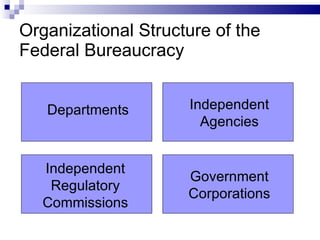
Organizational Structure of the Federal Bureaucracy Departments Independent Agencies Independent Regulatory Commissions Government Corporations
Cabinet Departments Originally 3 State, War, Treasury Homeland Security Most Recently Headed by Secretaries Appointed by the President with the “advice and consent of the Senate”
Departments State (1789) Treasury (1789) Defense (1947; formerly the War Department, created in 1789, and the Navy Department, created in 1798) Justice (1870; created in 1789 as Office of the Attorney General – a part-time position, made a cabinet level department in 1870) Interior (1849) Agriculture (1889) Commerce (1913)  Labor (1913) Health and Human Services (1953 as Health, Education, and Welfare; reorganized with Education as a separate department in 1979) Housing and Urban Development (1965) Transportation (1966) Energy (1977) Education (1979) Veterans Affairs (1989) Homeland Security (2002)
Centralized? Departments are NOT centralized or monolithic Each has many sub-units with responsibilities Department of Justice FBI, DEA, ATF, US Marshals, Bureau of Prisons, etc
What is a Czar? A popular term used in reference to an official who is appointed to oversee a particular policy or issue Drug Counterterrorism Energy Climate
Czars Allows quicker action on important matters Criticism No “advice and consent of the Senate”
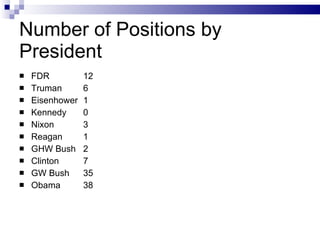
Number of Positions by President FDR  12 Truman  6 Eisenhower 1 Kennedy  0 Nixon  3 Reagan 1 GHW Bush 2 Clinton 7 GW Bush 35 Obama 38
Independent Agencies  These agencies are independent from larger departments, but still under the control of the president.
Independent Agencies Currently ~ 50 NASA ~20,000 employees Little oversight responsibility
Independent Executive Agencies Not included in any departments, but are distinct from corporations and regulatory commissions Environmental Protection, Central Intelligence, National Science Foundation
Government Corporations  These agencies are run by an independent board in the same way as a private corporation.
Government Corporations Perform an economically important activity Mostly self-supporting Postal Service, AMTRAK, Tennessee Valley Authority
Independent Regulatory Commissions  While these agencies are run by “political” figures, they are independent of both the president and larger departments.
Regulatory Commissions Regulate where the free market does not work properly to protect the public interest FCC, FEC
The Advantages of Bureaucracy Standardization Expertise and Competence Coordination
Ideological Problems Lack of popular sovereignty Little incentive to be efficient Public Opinion not as important to bureaucrats Largely shielded from Congress, the President “ Captured” by interest groups, private firms
Political Liberty Red Scare DOJ’s “Red Squads” IRS used to harass critics Nixon most famous for this Bill O’Reilly audited four consecutive years under Clinton
Political Liberty  FBI most notorious, especially under Hoover McCarthy witch hunts Cointelpro MLK
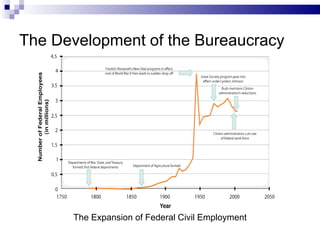
The Development of the Bureaucracy The Expansion of Federal Civil Employment
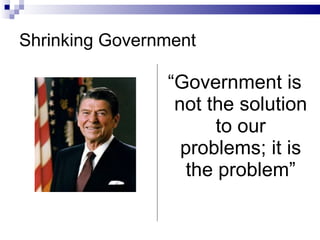
Shrinking Government “ Government is not the solution to our problems; it is the problem”
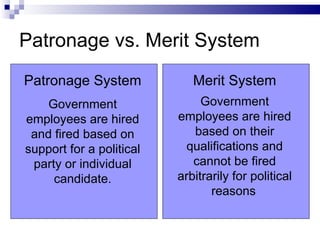
Patronage vs. Merit System Patronage System Government employees are hired and fired based on support for a political party or individual candidate. Merit System Government employees are hired based on their qualifications and cannot be fired arbitrarily for political reasons
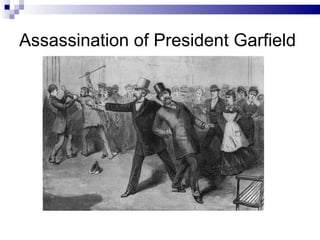
Assassination of President Garfield
Patronage President Jackson “ To the victor goes the spoils” Problems Massive turnover every administration Pendleton Act curbed patronage

Bureaucracy

  • 1.
  • 2.
    Bureaucracy Defined A large organization in which people with specialized knowledge are organized into a clearly defined hierarchy of bureaus and offices, each of which has a specific mission
  • 3.
    Democratic? Bureaucrats arede facto policymakers Sometimes conduct judicial-style hearings IRS, not a court, determines penalties; you must prove innocence to the IRS Bureaucrats yield considerable responsibility, but are not subjected to elections
  • 4.
    Organizational Structure ofthe Federal Bureaucracy Departments Independent Agencies Independent Regulatory Commissions Government Corporations
  • 5.
    Cabinet Departments Originally3 State, War, Treasury Homeland Security Most Recently Headed by Secretaries Appointed by the President with the “advice and consent of the Senate”
  • 6.
    Departments State (1789)Treasury (1789) Defense (1947; formerly the War Department, created in 1789, and the Navy Department, created in 1798) Justice (1870; created in 1789 as Office of the Attorney General – a part-time position, made a cabinet level department in 1870) Interior (1849) Agriculture (1889) Commerce (1913) Labor (1913) Health and Human Services (1953 as Health, Education, and Welfare; reorganized with Education as a separate department in 1979) Housing and Urban Development (1965) Transportation (1966) Energy (1977) Education (1979) Veterans Affairs (1989) Homeland Security (2002)
  • 7.
    Centralized? Departments areNOT centralized or monolithic Each has many sub-units with responsibilities Department of Justice FBI, DEA, ATF, US Marshals, Bureau of Prisons, etc
  • 8.
    What is aCzar? A popular term used in reference to an official who is appointed to oversee a particular policy or issue Drug Counterterrorism Energy Climate
  • 9.
    Czars Allows quickeraction on important matters Criticism No “advice and consent of the Senate”
  • 10.
    Number of Positionsby President FDR 12 Truman 6 Eisenhower 1 Kennedy 0 Nixon 3 Reagan 1 GHW Bush 2 Clinton 7 GW Bush 35 Obama 38
  • 11.
    Independent Agencies These agencies are independent from larger departments, but still under the control of the president.
  • 12.
    Independent Agencies Currently~ 50 NASA ~20,000 employees Little oversight responsibility
  • 13.
    Independent Executive AgenciesNot included in any departments, but are distinct from corporations and regulatory commissions Environmental Protection, Central Intelligence, National Science Foundation
  • 14.
    Government Corporations These agencies are run by an independent board in the same way as a private corporation.
  • 15.
    Government Corporations Performan economically important activity Mostly self-supporting Postal Service, AMTRAK, Tennessee Valley Authority
  • 16.
    Independent Regulatory Commissions While these agencies are run by “political” figures, they are independent of both the president and larger departments.
  • 17.
    Regulatory Commissions Regulatewhere the free market does not work properly to protect the public interest FCC, FEC
  • 18.
    The Advantages ofBureaucracy Standardization Expertise and Competence Coordination
  • 19.
    Ideological Problems Lackof popular sovereignty Little incentive to be efficient Public Opinion not as important to bureaucrats Largely shielded from Congress, the President “ Captured” by interest groups, private firms
  • 20.
    Political Liberty RedScare DOJ’s “Red Squads” IRS used to harass critics Nixon most famous for this Bill O’Reilly audited four consecutive years under Clinton
  • 21.
    Political Liberty FBI most notorious, especially under Hoover McCarthy witch hunts Cointelpro MLK
  • 22.
    The Development ofthe Bureaucracy The Expansion of Federal Civil Employment
  • 23.
    Shrinking Government “Government is not the solution to our problems; it is the problem”
  • 24.
    Patronage vs. MeritSystem Patronage System Government employees are hired and fired based on support for a political party or individual candidate. Merit System Government employees are hired based on their qualifications and cannot be fired arbitrarily for political reasons
  • 25.
  • 26.
    Patronage President Jackson“ To the victor goes the spoils” Problems Massive turnover every administration Pendleton Act curbed patronage