
The Bureaucracy Dr. Christopher S. Rice
What is a bureaucracy? Bureaucracy   and  bureaucrat   are  neutral  terms, describe  a type of organization and the people who work in it .  Connotations – unlearn what you have learned…
Overall, what is your opinion about the performance of the federal bureaucracy? Bureaucrats are generally incompetent Bureaucrats are generally well-trained and capable Don’t know
 
 
Bureaucracy   A  large organization  in which people with  specialized knowledge  are organized into a clearly defined  hierarchy  of bureaus and offices, each of which has a specified  mission .
The Weberian Model of Bureaucracy
The five characteristics of  bureaucracy: Division of labor Hierarchy Formal rules Maintenance of files and records Professionalization Merit vs. cronyism
The Merit System Spoils System  dominated the 19 th  and (most of the) 20 th  century bureaucracy. “ It’s not  what  you know, but  who  you know…” Merit System:  people hired & promoted on basis of qualifications & job performance, not political connections.
During Spring Break I… Consumed too much of my substance of choice. Hooked Up with a hottie. Got a tattoo. Choices 1, 2 & 3 – the Spring Break Trifecta! Went on a mission trip. Stayed home and watched bad T.V. Don’t Remember (probably a good thing).
Bureaucracy Public agencies that translate the intent of democratic institutions into action.
Advantages?
2
Ability to organize large tasks
Concentration of specialized talent
Disadvantages?
Efficiency vs. Responsiveness
The process of deciding what the laws passed by Congress actually mean is known as: rulemaking. legislative interpretation. bureaucratic interpretation. bureaucratic discretion.
So what do bureaucrats  do , exactly? Execution of laws Rule-Making  (Regulation) Rulemaking  – the process of deciding exactly what the laws passed by Congress mean. Rule  – statement by a federal agency that interprets a law and prescribes the specific action an agency will take to implement that law.
So what do bureaucrats  do , exactly? Rule-Making  (cont’d.) Federal Administrative Procedures Act Certain minimum standards must be met when making rules. Interest group participation
So what do bureaucrats  do , exactly? Adjudication  – process designed to establish whether a rule has been violated. In making rules, bureaucracies act like legislatures; in judging them they act like courts. National Highway Traffic Safety Administration (NHTSA) Potential problems with bureaucrats as policymakers…
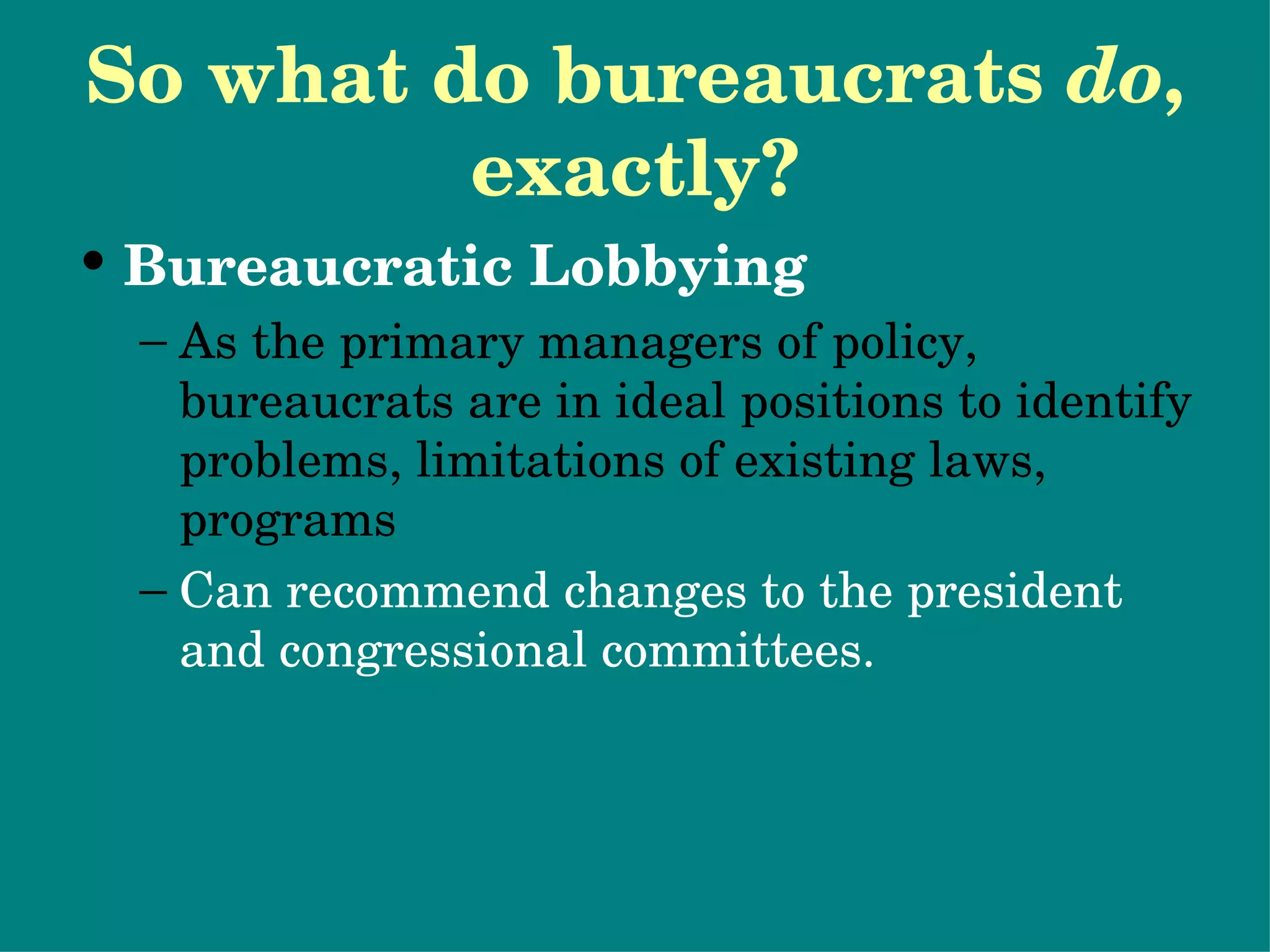
So what do bureaucrats  do , exactly? Bureaucratic Lobbying As the primary managers of policy, bureaucrats are in ideal positions to identify problems, limitations of existing laws, programs Can recommend changes to the president and congressional committees.
 
Structure of the Executive Branch
Executive Office of the White House
 
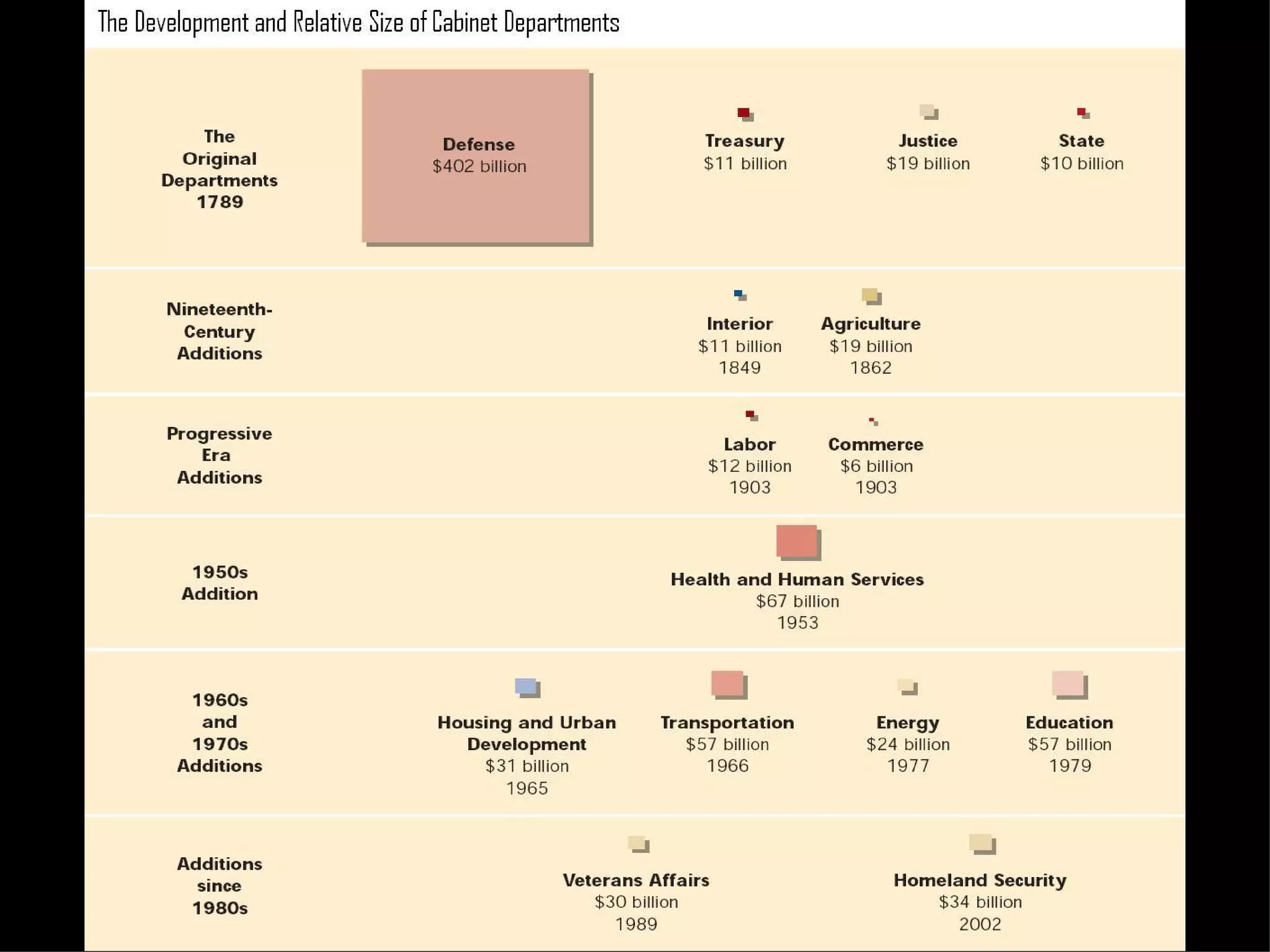
Cabinet Departments
 
 
Bureaus and Agencies
Government Corporations
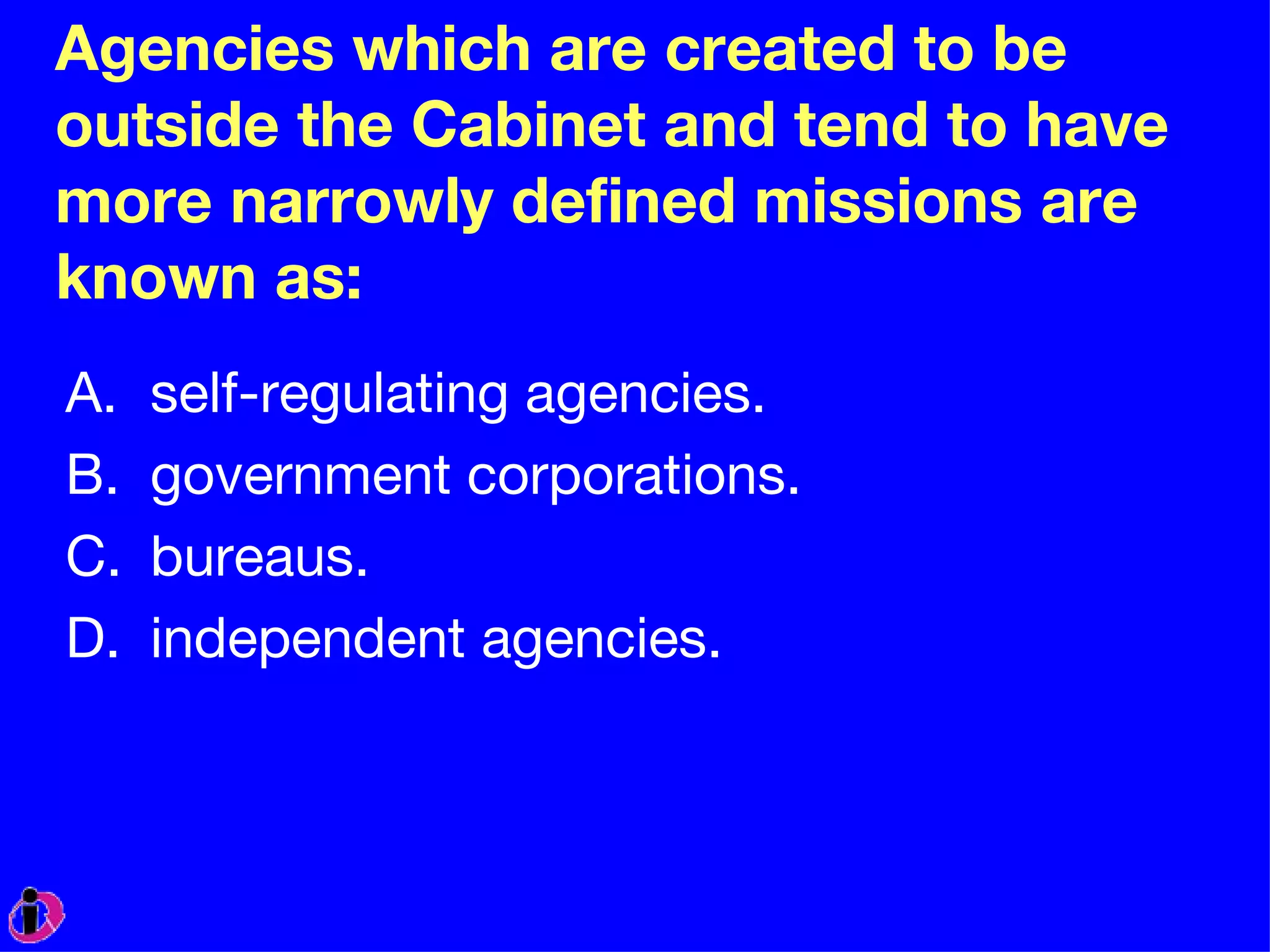
Agencies which are created to be outside the Cabinet and tend to have more narrowly defined missions are known as: self-regulating agencies. government corporations. bureaus. independent agencies.
Independent Executive Agencies
Independent Regulatory Commissions
 
The government should privatize more of the government’s activities.  Yes No Somewhat No opinion
Bureaucracy and the Benchmarks of Representative Democracy  Popular Sovereignty Political Equality Political Liberty

The Bureaucracy

  • 1.
    The Bureaucracy Dr.Christopher S. Rice
  • 2.
    What is abureaucracy? Bureaucracy and bureaucrat are neutral terms, describe a type of organization and the people who work in it . Connotations – unlearn what you have learned…
  • 3.
    Overall, what isyour opinion about the performance of the federal bureaucracy? Bureaucrats are generally incompetent Bureaucrats are generally well-trained and capable Don’t know
  • 4.
  • 5.
  • 6.
    Bureaucracy A large organization in which people with specialized knowledge are organized into a clearly defined hierarchy of bureaus and offices, each of which has a specified mission .
  • 7.
    The Weberian Modelof Bureaucracy
  • 8.
    The five characteristicsof bureaucracy: Division of labor Hierarchy Formal rules Maintenance of files and records Professionalization Merit vs. cronyism
  • 9.
    The five characteristicsof bureaucracy: Division of labor Hierarchy Formal rules Maintenance of files and records Professionalization Merit vs. cronyism
  • 10.
    The five characteristicsof bureaucracy: Division of labor Hierarchy Formal rules Maintenance of files and records Professionalization Merit vs. cronyism
  • 11.
    The five characteristicsof bureaucracy: Division of labor Hierarchy Formal rules Maintenance of files and records Professionalization Merit vs. cronyism
  • 12.
    The five characteristicsof bureaucracy: Division of labor Hierarchy Formal rules Maintenance of files and records Professionalization Merit vs. cronyism
  • 13.
    The Merit SystemSpoils System dominated the 19 th and (most of the) 20 th century bureaucracy. “ It’s not what you know, but who you know…” Merit System: people hired & promoted on basis of qualifications & job performance, not political connections.
  • 14.
    The Merit SystemSpoils System dominated the 19 th and (most of the) 20 th century bureaucracy. “ It’s not what you know, but who you know…” Merit System: people hired & promoted on basis of qualifications & job performance, not political connections.
  • 15.
    The Merit SystemSpoils System dominated the 19 th and (most of the) 20 th century bureaucracy. “ It’s not what you know, but who you know…” Merit System: people hired & promoted on basis of qualifications & job performance, not political connections.
  • 16.
    During Spring BreakI… Consumed too much of my substance of choice. Hooked Up with a hottie. Got a tattoo. Choices 1, 2 & 3 – the Spring Break Trifecta! Went on a mission trip. Stayed home and watched bad T.V. Don’t Remember (probably a good thing).
  • 17.
    Bureaucracy Public agenciesthat translate the intent of democratic institutions into action.
  • 18.
  • 19.
  • 20.
  • 21.
  • 22.
  • 23.
  • 24.
    The process ofdeciding what the laws passed by Congress actually mean is known as: rulemaking. legislative interpretation. bureaucratic interpretation. bureaucratic discretion.
  • 25.
    So what dobureaucrats do , exactly? Execution of laws Rule-Making (Regulation) Rulemaking – the process of deciding exactly what the laws passed by Congress mean. Rule – statement by a federal agency that interprets a law and prescribes the specific action an agency will take to implement that law.
  • 26.
    So what dobureaucrats do , exactly? Execution of laws Rule-Making (Regulation) Rulemaking – the process of deciding exactly what the laws passed by Congress mean. Rule – statement by a federal agency that interprets a law and prescribes the specific action an agency will take to implement that law.
  • 27.
    So what dobureaucrats do , exactly? Execution of laws Rule-Making (Regulation) Rulemaking – the process of deciding exactly what the laws passed by Congress mean. Rule – statement by a federal agency that interprets a law and prescribes the specific action an agency will take to implement that law.
  • 28.
    So what dobureaucrats do , exactly? Rule-Making (cont’d.) Federal Administrative Procedures Act Certain minimum standards must be met when making rules. Interest group participation
  • 29.
    So what dobureaucrats do , exactly? Rule-Making (cont’d.) Federal Administrative Procedures Act Certain minimum standards must be met when making rules. Interest group participation
  • 30.
    So what dobureaucrats do , exactly? Rule-Making (cont’d.) Federal Administrative Procedures Act Certain minimum standards must be met when making rules. Interest group participation
  • 31.
    So what dobureaucrats do , exactly? Adjudication – process designed to establish whether a rule has been violated. In making rules, bureaucracies act like legislatures; in judging them they act like courts. National Highway Traffic Safety Administration (NHTSA) Potential problems with bureaucrats as policymakers…
  • 32.
    So what dobureaucrats do , exactly? Adjudication – process designed to establish whether a rule has been violated. In making rules, bureaucracies act like legislatures; in judging them they act like courts. National Highway Traffic Safety Administration (NHTSA) Potential problems with bureaucrats as policymakers…
  • 33.
    So what dobureaucrats do , exactly? Adjudication – process designed to establish whether a rule has been violated. In making rules, bureaucracies act like legislatures; in judging them they act like courts. National Highway Traffic Safety Administration (NHTSA) Potential problems with bureaucrats as policymakers…
  • 34.
    So what dobureaucrats do , exactly? Adjudication – process designed to establish whether a rule has been violated. In making rules, bureaucracies act like legislatures; in judging them they act like courts. National Highway Traffic Safety Administration (NHTSA) Potential problems with bureaucrats as policymakers…
  • 35.
    So what dobureaucrats do , exactly? Bureaucratic Lobbying As the primary managers of policy, bureaucrats are in ideal positions to identify problems, limitations of existing laws, programs Can recommend changes to the president and congressional committees.
  • 36.
    So what dobureaucrats do , exactly? Bureaucratic Lobbying As the primary managers of policy, bureaucrats are in ideal positions to identify problems, limitations of existing laws, programs Can recommend changes to the president and congressional committees.
  • 37.
  • 38.
    Structure of theExecutive Branch
  • 39.
    Executive Office ofthe White House
  • 40.
  • 41.
  • 42.
  • 43.
  • 44.
  • 45.
  • 46.
    Agencies which arecreated to be outside the Cabinet and tend to have more narrowly defined missions are known as: self-regulating agencies. government corporations. bureaus. independent agencies.
  • 47.
  • 48.
  • 49.
  • 50.
    The government shouldprivatize more of the government’s activities. Yes No Somewhat No opinion
  • 51.
    Bureaucracy and theBenchmarks of Representative Democracy Popular Sovereignty Political Equality Political Liberty