System Calls & Libraries
Vivek Pai
Lecture 4, COS318
Sep 25, 2001
System Calls & Libraries 2
Gedankundmathematics
Recall the pointer verification case for fread( )
 Can you speed up the checking process?
 What’s the best you could achieve? O(n)?
O(logn)? O(1)?
 What happens if you have >32 bits?
 Aside: # atoms in universe = 1080, or 2256
 Does this provide any other benefits?
System Calls & Libraries 3
Mechanics
 Is the project workable?
 Has everyone started?
 Barring major problems, due Tuesday
midnight
 Readings updated
System Calls & Libraries 4
Protection Issues
 I/O protection
 Prevent users from performing illegal I/Os
 Memory protection
 Prevent users from modifying kernel code
and data structures
 CPU protection
 Prevent a user from using the CPU for too
long
System Calls & Libraries 5
Protection Is Not Safety/Security
 Protection is a prerequisite
 Safety can be separation of concerns
 Security related to overall design
Examples?
 Bad pointer access causing seg fault
 Sniffing cleartext passwords on the wire
System Calls & Libraries 6
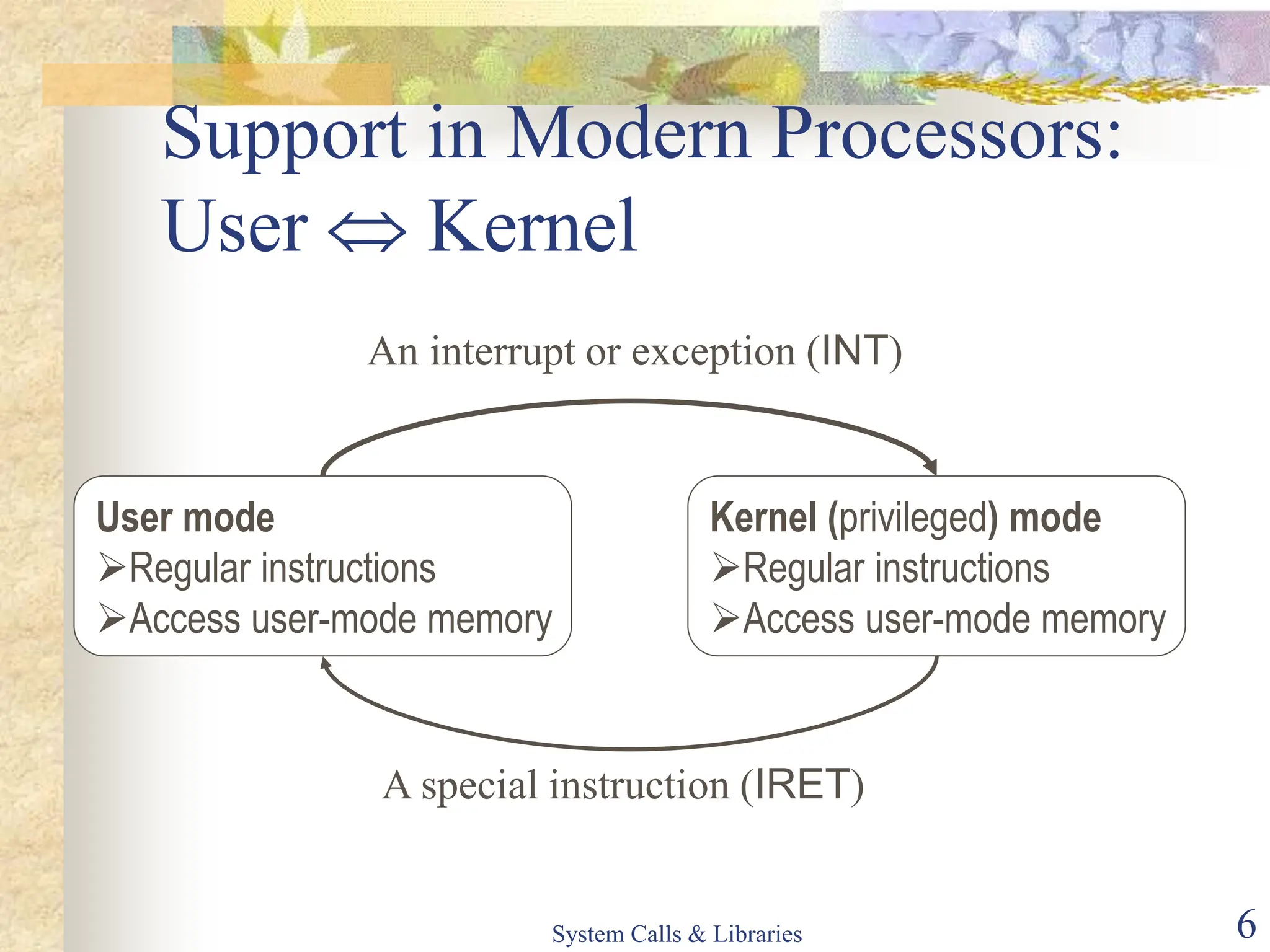
Support in Modern Processors:
User  Kernel
User mode
Regular instructions
Access user-mode memory
Kernel (privileged) mode
Regular instructions
Access user-mode memory
An interrupt or exception (INT)
A special instruction (IRET)
System Calls & Libraries 7
Why a Privileged Mode?
 Special Instructions
 Mapping, TLB, etc
 Device registers
 I/O channels, etc.
 Mode Bits
 Processor features
 Device access
System Calls & Libraries 8
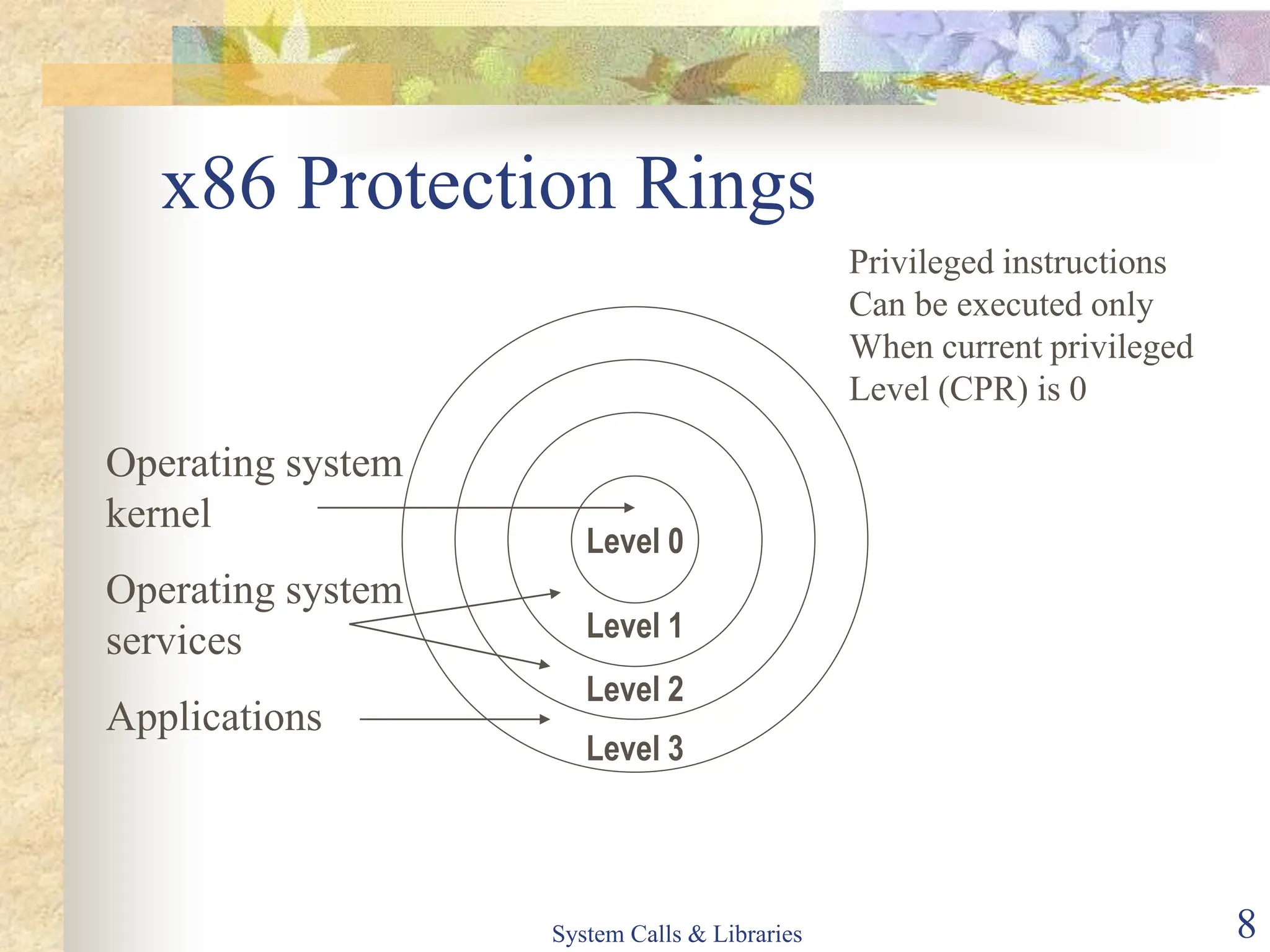
x86 Protection Rings
Level 0
Level 1
Level 2
Level 3
Operating system
kernel
Operating system
services
Applications
Privileged instructions
Can be executed only
When current privileged
Level (CPR) is 0
System Calls & Libraries 9
Other Design Approaches
 “Capabilities”
 Fine-grained access control
 Crypto-like tokens
 Microkernels
 OS services in user space
 Small core “hypervisor”
System Calls & Libraries 10
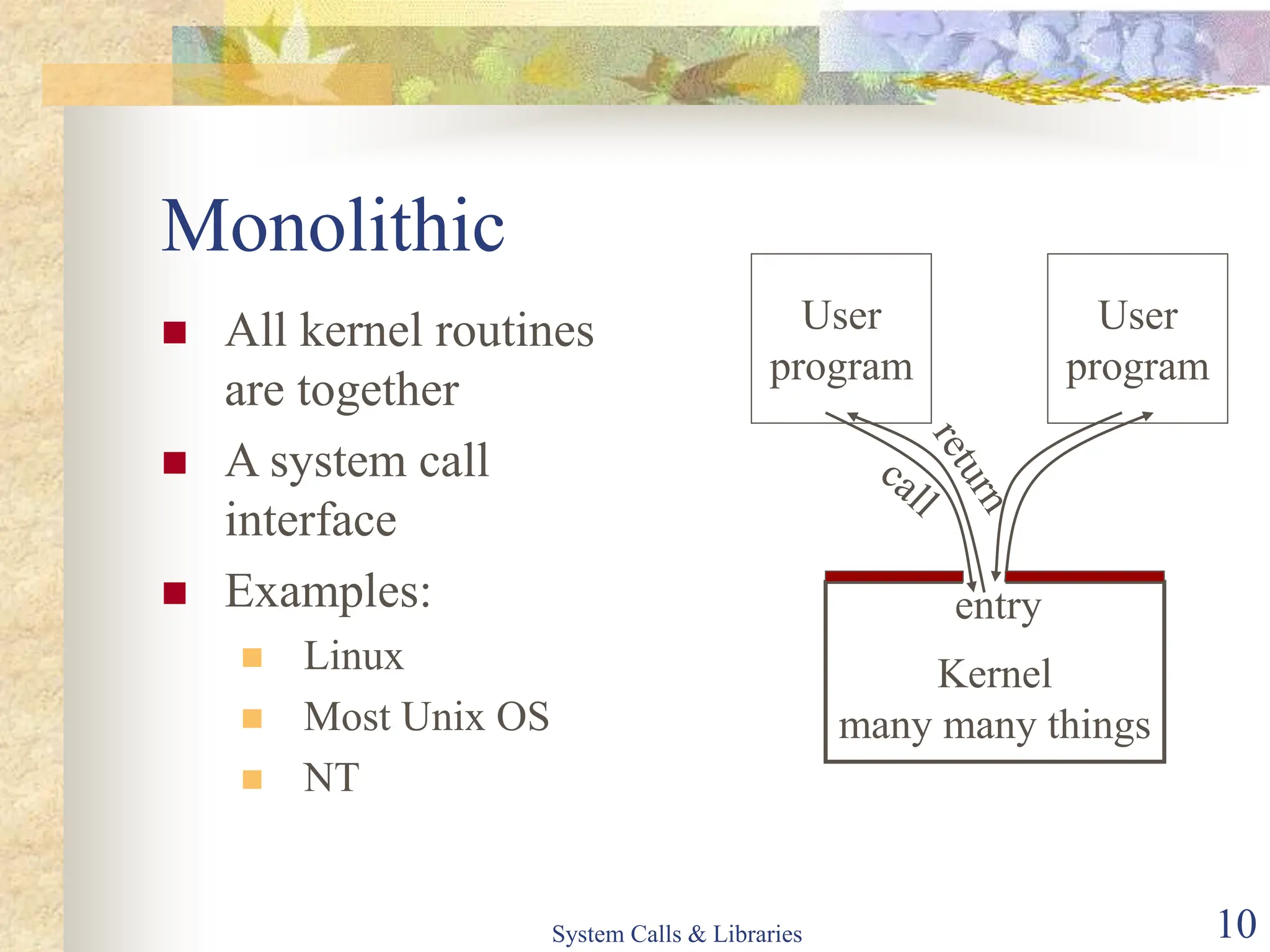
Monolithic
 All kernel routines
are together
 A system call
interface
 Examples:
 Linux
 Most Unix OS
 NT
Kernel
many many things
entry
User
program
User
program
System Calls & Libraries 11
Monolithic Pros and Cons
Pros
 Relatively few crossings
 Shared kernel address space
 Performance
Cons
 Flexibility
 Stability
 Experimentation
System Calls & Libraries 12
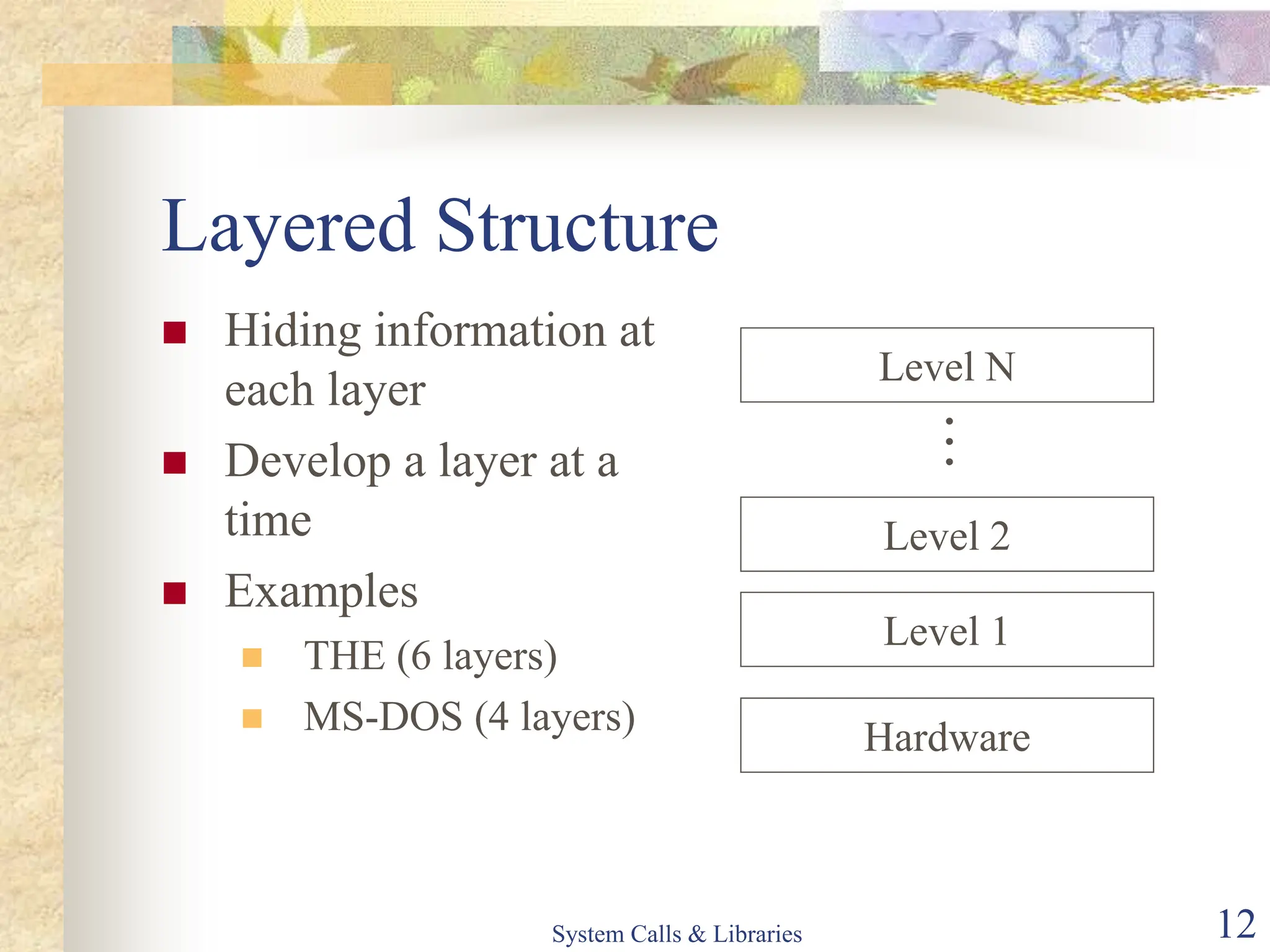
Layered Structure
 Hiding information at
each layer
 Develop a layer at a
time
 Examples
 THE (6 layers)
 MS-DOS (4 layers) Hardware
Level 1
Level 2
Level N
.
.
.
System Calls & Libraries 13
Layering Pros and Cons
Pros
 Separation of concerns
 Simplicity / elegance
Cons
 Boundary crossings
 Performance?
System Calls & Libraries 14
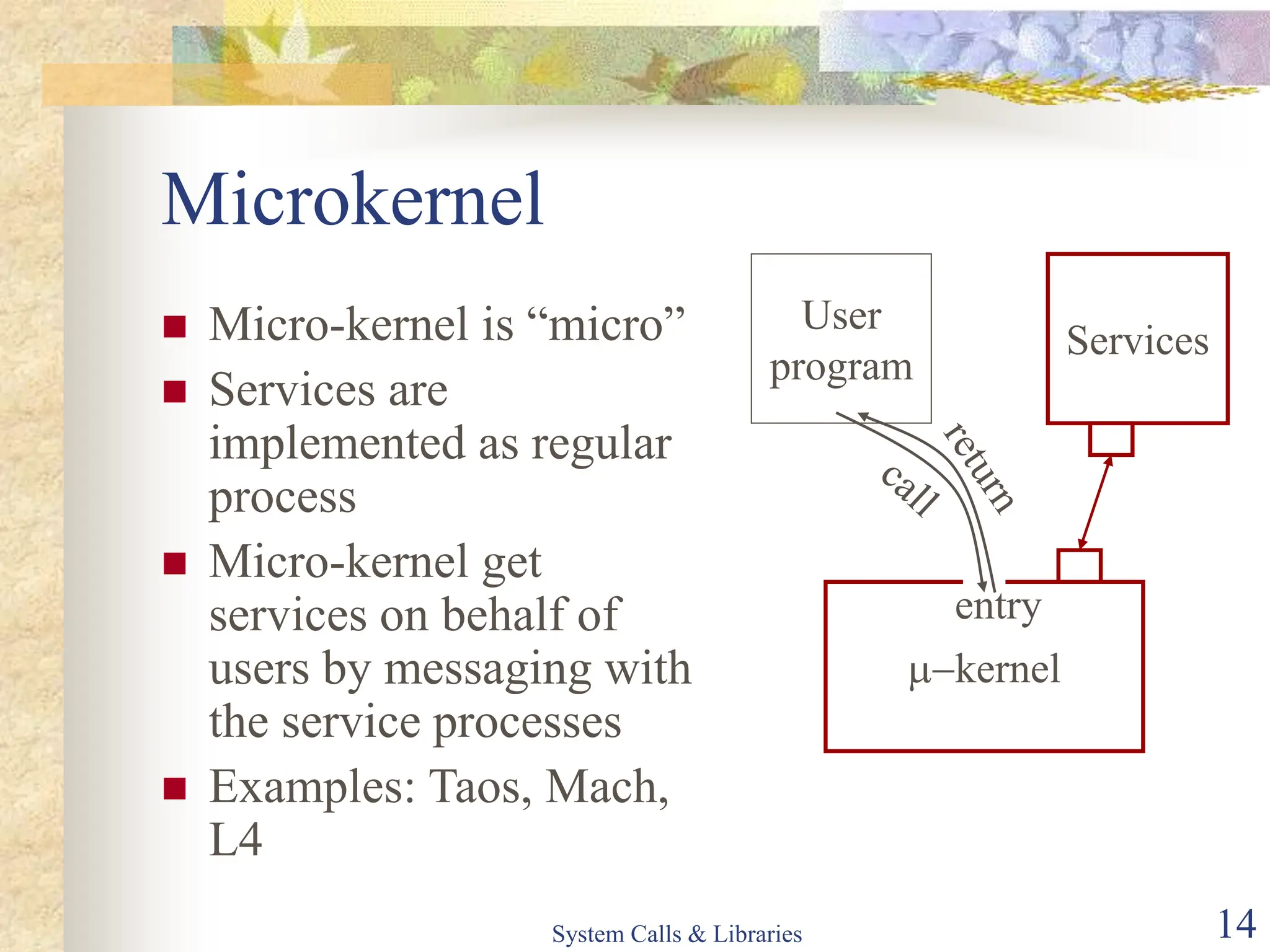
Microkernel
 Micro-kernel is “micro”
 Services are
implemented as regular
process
 Micro-kernel get
services on behalf of
users by messaging with
the service processes
 Examples: Taos, Mach,
L4
m-kernel
entry
User
program
Services
System Calls & Libraries 15
Microkernel Pros and Cons
Pros
 Easier to develop services
 Fault isolation
 Customization
 Smaller kernel => easier to optimize
Cons
 Lots of boundary crossings
 Really poor performance
System Calls & Libraries 16
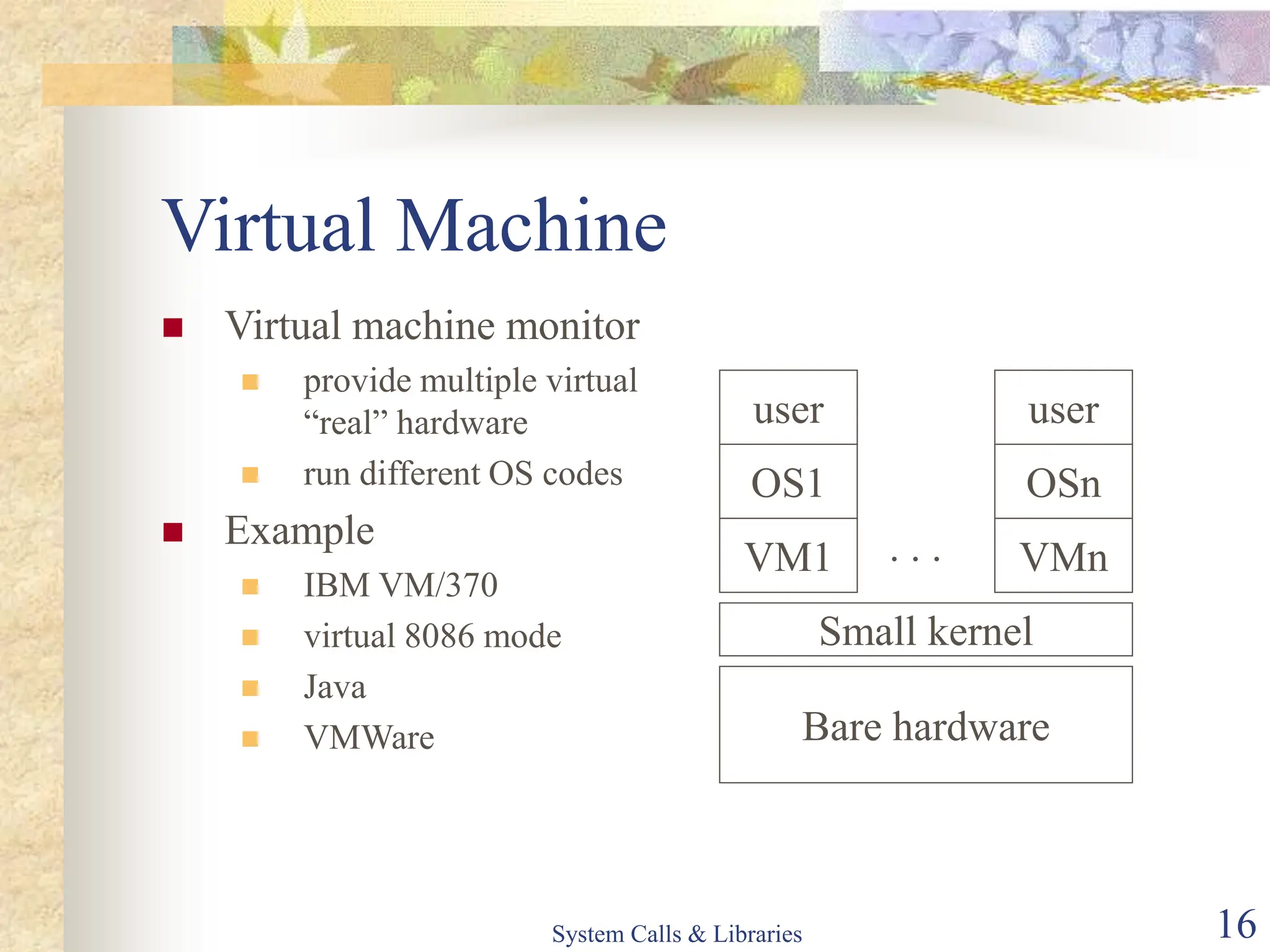
Virtual Machine
 Virtual machine monitor
 provide multiple virtual
“real” hardware
 run different OS codes
 Example
 IBM VM/370
 virtual 8086 mode
 Java
 VMWare Bare hardware
Small kernel
VM1 VMn
. . .
OS1 OSn
user user
System Calls & Libraries 17
Hardware Support
 What is the minimal support?
 Can virtual machine be protected without such
support?
 Hint: what is a Turing machine?
System Calls & Libraries 18
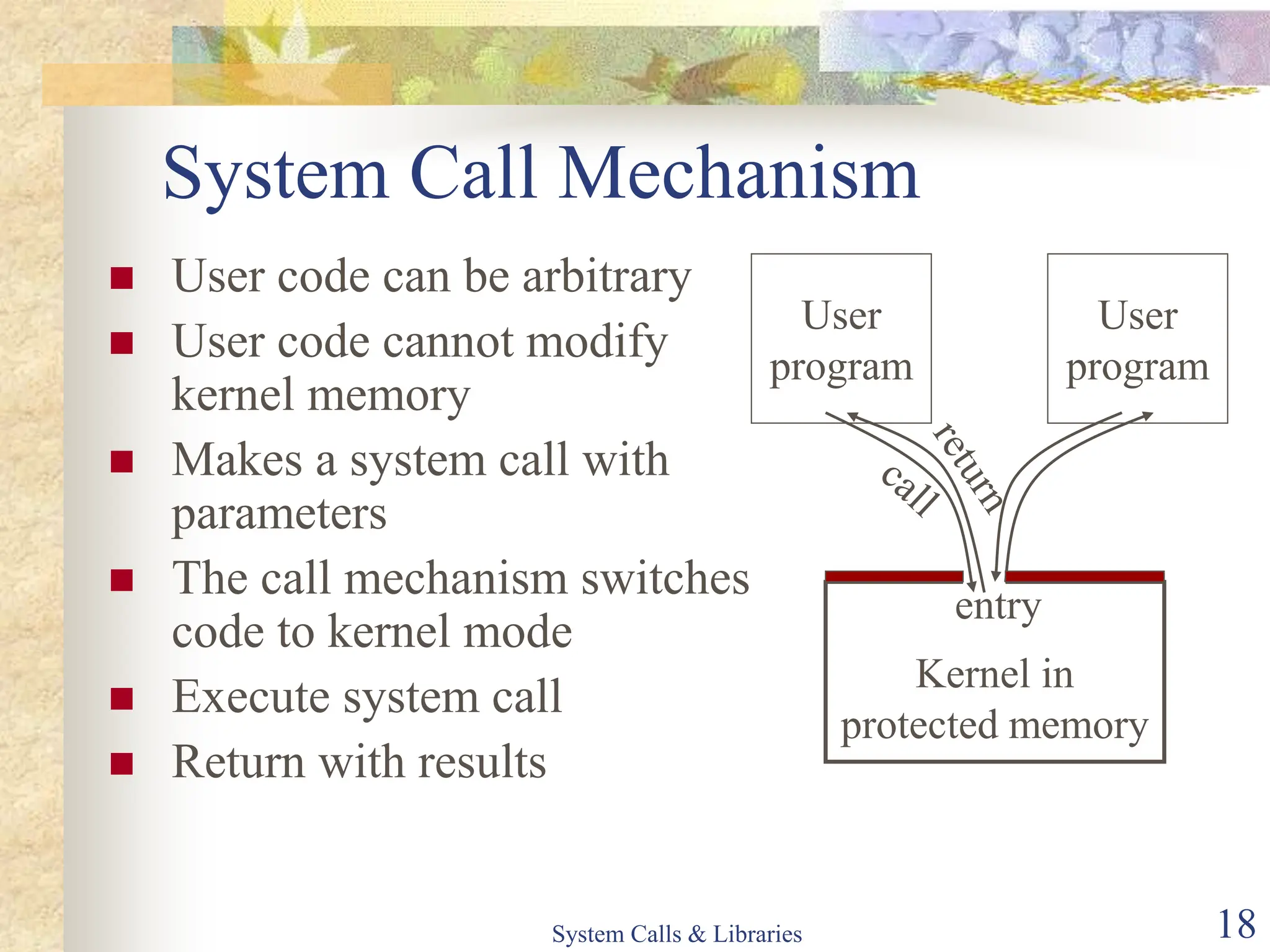
System Call Mechanism
Kernel in
protected memory
entry
 User code can be arbitrary
 User code cannot modify
kernel memory
 Makes a system call with
parameters
 The call mechanism switches
code to kernel mode
 Execute system call
 Return with results
User
program
User
program
System Calls & Libraries 19
Interrupt and Exceptions
 Interrupt Sources
 Hardware (by external devices)
 Software: INT n
 Exceptions
 Program error: faults, traps, and aborts
 Software generated: INT 3
 Machine-check exceptions
 See Intel document chapter 5, volume 3 for
details
System Calls & Libraries 20
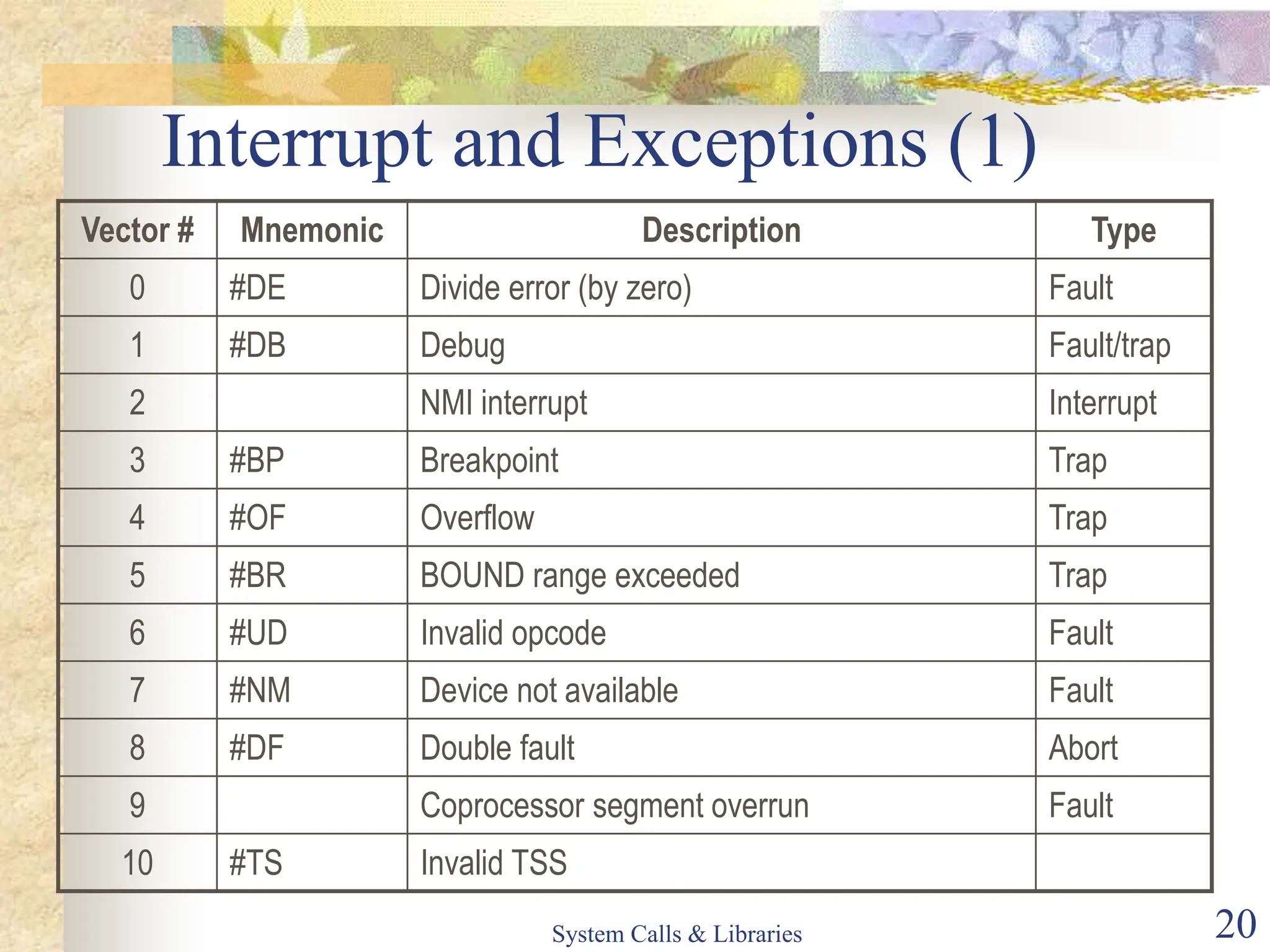
Interrupt and Exceptions (1)
Vector # Mnemonic Description Type
0 #DE Divide error (by zero) Fault
1 #DB Debug Fault/trap
2 NMI interrupt Interrupt
3 #BP Breakpoint Trap
4 #OF Overflow Trap
5 #BR BOUND range exceeded Trap
6 #UD Invalid opcode Fault
7 #NM Device not available Fault
8 #DF Double fault Abort
9 Coprocessor segment overrun Fault
10 #TS Invalid TSS
System Calls & Libraries 21
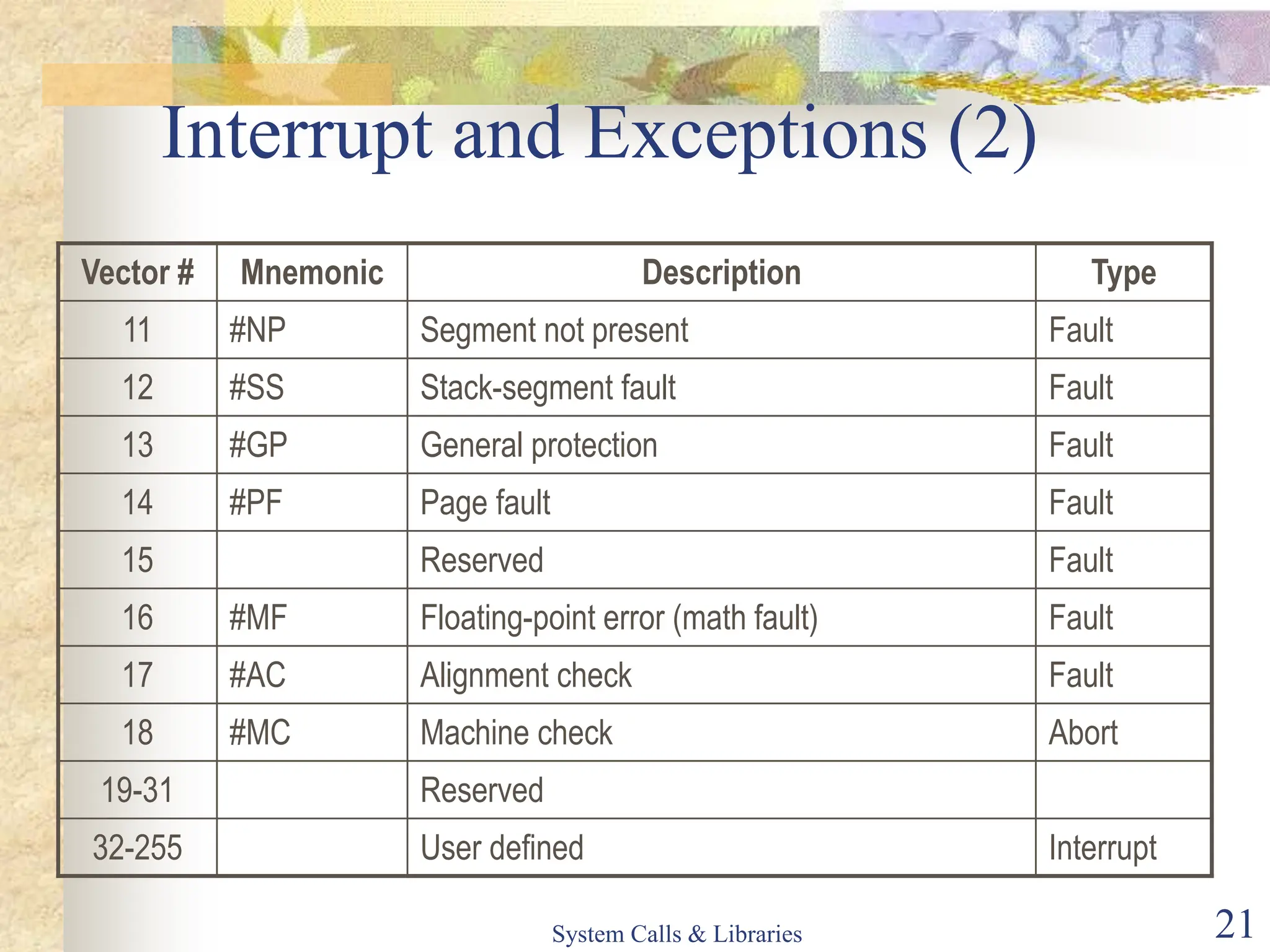
Interrupt and Exceptions (2)
Vector # Mnemonic Description Type
11 #NP Segment not present Fault
12 #SS Stack-segment fault Fault
13 #GP General protection Fault
14 #PF Page fault Fault
15 Reserved Fault
16 #MF Floating-point error (math fault) Fault
17 #AC Alignment check Fault
18 #MC Machine check Abort
19-31 Reserved
32-255 User defined Interrupt
System Calls & Libraries 22
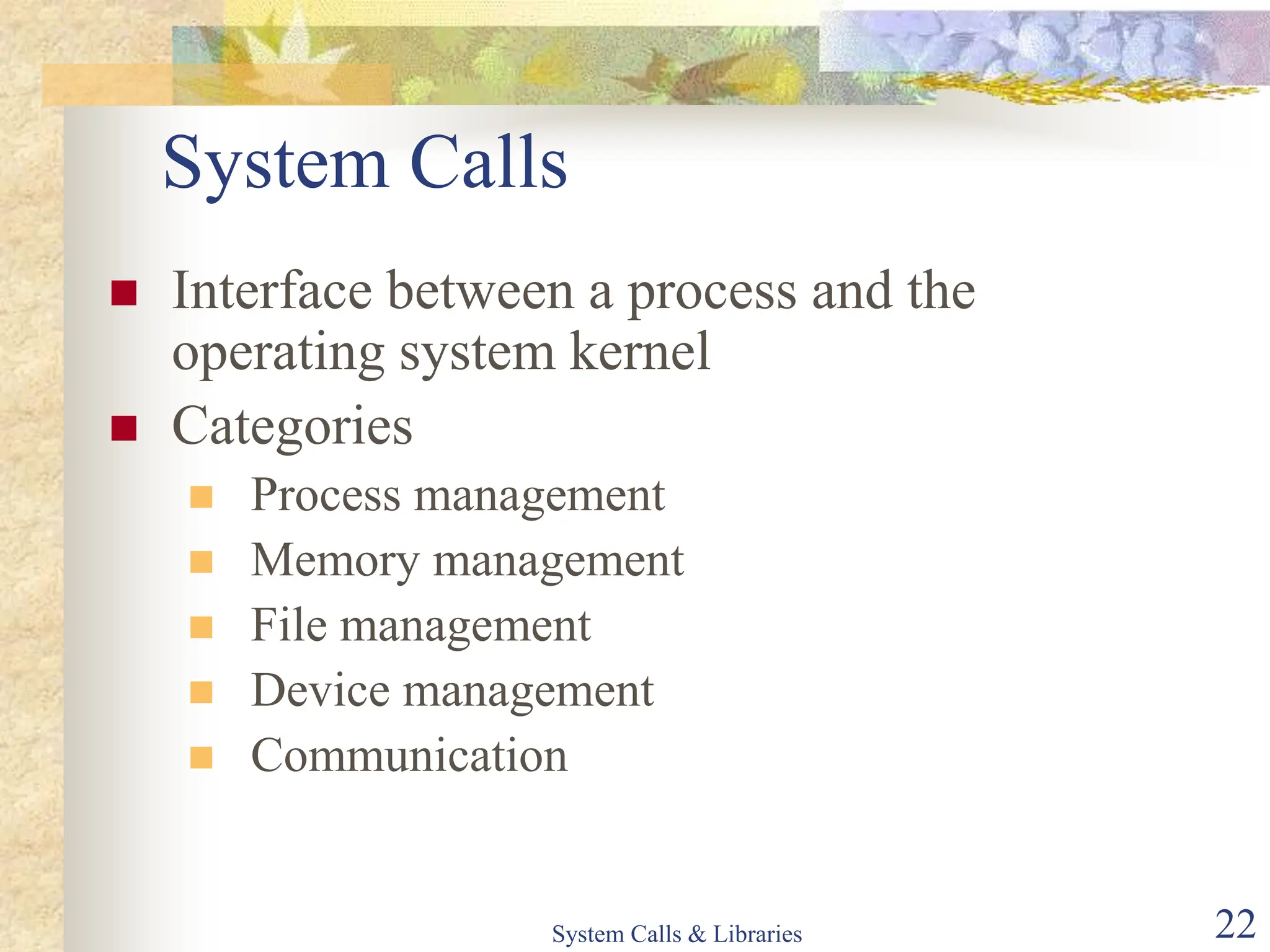
System Calls
 Interface between a process and the
operating system kernel
 Categories
 Process management
 Memory management
 File management
 Device management
 Communication
System Calls & Libraries 23
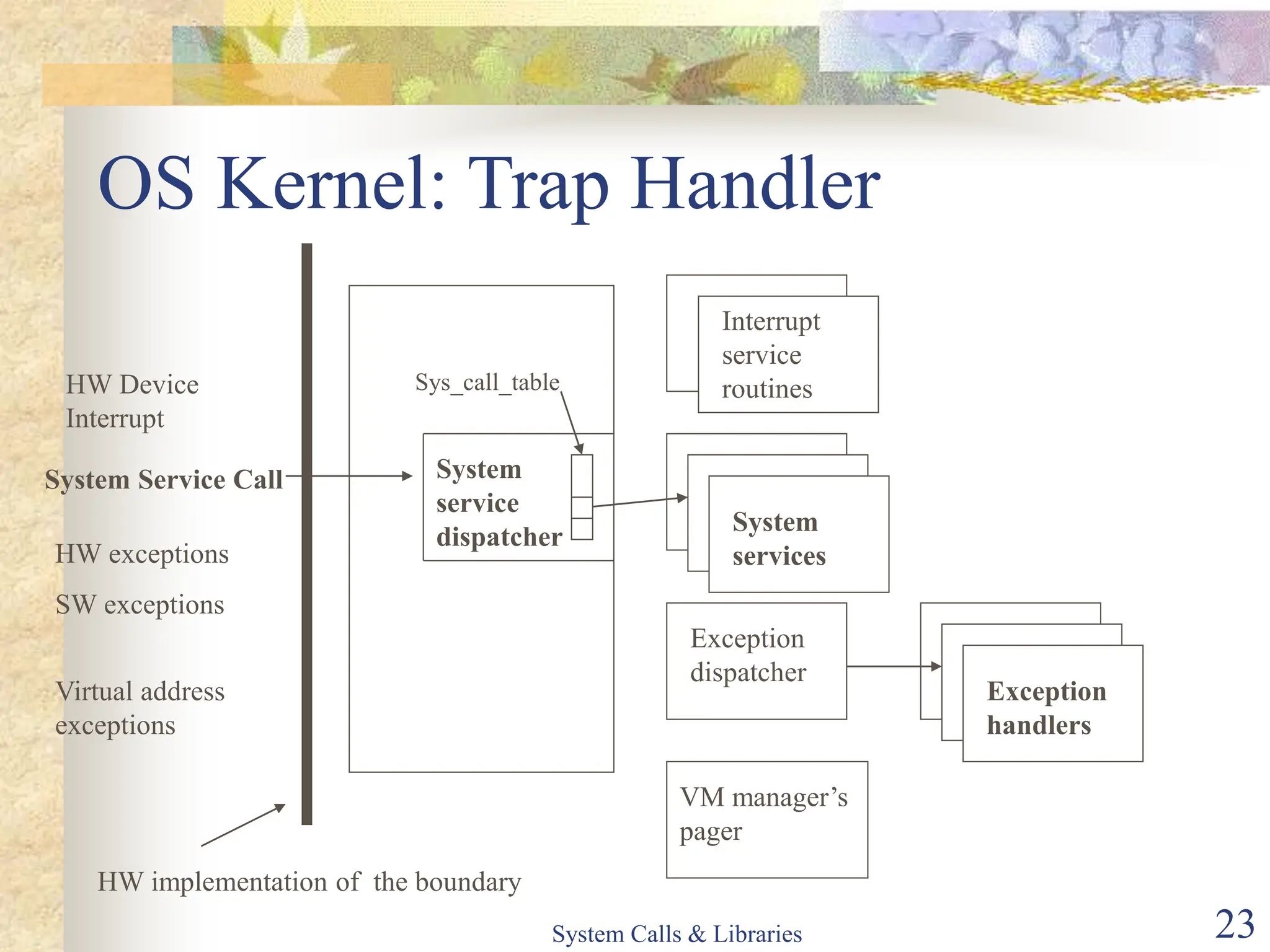
OS Kernel: Trap Handler
HW Device
Interrupt
HW exceptions
SW exceptions
System Service Call
Virtual address
exceptions
HW implementation of the boundary
System
service
dispatcher
System
services
Interrupt
service
routines
Exception
dispatcher
Exception
handlers
VM manager’s
pager
Sys_call_table
System Calls & Libraries 24
Passing Parameters
 Affects and depends on
 Architecture
 Compiler
 OS
 Different choices for different purposes
System Calls & Libraries 25
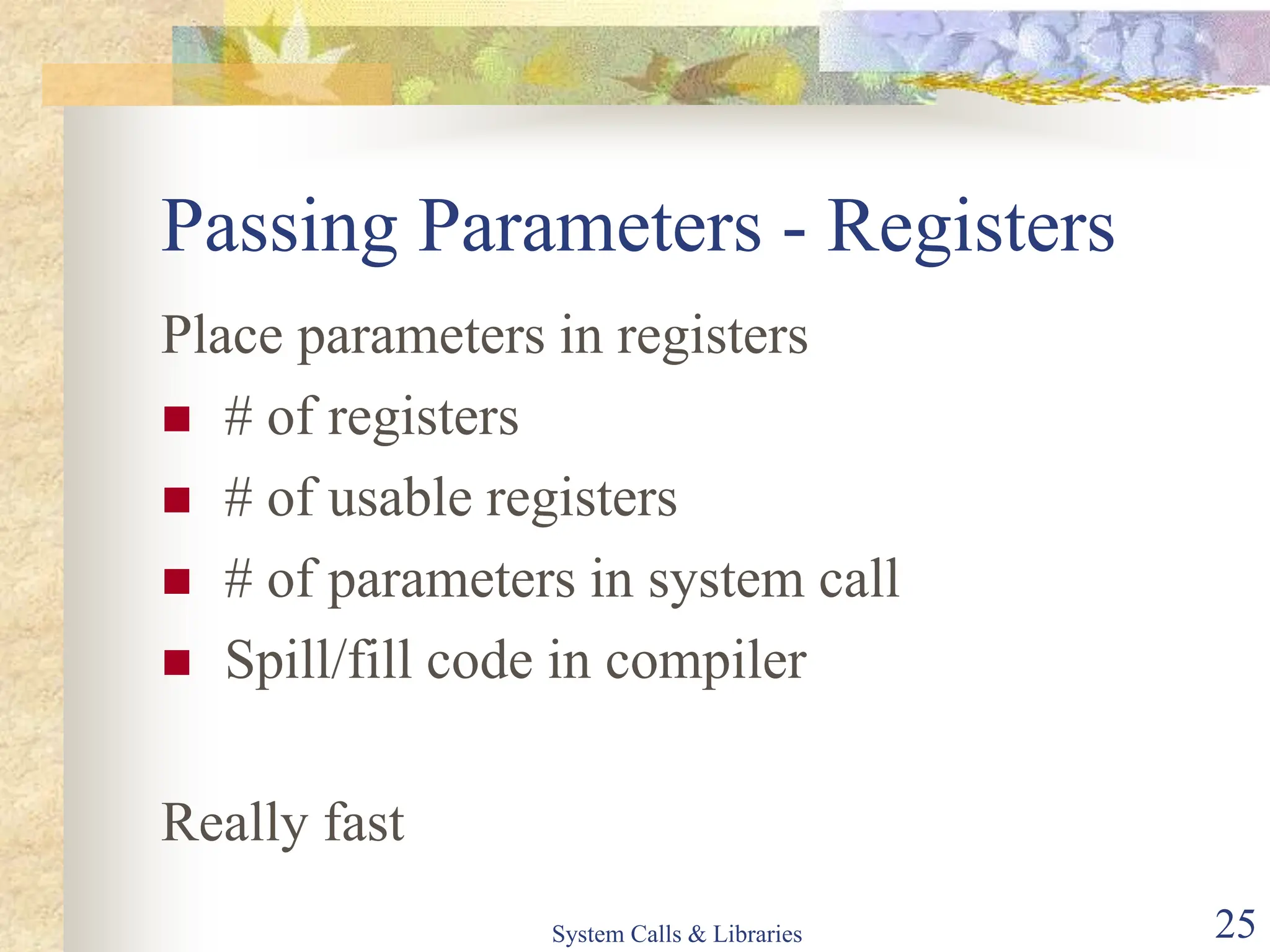
Passing Parameters - Registers
Place parameters in registers
 # of registers
 # of usable registers
 # of parameters in system call
 Spill/fill code in compiler
Really fast
System Calls & Libraries 26
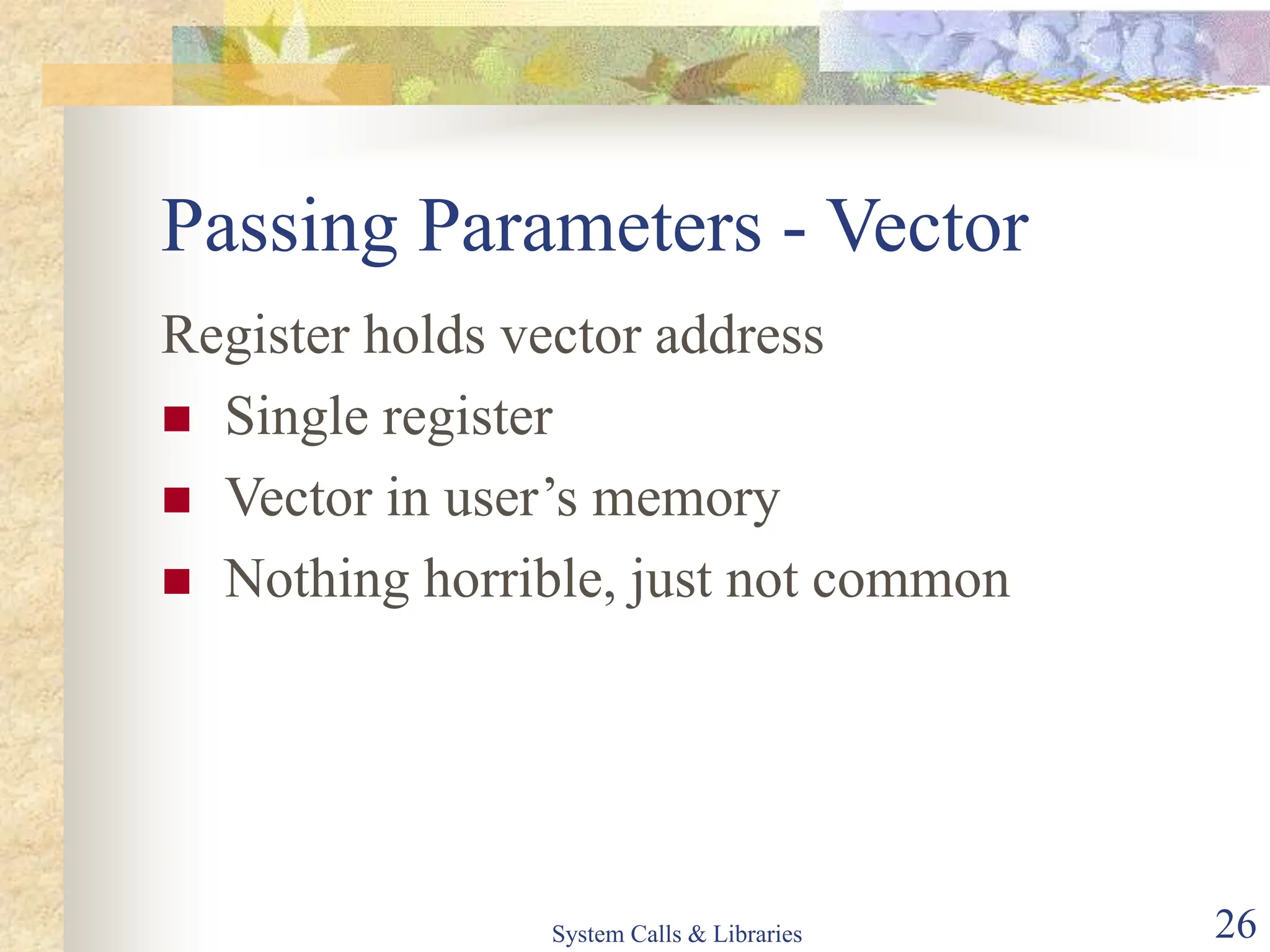
Passing Parameters - Vector
Register holds vector address
 Single register
 Vector in user’s memory
 Nothing horrible, just not common
System Calls & Libraries 27
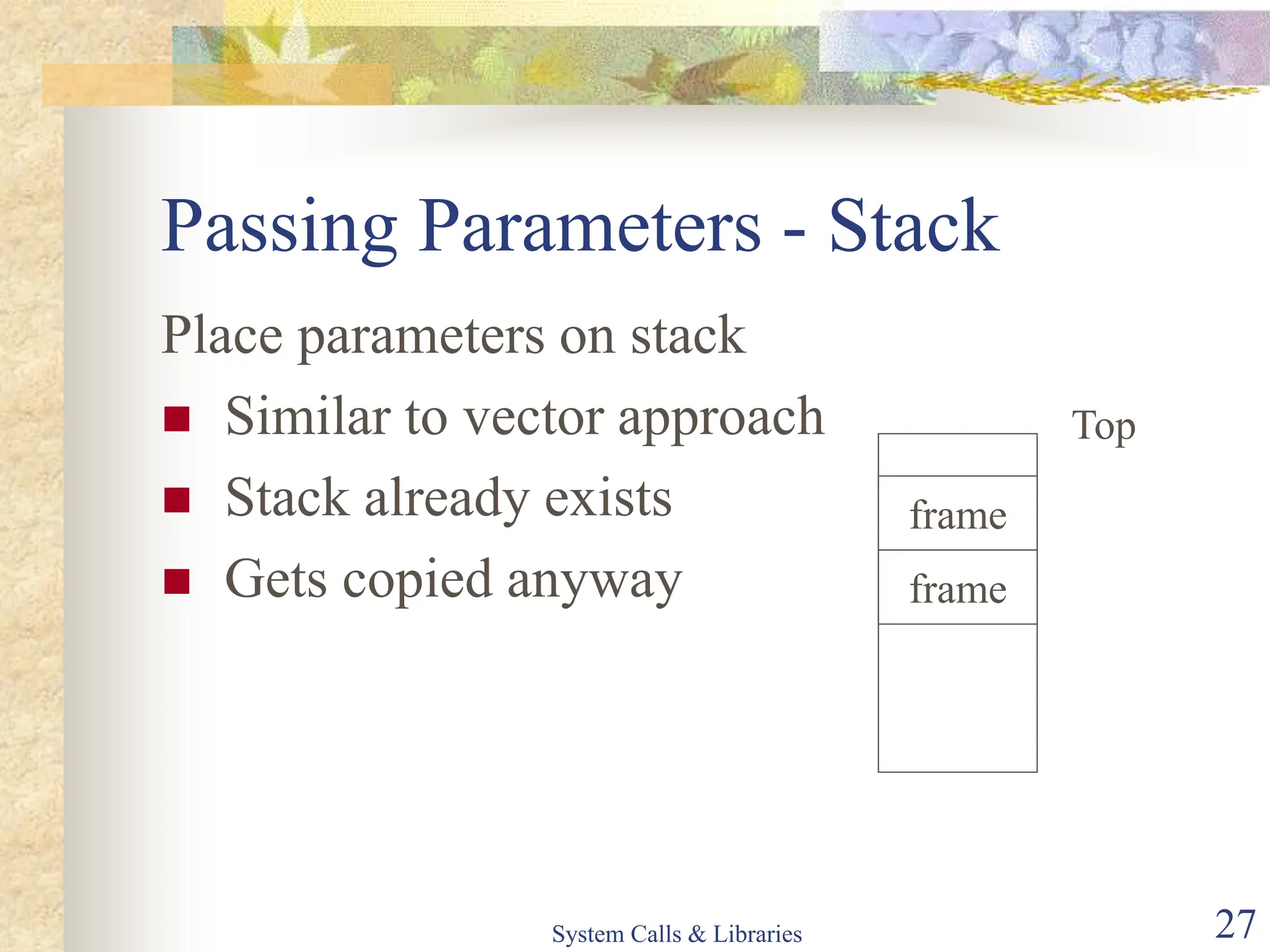
Passing Parameters - Stack
Place parameters on stack
 Similar to vector approach
 Stack already exists
 Gets copied anyway
frame
frame
Top
System Calls & Libraries 28
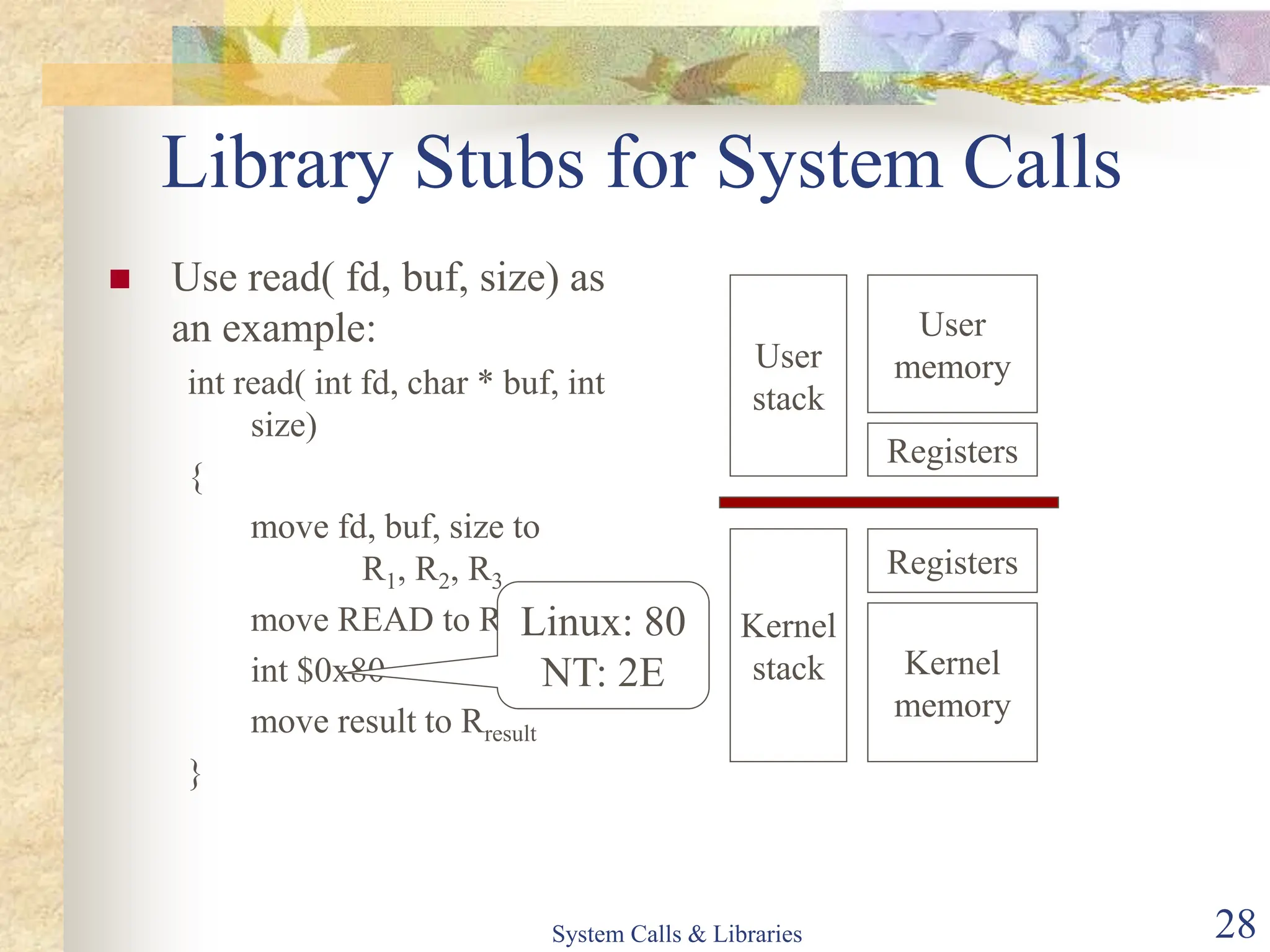
Library Stubs for System Calls
 Use read( fd, buf, size) as
an example:
int read( int fd, char * buf, int
size)
{
move fd, buf, size to
R1, R2, R3
move READ to R0
int $0x80
move result to Rresult
}
User
stack
Registers
User
memory
Kernel
stack
Registers
Kernel
memory
Linux: 80
NT: 2E
System Calls & Libraries 29
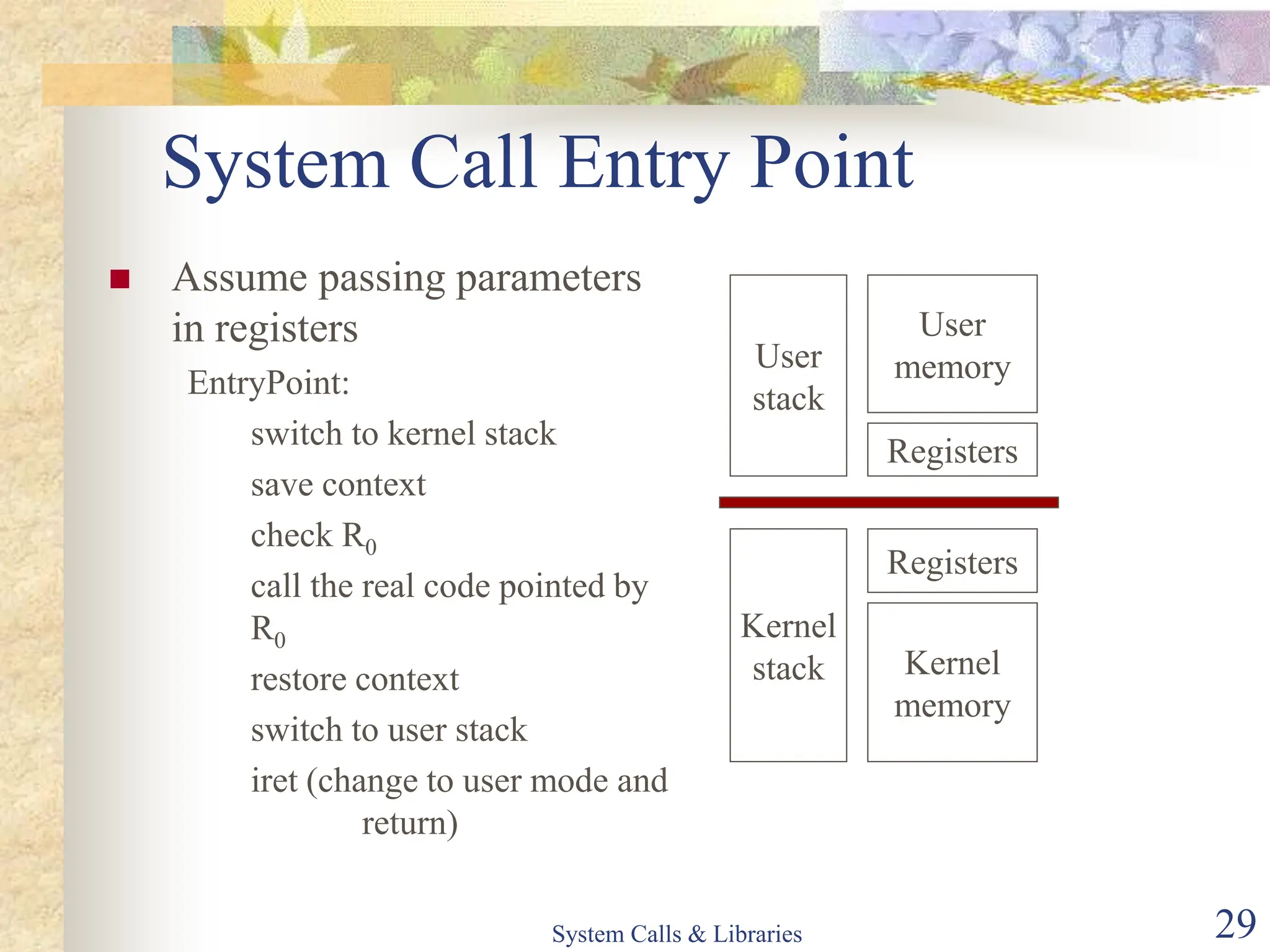
System Call Entry Point
User
stack
Registers
User
memory
Kernel
stack
Registers
Kernel
memory
 Assume passing parameters
in registers
EntryPoint:
switch to kernel stack
save context
check R0
call the real code pointed by
R0
restore context
switch to user stack
iret (change to user mode and
return)
System Calls & Libraries 30
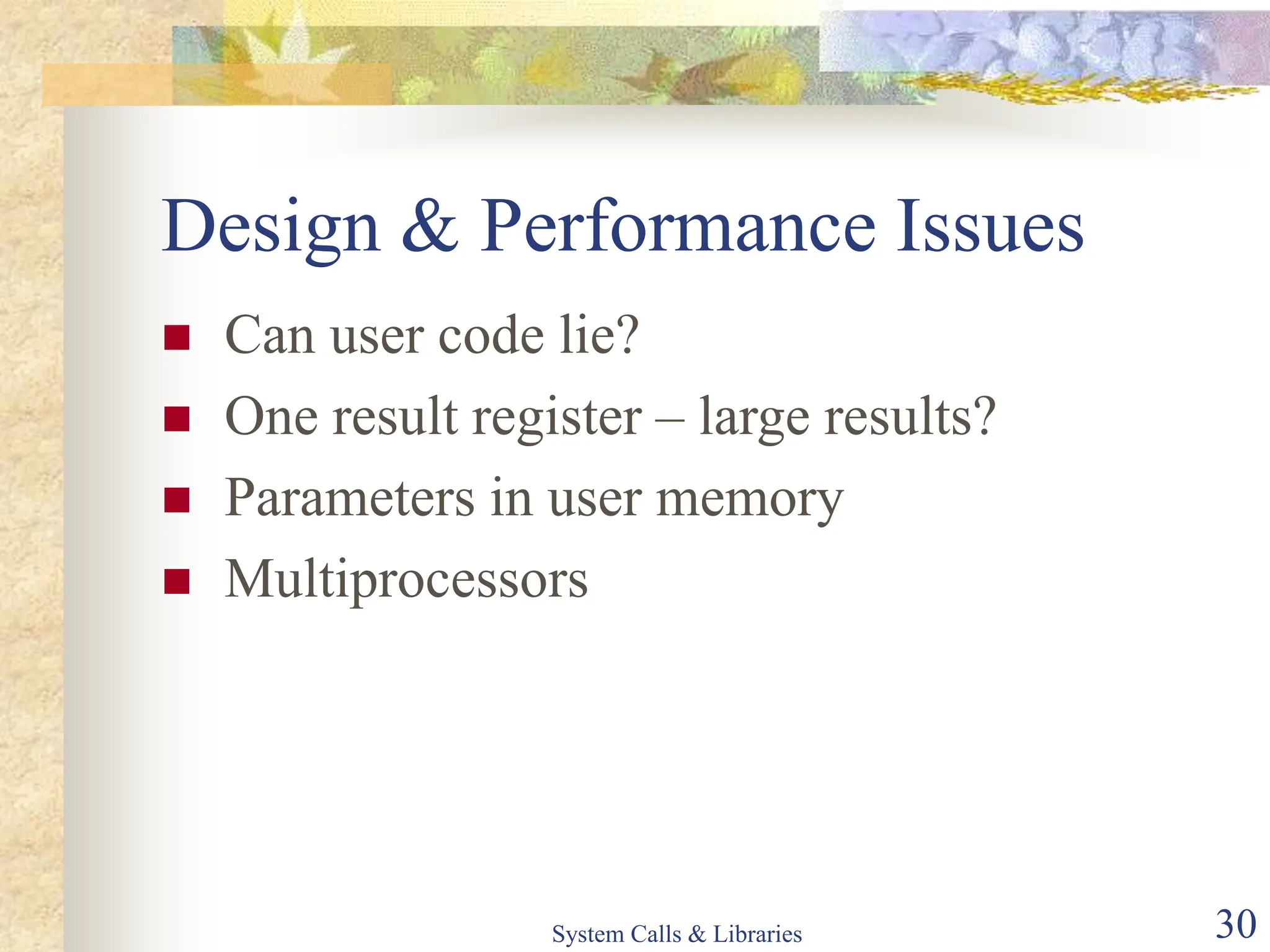
Design & Performance Issues
 Can user code lie?
 One result register – large results?
 Parameters in user memory
 Multiprocessors
System Calls & Libraries 31
General Design Aesthetics
 Simplicity, obviousness
 Generality – same call handles many cases
 Composition / decomposition
But:
 Expressiveness
 Performance
System Calls & Libraries 32
Separation Of Concerns
Memory management
 Kernel allocates “pages” – hw protection
 Programs use malloc( ) – fine grained
 Kernel doesn’t care about small allocs
 Allocates pages to library
 Library handles malloc/free
System Calls & Libraries 33
Library Benefits
 Call overhead
 Chains of alloc/free don’t go to kernel
 Flexibility – easy to change policy
 Fragmentation
 Coalescing, free list management
 Easier to program
System Calls & Libraries 34
Feedback To The Program
 System calls, libraries are program to OS
 What about other direction?
 Various exceptional conditions
 General information, like screen resize
 When would this occur?
Answer: signals

lec4.ppt system calls explained in detail

  • 1.
    System Calls &Libraries Vivek Pai Lecture 4, COS318 Sep 25, 2001
  • 2.
    System Calls &Libraries 2 Gedankundmathematics Recall the pointer verification case for fread( )  Can you speed up the checking process?  What’s the best you could achieve? O(n)? O(logn)? O(1)?  What happens if you have >32 bits?  Aside: # atoms in universe = 1080, or 2256  Does this provide any other benefits?
  • 3.
    System Calls &Libraries 3 Mechanics  Is the project workable?  Has everyone started?  Barring major problems, due Tuesday midnight  Readings updated
  • 4.
    System Calls &Libraries 4 Protection Issues  I/O protection  Prevent users from performing illegal I/Os  Memory protection  Prevent users from modifying kernel code and data structures  CPU protection  Prevent a user from using the CPU for too long
  • 5.
    System Calls &Libraries 5 Protection Is Not Safety/Security  Protection is a prerequisite  Safety can be separation of concerns  Security related to overall design Examples?  Bad pointer access causing seg fault  Sniffing cleartext passwords on the wire
  • 6.
    System Calls &Libraries 6 Support in Modern Processors: User  Kernel User mode Regular instructions Access user-mode memory Kernel (privileged) mode Regular instructions Access user-mode memory An interrupt or exception (INT) A special instruction (IRET)
  • 7.
    System Calls &Libraries 7 Why a Privileged Mode?  Special Instructions  Mapping, TLB, etc  Device registers  I/O channels, etc.  Mode Bits  Processor features  Device access
  • 8.
    System Calls &Libraries 8 x86 Protection Rings Level 0 Level 1 Level 2 Level 3 Operating system kernel Operating system services Applications Privileged instructions Can be executed only When current privileged Level (CPR) is 0
  • 9.
    System Calls &Libraries 9 Other Design Approaches  “Capabilities”  Fine-grained access control  Crypto-like tokens  Microkernels  OS services in user space  Small core “hypervisor”
  • 10.
    System Calls &Libraries 10 Monolithic  All kernel routines are together  A system call interface  Examples:  Linux  Most Unix OS  NT Kernel many many things entry User program User program
  • 11.
    System Calls &Libraries 11 Monolithic Pros and Cons Pros  Relatively few crossings  Shared kernel address space  Performance Cons  Flexibility  Stability  Experimentation
  • 12.
    System Calls &Libraries 12 Layered Structure  Hiding information at each layer  Develop a layer at a time  Examples  THE (6 layers)  MS-DOS (4 layers) Hardware Level 1 Level 2 Level N . . .
  • 13.
    System Calls &Libraries 13 Layering Pros and Cons Pros  Separation of concerns  Simplicity / elegance Cons  Boundary crossings  Performance?
  • 14.
    System Calls &Libraries 14 Microkernel  Micro-kernel is “micro”  Services are implemented as regular process  Micro-kernel get services on behalf of users by messaging with the service processes  Examples: Taos, Mach, L4 m-kernel entry User program Services
  • 15.
    System Calls &Libraries 15 Microkernel Pros and Cons Pros  Easier to develop services  Fault isolation  Customization  Smaller kernel => easier to optimize Cons  Lots of boundary crossings  Really poor performance
  • 16.
    System Calls &Libraries 16 Virtual Machine  Virtual machine monitor  provide multiple virtual “real” hardware  run different OS codes  Example  IBM VM/370  virtual 8086 mode  Java  VMWare Bare hardware Small kernel VM1 VMn . . . OS1 OSn user user
  • 17.
    System Calls &Libraries 17 Hardware Support  What is the minimal support?  Can virtual machine be protected without such support?  Hint: what is a Turing machine?
  • 18.
    System Calls &Libraries 18 System Call Mechanism Kernel in protected memory entry  User code can be arbitrary  User code cannot modify kernel memory  Makes a system call with parameters  The call mechanism switches code to kernel mode  Execute system call  Return with results User program User program
  • 19.
    System Calls &Libraries 19 Interrupt and Exceptions  Interrupt Sources  Hardware (by external devices)  Software: INT n  Exceptions  Program error: faults, traps, and aborts  Software generated: INT 3  Machine-check exceptions  See Intel document chapter 5, volume 3 for details
  • 20.
    System Calls &Libraries 20 Interrupt and Exceptions (1) Vector # Mnemonic Description Type 0 #DE Divide error (by zero) Fault 1 #DB Debug Fault/trap 2 NMI interrupt Interrupt 3 #BP Breakpoint Trap 4 #OF Overflow Trap 5 #BR BOUND range exceeded Trap 6 #UD Invalid opcode Fault 7 #NM Device not available Fault 8 #DF Double fault Abort 9 Coprocessor segment overrun Fault 10 #TS Invalid TSS
  • 21.
    System Calls &Libraries 21 Interrupt and Exceptions (2) Vector # Mnemonic Description Type 11 #NP Segment not present Fault 12 #SS Stack-segment fault Fault 13 #GP General protection Fault 14 #PF Page fault Fault 15 Reserved Fault 16 #MF Floating-point error (math fault) Fault 17 #AC Alignment check Fault 18 #MC Machine check Abort 19-31 Reserved 32-255 User defined Interrupt
  • 22.
    System Calls &Libraries 22 System Calls  Interface between a process and the operating system kernel  Categories  Process management  Memory management  File management  Device management  Communication
  • 23.
    System Calls &Libraries 23 OS Kernel: Trap Handler HW Device Interrupt HW exceptions SW exceptions System Service Call Virtual address exceptions HW implementation of the boundary System service dispatcher System services Interrupt service routines Exception dispatcher Exception handlers VM manager’s pager Sys_call_table
  • 24.
    System Calls &Libraries 24 Passing Parameters  Affects and depends on  Architecture  Compiler  OS  Different choices for different purposes
  • 25.
    System Calls &Libraries 25 Passing Parameters - Registers Place parameters in registers  # of registers  # of usable registers  # of parameters in system call  Spill/fill code in compiler Really fast
  • 26.
    System Calls &Libraries 26 Passing Parameters - Vector Register holds vector address  Single register  Vector in user’s memory  Nothing horrible, just not common
  • 27.
    System Calls &Libraries 27 Passing Parameters - Stack Place parameters on stack  Similar to vector approach  Stack already exists  Gets copied anyway frame frame Top
  • 28.
    System Calls &Libraries 28 Library Stubs for System Calls  Use read( fd, buf, size) as an example: int read( int fd, char * buf, int size) { move fd, buf, size to R1, R2, R3 move READ to R0 int $0x80 move result to Rresult } User stack Registers User memory Kernel stack Registers Kernel memory Linux: 80 NT: 2E
  • 29.
    System Calls &Libraries 29 System Call Entry Point User stack Registers User memory Kernel stack Registers Kernel memory  Assume passing parameters in registers EntryPoint: switch to kernel stack save context check R0 call the real code pointed by R0 restore context switch to user stack iret (change to user mode and return)
  • 30.
    System Calls &Libraries 30 Design & Performance Issues  Can user code lie?  One result register – large results?  Parameters in user memory  Multiprocessors
  • 31.
    System Calls &Libraries 31 General Design Aesthetics  Simplicity, obviousness  Generality – same call handles many cases  Composition / decomposition But:  Expressiveness  Performance
  • 32.
    System Calls &Libraries 32 Separation Of Concerns Memory management  Kernel allocates “pages” – hw protection  Programs use malloc( ) – fine grained  Kernel doesn’t care about small allocs  Allocates pages to library  Library handles malloc/free
  • 33.
    System Calls &Libraries 33 Library Benefits  Call overhead  Chains of alloc/free don’t go to kernel  Flexibility – easy to change policy  Fragmentation  Coalescing, free list management  Easier to program
  • 34.
    System Calls &Libraries 34 Feedback To The Program  System calls, libraries are program to OS  What about other direction?  Various exceptional conditions  General information, like screen resize  When would this occur? Answer: signals