Inter-Process Communication
             using
Linux System Call API and Standard API


                               Jyoti Prakash
              6th Semester , Information Technology
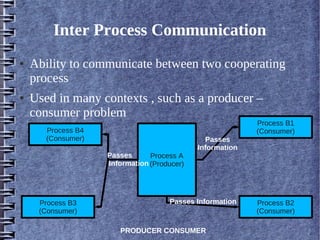
Inter Process Communication
●   Ability to communicate between two cooperating
    process
●   Used in many contexts , such as a producer –
    consumer problem
                                                           Process B1
       Process B4                                          (Consumer)
       (Consumer)                              Passes
                                             Information
                    Passes      Process A
                    Information (Producer)


     Process B3                      Passes Information    Process B2
     (Consumer)                                            (Consumer)

                       PRODUCER CONSUMER
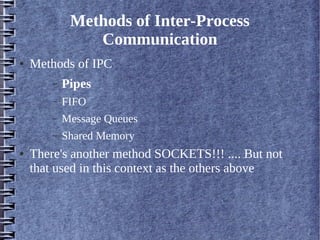
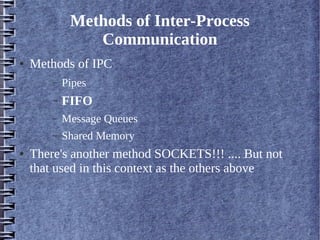
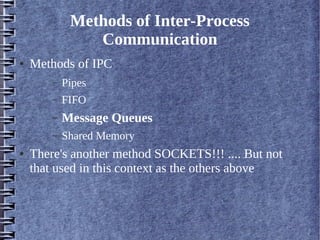
Methods of Inter-Process
                Communication
●   Methods of IPC
        –   Pipes
        –   FIFO
        –   Message Queues
        –   Shared Memory
●   There's another method SOCKETS!!! .... But not
    that used in this context as the others above
Pipes
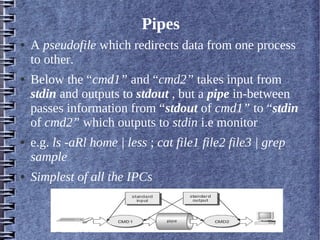
●   A pseudofile which redirects data from one process
    to other.
●   Below the “cmd1” and “cmd2” takes input from
    stdin and outputs to stdout , but a pipe in-between
    passes information from “stdout of cmd1” to “stdin
    of cmd2” which outputs to stdin i.e monitor
●   e.g. ls -aRl home | less ; cat file1 file2 file3 | grep
    sample
●   Simplest of all the IPCs
Pipes Implementation using Linux
        SysCall and Standard API
●   High Level
       –   User level implementation , end-user not required to
            interact with the kernel
       –   Two functions defined in stdio.h
                ●   FILE *popen(const char *command, const char
                      *open_mode)
                ●   int pclose(FILE *stream_to_close)
●   Low – Level
       –   Kernel level implementation, end-user required to
            interact with the kernel
       –   System call available in unistd.h
                ●   int pipe(int file_descriptor[2])
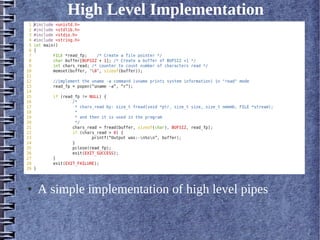
High Level Implementation


●   A simple implementation of high level pipes
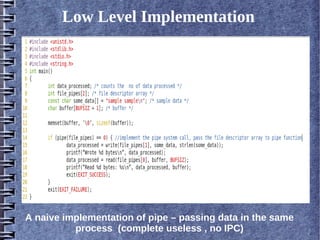
Low Level Implementation


A naive implementation of pipe – passing data in the same
          process (complete useless , no IPC)
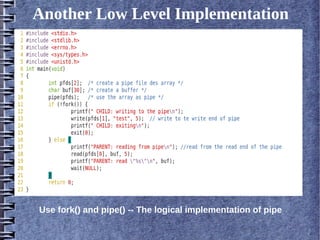
Another Low Level Implementation


Use fork() and pipe() -- The logical implementation of pipe
Methods of Inter-Process
                Communication
●   Methods of IPC
        –   Pipes
        –   FIFO
        –   Message Queues
        –   Shared Memory
●   There's another method SOCKETS!!! .... But not
    that used in this context as the others above
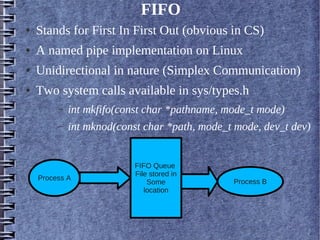
FIFO
●   Stands for First In First Out (obvious in CS)
●   A named pipe implementation on Linux
●   Unidirectional in nature (Simplex Communication)
●   Two system calls available in sys/types.h
         –   int mkfifo(const char *pathname, mode_t mode)
         –   int mknod(const char *path, mode_t mode, dev_t dev)


                           FIFO Queue
                           File stored in
    Process A
                               Some            Process B
                              location
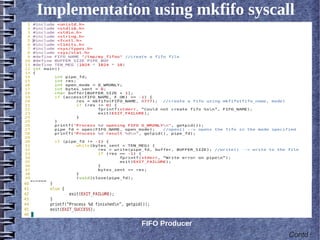
Implementation using mkfifo syscall


              FIFO Producer
                                  Contd ...
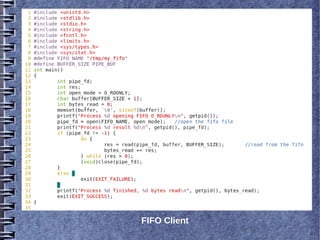
FIFO Client
Methods of Inter-Process
                Communication
●   Methods of IPC
        –   Pipes
        –   FIFO
        –   Message Queues
        –   Shared Memory
●   There's another method SOCKETS!!! .... But not
    that used in this context as the others above
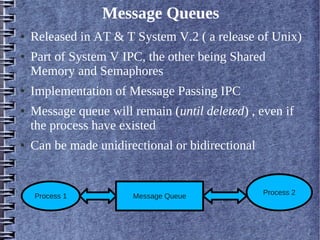
Message Queues
●   Released in AT & T System V.2 ( a release of Unix)
●   Part of System V IPC, the other being Shared
    Memory and Semaphores
●   Implementation of Message Passing IPC
●   Message queue will remain (until deleted) , even if
    the process have existed
●   Can be made unidirectional or bidirectional


                                                  Process 2
    Process 1          Message Queue
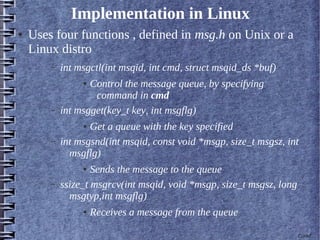
Implementation in Linux
●   Uses four functions , defined in msg.h on Unix or a
    Linux distro
        –   int msgctl(int msqid, int cmd, struct msqid_ds *buf)
                 ● Control the message queue, by specifying
                    command in cmd
        –   int msgget(key_t key, int msgflg)
                 ● Get a queue with the key specified
        –   int msgsnd(int msqid, const void *msgp, size_t msgsz, int
              msgflg)
                 ●  Sends the message to the queue
        –   ssize_t msgrcv(int msqid, void *msgp, size_t msgsz, long
              msgtyp,int msgflg)
                 ●   Receives a message from the queue

                                                                       Contd ...
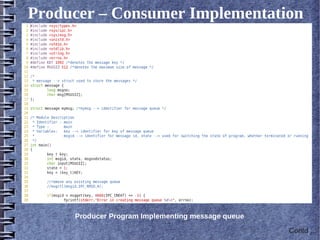
Producer – Consumer Implementation


     Producer Program Implementing message queue

                                                   Contd ...
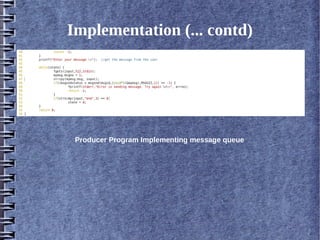
Implementation (... contd)


 Producer Program Implementing message queue
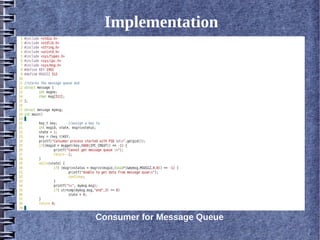
Implementation


Consumer for Message Queue
Methods of Inter-Process
                Communication
●   Methods of IPC
        –   Pipes
        –   FIFO
        –   Message Queues
        –  Shared Memory
●   There's another method SOCKETS!!! .... But not
    that used in this context as others
Shared Memory
●   One of the AT & T System V IPC
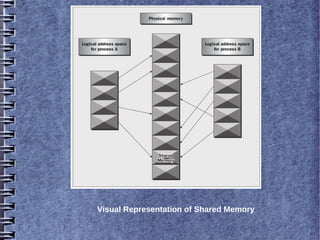
●   Simple concept, keep a memory segment , which can
    be shared by two or more processes
●   Real Implementation : A process creates a memory
    segment for IPC from its logical address space and
    appears in that. Other process can attach that
    available space for communication.
●   One of the most simplest and logical
    implementation of IPC
Visual Representation of Shared Memory
Implementation
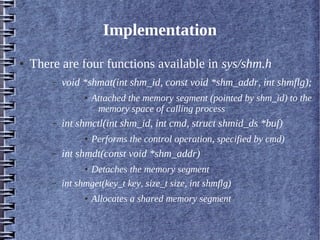
●   There are four functions available in sys/shm.h
        –   void *shmat(int shm_id, const void *shm_addr, int shmflg);
                  ●   Attached the memory segment (pointed by shm_id) to the
                       memory space of calling process
        –   int shmctl(int shm_id, int cmd, struct shmid_ds *buf)
                  ●   Performs the control operation, specified by cmd)
        –   int shmdt(const void *shm_addr)
                  ●Detaches the memory segment
        –   int shmget(key_t key, size_t size, int shmflg)
                  ●   Allocates a shared memory segment
Implementation


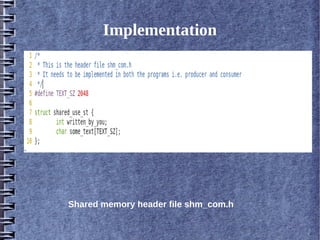
Shared memory header file shm_com.h
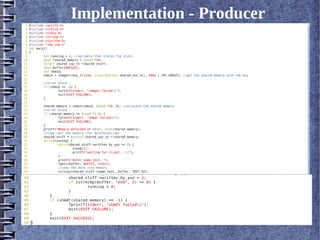
Implementation - Producer
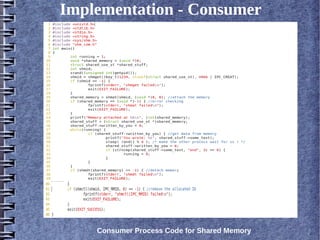
Implementation - Consumer


    Consumer Process Code for Shared Memory
References
●   Modern Operating Systems
            –   Andrew S. Tanenbaum
●   Operating Systems Design and Implementation
            –   Andrew S. Tanenbaum
●   Operating System Concepts
            –   Bear, Galvin and Silberschatz
●   Beginning Linux Programming
            –   Neil Matthew and Richard Stones
●   Beej's Guide to IPC
●   MIT OCW on Operating System Engineering
            –   www.ocw.mit.edu/6-828-fall-2006/6-828-fall-2006/contents/index.htm
Any Queries ???
Thank you

Inter process communication using Linux System Calls

  • 1.
    Inter-Process Communication using Linux System Call API and Standard API Jyoti Prakash 6th Semester , Information Technology
  • 2.
    Inter Process Communication ● Ability to communicate between two cooperating process ● Used in many contexts , such as a producer – consumer problem Process B1 Process B4 (Consumer) (Consumer) Passes Information Passes Process A Information (Producer) Process B3 Passes Information Process B2 (Consumer) (Consumer) PRODUCER CONSUMER
  • 3.
    Methods of Inter-Process Communication ● Methods of IPC – Pipes – FIFO – Message Queues – Shared Memory ● There's another method SOCKETS!!! .... But not that used in this context as the others above
  • 4.
    Pipes ● A pseudofile which redirects data from one process to other. ● Below the “cmd1” and “cmd2” takes input from stdin and outputs to stdout , but a pipe in-between passes information from “stdout of cmd1” to “stdin of cmd2” which outputs to stdin i.e monitor ● e.g. ls -aRl home | less ; cat file1 file2 file3 | grep sample ● Simplest of all the IPCs
  • 5.
    Pipes Implementation usingLinux SysCall and Standard API ● High Level – User level implementation , end-user not required to interact with the kernel – Two functions defined in stdio.h ● FILE *popen(const char *command, const char *open_mode) ● int pclose(FILE *stream_to_close) ● Low – Level – Kernel level implementation, end-user required to interact with the kernel – System call available in unistd.h ● int pipe(int file_descriptor[2])
  • 6.
    High Level Implementation ● A simple implementation of high level pipes
  • 7.
    Low Level Implementation Anaive implementation of pipe – passing data in the same process (complete useless , no IPC)
  • 8.
    Another Low LevelImplementation Use fork() and pipe() -- The logical implementation of pipe
  • 9.
    Methods of Inter-Process Communication ● Methods of IPC – Pipes – FIFO – Message Queues – Shared Memory ● There's another method SOCKETS!!! .... But not that used in this context as the others above
  • 10.
    FIFO ● Stands for First In First Out (obvious in CS) ● A named pipe implementation on Linux ● Unidirectional in nature (Simplex Communication) ● Two system calls available in sys/types.h – int mkfifo(const char *pathname, mode_t mode) – int mknod(const char *path, mode_t mode, dev_t dev) FIFO Queue File stored in Process A Some Process B location
  • 11.
    Implementation using mkfifosyscall FIFO Producer Contd ...
  • 12.
  • 13.
    Methods of Inter-Process Communication ● Methods of IPC – Pipes – FIFO – Message Queues – Shared Memory ● There's another method SOCKETS!!! .... But not that used in this context as the others above
  • 14.
    Message Queues ● Released in AT & T System V.2 ( a release of Unix) ● Part of System V IPC, the other being Shared Memory and Semaphores ● Implementation of Message Passing IPC ● Message queue will remain (until deleted) , even if the process have existed ● Can be made unidirectional or bidirectional Process 2 Process 1 Message Queue
  • 15.
    Implementation in Linux ● Uses four functions , defined in msg.h on Unix or a Linux distro – int msgctl(int msqid, int cmd, struct msqid_ds *buf) ● Control the message queue, by specifying command in cmd – int msgget(key_t key, int msgflg) ● Get a queue with the key specified – int msgsnd(int msqid, const void *msgp, size_t msgsz, int msgflg) ● Sends the message to the queue – ssize_t msgrcv(int msqid, void *msgp, size_t msgsz, long msgtyp,int msgflg) ● Receives a message from the queue Contd ...
  • 16.
    Producer – ConsumerImplementation Producer Program Implementing message queue Contd ...
  • 17.
    Implementation (... contd) Producer Program Implementing message queue
  • 18.
  • 19.
    Methods of Inter-Process Communication ● Methods of IPC – Pipes – FIFO – Message Queues – Shared Memory ● There's another method SOCKETS!!! .... But not that used in this context as others
  • 20.
    Shared Memory ● One of the AT & T System V IPC ● Simple concept, keep a memory segment , which can be shared by two or more processes ● Real Implementation : A process creates a memory segment for IPC from its logical address space and appears in that. Other process can attach that available space for communication. ● One of the most simplest and logical implementation of IPC
  • 21.
  • 22.
    Implementation ● There are four functions available in sys/shm.h – void *shmat(int shm_id, const void *shm_addr, int shmflg); ● Attached the memory segment (pointed by shm_id) to the memory space of calling process – int shmctl(int shm_id, int cmd, struct shmid_ds *buf) ● Performs the control operation, specified by cmd) – int shmdt(const void *shm_addr) ●Detaches the memory segment – int shmget(key_t key, size_t size, int shmflg) ● Allocates a shared memory segment
  • 23.
  • 24.
  • 25.
    Implementation - Consumer Consumer Process Code for Shared Memory
  • 26.
    References ● Modern Operating Systems – Andrew S. Tanenbaum ● Operating Systems Design and Implementation – Andrew S. Tanenbaum ● Operating System Concepts – Bear, Galvin and Silberschatz ● Beginning Linux Programming – Neil Matthew and Richard Stones ● Beej's Guide to IPC ● MIT OCW on Operating System Engineering – www.ocw.mit.edu/6-828-fall-2006/6-828-fall-2006/contents/index.htm
  • 27.
  • 28.