Spinal Fractures Classification System
an AOSpine Knowledge Forum initiative
Cervical Spine Fractures
Thoracolumbar Spine Fractures
AOSpine–the leading global academic community
for innovative education and research in spine care,
inspiring lifelong learning and improving patients’ lives.
Spinal Fractures Classification System 3
CONTENT AOSpine Classification and Injury Severity System . . . . . . . . . . . . . . . . 04
for Traumatic Fractures of the Cervical Spine
AOSpine Classification and Injury Severity System . . . . . . . . . . . . . . . . . 37
for Traumatic Fractures of the Thoracolumbar Spine
Spinal Fractures Classification System
an AOSpine Knowledge Forum initiative
Project members
(in alphabetic order)
Disclaimer
Aarabi B, Bellabarba C, Chapman J, Dvorak M, Fehlings M, Kandziora F, Kepler C,
Oner C, Rajasekaran S, Reinhold M, Schnake K, Vialle L and Vaccaro A.
1. Vaccaro, A. R., J. D. Koerner, K. E. Radcliff, F. C. Oner, M. Reinhold, K. J. Schnake, F.
Kandziora, M. G. Fehlings, M. F. Dvorak, B. Aarabi, S. Rajasekaran, G. D. Schroeder, C.
K. Kepler and L. R. Vialle (2015). “AOSpine subaxial cervical spine injury classification
system.” Eur Spine J.
2. International validation process to be completed in 2015.
3. Submitted to AOSpine International Board for endorsement as the official AOSpine
TL Fractures Classification
This is the present form of the classification the AOSpine Knowledge Forum (KF) SCI & Trauma is working on.
It is the aim of the KF to develop a system, which can in the future be used as a tool for scientific research and
a guide for treatment. This system is being subjected to a rigorous scientific assessment.
AOSpine Classification and Injury
Severity System for Traumatic Fractures
of the Cervical Spine
AOSpine Knowledge Forum
Cervical Spine Fractures Classification System 5
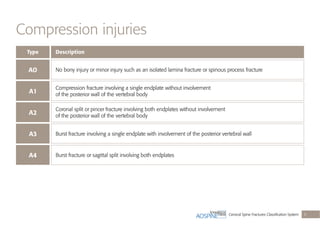
Compression injuries
Type
AO
A1
A2
A3
A4
Description
No bony injury or minor injury such as an isolated lamina fracture or spinous process fracture
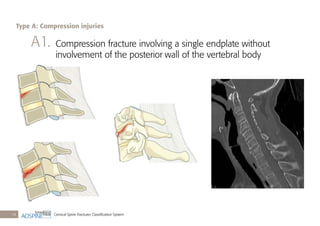
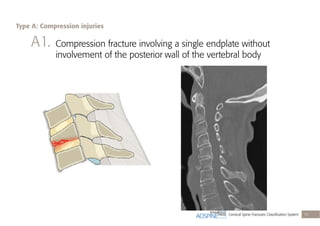
Compression fracture involving a single endplate without involvement
of the posterior wall of the vertebral body
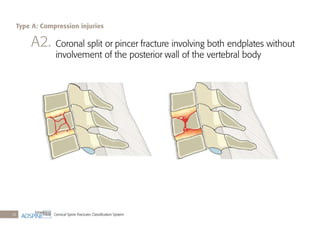
Coronal split or pincer fracture involving both endplates without involvement
of the posterior wall of the vertebral body
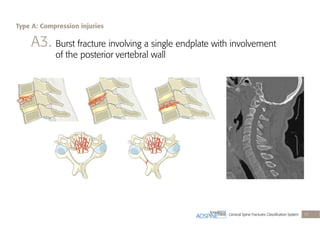
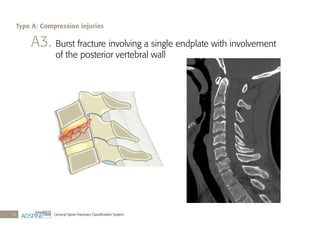
Burst fracture involving a single endplate with involvement of the posterior vertebral wall
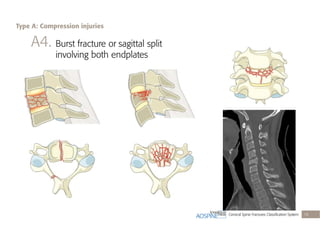
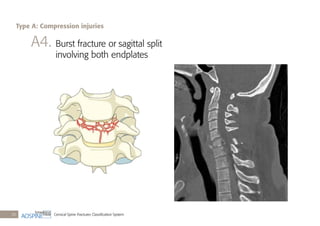
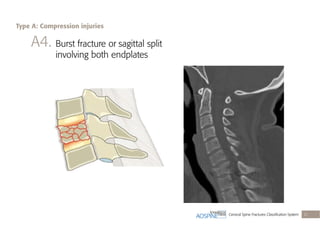
Burst fracture or sagittal split involving both endplates
Cervical Spine Fractures Classification System6
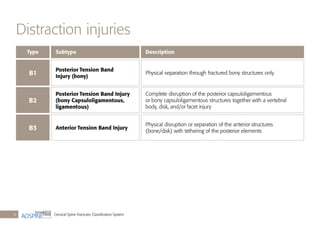
Distraction injuries
Type
B1
B2
B3
DescriptionSubtype
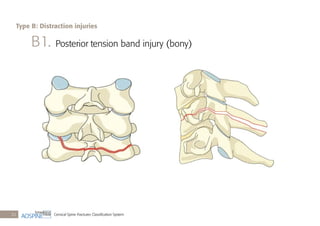
Physical separation through fractured bony structures only
Posterior Tension Band
Injury (bony)
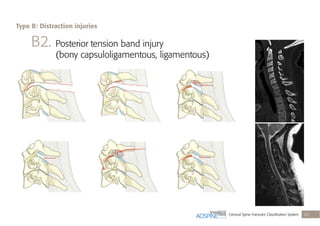
Complete disruption of the posterior capsuloligamentous
or bony capsuloligamentous structures together with a vertebral
body, disk, and/or facet injury
Posterior Tension Band Injury
(bony Capsuloligamentous,
ligamentous)
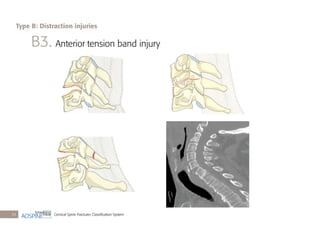
Physical disruption or separation of the anterior structures
(bone/disk) with tethering of the posterior elements
Anterior Tension Band Injury
Cervical Spine Fractures Classification System 7
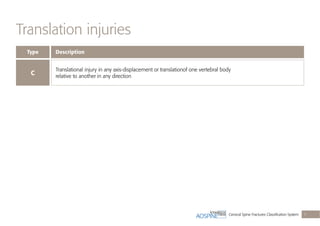
Translation injuries
Type
C
Description
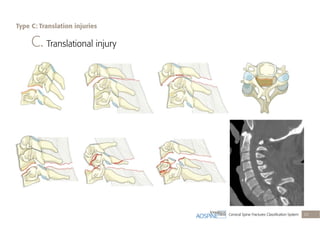
Translational injury in any axis-displacement or translationof one vertebral body
relative to another in any direction
Cervical Spine Fractures Classification System8
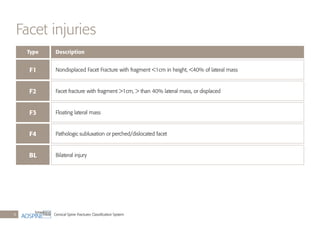
Facet injuries
Type
F1
F3
F2
F4
BL
Description
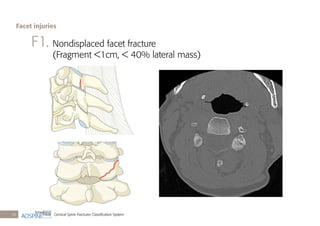
Nondisplaced Facet Fracture with fragment <1cm in height, <40% of lateral mass
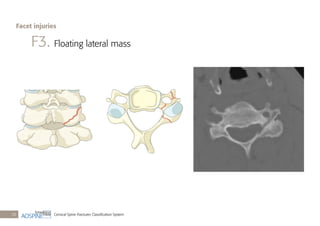
Floating lateral mass
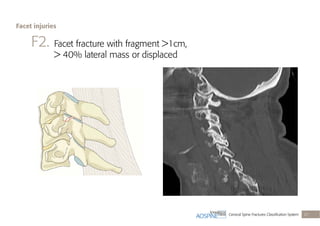
Facet fracture with fragment >1cm, > than 40% lateral mass, or displaced
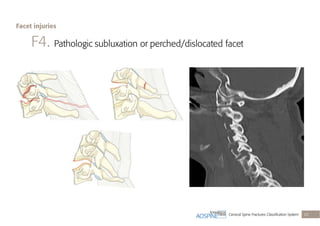
Pathologic subluxation or perched/dislocated facet
Bilateral injury
Cervical Spine Fractures Classification System 9
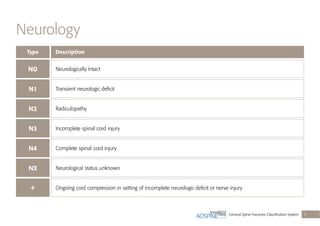
Neurology
Type
NO
N3
N1
N4
N2
NX
+
Description
Neurologically Intact
Incomplete spinal cord injury
Transient neurologic deficit
Complete spinal cord injury
Radiculopathy
Neurological status unknown
Ongoing cord compression in setting of incomplete neurologic deficit or nerve injury
Cervical Spine Fractures Classification System10
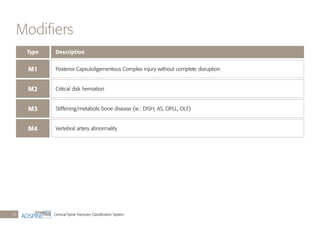
Modifiers
Type
M1
M4
M2
M3
Description
Posterior Capsuloligamentous Complex injury without complete disruption
Vertebral artery abnormality
Critical disk herniation
Stiffening/metabolic bone disease (ie.: DISH, AS, OPLL, OLF)
Cervical Spine Fractures Classification System 11
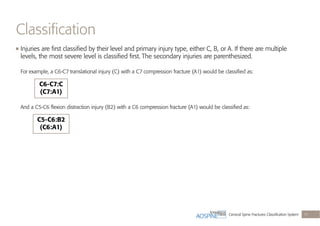
Injuries are first classified by their level and primary injury type, either C, B, or A. If there are multiple
levels, the most severe level is classified first. The secondary injuries are parenthesized.
For example, a C6-C7 translational injury (C) with a C7 compression fracture (A1) would be classified as:
C6-C7:C
(C7:A1)
And a C5-C6 flexion distraction injury (B2) with a C6 compression fracture (A1) would be classified as:
C5-C6:B2
(C6:A1)
Classification
Cervical Spine Fractures Classification System12
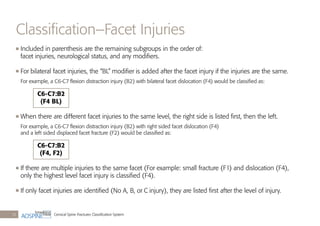
Included in parenthesis are the remaining subgroups in the order of:
facet injuries, neurological status, and any modifiers.
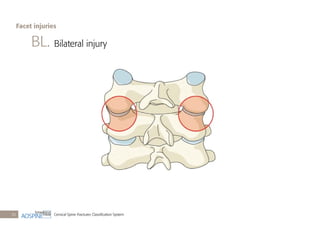
For bilateral facet injuries, the “BL” modifier is added after the facet injury if the injuries are the same.
For example, a C6-C7 flexion distraction injury (B2) with bilateral facet dislocation (F4) would be classified as:
C6-C7:B2
(F4 BL)
When there are different facet injuries to the same level, the right side is listed first, then the left.
For example, a C6-C7 flexion distraction injury (B2) with right sided facet dislocation (F4)
and a left sided displaced facet fracture (F2) would be classified as:
C6-C7:B2
(F4, F2)
If there are multiple injuries to the same facet (For example: small fracture (F1) and dislocation (F4),
only the highest level facet injury is classified (F4).
If only facet injuries are identified (No A, B, or C injury), they are listed first after the level of injury.
Classification–Facet Injuries
Cervical Spine Fractures Classification System 13
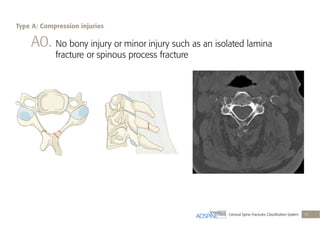
A0. No bony injury or minor injury such as an isolated lamina
fracture or spinous process fracture
Type A: Compression injuries
Cervical Spine Fractures Classification System14
A1. Compression fracture involving a single endplate without
involvement of the posterior wall of the vertebral body
Type A: Compression injuries
Cervical Spine Fractures Classification System 15
A1. Compression fracture involving a single endplate without
involvement of the posterior wall of the vertebral body
Type A: Compression injuries
Cervical Spine Fractures Classification System16
A2. Coronal split or pincer fracture involving both endplates without
involvement of the posterior wall of the vertebral body
Type A: Compression injuries
Cervical Spine Fractures Classification System 17
A3. Burst fracture involving a single endplate with involvement
of the posterior vertebral wall
Type A: Compression injuries
Cervical Spine Fractures Classification System18
A3. Burst fracture involving a single endplate with involvement
of the posterior vertebral wall
Type A: Compression injuries
Cervical Spine Fractures Classification System 19
A4. Burst fracture or sagittal split
involving both endplates
Type A: Compression injuries
Cervical Spine Fractures Classification System20
A4. Burst fracture or sagittal split
involving both endplates
Type A: Compression injuries
Cervical Spine Fractures Classification System 21
A4. Burst fracture or sagittal split
involving both endplates
Type A: Compression injuries
Cervical Spine Fractures Classification System22
B1. Posterior tension band injury (bony)
Type B: Distraction injuries
Cervical Spine Fractures Classification System 23
B2. Posterior tension band injury
(bony capsuloligamentous, ligamentous)
Type B: Distraction injuries
Cervical Spine Fractures Classification System24
B3. Anterior tension band injury
Type B: Distraction injuries
Cervical Spine Fractures Classification System 25
C. Translational injury
Type C: Translation injuries
Cervical Spine Fractures Classification System26
F1. Nondisplaced facet fracture
(Fragment <1cm, < 40% lateral mass)
Facet injuries
Cervical Spine Fractures Classification System 27
F2. Facet fracture with fragment >1cm,
> 40% lateral mass or displaced
Facet injuries
Cervical Spine Fractures Classification System28
F3. Floating lateral mass
Facet injuries
Cervical Spine Fractures Classification System 29
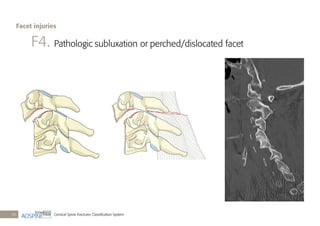
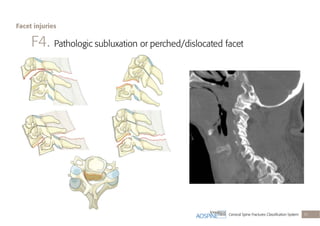
F4. Pathologic subluxation or perched/dislocated facet
Facet injuries
Cervical Spine Fractures Classification System30
F4. Pathologic subluxation or perched/dislocated facet
Facet injuries
Cervical Spine Fractures Classification System 31
F4. Pathologic subluxation or perched/dislocated facet
Facet injuries
Cervical Spine Fractures Classification System32
BL. Bilateral injury
Facet injuries
Cervical Spine Fractures Classification System 33
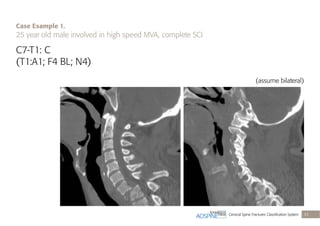
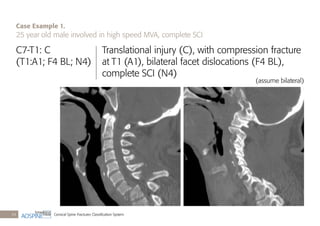
C7-T1: C
(T1:A1; F4 BL; N4)
(assume bilateral)
Case Example 1.
25 year old male involved in high speed MVA, complete SCI
Cervical Spine Fractures Classification System34
C7-T1: C
(T1:A1; F4 BL; N4)
Translational injury (C), with compression fracture
at T1 (A1), bilateral facet dislocations (F4 BL),
complete SCI (N4)
(assume bilateral)
Case Example 1.
25 year old male involved in high speed MVA, complete SCI
Cervical Spine Fractures Classification System 35
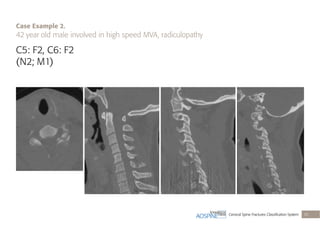
C5: F2, C6: F2
(N2; M1)
Case Example 2.
42 year old male involved in high speed MVA, radiculopathy
Cervical Spine Fractures Classification System36
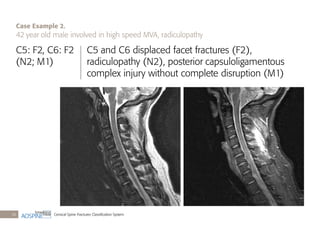
C5: F2, C6: F2
(N2; M1)
C5 and C6 displaced facet fractures (F2),
radiculopathy (N2), posterior capsuloligamentous
complex injury without complete disruption (M1)
Case Example 2.
42 year old male involved in high speed MVA, radiculopathy
AOSpine Classification and Injury
Severity System for Traumatic Fractures
of the Thoracolumbar Spine
AOSpine Knowledge Forum
Project members
(in alphabetic order)
Disclaimer
Aarabi B, Bellabarba C, Chapman J, Dvorak M, Fehlings M, Kandziora F, Kepler C,
Oner C, Rajasekaran S, Reinhold M, Schnake K, Vialle L and Vaccaro A.
1. Vaccaro, A. R., C. Oner, C. K. Kepler, M. Dvorak, K. Schnake, C. Bellabarba, M. Reinhold,
B. Aarabi, F. Kandziora, J. Chapman, R. Shanmuganathan, M. Fehlings, L. Vialle, A. O.
S. C. Injury and F. Trauma Knowledge (2013). “AOSpine thoracolumbar spine injury
classification system: fracture description, neurological status, and key modifiers.” Spine
(Phila Pa 1976) 38(23): 2028-2037.
2. Kepler, C. K., A. R. Vaccaro, J. D. Koerner, M. Dvorak, F. Kandziora, S. Rajasekaran, L. Vialle,
M. Fehlings, G. D. Schroeder, M. Reinhold, K. Schnake, C. Bellabarba and C. Oner (2015).
“Reliability Analysis of the AOSpine thoracolumbar Spine Injury Classification System by a
Worldwide Group of Naïve Spinal Surgeouns.” European Spine Journal. (in press)
3. Submitted to AOSpine International Board for endorsement as the official AOSpine TL
Fractures Classification
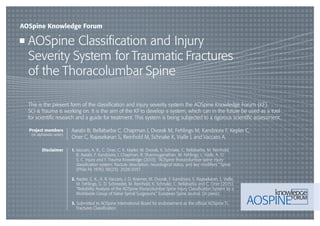
This is the present form of the classification and injury severity system the AOSpine Knowledge Forum (KF)
SCI & Trauma is working on. It is the aim of the KF to develop a system, which can in the future be used as a tool
for scientific research and a guide for treatment. This system is being subjected to a rigorous scientific assessment.
Thoracolumbar Spine Fractures Classification System38
Thoracolumbar Fractures–Overview
This classification and injury severity system is based
on the evaluation of three basic parameters:
1. Morphologic classification of the fracture
2. Neurologic injury
3. Clinical modifiers
Thoracolumbar Spine Fractures Classification System 39
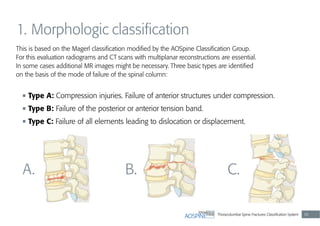
1. Morphologic classification
A. B. C.
This is based on the Magerl classification modified by the AOSpine Classification Group.
For this evaluation radiograms and CT scans with multiplanar reconstructions are essential.
In some cases additional MR images might be necessary. Three basic types are identified
on the basis of the mode of failure of the spinal column:
Type A: Compression injuries. Failure of anterior structures under compression.
Type B: Failure of the posterior or anterior tension band.
Type C: Failure of all elements leading to dislocation or displacement.
Thoracolumbar Spine Fractures Classification System40
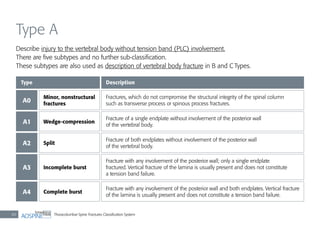
Type A
Describe injury to the vertebral body without tension band (PLC) involvement.
There are five subtypes and no further sub-classification.
These subtypes are also used as description of vertebral body fracture in B and C Types.
Type
A0
A2
A1
A3
A4
Description
Fractures, which do not compromise the structural integrity of the spinal column
such as transverse process or spinous process fractures.
Fracture of both endplates without involvement of the posterior wall
of the vertebral body.
Fracture of a single endplate without involvement of the posterior wall
of the vertebral body.
Fracture with any involvement of the posterior wall; only a single endplate
fractured. Vertical fracture of the lamina is usually present and does not constitute
a tension band failure.
Fracture with any involvement of the posterior wall and both endplates. Vertical fracture
of the lamina is usually present and does not constitute a tension band failure.
Minor, nonstructural
fractures
Split
Wedge-compression
Incomplete burst
Complete burst
Thoracolumbar Spine Fractures Classification System 41
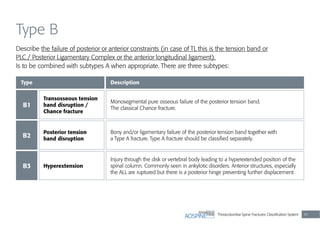
Type B
Describe the failure of posterior or anterior constraints (in case of TL this is the tension band or
PLC / Posterior Ligamentary Complex or the anterior longitudinal ligament).
Is to be combined with subtypes A when appropriate. There are three subtypes:
Type
B1
B3
B2
Description
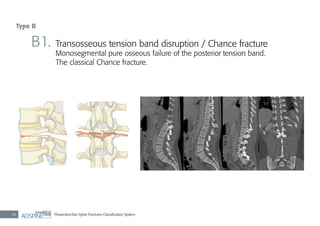
Monosegmental pure osseous failure of the posterior tension band.
The classical Chance fracture.
Injury through the disk or vertebral body leading to a hyperextended position of the
spinal column. Commonly seen in ankylotic disorders. Anterior structures, especially
the ALL are ruptured but there is a posterior hinge preventing further displacement.
Bony and/or ligamentary failure of the posterior tension band together with
a Type A fracture. Type A fracture should be classified separately.
Transosseous tension
band disruption /
Chance fracture
Hyperextension
Posterior tension
band disruption
Thoracolumbar Spine Fractures Classification System42
Type C
Describe displacement or dislocation.
There are no subtypes as because of the dissociation between cranial and
caudal segments various configurations are possible in different images.
Is combined with subtypes of A if necessary.
Thoracolumbar Spine Fractures Classification System 43
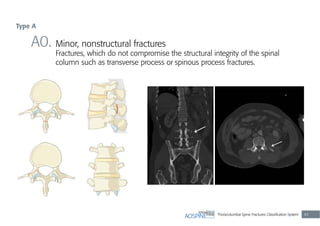
A0. Minor, nonstructural fractures
Fractures, which do not compromise the structural integrity of the spinal
column such as transverse process or spinous process fractures.
Type A
Thoracolumbar Spine Fractures Classification System44
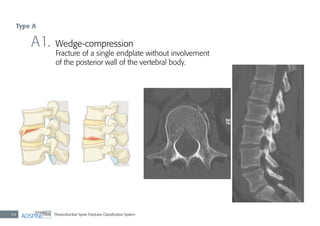
A1. Wedge-compression
Fracture of a single endplate without involvement
of the posterior wall of the vertebral body.
Type A
Thoracolumbar Spine Fractures Classification System 45
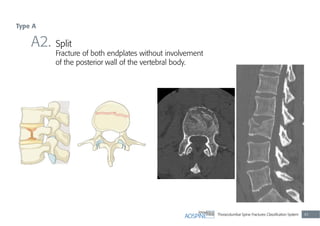
A2. Split
Fracture of both endplates without involvement
of the posterior wall of the vertebral body.
Type A
Thoracolumbar Spine Fractures Classification System46
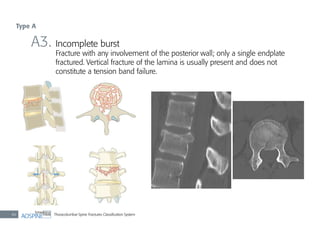
A3. Incomplete burst
Fracture with any involvement of the posterior wall; only a single endplate
fractured. Vertical fracture of the lamina is usually present and does not
constitute a tension band failure.
Type A
Thoracolumbar Spine Fractures Classification System 47
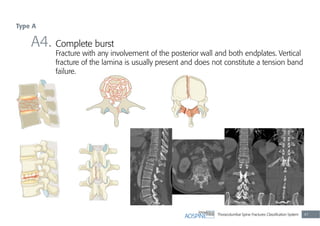
A4. Complete burst
Fracture with any involvement of the posterior wall and both endplates. Vertical
fracture of the lamina is usually present and does not constitute a tension band
failure.
Type A
Thoracolumbar Spine Fractures Classification System48
B1. Transosseous tension band disruption / Chance fracture
Monosegmental pure osseous failure of the posterior tension band.
The classical Chance fracture.
Type B
Thoracolumbar Spine Fractures Classification System 49
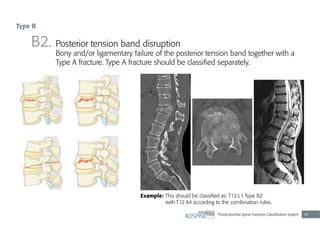
B2. Posterior tension band disruption
Bony and/or ligamentary failure of the posterior tension band together with a
Type A fracture. Type A fracture should be classified separately.
Example: This should be classified as: T12-L1Type B2
with T12 A4 according to the combination rules.
Type B
Thoracolumbar Spine Fractures Classification System50
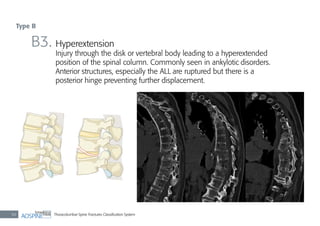
B3. Hyperextension
Injury through the disk or vertebral body leading to a hyperextended
position of the spinal column. Commonly seen in ankylotic disorders.
Anterior structures, especially the ALL are ruptured but there is a
posterior hinge preventing further displacement.
Type B
Thoracolumbar Spine Fractures Classification System 51
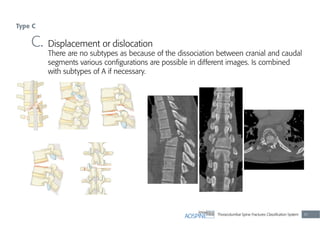
C. Displacement or dislocation
There are no subtypes as because of the dissociation between cranial and caudal
segments various configurations are possible in different images. Is combined
with subtypes of A if necessary.
Type C
Thoracolumbar Spine Fractures Classification System52
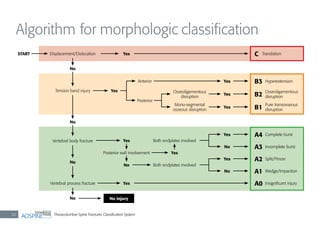
Algorithm for morphologic classification
START Yes
Yes
No
No
No
No
No No injury
No
No
Yes
Yes
Yes
Yes
Yes
Translation
Insignificant injury
Complete burst
Hyperextension
Split/Pincer
Pure transosseous
disruption
Wedge/Impaction
Incomplete burst
Osseoligamentous
disruption
C
A0
A4
B3
A2
B1
A1
A3
B2
Displacement/Dislocation
Vertebral process fracture
Vertebral body fracture
Tension band injury
Both endplates involved
Mono-segmental
osseous disruption
Posterior wall involvement
Posterior
Anterior
Yes
Yes
Yes
Both endplates involved
Osseoligamentous
disruption
Thoracolumbar Spine Fractures Classification System 53
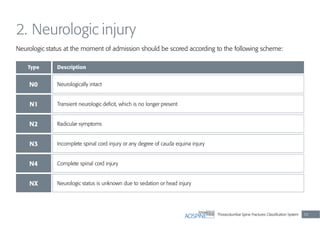
2. Neurologic injury
Neurologic status at the moment of admission should be scored according to the following scheme:
Type
N0
N2
N1
N3
N4
NX
Description
Neurologically intact
Radicular symptoms
Transient neurologic deficit, which is no longer present
Incomplete spinal cord injury or any degree of cauda equina injury
Complete spinal cord injury
Neurologic status is unknown due to sedation or head injury
Thoracolumbar Spine Fractures Classification System54
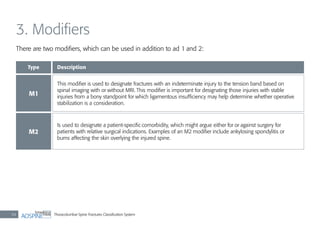
3. Modifiers
There are two modifiers, which can be used in addition to ad 1 and 2:
Type
M1
M2
Description
This modifier is used to designate fractures with an indeterminate injury to the tension band based on
spinal imaging with or without MRI. This modifier is important for designating those injuries with stable
injuries from a bony standpoint for which ligamentous insufficiency may help determine whether operative
stabilization is a consideration.
Is used to designate a patient-specific comorbidity, which might argue either for or against surgery for
patients with relative surgical indications. Examples of an M2 modifier include ankylosing spondylitis or
burns affecting the skin overlying the injured spine.
Advancing
spine care
worldwide
AOSpine Latin America
Avenida Silva Jardim, 2042
Cj 1505
80250-200
Curitiba, Brasil
T +55 (41) 3016 4491
F +55 (41) 3016 4491
aosla@aospine.org
www.aospine.org
AOSpine Latin America
@AOSpine_Latam

Ao artìculo

  • 1.
    Spinal Fractures ClassificationSystem an AOSpine Knowledge Forum initiative Cervical Spine Fractures Thoracolumbar Spine Fractures
  • 2.
    AOSpine–the leading globalacademic community for innovative education and research in spine care, inspiring lifelong learning and improving patients’ lives.
  • 3.
    Spinal Fractures ClassificationSystem 3 CONTENT AOSpine Classification and Injury Severity System . . . . . . . . . . . . . . . . 04 for Traumatic Fractures of the Cervical Spine AOSpine Classification and Injury Severity System . . . . . . . . . . . . . . . . . 37 for Traumatic Fractures of the Thoracolumbar Spine Spinal Fractures Classification System an AOSpine Knowledge Forum initiative
  • 4.
    Project members (in alphabeticorder) Disclaimer Aarabi B, Bellabarba C, Chapman J, Dvorak M, Fehlings M, Kandziora F, Kepler C, Oner C, Rajasekaran S, Reinhold M, Schnake K, Vialle L and Vaccaro A. 1. Vaccaro, A. R., J. D. Koerner, K. E. Radcliff, F. C. Oner, M. Reinhold, K. J. Schnake, F. Kandziora, M. G. Fehlings, M. F. Dvorak, B. Aarabi, S. Rajasekaran, G. D. Schroeder, C. K. Kepler and L. R. Vialle (2015). “AOSpine subaxial cervical spine injury classification system.” Eur Spine J. 2. International validation process to be completed in 2015. 3. Submitted to AOSpine International Board for endorsement as the official AOSpine TL Fractures Classification This is the present form of the classification the AOSpine Knowledge Forum (KF) SCI & Trauma is working on. It is the aim of the KF to develop a system, which can in the future be used as a tool for scientific research and a guide for treatment. This system is being subjected to a rigorous scientific assessment. AOSpine Classification and Injury Severity System for Traumatic Fractures of the Cervical Spine AOSpine Knowledge Forum
  • 5.
    Cervical Spine FracturesClassification System 5 Compression injuries Type AO A1 A2 A3 A4 Description No bony injury or minor injury such as an isolated lamina fracture or spinous process fracture Compression fracture involving a single endplate without involvement of the posterior wall of the vertebral body Coronal split or pincer fracture involving both endplates without involvement of the posterior wall of the vertebral body Burst fracture involving a single endplate with involvement of the posterior vertebral wall Burst fracture or sagittal split involving both endplates
  • 6.
    Cervical Spine FracturesClassification System6 Distraction injuries Type B1 B2 B3 DescriptionSubtype Physical separation through fractured bony structures only Posterior Tension Band Injury (bony) Complete disruption of the posterior capsuloligamentous or bony capsuloligamentous structures together with a vertebral body, disk, and/or facet injury Posterior Tension Band Injury (bony Capsuloligamentous, ligamentous) Physical disruption or separation of the anterior structures (bone/disk) with tethering of the posterior elements Anterior Tension Band Injury
  • 7.
    Cervical Spine FracturesClassification System 7 Translation injuries Type C Description Translational injury in any axis-displacement or translationof one vertebral body relative to another in any direction
  • 8.
    Cervical Spine FracturesClassification System8 Facet injuries Type F1 F3 F2 F4 BL Description Nondisplaced Facet Fracture with fragment <1cm in height, <40% of lateral mass Floating lateral mass Facet fracture with fragment >1cm, > than 40% lateral mass, or displaced Pathologic subluxation or perched/dislocated facet Bilateral injury
  • 9.
    Cervical Spine FracturesClassification System 9 Neurology Type NO N3 N1 N4 N2 NX + Description Neurologically Intact Incomplete spinal cord injury Transient neurologic deficit Complete spinal cord injury Radiculopathy Neurological status unknown Ongoing cord compression in setting of incomplete neurologic deficit or nerve injury
  • 10.
    Cervical Spine FracturesClassification System10 Modifiers Type M1 M4 M2 M3 Description Posterior Capsuloligamentous Complex injury without complete disruption Vertebral artery abnormality Critical disk herniation Stiffening/metabolic bone disease (ie.: DISH, AS, OPLL, OLF)
  • 11.
    Cervical Spine FracturesClassification System 11 Injuries are first classified by their level and primary injury type, either C, B, or A. If there are multiple levels, the most severe level is classified first. The secondary injuries are parenthesized. For example, a C6-C7 translational injury (C) with a C7 compression fracture (A1) would be classified as: C6-C7:C (C7:A1) And a C5-C6 flexion distraction injury (B2) with a C6 compression fracture (A1) would be classified as: C5-C6:B2 (C6:A1) Classification
  • 12.
    Cervical Spine FracturesClassification System12 Included in parenthesis are the remaining subgroups in the order of: facet injuries, neurological status, and any modifiers. For bilateral facet injuries, the “BL” modifier is added after the facet injury if the injuries are the same. For example, a C6-C7 flexion distraction injury (B2) with bilateral facet dislocation (F4) would be classified as: C6-C7:B2 (F4 BL) When there are different facet injuries to the same level, the right side is listed first, then the left. For example, a C6-C7 flexion distraction injury (B2) with right sided facet dislocation (F4) and a left sided displaced facet fracture (F2) would be classified as: C6-C7:B2 (F4, F2) If there are multiple injuries to the same facet (For example: small fracture (F1) and dislocation (F4), only the highest level facet injury is classified (F4). If only facet injuries are identified (No A, B, or C injury), they are listed first after the level of injury. Classification–Facet Injuries
  • 13.
    Cervical Spine FracturesClassification System 13 A0. No bony injury or minor injury such as an isolated lamina fracture or spinous process fracture Type A: Compression injuries
  • 14.
    Cervical Spine FracturesClassification System14 A1. Compression fracture involving a single endplate without involvement of the posterior wall of the vertebral body Type A: Compression injuries
  • 15.
    Cervical Spine FracturesClassification System 15 A1. Compression fracture involving a single endplate without involvement of the posterior wall of the vertebral body Type A: Compression injuries
  • 16.
    Cervical Spine FracturesClassification System16 A2. Coronal split or pincer fracture involving both endplates without involvement of the posterior wall of the vertebral body Type A: Compression injuries
  • 17.
    Cervical Spine FracturesClassification System 17 A3. Burst fracture involving a single endplate with involvement of the posterior vertebral wall Type A: Compression injuries
  • 18.
    Cervical Spine FracturesClassification System18 A3. Burst fracture involving a single endplate with involvement of the posterior vertebral wall Type A: Compression injuries
  • 19.
    Cervical Spine FracturesClassification System 19 A4. Burst fracture or sagittal split involving both endplates Type A: Compression injuries
  • 20.
    Cervical Spine FracturesClassification System20 A4. Burst fracture or sagittal split involving both endplates Type A: Compression injuries
  • 21.
    Cervical Spine FracturesClassification System 21 A4. Burst fracture or sagittal split involving both endplates Type A: Compression injuries
  • 22.
    Cervical Spine FracturesClassification System22 B1. Posterior tension band injury (bony) Type B: Distraction injuries
  • 23.
    Cervical Spine FracturesClassification System 23 B2. Posterior tension band injury (bony capsuloligamentous, ligamentous) Type B: Distraction injuries
  • 24.
    Cervical Spine FracturesClassification System24 B3. Anterior tension band injury Type B: Distraction injuries
  • 25.
    Cervical Spine FracturesClassification System 25 C. Translational injury Type C: Translation injuries
  • 26.
    Cervical Spine FracturesClassification System26 F1. Nondisplaced facet fracture (Fragment <1cm, < 40% lateral mass) Facet injuries
  • 27.
    Cervical Spine FracturesClassification System 27 F2. Facet fracture with fragment >1cm, > 40% lateral mass or displaced Facet injuries
  • 28.
    Cervical Spine FracturesClassification System28 F3. Floating lateral mass Facet injuries
  • 29.
    Cervical Spine FracturesClassification System 29 F4. Pathologic subluxation or perched/dislocated facet Facet injuries
  • 30.
    Cervical Spine FracturesClassification System30 F4. Pathologic subluxation or perched/dislocated facet Facet injuries
  • 31.
    Cervical Spine FracturesClassification System 31 F4. Pathologic subluxation or perched/dislocated facet Facet injuries
  • 32.
    Cervical Spine FracturesClassification System32 BL. Bilateral injury Facet injuries
  • 33.
    Cervical Spine FracturesClassification System 33 C7-T1: C (T1:A1; F4 BL; N4) (assume bilateral) Case Example 1. 25 year old male involved in high speed MVA, complete SCI
  • 34.
    Cervical Spine FracturesClassification System34 C7-T1: C (T1:A1; F4 BL; N4) Translational injury (C), with compression fracture at T1 (A1), bilateral facet dislocations (F4 BL), complete SCI (N4) (assume bilateral) Case Example 1. 25 year old male involved in high speed MVA, complete SCI
  • 35.
    Cervical Spine FracturesClassification System 35 C5: F2, C6: F2 (N2; M1) Case Example 2. 42 year old male involved in high speed MVA, radiculopathy
  • 36.
    Cervical Spine FracturesClassification System36 C5: F2, C6: F2 (N2; M1) C5 and C6 displaced facet fractures (F2), radiculopathy (N2), posterior capsuloligamentous complex injury without complete disruption (M1) Case Example 2. 42 year old male involved in high speed MVA, radiculopathy
  • 37.
    AOSpine Classification andInjury Severity System for Traumatic Fractures of the Thoracolumbar Spine AOSpine Knowledge Forum Project members (in alphabetic order) Disclaimer Aarabi B, Bellabarba C, Chapman J, Dvorak M, Fehlings M, Kandziora F, Kepler C, Oner C, Rajasekaran S, Reinhold M, Schnake K, Vialle L and Vaccaro A. 1. Vaccaro, A. R., C. Oner, C. K. Kepler, M. Dvorak, K. Schnake, C. Bellabarba, M. Reinhold, B. Aarabi, F. Kandziora, J. Chapman, R. Shanmuganathan, M. Fehlings, L. Vialle, A. O. S. C. Injury and F. Trauma Knowledge (2013). “AOSpine thoracolumbar spine injury classification system: fracture description, neurological status, and key modifiers.” Spine (Phila Pa 1976) 38(23): 2028-2037. 2. Kepler, C. K., A. R. Vaccaro, J. D. Koerner, M. Dvorak, F. Kandziora, S. Rajasekaran, L. Vialle, M. Fehlings, G. D. Schroeder, M. Reinhold, K. Schnake, C. Bellabarba and C. Oner (2015). “Reliability Analysis of the AOSpine thoracolumbar Spine Injury Classification System by a Worldwide Group of Naïve Spinal Surgeouns.” European Spine Journal. (in press) 3. Submitted to AOSpine International Board for endorsement as the official AOSpine TL Fractures Classification This is the present form of the classification and injury severity system the AOSpine Knowledge Forum (KF) SCI & Trauma is working on. It is the aim of the KF to develop a system, which can in the future be used as a tool for scientific research and a guide for treatment. This system is being subjected to a rigorous scientific assessment.
  • 38.
    Thoracolumbar Spine FracturesClassification System38 Thoracolumbar Fractures–Overview This classification and injury severity system is based on the evaluation of three basic parameters: 1. Morphologic classification of the fracture 2. Neurologic injury 3. Clinical modifiers
  • 39.
    Thoracolumbar Spine FracturesClassification System 39 1. Morphologic classification A. B. C. This is based on the Magerl classification modified by the AOSpine Classification Group. For this evaluation radiograms and CT scans with multiplanar reconstructions are essential. In some cases additional MR images might be necessary. Three basic types are identified on the basis of the mode of failure of the spinal column: Type A: Compression injuries. Failure of anterior structures under compression. Type B: Failure of the posterior or anterior tension band. Type C: Failure of all elements leading to dislocation or displacement.
  • 40.
    Thoracolumbar Spine FracturesClassification System40 Type A Describe injury to the vertebral body without tension band (PLC) involvement. There are five subtypes and no further sub-classification. These subtypes are also used as description of vertebral body fracture in B and C Types. Type A0 A2 A1 A3 A4 Description Fractures, which do not compromise the structural integrity of the spinal column such as transverse process or spinous process fractures. Fracture of both endplates without involvement of the posterior wall of the vertebral body. Fracture of a single endplate without involvement of the posterior wall of the vertebral body. Fracture with any involvement of the posterior wall; only a single endplate fractured. Vertical fracture of the lamina is usually present and does not constitute a tension band failure. Fracture with any involvement of the posterior wall and both endplates. Vertical fracture of the lamina is usually present and does not constitute a tension band failure. Minor, nonstructural fractures Split Wedge-compression Incomplete burst Complete burst
  • 41.
    Thoracolumbar Spine FracturesClassification System 41 Type B Describe the failure of posterior or anterior constraints (in case of TL this is the tension band or PLC / Posterior Ligamentary Complex or the anterior longitudinal ligament). Is to be combined with subtypes A when appropriate. There are three subtypes: Type B1 B3 B2 Description Monosegmental pure osseous failure of the posterior tension band. The classical Chance fracture. Injury through the disk or vertebral body leading to a hyperextended position of the spinal column. Commonly seen in ankylotic disorders. Anterior structures, especially the ALL are ruptured but there is a posterior hinge preventing further displacement. Bony and/or ligamentary failure of the posterior tension band together with a Type A fracture. Type A fracture should be classified separately. Transosseous tension band disruption / Chance fracture Hyperextension Posterior tension band disruption
  • 42.
    Thoracolumbar Spine FracturesClassification System42 Type C Describe displacement or dislocation. There are no subtypes as because of the dissociation between cranial and caudal segments various configurations are possible in different images. Is combined with subtypes of A if necessary.
  • 43.
    Thoracolumbar Spine FracturesClassification System 43 A0. Minor, nonstructural fractures Fractures, which do not compromise the structural integrity of the spinal column such as transverse process or spinous process fractures. Type A
  • 44.
    Thoracolumbar Spine FracturesClassification System44 A1. Wedge-compression Fracture of a single endplate without involvement of the posterior wall of the vertebral body. Type A
  • 45.
    Thoracolumbar Spine FracturesClassification System 45 A2. Split Fracture of both endplates without involvement of the posterior wall of the vertebral body. Type A
  • 46.
    Thoracolumbar Spine FracturesClassification System46 A3. Incomplete burst Fracture with any involvement of the posterior wall; only a single endplate fractured. Vertical fracture of the lamina is usually present and does not constitute a tension band failure. Type A
  • 47.
    Thoracolumbar Spine FracturesClassification System 47 A4. Complete burst Fracture with any involvement of the posterior wall and both endplates. Vertical fracture of the lamina is usually present and does not constitute a tension band failure. Type A
  • 48.
    Thoracolumbar Spine FracturesClassification System48 B1. Transosseous tension band disruption / Chance fracture Monosegmental pure osseous failure of the posterior tension band. The classical Chance fracture. Type B
  • 49.
    Thoracolumbar Spine FracturesClassification System 49 B2. Posterior tension band disruption Bony and/or ligamentary failure of the posterior tension band together with a Type A fracture. Type A fracture should be classified separately. Example: This should be classified as: T12-L1Type B2 with T12 A4 according to the combination rules. Type B
  • 50.
    Thoracolumbar Spine FracturesClassification System50 B3. Hyperextension Injury through the disk or vertebral body leading to a hyperextended position of the spinal column. Commonly seen in ankylotic disorders. Anterior structures, especially the ALL are ruptured but there is a posterior hinge preventing further displacement. Type B
  • 51.
    Thoracolumbar Spine FracturesClassification System 51 C. Displacement or dislocation There are no subtypes as because of the dissociation between cranial and caudal segments various configurations are possible in different images. Is combined with subtypes of A if necessary. Type C
  • 52.
    Thoracolumbar Spine FracturesClassification System52 Algorithm for morphologic classification START Yes Yes No No No No No No injury No No Yes Yes Yes Yes Yes Translation Insignificant injury Complete burst Hyperextension Split/Pincer Pure transosseous disruption Wedge/Impaction Incomplete burst Osseoligamentous disruption C A0 A4 B3 A2 B1 A1 A3 B2 Displacement/Dislocation Vertebral process fracture Vertebral body fracture Tension band injury Both endplates involved Mono-segmental osseous disruption Posterior wall involvement Posterior Anterior Yes Yes Yes Both endplates involved Osseoligamentous disruption
  • 53.
    Thoracolumbar Spine FracturesClassification System 53 2. Neurologic injury Neurologic status at the moment of admission should be scored according to the following scheme: Type N0 N2 N1 N3 N4 NX Description Neurologically intact Radicular symptoms Transient neurologic deficit, which is no longer present Incomplete spinal cord injury or any degree of cauda equina injury Complete spinal cord injury Neurologic status is unknown due to sedation or head injury
  • 54.
    Thoracolumbar Spine FracturesClassification System54 3. Modifiers There are two modifiers, which can be used in addition to ad 1 and 2: Type M1 M2 Description This modifier is used to designate fractures with an indeterminate injury to the tension band based on spinal imaging with or without MRI. This modifier is important for designating those injuries with stable injuries from a bony standpoint for which ligamentous insufficiency may help determine whether operative stabilization is a consideration. Is used to designate a patient-specific comorbidity, which might argue either for or against surgery for patients with relative surgical indications. Examples of an M2 modifier include ankylosing spondylitis or burns affecting the skin overlying the injured spine.
  • 55.
    Advancing spine care worldwide AOSpine LatinAmerica Avenida Silva Jardim, 2042 Cj 1505 80250-200 Curitiba, Brasil T +55 (41) 3016 4491 F +55 (41) 3016 4491 aosla@aospine.org www.aospine.org AOSpine Latin America @AOSpine_Latam